SARVAJANIK EDUCATION SOCIETY
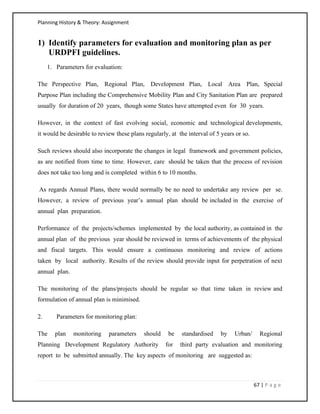
SARVAJANIK COLLEGE OF ENGINEERING &
TECHNOLOGY
R. K. Desai Marg, Athwalines
SURAT
P. G. CENTRE IN CIVIL ENGINEERING DEPARTMENT
MASTER OF ENGINEERING
(TOWN AND COUNTRY PLANNING)
[Branch Code - 048]
SUBJECT ASSIGNMENT
DECEMBER 2019
Planning History & Theory (3714801)
SARVAJANIK EDUCATION SOCIETY
SARVAJANIK COLLEGE OF ENGINEERING &
TECHNOLOGY
DR. R. K. DESAI MARG,
ATHWALINES, SURAT – 395001
Towards progressive civilization…….
CERTIFICATE
This is to certify that
Mr./Ms. ,
bearing Enrolment No.__________________, of class M. E. TCP I
(Semester I), has satisfactorily completed his/her term work for the
course of Planning History & Theory (3714801) for the odd term of the
academic year 2019-20 ending in the month of December 2019.
Date: ______________
Prof. Himanshu J. Padhya Prof. Sejal S. Bhagat
Associate Professor Assistant Professor
FEC, SCET FEC, SCET
External Examiner
Planning History & Theory: Assignment
3 | P a g e
Assignment – 1
1. Enlist framework for renewed planning system as per URDPFI guideline.
2. Explain detailed planning system framework as per URDPFI guideline.
3. Discuss inter-relationship between various plans.
4. Describe in detail the urban planning concepts of the following thinkers.
Ebenzer Howard Patrick Geddes
Le Corbusier
Charles Corea
5. Explain the evolution in planning in physical form after the industrial revolution.
6. Mention the general time span of industrial revolution and thereafter discuss in
detail
its effect on town planning and urbanisation
7. Explain the entire process of planning with neat and clean chart.
8. Short note – ‘Green Belt Concept’.
9. What are the major urban planning features in ancient cities?
10. What are the features of medieval cities? Describe the nature of Egyptian cities.
11. Define the following terminologies:
Rural area, Zone, Urbanization, Master plan/ D.P ,Urban area, Block, Urban
Renewal, C.D.P, Town, Sector, Urban Sprawl, Land use, City, Region Urban
agglomeration, Slum.
Planning History & Theory: Assignment
4 | P a g e
1) Enlist framework for renewed planning system as per URDPFI
guideline.
• Perspective plan
• Regional plan
• Development plan
• Local Area plan
• Special Purpose plan
• Annual plan
• Project Research
2) Explain detailed planning system framework as per URDPFI
guideline.
• Perspective Plan
Developing a vision for region is essential for policy framework. The vision stipulates direction
of growth and identification of resource potential and innovations to be adopted for the thrust
areas of development. It integrates broad level plan with the regional or development plan. A
realistic vision helps policy formulation and preparation of Perspective plan.
Perspective plan defines the vision and focuses on the spatio‐economic development policies,
strategies and programmes towards the intended development of the State. The Perspective Plan
of a State could include ‐ State Urbanisation Policy and State Land Utilisation Policy. The plan is
based on state resource mapping and analysis and assessment of potential resources. It addresses
the long-term policies regarding development of infrastructure and resource mobilisation. The
scope of this plan covers the social, economic, environmental and spatial development goals,
policies and priorities relating to the activities that have spatial and financial implications.
The purpose of a perspective plan is to provide an overall framework for preparation of detailed
plans. Therefore, it serves as a guide for urban local authorities and regional development
authorities in prepa and development plans.-
• Regional Plan
For planned and sustainable development of the human settlements, the regional planning
approach needs to be promoted. The planning regions could be classified under three heads:
Planning History & Theory: Assignment
5 | P a g e
(a) Administrative Regions, which can be District Regions or Metropolitan Regions as per the
recommendations of the 73rd & 74th Constitutional Amendment Act,
(b) Investment Regions, which can be new investment manufacturing zones, industrial and
freight corridors, special investment regions etc. They could be identified under National Acts/
policies,
(c) Special regions, which are sensitive in terms of environment/ socio economic or political
aspects.
States undertake Urban and Regional Planning under a variety of statutes such as the Town and
Country Planning Act, Municipal Laws, Urban/Metropolitan Planning/Development Act,
Improvement Trust Act, Industrial Development Act, Cantonment Board Act, Major Ports Act
etc. Often these laws are mutually exclusive. For instance, a Master Plan for a city would
exclude the lands covered under the Industrial Development Act, even though the lands would be
adjacent and the movement of the people and of the economic activities may be seamless. This
leads to sub‐optimal planning for land use as well as for infrastructure. It is, therefore, suggested
that the principles for spatial planning recommended by these guidelines are extended to all
areas, whether administered by the regular administrative system of the State Government or by
special laws such as for the ports, cantonments, railways, industrial zones etc. Furthermore, the
concepts of regional planning enunciated in these guidelines should be extended to all
contiguous areas that are socially, economically or functionally inter‐dependent. For instance, a
civilian town and the adjoining port/ cantonment/railway area should be covered by an umbrella
regional plan, even though the actual authority for administration of the individual piece of land
would continue to vest with the respective organisation, such as the Port Trust, Cantonment
Board, Railway Administration, etc. At times, even certain infrastructure could be planned and
developed in a regional set up. For instance, the road network/ mobility plan, or the drainage
plan could more efficiently be executed in a regional set up, rather than limiting to the
jurisdiction of the statutory authorities administering their respective lands
• Development Plan
Planning History & Theory: Assignment
6 | P a g e
Development plan is a statutory plan prepared (under relevant Act) within the framework of an
approved perspective plan. The objective of a development plan is to provide further necessary
details and intended actions in the form of strategies and physical proposals for various policies
given in the perspective plan and regional plan depending upon the economic and social needs
and aspiration of the people, available resources and priorities.
Proposals of a development plan should be definite, supported by an implementation strategy
and evaluation criteria. It makes known publicly the intention of the local authority regarding
physical, social and economic
development, the facilities and the services that are proposed to be provided in the near future.
The approved development plan allows the local authority to implement development of the land
area specified under the plan with the help of local area plans and projects.
The time frame of the existing Development Plans is for a period of 20 years by most of the
Urban Development Authorities/ULBs. For greenfield cities, a longer planning period can be
considered, aligned with the infrastructure life of 30 years.
These plans should be in phases of 5 years, to make it convenient for periodic reviews and
revision. This 5‐year cycle could also be usefully coincided with the State Five Year plans and
State Finance Commissions’ recommendations, though such an alignment need not be made
mandatory. The targets set for each phase can be assessed as the mid‐term review against the
achievements at the end of each phase. For Greenfield area, phasing could include a ‘Zero’
period for approvals, institutional set‐up, initial land polling and revisiting any strategy.
• Local Area Plan
The thrust of micro‐planning should shift to local area plans, which could encourage
decentralisation and improve implementation of Development Plans. In view of the 73rd and
74th CAA, planning decision and implementation of plans should be disaggregated in order to
bring the process closer to the local people. This would enhance the significance of Local Area
Plans.
Planning History & Theory: Assignment
7 | P a g e
Local area plans are to be prepared to guide the development or re‐development of land,
conservation of buildings and physical features, providing improvements in the physical layout,
making infrastructure and amenities available and managing the area to enhance health and
safety of the residents to support economic development as well as to enhance the quality of
living, environment, and for area specific regulatory parameters (see endnote) for the area
covered.
Local area plans need to specify the implementation details to comply with the Government
Policies, such as housing, hi‐tech townships, rainwater harvesting, energy, disaster management,
industrial and service sector investment, barrier‐free environment for the elderly and the
physically disabled, e‐Governance, tourism and other policies and facilitate formulation of
specific projects.
The plan should delineate reservation of land for roads and other public purposes, for
construction, reclamation etc. The plan should provide a framework for recovery of the
associated costs for public projects, by mechanisms like levy of betterment charges, charges on
additional development rights, and appropriate user charges.
• Special Purpose Plan
Special Purpose Plan can be prepared for specific development sectors depending on its
economic and environmental importance. Depending on the urgency of the need and priority of
the sector requiring special treatment and covering special aerial extent, Special Purpose Plans
for specific subjects can be prepared. However, these plans are to be within the framework of the
Regional Plan, Development Plan or Local Area Plan in the jurisdiction of the local authority
These plans may also emerge to serve the purpose of urban planning needs under different
Central and State Government grants, funding schemes (see endnote) /programmes with an aim
to:
• Encourage reforms and fast track planned development of cities, peri‐urban areas,
out‐growths, urban corridors, and others,
• Scale‐up delivery of civic amenities and provision of utilities with emphasis on
universal access to the urban poor,
Planning History & Theory: Assignment
8 | P a g e
• Special focus on urban renewal programme,
• Supplement to budget documents on ULBs,
• Sustainability, Environmental and heritage protection,
• Theme based development such as tourism, IT etc.
• Annual Plan
An Annual Plan would contain the details of the new and ongoing projects that the local
authority intends to implement during each financial year for necessary financial resource
mobilisation and monitoring its performance.
The annual plan is to be prepared by the local authority in each financial year to identify the new
projects, which the authority will undertake for implementation during the year, taking into
account the physical and fiscal performance of the preceding year, the priorities, the policies and
proposals contained in the approved Regional Plan, Development Plan or Local Area Plan.
The annual plan is intended to provide the resource requirement during the year and sources of
funds including those mobilised by the local authority, grants, aids and project/scheme funds by
the State and Central Governments. It is thus an important document for the resource
mobilisation as on the basis of this, the plan funds are to be allocated by the funding body. This
plan, therefore, serves as an important link with the budgetary process. Annual plans also
provide a mechanism to monitor progress of development plan and various projects.
• Project / Research
Projects are derived targets of the sequences of plans, which focus on items of execution,
investments, costing and returns. Conceived within the framework of the Perspective plan,
Development plan or any of the plans in the planning system, projects are the working layouts
with all supporting infrastructure and documents including cost, source of fund and recovery
providing all necessary details for execution including finance, development, administrative and
management.
These projects could be for any area, old or new, any activity or land use like residential,
commercial, industrial, recreational, educational or health related, or infrastructure development,
Planning History & Theory: Assignment
9 | P a g e
separately or in an integrated manner; for research and development in the field of planning, key
surveys to determine statistics, by any agency such as government, semi‐government, private or
even individual; or any agency prepared by town planners, architects, engineers as the case may
be, enjoying maximum freedom of expression in their design within the stipulations of
development promotion rules and other regulations as applicable. Research, specifically for
background studies preceding Perspective Plan, Regional Plan, Development Plan or even Local
Area Plan formulation may be undertaken as required by the State Government and local
authorities. Specifically, traffic surveys & related studies to collect current statistics are crucial
for making decisions in plan formulation.
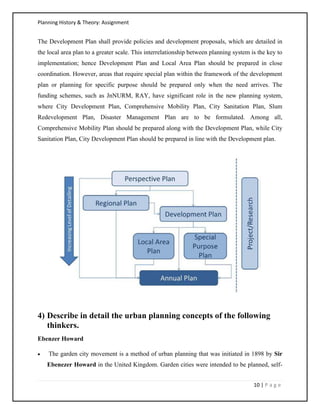
3) Discuss inter-relationship between various plans.
Taking into account the entire planning process and also incorporating the suggested planning
system, the inter‐relationship of the different plans, directly or indirectly related to the land
development, at various levels ranging from national to a transitional urban area.
A Perspective Plan is formulation of development strategy generally at the State level or at the
regional level. This is detailed further in Regional Plan or Sub Regional Plan as the case may be
and in Development Plan. Perspective Plan should be a guiding document for planning. It could
also specify the regional planning authorities, urban/local area planning authorities, regulatory
authorities in the State and those responsible for preparing plan at various levels. The State
Urbanisation Plan shall give a stock of the urbanisation, planning status and especially of the
land suitability.
Regional Plans are to be prepared at district and metropolitan region level, and where economic
regions are formulated. This is the linkage for aggregation of plan proposals for consolidation
and integration of physical and fiscal planning efforts at District, Metropolitan area, State and
also at National level (in case of inter‐stateregions). As depicts, integration and disaggregation of
policies, resources in the planning system occurs at the level of Regional and Development Plan.
Development Plan and Mobility Plan need to be integrated to ensure transportation oriented
spatial planning. It needs to be emphasised here that urban plans should not be considered in
isolation from its region as each urban centre is part of a regional system of the settlement which
in turn play their respective roles in the process of development of the region as a whole.
Planning History & Theory: Assignment
10 | P a g e
The Development Plan shall provide policies and development proposals, which are detailed in
the local area plan to a greater scale. This interrelationship between planning system is the key to
implementation; hence Development Plan and Local Area Plan should be prepared in close
coordination. However, areas that require special plan within the framework of the development
plan or planning for specific purpose should be prepared only when the need arrives. The
funding schemes, such as JnNURM, RAY, have significant role in the new planning system,
where City Development Plan, Comprehensive Mobility Plan, City Sanitation Plan, Slum
Redevelopment Plan, Disaster Management Plan are to be formulated. Among all,
Comprehensive Mobility Plan should be prepared along with the Development Plan, while City
Sanitation Plan, City Development Plan should be prepared in line with the Development plan.
4) Describe in detail the urban planning concepts of the following
thinkers.
Ebenzer Howard
• The garden city movement is a method of urban planning that was initiated in 1898 by Sir
Ebenezer Howard in the United Kingdom. Garden cities were intended to be planned, self-
Planning History & Theory: Assignment
11 | P a g e
contained communities surrounded by "greenbelts", containing proportionate areas of
residences, industry and agriculture.
• Ideally his garden city would accommodate 32,000 people on a site of 6,000 acres (2,400
ha), planned on a concentric pattern with open spaces, public parks and six radial boulevards,
120 ft (37 m) wide, extending from the centre. The garden city would be self-sufficient and
when it reached full population, another garden city would be developed nearby. Howard
envisaged a cluster of several garden cities as satellites of a central city of 50,000 people,
linked by road and rail.
Patrick Geddes
• Sir Patrick Geddes Theory is self-explanatory. Geddes was thinking about the relation
between people and the places and their impacts on each other. He mentioned that people
may not just need to have a good shelter, but they also do have a need for food, work, and
some social life. They also need some entertainment. He founded the concept and mechanism
of the city survey and regional survey. The planning of the town exactly meant creating
organic relations among the people place and the work that parallels to a triad. This is very
similar to the Geddesan triad of environment, function and the organism.
Le Corbusie
• Le Corbusier's proposed cities could be anywhere: free of context, history, or tradition. He
had no patience for environments that had grown up independently over time. "A city should
be treated by its planner as a blank piece of paper, a clean table-cloth, upon which a single,
integrated composition is imposed". His new cities were supposed to be organized, serene,
forceful, airy, ordered. It was in this context that Le Corbusier was drawn to the USSR and
the developing countries and their powerful rulen. There, he hoped, the high-modernist social
engineer would not be crarnped as in the West, where a dispersion of power among many
competing groups and individuals made it possible to practice only what he called an
'orthopedic’.
• Le Corbusier developed a theory of city planning in the 19201s, which has been very
influential throughout the remainde of the century. The most striking element of Le
Corbusier's approach is its strict adherence to geornetric form, regularity and standardization.
In his description of 'A Conternporary City of Three Million Inhabitants' (Le Corbusier 1929)
Planning History & Theory: Assignment
12 | P a g e
he states: "The city of to-day is a dying thing because its planning is not in the proportion of
geometrical one fourth. The result of 25 a true geometrical lay-out is repetition, the result of
repetition is a standard. The perfect form." l6 The result of this vision was a proposa1 for a
large scale redeveloprnent of a large area of Paris, which was a city based on a strict grid
pattern with cells containing his (in) famous 'skyscrapers in the park' and large high-rise
developments within areas of open space creating a high population density in the center of
the city. At the very core of the space was the main station which was located at the
intersection of main North-South and East-West roads and is the center of the urban and
national rail links as well as the focal point for "aero-taxis." The road system itself was
segregated depending on the type of traffic, with freight running underground.
Charles Corea
• The concept of “Modernism” in 20th century Indian architectural development remains
difficult to grasp, as it was used within numerous stylistic developments, following the spirit
of the day. Starting with the efforts made by Europeans in the 1920s, the idea of “modern
architecture” as a revolutionary and innovative force started to make cautious headway in
India in the early 1930s. But at that time any Western thought and practice introduced as a
British import was seen as “modern”, as India had no uniform independent architectural
movement in the early 20th century. Ideas influenced by the Bauhaus and Le Corbusier and
then brought to India were modern, and the subsequent Art Deco movement, influenced by
both regional and exotic motifs, also counted as modern. Even neoclassical architecture was
still pronounced modern into the 1950s and even the 1960s. But Modernism in India was
more like an overall approach to life. It meant designing the world positively, improving it,
doing better than the required standard, being progressive and inventive, and these certainly
included great visionary minds like Tagore and Nehru. British architects in India felt
themselves to be modern, because they could work within an experimental field, almost
without constraints and regulations, with an unusual degree of freedom.
Planning History & Theory: Assignment
13 | P a g e
5) Explain the evolution in planning in physical form after the
industrial revolution.
The macro-inventions of the BIR induced significant changes in various elements of
social technology, more importantly in the way the work was organized, which led to the rise
and spread of the factory. The factory itself was the major novelty in the BIR which had an
enormous effect on the development of economies as a whole. But what was a factory? This
question is crucial because the attributes of the factory must be clearly distinguished from its
distinctive attribute. Of course, the factory shares many characteristics with other kinds of
organization but being interested in its uniqueness we have to determine that feature that
exclusively characterizes it (as opposed to previous organizational forms). This requires an
analysis of the emergence of the factory from the viewpoint of the theory of the firm.The
factory replaced the putting-out system that was based on the “family firm” craft-shop. The
craft-shop was run by a master craftsman with a couple of journeymen, apprentices and
family helpers. Under the putting-out system the merchant-entrepreneur owned the raw
material, goods in process, the equipment and tools, and outsourced the work at piece rates to
workers who usually worked at home.The factory was a new organizational form: it was a
firm, while the putting-out system was a market-like organization based on market contracts.
Many argue (e.g., Landes, 1969; Mokyr, 2002; Leijonhufvud, 1986) that the rise of the
factory was primarily or at least largely driven by the new technology. However, when
analyzing this process in the co-evolutionary framework it becomes clear that this does not
imply that technology should be seen as the unique factor inducing the rise of the factory.
Also during the Progressive era, which extended through the early 20th century, efforts to
improve the urban environment emerged from recognition of the need for recreation. Parks
were developed to provide visual relief and places for healthful play or relaxation. Later,
playgrounds were carved out in congested areas, and facilities for games and sports were
established not only for children but also for adults, whose workdays gradually
shortened.Perhaps the single most influential factor in shaping the physical form of the
contemporary city was transportation technology. The evolution of transport modes from foot
and horse to mechanized vehicles facilitated tremendous urban territorial expansion. Workers
were able to live far from their jobs, and goods could move quickly from point of production
Planning History & Theory: Assignment
14 | P a g e
to market. However, automobiles and buses rapidly congested the streets in the older parts of
cities. By threatening strangulation of traffic, they dramatized the need to establish new kinds
of orderly circulation systems.
6) Mention the general time span of industrial revolution and
thereafter discuss in detail its effect on town planning and
urbanization.
Industrial Revolution in India:
The Industrial Revolution was a period in history from approximately 1770 through 1850
which was characterized by a change in the manufacturing process through the use of machinery
and other innovations. This time period brought about a distinct working class which worked in
the factories of the wealthier class, often producing goods for relatively low pay in less than
suitable conditions. The central hub of the Industrial Revolution was Great Britain. However,
the Industrial Revolution had a significant effect on many other countries around the globe.
Great Britain's East India Company collected revenue and raw material from the
prosperous area of East India and sent the money and materials to Britain. In addition, after
Planning History & Theory: Assignment
15 | P a g e
goods were manufactured in Britain, these goods were brought to India to be sold. Thus, India
served to expand Britain's market for the sale of Britain's manufactured goods.
Industrialization has historically led to urbanization by creating economic growth and job
opportunities that draw people to cities. Urbanization typically begins when a factory or multiple
factories are established within a region, thus creating a high demand for factory labor. Other
businesses such as building manufacturers, retailers, and service providers then follow the
factories to meet the product demands of the workers. This creates even more jobs and demands
for housing, thus establishing an urban area.
In the modern era, manufacturing facilities like factories are often replaced by technology-
industry hubs. These technological hubs draw workers from other areas in the same way
factories used to, contributing to urbanization.
Throughout the history of human civilization, urbanization patterns have been the strongest
near large bodies of water. Initially, this was just to meet the water and food needs of large
populations. However, since the Industrial Revolution, the trend of urbanization along waterways
has continued because large bodies of water are needed to sustain industry. Not only do many
businesses require large quantities of water to manufacture products, but they also depend on
oceans and rivers for the transportation of goods. This is partially why 75% of the world’s largest
urban areas are in coastal regions.
As industrialization creates economic growth, the demand for the improved education and
public works agencies that are characteristic of urban areas increases. This demand occurs
because businesses looking for new technology to increase productivity requires an educated
workforce, and pleasant living conditions attract skilled workers to the area.
Once an area is industrialized, the process of urbanization continues for a much longer
period of time as the area goes through several phases of economic and social reform. Each city
has a progressively higher level of social, environmental and economic prosperity achieved
through increased education, government intervention, and social reform.
Planning History & Theory: Assignment
16 | P a g e
7) Explain the entire process of planning with neat and clean chart.
Planning Process
• The planning function of management is one of the most crucial ones. It involves setting the
goals of the company and then managing the resources to achieve such goals. As you can
imagine it is a systematic process involving eight well thought out steps. Let us take a look at
the planning process.
1) Recognizing Need for Action
• An important part of the planning process is to be aware of the business opportunities in the
firm’s external environment as well as within the firm. Once such opportunities get
recognized the managers can recognize the actions that need to be taken to realize them. A
realistic look must be taken at the prospect of these new opportunities and SWOT analysis
should be done.
• Say for example the government plans on promoting cottage industries in semi-urban areas.
A firm can look to explore this opportunity.
2) Setting Objectives
• This is the second and perhaps the most important step of the planning process. Here we
establish the objectives for the whole organization and also individual departments.
Organizational objectives provide a general direction, objectives of departments will be more
planned and detailed.
• Objectives can be long term and short term as well. They indicate the end result the company
wishes to achieve. So objectives will percolate down from the managers and will also guide
and push the employees in the correct direction.
3) Planning Premises
• Planning is always done keeping the future in mind, however, the future is always uncertain.
So in the function of management certain assumptions will have to be made. These
assumptions are the premises. Such assumptions are made in the form of forecasts, existing
plans, past policies, etc.
Planning History & Theory: Assignment
17 | P a g e
• These planning premises are also of two types – internal and external. External assumptions
deal with factors such as political environment, social environment, the advancement of
technology, competition, government policies, etc. Internal assumptions deal with policies,
availability of resources, quality of management, etc.
• These assumptions being made should be uniform across the organization. All managers
should be aware of these premises and should agree with them.
4) Identifying Alternatives
• The fourth step of the planning process is to identify the alternatives available to the
managers. There is no one way to achieve the objectives of the firm, there is a multitude of
choices. All of these alternative courses should be identified. There must be options available
to the manager.
• Maybe he chooses an innovative alternative hoping for more efficient results. If he does not
want to experiment, he will stick to the more routine course of action. The problem with this
step is not finding the alternatives but narrowing them down to a reasonable amount of
choices so all of them can be thoroughly evaluated.
5) Examining Alternate Course of Action
• The next step of the planning process is to evaluate and closely examine each of the
alternative plans. Every option will go through an examination where all their pros and cons
will be weighed. The alternative plans need to be evaluated in light of the organizational
objectives.
• For example, if it is a financial plan. Then it that case its risk-return evaluation will be done.
Detailed calculation and analysis are done to ensure that the plan is capable of achieving the
objectives in the best and most efficient manner possible.
6) Selecting the Alternative
• Finally, we reach the decision making stage of the planning process. Now the best and most
feasible plan will be chosen to be implemented. The ideal plan is the most profitable one with
the least amount of negative consequences and is also adaptable to dynamic situations.
Planning History & Theory: Assignment
18 | P a g e
• The choice is obviously based on scientific analysis and mathematical equations. But a
manager’s intuition and experience should also play a big part in this decision. Sometimes a
few different aspects of different plans are combined to come up with the one ideal plan.
7) Formulating Supporting Plan
• Once you have chosen the plan to be implemented, managers will have to come up with one
or more supporting plans. These secondary plans help with the implementation of the main
plan. For example, plans to hire more people, train personnel, expand the office etc are
supporting plans for the main plan of launching a new product. So all these secondary plans
are in fact part of the main plan.
8) Implementation of the Plan
• And finally, we come to the last step of the planning process, implementation of the plan.
This is when all the other functions of management come into play and the plan is put into
action to achieve the objectives of the organization. The tools required for such
implementation involve the types of plans- procedures, policies, budgets, rules, standards etc.
8) Short note – ‘Green Belt Concept’.
Design of Green Belt:
Project site area is covered with sheet rock. Developing the greenbelt in this project needs
scientific approach. As far as possible the following guidelines will be considered in green belt
development programme.
All around the site, a green belt of 3 m width will be developed as bio- fence and bio-defense. In
view of the presence of surface or subsurface rock, trenches up to 2m depth will be dug out all
around the site. They will be filled with top soil from the construction site up to a depth of 1.75m
leaving a gap on about 0.25m for effective watering and manuring.
Where it is not possible for a trench; bore holes of 9 inches diameter and 10 Ft (3m) depth will
be drilled, filled with a mixture of garden soil, vermicompost and sand in equal proportions.
Saplings grown in poly bags will be transplanted. Fast growing, evergreen or semi evergreen tree
Planning History & Theory: Assignment
19 | P a g e
saplings or cuttings will be planted to develop a thick green belt. Saplings are readily available
from the local nurseries and the plants are well adapted to the local agro climate.
Shrubs and trees will be planted in encircling rows around the project site. The short trees (<10
m height) will be planted in the first rows (towards plant side) of the green belt. The tall trees
(>10 m height) will be planted in the outer row (away from plant side).
Some of guidelines to be considered are:
· Planting of trees in each row will be in staggered orientation.
· In the front row, shrubs will be grown.
· Since the trunks of the tall trees are generally devoid of foliage, it will be useful to have
shrubs in front of the trees so as to give coverage to this portion.
· The spacing between the trees will be maintained slightly less than the normal spaces, so
that the trees may grow vertically and slightly increase the effective height of the green belt.
· Providing the Greenbelt more than 33% area of the total project area with various species.
Purpose of Greenbelt Development:
The purpose of a green belt around the industrial site is to capture the fugitive emissions,
attenuate the noise generated and improve the aesthetics.
For example, if the industry has been proposed in an area of about 1.2265 hectares that is 12265
sq. m. Out of 12265 sq. m of total land available about 4019.5 sq. m for built up area like
production blocks, raw material stores, finished goods godowns, utilities, R&D, QC,
administrative block and pollution control facilities. About 1550 Sq. m for Roads, 2395.5 Sq. m
for Vacant area and 4300 sq. m greenbelt area.
The proposed green belt at the. project site will form an effective barrier between the plant and
the surroundings. Open spaces, where tree plantation may not be possible, will be covered with
shrubs and grass to prevent erosion of topsoil. Adequate attention has been paid to plantation of
trees, their maintenance and protection based on the geology, soil condition and topography of
the site area.
Green belt will be developed around the plant site, whatever space is available around the
periphery of the plant will be planned to be utilized for green belt. Other open spaces within the
factory will be converted to green areas in the form of lawns or flowering plants.
Planning History & Theory: Assignment
20 | P a g e
A wide range of plant species wilt be planted in and around the premises to help capture the
fugitive emissions and noise levels from the plant premises. This wide range covers plants of
fast-growing type with thick canopy cover, perennial green nature, native origin and a large leaf
area index. A specialist in horticulture may be appointed to identify any other native species and
also supervise greenbelt development.
Advantage of Green Belt Development:
1. The biological activity of the particles at various locations necessarily vary because of
difference of pollutant source profiles. These variations are expressions of both quantitative
and qualitative differences, as for instance the relative amount of sulfuric acid mist, sulfates,
or other reactive substances in the particulate mix or the relative amounts of specific
carcinogenic compounds in the organic fraction of airborne particulate.
2. It, therefore, can be seen that the evaluation of biological activity ascribable to “particulate”
is complex and depends not only on the total quantity, size range and intrinsic physical or
chemical properties, but also on their chance for interaction in the polluted air. The
opportunity for variation in biological activity is enormous.
3. Stomata are microscopic pores on the underside (abaxial) of the leaf. These stomata allow the
plant leaves takes in Carbon Dioxide (C02) and lets out Oxygen (02), and also allows water
vapor out in the process of transpiration. As air passes through the stomata, most of the
airborne particles will not pass through the stomata but will rather land on the’ leafs outer
surface.
4. This is similar to a filter, where air is pulled through the filter by an air pump and the
airborne particles deposit on the filter surface. If this air flow is the major cause of particles
depositing on the leaf, the result will be that the concentration of particles on the abaxial
surface of the leaf will be higher than that of the top surface (adaxial) because the airflow
through the stomata will be pulling more particles onto the bottom surface.
5. There is a certain amount of force needed for particles to stick to a surface. This amount is
greater depending on the size of the particles. Because the airflow through the stomata is not
very powerful, only the smaller particles will stick to the bottom surface. The particles on the
top surface of the leaves will mainly be from the settling of dust. Because settled particles are
mostly larger ones, those found on the top surface will be mostly larger. Therefore, analysis
Planning History & Theory: Assignment
21 | P a g e
of the particle sizes on the leaves will show that particles on the tops of leaves are on
average, larger than those on the bottom of leaves.
6. Different types of leaves tend to have differences in several aspects of their surfaces. Some
types of leaves have greater surface rigidity or roughness than other leaves, which may affect
their stickiness or particle solubility. Stickier leaves would be better for collecting particles
because more particles would stick to their surface. Therefore, some types of leaves may be
better for use in this type of analysis than others.
7. It has been derived that trees can delimit the fine particulate pollution and have tremendous
potential for improved air quality with substantial cost savings. This study will help to
quantify the relative ability of individual tree species for removing fine particulates such as
PM25. The plantation of urban trees can be evaluated in terms of money saved vis-a-vis
expenditure involved in implantation of fine particulate strategies.
8. Trees can act as efficient biological filters, removing significant amounts of particulate
pollution from urban atmospheres. The study indicated that there has been significant
difference in interception of particulate matter (PM2.5) by different tree species.
9. It is recommended based on the studies that Green cover /areas of Highly Dust capturing
plant species should be developed around residential areas / industrial area, since dust
capturing plants species can act as efficient biological filters, removing significant amounts
of particulate pollution from urban atmospheres. The dust capturing phenomenon of plant
species is a cost-effective technology for reduction of particulate load in urban
agglomerations.
9) What are the major urban planning features in ancient cities?
There are number of towns in India having historical background spanning over 2000
years. Most of them developed as religious and cultural centers. Varanasi is one of the
important towns among these. Prayag (Allahabad), Pataliputra (Patna), are some other examples
of ancient towns in the country.
Major part of the Human life occupied by Hunting-Gathering stage. They lived for a short period
either for manufacture or subsistence purposes in natural caves or shelters. This was due to
extremely cold climatic conditions. Traces of their occupation are found in at such shelters or
near the source of raw materials Neolithic Stage- Beginning of Agriculture due to changing
Planning History & Theory: Assignment
22 | P a g e
Climatic conditions, population rise, etc. Evidence of habitation, emergence of proper structural
activities, change in the social organization, different types of structures including domestic,
craftmen’s area, public, religious, etc.
10)What are the features of medieval cities? Describe the nature of
Egyptian cities.
• The Individual House -
House styles and their interior arrangements varied from region to region: - town houses
of lower nobility and feudal lords are quite different. - houses often designed as fortresses and
accommodate several generations of one individual family (in Italy often have towers in
association). - in some towns, street blocks are organized in defensive units with individual walls
and defensive towers.
• The Market Place-
public, social life concentrated in city centres. - represented political character of a city as well as
citizens’ self- identification. - communal centres (i.e. belonging to community, expressive of it).
Emerge only during high middle ages (10th, 11th , 12th centuries). In earlier times the fortress,
abbey, or Bishops’ seat took up central positions.
• Civic Buildings-
Express pride and wealth of a town’s inhabitants and are concentrated around and near
marketplace(s).
• Town Hall -
always reserved prime site on main market square where their scale and size provides striking
contrast to other buildings in the area. - often positioned opposite town church (cathedral) or
even secular ruler’s castle. - symbol of autonomy, jurisdiction, wealth they range from proud and
magnificent town halls of Hanseatic Cities of northern Europe to small and poor town halls of
Southern Germany and Austria. - seat of town councils i.e. local government. Councils had
splendid seals: town corporation could act in its own right and bind itself legally by letter and
seal.
• Guild Hall - besides church, the most important representative of corporate life
Hospital - to care for old and poor - set up by holy orders
Medieval Collegial Cities - first specialised elements of university life.
Walls
• defend city, people, animals and property
• symbolise to outside world a town’s strength & political independence note:
destruction of urban wall means loss of freedom
• large proportion of public funds devoted to construct, maintain and extend urban
Planning History & Theory: Assignment
23 | P a g e
fortifications
• ring of wall does, naturally, constrict inhabitant’s freedom of movement and available
urban space; when town too crowded extensions built.
• construction derived from techniques of fortress architecture: shortest
circumference enclosing largest area i.e. circular and square fortifications preferred.
• smaller settlements cannot afford wall, therefore perimeter building ring doubles as
fortification.
Gates
• represent link with the outside world
• major roads lead from gates to other towns etc.
• control and customs point for people and goods
• strategically represent weakness in defensive system, therefore often flanked by towers.
Towers
• to defend walls and city and afford the outflanking of enemy (crossfire)
• reinforce walls structurally
• ballistically represent an advantage as can fire further away
11) Define the following terminologies:
• Rural area
Rural areas (also referred to as "the country," and/or "the countryside") are large and
isolated areas of a country, often with a low population. About 91 percent of the rural
population now earns salaried incomes, often in urban areas. The 10 percent who still
produce resources are generating 20 percent of the world’s coal, copper, and oil; 10 percent
of its wheat, 20 percent of its meat, and 50 percent of its corn. The efficiency these farms
are due in large part to the commercialization of the farming industry, and not single-family
operations.
• Zone
Different areas like residential, industrial, commercial are divided into different part
that part are called as zone.
• Urbanization
It is the process of increasing urban area in a geographical or administrative area.
• Master plan/ D.P
It is an over all, long range development plan.this term was used earlier as master plan of
the city. Now it is often referred as development plan of a city to give a comprehensive
meaning to the planning of city.
Planning History & Theory: Assignment
24 | P a g e
• Urban area
An urban area is an area with an increased density of human-created structures in
comparison to the areas surrounding it. Urban areas may be cities, towns or conurbations, but
the term is not commonly extended to rural settlements such as villages and hamlets. Urban
areas are created and further developed by the process of urbanization. Measuring the extent
of an urbanized area helps in analyzing population density and urban sprawl, and in
determining urban and rural populations.
• Block
A city block is the smallest area that is surrounded by streets. City blocks are the space
for buildings within the street pattern of a city and form the basic unit of a city's urban fabric.
• Urban Renewal
It is the process of improving the built environment by conservation, rehabilitation or
redevelopment.
• C.D.P.
A City Development Plan (CDP) is both a perspective and a vision for the
future development of a city. In which future forecast data and developments are provided.
• Town
A built-up area with a name, defined boundaries, and local government, that is larger than a village
and generally smaller than a city
• Urban Sprawl
It means spread of urban growth outwards from the town to the suburds.
• Land use
Landuse is the function of land – what it is used for. Land use varies from area to area. In
rural areas (countryside) land use can include forestry and farming. In urban areas (towns and
cities) land use could be housing or industry. Land use in urban areas in MEDCs varies from
land use in urban areas in LEDCs. Urban land use use models attempt to simplify the way
land is used in urban areas.
• City
A city is an urban area with a large population and a particular administrative, legal, or
historical status. Large industrialized cities generally have advanced systems for sanitation,
utilities, land usage, housing, and transportation and more. This close proximity greatly
Planning History & Theory: Assignment
25 | P a g e
facilitates interaction between people and firms, benefiting both parties in the process.
However, there is debate now whether the age of technology and instantaneous
communication with the use of the Internet are making cities obsolete.
• Region Urban
urban and regional planning is the process by which communities attempt to control and/or
design change and development in their physical environments.
• agglomeration
In the study of human settlements, an urban agglomeration is an extended city or town area
comprising the built-up area of a central place (usually a municipality) and any suburbs
linked by continuous urban area
• Slum
a squalid and overcrowded urban street or district inhabited by very poor people.
Planning History & Theory: Assignment
26 | P a g e
Assignment – 2 Urbanization and climate change
1) Describe urbanization trend (population trend) as per URDPFI
guideline.
2) Short note - Urbanization scenario in India.
3) Discuss following concept in detailed.
i. Inclusive planning
ii. T.O.D.
4) Brief out the various Types of Migration.
5) Critically discuss the global scenario of urbanization.
6) Why it is important to account for environmental parameters in
town planning? Discuss in detail.
7) Explain why it is necessary for a town planner to account for
climate and climate changes.
8) Importance of topographic features in planning of a city.
9) Write a detailed note on trends and bases of development of
evolution of urban centres, cities, metro and mega cities.
Planning History & Theory: Assignment
27 | P a g e
1) Describe urbanisation trend (population trend) as per URDPFI
guideline.
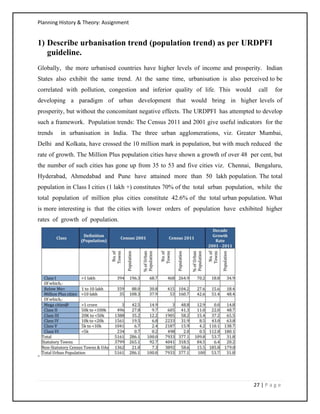
Globally, the more urbanised countries have higher levels of income and prosperity. Indian
States also exhibit the same trend. At the same time, urbanisation is also perceived to be
correlated with pollution, congestion and inferior quality of life. This would call for
developing a paradigm of urban development that would bring in higher levels of
prosperity, but without the concomitant negative effects. The URDPFI has attempted to develop
such a framework. Population trends: The Census 2011 and 2001 give useful indicators for the
trends in urbanisation in India. The three urban agglomerations, viz. Greater Mumbai,
Delhi and Kolkata, have crossed the 10 million mark in population, but with much reduced the
rate of growth. The Million Plus population cities have shown a growth of over 48 per cent, but
the number of such cities has gone up from 35 to 53 and five cities viz. Chennai, Bengaluru,
Hyderabad, Ahmedabad and Pune have attained more than 50 lakh population. The total
population in Class I cities (1 lakh +) constitutes 70% of the total urban population, while the
total population of million plus cities constitute 42.6% of the total urban population. What
is more interesting is that the cities with lower orders of population have exhibited higher
rates of growth of population.
-
Planning History & Theory: Assignment
28 | P a g e
The decadal population growth rate has, however, shown a decline from 21.5% during
1991‐2001 to 17.6% during 2001‐2011. The growth rate of urban population also seems to be
heading for stabilization as the decadal variation remained around 31.5% during the last two
decades. No statutory towns: The trend of urbanisation is reflected remarkably in the size of
towns that carry the growing urban population. As per Census‐2011, there are 7933 towns
including 4041 Statutory towns and 3892 Census towns. However, it is notable that the number
of statutory towns has increased marginally, by 6.4 per cent only, whereas the number of
non‐statutory towns has gone up by 186 per cent. Obviously, new towns are developing very
fast, but, being not notified as a town, these are kept out of the purview of planned spatial
development and become prone to haphazard growth. This would call for a serious effort to
introduce the principles of the URDPFI Guidelines to even non‐statutory towns, preferably in a
regional set up, wherein the spatial plans for such towns are prepared in conjunction with that
of the main cities, to which these are generally the satellite towns.
2) Short note - Urbanization scenario in India.
Urbanization the spatial concentration of people and economic activities arguably the
most important social transformation in the history of civilization since man changed from being
a nomadic hunter-gatherer and adopted a settled, subsistence agricultural way of life. While the
timing and speed of urbanization have varied and are varying between countries, regions, and
continents, the urbanization process has taken hold everywhere. It has proven to be an
unstoppable and a mostly desirable phenomenon. Cities are the foundation of modern
civilization; they are the engine room of economic growth and the centers of culture,
entertainment, innovation, education, knowledge, and political power. While the antecedents of
urbanization are long, contemporary urbanization is now predominantly a developing-country
phenomenon, centered largely in Asia. Urbanization in Asia involves around 44 million people
being added to the population of cities every year.
There are different elements with which urbanization can be understood or explained.
1. Urbanization can be explained in terms of different population thresholds in urban
areas.
Planning History & Theory: Assignment
29 | P a g e
2. Urbanization can be explained as the process of altering land uses to create and
develop urban centers.
3. Urbanization can be very broadly defined as a process of social and economic
change.
4. The most obvious definition of urbanization would be – A shift from less
intensive to more intensive uses of land and environment.
Urbanization and population
Urbanization can be explained by comparing the proportion of the population of a nation living
in urban places and rural places – that is the number of people residing in cities or other densely
settled areas and those living in villages or such rural areas. Urban population differs from rural
habitants in terms of diversity and age. By age, everywhere urban population are younger than
rural people, not because they have higher birth rate, that is because of migration. Cities attract
immigrants, and such immigrants tend to be young adults. A consequence is that cities have both
more young adults and more of the activities in which young adults engage.
INDIAN SCENARIO OF URBANIZATION
India's population stood at about 350 million at the time of country's Independence in
1947. By dodging the Malthusian checks, it grew at an unprecedented rate to reach the one
billion mark at the dawn of the new millennium. The Census of 2001 has put the population
figure provisionally at 1,027 million, even though it registered a significant reduction in the
growth rate of population. During the latter half of the twentieth century, India's population had
grown by nearly 650 million. The country is now the world’s second largest in population after
China. Only 11 percent of the land in country is free from inherent soil constraints.
The unit of classification in this regard is ‘town’ for urban areas and ‘village’ for rural areas.
Volume and Trend of Urbanization in India
India shares most characteristic features of urbanization in the developing
countries. Number of urban agglomeration /town has grown from 1827 in 1901 to 5161 in 2001.
Number of total population has increased from 23.84 crores in 1901 to 102.7 crores in 2001
Planning History & Theory: Assignment
30 | P a g e
whereas number. of population residing in urban areas has increased from 2.58 crores in 1901 to
28.53 crore in 2001. (table) This process of urbanization in India is shown in Fig. It reflects a
gradual increasing trend of urbanization. India is at acceleration stage of the process of
urbanization.
Basic Feature and Pattern of India's Urbanisation
Basic feature of urbanization in India can be highlighted as :
• Lopsided urbanization induces growth of class I cities
• Urbanisation occurs without industrialization and strong economic base
• Urbanisation is mainly a product of demographic explosion and poverty induced rural -
urban migration.
• Rapid urbanization leads to massive growth of slum followed by misery, poverty,
unemployment, exploitation, inequalities, degradation in the quality of urban life.
• Urbanisation occurs not due to urban pull but due to rural push.
• Poor quality of rural-urban migration leads to poor quality of urbanization (Bhagat,1992).
• Distress migration initiates urban decay.
3) Discuss following concept in detailed.
Inclusive planning
Inclusive planning means infusion of varying aspects, which lead to growth of the whole society
into development process, such as integrated trunk infrastructure, sustainable development,
poverty alleviation, decentralised decision making with special emphasis on women, elderly and
disabled friendly infrastructure and financial planning. These facets of development were not
traditionally recognised distinctly. Thus, for overall development of residents of human
settlements in India, inclusivity in planning must be fundamental feature.
Inclusive development in planning should focus on the following parameters; other such
features to promote inclusivity in development process can be identified based on the needs and
requirements of settlements and time9:
• Inclusive governance: entire system must function in a manner, which is seen to be fair
and inclusive.
Planning History & Theory: Assignment
31 | P a g e
• Inclusive Sustainable development: Development is a qualitative indicator rather than
quantitative. Development of human settlements should not be uni‐ directional
causing environmental degradation in the process. To direct growth on sustainable
manner Environmental Impact Assessment should be an essential part of development
plans and projects. ƒ Inclusive access to healthcare and education.
• For inclusive employment and regionally balanced growth, MSME should
be promoted through Plans.
• Developing capacities of Infrastructure: Infrastructure plays an important role in growth
and development of cities. It also promotes inclusivity in the society by means of
easy access to services.
• Agriculture has been identified as very important for promoting inclusivity.
Various Laws, Policies and Guidelines make provisions that agriculturally fertile/
multi‐cropped land be acquired as a last resort. Same provision should be followed while
planning for human settlements too.
• For holistic development of entire population, issues concerning the
people employed in the informal sector, besides women, elderly and the
disabled must be included in the entire process of plan preparation.
• The Plan should aim at creation of wealth and employment, in an inclusive and
sustainable manner.
• Water management including flood prevention, groundwater management, rainwater
harvesting, wastewater treatment, recycling and reuse to be encouraged.
• Public spaces are crucial for pedestrian movement and accessible public facilities have
significant impact on the quality of life.
ii. T.O.D.
The integration of land use with transport systems is called “Transit Oriented
Development”, which is essentially “any development, macro or micro that is focused
around a transit node, and facilitates complete ease of access to the transit facility thereby
inducing people to prefer to walk and use public transportation over personal modes of
transport”4. This entails planning for compact cities and reducing urban sprawl and
dependency on the large scale developments in the periphery which induce shift from
Planning History & Theory: Assignment
32 | P a g e
non‐motorized to motorized modes of travel. Approach to TOD highly depends on
establishing mixed land use zone as part of strategic densification. The policy includes:
• Network & Connectivity: Disperse high traffic volumes over multiple parallel streets
rather than concentrating traffic on major arterial roads. Create a fine network of streets
through urban design that provides choice of routes for all modes, reducing distances
between places as well as journey times.
• Last mile connectivity: Provide fast, convenient interchange options and spatial provision
for various modes of Intermediate Public Transport (IPT) at Multimodal Transit
Station for seamless travel. Provide multiple mode choices for last‐mile connectivity at
various prices and comfort levels. Also, if possible, eliminate the need of IPT by design
and engineering5. ƒ Pedestrian access: Provide the shortest direct route to pedestrians
and non‐ motorised modes to station as well as between building blocks.
• High Density, MixedIncome Development: Compact neighborhoods for shorter commutes
and equity for all sections of society. Mix of compatible use to promote 24 hour activity.
• Streetscape Design: Urban places should be designed for enjoyment, relaxation and equity.
Pedestrian and bicycle friendly designated space for all activities. Keeping in view the
prevention of heat island effects from wide and open streets, by proper street and
landscaping. ƒ Promote Place Making to Create a Sense of Place: Focus on promoting
liveability, quality and uniqueness of each space
• Direct Business to TOD Locations: Create transit services to regional job centers, focus
job creation investments in transit serviced locations.
• Public facilities at nodes of public transport: Plan for public facilities such as schools,
universities, sports facilities, stadiums, theatres and concert halls around nodes of public
transport.
• Function/Activities at nodes of public transport: Promote multi‐functional developments
around nodes that are otherwise deserted in the evening or at night. Plan a mix of
different types of users and inhabitants to create a lively and safe place.
Planning History & Theory: Assignment
33 | P a g e
4) Brief out the various Types of Migration.
(i) Immigration and Emigration:
When people from one country move permanently to another country, for example, if people
from India move to America then for America, it is termed as Immigration, whereas for India it
is termed as Emigration.
(ii) In-migration and Out-migration:
In-migration means migration occurring within an area only, while out-migration means
migration out of the area. Both types of migration are called internal migration occurring within
the country. Migration from Bihar to Bengal is in-migration for Bengal, while it is out- migration
for Bihar.
(iii) Gross and Net Migration:
During any time period, the total number of persons coming in the country and the total number
of people going out of the country for residing is called gross migration. The difference between
the total number of persons coming to reside in a country and going out of the country for
residing during any time period is termed as net migration.
(iv) Internal Migration and External Migration:
Internal migration means the movement of people in different states and regions within a country
from one place to another. On the other hand, external or international migration refers to the
movement of people from one country to another for permanent settlement.
5) Critically discuss the global scenario of urbanization.
Data on urban shares dating back to 1500 are available only for select countries, with an
estimated share at the global level. Using the timeline on the map (or by clicking on a country)
you can see how this share has changed over time.
Here we see clearly again that urbanization has largely been confined to the past 200 years. By
1800, still over 90 percent of the global (and country-level) population lived in rural areas.
Urbanization in the United States began to increase rapidly through the 19th century, reaching 40
percent by 1900.
By 1950 this reached 64%, and nearly 80% by 2000.
Planning History & Theory: Assignment
34 | P a g e
This rate of urbanization was, however, outpaced by Japan. Urban shares in Japan were low until
the 20th century.
By 1900, it had just surpassed 1-in-10. This increased rapidly, reaching over half of the
population by 1950; nearly 80 percent by 2000, and surpassing the USA to over 90 percent
today.
China and India had not dissimilar rates of urbanization until the late 1980s. By then, both had
around 1-in-4 living in urban areas. However, China’s rate of urbanization increased rapidly over
the 1990s, and 2000s. Over this 30-year period its urban share more than doubled to 58 percent.
India’s rise has continued to steadily rise to 1-in-3 (33 percent) today.
The recency of urbanization becomes even more pronounced when we look at trends for
countries and regions over even longer timescales – the past 10,000 years. This is shown in the
visualization here, derived from the work of the History Database of the Global Environment.
The past 50 years in particular have seen a rapid increase in rates of urbanization across the
world.
The UN World Urbanization Prospects provides estimates of urban shares across the world
through to 2050. These projections are shown in the chart — using the timeline you can watch
this change over time.
Across all countries urban shares are projected to increase in the coming decades, although at
varied rates. By 2050, it’s projected that 68 percent of the world’s population will live in urban
areas (an increase from 54 percent in 2016). In fact, by 2050 there are very few countries where
rural shares are expected to be higher than urban. These include several across Sub-Saharan
Africa, Asia, Pacific Island States, and Guyana in Latin America.
Why, when most countries are expected to be majority urban, does the global total just over two-
thirds? This seems low, but results from the fact that many of the world’s most populated
countries have comparably low urban shares (either just over half, or less). For example, India
(expected to be the world’s most populous country), is projected to have an urban share of only
53 percent in 2050.
Planning History & Theory: Assignment
35 | P a g e
The other map shown here provides a snapshot overview of how the world is expected to
continue to become more urbanized. It shows, for any given country, whether more people (the
majority) live in urban or rural areas.
Using the timeline feature and “play” button in the bottom-left of the chart, you can explore how
this has changed over time. In 1950, it was predominantly high-income countries across Europe,
the Americas, Australasia and Japan who were largely urban.
6) Why it is important to account for environmental parameters in
town planning? Discuss in detail.
In order to ensure safety and adequate conditions of life of the population, to limit the
negative impact of economic and other activities on the environment and to ensure the protection
and rational use of natural resources for the benefit of present and future generations, local
governments in the implementation of spatial planning should take environmental factors into
account. Therefore, speaking about environmental factors, we should pay attention to those
functional areas that are most dependent planning in relation to environmental factors or
themselves have an impact on the environment. These are production zones, zones of
engineering and transport infrastructures, residential and recreational areas. Production zone
designed to accommodate industrial, municipal and warehouse facilities. The production area
recommended to be placed on territories with a calm relief, providing convenient transport links
to places of settlement employed in the enterprise workers and external facilities and urban
transport. Planning should take into account the fact that in the production area included the
territory of sanitary protection zones of the objects themselves and in these sanitary protection
zones are not allowed in residential houses, preschool and educational institutions, and
healthcare institutions, leisure, recreational and sports facilities, horticultural, suburban and
gardening cooperatives and agricultural production. In addition to production areas should pay
attention to the zones of engineering and transport infrastructure, which is designed to
accommodate activities and facilities and communications of railway, road, river, Maritime, air
and pipeline transport, communications and engineering equipment, and also have in one way or
another impact on the environment. When planning must take into account compliance with the
required distances from such facilities to areas of residential, social, business and recreational
Planning History & Theory: Assignment
36 | P a g e
areas and other requirements to prevent harmful effects on the environment. It should be
understood that the objects of engineering and transport infrastructure, possessing the feature of a
direct harmful impact on the security of the population, must be located outside urban and rural
settlements
Also in planning land use should pay attention to the location of the city's recreational
areas. As these areas are intended for the organization of places of rest of the population you
need to consider that their territories are not permitted the construction and expansion of existing
industrial, communal and storage objects, which can have a negative impact on human health
and the environment. The exception may be only industrial, municipal and warehouse facilities,
which is directly related to the operation of facilities health and recreational purposes. Territorial
planning of the municipal district is accompanied by the preparation of necessary documentation
for territorial planning. documents of territorial planning; documents zoning; documentation on
planning the territory. In accordance with article 18 of the town planning Code of the Russian
Federation territorial planning documents of municipalities are: territorial planning schemes of
municipal districts; master plans of settlements; master plans of urban districts The General
plan of the municipal formation is main planning document that determines the prospects of
development of the city for a long time. It must be presented not only transport, architectural
planning, engineering, social and industrial aspects of city development and the ecological living
conditions of the population and prospects of preservation of the environment. With the
development of project planning documentation should consider the regulations and restrictions
on natural resources, the sanitary-hygienic norms and rules, and other regulations governing
environmental safety of living of population, natural features areas, the demographic features of
the territory, its historical and cultural value and other environmental factors, or otherwise
influencing the adoption of planning decisions. Such a collection of information about the area
required for the implementation of investment projects for the integrated development of the city.
Detailed preliminary analysis of the relevant documents allows to predict the possible risks at the
initial stage of implementation of the investment. These documents are very important for the
investor because on the basis of the relevant documents, management decisions that may affect
the interests of holders of land plots and capital construction objects.
Planning History & Theory: Assignment
37 | P a g e
7) Explain why it is necessary for a town planner to account for
climate and climate changes.
This guide takes the approach that climate change planning can, and should, augment and be
integrated and mainstreamed with existing city plans, planning processes and development
activities across all sectors. Climate change is simply another piece of information that should be
considered during every planning process, or when existing plans are modified and updated.
Fundamentally, good city planning practices are, by their nature, also climate smart planning
practices. This is because most climate change planning actions are consistent with planners’
responsibilities, including:
•Minimizing risk and improving land development activities that occur in or near flood, slope or
coastal hazard areas.
•Improving infrastructure for stormwater management, solid and liquid waste management,
access to safe drinking water, and the movement of goods and people.
•Protecting ecosystems and environmentally sensitive areas in and around towns and cities.
• Improving disaster risk reduction, including the improvement of response capacities for
disasters (particularly weather and climate-related events)
. •Supporting local economic development to reduce poverty and improve quality of life.
To help integrate climate change planning into current planning and urban development
initiatives, and make it easier for urban planners to take action on climate change, this guide is
organized around a four step strategic planning approach that incorporates innovative decision-
making tools with a participatory, local values-based methodology
8) Importance of topographic features in planning of a city.
Topographic maps are an important tool because they can represent the three-dimensional
landscape in two dimensions. A person who can read a topo map can find out the location of
peaks, valleys, ridges and saddles, among other land features. Topo maps can also show you
whether you will be traveling uphill or downhill on a road or trail.
Planning History & Theory: Assignment
38 | P a g e
Contour Lines
Elevations on a topo map are marked with contour lines, which connect points of equal
elevation. Imagine walking around a mountain in a circle, never going uphill and never going
downhill but staying at the same altitude. If you traced the path you walked, you would have a
contour line on a map. Contour lines are typically separated by 40 vertical feet, though you
should check the map you're using to be sure, and every fifth contour line is usually marked with
an actual elevation.
Land Features
The shape of the contour lines can tell you the shape of the landforms in a particular area. For
example, concentric circles show a peak, with the smallest circle marking the summit. Contour
lines that are close together indicate that the land is very steep, while contour lines that are
spread apart show that the land is relatively flat. Contour lines that encircle two peaks -- or two
sets of concentric circles -- can indicate the presence of a saddle, or gap, between the peaks.
USGS Maps
Topographic maps of the entire country have been produced by the U.S. Geological Survey,
which began surveying land to create such maps in 1879. Today, the USGS has created more
than 54,000 maps, which form the basis of most commercially available topographic maps used
today. USGS topo maps also show features that you would see on regular road maps, including
highways, dirt roads, towns and structures. The maps also show power lines, rivers, glaciers and
mines.
Orienting the Map
To match a topographic map to the landscape around you, which will allow you to identify
features such as mountains and rivers, it's important to make sure the map is oriented correctly.
You can quickly orient the map by using a compass and the "compass rose" found on the map,
which will have an arrow pointing north. Line up the compass needle, which points north, with
the arrow on the compass rose, turning the map if necessary.
Planning History & Theory: Assignment
39 | P a g e
9) Write a detailed note on trends and bases of development of
evolution of urban centres, cities, metro and mega cities.
Urbanisation will be central to India’s strategy of achieving faster and more inclusive
growth because agglomeration and densification of economic activ ities (and habitations) in
urban conglomerations stimulates economic efficiencies and provides more opportunities for
earning livelihoods. Thus urbanisation increases avenues for entrepreneurship and employment
compared to what is possible in dispersed rural areas. It, thereby, enables faster inclusion of more
people in the process of economic growth.
There is a concentration of the urban population in large cities and existing urban
agglomerations. As per census 2011, there are 53 million plus cities accounting for about 43 per
cent of India’s urban population. Class-I cities with population over 3 lakh accounted for about
56 per cent of the urban population and with a population ranging from 1 lakh to 3 lakh
accounted for another 14 per cent. This pattern of population concentration in large cities reflects
spatial polarisation of the employment opportunities. While it is expected that gains from an
agglomeration economy would lead to some polarisation of economic activities, there is a need
for developing an optimal portfolio of cities by drawing regional development plans and
promoting growth centres that are employment intensive and consistent with the economic
potential including the natural endowment of cities and regions. The availability of water to
provide for the needs of a large urban population must be a critical factor in plans for urban
development. Though the proportion of urban population concentrated in larger cities continue to
remain high, there is some evidence that other urban growth nodes are emerging underscoring
the need for adequate policy attention to smaller cities and peri-urban areas as against the narrow
focus of concentrating on large ‘Mission Cities’ as was followed in the Eleventh Plan period.
Census 2011 notes that the number of towns in India increased from 5,161 in 2001 to as many as
7935 in 2011.
Water supply: As per 2011 census 70.6 per cent of urban population is covered by individual
connections, compared with 91 per cent in China, 86 per cent in South Africa and 80 per cent in
Brazil. Duration of water supply in Indian cities ranges from 1 hour to 6 hours, compared with
24 hours in Brazil and China and 22 hours in Vietnam. Per capita supply of water in Indian cities
Planning History & Theory: Assignment
40 | P a g e
ranges from 37 lpcpd to 298 lpcpd for a limited duration, while Paris supplies 150 lpcpd
continuously and Mexico 171 lpcpd for 21 hours a day. Most Indian cities do not have metering
for residential water connections. Seventy per cent of water leakages occur from consumer
connections and due to malfunctioning of water meters. Non-revenue water (NRW) accounts for
50 per cent of water production compared with 5 per cent in Singapore. Sanitation: Even a partial
sewerage network is absent in 4861 cities and towns in India. Almost 50 per cent of households
in cities like Bangalore and Hyderabad do not have sewerage connections. As per 2011 census,
about 13 per cent of urban households do not have access to any form of latrine facility and
defecate in the open. Census 2011 also revealed that about 37 per cent of urban households are
connected with open drainage and another 18 per cent are not connected at all. Less than 20 per
cent of the road network is covered by storm water drains.
As per the report of the Central Pollution Control Board (CPCB) 2009, only about 20 per
cent sewage generated was treated before disposal in Class I cities and Class II towns (as per
2001 census). As per CPCB report brought out in 2005, about 1,15,000 MT of Municipal Solid
Waste is generated daily in the country. However, scientific disposal of the waste generated is
almost non-existent. Public transport: Public transport accounts for only 27 percent of urban
transport in India. Share of the public transport fleet has decreased from 11 percent in 1951 to
1.1 per cent in 2001. In 2009, only 20 out of 85 Indian cities with a population of 0.5 million had
bus services.
• Strengthen urban Governance:
The strategy for the Twelfth Five Year Plan will be focused on strengthening the five
enablers for urbanisation—governance, planning, financing, capacity building and innovation.
Despite the 74th Constitutional Amendment, which required States to transfer eighteen
functions to the ULBs, there is significant variation in devolution of functions, functionaries and
funds across the States. City mayors lack the powers and tenure to be truly accountable for
delivery of urban services. At the metropolitan level, Metropolitan Planning Committees (MPCs)
are yet to evolve and District Planning Committees must function not only in letter but in the
intended spirit too. In most States either State agencies or parastatals are in-charge of urban
service delivery rather than ULBs. This maze like structure of management and accountability
hampers good urban management.
Planning History & Theory: Assignment
41 | P a g e
A key weakness of India’s urbanisation efforts is that the agenda is being implemented
through disjointed projects/activities with inadequate or no planning for the urban area as a
whole. The ‘Master Plan’ approach generally focuses on only the core area of the city, has little
linkages to any financial and operating strategy and, in many cases has been used as a regulatory
tool instead of being a blueprint for the development of dynamic and smart cities.
Planning History & Theory: Assignment
42 | P a g e
Assignment – 3 Urban morphology and town classifications
1. Classify urban settlement as per URDPFI guidelines.
2. Discuss recommended decentralized plan approval process to avoid
delay in implementation.
3. Short note – Classification of towns.
4. What is land use? Discuss basic land use pattern for a city.
5. Explain advantages of grid iron pattern of town over organic growth
pattern.
6. Explain – Urban Morphology.
7. What do you mean by functional classification of towns?
8. While selecting a site for new city, what are the vital factors? Explain.
9. Discuss transportation facility as a function of land use.
10. Explain the growth theory.
11. Write a short note: Elements of Town Structure.
Planning History & Theory: Assignment
43 | P a g e
1) Classify urban settlement as per URDPFI guidelines.
Settlement: A human settlement is defined as a place inhabited more or less permanently. The
houses may be designed or redesigned, buildings may be altered, functions may change but
settlement continues with time and space.
Urban settlement: The census of India, 1991 defines urban settlements as “All places which have
municipality, corporation, cantonment board or notified town area committee and have a
minimum population of 5000 persons, at least 75 per cent of male workers are engaged in non-
agricultural pursuits and a density of population of at least 400 persons per square kilometers are
urban.
Evolution of urban settlement: The first urban settlement to reach a population of one million
was the city of London by around. A.D. 1810. By 1982 approximately 175 cities in the world
had crossed the one million population mark. Presently 48 per cent of the world’s population
lives in urban settlements compared to only 3 per cent in the year 1800.
BASIS FOR CLASSIFICATION OF URBAN SETTLEMENTS
The definition of urban areas varies from one country to another. Some of the common bases of
classification are size of
1. population
2. occupational structure
3. administrative setup
1.POPULATION SIZE:In India the size of population, density of 400 persons per sq km and
share of non-agricultural workers are taken into consideration.
2.OCCUPATIONAL STRUCTURE:In India if more than 50 per cent of its economically
productive population is engaged in non-agricultural pursuits.
3.Administration Setup:For example, in India, a settlement of any size is classified as urban, if it
has a municipality, Cantonment Board or Notified Area Council.
Planning History & Theory: Assignment
44 | P a g e
Types of Urban Settlements:Depending on the size and the services available and functions
rendered, urban centers are designated as town, city, million city, conurbation, megalopolis.
Town (more than 5000ppl):The concept of ‘town’ can best be understood with reference to
‘village’. Population size is not the only criterion. Functional contrasts between towns and
villages may not always be clear cut, but specific functions such as, manufacturing, retail and
wholesale trade, and professional services exist in towns.
In 2001, places were designated as urban or towns on the following principles.
(a) All places with Municipality, Corporation, Cantonment Board, Sanitary Board, Notified Area
Committee etc.
(b) All other places which satisfy the following criteria:
i) A minimum population of 5,000 ;
ii) At least 75 per cent of the male working population being engaged in non-agricultural (and
allied) activity ;
iii) A density of population of at least 400 per square kilometer (or one thousand persons per
square mile)
Statutory towns:All places which have been notified under the Karnataka Municipal Act and
have local bodies like Municipal Corporation, City Municipal Council, Town Municipal Council,
Town Panchayat etc., irrespective of their demographic characteristics will be considered as
“urban units”.
Non-Statutory towns:Further, all rural units which satisfy the demographic criterion cited above
(in Definition of Town 2b) have been identified as urban units based on 2001 Census data in this
Directorate. For Census purposes these places are treated as urban units and are called “Non
Municipal Census Towns’.
Planning History & Theory: Assignment
45 | P a g e
• City (more than 1 lac):A city may be regarded as a leading town, which has outstripped its local
or regional rivals. In the words of Lewis Mumford, “the city is in fact the physical form of the
highest and most complex type of associative life”. Cities are much larger than towns and have a
greater number of economic functions. They tend to have transport terminals, major financial
institutions and regional administrative offices. When the population crosses the one million
mark it is designated as a million city.
• Conurbation (pop of 2 or more cities combined):The term conurbation was coined by Patrick
Geddes in 1915 and applied to a large area of urban development that resulted from the merging
of originally separate towns or cities. Greater London, Manchester, Chicago and Tokyo are
examples.
• Megalopolis (more than 10 million):This Greek word meaning “great city”, was popularized by
Jean Gottman (1957) and signifies ‘super- metropolitan’ region extending, as union of
conurbations. The urban landscape stretching from Boston in the north to south of Washington in
U.S.A. is the best known example of a megalopolis.
• Million City (more than 10 lacs):The number of million cities in the world has been increasing
as never before. London reached the million mark in 1800, followed by Paris in 1850, New York
in 1860, and by 1950 there were around 80 such cities. The rate of increase in the number of
million cities has been three-fold in every three decades – around 160 in 1975 to around 438 in
200.
2) Discuss recommended decentralised plan approval process to
avoid delay in implementation.
Decentralisation of the planning process has acquired considerable significance with
the passage of the 73rd and 74 th Constitutional Amendment Acts. Decentralisation
through the involvement of local level representative institutions in the formulation of
plans for development as well as their implementation is being advocated in the
interest of efficient utilisation of resources and for ensuring a more equitable sharing
of benefits from development. Decentralisation of the planning process is basically an
exercise in multi-level planning. Although multi-level planning and the problems
connected with it have only recently been subjected to serious examination in India,
Planning History & Theory: Assignment
46 | P a g e
the idea of decentralisation as such is not new to Indian planning. Since 1950-51,
when the Planning Commission was established and the first five year plan was
launched, the importance of carrying the planning process to lower levels such as the
state, district, block, village, etc. has been emphasised. The reasons for the stress on
decentralisation are various. In the first place, the Indian planners emphasised
decentralised for the obvious reasons that in a democratic framework, unless
planning is carried to lower levels, that is to say subnational levels, the process will
not be effective. Secondly, the planners also realised that the participation of the
people in the planning process is essential if the process is to succeed and the
participation of the people can be achieved only if planning is carried to the lower sub-
national levels.
The history of the attempts made in India to decentralise the planning process are of
considerable importance. The First Five Year Plan was as clear and eloquent as any
official document on the subject of decentralisation. The following lines from the first
plan document bear this out: "A democracy working for social ends has to base itself
on the willing assent of the people and not the coercive power of the state…. Their
own views about their needs and difficulties and the correct solutions must be elicited
and given the fullest weight in making the plans, in the execution which they will be
called upon to assist…. Means have, therefore, to be devised to bring the people into
association both at the stage of formulation of the plans and in their implementation
from stage to stage".
Planning Implications :
These constitutional provisions mark a significant departure in the style and
substance of planning. Style refers to the democratic and participatory character of
planning. Substance refers to the programme and project components informed by
the goals of growth, equity, stability and sustainability. It has infected a new
conception of a multi level planning process which cuts across the three layers of the
local level and integrates into the state plan. In the new context, such planning is both
a democratic and technical exercise as well as a management and negotiation
process to obtain the maximum benefits of development for the local population.
Planning History & Theory: Assignment
47 | P a g e
3) Short note – Classification of towns.
Classification of towns can be done on a number of basis and different countries and
organizations use different classification of towns. It can be on basis of income level, education
level, according to per capita income etc.
Classification of Towns as per census
All places with a municipality, corporation, cantonment board or notified town area committee,
etc.
All other places which satisfied the following criteria:
i. A minimum population of 5,000;
ii. At least 75 per cent of the male main working population engaged in non-agricultural pursuits
iii. A density of population of at least 400 persons per sq. km.
The first category of urban units is known as Statutory Towns. These towns are notified under
law by the concerned State/UT Government and have local bodies like municipal corporations,
municipalities, municipal committees, etc., irrespective of their demographic characteristics as
reckoned on 31st December 2009. Examples: Vadodara (M Corp.), Shimla (M Corp.) etc.
The second category of Towns (as in item 2 above) is known as Census Town. These were
identified on the basis of Census 2001 data.
The Census of India has classified towns into six categories on the basis of their population:
I) Class 1 towns with more than 1, 00,000 population,
2) Class II towns with 50,000 to 99,999 population,
3) Class III towns with 20,000 to 49,999 population,
4) Class IV towns with 10,000 to 19,999 population,
5) Class V towns with 5000 to 9,999 population
6) Class VI towns with less than 5,000 population.
Urban Agglomeration (UA): An urban agglomeration is a continuous urban spread constituting a
town and its adjoining outgrowths (OGs), or two or more physically contiguous towns together
with or without outgrowths of such towns. An Urban Agglomeration must consist of at least a
statutory town and its total population (i.e. all the constituents put together) should not be less
than 20,000 as per the 2001 Census.
Planning History & Theory: Assignment
48 | P a g e
In varying local conditions, there were similar other combinations which have been treated as
urban agglomerations satisfying the basic condition of contiguity.
Related: Land Use Planning in India
Examples: Greater Mumbai UA, Delhi UA, etc.
Out Growths (OG): An Outgrowth (OG) is a viable unit such as a village or a hamlet or an
enumeration block made up of such village or hamlet and clearly identifiable in terms of its
boundaries and location. Some of the examples are railway colony, university campus, port area,
military camps, etc., which have come up near a statutory town outside its statutory limits but
within the revenue limits of a village or villages contiguous to the town.
Examples: Central Railway Colony (OG), Triveni Nagar (N.E.C.S.W.) (OG), etc. Each such
town together with its outgrowth(s) is treated as an integrated urban area and is designated as an
‘urban agglomeration’.
Number of UAs/Towns and Out Growths (OGs):
At the Census 2011 there are 7,935 towns in the country. The number of towns has increased by
2,774 since last Census. Many of these towns are part of UAs and the rest are independent towns.
The total number of Urban Agglomerations/Towns, which constitutes the urban frame, is 6166 in
the country.
The following is the list of most populous cities in India. The population statistics indicated in
this article are for the year 2011. The list does not indicate the population of the urban
agglomerations.
4) What is land use? Discuss basic land use pattern for a city.
• Land use:
If you've ever played a settlement building game like SimCity, you'll know all about land use.
Land use is the function or functions that humans apply to the land available to them. The study
of land use is the study of how the land is managed, including how the natural world is adapted
to human needs.
• Importance of land use:
Land use might not seem like the most exciting topic, but it's important to study. First, it tells us
a great deal about the governments making the decisions for land use and the priorities they hold.
Planning History & Theory: Assignment
49 | P a g e
Also, the better we understand the way the world has been adapted to human needs, and in what
patterns, the more we can predict future trends. And, the better we can predict the future of land
use, the more we can prepare for negative impacts.
• Basic land use pattern for a city:
Linear Urban Form:
• Ribbon or Strip development characterized by concentration of development along both
sides of major transportation routes such as roads, navigable rivers or other form of
transport network generally start on a one-lot-deep into a grid system. also resembles
what Kevin Lynch refers to as the Urban Star which is characterized by a strong urban
core with secondary centers of moderate densities, distributed along main radials roads.
Multi-Nodal Urban Form:
• re-directs development away from the urban core or city center toward identified urban
growth areas or nodes.
• approximates Lynch’s Galaxy form, which is characterized by clusters of development
with each cluster having its own specialization.
• the major center provides specialized facilities and services to its nodes and acts as it
external linkage to other centers of the city or municipality. The nodes support the major
center as its captive market while providing neighborhood facilities and services to its
area of influence.
Concentric Urban Form:
• this form reflects an outward expansion of urban development from the city center/core
induced by the construction of new circumferential and radial roads.
• the form pattern matches the Core City of Kevin Lynch has the unique characteristic of
concentrating development into one continuous body originating from the center or core.
• aiming to maximize land use in the Poblacion or city center to provide more open space
outside, this urban form redirects future development in and around the Poblacion/city
center, extending to the adjoining barangays or barrios. As a result, the direction of
growth enlarges the urban core.
Planning History & Theory: Assignment
50 | P a g e
Grid Form:
• this system is made up of rectangular blocks defined by parallel and intersecting streets.
The simplicity of this layout provides accessibility of plots and/or structures, but conflict
or movement could arise due to numerous intersections.
5) Explain advantages of grid iron pattern of town over organic
growth pattern.
Benefits of the Grid iron pattern over organic growth pattern:
1) Walkable: With the proper block size, the grid provides an inherently walkable street
network.
2) Navigable: Never ask for directions again.
3) Adaptable: Land uses change constantly. With blocks and lots, a new land use can simply
plug-in to the existing infrastructure.
4) Historical: The grid is a fundamental part of our American heritage.
5) Economical: A rectangular block allows you to do the most with the least. The exact same
block in Manhattan has accommodated everything from a farm to an office skyscraper. The
exact same piece of dirt
6) Sustainable: A rectangular block allows you to do the most with the least. The exact same
block in Manhattan has accommodated everything from a farm to an office skyscraper. The
exact same piece of dirt.
7) Orthogonal: We live in rectangular places / We park in rectangular spaces. The orthogonal
grid—it thrives / Due to the way that we live our lives.
6) Explain – Urban Morphology.
• Urban morphology is the study of the form of human settlements and the process of their
formation and transformation. The study seeks to understand the spatial structure and
character of a metropolitan area, city, town or village by examining the patterns of its
component parts and the ownership or control and occupation. Typically, analysis of physical
form focuses on street pattern, lot (or, in the UK, plot) pattern and building pattern,
sometimes referred to collectively as urban grain. Analysis of specific settlements is usually
Planning History & Theory: Assignment
51 | P a g e
undertaken using cartographic sources and the process of development is deduced from
comparison of historic maps.
• Special attention is given to how the physical form of a city changes over time and to how
different cities compare to each other. Another significant part of this subfield deals with the
study of the social forms which are expressed in the physical layout of a city, and,
conversely, how physical form produces or reproduces various social forms.
• The essence of the idea of morphology was initially expressed in the writings of the great
poet and philosopher Goethe (1790). However, the term as such was first used in bioscience.
Recently it is being increasingly used in geography, geology, philology and other subject
areas. In geography, urban morphology as a particular field of study owes its origins to Lewis
Mumford, James Vance and Sam Bass Warner. Peter Hall and Michael Batty of the UK and
Serge Salat, France, are also central figures.
• Urban morphology is considered as the study of urban tissue, or fabric, as a means of
discerning the environmental level normally associated with urban design. Tissue comprises
coherent neighborhood morphology (open spaces, building) and functions (human activity).
Neighborhoods exhibit recognizable patterns in the ordering of buildings, spaces and
functions (themes), variations within which nevertheless conform to an organizing set of
principles. This approach challenges the common perception of unplanned environments as
chaotic or vaguely organic through understanding the structures and processes embedded in
urbanisation. Complexity science has provided further explanations showing how urban
structures emerge from the uncoordinated action of multiple individuals in highly regular
ways. Amongst other things this is associated with permanent energy and material flows to
maintain these structures.
• Urban morphology deals with the physical layout and internal functional structure (functional
morphology) of an urban area. Here ‘physical layout’ means ‘urban structure’ and may be
termed as internal geography of the city. Similarly functional morphology may be
interchanged with urban land use.
• Various theories have been advanced by urban geographers to analyse the morphology of
urban centers. Of these mention may be made of the Concentric Zone Theory by E.W.
Burgess (1923), the Sector Theory by Homer Hoy t (1939), and the Multiple Nuclei Theory
Planning History & Theory: Assignment
52 | P a g e
by C.D. Harris and E.L. Ullman (1945). These models have helped us in identifying various
functional zones within the territorial limit of the city. These include business area (including
C.B.D.), residential area, industrial area, administrative area, educational area, cultural area,
other areas, and gardens and open area.
• O.H.K. Spate and A.T.A. Lear month (1967), John E. Brush (1962) and A.E. Smiles (1973)
are the pioneers to make significant contribution towards the study of morphology of Indian
towns. According to Brush Indian towns, on the basis of their morphological characteristics,
may be classified under two broad categories. (1) Indigenous : These have fully Indian
characteristics, Such towns are mainly distributed in the areas of northern plains, desert
borderlands and Deccan Peninsula and exhibit impact of South-West Asian (Islamic) culture
in the form of narrow winding streets. (2) European type: These include cantonments, civil
lines, railway colonies etc. built during the British rule. Here bungalow type houses are
separated by straight and wide roads. These were developed by Europeans as port cities and
European colonies.
• general morphology of the Indian cities was initially concentric in nature and was mostly
affected by the physical characterises of the site. During the British period with the
development of new mohallas, market places and suburbs it became sectored (consisting of
two or three sectors). In certain port and capital cities it is mufti-nuclei depicting the third
stage of urban morphological development.
• The study of the general functional structure and urban land use of the Indian cities shows
that here there is absence of clear separation between residential and other areas. Most of the
traders, business .men, artisans, service men and factory workers prefer to reside near their
place of work. In general, upper stories, rear portions of the houses and neighbourhood are
utilised for residential purposes.
• The central part of the city, which is the main market place, is called chowk. But its
characteristics are not similar to the central business district (CBD) of the Western cities.
Here retail trade area is well extended along the main road and streets. Its commercial
structure includes separate areas for food grains, clothes, ornaments, utensils, iron goods,
vegetables etc. Main commercial area is surrounded by residential area which too denotes
separation on the basis of religion, caste, language etc. Here high caste and elite class
Planning History & Theory: Assignment
53 | P a g e
residences are located nearer to the city-centre while low income group prefers to occupy the
peripheral area. But in recent years due to marked improvement in transport facilities, espe-
cially in road transport, people belonging to high and middle income groups are moving
away to outer parts of the city to avoid congestion and pollution. New residential colonies are
also emerging in these suburban areas.
• Due to multinucleated development in the Indian cities the CBD is not so developed as in
case of Europe and America. It has emerged as a weak centre lacking mono central
concentration. Excessive congestion, population density and intensity also obstruct its
growth. The old part of the city is characterised by irregular, narrow and winding street
whose two sides are dotted with multistoried buildings consisting of old to new modern
houses with occasional location of temples and mosques etc. The land use is mixed type
which further complicates the urban morphology of the city. That is why it is always difficult
to identify clear functional zones in such cities.
• On the other hand part of the city (including civil lines, military cantonment, railway colony,
etc) developed during the British regime is very much similar to the Western cities. After
Independence many new cities have been built or old cities have been replanted on the
Western model. Here roads are straight and wide well decorated with trees, open lands, parks
and gardens. Along the road lie single storied bungalows without any trace of social
segregation. With the growth of population there is increase in the vertical dimension of the
houses.
• The central part of the Indian cities is very dense and compact. Here intensity of centripetal
forces leaves little room for the development of suburban areas as is seen in the Western
cities.
• That is why there is marked difference in population density between city-centre and the
fringe area. Compared to the Western cities the sex ratio is also low in Indian cities. Within
the country sex ratio is higher in the urban areas of the southern India (Kerala, Tamil Nadu,
Karnataka and Andhra Pradesh) than its northern counterpart (Punjab, Haryana, Uttar
Pradesh, Madhya Pradesh, Bihar etc). Even job / employment opportunities are also higher
for women in South Indian cities. Indian cities are also dominated by rural and traditional
Planning History & Theory: Assignment
54 | P a g e
way of life. That is why Kachcha dwellings, huts, cattle sheds, road wandering cattle are the
typical features of such cities.
Allahabad city
• Located at the confluence of the sacred Ganga and Yamuna river Allahabad (25° 28N and
810 54′ E) is a cultural, administrative and educational urban centre. Its ancient name is
Prayag while the sacred confluence is called Triveni. In Hindu scriptures it is famous as
Tirtharaj. During the ancient period Prayag was famous as a place of worship, sacrifice and
penance for sages and rishis.
• In those days Pratisthanpur (present name Jhusi) in the east along the left bank of the Ganga
River and Kaushambi (present name Kosam) about 60 km south-west of Allahabad along the
left bank of the Yamuna River were the capitals of the Rajputs kings of the dynasty. Up to
the Buddhist period Prayageme as an important urban centre which became part Ashok’s
empire in 240 B.C. It continued to be part of the Magadh kingdom up to the 2nd cent AD.
• The descriptions of Chinese traveler Hi Tsiang also testify Prayag as a flourishing citing the
seventh century. Old city probably extend from Daraganj to the Yamuna high bank (Singh,
1956, p. 38). This was later on damaged by floods of the Ganga and Yamuna rivers.
• The nucleus of the present city was laid do by the famous Mughal emperor, Akbar who
realizing the strategic importance of the place decided build a fort in the last part of the 16th
century, name of the city was changed to Illahabas which occupied the Yamuna bank area
south of the Grand Trunk Road and was protected by two newly constructed embankments.
Later on Khuldabad and Khusrobagh came into being during the reign of Jehangir, Daraganj
during the time of Shahjahai (named after Dara Shikoh) and Katra during the rule of
Aurangzeb (by Maharaja Jaipur).
• The actual development of Allahabad city began with the 19th century during the British
rule. The process was accelerated when the city became capital of United Provinces in 1858
and High Court was established in 1868. Later on north and South cantonments, civil line,
Alfred Park, Muir Central College (Allahabad University), railway colony, western
cantonment, and police line were also developed during same period.
• The development process got further boost up with the laying down of Faizabad and
Varanasi rail lines, granting of teaching and residential status to Allahabad University and
Planning History & Theory: Assignment
55 | P a g e
emergence of new residential colonies of Lukerganj, George Town, Tagore Town, New
Katra, South Malaka and Ailenganj. But the shifting of capital to Lucknow was also a great
loss to the city.
• During the post-independence period four typical characteristics are well marked in the urban
development of the city. These include emergence of new residential colonies, urban
expansion in a six km wide narrow belt along the G.T. road from Subedarganj to Bamrauli,
expasion of city limit beyond the rivers towards Phaphamau, Jhusi and Naini sides, and
amalgamation of new rural areas to the municipal limit to grant it the status of Nagar Nigam.
Due to this urban expansion the city now covers an area of 85 sq. km with a total population
of more than 1 million (8, 41,638 in 1991).
7) What do you mean by functional classification of towns?
The structure and functions of any region varies in terms of function, history of development
as well as age of the town. Some towns and cities specialise in certain functions and they are
known for some specific activities, products or services. However, each town performs a number
of functions. On the basis of functions, Indian cities and towns can be broadly into -
Administrative towns and cities, Industrial towns, Transport Cities, Commercial towns, Mining
towns, Garrison Cantonment towns, Educational towns, Religious and cultural towns, and
Tourist towns which is discussed below :
• Administrative towns and cities: Towns supporting administrative headquarters of
higher order are administrative towns, such as Chandigarh, New Delhi, Bhopal, Shillong,
Guwahati, Imphal, Srinagar, Gandhinagar, Jaipur, Chennai, etc.
• Industrial towns: Industries constitute prime motive force of these cities such as
Mumbai, Salem, Coimbatore, Modinagar, Jamshedpur, Hugli, Bhilai, etc.
• Transport Cities: They may be ports primarily engaged in export and import activities
such as Kandla, Kochchi, Kozhikode, Visakhapatnam, etc. or hubs of inland transport
such as Agra, Dhulia, Mughal Sarai, Itarsi, Katni, etc.
• Commercial towns: Towns and cities specialising in trade and commerce are kept in this
class. Kolkata, Saharanpur, Satna, etc. are some examples.
Planning History & Theory: Assignment
56 | P a g e
• Mining towns: These towns have developed in mineral rich areas such as Raniganj,
Jharia, Digboi, Ankaleshwar, Singrauli, etc.
• Garrison Cantonment towns: These towns emerged as garrison towns such as Ambala,
Jalandhar, Mhow, Babina, Udhampur, etc.
• Educational towns: Starting as centres of education, some of the towns have grown into
major campus towns such as Roorki, Varanasi, Aligarh, Pilani, Allahabad etc.
• Religious and cultural towns: Varanasi, Mathura, Amritsar, Madurai, Puri, Ajmer,
Pushkar, Tirupati, Kurukshetra, Haridwar, Ujjain came to prominence due to their
religious/cultural significance.
• Tourist towns: Nainital, Mussoorie, Shimla, Pachmarhi, Jodhpur, Jaisalmer,
Udhagamandalam (Ooty), Mount Abu are some of the tourist destinations.
8) While selecting a site for new city, what are the vital factors?
Explain.
Selection of Suitable Site Factor # 1. Availability of Raw-Materials:
The place selected should be such where the raw materials are easily available. There should be
an easy approach to the place of raw-materials.
For example:
(i) Iron and steel industry in Bihar,
(ii) Textile factories in Gujarat and Maharashtra,
(iii) Jute works in Bengal owe their success on account of easy availability of raw-materials. It
reduces the cost of transportation.
Selection of Suitable Site Factor # 2. Nearness to the Market:
Manufacturing a thing successfully is not sufficient. It is also necessary that the output should
find ready market and that the product is sold at a price to yield reasonable profit. This is
possible only when the market is not far away. Nearness of the market ensures transportation
costless and minimum wastage.
Planning History & Theory: Assignment
57 | P a g e
Selection of Suitable Site Factor # 3. Nearness to Sources of Operating Power:
Every industry requires fuel for working the machinery and unless the region has rich fuel
resources of power now available are coal, hydro-electricity and oil etc. Coal is the cheapest
source of power, but it is very bulky and involves high transportation costs.
Selection of Suitable Site Factor # 4. Labour Supplies:
For the successful and un-interrupted working of a factory, availability of adequate supply of
labour of the right type at reasonable wages is also very essential. There are some industries in
which the inherited skill of the workers in an important factor in the process of manufacturing.
For example—The development of the dying and printing industry in Farukhabad and the glass
industry in Ferozabad d have been mainly located there due to the availability of skilled labour in
these towns.
Selection of Suitable Site Factor # 5. Transportation:
Every manufacturing industry requires cheap and efficient means of transportation for the
movement of both raw-materials from the source of supply to the factory and finished product
from the factory to the markets or the centres of consumption. The location of the plant, should
therefore be at a place where adequate transport facilities are available at cheaper rate.
Selection of Suitable Site Factor # 6. Finance:
No productive activity is possible without the availability of adequate capital. Banks, stock
exchanges and other similar institutions help in capital formation and expansion of industry by
providing financial help to it from time to time.
Selection of Suitable Site Factor # 7. Climate:
Certain industries for their successful working require a special type of climate. For example—
Cotton textile industry requires humid climate while the photographic goods industry flourishes
best in regions of dry climate. Climate also affects the efficiency of labour.
Selection of Suitable Site Factor # 8. Momentum of Early Start or Industrial Inertia:
There is a tendency for an established industry to remain localised in a particular areas in which
it arose even after some of the original advantages possessed by that area for such work have lost
their previous importance. If however, the entrepreneur acts rationally and his necessary
knowledge he will choose the location which offers the lowest cost per unit of output.
Planning History & Theory: Assignment
58 | P a g e
Selection of Suitable Site Factor # 9. Personal Preferences:
Location of any industry may sometimes be decided according to the personal preferences and
prejudices of the industrial enterprises.
Selection of Suitable Site Factor # 10. Government Policy:
These days the government plays an important role in determining the location of new industries.
In addition to the factors discussed above cost of land and building for setting up the factory
topography of the area; the possibilities of future expansion etc., are some other factors which
influence the decision-making regarding location of industry.
9) Discuss transportation facility as a function of land use.
· Effective utilization of land stimulates urban activities, road, and other transportation facilities
are maintained so as to follow for new transportation related activity.
· Creating new roads or expanding existing once increase the attractiveness of the land through
they pass through, promoting new urban facilities.
· The concept between transportation and land us is a fundamental concept in transportation.
· State department of transportation help shape land use by providing infrastructure to improve
accessibility and mobility.
· Mobility is directly influenced by the layout of transportation network, level of service and land
use pattern of the city.
· When transportation facility are poor, the floor area ratio can be kept low and the ratio can b
increased according to the progress of transportation infrastructure development.
· Transportation demand, that are connected in downtown areas can be dispersed to city sub
centers and cote cities, there by relieving congestion and promoting development of a more
balance city overall which helps in effective land use planning.
· Land use will result from investment into transport and that can promote urban development of
the city.
Planning History & Theory: Assignment
59 | P a g e
· Urban public transport plays a crucial role in land use policy, particularly when the
development of new transportation facility classification reduces the costs of every commuting.
· Land use generates vehical trps leading to traffic congestion and costly roadway capacity
improvements, but it can be avoided up to certain extent by proper land use planning.
· Every transportation action affects land use and everything that happen to land use has
transport implications.
10) Explain the growth theory.
In the cultural evolution of mankind, we came across mainly three stages such
‘Stone’,‘Bronze’and‘IronAges’accordingtothetypeofmaterialsandweaponsusedatthattime.The‘Ag
es’havedifferentperiodsinthedifferentpartoftheworld.Theearliestformofthedwellings of ‘Savage’
hunter were the rock-caves. Next job he did was to change the face of the jungle and create the
huts of reeds and tents, to protect against weather, wind, beasts and enemies. He started living a
settled life mostly on the bank of rives, which he found to be life giving source- water for
drinking and the reach fertile land for cultivation.
Man is a primarily a social creature. On account of its nature, he always preferred to live in
groups, forming camps, hamlets, villages. Human settlements like these as the population
increase expanded into towns and towns into cities and finally cities turned into highly
populated metropolitans, like Bombay, Calcutta, Madras, Delhi etc.
TYPES OFTOWNS: -
The factors that distinguish one town from another town are as follows.
A. Location
B. Function
C. Shape
D. Size.
Planning History & Theory: Assignment
60 | P a g e
The size of the town is fixed by the population such as a community with more than five
thousand but not more than about one lakh population may be roughly called as a town, that
with the population of one to ten-lakh a city; that with the population more than ten lakhs may
be called ‘metropolitan city’.
METHODS OF EXTERNAL GROWTH:-
With the passage of time, no towns for the long remained in static condition. The town
behave like the living creature and have the method of growth on account of new industries,
factories, educational institutions, aided by transport facilities, etc. The growth of town can be
classifying in two ways:
(A)Growth according to Origin
(B) Growth according to Direction
GROWTH ACCORDING TO DIRECTION:-
I. Horizontal Growth
II. Vertical Growth
HORIZONTAL GROWTH:
The City can grow horizontally in all directions, to accommodate the growing population. It
is clear that such horizontal growth is economical at places where the land is cheap.
Planning History & Theory: Assignment
61 | P a g e
Advantages of Horizontal Growth:-
(1) Since the building has only one story, the wall could be made thinner and this results in
saving masonry and foundation.
(2) It does not require high technical personnel.
(3) It is possible to have roof ventilation and maximum use of roof lighting.
(4) There is a lot of economy in space since there is no necessity of s lift or supporting
columns of walls.
(5) The density of population is generally low.
(6) The space around the buildings can be used for garden.
Disadvantages of Horizontal Growth:-
(1) It required more land for the same space area.
(2) The foundation cost per unit area used is more, since the area is spread throughout.
(3) It is uneconomical where the land is costly.
(4) There is absence of group living.
VERTICAL GROWTH: -
Here the City grows vertically which is done by adding more floors to the existing buildings or
by constructing high rise or multistoried buildings. This type of growth is suitable where the land
is costly.
Advantages of vertical growth:-
(1) Since is the same area is used for foundations, the foundations cost per unit area is within
reasonable limits.
(2) There is also economy in construction cost.
Planning History & Theory: Assignment
62 | P a g e
(3) As the building goes above, the landscape goes through underneath and the occupants
enjoy the beauty of the surrounding country.
(4) Since number of people utilize the common amenities of the same building, it develops a
sense of group living.
Disadvantages of vertical growth:-
(1) The density of population is very high.
(2) The design of all flats is same or stereotyped, hence there is no choice of likes or dislikes.
(3) In case of fire, the occupants staying in upper floors find it difficult to escape.
(4) In case of earthquake, the liabilities will be more.
(5) There is some wastage of floor space due to provision of supporting pillars, lifts,
elevators, etc.
11) Write a short note: Elements of Town Structure
Urban form generally encompasses a number of physical features and nonphysical characteristics
including size, shape, scale, density, land uses, building types, urban block layout and
distribution of green space. These are categorised here as five broad and interrelated elements
that make up urban form in a given city
Planning History & Theory: Assignment
63 | P a g e
These elements of urban form have been identified on the basis that they are claimed to influence
sustainability and human behaviour. They are considered in more detail below. These elements
relate to developed, and not developing, countries. For this reason, infrastructure (e.g. water,
roads, gas etc.) is not discussed here as an element of urban form; however, it is acknowledged
that infrastructure would form an important part of examinations of urban form in developing
countries.
Density
Density is a deceptively complex concept with a number of interrelated dimensions. While it
may provide an objective, spatially-based, measure of the number of people (living) in a given
area, it is also assessed subjectively; it is a social interpretation dependent on individual
characteristics and so may differ from resident to resident. For example, while the density of
Trafalgar Square in London may be reported as low (density usually being a measure of
residential occupancy), the perceived density, and extent of crowding, may be very high.
Density is also closely associated with other elements of urban form, such as land use and access
to services – for example, for a service or facility to be viable, it needs to serve a population of a
particular size. Density on the one hand can be seen as an outcome of the competition between
land uses within a given urban transport infrastructure and its associated pattern of accessibility.
On the other hand, it is a policy goal as it is also an input into the quality of urban life through
the viability of services provision and availability of public and private space
Land Use
Broadly speaking, the term land use is used to describe the different functions of the
environment. Within the urban context, the dominant land use tends to be residential but a
functional urban area requires industrial, retail, offices, infrastructure and other uses. The spatial
(micro) pattern of land uses is crucial to the arguments about the efficiency of a city and
potential ‘sustainable’ urban forms in influencing urban travel patterns and the quality of life, for
example through the existence of green space. There are also certain ‘locally-unwanted land
uses’ such as prisons, airports, or landfill sites claimed to be undesirable in residential mixed-use
Planning History & Theory: Assignment
64 | P a g e
areas. Planners have traditionally attempted to separate land uses because of potential
undesirable externalities but are now in favour of mixed-use developments. For example, current
UK policy promotes easily accessible services and facilities for residents; both ‘horizontally’ – at
ground floor level – and, increasingly in new city centre developments, ‘vertically’ – within the
same building. However, land use patterns are dynamic rather than static phenomena and are
subject to real estate market forces.
Accessibility and Transport Infrastructure
Transport infrastructure is closely associated with accessibility as it determines the ease with
which buildings, spaces and places can be reached. The level of accessibility describes the area
residents and users are able to reach, as well as the extent to which they have the means to access
places, services and facilities that are outside their local area. Accessibility is actually a layered
concept and is not simply proximity as distance is just one contributor. It is dependent on a
number of factors including the location of potential destinations relative to an individual’s
starting point, how well the transport system connects to spatially distributed locations, how the
individual uses the transport system, and the characteristics of, for example, the services and
facilities that the individual plans to use. A key accessibility relationship is between home and
the city centre. Different aspects of the concept encompass access in terms of what is available
within walking distance of home, or access in terms of the means to get to, for example, services
and facilities which are located further afield. It is therefore closely linked to land use and layout:
the services, facilities, open space, how they are arranged within a city or neighbourhood and the
means of getting to them all contribute to how accessible a place or service might be described
Urban Layout
Layout describes the spatial arrangement and configuration of elements of streets, blocks and
buildings, often referred to at the street scale, such as grid or tree-like (cul-de-sac) street patterns.
Layout has an important influence on pedestrian movement and the way in which different
places and spaces are connected to each other. The layout, whether or not it is ‘permeable’ and
easy to find the way, controls access and movement for pedestrians, and could influence other
aspects of urban form such as land use or density. The layouts of today’s cities are largely
artefacts of their historical development and planning and building regulations. The
Planning History & Theory: Assignment
65 | P a g e
configuration of the street network, in terms of its urban block sizes, their overall location within
the city, pedestrian and vehicular connectivity, can affect the functioning of a city by, for
example, influencing the location intensity of activities.
Housing and Building Characteristics
The characteristics of housing and other buildings in urban settlements can have an important
bearing on everyday living: it has already been noted that residents living in low-density
detached dwellings with large gardens will have a distinct experience of the urban environment
from high-rise city centre apartment dwellers. However, the influence of building characteristics
extends beyond the density of urban living. Factors such as building type, height and age may
have an effect on a number of issues. These might include a building’s orientation and exposure
to sunlight and daylight and the potential for modifications, such as changes to living space to
work space or individual room conversion to continue accommodating an ageing resident as in
the ‘lifetime homes’ model. Other factors such as the amount of living space in dwellings,
number and types of particular rooms and lowest level of living space may also have significant
influences on the efficiency of buildings in terms of its embodied, operating and life cycle
energy.
Planning History & Theory: Assignment
66 | P a g e
Assignment – 4 Site selection and planned city development
1. Identify parameter for evaluation and monitoring plan as per URDPFI
guidelines.
2. Explain various land-use zoning model with case-study for each.
3. With neat sketches discuss the planning of Gandhinagar.
4. Write a note on Las Vegas with land use point of view.
5. Discuss the CBD model in detail using neat diagrams.
6. Short note – Chandigarh town planning.
7. Short note Navi Mumbai
8. Short note Noida, Delhi
9. Short note NALCO Township, Angul, Orrisa
10. Explain various surveys conducted for town planning schemes
11. What are the different types of surveys carried out to collect data and
other relevant information required in planning process?
12. What are the different requirements of surveys and uses of surveys?
13. Write a detail note on site selection criteria
Planning History & Theory: Assignment
67 | P a g e
1) Identify parameters for evaluation and monitoring plan as per
URDPFI guidelines.
1. Parameters for evaluation:
The Perspective Plan, Regional Plan, Development Plan, Local Area Plan, Special
Purpose Plan including the Comprehensive Mobility Plan and City Sanitation Plan are prepared
usually for duration of 20 years, though some States have attempted even for 30 years.
However, in the context of fast evolving social, economic and technological developments,
it would be desirable to review these plans regularly, at the interval of 5 years or so.
Such reviews should also incorporate the changes in legal framework and government policies,
as are notified from time to time. However, care should be taken that the process of revision
does not take too long and is completed within 6 to 10 months.
As regards Annual Plans, there would normally be no need to undertake any review per se.
However, a review of previous year’s annual plan should be included in the exercise of
annual plan preparation.
Performance of the projects/schemes implemented by the local authority, as contained in the
annual plan of the previous year should be reviewed in terms of achievements of the physical
and fiscal targets. This would ensure a continuous monitoring and review of actions
taken by local authority. Results of the review should provide input for perpetration of next
annual plan.
The monitoring of the plans/projects should be regular so that time taken in review and
formulation of annual plan is minimised.
2. Parameters for monitoring plan:
The plan monitoring parameters should be standardised by Urban/ Regional
Planning Development Regulatory Authority for third party evaluation and monitoring
report to be submitted annually. The key aspects of monitoring are suggested as:
Planning History & Theory: Assignment
68 | P a g e
• Institutional setup of the authority in place (parameter may include adequate staff and
required qualifications, health & safety norms followed)
• Change in jurisdiction of the planned area (parameter may include extent of the area)
• Change in density (parameters may include population density, built‐up density)
• Infrastructure development (parameter may include actual infrastructure works vis a
vis the proposed targets or benchmarks)
• Decongestion (parameter may include reduced travel time)
• Investments (parameter may include proposed investments under various heads and
actuals)
• Public Participation (parameters may include formulation of citizens’ charter and its
functioning) ƒ Indicators of success and indicators of failures
2) Explain various land-use zoning models with case-study for each.
Leading models of urban land use
There are models that predict where different types of activity will be found around the city.
There are two main types of model:
• Monocentric: there is a single central point of the city
• Polycentric: there are multiple ‘centres’ of the city
These models have been developed by groups of academics whose work can be linked together
by their beliefs about how cities grow. These groups of academic researchers are known as
‘Schools’. They are not literally schools of education, nor are they even made up of people who
work in the same building. Instead they are made up of academics who do research along similar
lines and have similar beliefs about their subject.
Monocentric models and the Chicago School
Monocentric models of urban land use became popular in the 1920s and 1930s, especially with
geographers and sociologists at the University of Chicago in the United States. They were trying
to find patterns in the types of people and economic activities across the city. All the
Planning History & Theory: Assignment
69 | P a g e
monocentric models assume that there is a single Central Business District in the city. The most
famous of these models are:
• Burgess’s ‘Concentric Zone Model’ (1925)
• Hoyt’s ‘Sector Model’ (1939)
• Harris and Ullman’s ‘Multiple Nuclei Model’ (1945)
These are examples of the ‘Chicago School of Urbanism’. It was a movement amongst social
scientists to understand how different social groups interacted in cities, and how different groups
were attracted to different parts of the city, resulting in variations in land use.
Burgess’s Concentric Zone Model
The Burgess Model was developed by Ernest Burgess in 1925. He identified a series of
concentric rings coming out from the centre of the city which correspond to different types of
land use. In the centre was the Central Business District; followed by an inner city area known as
the transition zone, with light manufacturing; then a series of residential zones gradually
becoming wealthier towards the edge of the city.
Burgess’s original model can be seen below. It was entirely based on Chicago. The sloping line
through the centre shows the shore of Lake Michigan. To the left of this line Burgess labelled the
reality of Chicago with names and types of places; to the right, he identified the academic terms
he gives to each zone.
Planning History & Theory: Assignment
70 | P a g e
The Concentric Zone Model, also known as the Burgess Model.
The model is useful because it shows a heavily simplified version of reality that could be applied
to many cities. It doesn’t actually explain why these zones are in those locations, but it is the
basis for theories that do: the main one is bid-rent, discussed elsewhere on this site. Some other
explanations that follow from the Burgess model are:
• The CBD is in the middle because it is the central location, and therefore easiest to get to.
This encourages businesses to be located there because they can access the most customers.
• Low class residential (the ‘zone of working-men’s homes’) is near the factory/transition
zone because it is an undesirable location (polluted and congested), and because these people
must walk or use public transport to get to work in the factories
• People on low incomes cannot afford large houses, so these areas become densely
populated; the population density on the outskirts is lower as the house size is larger
• High class residential is around the outside because these people can afford the private
transport to get to the city centre quickly and conveniently
However, the model is also criticised for many reasons:
• It is too specific to North American cities; it does not fit more historic cities or those that
have recently grown
• At the time of writing this page, the model is over 90 years old! It does not fit the modern
age and is “a product of its time” both in terms of the wording used on the model and the way
that the model is organised
• There are many assumptions in the model that mean it doesn’t fit other cities very well
Hoyt’s Sector Model
In 1939 Homer Hoyt published “The Structure and Growth of Residential Neighborhoods in
American Cities” in which he developed Burgess’s ideas further. Hoyt studied 142 cities in the
United States. He recognised that they were more complex than simple rings of land use, and
Planning History & Theory: Assignment
71 | P a g e
suggested that industrial land use is linked to transport routes. He also suggested that the location
of transport and industry within the city affects the location of residential districts. This results in
‘sectors’ of the city with different land uses.
• An extract from Hoyt’s work, showing the different rents charged in different parts of
cities across the United States, which he called ‘sectors’.
Hoyt’s model (see below) follows on from Burgess’s model in that the CBD remains in the
centre of the city because it is the easiest place to access and therefore there are more potential
customers for commercial businesses, and the sectors are clearly visible in rings radiating out
from the centre. However, there are important differences. The manufacturing zone is found
along transport routes – especially railways, but also highways and rivers or canals – that link the
city centre to other cities. The low class residential land is found nearby, with the high class
residential the furthest away. The high class residential may also follow transport routes,
especially highways, as wealthier people have private cars which they use to get to their jobs in
the CBD.
Planning History & Theory: Assignment
72 | P a g e
• Hoyt’s Sector Model.
Harris and Ullman’s Multiple Nuclei Model
In 1945, Chauncy Harris and Edward Ullman continued the work of Burgess and Hoyt by
publishing a new model of the city. This model recognises that as cities grow, they swallow up
smaller settlements around the edge. Meanwhile as the city becomes larger, travel between the
outskirts and CBD becomes impractical and smaller centres grow throughout the city.
Planning History & Theory: Assignment
73 | P a g e
• Generalisations of internal structure of cities. Harris and Ullman’s model is shown at the
bottom left.
The model has the advantage of being more flexible than the earlier models, as it doesn’t have a
specific location for each zone. Instead, the zones are recognised as existing nearby to one
another but can be in different places depending on the city. It also accounts for the development
of the motor car, with the CBD no longer necessarily the easiest place to get to.
Like the other models of the Chicago School, the Multiple Nuclei Model does not recognise
several key features of cities that could affect how the model applies to reality :
• High-rise buildings that could affect population density are ignored
• Each zone is homogenous throughout (meaning that there is no variation within each zone)
• Government policies are not considered, e.g. planning laws
• The model is hard to apply to non-Western cities
Even so, it is the balance between the flexibility of the model and its simplicity that makes it still
useful today
Polycentric models and the Los Angeles School
Although the Ullman and Harris Multiple Nuclei Model identifies more than one centre in the
city, it still identifies a core Central Business District. This is the common view of a monocentric
city. However, more recent scholars have argued that this is not the way modern cities develop.
The Los Angeles School of urbanism was a group of academics who were mostly based in
southern California in the 1980s to the 2000s. (Some members of the group are still working but
the group has become less influential in the twentieth century.) They formed the idea that large
modern cities do not grow around a single Central Business District, but in fact grow
haphazardly “in a sprawling fashion, as a multiplicity of commercial, industrial and residential
areas spread outward without noticeable pattern”. This means that rather than having a main
CBD, there will be many centres, and instead of having a similar mix of land use in those
Planning History & Theory: Assignment
74 | P a g e
centres, they might have different functions. The school generally argues that the core of the city
is in decline, while the periphery of the city is expanding, an idea that relates closely to the issue
of urban sprawl.
The work was based mainly on the study of the US city of Los Angeles. As the map below
shows, the land use in Los Angeles has little clear structure to it. Therefore it is difficult if not
impossible to model it in the way that the Chicago School had done for cities earlier in the
twentieth century. For this reason, there is no standard model in the Los Angeles School, which
is a key difference to the Chicago School.
3) With neat sketches discuss the planning of Gandhinagar.
The basic concept of the city draw inspiration from the city of Chandigarh. Gandhinagar is
predomi- nantly an administration centre of the state. It may slowly attract many important
cultural, civic and allied activities. Initially it has to accommodate the state government
employees, so the design is based on the government employment structure. Conceptually, the
major work areas are provided in the centre and other work areas are distributed along the major
roads. This will avoid concentration of traffic at peak hours and attains even distribution of
traffic. An industrial area is located on the side, away from the wind of the city. It is considered
Planning History & Theory: Assignment
75 | P a g e
essential for the economic base of the city. The residential areas of the people working in these
areas are planned on the basis of neighbourhood concept. The capital complex of the city is
located in the central sector of the city, It is connected to the railway station at the other end. The
road connecting these two forms the central axis of the city. The new city is planned on the
western banks of the river. The arc of the land on the eastem side of the river is not proposed for
immediate use. The living areas, work areas and recreational areas are nicely related. The time
spent for the journey to work and back is kept minimum. Thus people can spare time for other
cultural and recreational activities. The various work centres are distributed with easy access
from the residential areas. A grid iron pattern with exclusive cycle tracks form the major
circulation network of the city. Primarily a čity is formed near the work area. In due course of
time. with the immigration of the people, the city grows expanding outwards. Thus it leads to
concentration of people at the centre to less number of people at the periphery of the
city.
Figure: Gandhi Nagar Master Plan
The riverside park is easily accessible to the people through cycle and pedestrian system. The
city has a series of parks and play-grounds in the residential areas, where children can easily go
and play. Though the government employees may form almost 50 per cent of the population of
Planning History & Theory: Assignment
76 | P a g e
the city, most of the residential sectors are planned to accommodate both government employees
and people from other occupations. This is done not to isolate the government employees
colonies. The residential sectors present a mixed character of development of both government
and non-government employees. In order to achieve economy in development, the residential
sectors are planned in compact way leaving larger open spaces and playgrounds for recreational
use.
4) Write a note on Las Vegas with land use point of view.
LAND USE:
The purpose of land-use planning is to efficiently manage the development of land and
resources within the boundaries of the city. Though a relatively young city, Las Vegas has grown
to become one of the most populous cities in the world. With even more expected growth in the
future, the city of Las Vegas must enact land use policy to plan its limited land in the most
efficient way.
EARLY LAND USE - 1966:
As the city begins to flourish, control of the city slowly left the hands of underground crime
organizations. Nonetheless, the urban planning of the strip remained within private interests.
Many affluent and influential figures began to set their eyes upon Las Vegas and used their
money to seize Las Vegas from these gangs. Entrepreneur Howard Hughes played an influential
role by investing $300 million into the city’s real estate, hotels, and media outlets. Furthermore,
Editor Hank Greenspun also expunged crime organization through articles in the local
newspapers. Thus, the affluent and influential were able to clean up the city .
With lessening influence from crime organization, the local government was able to gain
greater interest and control in land use planning and policy within the boundaries of its city.
Land use policies advocated for the elimination of outdated motels and crime organization sites
to create sites of business. Policies largely favored for the transformation of Downtown Las
Vegas into a economic core for commercial entities
CURRENT LAND USE
Planning History & Theory: Assignment
77 | P a g e
In recent years, population of the city has grown substantially. With the influx of
inhabitants, the city must utilize its land within its boundaries more efficiently. Land use and
urban planning policies have been geared towards raising revenue and economy within the city
whilst enhancing the urban design of the establishment
Contrary to past paradigms, the city strived to create a greater sense of community. By
researching cities such as Seattle, San Diego, Portland, and Phoenix, the city council adopted a
master plan that would strive to develop this sense of belonging and neighborhood kinship .
The housing market of suburban Las Vegas experienced increased sales in the 2011 fiscal
year. In addition to expansion of the suburban community, the city council created more public
goods and services within these communities. Policies called for mixing of suburban housing
along with local shops, parks, and educational and cultural amenities. Cafes, small businesses
and public spaces make for a greater sense of community and more complex patterns of
navigating through urban spaces.
FUTURE LAND USE
Long-term goals of the city for its land use include the transformation of Downtown Las
Vegas into a greater economic and cultural center. The city will continue to redevelop and
reconstruct old neighborhoods.
The city plans to decrease dependability on automobiles while advocating for pedestrianism
and public transportation. Public accessibility remains key in establishing a strong sense of
community. Furthermore, sustainable efforts include instituting green roofs and establishing
more
In the near future, it is estimated that Las Vegas will see an increase in commercial
skyscraper developments in the Downtown area. The plan is to develop a functioning urban core
of the urban area. The Downtown Project will invest large sums of money into central and
community-building sectors. Investments in real estate, residential development, small business,
education, and tech startups are in the long-term policies as well.
. The recent increase in population of Las Vegas included many retirees and individuals that
will soon leave the work force. Thus future land use policies include healthcare in order to
provide services to these individuals
Planning History & Theory: Assignment
78 | P a g e
While planning for tremendous growth and expansion, the city of Las Vegas also strives to
preserve natural resources and historical landmarks. By preserving these historical sites, the city
is able to maintain and highlight the natural culture of the city
5) Discuss the CBD model in detail using neat diagrams.
A central business district (CBD) is the commercial and business center of a city. In larger cities,
it is often synonymous with the city's "financial district". Geographically, it often coincides with
the "city centre" or "downtown", but the two concepts are separate: many cities have a central
business district located away from its commercial or cultural city centre or downtown, or even
several CBDs at once. In London, for example, the "city centre" is usually regarded as
encompassing the historic City of London and the mediaeval City of Westminster, whereas the
City of London and the transformed Docklands area are regarded as its two CBDs.
In New York City, Midtown Manhattan is the largest central business district in the city and in
the world; yet Lower Manhattan, commonly called Downtown Manhattan, represents the second
largest, and second, distinct CBD in New York City and is geographically situated south of
Midtown. In Chicago, the Chicago Loop is the second largest central business district in the
United States and is also referred to as the core of the city's downtown. Mexico City also has a
historic city centre, the colonial-era Centro Histórico, along with two CBDs: the mid-late 20th
century Paseo de la Reforma – Polanco, and the new Santa Fe.
The shape and type of a CBD almost always closely reflect the city's history. Cities with strong
preservation laws and maximum building height restrictions to retain the character of the historic
and cultural core will have a CBD quite a distance from the center of the city. This is quite
common for European cities such as Paris or Vienna. In cities in the New World that grew
quickly after the invention of mechanized modes such as road or rail transport, a single central
area or downtown will often contain most of the region's tallest buildings and act both as the
CBD and the commercial and cultural city center.
Increasing urbanization in the 21st century have developed megacities, particularly in Asia, that
will often have multiple CBDs scattered across the urban area. It has been said that downtowns
(as understood in North America) are therefore conceptually distinct from both CBDs and city
centers. No two CBDs look alike in terms of their spatial shape, however certain geometric
Planning History & Theory: Assignment
79 | P a g e
patterns in these areas are recurring throughout many cities due to the nature of centralized
commercial and industrial activities.
A central business district (CBD) is the commercial and business centre of a city, often referred
to as the ‘financial district’. Although many cities share their CBD with the ‘city centre’, the
concepts differ, since the latter is the area of a city where significant commerce, political,
cultural and power is concentrated.
CBDs traditionally developed in historic cities as the market square where there would be trade
and other business activities. This would typically be in the geographic centre of the a settlement.
However, as cities grew and became more populous, CBDs became a more fixed location where
retail and commerce took place, often in an area away from the centre, in what are sometimes
termed ‘edge cities’, e.g. Canary Wharf in London (top image).
This distance from the centre of a city to a CBD can be due to strong preservation laws and
maximum building height restrictions that seek to preserve the historic character of the centre,
e.g. Paris and Vienna. In the 21st century megacities of Asia, it is quite common for there to be
several CBDs located across an urban area.
Some of the key characteristics of CBDs include:
· High concentration of offices, banks, financial institutions, and so on.
· High density and high-rise buildings.
· High land values.
· Lack of open and/or green space.
· Department stores and high-end shops.
· Multi-storey car parks.
· Well-managed infrastructure links with other parts of the city.
· Lack of people outside of business hours and at weekends.
· High concentration of pedestrians.
Characteristics of CBD:
Accessibility is one of the most significant attributes of CBD. It possesses the quality of being
accessible from almost all residential areas lying all around in the far-flung middle and outer
zones of a city. The city centre itself is a jumble of neatly placed multi-storeyed buildings on
both sides of a principal broadway. The multi-storeyed buildings are generally occupied by
commerce and business offices.
Planning History & Theory: Assignment
80 | P a g e
In CBD area, competition for land has become too acute to cope with, and it is for this reason
that buildings show vertical expansion rather than horizontal. The buildings are rarely used for
residential purposes because of intensity and density of business uses. However, in the cities of
the developing areas, the central business area is also occupied sporadically by residences, and in
some cases upper storeys are used for residences.
Business dominated central area of a city should not be misunderstood as ‘homogenous’ in its
aspect of urban land uses. It is characterized by internal specialization of mixed-uses regarding
retailing. There one may find readymade dresses, utensils, general merchandise, footwear’s,
electronic goods, medical stores, tailoring and outfit, confectionary, watches, restaurants and
fashionable ladies wear, ornaments, etc. The competition for the central location has increased
with diversification of shopping and with specialization. Diamond has identified three
specialized areas at the CBD of Glasgow. These are offices, wholesaling and retailing.
Recently, there has been a danger that the central function of the city might break down
completely because they are becoming painfully inaccessible. Traffic breakdown has become a
common phenomenon, especially in the metropolises of the Third World countries, “…cities
have much to offer us when the quality of life within them is high and much to trouble us when it
is not”.
The significance of the primary CBD has been minimized because people do not prefer to reach
the downtown under traffic-tension and uneasy movement out of their own residential sector.
The outlying business district fulfills nearly all needs – social, cultural and economic – of the
residents who are living about ten to twenty miles off the main city centre.
Hierarchical Order of CBD:
Now in cities at various places, facilities are available meeting the requirements of
central business type. B.J.L. Berry has identified an hierarchical order among various
business areas. The demand can be met at the various levels but of varying degree of
threshold. Only the very essential goods are made available at the lowest order or at
nearest point for consumers. This is the lowest level where only essential goods stores
are located and are within easy reach.
Planning History & Theory: Assignment
81 | P a g e
At this most convenient point, frequency of consumers is very high. But with the
increasing level of hierarchical order, the level or degree of threshold changes and more
special nature of goods centres are found with lesser degree of consumers’ frequency.
6) Short note – Chandigarh town planning.
The city has a pre-historic past. The gently sloping plains on which modern Chandigarh
exists, was in the ancient past, a wide lake ringed by a marsh. The fossil remains found at the site
indicate a large variety of aquatic and amphibian life, which was supported by that environment.
About 8000 years ago the area was also known to be a home to the Harappans. Since the
medieval through modern era, the area was part of the large and prosperous Punjab Province
which was divided into East & West Punjab during partition of the country in 1947. The city was
conceived not only to serve as the capital of East Punjab, but also to resettle thousands of
refugees who had been uprooted from West Punjab. In March, 1948, the Government of Punjab,
in consultation with the Government of India, approved the area of the foothills of the Shivaliks
as the site for the new capital. The location of the city site was a part of the erstwhile Ambala
district as per the 1892-93 gazetteer of District Ambala. The foundation stone of the city was laid
in 1952. Subsequently, at the time of reorganization of the state on 01.11.1966 into Punjab,
Haryana and Himachal Pardesh, the city assumed the unique distinction of being the capital city
Planning History & Theory: Assignment
82 | P a g e
of both, Punjab and Haryana while it itself was declared as a Union Territory and under the
direct control of the Central Government.
The Master plan prepared by Le Corbusier was broadly similar to the one prepared by the
team of planners led by Albert Mayer and Mathew Novicki except that the shape of the city plan
was modified from one with a curving road network to rectangular shape with a grid iron pattern
for the fast traffic roads, besides reducing its area for reason of economy. The city plan was
conceived as post war ‘Garden City’ wherein vertical and high rise buildings were ruled out,
keeping in view the socio economic-conditions and living habits of the people.
Due to economic constraints, the master plan was to be realized in two phases, catering to a
total population of half a million. Phase-I consisting of 30 low density sector spread over an area
of 9000 acres (Sector 1 to 30) for 1,50,000 people whereas Phase-II consisting of 17
considerably high density Sectors ( Sectors 31 to 47) spread over an area of 6000 acres for a
population of 3,50,000.
Le Corbusier conceived the master plan of Chandigarh as analogous to human body, with a
clearly defined
1. Head (the Capital Complex, Sector 1),
2. Heart (the City Centre Sector-17),
3. Lungs ( the leisure valley, innumerable open spaces and sector greens),
4. The intellect (the cultural and educational institutions),
5. The circulatory system (the network of roads, the 7Vs) and
6. The viscera (the Industrial Area).
The Capital complex comprises three architectural masterpieces: the "Secretariat", the "High
Court" and the "Legislati11111ve Assembly", separated by large piazzas. In the heart of the
Capital Complex stands the giant metallic sculpture of The Open Hand, the official emblem of
Chandigarh, signifying the city's credo of "open to given, open to receive". The city centre
(Sector 17) is the heart of Chandigarh's activities. It comprises the Inter-State Bus Terminus,
Parade Ground, District Courts, etc. on one hand, and vast business and shopping centre on the
other.
Planning History & Theory: Assignment
83 | P a g e
SECTOR- THE BASIS PLANNING UNIT:
The primary module of city design is a Sector, a neighbourhood unit of size 800 meters x
1200 meters. It is a self-sufficient unit having shops, school, health centres and places of
recreations and worship. The population of a sector varies between 3000 and 20000 depending
upon the sizes of plots and the topography of the area. The shops are located along the V4 street
(shopping street), which runs North-West to South-East across the sector. Every sector is
introvert in character and permits only 4 vehicular entries into its interior.The shopping street 0.
CIRCULATION SYSTEM NETWORK:-
Type or
Roads
Functions/Names
Planning History & Theory: Assignment
84 | P a g e
V-1 Roads connecting Chandigarh with other cities like Ambala, Kharar and Shimla. They
have dual carriageway, good tree plantation and distinctive central verge lighting. The
Madhya Marg and Dakshin Marg are two roads, which merge into V-1s leading the
Kalka and Ambala, respectively.
V-2 They are the major avenues of Chandigarh, with important institutional and
commercial functions running alongside. In Chandigarh they are identifiable as
‘Marg’, Madhya Marg,Dakshin Marg, Jan Marg, Himalaya Marg, Uttar Marg and
Purv Marg are important examples.
V-3 They are the corridor- streets for fast moving vehicular traffic. A sector is surrounded
either by V-2 of V-3 roads.
V-4 Roads bisecting the Sector with shopping complex located along their southern edge.
V –5 Roads meandering through the sector giving access to its inner lands.
V –6 Roads coming off of the V-5s and leading to the residential houses.
V-7 They are intended for pedestrian movement and run through the middle of the sector
in the green areas. A few examples are along the Jan Marg, in the Punjab University
& Sector-15.
V-8 They are intended to run parallel with V-7s for the bi-cycles. Not properly developed,
as yet.
Planning History & Theory: Assignment
85 | P a g e
7) Short note Navi Mumbai
· Navi Mumbai also known by its former name New Bombay is a planned city off the west
coast of the Indian state of Maharashtra in Konkan division. The city is divided into two
parts, North Navi Mumbai and South Navi Mumbai, for the individual development of
Panvel Mega City, which includes the area from Kharghar to Uran. Navi Mumbai has a
population of 1,119,477 as per the 2011 provisional census. It has average city elevation
excluding forest area of 14 meters.
· In the late 1960s, Adi Kanga, a civil engineer, and some of his friends lamented that their
city, the bustling Mumbai, was overpopulated. As the commercial capital of India, it was
attracting large numbers of citizens, with which the available infrastructure could not cope.
So the friends came up with the concept of building a new city, New Bombay, on the
mainland, across from the seven islands of the old city.
· The area was proposed in 1971 to be a new urban township of Mumbai by the
Government of Maharashtra. For this purpose, a new public sector undertaking was
established that is the CIDCO. Navi Mumbai is situated across two districts, Thane and
Raigad. The city has been ranked 12th among 73 cities surveyed for cleanliness and hygiene
by the Union Ministry of Urban Development (MoUD) and Quality Council of India (QCI)
as a part of Swachh Bharat Abhiyan.
History
· India experienced a phenomenal rate of urban growth during the 25 years following
independence and Bombay has had its due share in it. The population of Greater Bombay
rose from 2.966 million in 1951 to 4.152 million in 1961 and to 5.970 million in 1971,
registering 40.0 and 43.80 per cent growths during the first and second decades
respectively. The rapid rate of growth of population, made possible by the increasing
industrial and commercial importance of the city, resulted in a fast deterioration in the
quality of life for the majority of people living in the city. Development inputs could not
keep pace with the rapidly growing population, industry, trade and commerce. Besides,
there are physical limitations to the growth of a city built on a long and narrow peninsula,
which has very few connections with the mainland.
Planning History & Theory: Assignment
86 | P a g e
· The Government of Maharashtra has been alive to the emerging problems of this
metropolis. Responsible public opinion was equally vigilant and several constructive
suggestions appeared from time to time in the press and elsewhere. All this helped in
keeping the problems of Bombay in the forefront of public awareness. In 1958, the Govt.
of Bombay appointed a study group under the Chairmanship of Shri S.G. Barve,
Secretary to Government, Public Works Department, to consider the problems relating to
congestion of traffic, deficiency of open spaces and play fields, shortage of housing and
over concentration of industry in the metropolitan and suburban areas of Bombay, and to
recommend specific measures to deal with these.
· The Barve Group reported in February 1959. One of its major recommendations was
that a rail-cum-road bridge be built across the Thane Creek to connect peninsular
Bombay with the mainland. The group felt that the bridge would accelerate development
across the Creek, relieve pressure on the city’s railways and roadways, and draw away
industrial and residential concentrations eastward to the mainland. The Group hoped that
the eastward development would be orderly and would take place in a planned manner.
· The Government of Maharashtra accepted the Barve Group recommendation. Another
Committee under the Chairmanship of Prof. D.R. Gadgil, then Director of the Gokhale
Institute of Politics and Economics, Poona was formed and asked “to formulate broad
principles of regional planning for the metropolitan regions of Bombay Panvel and Poona
and to make recommendations for the establishment of Metropolitan Authorities for
preparation and execution of such plans”.
· The Gadgil Committee inter-alia made two important recommendations which have
influenced the planning for Navi Mumbai. One, a planned decentralization of industries
with severe restrictions on further industrial growth in the Bombay region. Two,
development of the mainland area as a multi-nucleated settlement, each settlement
smaller in size than 250,000 population. These multi-nucleated settlements are called
nodes in the plan, where the entire development is proposed as a series of nodes strung
out along mass transit area. The nodes proposed by us are, however, more closely spaced
than the multi-nucleated settlements envisaged by Dr. Gadgil. But the principle remains
Planning History & Theory: Assignment
87 | P a g e
of individual settlements, self-contained in respect of schools and shopping and other
essential services and separated from each other by green spaces.
· The Maharashtra Regional and Town Planning Act was passed in 1966 and brought
into force in January 1967. The Bombay Metropolitan Region was notified in June 1967
and a Regional Planning Board constituted under the Chairmanship of Shri L.G.
Rajwade, I.C.S. The Draft Regional Plan of the Board was finalised in January 1970. It
proposed the development of a twin city across the harbour, on the mainland to the east,
as a counter-magnet to the office concentration taking place at the southern tip of
Bombay. The alternative growth pole was to siphon off the over concentration of jobs
and population which further growth would cause in the city and reallocate these on the
mainland. In making this recommendation, the Board was influenced by various factors
such as the existing industrial sites in the Thana-Belapur area and Taloja, the imminent
completion of the Thana Creek Bridge and the proposal of the Bombay Port Trust to
establish a new port at Nhava Sheva.
· The Board recommended that the new metro-centre or Navi Mumbai as it is now
called, be developed to accommodate a population of 2.1 million.
Implementation, development and issues
· The planning of Navi Mumbai could begin, in the right earnest, only by 1971, and
involved leading architects and urban planner like, Charles Correa (Chief Architect),
Shirish Patel, Pravina Mehta and R. K. Jha (Chief Planner), The City and Industrial
Development Corporation (CIDCO) was established on 17 March 1971, under the Indian
Companies Act, 1956 for this purpose. The area covered 150 kilometres (93 mi) of the
total 720 kilometres (450 mi) of the Konkan coast. Privately owned land consisting of 86
villages covering 15,954 hectares (39,420 acres) within the present limits of Navi
Mumbai and further villages measuring an additional 2,870 hectares (7,100 acres) were
acquired by the government of Maharashtra.[11]
The major part of Navi Mumbai covers
the southern part of Thane Taluka (from Thane District) and part of Panvel and Uran
taluka (from Raigad District).
· CIDCO carved out 14 small nodes with a view towards facilitating comprehensive
development. These nodes are named Airoli, Ghansoli, Kopar Khairane, Juhu Nagar,
Planning History & Theory: Assignment
88 | P a g e
Vashi, Turbhe, Sanpada, Juinagar, Nerul, CBD Belapur, Kharghar, Kamothe, New
Panvel, Kalamboli, Ulwe, Dronagiri, Taloja, Karanjade.
· CIDCO planned and constructed all the railway stations, roads and public spaces in
Navi Mumbai and developed nearby areas commercially.
· In 1973, the Vashi bridge was opened to the public for residents of Vashi, CBD
Belapur and Nerul. The Sion-Panvel Highway was built to reduce the time taken to travel
from Sion to Panvel. Initially there was not much response to the new city. Major
changes took place only after 1990, with the commissioning of a wholesale agricultural
produce market at Vashi and the construction of a commuter railway line from Mankhurd
to Vashi in May 1992. These developments caused a sudden growth in economic
activities and population in Navi Mumbai.
· The city has some issues too. The city was originally planned to create affordable
housing for people who could not afford living in Mumbai. It was decided not to let any
slum pockets pop up across the city. But it failed. According to the 2001 census, a fifth to
a third of the population of municipalised Navi Mumbai lives in slums and gaothans
(urban villages) with thousands of buildings built violating planning norms.
· By the end of the 1990s, the planning authority of Navi Mumbai initiated private
participation in the developmental activity of Navi Mumbai. A new railway link between
Nerul and Uran is under construction and the portion of this line from Seawoods to Ulwe
is at an advanced stage of construction. Southern Navi Mumbai is being developed
rapidly with its class infrastructure and modern nodes of Kharghar, Kamothe, Panvel and
Kalamboli. These nodes are experiencing major infrastructural.
8) Short note Noida, Delhi
·Noida, short for the New Okhla Industrial Development Authority, is a planned city
under the management of the New Okhla Industrial Development Authority (also called
NOIDA). It is a satellite city of Delhi and is part of the National Capital Region of India.
As per provisional reports of Census of India, the population of Noida in 2011 was
642,381. Noida is located in Gautam Buddh Nagar district of Uttar Pradesh state in close
Planning History & Theory: Assignment
89 | P a g e
proximity to NCT of Delhi. The district's administrative headquarters are in the nearby
town of Greater Noida.
·The city is a part of the Noida (Vidhan Sabha) constituency and Gautam Buddha Nagar
(Lok Sabha) constituency. Minister of State for Culture and Tourism Mahesh Sharma is
the present Lok Sabha MP of Gautam Buddha Nagar, while Pankaj Singh is the present
MLA of Noida.
·Noida was ranked as the Best City in Uttar Pradesh and the Best City in Housing in all
of India in "Best City Awards" conducted by ABP News in 2015. Noida replaced
Mumbai as the second-best realty destination, according to an analyst report. Roads in
Noida are lined by trees and it is considered to be India's greenest city with nearly 50%
green cover, the highest of any city in India.
History
· Noida came into administrative existence on 17 April 1976 and celebrates 17 April as
"Noida Day". It was set up as part of an urbanization thrust during the controversial
Emergency period (1975–1977). The city was created under the UP Industrial Area
Development Act, 1976 by the initiatives of Sanjay Gandhi. The city has the highest per
capita income in the whole National Capital Region. Noida is classified as a special
economic zone (SEZ). The Noida Authority is among the richest civic bodies in the
country.
Infrastructure
· Noida stands at 17th place when it comes to cleanliness among cities in India. The
creation of associated physical infrastructure is higher in Noida and Greater Noida. Most
of the land in Noida is not very fertile and the agricultural output is low. It is in the flood
plains of the Yamuna River on one side and the Hindon River on the other. Many villages
are visible from the Noida Expressway, beginning from the Mahamaya flyover to Greater
Noida on both sides. One end of Taj expressway terminates on Noida Expressway near
the Hindon River and the other at Agra. Up until the 1980s, these villages were flooded
every 2–3 years, resulting in people temporarily moving to other places in Noida, and
even as far as Mehrauli in Delhi. Noida is also famous for its tall buildings and comes
2nd in India after Mumbai in this parameter.
Planning History & Theory: Assignment
90 | P a g e
·There is always a huge amount of revenue surplus each year as they are unable to spend
the entire amount on development or on maintaining civic amenities. Lease rent and
interest from builders are the biggest contributors to Noida’s revenue. Besides, the
authority gets huge revenues out of water and property transfer charges. "The Noida
authority had deposited ₹3,500 crore as fixed deposits in various banks because of
surplus funds. Noida has so much surplus funds with it that it can run the city even if it
does not take any taxes from its allottees for 5 years in a row."
Metro
· Noida has excellent Metro connectivity.
· The Metro, which was earlier slated to enter Noida in 2011, opened officially on 12
November 2009, 10 months before the Commonwealth Games. Through Delhi Metro,
Noida is now connected to Connaught Place, New Delhi and Dwarka sub city, via the
Blue Line touching Akshardham Complex, IP Estate, Barakhambha Road, Karol Bagh,
Rajendra Place, Rajouri Garden and Uttam Nagar. The same Blue Line connects NOIDA
with Vaishali, through the Yamuna Bank interchange station. A part of this link opened
on 11 November 2006.
· A metro line named the Aqua Line between Sector-51, Noida and GNIDA Office,
Greater Noida is already operational.
Noida-Greater Noida Expressway
·The Noida-Greater Noida Expressway is poised to become a self-sustaining urban
pocket in Noida with good infrastructure. This 24.5 km long corridor has attracted real
estate Noida Extension investors and buyers with its good infrastructure facilities and
connectivity to the other regions of NCR.
·This area has emerged as a major growth corridor. Sectors abutting this corridor are 44,
45, 92-94, 96-100, 105, 108, 125-137 and 141-168. These sectors lie towards the south
and south-east of Noida.
·This area is getting Metro connectivity which will make this region easily accessible
from other parts of NCR. The proposed Metro line in this corridor will have 22 stations,
out of which 15 stations will come up in Noida and 7 in Greater Noida. This line would
be an extension of Noida City Centre line in sector 32.
Planning History & Theory: Assignment
91 | P a g e
·The Noida-Greater Noida Expressway is one of the prime development corridors in the
country and is unique as connectivity options are already functional or are making good
progress.
9) Short note NALCO Township, Angul, Orrisa
· Damanjodi is a town located in the Angul district of the Indian state of Odisha in the
Eastern Ghats. As of 2001, its population was 8,469. The town was founded as a residential
area for employees of the National Aluminium Company (NALCO), a company that was
established to harness the bauxite-rich deposits of the Panchpatmali Range. Damanjodi
contains the NALCO Township, a residential area for employees of NALCO, Mathalput, a
semi-urban neighborhood with shops, and Bhejaput, a shopping complex. The population is
considered cosmopolitan in nature with employees from all over India and locals from the
tribal region.
Geography
· Damanjodi is located on the foothills of the Panchapatmali mountain range. The soil is
rich with bauxite and has a reddish appearance. The topography is mountainous, and the river
Kerandi runs nearby, serving as a source of clean water.
The local agrarian community produces rice, millets, vegetables, and mustard.
NALCO Township
· The NALCO township is composed of four sectors of housing quarters for the employees
of the firm. Facilities include a water supply and treatment plant, NALCO's captive power
plant, a hospital, banks with networked ATMs, three large co-operative stores, two market
complexes, clubs, community centers, temples, a church, and a mosque.
· The firm also has some housing in different locations around the township for employees
displaced from the main complex. The township also has stadiums, parks, avenues, walking
tracks, gardens, plantations, and waterfalls.
Demographics
· According to the 2001 Indian census,[1] Damanjodi has a population of 8,469. Males
constitute 54% of the population and females 46%. The average literacy rate was 83%,
Planning History & Theory: Assignment
92 | P a g e
higher than the national average of 59.5%. Male literacy was 85% and female literacy was
81%. 14% of the population was under 6 years of age.
Healthcare
· NALCO supports a state-of-the-art hospital complex within the town for company
employees, including an occupational health centre and a pharmacy. The Government Health
facility is located near Mathalput serves as the main hospital for locals who are not employed
by NALCO.
Transportation
· Roads: National Highway 26 (Visakhapatnam-Raipur) is 9 km away from Damanjodi and
connected through a service road. The District Headquarters, Koraput, is 36 km away and
Jeypore is 52 km. Semilguda and Sunabeda are 9 km and 11 km away respectively. There is
a government-run bus service connecting Damanjodi to all major local towns, including
Visakhapatnam, Vizianagram, Bhubaneswar, Cuttack, Brahmapur, Jagdalpur, Durg, Raipur,
Bhilai, Bolangir, Sambalpur, Baragarh, Nayagarh, and Anugul. Private cab and shared taxi
services are also available from Damanjodi to all major locations across Odisha and nearby
cities like Visakhapatanam, Vizianagram, Jagdalpur and Raipur.
· Rail: The Koraput-Rayagada rail link passes through the Damanjodi railway station,
connecting the town to the East Coast Railway Division. There are rail connections to
Rayagada, Visakhapatnam, Bhubaneswar, Behrampur, Sambalpur, Jharsuguda, Rourkela,
Jeypore, Koraput, Raipur, Howrah, and Jagdalpur.
· Air. Visakhapatnam Airport (200 km away) is the nearest airport used by locals for
scheduled domestic flights. There is an airport under development at Jeypore, 54 km away.
Planning History & Theory: Assignment
93 | P a g e
10) Explain various surveys conducted for town planning schemes
Types of Surveys
The various surveys conducted for town planning schemes can broadly be divided into the
following four types:
1. Preliminary survey: The data collected in the preliminary survey are of fairly general
nature and it is the usual practice to conduct preliminary survey before conducting national,
regional or civic surveys. The main objective of the preliminary survey is to decide
approximate boundary of area to be planned. The topics which are usually covered in the
preliminary survey are as follows,
Electric power: Source and distribution of power and location of supply units.
Water supply and sewerage: The existing facilities as well as the future requirements.
General amenities: Study of civic arts, parks and playgrounds, etc.
Highways: Conditions of existing roads with respect to their construction and maintenance
problem.
Railway: The existing routes and volume of goods traffic.
Waterways: Highest water level, yearly, seasonal variations, etc.
Housing: Study of existing housing conditions with respect to lighting, ventilation, sanitation,
etc.
Industries: Arrangement and classification of various industries, location and distribution of the
manufacturing units, etc.
Land use: The density and character of structures, divisions and uses of land, etc. are studied.
2. National survey: The study of national resource gives a broad vision for the requirements
of town planning schemes. The policy and procedure adopted by nation as a whole affect
considerably the proposals of town planning schemes. The topics that are usually covered are
as follows:
Planning History & Theory: Assignment
94 | P a g e
Administration: The aspects of land ownership and general administration of the country are
considered.
Agriculture: It includes the study of types of agricultural soil, crops, and number of crops per
year.
Communication facilities: The existing modes of transport such as roads, railways, waterways
and air routes are studied.
Economic development: The overall situation of economic conditions of the nation including
availability, etc. are considered.
Geography: The geological conditions, the extent of sea coast, etc. are considered.
Natural resources: The availability of natural resources in the form of oil, minerals, gas, water,
etc. are studied.
Urban settlement: It includes the study of distribution and density of population.
3. Civic survey: The civic or town survey is conducted with special reference to the
conditions prevailing in and around the town to be planned the topics covered in civic survey
are as follows:
Communication amenities: The means of communication such as roads, railways, airways, and
waterways are studied together with their inter-relationship.
Contour: The study of contour of the area helps in deciding the gradients of roads, location of
waterworks and sewage plants, etc.
Land uses and land values: It includes the study of agricultural lands, residential and commercial
areas, parks, open spaces, location of airports, etc. The study of land values is useful to get an
idea of the compensation required to be paid to private owners for the acquisition of land for
public purposes.
Historical background: It includes the study of general historical development of town, present
policy of administration, physical and social aspects of the area, etc.
Planning History & Theory: Assignment
95 | P a g e
Housing: The characteristics of houses, distribution and relation of people to houses, etc. are
studied.
Industries: The character, distribution, types, and special requirement of the local industries are
studied.
Population: It includes the study of present and future population to be served by the town
planning scheme, family structure, density of population, migration tendencies, etc.
Natural features: The building, open spaces and spots of natural beauty, which are to be
preserved, are considered.
Public health: A study is made of general health of inhabitants, death rates, causes of special
diseases, etc.
Topography: The topography of the area is studied with reference to climatic conditions,
locations of rivers and streams, etc.
4. Regional survey: It is conducted on a slightly bigger scale as compared to the civic
survey. The purpose of regional survey and civic survey is the same, namely, to investigate
the economical, physical, and social conditions of the area to be covered under the town
planning schemes. The investigations made under regional survey are of general nature and
as same as those of civic survey.
11) What are the different types of surveys carried out to collect
data and other relevant information required in planning
process?
Surveys can be classified in different ways, as mentioned earlier, depending upon the frequency
at which they are administered and ways in which they are deployed. There are other types of
survey like random sample survey (to understand public opinion or attitude) and self-selected
type of surveys.
Types of survey based on deployment methods:
1. Online surveys: One of the most popular types of survey is online survey. With technology
advancing many folds with each passing day, online survey is becoming more popular. This
Planning History & Theory: Assignment
96 | P a g e
survey consists of survey questions that can be easily deployed to the respondents online via
email or they can simply access the survey if they have an internet connection. These surveys are
easy to design and simple to deploy. Respondents are given ample time and space to respondent
to answer these surveys and so researchers can expect unbiased responses. They are less
expensive as compared to traditional surveys and data can be collected and analyzed quickly.
2. Paper surveys: As the name suggests, this survey uses the traditional paper and pencil
approach. Many would believe that paper surveys are a thing of past. However, they are quite
handy when it comes to field research and data collection. These surveys can go where
computers, laptops or other handheld devices cannot go.
3. Telephonic Surveys: These surveys are conducted usually over telephones. Respondents are
asked questions related to the research topic by researcher. These surveys are time-consuming
and sometimes non-conclusive, as the success of such surveys dependents on how many people
answer the phone and would want to invest their time in answering questions over the telephone.
4. One-to-One interviews: One-to-one interview helps researchers gather information or data
directly from a respondent. It’s a qualitative research method and depends on the knowledge and
experience of a researcher to frame and ask relevant questions one after the other to collect
meaningful insights from the interview. These interviews can last from 30 minutes up to a few
hours.
Random Sample – Public Opinion/Attitude Type of Survey:
When an agency needs reliable, projectable data about the attitudes and opinions of its citizens or
a select group of its citizens, it is essential to conduct a valid, random sample survey. Telephone
interview surveys are considerably more common than in-person interviews because they are far
less expensive to conduct and tend to be widely accepted as an information-gathering tool.
There is a margin of error, based upon the size of the sample (generally, a minimum sample of
200 is the industry standard for reliable data about any population segment). Overall, random
sample telephone interview surveys provide reasonably accurate information about the
population from which the sample is drawn.
While there is a statistical margin of error (the sample of 200 provides an error range of +/- 7%
with a 95% confidence), this type of survey is the most democratic process there is, and the most
reliable, for learning about the opinions of an entire community.
Planning History & Theory: Assignment
97 | P a g e
A random sample survey is not appropriate for educating people about an issue or trying to
assess what people will do at some future point (i.e., “Will you vote for this bond issue?”). But,
the results do provide a reasonably accurate portrait of the person’s opinions in the present
moment (i.e., a person’s feelings or attitudes about the issues relating to the need for approving a
bond). Questions asked in the past and present tense provides a reasonable degree of accuracy
about a person’s usage and habit patterns.
12) What are the different requirements of surveys and uses of
surveys?
Surveys are useful in describing the characteristics of a large population. No other
research method can provide this broad capability, which ensures a more accurate
sample to gather targeted results in which to draw conclusions and make important
decisions
Use of suvey
a) the objective and purpose of the survey and how information will be gathered and
used to improve the quality of the survey purpose
b) state who is responsible for the survey being carried out
c) state that the responses are voluntary and anonymous
d) state how feedback will be returned
e) state when survey will be closed
f) thank respondents for their time
13) Write a detail note on site selection criteria
SAFETY (these factors should be considered)
• Adjacent to or near roadways with a high volume of traffic
• Close proximity to railroad tracks
• Close to high-voltage power line, high-pressure lines, for example
natural gas, gasoline sewer or water lines
• Contaminants/toxics in the soil or groundwater, such as from landfills,
Planning History & Theory: Assignment
98 | P a g e
dumps, chemical plants, refineries, fuel tanks, nuclear plants, or
agricultural use of pesticides or fertilizer, etc.
• Close to high decibel noise sources
• A 100-year flood plain
• Social hazards in the neighborhood, such as high incidence of crime
and drug or alcohol abuse
LOCATION
• Safe walking areas
• Centrally located to avoid extensive transporting and to minimize
student travel distance
• Compatible with current and probable future zoning regulations
• Close to neighborhoods, libraries, parks, museums, and other
community services
• Favorable orientation to wind and natural light
TOPOGRAPHY/SOILS
• Proximity to faults or fault traces
• Stable subsurface and bearing capacity
• Danger of slides or liquefaction
• Percolation for septic system and drainage
• Adequate water table level
• Existing land fill is reasonably well compacted
• Feasibility of mitigating steep grades
• Rock ledges or outcroppings
• Surface and subsurface drainage
• Level area for playfields
SIZE AND SHAPE
• Net acreage consistent with the International Council of Educational
Facility Planners (+13 acres)
• Length-to-width ratio does not exceed 2:1
• Sufficient open play area and open space
• Potential for expansion for future needs
Planning History & Theory: Assignment
99 | P a g e
• Area for adequate and separate bus loading and parking
ACCESSIBILITY
• Obstacles such as crossing on major streets and intersections, narrow
or winding streets, heavy traffic patterns
• Access and dispersal roads
• Natural obstacles such as grades or gullies
• Routing patterns for foot traffic
• Remote areas (with no sidewalks) where students walk to and from
school
• Easily reachable by emergency response vehicles
• Fire and police protection
UTILITIES
• Availability of water, electricity, gas, sewer
• Feasibility of bringing utilities to site at reasonable cost
• Restrictions on right of way
COST
• Reasonable costs for purchase of property, and legal fees
• Reasonable costs for site preparation including, but not limited to,
drainage, parking, driveways, removal of existing building, and grading
• Toxic cleanup beyond, the owner’s obligation
• Environmental mitigation
• Reasonable maintenance costs

Planning History Theory Study Notes

  • 1.
    SARVAJANIK EDUCATION SOCIETY SARVAJANIKCOLLEGE OF ENGINEERING & TECHNOLOGY R. K. Desai Marg, Athwalines SURAT P. G. CENTRE IN CIVIL ENGINEERING DEPARTMENT MASTER OF ENGINEERING (TOWN AND COUNTRY PLANNING) [Branch Code - 048] SUBJECT ASSIGNMENT DECEMBER 2019 Planning History & Theory (3714801)
  • 2.
    SARVAJANIK EDUCATION SOCIETY SARVAJANIKCOLLEGE OF ENGINEERING & TECHNOLOGY DR. R. K. DESAI MARG, ATHWALINES, SURAT – 395001 Towards progressive civilization……. CERTIFICATE This is to certify that Mr./Ms. , bearing Enrolment No.__________________, of class M. E. TCP I (Semester I), has satisfactorily completed his/her term work for the course of Planning History & Theory (3714801) for the odd term of the academic year 2019-20 ending in the month of December 2019. Date: ______________ Prof. Himanshu J. Padhya Prof. Sejal S. Bhagat Associate Professor Assistant Professor FEC, SCET FEC, SCET External Examiner
  • 3.
    Planning History &Theory: Assignment 3 | P a g e Assignment – 1 1. Enlist framework for renewed planning system as per URDPFI guideline. 2. Explain detailed planning system framework as per URDPFI guideline. 3. Discuss inter-relationship between various plans. 4. Describe in detail the urban planning concepts of the following thinkers. Ebenzer Howard Patrick Geddes Le Corbusier Charles Corea 5. Explain the evolution in planning in physical form after the industrial revolution. 6. Mention the general time span of industrial revolution and thereafter discuss in detail its effect on town planning and urbanisation 7. Explain the entire process of planning with neat and clean chart. 8. Short note – ‘Green Belt Concept’. 9. What are the major urban planning features in ancient cities? 10. What are the features of medieval cities? Describe the nature of Egyptian cities. 11. Define the following terminologies: Rural area, Zone, Urbanization, Master plan/ D.P ,Urban area, Block, Urban Renewal, C.D.P, Town, Sector, Urban Sprawl, Land use, City, Region Urban agglomeration, Slum.
  • 4.
    Planning History &Theory: Assignment 4 | P a g e 1) Enlist framework for renewed planning system as per URDPFI guideline. • Perspective plan • Regional plan • Development plan • Local Area plan • Special Purpose plan • Annual plan • Project Research 2) Explain detailed planning system framework as per URDPFI guideline. • Perspective Plan Developing a vision for region is essential for policy framework. The vision stipulates direction of growth and identification of resource potential and innovations to be adopted for the thrust areas of development. It integrates broad level plan with the regional or development plan. A realistic vision helps policy formulation and preparation of Perspective plan. Perspective plan defines the vision and focuses on the spatio‐economic development policies, strategies and programmes towards the intended development of the State. The Perspective Plan of a State could include ‐ State Urbanisation Policy and State Land Utilisation Policy. The plan is based on state resource mapping and analysis and assessment of potential resources. It addresses the long-term policies regarding development of infrastructure and resource mobilisation. The scope of this plan covers the social, economic, environmental and spatial development goals, policies and priorities relating to the activities that have spatial and financial implications. The purpose of a perspective plan is to provide an overall framework for preparation of detailed plans. Therefore, it serves as a guide for urban local authorities and regional development authorities in prepa and development plans.- • Regional Plan For planned and sustainable development of the human settlements, the regional planning approach needs to be promoted. The planning regions could be classified under three heads:
  • 5.
    Planning History &Theory: Assignment 5 | P a g e (a) Administrative Regions, which can be District Regions or Metropolitan Regions as per the recommendations of the 73rd & 74th Constitutional Amendment Act, (b) Investment Regions, which can be new investment manufacturing zones, industrial and freight corridors, special investment regions etc. They could be identified under National Acts/ policies, (c) Special regions, which are sensitive in terms of environment/ socio economic or political aspects. States undertake Urban and Regional Planning under a variety of statutes such as the Town and Country Planning Act, Municipal Laws, Urban/Metropolitan Planning/Development Act, Improvement Trust Act, Industrial Development Act, Cantonment Board Act, Major Ports Act etc. Often these laws are mutually exclusive. For instance, a Master Plan for a city would exclude the lands covered under the Industrial Development Act, even though the lands would be adjacent and the movement of the people and of the economic activities may be seamless. This leads to sub‐optimal planning for land use as well as for infrastructure. It is, therefore, suggested that the principles for spatial planning recommended by these guidelines are extended to all areas, whether administered by the regular administrative system of the State Government or by special laws such as for the ports, cantonments, railways, industrial zones etc. Furthermore, the concepts of regional planning enunciated in these guidelines should be extended to all contiguous areas that are socially, economically or functionally inter‐dependent. For instance, a civilian town and the adjoining port/ cantonment/railway area should be covered by an umbrella regional plan, even though the actual authority for administration of the individual piece of land would continue to vest with the respective organisation, such as the Port Trust, Cantonment Board, Railway Administration, etc. At times, even certain infrastructure could be planned and developed in a regional set up. For instance, the road network/ mobility plan, or the drainage plan could more efficiently be executed in a regional set up, rather than limiting to the jurisdiction of the statutory authorities administering their respective lands • Development Plan
  • 6.
    Planning History &Theory: Assignment 6 | P a g e Development plan is a statutory plan prepared (under relevant Act) within the framework of an approved perspective plan. The objective of a development plan is to provide further necessary details and intended actions in the form of strategies and physical proposals for various policies given in the perspective plan and regional plan depending upon the economic and social needs and aspiration of the people, available resources and priorities. Proposals of a development plan should be definite, supported by an implementation strategy and evaluation criteria. It makes known publicly the intention of the local authority regarding physical, social and economic development, the facilities and the services that are proposed to be provided in the near future. The approved development plan allows the local authority to implement development of the land area specified under the plan with the help of local area plans and projects. The time frame of the existing Development Plans is for a period of 20 years by most of the Urban Development Authorities/ULBs. For greenfield cities, a longer planning period can be considered, aligned with the infrastructure life of 30 years. These plans should be in phases of 5 years, to make it convenient for periodic reviews and revision. This 5‐year cycle could also be usefully coincided with the State Five Year plans and State Finance Commissions’ recommendations, though such an alignment need not be made mandatory. The targets set for each phase can be assessed as the mid‐term review against the achievements at the end of each phase. For Greenfield area, phasing could include a ‘Zero’ period for approvals, institutional set‐up, initial land polling and revisiting any strategy. • Local Area Plan The thrust of micro‐planning should shift to local area plans, which could encourage decentralisation and improve implementation of Development Plans. In view of the 73rd and 74th CAA, planning decision and implementation of plans should be disaggregated in order to bring the process closer to the local people. This would enhance the significance of Local Area Plans.
  • 7.
    Planning History &Theory: Assignment 7 | P a g e Local area plans are to be prepared to guide the development or re‐development of land, conservation of buildings and physical features, providing improvements in the physical layout, making infrastructure and amenities available and managing the area to enhance health and safety of the residents to support economic development as well as to enhance the quality of living, environment, and for area specific regulatory parameters (see endnote) for the area covered. Local area plans need to specify the implementation details to comply with the Government Policies, such as housing, hi‐tech townships, rainwater harvesting, energy, disaster management, industrial and service sector investment, barrier‐free environment for the elderly and the physically disabled, e‐Governance, tourism and other policies and facilitate formulation of specific projects. The plan should delineate reservation of land for roads and other public purposes, for construction, reclamation etc. The plan should provide a framework for recovery of the associated costs for public projects, by mechanisms like levy of betterment charges, charges on additional development rights, and appropriate user charges. • Special Purpose Plan Special Purpose Plan can be prepared for specific development sectors depending on its economic and environmental importance. Depending on the urgency of the need and priority of the sector requiring special treatment and covering special aerial extent, Special Purpose Plans for specific subjects can be prepared. However, these plans are to be within the framework of the Regional Plan, Development Plan or Local Area Plan in the jurisdiction of the local authority These plans may also emerge to serve the purpose of urban planning needs under different Central and State Government grants, funding schemes (see endnote) /programmes with an aim to: • Encourage reforms and fast track planned development of cities, peri‐urban areas, out‐growths, urban corridors, and others, • Scale‐up delivery of civic amenities and provision of utilities with emphasis on universal access to the urban poor,
  • 8.
    Planning History &Theory: Assignment 8 | P a g e • Special focus on urban renewal programme, • Supplement to budget documents on ULBs, • Sustainability, Environmental and heritage protection, • Theme based development such as tourism, IT etc. • Annual Plan An Annual Plan would contain the details of the new and ongoing projects that the local authority intends to implement during each financial year for necessary financial resource mobilisation and monitoring its performance. The annual plan is to be prepared by the local authority in each financial year to identify the new projects, which the authority will undertake for implementation during the year, taking into account the physical and fiscal performance of the preceding year, the priorities, the policies and proposals contained in the approved Regional Plan, Development Plan or Local Area Plan. The annual plan is intended to provide the resource requirement during the year and sources of funds including those mobilised by the local authority, grants, aids and project/scheme funds by the State and Central Governments. It is thus an important document for the resource mobilisation as on the basis of this, the plan funds are to be allocated by the funding body. This plan, therefore, serves as an important link with the budgetary process. Annual plans also provide a mechanism to monitor progress of development plan and various projects. • Project / Research Projects are derived targets of the sequences of plans, which focus on items of execution, investments, costing and returns. Conceived within the framework of the Perspective plan, Development plan or any of the plans in the planning system, projects are the working layouts with all supporting infrastructure and documents including cost, source of fund and recovery providing all necessary details for execution including finance, development, administrative and management. These projects could be for any area, old or new, any activity or land use like residential, commercial, industrial, recreational, educational or health related, or infrastructure development,
  • 9.
    Planning History &Theory: Assignment 9 | P a g e separately or in an integrated manner; for research and development in the field of planning, key surveys to determine statistics, by any agency such as government, semi‐government, private or even individual; or any agency prepared by town planners, architects, engineers as the case may be, enjoying maximum freedom of expression in their design within the stipulations of development promotion rules and other regulations as applicable. Research, specifically for background studies preceding Perspective Plan, Regional Plan, Development Plan or even Local Area Plan formulation may be undertaken as required by the State Government and local authorities. Specifically, traffic surveys & related studies to collect current statistics are crucial for making decisions in plan formulation. 3) Discuss inter-relationship between various plans. Taking into account the entire planning process and also incorporating the suggested planning system, the inter‐relationship of the different plans, directly or indirectly related to the land development, at various levels ranging from national to a transitional urban area. A Perspective Plan is formulation of development strategy generally at the State level or at the regional level. This is detailed further in Regional Plan or Sub Regional Plan as the case may be and in Development Plan. Perspective Plan should be a guiding document for planning. It could also specify the regional planning authorities, urban/local area planning authorities, regulatory authorities in the State and those responsible for preparing plan at various levels. The State Urbanisation Plan shall give a stock of the urbanisation, planning status and especially of the land suitability. Regional Plans are to be prepared at district and metropolitan region level, and where economic regions are formulated. This is the linkage for aggregation of plan proposals for consolidation and integration of physical and fiscal planning efforts at District, Metropolitan area, State and also at National level (in case of inter‐stateregions). As depicts, integration and disaggregation of policies, resources in the planning system occurs at the level of Regional and Development Plan. Development Plan and Mobility Plan need to be integrated to ensure transportation oriented spatial planning. It needs to be emphasised here that urban plans should not be considered in isolation from its region as each urban centre is part of a regional system of the settlement which in turn play their respective roles in the process of development of the region as a whole.
  • 10.
    Planning History &Theory: Assignment 10 | P a g e The Development Plan shall provide policies and development proposals, which are detailed in the local area plan to a greater scale. This interrelationship between planning system is the key to implementation; hence Development Plan and Local Area Plan should be prepared in close coordination. However, areas that require special plan within the framework of the development plan or planning for specific purpose should be prepared only when the need arrives. The funding schemes, such as JnNURM, RAY, have significant role in the new planning system, where City Development Plan, Comprehensive Mobility Plan, City Sanitation Plan, Slum Redevelopment Plan, Disaster Management Plan are to be formulated. Among all, Comprehensive Mobility Plan should be prepared along with the Development Plan, while City Sanitation Plan, City Development Plan should be prepared in line with the Development plan. 4) Describe in detail the urban planning concepts of the following thinkers. Ebenzer Howard • The garden city movement is a method of urban planning that was initiated in 1898 by Sir Ebenezer Howard in the United Kingdom. Garden cities were intended to be planned, self-
  • 11.
    Planning History &Theory: Assignment 11 | P a g e contained communities surrounded by "greenbelts", containing proportionate areas of residences, industry and agriculture. • Ideally his garden city would accommodate 32,000 people on a site of 6,000 acres (2,400 ha), planned on a concentric pattern with open spaces, public parks and six radial boulevards, 120 ft (37 m) wide, extending from the centre. The garden city would be self-sufficient and when it reached full population, another garden city would be developed nearby. Howard envisaged a cluster of several garden cities as satellites of a central city of 50,000 people, linked by road and rail. Patrick Geddes • Sir Patrick Geddes Theory is self-explanatory. Geddes was thinking about the relation between people and the places and their impacts on each other. He mentioned that people may not just need to have a good shelter, but they also do have a need for food, work, and some social life. They also need some entertainment. He founded the concept and mechanism of the city survey and regional survey. The planning of the town exactly meant creating organic relations among the people place and the work that parallels to a triad. This is very similar to the Geddesan triad of environment, function and the organism. Le Corbusie • Le Corbusier's proposed cities could be anywhere: free of context, history, or tradition. He had no patience for environments that had grown up independently over time. "A city should be treated by its planner as a blank piece of paper, a clean table-cloth, upon which a single, integrated composition is imposed". His new cities were supposed to be organized, serene, forceful, airy, ordered. It was in this context that Le Corbusier was drawn to the USSR and the developing countries and their powerful rulen. There, he hoped, the high-modernist social engineer would not be crarnped as in the West, where a dispersion of power among many competing groups and individuals made it possible to practice only what he called an 'orthopedic’. • Le Corbusier developed a theory of city planning in the 19201s, which has been very influential throughout the remainde of the century. The most striking element of Le Corbusier's approach is its strict adherence to geornetric form, regularity and standardization. In his description of 'A Conternporary City of Three Million Inhabitants' (Le Corbusier 1929)
  • 12.
    Planning History &Theory: Assignment 12 | P a g e he states: "The city of to-day is a dying thing because its planning is not in the proportion of geometrical one fourth. The result of 25 a true geometrical lay-out is repetition, the result of repetition is a standard. The perfect form." l6 The result of this vision was a proposa1 for a large scale redeveloprnent of a large area of Paris, which was a city based on a strict grid pattern with cells containing his (in) famous 'skyscrapers in the park' and large high-rise developments within areas of open space creating a high population density in the center of the city. At the very core of the space was the main station which was located at the intersection of main North-South and East-West roads and is the center of the urban and national rail links as well as the focal point for "aero-taxis." The road system itself was segregated depending on the type of traffic, with freight running underground. Charles Corea • The concept of “Modernism” in 20th century Indian architectural development remains difficult to grasp, as it was used within numerous stylistic developments, following the spirit of the day. Starting with the efforts made by Europeans in the 1920s, the idea of “modern architecture” as a revolutionary and innovative force started to make cautious headway in India in the early 1930s. But at that time any Western thought and practice introduced as a British import was seen as “modern”, as India had no uniform independent architectural movement in the early 20th century. Ideas influenced by the Bauhaus and Le Corbusier and then brought to India were modern, and the subsequent Art Deco movement, influenced by both regional and exotic motifs, also counted as modern. Even neoclassical architecture was still pronounced modern into the 1950s and even the 1960s. But Modernism in India was more like an overall approach to life. It meant designing the world positively, improving it, doing better than the required standard, being progressive and inventive, and these certainly included great visionary minds like Tagore and Nehru. British architects in India felt themselves to be modern, because they could work within an experimental field, almost without constraints and regulations, with an unusual degree of freedom.
  • 13.
    Planning History &Theory: Assignment 13 | P a g e 5) Explain the evolution in planning in physical form after the industrial revolution. The macro-inventions of the BIR induced significant changes in various elements of social technology, more importantly in the way the work was organized, which led to the rise and spread of the factory. The factory itself was the major novelty in the BIR which had an enormous effect on the development of economies as a whole. But what was a factory? This question is crucial because the attributes of the factory must be clearly distinguished from its distinctive attribute. Of course, the factory shares many characteristics with other kinds of organization but being interested in its uniqueness we have to determine that feature that exclusively characterizes it (as opposed to previous organizational forms). This requires an analysis of the emergence of the factory from the viewpoint of the theory of the firm.The factory replaced the putting-out system that was based on the “family firm” craft-shop. The craft-shop was run by a master craftsman with a couple of journeymen, apprentices and family helpers. Under the putting-out system the merchant-entrepreneur owned the raw material, goods in process, the equipment and tools, and outsourced the work at piece rates to workers who usually worked at home.The factory was a new organizational form: it was a firm, while the putting-out system was a market-like organization based on market contracts. Many argue (e.g., Landes, 1969; Mokyr, 2002; Leijonhufvud, 1986) that the rise of the factory was primarily or at least largely driven by the new technology. However, when analyzing this process in the co-evolutionary framework it becomes clear that this does not imply that technology should be seen as the unique factor inducing the rise of the factory. Also during the Progressive era, which extended through the early 20th century, efforts to improve the urban environment emerged from recognition of the need for recreation. Parks were developed to provide visual relief and places for healthful play or relaxation. Later, playgrounds were carved out in congested areas, and facilities for games and sports were established not only for children but also for adults, whose workdays gradually shortened.Perhaps the single most influential factor in shaping the physical form of the contemporary city was transportation technology. The evolution of transport modes from foot and horse to mechanized vehicles facilitated tremendous urban territorial expansion. Workers were able to live far from their jobs, and goods could move quickly from point of production
  • 14.
    Planning History &Theory: Assignment 14 | P a g e to market. However, automobiles and buses rapidly congested the streets in the older parts of cities. By threatening strangulation of traffic, they dramatized the need to establish new kinds of orderly circulation systems. 6) Mention the general time span of industrial revolution and thereafter discuss in detail its effect on town planning and urbanization. Industrial Revolution in India: The Industrial Revolution was a period in history from approximately 1770 through 1850 which was characterized by a change in the manufacturing process through the use of machinery and other innovations. This time period brought about a distinct working class which worked in the factories of the wealthier class, often producing goods for relatively low pay in less than suitable conditions. The central hub of the Industrial Revolution was Great Britain. However, the Industrial Revolution had a significant effect on many other countries around the globe. Great Britain's East India Company collected revenue and raw material from the prosperous area of East India and sent the money and materials to Britain. In addition, after
  • 15.
    Planning History &Theory: Assignment 15 | P a g e goods were manufactured in Britain, these goods were brought to India to be sold. Thus, India served to expand Britain's market for the sale of Britain's manufactured goods. Industrialization has historically led to urbanization by creating economic growth and job opportunities that draw people to cities. Urbanization typically begins when a factory or multiple factories are established within a region, thus creating a high demand for factory labor. Other businesses such as building manufacturers, retailers, and service providers then follow the factories to meet the product demands of the workers. This creates even more jobs and demands for housing, thus establishing an urban area. In the modern era, manufacturing facilities like factories are often replaced by technology- industry hubs. These technological hubs draw workers from other areas in the same way factories used to, contributing to urbanization. Throughout the history of human civilization, urbanization patterns have been the strongest near large bodies of water. Initially, this was just to meet the water and food needs of large populations. However, since the Industrial Revolution, the trend of urbanization along waterways has continued because large bodies of water are needed to sustain industry. Not only do many businesses require large quantities of water to manufacture products, but they also depend on oceans and rivers for the transportation of goods. This is partially why 75% of the world’s largest urban areas are in coastal regions. As industrialization creates economic growth, the demand for the improved education and public works agencies that are characteristic of urban areas increases. This demand occurs because businesses looking for new technology to increase productivity requires an educated workforce, and pleasant living conditions attract skilled workers to the area. Once an area is industrialized, the process of urbanization continues for a much longer period of time as the area goes through several phases of economic and social reform. Each city has a progressively higher level of social, environmental and economic prosperity achieved through increased education, government intervention, and social reform.
  • 16.
    Planning History &Theory: Assignment 16 | P a g e 7) Explain the entire process of planning with neat and clean chart. Planning Process • The planning function of management is one of the most crucial ones. It involves setting the goals of the company and then managing the resources to achieve such goals. As you can imagine it is a systematic process involving eight well thought out steps. Let us take a look at the planning process. 1) Recognizing Need for Action • An important part of the planning process is to be aware of the business opportunities in the firm’s external environment as well as within the firm. Once such opportunities get recognized the managers can recognize the actions that need to be taken to realize them. A realistic look must be taken at the prospect of these new opportunities and SWOT analysis should be done. • Say for example the government plans on promoting cottage industries in semi-urban areas. A firm can look to explore this opportunity. 2) Setting Objectives • This is the second and perhaps the most important step of the planning process. Here we establish the objectives for the whole organization and also individual departments. Organizational objectives provide a general direction, objectives of departments will be more planned and detailed. • Objectives can be long term and short term as well. They indicate the end result the company wishes to achieve. So objectives will percolate down from the managers and will also guide and push the employees in the correct direction. 3) Planning Premises • Planning is always done keeping the future in mind, however, the future is always uncertain. So in the function of management certain assumptions will have to be made. These assumptions are the premises. Such assumptions are made in the form of forecasts, existing plans, past policies, etc.
  • 17.
    Planning History &Theory: Assignment 17 | P a g e • These planning premises are also of two types – internal and external. External assumptions deal with factors such as political environment, social environment, the advancement of technology, competition, government policies, etc. Internal assumptions deal with policies, availability of resources, quality of management, etc. • These assumptions being made should be uniform across the organization. All managers should be aware of these premises and should agree with them. 4) Identifying Alternatives • The fourth step of the planning process is to identify the alternatives available to the managers. There is no one way to achieve the objectives of the firm, there is a multitude of choices. All of these alternative courses should be identified. There must be options available to the manager. • Maybe he chooses an innovative alternative hoping for more efficient results. If he does not want to experiment, he will stick to the more routine course of action. The problem with this step is not finding the alternatives but narrowing them down to a reasonable amount of choices so all of them can be thoroughly evaluated. 5) Examining Alternate Course of Action • The next step of the planning process is to evaluate and closely examine each of the alternative plans. Every option will go through an examination where all their pros and cons will be weighed. The alternative plans need to be evaluated in light of the organizational objectives. • For example, if it is a financial plan. Then it that case its risk-return evaluation will be done. Detailed calculation and analysis are done to ensure that the plan is capable of achieving the objectives in the best and most efficient manner possible. 6) Selecting the Alternative • Finally, we reach the decision making stage of the planning process. Now the best and most feasible plan will be chosen to be implemented. The ideal plan is the most profitable one with the least amount of negative consequences and is also adaptable to dynamic situations.
  • 18.
    Planning History &Theory: Assignment 18 | P a g e • The choice is obviously based on scientific analysis and mathematical equations. But a manager’s intuition and experience should also play a big part in this decision. Sometimes a few different aspects of different plans are combined to come up with the one ideal plan. 7) Formulating Supporting Plan • Once you have chosen the plan to be implemented, managers will have to come up with one or more supporting plans. These secondary plans help with the implementation of the main plan. For example, plans to hire more people, train personnel, expand the office etc are supporting plans for the main plan of launching a new product. So all these secondary plans are in fact part of the main plan. 8) Implementation of the Plan • And finally, we come to the last step of the planning process, implementation of the plan. This is when all the other functions of management come into play and the plan is put into action to achieve the objectives of the organization. The tools required for such implementation involve the types of plans- procedures, policies, budgets, rules, standards etc. 8) Short note – ‘Green Belt Concept’. Design of Green Belt: Project site area is covered with sheet rock. Developing the greenbelt in this project needs scientific approach. As far as possible the following guidelines will be considered in green belt development programme. All around the site, a green belt of 3 m width will be developed as bio- fence and bio-defense. In view of the presence of surface or subsurface rock, trenches up to 2m depth will be dug out all around the site. They will be filled with top soil from the construction site up to a depth of 1.75m leaving a gap on about 0.25m for effective watering and manuring. Where it is not possible for a trench; bore holes of 9 inches diameter and 10 Ft (3m) depth will be drilled, filled with a mixture of garden soil, vermicompost and sand in equal proportions. Saplings grown in poly bags will be transplanted. Fast growing, evergreen or semi evergreen tree
  • 19.
    Planning History &Theory: Assignment 19 | P a g e saplings or cuttings will be planted to develop a thick green belt. Saplings are readily available from the local nurseries and the plants are well adapted to the local agro climate. Shrubs and trees will be planted in encircling rows around the project site. The short trees (<10 m height) will be planted in the first rows (towards plant side) of the green belt. The tall trees (>10 m height) will be planted in the outer row (away from plant side). Some of guidelines to be considered are: · Planting of trees in each row will be in staggered orientation. · In the front row, shrubs will be grown. · Since the trunks of the tall trees are generally devoid of foliage, it will be useful to have shrubs in front of the trees so as to give coverage to this portion. · The spacing between the trees will be maintained slightly less than the normal spaces, so that the trees may grow vertically and slightly increase the effective height of the green belt. · Providing the Greenbelt more than 33% area of the total project area with various species. Purpose of Greenbelt Development: The purpose of a green belt around the industrial site is to capture the fugitive emissions, attenuate the noise generated and improve the aesthetics. For example, if the industry has been proposed in an area of about 1.2265 hectares that is 12265 sq. m. Out of 12265 sq. m of total land available about 4019.5 sq. m for built up area like production blocks, raw material stores, finished goods godowns, utilities, R&D, QC, administrative block and pollution control facilities. About 1550 Sq. m for Roads, 2395.5 Sq. m for Vacant area and 4300 sq. m greenbelt area. The proposed green belt at the. project site will form an effective barrier between the plant and the surroundings. Open spaces, where tree plantation may not be possible, will be covered with shrubs and grass to prevent erosion of topsoil. Adequate attention has been paid to plantation of trees, their maintenance and protection based on the geology, soil condition and topography of the site area. Green belt will be developed around the plant site, whatever space is available around the periphery of the plant will be planned to be utilized for green belt. Other open spaces within the factory will be converted to green areas in the form of lawns or flowering plants.
  • 20.
    Planning History &Theory: Assignment 20 | P a g e A wide range of plant species wilt be planted in and around the premises to help capture the fugitive emissions and noise levels from the plant premises. This wide range covers plants of fast-growing type with thick canopy cover, perennial green nature, native origin and a large leaf area index. A specialist in horticulture may be appointed to identify any other native species and also supervise greenbelt development. Advantage of Green Belt Development: 1. The biological activity of the particles at various locations necessarily vary because of difference of pollutant source profiles. These variations are expressions of both quantitative and qualitative differences, as for instance the relative amount of sulfuric acid mist, sulfates, or other reactive substances in the particulate mix or the relative amounts of specific carcinogenic compounds in the organic fraction of airborne particulate. 2. It, therefore, can be seen that the evaluation of biological activity ascribable to “particulate” is complex and depends not only on the total quantity, size range and intrinsic physical or chemical properties, but also on their chance for interaction in the polluted air. The opportunity for variation in biological activity is enormous. 3. Stomata are microscopic pores on the underside (abaxial) of the leaf. These stomata allow the plant leaves takes in Carbon Dioxide (C02) and lets out Oxygen (02), and also allows water vapor out in the process of transpiration. As air passes through the stomata, most of the airborne particles will not pass through the stomata but will rather land on the’ leafs outer surface. 4. This is similar to a filter, where air is pulled through the filter by an air pump and the airborne particles deposit on the filter surface. If this air flow is the major cause of particles depositing on the leaf, the result will be that the concentration of particles on the abaxial surface of the leaf will be higher than that of the top surface (adaxial) because the airflow through the stomata will be pulling more particles onto the bottom surface. 5. There is a certain amount of force needed for particles to stick to a surface. This amount is greater depending on the size of the particles. Because the airflow through the stomata is not very powerful, only the smaller particles will stick to the bottom surface. The particles on the top surface of the leaves will mainly be from the settling of dust. Because settled particles are mostly larger ones, those found on the top surface will be mostly larger. Therefore, analysis
  • 21.
    Planning History &Theory: Assignment 21 | P a g e of the particle sizes on the leaves will show that particles on the tops of leaves are on average, larger than those on the bottom of leaves. 6. Different types of leaves tend to have differences in several aspects of their surfaces. Some types of leaves have greater surface rigidity or roughness than other leaves, which may affect their stickiness or particle solubility. Stickier leaves would be better for collecting particles because more particles would stick to their surface. Therefore, some types of leaves may be better for use in this type of analysis than others. 7. It has been derived that trees can delimit the fine particulate pollution and have tremendous potential for improved air quality with substantial cost savings. This study will help to quantify the relative ability of individual tree species for removing fine particulates such as PM25. The plantation of urban trees can be evaluated in terms of money saved vis-a-vis expenditure involved in implantation of fine particulate strategies. 8. Trees can act as efficient biological filters, removing significant amounts of particulate pollution from urban atmospheres. The study indicated that there has been significant difference in interception of particulate matter (PM2.5) by different tree species. 9. It is recommended based on the studies that Green cover /areas of Highly Dust capturing plant species should be developed around residential areas / industrial area, since dust capturing plants species can act as efficient biological filters, removing significant amounts of particulate pollution from urban atmospheres. The dust capturing phenomenon of plant species is a cost-effective technology for reduction of particulate load in urban agglomerations. 9) What are the major urban planning features in ancient cities? There are number of towns in India having historical background spanning over 2000 years. Most of them developed as religious and cultural centers. Varanasi is one of the important towns among these. Prayag (Allahabad), Pataliputra (Patna), are some other examples of ancient towns in the country. Major part of the Human life occupied by Hunting-Gathering stage. They lived for a short period either for manufacture or subsistence purposes in natural caves or shelters. This was due to extremely cold climatic conditions. Traces of their occupation are found in at such shelters or near the source of raw materials Neolithic Stage- Beginning of Agriculture due to changing
  • 22.
    Planning History &Theory: Assignment 22 | P a g e Climatic conditions, population rise, etc. Evidence of habitation, emergence of proper structural activities, change in the social organization, different types of structures including domestic, craftmen’s area, public, religious, etc. 10)What are the features of medieval cities? Describe the nature of Egyptian cities. • The Individual House - House styles and their interior arrangements varied from region to region: - town houses of lower nobility and feudal lords are quite different. - houses often designed as fortresses and accommodate several generations of one individual family (in Italy often have towers in association). - in some towns, street blocks are organized in defensive units with individual walls and defensive towers. • The Market Place- public, social life concentrated in city centres. - represented political character of a city as well as citizens’ self- identification. - communal centres (i.e. belonging to community, expressive of it). Emerge only during high middle ages (10th, 11th , 12th centuries). In earlier times the fortress, abbey, or Bishops’ seat took up central positions. • Civic Buildings- Express pride and wealth of a town’s inhabitants and are concentrated around and near marketplace(s). • Town Hall - always reserved prime site on main market square where their scale and size provides striking contrast to other buildings in the area. - often positioned opposite town church (cathedral) or even secular ruler’s castle. - symbol of autonomy, jurisdiction, wealth they range from proud and magnificent town halls of Hanseatic Cities of northern Europe to small and poor town halls of Southern Germany and Austria. - seat of town councils i.e. local government. Councils had splendid seals: town corporation could act in its own right and bind itself legally by letter and seal. • Guild Hall - besides church, the most important representative of corporate life Hospital - to care for old and poor - set up by holy orders Medieval Collegial Cities - first specialised elements of university life. Walls • defend city, people, animals and property • symbolise to outside world a town’s strength & political independence note: destruction of urban wall means loss of freedom • large proportion of public funds devoted to construct, maintain and extend urban
  • 23.
    Planning History &Theory: Assignment 23 | P a g e fortifications • ring of wall does, naturally, constrict inhabitant’s freedom of movement and available urban space; when town too crowded extensions built. • construction derived from techniques of fortress architecture: shortest circumference enclosing largest area i.e. circular and square fortifications preferred. • smaller settlements cannot afford wall, therefore perimeter building ring doubles as fortification. Gates • represent link with the outside world • major roads lead from gates to other towns etc. • control and customs point for people and goods • strategically represent weakness in defensive system, therefore often flanked by towers. Towers • to defend walls and city and afford the outflanking of enemy (crossfire) • reinforce walls structurally • ballistically represent an advantage as can fire further away 11) Define the following terminologies: • Rural area Rural areas (also referred to as "the country," and/or "the countryside") are large and isolated areas of a country, often with a low population. About 91 percent of the rural population now earns salaried incomes, often in urban areas. The 10 percent who still produce resources are generating 20 percent of the world’s coal, copper, and oil; 10 percent of its wheat, 20 percent of its meat, and 50 percent of its corn. The efficiency these farms are due in large part to the commercialization of the farming industry, and not single-family operations. • Zone Different areas like residential, industrial, commercial are divided into different part that part are called as zone. • Urbanization It is the process of increasing urban area in a geographical or administrative area. • Master plan/ D.P It is an over all, long range development plan.this term was used earlier as master plan of the city. Now it is often referred as development plan of a city to give a comprehensive meaning to the planning of city.
  • 24.
    Planning History &Theory: Assignment 24 | P a g e • Urban area An urban area is an area with an increased density of human-created structures in comparison to the areas surrounding it. Urban areas may be cities, towns or conurbations, but the term is not commonly extended to rural settlements such as villages and hamlets. Urban areas are created and further developed by the process of urbanization. Measuring the extent of an urbanized area helps in analyzing population density and urban sprawl, and in determining urban and rural populations. • Block A city block is the smallest area that is surrounded by streets. City blocks are the space for buildings within the street pattern of a city and form the basic unit of a city's urban fabric. • Urban Renewal It is the process of improving the built environment by conservation, rehabilitation or redevelopment. • C.D.P. A City Development Plan (CDP) is both a perspective and a vision for the future development of a city. In which future forecast data and developments are provided. • Town A built-up area with a name, defined boundaries, and local government, that is larger than a village and generally smaller than a city • Urban Sprawl It means spread of urban growth outwards from the town to the suburds. • Land use Landuse is the function of land – what it is used for. Land use varies from area to area. In rural areas (countryside) land use can include forestry and farming. In urban areas (towns and cities) land use could be housing or industry. Land use in urban areas in MEDCs varies from land use in urban areas in LEDCs. Urban land use use models attempt to simplify the way land is used in urban areas. • City A city is an urban area with a large population and a particular administrative, legal, or historical status. Large industrialized cities generally have advanced systems for sanitation, utilities, land usage, housing, and transportation and more. This close proximity greatly
  • 25.
    Planning History &Theory: Assignment 25 | P a g e facilitates interaction between people and firms, benefiting both parties in the process. However, there is debate now whether the age of technology and instantaneous communication with the use of the Internet are making cities obsolete. • Region Urban urban and regional planning is the process by which communities attempt to control and/or design change and development in their physical environments. • agglomeration In the study of human settlements, an urban agglomeration is an extended city or town area comprising the built-up area of a central place (usually a municipality) and any suburbs linked by continuous urban area • Slum a squalid and overcrowded urban street or district inhabited by very poor people.
  • 26.
    Planning History &Theory: Assignment 26 | P a g e Assignment – 2 Urbanization and climate change 1) Describe urbanization trend (population trend) as per URDPFI guideline. 2) Short note - Urbanization scenario in India. 3) Discuss following concept in detailed. i. Inclusive planning ii. T.O.D. 4) Brief out the various Types of Migration. 5) Critically discuss the global scenario of urbanization. 6) Why it is important to account for environmental parameters in town planning? Discuss in detail. 7) Explain why it is necessary for a town planner to account for climate and climate changes. 8) Importance of topographic features in planning of a city. 9) Write a detailed note on trends and bases of development of evolution of urban centres, cities, metro and mega cities.
  • 27.
    Planning History &Theory: Assignment 27 | P a g e 1) Describe urbanisation trend (population trend) as per URDPFI guideline. Globally, the more urbanised countries have higher levels of income and prosperity. Indian States also exhibit the same trend. At the same time, urbanisation is also perceived to be correlated with pollution, congestion and inferior quality of life. This would call for developing a paradigm of urban development that would bring in higher levels of prosperity, but without the concomitant negative effects. The URDPFI has attempted to develop such a framework. Population trends: The Census 2011 and 2001 give useful indicators for the trends in urbanisation in India. The three urban agglomerations, viz. Greater Mumbai, Delhi and Kolkata, have crossed the 10 million mark in population, but with much reduced the rate of growth. The Million Plus population cities have shown a growth of over 48 per cent, but the number of such cities has gone up from 35 to 53 and five cities viz. Chennai, Bengaluru, Hyderabad, Ahmedabad and Pune have attained more than 50 lakh population. The total population in Class I cities (1 lakh +) constitutes 70% of the total urban population, while the total population of million plus cities constitute 42.6% of the total urban population. What is more interesting is that the cities with lower orders of population have exhibited higher rates of growth of population. -
  • 28.
    Planning History &Theory: Assignment 28 | P a g e The decadal population growth rate has, however, shown a decline from 21.5% during 1991‐2001 to 17.6% during 2001‐2011. The growth rate of urban population also seems to be heading for stabilization as the decadal variation remained around 31.5% during the last two decades. No statutory towns: The trend of urbanisation is reflected remarkably in the size of towns that carry the growing urban population. As per Census‐2011, there are 7933 towns including 4041 Statutory towns and 3892 Census towns. However, it is notable that the number of statutory towns has increased marginally, by 6.4 per cent only, whereas the number of non‐statutory towns has gone up by 186 per cent. Obviously, new towns are developing very fast, but, being not notified as a town, these are kept out of the purview of planned spatial development and become prone to haphazard growth. This would call for a serious effort to introduce the principles of the URDPFI Guidelines to even non‐statutory towns, preferably in a regional set up, wherein the spatial plans for such towns are prepared in conjunction with that of the main cities, to which these are generally the satellite towns. 2) Short note - Urbanization scenario in India. Urbanization the spatial concentration of people and economic activities arguably the most important social transformation in the history of civilization since man changed from being a nomadic hunter-gatherer and adopted a settled, subsistence agricultural way of life. While the timing and speed of urbanization have varied and are varying between countries, regions, and continents, the urbanization process has taken hold everywhere. It has proven to be an unstoppable and a mostly desirable phenomenon. Cities are the foundation of modern civilization; they are the engine room of economic growth and the centers of culture, entertainment, innovation, education, knowledge, and political power. While the antecedents of urbanization are long, contemporary urbanization is now predominantly a developing-country phenomenon, centered largely in Asia. Urbanization in Asia involves around 44 million people being added to the population of cities every year. There are different elements with which urbanization can be understood or explained. 1. Urbanization can be explained in terms of different population thresholds in urban areas.
  • 29.
    Planning History &Theory: Assignment 29 | P a g e 2. Urbanization can be explained as the process of altering land uses to create and develop urban centers. 3. Urbanization can be very broadly defined as a process of social and economic change. 4. The most obvious definition of urbanization would be – A shift from less intensive to more intensive uses of land and environment. Urbanization and population Urbanization can be explained by comparing the proportion of the population of a nation living in urban places and rural places – that is the number of people residing in cities or other densely settled areas and those living in villages or such rural areas. Urban population differs from rural habitants in terms of diversity and age. By age, everywhere urban population are younger than rural people, not because they have higher birth rate, that is because of migration. Cities attract immigrants, and such immigrants tend to be young adults. A consequence is that cities have both more young adults and more of the activities in which young adults engage. INDIAN SCENARIO OF URBANIZATION India's population stood at about 350 million at the time of country's Independence in 1947. By dodging the Malthusian checks, it grew at an unprecedented rate to reach the one billion mark at the dawn of the new millennium. The Census of 2001 has put the population figure provisionally at 1,027 million, even though it registered a significant reduction in the growth rate of population. During the latter half of the twentieth century, India's population had grown by nearly 650 million. The country is now the world’s second largest in population after China. Only 11 percent of the land in country is free from inherent soil constraints. The unit of classification in this regard is ‘town’ for urban areas and ‘village’ for rural areas. Volume and Trend of Urbanization in India India shares most characteristic features of urbanization in the developing countries. Number of urban agglomeration /town has grown from 1827 in 1901 to 5161 in 2001. Number of total population has increased from 23.84 crores in 1901 to 102.7 crores in 2001
  • 30.
    Planning History &Theory: Assignment 30 | P a g e whereas number. of population residing in urban areas has increased from 2.58 crores in 1901 to 28.53 crore in 2001. (table) This process of urbanization in India is shown in Fig. It reflects a gradual increasing trend of urbanization. India is at acceleration stage of the process of urbanization. Basic Feature and Pattern of India's Urbanisation Basic feature of urbanization in India can be highlighted as : • Lopsided urbanization induces growth of class I cities • Urbanisation occurs without industrialization and strong economic base • Urbanisation is mainly a product of demographic explosion and poverty induced rural - urban migration. • Rapid urbanization leads to massive growth of slum followed by misery, poverty, unemployment, exploitation, inequalities, degradation in the quality of urban life. • Urbanisation occurs not due to urban pull but due to rural push. • Poor quality of rural-urban migration leads to poor quality of urbanization (Bhagat,1992). • Distress migration initiates urban decay. 3) Discuss following concept in detailed. Inclusive planning Inclusive planning means infusion of varying aspects, which lead to growth of the whole society into development process, such as integrated trunk infrastructure, sustainable development, poverty alleviation, decentralised decision making with special emphasis on women, elderly and disabled friendly infrastructure and financial planning. These facets of development were not traditionally recognised distinctly. Thus, for overall development of residents of human settlements in India, inclusivity in planning must be fundamental feature. Inclusive development in planning should focus on the following parameters; other such features to promote inclusivity in development process can be identified based on the needs and requirements of settlements and time9: • Inclusive governance: entire system must function in a manner, which is seen to be fair and inclusive.
  • 31.
    Planning History &Theory: Assignment 31 | P a g e • Inclusive Sustainable development: Development is a qualitative indicator rather than quantitative. Development of human settlements should not be uni‐ directional causing environmental degradation in the process. To direct growth on sustainable manner Environmental Impact Assessment should be an essential part of development plans and projects. ƒ Inclusive access to healthcare and education. • For inclusive employment and regionally balanced growth, MSME should be promoted through Plans. • Developing capacities of Infrastructure: Infrastructure plays an important role in growth and development of cities. It also promotes inclusivity in the society by means of easy access to services. • Agriculture has been identified as very important for promoting inclusivity. Various Laws, Policies and Guidelines make provisions that agriculturally fertile/ multi‐cropped land be acquired as a last resort. Same provision should be followed while planning for human settlements too. • For holistic development of entire population, issues concerning the people employed in the informal sector, besides women, elderly and the disabled must be included in the entire process of plan preparation. • The Plan should aim at creation of wealth and employment, in an inclusive and sustainable manner. • Water management including flood prevention, groundwater management, rainwater harvesting, wastewater treatment, recycling and reuse to be encouraged. • Public spaces are crucial for pedestrian movement and accessible public facilities have significant impact on the quality of life. ii. T.O.D. The integration of land use with transport systems is called “Transit Oriented Development”, which is essentially “any development, macro or micro that is focused around a transit node, and facilitates complete ease of access to the transit facility thereby inducing people to prefer to walk and use public transportation over personal modes of transport”4. This entails planning for compact cities and reducing urban sprawl and dependency on the large scale developments in the periphery which induce shift from
  • 32.
    Planning History &Theory: Assignment 32 | P a g e non‐motorized to motorized modes of travel. Approach to TOD highly depends on establishing mixed land use zone as part of strategic densification. The policy includes: • Network & Connectivity: Disperse high traffic volumes over multiple parallel streets rather than concentrating traffic on major arterial roads. Create a fine network of streets through urban design that provides choice of routes for all modes, reducing distances between places as well as journey times. • Last mile connectivity: Provide fast, convenient interchange options and spatial provision for various modes of Intermediate Public Transport (IPT) at Multimodal Transit Station for seamless travel. Provide multiple mode choices for last‐mile connectivity at various prices and comfort levels. Also, if possible, eliminate the need of IPT by design and engineering5. ƒ Pedestrian access: Provide the shortest direct route to pedestrians and non‐ motorised modes to station as well as between building blocks. • High Density, MixedIncome Development: Compact neighborhoods for shorter commutes and equity for all sections of society. Mix of compatible use to promote 24 hour activity. • Streetscape Design: Urban places should be designed for enjoyment, relaxation and equity. Pedestrian and bicycle friendly designated space for all activities. Keeping in view the prevention of heat island effects from wide and open streets, by proper street and landscaping. ƒ Promote Place Making to Create a Sense of Place: Focus on promoting liveability, quality and uniqueness of each space • Direct Business to TOD Locations: Create transit services to regional job centers, focus job creation investments in transit serviced locations. • Public facilities at nodes of public transport: Plan for public facilities such as schools, universities, sports facilities, stadiums, theatres and concert halls around nodes of public transport. • Function/Activities at nodes of public transport: Promote multi‐functional developments around nodes that are otherwise deserted in the evening or at night. Plan a mix of different types of users and inhabitants to create a lively and safe place.
  • 33.
    Planning History &Theory: Assignment 33 | P a g e 4) Brief out the various Types of Migration. (i) Immigration and Emigration: When people from one country move permanently to another country, for example, if people from India move to America then for America, it is termed as Immigration, whereas for India it is termed as Emigration. (ii) In-migration and Out-migration: In-migration means migration occurring within an area only, while out-migration means migration out of the area. Both types of migration are called internal migration occurring within the country. Migration from Bihar to Bengal is in-migration for Bengal, while it is out- migration for Bihar. (iii) Gross and Net Migration: During any time period, the total number of persons coming in the country and the total number of people going out of the country for residing is called gross migration. The difference between the total number of persons coming to reside in a country and going out of the country for residing during any time period is termed as net migration. (iv) Internal Migration and External Migration: Internal migration means the movement of people in different states and regions within a country from one place to another. On the other hand, external or international migration refers to the movement of people from one country to another for permanent settlement. 5) Critically discuss the global scenario of urbanization. Data on urban shares dating back to 1500 are available only for select countries, with an estimated share at the global level. Using the timeline on the map (or by clicking on a country) you can see how this share has changed over time. Here we see clearly again that urbanization has largely been confined to the past 200 years. By 1800, still over 90 percent of the global (and country-level) population lived in rural areas. Urbanization in the United States began to increase rapidly through the 19th century, reaching 40 percent by 1900. By 1950 this reached 64%, and nearly 80% by 2000.
  • 34.
    Planning History &Theory: Assignment 34 | P a g e This rate of urbanization was, however, outpaced by Japan. Urban shares in Japan were low until the 20th century. By 1900, it had just surpassed 1-in-10. This increased rapidly, reaching over half of the population by 1950; nearly 80 percent by 2000, and surpassing the USA to over 90 percent today. China and India had not dissimilar rates of urbanization until the late 1980s. By then, both had around 1-in-4 living in urban areas. However, China’s rate of urbanization increased rapidly over the 1990s, and 2000s. Over this 30-year period its urban share more than doubled to 58 percent. India’s rise has continued to steadily rise to 1-in-3 (33 percent) today. The recency of urbanization becomes even more pronounced when we look at trends for countries and regions over even longer timescales – the past 10,000 years. This is shown in the visualization here, derived from the work of the History Database of the Global Environment. The past 50 years in particular have seen a rapid increase in rates of urbanization across the world. The UN World Urbanization Prospects provides estimates of urban shares across the world through to 2050. These projections are shown in the chart — using the timeline you can watch this change over time. Across all countries urban shares are projected to increase in the coming decades, although at varied rates. By 2050, it’s projected that 68 percent of the world’s population will live in urban areas (an increase from 54 percent in 2016). In fact, by 2050 there are very few countries where rural shares are expected to be higher than urban. These include several across Sub-Saharan Africa, Asia, Pacific Island States, and Guyana in Latin America. Why, when most countries are expected to be majority urban, does the global total just over two- thirds? This seems low, but results from the fact that many of the world’s most populated countries have comparably low urban shares (either just over half, or less). For example, India (expected to be the world’s most populous country), is projected to have an urban share of only 53 percent in 2050.
  • 35.
    Planning History &Theory: Assignment 35 | P a g e The other map shown here provides a snapshot overview of how the world is expected to continue to become more urbanized. It shows, for any given country, whether more people (the majority) live in urban or rural areas. Using the timeline feature and “play” button in the bottom-left of the chart, you can explore how this has changed over time. In 1950, it was predominantly high-income countries across Europe, the Americas, Australasia and Japan who were largely urban. 6) Why it is important to account for environmental parameters in town planning? Discuss in detail. In order to ensure safety and adequate conditions of life of the population, to limit the negative impact of economic and other activities on the environment and to ensure the protection and rational use of natural resources for the benefit of present and future generations, local governments in the implementation of spatial planning should take environmental factors into account. Therefore, speaking about environmental factors, we should pay attention to those functional areas that are most dependent planning in relation to environmental factors or themselves have an impact on the environment. These are production zones, zones of engineering and transport infrastructures, residential and recreational areas. Production zone designed to accommodate industrial, municipal and warehouse facilities. The production area recommended to be placed on territories with a calm relief, providing convenient transport links to places of settlement employed in the enterprise workers and external facilities and urban transport. Planning should take into account the fact that in the production area included the territory of sanitary protection zones of the objects themselves and in these sanitary protection zones are not allowed in residential houses, preschool and educational institutions, and healthcare institutions, leisure, recreational and sports facilities, horticultural, suburban and gardening cooperatives and agricultural production. In addition to production areas should pay attention to the zones of engineering and transport infrastructure, which is designed to accommodate activities and facilities and communications of railway, road, river, Maritime, air and pipeline transport, communications and engineering equipment, and also have in one way or another impact on the environment. When planning must take into account compliance with the required distances from such facilities to areas of residential, social, business and recreational
  • 36.
    Planning History &Theory: Assignment 36 | P a g e areas and other requirements to prevent harmful effects on the environment. It should be understood that the objects of engineering and transport infrastructure, possessing the feature of a direct harmful impact on the security of the population, must be located outside urban and rural settlements Also in planning land use should pay attention to the location of the city's recreational areas. As these areas are intended for the organization of places of rest of the population you need to consider that their territories are not permitted the construction and expansion of existing industrial, communal and storage objects, which can have a negative impact on human health and the environment. The exception may be only industrial, municipal and warehouse facilities, which is directly related to the operation of facilities health and recreational purposes. Territorial planning of the municipal district is accompanied by the preparation of necessary documentation for territorial planning. documents of territorial planning; documents zoning; documentation on planning the territory. In accordance with article 18 of the town planning Code of the Russian Federation territorial planning documents of municipalities are: territorial planning schemes of municipal districts; master plans of settlements; master plans of urban districts The General plan of the municipal formation is main planning document that determines the prospects of development of the city for a long time. It must be presented not only transport, architectural planning, engineering, social and industrial aspects of city development and the ecological living conditions of the population and prospects of preservation of the environment. With the development of project planning documentation should consider the regulations and restrictions on natural resources, the sanitary-hygienic norms and rules, and other regulations governing environmental safety of living of population, natural features areas, the demographic features of the territory, its historical and cultural value and other environmental factors, or otherwise influencing the adoption of planning decisions. Such a collection of information about the area required for the implementation of investment projects for the integrated development of the city. Detailed preliminary analysis of the relevant documents allows to predict the possible risks at the initial stage of implementation of the investment. These documents are very important for the investor because on the basis of the relevant documents, management decisions that may affect the interests of holders of land plots and capital construction objects.
  • 37.
    Planning History &Theory: Assignment 37 | P a g e 7) Explain why it is necessary for a town planner to account for climate and climate changes. This guide takes the approach that climate change planning can, and should, augment and be integrated and mainstreamed with existing city plans, planning processes and development activities across all sectors. Climate change is simply another piece of information that should be considered during every planning process, or when existing plans are modified and updated. Fundamentally, good city planning practices are, by their nature, also climate smart planning practices. This is because most climate change planning actions are consistent with planners’ responsibilities, including: •Minimizing risk and improving land development activities that occur in or near flood, slope or coastal hazard areas. •Improving infrastructure for stormwater management, solid and liquid waste management, access to safe drinking water, and the movement of goods and people. •Protecting ecosystems and environmentally sensitive areas in and around towns and cities. • Improving disaster risk reduction, including the improvement of response capacities for disasters (particularly weather and climate-related events) . •Supporting local economic development to reduce poverty and improve quality of life. To help integrate climate change planning into current planning and urban development initiatives, and make it easier for urban planners to take action on climate change, this guide is organized around a four step strategic planning approach that incorporates innovative decision- making tools with a participatory, local values-based methodology 8) Importance of topographic features in planning of a city. Topographic maps are an important tool because they can represent the three-dimensional landscape in two dimensions. A person who can read a topo map can find out the location of peaks, valleys, ridges and saddles, among other land features. Topo maps can also show you whether you will be traveling uphill or downhill on a road or trail.
  • 38.
    Planning History &Theory: Assignment 38 | P a g e Contour Lines Elevations on a topo map are marked with contour lines, which connect points of equal elevation. Imagine walking around a mountain in a circle, never going uphill and never going downhill but staying at the same altitude. If you traced the path you walked, you would have a contour line on a map. Contour lines are typically separated by 40 vertical feet, though you should check the map you're using to be sure, and every fifth contour line is usually marked with an actual elevation. Land Features The shape of the contour lines can tell you the shape of the landforms in a particular area. For example, concentric circles show a peak, with the smallest circle marking the summit. Contour lines that are close together indicate that the land is very steep, while contour lines that are spread apart show that the land is relatively flat. Contour lines that encircle two peaks -- or two sets of concentric circles -- can indicate the presence of a saddle, or gap, between the peaks. USGS Maps Topographic maps of the entire country have been produced by the U.S. Geological Survey, which began surveying land to create such maps in 1879. Today, the USGS has created more than 54,000 maps, which form the basis of most commercially available topographic maps used today. USGS topo maps also show features that you would see on regular road maps, including highways, dirt roads, towns and structures. The maps also show power lines, rivers, glaciers and mines. Orienting the Map To match a topographic map to the landscape around you, which will allow you to identify features such as mountains and rivers, it's important to make sure the map is oriented correctly. You can quickly orient the map by using a compass and the "compass rose" found on the map, which will have an arrow pointing north. Line up the compass needle, which points north, with the arrow on the compass rose, turning the map if necessary.
  • 39.
    Planning History &Theory: Assignment 39 | P a g e 9) Write a detailed note on trends and bases of development of evolution of urban centres, cities, metro and mega cities. Urbanisation will be central to India’s strategy of achieving faster and more inclusive growth because agglomeration and densification of economic activ ities (and habitations) in urban conglomerations stimulates economic efficiencies and provides more opportunities for earning livelihoods. Thus urbanisation increases avenues for entrepreneurship and employment compared to what is possible in dispersed rural areas. It, thereby, enables faster inclusion of more people in the process of economic growth. There is a concentration of the urban population in large cities and existing urban agglomerations. As per census 2011, there are 53 million plus cities accounting for about 43 per cent of India’s urban population. Class-I cities with population over 3 lakh accounted for about 56 per cent of the urban population and with a population ranging from 1 lakh to 3 lakh accounted for another 14 per cent. This pattern of population concentration in large cities reflects spatial polarisation of the employment opportunities. While it is expected that gains from an agglomeration economy would lead to some polarisation of economic activities, there is a need for developing an optimal portfolio of cities by drawing regional development plans and promoting growth centres that are employment intensive and consistent with the economic potential including the natural endowment of cities and regions. The availability of water to provide for the needs of a large urban population must be a critical factor in plans for urban development. Though the proportion of urban population concentrated in larger cities continue to remain high, there is some evidence that other urban growth nodes are emerging underscoring the need for adequate policy attention to smaller cities and peri-urban areas as against the narrow focus of concentrating on large ‘Mission Cities’ as was followed in the Eleventh Plan period. Census 2011 notes that the number of towns in India increased from 5,161 in 2001 to as many as 7935 in 2011. Water supply: As per 2011 census 70.6 per cent of urban population is covered by individual connections, compared with 91 per cent in China, 86 per cent in South Africa and 80 per cent in Brazil. Duration of water supply in Indian cities ranges from 1 hour to 6 hours, compared with 24 hours in Brazil and China and 22 hours in Vietnam. Per capita supply of water in Indian cities
  • 40.
    Planning History &Theory: Assignment 40 | P a g e ranges from 37 lpcpd to 298 lpcpd for a limited duration, while Paris supplies 150 lpcpd continuously and Mexico 171 lpcpd for 21 hours a day. Most Indian cities do not have metering for residential water connections. Seventy per cent of water leakages occur from consumer connections and due to malfunctioning of water meters. Non-revenue water (NRW) accounts for 50 per cent of water production compared with 5 per cent in Singapore. Sanitation: Even a partial sewerage network is absent in 4861 cities and towns in India. Almost 50 per cent of households in cities like Bangalore and Hyderabad do not have sewerage connections. As per 2011 census, about 13 per cent of urban households do not have access to any form of latrine facility and defecate in the open. Census 2011 also revealed that about 37 per cent of urban households are connected with open drainage and another 18 per cent are not connected at all. Less than 20 per cent of the road network is covered by storm water drains. As per the report of the Central Pollution Control Board (CPCB) 2009, only about 20 per cent sewage generated was treated before disposal in Class I cities and Class II towns (as per 2001 census). As per CPCB report brought out in 2005, about 1,15,000 MT of Municipal Solid Waste is generated daily in the country. However, scientific disposal of the waste generated is almost non-existent. Public transport: Public transport accounts for only 27 percent of urban transport in India. Share of the public transport fleet has decreased from 11 percent in 1951 to 1.1 per cent in 2001. In 2009, only 20 out of 85 Indian cities with a population of 0.5 million had bus services. • Strengthen urban Governance: The strategy for the Twelfth Five Year Plan will be focused on strengthening the five enablers for urbanisation—governance, planning, financing, capacity building and innovation. Despite the 74th Constitutional Amendment, which required States to transfer eighteen functions to the ULBs, there is significant variation in devolution of functions, functionaries and funds across the States. City mayors lack the powers and tenure to be truly accountable for delivery of urban services. At the metropolitan level, Metropolitan Planning Committees (MPCs) are yet to evolve and District Planning Committees must function not only in letter but in the intended spirit too. In most States either State agencies or parastatals are in-charge of urban service delivery rather than ULBs. This maze like structure of management and accountability hampers good urban management.
  • 41.
    Planning History &Theory: Assignment 41 | P a g e A key weakness of India’s urbanisation efforts is that the agenda is being implemented through disjointed projects/activities with inadequate or no planning for the urban area as a whole. The ‘Master Plan’ approach generally focuses on only the core area of the city, has little linkages to any financial and operating strategy and, in many cases has been used as a regulatory tool instead of being a blueprint for the development of dynamic and smart cities.
  • 42.
    Planning History &Theory: Assignment 42 | P a g e Assignment – 3 Urban morphology and town classifications 1. Classify urban settlement as per URDPFI guidelines. 2. Discuss recommended decentralized plan approval process to avoid delay in implementation. 3. Short note – Classification of towns. 4. What is land use? Discuss basic land use pattern for a city. 5. Explain advantages of grid iron pattern of town over organic growth pattern. 6. Explain – Urban Morphology. 7. What do you mean by functional classification of towns? 8. While selecting a site for new city, what are the vital factors? Explain. 9. Discuss transportation facility as a function of land use. 10. Explain the growth theory. 11. Write a short note: Elements of Town Structure.
  • 43.
    Planning History &Theory: Assignment 43 | P a g e 1) Classify urban settlement as per URDPFI guidelines. Settlement: A human settlement is defined as a place inhabited more or less permanently. The houses may be designed or redesigned, buildings may be altered, functions may change but settlement continues with time and space. Urban settlement: The census of India, 1991 defines urban settlements as “All places which have municipality, corporation, cantonment board or notified town area committee and have a minimum population of 5000 persons, at least 75 per cent of male workers are engaged in non- agricultural pursuits and a density of population of at least 400 persons per square kilometers are urban. Evolution of urban settlement: The first urban settlement to reach a population of one million was the city of London by around. A.D. 1810. By 1982 approximately 175 cities in the world had crossed the one million population mark. Presently 48 per cent of the world’s population lives in urban settlements compared to only 3 per cent in the year 1800. BASIS FOR CLASSIFICATION OF URBAN SETTLEMENTS The definition of urban areas varies from one country to another. Some of the common bases of classification are size of 1. population 2. occupational structure 3. administrative setup 1.POPULATION SIZE:In India the size of population, density of 400 persons per sq km and share of non-agricultural workers are taken into consideration. 2.OCCUPATIONAL STRUCTURE:In India if more than 50 per cent of its economically productive population is engaged in non-agricultural pursuits. 3.Administration Setup:For example, in India, a settlement of any size is classified as urban, if it has a municipality, Cantonment Board or Notified Area Council.
  • 44.
    Planning History &Theory: Assignment 44 | P a g e Types of Urban Settlements:Depending on the size and the services available and functions rendered, urban centers are designated as town, city, million city, conurbation, megalopolis. Town (more than 5000ppl):The concept of ‘town’ can best be understood with reference to ‘village’. Population size is not the only criterion. Functional contrasts between towns and villages may not always be clear cut, but specific functions such as, manufacturing, retail and wholesale trade, and professional services exist in towns. In 2001, places were designated as urban or towns on the following principles. (a) All places with Municipality, Corporation, Cantonment Board, Sanitary Board, Notified Area Committee etc. (b) All other places which satisfy the following criteria: i) A minimum population of 5,000 ; ii) At least 75 per cent of the male working population being engaged in non-agricultural (and allied) activity ; iii) A density of population of at least 400 per square kilometer (or one thousand persons per square mile) Statutory towns:All places which have been notified under the Karnataka Municipal Act and have local bodies like Municipal Corporation, City Municipal Council, Town Municipal Council, Town Panchayat etc., irrespective of their demographic characteristics will be considered as “urban units”. Non-Statutory towns:Further, all rural units which satisfy the demographic criterion cited above (in Definition of Town 2b) have been identified as urban units based on 2001 Census data in this Directorate. For Census purposes these places are treated as urban units and are called “Non Municipal Census Towns’.
  • 45.
    Planning History &Theory: Assignment 45 | P a g e • City (more than 1 lac):A city may be regarded as a leading town, which has outstripped its local or regional rivals. In the words of Lewis Mumford, “the city is in fact the physical form of the highest and most complex type of associative life”. Cities are much larger than towns and have a greater number of economic functions. They tend to have transport terminals, major financial institutions and regional administrative offices. When the population crosses the one million mark it is designated as a million city. • Conurbation (pop of 2 or more cities combined):The term conurbation was coined by Patrick Geddes in 1915 and applied to a large area of urban development that resulted from the merging of originally separate towns or cities. Greater London, Manchester, Chicago and Tokyo are examples. • Megalopolis (more than 10 million):This Greek word meaning “great city”, was popularized by Jean Gottman (1957) and signifies ‘super- metropolitan’ region extending, as union of conurbations. The urban landscape stretching from Boston in the north to south of Washington in U.S.A. is the best known example of a megalopolis. • Million City (more than 10 lacs):The number of million cities in the world has been increasing as never before. London reached the million mark in 1800, followed by Paris in 1850, New York in 1860, and by 1950 there were around 80 such cities. The rate of increase in the number of million cities has been three-fold in every three decades – around 160 in 1975 to around 438 in 200. 2) Discuss recommended decentralised plan approval process to avoid delay in implementation. Decentralisation of the planning process has acquired considerable significance with the passage of the 73rd and 74 th Constitutional Amendment Acts. Decentralisation through the involvement of local level representative institutions in the formulation of plans for development as well as their implementation is being advocated in the interest of efficient utilisation of resources and for ensuring a more equitable sharing of benefits from development. Decentralisation of the planning process is basically an exercise in multi-level planning. Although multi-level planning and the problems connected with it have only recently been subjected to serious examination in India,
  • 46.
    Planning History &Theory: Assignment 46 | P a g e the idea of decentralisation as such is not new to Indian planning. Since 1950-51, when the Planning Commission was established and the first five year plan was launched, the importance of carrying the planning process to lower levels such as the state, district, block, village, etc. has been emphasised. The reasons for the stress on decentralisation are various. In the first place, the Indian planners emphasised decentralised for the obvious reasons that in a democratic framework, unless planning is carried to lower levels, that is to say subnational levels, the process will not be effective. Secondly, the planners also realised that the participation of the people in the planning process is essential if the process is to succeed and the participation of the people can be achieved only if planning is carried to the lower sub- national levels. The history of the attempts made in India to decentralise the planning process are of considerable importance. The First Five Year Plan was as clear and eloquent as any official document on the subject of decentralisation. The following lines from the first plan document bear this out: "A democracy working for social ends has to base itself on the willing assent of the people and not the coercive power of the state…. Their own views about their needs and difficulties and the correct solutions must be elicited and given the fullest weight in making the plans, in the execution which they will be called upon to assist…. Means have, therefore, to be devised to bring the people into association both at the stage of formulation of the plans and in their implementation from stage to stage". Planning Implications : These constitutional provisions mark a significant departure in the style and substance of planning. Style refers to the democratic and participatory character of planning. Substance refers to the programme and project components informed by the goals of growth, equity, stability and sustainability. It has infected a new conception of a multi level planning process which cuts across the three layers of the local level and integrates into the state plan. In the new context, such planning is both a democratic and technical exercise as well as a management and negotiation process to obtain the maximum benefits of development for the local population.
  • 47.
    Planning History &Theory: Assignment 47 | P a g e 3) Short note – Classification of towns. Classification of towns can be done on a number of basis and different countries and organizations use different classification of towns. It can be on basis of income level, education level, according to per capita income etc. Classification of Towns as per census All places with a municipality, corporation, cantonment board or notified town area committee, etc. All other places which satisfied the following criteria: i. A minimum population of 5,000; ii. At least 75 per cent of the male main working population engaged in non-agricultural pursuits iii. A density of population of at least 400 persons per sq. km. The first category of urban units is known as Statutory Towns. These towns are notified under law by the concerned State/UT Government and have local bodies like municipal corporations, municipalities, municipal committees, etc., irrespective of their demographic characteristics as reckoned on 31st December 2009. Examples: Vadodara (M Corp.), Shimla (M Corp.) etc. The second category of Towns (as in item 2 above) is known as Census Town. These were identified on the basis of Census 2001 data. The Census of India has classified towns into six categories on the basis of their population: I) Class 1 towns with more than 1, 00,000 population, 2) Class II towns with 50,000 to 99,999 population, 3) Class III towns with 20,000 to 49,999 population, 4) Class IV towns with 10,000 to 19,999 population, 5) Class V towns with 5000 to 9,999 population 6) Class VI towns with less than 5,000 population. Urban Agglomeration (UA): An urban agglomeration is a continuous urban spread constituting a town and its adjoining outgrowths (OGs), or two or more physically contiguous towns together with or without outgrowths of such towns. An Urban Agglomeration must consist of at least a statutory town and its total population (i.e. all the constituents put together) should not be less than 20,000 as per the 2001 Census.
  • 48.
    Planning History &Theory: Assignment 48 | P a g e In varying local conditions, there were similar other combinations which have been treated as urban agglomerations satisfying the basic condition of contiguity. Related: Land Use Planning in India Examples: Greater Mumbai UA, Delhi UA, etc. Out Growths (OG): An Outgrowth (OG) is a viable unit such as a village or a hamlet or an enumeration block made up of such village or hamlet and clearly identifiable in terms of its boundaries and location. Some of the examples are railway colony, university campus, port area, military camps, etc., which have come up near a statutory town outside its statutory limits but within the revenue limits of a village or villages contiguous to the town. Examples: Central Railway Colony (OG), Triveni Nagar (N.E.C.S.W.) (OG), etc. Each such town together with its outgrowth(s) is treated as an integrated urban area and is designated as an ‘urban agglomeration’. Number of UAs/Towns and Out Growths (OGs): At the Census 2011 there are 7,935 towns in the country. The number of towns has increased by 2,774 since last Census. Many of these towns are part of UAs and the rest are independent towns. The total number of Urban Agglomerations/Towns, which constitutes the urban frame, is 6166 in the country. The following is the list of most populous cities in India. The population statistics indicated in this article are for the year 2011. The list does not indicate the population of the urban agglomerations. 4) What is land use? Discuss basic land use pattern for a city. • Land use: If you've ever played a settlement building game like SimCity, you'll know all about land use. Land use is the function or functions that humans apply to the land available to them. The study of land use is the study of how the land is managed, including how the natural world is adapted to human needs. • Importance of land use: Land use might not seem like the most exciting topic, but it's important to study. First, it tells us a great deal about the governments making the decisions for land use and the priorities they hold.
  • 49.
    Planning History &Theory: Assignment 49 | P a g e Also, the better we understand the way the world has been adapted to human needs, and in what patterns, the more we can predict future trends. And, the better we can predict the future of land use, the more we can prepare for negative impacts. • Basic land use pattern for a city: Linear Urban Form: • Ribbon or Strip development characterized by concentration of development along both sides of major transportation routes such as roads, navigable rivers or other form of transport network generally start on a one-lot-deep into a grid system. also resembles what Kevin Lynch refers to as the Urban Star which is characterized by a strong urban core with secondary centers of moderate densities, distributed along main radials roads. Multi-Nodal Urban Form: • re-directs development away from the urban core or city center toward identified urban growth areas or nodes. • approximates Lynch’s Galaxy form, which is characterized by clusters of development with each cluster having its own specialization. • the major center provides specialized facilities and services to its nodes and acts as it external linkage to other centers of the city or municipality. The nodes support the major center as its captive market while providing neighborhood facilities and services to its area of influence. Concentric Urban Form: • this form reflects an outward expansion of urban development from the city center/core induced by the construction of new circumferential and radial roads. • the form pattern matches the Core City of Kevin Lynch has the unique characteristic of concentrating development into one continuous body originating from the center or core. • aiming to maximize land use in the Poblacion or city center to provide more open space outside, this urban form redirects future development in and around the Poblacion/city center, extending to the adjoining barangays or barrios. As a result, the direction of growth enlarges the urban core.
  • 50.
    Planning History &Theory: Assignment 50 | P a g e Grid Form: • this system is made up of rectangular blocks defined by parallel and intersecting streets. The simplicity of this layout provides accessibility of plots and/or structures, but conflict or movement could arise due to numerous intersections. 5) Explain advantages of grid iron pattern of town over organic growth pattern. Benefits of the Grid iron pattern over organic growth pattern: 1) Walkable: With the proper block size, the grid provides an inherently walkable street network. 2) Navigable: Never ask for directions again. 3) Adaptable: Land uses change constantly. With blocks and lots, a new land use can simply plug-in to the existing infrastructure. 4) Historical: The grid is a fundamental part of our American heritage. 5) Economical: A rectangular block allows you to do the most with the least. The exact same block in Manhattan has accommodated everything from a farm to an office skyscraper. The exact same piece of dirt 6) Sustainable: A rectangular block allows you to do the most with the least. The exact same block in Manhattan has accommodated everything from a farm to an office skyscraper. The exact same piece of dirt. 7) Orthogonal: We live in rectangular places / We park in rectangular spaces. The orthogonal grid—it thrives / Due to the way that we live our lives. 6) Explain – Urban Morphology. • Urban morphology is the study of the form of human settlements and the process of their formation and transformation. The study seeks to understand the spatial structure and character of a metropolitan area, city, town or village by examining the patterns of its component parts and the ownership or control and occupation. Typically, analysis of physical form focuses on street pattern, lot (or, in the UK, plot) pattern and building pattern, sometimes referred to collectively as urban grain. Analysis of specific settlements is usually
  • 51.
    Planning History &Theory: Assignment 51 | P a g e undertaken using cartographic sources and the process of development is deduced from comparison of historic maps. • Special attention is given to how the physical form of a city changes over time and to how different cities compare to each other. Another significant part of this subfield deals with the study of the social forms which are expressed in the physical layout of a city, and, conversely, how physical form produces or reproduces various social forms. • The essence of the idea of morphology was initially expressed in the writings of the great poet and philosopher Goethe (1790). However, the term as such was first used in bioscience. Recently it is being increasingly used in geography, geology, philology and other subject areas. In geography, urban morphology as a particular field of study owes its origins to Lewis Mumford, James Vance and Sam Bass Warner. Peter Hall and Michael Batty of the UK and Serge Salat, France, are also central figures. • Urban morphology is considered as the study of urban tissue, or fabric, as a means of discerning the environmental level normally associated with urban design. Tissue comprises coherent neighborhood morphology (open spaces, building) and functions (human activity). Neighborhoods exhibit recognizable patterns in the ordering of buildings, spaces and functions (themes), variations within which nevertheless conform to an organizing set of principles. This approach challenges the common perception of unplanned environments as chaotic or vaguely organic through understanding the structures and processes embedded in urbanisation. Complexity science has provided further explanations showing how urban structures emerge from the uncoordinated action of multiple individuals in highly regular ways. Amongst other things this is associated with permanent energy and material flows to maintain these structures. • Urban morphology deals with the physical layout and internal functional structure (functional morphology) of an urban area. Here ‘physical layout’ means ‘urban structure’ and may be termed as internal geography of the city. Similarly functional morphology may be interchanged with urban land use. • Various theories have been advanced by urban geographers to analyse the morphology of urban centers. Of these mention may be made of the Concentric Zone Theory by E.W. Burgess (1923), the Sector Theory by Homer Hoy t (1939), and the Multiple Nuclei Theory
  • 52.
    Planning History &Theory: Assignment 52 | P a g e by C.D. Harris and E.L. Ullman (1945). These models have helped us in identifying various functional zones within the territorial limit of the city. These include business area (including C.B.D.), residential area, industrial area, administrative area, educational area, cultural area, other areas, and gardens and open area. • O.H.K. Spate and A.T.A. Lear month (1967), John E. Brush (1962) and A.E. Smiles (1973) are the pioneers to make significant contribution towards the study of morphology of Indian towns. According to Brush Indian towns, on the basis of their morphological characteristics, may be classified under two broad categories. (1) Indigenous : These have fully Indian characteristics, Such towns are mainly distributed in the areas of northern plains, desert borderlands and Deccan Peninsula and exhibit impact of South-West Asian (Islamic) culture in the form of narrow winding streets. (2) European type: These include cantonments, civil lines, railway colonies etc. built during the British rule. Here bungalow type houses are separated by straight and wide roads. These were developed by Europeans as port cities and European colonies. • general morphology of the Indian cities was initially concentric in nature and was mostly affected by the physical characterises of the site. During the British period with the development of new mohallas, market places and suburbs it became sectored (consisting of two or three sectors). In certain port and capital cities it is mufti-nuclei depicting the third stage of urban morphological development. • The study of the general functional structure and urban land use of the Indian cities shows that here there is absence of clear separation between residential and other areas. Most of the traders, business .men, artisans, service men and factory workers prefer to reside near their place of work. In general, upper stories, rear portions of the houses and neighbourhood are utilised for residential purposes. • The central part of the city, which is the main market place, is called chowk. But its characteristics are not similar to the central business district (CBD) of the Western cities. Here retail trade area is well extended along the main road and streets. Its commercial structure includes separate areas for food grains, clothes, ornaments, utensils, iron goods, vegetables etc. Main commercial area is surrounded by residential area which too denotes separation on the basis of religion, caste, language etc. Here high caste and elite class
  • 53.
    Planning History &Theory: Assignment 53 | P a g e residences are located nearer to the city-centre while low income group prefers to occupy the peripheral area. But in recent years due to marked improvement in transport facilities, espe- cially in road transport, people belonging to high and middle income groups are moving away to outer parts of the city to avoid congestion and pollution. New residential colonies are also emerging in these suburban areas. • Due to multinucleated development in the Indian cities the CBD is not so developed as in case of Europe and America. It has emerged as a weak centre lacking mono central concentration. Excessive congestion, population density and intensity also obstruct its growth. The old part of the city is characterised by irregular, narrow and winding street whose two sides are dotted with multistoried buildings consisting of old to new modern houses with occasional location of temples and mosques etc. The land use is mixed type which further complicates the urban morphology of the city. That is why it is always difficult to identify clear functional zones in such cities. • On the other hand part of the city (including civil lines, military cantonment, railway colony, etc) developed during the British regime is very much similar to the Western cities. After Independence many new cities have been built or old cities have been replanted on the Western model. Here roads are straight and wide well decorated with trees, open lands, parks and gardens. Along the road lie single storied bungalows without any trace of social segregation. With the growth of population there is increase in the vertical dimension of the houses. • The central part of the Indian cities is very dense and compact. Here intensity of centripetal forces leaves little room for the development of suburban areas as is seen in the Western cities. • That is why there is marked difference in population density between city-centre and the fringe area. Compared to the Western cities the sex ratio is also low in Indian cities. Within the country sex ratio is higher in the urban areas of the southern India (Kerala, Tamil Nadu, Karnataka and Andhra Pradesh) than its northern counterpart (Punjab, Haryana, Uttar Pradesh, Madhya Pradesh, Bihar etc). Even job / employment opportunities are also higher for women in South Indian cities. Indian cities are also dominated by rural and traditional
  • 54.
    Planning History &Theory: Assignment 54 | P a g e way of life. That is why Kachcha dwellings, huts, cattle sheds, road wandering cattle are the typical features of such cities. Allahabad city • Located at the confluence of the sacred Ganga and Yamuna river Allahabad (25° 28N and 810 54′ E) is a cultural, administrative and educational urban centre. Its ancient name is Prayag while the sacred confluence is called Triveni. In Hindu scriptures it is famous as Tirtharaj. During the ancient period Prayag was famous as a place of worship, sacrifice and penance for sages and rishis. • In those days Pratisthanpur (present name Jhusi) in the east along the left bank of the Ganga River and Kaushambi (present name Kosam) about 60 km south-west of Allahabad along the left bank of the Yamuna River were the capitals of the Rajputs kings of the dynasty. Up to the Buddhist period Prayageme as an important urban centre which became part Ashok’s empire in 240 B.C. It continued to be part of the Magadh kingdom up to the 2nd cent AD. • The descriptions of Chinese traveler Hi Tsiang also testify Prayag as a flourishing citing the seventh century. Old city probably extend from Daraganj to the Yamuna high bank (Singh, 1956, p. 38). This was later on damaged by floods of the Ganga and Yamuna rivers. • The nucleus of the present city was laid do by the famous Mughal emperor, Akbar who realizing the strategic importance of the place decided build a fort in the last part of the 16th century, name of the city was changed to Illahabas which occupied the Yamuna bank area south of the Grand Trunk Road and was protected by two newly constructed embankments. Later on Khuldabad and Khusrobagh came into being during the reign of Jehangir, Daraganj during the time of Shahjahai (named after Dara Shikoh) and Katra during the rule of Aurangzeb (by Maharaja Jaipur). • The actual development of Allahabad city began with the 19th century during the British rule. The process was accelerated when the city became capital of United Provinces in 1858 and High Court was established in 1868. Later on north and South cantonments, civil line, Alfred Park, Muir Central College (Allahabad University), railway colony, western cantonment, and police line were also developed during same period. • The development process got further boost up with the laying down of Faizabad and Varanasi rail lines, granting of teaching and residential status to Allahabad University and
  • 55.
    Planning History &Theory: Assignment 55 | P a g e emergence of new residential colonies of Lukerganj, George Town, Tagore Town, New Katra, South Malaka and Ailenganj. But the shifting of capital to Lucknow was also a great loss to the city. • During the post-independence period four typical characteristics are well marked in the urban development of the city. These include emergence of new residential colonies, urban expansion in a six km wide narrow belt along the G.T. road from Subedarganj to Bamrauli, expasion of city limit beyond the rivers towards Phaphamau, Jhusi and Naini sides, and amalgamation of new rural areas to the municipal limit to grant it the status of Nagar Nigam. Due to this urban expansion the city now covers an area of 85 sq. km with a total population of more than 1 million (8, 41,638 in 1991). 7) What do you mean by functional classification of towns? The structure and functions of any region varies in terms of function, history of development as well as age of the town. Some towns and cities specialise in certain functions and they are known for some specific activities, products or services. However, each town performs a number of functions. On the basis of functions, Indian cities and towns can be broadly into - Administrative towns and cities, Industrial towns, Transport Cities, Commercial towns, Mining towns, Garrison Cantonment towns, Educational towns, Religious and cultural towns, and Tourist towns which is discussed below : • Administrative towns and cities: Towns supporting administrative headquarters of higher order are administrative towns, such as Chandigarh, New Delhi, Bhopal, Shillong, Guwahati, Imphal, Srinagar, Gandhinagar, Jaipur, Chennai, etc. • Industrial towns: Industries constitute prime motive force of these cities such as Mumbai, Salem, Coimbatore, Modinagar, Jamshedpur, Hugli, Bhilai, etc. • Transport Cities: They may be ports primarily engaged in export and import activities such as Kandla, Kochchi, Kozhikode, Visakhapatnam, etc. or hubs of inland transport such as Agra, Dhulia, Mughal Sarai, Itarsi, Katni, etc. • Commercial towns: Towns and cities specialising in trade and commerce are kept in this class. Kolkata, Saharanpur, Satna, etc. are some examples.
  • 56.
    Planning History &Theory: Assignment 56 | P a g e • Mining towns: These towns have developed in mineral rich areas such as Raniganj, Jharia, Digboi, Ankaleshwar, Singrauli, etc. • Garrison Cantonment towns: These towns emerged as garrison towns such as Ambala, Jalandhar, Mhow, Babina, Udhampur, etc. • Educational towns: Starting as centres of education, some of the towns have grown into major campus towns such as Roorki, Varanasi, Aligarh, Pilani, Allahabad etc. • Religious and cultural towns: Varanasi, Mathura, Amritsar, Madurai, Puri, Ajmer, Pushkar, Tirupati, Kurukshetra, Haridwar, Ujjain came to prominence due to their religious/cultural significance. • Tourist towns: Nainital, Mussoorie, Shimla, Pachmarhi, Jodhpur, Jaisalmer, Udhagamandalam (Ooty), Mount Abu are some of the tourist destinations. 8) While selecting a site for new city, what are the vital factors? Explain. Selection of Suitable Site Factor # 1. Availability of Raw-Materials: The place selected should be such where the raw materials are easily available. There should be an easy approach to the place of raw-materials. For example: (i) Iron and steel industry in Bihar, (ii) Textile factories in Gujarat and Maharashtra, (iii) Jute works in Bengal owe their success on account of easy availability of raw-materials. It reduces the cost of transportation. Selection of Suitable Site Factor # 2. Nearness to the Market: Manufacturing a thing successfully is not sufficient. It is also necessary that the output should find ready market and that the product is sold at a price to yield reasonable profit. This is possible only when the market is not far away. Nearness of the market ensures transportation costless and minimum wastage.
  • 57.
    Planning History &Theory: Assignment 57 | P a g e Selection of Suitable Site Factor # 3. Nearness to Sources of Operating Power: Every industry requires fuel for working the machinery and unless the region has rich fuel resources of power now available are coal, hydro-electricity and oil etc. Coal is the cheapest source of power, but it is very bulky and involves high transportation costs. Selection of Suitable Site Factor # 4. Labour Supplies: For the successful and un-interrupted working of a factory, availability of adequate supply of labour of the right type at reasonable wages is also very essential. There are some industries in which the inherited skill of the workers in an important factor in the process of manufacturing. For example—The development of the dying and printing industry in Farukhabad and the glass industry in Ferozabad d have been mainly located there due to the availability of skilled labour in these towns. Selection of Suitable Site Factor # 5. Transportation: Every manufacturing industry requires cheap and efficient means of transportation for the movement of both raw-materials from the source of supply to the factory and finished product from the factory to the markets or the centres of consumption. The location of the plant, should therefore be at a place where adequate transport facilities are available at cheaper rate. Selection of Suitable Site Factor # 6. Finance: No productive activity is possible without the availability of adequate capital. Banks, stock exchanges and other similar institutions help in capital formation and expansion of industry by providing financial help to it from time to time. Selection of Suitable Site Factor # 7. Climate: Certain industries for their successful working require a special type of climate. For example— Cotton textile industry requires humid climate while the photographic goods industry flourishes best in regions of dry climate. Climate also affects the efficiency of labour. Selection of Suitable Site Factor # 8. Momentum of Early Start or Industrial Inertia: There is a tendency for an established industry to remain localised in a particular areas in which it arose even after some of the original advantages possessed by that area for such work have lost their previous importance. If however, the entrepreneur acts rationally and his necessary knowledge he will choose the location which offers the lowest cost per unit of output.
  • 58.
    Planning History &Theory: Assignment 58 | P a g e Selection of Suitable Site Factor # 9. Personal Preferences: Location of any industry may sometimes be decided according to the personal preferences and prejudices of the industrial enterprises. Selection of Suitable Site Factor # 10. Government Policy: These days the government plays an important role in determining the location of new industries. In addition to the factors discussed above cost of land and building for setting up the factory topography of the area; the possibilities of future expansion etc., are some other factors which influence the decision-making regarding location of industry. 9) Discuss transportation facility as a function of land use. · Effective utilization of land stimulates urban activities, road, and other transportation facilities are maintained so as to follow for new transportation related activity. · Creating new roads or expanding existing once increase the attractiveness of the land through they pass through, promoting new urban facilities. · The concept between transportation and land us is a fundamental concept in transportation. · State department of transportation help shape land use by providing infrastructure to improve accessibility and mobility. · Mobility is directly influenced by the layout of transportation network, level of service and land use pattern of the city. · When transportation facility are poor, the floor area ratio can be kept low and the ratio can b increased according to the progress of transportation infrastructure development. · Transportation demand, that are connected in downtown areas can be dispersed to city sub centers and cote cities, there by relieving congestion and promoting development of a more balance city overall which helps in effective land use planning. · Land use will result from investment into transport and that can promote urban development of the city.
  • 59.
    Planning History &Theory: Assignment 59 | P a g e · Urban public transport plays a crucial role in land use policy, particularly when the development of new transportation facility classification reduces the costs of every commuting. · Land use generates vehical trps leading to traffic congestion and costly roadway capacity improvements, but it can be avoided up to certain extent by proper land use planning. · Every transportation action affects land use and everything that happen to land use has transport implications. 10) Explain the growth theory. In the cultural evolution of mankind, we came across mainly three stages such ‘Stone’,‘Bronze’and‘IronAges’accordingtothetypeofmaterialsandweaponsusedatthattime.The‘Ag es’havedifferentperiodsinthedifferentpartoftheworld.Theearliestformofthedwellings of ‘Savage’ hunter were the rock-caves. Next job he did was to change the face of the jungle and create the huts of reeds and tents, to protect against weather, wind, beasts and enemies. He started living a settled life mostly on the bank of rives, which he found to be life giving source- water for drinking and the reach fertile land for cultivation. Man is a primarily a social creature. On account of its nature, he always preferred to live in groups, forming camps, hamlets, villages. Human settlements like these as the population increase expanded into towns and towns into cities and finally cities turned into highly populated metropolitans, like Bombay, Calcutta, Madras, Delhi etc. TYPES OFTOWNS: - The factors that distinguish one town from another town are as follows. A. Location B. Function C. Shape D. Size.
  • 60.
    Planning History &Theory: Assignment 60 | P a g e The size of the town is fixed by the population such as a community with more than five thousand but not more than about one lakh population may be roughly called as a town, that with the population of one to ten-lakh a city; that with the population more than ten lakhs may be called ‘metropolitan city’. METHODS OF EXTERNAL GROWTH:- With the passage of time, no towns for the long remained in static condition. The town behave like the living creature and have the method of growth on account of new industries, factories, educational institutions, aided by transport facilities, etc. The growth of town can be classifying in two ways: (A)Growth according to Origin (B) Growth according to Direction GROWTH ACCORDING TO DIRECTION:- I. Horizontal Growth II. Vertical Growth HORIZONTAL GROWTH: The City can grow horizontally in all directions, to accommodate the growing population. It is clear that such horizontal growth is economical at places where the land is cheap.
  • 61.
    Planning History &Theory: Assignment 61 | P a g e Advantages of Horizontal Growth:- (1) Since the building has only one story, the wall could be made thinner and this results in saving masonry and foundation. (2) It does not require high technical personnel. (3) It is possible to have roof ventilation and maximum use of roof lighting. (4) There is a lot of economy in space since there is no necessity of s lift or supporting columns of walls. (5) The density of population is generally low. (6) The space around the buildings can be used for garden. Disadvantages of Horizontal Growth:- (1) It required more land for the same space area. (2) The foundation cost per unit area used is more, since the area is spread throughout. (3) It is uneconomical where the land is costly. (4) There is absence of group living. VERTICAL GROWTH: - Here the City grows vertically which is done by adding more floors to the existing buildings or by constructing high rise or multistoried buildings. This type of growth is suitable where the land is costly. Advantages of vertical growth:- (1) Since is the same area is used for foundations, the foundations cost per unit area is within reasonable limits. (2) There is also economy in construction cost.
  • 62.
    Planning History &Theory: Assignment 62 | P a g e (3) As the building goes above, the landscape goes through underneath and the occupants enjoy the beauty of the surrounding country. (4) Since number of people utilize the common amenities of the same building, it develops a sense of group living. Disadvantages of vertical growth:- (1) The density of population is very high. (2) The design of all flats is same or stereotyped, hence there is no choice of likes or dislikes. (3) In case of fire, the occupants staying in upper floors find it difficult to escape. (4) In case of earthquake, the liabilities will be more. (5) There is some wastage of floor space due to provision of supporting pillars, lifts, elevators, etc. 11) Write a short note: Elements of Town Structure Urban form generally encompasses a number of physical features and nonphysical characteristics including size, shape, scale, density, land uses, building types, urban block layout and distribution of green space. These are categorised here as five broad and interrelated elements that make up urban form in a given city
  • 63.
    Planning History &Theory: Assignment 63 | P a g e These elements of urban form have been identified on the basis that they are claimed to influence sustainability and human behaviour. They are considered in more detail below. These elements relate to developed, and not developing, countries. For this reason, infrastructure (e.g. water, roads, gas etc.) is not discussed here as an element of urban form; however, it is acknowledged that infrastructure would form an important part of examinations of urban form in developing countries. Density Density is a deceptively complex concept with a number of interrelated dimensions. While it may provide an objective, spatially-based, measure of the number of people (living) in a given area, it is also assessed subjectively; it is a social interpretation dependent on individual characteristics and so may differ from resident to resident. For example, while the density of Trafalgar Square in London may be reported as low (density usually being a measure of residential occupancy), the perceived density, and extent of crowding, may be very high. Density is also closely associated with other elements of urban form, such as land use and access to services – for example, for a service or facility to be viable, it needs to serve a population of a particular size. Density on the one hand can be seen as an outcome of the competition between land uses within a given urban transport infrastructure and its associated pattern of accessibility. On the other hand, it is a policy goal as it is also an input into the quality of urban life through the viability of services provision and availability of public and private space Land Use Broadly speaking, the term land use is used to describe the different functions of the environment. Within the urban context, the dominant land use tends to be residential but a functional urban area requires industrial, retail, offices, infrastructure and other uses. The spatial (micro) pattern of land uses is crucial to the arguments about the efficiency of a city and potential ‘sustainable’ urban forms in influencing urban travel patterns and the quality of life, for example through the existence of green space. There are also certain ‘locally-unwanted land uses’ such as prisons, airports, or landfill sites claimed to be undesirable in residential mixed-use
  • 64.
    Planning History &Theory: Assignment 64 | P a g e areas. Planners have traditionally attempted to separate land uses because of potential undesirable externalities but are now in favour of mixed-use developments. For example, current UK policy promotes easily accessible services and facilities for residents; both ‘horizontally’ – at ground floor level – and, increasingly in new city centre developments, ‘vertically’ – within the same building. However, land use patterns are dynamic rather than static phenomena and are subject to real estate market forces. Accessibility and Transport Infrastructure Transport infrastructure is closely associated with accessibility as it determines the ease with which buildings, spaces and places can be reached. The level of accessibility describes the area residents and users are able to reach, as well as the extent to which they have the means to access places, services and facilities that are outside their local area. Accessibility is actually a layered concept and is not simply proximity as distance is just one contributor. It is dependent on a number of factors including the location of potential destinations relative to an individual’s starting point, how well the transport system connects to spatially distributed locations, how the individual uses the transport system, and the characteristics of, for example, the services and facilities that the individual plans to use. A key accessibility relationship is between home and the city centre. Different aspects of the concept encompass access in terms of what is available within walking distance of home, or access in terms of the means to get to, for example, services and facilities which are located further afield. It is therefore closely linked to land use and layout: the services, facilities, open space, how they are arranged within a city or neighbourhood and the means of getting to them all contribute to how accessible a place or service might be described Urban Layout Layout describes the spatial arrangement and configuration of elements of streets, blocks and buildings, often referred to at the street scale, such as grid or tree-like (cul-de-sac) street patterns. Layout has an important influence on pedestrian movement and the way in which different places and spaces are connected to each other. The layout, whether or not it is ‘permeable’ and easy to find the way, controls access and movement for pedestrians, and could influence other aspects of urban form such as land use or density. The layouts of today’s cities are largely artefacts of their historical development and planning and building regulations. The
  • 65.
    Planning History &Theory: Assignment 65 | P a g e configuration of the street network, in terms of its urban block sizes, their overall location within the city, pedestrian and vehicular connectivity, can affect the functioning of a city by, for example, influencing the location intensity of activities. Housing and Building Characteristics The characteristics of housing and other buildings in urban settlements can have an important bearing on everyday living: it has already been noted that residents living in low-density detached dwellings with large gardens will have a distinct experience of the urban environment from high-rise city centre apartment dwellers. However, the influence of building characteristics extends beyond the density of urban living. Factors such as building type, height and age may have an effect on a number of issues. These might include a building’s orientation and exposure to sunlight and daylight and the potential for modifications, such as changes to living space to work space or individual room conversion to continue accommodating an ageing resident as in the ‘lifetime homes’ model. Other factors such as the amount of living space in dwellings, number and types of particular rooms and lowest level of living space may also have significant influences on the efficiency of buildings in terms of its embodied, operating and life cycle energy.
  • 66.
    Planning History &Theory: Assignment 66 | P a g e Assignment – 4 Site selection and planned city development 1. Identify parameter for evaluation and monitoring plan as per URDPFI guidelines. 2. Explain various land-use zoning model with case-study for each. 3. With neat sketches discuss the planning of Gandhinagar. 4. Write a note on Las Vegas with land use point of view. 5. Discuss the CBD model in detail using neat diagrams. 6. Short note – Chandigarh town planning. 7. Short note Navi Mumbai 8. Short note Noida, Delhi 9. Short note NALCO Township, Angul, Orrisa 10. Explain various surveys conducted for town planning schemes 11. What are the different types of surveys carried out to collect data and other relevant information required in planning process? 12. What are the different requirements of surveys and uses of surveys? 13. Write a detail note on site selection criteria
  • 67.
    Planning History &Theory: Assignment 67 | P a g e 1) Identify parameters for evaluation and monitoring plan as per URDPFI guidelines. 1. Parameters for evaluation: The Perspective Plan, Regional Plan, Development Plan, Local Area Plan, Special Purpose Plan including the Comprehensive Mobility Plan and City Sanitation Plan are prepared usually for duration of 20 years, though some States have attempted even for 30 years. However, in the context of fast evolving social, economic and technological developments, it would be desirable to review these plans regularly, at the interval of 5 years or so. Such reviews should also incorporate the changes in legal framework and government policies, as are notified from time to time. However, care should be taken that the process of revision does not take too long and is completed within 6 to 10 months. As regards Annual Plans, there would normally be no need to undertake any review per se. However, a review of previous year’s annual plan should be included in the exercise of annual plan preparation. Performance of the projects/schemes implemented by the local authority, as contained in the annual plan of the previous year should be reviewed in terms of achievements of the physical and fiscal targets. This would ensure a continuous monitoring and review of actions taken by local authority. Results of the review should provide input for perpetration of next annual plan. The monitoring of the plans/projects should be regular so that time taken in review and formulation of annual plan is minimised. 2. Parameters for monitoring plan: The plan monitoring parameters should be standardised by Urban/ Regional Planning Development Regulatory Authority for third party evaluation and monitoring report to be submitted annually. The key aspects of monitoring are suggested as:
  • 68.
    Planning History &Theory: Assignment 68 | P a g e • Institutional setup of the authority in place (parameter may include adequate staff and required qualifications, health & safety norms followed) • Change in jurisdiction of the planned area (parameter may include extent of the area) • Change in density (parameters may include population density, built‐up density) • Infrastructure development (parameter may include actual infrastructure works vis a vis the proposed targets or benchmarks) • Decongestion (parameter may include reduced travel time) • Investments (parameter may include proposed investments under various heads and actuals) • Public Participation (parameters may include formulation of citizens’ charter and its functioning) ƒ Indicators of success and indicators of failures 2) Explain various land-use zoning models with case-study for each. Leading models of urban land use There are models that predict where different types of activity will be found around the city. There are two main types of model: • Monocentric: there is a single central point of the city • Polycentric: there are multiple ‘centres’ of the city These models have been developed by groups of academics whose work can be linked together by their beliefs about how cities grow. These groups of academic researchers are known as ‘Schools’. They are not literally schools of education, nor are they even made up of people who work in the same building. Instead they are made up of academics who do research along similar lines and have similar beliefs about their subject. Monocentric models and the Chicago School Monocentric models of urban land use became popular in the 1920s and 1930s, especially with geographers and sociologists at the University of Chicago in the United States. They were trying to find patterns in the types of people and economic activities across the city. All the
  • 69.
    Planning History &Theory: Assignment 69 | P a g e monocentric models assume that there is a single Central Business District in the city. The most famous of these models are: • Burgess’s ‘Concentric Zone Model’ (1925) • Hoyt’s ‘Sector Model’ (1939) • Harris and Ullman’s ‘Multiple Nuclei Model’ (1945) These are examples of the ‘Chicago School of Urbanism’. It was a movement amongst social scientists to understand how different social groups interacted in cities, and how different groups were attracted to different parts of the city, resulting in variations in land use. Burgess’s Concentric Zone Model The Burgess Model was developed by Ernest Burgess in 1925. He identified a series of concentric rings coming out from the centre of the city which correspond to different types of land use. In the centre was the Central Business District; followed by an inner city area known as the transition zone, with light manufacturing; then a series of residential zones gradually becoming wealthier towards the edge of the city. Burgess’s original model can be seen below. It was entirely based on Chicago. The sloping line through the centre shows the shore of Lake Michigan. To the left of this line Burgess labelled the reality of Chicago with names and types of places; to the right, he identified the academic terms he gives to each zone.
  • 70.
    Planning History &Theory: Assignment 70 | P a g e The Concentric Zone Model, also known as the Burgess Model. The model is useful because it shows a heavily simplified version of reality that could be applied to many cities. It doesn’t actually explain why these zones are in those locations, but it is the basis for theories that do: the main one is bid-rent, discussed elsewhere on this site. Some other explanations that follow from the Burgess model are: • The CBD is in the middle because it is the central location, and therefore easiest to get to. This encourages businesses to be located there because they can access the most customers. • Low class residential (the ‘zone of working-men’s homes’) is near the factory/transition zone because it is an undesirable location (polluted and congested), and because these people must walk or use public transport to get to work in the factories • People on low incomes cannot afford large houses, so these areas become densely populated; the population density on the outskirts is lower as the house size is larger • High class residential is around the outside because these people can afford the private transport to get to the city centre quickly and conveniently However, the model is also criticised for many reasons: • It is too specific to North American cities; it does not fit more historic cities or those that have recently grown • At the time of writing this page, the model is over 90 years old! It does not fit the modern age and is “a product of its time” both in terms of the wording used on the model and the way that the model is organised • There are many assumptions in the model that mean it doesn’t fit other cities very well Hoyt’s Sector Model In 1939 Homer Hoyt published “The Structure and Growth of Residential Neighborhoods in American Cities” in which he developed Burgess’s ideas further. Hoyt studied 142 cities in the United States. He recognised that they were more complex than simple rings of land use, and
  • 71.
    Planning History &Theory: Assignment 71 | P a g e suggested that industrial land use is linked to transport routes. He also suggested that the location of transport and industry within the city affects the location of residential districts. This results in ‘sectors’ of the city with different land uses. • An extract from Hoyt’s work, showing the different rents charged in different parts of cities across the United States, which he called ‘sectors’. Hoyt’s model (see below) follows on from Burgess’s model in that the CBD remains in the centre of the city because it is the easiest place to access and therefore there are more potential customers for commercial businesses, and the sectors are clearly visible in rings radiating out from the centre. However, there are important differences. The manufacturing zone is found along transport routes – especially railways, but also highways and rivers or canals – that link the city centre to other cities. The low class residential land is found nearby, with the high class residential the furthest away. The high class residential may also follow transport routes, especially highways, as wealthier people have private cars which they use to get to their jobs in the CBD.
  • 72.
    Planning History &Theory: Assignment 72 | P a g e • Hoyt’s Sector Model. Harris and Ullman’s Multiple Nuclei Model In 1945, Chauncy Harris and Edward Ullman continued the work of Burgess and Hoyt by publishing a new model of the city. This model recognises that as cities grow, they swallow up smaller settlements around the edge. Meanwhile as the city becomes larger, travel between the outskirts and CBD becomes impractical and smaller centres grow throughout the city.
  • 73.
    Planning History &Theory: Assignment 73 | P a g e • Generalisations of internal structure of cities. Harris and Ullman’s model is shown at the bottom left. The model has the advantage of being more flexible than the earlier models, as it doesn’t have a specific location for each zone. Instead, the zones are recognised as existing nearby to one another but can be in different places depending on the city. It also accounts for the development of the motor car, with the CBD no longer necessarily the easiest place to get to. Like the other models of the Chicago School, the Multiple Nuclei Model does not recognise several key features of cities that could affect how the model applies to reality : • High-rise buildings that could affect population density are ignored • Each zone is homogenous throughout (meaning that there is no variation within each zone) • Government policies are not considered, e.g. planning laws • The model is hard to apply to non-Western cities Even so, it is the balance between the flexibility of the model and its simplicity that makes it still useful today Polycentric models and the Los Angeles School Although the Ullman and Harris Multiple Nuclei Model identifies more than one centre in the city, it still identifies a core Central Business District. This is the common view of a monocentric city. However, more recent scholars have argued that this is not the way modern cities develop. The Los Angeles School of urbanism was a group of academics who were mostly based in southern California in the 1980s to the 2000s. (Some members of the group are still working but the group has become less influential in the twentieth century.) They formed the idea that large modern cities do not grow around a single Central Business District, but in fact grow haphazardly “in a sprawling fashion, as a multiplicity of commercial, industrial and residential areas spread outward without noticeable pattern”. This means that rather than having a main CBD, there will be many centres, and instead of having a similar mix of land use in those
  • 74.
    Planning History &Theory: Assignment 74 | P a g e centres, they might have different functions. The school generally argues that the core of the city is in decline, while the periphery of the city is expanding, an idea that relates closely to the issue of urban sprawl. The work was based mainly on the study of the US city of Los Angeles. As the map below shows, the land use in Los Angeles has little clear structure to it. Therefore it is difficult if not impossible to model it in the way that the Chicago School had done for cities earlier in the twentieth century. For this reason, there is no standard model in the Los Angeles School, which is a key difference to the Chicago School. 3) With neat sketches discuss the planning of Gandhinagar. The basic concept of the city draw inspiration from the city of Chandigarh. Gandhinagar is predomi- nantly an administration centre of the state. It may slowly attract many important cultural, civic and allied activities. Initially it has to accommodate the state government employees, so the design is based on the government employment structure. Conceptually, the major work areas are provided in the centre and other work areas are distributed along the major roads. This will avoid concentration of traffic at peak hours and attains even distribution of traffic. An industrial area is located on the side, away from the wind of the city. It is considered
  • 75.
    Planning History &Theory: Assignment 75 | P a g e essential for the economic base of the city. The residential areas of the people working in these areas are planned on the basis of neighbourhood concept. The capital complex of the city is located in the central sector of the city, It is connected to the railway station at the other end. The road connecting these two forms the central axis of the city. The new city is planned on the western banks of the river. The arc of the land on the eastem side of the river is not proposed for immediate use. The living areas, work areas and recreational areas are nicely related. The time spent for the journey to work and back is kept minimum. Thus people can spare time for other cultural and recreational activities. The various work centres are distributed with easy access from the residential areas. A grid iron pattern with exclusive cycle tracks form the major circulation network of the city. Primarily a čity is formed near the work area. In due course of time. with the immigration of the people, the city grows expanding outwards. Thus it leads to concentration of people at the centre to less number of people at the periphery of the city. Figure: Gandhi Nagar Master Plan The riverside park is easily accessible to the people through cycle and pedestrian system. The city has a series of parks and play-grounds in the residential areas, where children can easily go and play. Though the government employees may form almost 50 per cent of the population of
  • 76.
    Planning History &Theory: Assignment 76 | P a g e the city, most of the residential sectors are planned to accommodate both government employees and people from other occupations. This is done not to isolate the government employees colonies. The residential sectors present a mixed character of development of both government and non-government employees. In order to achieve economy in development, the residential sectors are planned in compact way leaving larger open spaces and playgrounds for recreational use. 4) Write a note on Las Vegas with land use point of view. LAND USE: The purpose of land-use planning is to efficiently manage the development of land and resources within the boundaries of the city. Though a relatively young city, Las Vegas has grown to become one of the most populous cities in the world. With even more expected growth in the future, the city of Las Vegas must enact land use policy to plan its limited land in the most efficient way. EARLY LAND USE - 1966: As the city begins to flourish, control of the city slowly left the hands of underground crime organizations. Nonetheless, the urban planning of the strip remained within private interests. Many affluent and influential figures began to set their eyes upon Las Vegas and used their money to seize Las Vegas from these gangs. Entrepreneur Howard Hughes played an influential role by investing $300 million into the city’s real estate, hotels, and media outlets. Furthermore, Editor Hank Greenspun also expunged crime organization through articles in the local newspapers. Thus, the affluent and influential were able to clean up the city . With lessening influence from crime organization, the local government was able to gain greater interest and control in land use planning and policy within the boundaries of its city. Land use policies advocated for the elimination of outdated motels and crime organization sites to create sites of business. Policies largely favored for the transformation of Downtown Las Vegas into a economic core for commercial entities CURRENT LAND USE
  • 77.
    Planning History &Theory: Assignment 77 | P a g e In recent years, population of the city has grown substantially. With the influx of inhabitants, the city must utilize its land within its boundaries more efficiently. Land use and urban planning policies have been geared towards raising revenue and economy within the city whilst enhancing the urban design of the establishment Contrary to past paradigms, the city strived to create a greater sense of community. By researching cities such as Seattle, San Diego, Portland, and Phoenix, the city council adopted a master plan that would strive to develop this sense of belonging and neighborhood kinship . The housing market of suburban Las Vegas experienced increased sales in the 2011 fiscal year. In addition to expansion of the suburban community, the city council created more public goods and services within these communities. Policies called for mixing of suburban housing along with local shops, parks, and educational and cultural amenities. Cafes, small businesses and public spaces make for a greater sense of community and more complex patterns of navigating through urban spaces. FUTURE LAND USE Long-term goals of the city for its land use include the transformation of Downtown Las Vegas into a greater economic and cultural center. The city will continue to redevelop and reconstruct old neighborhoods. The city plans to decrease dependability on automobiles while advocating for pedestrianism and public transportation. Public accessibility remains key in establishing a strong sense of community. Furthermore, sustainable efforts include instituting green roofs and establishing more In the near future, it is estimated that Las Vegas will see an increase in commercial skyscraper developments in the Downtown area. The plan is to develop a functioning urban core of the urban area. The Downtown Project will invest large sums of money into central and community-building sectors. Investments in real estate, residential development, small business, education, and tech startups are in the long-term policies as well. . The recent increase in population of Las Vegas included many retirees and individuals that will soon leave the work force. Thus future land use policies include healthcare in order to provide services to these individuals
  • 78.
    Planning History &Theory: Assignment 78 | P a g e While planning for tremendous growth and expansion, the city of Las Vegas also strives to preserve natural resources and historical landmarks. By preserving these historical sites, the city is able to maintain and highlight the natural culture of the city 5) Discuss the CBD model in detail using neat diagrams. A central business district (CBD) is the commercial and business center of a city. In larger cities, it is often synonymous with the city's "financial district". Geographically, it often coincides with the "city centre" or "downtown", but the two concepts are separate: many cities have a central business district located away from its commercial or cultural city centre or downtown, or even several CBDs at once. In London, for example, the "city centre" is usually regarded as encompassing the historic City of London and the mediaeval City of Westminster, whereas the City of London and the transformed Docklands area are regarded as its two CBDs. In New York City, Midtown Manhattan is the largest central business district in the city and in the world; yet Lower Manhattan, commonly called Downtown Manhattan, represents the second largest, and second, distinct CBD in New York City and is geographically situated south of Midtown. In Chicago, the Chicago Loop is the second largest central business district in the United States and is also referred to as the core of the city's downtown. Mexico City also has a historic city centre, the colonial-era Centro Histórico, along with two CBDs: the mid-late 20th century Paseo de la Reforma – Polanco, and the new Santa Fe. The shape and type of a CBD almost always closely reflect the city's history. Cities with strong preservation laws and maximum building height restrictions to retain the character of the historic and cultural core will have a CBD quite a distance from the center of the city. This is quite common for European cities such as Paris or Vienna. In cities in the New World that grew quickly after the invention of mechanized modes such as road or rail transport, a single central area or downtown will often contain most of the region's tallest buildings and act both as the CBD and the commercial and cultural city center. Increasing urbanization in the 21st century have developed megacities, particularly in Asia, that will often have multiple CBDs scattered across the urban area. It has been said that downtowns (as understood in North America) are therefore conceptually distinct from both CBDs and city centers. No two CBDs look alike in terms of their spatial shape, however certain geometric
  • 79.
    Planning History &Theory: Assignment 79 | P a g e patterns in these areas are recurring throughout many cities due to the nature of centralized commercial and industrial activities. A central business district (CBD) is the commercial and business centre of a city, often referred to as the ‘financial district’. Although many cities share their CBD with the ‘city centre’, the concepts differ, since the latter is the area of a city where significant commerce, political, cultural and power is concentrated. CBDs traditionally developed in historic cities as the market square where there would be trade and other business activities. This would typically be in the geographic centre of the a settlement. However, as cities grew and became more populous, CBDs became a more fixed location where retail and commerce took place, often in an area away from the centre, in what are sometimes termed ‘edge cities’, e.g. Canary Wharf in London (top image). This distance from the centre of a city to a CBD can be due to strong preservation laws and maximum building height restrictions that seek to preserve the historic character of the centre, e.g. Paris and Vienna. In the 21st century megacities of Asia, it is quite common for there to be several CBDs located across an urban area. Some of the key characteristics of CBDs include: · High concentration of offices, banks, financial institutions, and so on. · High density and high-rise buildings. · High land values. · Lack of open and/or green space. · Department stores and high-end shops. · Multi-storey car parks. · Well-managed infrastructure links with other parts of the city. · Lack of people outside of business hours and at weekends. · High concentration of pedestrians. Characteristics of CBD: Accessibility is one of the most significant attributes of CBD. It possesses the quality of being accessible from almost all residential areas lying all around in the far-flung middle and outer zones of a city. The city centre itself is a jumble of neatly placed multi-storeyed buildings on both sides of a principal broadway. The multi-storeyed buildings are generally occupied by commerce and business offices.
  • 80.
    Planning History &Theory: Assignment 80 | P a g e In CBD area, competition for land has become too acute to cope with, and it is for this reason that buildings show vertical expansion rather than horizontal. The buildings are rarely used for residential purposes because of intensity and density of business uses. However, in the cities of the developing areas, the central business area is also occupied sporadically by residences, and in some cases upper storeys are used for residences. Business dominated central area of a city should not be misunderstood as ‘homogenous’ in its aspect of urban land uses. It is characterized by internal specialization of mixed-uses regarding retailing. There one may find readymade dresses, utensils, general merchandise, footwear’s, electronic goods, medical stores, tailoring and outfit, confectionary, watches, restaurants and fashionable ladies wear, ornaments, etc. The competition for the central location has increased with diversification of shopping and with specialization. Diamond has identified three specialized areas at the CBD of Glasgow. These are offices, wholesaling and retailing. Recently, there has been a danger that the central function of the city might break down completely because they are becoming painfully inaccessible. Traffic breakdown has become a common phenomenon, especially in the metropolises of the Third World countries, “…cities have much to offer us when the quality of life within them is high and much to trouble us when it is not”. The significance of the primary CBD has been minimized because people do not prefer to reach the downtown under traffic-tension and uneasy movement out of their own residential sector. The outlying business district fulfills nearly all needs – social, cultural and economic – of the residents who are living about ten to twenty miles off the main city centre. Hierarchical Order of CBD: Now in cities at various places, facilities are available meeting the requirements of central business type. B.J.L. Berry has identified an hierarchical order among various business areas. The demand can be met at the various levels but of varying degree of threshold. Only the very essential goods are made available at the lowest order or at nearest point for consumers. This is the lowest level where only essential goods stores are located and are within easy reach.
  • 81.
    Planning History &Theory: Assignment 81 | P a g e At this most convenient point, frequency of consumers is very high. But with the increasing level of hierarchical order, the level or degree of threshold changes and more special nature of goods centres are found with lesser degree of consumers’ frequency. 6) Short note – Chandigarh town planning. The city has a pre-historic past. The gently sloping plains on which modern Chandigarh exists, was in the ancient past, a wide lake ringed by a marsh. The fossil remains found at the site indicate a large variety of aquatic and amphibian life, which was supported by that environment. About 8000 years ago the area was also known to be a home to the Harappans. Since the medieval through modern era, the area was part of the large and prosperous Punjab Province which was divided into East & West Punjab during partition of the country in 1947. The city was conceived not only to serve as the capital of East Punjab, but also to resettle thousands of refugees who had been uprooted from West Punjab. In March, 1948, the Government of Punjab, in consultation with the Government of India, approved the area of the foothills of the Shivaliks as the site for the new capital. The location of the city site was a part of the erstwhile Ambala district as per the 1892-93 gazetteer of District Ambala. The foundation stone of the city was laid in 1952. Subsequently, at the time of reorganization of the state on 01.11.1966 into Punjab, Haryana and Himachal Pardesh, the city assumed the unique distinction of being the capital city
  • 82.
    Planning History &Theory: Assignment 82 | P a g e of both, Punjab and Haryana while it itself was declared as a Union Territory and under the direct control of the Central Government. The Master plan prepared by Le Corbusier was broadly similar to the one prepared by the team of planners led by Albert Mayer and Mathew Novicki except that the shape of the city plan was modified from one with a curving road network to rectangular shape with a grid iron pattern for the fast traffic roads, besides reducing its area for reason of economy. The city plan was conceived as post war ‘Garden City’ wherein vertical and high rise buildings were ruled out, keeping in view the socio economic-conditions and living habits of the people. Due to economic constraints, the master plan was to be realized in two phases, catering to a total population of half a million. Phase-I consisting of 30 low density sector spread over an area of 9000 acres (Sector 1 to 30) for 1,50,000 people whereas Phase-II consisting of 17 considerably high density Sectors ( Sectors 31 to 47) spread over an area of 6000 acres for a population of 3,50,000. Le Corbusier conceived the master plan of Chandigarh as analogous to human body, with a clearly defined 1. Head (the Capital Complex, Sector 1), 2. Heart (the City Centre Sector-17), 3. Lungs ( the leisure valley, innumerable open spaces and sector greens), 4. The intellect (the cultural and educational institutions), 5. The circulatory system (the network of roads, the 7Vs) and 6. The viscera (the Industrial Area). The Capital complex comprises three architectural masterpieces: the "Secretariat", the "High Court" and the "Legislati11111ve Assembly", separated by large piazzas. In the heart of the Capital Complex stands the giant metallic sculpture of The Open Hand, the official emblem of Chandigarh, signifying the city's credo of "open to given, open to receive". The city centre (Sector 17) is the heart of Chandigarh's activities. It comprises the Inter-State Bus Terminus, Parade Ground, District Courts, etc. on one hand, and vast business and shopping centre on the other.
  • 83.
    Planning History &Theory: Assignment 83 | P a g e SECTOR- THE BASIS PLANNING UNIT: The primary module of city design is a Sector, a neighbourhood unit of size 800 meters x 1200 meters. It is a self-sufficient unit having shops, school, health centres and places of recreations and worship. The population of a sector varies between 3000 and 20000 depending upon the sizes of plots and the topography of the area. The shops are located along the V4 street (shopping street), which runs North-West to South-East across the sector. Every sector is introvert in character and permits only 4 vehicular entries into its interior.The shopping street 0. CIRCULATION SYSTEM NETWORK:- Type or Roads Functions/Names
  • 84.
    Planning History &Theory: Assignment 84 | P a g e V-1 Roads connecting Chandigarh with other cities like Ambala, Kharar and Shimla. They have dual carriageway, good tree plantation and distinctive central verge lighting. The Madhya Marg and Dakshin Marg are two roads, which merge into V-1s leading the Kalka and Ambala, respectively. V-2 They are the major avenues of Chandigarh, with important institutional and commercial functions running alongside. In Chandigarh they are identifiable as ‘Marg’, Madhya Marg,Dakshin Marg, Jan Marg, Himalaya Marg, Uttar Marg and Purv Marg are important examples. V-3 They are the corridor- streets for fast moving vehicular traffic. A sector is surrounded either by V-2 of V-3 roads. V-4 Roads bisecting the Sector with shopping complex located along their southern edge. V –5 Roads meandering through the sector giving access to its inner lands. V –6 Roads coming off of the V-5s and leading to the residential houses. V-7 They are intended for pedestrian movement and run through the middle of the sector in the green areas. A few examples are along the Jan Marg, in the Punjab University & Sector-15. V-8 They are intended to run parallel with V-7s for the bi-cycles. Not properly developed, as yet.
  • 85.
    Planning History &Theory: Assignment 85 | P a g e 7) Short note Navi Mumbai · Navi Mumbai also known by its former name New Bombay is a planned city off the west coast of the Indian state of Maharashtra in Konkan division. The city is divided into two parts, North Navi Mumbai and South Navi Mumbai, for the individual development of Panvel Mega City, which includes the area from Kharghar to Uran. Navi Mumbai has a population of 1,119,477 as per the 2011 provisional census. It has average city elevation excluding forest area of 14 meters. · In the late 1960s, Adi Kanga, a civil engineer, and some of his friends lamented that their city, the bustling Mumbai, was overpopulated. As the commercial capital of India, it was attracting large numbers of citizens, with which the available infrastructure could not cope. So the friends came up with the concept of building a new city, New Bombay, on the mainland, across from the seven islands of the old city. · The area was proposed in 1971 to be a new urban township of Mumbai by the Government of Maharashtra. For this purpose, a new public sector undertaking was established that is the CIDCO. Navi Mumbai is situated across two districts, Thane and Raigad. The city has been ranked 12th among 73 cities surveyed for cleanliness and hygiene by the Union Ministry of Urban Development (MoUD) and Quality Council of India (QCI) as a part of Swachh Bharat Abhiyan. History · India experienced a phenomenal rate of urban growth during the 25 years following independence and Bombay has had its due share in it. The population of Greater Bombay rose from 2.966 million in 1951 to 4.152 million in 1961 and to 5.970 million in 1971, registering 40.0 and 43.80 per cent growths during the first and second decades respectively. The rapid rate of growth of population, made possible by the increasing industrial and commercial importance of the city, resulted in a fast deterioration in the quality of life for the majority of people living in the city. Development inputs could not keep pace with the rapidly growing population, industry, trade and commerce. Besides, there are physical limitations to the growth of a city built on a long and narrow peninsula, which has very few connections with the mainland.
  • 86.
    Planning History &Theory: Assignment 86 | P a g e · The Government of Maharashtra has been alive to the emerging problems of this metropolis. Responsible public opinion was equally vigilant and several constructive suggestions appeared from time to time in the press and elsewhere. All this helped in keeping the problems of Bombay in the forefront of public awareness. In 1958, the Govt. of Bombay appointed a study group under the Chairmanship of Shri S.G. Barve, Secretary to Government, Public Works Department, to consider the problems relating to congestion of traffic, deficiency of open spaces and play fields, shortage of housing and over concentration of industry in the metropolitan and suburban areas of Bombay, and to recommend specific measures to deal with these. · The Barve Group reported in February 1959. One of its major recommendations was that a rail-cum-road bridge be built across the Thane Creek to connect peninsular Bombay with the mainland. The group felt that the bridge would accelerate development across the Creek, relieve pressure on the city’s railways and roadways, and draw away industrial and residential concentrations eastward to the mainland. The Group hoped that the eastward development would be orderly and would take place in a planned manner. · The Government of Maharashtra accepted the Barve Group recommendation. Another Committee under the Chairmanship of Prof. D.R. Gadgil, then Director of the Gokhale Institute of Politics and Economics, Poona was formed and asked “to formulate broad principles of regional planning for the metropolitan regions of Bombay Panvel and Poona and to make recommendations for the establishment of Metropolitan Authorities for preparation and execution of such plans”. · The Gadgil Committee inter-alia made two important recommendations which have influenced the planning for Navi Mumbai. One, a planned decentralization of industries with severe restrictions on further industrial growth in the Bombay region. Two, development of the mainland area as a multi-nucleated settlement, each settlement smaller in size than 250,000 population. These multi-nucleated settlements are called nodes in the plan, where the entire development is proposed as a series of nodes strung out along mass transit area. The nodes proposed by us are, however, more closely spaced than the multi-nucleated settlements envisaged by Dr. Gadgil. But the principle remains
  • 87.
    Planning History &Theory: Assignment 87 | P a g e of individual settlements, self-contained in respect of schools and shopping and other essential services and separated from each other by green spaces. · The Maharashtra Regional and Town Planning Act was passed in 1966 and brought into force in January 1967. The Bombay Metropolitan Region was notified in June 1967 and a Regional Planning Board constituted under the Chairmanship of Shri L.G. Rajwade, I.C.S. The Draft Regional Plan of the Board was finalised in January 1970. It proposed the development of a twin city across the harbour, on the mainland to the east, as a counter-magnet to the office concentration taking place at the southern tip of Bombay. The alternative growth pole was to siphon off the over concentration of jobs and population which further growth would cause in the city and reallocate these on the mainland. In making this recommendation, the Board was influenced by various factors such as the existing industrial sites in the Thana-Belapur area and Taloja, the imminent completion of the Thana Creek Bridge and the proposal of the Bombay Port Trust to establish a new port at Nhava Sheva. · The Board recommended that the new metro-centre or Navi Mumbai as it is now called, be developed to accommodate a population of 2.1 million. Implementation, development and issues · The planning of Navi Mumbai could begin, in the right earnest, only by 1971, and involved leading architects and urban planner like, Charles Correa (Chief Architect), Shirish Patel, Pravina Mehta and R. K. Jha (Chief Planner), The City and Industrial Development Corporation (CIDCO) was established on 17 March 1971, under the Indian Companies Act, 1956 for this purpose. The area covered 150 kilometres (93 mi) of the total 720 kilometres (450 mi) of the Konkan coast. Privately owned land consisting of 86 villages covering 15,954 hectares (39,420 acres) within the present limits of Navi Mumbai and further villages measuring an additional 2,870 hectares (7,100 acres) were acquired by the government of Maharashtra.[11] The major part of Navi Mumbai covers the southern part of Thane Taluka (from Thane District) and part of Panvel and Uran taluka (from Raigad District). · CIDCO carved out 14 small nodes with a view towards facilitating comprehensive development. These nodes are named Airoli, Ghansoli, Kopar Khairane, Juhu Nagar,
  • 88.
    Planning History &Theory: Assignment 88 | P a g e Vashi, Turbhe, Sanpada, Juinagar, Nerul, CBD Belapur, Kharghar, Kamothe, New Panvel, Kalamboli, Ulwe, Dronagiri, Taloja, Karanjade. · CIDCO planned and constructed all the railway stations, roads and public spaces in Navi Mumbai and developed nearby areas commercially. · In 1973, the Vashi bridge was opened to the public for residents of Vashi, CBD Belapur and Nerul. The Sion-Panvel Highway was built to reduce the time taken to travel from Sion to Panvel. Initially there was not much response to the new city. Major changes took place only after 1990, with the commissioning of a wholesale agricultural produce market at Vashi and the construction of a commuter railway line from Mankhurd to Vashi in May 1992. These developments caused a sudden growth in economic activities and population in Navi Mumbai. · The city has some issues too. The city was originally planned to create affordable housing for people who could not afford living in Mumbai. It was decided not to let any slum pockets pop up across the city. But it failed. According to the 2001 census, a fifth to a third of the population of municipalised Navi Mumbai lives in slums and gaothans (urban villages) with thousands of buildings built violating planning norms. · By the end of the 1990s, the planning authority of Navi Mumbai initiated private participation in the developmental activity of Navi Mumbai. A new railway link between Nerul and Uran is under construction and the portion of this line from Seawoods to Ulwe is at an advanced stage of construction. Southern Navi Mumbai is being developed rapidly with its class infrastructure and modern nodes of Kharghar, Kamothe, Panvel and Kalamboli. These nodes are experiencing major infrastructural. 8) Short note Noida, Delhi ·Noida, short for the New Okhla Industrial Development Authority, is a planned city under the management of the New Okhla Industrial Development Authority (also called NOIDA). It is a satellite city of Delhi and is part of the National Capital Region of India. As per provisional reports of Census of India, the population of Noida in 2011 was 642,381. Noida is located in Gautam Buddh Nagar district of Uttar Pradesh state in close
  • 89.
    Planning History &Theory: Assignment 89 | P a g e proximity to NCT of Delhi. The district's administrative headquarters are in the nearby town of Greater Noida. ·The city is a part of the Noida (Vidhan Sabha) constituency and Gautam Buddha Nagar (Lok Sabha) constituency. Minister of State for Culture and Tourism Mahesh Sharma is the present Lok Sabha MP of Gautam Buddha Nagar, while Pankaj Singh is the present MLA of Noida. ·Noida was ranked as the Best City in Uttar Pradesh and the Best City in Housing in all of India in "Best City Awards" conducted by ABP News in 2015. Noida replaced Mumbai as the second-best realty destination, according to an analyst report. Roads in Noida are lined by trees and it is considered to be India's greenest city with nearly 50% green cover, the highest of any city in India. History · Noida came into administrative existence on 17 April 1976 and celebrates 17 April as "Noida Day". It was set up as part of an urbanization thrust during the controversial Emergency period (1975–1977). The city was created under the UP Industrial Area Development Act, 1976 by the initiatives of Sanjay Gandhi. The city has the highest per capita income in the whole National Capital Region. Noida is classified as a special economic zone (SEZ). The Noida Authority is among the richest civic bodies in the country. Infrastructure · Noida stands at 17th place when it comes to cleanliness among cities in India. The creation of associated physical infrastructure is higher in Noida and Greater Noida. Most of the land in Noida is not very fertile and the agricultural output is low. It is in the flood plains of the Yamuna River on one side and the Hindon River on the other. Many villages are visible from the Noida Expressway, beginning from the Mahamaya flyover to Greater Noida on both sides. One end of Taj expressway terminates on Noida Expressway near the Hindon River and the other at Agra. Up until the 1980s, these villages were flooded every 2–3 years, resulting in people temporarily moving to other places in Noida, and even as far as Mehrauli in Delhi. Noida is also famous for its tall buildings and comes 2nd in India after Mumbai in this parameter.
  • 90.
    Planning History &Theory: Assignment 90 | P a g e ·There is always a huge amount of revenue surplus each year as they are unable to spend the entire amount on development or on maintaining civic amenities. Lease rent and interest from builders are the biggest contributors to Noida’s revenue. Besides, the authority gets huge revenues out of water and property transfer charges. "The Noida authority had deposited ₹3,500 crore as fixed deposits in various banks because of surplus funds. Noida has so much surplus funds with it that it can run the city even if it does not take any taxes from its allottees for 5 years in a row." Metro · Noida has excellent Metro connectivity. · The Metro, which was earlier slated to enter Noida in 2011, opened officially on 12 November 2009, 10 months before the Commonwealth Games. Through Delhi Metro, Noida is now connected to Connaught Place, New Delhi and Dwarka sub city, via the Blue Line touching Akshardham Complex, IP Estate, Barakhambha Road, Karol Bagh, Rajendra Place, Rajouri Garden and Uttam Nagar. The same Blue Line connects NOIDA with Vaishali, through the Yamuna Bank interchange station. A part of this link opened on 11 November 2006. · A metro line named the Aqua Line between Sector-51, Noida and GNIDA Office, Greater Noida is already operational. Noida-Greater Noida Expressway ·The Noida-Greater Noida Expressway is poised to become a self-sustaining urban pocket in Noida with good infrastructure. This 24.5 km long corridor has attracted real estate Noida Extension investors and buyers with its good infrastructure facilities and connectivity to the other regions of NCR. ·This area has emerged as a major growth corridor. Sectors abutting this corridor are 44, 45, 92-94, 96-100, 105, 108, 125-137 and 141-168. These sectors lie towards the south and south-east of Noida. ·This area is getting Metro connectivity which will make this region easily accessible from other parts of NCR. The proposed Metro line in this corridor will have 22 stations, out of which 15 stations will come up in Noida and 7 in Greater Noida. This line would be an extension of Noida City Centre line in sector 32.
  • 91.
    Planning History &Theory: Assignment 91 | P a g e ·The Noida-Greater Noida Expressway is one of the prime development corridors in the country and is unique as connectivity options are already functional or are making good progress. 9) Short note NALCO Township, Angul, Orrisa · Damanjodi is a town located in the Angul district of the Indian state of Odisha in the Eastern Ghats. As of 2001, its population was 8,469. The town was founded as a residential area for employees of the National Aluminium Company (NALCO), a company that was established to harness the bauxite-rich deposits of the Panchpatmali Range. Damanjodi contains the NALCO Township, a residential area for employees of NALCO, Mathalput, a semi-urban neighborhood with shops, and Bhejaput, a shopping complex. The population is considered cosmopolitan in nature with employees from all over India and locals from the tribal region. Geography · Damanjodi is located on the foothills of the Panchapatmali mountain range. The soil is rich with bauxite and has a reddish appearance. The topography is mountainous, and the river Kerandi runs nearby, serving as a source of clean water. The local agrarian community produces rice, millets, vegetables, and mustard. NALCO Township · The NALCO township is composed of four sectors of housing quarters for the employees of the firm. Facilities include a water supply and treatment plant, NALCO's captive power plant, a hospital, banks with networked ATMs, three large co-operative stores, two market complexes, clubs, community centers, temples, a church, and a mosque. · The firm also has some housing in different locations around the township for employees displaced from the main complex. The township also has stadiums, parks, avenues, walking tracks, gardens, plantations, and waterfalls. Demographics · According to the 2001 Indian census,[1] Damanjodi has a population of 8,469. Males constitute 54% of the population and females 46%. The average literacy rate was 83%,
  • 92.
    Planning History &Theory: Assignment 92 | P a g e higher than the national average of 59.5%. Male literacy was 85% and female literacy was 81%. 14% of the population was under 6 years of age. Healthcare · NALCO supports a state-of-the-art hospital complex within the town for company employees, including an occupational health centre and a pharmacy. The Government Health facility is located near Mathalput serves as the main hospital for locals who are not employed by NALCO. Transportation · Roads: National Highway 26 (Visakhapatnam-Raipur) is 9 km away from Damanjodi and connected through a service road. The District Headquarters, Koraput, is 36 km away and Jeypore is 52 km. Semilguda and Sunabeda are 9 km and 11 km away respectively. There is a government-run bus service connecting Damanjodi to all major local towns, including Visakhapatnam, Vizianagram, Bhubaneswar, Cuttack, Brahmapur, Jagdalpur, Durg, Raipur, Bhilai, Bolangir, Sambalpur, Baragarh, Nayagarh, and Anugul. Private cab and shared taxi services are also available from Damanjodi to all major locations across Odisha and nearby cities like Visakhapatanam, Vizianagram, Jagdalpur and Raipur. · Rail: The Koraput-Rayagada rail link passes through the Damanjodi railway station, connecting the town to the East Coast Railway Division. There are rail connections to Rayagada, Visakhapatnam, Bhubaneswar, Behrampur, Sambalpur, Jharsuguda, Rourkela, Jeypore, Koraput, Raipur, Howrah, and Jagdalpur. · Air. Visakhapatnam Airport (200 km away) is the nearest airport used by locals for scheduled domestic flights. There is an airport under development at Jeypore, 54 km away.
  • 93.
    Planning History &Theory: Assignment 93 | P a g e 10) Explain various surveys conducted for town planning schemes Types of Surveys The various surveys conducted for town planning schemes can broadly be divided into the following four types: 1. Preliminary survey: The data collected in the preliminary survey are of fairly general nature and it is the usual practice to conduct preliminary survey before conducting national, regional or civic surveys. The main objective of the preliminary survey is to decide approximate boundary of area to be planned. The topics which are usually covered in the preliminary survey are as follows, Electric power: Source and distribution of power and location of supply units. Water supply and sewerage: The existing facilities as well as the future requirements. General amenities: Study of civic arts, parks and playgrounds, etc. Highways: Conditions of existing roads with respect to their construction and maintenance problem. Railway: The existing routes and volume of goods traffic. Waterways: Highest water level, yearly, seasonal variations, etc. Housing: Study of existing housing conditions with respect to lighting, ventilation, sanitation, etc. Industries: Arrangement and classification of various industries, location and distribution of the manufacturing units, etc. Land use: The density and character of structures, divisions and uses of land, etc. are studied. 2. National survey: The study of national resource gives a broad vision for the requirements of town planning schemes. The policy and procedure adopted by nation as a whole affect considerably the proposals of town planning schemes. The topics that are usually covered are as follows:
  • 94.
    Planning History &Theory: Assignment 94 | P a g e Administration: The aspects of land ownership and general administration of the country are considered. Agriculture: It includes the study of types of agricultural soil, crops, and number of crops per year. Communication facilities: The existing modes of transport such as roads, railways, waterways and air routes are studied. Economic development: The overall situation of economic conditions of the nation including availability, etc. are considered. Geography: The geological conditions, the extent of sea coast, etc. are considered. Natural resources: The availability of natural resources in the form of oil, minerals, gas, water, etc. are studied. Urban settlement: It includes the study of distribution and density of population. 3. Civic survey: The civic or town survey is conducted with special reference to the conditions prevailing in and around the town to be planned the topics covered in civic survey are as follows: Communication amenities: The means of communication such as roads, railways, airways, and waterways are studied together with their inter-relationship. Contour: The study of contour of the area helps in deciding the gradients of roads, location of waterworks and sewage plants, etc. Land uses and land values: It includes the study of agricultural lands, residential and commercial areas, parks, open spaces, location of airports, etc. The study of land values is useful to get an idea of the compensation required to be paid to private owners for the acquisition of land for public purposes. Historical background: It includes the study of general historical development of town, present policy of administration, physical and social aspects of the area, etc.
  • 95.
    Planning History &Theory: Assignment 95 | P a g e Housing: The characteristics of houses, distribution and relation of people to houses, etc. are studied. Industries: The character, distribution, types, and special requirement of the local industries are studied. Population: It includes the study of present and future population to be served by the town planning scheme, family structure, density of population, migration tendencies, etc. Natural features: The building, open spaces and spots of natural beauty, which are to be preserved, are considered. Public health: A study is made of general health of inhabitants, death rates, causes of special diseases, etc. Topography: The topography of the area is studied with reference to climatic conditions, locations of rivers and streams, etc. 4. Regional survey: It is conducted on a slightly bigger scale as compared to the civic survey. The purpose of regional survey and civic survey is the same, namely, to investigate the economical, physical, and social conditions of the area to be covered under the town planning schemes. The investigations made under regional survey are of general nature and as same as those of civic survey. 11) What are the different types of surveys carried out to collect data and other relevant information required in planning process? Surveys can be classified in different ways, as mentioned earlier, depending upon the frequency at which they are administered and ways in which they are deployed. There are other types of survey like random sample survey (to understand public opinion or attitude) and self-selected type of surveys. Types of survey based on deployment methods: 1. Online surveys: One of the most popular types of survey is online survey. With technology advancing many folds with each passing day, online survey is becoming more popular. This
  • 96.
    Planning History &Theory: Assignment 96 | P a g e survey consists of survey questions that can be easily deployed to the respondents online via email or they can simply access the survey if they have an internet connection. These surveys are easy to design and simple to deploy. Respondents are given ample time and space to respondent to answer these surveys and so researchers can expect unbiased responses. They are less expensive as compared to traditional surveys and data can be collected and analyzed quickly. 2. Paper surveys: As the name suggests, this survey uses the traditional paper and pencil approach. Many would believe that paper surveys are a thing of past. However, they are quite handy when it comes to field research and data collection. These surveys can go where computers, laptops or other handheld devices cannot go. 3. Telephonic Surveys: These surveys are conducted usually over telephones. Respondents are asked questions related to the research topic by researcher. These surveys are time-consuming and sometimes non-conclusive, as the success of such surveys dependents on how many people answer the phone and would want to invest their time in answering questions over the telephone. 4. One-to-One interviews: One-to-one interview helps researchers gather information or data directly from a respondent. It’s a qualitative research method and depends on the knowledge and experience of a researcher to frame and ask relevant questions one after the other to collect meaningful insights from the interview. These interviews can last from 30 minutes up to a few hours. Random Sample – Public Opinion/Attitude Type of Survey: When an agency needs reliable, projectable data about the attitudes and opinions of its citizens or a select group of its citizens, it is essential to conduct a valid, random sample survey. Telephone interview surveys are considerably more common than in-person interviews because they are far less expensive to conduct and tend to be widely accepted as an information-gathering tool. There is a margin of error, based upon the size of the sample (generally, a minimum sample of 200 is the industry standard for reliable data about any population segment). Overall, random sample telephone interview surveys provide reasonably accurate information about the population from which the sample is drawn. While there is a statistical margin of error (the sample of 200 provides an error range of +/- 7% with a 95% confidence), this type of survey is the most democratic process there is, and the most reliable, for learning about the opinions of an entire community.
  • 97.
    Planning History &Theory: Assignment 97 | P a g e A random sample survey is not appropriate for educating people about an issue or trying to assess what people will do at some future point (i.e., “Will you vote for this bond issue?”). But, the results do provide a reasonably accurate portrait of the person’s opinions in the present moment (i.e., a person’s feelings or attitudes about the issues relating to the need for approving a bond). Questions asked in the past and present tense provides a reasonable degree of accuracy about a person’s usage and habit patterns. 12) What are the different requirements of surveys and uses of surveys? Surveys are useful in describing the characteristics of a large population. No other research method can provide this broad capability, which ensures a more accurate sample to gather targeted results in which to draw conclusions and make important decisions Use of suvey a) the objective and purpose of the survey and how information will be gathered and used to improve the quality of the survey purpose b) state who is responsible for the survey being carried out c) state that the responses are voluntary and anonymous d) state how feedback will be returned e) state when survey will be closed f) thank respondents for their time 13) Write a detail note on site selection criteria SAFETY (these factors should be considered) • Adjacent to or near roadways with a high volume of traffic • Close proximity to railroad tracks • Close to high-voltage power line, high-pressure lines, for example natural gas, gasoline sewer or water lines • Contaminants/toxics in the soil or groundwater, such as from landfills,
  • 98.
    Planning History &Theory: Assignment 98 | P a g e dumps, chemical plants, refineries, fuel tanks, nuclear plants, or agricultural use of pesticides or fertilizer, etc. • Close to high decibel noise sources • A 100-year flood plain • Social hazards in the neighborhood, such as high incidence of crime and drug or alcohol abuse LOCATION • Safe walking areas • Centrally located to avoid extensive transporting and to minimize student travel distance • Compatible with current and probable future zoning regulations • Close to neighborhoods, libraries, parks, museums, and other community services • Favorable orientation to wind and natural light TOPOGRAPHY/SOILS • Proximity to faults or fault traces • Stable subsurface and bearing capacity • Danger of slides or liquefaction • Percolation for septic system and drainage • Adequate water table level • Existing land fill is reasonably well compacted • Feasibility of mitigating steep grades • Rock ledges or outcroppings • Surface and subsurface drainage • Level area for playfields SIZE AND SHAPE • Net acreage consistent with the International Council of Educational Facility Planners (+13 acres) • Length-to-width ratio does not exceed 2:1 • Sufficient open play area and open space • Potential for expansion for future needs
  • 99.
    Planning History &Theory: Assignment 99 | P a g e • Area for adequate and separate bus loading and parking ACCESSIBILITY • Obstacles such as crossing on major streets and intersections, narrow or winding streets, heavy traffic patterns • Access and dispersal roads • Natural obstacles such as grades or gullies • Routing patterns for foot traffic • Remote areas (with no sidewalks) where students walk to and from school • Easily reachable by emergency response vehicles • Fire and police protection UTILITIES • Availability of water, electricity, gas, sewer • Feasibility of bringing utilities to site at reasonable cost • Restrictions on right of way COST • Reasonable costs for purchase of property, and legal fees • Reasonable costs for site preparation including, but not limited to, drainage, parking, driveways, removal of existing building, and grading • Toxic cleanup beyond, the owner’s obligation • Environmental mitigation • Reasonable maintenance costs