   It refers to the determination of a course of
    action to achieve a desired result
   It is a process rather than behavior at a given
    point of time
   It is primarily concerned with looking into
    future
   It involves selection of suitable course of action
   It provides the framework within which
    coordinating, motivating and controlling can be
    under taken
   Planning is in fact prerequisite to effective
    management
o   Planning may be broadly defined as a concept of
    executive action that embodies the skills of
    anticipating, influencing and controlling the nature and
    direction of change.


o   “Planning is deciding in advance what to do how to do
    it, where to do and who is to do it. Planning bridges the
    gap from where we want to go. It makes it possible for
    things to occur while would not otherwise open”
                                     -Koontz and O’Donnel


                                                   ......continued
o   “Planning is fundamentally a mental predisposition to do
    things in an orderly way, to think before and to act in the
    light of the fact rather than guesses”.
                                          -L.F. Urwick


o   “The plan of action is, at one end and at the same time
    the result envisaged, the line of action to be
    followed, the stages to go through and the methods to
    use”
                                          -Henri Fayol
 Helps Organisation a right path
 Making Objectives Clear

 It reduces risk and uncertainty

 It improves efficiency of operations

 Provides the basis of control

 Facilitates decision making

 Offers effective & better co-ordination

 Encourages innovations and creativity

 Planning leads to Economy in operation
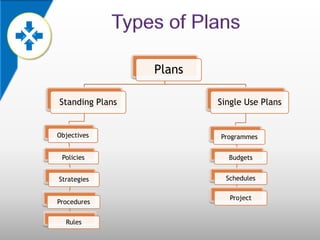
Plans

Standing Plans           Single Use Plans


Objectives               Programmes


 Policies                  Budgets


Strategies                 Schedules

                            Project
Procedures


  Rules
 On the basis of time dimension, planning is
generally divided into long range and short
range planning
    a.   Long-range Planning sets long terms goals for the
         enterprise and then proceeds to formulate specific plans
         for attaining these goals.
    b.   Short-range Planning is concerned with the
         determination of short term activities to accomplish
         long term activities.


                                                 .......   continued
   On the basis of nature or level of
    planning, there can be following types of
    planning
    a.    Strategic Planning concerns long term survival and
         development, it’s objective is on future profit.
    b.   Operational Planning is planning that covers functional
         areas like production, marketing, finance and
         purchasing.
    c.   Functional Planning is prepared for various functional
         areas of business like production planning, marketing
         planning, financial planning and manpower planning.
i. Setting Objectives
ii. Establishing Planning
     Premises
iii. Identify alternatives
iv. Evaluation and choice
v. Formulating derivative
     plans
vi. securing cooperation
vii. Follow up of plans
   Planning Premises may not be fully reliable
   Dynamic condition act as a limitation of
    planning
   Availability of time is a limiting factor of
    planning
   Cost involved in planning is also a limiting
    factor
   Mental attitude of a management
   Capital invested in fixed assets may be
    limitation to planning
   The planning premise is a set of
    assumptions made about the
    environment during a planning process.
   Planning Premises means systematic
    and logical estimate for the future
    factors affecting planning
    •   Internal and External Premises
    •   Tangible and Intangible Premises
    •   Controllable and Uncontrollable Premises
THANK YOU


      presented by:-
      (GROUP ONE)
             Manish Ranjan Singh
               Manish Chaudhary
                     Manibhushan
                     Manika Suyal

Planning

  • 2.
    It refers to the determination of a course of action to achieve a desired result  It is a process rather than behavior at a given point of time  It is primarily concerned with looking into future  It involves selection of suitable course of action  It provides the framework within which coordinating, motivating and controlling can be under taken  Planning is in fact prerequisite to effective management
  • 3.
    o Planning may be broadly defined as a concept of executive action that embodies the skills of anticipating, influencing and controlling the nature and direction of change. o “Planning is deciding in advance what to do how to do it, where to do and who is to do it. Planning bridges the gap from where we want to go. It makes it possible for things to occur while would not otherwise open” -Koontz and O’Donnel ......continued
  • 4.
    o “Planning is fundamentally a mental predisposition to do things in an orderly way, to think before and to act in the light of the fact rather than guesses”. -L.F. Urwick o “The plan of action is, at one end and at the same time the result envisaged, the line of action to be followed, the stages to go through and the methods to use” -Henri Fayol
  • 5.
     Helps Organisationa right path  Making Objectives Clear  It reduces risk and uncertainty  It improves efficiency of operations  Provides the basis of control  Facilitates decision making  Offers effective & better co-ordination  Encourages innovations and creativity  Planning leads to Economy in operation
  • 6.
    Plans Standing Plans Single Use Plans Objectives Programmes Policies Budgets Strategies Schedules Project Procedures Rules
  • 7.
     On thebasis of time dimension, planning is generally divided into long range and short range planning a. Long-range Planning sets long terms goals for the enterprise and then proceeds to formulate specific plans for attaining these goals. b. Short-range Planning is concerned with the determination of short term activities to accomplish long term activities. ....... continued
  • 8.
    On the basis of nature or level of planning, there can be following types of planning a. Strategic Planning concerns long term survival and development, it’s objective is on future profit. b. Operational Planning is planning that covers functional areas like production, marketing, finance and purchasing. c. Functional Planning is prepared for various functional areas of business like production planning, marketing planning, financial planning and manpower planning.
  • 9.
    i. Setting Objectives ii.Establishing Planning Premises iii. Identify alternatives iv. Evaluation and choice v. Formulating derivative plans vi. securing cooperation vii. Follow up of plans
  • 10.
    Planning Premises may not be fully reliable  Dynamic condition act as a limitation of planning  Availability of time is a limiting factor of planning  Cost involved in planning is also a limiting factor  Mental attitude of a management  Capital invested in fixed assets may be limitation to planning
  • 11.
    The planning premise is a set of assumptions made about the environment during a planning process.  Planning Premises means systematic and logical estimate for the future factors affecting planning • Internal and External Premises • Tangible and Intangible Premises • Controllable and Uncontrollable Premises
  • 12.
    THANK YOU presented by:- (GROUP ONE) Manish Ranjan Singh Manish Chaudhary Manibhushan Manika Suyal