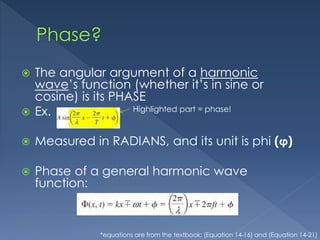
 The angular argument of a harmonic
wave’s function (whether it’s in sine or
cosine) is its PHASE
 Ex.
 Measured in RADIANS, and its unit is phi (ϕ)
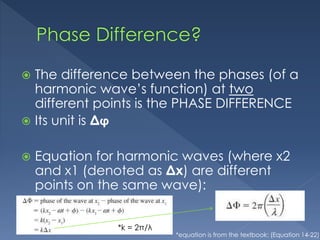
 Phase of a general harmonic wave
function:
Highlighted part = phase!
*equations are from the textbook: (Equation 14-16) and (Equation 14-21)
 The difference between the phases (of a
harmonic wave’s function) at two
different points is the PHASE DIFFERENCE
 Its unit is Δϕ
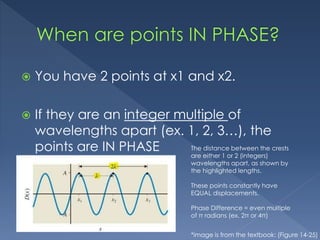
 Equation for harmonic waves (where x2
and x1 (denoted as Δx) are different
points on the same wave):
*k = 2π/λ
*equation is from the textbook: (Equation 14-22)
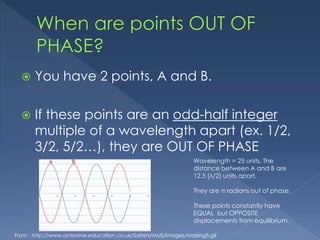
 You have 2 points at x1 and x2.
 If they are an integer multiple of
wavelengths apart (ex. 1, 2, 3…), the
points are IN PHASE The distance between the crests
are either 1 or 2 (integers)
wavelengths apart, as shown by
the highlighted lengths.
These points constantly have
EQUAL displacements.
Phase Difference = even multiple
of π radians (ex. 2π or 4π)
*image is from the textbook: (Figure 14-25)
 You have 2 points, A and B.
 If these points are an odd-half integer
multiple of a wavelength apart (ex. 1/2,
3/2, 5/2…), they are OUT OF PHASE
From : http://www.antonine-education.co.uk/Salters/MUS/images/Making5.gif
Wavelength = 25 units. The
distance between A and B are
12.5 (λ/2) units apart.
They are π radians out of phase.
These points constantly have
EQUAL but OPPOSITE
displacements from equilibrium.
Two points on a wave on a string are 15m
apart.
The wave has a wavelength of 20m.
What is the phase difference between the
two points?
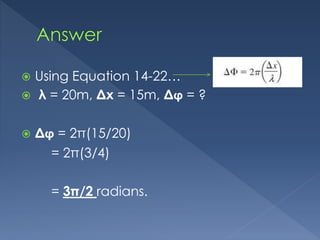
 Using Equation 14-22…
 λ = 20m, Δx = 15m, Δϕ = ?
 Δϕ = 2π(15/20)
= 2π(3/4)
= 3π/2 radians.

Physics101 Learning object

  • 2.
     The angularargument of a harmonic wave’s function (whether it’s in sine or cosine) is its PHASE  Ex.  Measured in RADIANS, and its unit is phi (ϕ)  Phase of a general harmonic wave function: Highlighted part = phase! *equations are from the textbook: (Equation 14-16) and (Equation 14-21)
  • 3.
     The differencebetween the phases (of a harmonic wave’s function) at two different points is the PHASE DIFFERENCE  Its unit is Δϕ  Equation for harmonic waves (where x2 and x1 (denoted as Δx) are different points on the same wave): *k = 2π/λ *equation is from the textbook: (Equation 14-22)
  • 4.
     You have2 points at x1 and x2.  If they are an integer multiple of wavelengths apart (ex. 1, 2, 3…), the points are IN PHASE The distance between the crests are either 1 or 2 (integers) wavelengths apart, as shown by the highlighted lengths. These points constantly have EQUAL displacements. Phase Difference = even multiple of π radians (ex. 2π or 4π) *image is from the textbook: (Figure 14-25)
  • 5.
     You have2 points, A and B.  If these points are an odd-half integer multiple of a wavelength apart (ex. 1/2, 3/2, 5/2…), they are OUT OF PHASE From : http://www.antonine-education.co.uk/Salters/MUS/images/Making5.gif Wavelength = 25 units. The distance between A and B are 12.5 (λ/2) units apart. They are π radians out of phase. These points constantly have EQUAL but OPPOSITE displacements from equilibrium.
  • 6.
    Two points ona wave on a string are 15m apart. The wave has a wavelength of 20m. What is the phase difference between the two points?
  • 7.
     Using Equation14-22…  λ = 20m, Δx = 15m, Δϕ = ?  Δϕ = 2π(15/20) = 2π(3/4) = 3π/2 radians.