PHYSICS
(Ye - U Teacher Training)
Contents
• Introduction to Physics
• Objectives of teaching Physics in Upper Secondary Level
• Syllabuses of Physics in Upper Secondary Level
• Syllabuses of Practical Physics
• Stages of teaching-learning process in Upper Secondary Level
• Lesson plan (Grade 11-Physcis)
• Teaching Aids for teaching Physics
• Assessment
Introduction to Physics
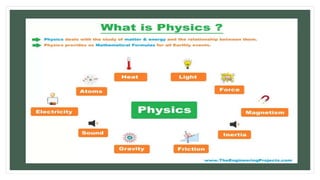
• Latin word Physica means natural things.
• a field of science
• mainly focuses on matter and energy and their relationships
• mathematical formula of all natural activities
• the study of all natural laws defined for matters or forces
Objectives of teaching Physics in Upper
Secondary Level
Objectives of teaching Physics in Upper Secondary Level
• To acquire the basic knowledge and skills of physics.
• To acquire competence in reasoning comprehension, analysis, synthesis, and
evaluation.
• To know and understand the application of the basic knowledge and skill of
physics to daily-life phenomena and national production.
• To develop the enquiring mind and scientific attitude.
• To lay the foundation for further study in physics.
𝟐𝟏𝒔𝒕
Century Skills for Learning
Collaboration : action of working with someone to produce something.
Communication : exchanging of information by speaking, writing
or using some other medium.
Critical Thinking & Problem Solving : a kind of thinking in which you
question , analyze , interpret , evaluate and make a judgement about what
you read , hear , say or write.
Creativity & Innovation : ability to create especially new and original
things.
Citizenship : the abilities and competencies that individuals need to be
active and responsible citizens in global society.
Syllabuses of teaching Physics in Upper
Secondary Level
Syllabuses
• Syllabuses Concepts
• Benjamin Bloom’s cognitive domain learning objectives & learning
outcomes General objectives
• Learning activities teaching learning methods/processes
• Assessments learning outcomes.
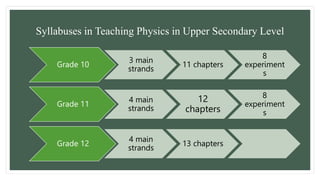
Grade 10
3 main
strands
11 chapters
8
experiment
s
Grade 11
4 main
strands
12
chapters
8
experiment
s
Grade 12
4 main
strands
13 chapters
Syllabuses in Teaching Physics in Upper Secondary Level
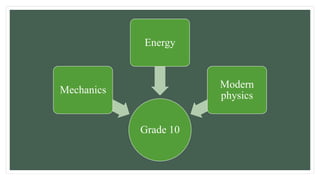
Grade 10
Mechanics
Energy
Modern
physics
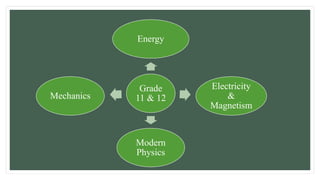
Grade
11 & 12
Energy
Electricity
&
Magnetism
Modern
Physics
Mechanics
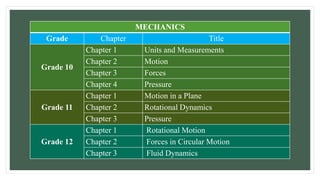
MECHANICS
Grade Chapter Title
Grade 10
Chapter 1 Units and Measurements
Chapter 2 Motion
Chapter 3 Forces
Chapter 4 Pressure
Grade 11
Chapter 1 Motion in a Plane
Chapter 2 Rotational Dynamics
Chapter 3 Pressure
Grade 12
Chapter 1 Rotational Motion
Chapter 2 Forces in Circular Motion
Chapter 3 Fluid Dynamics
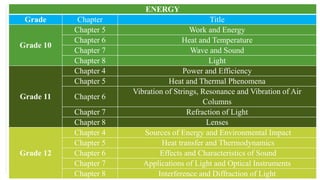
ENERGY
Grade Chapter Title
Grade 10
Chapter 5 Work and Energy
Chapter 6 Heat and Temperature
Chapter 7 Wave and Sound
Chapter 8 Light
Grade 11
Chapter 4 Power and Efficiency
Chapter 5 Heat and Thermal Phenomena
Chapter 6
Vibration of Strings, Resonance and Vibration of Air
Columns
Chapter 7 Refraction of Light
Chapter 8 Lenses
Grade 12
Chapter 4 Sources of Energy and Environmental Impact
Chapter 5 Heat transfer and Thermodynamics
Chapter 6 Effects and Characteristics of Sound
Chapter 7 Applications of Light and Optical Instruments
Chapter 8 Interference and Diffraction of Light
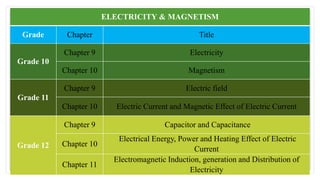
ELECTRICITY & MAGNETISM
Grade Chapter Title
Grade 10
Chapter 9 Electricity
Chapter 10 Magnetism
Grade 11
Chapter 9 Electric field
Chapter 10 Electric Current and Magnetic Effect of Electric Current
Grade 12
Chapter 9 Capacitor and Capacitance
Chapter 10
Electrical Energy, Power and Heating Effect of Electric
Current
Chapter 11
Electromagnetic Induction, generation and Distribution of
Electricity
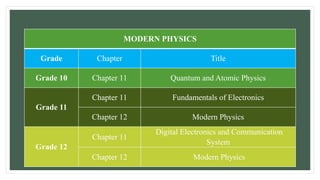
MODERN PHYSICS
Grade Chapter Title
Grade 10 Chapter 11 Quantum and Atomic Physics
Grade 11
Chapter 11 Fundamentals of Electronics
Chapter 12 Modern Physics
Grade 12
Chapter 11
Digital Electronics and Communication
System
Chapter 12 Modern Physics
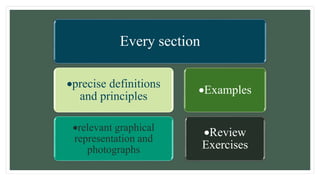
Every section
precise definitions
and principles
relevant graphical
representation and
photographs
Examples
Review
Exercises
At the end of each chapter
Summary Exercises Concept Map
Syllabuses of Practical Physics
Syllabuses of practical physics
In practical physics, the course is designed
• to give students an understanding of important facts , laws and basic concepts
of Physics with the application of theoretical knowledge to solving problems.
Objectives of laboratory studies
• to carry out the operations and makes measurements
that will give us information about the physical world.
• to serve as the basis for laboratory experiences such
as appreciation of experimental science and
the installation of a qualitative, quantitative and
critical approach to understanding physical world.
•
After learning this experimental physics , the students will be able to
• develop and practice higher order thinking skills
• participate actively in all experiments through the 5’C,
as 21st century skill for learning.
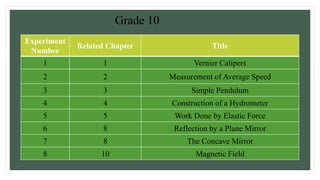
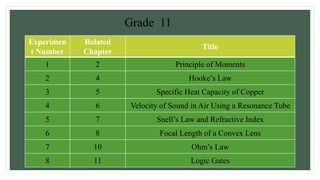
Experiment
Number
Related Chapter Title
1 1 Vernier Calipers
2 2 Measurement of Average Speed
3 3 Simple Pendulum
4 4 Construction of a Hydrometer
5 5 Work Done by Elastic Force
6 8 Reflection by a Plane Mirror
7 8 The Concave Mirror
8 10 Magnetic Field
Grade 10
Experimen
t Number
Related
Chapter
Title
1 2 Principle of Moments
2 4 Hooke’s Law
3 5 Specific Heat Capacity of Copper
4 6 Velocity of Sound in Air Using a Resonance Tube
5 7 Snell’s Law and Refractive Index
6 8 Focal Length of a Convex Lens
7 10 Ohm’s Law
8 11 Logic Gates
Grade 11
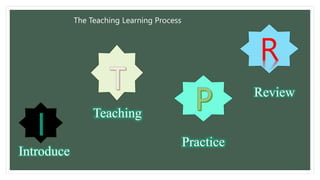
Stages of teaching-learning process
R
Introduce
Teaching
Practice
Review
The Teaching Learning Process
Introduction Stage
• Introduce the lesson by relating the
pervious knowledge of students
• Motivate students to become
interested in the lesson
Teaching Stage
• Teach by coping with unfamiliar input
by providing feedback that highlights
the problem areas
• Not only to explain but also to create a
suitable learning environment
• Encourage self-correction or further
exploration of the learners
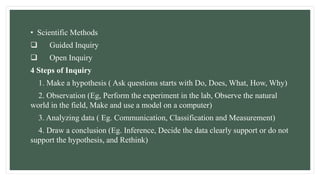
• Scientific Methods
 Guided Inquiry
 Open Inquiry
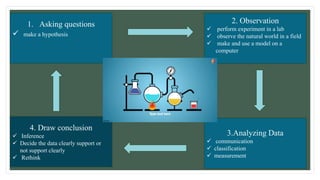
4 Steps of Inquiry
1. Make a hypothesis ( Ask questions starts with Do, Does, What, How, Why)
2. Observation (Eg, Perform the experiment in the lab, Observe the natural
world in the field, Make and use a model on a computer)
3. Analyzing data ( Eg. Communication, Classification and Measurement)
4. Draw a conclusion (Eg. Inference, Decide the data clearly support or do not
support the hypothesis, and Rethink)
1. Asking questions
 make a hypothesis
2. Observation
 perform experiment in a lab
 observe the natural world in a field
 make and use a model on a
computer
3.Analyzing Data
 communication
 classification
 measurement
4. Draw conclusion
 Inference
 Decide the data clearly support or
not support clearly
 Rethink
Practice Stage
• Give students opportunities to do exercises or activity
• Practice individually or in pairs or in groups
Review Stage
• Review the lesson
• By asking some check-up questions
• By asking them to do some simple
tasks to discover whether students have
achieved the objectives
• By summarizing the lesson taught
What methods do you use in teaching
physics?
Methods for Teaching Physics
Perform interesting experiments to explain how physics works ( PBL).
Relate physics to everyday life.
Asking questions.
Encourage your students to ask questions.
Use interactive visual aids.
Sample Lesson Plan
for Grade 11
Lesson Plan (Teaching Procedure)
Class Grade 11
Subject Physics
Unit Chapter 1
Lesson Projectile motion
Time Period 1
It is expected that students will be able to:
 Examine projectile motion
 Solve projectile motion problems
 Understand the proper use of quantities, notations and units for projectile motion
 Utilize the importance of projectile motion
Objectives
Introduce
Introduce the lesson by asking students what they knew in Grade 10.
e.g.
What is motion?
What types of motion have you been studied?
What is the difference of the acceleration and the velocity?
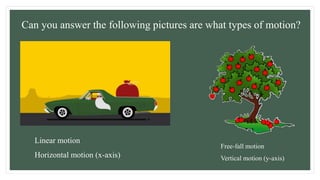
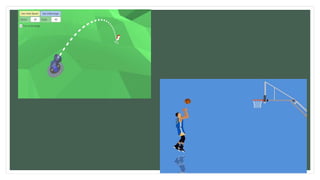
Can you answer the following pictures are what types of motion?
Linear motion
Horizontal motion (x-axis)
Free-fall motion
Vertical motion (y-axis)
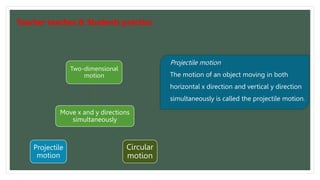
Move x and y directions
simultaneously
Two-dimensional
motion
Circular
motion
Projectile
motion
Projectile motion
The motion of an object moving in both
horizontal x direction and vertical y direction
simultaneously is called the projectile motion.
Teacher teaches & Students practice
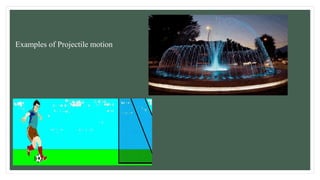
Examples of Projectile motion
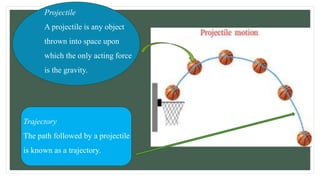
Projectile
A projectile is any object
thrown into space upon
which the only acting force
is the gravity.
Trajectory
The path followed by a projectile
is known as a trajectory.
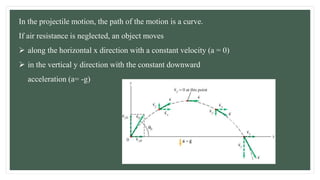
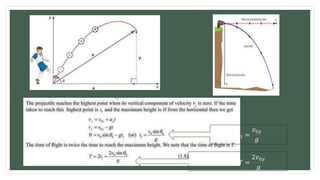
In the projectile motion, the path of the motion is a curve.
If air resistance is neglected, an object moves
 along the horizontal x direction with a constant velocity (a = 0)
 in the vertical y direction with the constant downward
acceleration (a= -g)
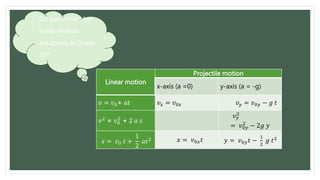
Linear motion
Projectile motion
x-axis (a =0) y-axis (a = -g)
𝑣 = 𝑣0+ 𝑎𝑡 𝑣𝑥 = 𝑣0𝑥 𝑣𝑦 = 𝑣0𝑦 − 𝑔 𝑡
𝑣2
= 𝑣0
2
+ 2 𝑎 𝑠
𝑣𝑦
2
= 𝑣0𝑦
2
− 2𝑔 𝑦
𝑠 = 𝑣0 𝑡 +
1
2
𝑎𝑡2 𝑥 = 𝑣0𝑥𝑡 𝑦 = 𝑣0𝑦𝑡 −
1
2
𝑔 𝑡2
Do you remember
linear motion
equations in Grade
10?
𝑡1 =
𝑣0𝑦
𝑔
𝑇 =
2𝑣0𝑦
𝑔
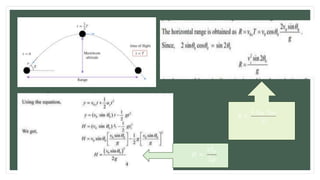
𝐻 =
𝑣0𝑦
2
2𝑔
𝑅 =
2 𝑣0𝑥 𝑣0𝑦
𝑔
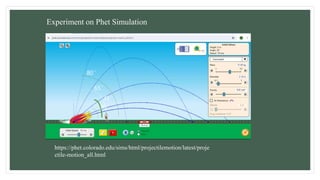
https://phet.colorado.edu/sims/html/projectilemotion/latest/proje
ctile-motion_all.html
80 ̊
65 ̊
45 ̊
30 ̊
Experiment on Phet Simulation
Example 1.3 An object is projected upward with a 30 ̊ launch angle and an initial
speed of 40 m s-1. How long will it take for the object to reach the top of its
trajectory? Find the maximum height of its trajectory.
Example 1.4 A bomb is dropped from an airplane moving horizontally with its
speed of 50 m s-1. if the bomb will reach the ground in 5 s, find the altitude of the
plane. The air resistance is negligible.
Example 1.5 A stone is thrown with a speed 20 m s-1 and at an angle 30 ̊ above the
horizontal. Find (i) the horizontal range (ii) the maximum height reached (iii) the
time of flight of the stone.
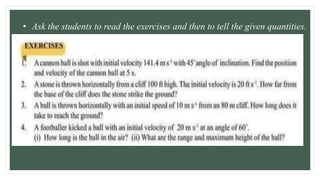
• Teacher reads the examples and ask the students what quantities are given.
• Ask the students to read the exercises and then to tell the given quantities.
Review
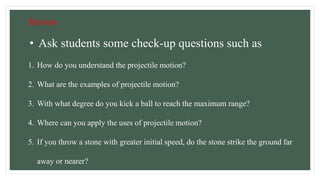
1. How do you understand the projectile motion?
2. What are the examples of projectile motion?
3. With what degree do you kick a ball to reach the maximum range?
4. Where can you apply the uses of projectile motion?
5. If you throw a stone with greater initial speed, do the stone strike the ground far
away or nearer?
• Ask students some check-up questions such as
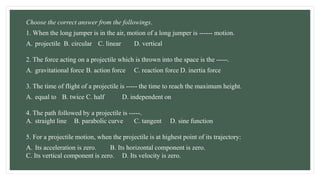
Choose the correct answer from the followings.
1. When the long jumper is in the air, motion of a long jumper is ------ motion.
A. projectile B. circular C. linear D. vertical
2. The force acting on a projectile which is thrown into the space is the -----.
A. gravitational force B. action force C. reaction force D. inertia force
3. The time of flight of a projectile is ----- the time to reach the maximum height.
A. equal to B. twice C. half D. independent on
4. The path followed by a projectile is -----.
A. straight line B. parabolic curve C. tangent D. sine function
5. For a projectile motion, when the projectile is at highest point of its trajectory:
A. Its acceleration is zero. B. Its horizontal component is zero.
C. Its vertical component is zero. D. Its velocity is zero.
Credit to those
for their
multimedia
contribution in
this lesson
References
• Grade 10 & 11 Physics Textbook
• Grade 10 Physics Teacher Guide
Teaching Aids for teaching Physics
What kinds of teaching aids you use
teaching physics?
Teaching aids for teaching physics
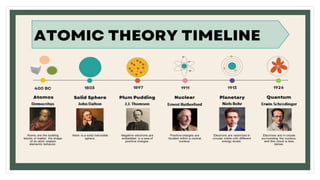
Time line
Power point
Mind map
Pictures
Real Things
Videos
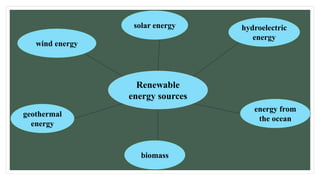
Renewable
energy sources
solar energy hydroelectric
energy
biomass
energy from
the ocean
geothermal
energy
wind energy
Heat Conduction
Process
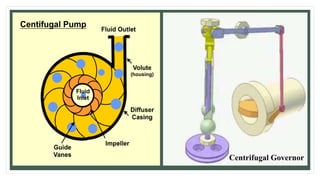
Centrifugal Governor
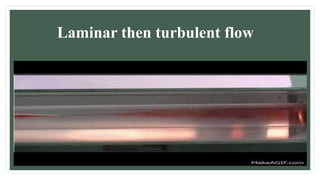
Laminar then turbulent flow
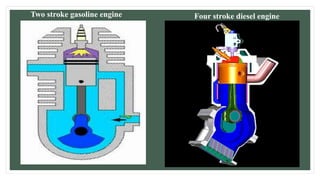
Two stroke gasoline engine Four stroke diesel engine
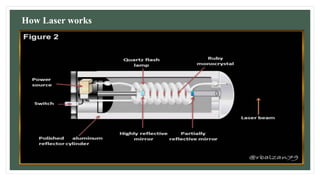
How Laser works
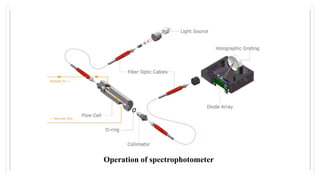
Operation of spectrophotometer
Electricity from biomass
Assessment
How many types of assessment do you know?
&
When you do assessment?
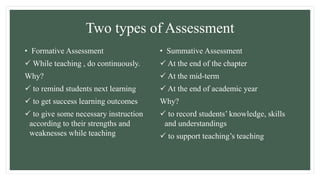
Two types of Assessment
• Formative Assessment
 While teaching , do continuously.
Why?
 to remind students next learning
 to get success learning outcomes
 to give some necessary instruction
according to their strengths and
weaknesses while teaching
• Summative Assessment
 At the end of the chapter
 At the mid-term
 At the end of academic year
Why?
 to record students’ knowledge, skills
and understandings
 to support teaching’s teaching
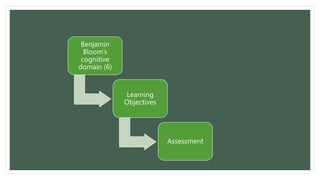
Benjamin
Bloom’s
cognitive
domain (6)
Learning
Objectives
Assessment
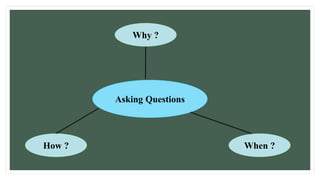
Asking Questions
Why ?
When ?
How ?
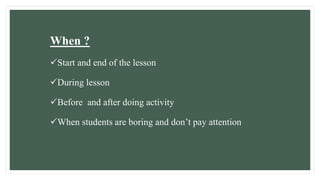
When ?
Start and end of the lesson
During lesson
Before and after doing activity
When students are boring and don’t pay attention
Why ?
To check understanding
To recall the lesson
To interest the learners
To memorize the lesson
To link the lesson
To get different opinions
How ?
Write it on the book
Nominate
Whole class
In pair
By group
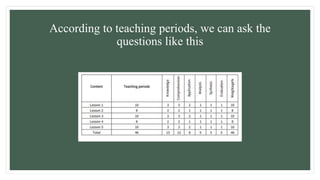
According to teaching periods, we can ask the
questions like this
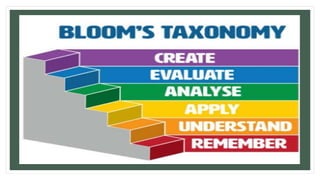
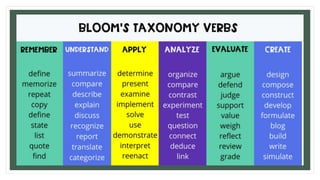
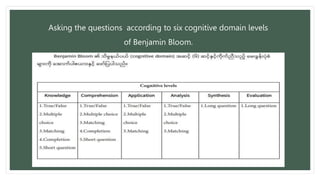
Asking the questions according to six cognitive domain levels
of Benjamin Bloom.
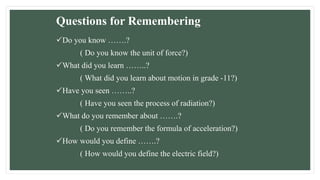
Questions for Remembering
Do you know …….?
( Do you know the unit of force?)
What did you learn ……..?
( What did you learn about motion in grade -11?)
Have you seen ……..?
( Have you seen the process of radiation?)
What do you remember about …….?
( Do you remember the formula of acceleration?)
How would you define …….?
( How would you define the electric field?)
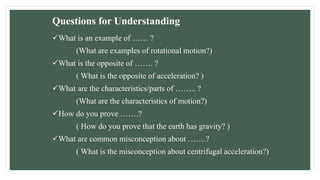
Questions for Understanding
What is an example of …… ?
(What are examples of rotational motion?)
What is the opposite of ……. ?
( What is the opposite of acceleration? )
What are the characteristics/parts of …….. ?
(What are the characteristics of motion?)
How do you prove …….?
( How do you prove that the earth has gravity? )
What are common misconception about …….?
( What is the misconception about centrifugal acceleration?)
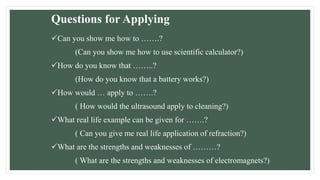
Questions for Applying
Can you show me how to …….?
(Can you show me how to use scientific calculator?)
How do you know that ……..?
(How do you know that a battery works?)
How would … apply to …….?
( How would the ultrasound apply to cleaning?)
What real life example can be given for …….?
( Can you give me real life application of refraction?)
What are the strengths and weaknesses of ………?
( What are the strengths and weaknesses of electromagnets?)
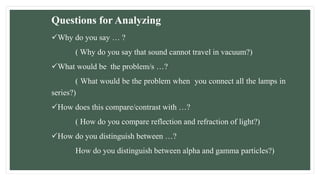
Questions for Analyzing
Why do you say … ?
( Why do you say that sound cannot travel in vacuum?)
What would be the problem/s …?
( What would be the problem when you connect all the lamps in
series?)
How does this compare/contrast with …?
( How do you compare reflection and refraction of light?)
How do you distinguish between …?
How do you distinguish between alpha and gamma particles?)
Questions for Evaluating
What are your reasons for …?
( What are your reasons for the gate which is NAND ?)
How do you explain …?
( How do you explain the theory of relativity?)
Why do you agree/disagree with …?
( Why do you disagree with my opinion?)
How would you decide …?
( How do you decide this description is right or wrong?)
Questions for Creating
What solutions are there …?
( What solutions are there in this experiment?)
What ideas do you have about …?
( What ideas do you have about generating electricity from
Biomass?)
What is the plan for …?
( What is your plan for constructing automatic watering system
by using gates? )
What are some changes …?
( What are some changes for producing energy to reduce the use
of non-renewable energy resources?)
Thank You

Physic ( Ye-U).pptx for education department

  • 1.
    PHYSICS (Ye - UTeacher Training)
  • 2.
    Contents • Introduction toPhysics • Objectives of teaching Physics in Upper Secondary Level • Syllabuses of Physics in Upper Secondary Level • Syllabuses of Practical Physics • Stages of teaching-learning process in Upper Secondary Level • Lesson plan (Grade 11-Physcis) • Teaching Aids for teaching Physics • Assessment
  • 4.
  • 6.
    Introduction to Physics •Latin word Physica means natural things. • a field of science • mainly focuses on matter and energy and their relationships • mathematical formula of all natural activities • the study of all natural laws defined for matters or forces
  • 7.
    Objectives of teachingPhysics in Upper Secondary Level
  • 8.
    Objectives of teachingPhysics in Upper Secondary Level • To acquire the basic knowledge and skills of physics. • To acquire competence in reasoning comprehension, analysis, synthesis, and evaluation. • To know and understand the application of the basic knowledge and skill of physics to daily-life phenomena and national production. • To develop the enquiring mind and scientific attitude. • To lay the foundation for further study in physics.
  • 9.
    𝟐𝟏𝒔𝒕 Century Skills forLearning Collaboration : action of working with someone to produce something. Communication : exchanging of information by speaking, writing or using some other medium. Critical Thinking & Problem Solving : a kind of thinking in which you question , analyze , interpret , evaluate and make a judgement about what you read , hear , say or write. Creativity & Innovation : ability to create especially new and original things. Citizenship : the abilities and competencies that individuals need to be active and responsible citizens in global society.
  • 10.
    Syllabuses of teachingPhysics in Upper Secondary Level
  • 11.
    Syllabuses • Syllabuses Concepts •Benjamin Bloom’s cognitive domain learning objectives & learning outcomes General objectives • Learning activities teaching learning methods/processes • Assessments learning outcomes.
  • 12.
    Grade 10 3 main strands 11chapters 8 experiment s Grade 11 4 main strands 12 chapters 8 experiment s Grade 12 4 main strands 13 chapters Syllabuses in Teaching Physics in Upper Secondary Level
  • 13.
  • 14.
  • 15.
    MECHANICS Grade Chapter Title Grade10 Chapter 1 Units and Measurements Chapter 2 Motion Chapter 3 Forces Chapter 4 Pressure Grade 11 Chapter 1 Motion in a Plane Chapter 2 Rotational Dynamics Chapter 3 Pressure Grade 12 Chapter 1 Rotational Motion Chapter 2 Forces in Circular Motion Chapter 3 Fluid Dynamics
  • 16.
    ENERGY Grade Chapter Title Grade10 Chapter 5 Work and Energy Chapter 6 Heat and Temperature Chapter 7 Wave and Sound Chapter 8 Light Grade 11 Chapter 4 Power and Efficiency Chapter 5 Heat and Thermal Phenomena Chapter 6 Vibration of Strings, Resonance and Vibration of Air Columns Chapter 7 Refraction of Light Chapter 8 Lenses Grade 12 Chapter 4 Sources of Energy and Environmental Impact Chapter 5 Heat transfer and Thermodynamics Chapter 6 Effects and Characteristics of Sound Chapter 7 Applications of Light and Optical Instruments Chapter 8 Interference and Diffraction of Light
  • 17.
    ELECTRICITY & MAGNETISM GradeChapter Title Grade 10 Chapter 9 Electricity Chapter 10 Magnetism Grade 11 Chapter 9 Electric field Chapter 10 Electric Current and Magnetic Effect of Electric Current Grade 12 Chapter 9 Capacitor and Capacitance Chapter 10 Electrical Energy, Power and Heating Effect of Electric Current Chapter 11 Electromagnetic Induction, generation and Distribution of Electricity
  • 18.
    MODERN PHYSICS Grade ChapterTitle Grade 10 Chapter 11 Quantum and Atomic Physics Grade 11 Chapter 11 Fundamentals of Electronics Chapter 12 Modern Physics Grade 12 Chapter 11 Digital Electronics and Communication System Chapter 12 Modern Physics
  • 19.
    Every section precise definitions andprinciples relevant graphical representation and photographs Examples Review Exercises
  • 20.
    At the endof each chapter Summary Exercises Concept Map
  • 21.
  • 22.
    Syllabuses of practicalphysics In practical physics, the course is designed • to give students an understanding of important facts , laws and basic concepts of Physics with the application of theoretical knowledge to solving problems.
  • 23.
    Objectives of laboratorystudies • to carry out the operations and makes measurements that will give us information about the physical world. • to serve as the basis for laboratory experiences such as appreciation of experimental science and the installation of a qualitative, quantitative and critical approach to understanding physical world. •
  • 24.
    After learning thisexperimental physics , the students will be able to • develop and practice higher order thinking skills • participate actively in all experiments through the 5’C, as 21st century skill for learning.
  • 25.
    Experiment Number Related Chapter Title 11 Vernier Calipers 2 2 Measurement of Average Speed 3 3 Simple Pendulum 4 4 Construction of a Hydrometer 5 5 Work Done by Elastic Force 6 8 Reflection by a Plane Mirror 7 8 The Concave Mirror 8 10 Magnetic Field Grade 10
  • 26.
    Experimen t Number Related Chapter Title 1 2Principle of Moments 2 4 Hooke’s Law 3 5 Specific Heat Capacity of Copper 4 6 Velocity of Sound in Air Using a Resonance Tube 5 7 Snell’s Law and Refractive Index 6 8 Focal Length of a Convex Lens 7 10 Ohm’s Law 8 11 Logic Gates Grade 11
  • 27.
  • 28.
  • 29.
    Introduction Stage • Introducethe lesson by relating the pervious knowledge of students • Motivate students to become interested in the lesson
  • 30.
    Teaching Stage • Teachby coping with unfamiliar input by providing feedback that highlights the problem areas • Not only to explain but also to create a suitable learning environment • Encourage self-correction or further exploration of the learners
  • 31.
    • Scientific Methods Guided Inquiry  Open Inquiry 4 Steps of Inquiry 1. Make a hypothesis ( Ask questions starts with Do, Does, What, How, Why) 2. Observation (Eg, Perform the experiment in the lab, Observe the natural world in the field, Make and use a model on a computer) 3. Analyzing data ( Eg. Communication, Classification and Measurement) 4. Draw a conclusion (Eg. Inference, Decide the data clearly support or do not support the hypothesis, and Rethink)
  • 32.
    1. Asking questions make a hypothesis 2. Observation  perform experiment in a lab  observe the natural world in a field  make and use a model on a computer 3.Analyzing Data  communication  classification  measurement 4. Draw conclusion  Inference  Decide the data clearly support or not support clearly  Rethink
  • 33.
    Practice Stage • Givestudents opportunities to do exercises or activity • Practice individually or in pairs or in groups
  • 34.
    Review Stage • Reviewthe lesson • By asking some check-up questions • By asking them to do some simple tasks to discover whether students have achieved the objectives • By summarizing the lesson taught
  • 35.
    What methods doyou use in teaching physics?
  • 36.
    Methods for TeachingPhysics Perform interesting experiments to explain how physics works ( PBL). Relate physics to everyday life. Asking questions. Encourage your students to ask questions. Use interactive visual aids.
  • 38.
  • 39.
    Lesson Plan (TeachingProcedure) Class Grade 11 Subject Physics Unit Chapter 1 Lesson Projectile motion Time Period 1
  • 40.
    It is expectedthat students will be able to:  Examine projectile motion  Solve projectile motion problems  Understand the proper use of quantities, notations and units for projectile motion  Utilize the importance of projectile motion Objectives
  • 41.
    Introduce Introduce the lessonby asking students what they knew in Grade 10. e.g. What is motion? What types of motion have you been studied? What is the difference of the acceleration and the velocity?
  • 42.
    Can you answerthe following pictures are what types of motion? Linear motion Horizontal motion (x-axis) Free-fall motion Vertical motion (y-axis)
  • 43.
    Move x andy directions simultaneously Two-dimensional motion Circular motion Projectile motion Projectile motion The motion of an object moving in both horizontal x direction and vertical y direction simultaneously is called the projectile motion. Teacher teaches & Students practice
  • 44.
  • 46.
    Projectile A projectile isany object thrown into space upon which the only acting force is the gravity. Trajectory The path followed by a projectile is known as a trajectory.
  • 47.
    In the projectilemotion, the path of the motion is a curve. If air resistance is neglected, an object moves  along the horizontal x direction with a constant velocity (a = 0)  in the vertical y direction with the constant downward acceleration (a= -g)
  • 48.
    Linear motion Projectile motion x-axis(a =0) y-axis (a = -g) 𝑣 = 𝑣0+ 𝑎𝑡 𝑣𝑥 = 𝑣0𝑥 𝑣𝑦 = 𝑣0𝑦 − 𝑔 𝑡 𝑣2 = 𝑣0 2 + 2 𝑎 𝑠 𝑣𝑦 2 = 𝑣0𝑦 2 − 2𝑔 𝑦 𝑠 = 𝑣0 𝑡 + 1 2 𝑎𝑡2 𝑥 = 𝑣0𝑥𝑡 𝑦 = 𝑣0𝑦𝑡 − 1 2 𝑔 𝑡2 Do you remember linear motion equations in Grade 10?
  • 49.
  • 50.
    𝐻 = 𝑣0𝑦 2 2𝑔 𝑅 = 2𝑣0𝑥 𝑣0𝑦 𝑔
  • 51.
  • 52.
    Example 1.3 Anobject is projected upward with a 30 ̊ launch angle and an initial speed of 40 m s-1. How long will it take for the object to reach the top of its trajectory? Find the maximum height of its trajectory. Example 1.4 A bomb is dropped from an airplane moving horizontally with its speed of 50 m s-1. if the bomb will reach the ground in 5 s, find the altitude of the plane. The air resistance is negligible. Example 1.5 A stone is thrown with a speed 20 m s-1 and at an angle 30 ̊ above the horizontal. Find (i) the horizontal range (ii) the maximum height reached (iii) the time of flight of the stone. • Teacher reads the examples and ask the students what quantities are given.
  • 53.
    • Ask thestudents to read the exercises and then to tell the given quantities.
  • 54.
    Review 1. How doyou understand the projectile motion? 2. What are the examples of projectile motion? 3. With what degree do you kick a ball to reach the maximum range? 4. Where can you apply the uses of projectile motion? 5. If you throw a stone with greater initial speed, do the stone strike the ground far away or nearer? • Ask students some check-up questions such as
  • 55.
    Choose the correctanswer from the followings. 1. When the long jumper is in the air, motion of a long jumper is ------ motion. A. projectile B. circular C. linear D. vertical 2. The force acting on a projectile which is thrown into the space is the -----. A. gravitational force B. action force C. reaction force D. inertia force 3. The time of flight of a projectile is ----- the time to reach the maximum height. A. equal to B. twice C. half D. independent on 4. The path followed by a projectile is -----. A. straight line B. parabolic curve C. tangent D. sine function 5. For a projectile motion, when the projectile is at highest point of its trajectory: A. Its acceleration is zero. B. Its horizontal component is zero. C. Its vertical component is zero. D. Its velocity is zero.

  • 57.
    Credit to those fortheir multimedia contribution in this lesson
  • 58.
    References • Grade 10& 11 Physics Textbook • Grade 10 Physics Teacher Guide
  • 59.
    Teaching Aids forteaching Physics
  • 60.
    What kinds ofteaching aids you use teaching physics?
  • 61.
    Teaching aids forteaching physics Time line Power point Mind map Pictures Real Things Videos
  • 63.
    Renewable energy sources solar energyhydroelectric energy biomass energy from the ocean geothermal energy wind energy
  • 64.
  • 66.
  • 67.
  • 70.
    Two stroke gasolineengine Four stroke diesel engine
  • 71.
  • 72.
  • 74.
  • 75.
  • 76.
    How many typesof assessment do you know? & When you do assessment?
  • 77.
    Two types ofAssessment • Formative Assessment  While teaching , do continuously. Why?  to remind students next learning  to get success learning outcomes  to give some necessary instruction according to their strengths and weaknesses while teaching • Summative Assessment  At the end of the chapter  At the mid-term  At the end of academic year Why?  to record students’ knowledge, skills and understandings  to support teaching’s teaching
  • 78.
  • 81.
  • 82.
    When ? Start andend of the lesson During lesson Before and after doing activity When students are boring and don’t pay attention
  • 83.
    Why ? To checkunderstanding To recall the lesson To interest the learners To memorize the lesson To link the lesson To get different opinions
  • 84.
    How ? Write iton the book Nominate Whole class In pair By group
  • 85.
    According to teachingperiods, we can ask the questions like this
  • 86.
    Asking the questionsaccording to six cognitive domain levels of Benjamin Bloom.
  • 87.
    Questions for Remembering Doyou know …….? ( Do you know the unit of force?) What did you learn ……..? ( What did you learn about motion in grade -11?) Have you seen ……..? ( Have you seen the process of radiation?) What do you remember about …….? ( Do you remember the formula of acceleration?) How would you define …….? ( How would you define the electric field?)
  • 88.
    Questions for Understanding Whatis an example of …… ? (What are examples of rotational motion?) What is the opposite of ……. ? ( What is the opposite of acceleration? ) What are the characteristics/parts of …….. ? (What are the characteristics of motion?) How do you prove …….? ( How do you prove that the earth has gravity? ) What are common misconception about …….? ( What is the misconception about centrifugal acceleration?)
  • 89.
    Questions for Applying Canyou show me how to …….? (Can you show me how to use scientific calculator?) How do you know that ……..? (How do you know that a battery works?) How would … apply to …….? ( How would the ultrasound apply to cleaning?) What real life example can be given for …….? ( Can you give me real life application of refraction?) What are the strengths and weaknesses of ………? ( What are the strengths and weaknesses of electromagnets?)
  • 90.
    Questions for Analyzing Whydo you say … ? ( Why do you say that sound cannot travel in vacuum?) What would be the problem/s …? ( What would be the problem when you connect all the lamps in series?) How does this compare/contrast with …? ( How do you compare reflection and refraction of light?) How do you distinguish between …? How do you distinguish between alpha and gamma particles?)
  • 91.
    Questions for Evaluating Whatare your reasons for …? ( What are your reasons for the gate which is NAND ?) How do you explain …? ( How do you explain the theory of relativity?) Why do you agree/disagree with …? ( Why do you disagree with my opinion?) How would you decide …? ( How do you decide this description is right or wrong?)
  • 92.
    Questions for Creating Whatsolutions are there …? ( What solutions are there in this experiment?) What ideas do you have about …? ( What ideas do you have about generating electricity from Biomass?) What is the plan for …? ( What is your plan for constructing automatic watering system by using gates? ) What are some changes …? ( What are some changes for producing energy to reduce the use of non-renewable energy resources?)
  • 93.