
PHP7 is coming
in November 2015
Hello
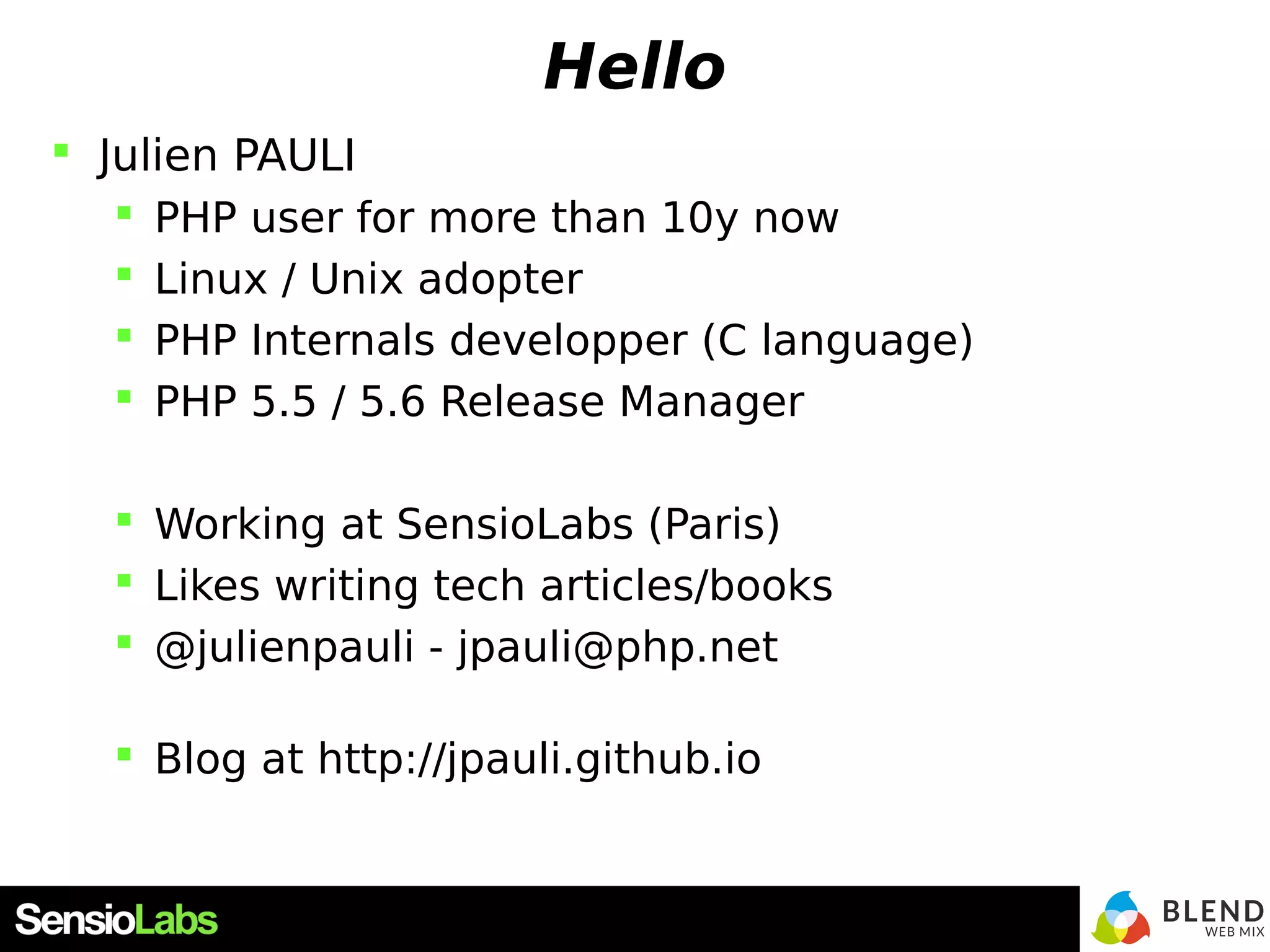
 Julien PAULI
 PHP user for more than 10y now
 Linux / Unix adopter
 PHP Internals developper (C language)
 PHP 5.5 / 5.6 Release Manager
 Working at SensioLabs (Paris)
 Likes writing tech articles/books
 @julienpauli - jpauli@php.net
 Blog at http://jpauli.github.io
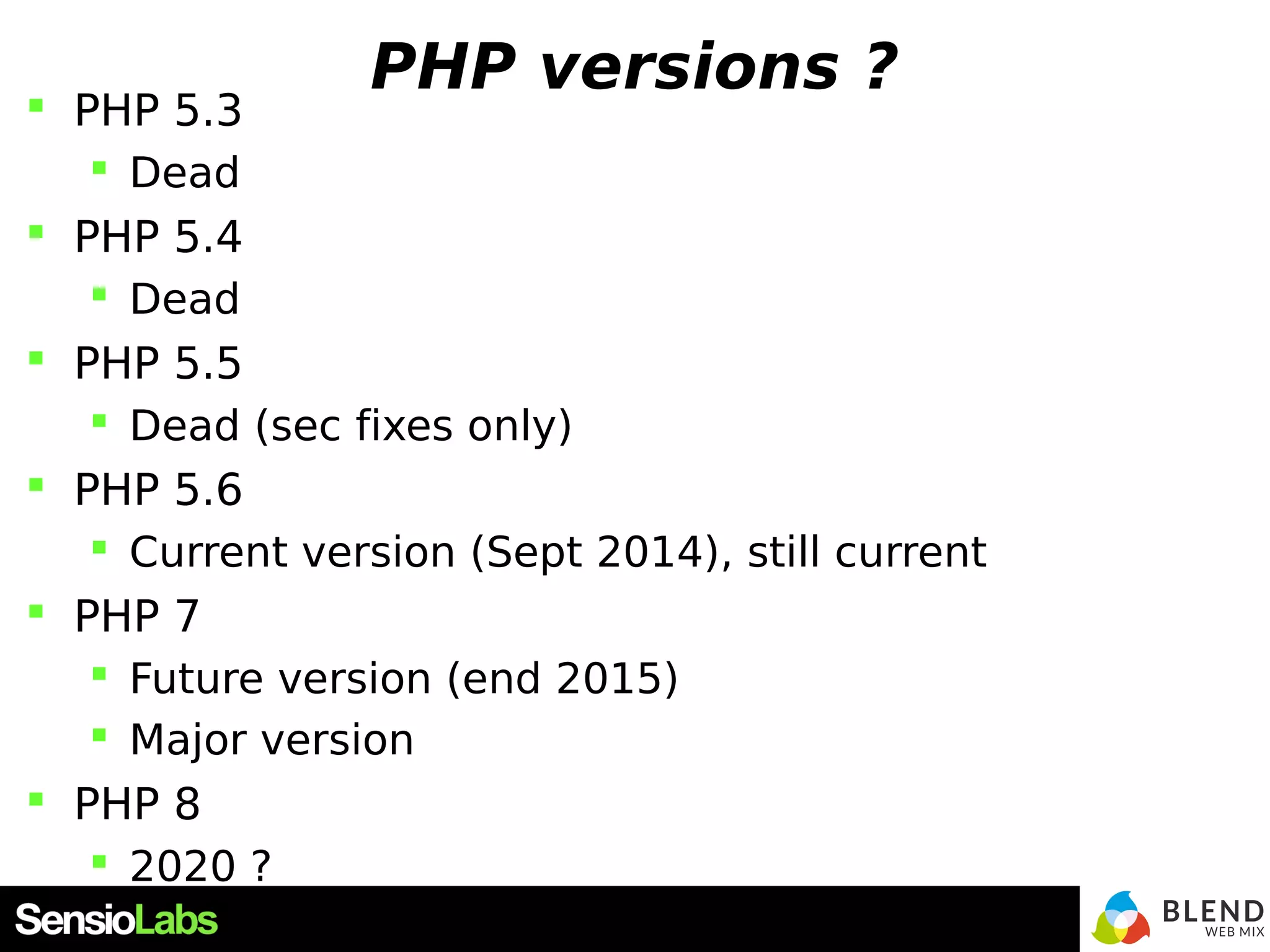
PHP versions ?
 PHP 5.3
 Dead
 PHP 5.4
 Dead
 PHP 5.5
 Dead (sec fixes only)
 PHP 5.6
 Current version (Sept 2014), still current
 PHP 7
 Future version (end 2015)
 Major version
 PHP 8
 2020 ?
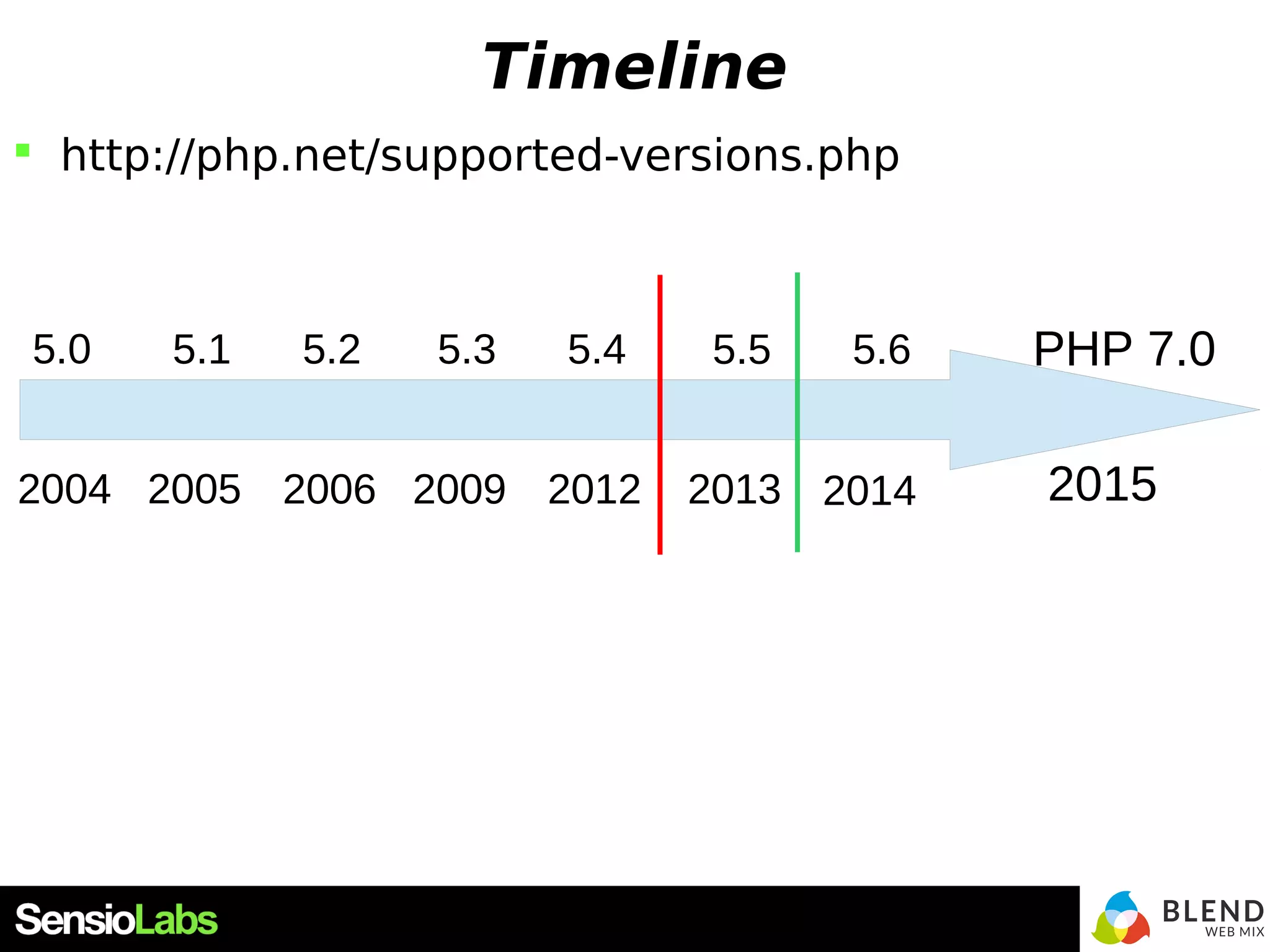
Timeline
 http://php.net/supported-versions.php
2004 2015
5.0 PHP 7.0
2005 2006 2009
5.1 5.2 5.3 5.4
2012 2013 2014
5.5 5.6
PHP 6 ?
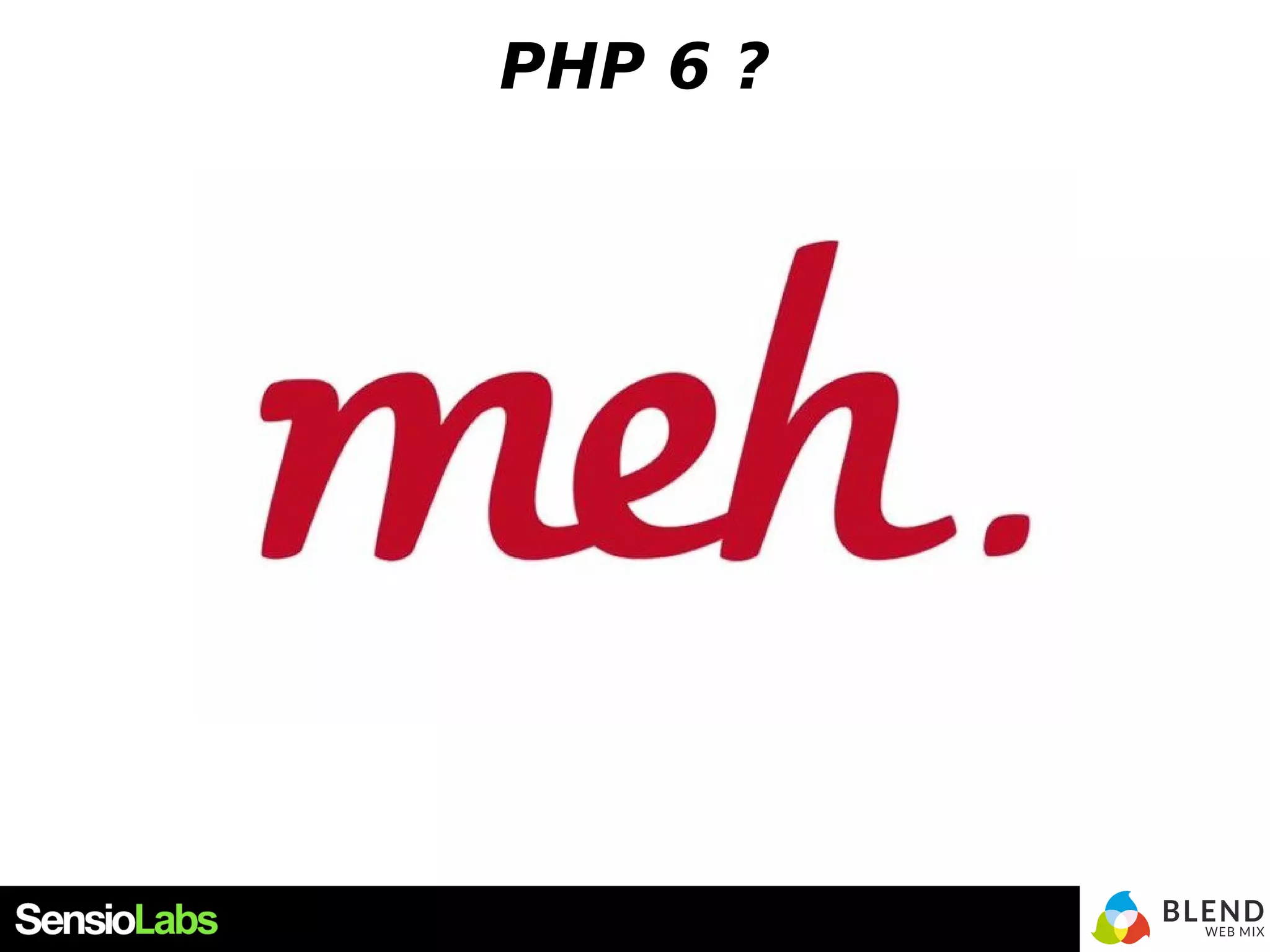
PHP 6 ?
PHP 7
PHP 7
PHP 7 doctrines
 We are in a new major, we may break things
 Only majors are allowed to do so (starting from 5.4)
 We are devs. we also need to refactor (like you)
 Only break when it brings a significant advantage
 Think about our users and their migrations
 Do not fall into a Python2 vs Python3 war
 We'll have PHP 7.1 etc.. and PHP 8.0, probably in 2020.
So ?
 Functions arguments order will not be touched
 Functions() won't be turned into objects->methods()
 "Goto" will not disappear
 And the earth won't just stop its rotation tomorrow
PHP 7 changes
 Internal Engine evolutions (Zend Engine 3.0)
 Perfs ++
 32/64bits platform fully supported
 Integer sizes
 New parser based on an AST
 Some syntaxes change with PHP5
 Tidy up old things that were deprecated before
 Many new features
PHP7 new user features
 Exceptions to replace fatal errors
 New language syntaxes
 ?? operator
 <=> operator
 Group use
 Return type declaration and scalar type hints
 Anonymous classes
 Other new features (Can't list all here)
PHP 7 new features
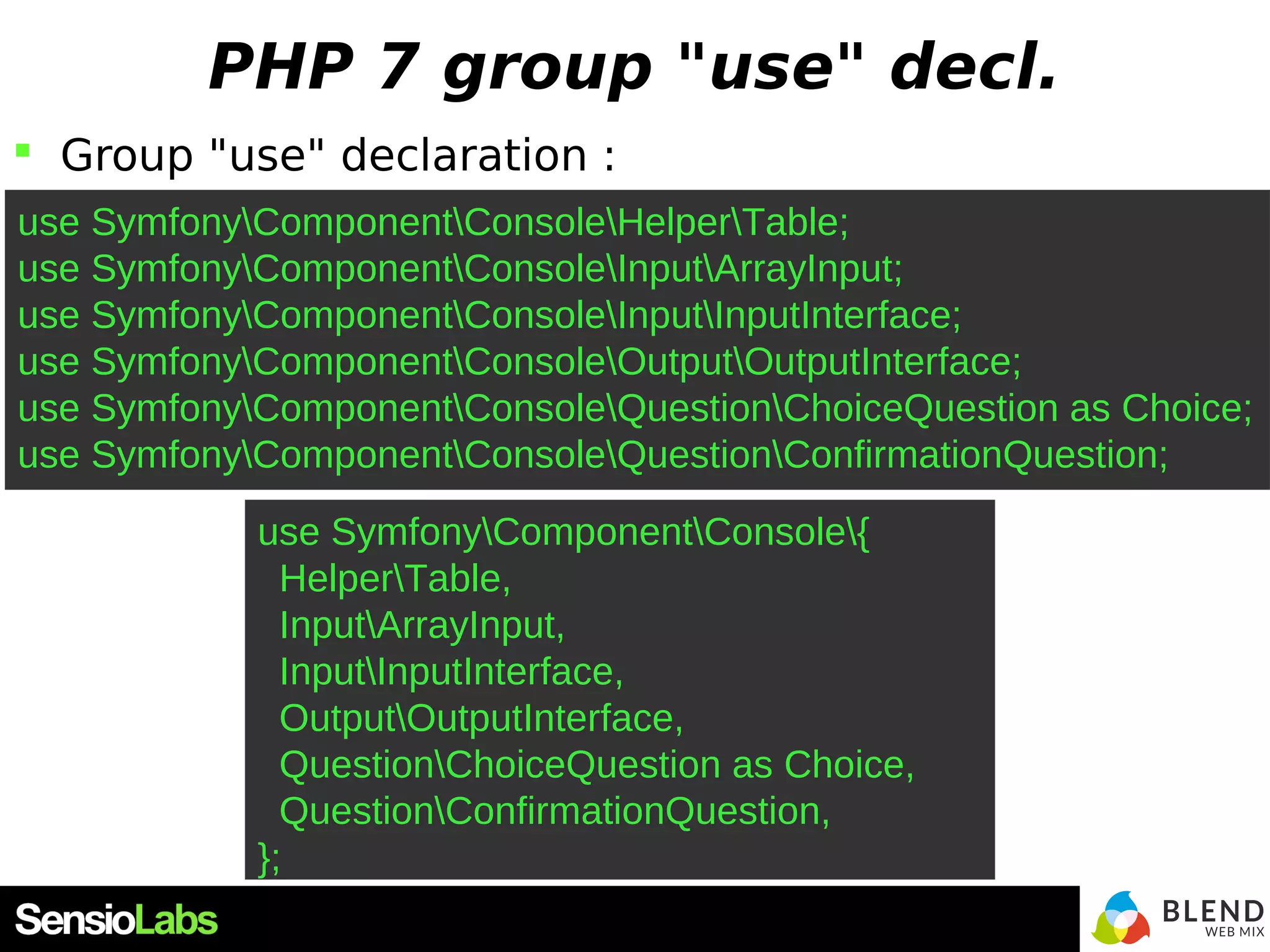
PHP 7 group "use" decl.
 Group "use" declaration :
use SymfonyComponentConsoleHelperTable;
use SymfonyComponentConsoleInputArrayInput;
use SymfonyComponentConsoleInputInputInterface;
use SymfonyComponentConsoleOutputOutputInterface;
use SymfonyComponentConsoleQuestionChoiceQuestion as Choice;
use SymfonyComponentConsoleQuestionConfirmationQuestion;
use SymfonyComponentConsole{
HelperTable,
InputArrayInput,
InputInputInterface,
OutputOutputInterface,
QuestionChoiceQuestion as Choice,
QuestionConfirmationQuestion,
};
PHP 7 ?? operator
 ?? : Null Coalesce Operator
$username = isset($_GET['user']) ? $_GET['user'] : 'nobody';
$username = $_GET['user'] ?? 'nobody';
PHP 7 <=> operator
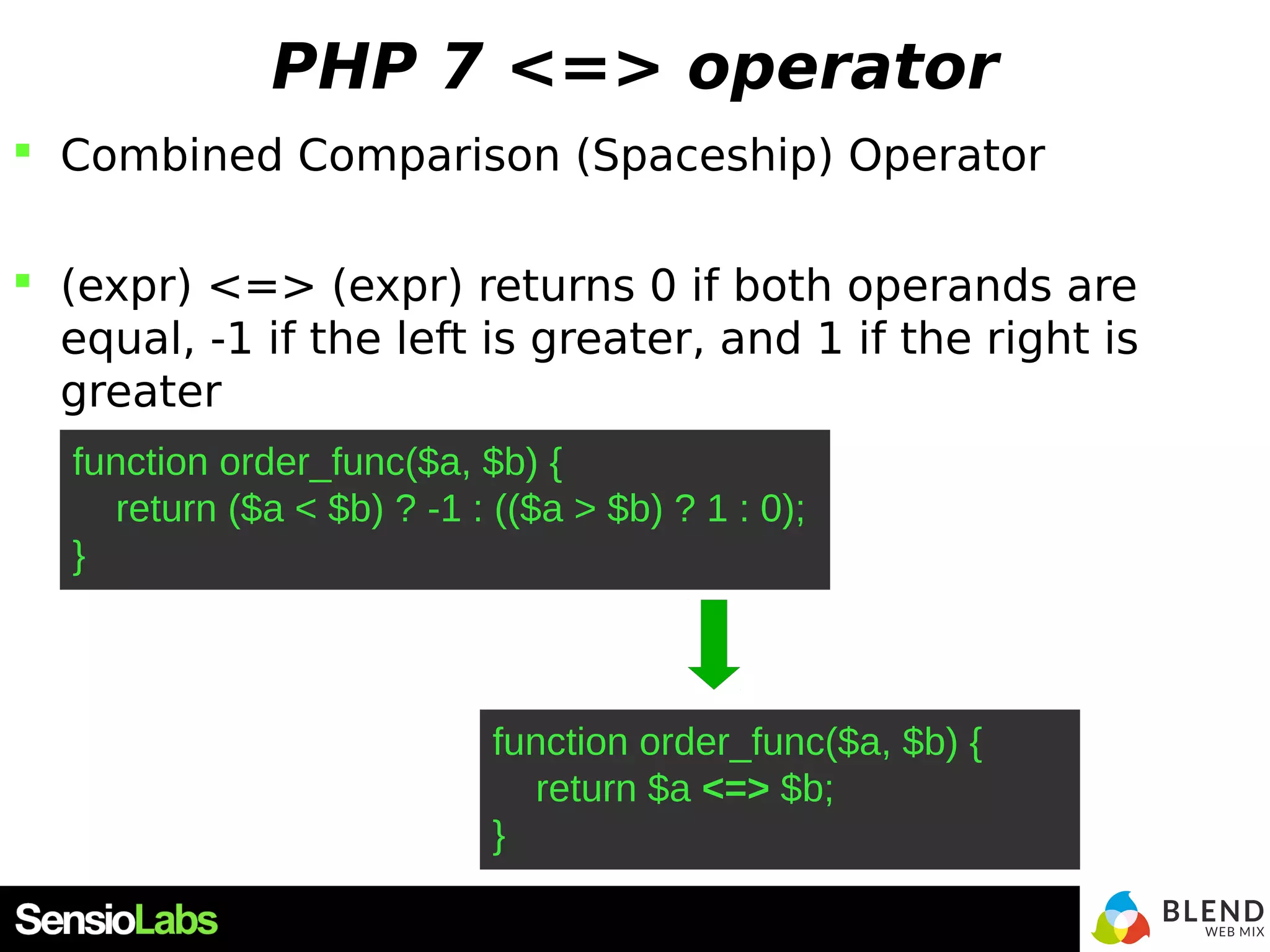
 Combined Comparison (Spaceship) Operator
 (expr) <=> (expr) returns 0 if both operands are
equal, -1 if the left is greater, and 1 if the right is
greater
function order_func($a, $b) {
return ($a < $b) ? -1 : (($a > $b) ? 1 : 0);
}
function order_func($a, $b) {
return $a <=> $b;
}
PHP7 Errors and Exceptions
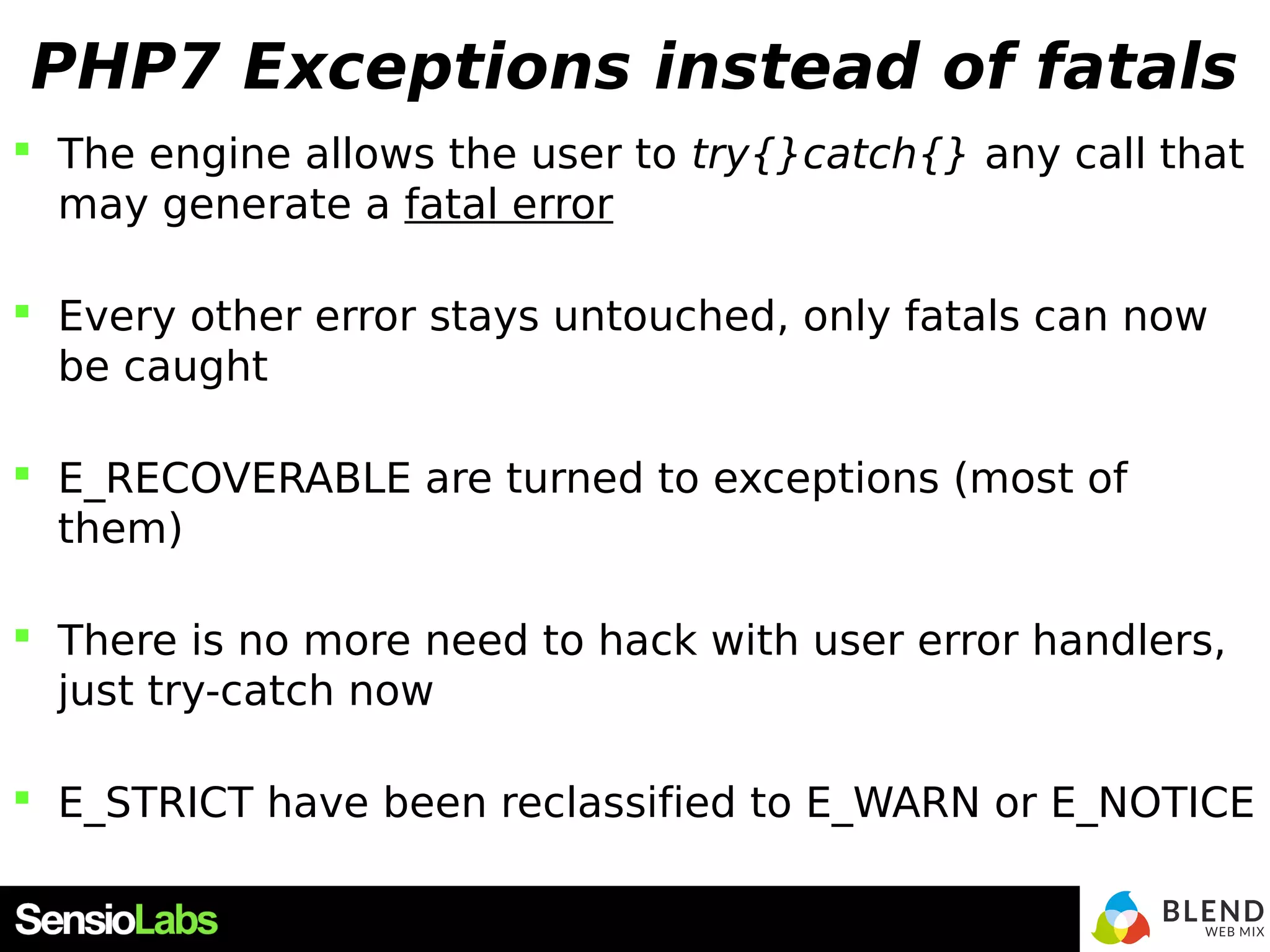
PHP7 Exceptions instead of fatals
 The engine allows the user to try{}catch{} any call that
may generate a fatal error
 Every other error stays untouched, only fatals can now
be caught
 E_RECOVERABLE are turned to exceptions (most of
them)
 There is no more need to hack with user error handlers,
just try-catch now
 E_STRICT have been reclassified to E_WARN or E_NOTICE
PHP7 Exceptions instead of fatals
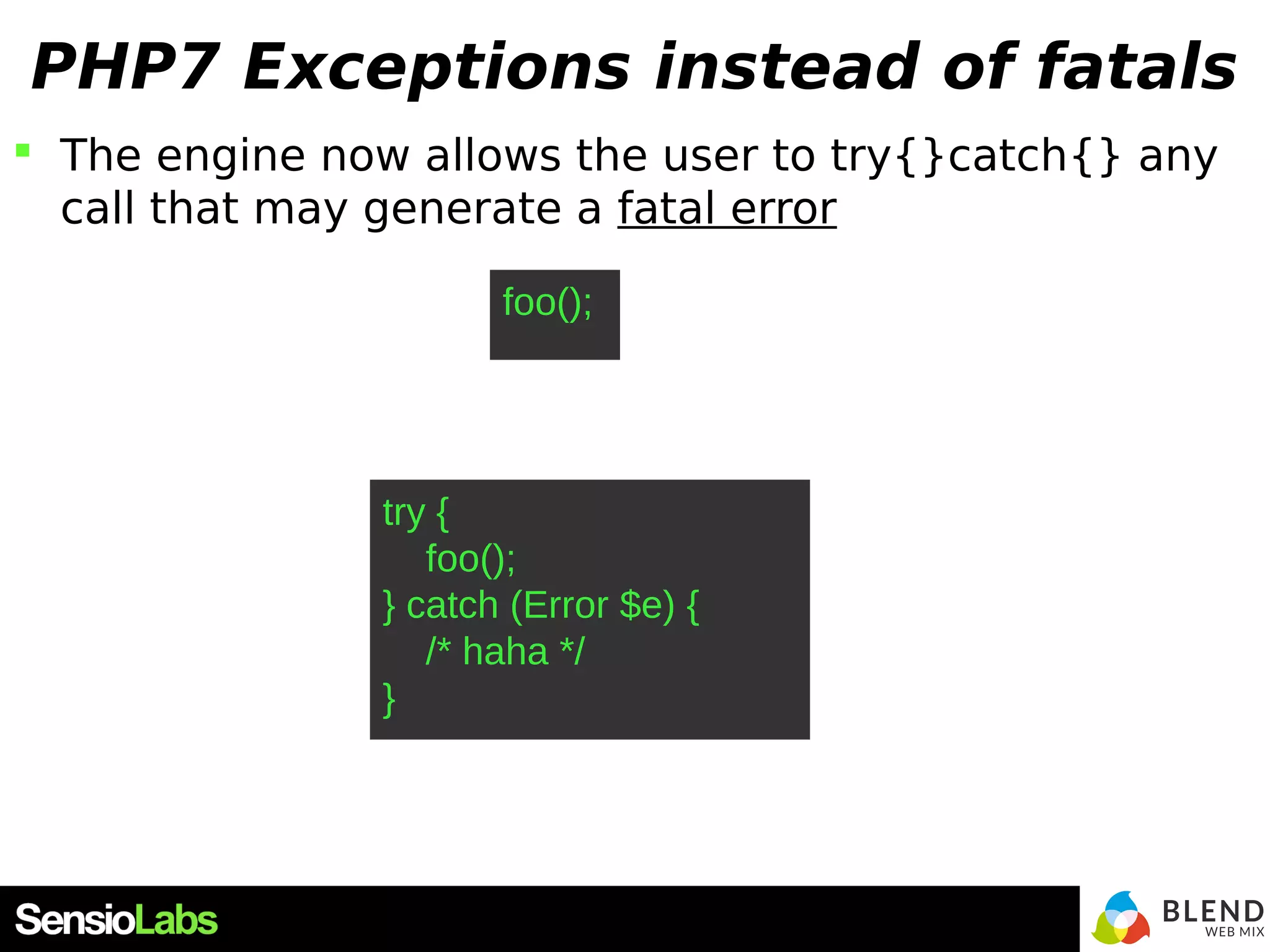
 The engine now allows the user to try{}catch{} any
call that may generate a fatal error
foo();
try {
foo();
} catch (Error $e) {
/* haha */
}
PHP7 Exceptions instead of fatals
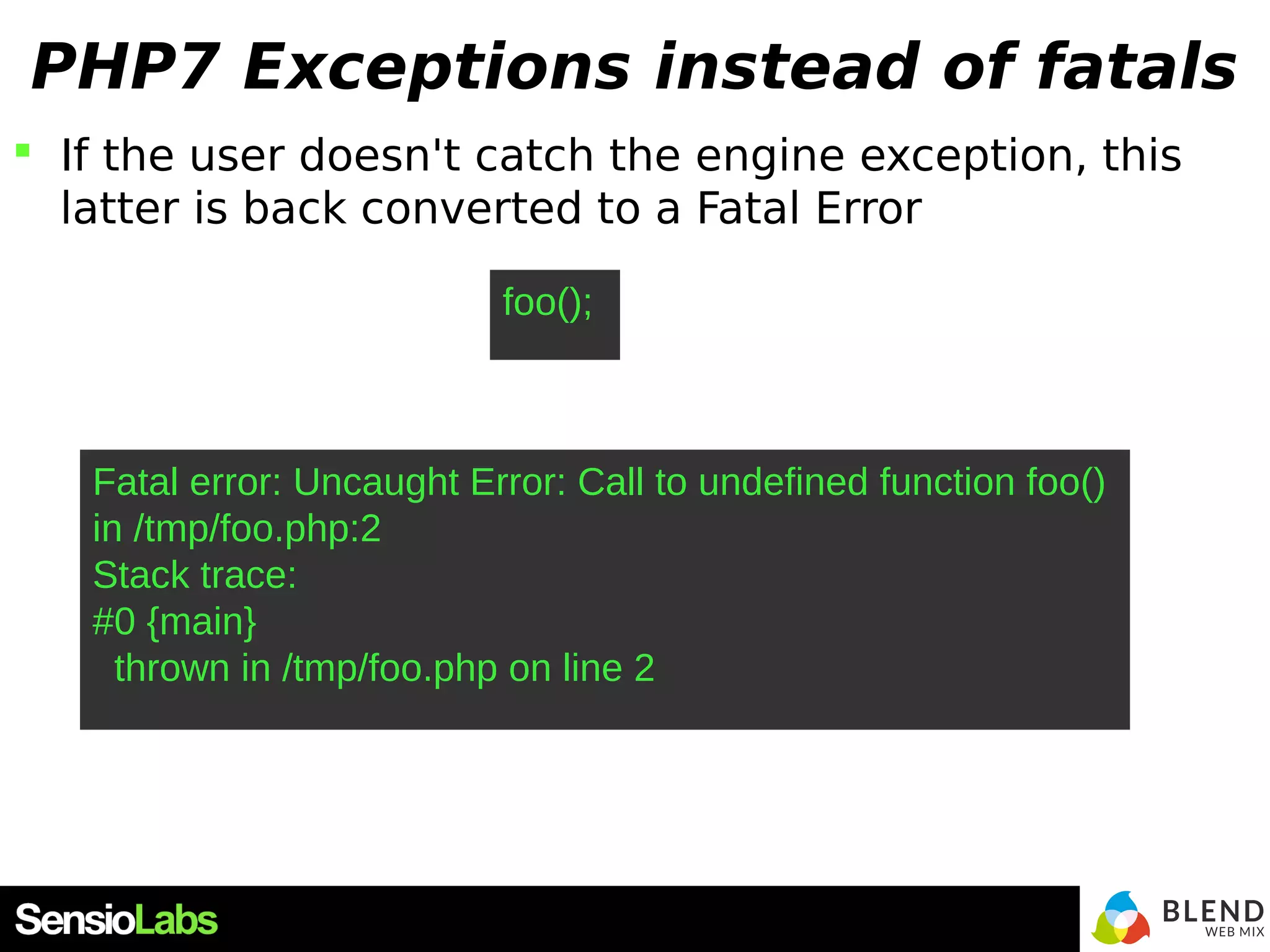
 If the user doesn't catch the engine exception, this
latter is back converted to a Fatal Error
foo();
Fatal error: Uncaught Error: Call to undefined function foo()
in /tmp/foo.php:2
Stack trace:
#0 {main}
thrown in /tmp/foo.php on line 2
PHP7 Exceptions instead of fatals
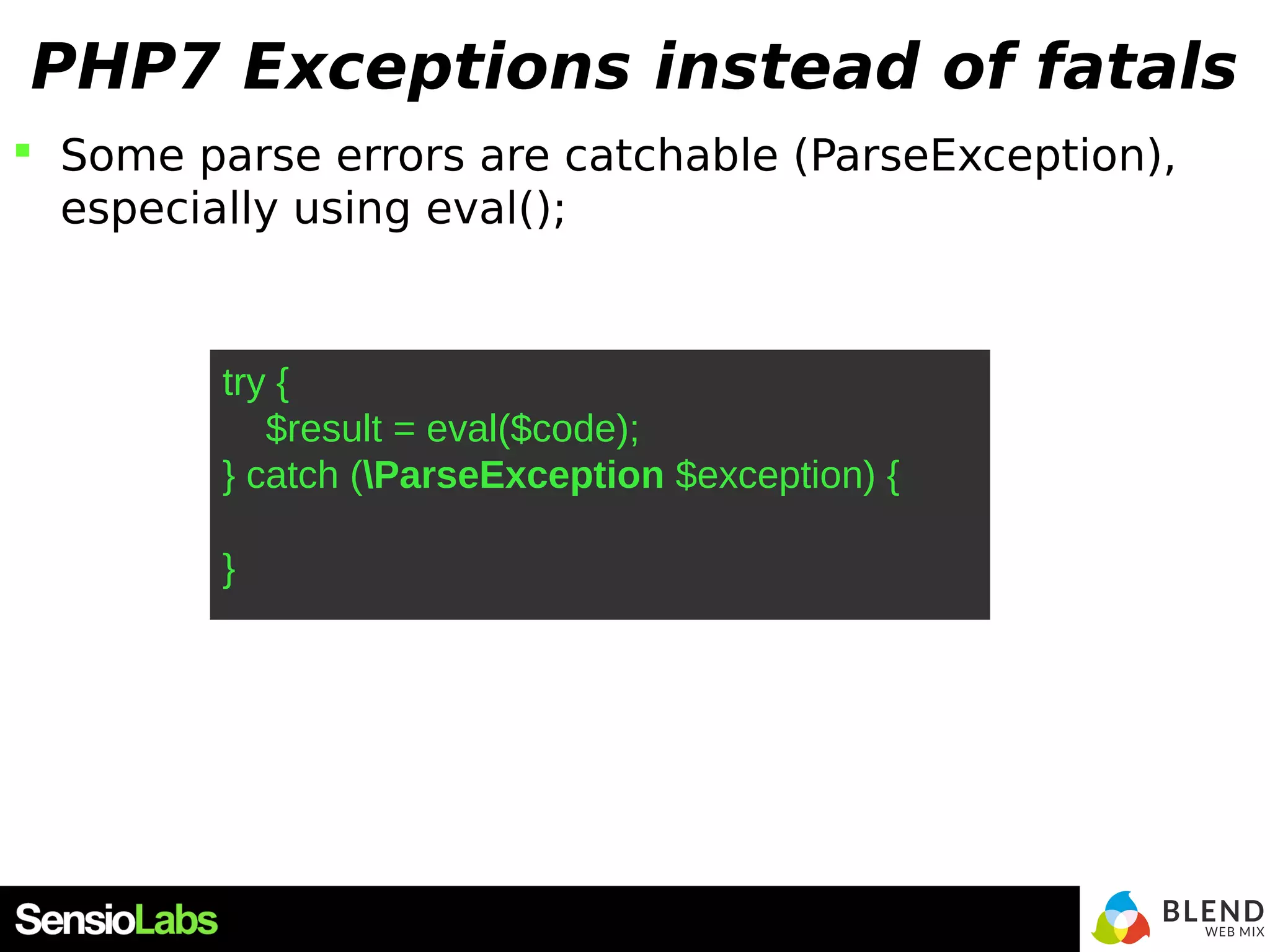
 Some parse errors are catchable (ParseException),
especially using eval();
try {
$result = eval($code);
} catch (ParseException $exception) {
}
PHP7 Exceptions instead of fatals
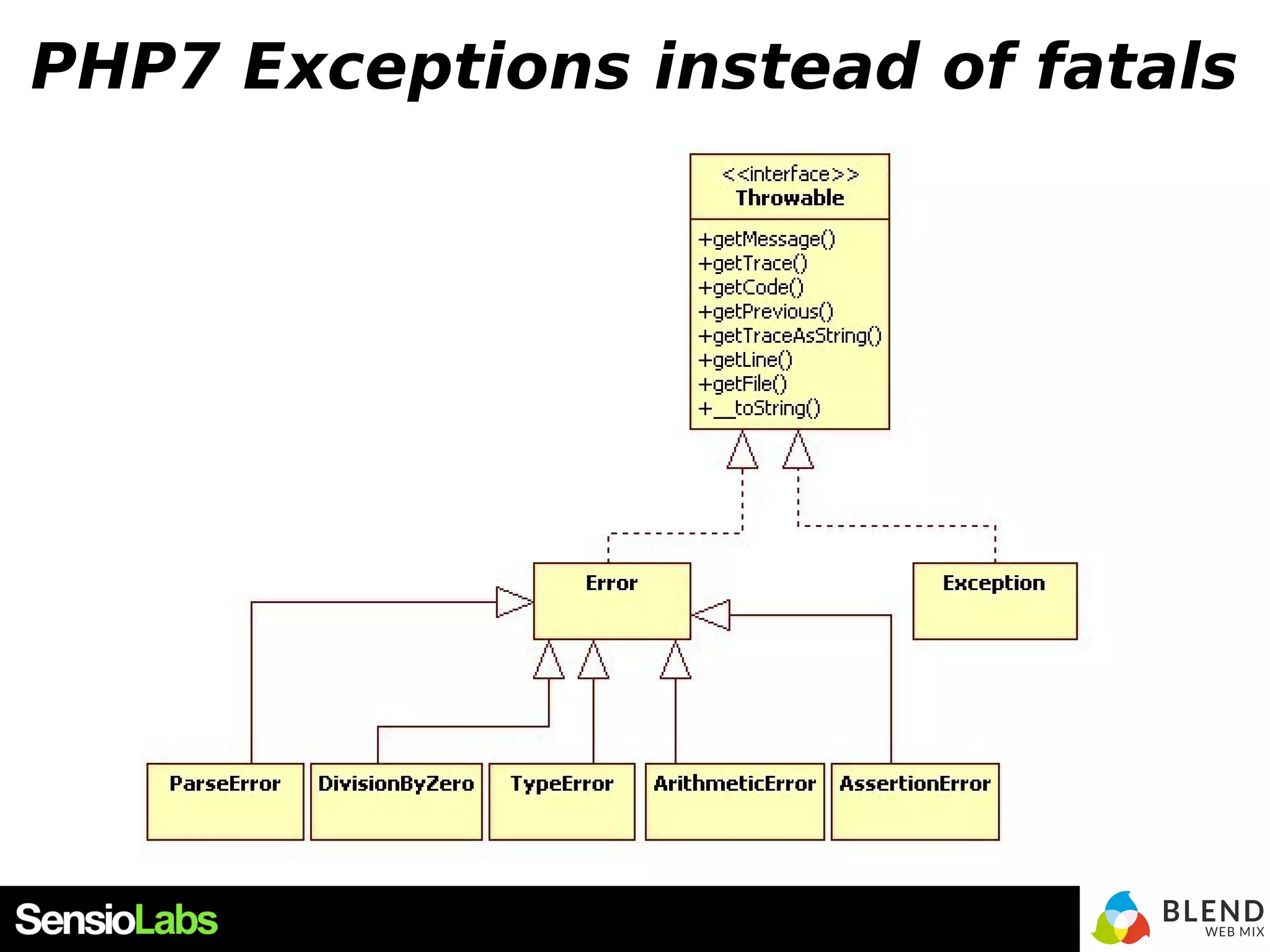
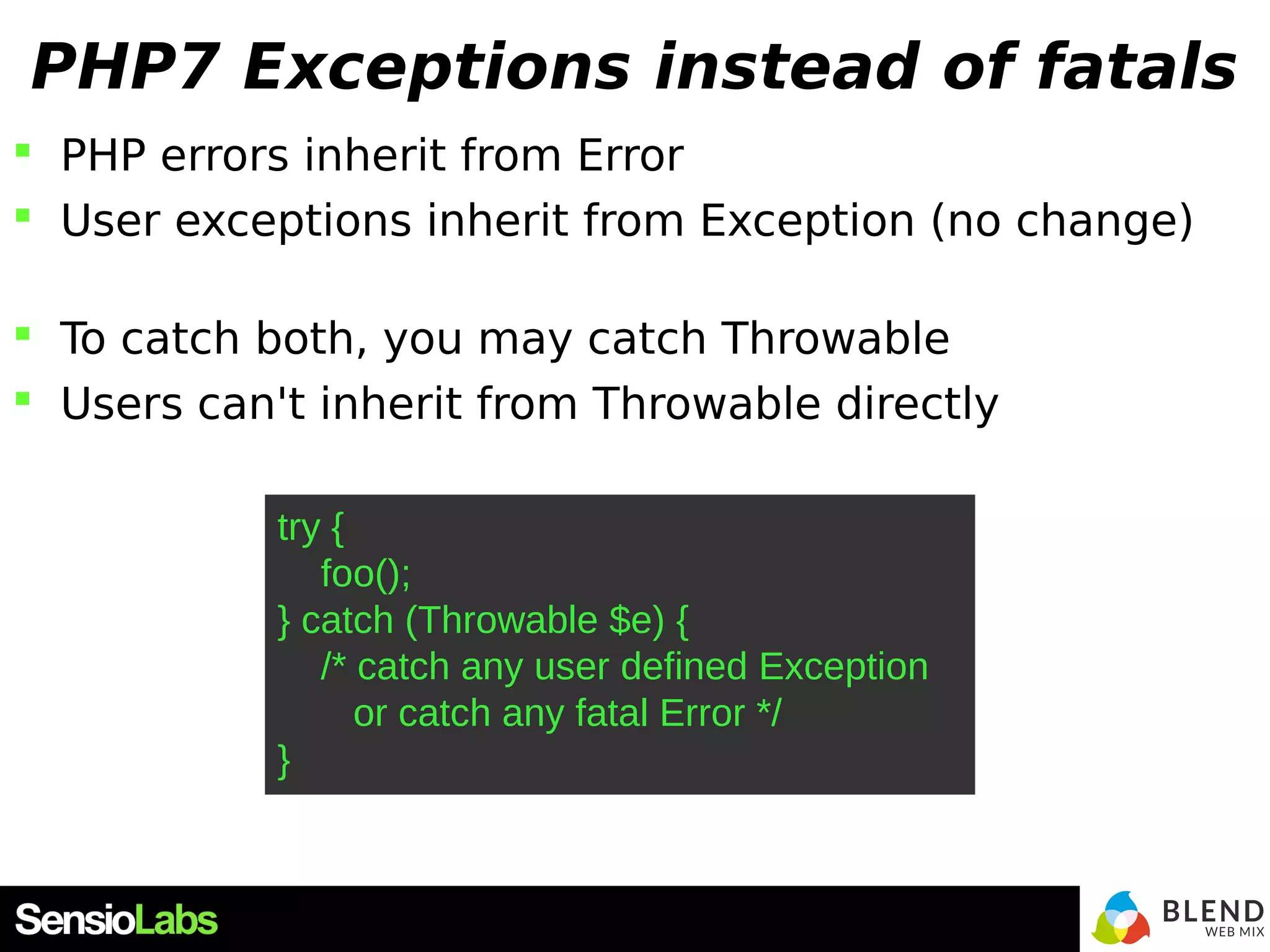
 PHP errors inherit from Error
 User exceptions inherit from Exception (no change)
 To catch both, you may catch Throwable
 Users can't inherit from Throwable directly
try {
foo();
} catch (Throwable $e) {
/* catch any user defined Exception
or catch any fatal Error */
}
PHP7 Closures
 Closure::call(object $to, [mixed ...$params])
 Allows to bind a Closure to a specific object at
runtime
 Won't work for internal classes : user classes only
class Foo { public $bar; }
$foo = new Foo;
$foo->bar = 3;
$foobar = function ($qux) { var_dump($this->bar + $qux); };
$foobar->call($foo, 4); /* int(7) */
PHP7 return type declaration
 Functions may declare return types.
 Types "null" and "resource" are not supported
 Those are checked at runtime issuing Fatal errors
function foo(): int {
return [];
}
foo();
Fatal error: Return value of foo() must be of the
type integer, array returned
PHP7 return type declaration
 Functions may declare return types
 Types "null" and "resource" are not supported
 PHP will try to convert them when possible, if not, it
issues a fatal error
function foo($i): int {
return $i;
}
var_dump(foo("123"));
(int)123
var_dump(foo( ["123"] ));
Fatal error: Return value of foo() must be of
the type integer, array returned
PHP7 return type declaration
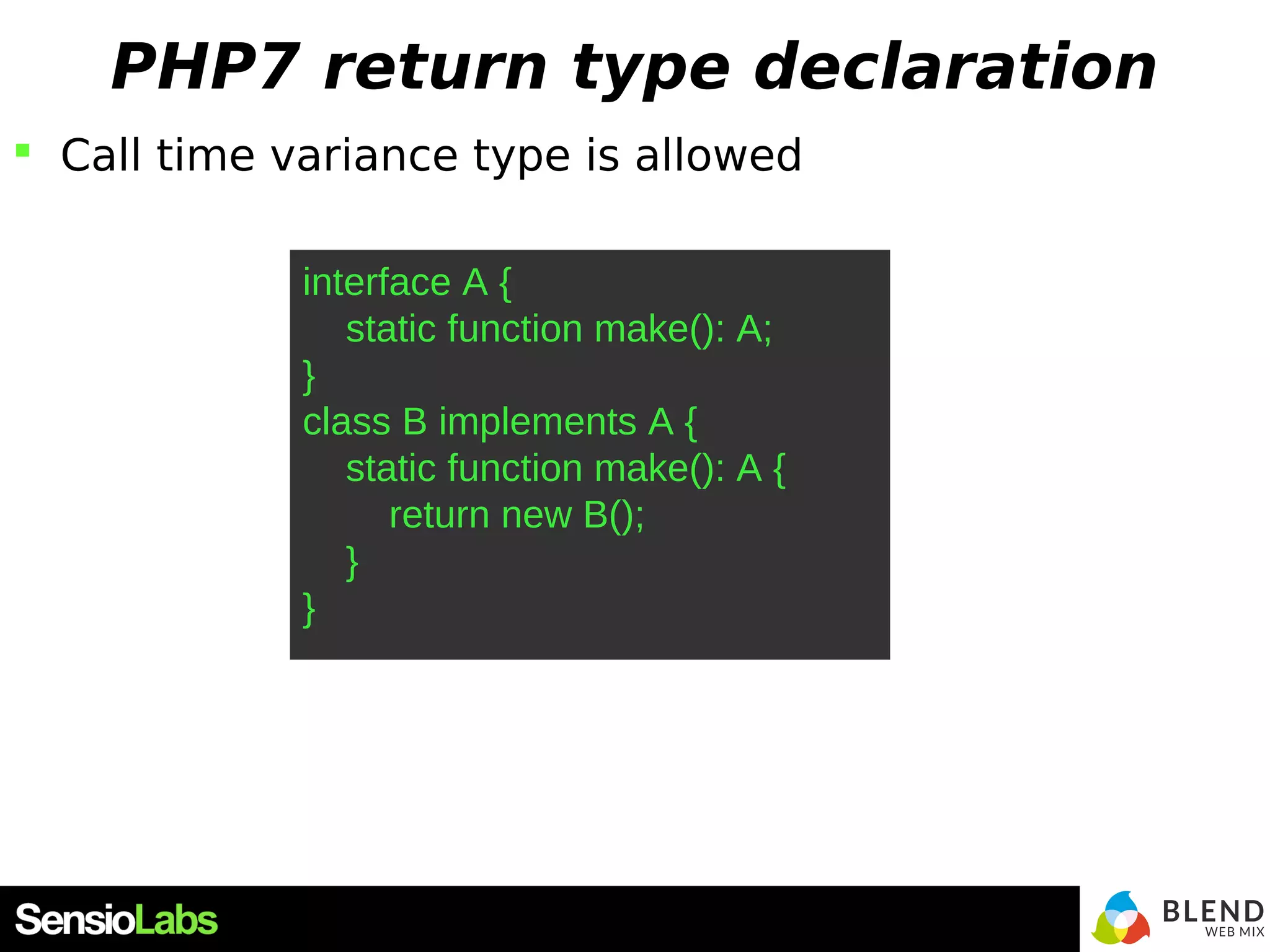
 Call time variance type is allowed
interface A {
static function make(): A;
}
class B implements A {
static function make(): A {
return new B();
}
}
PHP7 return type declaration
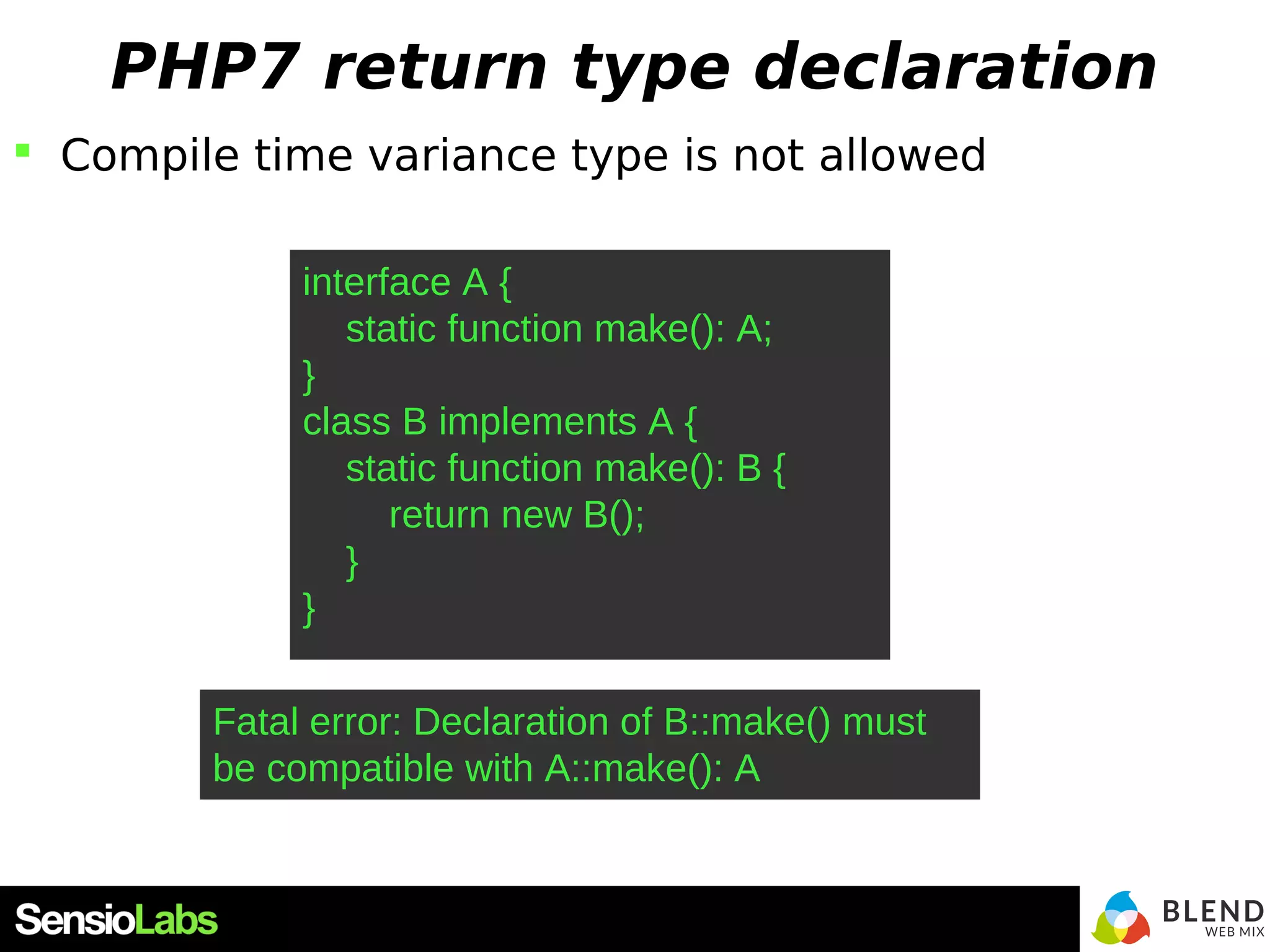
 Compile time variance type is not allowed
interface A {
static function make(): A;
}
class B implements A {
static function make(): B {
return new B();
}
}
Fatal error: Declaration of B::make() must
be compatible with A::make(): A
PHP7 scalar type hints
 Scalar type hints are now allowed in functions arguments
declarations
 Type "null" and "resource" are not supported
 https://wiki.php.net/rfc/scalar_type_hints_v5
function foo(int $i, string $j, bool $k) { }
PHP7 scalar type hints
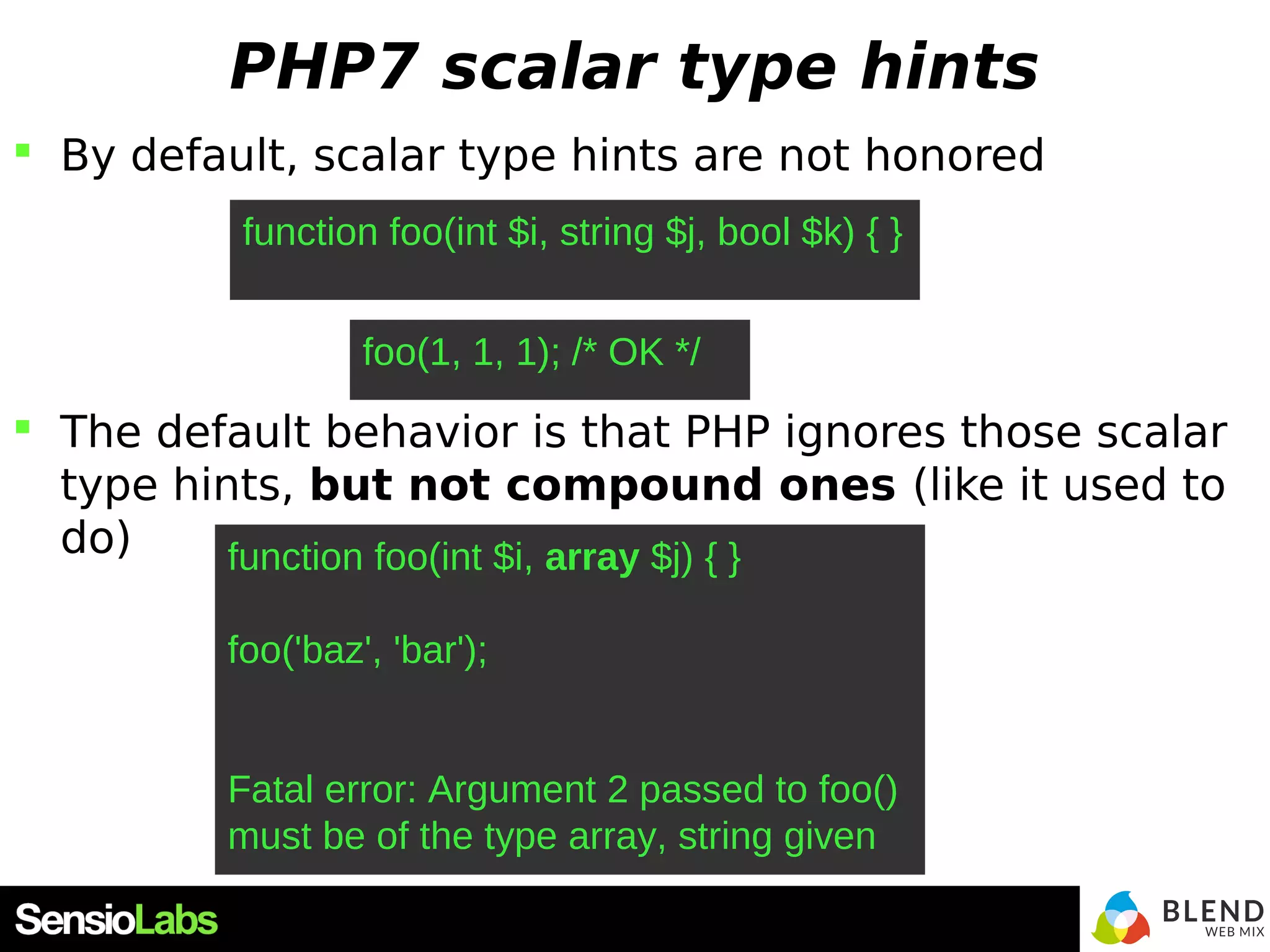
 By default, scalar type hints are not honored
 The default behavior is that PHP ignores those scalar
type hints, but not compound ones (like it used to
do)
function foo(int $i, string $j, bool $k) { }
foo(1, 1, 1); /* OK */
function foo(int $i, array $j) { }
foo('baz', 'bar');
Fatal error: Argument 2 passed to foo()
must be of the type array, string given
PHP7 scalar type hints
 PHP converts the scalar type hinted arguments
function foo(int $i, string $j, bool $k)
{
var_dump(func_get_args());
}
foo('12', 0, 'foo');
array(3) {
[0]=>
int(12)
[1]=>
string(1) "0"
[2]=>
bool(true)
}
PHP7 scalar type hints
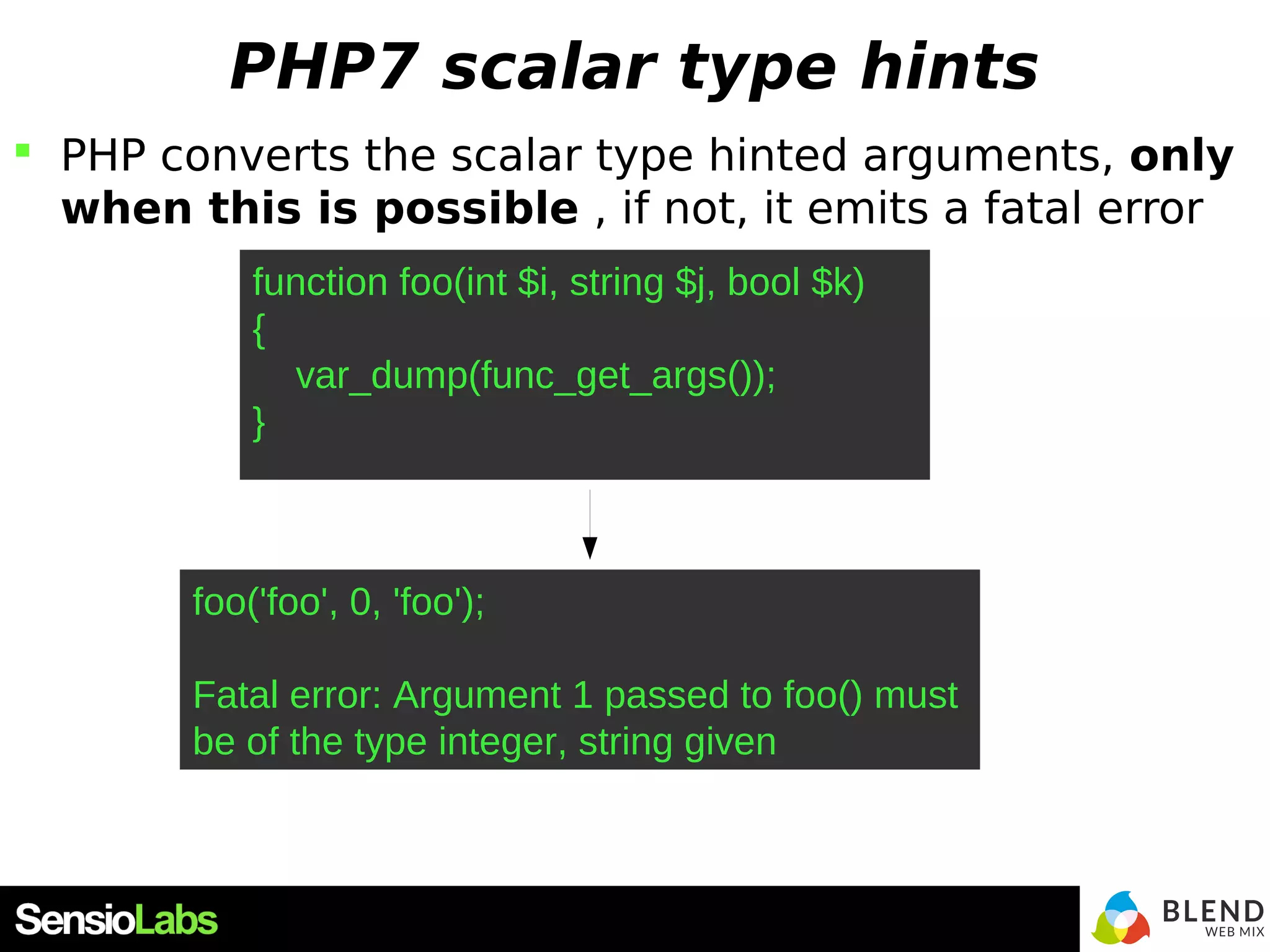
 PHP converts the scalar type hinted arguments, only
when this is possible , if not, it emits a fatal error
function foo(int $i, string $j, bool $k)
{
var_dump(func_get_args());
}
foo('foo', 0, 'foo');
Fatal error: Argument 1 passed to foo() must
be of the type integer, string given
PHP7 scalar type hints errors
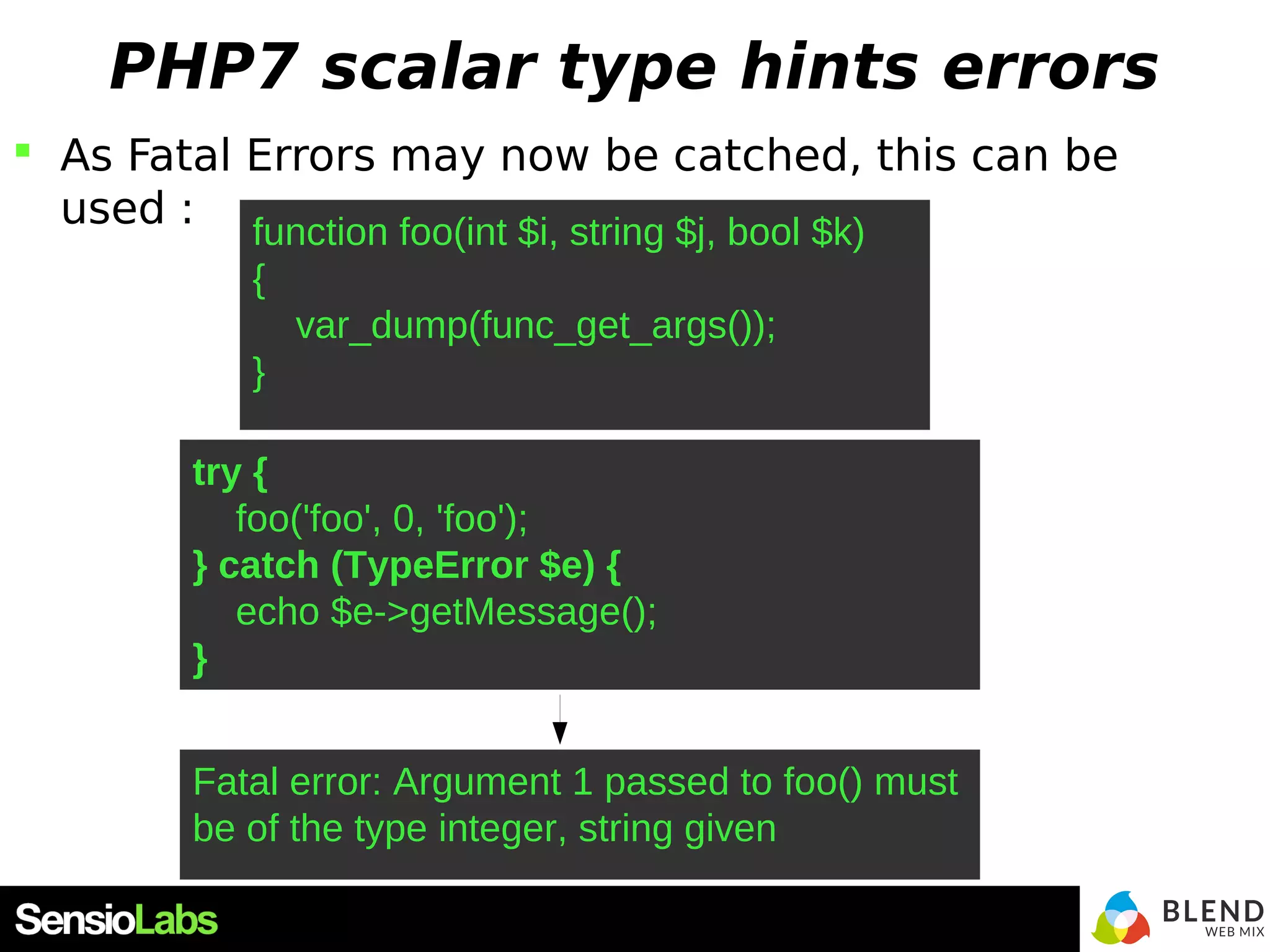
 As Fatal Errors may now be catched, this can be
used : function foo(int $i, string $j, bool $k)
{
var_dump(func_get_args());
}
try {
foo('foo', 0, 'foo');
} catch (TypeError $e) {
echo $e->getMessage();
}
Fatal error: Argument 1 passed to foo() must
be of the type integer, string given
PHP7 scalar type hints
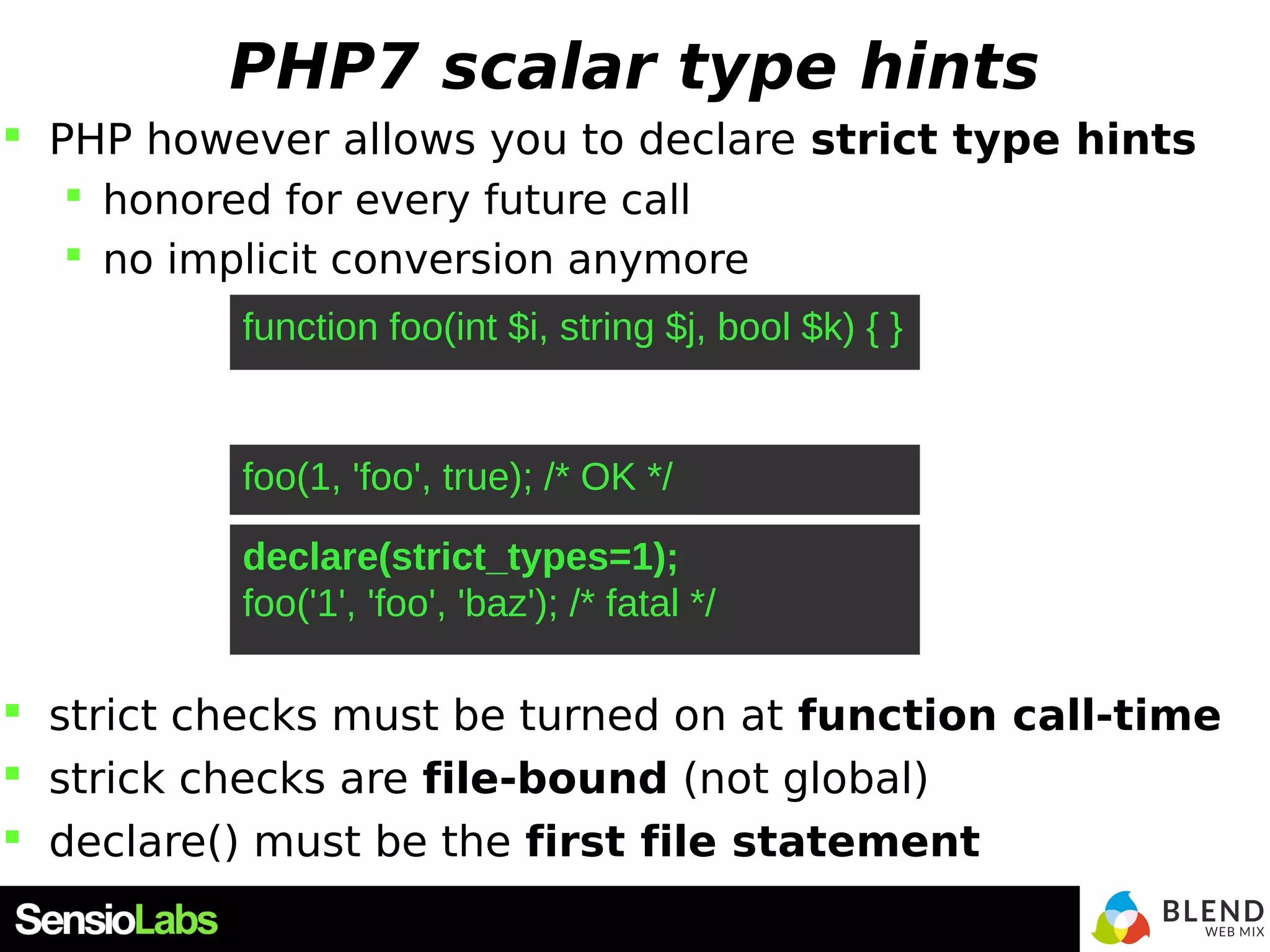
 PHP however allows you to declare strict type hints
 honored for every future call
 no implicit conversion anymore
 strict checks must be turned on at function call-time
 strick checks are file-bound (not global)
 declare() must be the first file statement
function foo(int $i, string $j, bool $k) { }
foo(1, 'foo', true); /* OK */
declare(strict_types=1);
foo('1', 'foo', 'baz'); /* fatal */
PHP7 scalar type hints
 strict mode is also relevant for return type hints :
function foo(int $i) :string { return $i; }
var_dump(foo("123 pigs"));
string(3) "123"
declare(strict_types=1);
var_dump(foo(123));
Fatal error: Return value of foo() must be
of the type string, integer returned
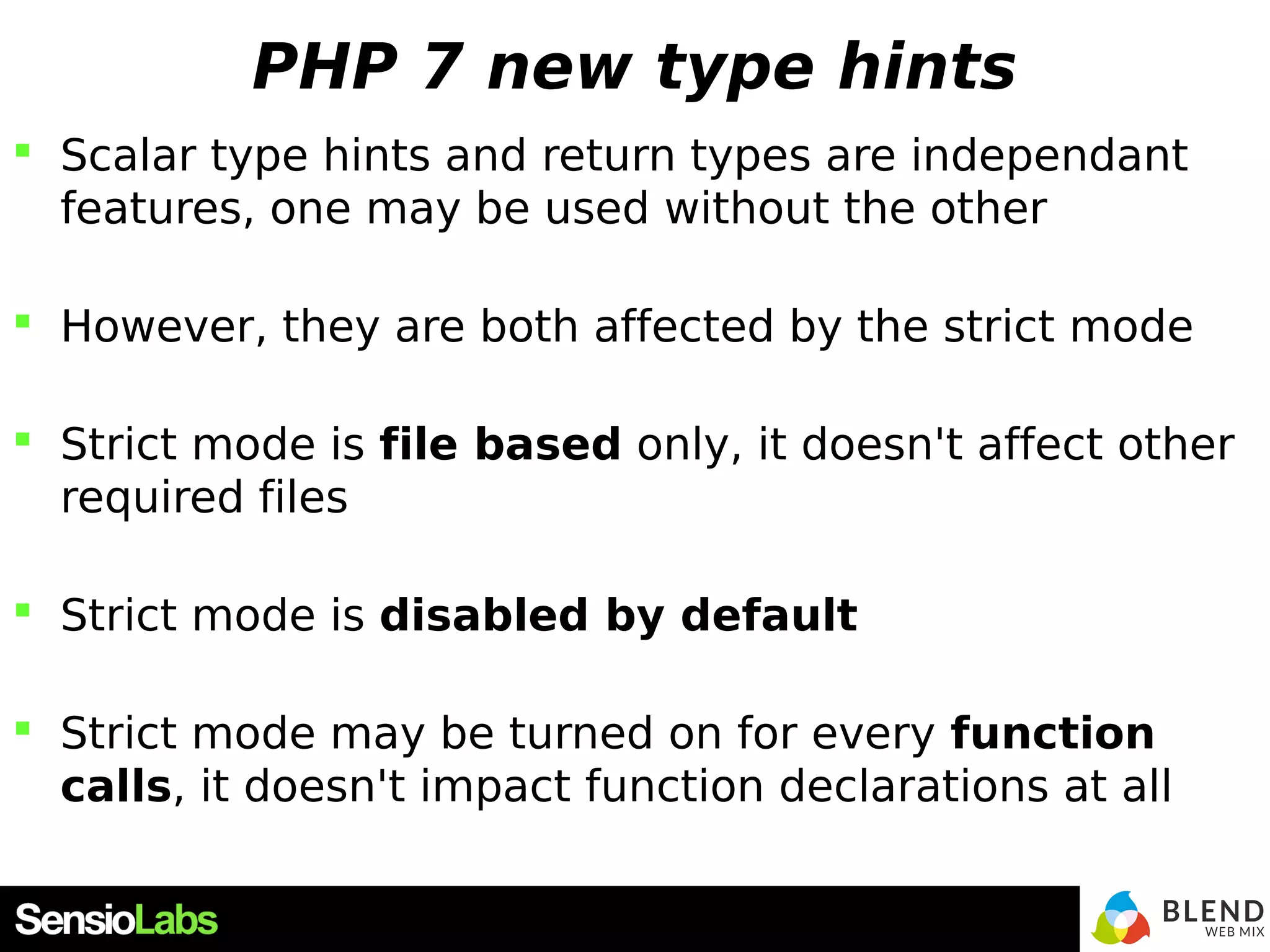
PHP 7 new type hints
 Scalar type hints and return types are independant
features, one may be used without the other
 However, they are both affected by the strict mode
 Strict mode is file based only, it doesn't affect other
required files
 Strict mode is disabled by default
 Strict mode may be turned on for every function
calls, it doesn't impact function declarations at all
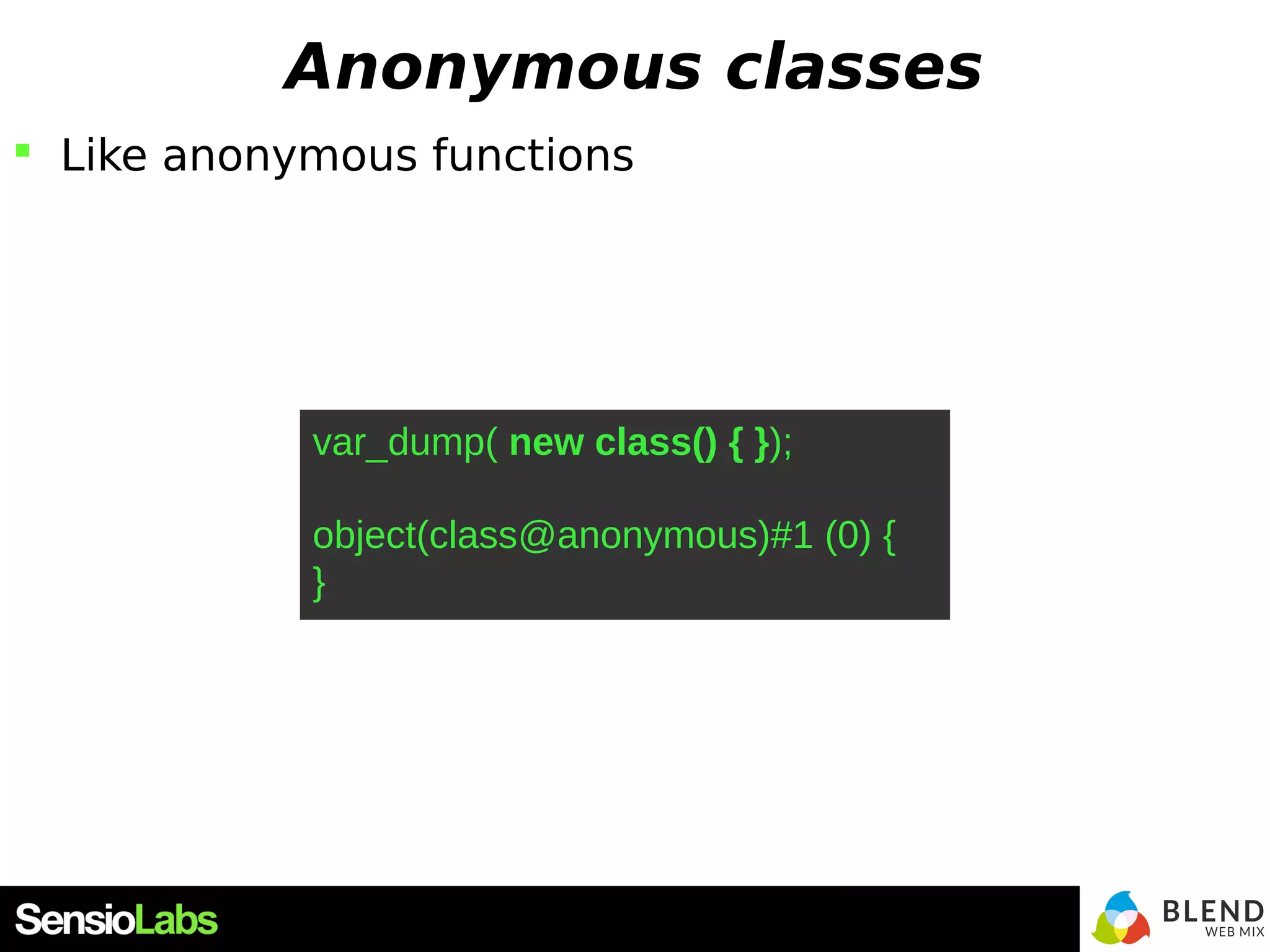
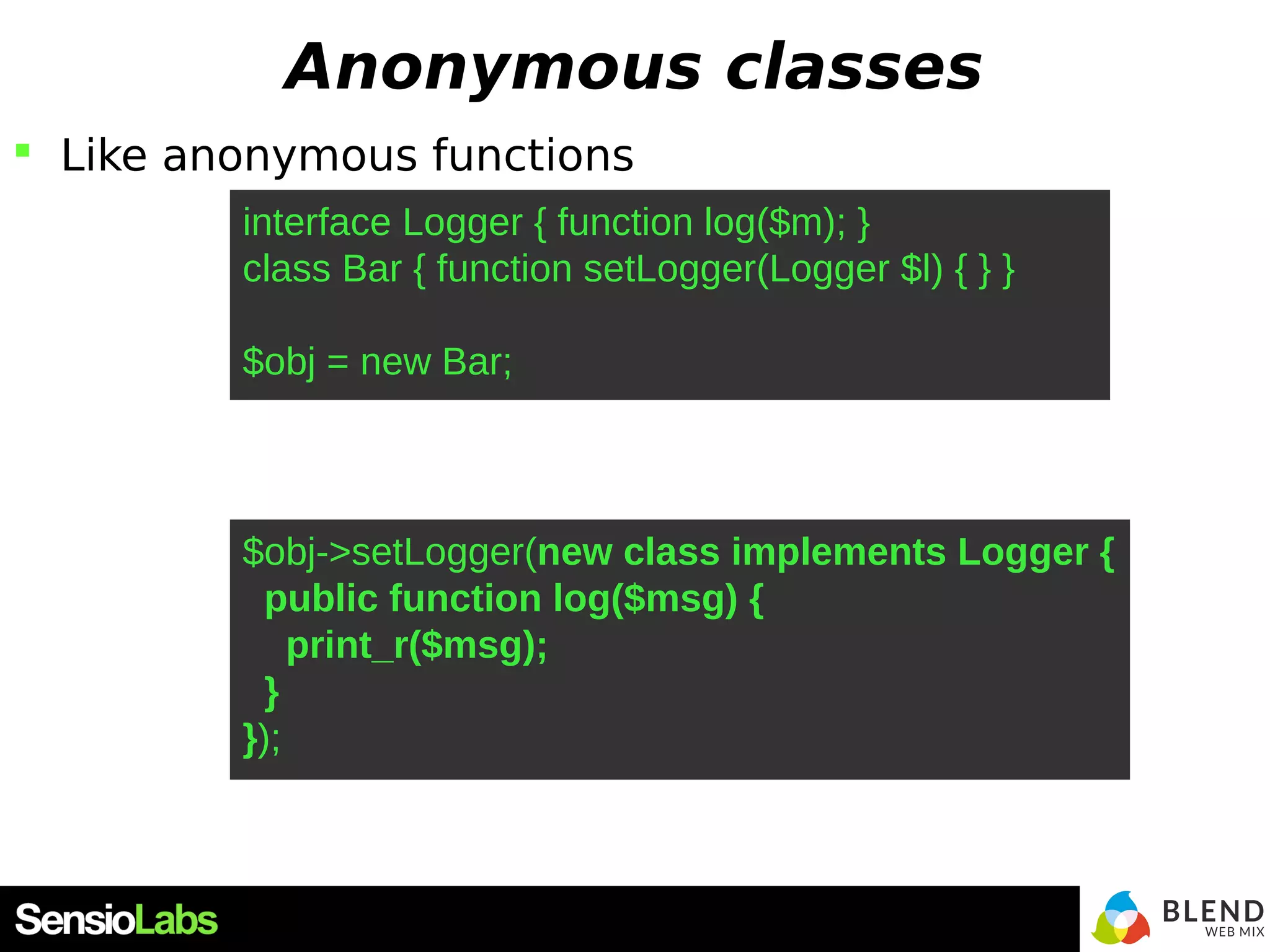
Anonymous classes
 Like anonymous functions
var_dump( new class() { });
object(class@anonymous)#1 (0) {
}
Anonymous classes
 Like anonymous functions
$obj->setLogger(new class implements Logger {
public function log($msg) {
print_r($msg);
}
});
interface Logger { function log($m); }
class Bar { function setLogger(Logger $l) { } }
$obj = new Bar;
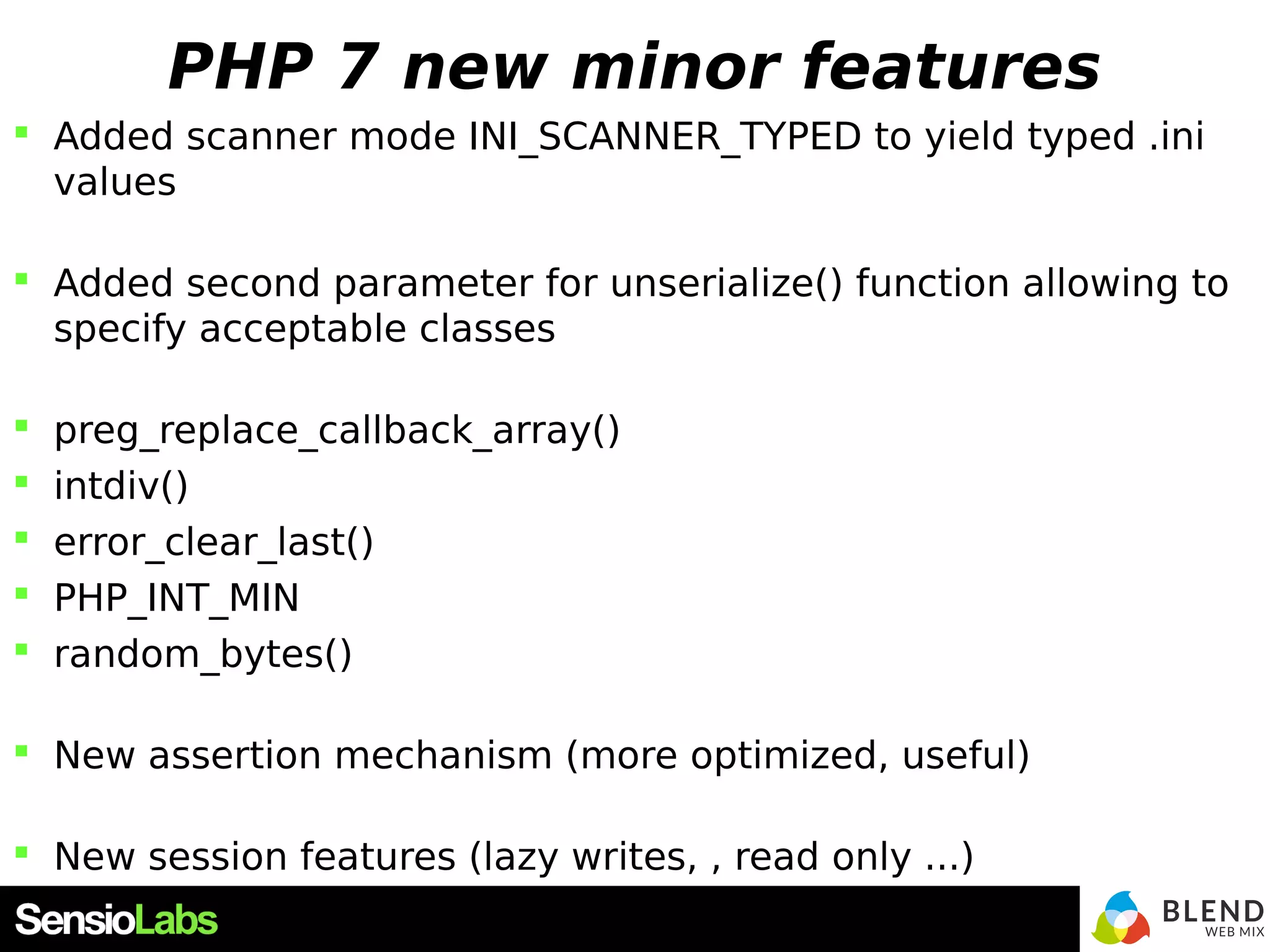
PHP 7 new minor features
 Added scanner mode INI_SCANNER_TYPED to yield typed .ini
values
 Added second parameter for unserialize() function allowing to
specify acceptable classes
 preg_replace_callback_array()
 intdiv()
 error_clear_last()
 PHP_INT_MIN
 random_bytes()
 New assertion mechanism (more optimized, useful)
 New session features (lazy writes, , read only ...)
PHP 7 breakages
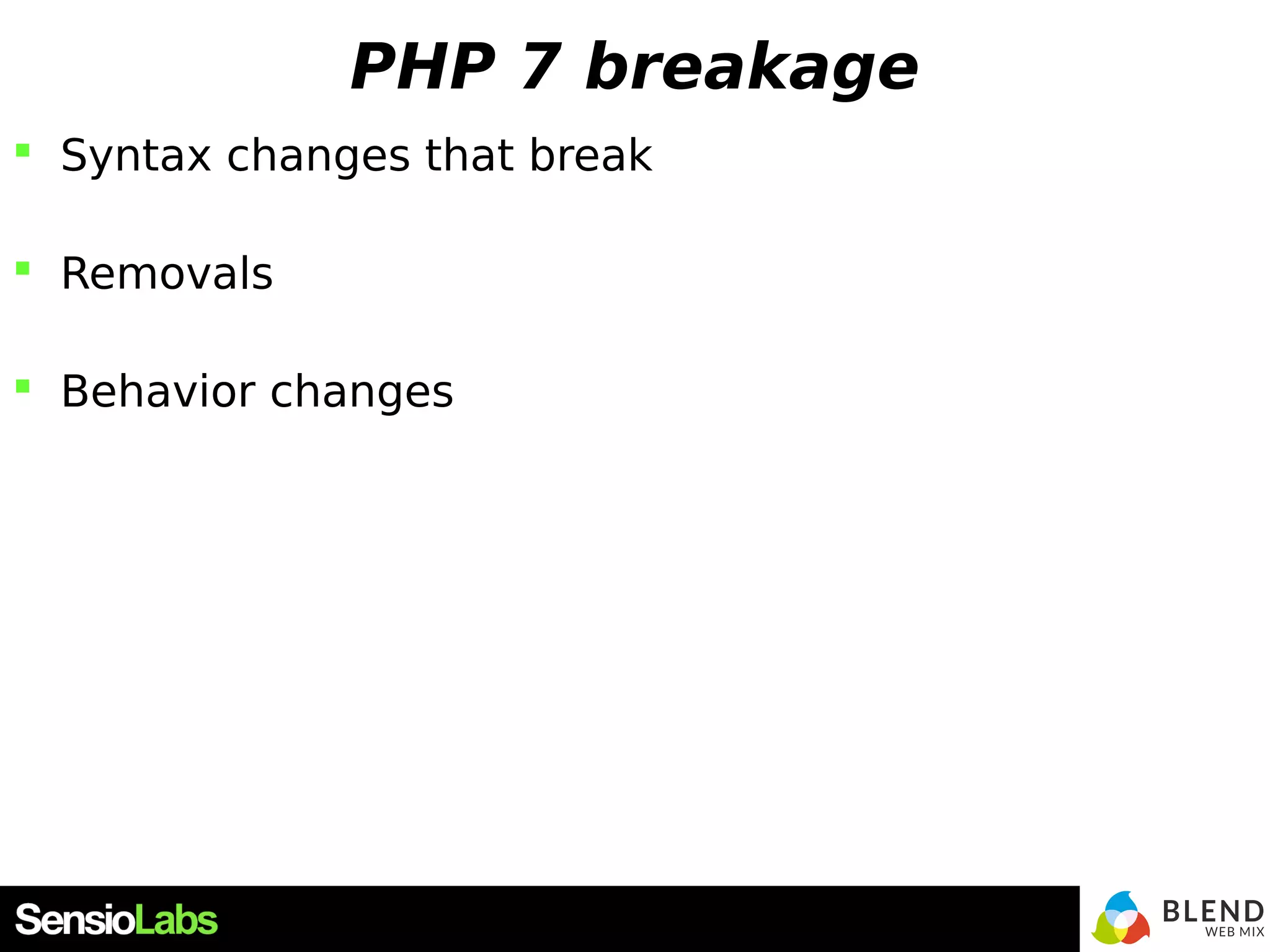
PHP 7 breakage
 Syntax changes that break
 Removals
 Behavior changes
PHP 7 Syntax changes
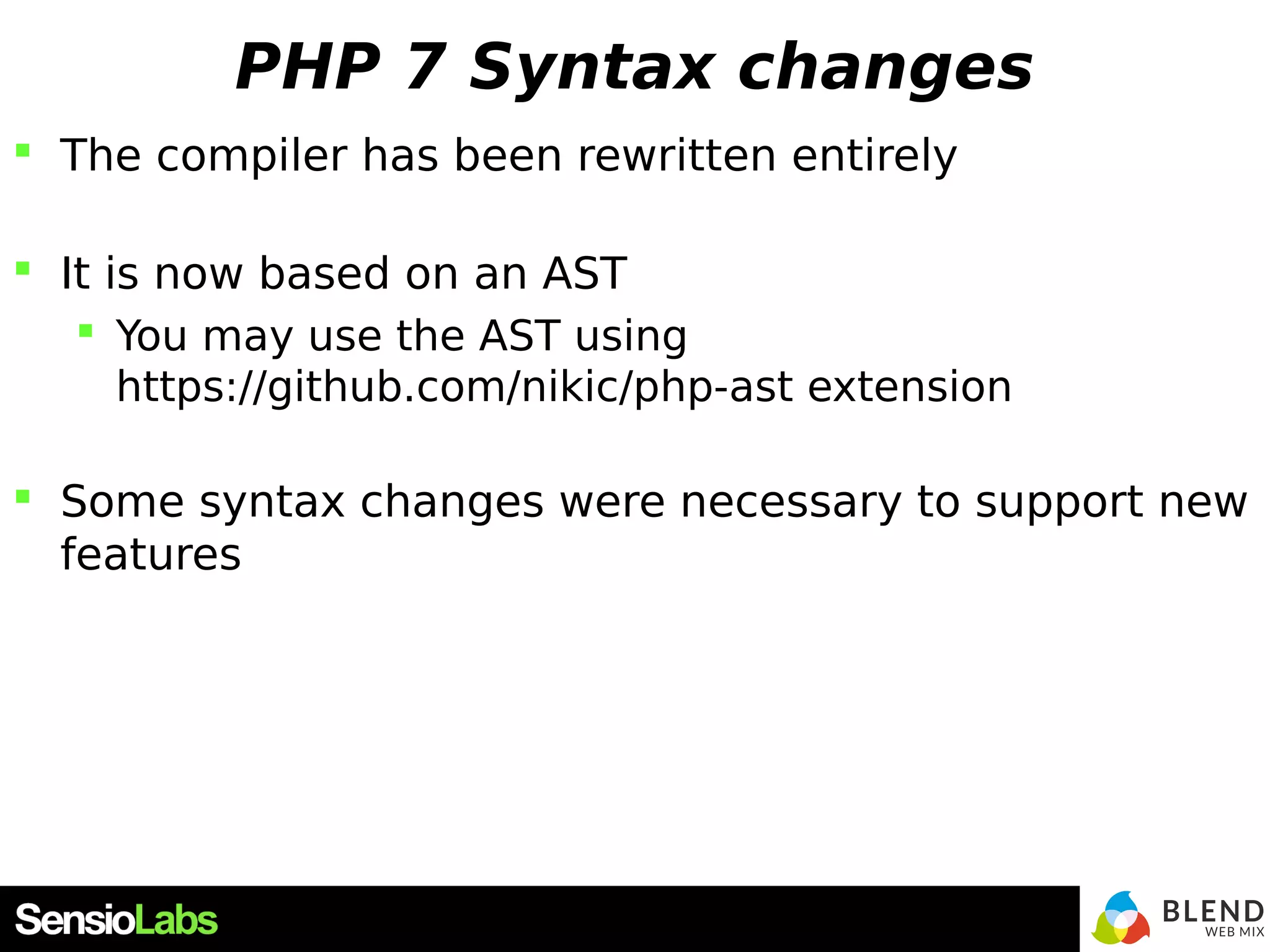
 The compiler has been rewritten entirely
 It is now based on an AST
 You may use the AST using
https://github.com/nikic/php-ast extension
 Some syntax changes were necessary to support new
features
PHP 7 Syntax changes
 Indirect variable, property and method references are
now interpreted with left-to-right semantics
$$foo['bar']['baz']
$foo->$bar['baz']
$foo->$bar['baz']()
Foo::$bar['baz']()
($$foo)['bar']['baz']
($foo->$bar)['baz']
($foo->$bar)['baz']()
(Foo::$bar)['baz']()
${$foo['bar']['baz']}
$foo->{$bar['baz']}
$foo->{$bar['baz']}()
Foo::{$bar['baz']}()
In PHP5
PHP 7 Syntax changes
 list() allows ArrayAccess objects (everytime)
 list() doesn't allow unpacking strings anymore
 Other minor changes to list() ...
list($a, $b) = (object) new ArrayObject([0, 1]);
/* $a == 0 and $b == 1 */
$str = "xy";
list($x, $y) = $str;
/* $x == null and $y == null */
/* no error */
PHP 7 Syntax changes
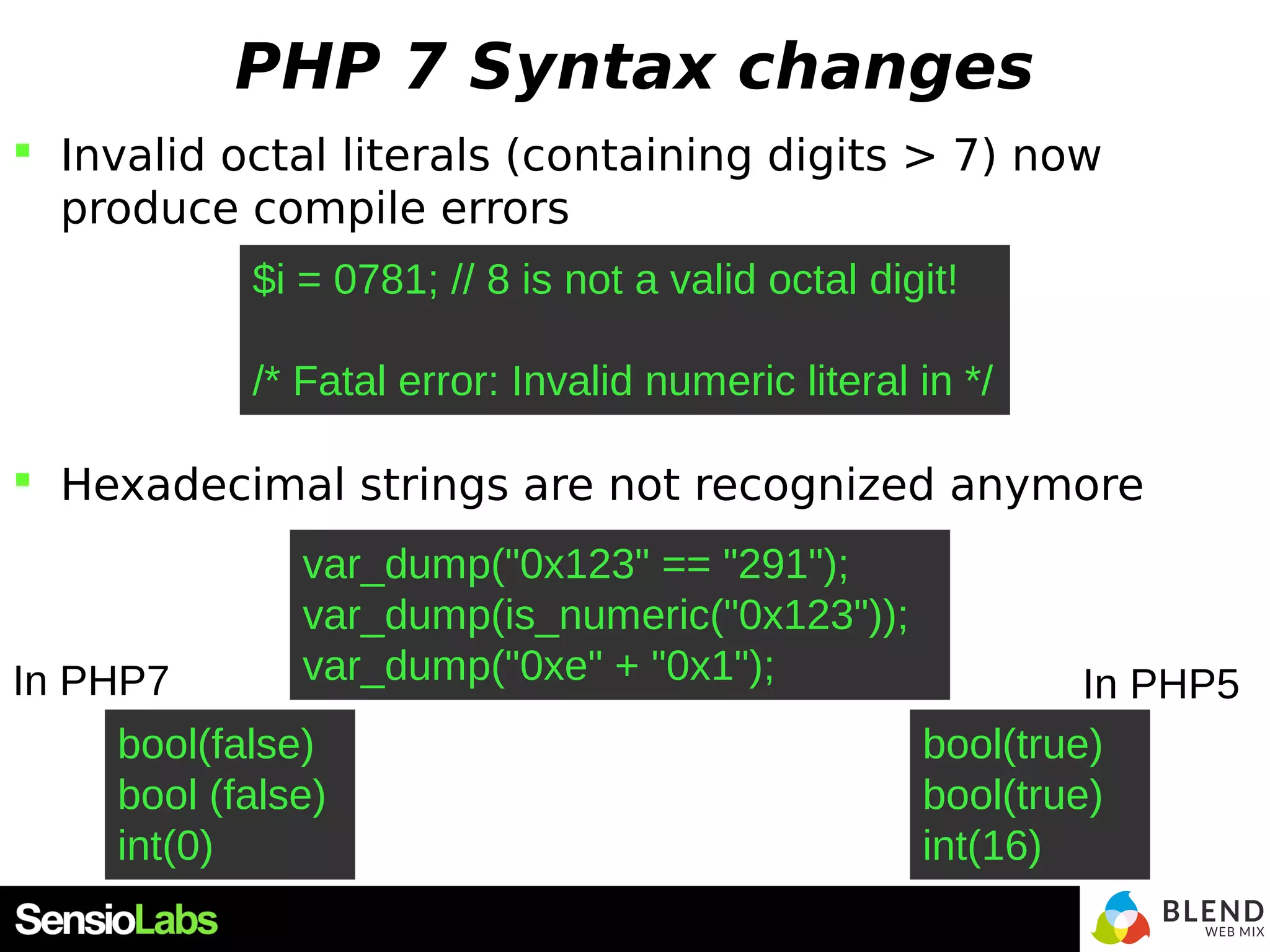
 Invalid octal literals (containing digits > 7) now
produce compile errors
 Hexadecimal strings are not recognized anymore
$i = 0781; // 8 is not a valid octal digit!
/* Fatal error: Invalid numeric literal in */
var_dump("0x123" == "291");
var_dump(is_numeric("0x123"));
var_dump("0xe" + "0x1");
bool(false)
bool (false)
int(0)
bool(true)
bool(true)
int(16)
In PHP5In PHP7
PHP 7 Syntax changes
 The new UTF-8 escape character u has been added
 Only added in heredocs and double-quoted strings
(as usual)
 Codepoints above U+10FFFF generate an error
 https://wiki.php.net/rfc/unicode_escape
echo "u{262F}";
u{262F} ☯
In PHP7In PHP5
PHP 7 Removals
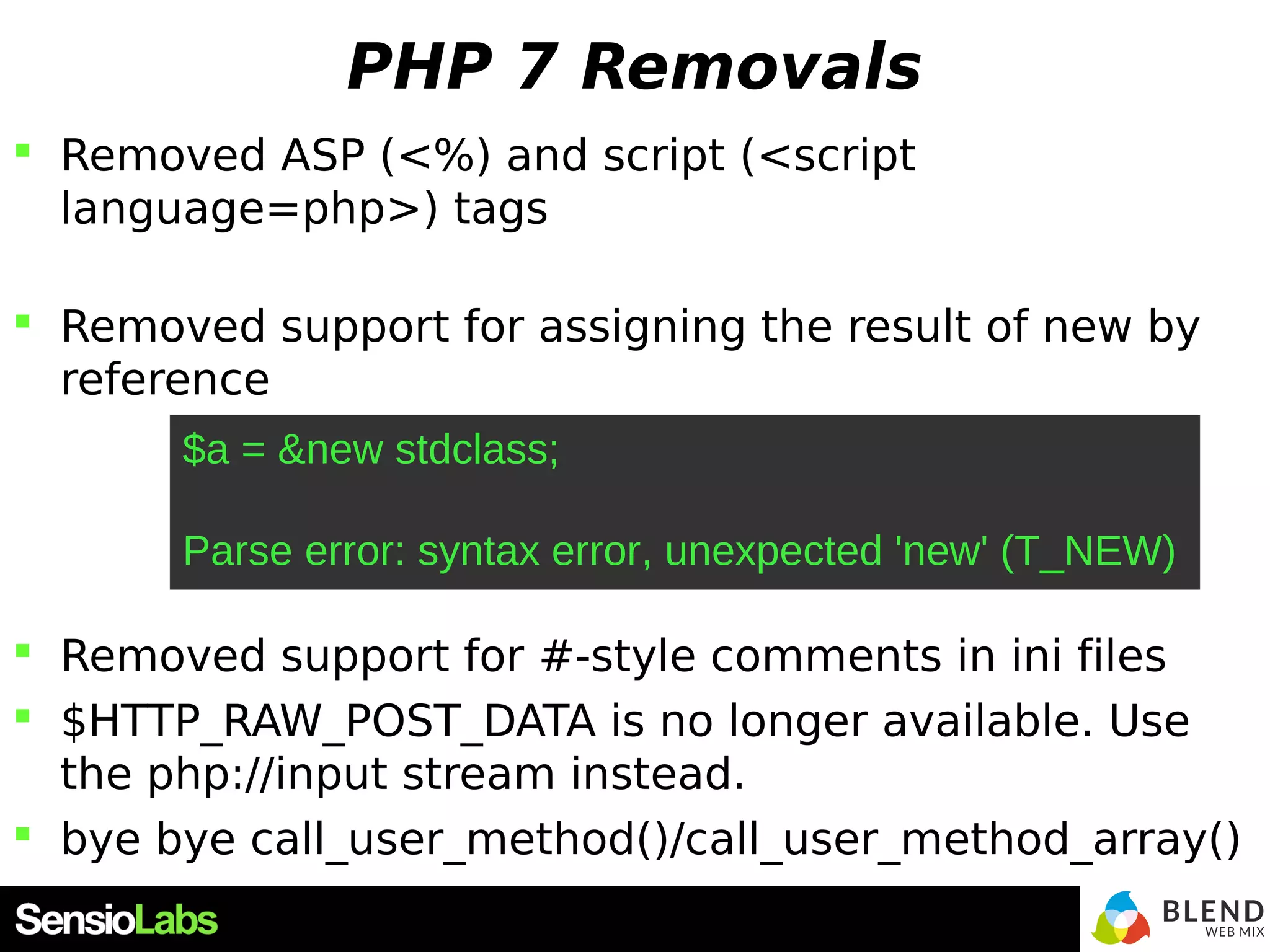
 Removed ASP (<%) and script (<script
language=php>) tags
 Removed support for assigning the result of new by
reference
 Removed support for #-style comments in ini files
 $HTTP_RAW_POST_DATA is no longer available. Use
the php://input stream instead.
 bye bye call_user_method()/call_user_method_array()
$a = &new stdclass;
Parse error: syntax error, unexpected 'new' (T_NEW)
PHP 7 Removals
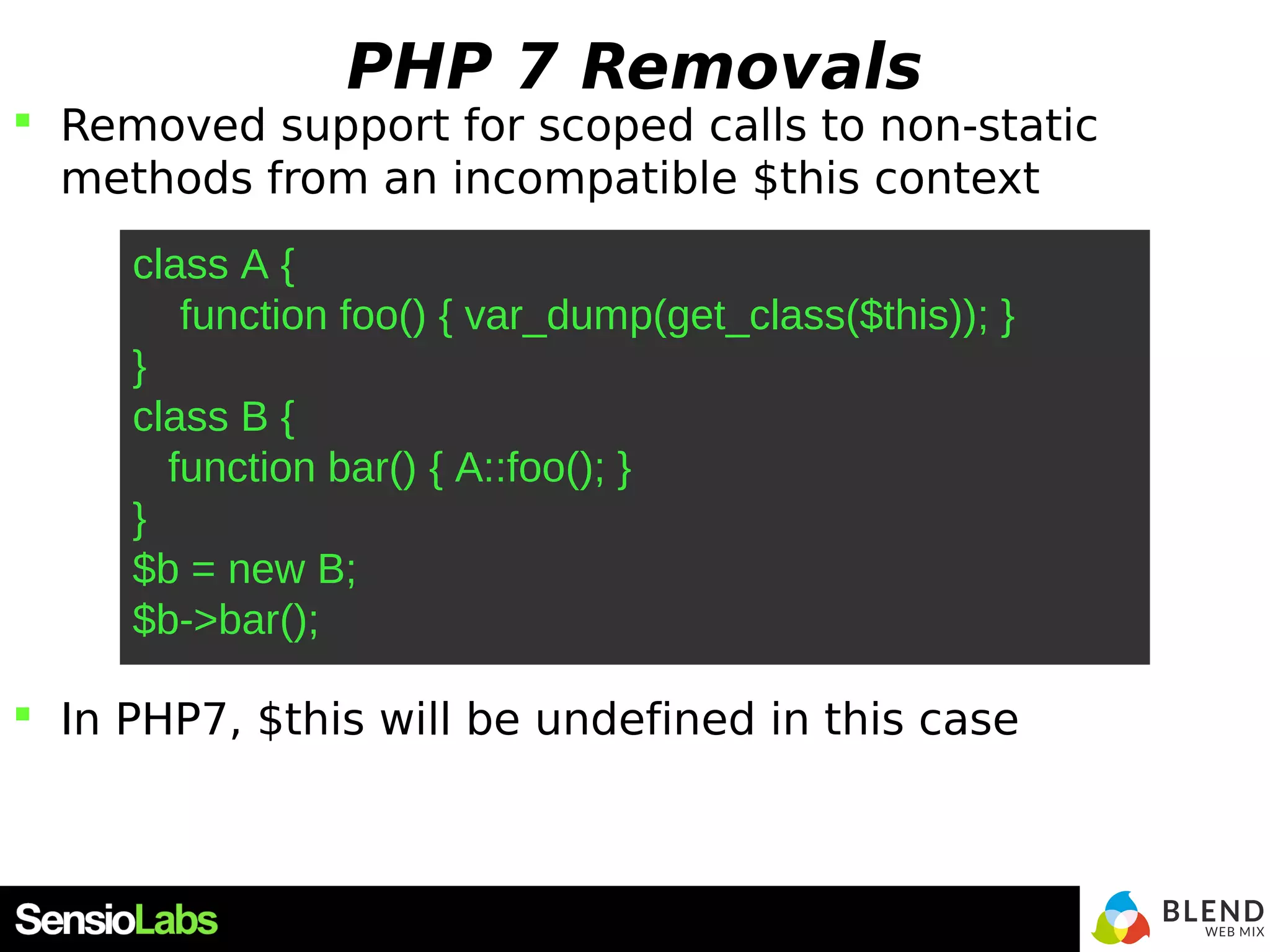
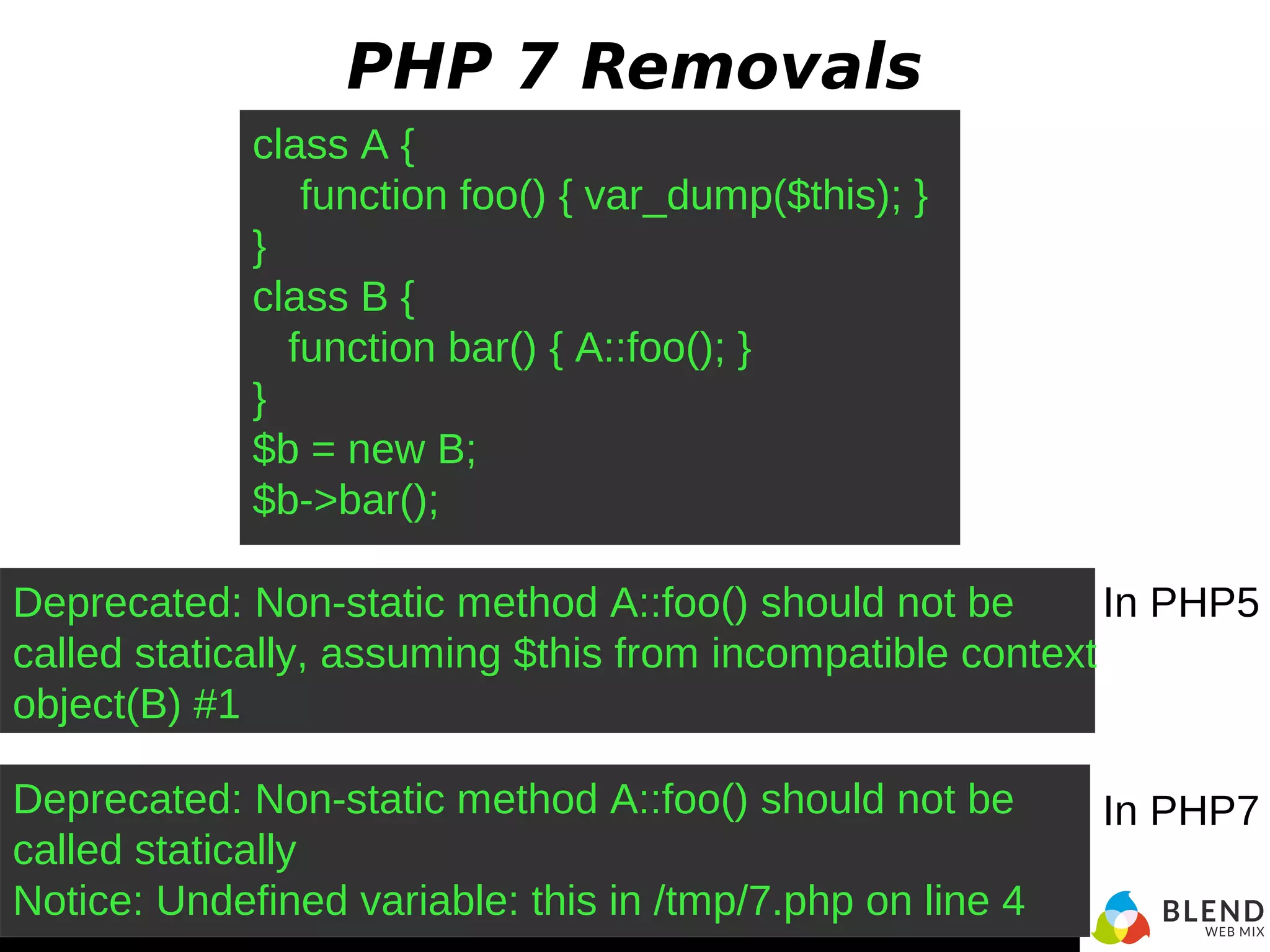
 Removed support for scoped calls to non-static
methods from an incompatible $this context
 In PHP7, $this will be undefined in this case
class A {
function foo() { var_dump(get_class($this)); }
}
class B {
function bar() { A::foo(); }
}
$b = new B;
$b->bar();
PHP 7 Removals
class A {
function foo() { var_dump($this); }
}
class B {
function bar() { A::foo(); }
}
$b = new B;
$b->bar();
Deprecated: Non-static method A::foo() should not be
called statically, assuming $this from incompatible context
object(B) #1
Deprecated: Non-static method A::foo() should not be
called statically
Notice: Undefined variable: this in /tmp/7.php on line 4
In PHP5
In PHP7
PHP 7 Removals
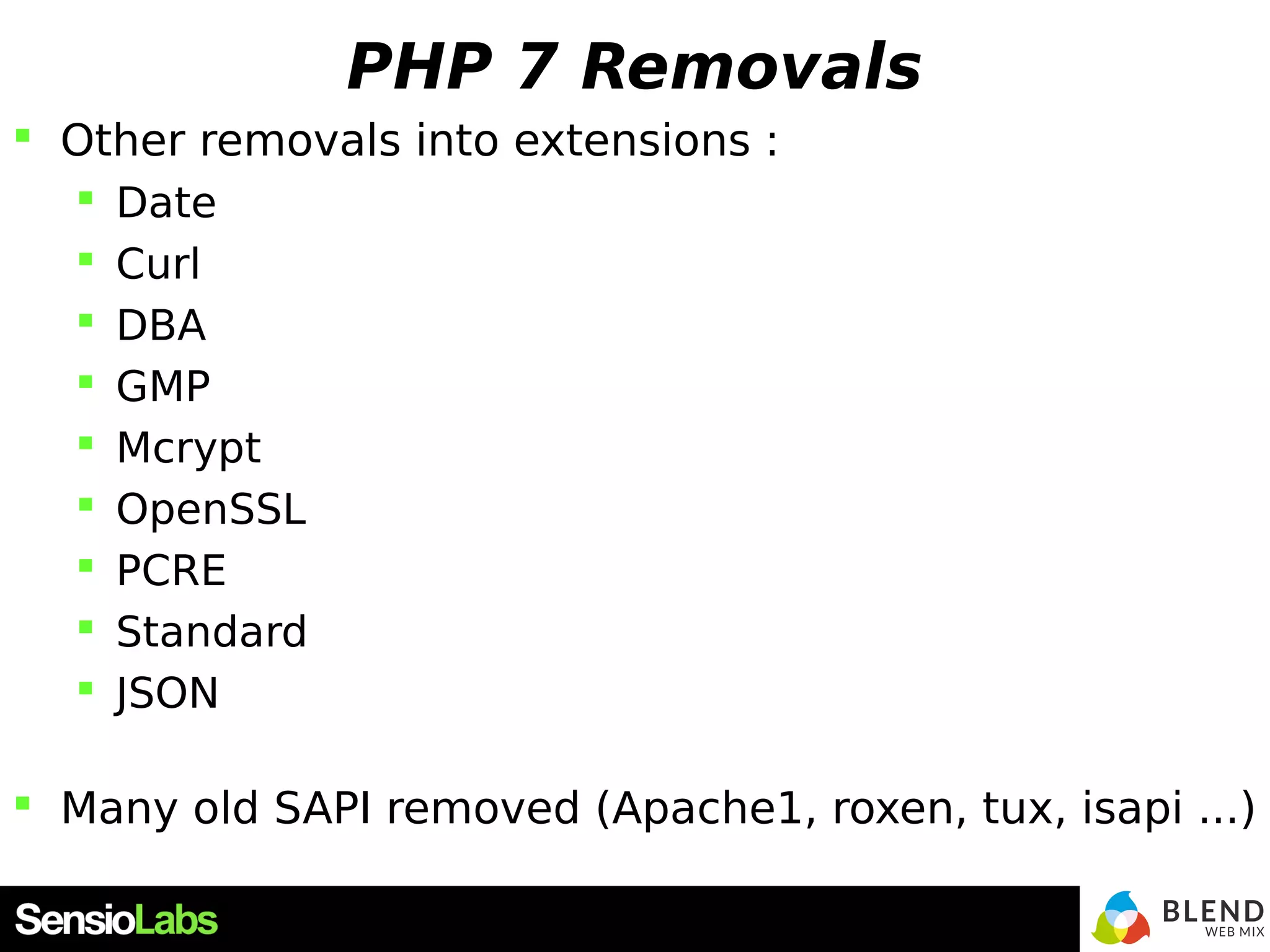
 Other removals into extensions :
 Date
 Curl
 DBA
 GMP
 Mcrypt
 OpenSSL
 PCRE
 Standard
 JSON
 Many old SAPI removed (Apache1, roxen, tux, isapi ...)
PHP 7 changed behaviors
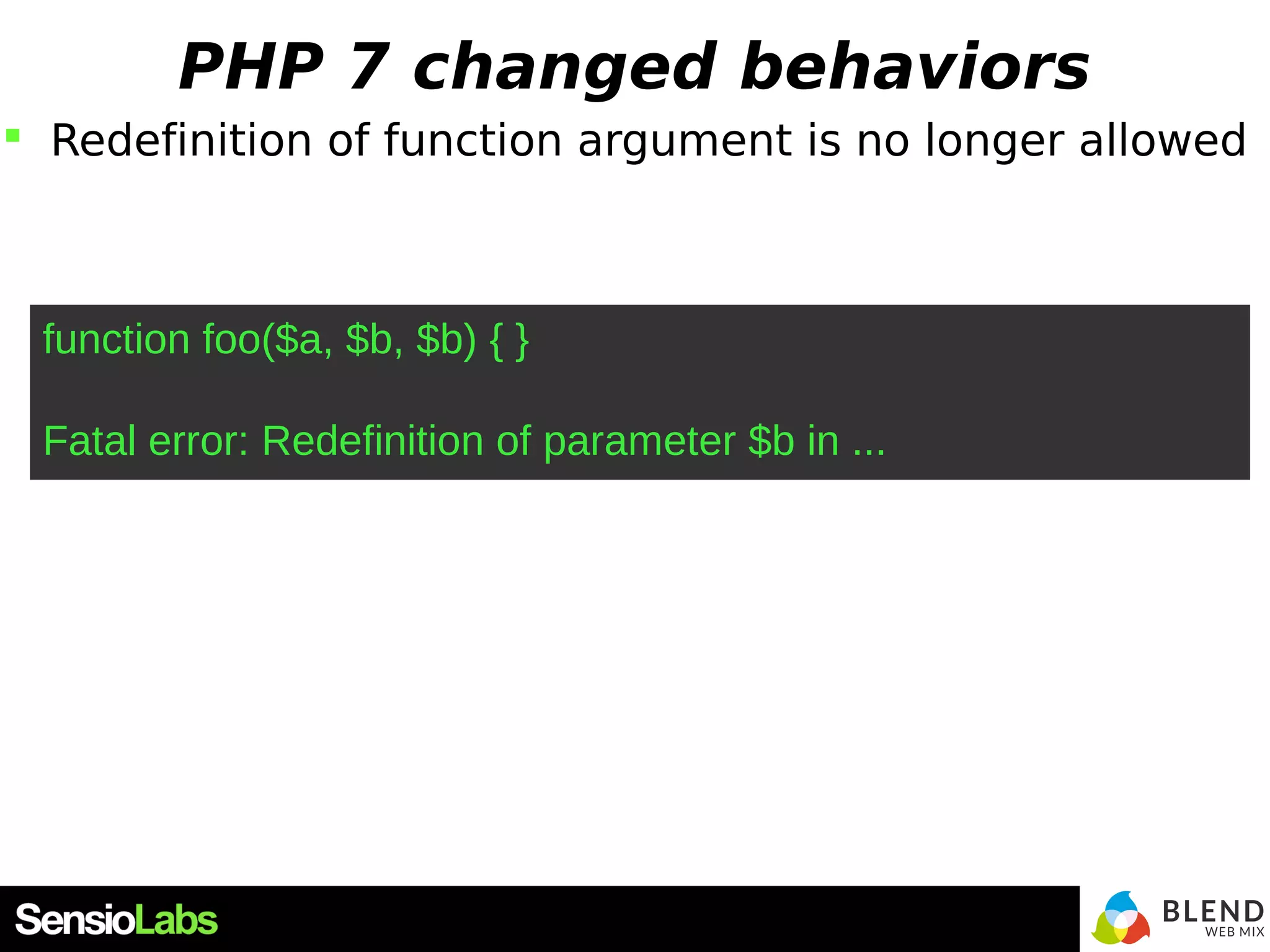
 Redefinition of function argument is no longer allowed
function foo($a, $b, $b) { }
Fatal error: Redefinition of parameter $b in ...
PHP 7 changed behaviors
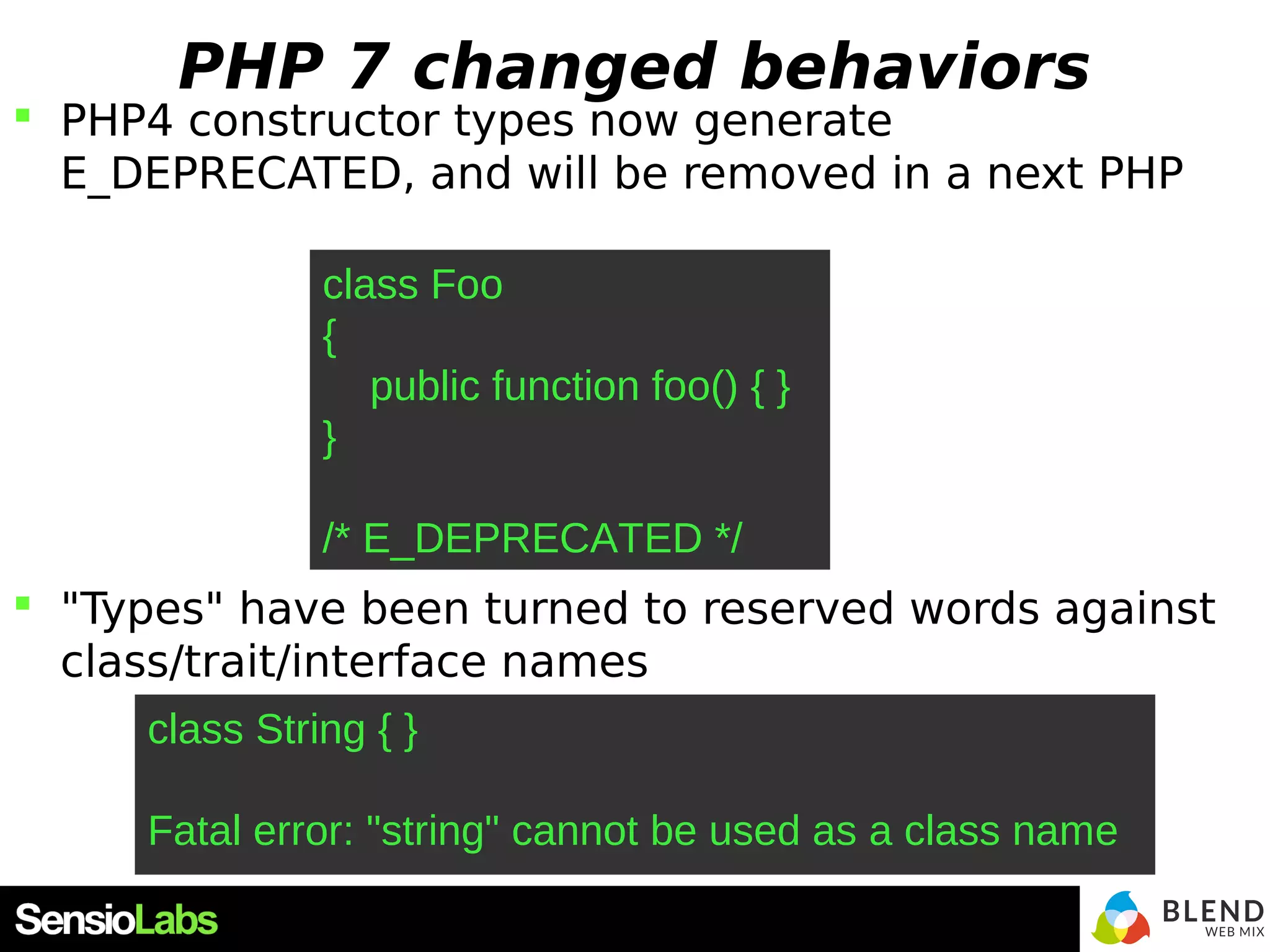
 PHP4 constructor types now generate
E_DEPRECATED, and will be removed in a next PHP
 "Types" have been turned to reserved words against
class/trait/interface names
class Foo
{
public function foo() { }
}
/* E_DEPRECATED */
class String { }
Fatal error: "string" cannot be used as a class name
PHP 7 changed behaviors
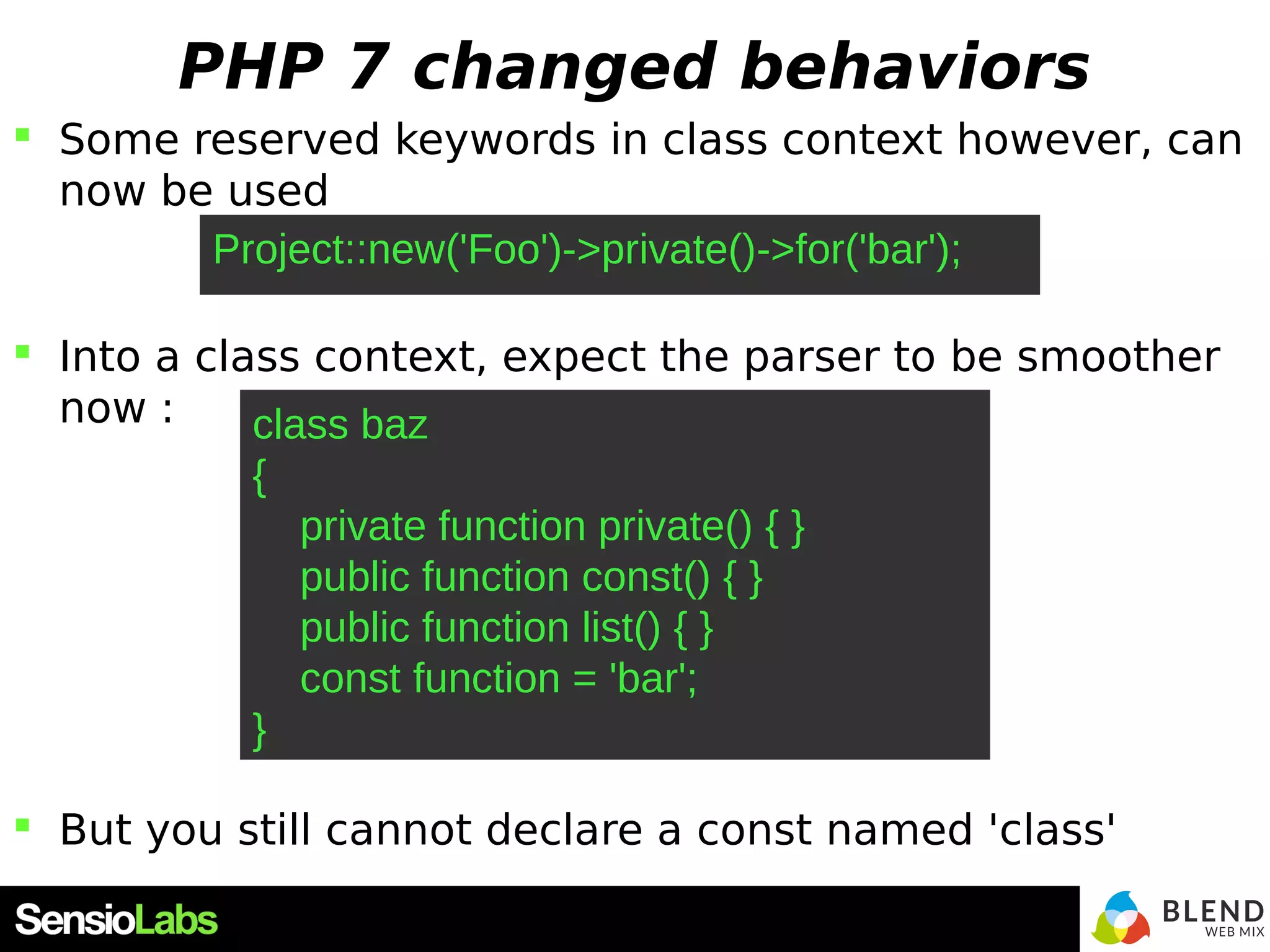
 Some reserved keywords in class context however, can
now be used
 Into a class context, expect the parser to be smoother
now :
 But you still cannot declare a const named 'class'
Project::new('Foo')->private()->for('bar');
class baz
{
private function private() { }
public function const() { }
public function list() { }
const function = 'bar';
}
PHP 7 changed behaviors
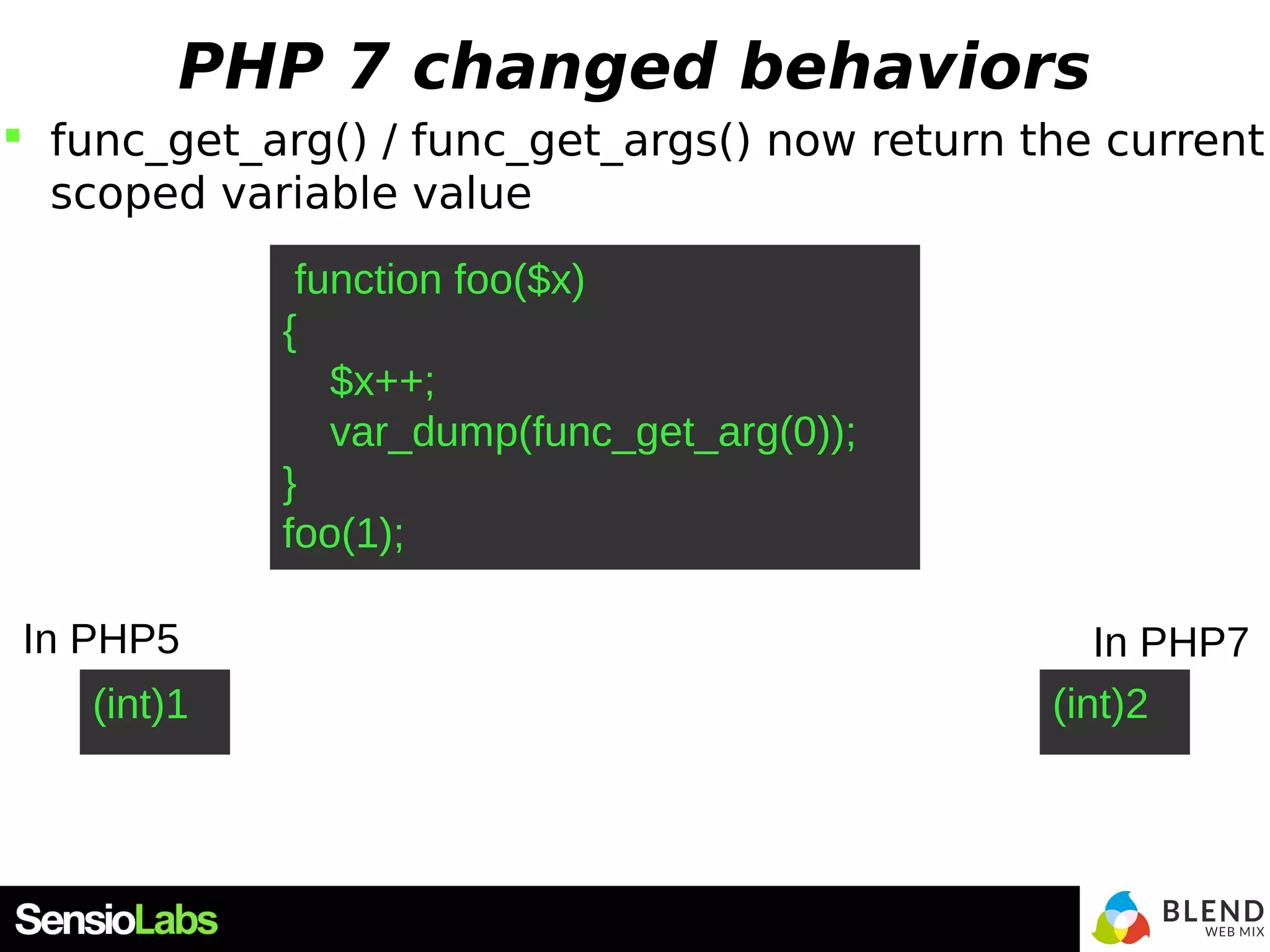
 func_get_arg() / func_get_args() now return the current
scoped variable value
function foo($x)
{
$x++;
var_dump(func_get_arg(0));
}
foo(1);
(int)1 (int)2
In PHP7In PHP5
PHP 7 changed behaviors
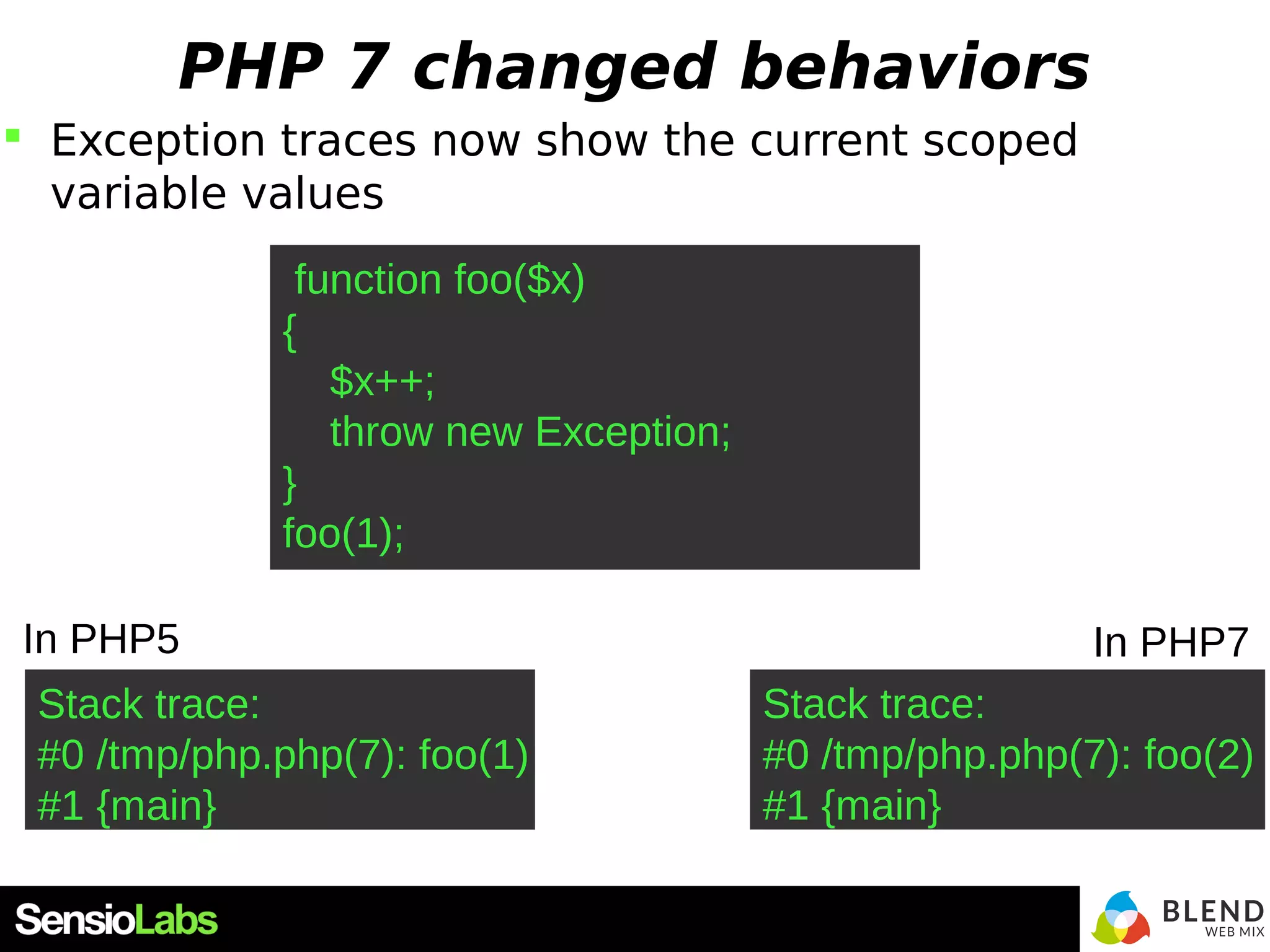
 Exception traces now show the current scoped
variable values
function foo($x)
{
$x++;
throw new Exception;
}
foo(1);
Stack trace:
#0 /tmp/php.php(7): foo(1)
#1 {main}
Stack trace:
#0 /tmp/php.php(7): foo(2)
#1 {main}
In PHP7In PHP5
PHP 7 changed behaviors
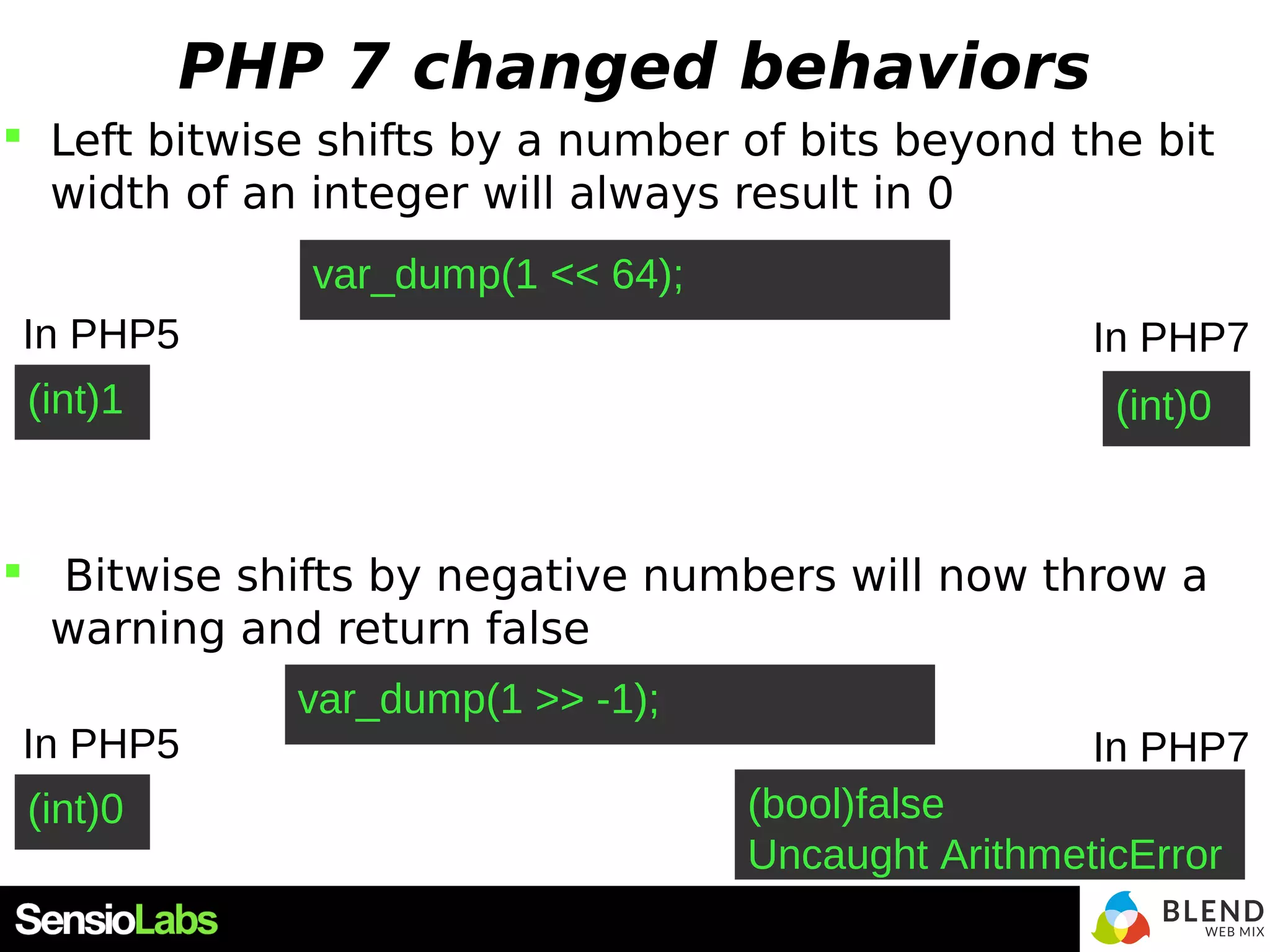
 Left bitwise shifts by a number of bits beyond the bit
width of an integer will always result in 0
 Bitwise shifts by negative numbers will now throw a
warning and return false
var_dump(1 << 64);
(int)1 (int)0
In PHP7In PHP5
var_dump(1 >> -1);
(int)0 (bool)false
Uncaught ArithmeticError
In PHP7In PHP5
PHP 7 changed behaviors
 Iteration with foreach() no longer has any effect on the
internal array pointer
$array = [0, 1, 2];
foreach ($array as $val) {
var_dump(current($array));
}
int(1)
int(1)
int(1)
int(0)
int(0)
int(0)
In PHP7In PHP5
PHP 7 changed behaviors
 When iterating arrays by-reference with foreach(),
modifications to the array will continue to influence
the iteration. Correct position pointer is maintained
$array = [0];
foreach ($array as &$val) {
var_dump($val);
$array[1] = 1;
}
int(0) int(0)
int(1)
In PHP7In PHP5
PHP7 : Other changes
 More generally , what before used to generate
E_DEPRECATED is now removed, or may be very soon
PHP 7 new engine
PHP 7 new internals
 Full 64bit support
 New Thread Safety mechanism
 New engine memory management
 New optimized executor
 New optimized structures
PHP 7 full 64bit engine
 PHP was known to be platform dependent on this crucial
criteria
 LP64: Linux64 (and most Unixes)
 LLP64: Windows64
 ILP64: SPARC64
http://www.unix.org/whitepapers/64bit.html
string size signed integer
Platform int long
LP64 32 64
LLP64 32 32
ILP64 64 64
PHP 7 full 64bit engine
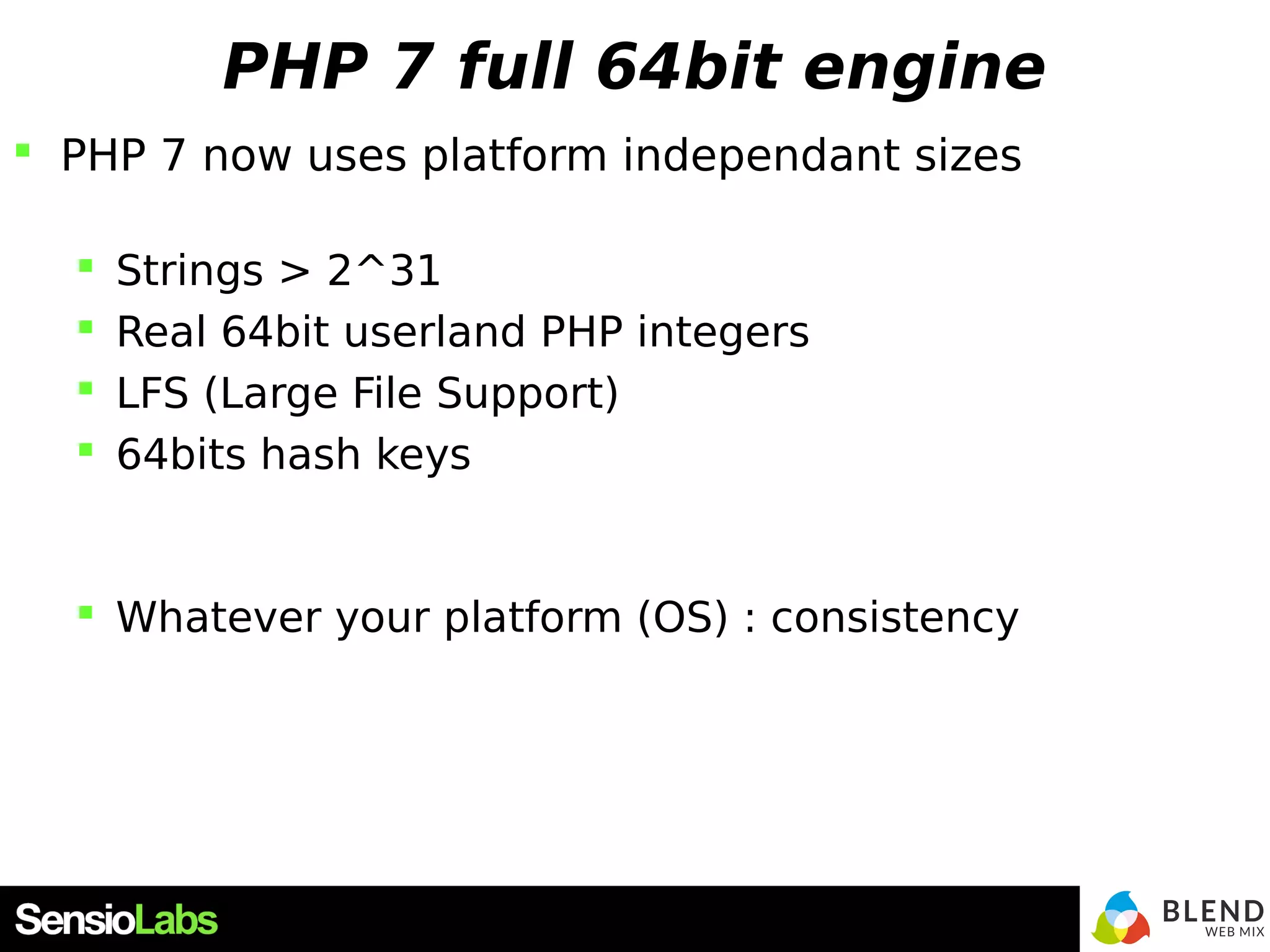
 PHP 7 now uses platform independant sizes
 Strings > 2^31
 Real 64bit userland PHP integers
 LFS (Large File Support)
 64bits hash keys
 Whatever your platform (OS) : consistency
PHP 7 new memory management
 PHP7 has reworked every memory management
routine
 Use less heap and more stack
 Zvals are stack allocated
 refcount management more accurate
 Scalar types are no longer refcounted
 Redevelop a new MM heap, more optimized
 Based on sized pools (small, medium and large)
 CPU cache friendly
 Concepts borrowed from tcmalloc
PHP 7 thread safety
 PHP7 has reworked its thread safety mechanism
routine
 PHP5 thread safety routine had a ~20% perf impact
 This is no more the case in PHP7
 TLS is now mature, and it is used
 For PHP under Windows (mandatory)
 For PHP under Unix, if asked for (usually not)
PHP 7 new structures
 Critical structures have been reworked
 More memory friendly
 More CPU friendly (data alignment, cache friendly)
 Strings are now refcounted
 Objects now share their refcount with other types
 Wasn't the case in PHP5
 The engine Executor uses a full new stack frame to
push and manage arguments
 Function calls have been heavilly reworked
PHP 7 performances
PHP 7 performances
 A lot of tweaks have been performed against PHP 7
code performances.
 A lot of internal changes - invisible to userland - have
been performed to have a more performant language
 CPU cache misses have been heavilly worked on
 Spacial locality of code is improved
 This results in a language beeing at least twice fast
and that consumes at least twice less memory
PHP 7 performances
... ...
$x = TEST 0.664 0.269
$x = $_GET 0.876 0.480
$x = $GLOBALS['v'] 1.228 0.833
$x = $hash['v'] 1.048 0.652
$x = $str[0] 1.711 1.315
$x = $a ?: null 0.880 0.484
$x = $f ?: tmp 1.367 0.972
$x = $f ? $f : $a 0.905 0.509
$x = $f ? $f : tmp 1.371 0.976
----------------------------------------------
Total 35.412
... ...
$x = TEST 0.400 0.223
$x = $_GET 0.616 0.440
$x = $GLOBALS['v'] 0.920 0.743
$x = $hash['v'] 0.668 0.491
$x = $str[0] 1.182 1.005
$x = $a ?: null 0.529 0.352
$x = $f ?: tmp 0.614 0.438
$x = $f ? $f : $a 0.536 0.360
$x = $f ? $f : tmp 0.587 0.411
----------------------------------------------
Total 20.707
PHP7PHP5.6
Zend/micro_bench.php
PHP 7 performances
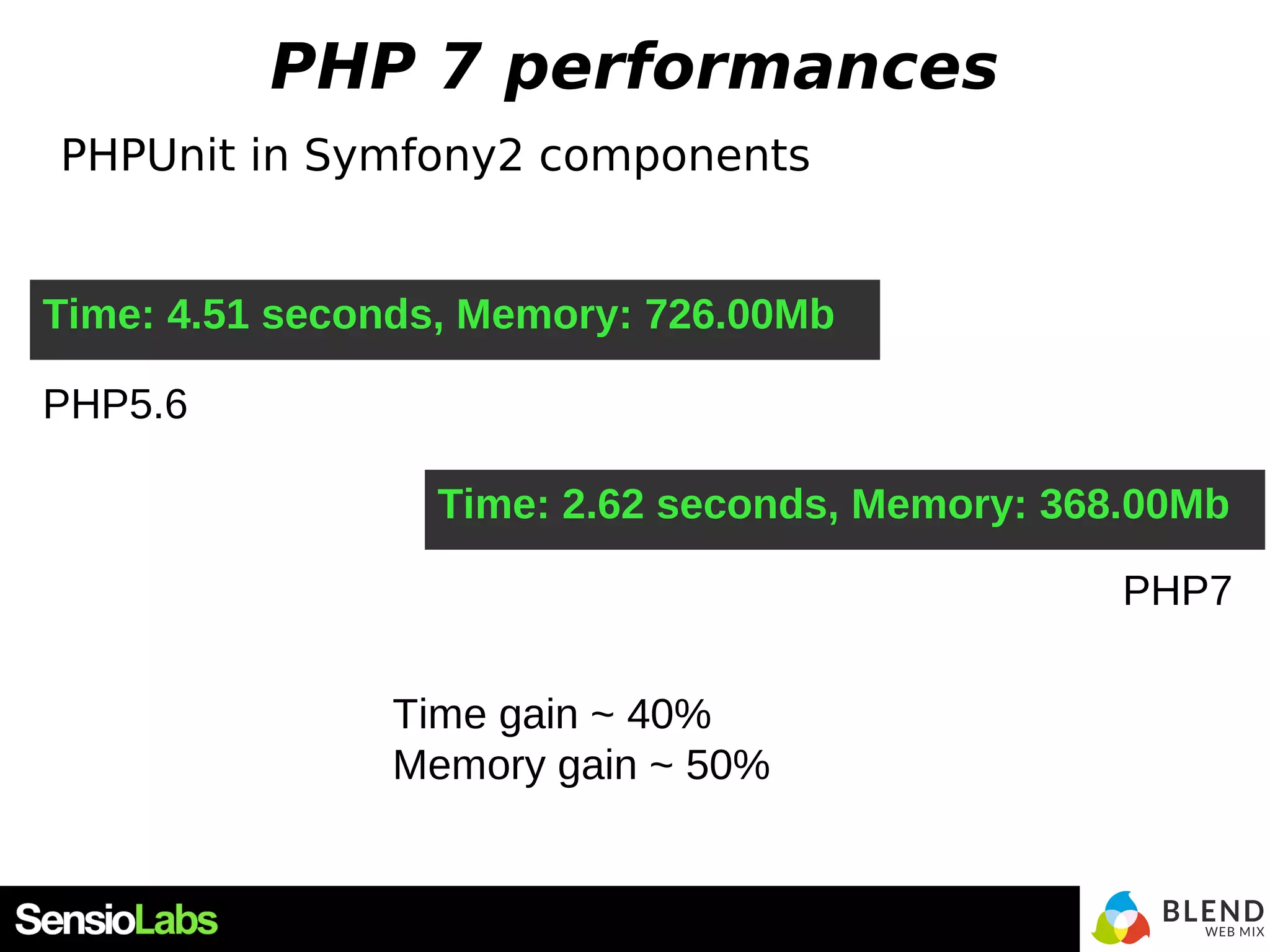
Time: 4.51 seconds, Memory: 726.00Mb
Time: 2.62 seconds, Memory: 368.00Mb
PHP7
PHP5.6
PHPUnit in Symfony2 components
Time gain ~ 40%
Memory gain ~ 50%
PHP 7 performances
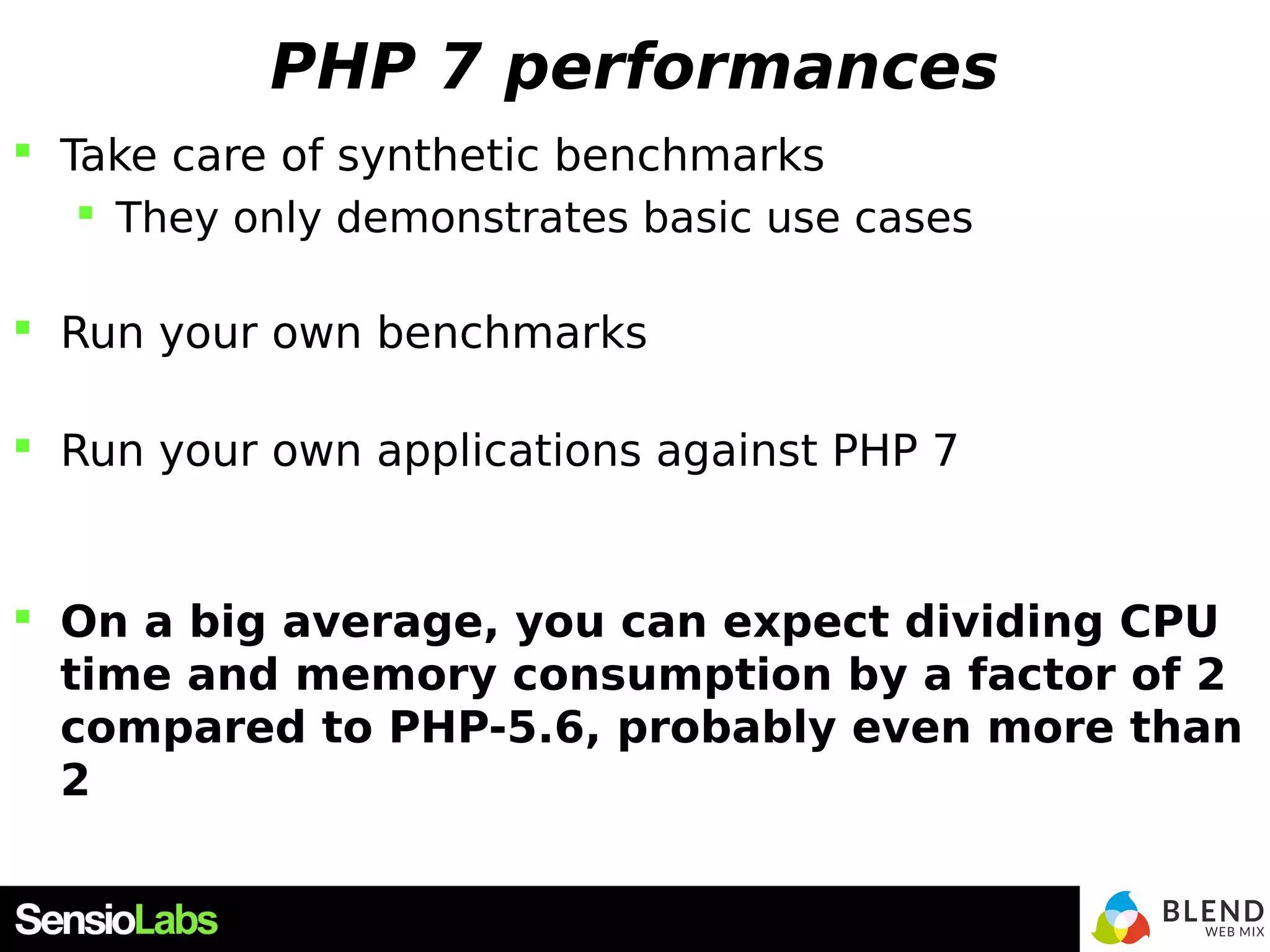
 Take care of synthetic benchmarks
 They only demonstrates basic use cases
 Run your own benchmarks
 Run your own applications against PHP 7
 On a big average, you can expect dividing CPU
time and memory consumption by a factor of 2
compared to PHP-5.6, probably even more than
2
Thank you for listening !

PHP7 is coming

  • 1.
    PHP7 is coming inNovember 2015
  • 2.
    Hello  Julien PAULI PHP user for more than 10y now  Linux / Unix adopter  PHP Internals developper (C language)  PHP 5.5 / 5.6 Release Manager  Working at SensioLabs (Paris)  Likes writing tech articles/books  @julienpauli - jpauli@php.net  Blog at http://jpauli.github.io
  • 3.
    PHP versions ? PHP 5.3  Dead  PHP 5.4  Dead  PHP 5.5  Dead (sec fixes only)  PHP 5.6  Current version (Sept 2014), still current  PHP 7  Future version (end 2015)  Major version  PHP 8  2020 ?
  • 4.
    Timeline  http://php.net/supported-versions.php 2004 2015 5.0PHP 7.0 2005 2006 2009 5.1 5.2 5.3 5.4 2012 2013 2014 5.5 5.6
  • 5.
  • 6.
  • 7.
  • 8.
  • 9.
    PHP 7 doctrines We are in a new major, we may break things  Only majors are allowed to do so (starting from 5.4)  We are devs. we also need to refactor (like you)  Only break when it brings a significant advantage  Think about our users and their migrations  Do not fall into a Python2 vs Python3 war  We'll have PHP 7.1 etc.. and PHP 8.0, probably in 2020.
  • 10.
    So ?  Functionsarguments order will not be touched  Functions() won't be turned into objects->methods()  "Goto" will not disappear  And the earth won't just stop its rotation tomorrow
  • 11.
    PHP 7 changes Internal Engine evolutions (Zend Engine 3.0)  Perfs ++  32/64bits platform fully supported  Integer sizes  New parser based on an AST  Some syntaxes change with PHP5  Tidy up old things that were deprecated before  Many new features
  • 12.
    PHP7 new userfeatures  Exceptions to replace fatal errors  New language syntaxes  ?? operator  <=> operator  Group use  Return type declaration and scalar type hints  Anonymous classes  Other new features (Can't list all here)
  • 13.
    PHP 7 newfeatures
  • 14.
    PHP 7 group"use" decl.  Group "use" declaration : use SymfonyComponentConsoleHelperTable; use SymfonyComponentConsoleInputArrayInput; use SymfonyComponentConsoleInputInputInterface; use SymfonyComponentConsoleOutputOutputInterface; use SymfonyComponentConsoleQuestionChoiceQuestion as Choice; use SymfonyComponentConsoleQuestionConfirmationQuestion; use SymfonyComponentConsole{ HelperTable, InputArrayInput, InputInputInterface, OutputOutputInterface, QuestionChoiceQuestion as Choice, QuestionConfirmationQuestion, };
  • 15.
    PHP 7 ??operator  ?? : Null Coalesce Operator $username = isset($_GET['user']) ? $_GET['user'] : 'nobody'; $username = $_GET['user'] ?? 'nobody';
  • 16.
    PHP 7 <=>operator  Combined Comparison (Spaceship) Operator  (expr) <=> (expr) returns 0 if both operands are equal, -1 if the left is greater, and 1 if the right is greater function order_func($a, $b) { return ($a < $b) ? -1 : (($a > $b) ? 1 : 0); } function order_func($a, $b) { return $a <=> $b; }
  • 17.
    PHP7 Errors andExceptions
  • 18.
    PHP7 Exceptions insteadof fatals  The engine allows the user to try{}catch{} any call that may generate a fatal error  Every other error stays untouched, only fatals can now be caught  E_RECOVERABLE are turned to exceptions (most of them)  There is no more need to hack with user error handlers, just try-catch now  E_STRICT have been reclassified to E_WARN or E_NOTICE
  • 19.
    PHP7 Exceptions insteadof fatals  The engine now allows the user to try{}catch{} any call that may generate a fatal error foo(); try { foo(); } catch (Error $e) { /* haha */ }
  • 20.
    PHP7 Exceptions insteadof fatals  If the user doesn't catch the engine exception, this latter is back converted to a Fatal Error foo(); Fatal error: Uncaught Error: Call to undefined function foo() in /tmp/foo.php:2 Stack trace: #0 {main} thrown in /tmp/foo.php on line 2
  • 21.
    PHP7 Exceptions insteadof fatals  Some parse errors are catchable (ParseException), especially using eval(); try { $result = eval($code); } catch (ParseException $exception) { }
  • 22.
  • 23.
    PHP7 Exceptions insteadof fatals  PHP errors inherit from Error  User exceptions inherit from Exception (no change)  To catch both, you may catch Throwable  Users can't inherit from Throwable directly try { foo(); } catch (Throwable $e) { /* catch any user defined Exception or catch any fatal Error */ }
  • 24.
    PHP7 Closures  Closure::call(object$to, [mixed ...$params])  Allows to bind a Closure to a specific object at runtime  Won't work for internal classes : user classes only class Foo { public $bar; } $foo = new Foo; $foo->bar = 3; $foobar = function ($qux) { var_dump($this->bar + $qux); }; $foobar->call($foo, 4); /* int(7) */
  • 25.
    PHP7 return typedeclaration  Functions may declare return types.  Types "null" and "resource" are not supported  Those are checked at runtime issuing Fatal errors function foo(): int { return []; } foo(); Fatal error: Return value of foo() must be of the type integer, array returned
  • 26.
    PHP7 return typedeclaration  Functions may declare return types  Types "null" and "resource" are not supported  PHP will try to convert them when possible, if not, it issues a fatal error function foo($i): int { return $i; } var_dump(foo("123")); (int)123 var_dump(foo( ["123"] )); Fatal error: Return value of foo() must be of the type integer, array returned
  • 27.
    PHP7 return typedeclaration  Call time variance type is allowed interface A { static function make(): A; } class B implements A { static function make(): A { return new B(); } }
  • 28.
    PHP7 return typedeclaration  Compile time variance type is not allowed interface A { static function make(): A; } class B implements A { static function make(): B { return new B(); } } Fatal error: Declaration of B::make() must be compatible with A::make(): A
  • 29.
    PHP7 scalar typehints  Scalar type hints are now allowed in functions arguments declarations  Type "null" and "resource" are not supported  https://wiki.php.net/rfc/scalar_type_hints_v5 function foo(int $i, string $j, bool $k) { }
  • 30.
    PHP7 scalar typehints  By default, scalar type hints are not honored  The default behavior is that PHP ignores those scalar type hints, but not compound ones (like it used to do) function foo(int $i, string $j, bool $k) { } foo(1, 1, 1); /* OK */ function foo(int $i, array $j) { } foo('baz', 'bar'); Fatal error: Argument 2 passed to foo() must be of the type array, string given
  • 31.
    PHP7 scalar typehints  PHP converts the scalar type hinted arguments function foo(int $i, string $j, bool $k) { var_dump(func_get_args()); } foo('12', 0, 'foo'); array(3) { [0]=> int(12) [1]=> string(1) "0" [2]=> bool(true) }
  • 32.
    PHP7 scalar typehints  PHP converts the scalar type hinted arguments, only when this is possible , if not, it emits a fatal error function foo(int $i, string $j, bool $k) { var_dump(func_get_args()); } foo('foo', 0, 'foo'); Fatal error: Argument 1 passed to foo() must be of the type integer, string given
  • 33.
    PHP7 scalar typehints errors  As Fatal Errors may now be catched, this can be used : function foo(int $i, string $j, bool $k) { var_dump(func_get_args()); } try { foo('foo', 0, 'foo'); } catch (TypeError $e) { echo $e->getMessage(); } Fatal error: Argument 1 passed to foo() must be of the type integer, string given
  • 34.
    PHP7 scalar typehints  PHP however allows you to declare strict type hints  honored for every future call  no implicit conversion anymore  strict checks must be turned on at function call-time  strick checks are file-bound (not global)  declare() must be the first file statement function foo(int $i, string $j, bool $k) { } foo(1, 'foo', true); /* OK */ declare(strict_types=1); foo('1', 'foo', 'baz'); /* fatal */
  • 35.
    PHP7 scalar typehints  strict mode is also relevant for return type hints : function foo(int $i) :string { return $i; } var_dump(foo("123 pigs")); string(3) "123" declare(strict_types=1); var_dump(foo(123)); Fatal error: Return value of foo() must be of the type string, integer returned
  • 36.
    PHP 7 newtype hints  Scalar type hints and return types are independant features, one may be used without the other  However, they are both affected by the strict mode  Strict mode is file based only, it doesn't affect other required files  Strict mode is disabled by default  Strict mode may be turned on for every function calls, it doesn't impact function declarations at all
  • 37.
    Anonymous classes  Likeanonymous functions var_dump( new class() { }); object(class@anonymous)#1 (0) { }
  • 38.
    Anonymous classes  Likeanonymous functions $obj->setLogger(new class implements Logger { public function log($msg) { print_r($msg); } }); interface Logger { function log($m); } class Bar { function setLogger(Logger $l) { } } $obj = new Bar;
  • 39.
    PHP 7 newminor features  Added scanner mode INI_SCANNER_TYPED to yield typed .ini values  Added second parameter for unserialize() function allowing to specify acceptable classes  preg_replace_callback_array()  intdiv()  error_clear_last()  PHP_INT_MIN  random_bytes()  New assertion mechanism (more optimized, useful)  New session features (lazy writes, , read only ...)
  • 40.
  • 41.
    PHP 7 breakage Syntax changes that break  Removals  Behavior changes
  • 42.
    PHP 7 Syntaxchanges  The compiler has been rewritten entirely  It is now based on an AST  You may use the AST using https://github.com/nikic/php-ast extension  Some syntax changes were necessary to support new features
  • 43.
    PHP 7 Syntaxchanges  Indirect variable, property and method references are now interpreted with left-to-right semantics $$foo['bar']['baz'] $foo->$bar['baz'] $foo->$bar['baz']() Foo::$bar['baz']() ($$foo)['bar']['baz'] ($foo->$bar)['baz'] ($foo->$bar)['baz']() (Foo::$bar)['baz']() ${$foo['bar']['baz']} $foo->{$bar['baz']} $foo->{$bar['baz']}() Foo::{$bar['baz']}() In PHP5
  • 44.
    PHP 7 Syntaxchanges  list() allows ArrayAccess objects (everytime)  list() doesn't allow unpacking strings anymore  Other minor changes to list() ... list($a, $b) = (object) new ArrayObject([0, 1]); /* $a == 0 and $b == 1 */ $str = "xy"; list($x, $y) = $str; /* $x == null and $y == null */ /* no error */
  • 45.
    PHP 7 Syntaxchanges  Invalid octal literals (containing digits > 7) now produce compile errors  Hexadecimal strings are not recognized anymore $i = 0781; // 8 is not a valid octal digit! /* Fatal error: Invalid numeric literal in */ var_dump("0x123" == "291"); var_dump(is_numeric("0x123")); var_dump("0xe" + "0x1"); bool(false) bool (false) int(0) bool(true) bool(true) int(16) In PHP5In PHP7
  • 46.
    PHP 7 Syntaxchanges  The new UTF-8 escape character u has been added  Only added in heredocs and double-quoted strings (as usual)  Codepoints above U+10FFFF generate an error  https://wiki.php.net/rfc/unicode_escape echo "u{262F}"; u{262F} ☯ In PHP7In PHP5
  • 47.
    PHP 7 Removals Removed ASP (<%) and script (<script language=php>) tags  Removed support for assigning the result of new by reference  Removed support for #-style comments in ini files  $HTTP_RAW_POST_DATA is no longer available. Use the php://input stream instead.  bye bye call_user_method()/call_user_method_array() $a = &new stdclass; Parse error: syntax error, unexpected 'new' (T_NEW)
  • 48.
    PHP 7 Removals Removed support for scoped calls to non-static methods from an incompatible $this context  In PHP7, $this will be undefined in this case class A { function foo() { var_dump(get_class($this)); } } class B { function bar() { A::foo(); } } $b = new B; $b->bar();
  • 49.
    PHP 7 Removals classA { function foo() { var_dump($this); } } class B { function bar() { A::foo(); } } $b = new B; $b->bar(); Deprecated: Non-static method A::foo() should not be called statically, assuming $this from incompatible context object(B) #1 Deprecated: Non-static method A::foo() should not be called statically Notice: Undefined variable: this in /tmp/7.php on line 4 In PHP5 In PHP7
  • 50.
    PHP 7 Removals Other removals into extensions :  Date  Curl  DBA  GMP  Mcrypt  OpenSSL  PCRE  Standard  JSON  Many old SAPI removed (Apache1, roxen, tux, isapi ...)
  • 51.
    PHP 7 changedbehaviors
  • 52.
    PHP 7 changedbehaviors  Redefinition of function argument is no longer allowed function foo($a, $b, $b) { } Fatal error: Redefinition of parameter $b in ...
  • 53.
    PHP 7 changedbehaviors  PHP4 constructor types now generate E_DEPRECATED, and will be removed in a next PHP  "Types" have been turned to reserved words against class/trait/interface names class Foo { public function foo() { } } /* E_DEPRECATED */ class String { } Fatal error: "string" cannot be used as a class name
  • 54.
    PHP 7 changedbehaviors  Some reserved keywords in class context however, can now be used  Into a class context, expect the parser to be smoother now :  But you still cannot declare a const named 'class' Project::new('Foo')->private()->for('bar'); class baz { private function private() { } public function const() { } public function list() { } const function = 'bar'; }
  • 55.
    PHP 7 changedbehaviors  func_get_arg() / func_get_args() now return the current scoped variable value function foo($x) { $x++; var_dump(func_get_arg(0)); } foo(1); (int)1 (int)2 In PHP7In PHP5
  • 56.
    PHP 7 changedbehaviors  Exception traces now show the current scoped variable values function foo($x) { $x++; throw new Exception; } foo(1); Stack trace: #0 /tmp/php.php(7): foo(1) #1 {main} Stack trace: #0 /tmp/php.php(7): foo(2) #1 {main} In PHP7In PHP5
  • 57.
    PHP 7 changedbehaviors  Left bitwise shifts by a number of bits beyond the bit width of an integer will always result in 0  Bitwise shifts by negative numbers will now throw a warning and return false var_dump(1 << 64); (int)1 (int)0 In PHP7In PHP5 var_dump(1 >> -1); (int)0 (bool)false Uncaught ArithmeticError In PHP7In PHP5
  • 58.
    PHP 7 changedbehaviors  Iteration with foreach() no longer has any effect on the internal array pointer $array = [0, 1, 2]; foreach ($array as $val) { var_dump(current($array)); } int(1) int(1) int(1) int(0) int(0) int(0) In PHP7In PHP5
  • 59.
    PHP 7 changedbehaviors  When iterating arrays by-reference with foreach(), modifications to the array will continue to influence the iteration. Correct position pointer is maintained $array = [0]; foreach ($array as &$val) { var_dump($val); $array[1] = 1; } int(0) int(0) int(1) In PHP7In PHP5
  • 60.
    PHP7 : Otherchanges  More generally , what before used to generate E_DEPRECATED is now removed, or may be very soon
  • 61.
    PHP 7 newengine
  • 62.
    PHP 7 newinternals  Full 64bit support  New Thread Safety mechanism  New engine memory management  New optimized executor  New optimized structures
  • 63.
    PHP 7 full64bit engine  PHP was known to be platform dependent on this crucial criteria  LP64: Linux64 (and most Unixes)  LLP64: Windows64  ILP64: SPARC64 http://www.unix.org/whitepapers/64bit.html string size signed integer Platform int long LP64 32 64 LLP64 32 32 ILP64 64 64
  • 64.
    PHP 7 full64bit engine  PHP 7 now uses platform independant sizes  Strings > 2^31  Real 64bit userland PHP integers  LFS (Large File Support)  64bits hash keys  Whatever your platform (OS) : consistency
  • 65.
    PHP 7 newmemory management  PHP7 has reworked every memory management routine  Use less heap and more stack  Zvals are stack allocated  refcount management more accurate  Scalar types are no longer refcounted  Redevelop a new MM heap, more optimized  Based on sized pools (small, medium and large)  CPU cache friendly  Concepts borrowed from tcmalloc
  • 66.
    PHP 7 threadsafety  PHP7 has reworked its thread safety mechanism routine  PHP5 thread safety routine had a ~20% perf impact  This is no more the case in PHP7  TLS is now mature, and it is used  For PHP under Windows (mandatory)  For PHP under Unix, if asked for (usually not)
  • 67.
    PHP 7 newstructures  Critical structures have been reworked  More memory friendly  More CPU friendly (data alignment, cache friendly)  Strings are now refcounted  Objects now share their refcount with other types  Wasn't the case in PHP5  The engine Executor uses a full new stack frame to push and manage arguments  Function calls have been heavilly reworked
  • 68.
  • 69.
    PHP 7 performances A lot of tweaks have been performed against PHP 7 code performances.  A lot of internal changes - invisible to userland - have been performed to have a more performant language  CPU cache misses have been heavilly worked on  Spacial locality of code is improved  This results in a language beeing at least twice fast and that consumes at least twice less memory
  • 70.
    PHP 7 performances ...... $x = TEST 0.664 0.269 $x = $_GET 0.876 0.480 $x = $GLOBALS['v'] 1.228 0.833 $x = $hash['v'] 1.048 0.652 $x = $str[0] 1.711 1.315 $x = $a ?: null 0.880 0.484 $x = $f ?: tmp 1.367 0.972 $x = $f ? $f : $a 0.905 0.509 $x = $f ? $f : tmp 1.371 0.976 ---------------------------------------------- Total 35.412 ... ... $x = TEST 0.400 0.223 $x = $_GET 0.616 0.440 $x = $GLOBALS['v'] 0.920 0.743 $x = $hash['v'] 0.668 0.491 $x = $str[0] 1.182 1.005 $x = $a ?: null 0.529 0.352 $x = $f ?: tmp 0.614 0.438 $x = $f ? $f : $a 0.536 0.360 $x = $f ? $f : tmp 0.587 0.411 ---------------------------------------------- Total 20.707 PHP7PHP5.6 Zend/micro_bench.php
  • 71.
    PHP 7 performances Time:4.51 seconds, Memory: 726.00Mb Time: 2.62 seconds, Memory: 368.00Mb PHP7 PHP5.6 PHPUnit in Symfony2 components Time gain ~ 40% Memory gain ~ 50%
  • 72.
    PHP 7 performances Take care of synthetic benchmarks  They only demonstrates basic use cases  Run your own benchmarks  Run your own applications against PHP 7  On a big average, you can expect dividing CPU time and memory consumption by a factor of 2 compared to PHP-5.6, probably even more than 2
  • 73.
    Thank you forlistening !