PHP cơ bản
Những vấn đề cơ bản Lịch sử Cài đặt: sử dụng WAMP Ngôn ngữ:PHP PHP và MySQL  PHP và Hướng đối tượng
PHP là gì ? Một ngôn ngữ (viết từ C++, mã nguồn mở) có thể nhúng vào HTML, tạo ra ứng dụng WEB. Ví dụ: <html>     <head>         <title>Example</title>     </head>     <body>         <?php          echo &quot;Hi, I'm a PHP script!&quot;;          ?>     </body> </html>
PHP là gì ? Với <?  Và ?> là dấu hiệu dùng để nhận biết đoạn mã PHP Echo dùng để xuất ra 1 nội dung cho file HTML. PHP là ngôn ngữ phục vụ xử lý tại WEB Server (khác với JavaScript thông thường là Client Script)    Không thể biết được mã PHP tại Server (được trả về cho Client chỉ là mã HTML)
Những ưu điểm nổi bật Miễn phí  Tạo nên một sức mạnh rất lớn của PHP. Từ Internet, chúng ta có thể thu thập rất nhiều mã nguồn mở PHP. Ngôn ngữ PHP đơn giản, giống C, Perl Hỗ trợ hầu hết các cơ sở dữ liệu Chạy nhanh
Web Server hỗ trợ PHP Apache Microsoft IIS   PWS (Personal WebServer) iPlant server 、 Oreilly Website Pro Server 、 Caudium 、 Xitami 、 OmniHTTPd  … .
Các hướng tiếp cận lập trình Lập trình theo cấu trúc  Lập trình hướng đối tượng OOP Lập trình AOP  (aspect-oriented programming)
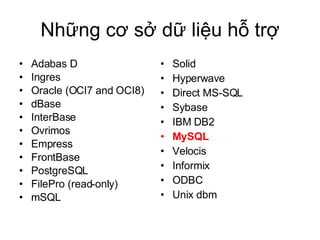
Những cơ sở dữ liệu hỗ trợ Adabas D Ingres Oracle (OCI7 and OCI8) dBase InterBase Ovrimos Empress FrontBase PostgreSQL FilePro (read-only) mSQL Solid Hyperwave Direct MS-SQL Sybase IBM DB2 MySQL Velocis Informix ODBC Unix dbm
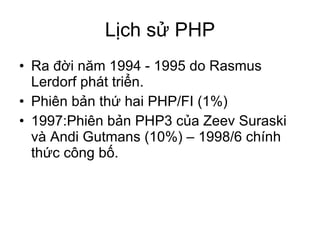
Lịch sử PHP Ra đời năm 1994 - 1995 do Rasmus Lerdorf phát triển. Phiên bản thứ hai PHP/FI (1%) 1997:Phiên bản PHP3 của Zeev Suraski và Andi Gutmans (10%) – 1998/6 chính thức công bố.
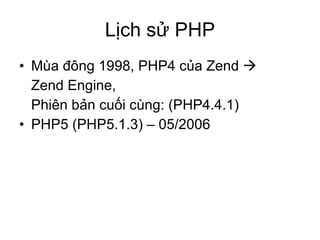
Lịch sử PHP Mùa đông 1998, PHP4 của Zend   Zend Engine,  Phiên bản cuối cùng: (PHP4.4.1)  PHP5 (PHP5.1.3) – 05/2006
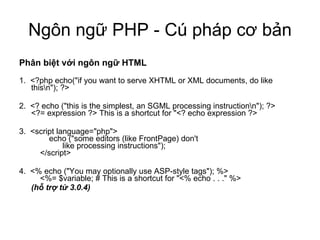
Ngôn ngữ PHP - Cú pháp cơ bản Phân biệt với ngôn ngữ HTML 1.  <?php echo(&quot;if you want to serve XHTML or XML documents, do like this\n&quot;); ?> 2.  <? echo (&quot;this is the simplest, an SGML processing instruction\n&quot;); ?> <?= expression ?> This is a shortcut for &quot;<? echo expression ?> 3.  <script language=&quot;php&quot;>         echo (&quot;some editors (like FrontPage) don't               like processing instructions&quot;);     </script> 4.  <% echo (&quot;You may optionally use ASP-style tags&quot;); %>     <%= $variable; # This is a shortcut for &quot;<% echo . . .&quot; %>  (hỗ trợ từ 3.0.4)
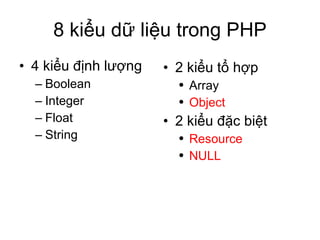
8 kiểu dữ liệu trong PHP 4 kiểu định lượng Boolean  Integer Float String 2 kiểu tổ hợp Array Object 2 kiểu đặc biệt Resource NULL
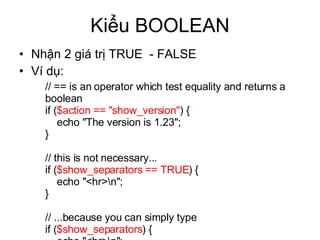
Kiểu BOOLEAN Nhận 2 giá trị TRUE  - FALSE Ví dụ: // == is an operator which test equality and returns a boolean if ( $action == &quot;show_version&quot; ) {     echo &quot;The version is 1.23&quot;; } // this is not necessary... if ( $show_separators == TRUE ) {     echo &quot;<hr>\n&quot;; } // ...because you can simply type if ( $show_separators ) {     echo &quot;<hr>\n&quot;; }
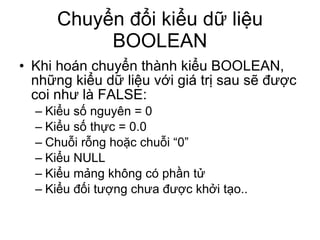
Chuyển đổi kiểu dữ liệu BOOLEAN Khi hoán chuyển thành kiểu BOOLEAN, những kiểu dữ liệu với giá trị sau sẽ được coi như là FALSE: Kiểu số nguyên = 0  Kiểu số thực = 0.0 Chuỗi rỗng hoặc chuỗi “0” Kiểu NULL Kiểu mảng không có phần tử Kiểu đối tượng chưa được khởi tạo..
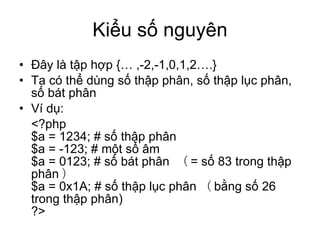
Kiểu số nguyên Đây là tập hợp {… ,-2,-1,0,1,2….} Ta có thể dùng số thập phân, số thập lục phân, số bát phân Ví dụ: <?php $a = 1234; # số thập phân $a = -123; # một số âm $a = 0123; # số bát phân  ( = số 83 trong thập phân ) $a = 0x1A; # số thập lục phân ( bằng số 26 trong thập phân) ?>
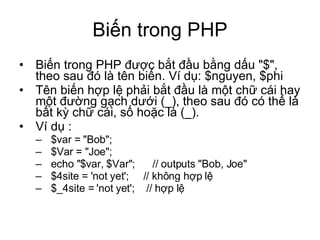
Biến trong PHP Biến trong PHP được bắt đầu bằng dấu &quot;$&quot;, theo sau đó là tên biến. Ví dụ: $nguyen, $phi Tên biến hợp lệ phải bắt đầu là một chữ cái hay một đường gạch dưới (_), theo sau đó có thể là bất kỳ chữ cái, số hoặc là (_). Ví dụ : $var = &quot;Bob&quot;; $Var = &quot;Joe&quot;; echo &quot;$var, $Var&quot;;  // outputs &quot;Bob, Joe&quot; $4site = 'not yet';  // không hợp lệ $_4site = 'not yet';  // hợp lệ
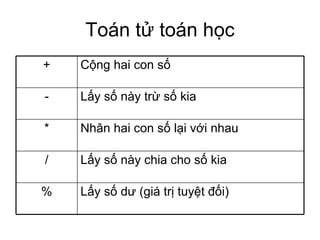
Toán tử toán học Lấy số dư (giá trị tuyệt đối) % Lấy số này chia cho số kia / Nhân hai con số lại với nhau  * Lấy số này trừ số kia - Cộng hai con số +
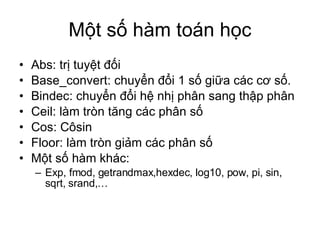
Một số hàm toán học Abs: trị tuyệt đối Base_convert: chuyển đổi 1 số giữa các cơ số. Bindec: chuyển đổi hệ nhị phân sang thập phân Ceil: làm tròn tăng các phân số  Cos: Côsin Floor: làm tròn giảm các phân số Một số hàm khác:  Exp, fmod, getrandmax,hexdec, log10, pow, pi, sin, sqrt, srand,…
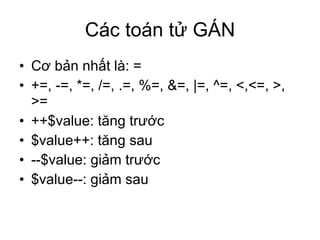
Các toán tử GÁN Cơ bản nhất là: =  +=, -=, *=, /=, .=, %=, &=, |=, ^=, <,<=, >, >= ++$value: tăng trước $value++: tăng sau --$value: giảm trước $value--: giảm sau
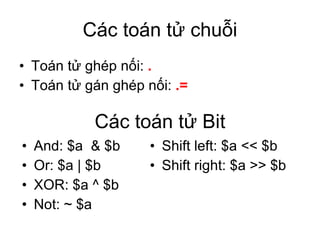
Các toán tử chuỗi Toán tử ghép nối:  . Toán tử gán ghép nối:  .= Các toán tử Bit And: $a  & $b Or: $a | $b XOR: $a ^ $b  Not: ~ $a Shift left: $a << $b Shift right: $a >> $b
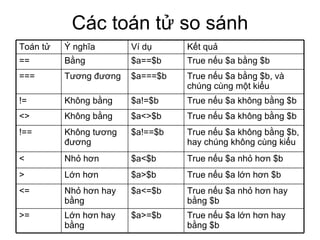
Các toán tử so sánh True nếu $a lớn hơn hay bằng $b $a>=$b Lớn hơn hay bằng >= True nếu $a nhỏ hơn hay bằng $b $a<=$b Nhỏ hơn hay bằng <= True nếu $a lớn hơn $b $a>$b Lớn hơn > True nếu $a nhỏ hơn $b $a<$b Nhỏ hơn < True nếu $a không bằng $b, hay chúng không cùng kiểu $a!==$b Không tương đương !== True nếu $a không bằng $b $a<>$b Không bằng <> True nếu $a không bằng $b $a!=$b Không bằng != True nếu $a bằng $b, và chúng cùng một kiểu $a===$b Tương đương === True nếu $a bằng $b $a==$b Bằng == Kết quả Ví dụ Ý nghĩa Toán tử
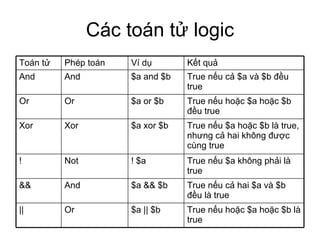
Các toán tử logic True nếu hoặc $a hoặc $b là true $a || $b Or || True nếu cả hai $a và $b đều là true $a && $b And && True nếu $a không phải là true ! $a Not ! True nếu $a hoặc $b là true, nhưng cả hai không được cùng true $a xor $b Xor Xor True nếu hoặc $a hoặc $b đều true $a or $b Or Or True nếu cả $a và $b đều true $a and $b And And Kết quả Ví dụ Phép toán Toán tử
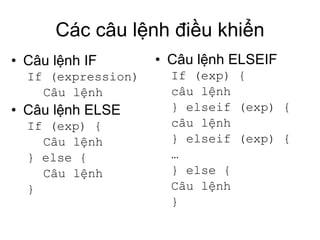
Các câu lệnh điều khiển Câu lệnh IF If (expression) Câu lệnh Câu lệnh ELSE If (exp) { Câu lệnh } else { Câu lệnh } Câu lệnh ELSEIF If (exp) { câu lệnh } elseif (exp) { câu lệnh } elseif (exp) { … } else { Câu lệnh }
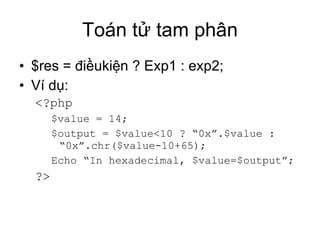
Toán tử tam phân $res = điềukiện ? Exp1 : exp2;  Ví dụ: <?php $value = 14;  $output = $value<10 ? “0x”.$value : “0x”.chr($value-10+65); Echo “In hexadecimal, $value=$output”; ?>
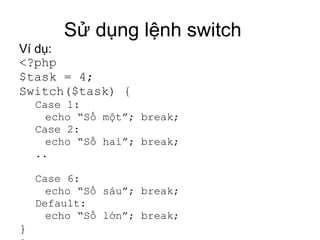
Sử dụng lệnh switch Ví dụ: <?php $task = 4; Switch($task) { Case 1: echo “Số một”; break; Case 2: echo “Số hai”; break; .. Case 6: echo “Số sáu”; break; Default: echo “Số lớn”; break; } ?>
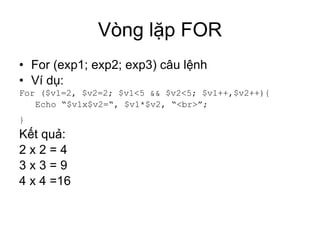
Vòng lặp FOR For (exp1; exp2; exp3) câu lệnh Ví dụ: For ($v1=2, $v2=2; $v1<5 && $v2<5; $v1++,$v2++){ Echo “$v1x$v2=“, $v1*$v2, “<br>”; }   Kết quả: 2 x 2 = 4 3 x 3 = 9 4 x 4 =16
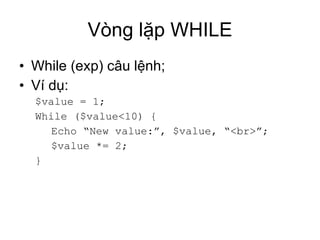
Vòng lặp WHILE While (exp) câu lệnh;  Ví dụ: $value = 1;  While ($value<10) { Echo “New value:”, $value, “<br>”; $value *= 2;  }
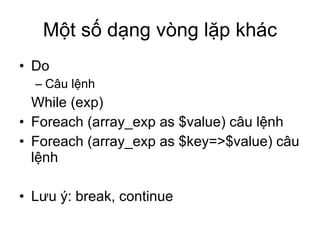
Một số dạng vòng lặp khác Do  Câu lệnh While (exp) Foreach (array_exp as $value) câu lệnh Foreach (array_exp as $key=>$value) câu lệnh Lưu ý: break, continue
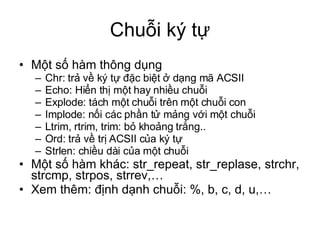
Chuỗi ký tự Một số hàm thông dụng Chr: trả về ký tự đặc biệt ở dạng mã ACSII Echo: Hiển thị một hay nhiều chuỗi Explode: tách một chuỗi trên một chuỗi con Implode: nối các phần tử mảng với một chuỗi Ltrim, rtrim, trim: bỏ khoảng trắng.. Ord: trả về trị ACSII của ký tự Strlen: chiều dài của một chuỗi Một số hàm khác: str_repeat, str_replase, strchr, strcmp, strpos, strrev,… Xem thêm: định dạnh chuỗi: %, b, c, d, u,…
Mảng trong PHP Tập hợp các giá trị được lưu trữ dưới 1 tên, 1 phần quan trọng của PHP. Chỉ số mảng có thể là số, chuỗi  (numeric array, associative array) Ví dụ: $traicay[1] = “apple”; $tenbien[“abc”] = 123; Mặc định giá trị bắt đầu của mảng là: 0
Khai báo mảng Cách 1:   <?php $a=array(&quot;a&quot;=>&quot;Dog&quot;,&quot;b&quot;=>&quot;Cat&quot;,&quot;c&quot;=>&quot;Horse&quot;);  print_r($a);  ?>   Kết quả: Array ( [a] => Dog [b] => Cat [c] => Horse )  Cách 2: <?php  $a=array(&quot;Dog&quot;,&quot;Cat&quot;,&quot;Horse&quot;); print_r($a);  ?> Kết quả: Array ( [0] => Dog [1] => Cat [2] => Horse )
Vòng lặp đối với mảng $a[0] = “an”; $a[1]=“binh”; $a[2]=“chinh”; For ($i=0; $i<count($a); $i++) { Echo $a[$i],”\n”; } Kết quả: an binh  chinh
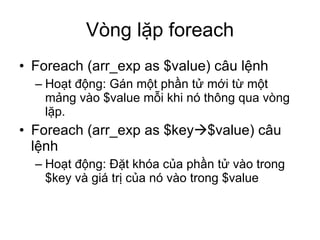
Vòng lặp foreach Foreach (arr_exp as $value) câu lệnh Hoạt động: Gán một phần tử mới từ một mảng vào $value mỗi khi nó thông qua vòng lặp. Foreach (arr_exp as $key  $value) câu lệnh Hoạt động: Đặt khóa của phần tử vào trong $key và giá trị của nó vào trong $value
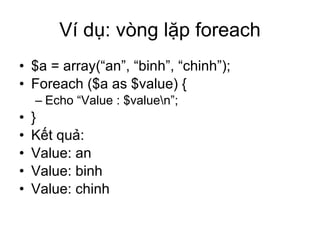
Ví dụ: vòng lặp foreach $a = array(“an”, “binh”, “chinh”); Foreach ($a as $value) { Echo “Value : $value\n”; } Kết quả:  Value: an Value: binh Value: chinh
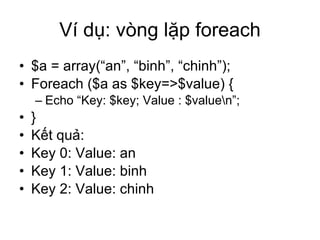
Ví dụ: vòng lặp foreach $a = array(“an”, “binh”, “chinh”); Foreach ($a as $key=>$value) { Echo “Key: $key; Value : $value\n”; } Kết quả:  Key 0: Value: an Key 1: Value: binh Key 2: Value: chinh
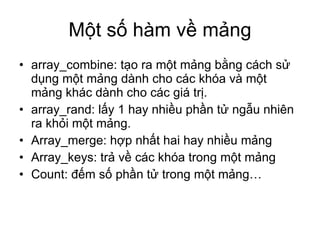
Một số hàm về mảng array_combine: tạo ra một mảng bằng cách sử dụng một mảng dành cho các khóa và một mảng khác dành cho các giá trị.  array_rand: lấy 1 hay nhiều phần tử ngẫu nhiên ra khỏi một mảng.  Array_merge: hợp nhất hai hay nhiều mảng Array_keys: trả về các khóa trong một mảng Count: đếm số phần tử trong một mảng…
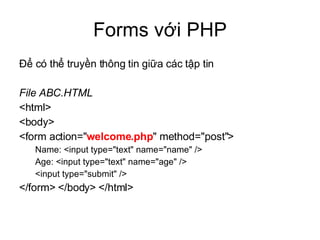
Forms với PHP Để có thể truyền thông tin giữa các tập tin  File ABC.HTML <html>  <body>  <form action=&quot; welcome.php &quot; method=&quot;post&quot;>  Name: <input type=&quot;text&quot; name=&quot;name&quot; /> Age: <input type=&quot;text&quot; name=&quot;age&quot; />  <input type=&quot;submit&quot; />  </form> </body> </html>
Tập tin PHP nhận biến File welcome.php <html> <body>  Welcome <?php echo $_POST[&quot;name&quot;]; ?>.<br />  You are <?php echo $_POST[&quot;age&quot;]; ?> years old.  </body> </html>  Kết quả: Welcome  ABC .  You are  20  years old.
$_GET <form action=&quot;welcome.php&quot; method=&quot; get &quot;>  Name: <input type=&quot;text&quot; name=&quot;name&quot; /> Age: <input type=&quot;text&quot; name=&quot;age&quot; />  <input type=&quot;submit&quot; />  </form>  Khi nhấn SUBMIT, Kết quả: http://www.w3schools.com/welcome.php?name= ABC &age= 20   Welcome <?php echo  $_GET[&quot;name&quot;] ; ?>.<br /> You are <?php echo  $_GET[&quot;age&quot;] ; ?> years old!
$_POST <form action=&quot;welcome.php&quot; method=“ post &quot;>  Name: <input type=&quot;text&quot; name=&quot;name&quot; /> Age: <input type=&quot;text&quot; name=&quot;age&quot; />  <input type=&quot;submit&quot; />  </form>  Khi nhấn SUBMIT, Kết quả: http://www.w3schools.com/welcome.php Welcome <?php echo  $_POST[&quot;name&quot;] ; ?>.<br /> You are <?php echo  $_POST[&quot;age&quot;] ; ?> years old!  Lưu ý: $_REQUEST có thể dùng thay cho $_GET và $_POST
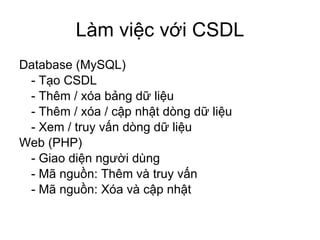
Làm việc với CSDL Database (MySQL) - Tạo CSDL - Thêm / xóa bảng dữ liệu - Thêm / xóa / cập nhật dòng dữ liệu - Xem / truy vấn dòng dữ liệu Web (PHP) - Giao diện người dùng - Mã nguồn: Thêm và truy vấn - Mã nguồn: Xóa và cập nhật
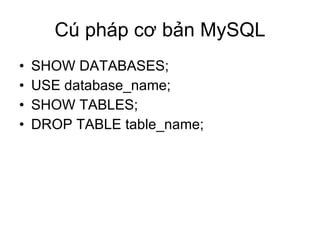
Cú pháp cơ bản MySQL SHOW DATABASES; USE database_name; SHOW TABLES; DROP TABLE table_name;
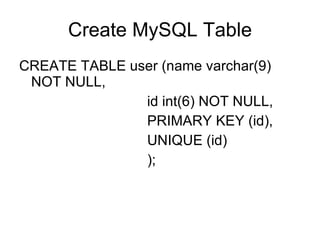
Create MySQL Table CREATE TABLE user (name varchar(9) NOT NULL, id int(6) NOT NULL, PRIMARY KEY (id), UNIQUE (id) );
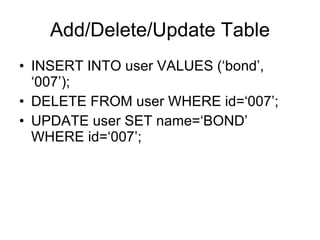
Add/Delete/Update Table INSERT INTO user VALUES (‘bond’, ‘007’); DELETE FROM user WHERE id=‘007’; UPDATE user SET name=‘BOND’ WHERE id=‘007’;
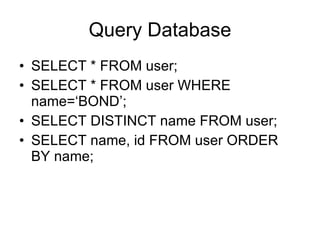
Query Database SELECT * FROM user; SELECT * FROM user WHERE name=‘BOND’; SELECT DISTINCT name FROM user; SELECT name, id FROM user ORDER BY name;
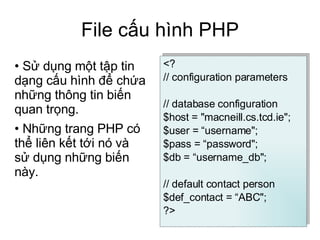
File cấu hình PHP <? // configuration parameters // database configuration $host = &quot;macneill.cs.tcd.ie&quot;; $user = “username&quot;; $pass = “password&quot;; $db = “username_db&quot;; // default contact person $def_contact = “ABC&quot;; ?> Sử dụng một tập tin dạng cấu hình để chứa những thông tin biến quan trọng. Những trang PHP có thể liên kết tới nó và sử dụng những biến này.
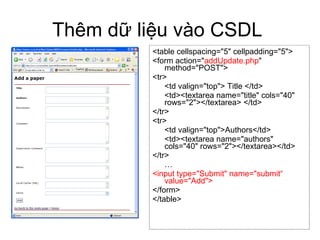
Thêm dữ liệu vào CSDL  <table cellspacing=&quot;5&quot; cellpadding=&quot;5&quot;> <form action=&quot; addUpdate.php &quot;  method=&quot;POST&quot;> <tr> <td valign=&quot;top&quot;> Title </td> <td><textarea name=&quot;title&quot; cols=&quot;40&quot; rows=&quot;2&quot;></textarea> </td> </tr> <tr> <td valign=&quot;top&quot;>Authors</td> <td><textarea name=&quot;authors&quot; cols=&quot;40&quot; rows=&quot;2&quot;></textarea></td> </tr> … <input type=&quot;Submit&quot; name=&quot;submit“ value=&quot;Add&quot;> </form> </table>
Thêm dữ liệu vào CSDL (tt) <? include(&quot;conf.php&quot;); // form submitted so start processing it $title = $_POST[&quot;title&quot;]; $authors = $_POST[&quot;authors&quot;]; … // set up error list array & validate text input fields $errorList = array(); $count = 0; if (!$title) { $errorList[$count] = &quot;Invalid entry: Title&quot;; $count++; } // set default value for contact person if (!$contact) { $contact = $def_contact; } // check for errors & if none found... if (sizeof($errorList) == 0) { $connection = mysql_connect($host, $user, $pass) or die (&quot;Unable to connect!&quot;); mysql_select_db($db) or die (&quot;Unable to select database!&quot;); $query = &quot;INSERT INTO papers (title, authors, description, comment, super, bibtex, url, genre) VALUES ('$title', '$authors', '$description', '$comment', '$super','$bibtex','$url','$genre')&quot;; $result = mysql_query($query) or die (&quot;Error in query: $query. &quot; . mysql_error()); echo &quot;<font size=-1>Addition successful. </font>&quot;; // close database connection mysql_close($connection); } else {// errors occurred} ?>
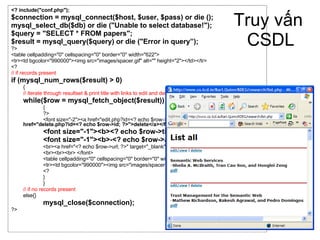
Truy vấn  CSDL <? include(&quot;conf.php&quot;); $connection = mysql_connect($host, $user, $pass) or die (); mysql_select_db($db) or die (&quot;Unable to select database!&quot;); $query = &quot;SELECT * FROM papers&quot;; $result = mysql_query($query) or die (&quot;Error in query”); ?> <table cellpadding=&quot;0&quot; cellspacing=&quot;0&quot; border=&quot;0&quot; width=&quot;622&quot;> <tr><td bgcolor=&quot;990000&quot;><img src=&quot;images/spacer.gif&quot; alt=&quot;&quot; height=&quot;2&quot;></td></tr> <? // if records present if (mysql_num_rows($result) > 0) { // iterate through resultset & print title with links to edit and delete scripts while($row = mysql_fetch_object($result)) { ?> <font size=&quot;-2&quot;><a href=&quot;edit.php?id=<? echo $row->id; ?>&quot;>edit/view</a> |  <a href=&quot;delete.php?id=<? echo $row->id; ?>&quot;>delete</a></font><p> <font size=&quot;-1&quot;><b><? echo $row->title; ?></b><br> <font size=&quot;-1&quot;><b>-<? echo $row->authors; ?></b> <br><a href=&quot;<? echo $row->url; ?>&quot; target=&quot;_blank&quot;> pdf</a> <br><br><br> </font> <table cellpadding=&quot;0&quot; cellspacing=&quot;0&quot; border=&quot;0&quot; width=&quot;622&quot;> <tr><td bgcolor=&quot;990000&quot;><img src=&quot;images/spacer.gif&quot; alt=&quot;“ height=&quot;2&quot;></td></tr> <? } } // if no records present  else{} mysql_close($connection); ?>
Xóa dòng dữ liệu trong PHP include(&quot;conf.php&quot;); // form not yet submitted, display initial form with values pre-filled $id=$_GET['id'];  { // open database connection $connection = mysql_connect($host, $user, $pass) or die (&quot;Unable to connect!&quot;); // select database mysql_select_db($db) or die (&quot;Unable to select database!&quot;); // generate and execute query $query = &quot;DELETE FROM papers WHERE id = '$id'&quot;; $result = mysql_query($query) or die (&quot;Error in query: $query. &quot; . mysql_error()); // close database connection mysql_close($connection); // print result echo &quot;<font size=-1>Deletion successful</font>&quot;; }
Cập nhật  CSDL 1 $id=$_GET['id'];  if (!$submit) { $connection = mysql_connect($host, $user, $pass) or die (&quot;Unable to connect!&quot;); mysql_select_db($db) or die (&quot;Unable to select database!&quot;); $query = &quot;SELECT title, authors, description, comment, super, bibtex, url, genre FROM papers WHERE id = '$id'&quot;; $result = mysql_query($query) or die (&quot;Error in query: $query. &quot; . mysql_error()) if (mysql_num_rows($result) > 0) { $row = mysql_fetch_object($result); // print form with values pre-filled ?> <table cellspacing=&quot;5&quot; cellpadding=&quot;5&quot;> <form action=&quot; Update.php &quot;  method=&quot;POST&quot;> <input type=&quot;hidden&quot; name=&quot;id&quot;  value=&quot;<? echo $id; ?>&quot;> <tr> <td valign=&quot;top&quot;><b><font size=&quot;-1&quot;>Title</font></b></td> <td><textarea name=&quot;title&quot; cols=&quot;40&quot; rows=&quot;2&quot;><? echo $row->title; ?> </textarea></td> </tr> <tr> <td valign=&quot;top&quot;><b><font size=&quot;-1&quot;>Authors</font></b></td> <td><textarea name=&quot;authors&quot; cols=&quot;40&quot; rows=&quot;2&quot;><? echo $row->authors; ?> </textarea>  </td> </tr> … <tr> <td colspan=2> <input type=&quot;Submit&quot; name=&quot;submit&quot; value=&quot;Update&quot;></td></tr> </form> </table>
Cập nhật CSDL 2 include(&quot;conf.php&quot;); // form submitted so start processing it $title = $_POST[&quot;title&quot;]; $authors = $_POST[&quot;authors&quot;]; … $id = $_POST[&quot;id&quot;]; // set up error list array $errorList = array(); $count = 0; // validate text input fields if (!$title) { $errorList[$count] = &quot;Invalid entry: Title&quot;; $count++; } if (!$contact) { $contact = $def_contact; } // check for errors, if none found... if (sizeof($errorList) == 0) { $connection = mysql_connect($host, $user, $pass) or die (&quot;Unable to connect!&quot;); mysql_select_db($db) or die (&quot;Unable to select database!&quot;); $query = &quot;UPDATE papers SET title = '$title', authors = '$authors', description = '$description', comment =  '$comment', super = '$super', bibtex = '$bibtex', url = '$url', genre = '$genre' WHERE id = '$id'&quot;; $result = mysql_query($query) or die (&quot;Error in query: $query. &quot; . mysql_error()); // print result echo “Update successful&quot;; // close database connection mysql_close($connection); } else{} ?>
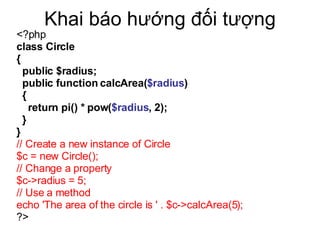
Khai báo hướng đối tượng <?php class Circle { public $radius; public function calcArea( $radius ) { return pi() * pow( $radius , 2); } } // Create a new instance of Circle $c = new Circle(); // Change a property $c->radius = 5; // Use a method echo 'The area of the circle is ' . $c->calcArea(5); ?>
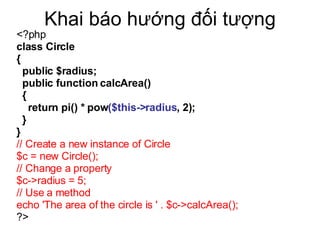
Khai báo hướng đối tượng <?php class Circle { public $radius; public function calcArea() { return pi() * pow ($this->radius , 2); } } // Create a new instance of Circle $c = new Circle(); // Change a property $c->radius = 5; // Use a method echo 'The area of the circle is ' . $c->calcArea(); ?>
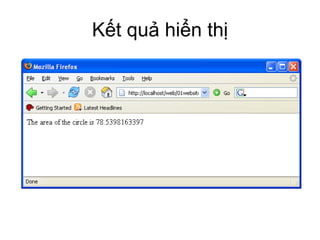
Kết quả hiển thị
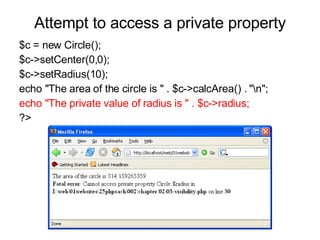
Private property <?php class Circle { private $center = array('x' => 0, 'y' => 0); private $radius = 1; public function setRadius($radius) { $this->radius = $radius; } public function setCenter($x, $y) { $this->center['x'] = $x; $this->center['y'] = $y; } public function calcArea() { return pi() * pow($this->radius, 2); }
Attempt to access a private property $c = new Circle(); $c->setCenter(0,0); $c->setRadius(10); echo &quot;The area of the circle is &quot; . $c->calcArea() . &quot;\n&quot;; echo &quot;The private value of radius is &quot; . $c->radius; ?>
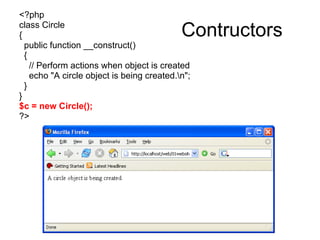
Contructors <?php class Circle { public function __construct() { // Perform actions when object is created echo &quot;A circle object is being created.\n&quot;; } } $c = new Circle(); ?>
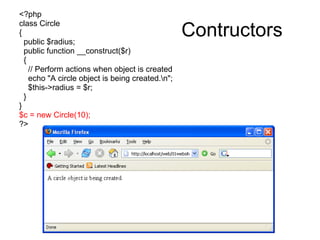
Contructors <?php class Circle { public $radius; public function __construct($r) { // Perform actions when object is created echo &quot;A circle object is being created.\n&quot;; $this->radius = $r; } } $c = new Circle(10); ?>
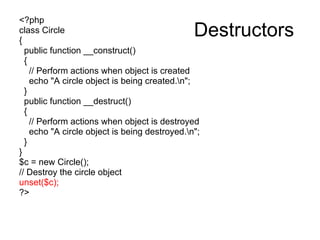
Destructors <?php class Circle { public function __construct() { // Perform actions when object is created echo &quot;A circle object is being created.\n&quot;; } public function __destruct() { // Perform actions when object is destroyed echo &quot;A circle object is being destroyed.\n&quot;; } } $c = new Circle(); // Destroy the circle object unset($c); ?>
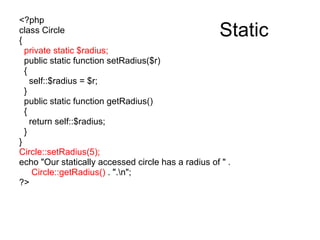
Static <?php class Circle { private static $radius; public static function setRadius($r) { self::$radius = $r; } public static function getRadius() { return self::$radius; } } Circle::setRadius(5); echo &quot;Our statically accessed circle has a radius of &quot; .  Circle::getRadius()  . &quot;.\n&quot;; ?>
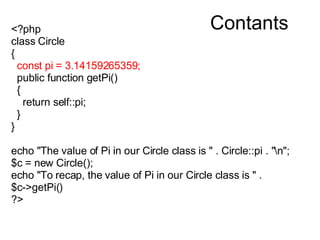
Contants <?php class Circle { const pi = 3.14159265359; public function getPi() { return self::pi; } } echo &quot;The value of Pi in our Circle class is &quot; . Circle::pi . &quot;\n&quot;; $c = new Circle(); echo &quot;To recap, the value of Pi in our Circle class is &quot; .  $c->getPi() ?>
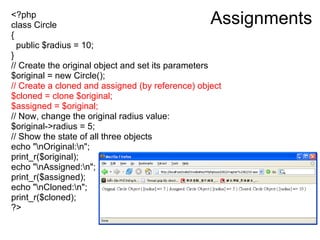
Assignments <?php class Circle { public $radius = 10; } // Create the original object and set its parameters $original = new Circle(); // Create a cloned and assigned (by reference) object $cloned = clone $original; $assigned = $original; // Now, change the original radius value: $original->radius = 5; // Show the state of all three objects echo &quot;\nOriginal:\n&quot;; print_r($original); echo &quot;\nAssigned:\n&quot;; print_r($assigned); echo &quot;\nCloned:\n&quot;; print_r($cloned); ?>
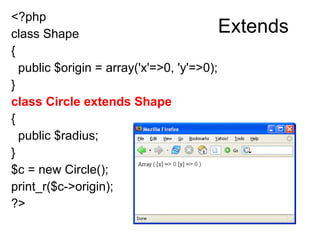
Extends <?php class Shape { public $origin = array('x'=>0, 'y'=>0); } class Circle extends Shape { public $radius; } $c = new Circle(); print_r($c->origin); ?>
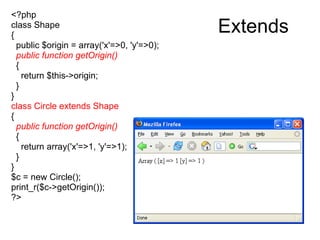
Extends <?php class Shape { public $origin = array('x'=>0, 'y'=>0); public function getOrigin() { return $this->origin; } } class Circle extends Shape { public function getOrigin() { return array('x'=>1, 'y'=>1); } } $c = new Circle(); print_r($c->getOrigin()); ?>
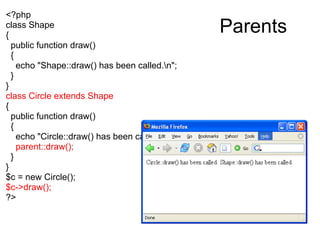
Parents <?php class Shape { public function draw() { echo &quot;Shape::draw() has been called.\n&quot;; } } class Circle extends Shape { public function draw() { echo &quot;Circle::draw() has been called.\n&quot;; parent::draw(); } } $c = new Circle(); $c->draw(); ?>
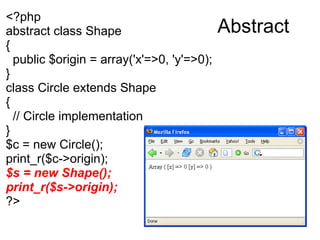
Abstract <?php abstract class Shape { public $origin = array('x'=>0, 'y'=>0); } class Circle extends Shape { // Circle implementation } $c = new Circle(); print_r($c->origin); $s = new Shape(); print_r($s->origin); ?>
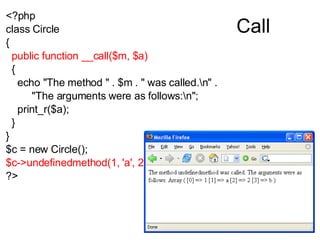
Call <?php class Circle { public function __call($m, $a) { echo &quot;The method &quot; . $m . &quot; was called.\n&quot; . &quot;The arguments were as follows:\n&quot;; print_r($a); } } $c = new Circle(); $c->undefinedmethod(1, 'a', 2, 'b'); ?>
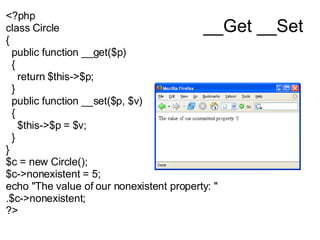
__Get __Set <?php class Circle { public function __get($p) { return $this->$p; } public function __set($p, $v) { $this->$p = $v; } } $c = new Circle(); $c->nonexistent = 5; echo &quot;The value of our nonexistent property: &quot;  .$c->nonexistent; ?>
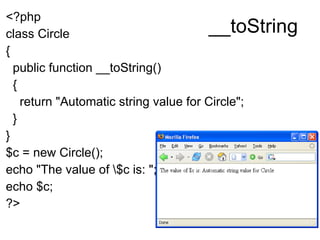
__toString <?php class Circle { public function __toString() { return &quot;Automatic string value for Circle&quot;; } } $c = new Circle(); echo &quot;The value of \$c is: &quot;; echo $c; ?>
<?php session_start(); class Circle { public $radius; public $origin = array('x'=>0, 'y'=>0); public function __sleep() { echo 'zzzzz'; return array('radius','origin'); } public function __wakeup() { echo 'good morning!'; } } Page1.php $c = new Circle(); $c->radius = 5; $c->origin['x'] = 3; $c->origin['y'] = 4; echo 'Preparing to sleep.....'; $_SESSION['c'] = serialize($c); echo '<br /><a href=&quot;page2.php&quot;>Wake the object</a>'; ?>
<?php session_start(); class Circle { public $radius; public $origin = array('x'=>0, 'y'=>0); public function __sleep() { echo 'zzzzz'; return array('radius','origin'); } public function __wakeup() { echo 'good morning!'; } } Page2.php echo 'Rise and shine.....'; $c = unserialize($_SESSION['c']); echo '<br />The contents of our Circle object are:<br />'; echo 'Radius: ' . $c->radius . '<br />'; echo 'Origin: (' . $c->origin['x'] . ',' . $c->origin['y'] . ')'; ?>
Session in PHP Starting a PHP Session <?php session_start(); ?>  <html> <body> </body> </html> Storing a Session Variable <?php session_start();  // store session data  $_SESSION['views']=1; ?>  <html> <body>  <?php  //retrieve session data  echo &quot;Pageviews=&quot;. $_SESSION['views'];  ?>  </body> </html>  Output: Pageviews=1
Tận dụng biến session <?php session_start();  if(isset($_SESSION['views'])) $_SESSION['views']=$_SESSION['views']+1; else $_SESSION['views']=1; echo &quot;Views=&quot;. $_SESSION['views'];  ?>  Destroying a session variables: unset($_SESSION['views']);  Session destroyed: session_destroy();

Php Csdlweb06

  • 1.
  • 2.
    Những vấn đềcơ bản Lịch sử Cài đặt: sử dụng WAMP Ngôn ngữ:PHP PHP và MySQL PHP và Hướng đối tượng
  • 3.
    PHP là gì? Một ngôn ngữ (viết từ C++, mã nguồn mở) có thể nhúng vào HTML, tạo ra ứng dụng WEB. Ví dụ: <html>     <head>         <title>Example</title>     </head>     <body>         <?php         echo &quot;Hi, I'm a PHP script!&quot;;         ?>     </body> </html>
  • 4.
    PHP là gì? Với <? Và ?> là dấu hiệu dùng để nhận biết đoạn mã PHP Echo dùng để xuất ra 1 nội dung cho file HTML. PHP là ngôn ngữ phục vụ xử lý tại WEB Server (khác với JavaScript thông thường là Client Script)  Không thể biết được mã PHP tại Server (được trả về cho Client chỉ là mã HTML)
  • 5.
    Những ưu điểmnổi bật Miễn phí  Tạo nên một sức mạnh rất lớn của PHP. Từ Internet, chúng ta có thể thu thập rất nhiều mã nguồn mở PHP. Ngôn ngữ PHP đơn giản, giống C, Perl Hỗ trợ hầu hết các cơ sở dữ liệu Chạy nhanh
  • 6.
    Web Server hỗtrợ PHP Apache Microsoft IIS PWS (Personal WebServer) iPlant server 、 Oreilly Website Pro Server 、 Caudium 、 Xitami 、 OmniHTTPd … .
  • 7.
    Các hướng tiếpcận lập trình Lập trình theo cấu trúc Lập trình hướng đối tượng OOP Lập trình AOP (aspect-oriented programming)
  • 8.
    Những cơ sởdữ liệu hỗ trợ Adabas D Ingres Oracle (OCI7 and OCI8) dBase InterBase Ovrimos Empress FrontBase PostgreSQL FilePro (read-only) mSQL Solid Hyperwave Direct MS-SQL Sybase IBM DB2 MySQL Velocis Informix ODBC Unix dbm
  • 9.
    Lịch sử PHPRa đời năm 1994 - 1995 do Rasmus Lerdorf phát triển. Phiên bản thứ hai PHP/FI (1%) 1997:Phiên bản PHP3 của Zeev Suraski và Andi Gutmans (10%) – 1998/6 chính thức công bố.
  • 10.
    Lịch sử PHPMùa đông 1998, PHP4 của Zend  Zend Engine, Phiên bản cuối cùng: (PHP4.4.1) PHP5 (PHP5.1.3) – 05/2006
  • 11.
    Ngôn ngữ PHP- Cú pháp cơ bản Phân biệt với ngôn ngữ HTML 1.  <?php echo(&quot;if you want to serve XHTML or XML documents, do like this\n&quot;); ?> 2.  <? echo (&quot;this is the simplest, an SGML processing instruction\n&quot;); ?> <?= expression ?> This is a shortcut for &quot;<? echo expression ?> 3.  <script language=&quot;php&quot;>         echo (&quot;some editors (like FrontPage) don't               like processing instructions&quot;);     </script> 4.  <% echo (&quot;You may optionally use ASP-style tags&quot;); %>     <%= $variable; # This is a shortcut for &quot;<% echo . . .&quot; %> (hỗ trợ từ 3.0.4)
  • 12.
    8 kiểu dữliệu trong PHP 4 kiểu định lượng Boolean Integer Float String 2 kiểu tổ hợp Array Object 2 kiểu đặc biệt Resource NULL
  • 13.
    Kiểu BOOLEAN Nhận2 giá trị TRUE - FALSE Ví dụ: // == is an operator which test equality and returns a boolean if ( $action == &quot;show_version&quot; ) {     echo &quot;The version is 1.23&quot;; } // this is not necessary... if ( $show_separators == TRUE ) {     echo &quot;<hr>\n&quot;; } // ...because you can simply type if ( $show_separators ) {     echo &quot;<hr>\n&quot;; }
  • 14.
    Chuyển đổi kiểudữ liệu BOOLEAN Khi hoán chuyển thành kiểu BOOLEAN, những kiểu dữ liệu với giá trị sau sẽ được coi như là FALSE: Kiểu số nguyên = 0 Kiểu số thực = 0.0 Chuỗi rỗng hoặc chuỗi “0” Kiểu NULL Kiểu mảng không có phần tử Kiểu đối tượng chưa được khởi tạo..
  • 15.
    Kiểu số nguyênĐây là tập hợp {… ,-2,-1,0,1,2….} Ta có thể dùng số thập phân, số thập lục phân, số bát phân Ví dụ: <?php $a = 1234; # số thập phân $a = -123; # một số âm $a = 0123; # số bát phân ( = số 83 trong thập phân ) $a = 0x1A; # số thập lục phân ( bằng số 26 trong thập phân) ?>
  • 16.
    Biến trong PHPBiến trong PHP được bắt đầu bằng dấu &quot;$&quot;, theo sau đó là tên biến. Ví dụ: $nguyen, $phi Tên biến hợp lệ phải bắt đầu là một chữ cái hay một đường gạch dưới (_), theo sau đó có thể là bất kỳ chữ cái, số hoặc là (_). Ví dụ : $var = &quot;Bob&quot;; $Var = &quot;Joe&quot;; echo &quot;$var, $Var&quot;; // outputs &quot;Bob, Joe&quot; $4site = 'not yet'; // không hợp lệ $_4site = 'not yet'; // hợp lệ
  • 17.
    Toán tử toánhọc Lấy số dư (giá trị tuyệt đối) % Lấy số này chia cho số kia / Nhân hai con số lại với nhau * Lấy số này trừ số kia - Cộng hai con số +
  • 18.
    Một số hàmtoán học Abs: trị tuyệt đối Base_convert: chuyển đổi 1 số giữa các cơ số. Bindec: chuyển đổi hệ nhị phân sang thập phân Ceil: làm tròn tăng các phân số Cos: Côsin Floor: làm tròn giảm các phân số Một số hàm khác: Exp, fmod, getrandmax,hexdec, log10, pow, pi, sin, sqrt, srand,…
  • 19.
    Các toán tửGÁN Cơ bản nhất là: = +=, -=, *=, /=, .=, %=, &=, |=, ^=, <,<=, >, >= ++$value: tăng trước $value++: tăng sau --$value: giảm trước $value--: giảm sau
  • 20.
    Các toán tửchuỗi Toán tử ghép nối: . Toán tử gán ghép nối: .= Các toán tử Bit And: $a & $b Or: $a | $b XOR: $a ^ $b Not: ~ $a Shift left: $a << $b Shift right: $a >> $b
  • 21.
    Các toán tửso sánh True nếu $a lớn hơn hay bằng $b $a>=$b Lớn hơn hay bằng >= True nếu $a nhỏ hơn hay bằng $b $a<=$b Nhỏ hơn hay bằng <= True nếu $a lớn hơn $b $a>$b Lớn hơn > True nếu $a nhỏ hơn $b $a<$b Nhỏ hơn < True nếu $a không bằng $b, hay chúng không cùng kiểu $a!==$b Không tương đương !== True nếu $a không bằng $b $a<>$b Không bằng <> True nếu $a không bằng $b $a!=$b Không bằng != True nếu $a bằng $b, và chúng cùng một kiểu $a===$b Tương đương === True nếu $a bằng $b $a==$b Bằng == Kết quả Ví dụ Ý nghĩa Toán tử
  • 22.
    Các toán tửlogic True nếu hoặc $a hoặc $b là true $a || $b Or || True nếu cả hai $a và $b đều là true $a && $b And && True nếu $a không phải là true ! $a Not ! True nếu $a hoặc $b là true, nhưng cả hai không được cùng true $a xor $b Xor Xor True nếu hoặc $a hoặc $b đều true $a or $b Or Or True nếu cả $a và $b đều true $a and $b And And Kết quả Ví dụ Phép toán Toán tử
  • 23.
    Các câu lệnhđiều khiển Câu lệnh IF If (expression) Câu lệnh Câu lệnh ELSE If (exp) { Câu lệnh } else { Câu lệnh } Câu lệnh ELSEIF If (exp) { câu lệnh } elseif (exp) { câu lệnh } elseif (exp) { … } else { Câu lệnh }
  • 24.
    Toán tử tamphân $res = điềukiện ? Exp1 : exp2; Ví dụ: <?php $value = 14; $output = $value<10 ? “0x”.$value : “0x”.chr($value-10+65); Echo “In hexadecimal, $value=$output”; ?>
  • 25.
    Sử dụng lệnhswitch Ví dụ: <?php $task = 4; Switch($task) { Case 1: echo “Số một”; break; Case 2: echo “Số hai”; break; .. Case 6: echo “Số sáu”; break; Default: echo “Số lớn”; break; } ?>
  • 26.
    Vòng lặp FORFor (exp1; exp2; exp3) câu lệnh Ví dụ: For ($v1=2, $v2=2; $v1<5 && $v2<5; $v1++,$v2++){ Echo “$v1x$v2=“, $v1*$v2, “<br>”; } Kết quả: 2 x 2 = 4 3 x 3 = 9 4 x 4 =16
  • 27.
    Vòng lặp WHILEWhile (exp) câu lệnh; Ví dụ: $value = 1; While ($value<10) { Echo “New value:”, $value, “<br>”; $value *= 2; }
  • 28.
    Một số dạngvòng lặp khác Do Câu lệnh While (exp) Foreach (array_exp as $value) câu lệnh Foreach (array_exp as $key=>$value) câu lệnh Lưu ý: break, continue
  • 29.
    Chuỗi ký tựMột số hàm thông dụng Chr: trả về ký tự đặc biệt ở dạng mã ACSII Echo: Hiển thị một hay nhiều chuỗi Explode: tách một chuỗi trên một chuỗi con Implode: nối các phần tử mảng với một chuỗi Ltrim, rtrim, trim: bỏ khoảng trắng.. Ord: trả về trị ACSII của ký tự Strlen: chiều dài của một chuỗi Một số hàm khác: str_repeat, str_replase, strchr, strcmp, strpos, strrev,… Xem thêm: định dạnh chuỗi: %, b, c, d, u,…
  • 30.
    Mảng trong PHPTập hợp các giá trị được lưu trữ dưới 1 tên, 1 phần quan trọng của PHP. Chỉ số mảng có thể là số, chuỗi (numeric array, associative array) Ví dụ: $traicay[1] = “apple”; $tenbien[“abc”] = 123; Mặc định giá trị bắt đầu của mảng là: 0
  • 31.
    Khai báo mảngCách 1: <?php $a=array(&quot;a&quot;=>&quot;Dog&quot;,&quot;b&quot;=>&quot;Cat&quot;,&quot;c&quot;=>&quot;Horse&quot;); print_r($a); ?> Kết quả: Array ( [a] => Dog [b] => Cat [c] => Horse ) Cách 2: <?php $a=array(&quot;Dog&quot;,&quot;Cat&quot;,&quot;Horse&quot;); print_r($a); ?> Kết quả: Array ( [0] => Dog [1] => Cat [2] => Horse )
  • 32.
    Vòng lặp đốivới mảng $a[0] = “an”; $a[1]=“binh”; $a[2]=“chinh”; For ($i=0; $i<count($a); $i++) { Echo $a[$i],”\n”; } Kết quả: an binh chinh
  • 33.
    Vòng lặp foreachForeach (arr_exp as $value) câu lệnh Hoạt động: Gán một phần tử mới từ một mảng vào $value mỗi khi nó thông qua vòng lặp. Foreach (arr_exp as $key  $value) câu lệnh Hoạt động: Đặt khóa của phần tử vào trong $key và giá trị của nó vào trong $value
  • 34.
    Ví dụ: vònglặp foreach $a = array(“an”, “binh”, “chinh”); Foreach ($a as $value) { Echo “Value : $value\n”; } Kết quả: Value: an Value: binh Value: chinh
  • 35.
    Ví dụ: vònglặp foreach $a = array(“an”, “binh”, “chinh”); Foreach ($a as $key=>$value) { Echo “Key: $key; Value : $value\n”; } Kết quả: Key 0: Value: an Key 1: Value: binh Key 2: Value: chinh
  • 36.
    Một số hàmvề mảng array_combine: tạo ra một mảng bằng cách sử dụng một mảng dành cho các khóa và một mảng khác dành cho các giá trị. array_rand: lấy 1 hay nhiều phần tử ngẫu nhiên ra khỏi một mảng. Array_merge: hợp nhất hai hay nhiều mảng Array_keys: trả về các khóa trong một mảng Count: đếm số phần tử trong một mảng…
  • 37.
    Forms với PHPĐể có thể truyền thông tin giữa các tập tin File ABC.HTML <html> <body> <form action=&quot; welcome.php &quot; method=&quot;post&quot;> Name: <input type=&quot;text&quot; name=&quot;name&quot; /> Age: <input type=&quot;text&quot; name=&quot;age&quot; /> <input type=&quot;submit&quot; /> </form> </body> </html>
  • 38.
    Tập tin PHPnhận biến File welcome.php <html> <body> Welcome <?php echo $_POST[&quot;name&quot;]; ?>.<br /> You are <?php echo $_POST[&quot;age&quot;]; ?> years old. </body> </html> Kết quả: Welcome ABC . You are 20 years old.
  • 39.
    $_GET <form action=&quot;welcome.php&quot;method=&quot; get &quot;> Name: <input type=&quot;text&quot; name=&quot;name&quot; /> Age: <input type=&quot;text&quot; name=&quot;age&quot; /> <input type=&quot;submit&quot; /> </form> Khi nhấn SUBMIT, Kết quả: http://www.w3schools.com/welcome.php?name= ABC &age= 20 Welcome <?php echo $_GET[&quot;name&quot;] ; ?>.<br /> You are <?php echo $_GET[&quot;age&quot;] ; ?> years old!
  • 40.
    $_POST <form action=&quot;welcome.php&quot;method=“ post &quot;> Name: <input type=&quot;text&quot; name=&quot;name&quot; /> Age: <input type=&quot;text&quot; name=&quot;age&quot; /> <input type=&quot;submit&quot; /> </form> Khi nhấn SUBMIT, Kết quả: http://www.w3schools.com/welcome.php Welcome <?php echo $_POST[&quot;name&quot;] ; ?>.<br /> You are <?php echo $_POST[&quot;age&quot;] ; ?> years old! Lưu ý: $_REQUEST có thể dùng thay cho $_GET và $_POST
  • 41.
    Làm việc vớiCSDL Database (MySQL) - Tạo CSDL - Thêm / xóa bảng dữ liệu - Thêm / xóa / cập nhật dòng dữ liệu - Xem / truy vấn dòng dữ liệu Web (PHP) - Giao diện người dùng - Mã nguồn: Thêm và truy vấn - Mã nguồn: Xóa và cập nhật
  • 42.
    Cú pháp cơbản MySQL SHOW DATABASES; USE database_name; SHOW TABLES; DROP TABLE table_name;
  • 43.
    Create MySQL TableCREATE TABLE user (name varchar(9) NOT NULL, id int(6) NOT NULL, PRIMARY KEY (id), UNIQUE (id) );
  • 44.
    Add/Delete/Update Table INSERTINTO user VALUES (‘bond’, ‘007’); DELETE FROM user WHERE id=‘007’; UPDATE user SET name=‘BOND’ WHERE id=‘007’;
  • 45.
    Query Database SELECT* FROM user; SELECT * FROM user WHERE name=‘BOND’; SELECT DISTINCT name FROM user; SELECT name, id FROM user ORDER BY name;
  • 46.
    File cấu hìnhPHP <? // configuration parameters // database configuration $host = &quot;macneill.cs.tcd.ie&quot;; $user = “username&quot;; $pass = “password&quot;; $db = “username_db&quot;; // default contact person $def_contact = “ABC&quot;; ?> Sử dụng một tập tin dạng cấu hình để chứa những thông tin biến quan trọng. Những trang PHP có thể liên kết tới nó và sử dụng những biến này.
  • 47.
    Thêm dữ liệuvào CSDL <table cellspacing=&quot;5&quot; cellpadding=&quot;5&quot;> <form action=&quot; addUpdate.php &quot; method=&quot;POST&quot;> <tr> <td valign=&quot;top&quot;> Title </td> <td><textarea name=&quot;title&quot; cols=&quot;40&quot; rows=&quot;2&quot;></textarea> </td> </tr> <tr> <td valign=&quot;top&quot;>Authors</td> <td><textarea name=&quot;authors&quot; cols=&quot;40&quot; rows=&quot;2&quot;></textarea></td> </tr> … <input type=&quot;Submit&quot; name=&quot;submit“ value=&quot;Add&quot;> </form> </table>
  • 48.
    Thêm dữ liệuvào CSDL (tt) <? include(&quot;conf.php&quot;); // form submitted so start processing it $title = $_POST[&quot;title&quot;]; $authors = $_POST[&quot;authors&quot;]; … // set up error list array & validate text input fields $errorList = array(); $count = 0; if (!$title) { $errorList[$count] = &quot;Invalid entry: Title&quot;; $count++; } // set default value for contact person if (!$contact) { $contact = $def_contact; } // check for errors & if none found... if (sizeof($errorList) == 0) { $connection = mysql_connect($host, $user, $pass) or die (&quot;Unable to connect!&quot;); mysql_select_db($db) or die (&quot;Unable to select database!&quot;); $query = &quot;INSERT INTO papers (title, authors, description, comment, super, bibtex, url, genre) VALUES ('$title', '$authors', '$description', '$comment', '$super','$bibtex','$url','$genre')&quot;; $result = mysql_query($query) or die (&quot;Error in query: $query. &quot; . mysql_error()); echo &quot;<font size=-1>Addition successful. </font>&quot;; // close database connection mysql_close($connection); } else {// errors occurred} ?>
  • 49.
    Truy vấn CSDL <? include(&quot;conf.php&quot;); $connection = mysql_connect($host, $user, $pass) or die (); mysql_select_db($db) or die (&quot;Unable to select database!&quot;); $query = &quot;SELECT * FROM papers&quot;; $result = mysql_query($query) or die (&quot;Error in query”); ?> <table cellpadding=&quot;0&quot; cellspacing=&quot;0&quot; border=&quot;0&quot; width=&quot;622&quot;> <tr><td bgcolor=&quot;990000&quot;><img src=&quot;images/spacer.gif&quot; alt=&quot;&quot; height=&quot;2&quot;></td></tr> <? // if records present if (mysql_num_rows($result) > 0) { // iterate through resultset & print title with links to edit and delete scripts while($row = mysql_fetch_object($result)) { ?> <font size=&quot;-2&quot;><a href=&quot;edit.php?id=<? echo $row->id; ?>&quot;>edit/view</a> | <a href=&quot;delete.php?id=<? echo $row->id; ?>&quot;>delete</a></font><p> <font size=&quot;-1&quot;><b><? echo $row->title; ?></b><br> <font size=&quot;-1&quot;><b>-<? echo $row->authors; ?></b> <br><a href=&quot;<? echo $row->url; ?>&quot; target=&quot;_blank&quot;> pdf</a> <br><br><br> </font> <table cellpadding=&quot;0&quot; cellspacing=&quot;0&quot; border=&quot;0&quot; width=&quot;622&quot;> <tr><td bgcolor=&quot;990000&quot;><img src=&quot;images/spacer.gif&quot; alt=&quot;“ height=&quot;2&quot;></td></tr> <? } } // if no records present else{} mysql_close($connection); ?>
  • 50.
    Xóa dòng dữliệu trong PHP include(&quot;conf.php&quot;); // form not yet submitted, display initial form with values pre-filled $id=$_GET['id']; { // open database connection $connection = mysql_connect($host, $user, $pass) or die (&quot;Unable to connect!&quot;); // select database mysql_select_db($db) or die (&quot;Unable to select database!&quot;); // generate and execute query $query = &quot;DELETE FROM papers WHERE id = '$id'&quot;; $result = mysql_query($query) or die (&quot;Error in query: $query. &quot; . mysql_error()); // close database connection mysql_close($connection); // print result echo &quot;<font size=-1>Deletion successful</font>&quot;; }
  • 51.
    Cập nhật CSDL 1 $id=$_GET['id']; if (!$submit) { $connection = mysql_connect($host, $user, $pass) or die (&quot;Unable to connect!&quot;); mysql_select_db($db) or die (&quot;Unable to select database!&quot;); $query = &quot;SELECT title, authors, description, comment, super, bibtex, url, genre FROM papers WHERE id = '$id'&quot;; $result = mysql_query($query) or die (&quot;Error in query: $query. &quot; . mysql_error()) if (mysql_num_rows($result) > 0) { $row = mysql_fetch_object($result); // print form with values pre-filled ?> <table cellspacing=&quot;5&quot; cellpadding=&quot;5&quot;> <form action=&quot; Update.php &quot; method=&quot;POST&quot;> <input type=&quot;hidden&quot; name=&quot;id&quot; value=&quot;<? echo $id; ?>&quot;> <tr> <td valign=&quot;top&quot;><b><font size=&quot;-1&quot;>Title</font></b></td> <td><textarea name=&quot;title&quot; cols=&quot;40&quot; rows=&quot;2&quot;><? echo $row->title; ?> </textarea></td> </tr> <tr> <td valign=&quot;top&quot;><b><font size=&quot;-1&quot;>Authors</font></b></td> <td><textarea name=&quot;authors&quot; cols=&quot;40&quot; rows=&quot;2&quot;><? echo $row->authors; ?> </textarea> </td> </tr> … <tr> <td colspan=2> <input type=&quot;Submit&quot; name=&quot;submit&quot; value=&quot;Update&quot;></td></tr> </form> </table>
  • 52.
    Cập nhật CSDL2 include(&quot;conf.php&quot;); // form submitted so start processing it $title = $_POST[&quot;title&quot;]; $authors = $_POST[&quot;authors&quot;]; … $id = $_POST[&quot;id&quot;]; // set up error list array $errorList = array(); $count = 0; // validate text input fields if (!$title) { $errorList[$count] = &quot;Invalid entry: Title&quot;; $count++; } if (!$contact) { $contact = $def_contact; } // check for errors, if none found... if (sizeof($errorList) == 0) { $connection = mysql_connect($host, $user, $pass) or die (&quot;Unable to connect!&quot;); mysql_select_db($db) or die (&quot;Unable to select database!&quot;); $query = &quot;UPDATE papers SET title = '$title', authors = '$authors', description = '$description', comment = '$comment', super = '$super', bibtex = '$bibtex', url = '$url', genre = '$genre' WHERE id = '$id'&quot;; $result = mysql_query($query) or die (&quot;Error in query: $query. &quot; . mysql_error()); // print result echo “Update successful&quot;; // close database connection mysql_close($connection); } else{} ?>
  • 53.
    Khai báo hướngđối tượng <?php class Circle { public $radius; public function calcArea( $radius ) { return pi() * pow( $radius , 2); } } // Create a new instance of Circle $c = new Circle(); // Change a property $c->radius = 5; // Use a method echo 'The area of the circle is ' . $c->calcArea(5); ?>
  • 54.
    Khai báo hướngđối tượng <?php class Circle { public $radius; public function calcArea() { return pi() * pow ($this->radius , 2); } } // Create a new instance of Circle $c = new Circle(); // Change a property $c->radius = 5; // Use a method echo 'The area of the circle is ' . $c->calcArea(); ?>
  • 55.
  • 56.
    Private property <?phpclass Circle { private $center = array('x' => 0, 'y' => 0); private $radius = 1; public function setRadius($radius) { $this->radius = $radius; } public function setCenter($x, $y) { $this->center['x'] = $x; $this->center['y'] = $y; } public function calcArea() { return pi() * pow($this->radius, 2); }
  • 57.
    Attempt to accessa private property $c = new Circle(); $c->setCenter(0,0); $c->setRadius(10); echo &quot;The area of the circle is &quot; . $c->calcArea() . &quot;\n&quot;; echo &quot;The private value of radius is &quot; . $c->radius; ?>
  • 58.
    Contructors <?php classCircle { public function __construct() { // Perform actions when object is created echo &quot;A circle object is being created.\n&quot;; } } $c = new Circle(); ?>
  • 59.
    Contructors <?php classCircle { public $radius; public function __construct($r) { // Perform actions when object is created echo &quot;A circle object is being created.\n&quot;; $this->radius = $r; } } $c = new Circle(10); ?>
  • 60.
    Destructors <?php classCircle { public function __construct() { // Perform actions when object is created echo &quot;A circle object is being created.\n&quot;; } public function __destruct() { // Perform actions when object is destroyed echo &quot;A circle object is being destroyed.\n&quot;; } } $c = new Circle(); // Destroy the circle object unset($c); ?>
  • 61.
    Static <?php classCircle { private static $radius; public static function setRadius($r) { self::$radius = $r; } public static function getRadius() { return self::$radius; } } Circle::setRadius(5); echo &quot;Our statically accessed circle has a radius of &quot; . Circle::getRadius() . &quot;.\n&quot;; ?>
  • 62.
    Contants <?php classCircle { const pi = 3.14159265359; public function getPi() { return self::pi; } } echo &quot;The value of Pi in our Circle class is &quot; . Circle::pi . &quot;\n&quot;; $c = new Circle(); echo &quot;To recap, the value of Pi in our Circle class is &quot; . $c->getPi() ?>
  • 63.
    Assignments <?php classCircle { public $radius = 10; } // Create the original object and set its parameters $original = new Circle(); // Create a cloned and assigned (by reference) object $cloned = clone $original; $assigned = $original; // Now, change the original radius value: $original->radius = 5; // Show the state of all three objects echo &quot;\nOriginal:\n&quot;; print_r($original); echo &quot;\nAssigned:\n&quot;; print_r($assigned); echo &quot;\nCloned:\n&quot;; print_r($cloned); ?>
  • 64.
    Extends <?php classShape { public $origin = array('x'=>0, 'y'=>0); } class Circle extends Shape { public $radius; } $c = new Circle(); print_r($c->origin); ?>
  • 65.
    Extends <?php classShape { public $origin = array('x'=>0, 'y'=>0); public function getOrigin() { return $this->origin; } } class Circle extends Shape { public function getOrigin() { return array('x'=>1, 'y'=>1); } } $c = new Circle(); print_r($c->getOrigin()); ?>
  • 66.
    Parents <?php classShape { public function draw() { echo &quot;Shape::draw() has been called.\n&quot;; } } class Circle extends Shape { public function draw() { echo &quot;Circle::draw() has been called.\n&quot;; parent::draw(); } } $c = new Circle(); $c->draw(); ?>
  • 67.
    Abstract <?php abstractclass Shape { public $origin = array('x'=>0, 'y'=>0); } class Circle extends Shape { // Circle implementation } $c = new Circle(); print_r($c->origin); $s = new Shape(); print_r($s->origin); ?>
  • 68.
    Call <?php classCircle { public function __call($m, $a) { echo &quot;The method &quot; . $m . &quot; was called.\n&quot; . &quot;The arguments were as follows:\n&quot;; print_r($a); } } $c = new Circle(); $c->undefinedmethod(1, 'a', 2, 'b'); ?>
  • 69.
    __Get __Set <?phpclass Circle { public function __get($p) { return $this->$p; } public function __set($p, $v) { $this->$p = $v; } } $c = new Circle(); $c->nonexistent = 5; echo &quot;The value of our nonexistent property: &quot; .$c->nonexistent; ?>
  • 70.
    __toString <?php classCircle { public function __toString() { return &quot;Automatic string value for Circle&quot;; } } $c = new Circle(); echo &quot;The value of \$c is: &quot;; echo $c; ?>
  • 71.
    <?php session_start(); classCircle { public $radius; public $origin = array('x'=>0, 'y'=>0); public function __sleep() { echo 'zzzzz'; return array('radius','origin'); } public function __wakeup() { echo 'good morning!'; } } Page1.php $c = new Circle(); $c->radius = 5; $c->origin['x'] = 3; $c->origin['y'] = 4; echo 'Preparing to sleep.....'; $_SESSION['c'] = serialize($c); echo '<br /><a href=&quot;page2.php&quot;>Wake the object</a>'; ?>
  • 72.
    <?php session_start(); classCircle { public $radius; public $origin = array('x'=>0, 'y'=>0); public function __sleep() { echo 'zzzzz'; return array('radius','origin'); } public function __wakeup() { echo 'good morning!'; } } Page2.php echo 'Rise and shine.....'; $c = unserialize($_SESSION['c']); echo '<br />The contents of our Circle object are:<br />'; echo 'Radius: ' . $c->radius . '<br />'; echo 'Origin: (' . $c->origin['x'] . ',' . $c->origin['y'] . ')'; ?>
  • 73.
    Session in PHPStarting a PHP Session <?php session_start(); ?> <html> <body> </body> </html> Storing a Session Variable <?php session_start(); // store session data $_SESSION['views']=1; ?> <html> <body> <?php //retrieve session data echo &quot;Pageviews=&quot;. $_SESSION['views']; ?> </body> </html> Output: Pageviews=1
  • 74.
    Tận dụng biếnsession <?php session_start(); if(isset($_SESSION['views'])) $_SESSION['views']=$_SESSION['views']+1; else $_SESSION['views']=1; echo &quot;Views=&quot;. $_SESSION['views']; ?> Destroying a session variables: unset($_SESSION['views']); Session destroyed: session_destroy();