AnnouncementsPHP 5.2.10 is available (June 18 release)CodeWorks 2009 Announced – Washington, D.C.Tutorial Day: October 2Main Conference: October 3Two day conference for PHP developersEach event is limited to 300 attendeeshttp://cw.mtacon.com/signup/index to RegisterDiscount prices until July 152009 DC PHP Conference & ExpoSeptember 16 & 17Discount prices until August 15No sessions available yet1
PHP 5.3July 2009 Baltimore/Washington PHP MeetupChris Stonechris@emoxie.comFollow me @cmstone
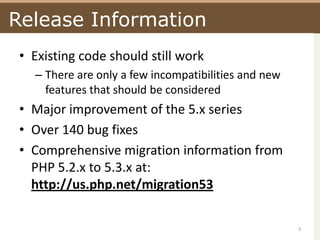
Release InformationExisting code should still workThere are only a few incompatibilities and new features that should be consideredMajor improvement of the 5.x seriesOver 140 bug fixesComprehensive migration information from PHP 5.2.x to 5.3.x at: http://us.php.net/migration533
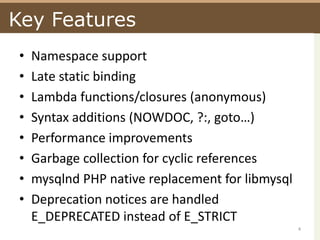
Key FeaturesNamespace supportLate static bindingLambda functions/closures (anonymous)Syntax additions (NOWDOC, ?:, goto…)Performance improvementsGarbage collection for cyclic referencesmysqlnd PHP native replacement for libmysqlDeprecation notices are handled E_DEPRECATED instead of E_STRICT4
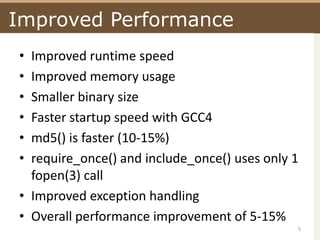
Improved PerformanceImproved runtime speedImproved memory usageSmaller binary sizeFaster startup speed with GCC4md5() is faster (10-15%)require_once() and include_once() uses only 1  fopen(3) callImproved exception handlingOverall performance improvement of 5-15%5
Namespaces
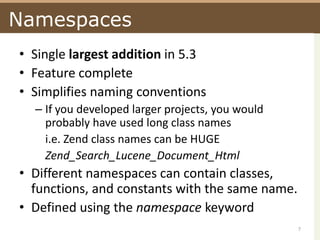
NamespacesSingle largest addition in 5.3Feature completeSimplifies naming conventionsIf you developed larger projects, you would probably have used long class namesi.e. Zend class names can be HUGEZend_Search_Lucene_Document_HtmlDifferent namespaces can contain classes, functions, and constants with the same name.Defined using the namespace keyword7
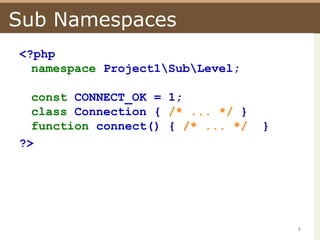
Sub Namespaces<?phpnamespace Project1\Sub\Level;const CONNECT_OK = 1;class Connection { /* ... */ }function connect() { /* ... */  }?> 8
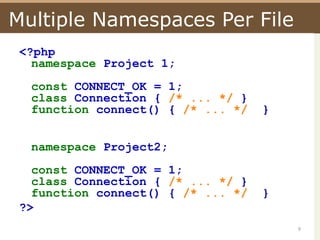
Multiple Namespaces Per File<?phpnamespace Project 1;const CONNECT_OK = 1;class Connection { /* ... */ }function connect() { /* ... */  }namespace Project2;const CONNECT_OK = 1;class Connection { /* ... */ }function connect() { /* ... */  }?> 9
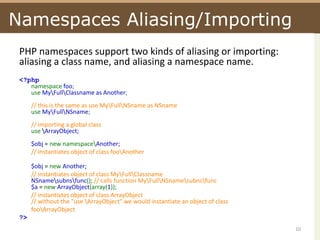
Namespaces Aliasing/ImportingPHP namespaces support two kinds of aliasing or importing: aliasing a class name, and aliasing a namespace name.<?phpnamespace foo;use My\Full\Classname as Another;// this is the same as use My\Full\NSname as NSnameuse My\Full\NSname;// importing a global classuse \ArrayObject;$obj = new namespace\Another;// instantiates object of class foo\Another$obj = new Another;// instantiates object of class My\Full\ClassnameNSname\subns\func(); // calls function My\Full\NSname\subns\func$a = new ArrayObject(array(1));// instantiates object of class ArrayObject// without the "use \ArrayObject" we would instantiate an object of classfoo\ArrayObject?> 10
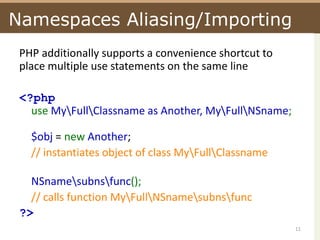
Namespaces Aliasing/ImportingPHP additionally supports a convenience shortcut to place multiple use statements on the same line <?phpuse My\Full\Classname as Another, My\Full\NSname;$obj = new Another;// instantiates object of class My\Full\ClassnameNSname\subns\func(); // calls function My\Full\NSname\subns\func?> 11
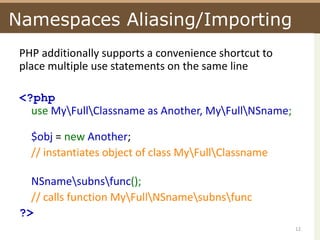
Namespaces Aliasing/ImportingPHP additionally supports a convenience shortcut to place multiple use statements on the same line <?phpuse My\Full\Classname as Another, My\Full\NSname;$obj = new Another;// instantiates object of class My\Full\ClassnameNSname\subns\func(); // calls function My\Full\NSname\subns\func?> 12
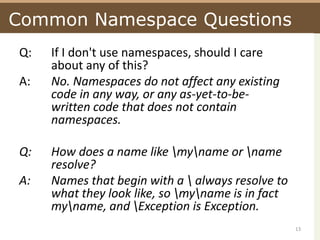
Common Namespace QuestionsQ:	If I don't use namespaces, should I care 	about any of this?A:	No. Namespaces do not affect any existing 	code in any way, or any as-yet-to-be-	written code that does not contain 	namespaces.Q:	How does a name like \my\name or \name 	resolve? A:		Names that begin with a \ always resolve to 	what they look like, so \my\name is in fact 	my\name, and \Exception is Exception.13
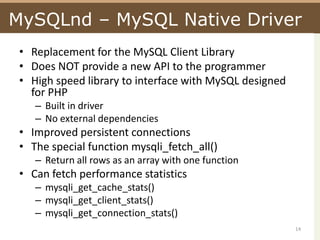
MySQLnd – MySQL Native DriverReplacement for the MySQL Client LibraryDoes NOT provide a new API to the programmerHigh speed library to interface with MySQL designed for PHPBuilt in driverNo external dependenciesImproved persistent connectionsThe special function mysqli_fetch_all()Return all rows as an array with one functionCan fetch performance statisticsmysqli_get_cache_stats()mysqli_get_client_stats()mysqli_get_connection_stats()14
New Language Features
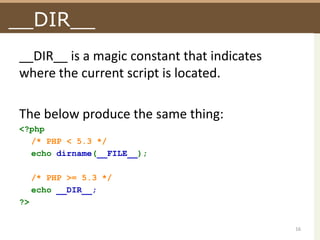
__DIR____DIR__ is a magic constant that indicates where the current script is located.The below produce the same thing:<?php/* PHP < 5.3 */	echo dirname(__FILE__);/* PHP >= 5.3 */echo __DIR__;?>16
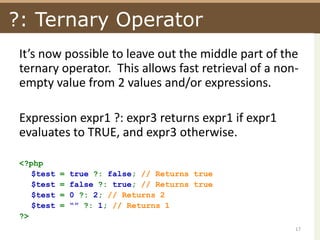
?: Ternary OperatorIt’s now possible to leave out the middle part of the ternary operator.  This allows fast retrieval of a non-empty value from 2 values and/or expressions.Expression expr1 ?: expr3 returns expr1 if expr1 evaluates to TRUE, and expr3 otherwise. <?php$test = true ?: false; // Returns true$test = false ?: true; // Returns true$test = 0 ?: 2; // Returns 2$test = “” ?: 1; // Returns 1?>17
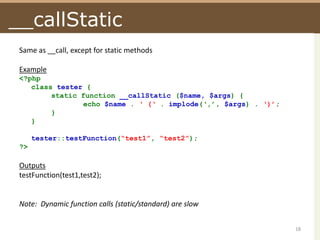
__callStaticSame as __call, except for static methodsExample<?phpclass tester {	static function __callStatic($name, $args) {		echo $name . ‘ (‘ . implode(‘,’, $args) . ‘)’;	}}tester::testFunction(“test1”, “test2”);?>OutputstestFunction(test1,test2);Note:  Dynamic function calls (static/standard) are slow18
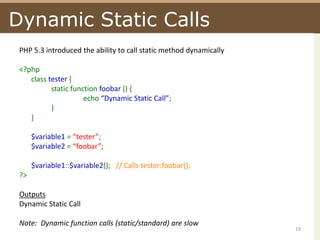
Dynamic Static CallsPHP 5.3 introduced the ability to call static method dynamically<?phpclass tester {	static functionfoobar() {		echo “Dynamic Static Call”;	}}$variable1 = “tester”;$variable2 = “foobar”;$variable1::$variable2();   // Calls tester:foobar();?>OutputsDynamic Static CallNote:  Dynamic function calls (static/standard) are slow19
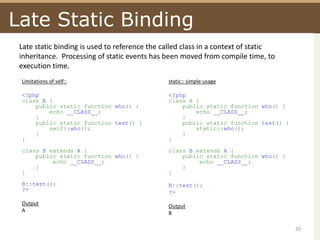
Late Static BindingLimitations of self::<?phpclass A {    public static function who() {        echo __CLASS__;    }    public static function test() {        self::who();    }}class B extends A {    public static function who() {         echo __CLASS__;    }}B::test();?>OutputA20Late static binding is used to reference the called class in a context of static inheritance.  Processing of static events has been moved from compile time, to execution time.static:: simple usage<?phpclass A {    public static function who() {        echo __CLASS__;    }    public static function test() {        static::who();    }}class B extends A {    public static function who() {         echo __CLASS__;    }}B::test();?>OutputB
Anonymous FunctionsAlso known as closures, allow the creation of functions which have no specified name.  They are most useful as the value of a callback parameter.Example #1 - Anonymous function example<?phpecho preg_replace_callback('~-([a-z])~', function ($match) {    return strtoupper($match[1]);}, 'hello-world');?> OutputshelloWorldExample #2 - Anonymous function variable assignment example<?php$greet = function($name) {    printf("Hello %s\r\n", $name);};$greet('World');$greet('PHP');?> OutputsHello WorldHello PHP21
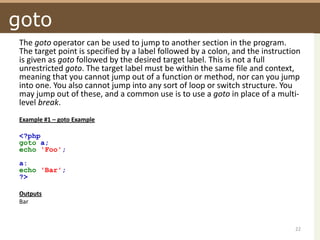
gotoThe goto operator can be used to jump to another section in the program. The target point is specified by a label followed by a colon, and the instruction is given as goto followed by the desired target label. This is not a full unrestricted goto. The target label must be within the same file and context, meaning that you cannot jump out of a function or method, nor can you jump into one. You also cannot jump into any sort of loop or switch structure. You may jump out of these, and a common use is to use a goto in place of a multi-level break. Example #1 – goto Example<?phpgoto a;echo 'Foo'; a:echo 'Bar';?> OutputsBar22
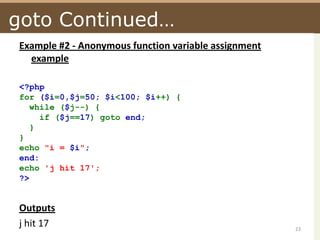
goto Continued…Example #2 - Anonymous function variable assignment example<?phpfor ($i=0,$j=50; $i<100; $i++) {  while ($j--) {    if ($j==17) goto end;   }}echo "i = $i";end:echo 'j hit 17';?> Outputsj hit 1723
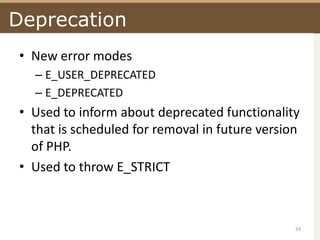
DeprecationNew error modes E_USER_DEPRECATEDE_DEPRECATEDUsed to inform about deprecated functionality that is scheduled for removal in future version of PHP.Used to throw E_STRICT24
INI File Handling
INI Changes OverviewSupport for .htaccess style INI controlsPer directory/host INI settings that can not be overridden by the user[PATH=/var/www/www.phpmeetup.com/][HOST=www.meetup.com]Only supported by CGI/FastCGI, not for PHP-CLI, or as an Apache moduleImproved error handling"ini-variables" can now be used almost anywhere in a php.ini file.26
INI Changes ExampleName for user-defined php.ini (.htaccess) files. Default is ".user.ini“user_ini.filename= ".user.ini"To disable this feature set this option to empty valueuser_ini.filename=TTL for user-defined php.ini files (time-to-live) in seconds.Default is 300 seconds (5 minutes)user_ini.cache_ttl= 300[PATH=/var/www/phpmeetup.com]error_reporting= E_ALL & ~E_DEPRECATEDhtml_errors = off27
Other ImprovementsImproved streamsImproved DNS APIImproved hash extensionImproved IMAP supportImproved mbstring extensionImproved OCI8 extensionImproved OpenSSL (OpenID in mind, simplify implementation)Improved crypt() functionMany, many more!28
The EndSlides will be posted on MeetUp and http://www.e-moxie.comI can also e-mail them to you if you would like, just make sure I have your e-mail address.Next TopicProject & Code Management using Trac w/ 	Subversion IntegrationPresented by Steve CrumpAugust 12, 2009 @ 6:30 p.m.29

PHP 5.3

  • 1.
    AnnouncementsPHP 5.2.10 isavailable (June 18 release)CodeWorks 2009 Announced – Washington, D.C.Tutorial Day: October 2Main Conference: October 3Two day conference for PHP developersEach event is limited to 300 attendeeshttp://cw.mtacon.com/signup/index to RegisterDiscount prices until July 152009 DC PHP Conference & ExpoSeptember 16 & 17Discount prices until August 15No sessions available yet1
  • 2.
    PHP 5.3July 2009Baltimore/Washington PHP MeetupChris Stonechris@emoxie.comFollow me @cmstone
  • 3.
    Release InformationExisting codeshould still workThere are only a few incompatibilities and new features that should be consideredMajor improvement of the 5.x seriesOver 140 bug fixesComprehensive migration information from PHP 5.2.x to 5.3.x at: http://us.php.net/migration533
  • 4.
    Key FeaturesNamespace supportLatestatic bindingLambda functions/closures (anonymous)Syntax additions (NOWDOC, ?:, goto…)Performance improvementsGarbage collection for cyclic referencesmysqlnd PHP native replacement for libmysqlDeprecation notices are handled E_DEPRECATED instead of E_STRICT4
  • 5.
    Improved PerformanceImproved runtimespeedImproved memory usageSmaller binary sizeFaster startup speed with GCC4md5() is faster (10-15%)require_once() and include_once() uses only 1 fopen(3) callImproved exception handlingOverall performance improvement of 5-15%5
  • 6.
  • 7.
    NamespacesSingle largest additionin 5.3Feature completeSimplifies naming conventionsIf you developed larger projects, you would probably have used long class namesi.e. Zend class names can be HUGEZend_Search_Lucene_Document_HtmlDifferent namespaces can contain classes, functions, and constants with the same name.Defined using the namespace keyword7
  • 8.
  • 9.
    Multiple Namespaces PerFile<?phpnamespace Project 1;const CONNECT_OK = 1;class Connection { /* ... */ }function connect() { /* ... */  }namespace Project2;const CONNECT_OK = 1;class Connection { /* ... */ }function connect() { /* ... */  }?> 9
  • 10.
    Namespaces Aliasing/ImportingPHP namespacessupport two kinds of aliasing or importing: aliasing a class name, and aliasing a namespace name.<?phpnamespace foo;use My\Full\Classname as Another;// this is the same as use My\Full\NSname as NSnameuse My\Full\NSname;// importing a global classuse \ArrayObject;$obj = new namespace\Another;// instantiates object of class foo\Another$obj = new Another;// instantiates object of class My\Full\ClassnameNSname\subns\func(); // calls function My\Full\NSname\subns\func$a = new ArrayObject(array(1));// instantiates object of class ArrayObject// without the "use \ArrayObject" we would instantiate an object of classfoo\ArrayObject?> 10
  • 11.
    Namespaces Aliasing/ImportingPHP additionallysupports a convenience shortcut to place multiple use statements on the same line <?phpuse My\Full\Classname as Another, My\Full\NSname;$obj = new Another;// instantiates object of class My\Full\ClassnameNSname\subns\func(); // calls function My\Full\NSname\subns\func?> 11
  • 12.
    Namespaces Aliasing/ImportingPHP additionallysupports a convenience shortcut to place multiple use statements on the same line <?phpuse My\Full\Classname as Another, My\Full\NSname;$obj = new Another;// instantiates object of class My\Full\ClassnameNSname\subns\func(); // calls function My\Full\NSname\subns\func?> 12
  • 13.
    Common Namespace QuestionsQ: IfI don't use namespaces, should I care about any of this?A: No. Namespaces do not affect any existing code in any way, or any as-yet-to-be- written code that does not contain namespaces.Q: How does a name like \my\name or \name resolve? A: Names that begin with a \ always resolve to what they look like, so \my\name is in fact my\name, and \Exception is Exception.13
  • 14.
    MySQLnd – MySQLNative DriverReplacement for the MySQL Client LibraryDoes NOT provide a new API to the programmerHigh speed library to interface with MySQL designed for PHPBuilt in driverNo external dependenciesImproved persistent connectionsThe special function mysqli_fetch_all()Return all rows as an array with one functionCan fetch performance statisticsmysqli_get_cache_stats()mysqli_get_client_stats()mysqli_get_connection_stats()14
  • 15.
  • 16.
    __DIR____DIR__ is amagic constant that indicates where the current script is located.The below produce the same thing:<?php/* PHP < 5.3 */ echo dirname(__FILE__);/* PHP >= 5.3 */echo __DIR__;?>16
  • 17.
    ?: Ternary OperatorIt’snow possible to leave out the middle part of the ternary operator. This allows fast retrieval of a non-empty value from 2 values and/or expressions.Expression expr1 ?: expr3 returns expr1 if expr1 evaluates to TRUE, and expr3 otherwise. <?php$test = true ?: false; // Returns true$test = false ?: true; // Returns true$test = 0 ?: 2; // Returns 2$test = “” ?: 1; // Returns 1?>17
  • 18.
    __callStaticSame as __call,except for static methodsExample<?phpclass tester { static function __callStatic($name, $args) { echo $name . ‘ (‘ . implode(‘,’, $args) . ‘)’; }}tester::testFunction(“test1”, “test2”);?>OutputstestFunction(test1,test2);Note: Dynamic function calls (static/standard) are slow18
  • 19.
    Dynamic Static CallsPHP5.3 introduced the ability to call static method dynamically<?phpclass tester { static functionfoobar() { echo “Dynamic Static Call”; }}$variable1 = “tester”;$variable2 = “foobar”;$variable1::$variable2(); // Calls tester:foobar();?>OutputsDynamic Static CallNote: Dynamic function calls (static/standard) are slow19
  • 20.
    Late Static BindingLimitationsof self::<?phpclass A {    public static function who() {        echo __CLASS__;    }    public static function test() {        self::who();    }}class B extends A {    public static function who() {         echo __CLASS__;    }}B::test();?>OutputA20Late static binding is used to reference the called class in a context of static inheritance. Processing of static events has been moved from compile time, to execution time.static:: simple usage<?phpclass A {    public static function who() {        echo __CLASS__;    }    public static function test() {        static::who();    }}class B extends A {    public static function who() {         echo __CLASS__;    }}B::test();?>OutputB
  • 21.
    Anonymous FunctionsAlso knownas closures, allow the creation of functions which have no specified name. They are most useful as the value of a callback parameter.Example #1 - Anonymous function example<?phpecho preg_replace_callback('~-([a-z])~', function ($match) {    return strtoupper($match[1]);}, 'hello-world');?> OutputshelloWorldExample #2 - Anonymous function variable assignment example<?php$greet = function($name) {    printf("Hello %s\r\n", $name);};$greet('World');$greet('PHP');?> OutputsHello WorldHello PHP21
  • 22.
    gotoThe goto operatorcan be used to jump to another section in the program. The target point is specified by a label followed by a colon, and the instruction is given as goto followed by the desired target label. This is not a full unrestricted goto. The target label must be within the same file and context, meaning that you cannot jump out of a function or method, nor can you jump into one. You also cannot jump into any sort of loop or switch structure. You may jump out of these, and a common use is to use a goto in place of a multi-level break. Example #1 – goto Example<?phpgoto a;echo 'Foo'; a:echo 'Bar';?> OutputsBar22
  • 23.
    goto Continued…Example #2- Anonymous function variable assignment example<?phpfor ($i=0,$j=50; $i<100; $i++) {  while ($j--) {    if ($j==17) goto end;   }}echo "i = $i";end:echo 'j hit 17';?> Outputsj hit 1723
  • 24.
    DeprecationNew error modesE_USER_DEPRECATEDE_DEPRECATEDUsed to inform about deprecated functionality that is scheduled for removal in future version of PHP.Used to throw E_STRICT24
  • 25.
  • 26.
    INI Changes OverviewSupportfor .htaccess style INI controlsPer directory/host INI settings that can not be overridden by the user[PATH=/var/www/www.phpmeetup.com/][HOST=www.meetup.com]Only supported by CGI/FastCGI, not for PHP-CLI, or as an Apache moduleImproved error handling"ini-variables" can now be used almost anywhere in a php.ini file.26
  • 27.
    INI Changes ExampleNamefor user-defined php.ini (.htaccess) files. Default is ".user.ini“user_ini.filename= ".user.ini"To disable this feature set this option to empty valueuser_ini.filename=TTL for user-defined php.ini files (time-to-live) in seconds.Default is 300 seconds (5 minutes)user_ini.cache_ttl= 300[PATH=/var/www/phpmeetup.com]error_reporting= E_ALL & ~E_DEPRECATEDhtml_errors = off27
  • 28.
    Other ImprovementsImproved streamsImprovedDNS APIImproved hash extensionImproved IMAP supportImproved mbstring extensionImproved OCI8 extensionImproved OpenSSL (OpenID in mind, simplify implementation)Improved crypt() functionMany, many more!28
  • 29.
    The EndSlides willbe posted on MeetUp and http://www.e-moxie.comI can also e-mail them to you if you would like, just make sure I have your e-mail address.Next TopicProject & Code Management using Trac w/ Subversion IntegrationPresented by Steve CrumpAugust 12, 2009 @ 6:30 p.m.29