PHOTON THEORY
OF LIGHT
OBJECTIVES:
• Relate the atomic spectra to the photon theory of light
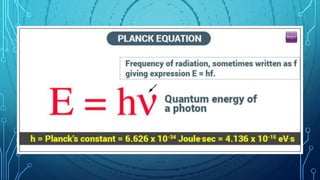
• Describe the relationship between the energy of the photon and
its frequency
• Explain certain phenomena using the photon theory
• Apply speed- wavelength- frequency relationship in problem
solving
• Describe the attempts of Galileo and Roemer to measure the
speed of light
SPEED OF LIGHT
Galileo Galilei
•One of the scientists who tried to measure the speed
of light
•Believed that light have speed
•Designed an experiment to measure the speed of
light
OLE ROEMER
•Danish astronomer who also attempted to measure
the speed of light
•Very keen in observing Io (Jupiter’s moon)
❖Was been observed of having a
black shadow or eclipse casted by it
❖Makes a complete orbit around
Jupiter for 1.76 days (or 1 day,18
hours, and 14 minutes)
ELECTROMAGNETIC
SPECTRUM
NOTE: All electromagnetic waves
travel in a vacuum at a constant
speed of 3x 𝟏𝟎𝟖 m⁄s
LIGHT AS A PARTICLE
ISAAC
NEWTON
• Noticed that light
casted sharp
shadows
• He thought of light
as something like
matter
• Formulated the
particle theory of
light
PARTICLE
THEORY
• Visible light is
composed of
submicroscopic
particles called
photons
PHOTONS
• These are
elementary
paticles of light
that have
properties of a
wave.
SOME PROPERTIES OF
PHOTONS
❖They move at a constant speed of 3 x 10⁸𝑚⁄𝑠
❖They are massless
❖They carry energy and momentum
❖They have no charge like a neutron
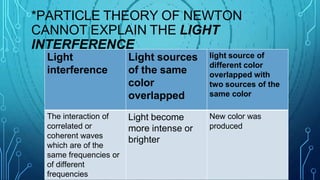
*PARTICLE THEORY OF NEWTON
CANNOT EXPLAIN THE LIGHT
INTERFERENCE
Light
interference
Light sources
of the same
color
overlapped
light source of
different color
overlapped with
two sources of the
same color
The interaction of Light become
more intense or
brighter
New color was
correlated or produced
coherent waves
which are of the
same frequencies or
of different
frequencies
ALBERT EINSTEIN
- REVIVE THE THEORY OF LIGHT
INTERFERENCE
- INTRODUCED THE PHOTOELECTRIC
EFFECT
- ELECTRONS ARE EMITTED FROM A
METALLIC SURFACE WHEN SUBJECTED
TO AN INCIDENT LIGHT CONSISTING OF
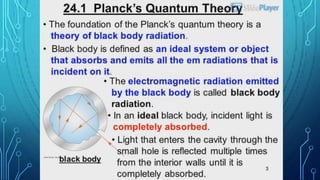
Blackbody Radiation
•A black body is an idealized object that absorbs
all electromagnetic radiation it comes in contact
with
•The relationship between an object’s
temperature, and the wavelength of
electromagnetic radiation it emits.
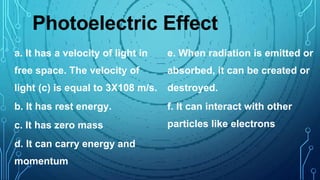
Photoelectric Effect
a. It has a velocity of light in
free space. The velocity of
light (c) is equal to 3X10⁸ m/s.
b. It has rest energy.
c. It has zero mass
d. It can carry energy and
momentum
e. When radiation is emitted or
absorbed, it can be created or
destroyed.
f. It can interact with other
particles like electrons
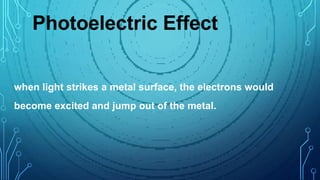
Photoelectric Effect
when light strikes a metal surface, the electrons would
become excited and jump out of the metal.
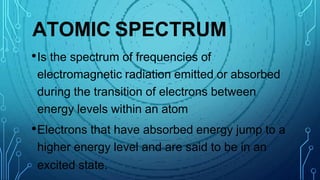
ATOMIC SPECTRUM
•Is the spectrum of frequencies of
electromagnetic radiation emitted or absorbed
during the transition of electrons between
energy levels within an atom
•Electrons that have absorbed energy jump to a
higher energy level and are said to be in an
excited state.

Photon.pdf

  • 2.
  • 3.
    OBJECTIVES: • Relate theatomic spectra to the photon theory of light • Describe the relationship between the energy of the photon and its frequency • Explain certain phenomena using the photon theory • Apply speed- wavelength- frequency relationship in problem solving • Describe the attempts of Galileo and Roemer to measure the speed of light
  • 4.
    SPEED OF LIGHT GalileoGalilei •One of the scientists who tried to measure the speed of light •Believed that light have speed •Designed an experiment to measure the speed of light
  • 5.
    OLE ROEMER •Danish astronomerwho also attempted to measure the speed of light •Very keen in observing Io (Jupiter’s moon) ❖Was been observed of having a black shadow or eclipse casted by it ❖Makes a complete orbit around Jupiter for 1.76 days (or 1 day,18 hours, and 14 minutes)
  • 6.
    ELECTROMAGNETIC SPECTRUM NOTE: All electromagneticwaves travel in a vacuum at a constant speed of 3x 𝟏𝟎𝟖 m⁄s
  • 7.
    LIGHT AS APARTICLE ISAAC NEWTON • Noticed that light casted sharp shadows • He thought of light as something like matter • Formulated the particle theory of light PARTICLE THEORY • Visible light is composed of submicroscopic particles called photons PHOTONS • These are elementary paticles of light that have properties of a wave.
  • 8.
    SOME PROPERTIES OF PHOTONS ❖Theymove at a constant speed of 3 x 10⁸𝑚⁄𝑠 ❖They are massless ❖They carry energy and momentum ❖They have no charge like a neutron
  • 9.
    *PARTICLE THEORY OFNEWTON CANNOT EXPLAIN THE LIGHT INTERFERENCE Light interference Light sources of the same color overlapped light source of different color overlapped with two sources of the same color The interaction of Light become more intense or brighter New color was correlated or produced coherent waves which are of the same frequencies or of different frequencies
  • 11.
    ALBERT EINSTEIN - REVIVETHE THEORY OF LIGHT INTERFERENCE - INTRODUCED THE PHOTOELECTRIC EFFECT - ELECTRONS ARE EMITTED FROM A METALLIC SURFACE WHEN SUBJECTED TO AN INCIDENT LIGHT CONSISTING OF
  • 12.
    Blackbody Radiation •A blackbody is an idealized object that absorbs all electromagnetic radiation it comes in contact with •The relationship between an object’s temperature, and the wavelength of electromagnetic radiation it emits.
  • 14.
    Photoelectric Effect a. Ithas a velocity of light in free space. The velocity of light (c) is equal to 3X10⁸ m/s. b. It has rest energy. c. It has zero mass d. It can carry energy and momentum e. When radiation is emitted or absorbed, it can be created or destroyed. f. It can interact with other particles like electrons
  • 15.
    Photoelectric Effect when lightstrikes a metal surface, the electrons would become excited and jump out of the metal.
  • 16.
    ATOMIC SPECTRUM •Is thespectrum of frequencies of electromagnetic radiation emitted or absorbed during the transition of electrons between energy levels within an atom •Electrons that have absorbed energy jump to a higher energy level and are said to be in an excited state.