Philosophical
Foundations
Based upon fundamental beliefs that arise from
one's philosophy of Education, curricular
decisions involve consideration of several topics and
issues. Precisely for this reason, we consider
philosophy one of the major foundation areas in
curriculum.
Importance of Philosophical foundations
It helps educators in formulating beliefs, arguments,
and assumptions and in making value judgments.
Philosophy develops a broad outlook, and it also helps
in answering what schools are for, what subjects are
important, how students should learn, and what
materials and methods should be used.
What is Philosophy?
Philosophy, also called the 'love of wisdom,’ is a deep study of
knowledge, existence, and the reality of life. It sparks debates and
challenges us to think about profound questions about life and the
universe. The origin of the word 'philosophy' goes back to ancient
Greek. Philosophy is divided into two words, where Philo means
Love and Sophia means wisdom. Thus, bringing to us, the love of
wisdom.
Major branches of philosophy
1. Metaphysics: Examining the Universe
Works of Philosophers: Aristotle, Plato, and others
Metaphysics, one of the core branches of philosophy, explores
the fundamental nature of reality and existence. The term
“metaphysics” has its roots in the writings of ancient Greek
philosophers and is derived from the Greek words meta (after)
and phusiká (physics).
1. Ontology: This sub-branch focuses
on the study of "being" itself.
2. Cosmology: Cosmology, another key sub-
branch of metaphysics, examines the origins,
evolution, and structure of the universe.
2. Epistemology: The Study of Knowledge
Works of Philosophers: Socrates, Plato,
Descartes, and others
Epistemology, one of the key types of
philosophy, focuses on the study of knowledge.
3. Axiology: The Study of Value
Works of Philosophers: Socrates, Immanuel Kant,
and others
Axiology, one of the significant branches of
philosophy, derives from the Greek words 'Axios'
(value) and 'logos' (study), making it the
comprehensive study of values.
4. Aesthetics: The Study of Beauty
Works of Philosophers: Plato, Aristotle, and others Aesthetics,
one of the branches of philosophy, explores the nature of beauty and
what makes something visually or emotionally pleasing. Whether it's art,
music, photographs, or paintings, aesthetics is concerned with
understanding why we find certain things beautiful and how this
perception affects our emotions and thoughts.
5. Logic: The Study of Reason
Works of Philosophers: Aristotle and others
Logic, one of the essential branches of philosophy, is the
study of argument and reasoning that helps determine
whether a given statement is correct or not.
Logic is broadly divided into categories:
1. Deductive: Deductive logic is one of the most
important types of philosophy that deals with valid
reasoning.
2. Inductive: Inductive logic, on the other hand, focuses on resolving
specific problems based on patterns or observations, though the
conclusion may not always be guaranteed as true.
3. Symbolic Logic: This type of logic uses symbols and formal
systems to represent logical expressions.
6. Ethics: The Study of Morality
Works of Philosophers: Aristotle, Immanuel Kant, and
others
One of the other major branches of philosophy is Ethics,
which studies a set of guidelines to be a better person.
7. Political Philosophy: The Study of Governance
Works of Philosophers: Aristotle, Plato, John Locke,
Rousseau, and others
Political Philosophy is also one of the 10 branches of
philosophy.
8. Deontology: The Study of Duty
Works of Philosophers: Immanuel Kant, and others
Deontology, one of the vital branches of philosophy, focuses
on moral principles, duties, and obligations.
9. Nihilism: The Rejection of Established Values
Works of Philosophers: Friedrich Nietzsche, and others
If you're drawn to exploring the deeper meaning of existence, then
nihilism—one of the more provocative branches of philosophy—
may capture your interest.
10. Theology: The Study of Religion
Works of Philosophers: St Thomas Aquinas, Immanuel
Kant, St. Augustine
Theology, one of the significant branches of philosophy, seeks to
explore questions like, "Who or what is God?" and "What is our
relationship with God?" It is the philosophical study of religion,
examining the nature of the divine, religious beliefs, and the
human experience in relation to spirituality.
There are four key types of theology
1.Biblical Theology:
2. Historical Theology:
3. Systematic Theology:
4. Practical Theology:
11. Determinism: The Study of Causality and Free
Will
Works of Philosophers: Democritus, and others
Determinism, one of the important branches of
philosophy, examines the idea that all events,
including human actions, are determined by
preceding causes.
12. Existentialism
Works of Philosophers: Søren Kierkegaard, Friedrich
Nietzsche, Jean-Paul Sartre, Albert Camus, and others
Existentialism, a profound branch of philosophy, focuses on the
individual's experience of existence, freedom, and choice.
13. Empiricism
Works of Philosophers: John Locke, George Berkeley, and
David Hume, and others
Empiricism, one of the key branches of philosophy, is the belief
that knowledge comes primarily from sensory experience.
Idealism
The doctrine of idealism suggests that matter is an
illusion and that reality is that which exists
mentally. It emphasizes moral and spiritual reality
as the chief explanation of the world and
considers moral values absolute, timeless and
universal.
Realism
What kind of philosophy will that be? 'Realists'
consider Education a matter of reality rather than
speculation. Application, The paramount
responsibility of the teacher, then, is to impart to
learners the knowledge about the world they live
in.
Pragmatism
In contrast to the traditional philosophies, i.e., idealism and
realism, Pragmatism gives
importance to change, processes and relativity, as it suggests
that the value of an idea lies in its
actual consequences. The actual consequences are related to
those aims that focus on practical
aspects in teaching and learning (Nash, 1995).
Existentialism
This doctrine emphasizes that there are no values
outside human beings, and thus, suggests that
human beings should have the freedom to make
choices and then be responsible for the
consequences of those choices.
Perennialism
It advocates the permanency of knowledge that has
stood the test of time and values that have
moral and spiritual bases. The underlying idea is
that education is constant, absolute and
universal. Obviously, "perennialism" in education is
born of "idealism" in general philosophy.
Progressivism
This emerged as a protest against perennialist thinking in education. It was
considered a contemporary reformist movement in educational, social and
political affairs during the 1920’s and 30's. According to progressivist thought,
the skills and tools of learning include problem solving methods and scientific
inquiry. In addition, learning experiences should include cooperative behavior
and self- discipline, both of which are important for democratic living. The
curriculum, thus, was interdisciplinary in nature
Essentialism
This philosophy, rooted partly in idealism and partly in realism, evolved
mainly as a critique of progressive thought in education. Yet, the proponents
of essentialism do not totally reject progressive methods as they do believe
that education should prepare the learner to adjust to a changing society.
Thus, in essentialism learning should consist in mastering the subject matter
that reflects currently available knowledge in various disciplines. Teachers
play a highly directive role by disseminating information to students.
Reconstructionism
It views education as a means of reconstructing society. The
reconstructionist believe that as school/college is attended
by virtually all youth, it must be used as a means to shape the
attitudes and values of each generation. As a result, when
the youth become adults they will share certain common
values, and thus the society will have reshaped itself.
Role of philosophy in the development of
Philippine Education
A philosophy of education may influence what subjects or
topics are taught, how they are taught, and perhaps more
importantly, the supporting beliefs and values that are taught,
both implicitly and explicitly, within and around the core
curriculum.
Relationship of Philosophy and Education
The discipline of philosophy contributes in an indispensable
way to the realization of four goals that should be
fundamental to any institution of higher learning: instilling
habits of critical thinking in students; enhancing their reading,
writing, and public speaking skills; transmitting cultural
heritages to them.
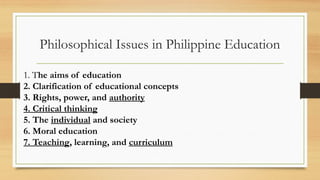
Philosophical Issues in Philippine Education
1. The aims of education
2. Clarification of educational concepts
3. Rights, power, and authority
4. Critical thinking
5. The individual and society
6. Moral education
7. Teaching, learning, and curriculum
The end
Thank you !

Philosophical Foundations for maed .pptx

  • 1.
  • 2.
    Based upon fundamentalbeliefs that arise from one's philosophy of Education, curricular decisions involve consideration of several topics and issues. Precisely for this reason, we consider philosophy one of the major foundation areas in curriculum.
  • 3.
    Importance of Philosophicalfoundations It helps educators in formulating beliefs, arguments, and assumptions and in making value judgments. Philosophy develops a broad outlook, and it also helps in answering what schools are for, what subjects are important, how students should learn, and what materials and methods should be used.
  • 4.
    What is Philosophy? Philosophy,also called the 'love of wisdom,’ is a deep study of knowledge, existence, and the reality of life. It sparks debates and challenges us to think about profound questions about life and the universe. The origin of the word 'philosophy' goes back to ancient Greek. Philosophy is divided into two words, where Philo means Love and Sophia means wisdom. Thus, bringing to us, the love of wisdom.
  • 5.
    Major branches ofphilosophy 1. Metaphysics: Examining the Universe Works of Philosophers: Aristotle, Plato, and others Metaphysics, one of the core branches of philosophy, explores the fundamental nature of reality and existence. The term “metaphysics” has its roots in the writings of ancient Greek philosophers and is derived from the Greek words meta (after) and phusiká (physics).
  • 6.
    1. Ontology: Thissub-branch focuses on the study of "being" itself. 2. Cosmology: Cosmology, another key sub- branch of metaphysics, examines the origins, evolution, and structure of the universe.
  • 7.
    2. Epistemology: TheStudy of Knowledge Works of Philosophers: Socrates, Plato, Descartes, and others Epistemology, one of the key types of philosophy, focuses on the study of knowledge.
  • 8.
    3. Axiology: TheStudy of Value Works of Philosophers: Socrates, Immanuel Kant, and others Axiology, one of the significant branches of philosophy, derives from the Greek words 'Axios' (value) and 'logos' (study), making it the comprehensive study of values.
  • 9.
    4. Aesthetics: TheStudy of Beauty Works of Philosophers: Plato, Aristotle, and others Aesthetics, one of the branches of philosophy, explores the nature of beauty and what makes something visually or emotionally pleasing. Whether it's art, music, photographs, or paintings, aesthetics is concerned with understanding why we find certain things beautiful and how this perception affects our emotions and thoughts.
  • 10.
    5. Logic: TheStudy of Reason Works of Philosophers: Aristotle and others Logic, one of the essential branches of philosophy, is the study of argument and reasoning that helps determine whether a given statement is correct or not.
  • 11.
    Logic is broadlydivided into categories: 1. Deductive: Deductive logic is one of the most important types of philosophy that deals with valid reasoning. 2. Inductive: Inductive logic, on the other hand, focuses on resolving specific problems based on patterns or observations, though the conclusion may not always be guaranteed as true. 3. Symbolic Logic: This type of logic uses symbols and formal systems to represent logical expressions.
  • 12.
    6. Ethics: TheStudy of Morality Works of Philosophers: Aristotle, Immanuel Kant, and others One of the other major branches of philosophy is Ethics, which studies a set of guidelines to be a better person.
  • 13.
    7. Political Philosophy:The Study of Governance Works of Philosophers: Aristotle, Plato, John Locke, Rousseau, and others Political Philosophy is also one of the 10 branches of philosophy.
  • 14.
    8. Deontology: TheStudy of Duty Works of Philosophers: Immanuel Kant, and others Deontology, one of the vital branches of philosophy, focuses on moral principles, duties, and obligations.
  • 15.
    9. Nihilism: TheRejection of Established Values Works of Philosophers: Friedrich Nietzsche, and others If you're drawn to exploring the deeper meaning of existence, then nihilism—one of the more provocative branches of philosophy— may capture your interest.
  • 16.
    10. Theology: TheStudy of Religion Works of Philosophers: St Thomas Aquinas, Immanuel Kant, St. Augustine Theology, one of the significant branches of philosophy, seeks to explore questions like, "Who or what is God?" and "What is our relationship with God?" It is the philosophical study of religion, examining the nature of the divine, religious beliefs, and the human experience in relation to spirituality.
  • 17.
    There are fourkey types of theology 1.Biblical Theology: 2. Historical Theology: 3. Systematic Theology: 4. Practical Theology:
  • 18.
    11. Determinism: TheStudy of Causality and Free Will Works of Philosophers: Democritus, and others Determinism, one of the important branches of philosophy, examines the idea that all events, including human actions, are determined by preceding causes.
  • 19.
    12. Existentialism Works ofPhilosophers: Søren Kierkegaard, Friedrich Nietzsche, Jean-Paul Sartre, Albert Camus, and others Existentialism, a profound branch of philosophy, focuses on the individual's experience of existence, freedom, and choice.
  • 20.
    13. Empiricism Works ofPhilosophers: John Locke, George Berkeley, and David Hume, and others Empiricism, one of the key branches of philosophy, is the belief that knowledge comes primarily from sensory experience.
  • 21.
    Idealism The doctrine ofidealism suggests that matter is an illusion and that reality is that which exists mentally. It emphasizes moral and spiritual reality as the chief explanation of the world and considers moral values absolute, timeless and universal.
  • 22.
    Realism What kind ofphilosophy will that be? 'Realists' consider Education a matter of reality rather than speculation. Application, The paramount responsibility of the teacher, then, is to impart to learners the knowledge about the world they live in.
  • 23.
    Pragmatism In contrast tothe traditional philosophies, i.e., idealism and realism, Pragmatism gives importance to change, processes and relativity, as it suggests that the value of an idea lies in its actual consequences. The actual consequences are related to those aims that focus on practical aspects in teaching and learning (Nash, 1995).
  • 24.
    Existentialism This doctrine emphasizesthat there are no values outside human beings, and thus, suggests that human beings should have the freedom to make choices and then be responsible for the consequences of those choices.
  • 25.
    Perennialism It advocates thepermanency of knowledge that has stood the test of time and values that have moral and spiritual bases. The underlying idea is that education is constant, absolute and universal. Obviously, "perennialism" in education is born of "idealism" in general philosophy.
  • 26.
    Progressivism This emerged asa protest against perennialist thinking in education. It was considered a contemporary reformist movement in educational, social and political affairs during the 1920’s and 30's. According to progressivist thought, the skills and tools of learning include problem solving methods and scientific inquiry. In addition, learning experiences should include cooperative behavior and self- discipline, both of which are important for democratic living. The curriculum, thus, was interdisciplinary in nature
  • 27.
    Essentialism This philosophy, rootedpartly in idealism and partly in realism, evolved mainly as a critique of progressive thought in education. Yet, the proponents of essentialism do not totally reject progressive methods as they do believe that education should prepare the learner to adjust to a changing society. Thus, in essentialism learning should consist in mastering the subject matter that reflects currently available knowledge in various disciplines. Teachers play a highly directive role by disseminating information to students.
  • 28.
    Reconstructionism It views educationas a means of reconstructing society. The reconstructionist believe that as school/college is attended by virtually all youth, it must be used as a means to shape the attitudes and values of each generation. As a result, when the youth become adults they will share certain common values, and thus the society will have reshaped itself.
  • 29.
    Role of philosophyin the development of Philippine Education A philosophy of education may influence what subjects or topics are taught, how they are taught, and perhaps more importantly, the supporting beliefs and values that are taught, both implicitly and explicitly, within and around the core curriculum.
  • 30.
    Relationship of Philosophyand Education The discipline of philosophy contributes in an indispensable way to the realization of four goals that should be fundamental to any institution of higher learning: instilling habits of critical thinking in students; enhancing their reading, writing, and public speaking skills; transmitting cultural heritages to them.
  • 31.
    Philosophical Issues inPhilippine Education 1. The aims of education 2. Clarification of educational concepts 3. Rights, power, and authority 4. Critical thinking 5. The individual and society 6. Moral education 7. Teaching, learning, and curriculum
  • 32.