1
Ph. BASIC
EDUCATION
CURRICULUM ‘02GLEND JHON R.CANANEA
Kabangahan I Elementary School
Rogongon, Iligan City
JOSE ALONSABE, Ph.D
Professor
The Structure of the 2002
BEC
The objective of elementary and secondary education serve
as the “official learning goals” of basic education as
stated for a particular population of learners; that is,
the elementary and secondary education learners. The
Bureau of Alternative Learning System (formerly Non-
Formal Education) likewise has a set of official learning
goals for its particular set of target learners – the out-
of-school youth and adults.
2
The Education Act of 1982 or Batas
Pambansa Blg. 232
Provide the general objective of elementary, secondary and non-formal
education.
3
The Features of the BEC
1. Greater emphasis on helping every learner to
become more successful reader.
2. Emphasis on interactive/collaborative learning
approaches.
 Between teachers and students
 Between students and self-instructional materials
 Between students (collaborative learning)
 Between students and multimedia assisted instruction
1. Emphasis on use of integrative learning approaches.
4
The Features of the BEC
4. Greater focus on values formation in all the subject
areas. Every teacher is a values education teacher.
5. Emphasis on the development of self-reliant and
patriotic citizens.
6. Emphasis on the use of effective strategies for the
development of critical and creative thinking skills.
5
The Curriculum Structure of
the 2002 BEC
 The CORE SUBJECTS: Filipino; English; Math; Science
(Science and Health for Elem.); Science and Technology
for Secondary
 The Experiential Area:
Makabayan: Araling Panlipunan; MAPEH (Music, Arts, PE
and health); TLE; Edukasyon sa Pagpapahalaga (the
practice environment for holistic learning to develop a
healthy personal and national self-identity”.
6
The Medium of Instructions:
 ENGLISH
 FILIPINO
 MOTHER-TONGUE-BASED MULTI-LINGUAL EDUCATION
(MTB-MLE)
7
 Medium of Instruction: Pursuant to the DepEd Bilingual
Policy (Dep.Ed Order No. 52, s,1987), the media of instruction shall be as
follows:
 For Elementary Education:
 Filipino shall be used in the following areas: Filipino; Makabayan
 English shall be used in the following learning areas: English; Science;
Mathematics
 Mother-Tongue-Based Multi-Lingual Education (MTB-MLE)
8
 For Secondary Education:
 English: Mathematics, Science and Technology, English, Technology and
Livelihood Education, Music, Arts, Physical Education and Health/CAT
 Filipino: Edukasyon sa Pagpapahalaga (Values Education), Araling
Panlipunan, Filipino
9
Major local languages as
medium of instruction
 The other 12 local languages used in MTB-MLE are
Tagalog, Kapampangan, Pangasinense, Iloko, Bikol,
Cebuano, Hiligaynon, Waray, Tausug, Maguindanaoan,
Maranao and Chabacano. The MTB-MLE is implemented
in two modules: 1) as a learning/subject area and 2) as
medium of instruction.
 The additional languages are Ybanag for pupils in
Tuguegarao City, Cagayan, and Isabela; Ivatan for the
Batanes Group; Sambal in Zambales; Aklanon in Aklan,
Capiz; Kinaray-a in Capiz, Aklan; Yakan in Autonomous
Region Muslim Mindanao and Surigaonon covering
Surigao City and provinces.
10
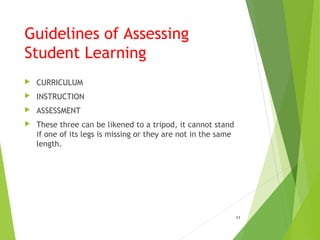
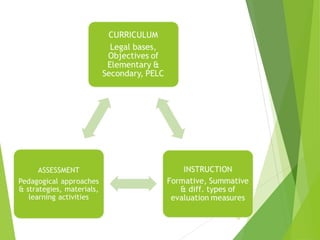
Guidelines of Assessing
Student Learning
 CURRICULUM
 INSTRUCTION
 ASSESSMENT
 These three can be likened to a tripod, it cannot stand
if one of its legs is missing or they are not in the same
length.
11
12
13

Phil. educ. legislation

  • 1.
    1 Ph. BASIC EDUCATION CURRICULUM ‘02GLENDJHON R.CANANEA Kabangahan I Elementary School Rogongon, Iligan City JOSE ALONSABE, Ph.D Professor
  • 2.
    The Structure ofthe 2002 BEC The objective of elementary and secondary education serve as the “official learning goals” of basic education as stated for a particular population of learners; that is, the elementary and secondary education learners. The Bureau of Alternative Learning System (formerly Non- Formal Education) likewise has a set of official learning goals for its particular set of target learners – the out- of-school youth and adults. 2
  • 3.
    The Education Actof 1982 or Batas Pambansa Blg. 232 Provide the general objective of elementary, secondary and non-formal education. 3
  • 4.
    The Features ofthe BEC 1. Greater emphasis on helping every learner to become more successful reader. 2. Emphasis on interactive/collaborative learning approaches.  Between teachers and students  Between students and self-instructional materials  Between students (collaborative learning)  Between students and multimedia assisted instruction 1. Emphasis on use of integrative learning approaches. 4
  • 5.
    The Features ofthe BEC 4. Greater focus on values formation in all the subject areas. Every teacher is a values education teacher. 5. Emphasis on the development of self-reliant and patriotic citizens. 6. Emphasis on the use of effective strategies for the development of critical and creative thinking skills. 5
  • 6.
    The Curriculum Structureof the 2002 BEC  The CORE SUBJECTS: Filipino; English; Math; Science (Science and Health for Elem.); Science and Technology for Secondary  The Experiential Area: Makabayan: Araling Panlipunan; MAPEH (Music, Arts, PE and health); TLE; Edukasyon sa Pagpapahalaga (the practice environment for holistic learning to develop a healthy personal and national self-identity”. 6
  • 7.
    The Medium ofInstructions:  ENGLISH  FILIPINO  MOTHER-TONGUE-BASED MULTI-LINGUAL EDUCATION (MTB-MLE) 7
  • 8.
     Medium ofInstruction: Pursuant to the DepEd Bilingual Policy (Dep.Ed Order No. 52, s,1987), the media of instruction shall be as follows:  For Elementary Education:  Filipino shall be used in the following areas: Filipino; Makabayan  English shall be used in the following learning areas: English; Science; Mathematics  Mother-Tongue-Based Multi-Lingual Education (MTB-MLE) 8
  • 9.
     For SecondaryEducation:  English: Mathematics, Science and Technology, English, Technology and Livelihood Education, Music, Arts, Physical Education and Health/CAT  Filipino: Edukasyon sa Pagpapahalaga (Values Education), Araling Panlipunan, Filipino 9
  • 10.
    Major local languagesas medium of instruction  The other 12 local languages used in MTB-MLE are Tagalog, Kapampangan, Pangasinense, Iloko, Bikol, Cebuano, Hiligaynon, Waray, Tausug, Maguindanaoan, Maranao and Chabacano. The MTB-MLE is implemented in two modules: 1) as a learning/subject area and 2) as medium of instruction.  The additional languages are Ybanag for pupils in Tuguegarao City, Cagayan, and Isabela; Ivatan for the Batanes Group; Sambal in Zambales; Aklanon in Aklan, Capiz; Kinaray-a in Capiz, Aklan; Yakan in Autonomous Region Muslim Mindanao and Surigaonon covering Surigao City and provinces. 10
  • 11.
    Guidelines of Assessing StudentLearning  CURRICULUM  INSTRUCTION  ASSESSMENT  These three can be likened to a tripod, it cannot stand if one of its legs is missing or they are not in the same length. 11
  • 12.
  • 13.