PRESENTED BY
Mariama Mili-117474
Ariful Islam-117475
Hasan-Al-Razi-117476
WHO ARE LOCUSTS?
 Locusts are any of a group of insects belongs
to the family Acrididae of order Orthoptera.
 Locust are commonly known as short-horned
grasshoppers
 They Often increase greatly in numbers and
migrate long distances in destructive swarms.
 They are distributed worldwide.
SOME COMMON LOCUSTS ARE:
1. American locust: Schistocerca americana
2. Bombay locust: Nomadacris succincta
3. Brown locust: Locustana pardalina
4. Desert locust: Schistocerca gregaria
5. Italian locust: Calliptamus italicus
6. Migratory locust: Locusta migratoria
7. Red locust: Nomadacris septemfasciata
8. Tree locusts: Anacridium spp. etc.
LOCUSTS
Locusta migratoria
(Migratory Locust)
Schistocerca gregaria
(Desert Locust)
PHASE VARIATION
 Phase refers to the different forms of the
insects.
 Uvarov (1921) proposed the “Phase Theory of
Locusts”.
 According to Uvarov and Zolotaresvsky(1929),
species of Locusts are phase polyphenic,
existing in a series of forms.
 Sharing the same genotype, individuals may
display different phenotypes that incorporate
variations in morphology, coloration,
reproductive features and significantly in
behavior.
 Of these two extreme forms or phases are
distinct.
These phases are:
1. Solitarious Phase (or phasis solitaria)
2. Gregarious or Migratory phase (or
phasis gregaria)
They are often strikingly so distinct that they were
earlier regarded as separate species by
taxonomists.
Solitarious Phase (or phasis solitaria)
Major Characteristics of Solitary phase are:
Habit:
 They used to solitarious in habit.
 Solitarious individuals are repelled from
other locusts.
Walk slowly with creeping.
Diet restricted.
Active mostly at night.
Coloration:
 Nymphs extremely variable in color-
green, grey, brown etc.
 Colors usually similar to their normal
environment.
Pronotum:
 Pronotum of adult is extremely large
and with a mid-longitudinal crest or
carina.
 There is no constriction.
Wings: Normal
Femur:
 Hind femur is relatively longer.
 Tactile hairs are present in large numbers.
Maturity:
Attain sexual maturity without a diapause
or
migratory flight.
Diapause:
Eggs develop without a diapause
(suspended growth).
Behaviour:
Solitary Locust behave like a large
SOLITARY PHASE
Locusta migratoria Schistocerca gregaria
GREGARIOUS OR MIGRATORY
PHASE
Major Characteristics of gregarious phase are:
Habit:
Nymphs and adults are definitely
gregarious.
 They are attracted to conspecifics.
 Walk rapidly with upright gait.
 Diet broad.
 Active mostly at day.
Coloration:
 Nymphs have a bold coloration.
Mainly of black, yellow or orange
irrespective to environment.
Pronotum:
 Pronotum of adult is shorter, and
saddle-shaped.
 It is laterally constricted and dorsally
concave.
 There is no carina.
Wings:
Wings conspicuous and proportionately
large.
Femur:
 Hind femur is relatively shorter.
 Tactile hairs relatively less in femur.
Maturity:
Do not attain sexual maturity without a
migratory flight.
Diapause:
Eggs required a diapause at low
temperature for their development.
Behaviour:
 Gregarious locusts are very active in
swarming.
They are destructive to green foliage.
GREGARIOUS PHASE
Locusta migratoria Schistocerca gregaria
Two distinct phases together
showing the femoral length
PHASIS TRANSIENS
A third phase also occurs during transition
of the population from one extreme phase
to another.
It is called “Phasis transiens”.
It has no definite form but is represented
by a continuous series of transitional or
intermediate forms.
When phase transitions occur from solitary to
gregarious phase, these forms are termed phasis
congrigens.
 And when phase transitions occur from
gregarious to solitarious these forms are termed
as phasis dissocians.
 Transitions occur from a solitarious state to a
gregarious one & vice versa.
 These phase transitions are called solitarization
and gregarization.
FACTORS GOVERNING PHASE
PRODUCTION
Under specific conditions in their natural
breeding places, the solitary locusts
increase in numbers and leading to
gregarization.
This conditions or factors may be:
Environmental:
 Meteorological: Temperature
 Physical: Water
Physiological: Food, fat, protein, hormone
 Gregarization dominates when large numbers of
locusts gather at the same site.
 In tropical regions increase in number of locusts
may be provided by dryness or lack of water and
in temperate by a high temperature.
 When food is scare, the solitary locusts become
congregated in restricted areas where water is
available to keep vegetation green.
 In overcrowded conditions a juvenile is secreted
in large quantities by a gland in the head of
solitary locusts.
 This hormone speeds up reproduction leading
to characteristics of gregarious phase.
 Locust gregarization may be induced by visual,
olfactory, or tactile cues.
 In Schistocerca gregaria, the most potent
stimulus is tactile like- repetitive stroking of the
femora of hind legs, functions as a crowding
indicator.
 Gregarious locusts sometimes migrate a very
long distance in vast swarms which is known as
invasion or plague, under the influence of
winds.
 In sparse surroundings, with the influence of
different conditions number of their generations
reduce.
 When the area affected by swarms become
smaller, the locust plague ends and the locusts
enter upon the solitary phase.
 Cessation of physical contact leads to
solitarization.
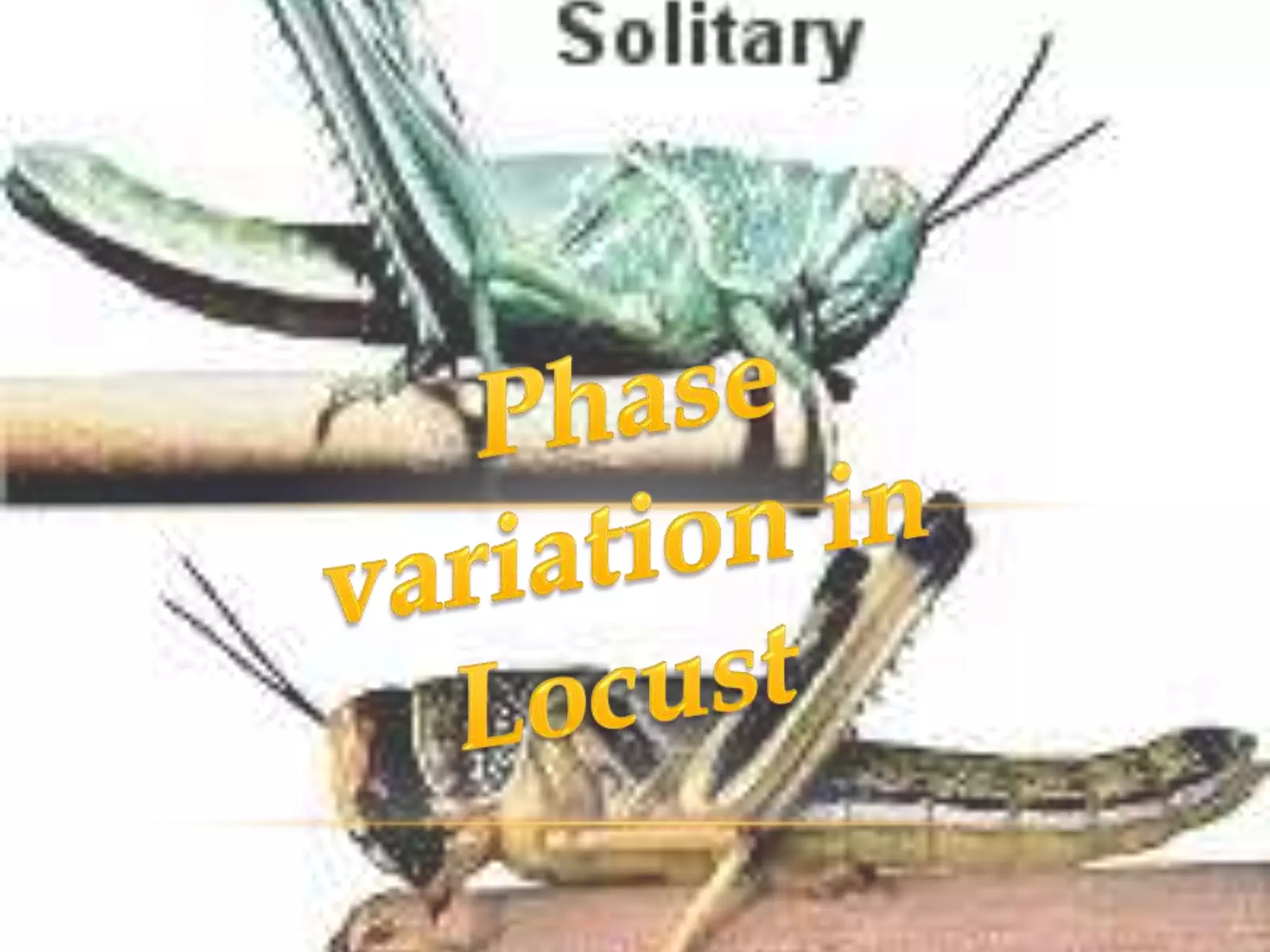
Phase variation in locust

Phase variation in locust

  • 2.
    PRESENTED BY Mariama Mili-117474 ArifulIslam-117475 Hasan-Al-Razi-117476
  • 3.
    WHO ARE LOCUSTS? Locusts are any of a group of insects belongs to the family Acrididae of order Orthoptera.  Locust are commonly known as short-horned grasshoppers  They Often increase greatly in numbers and migrate long distances in destructive swarms.  They are distributed worldwide.
  • 4.
    SOME COMMON LOCUSTSARE: 1. American locust: Schistocerca americana 2. Bombay locust: Nomadacris succincta 3. Brown locust: Locustana pardalina 4. Desert locust: Schistocerca gregaria 5. Italian locust: Calliptamus italicus 6. Migratory locust: Locusta migratoria 7. Red locust: Nomadacris septemfasciata 8. Tree locusts: Anacridium spp. etc.
  • 5.
  • 6.
    PHASE VARIATION  Phaserefers to the different forms of the insects.  Uvarov (1921) proposed the “Phase Theory of Locusts”.  According to Uvarov and Zolotaresvsky(1929), species of Locusts are phase polyphenic, existing in a series of forms.  Sharing the same genotype, individuals may display different phenotypes that incorporate variations in morphology, coloration, reproductive features and significantly in behavior.
  • 7.
     Of thesetwo extreme forms or phases are distinct. These phases are: 1. Solitarious Phase (or phasis solitaria) 2. Gregarious or Migratory phase (or phasis gregaria) They are often strikingly so distinct that they were earlier regarded as separate species by taxonomists.
  • 8.
    Solitarious Phase (orphasis solitaria) Major Characteristics of Solitary phase are: Habit:  They used to solitarious in habit.  Solitarious individuals are repelled from other locusts. Walk slowly with creeping. Diet restricted. Active mostly at night.
  • 9.
    Coloration:  Nymphs extremelyvariable in color- green, grey, brown etc.  Colors usually similar to their normal environment. Pronotum:  Pronotum of adult is extremely large and with a mid-longitudinal crest or carina.  There is no constriction. Wings: Normal
  • 10.
    Femur:  Hind femuris relatively longer.  Tactile hairs are present in large numbers. Maturity: Attain sexual maturity without a diapause or migratory flight. Diapause: Eggs develop without a diapause (suspended growth). Behaviour: Solitary Locust behave like a large
  • 11.
    SOLITARY PHASE Locusta migratoriaSchistocerca gregaria
  • 12.
    GREGARIOUS OR MIGRATORY PHASE MajorCharacteristics of gregarious phase are: Habit: Nymphs and adults are definitely gregarious.  They are attracted to conspecifics.  Walk rapidly with upright gait.  Diet broad.  Active mostly at day.
  • 13.
    Coloration:  Nymphs havea bold coloration. Mainly of black, yellow or orange irrespective to environment. Pronotum:  Pronotum of adult is shorter, and saddle-shaped.  It is laterally constricted and dorsally concave.  There is no carina. Wings: Wings conspicuous and proportionately large.
  • 14.
    Femur:  Hind femuris relatively shorter.  Tactile hairs relatively less in femur. Maturity: Do not attain sexual maturity without a migratory flight. Diapause: Eggs required a diapause at low temperature for their development. Behaviour:  Gregarious locusts are very active in swarming. They are destructive to green foliage.
  • 15.
  • 16.
    Two distinct phasestogether showing the femoral length
  • 17.
    PHASIS TRANSIENS A thirdphase also occurs during transition of the population from one extreme phase to another. It is called “Phasis transiens”. It has no definite form but is represented by a continuous series of transitional or intermediate forms.
  • 18.
    When phase transitionsoccur from solitary to gregarious phase, these forms are termed phasis congrigens.  And when phase transitions occur from gregarious to solitarious these forms are termed as phasis dissocians.  Transitions occur from a solitarious state to a gregarious one & vice versa.  These phase transitions are called solitarization and gregarization.
  • 19.
    FACTORS GOVERNING PHASE PRODUCTION Underspecific conditions in their natural breeding places, the solitary locusts increase in numbers and leading to gregarization. This conditions or factors may be: Environmental:  Meteorological: Temperature  Physical: Water Physiological: Food, fat, protein, hormone
  • 20.
     Gregarization dominateswhen large numbers of locusts gather at the same site.  In tropical regions increase in number of locusts may be provided by dryness or lack of water and in temperate by a high temperature.  When food is scare, the solitary locusts become congregated in restricted areas where water is available to keep vegetation green.  In overcrowded conditions a juvenile is secreted in large quantities by a gland in the head of solitary locusts.
  • 21.
     This hormonespeeds up reproduction leading to characteristics of gregarious phase.  Locust gregarization may be induced by visual, olfactory, or tactile cues.  In Schistocerca gregaria, the most potent stimulus is tactile like- repetitive stroking of the femora of hind legs, functions as a crowding indicator.  Gregarious locusts sometimes migrate a very long distance in vast swarms which is known as invasion or plague, under the influence of winds.
  • 22.
     In sparsesurroundings, with the influence of different conditions number of their generations reduce.  When the area affected by swarms become smaller, the locust plague ends and the locusts enter upon the solitary phase.  Cessation of physical contact leads to solitarization.