Pharo
A roadmap to solid evolution
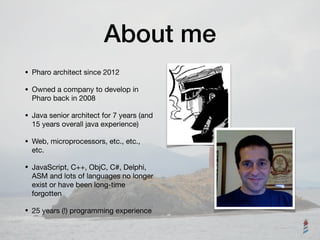
About me
• Pharo architect since 2012

• Owned a company to develop in
Pharo back in 2008

• Java senior architect for 7 years (and
15 years overall java experience)

• Web, microprocessors, etc., etc.,
etc.

• JavaScript, C++, ObjC, C#, Delphi,
ASM and lots of languages no longer
exist or have been long-time
forgotten

• 25 years (!) programming experience
This talk will be about coherence.
This talk will be mostly about coherence.
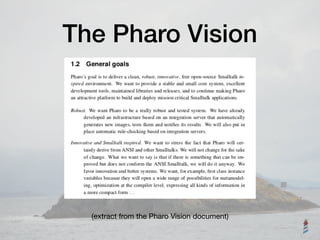
The Pharo Vision
(extract from the Pharo Vision document)
The Pharo Vision
• Clean, robust, innovative.

• Free and Open-source.

• An attractive platform to build and
deploy mission critical Smalltalk
applications.

• Smalltalk inspired environment.
In one way or another, behind each Pharo version, 

there were always the same persistent story: 

modularisation.
This focus moved a bit for Pharo 7.
The story behind Pharo 7 is about process.
Why to focus on process?
• Our process was not scaling anymore.

• “Technical debt” needed to be solved. Both for Pharo
itself and for its users.
Put the pieces in place
• Bootstrap.

• Iceberg.

• The new process itself.
Bootstrap
• This is a major effort that took several years of studies
(and even two PhD) to get it working.

• Bootstrapping: Build a full image from scratch. 

‣ Just with the packages you need (you can produce
small or big images as you need).

‣ Verifiable and repeatable process.
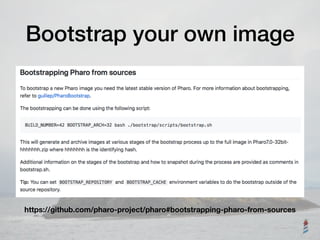
Bootstrap your own image
https://github.com/pharo-project/pharo#bootstrapping-pharo-from-sources
You can build your own image!
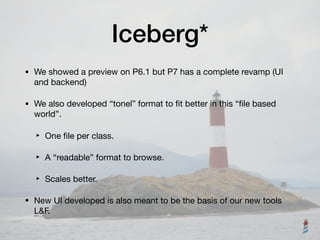
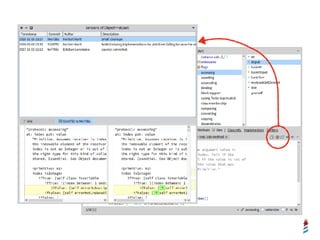
Iceberg*
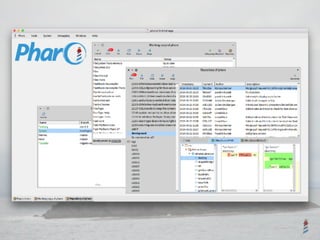
• We showed a preview on P6.1 but P7 has a complete revamp (UI
and backend)

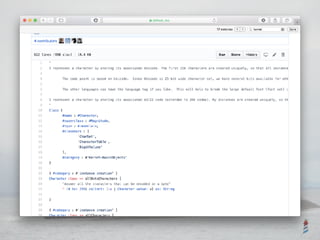
• We also developed “tonel” format to fit better in this “file based
world”. 

‣ One file per class.

‣ A “readable” format to browse.

‣ Scales better.

• New UI developed is also meant to be the basis of our new tools
L&F.
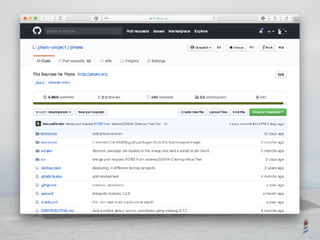
The new Pharo process*
• Bootstrapped. 

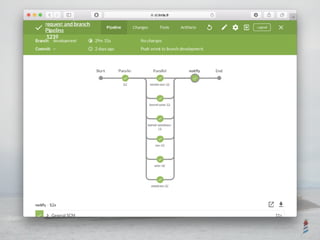
• Git, GitHub and Pull Requests (with Iceberg).
Why?
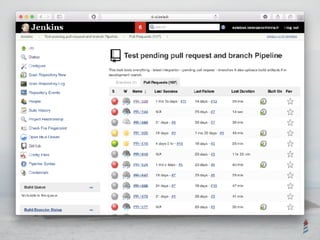
• Reproducible.

• Verified (CI).

• Process of review and approve get’s accessible to all
community (and we can “distribute ownership”).

• Visibility.

• We prepare next steps: release often, back-port better,
LTS.
Some numbers
• More than 1700 Pull Requests closed.

• 104 GitHub forks.

• 63 contributors.

• And that not counting Iceberg, Calypso and others.
Since we are always
improving…
•New system browser (and related tools): Calypso.

•Stateful traits*.

•Streams refactor.

•Working directory now is a real working directory (and there is #imageDirectory that works
as before).

•UFFI has been adapted to Windows 64bit.

•“Plugin replacement program”: move to the image while is possible (FreeType done, SSL
ongoing).

•Windows 64bit VM.

•The OpenSmalltalkVM has continued improving in several ways. Not just Cog (The “Core
VM”) but also specific plugins like FilePlugin for Windows.

•Pharo launcher*

•…
What will be the story on Pharo 8?
Not yet completely decided…
But we think it should be “headless”
The headless story
• “World” start should be a responsibility of the image, not the VM.

• It will expand the “universe of the possible”.

• We will need to work on:

‣ Headless VM (There is already a prototype).

‣ OSWindow and SDL2 backend.

‣ Threaded FFI.

‣ Command line tools (Clap).
Other…
• Move issue tracker to GitHub.

• Remove some duplications in image.

• Enhance Spec and related UI components.

• 64bit as default.

• …
Now… how to give coherence 

to Pharo development itself?
The Pharo Community
• Is composed of companies, organisations and individuals
that make Pharo, and contribute to it in some way.

• Some numbers

‣ Lists: pharo-dev, pharo-users (1000+).

‣ Discord (400+).

‣ FogBugz and GitHub tracker have interesting
discussions too.
The Pharo Consortium
• Non-profit organisation.

• Started at INRIA (by the RMoD team) in 2012.

• Hosted at INRIA Foundation since 2018.
Pharo Consortium goals
• Ensure Pharo continues evolving.

• Deliver updated versions that match the software industry
needs.

• Structure the community.

• Companies and individuals can get an impact.
INRIA Foundation
• Umbrella to host different consortiums (Pharo, Coq,
SOFA, …)

• Share engineering resources to improve all.

• Share also administrative resources.

• Part of the “Software Heritage” initiative.
Other advantages of being
part of INRIA Foundation
• Visibility.

• Solidity (having the continuous support of an institution as
INRIA matters).

• Business development.

• Legal department.

• Tax reduction for donations (FR and US).
Current members
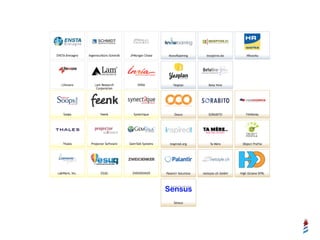
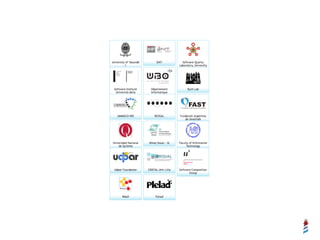
• 30 industrial partners (+5 since last year).

• 17 academic partners (+4 since last year).

• 101 individual members through the Pharo association.
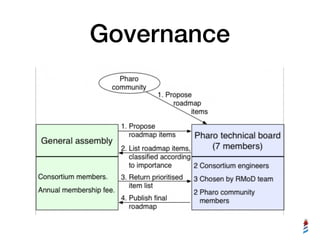
Governance
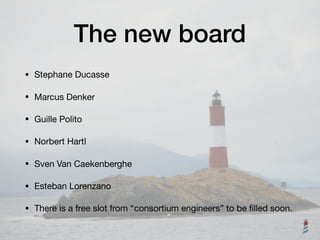
The new board
• Stephane Ducasse

• Marcus Denker

• Guille Polito

• Norbert Hartl

• Sven Van Caekenberghe

• Esteban Lorenzano

• There is a free slot from “consortium engineers” to be filled soon.
The business model
• “Pharo Daily”.

• “Pharo for you”.
Pharo daily
• We take care about evolution of Pharo, to keep it up to
date with ever-growing software industry needs.

• We keep all the elements in place: CI infrastructure,
mailing lists, web-sites, etc.

• We also take care about sustaining an ecosystem of
Pharo packages (to manage databases, etc., etc., etc.).
Pharo for you
• Support for migrations.

• Help on development practices, specific libraries/
frameworks, etc.

• Development of custom libraries/frameworks.

‣ Thales case.
Consortium benefits
• Privileged access to the core development team.

• Influence priorities of the next development.

• Engineering support time.

• Job posts.

• Training/Conference special price.
Expert engineers
• We have now high expertise engineers available to hire.

• We want to hire our second permanent engineer soon.

• But we also want to sustain Pharo growth and that means
have even more engineers. 

‣ In the future, we want to be four engineers (with
engineers to work also on VM related problems).
The Pharo Consortium is a player in a bigger community. 

Is our way to ensure what has been from day one the

ultimate goal of Pharo.
A powerful engine 

to invent 

(y)our future
An ecosystem where
innovation/business
bloom
Pharo is yours.

Pharo Consortium: A roadmap to solid evolution

  • 1.
    Pharo A roadmap tosolid evolution
  • 2.
    About me • Pharoarchitect since 2012 • Owned a company to develop in Pharo back in 2008 • Java senior architect for 7 years (and 15 years overall java experience) • Web, microprocessors, etc., etc., etc. • JavaScript, C++, ObjC, C#, Delphi, ASM and lots of languages no longer exist or have been long-time forgotten • 25 years (!) programming experience
  • 3.
    This talk willbe about coherence.
  • 4.
    This talk willbe mostly about coherence.
  • 5.
    The Pharo Vision (extractfrom the Pharo Vision document)
  • 6.
    The Pharo Vision •Clean, robust, innovative. • Free and Open-source. • An attractive platform to build and deploy mission critical Smalltalk applications. • Smalltalk inspired environment.
  • 7.
    In one wayor another, behind each Pharo version, there were always the same persistent story: modularisation. This focus moved a bit for Pharo 7.
  • 8.
    The story behindPharo 7 is about process.
  • 9.
    Why to focuson process? • Our process was not scaling anymore. • “Technical debt” needed to be solved. Both for Pharo itself and for its users.
  • 10.
    Put the piecesin place • Bootstrap. • Iceberg. • The new process itself.
  • 11.
    Bootstrap • This isa major effort that took several years of studies (and even two PhD) to get it working. • Bootstrapping: Build a full image from scratch. ‣ Just with the packages you need (you can produce small or big images as you need). ‣ Verifiable and repeatable process.
  • 12.
    Bootstrap your ownimage https://github.com/pharo-project/pharo#bootstrapping-pharo-from-sources
  • 13.
    You can buildyour own image!
  • 14.
    Iceberg* • We showeda preview on P6.1 but P7 has a complete revamp (UI and backend) • We also developed “tonel” format to fit better in this “file based world”. ‣ One file per class. ‣ A “readable” format to browse. ‣ Scales better. • New UI developed is also meant to be the basis of our new tools L&F.
  • 18.
    The new Pharoprocess* • Bootstrapped. • Git, GitHub and Pull Requests (with Iceberg).
  • 22.
    Why? • Reproducible. • Verified(CI). • Process of review and approve get’s accessible to all community (and we can “distribute ownership”). • Visibility. • We prepare next steps: release often, back-port better, LTS.
  • 23.
    Some numbers • Morethan 1700 Pull Requests closed. • 104 GitHub forks. • 63 contributors. • And that not counting Iceberg, Calypso and others.
  • 24.
    Since we arealways improving… •New system browser (and related tools): Calypso. •Stateful traits*. •Streams refactor. •Working directory now is a real working directory (and there is #imageDirectory that works as before). •UFFI has been adapted to Windows 64bit. •“Plugin replacement program”: move to the image while is possible (FreeType done, SSL ongoing). •Windows 64bit VM. •The OpenSmalltalkVM has continued improving in several ways. Not just Cog (The “Core VM”) but also specific plugins like FilePlugin for Windows. •Pharo launcher* •…
  • 25.
    What will bethe story on Pharo 8?
  • 26.
  • 27.
    But we thinkit should be “headless”
  • 28.
    The headless story •“World” start should be a responsibility of the image, not the VM. • It will expand the “universe of the possible”. • We will need to work on: ‣ Headless VM (There is already a prototype). ‣ OSWindow and SDL2 backend. ‣ Threaded FFI. ‣ Command line tools (Clap).
  • 29.
    Other… • Move issuetracker to GitHub. • Remove some duplications in image. • Enhance Spec and related UI components. • 64bit as default. • …
  • 30.
    Now… how togive coherence to Pharo development itself?
  • 31.
    The Pharo Community •Is composed of companies, organisations and individuals that make Pharo, and contribute to it in some way. • Some numbers ‣ Lists: pharo-dev, pharo-users (1000+). ‣ Discord (400+). ‣ FogBugz and GitHub tracker have interesting discussions too.
  • 32.
    The Pharo Consortium •Non-profit organisation. • Started at INRIA (by the RMoD team) in 2012. • Hosted at INRIA Foundation since 2018.
  • 33.
    Pharo Consortium goals •Ensure Pharo continues evolving. • Deliver updated versions that match the software industry needs. • Structure the community. • Companies and individuals can get an impact.
  • 34.
    INRIA Foundation • Umbrellato host different consortiums (Pharo, Coq, SOFA, …) • Share engineering resources to improve all. • Share also administrative resources. • Part of the “Software Heritage” initiative.
  • 35.
    Other advantages ofbeing part of INRIA Foundation • Visibility. • Solidity (having the continuous support of an institution as INRIA matters). • Business development. • Legal department. • Tax reduction for donations (FR and US).
  • 36.
    Current members • 30industrial partners (+5 since last year). • 17 academic partners (+4 since last year). • 101 individual members through the Pharo association.
  • 39.
  • 40.
    The new board •Stephane Ducasse • Marcus Denker • Guille Polito • Norbert Hartl • Sven Van Caekenberghe • Esteban Lorenzano • There is a free slot from “consortium engineers” to be filled soon.
  • 41.
    The business model •“Pharo Daily”. • “Pharo for you”.
  • 42.
    Pharo daily • Wetake care about evolution of Pharo, to keep it up to date with ever-growing software industry needs. • We keep all the elements in place: CI infrastructure, mailing lists, web-sites, etc. • We also take care about sustaining an ecosystem of Pharo packages (to manage databases, etc., etc., etc.).
  • 43.
    Pharo for you •Support for migrations. • Help on development practices, specific libraries/ frameworks, etc. • Development of custom libraries/frameworks. ‣ Thales case.
  • 44.
    Consortium benefits • Privilegedaccess to the core development team. • Influence priorities of the next development. • Engineering support time. • Job posts. • Training/Conference special price.
  • 45.
    Expert engineers • Wehave now high expertise engineers available to hire. • We want to hire our second permanent engineer soon. • But we also want to sustain Pharo growth and that means have even more engineers. ‣ In the future, we want to be four engineers (with engineers to work also on VM related problems).
  • 46.
    The Pharo Consortiumis a player in a bigger community. Is our way to ensure what has been from day one the ultimate goal of Pharo.
  • 47.
    A powerful engine to invent (y)our future
  • 48.
  • 49.