Pharmacovigilance
Presenter: Dr. Siddhant Mehrotra (JR-1)
Department of Pharmacology & Therapeutics
King George’s Medical University, Lucknow U.P.
Email: dr.sidmehrotrakgmu@gmail.com
10/07/2025 Dr. Siddhant Mehrotra 2
Celebrating 4th
National Pharmacovigilance Week
10/07/2025 Dr. Siddhant Mehrotra 3
10/07/2025 Dr. Siddhant Mehrotra 4
• Adverse drug reaction caused 100,000 annual deaths worldwide
Feb. 2007
Feb 2011
For child < 12 years
10/07/2025 Dr. Siddhant Mehrotra 5
Content
• Introduction
• Need for Pharmacovigilance
• Pharmacovigilance in India
• Responsibilities and objectives
• Short term & long term goals
• International status of Pharmacovigilance
• ADR reporting
• Scope of Pharmacovigilance
10/07/2025 Dr. Siddhant Mehrotra 6
List of Important Abbreviations Used
• ADR- Adverse drug reaction
• PvPI- Pharmacovigilance programme of India
• AMC- ADR monitoring centre
• CDSCO- Central drug standard control organization
• ICSR- Individual case safety report
10/07/2025 Dr. Siddhant Mehrotra 7
Specific learning objectives
At the end of this PG -teaching session my co- learners will be able to:
• Get sensitize with pharmacovigilance
• Objectives, roles and importance of pharmacovigilance
• Pharmacovigilance program in India
• Scope of pharmacovigilance after MD pharmacology
10/07/2025 Dr. Siddhant Mehrotra 8
What is Pharmacovigilance?
• Pharmacovigilance is the science and activities related to
Detection
Assessment
Understanding
Prevention
Of adverse effects or
any other medicine
related problems
10/07/2025 Dr. Siddhant Mehrotra 9
Need for Pharmacovigilance
• To protect patients from unnecessary harm and increasing healthcare cost from
medicines
• For signal detection and risk minimisation measures
• Early detection of new ADRs on patients subgroups of exceptional sensitivity
(Paediatrics, Geriatrics, Pregnant women)
• Promoting rational use of medicines
• To support regulatory agencies in decision making process for safe use of
medicines
10/07/2025 Dr. Siddhant Mehrotra 10
Brief history of Pharmacovigilance in India
In 1986,there was formal ADR monitoring system consisting of 12
regional centres, each covering 50 million population
In 1989, under the drug controller of India,6 regional centres were set
up in Mumbai, Delhi, Kolkata, Lucknow, Pondicherry and Chandigarh
In 1997, India joined WHO programme for international drug
monitoring managed by Uppasla Monitoring Centre, Sweden
10/07/2025 Dr. Siddhant Mehrotra 11
NPVP (National Pharmacovigilance Programme ) was launched in
November 2004.
NPVP was overseen by the National Pharmacovigilance Advisory
Committee based in CDSCO, New Delhi
PvPI was initiated by GOI on 14 July,2010 with AIIMS, New Delhi as NCC
for monitoring adverse drug reaction
Shifted from AIIMS, New Delhi to Indian Pharmacopoeia Commission,
Ghaziabad, Uttar Pradesh on 15th
April,2011
Brief history of Pharmacovigilance in India
10/07/2025 Dr. Siddhant Mehrotra 12
Mission of PvPI Vision of PvPI
To safeguard the
health of the Indian
population by
ensuring that the
benefit of use of
medicine outweighs
the risks associated
with its use
To improve patient
safety and welfare in
Indian population by
monitoring drug
safety and thereby
reducing the risk
associated with use of
medicines
Pharmacovigilance Programme in India
10/07/2025 Dr. Siddhant Mehrotra 13
Responsibilities of Pharmacovigilance
Creates appropriate structures and means of
communication needed to perform its tasks
Expedited and Periodic recording
Timely Collection of Data and Appropriate
assessment
10/07/2025 Dr. Siddhant Mehrotra 14
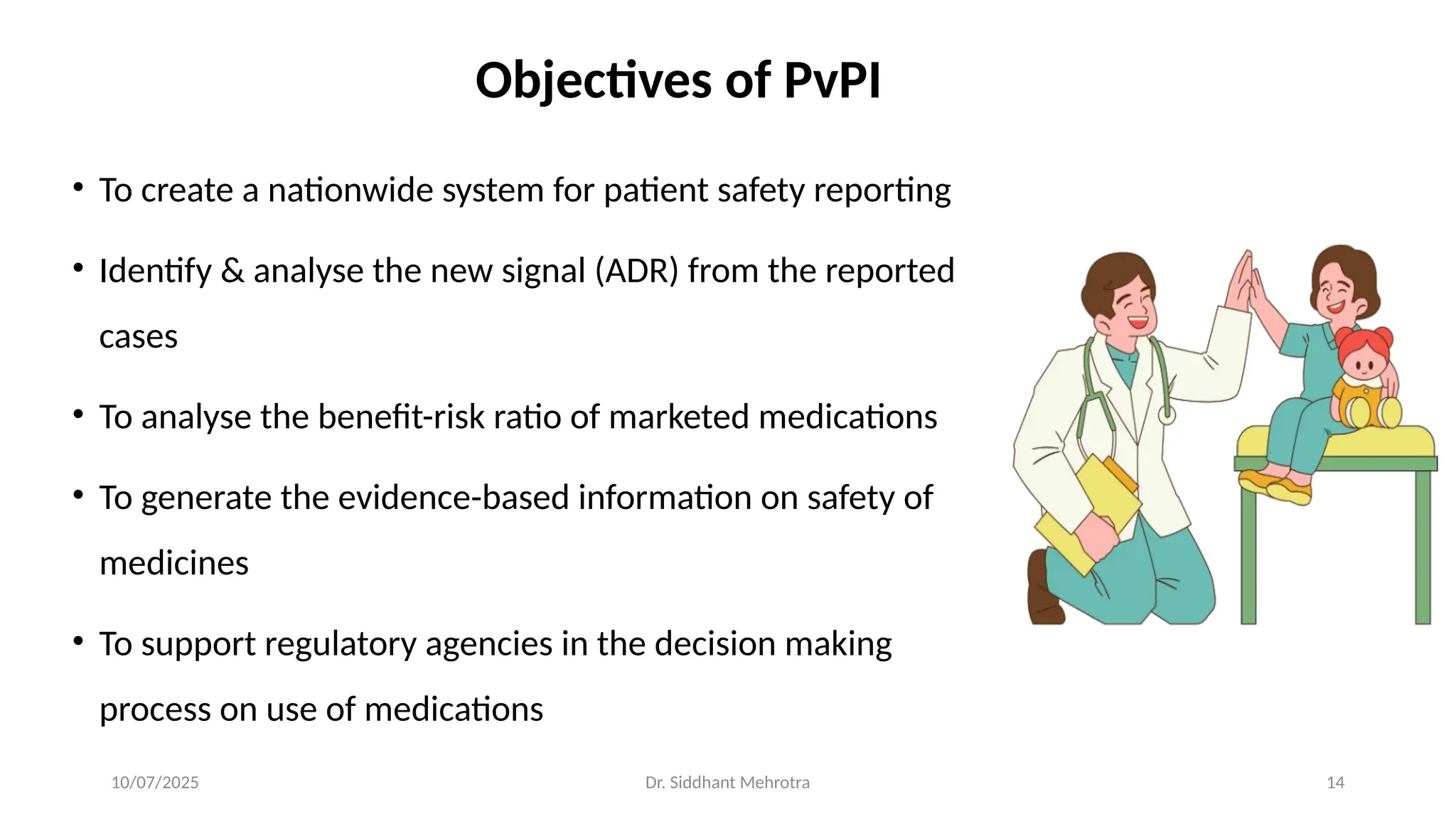
Objectives of PvPI
• To create a nationwide system for patient safety reporting
• Identify & analyse the new signal (ADR) from the reported
cases
• To analyse the benefit-risk ratio of marketed medications
• To generate the evidence-based information on safety of
medicines
• To support regulatory agencies in the decision making
process on use of medications
10/07/2025 15
• To communicate the safety information on use of
medicines to various stakeholders to minimize the risk
• To collaborate with other national centres for the
exchange of information and data management
• To provide training and consultancy support to other
national pharmacovigilance centres located across globe
Objectives of PvPI
Dr. Siddhant Mehrotra
10/07/2025 Dr. Siddhant Mehrotra 16
What is Signal?
• Signal is reported information on possible
causal association between drug and adverse
event
• Signal is not a confirmatory finding but it is
hypothesis generating situation that must be
validated
10/07/2025 Dr. Siddhant Mehrotra 17
International Status of Pharmacovigilance
•WHO- Uppsala monitoring center (UMC)
• WHO’s program for International Drug monitoring was
started in 1968
• Currently more than 100 countries participate in the
program
• The program is coordinated by WHO along with
collaborating centre in Uppsala, Sweden
10/07/2025 Dr. Siddhant Mehrotra 18
• This center is responsible for
maintaining the global ADR
database, Vigibase
• As of February 2025, the
database contains over 40
million ADR reports
5
million
15
million
40
million
2009 2017 2025
International Status of Pharmacovigilance
10/07/2025 Dr. Siddhant Mehrotra 19
Pharmacovigilance In India:
Present status:
• India contributed 2% of Vigibase (WHO-UMC global database of ICSR)
• Presently, there are 760 functioning Adverse Drug Monitoring
Centers (AMCs) in the country under PvPI
• AMCs are located in medical colleges and corporate hospitals
10/07/2025 Dr. Siddhant Mehrotra 20
10/07/2025 Dr. Siddhant Mehrotra 21
Short Term Goals
• To develop and implement pharmaco-vigilance system in
India
• To enroll, initially, all NMC approved medical colleges in the
program covering north, south, east and west of India
• To encourage healthcare professionals in reporting of
adverse reaction to drugs, vaccines, medical devices and
biological products
• Collection of case reports and data
10/07/2025 Dr. Siddhant Mehrotra 22
Long Term Goals
• To expand the pharmacovigilance program to all hospitals
(govt. & private) and centers of public health programs located
across India
• To develop and implement electronic reporting system
(e-reporting)
• To develop reporting culture amongst healthcare professionals
• To make ADR reporting mandatory for healthcare professional
10/07/2025 Dr. Siddhant Mehrotra 23
PvPI Data Sources
• Patients
• National Health Programs
• Marketing Authorization Holders
• ADR Monitoring Centre
10/07/2025 Dr. Siddhant Mehrotra 24
Expansion of PvPI
PVPI after its launch expanded further
Medical Council of India (MCI)
• Mandatory for every medical college in India to have a Pharmacovigilance
committee, as per regulations of Medical Council of India, 2010
Participation of Nursing Professionals
• NCI-PvPI organized a meeting with president Nursing Council of India (NCI), on July
16, 2014, New Delhi to initiate the participation of nursing professionals in PvPI.
10/07/2025 Dr. Siddhant Mehrotra 25
Why to report?
• Ensure safety of patients on drugs
• Reduce economic burden of patients, society
& nation
• Identify risk factors
• Genetic & Ethnic variability
• Poor patient compliance
10/07/2025 Dr. Siddhant Mehrotra 26
What to report?
• ADRs related with the use of allopathic medicines,
vaccines, traditional medicines, blood products, medical
devices, contrast media can be reported
• Report all the suspected ADRs irrespective to:
• Known or Unknown
• Serious or non serious
• Frequent or Rare
10/07/2025 Dr. Siddhant Mehrotra 27
How to report
• Suspected ADR reporting forms for healthcare : professional and
consumers
• To remove language barrier in ADR reporting, the consumer
reporting form are made available in 10 vernacular languages
• ADRs via PvPI helpline number (1800-180-3024) on weekdays from
9:00 am to 5:30 pm.
• Mailing the filled ADR reporting form directly to pvpi@ipcindia.net or
pvpi.ipcindia@gmail.com
❓
10/07/2025 Dr. Siddhant Mehrotra 28
• The mobile Android application for ADR reporting has also been made available
to the public.
10/07/2025 Dr. Siddhant Mehrotra 29
Who can report
10/07/2025 Dr. Siddhant Mehrotra 30
What happens to the information submitted
The information in the form shall be handled in strict confidence
Peripheral pharmacovigilance centre
Regional Centre
Zonal centre (data will be statically analysed)
Global Pharmacovigilance Database(WHO-UMC)
10/07/2025 Dr. Siddhant Mehrotra 31
Minimum requirements for a functional
Pharmacovigilance system
• A national pharmacovigilance center with designated staff (at least one full time), well
defined structures and collaborating with the WHO Program for International Drug
Monitoring
• The existence of a national spontaneous reporting system with a national individual
case safety report (ICSR) form i.e. an adverse drug reaction (ADR) reporting form
• A national database or system for collecting and managing ADR reports (Vigibase
database and Vigiflow software for PvPI)
10/07/2025 Dr. Siddhant Mehrotra 32
Communication
• Press and Media
• Website
• Newsletter
• Poster and Pamphlets
• Communication through social media
10/07/2025 Dr. Siddhant Mehrotra 33
Scope of Pharmacovigilance
Govt. Sector:
• CDSCO
• AMC coordinator or safety reviewer
• Public sector hospitals for ADR monitoring committee member
CRO Industry:
• Drug safety associate
• Pharmacovigilance scientist
Academics:
• Head institutional Adverse drug monitoring center
10/07/2025 Dr. Siddhant Mehrotra 34
Summary
• Pharmacovigilance is the science and activities related to detection, assessment, prevention
and understanding of adverse effects related to drugs
• Visions to improve patient safety and welfare in Indian population by monitoring drug safety
and thereby reducing the risk associated with use of medicine
• WHO- Uppsala monitoring center (UMC): program for International Drug monitoring was
started in 1968
• As of February 2025, the database contains over 40 million ADR reports
• Collaborating centre is in Uppsala, Sweden which is responsible for maintaining the global
ADR database, Vigibase
10/07/2025 Dr. Siddhant Mehrotra 35
Suggested Readings
• WHO – Uppsala monitoring centre causality assessment
• Types of ADRs
• Difference between ADR and side effects
10/07/2025 Dr. Siddhant Mehrotra 36
References
• B. Medhi, A. Prakash, Advanced Pharmacology, 2ND
edition. PharmaMed
Press, 2019
• Tripathi KD. Essentials of medical pharmacology. 8th
edition. New Delhi:
Jaypee Brothers Medical Publisher (P) ltd;2019
• Sharma HL, Sharma KK. Principles of Pharmacology. 3rd ed. Hyderabad,
India: Paras Medical Publisher; 2017
• https://www.ncbi.nlm.nih.gov/pmc
10/07/2025 Dr. Siddhant Mehrotra 37
Specific learning objectives achieved
At the end of this PG -teaching session my co – learners are able to:
• Get sensitize with pharmacovigilance
• Objectives, roles and importance of pharmacovigilance
• Pharmacovigilance program in India
• Scope of pharmacovigilance after MD pharmacology
10/07/2025 Dr. Siddhant Mehrotra 38
THANK YOU

pharmacovigilance program in india .pptx

  • 1.
    Pharmacovigilance Presenter: Dr. SiddhantMehrotra (JR-1) Department of Pharmacology & Therapeutics King George’s Medical University, Lucknow U.P. Email: dr.sidmehrotrakgmu@gmail.com
  • 2.
    10/07/2025 Dr. SiddhantMehrotra 2 Celebrating 4th National Pharmacovigilance Week
  • 3.
  • 4.
    10/07/2025 Dr. SiddhantMehrotra 4 • Adverse drug reaction caused 100,000 annual deaths worldwide Feb. 2007 Feb 2011 For child < 12 years
  • 5.
    10/07/2025 Dr. SiddhantMehrotra 5 Content • Introduction • Need for Pharmacovigilance • Pharmacovigilance in India • Responsibilities and objectives • Short term & long term goals • International status of Pharmacovigilance • ADR reporting • Scope of Pharmacovigilance
  • 6.
    10/07/2025 Dr. SiddhantMehrotra 6 List of Important Abbreviations Used • ADR- Adverse drug reaction • PvPI- Pharmacovigilance programme of India • AMC- ADR monitoring centre • CDSCO- Central drug standard control organization • ICSR- Individual case safety report
  • 7.
    10/07/2025 Dr. SiddhantMehrotra 7 Specific learning objectives At the end of this PG -teaching session my co- learners will be able to: • Get sensitize with pharmacovigilance • Objectives, roles and importance of pharmacovigilance • Pharmacovigilance program in India • Scope of pharmacovigilance after MD pharmacology
  • 8.
    10/07/2025 Dr. SiddhantMehrotra 8 What is Pharmacovigilance? • Pharmacovigilance is the science and activities related to Detection Assessment Understanding Prevention Of adverse effects or any other medicine related problems
  • 9.
    10/07/2025 Dr. SiddhantMehrotra 9 Need for Pharmacovigilance • To protect patients from unnecessary harm and increasing healthcare cost from medicines • For signal detection and risk minimisation measures • Early detection of new ADRs on patients subgroups of exceptional sensitivity (Paediatrics, Geriatrics, Pregnant women) • Promoting rational use of medicines • To support regulatory agencies in decision making process for safe use of medicines
  • 10.
    10/07/2025 Dr. SiddhantMehrotra 10 Brief history of Pharmacovigilance in India In 1986,there was formal ADR monitoring system consisting of 12 regional centres, each covering 50 million population In 1989, under the drug controller of India,6 regional centres were set up in Mumbai, Delhi, Kolkata, Lucknow, Pondicherry and Chandigarh In 1997, India joined WHO programme for international drug monitoring managed by Uppasla Monitoring Centre, Sweden
  • 11.
    10/07/2025 Dr. SiddhantMehrotra 11 NPVP (National Pharmacovigilance Programme ) was launched in November 2004. NPVP was overseen by the National Pharmacovigilance Advisory Committee based in CDSCO, New Delhi PvPI was initiated by GOI on 14 July,2010 with AIIMS, New Delhi as NCC for monitoring adverse drug reaction Shifted from AIIMS, New Delhi to Indian Pharmacopoeia Commission, Ghaziabad, Uttar Pradesh on 15th April,2011 Brief history of Pharmacovigilance in India
  • 12.
    10/07/2025 Dr. SiddhantMehrotra 12 Mission of PvPI Vision of PvPI To safeguard the health of the Indian population by ensuring that the benefit of use of medicine outweighs the risks associated with its use To improve patient safety and welfare in Indian population by monitoring drug safety and thereby reducing the risk associated with use of medicines Pharmacovigilance Programme in India
  • 13.
    10/07/2025 Dr. SiddhantMehrotra 13 Responsibilities of Pharmacovigilance Creates appropriate structures and means of communication needed to perform its tasks Expedited and Periodic recording Timely Collection of Data and Appropriate assessment
  • 14.
    10/07/2025 Dr. SiddhantMehrotra 14 Objectives of PvPI • To create a nationwide system for patient safety reporting • Identify & analyse the new signal (ADR) from the reported cases • To analyse the benefit-risk ratio of marketed medications • To generate the evidence-based information on safety of medicines • To support regulatory agencies in the decision making process on use of medications
  • 15.
    10/07/2025 15 • Tocommunicate the safety information on use of medicines to various stakeholders to minimize the risk • To collaborate with other national centres for the exchange of information and data management • To provide training and consultancy support to other national pharmacovigilance centres located across globe Objectives of PvPI Dr. Siddhant Mehrotra
  • 16.
    10/07/2025 Dr. SiddhantMehrotra 16 What is Signal? • Signal is reported information on possible causal association between drug and adverse event • Signal is not a confirmatory finding but it is hypothesis generating situation that must be validated
  • 17.
    10/07/2025 Dr. SiddhantMehrotra 17 International Status of Pharmacovigilance •WHO- Uppsala monitoring center (UMC) • WHO’s program for International Drug monitoring was started in 1968 • Currently more than 100 countries participate in the program • The program is coordinated by WHO along with collaborating centre in Uppsala, Sweden
  • 18.
    10/07/2025 Dr. SiddhantMehrotra 18 • This center is responsible for maintaining the global ADR database, Vigibase • As of February 2025, the database contains over 40 million ADR reports 5 million 15 million 40 million 2009 2017 2025 International Status of Pharmacovigilance
  • 19.
    10/07/2025 Dr. SiddhantMehrotra 19 Pharmacovigilance In India: Present status: • India contributed 2% of Vigibase (WHO-UMC global database of ICSR) • Presently, there are 760 functioning Adverse Drug Monitoring Centers (AMCs) in the country under PvPI • AMCs are located in medical colleges and corporate hospitals
  • 20.
  • 21.
    10/07/2025 Dr. SiddhantMehrotra 21 Short Term Goals • To develop and implement pharmaco-vigilance system in India • To enroll, initially, all NMC approved medical colleges in the program covering north, south, east and west of India • To encourage healthcare professionals in reporting of adverse reaction to drugs, vaccines, medical devices and biological products • Collection of case reports and data
  • 22.
    10/07/2025 Dr. SiddhantMehrotra 22 Long Term Goals • To expand the pharmacovigilance program to all hospitals (govt. & private) and centers of public health programs located across India • To develop and implement electronic reporting system (e-reporting) • To develop reporting culture amongst healthcare professionals • To make ADR reporting mandatory for healthcare professional
  • 23.
    10/07/2025 Dr. SiddhantMehrotra 23 PvPI Data Sources • Patients • National Health Programs • Marketing Authorization Holders • ADR Monitoring Centre
  • 24.
    10/07/2025 Dr. SiddhantMehrotra 24 Expansion of PvPI PVPI after its launch expanded further Medical Council of India (MCI) • Mandatory for every medical college in India to have a Pharmacovigilance committee, as per regulations of Medical Council of India, 2010 Participation of Nursing Professionals • NCI-PvPI organized a meeting with president Nursing Council of India (NCI), on July 16, 2014, New Delhi to initiate the participation of nursing professionals in PvPI.
  • 25.
    10/07/2025 Dr. SiddhantMehrotra 25 Why to report? • Ensure safety of patients on drugs • Reduce economic burden of patients, society & nation • Identify risk factors • Genetic & Ethnic variability • Poor patient compliance
  • 26.
    10/07/2025 Dr. SiddhantMehrotra 26 What to report? • ADRs related with the use of allopathic medicines, vaccines, traditional medicines, blood products, medical devices, contrast media can be reported • Report all the suspected ADRs irrespective to: • Known or Unknown • Serious or non serious • Frequent or Rare
  • 27.
    10/07/2025 Dr. SiddhantMehrotra 27 How to report • Suspected ADR reporting forms for healthcare : professional and consumers • To remove language barrier in ADR reporting, the consumer reporting form are made available in 10 vernacular languages • ADRs via PvPI helpline number (1800-180-3024) on weekdays from 9:00 am to 5:30 pm. • Mailing the filled ADR reporting form directly to pvpi@ipcindia.net or pvpi.ipcindia@gmail.com ❓
  • 28.
    10/07/2025 Dr. SiddhantMehrotra 28 • The mobile Android application for ADR reporting has also been made available to the public.
  • 29.
    10/07/2025 Dr. SiddhantMehrotra 29 Who can report
  • 30.
    10/07/2025 Dr. SiddhantMehrotra 30 What happens to the information submitted The information in the form shall be handled in strict confidence Peripheral pharmacovigilance centre Regional Centre Zonal centre (data will be statically analysed) Global Pharmacovigilance Database(WHO-UMC)
  • 31.
    10/07/2025 Dr. SiddhantMehrotra 31 Minimum requirements for a functional Pharmacovigilance system • A national pharmacovigilance center with designated staff (at least one full time), well defined structures and collaborating with the WHO Program for International Drug Monitoring • The existence of a national spontaneous reporting system with a national individual case safety report (ICSR) form i.e. an adverse drug reaction (ADR) reporting form • A national database or system for collecting and managing ADR reports (Vigibase database and Vigiflow software for PvPI)
  • 32.
    10/07/2025 Dr. SiddhantMehrotra 32 Communication • Press and Media • Website • Newsletter • Poster and Pamphlets • Communication through social media
  • 33.
    10/07/2025 Dr. SiddhantMehrotra 33 Scope of Pharmacovigilance Govt. Sector: • CDSCO • AMC coordinator or safety reviewer • Public sector hospitals for ADR monitoring committee member CRO Industry: • Drug safety associate • Pharmacovigilance scientist Academics: • Head institutional Adverse drug monitoring center
  • 34.
    10/07/2025 Dr. SiddhantMehrotra 34 Summary • Pharmacovigilance is the science and activities related to detection, assessment, prevention and understanding of adverse effects related to drugs • Visions to improve patient safety and welfare in Indian population by monitoring drug safety and thereby reducing the risk associated with use of medicine • WHO- Uppsala monitoring center (UMC): program for International Drug monitoring was started in 1968 • As of February 2025, the database contains over 40 million ADR reports • Collaborating centre is in Uppsala, Sweden which is responsible for maintaining the global ADR database, Vigibase
  • 35.
    10/07/2025 Dr. SiddhantMehrotra 35 Suggested Readings • WHO – Uppsala monitoring centre causality assessment • Types of ADRs • Difference between ADR and side effects
  • 36.
    10/07/2025 Dr. SiddhantMehrotra 36 References • B. Medhi, A. Prakash, Advanced Pharmacology, 2ND edition. PharmaMed Press, 2019 • Tripathi KD. Essentials of medical pharmacology. 8th edition. New Delhi: Jaypee Brothers Medical Publisher (P) ltd;2019 • Sharma HL, Sharma KK. Principles of Pharmacology. 3rd ed. Hyderabad, India: Paras Medical Publisher; 2017 • https://www.ncbi.nlm.nih.gov/pmc
  • 37.
    10/07/2025 Dr. SiddhantMehrotra 37 Specific learning objectives achieved At the end of this PG -teaching session my co – learners are able to: • Get sensitize with pharmacovigilance • Objectives, roles and importance of pharmacovigilance • Pharmacovigilance program in India • Scope of pharmacovigilance after MD pharmacology
  • 38.
    10/07/2025 Dr. SiddhantMehrotra 38 THANK YOU