PHARMACEUTICAL 
INDUSTRY 
BY 
PRATEEK GUPTA (33) 
Sathish Kumar (46)
PHARMACEUTICAL INDUSTRY 
 The pharmaceutical industry develops, produces, and 
markets drugs or pharmaceuticals licensed for use as 
medication .
GLOBAL PHARMACEUTICAL MARKET 
600 
580 
750 
710 
670 
790 
959 
940 
900 
880 
IN US 
BILLION $ 
0 200 400 600 800 1000 1200 
2012 
2011 
2010 
2009 
2008 
2007 
2006 
2005 
2004 
2003 
Pharma Sales 
Pharma Sales 
Source of 
Data 
By Deloitte
Globally region wise Sales 
959 US BILLION$ 
2012-2013 
America 
Europe 
Australia, Asia and 
Africa 
Japan 
45.36 
12.02 
18.26 
24.36 
Source of Data 
By Deloitte
MAJOR PLAYERS OF THE WORLD 
1. Johnson & Johnson 
2. Pfizer 
3. Roche 
4. GlaxoSmithKline 
5. Novartis 
6. Sanofi 
7. AstraZeneca 
8. Abbott Laboratories 
9. Merck & Co. 
10.Bayer HealthCare
MAIN TRENDS 
 The research based pharmaceutical industry is 
playing a major role in reviving Europe’s economy. 
 There is rapid growth in market and research 
environment in the emerging economies such as 
brazil, china and India. 
 In 2012 Nor th America accounted for 41.0% of world 
pharmaceutical sales compared with 26.7% for 
Europe.
PHARMACEUTICAL R&D EXPENDITURE IN EUROPE, USA AND 
JAPAN 
(MILLION OF NATIONAL CURRENCY UNITS*) , 1990-2012
PHARMACEUTICAL RESEARCH IN EUROPE 
 The cost of developing a new chemical was 
estimated at 1172 million pounds. 
 On average, only one to two of every 10,000 
substances produced in laboratories will successfully 
pass all stages of development process required to 
become a marketable medicine.
PHASES OF RESEARCH AND 
DEVELOPMENT
NUMBER OF NEW CHEMICALS(1993- 
2012)
IMPORTANCE OF RESEARCH AND 
DEVELOPMENT. 
 In 2011 the pharmaceutical industry in Europe invested 
about € 29,200Million in R&D. 
 Facing increased competition from emerging economies 
like India Brazil and China. 
 The change of focus towards emerging economies. 
 According to EUROSTAT data pharmaceutical sector is the 
sector contributing huge amount of money to R&D.
PRICE STRUCTURE 
 Distribution margins, are general ly fixed by governments, and 
VAT rates vary from country to country in Europe 
 On average, approximately 35% of the retai l price of a 
medicine goes not to the manufacturer, but rather to the 
distributors (pharmacists and wholesalers) and state 
 Breakdown of the retai l 
price of a medicine in 
2011 (%) .
GENERICS 
 It is usually produced by manufacturer not by inventor. 
 Marketed according to Intellectual Proper ty Rights. 
 The market share is higher in European union.
EXPORTS, IMPORTS AND TRADE 
BALANCE
ADDED VALUES OF MEDICINES IN HEALTH 
CARE 
 On average, 16.6% of total health expenditure in Europe being 
spent on pharmaceuticals and other medical nondurables. 
 In costly diseases such as cancer and rheumatoid, ar thritis, 
medicines account for even less than 10% of the total disease 
costs.
INDIAN PHARMA INDUSTRY 
Sources: http://www.ibef.org/industry/pharmaceutical-india.aspx
PHARMA MANUFACTURING & PATENTS 
 India is home to 10,500 manufacturing units and 
over 3,000 pharma companies. 
 India accounts for 36.9 per cent (3,411) of the 9,296 
Drug Master Files (DMFs) filed with the USA, which is 
the highest outside of the USA (as on December 31, 
2013). 
 Higher spending on R&D, owing to products patents 
have made India a major destination for generic drug 
manufacturing.
MARKET SIZE 
 From a market size of US$ 12.6 bi l l ion in 2009, the Indian 
pharmaceutical market wi l l grow to US$ 55 bi l l ion by 2020, 
with the potential to reach US$ 70 bi l lion in an aggressive 
growth scenario. In a pessimistic scenario characterized by 
regulatory controls and economic slowdown, the market wi l l 
be depressed but is sti l l expected to reach US$ 35 bi l l ion. 
 India currently expor ts drug intermediates, Active 
Pharmaceutical Ingredients (APIs) , Finished Dosage 
Formulations (FDFs) , Bio-Pharmaceuticals, and Cl inical 
Services across the globe.
 As per 'Pharma Vision 2020' , the Government of India aims to 
make India a global leader in end-to-end drug manufacturing. 
 Manufacturing costs in India are approximately 35-40 per cent 
of those in the US due to low installation and manufacturing 
costs. 
 Indian vaccines are expor ted to 150 countries. 
 The projected human resource requirement in the Indian 
pharma sector is estimated to be about 21,50,000 by 2020
ROAD AHEAD 
 The growth in Indian domestic market wi l l be boosted by 
increasing consumer spending, rapid urbanization, increasing 
healthcare insurance and so on. 
 The l ifestyle segments such as cardiovascular, anti -diabetes, 
anti -depressants and anti -cancers wi l l continue to be lucrative 
and fast growing owing to increased urbanization and change 
in l i festyle patterns. 
 For the US market, Indian companies are developing niche 
por tfol ios in various segments. High margin injectables, 
dermatology, respiratory, biogenerics, complex generics, etc. , 
have become areas of interest.
ADVANTAGES 
 Due to a genetically diverse population and availability of 
ski l led doctors, India has the potential to attract huge 
investments to its cl inical trial market. 
 Demand for generic medicines in rural markets has seen a 
sharp growth. Various companies are investing in the 
distribution network in rural areas. 
 Growing demand could open up the market for production of 
high-end drugs in India. 
 The domestic pharma sector is witnessing strong growth due 
to higher penetration in tier - I I and tier - I I I cities and greater 
focus on the largely - untapped rural market.
 India is one of the fastest -growing pharmaceutical markets in 
the world and has established itself as a global manufacturing 
and research hub. A large raw material base and the 
avai lability of a ski l led workforce gives the industry a definite 
competitive advantage. 
 The rise of pharmaceutical outsourcing and investments by 
multinational companies (MNCs), al l ied with the country's 
growing economy, committed health insurance segment and 
improved healthcare faci l ities, is expected to drive the 
market's growth. 
 I n d i a ’ s c o s t o f p ro d u c t io n i s s i g n i fican t ly l owe r t h a n t h a t o f 
the USA and almost hal f of that of Europe.
GOVERNMENT SUPPORT 
 The Government of India plans to set up a US$ 640 mi l l ion 
venture capital fund to boost drug discovery and strengthen 
pharma infrastructure. Government expenditure on health has 
increased from US$ 14 bi l lion in 2008 to US$ 23 bi l l ion in 
2011. 
 FDI in India al lowed upto 100% on pharma industry. 
 Al location of INR 5000 Mi l l ion to set up four more institutions 
of the stature of AI IMS in Andhra Pradesh, West Bengal, 
Maharashtra and U.P. 
 Ful l exemption from excise duty is being provided for 
HIV/AIDS drugs and diagnostic kits.
OPPORTUNITY FOR FUTURE 
 Sites that al low onl ine ordering and del ivery of prescriptions. 
 Manufacturer sponsored sites to access rel iable health care 
information. 
 Apps that remind patients to take medicine, schedule fol low 
up doctors visits. 
 Apps for patients to use as tools to monitor their health. 
 Customized interactive platforms with a focus on doctor 
engagement for sales reps to uti l ize during of fice visits.
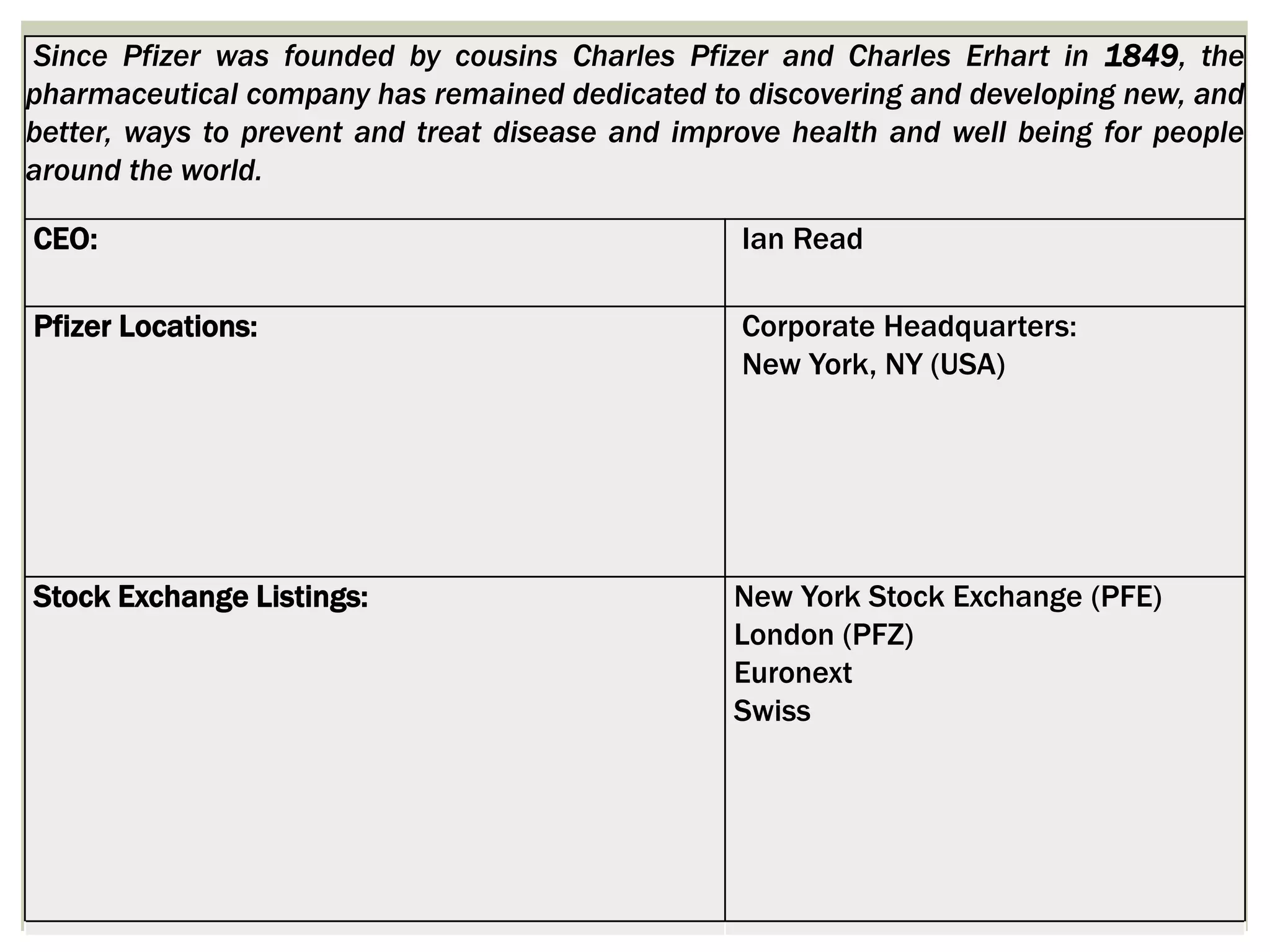
Since Pfizer was founded by cousins Charles Pfizer and Charles Erhart in 1849, the 
pharmaceutical company has remained dedicated to discovering and developing new, and 
better, ways to prevent and treat disease and improve health and well being for people 
around the world. 
CEO: Ian Read 
Pfizer Locations: Corporate Headquarters: 
New York, NY (USA) 
Stock Exchange Listings: New York Stock Exchange (PFE) 
London (PFZ) 
Euronext 
Swiss
Key Pfizer Pharmaceutical Products: 
BeneFIX 
Bosulif 
Celebrex 
Chantix/Champix 
Detrol/Detrol LA 
Diflucan 
Duavee 
Eliquis 
Rare Disease: 
Elelyso 
Vyndaqel 
Norvasc 
Enbrel 
EpiPen 
Genotropin 
Inlyta 
Lipitor 
Lyrica 
Medrol 
Premarin 
Prevnar 
Pristiq 
Quillivant XR 
ReFacto AF/Xyntha 
Spiriva 
Sutent 
Vfend 
Viagra 
Xalatan/Xalacom 
Xalkori 
Xanax XR 
Xeljanz 
Zithromax/Zmax 
Zoloft 
Zyvox 
Products
Revenue, Net Income 
Millions of Dollars 2013 2012 2011 
REVENUE $ 51,584 54,657 $ 61,035 
NET INCOME $ 22,003 $ 14,570 $ 10,009 
Research and 
development 
expenses 
$ 6,678 $ 7,482 $ 8,681
REVENUE 
Total revenues were $51.6 billion in 2013, a 
decrease of 6% compared to 2012, Which 
reflects an operational decline of $1.9 billion, 
or 4%. Total revenues were $54.7 billion in 
2012, a decrease of 10% compared to 2011, 
which reflects an operational decline of $5.0 
billion, or 8%.
THE OPERATIONAL DECREASE WAS 
PRIMARILY THE RESULT OF: 
 The continued erosion of branded Lipitor (Cholesterol fighter) 
in the U.S. , developed Europe and cer tain other developed 
markets (approximately $1.7 bi l l ion); 
 The loss of exclusivity for Geodon in March 2012 in the U.S. 
(approximately $130 mi l l ion) ; 
 Other product losses of exclusivity (approximately $1.3 
bi l lion); 
 Decreased government purchases of the Prevnar family of 
products and Enbrel in cer tain emerging markets 
(approximately $160 mi llion) ; and lower revenues from 
generic atorvastatin (approximately $145 mi l l ion)
R&D EXPENSES 
 2013 v. 2012 : R&D expenses decreased 11% in 2013, compared 
to 2012, primarily due to: 
-- lower charges related to implementing cost -reduction and 
productivity initiatives. 
 2012 v. 2011: R&D expenses decreased 14% in 2012, compared 
to 2011, primarily due to: 
-- savings generated by the discontinuation of cer tain therapeutic 
areas and R&D programs in connection with their previously 
announced cost -reduction and productivity initiatives.
SUN PHARMA 
 I t was establ ished in 1983. 
 Headquar ters are in Mumbai , Maharasht ra. 
 I t was l isted on the stock exchange in 1994. 
 Chai rman is Israel Makov. 
 25 manufacturing faci l i ties in 4 count r ies. 
 I t ’ s ma j o r a c q u i s i t i o n s l i k e Ta r o , U R L Pharma and Mi lmet , Able and 
many more. 
 2014- Acqui red Ranbaxy for 4bi l l ion$.
 Sun Pharma to sustain its ranking as the 5th largest 
global specialty generic pharma company 
 No. 1 pharma company in India 
 No. 1 by prescriptions in 13 specialty segments, Strong 
OTC business with trusted brands 
 No. 1 Indian pharma company in US market. 
 More than 75% of its sales from international markets.
REVENUE COMPOSITION 
Gross Annual Sales (Rs 161,995 million ) 
US Formulations ( 60% 
) 
International Generics ( 
38% ) 
API's ( 11% ) 
India Branded Generics 
( 23% )
NET SALES 
 Rs Crores 
2010- 
2011 
5723 
2011-12 8006 
2012- 13 11239 
2013-14 16004
NET PROFIT 
 Rs Crores 
2010-11 1816 
2011-12 2587 
2012-13 2983 
2013-14 3204
Thank you 
!

Pharmaceutical Industry Global & Indian

  • 1.
    PHARMACEUTICAL INDUSTRY BY PRATEEK GUPTA (33) Sathish Kumar (46)
  • 2.
    PHARMACEUTICAL INDUSTRY The pharmaceutical industry develops, produces, and markets drugs or pharmaceuticals licensed for use as medication .
  • 3.
    GLOBAL PHARMACEUTICAL MARKET 600 580 750 710 670 790 959 940 900 880 IN US BILLION $ 0 200 400 600 800 1000 1200 2012 2011 2010 2009 2008 2007 2006 2005 2004 2003 Pharma Sales Pharma Sales Source of Data By Deloitte
  • 4.
    Globally region wiseSales 959 US BILLION$ 2012-2013 America Europe Australia, Asia and Africa Japan 45.36 12.02 18.26 24.36 Source of Data By Deloitte
  • 5.
    MAJOR PLAYERS OFTHE WORLD 1. Johnson & Johnson 2. Pfizer 3. Roche 4. GlaxoSmithKline 5. Novartis 6. Sanofi 7. AstraZeneca 8. Abbott Laboratories 9. Merck & Co. 10.Bayer HealthCare
  • 6.
    MAIN TRENDS The research based pharmaceutical industry is playing a major role in reviving Europe’s economy.  There is rapid growth in market and research environment in the emerging economies such as brazil, china and India.  In 2012 Nor th America accounted for 41.0% of world pharmaceutical sales compared with 26.7% for Europe.
  • 7.
    PHARMACEUTICAL R&D EXPENDITUREIN EUROPE, USA AND JAPAN (MILLION OF NATIONAL CURRENCY UNITS*) , 1990-2012
  • 8.
    PHARMACEUTICAL RESEARCH INEUROPE  The cost of developing a new chemical was estimated at 1172 million pounds.  On average, only one to two of every 10,000 substances produced in laboratories will successfully pass all stages of development process required to become a marketable medicine.
  • 9.
    PHASES OF RESEARCHAND DEVELOPMENT
  • 10.
    NUMBER OF NEWCHEMICALS(1993- 2012)
  • 11.
    IMPORTANCE OF RESEARCHAND DEVELOPMENT.  In 2011 the pharmaceutical industry in Europe invested about € 29,200Million in R&D.  Facing increased competition from emerging economies like India Brazil and China.  The change of focus towards emerging economies.  According to EUROSTAT data pharmaceutical sector is the sector contributing huge amount of money to R&D.
  • 12.
    PRICE STRUCTURE Distribution margins, are general ly fixed by governments, and VAT rates vary from country to country in Europe  On average, approximately 35% of the retai l price of a medicine goes not to the manufacturer, but rather to the distributors (pharmacists and wholesalers) and state  Breakdown of the retai l price of a medicine in 2011 (%) .
  • 13.
    GENERICS  Itis usually produced by manufacturer not by inventor.  Marketed according to Intellectual Proper ty Rights.  The market share is higher in European union.
  • 14.
    EXPORTS, IMPORTS ANDTRADE BALANCE
  • 15.
    ADDED VALUES OFMEDICINES IN HEALTH CARE  On average, 16.6% of total health expenditure in Europe being spent on pharmaceuticals and other medical nondurables.  In costly diseases such as cancer and rheumatoid, ar thritis, medicines account for even less than 10% of the total disease costs.
  • 16.
    INDIAN PHARMA INDUSTRY Sources: http://www.ibef.org/industry/pharmaceutical-india.aspx
  • 18.
    PHARMA MANUFACTURING &PATENTS  India is home to 10,500 manufacturing units and over 3,000 pharma companies.  India accounts for 36.9 per cent (3,411) of the 9,296 Drug Master Files (DMFs) filed with the USA, which is the highest outside of the USA (as on December 31, 2013).  Higher spending on R&D, owing to products patents have made India a major destination for generic drug manufacturing.
  • 19.
    MARKET SIZE From a market size of US$ 12.6 bi l l ion in 2009, the Indian pharmaceutical market wi l l grow to US$ 55 bi l l ion by 2020, with the potential to reach US$ 70 bi l lion in an aggressive growth scenario. In a pessimistic scenario characterized by regulatory controls and economic slowdown, the market wi l l be depressed but is sti l l expected to reach US$ 35 bi l l ion.  India currently expor ts drug intermediates, Active Pharmaceutical Ingredients (APIs) , Finished Dosage Formulations (FDFs) , Bio-Pharmaceuticals, and Cl inical Services across the globe.
  • 20.
     As per'Pharma Vision 2020' , the Government of India aims to make India a global leader in end-to-end drug manufacturing.  Manufacturing costs in India are approximately 35-40 per cent of those in the US due to low installation and manufacturing costs.  Indian vaccines are expor ted to 150 countries.  The projected human resource requirement in the Indian pharma sector is estimated to be about 21,50,000 by 2020
  • 21.
    ROAD AHEAD The growth in Indian domestic market wi l l be boosted by increasing consumer spending, rapid urbanization, increasing healthcare insurance and so on.  The l ifestyle segments such as cardiovascular, anti -diabetes, anti -depressants and anti -cancers wi l l continue to be lucrative and fast growing owing to increased urbanization and change in l i festyle patterns.  For the US market, Indian companies are developing niche por tfol ios in various segments. High margin injectables, dermatology, respiratory, biogenerics, complex generics, etc. , have become areas of interest.
  • 22.
    ADVANTAGES  Dueto a genetically diverse population and availability of ski l led doctors, India has the potential to attract huge investments to its cl inical trial market.  Demand for generic medicines in rural markets has seen a sharp growth. Various companies are investing in the distribution network in rural areas.  Growing demand could open up the market for production of high-end drugs in India.  The domestic pharma sector is witnessing strong growth due to higher penetration in tier - I I and tier - I I I cities and greater focus on the largely - untapped rural market.
  • 23.
     India isone of the fastest -growing pharmaceutical markets in the world and has established itself as a global manufacturing and research hub. A large raw material base and the avai lability of a ski l led workforce gives the industry a definite competitive advantage.  The rise of pharmaceutical outsourcing and investments by multinational companies (MNCs), al l ied with the country's growing economy, committed health insurance segment and improved healthcare faci l ities, is expected to drive the market's growth.  I n d i a ’ s c o s t o f p ro d u c t io n i s s i g n i fican t ly l owe r t h a n t h a t o f the USA and almost hal f of that of Europe.
  • 24.
    GOVERNMENT SUPPORT The Government of India plans to set up a US$ 640 mi l l ion venture capital fund to boost drug discovery and strengthen pharma infrastructure. Government expenditure on health has increased from US$ 14 bi l lion in 2008 to US$ 23 bi l l ion in 2011.  FDI in India al lowed upto 100% on pharma industry.  Al location of INR 5000 Mi l l ion to set up four more institutions of the stature of AI IMS in Andhra Pradesh, West Bengal, Maharashtra and U.P.  Ful l exemption from excise duty is being provided for HIV/AIDS drugs and diagnostic kits.
  • 25.
    OPPORTUNITY FOR FUTURE  Sites that al low onl ine ordering and del ivery of prescriptions.  Manufacturer sponsored sites to access rel iable health care information.  Apps that remind patients to take medicine, schedule fol low up doctors visits.  Apps for patients to use as tools to monitor their health.  Customized interactive platforms with a focus on doctor engagement for sales reps to uti l ize during of fice visits.
  • 27.
    Since Pfizer wasfounded by cousins Charles Pfizer and Charles Erhart in 1849, the pharmaceutical company has remained dedicated to discovering and developing new, and better, ways to prevent and treat disease and improve health and well being for people around the world. CEO: Ian Read Pfizer Locations: Corporate Headquarters: New York, NY (USA) Stock Exchange Listings: New York Stock Exchange (PFE) London (PFZ) Euronext Swiss
  • 28.
    Key Pfizer PharmaceuticalProducts: BeneFIX Bosulif Celebrex Chantix/Champix Detrol/Detrol LA Diflucan Duavee Eliquis Rare Disease: Elelyso Vyndaqel Norvasc Enbrel EpiPen Genotropin Inlyta Lipitor Lyrica Medrol Premarin Prevnar Pristiq Quillivant XR ReFacto AF/Xyntha Spiriva Sutent Vfend Viagra Xalatan/Xalacom Xalkori Xanax XR Xeljanz Zithromax/Zmax Zoloft Zyvox Products
  • 29.
    Revenue, Net Income Millions of Dollars 2013 2012 2011 REVENUE $ 51,584 54,657 $ 61,035 NET INCOME $ 22,003 $ 14,570 $ 10,009 Research and development expenses $ 6,678 $ 7,482 $ 8,681
  • 30.
    REVENUE Total revenueswere $51.6 billion in 2013, a decrease of 6% compared to 2012, Which reflects an operational decline of $1.9 billion, or 4%. Total revenues were $54.7 billion in 2012, a decrease of 10% compared to 2011, which reflects an operational decline of $5.0 billion, or 8%.
  • 31.
    THE OPERATIONAL DECREASEWAS PRIMARILY THE RESULT OF:  The continued erosion of branded Lipitor (Cholesterol fighter) in the U.S. , developed Europe and cer tain other developed markets (approximately $1.7 bi l l ion);  The loss of exclusivity for Geodon in March 2012 in the U.S. (approximately $130 mi l l ion) ;  Other product losses of exclusivity (approximately $1.3 bi l lion);  Decreased government purchases of the Prevnar family of products and Enbrel in cer tain emerging markets (approximately $160 mi llion) ; and lower revenues from generic atorvastatin (approximately $145 mi l l ion)
  • 32.
    R&D EXPENSES 2013 v. 2012 : R&D expenses decreased 11% in 2013, compared to 2012, primarily due to: -- lower charges related to implementing cost -reduction and productivity initiatives.  2012 v. 2011: R&D expenses decreased 14% in 2012, compared to 2011, primarily due to: -- savings generated by the discontinuation of cer tain therapeutic areas and R&D programs in connection with their previously announced cost -reduction and productivity initiatives.
  • 34.
    SUN PHARMA I t was establ ished in 1983.  Headquar ters are in Mumbai , Maharasht ra.  I t was l isted on the stock exchange in 1994.  Chai rman is Israel Makov.  25 manufacturing faci l i ties in 4 count r ies.  I t ’ s ma j o r a c q u i s i t i o n s l i k e Ta r o , U R L Pharma and Mi lmet , Able and many more.  2014- Acqui red Ranbaxy for 4bi l l ion$.
  • 35.
     Sun Pharmato sustain its ranking as the 5th largest global specialty generic pharma company  No. 1 pharma company in India  No. 1 by prescriptions in 13 specialty segments, Strong OTC business with trusted brands  No. 1 Indian pharma company in US market.  More than 75% of its sales from international markets.
  • 36.
    REVENUE COMPOSITION GrossAnnual Sales (Rs 161,995 million ) US Formulations ( 60% ) International Generics ( 38% ) API's ( 11% ) India Branded Generics ( 23% )
  • 37.
    NET SALES Rs Crores 2010- 2011 5723 2011-12 8006 2012- 13 11239 2013-14 16004
  • 38.
    NET PROFIT Rs Crores 2010-11 1816 2011-12 2587 2012-13 2983 2013-14 3204
  • 39.