
Development of
Cold Chains in
India
Development of Cold
Chains in India
Prepared by:
M. Farhan Khan
Mohit Chaurasia
Sumanta Chatterjee
Vishu Vishal
S.P. JAIN INSTITUTE OF MANAGEMENT AND RESEARCH, MUMBAI
• What is Cold Chain Supply ?
• Current Status of Cold Chain in India
• Industries using Cold Chains in India
• Trends in Food Consumption Patterns – Growing
Scope of Cold Chains
• Challenges & Issues for Cold Chain in India
• Key Issues with Cold Chain development in India
• Government Policies and Initiatives
• FDI in Cold Chains
• Recommendation
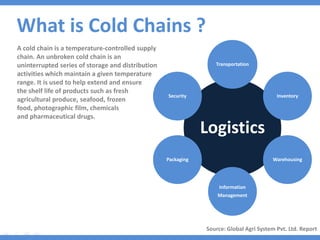
A cold chain is a temperature-controlled supply
chain. An unbroken cold chain is an
uninterrupted series of storage and distribution
activities which maintain a given temperature
range. It is used to help extend and ensure
the shelf life of products such as fresh
agricultural produce, seafood, frozen
food, photographic film, chemicals
and pharmaceutical drugs.
What is Cold Chains ?
Logistics
Transportation
Inventory
Warehousing
Information
Management
Packaging
Security
Source: Global Agri System Pvt. Ltd. Report
What is Cold Chain?
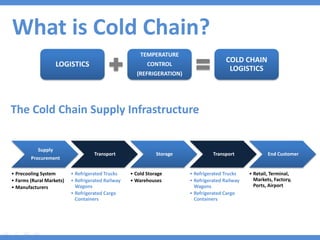
The Cold Chain Supply Infrastructure
Supply
Procurement
• Precooling System
• Farms (Rural Markets)
• Manufacturers
Transport
• Refrigerated Trucks
• Refrigerated Railway
Wagons
• Refrigerated Cargo
Containers
Storage
• Cold Storage
• Warehouses
Transport
• Refrigerated Trucks
• Refrigerated Railway
Wagons
• Refrigerated Cargo
Containers
End Customer
• Retail, Terminal,
Markets, Factory,
Ports, Airport
LOGISTICS
TEMPERATURE
CONTROL
(REFRIGERATION)
COLD CHAIN
LOGISTICS
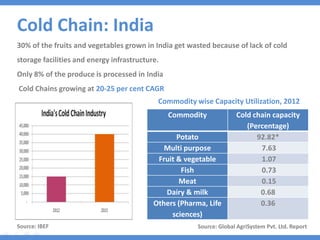
30% of the fruits and vegetables grown in India get wasted because of lack of cold
storage facilities and energy infrastructure.
Only 8% of the produce is processed in India
Cold Chains growing at 20-25 per cent CAGR
Source: IBEF
Commodity Cold chain capacity
(Percentage)
Potato 92.82*
Multi purpose 7.63
Fruit & vegetable 1.07
Fish 0.73
Meat 0.15
Dairy & milk 0.68
Others (Pharma, Life
sciences)
0.36
Cold Chain: India
Commodity wise Capacity Utilization, 2012
Source: Global AgriSystem Pvt. Ltd. Report
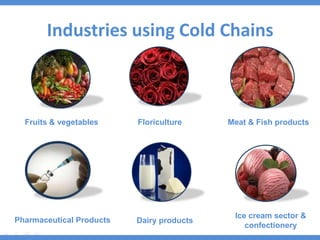
Industries using Cold Chains
Fruits & vegetables
Ice cream sector &
confectionery
Dairy products
Meat & Fish productsFloriculture
Pharmaceutical Products
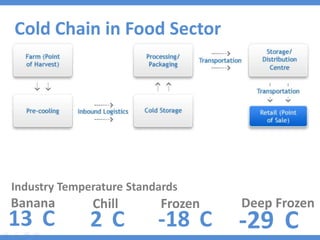
Cold Chain in Food Sector
Industry Temperature Standards
Banana
13 C
Chill
2 C
Frozen
-18 C
Deep Frozen
-29 C
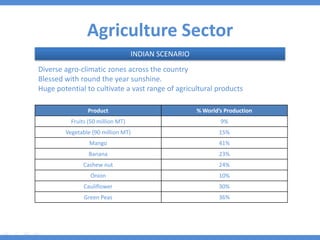
Agriculture Sector
Product % World’s Production
Fruits (50 million MT) 9%
Vegetable (90 million MT) 15%
Mango 41%
Banana 23%
Cashew nut 24%
Onion 10%
Cauliflower 30%
Green Peas 36%
Diverse agro-climatic zones across the country
Blessed with round the year sunshine.
Huge potential to cultivate a vast range of agricultural products
INDIAN SCENARIO
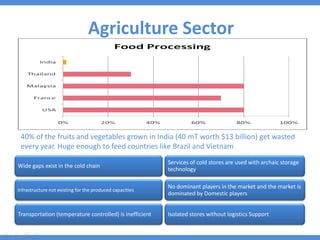
Agriculture Sector
40% of the fruits and vegetables grown in India (40 mT worth $13 billion) get wasted
every year. Huge enough to feed countries like Brazil and Vietnam
Wide gaps exist in the cold chain
Infrastructure not existing for the produced capacities
Transportation (temperature controlled) is inefficient
Services of cold stores are used with archaic storage
technology
No dominant players in the market and the market is
dominated by Domestic players
Isolated stores without logistics Support
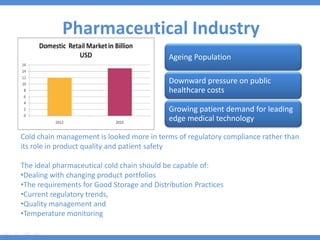
Pharmaceutical Industry
Cold chain management is looked more in terms of regulatory compliance rather than
its role in product quality and patient safety
The ideal pharmaceutical cold chain should be capable of:
•Dealing with changing product portfolios
•The requirements for Good Storage and Distribution Practices
•Current regulatory trends,
•Quality management and
•Temperature monitoring
Ageing Population
Downward pressure on public
healthcare costs
Growing patient demand for leading
edge medical technology
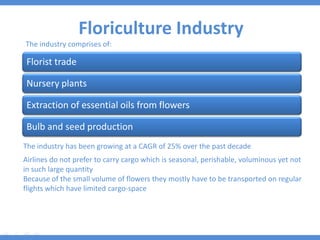
Floriculture Industry
Airlines do not prefer to carry cargo which is seasonal, perishable, voluminous yet not
in such large quantity
Because of the small volume of flowers they mostly have to be transported on regular
flights which have limited cargo-space
Florist trade
Nursery plants
Extraction of essential oils from flowers
Bulb and seed production
The industry has been growing at a CAGR of 25% over the past decade
The industry comprises of:
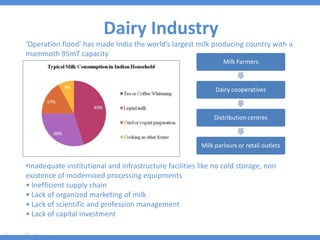
Dairy Industry
‘Operation flood’ has made India the world’s largest milk producing country with a
mammoth 95mT capacity
Milk Farmers
Dairy cooperatives
Distribution centres
Milk parlours or retail outlets
•Inadequate institutional and infrastructure facilities like no cold storage, non
existence of modernized processing equipments
• Inefficient supply chain
• Lack of organized marketing of milk
• Lack of scientific and profession management
• Lack of capital investment
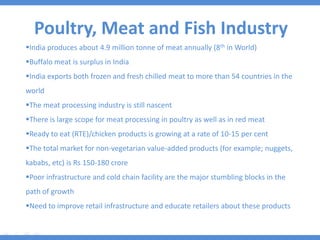
Poultry, Meat and Fish Industry
India produces about 4.9 million tonne of meat annually (8th in World)
Buffalo meat is surplus in India
India exports both frozen and fresh chilled meat to more than 54 countries in the
world
The meat processing industry is still nascent
There is large scope for meat processing in poultry as well as in red meat
Ready to eat (RTE)/chicken products is growing at a rate of 10-15 per cent
The total market for non-vegetarian value-added products (for example; nuggets,
kababs, etc) is Rs 150-180 crore
Poor infrastructure and cold chain facility are the major stumbling blocks in the
path of growth
Need to improve retail infrastructure and educate retailers about these products
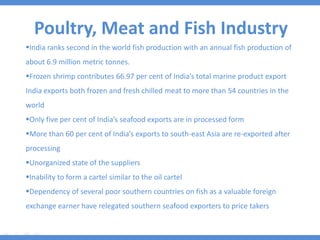
Poultry, Meat and Fish Industry
India ranks second in the world fish production with an annual fish production of
about 6.9 million metric tonnes.
Frozen shrimp contributes 66.97 per cent of India’s total marine product export
India exports both frozen and fresh chilled meat to more than 54 countries in the
world
Only five per cent of India’s seafood exports are in processed form
More than 60 per cent of India’s exports to south-east Asia are re-exported after
processing
Unorganized state of the suppliers
Inability to form a cartel similar to the oil cartel
Dependency of several poor southern countries on fish as a valuable foreign
exchange earner have relegated southern seafood exporters to price takers
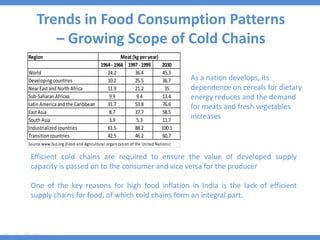
Trends in Food Consumption Patterns
– Growing Scope of Cold Chains
Region
1964- 1966 1997- 1999 2030
World 24.2 36.4 45.3
Developing countries 10.2 25.5 36.7
Near East and North Africa 11.9 21.2 35
Sub-Saharan Africaa 9.9 9.4 13.4
Latin America and the Caribbean 31.7 53.8 76.6
East Asia 8.7 37.7 58.5
South Asia 3.9 5.3 11.7
Industrialized countries 61.5 88.2 100.1
Transition countries 42.5 46.2 60.7
Source:www.fao.org (Food and Agricultural organization of the United Nations)
Meat (kg peryear)
As a nation develops, its
dependence on cereals for dietary
energy reduces and the demand
for meats and fresh vegetables
increases
Efficient cold chains are required to ensure the value of developed supply
capacity is passed on to the consumer and vice versa for the producer
One of the key reasons for high food inflation in India is the lack of efficient
supply chains for food, of which cold chains form an integral part.
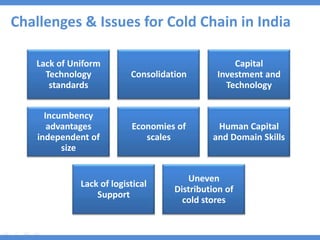
Challenges & Issues for Cold Chain in India
Lack of Uniform
Technology
standards
Consolidation
Capital
Investment and
Technology
Incumbency
advantages
independent of
size
Economies of
scales
Human Capital
and Domain Skills
Lack of logistical
Support
Uneven
Distribution of
cold stores
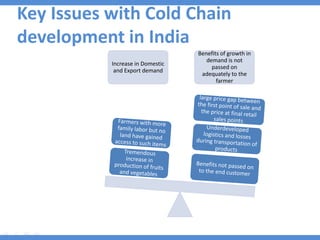
Key Issues with Cold Chain
development in India
Increase in Domestic
and Export demand
Benefits of growth in
demand is not
passed on
adequately to the
farmer
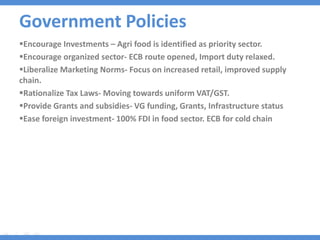
Government Policies
Encourage Investments – Agri food is identified as priority sector.
Encourage organized sector- ECB route opened, Import duty relaxed.
Liberalize Marketing Norms- Focus on increased retail, improved supply
chain.
Rationalize Tax Laws- Moving towards uniform VAT/GST.
Provide Grants and subsidies- VG funding, Grants, Infrastructure status
Ease foreign investment- 100% FDI in food sector. ECB for cold chain
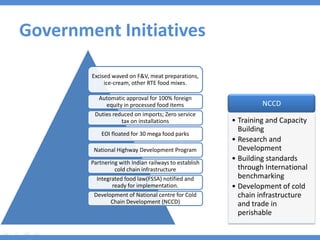
Government Initiatives
Excised waved on F&V, meat preparations,
ice-cream, other RTE food mixes.
Automatic approval for 100% foreign
equity in processed food items
Duties reduced on imports; Zero service
tax on installations
EOI floated for 30 mega food parks
National Highway Development Program
Partnering with Indian railways to establish
cold chain infrastructure
Integrated food law(FSSA) notified and
ready for implementation.
Development of National centre for Cold
Chain Development (NCCD)
NCCD
• Training and Capacity
Building
• Research and
Development
• Building standards
through International
benchmarking
• Development of cold
chain infrastructure
and trade in
perishable
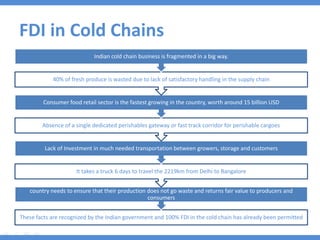
FDI in Cold Chains
These facts are recognized by the Indian government and 100% FDI in the cold chain has already been permitted
country needs to ensure that their production does not go waste and returns fair value to producers and
consumers
It takes a truck 6 days to travel the 2219km from Delhi to Bangalore
Lack of Investment in much needed transportation between growers, storage and customers
Absence of a single dedicated perishables gateway or fast track corridor for perishable cargoes
Consumer food retail sector is the fastest growing in the country, worth around 15 billion USD
40% of fresh produce is wasted due to lack of satisfactory handling in the supply chain
Indian cold chain business is fragmented in a big way.
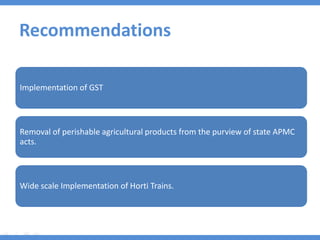
Recommendations
Implementation of GST
Removal of perishable agricultural products from the purview of state APMC
acts.
Wide scale Implementation of Horti Trains.
Thank You

Development of Cold Chain Supply in India

  • 1.
  • 2.
    Development of Cold Chainsin India Prepared by: M. Farhan Khan Mohit Chaurasia Sumanta Chatterjee Vishu Vishal S.P. JAIN INSTITUTE OF MANAGEMENT AND RESEARCH, MUMBAI
  • 3.
    • What isCold Chain Supply ? • Current Status of Cold Chain in India • Industries using Cold Chains in India • Trends in Food Consumption Patterns – Growing Scope of Cold Chains • Challenges & Issues for Cold Chain in India • Key Issues with Cold Chain development in India • Government Policies and Initiatives • FDI in Cold Chains • Recommendation
  • 4.
    A cold chainis a temperature-controlled supply chain. An unbroken cold chain is an uninterrupted series of storage and distribution activities which maintain a given temperature range. It is used to help extend and ensure the shelf life of products such as fresh agricultural produce, seafood, frozen food, photographic film, chemicals and pharmaceutical drugs. What is Cold Chains ? Logistics Transportation Inventory Warehousing Information Management Packaging Security Source: Global Agri System Pvt. Ltd. Report
  • 5.
    What is ColdChain? The Cold Chain Supply Infrastructure Supply Procurement • Precooling System • Farms (Rural Markets) • Manufacturers Transport • Refrigerated Trucks • Refrigerated Railway Wagons • Refrigerated Cargo Containers Storage • Cold Storage • Warehouses Transport • Refrigerated Trucks • Refrigerated Railway Wagons • Refrigerated Cargo Containers End Customer • Retail, Terminal, Markets, Factory, Ports, Airport LOGISTICS TEMPERATURE CONTROL (REFRIGERATION) COLD CHAIN LOGISTICS
  • 6.
    30% of thefruits and vegetables grown in India get wasted because of lack of cold storage facilities and energy infrastructure. Only 8% of the produce is processed in India Cold Chains growing at 20-25 per cent CAGR Source: IBEF Commodity Cold chain capacity (Percentage) Potato 92.82* Multi purpose 7.63 Fruit & vegetable 1.07 Fish 0.73 Meat 0.15 Dairy & milk 0.68 Others (Pharma, Life sciences) 0.36 Cold Chain: India Commodity wise Capacity Utilization, 2012 Source: Global AgriSystem Pvt. Ltd. Report
  • 7.
    Industries using ColdChains Fruits & vegetables Ice cream sector & confectionery Dairy products Meat & Fish productsFloriculture Pharmaceutical Products
  • 8.
    Cold Chain inFood Sector Industry Temperature Standards Banana 13 C Chill 2 C Frozen -18 C Deep Frozen -29 C
  • 9.
    Agriculture Sector Product %World’s Production Fruits (50 million MT) 9% Vegetable (90 million MT) 15% Mango 41% Banana 23% Cashew nut 24% Onion 10% Cauliflower 30% Green Peas 36% Diverse agro-climatic zones across the country Blessed with round the year sunshine. Huge potential to cultivate a vast range of agricultural products INDIAN SCENARIO
  • 10.
    Agriculture Sector 40% ofthe fruits and vegetables grown in India (40 mT worth $13 billion) get wasted every year. Huge enough to feed countries like Brazil and Vietnam Wide gaps exist in the cold chain Infrastructure not existing for the produced capacities Transportation (temperature controlled) is inefficient Services of cold stores are used with archaic storage technology No dominant players in the market and the market is dominated by Domestic players Isolated stores without logistics Support
  • 11.
    Pharmaceutical Industry Cold chainmanagement is looked more in terms of regulatory compliance rather than its role in product quality and patient safety The ideal pharmaceutical cold chain should be capable of: •Dealing with changing product portfolios •The requirements for Good Storage and Distribution Practices •Current regulatory trends, •Quality management and •Temperature monitoring Ageing Population Downward pressure on public healthcare costs Growing patient demand for leading edge medical technology
  • 12.
    Floriculture Industry Airlines donot prefer to carry cargo which is seasonal, perishable, voluminous yet not in such large quantity Because of the small volume of flowers they mostly have to be transported on regular flights which have limited cargo-space Florist trade Nursery plants Extraction of essential oils from flowers Bulb and seed production The industry has been growing at a CAGR of 25% over the past decade The industry comprises of:
  • 13.
    Dairy Industry ‘Operation flood’has made India the world’s largest milk producing country with a mammoth 95mT capacity Milk Farmers Dairy cooperatives Distribution centres Milk parlours or retail outlets •Inadequate institutional and infrastructure facilities like no cold storage, non existence of modernized processing equipments • Inefficient supply chain • Lack of organized marketing of milk • Lack of scientific and profession management • Lack of capital investment
  • 14.
    Poultry, Meat andFish Industry India produces about 4.9 million tonne of meat annually (8th in World) Buffalo meat is surplus in India India exports both frozen and fresh chilled meat to more than 54 countries in the world The meat processing industry is still nascent There is large scope for meat processing in poultry as well as in red meat Ready to eat (RTE)/chicken products is growing at a rate of 10-15 per cent The total market for non-vegetarian value-added products (for example; nuggets, kababs, etc) is Rs 150-180 crore Poor infrastructure and cold chain facility are the major stumbling blocks in the path of growth Need to improve retail infrastructure and educate retailers about these products
  • 15.
    Poultry, Meat andFish Industry India ranks second in the world fish production with an annual fish production of about 6.9 million metric tonnes. Frozen shrimp contributes 66.97 per cent of India’s total marine product export India exports both frozen and fresh chilled meat to more than 54 countries in the world Only five per cent of India’s seafood exports are in processed form More than 60 per cent of India’s exports to south-east Asia are re-exported after processing Unorganized state of the suppliers Inability to form a cartel similar to the oil cartel Dependency of several poor southern countries on fish as a valuable foreign exchange earner have relegated southern seafood exporters to price takers
  • 16.
    Trends in FoodConsumption Patterns – Growing Scope of Cold Chains Region 1964- 1966 1997- 1999 2030 World 24.2 36.4 45.3 Developing countries 10.2 25.5 36.7 Near East and North Africa 11.9 21.2 35 Sub-Saharan Africaa 9.9 9.4 13.4 Latin America and the Caribbean 31.7 53.8 76.6 East Asia 8.7 37.7 58.5 South Asia 3.9 5.3 11.7 Industrialized countries 61.5 88.2 100.1 Transition countries 42.5 46.2 60.7 Source:www.fao.org (Food and Agricultural organization of the United Nations) Meat (kg peryear) As a nation develops, its dependence on cereals for dietary energy reduces and the demand for meats and fresh vegetables increases Efficient cold chains are required to ensure the value of developed supply capacity is passed on to the consumer and vice versa for the producer One of the key reasons for high food inflation in India is the lack of efficient supply chains for food, of which cold chains form an integral part.
  • 17.
    Challenges & Issuesfor Cold Chain in India Lack of Uniform Technology standards Consolidation Capital Investment and Technology Incumbency advantages independent of size Economies of scales Human Capital and Domain Skills Lack of logistical Support Uneven Distribution of cold stores
  • 18.
    Key Issues withCold Chain development in India Increase in Domestic and Export demand Benefits of growth in demand is not passed on adequately to the farmer
  • 19.
    Government Policies Encourage Investments– Agri food is identified as priority sector. Encourage organized sector- ECB route opened, Import duty relaxed. Liberalize Marketing Norms- Focus on increased retail, improved supply chain. Rationalize Tax Laws- Moving towards uniform VAT/GST. Provide Grants and subsidies- VG funding, Grants, Infrastructure status Ease foreign investment- 100% FDI in food sector. ECB for cold chain
  • 20.
    Government Initiatives Excised wavedon F&V, meat preparations, ice-cream, other RTE food mixes. Automatic approval for 100% foreign equity in processed food items Duties reduced on imports; Zero service tax on installations EOI floated for 30 mega food parks National Highway Development Program Partnering with Indian railways to establish cold chain infrastructure Integrated food law(FSSA) notified and ready for implementation. Development of National centre for Cold Chain Development (NCCD) NCCD • Training and Capacity Building • Research and Development • Building standards through International benchmarking • Development of cold chain infrastructure and trade in perishable
  • 21.
    FDI in ColdChains These facts are recognized by the Indian government and 100% FDI in the cold chain has already been permitted country needs to ensure that their production does not go waste and returns fair value to producers and consumers It takes a truck 6 days to travel the 2219km from Delhi to Bangalore Lack of Investment in much needed transportation between growers, storage and customers Absence of a single dedicated perishables gateway or fast track corridor for perishable cargoes Consumer food retail sector is the fastest growing in the country, worth around 15 billion USD 40% of fresh produce is wasted due to lack of satisfactory handling in the supply chain Indian cold chain business is fragmented in a big way.
  • 22.
    Recommendations Implementation of GST Removalof perishable agricultural products from the purview of state APMC acts. Wide scale Implementation of Horti Trains.
  • 23.

Editor's Notes

  • #2 title
  • #4 Content of what all we are going to present
  • #5 What is logistics and then coming down to cold chain logistics.