PETROLEUM
AN OVERVIEW OF THE SEGMENT PRESENTED BY
GROUP-3
MUNCH ON TO SOME INFORMATION: THE ALKANES, ALSO KNOWN AS PARAFFINS, ARE SATURATED HYDROCARBONS
WITH STRAIGHT OR BRANCHED CHAINS WHICH CONTAIN ONLY CARBON AND HYDROGEN AND HAVE THE
GENERAL FORMULA CNH2N+2. THEY GENERALLY HAVE FROM 5 TO 40 CARBON ATOMS PER MOLECULE, ALTHOUGH TRACE
AMOUNTS OF SHORTER OR LONGER MOLECULES MAY BE PRESENT IN THE MIXTURE.
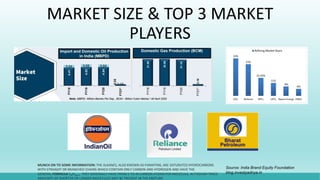
MARKET SIZE & TOP 3 MARKET
PLAYERS
Source: India Brand Equity Foundation
blog.investyadnya.in
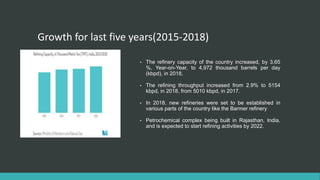
Growth for last five years(2015-2018)
• The refinery capacity of the country increased, by 3.65
%, Year-on-Year, to 4,972 thousand barrels per day
(kbpd), in 2018,
• The refining throughput increased from 2.9% to 5154
kbpd, in 2018, from 5010 kbpd, in 2017.
• In 2018, new refineries were set to be established in
various parts of the country like the Barmer refinery
• Petrochemical complex being built in Rajasthan, India,
and is expected to start refining activities by 2022.
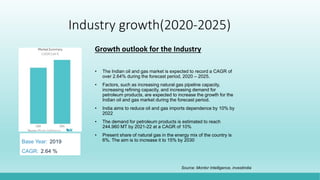
Industry growth(2020-2025)
Growth outlook for the Industry
• The Indian oil and gas market is expected to record a CAGR of
over 2.64% during the forecast period, 2020 – 2025.
• Factors, such as increasing natural gas pipeline capacity,
increasing refining capacity, and increasing demand for
petroleum products, are expected to increase the growth for the
Indian oil and gas market during the forecast period.
• India aims to reduce oil and gas imports dependence by 10% by
2022
• The demand for petroleum products is estimated to reach
244.960 MT by 2021-22 at a CAGR of 10%
• Present share of natural gas in the energy mix of the country is
6%. The aim is to increase it to 15% by 2030
Source: Mordor Intelligence, investindia
Base Year: 2019
CAGR: 2.64 %
Indian Oil Corporation Ltd.
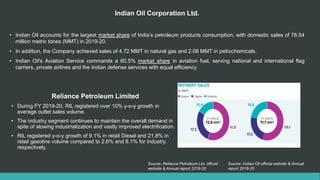
• Indian Oil accounts for the largest market share of India’s petroleum products consumption, with domestic sales of 78.54
million metric tones (MMT) in 2019-20.
• In addition, the Company achieved sales of 4.72 MMT in natural gas and 2.08 MMT in petrochemicals.
• Indian Oil's Aviation Service commands a 60.5% market share in aviation fuel, serving national and international flag
carriers, private airlines and the Indian defense services with equal efficiency.
Reliance Petroleum Limited
• During FY 2019-20, RIL registered over 10% y-o-y growth in
average outlet sales volume.
• The industry segment continues to maintain the overall demand in
spite of slowing industrialization and vastly improved electrification.
• RIL registered y-o-y growth of 9.1% in retail Diesel and 21.8% in
retail gasoline volume compared to 2.6% and 8.1% for industry,
respectively.
Source: Reliance Petroleum Ltd. official
website & Annual report 2019-20
Source: Indian Oil official website & Annual
report 2019-20
BHARAT PETROLEUM
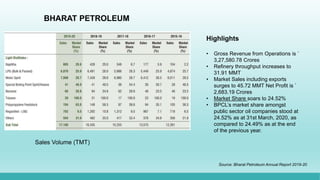
Sales Volume (TMT)
Highlights
• Gross Revenue from Operations is `
3,27,580.78 Crores
• Refinery throughput increases to
31.91 MMT
• Market Sales including exports
surges to 45.72 MMT Net Profit is `
2,683.19 Crores
• Market Share soars to 24.52%
• BPCL’s market share amongst
public sector oil companies stood at
24.52% as at 31st March, 2020, as
compared to 24.49% as at the end
of the previous year.
Source: Bharat Petroleum Annual Report 2019-20
PESTEL ANALYSIS
PESTEL analysis provides great detail about operating challenges any oil & petroleum company will face in
prevalent macro environment other than competitive forces.
• POLITICAL ANALYSIS
Political factors play a significant role in analysing the
factors that can impact petroleum companies long term
profitability in a certain country or market.
 Political stability and significance of Oil & Gas sector in
the country's economy.
 Corruption level - especially regulatory factors in Oil &
Gas sector.
 Bureaucracy and government interference in Oil & Gas
industry
 Protection of Intellectual property rights
 Tariffs and Trade regulations related to Oil
& Gas
 Pricing regulations and regulatory
mechanism related to oil and gas
 Taxation - tax rates and incentives etc
ECONOMIC FACTORS
The Macro environment factors such as – inflation rate, savings rate, interest rate, foreign exchange rate
and economic cycle determine the demand , supply and investment level in the economy
• Government interference in the free market and related Oil & Gas
• Exchange rates & currency value stability of host country
• Efficiency of financial markets and it’s impact on pricing
• Infrastructure quality in Oil & Gas industry
• Skill level of human resources in Oil & Gas industry.
• Business cycle stage (e.g. prosperity, recession, recovery)
• Growth rate of the economy
• Unemployment rate
• Inflation and interest rate
SOCIAL FACTORS
Society’s culture and way of doing things significantly impact the culture of an organization in an
environment. Shared beliefs and attitude of the targeted population plays an important role to
understand the customer base.
 Demographics and skill level of the population in the economy
 Social Classes, hierarchy and power structure in the society.
 Education level as well as education standards in the Independent Oil & Gas industry in the
economy
 Dominant culture (gender roles, social conventions etc.)
 Entrepreneurial spirit and initiatives by the people of the society
• Attitudes (health, environmental consciousness, etc.)
TECHNOLOGICAL FACTORS
A firm should not only do technological analysis of the industry but should also analyze the
speed at which technology is disrupting that industry. Slow speed will give more time to adjust
while fast speed of technological disruption may give a firm little time to cope and be
profitable. Technology analysis involves understanding the following impacts
• Recent technological developments and related growth by Independent Oil & Gas
competitors
• Technology’s impact on product offering and after sale
• Impact on cost structure on new technology implementation in Oil & Gas industry
• Impact on value chain structure in this sector
• Rate of technological diffusion in the industry
ENVIRONMENTAL ANALYSIS
Different markets have different norms or environmental standards which can affect the profitability and growth of an
organization in those markets. Even within a country like India, often states can have different environmental laws and liability
laws. Some of the environmental factors that a firm should analyze and consider beforehand are as under:
 Weather and climate change
 Laws regulating environment pollution and sustainability
 Air and water pollution related regulations in Oil & Gas industry
 Recycling and waste management in Oil & Gas sector
 Attitudes toward “green” or ecological products
 Endangered species
 Attitudes toward and support for renewable energy
LEGAL FACTORS
In number of countries, the legal framework and institutions are not robust enough to protect the
legality and property rights of an organization within the industry.
 Anti-trust law in Oil & Gas industry and in the country as a whole
 Copyright, patents / Intellectual property law
 Consumer protection and e-commerce legalities
 Employment related law
 Health and safety law
 Data Protection law
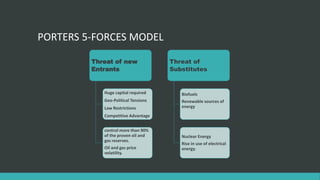
PORTERS 5-FORCES MODEL
Threat of new
Entrants
Huge capital required
Geo-Political Tensions
Law Restrictions
Competitive Advantage
National Oil Companies
control more than 90%
of the proven oil and
gas reserves.
Oil and gas price
volatility.
Threat of
Substitutes
Biofuels
Renewable sources of
energy
Nuclear Energy
Rise in use of electrical
energy.
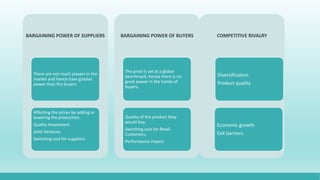
BARGAINING POWER OF SUPPLIERS
There are not much players in the
market and hence have greater
power than the buyers
Affecting the prices by adding or
lowering the production.
Quality Investment.
Joint Ventures.
Switching cost for suppliers
BARGAINING POWER OF BUYERS
The price is set at a global
benchmark, hence there is no
great power in the hands of
buyers.
Quality of the product they
would buy.
Switching cost for Retail
Customers.
Performance impact.
COMPETITIVE RIVALRY
Diversification
Product quality
Economic growth
Exit barriers.
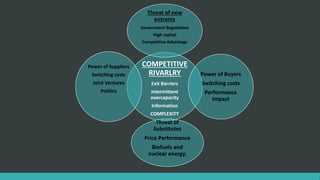
COMPETITIVE
RIVARLRY
Exit Barriers
Intermittent
overcapacity
Information
COMPLEXITY
Threat of new
entrants
Government Regulations
High capital
Competitive Advantage
Power of Buyers
Switching costs
Performance
impact
Threat of
Substitutes
Price Performance
Biofuels and
nuclear energy.
Power of Suppliers
Switching costs
Joint Ventures
Politics
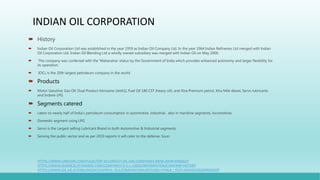
INDIAN OIL CORPORATION
 History
 Indian Oil Corporation Ltd was established in the year 1959 as Indian Oil Company Ltd. In the year 1964 Indian Refineries Ltd merged with Indian
Oil Corporation Ltd. Indian Oil Blending Ltd a wholly owned subsidiary was merged with Indian Oil on May 2006.
 The company was conferred with the 'Maharatna' status by the Government of India which provides enhanced autonomy and larger flexibility for
its operation.
 IOCL is the 20th largest petroleum company in the world.
 Products
 Motor Gasoline; Gas Oil; Dual Product Kerosene (JetA1); Fuel Oil 180 CST (heavy oil); and Xtra Premium petrol, Xtra Mile diesel, Servo lubricants
and Indane LPG.
 Segments catered
 caters to nearly half of India’s petroleum consumption in automotive, industrial , also in maritime segments, locomotives
 Domestic segment using LPG
 Servo is the Largest selling Lubricant Brand in both Automotive & Industrial segments.
 Serving the public sector and as per 2019 reports it will cater to the defense. Soon
HTTPS://WWW.LINKEDIN.COM/PULSE/TOP-10-LARGEST-OIL-GAS-COMPANIES-INDIA-JOHN-KINGSLEY
HTTPS://WWW.BUSINESS-STANDARD.COM/COMPANY/I-O-C-L-12002/INFORMATION/COMPANY-HISTORY
HTTPS://WWW.IDE.GO.JP/ENGLISH/DATA/AFRICA_FILE/COMPANY/MAURITIUS05.HTML#:~:TEXT=SERVICES%20AND%20P
RODUCTS,SERVO%20LUBRICANTS%20AND%20INDANE%20LPG
RELIANCE PETROLEUM LIMITED
• History
• in 1991,Indian The Comp. was incorporated under the name Reliance Refineries Private Limited on 3rd September, in the State of Maharashtra, Mumbai.
• 1993, The name of Comp. was changed from Reliance Refineries Pvt. Ltd., to Reliance Refineries Ltd on 6th March. And on 26th March, the name of the company
was changed from Reliance Refineries Ltd., to Reliance Petroleum Ltd. promoted by Reliance Industries Limited [RILs]
• Products
• Indian Liquefied Petroleum Gas (LPG)
• Propylene
• Naphtha
• Gasoline
• Jet /Aviation Turbine Fuel
• Superior Kerosene Oil
• High-Speed Diesel
• Sulphur
• Petroleum
• Segments catered
• Industrial and domestic segment, transportation segment in terms of fuels, pharmaceutical and fertilization, petrochemicals feedstock, aviation as well as power
plants and cement plants through coke
HTTPS://WWW.RIL.COM/OURBUSINESSES/PETROLEUMREFININGANDMARKETING.ASPXTER
HTTP://WWW.SOURCE2UPDATE.COM/COMPANY-HISTORY/RELIANCE-PETROLEUMOLD-RELPT.HTML
Major Segments & Rationale behind them
• Automotive-Regulation & distribution of petroleum in India, is altogether in the
hands of the government with few exception like Reliance and Essar. therefore
defining a segment leader would be insignificant.
• Aviation
• Locomotive
• Domestic
• Industrial
Due to the high Calorific Value of fossil fuels, Petroleum yields a good conversion
factor for the change of Chemical energy into Kinetic/Heat energy. In the post
Industrialisation era the demand for fuel to rum the machines led to a very
ubiquitous use of petroleum derived products as fuels.
Product line
• Motor gasoline(fuel)
- Diesel and petrol
• Aviation fuel
• Lubricants
• Liquefied Petroleum Gas
• Paraffin and Grease
• Fertilizers
• Kerosene
GENERIC STRATEGIES
COST LEADERSHIP
• INDIAN OIL CORPORATION LIMITED PROJECT MANTHAN uses a cost leadership
strategy
• The primary objective of using this strategy is to preserve the market leadership
position through efficient value chain management.
• This strategy allows INDIAN OIL CORPORATION LIMITED PROJECT MANTHAN to expand
the market share by targeting the. Middle class consumers generally place high
importance to the pricing factor and cost leadership is the best strategy to cater the
needs of this consumer segment.
• INDIAN OIL CORPORATION LIMITED PROJECT MANTHAN focuses on affordability and
easy accessibility of its produce.
WIKIPEDIA
HTTPS://WWW.LIVEMINT.COM/COMPANIES/NEWS/RELIANCE-INDUSTRIES-REGAINS-MARKET-SHARE-IN-PETROL-AND-DIESEL-SALES-
1556084379984.HTMLHTTPS://WWW.LIVEMINT.COM/COMPANIES/NEWS/RELIANCE-INDUSTRIES-REGAINS-MARKET-SHARE-IN-PETROL-AND-DIESEL-SALES-1556084379984.HTML
HTTPS://WWW.IBEF.ORG/INDUSTRY/INDIAN-OIL-AND-GAS-INDUSTRY-ANALYSIS-PRESENTATION
HTTPS://WWW.INVESTINDIA.GOV.IN/SECTOR/OIL-GAS
HTTPS://WWW.STATISTA.COM/TOPICS/5621/PETROLEUM-SECTOR-IN-INDIA/
• HTTPS://ECONOMICTIMES.INDIATIMES.COM/BPCL-UNVEILS-RETAIL-MARKETING-
STRATEGY/ARTICLESHOW/23261822.CMS?UTM_SOURCE=CONTENTOFINTEREST&UTM_MEDIUM=TEXT&UTM_CAMPAIGN=CPPST
DIFFERENTIATION STRATEGY
• The adoption of differentiation as a secondary generic strategy allows INDIAN OIL CORPORATION LIMITED PROJECT
MANTHAN to expand the customer base by emphasizing over the unique product features.
• INDIAN OIL CORPORATION LIMITED PROJECT MANTHAN has extended its product line after studying the
consumers’ changing interests to differentiate itself from competitors and expand the scope of opportunities
within the industry.
• In order to service rural customers, he said BPCL has introduced 20 rural LPG marketing vehicles which offer filling
facility near the customer location, thus saving the hassle of bringing back the five kg cylinders to the bottling
plants.
• Has an edge in creating superior offering to the customer (at their gas stations), which has formed the backbone
for its growth
IOCL
BPCL
Market leader : INDIAN OIL
• Largest & widest network of petrol& diesel stations in the country numbering over 17600
• Meeting the fuel needs of domestic & international flag carriers, private industry, Indian defense services
• Xtrapremium registered whopping 89% growth sales & emerge as country leader in petroleum segment
• Commands 62% market share in aviation fuel business
• Track strategic inititatives by supporting sales activities- network of 34000 sales points
• Assess IOC as prospective partner , vendor , supplier
• 166 bulk storage terminals & depots, 89 LPG bottling plant,101 aviation fuel stations
sources: https://ukdiss.com/examples/oil-industry.php
SOURCES : HTTPS://WWW.FINANCIALEXPRESS.COM/ARCHIVE/BPCL-OUTLINES-GROWTH-STRATEGY-TO-TAKE-ON-NEW-
PRIVATE-OIL-RETAILERS/90583/
Market challenger: BPCL
• Largest public sector undertaking in India with 50% govt shareholdings as well as leading forecourt retailer in India
• 400 of the outlets had an organized convenience store attached
• Planning to grow its non fuel retail business at its existing urban outlets as well as at highways
• In & out launched an e-traveller facility at its forecourt retail outlets
• BPCL also proposes to offer its own brand water bottles at outlets ,water will be a by product based on hydrogen fuel cell
technology
• Sales revenue of BPCL non fuel retail arm grew by 32% making it largest non fuel revenue generator in the oil industry
SOURCES: HTTPS://WWW.ESSAY48.COM/MARKETING-STRATEGY/13986-RELIANCE-INDUSTRIES-MARKETING-STRATEGY
Market follower: RELIANCE OIL
• RIL is India no 1 private sector in exploration & production player with 100000 sq km
• 14 exploration blocks & increase gas production by 3 times
• Largest single site refinery with robust configuration
• Maintaining high refinery utilization by delivering superior refining margins
• Lowest cost producer globally with flexible product slates
FACTORS INFLUENCING CONSUMER BEHVAIOUR
FOR LUBRICANTS & FUEL
• Price discounts, extra features , other extra benefits influences the buying behaviour for particular brand
• Choosing the fuel which has been recommended as excellent in terms of performance as opposed to the fuel that is
currently being used
• Facilities like air pressure check, number of pumps, petro card facility, ATM, parking area availability
• Assured quality, quantity ,efficient forecourt service ,electronic dispensing, cashless transactions, loyalty programs for
credit & cash customers
• Fuel must be environmental conscious & have high level of ethanol blends
COMPANIES IN DIFFERENT SEGMENTS
DOMESTIC LPG
The competition in LPG segment is mainly between 3 companies
IOCL No. of consumers - 123984322
HPCL No. of consumers - 73245146
BPCL No. of consumers – 68135757
IOCL has the majority in this sector clearly.
AVIATION
Bharat Petroleum and Shell are the leading companies globally
followed by HP and IOCL
01
02
HTTP://PETROLEUM.NIC.IN/MORE/INDIAN-PNG-STATISTICS
AUTOMOTIVE
IOCL, BPCL, HPCL – These 3 being the majority in this segment/
Quality of petrol is almost same because of the standards set
by oil ministry in India moreover, different companies get their
petrol from same company’s refinery so not much difference
in quality.
LOCOMOTIVE
IOCL, HPCL and BPCL are major suppliers of the fuel along with
Reliance Industries and Essar Oil.
03
04
HTTPS://WWW.FORTUNEBUSINESSINSIGHTS.COM/INDUSTRY-REPORTS/AVIATION-FUEL-MARKET-100427
MAJOR M&A IN PETROLEUM INDUSTRY
• IOCL and one of the oldest companies in oil and gas sector IBP(indo-Burma petroleum)
• The government after successfully merging fuel retailer HP with Oil and Natural Gas
Corporation (ONGC) in 2018 has become the promoter of the company.
• IOCL in collaboration with Ola launched the country's first electric charging station at its fuel
station at RBI Square Nagpur.
• IOCL merged with Skytanking GmbH, Germany to from IndianOil Skytanking Pvt. Ltd. To supply
fuels to aviation projects.
• Merger of RPL and RIL, on 1st of April, 2008 with a ration of 16:1 respectively
• Essar oil becomes Nayara Energy after take over by Rosneft, trafigura
• In 2018, ONGC acquired HPCL and is looking forward to merge its two refining subsidiaries
MRPL and HPCL in june 2021
• And IOCL to acquire major stakes of BPCL
HTTPS://IOCL.COM/ABOUTUS/GROUPCOMPANIES_JVS.ASPX ALL THESE REPORTS ARE VERIFIED FROM BUSINESS
STANDARDS REPORTS
WE ARE READY FOR QUESTION, IF ANY.
ISHIKA AGARWAL
JIGAR SHAH
KAUSHTUBH AGARWAL
PRIYAL MUNDRA
SAKSHI KUMARI
SHREYANKA MEHTA
SIMRAN KAUHSIK

Petroleum bsp presentation

  • 1.
    PETROLEUM AN OVERVIEW OFTHE SEGMENT PRESENTED BY GROUP-3
  • 2.
    MUNCH ON TOSOME INFORMATION: THE ALKANES, ALSO KNOWN AS PARAFFINS, ARE SATURATED HYDROCARBONS WITH STRAIGHT OR BRANCHED CHAINS WHICH CONTAIN ONLY CARBON AND HYDROGEN AND HAVE THE GENERAL FORMULA CNH2N+2. THEY GENERALLY HAVE FROM 5 TO 40 CARBON ATOMS PER MOLECULE, ALTHOUGH TRACE AMOUNTS OF SHORTER OR LONGER MOLECULES MAY BE PRESENT IN THE MIXTURE. MARKET SIZE & TOP 3 MARKET PLAYERS Source: India Brand Equity Foundation blog.investyadnya.in
  • 3.
    Growth for lastfive years(2015-2018) • The refinery capacity of the country increased, by 3.65 %, Year-on-Year, to 4,972 thousand barrels per day (kbpd), in 2018, • The refining throughput increased from 2.9% to 5154 kbpd, in 2018, from 5010 kbpd, in 2017. • In 2018, new refineries were set to be established in various parts of the country like the Barmer refinery • Petrochemical complex being built in Rajasthan, India, and is expected to start refining activities by 2022.
  • 4.
    Industry growth(2020-2025) Growth outlookfor the Industry • The Indian oil and gas market is expected to record a CAGR of over 2.64% during the forecast period, 2020 – 2025. • Factors, such as increasing natural gas pipeline capacity, increasing refining capacity, and increasing demand for petroleum products, are expected to increase the growth for the Indian oil and gas market during the forecast period. • India aims to reduce oil and gas imports dependence by 10% by 2022 • The demand for petroleum products is estimated to reach 244.960 MT by 2021-22 at a CAGR of 10% • Present share of natural gas in the energy mix of the country is 6%. The aim is to increase it to 15% by 2030 Source: Mordor Intelligence, investindia Base Year: 2019 CAGR: 2.64 %
  • 5.
    Indian Oil CorporationLtd. • Indian Oil accounts for the largest market share of India’s petroleum products consumption, with domestic sales of 78.54 million metric tones (MMT) in 2019-20. • In addition, the Company achieved sales of 4.72 MMT in natural gas and 2.08 MMT in petrochemicals. • Indian Oil's Aviation Service commands a 60.5% market share in aviation fuel, serving national and international flag carriers, private airlines and the Indian defense services with equal efficiency. Reliance Petroleum Limited • During FY 2019-20, RIL registered over 10% y-o-y growth in average outlet sales volume. • The industry segment continues to maintain the overall demand in spite of slowing industrialization and vastly improved electrification. • RIL registered y-o-y growth of 9.1% in retail Diesel and 21.8% in retail gasoline volume compared to 2.6% and 8.1% for industry, respectively. Source: Reliance Petroleum Ltd. official website & Annual report 2019-20 Source: Indian Oil official website & Annual report 2019-20
  • 6.
    BHARAT PETROLEUM Sales Volume(TMT) Highlights • Gross Revenue from Operations is ` 3,27,580.78 Crores • Refinery throughput increases to 31.91 MMT • Market Sales including exports surges to 45.72 MMT Net Profit is ` 2,683.19 Crores • Market Share soars to 24.52% • BPCL’s market share amongst public sector oil companies stood at 24.52% as at 31st March, 2020, as compared to 24.49% as at the end of the previous year. Source: Bharat Petroleum Annual Report 2019-20
  • 7.
    PESTEL ANALYSIS PESTEL analysisprovides great detail about operating challenges any oil & petroleum company will face in prevalent macro environment other than competitive forces. • POLITICAL ANALYSIS Political factors play a significant role in analysing the factors that can impact petroleum companies long term profitability in a certain country or market.  Political stability and significance of Oil & Gas sector in the country's economy.  Corruption level - especially regulatory factors in Oil & Gas sector.  Bureaucracy and government interference in Oil & Gas industry  Protection of Intellectual property rights  Tariffs and Trade regulations related to Oil & Gas  Pricing regulations and regulatory mechanism related to oil and gas  Taxation - tax rates and incentives etc
  • 8.
    ECONOMIC FACTORS The Macroenvironment factors such as – inflation rate, savings rate, interest rate, foreign exchange rate and economic cycle determine the demand , supply and investment level in the economy • Government interference in the free market and related Oil & Gas • Exchange rates & currency value stability of host country • Efficiency of financial markets and it’s impact on pricing • Infrastructure quality in Oil & Gas industry • Skill level of human resources in Oil & Gas industry. • Business cycle stage (e.g. prosperity, recession, recovery) • Growth rate of the economy • Unemployment rate • Inflation and interest rate
  • 9.
    SOCIAL FACTORS Society’s cultureand way of doing things significantly impact the culture of an organization in an environment. Shared beliefs and attitude of the targeted population plays an important role to understand the customer base.  Demographics and skill level of the population in the economy  Social Classes, hierarchy and power structure in the society.  Education level as well as education standards in the Independent Oil & Gas industry in the economy  Dominant culture (gender roles, social conventions etc.)  Entrepreneurial spirit and initiatives by the people of the society • Attitudes (health, environmental consciousness, etc.)
  • 10.
    TECHNOLOGICAL FACTORS A firmshould not only do technological analysis of the industry but should also analyze the speed at which technology is disrupting that industry. Slow speed will give more time to adjust while fast speed of technological disruption may give a firm little time to cope and be profitable. Technology analysis involves understanding the following impacts • Recent technological developments and related growth by Independent Oil & Gas competitors • Technology’s impact on product offering and after sale • Impact on cost structure on new technology implementation in Oil & Gas industry • Impact on value chain structure in this sector • Rate of technological diffusion in the industry
  • 11.
    ENVIRONMENTAL ANALYSIS Different marketshave different norms or environmental standards which can affect the profitability and growth of an organization in those markets. Even within a country like India, often states can have different environmental laws and liability laws. Some of the environmental factors that a firm should analyze and consider beforehand are as under:  Weather and climate change  Laws regulating environment pollution and sustainability  Air and water pollution related regulations in Oil & Gas industry  Recycling and waste management in Oil & Gas sector  Attitudes toward “green” or ecological products  Endangered species  Attitudes toward and support for renewable energy
  • 12.
    LEGAL FACTORS In numberof countries, the legal framework and institutions are not robust enough to protect the legality and property rights of an organization within the industry.  Anti-trust law in Oil & Gas industry and in the country as a whole  Copyright, patents / Intellectual property law  Consumer protection and e-commerce legalities  Employment related law  Health and safety law  Data Protection law
  • 13.
    PORTERS 5-FORCES MODEL Threatof new Entrants Huge capital required Geo-Political Tensions Law Restrictions Competitive Advantage National Oil Companies control more than 90% of the proven oil and gas reserves. Oil and gas price volatility. Threat of Substitutes Biofuels Renewable sources of energy Nuclear Energy Rise in use of electrical energy.
  • 14.
    BARGAINING POWER OFSUPPLIERS There are not much players in the market and hence have greater power than the buyers Affecting the prices by adding or lowering the production. Quality Investment. Joint Ventures. Switching cost for suppliers BARGAINING POWER OF BUYERS The price is set at a global benchmark, hence there is no great power in the hands of buyers. Quality of the product they would buy. Switching cost for Retail Customers. Performance impact. COMPETITIVE RIVALRY Diversification Product quality Economic growth Exit barriers.
  • 15.
    COMPETITIVE RIVARLRY Exit Barriers Intermittent overcapacity Information COMPLEXITY Threat ofnew entrants Government Regulations High capital Competitive Advantage Power of Buyers Switching costs Performance impact Threat of Substitutes Price Performance Biofuels and nuclear energy. Power of Suppliers Switching costs Joint Ventures Politics
  • 16.
    INDIAN OIL CORPORATION History  Indian Oil Corporation Ltd was established in the year 1959 as Indian Oil Company Ltd. In the year 1964 Indian Refineries Ltd merged with Indian Oil Corporation Ltd. Indian Oil Blending Ltd a wholly owned subsidiary was merged with Indian Oil on May 2006.  The company was conferred with the 'Maharatna' status by the Government of India which provides enhanced autonomy and larger flexibility for its operation.  IOCL is the 20th largest petroleum company in the world.  Products  Motor Gasoline; Gas Oil; Dual Product Kerosene (JetA1); Fuel Oil 180 CST (heavy oil); and Xtra Premium petrol, Xtra Mile diesel, Servo lubricants and Indane LPG.  Segments catered  caters to nearly half of India’s petroleum consumption in automotive, industrial , also in maritime segments, locomotives  Domestic segment using LPG  Servo is the Largest selling Lubricant Brand in both Automotive & Industrial segments.  Serving the public sector and as per 2019 reports it will cater to the defense. Soon HTTPS://WWW.LINKEDIN.COM/PULSE/TOP-10-LARGEST-OIL-GAS-COMPANIES-INDIA-JOHN-KINGSLEY HTTPS://WWW.BUSINESS-STANDARD.COM/COMPANY/I-O-C-L-12002/INFORMATION/COMPANY-HISTORY HTTPS://WWW.IDE.GO.JP/ENGLISH/DATA/AFRICA_FILE/COMPANY/MAURITIUS05.HTML#:~:TEXT=SERVICES%20AND%20P RODUCTS,SERVO%20LUBRICANTS%20AND%20INDANE%20LPG
  • 17.
    RELIANCE PETROLEUM LIMITED •History • in 1991,Indian The Comp. was incorporated under the name Reliance Refineries Private Limited on 3rd September, in the State of Maharashtra, Mumbai. • 1993, The name of Comp. was changed from Reliance Refineries Pvt. Ltd., to Reliance Refineries Ltd on 6th March. And on 26th March, the name of the company was changed from Reliance Refineries Ltd., to Reliance Petroleum Ltd. promoted by Reliance Industries Limited [RILs] • Products • Indian Liquefied Petroleum Gas (LPG) • Propylene • Naphtha • Gasoline • Jet /Aviation Turbine Fuel • Superior Kerosene Oil • High-Speed Diesel • Sulphur • Petroleum • Segments catered • Industrial and domestic segment, transportation segment in terms of fuels, pharmaceutical and fertilization, petrochemicals feedstock, aviation as well as power plants and cement plants through coke HTTPS://WWW.RIL.COM/OURBUSINESSES/PETROLEUMREFININGANDMARKETING.ASPXTER HTTP://WWW.SOURCE2UPDATE.COM/COMPANY-HISTORY/RELIANCE-PETROLEUMOLD-RELPT.HTML
  • 18.
    Major Segments &Rationale behind them • Automotive-Regulation & distribution of petroleum in India, is altogether in the hands of the government with few exception like Reliance and Essar. therefore defining a segment leader would be insignificant. • Aviation • Locomotive • Domestic • Industrial Due to the high Calorific Value of fossil fuels, Petroleum yields a good conversion factor for the change of Chemical energy into Kinetic/Heat energy. In the post Industrialisation era the demand for fuel to rum the machines led to a very ubiquitous use of petroleum derived products as fuels.
  • 19.
    Product line • Motorgasoline(fuel) - Diesel and petrol • Aviation fuel • Lubricants • Liquefied Petroleum Gas • Paraffin and Grease • Fertilizers • Kerosene
  • 20.
    GENERIC STRATEGIES COST LEADERSHIP •INDIAN OIL CORPORATION LIMITED PROJECT MANTHAN uses a cost leadership strategy • The primary objective of using this strategy is to preserve the market leadership position through efficient value chain management. • This strategy allows INDIAN OIL CORPORATION LIMITED PROJECT MANTHAN to expand the market share by targeting the. Middle class consumers generally place high importance to the pricing factor and cost leadership is the best strategy to cater the needs of this consumer segment. • INDIAN OIL CORPORATION LIMITED PROJECT MANTHAN focuses on affordability and easy accessibility of its produce. WIKIPEDIA HTTPS://WWW.LIVEMINT.COM/COMPANIES/NEWS/RELIANCE-INDUSTRIES-REGAINS-MARKET-SHARE-IN-PETROL-AND-DIESEL-SALES- 1556084379984.HTMLHTTPS://WWW.LIVEMINT.COM/COMPANIES/NEWS/RELIANCE-INDUSTRIES-REGAINS-MARKET-SHARE-IN-PETROL-AND-DIESEL-SALES-1556084379984.HTML HTTPS://WWW.IBEF.ORG/INDUSTRY/INDIAN-OIL-AND-GAS-INDUSTRY-ANALYSIS-PRESENTATION HTTPS://WWW.INVESTINDIA.GOV.IN/SECTOR/OIL-GAS HTTPS://WWW.STATISTA.COM/TOPICS/5621/PETROLEUM-SECTOR-IN-INDIA/
  • 21.
    • HTTPS://ECONOMICTIMES.INDIATIMES.COM/BPCL-UNVEILS-RETAIL-MARKETING- STRATEGY/ARTICLESHOW/23261822.CMS?UTM_SOURCE=CONTENTOFINTEREST&UTM_MEDIUM=TEXT&UTM_CAMPAIGN=CPPST DIFFERENTIATION STRATEGY •The adoption of differentiation as a secondary generic strategy allows INDIAN OIL CORPORATION LIMITED PROJECT MANTHAN to expand the customer base by emphasizing over the unique product features. • INDIAN OIL CORPORATION LIMITED PROJECT MANTHAN has extended its product line after studying the consumers’ changing interests to differentiate itself from competitors and expand the scope of opportunities within the industry. • In order to service rural customers, he said BPCL has introduced 20 rural LPG marketing vehicles which offer filling facility near the customer location, thus saving the hassle of bringing back the five kg cylinders to the bottling plants. • Has an edge in creating superior offering to the customer (at their gas stations), which has formed the backbone for its growth IOCL BPCL
  • 22.
    Market leader :INDIAN OIL • Largest & widest network of petrol& diesel stations in the country numbering over 17600 • Meeting the fuel needs of domestic & international flag carriers, private industry, Indian defense services • Xtrapremium registered whopping 89% growth sales & emerge as country leader in petroleum segment • Commands 62% market share in aviation fuel business • Track strategic inititatives by supporting sales activities- network of 34000 sales points • Assess IOC as prospective partner , vendor , supplier • 166 bulk storage terminals & depots, 89 LPG bottling plant,101 aviation fuel stations sources: https://ukdiss.com/examples/oil-industry.php
  • 23.
    SOURCES : HTTPS://WWW.FINANCIALEXPRESS.COM/ARCHIVE/BPCL-OUTLINES-GROWTH-STRATEGY-TO-TAKE-ON-NEW- PRIVATE-OIL-RETAILERS/90583/ Marketchallenger: BPCL • Largest public sector undertaking in India with 50% govt shareholdings as well as leading forecourt retailer in India • 400 of the outlets had an organized convenience store attached • Planning to grow its non fuel retail business at its existing urban outlets as well as at highways • In & out launched an e-traveller facility at its forecourt retail outlets • BPCL also proposes to offer its own brand water bottles at outlets ,water will be a by product based on hydrogen fuel cell technology • Sales revenue of BPCL non fuel retail arm grew by 32% making it largest non fuel revenue generator in the oil industry
  • 24.
    SOURCES: HTTPS://WWW.ESSAY48.COM/MARKETING-STRATEGY/13986-RELIANCE-INDUSTRIES-MARKETING-STRATEGY Market follower:RELIANCE OIL • RIL is India no 1 private sector in exploration & production player with 100000 sq km • 14 exploration blocks & increase gas production by 3 times • Largest single site refinery with robust configuration • Maintaining high refinery utilization by delivering superior refining margins • Lowest cost producer globally with flexible product slates
  • 25.
    FACTORS INFLUENCING CONSUMERBEHVAIOUR FOR LUBRICANTS & FUEL • Price discounts, extra features , other extra benefits influences the buying behaviour for particular brand • Choosing the fuel which has been recommended as excellent in terms of performance as opposed to the fuel that is currently being used • Facilities like air pressure check, number of pumps, petro card facility, ATM, parking area availability • Assured quality, quantity ,efficient forecourt service ,electronic dispensing, cashless transactions, loyalty programs for credit & cash customers • Fuel must be environmental conscious & have high level of ethanol blends
  • 26.
    COMPANIES IN DIFFERENTSEGMENTS DOMESTIC LPG The competition in LPG segment is mainly between 3 companies IOCL No. of consumers - 123984322 HPCL No. of consumers - 73245146 BPCL No. of consumers – 68135757 IOCL has the majority in this sector clearly. AVIATION Bharat Petroleum and Shell are the leading companies globally followed by HP and IOCL 01 02 HTTP://PETROLEUM.NIC.IN/MORE/INDIAN-PNG-STATISTICS
  • 27.
    AUTOMOTIVE IOCL, BPCL, HPCL– These 3 being the majority in this segment/ Quality of petrol is almost same because of the standards set by oil ministry in India moreover, different companies get their petrol from same company’s refinery so not much difference in quality. LOCOMOTIVE IOCL, HPCL and BPCL are major suppliers of the fuel along with Reliance Industries and Essar Oil. 03 04 HTTPS://WWW.FORTUNEBUSINESSINSIGHTS.COM/INDUSTRY-REPORTS/AVIATION-FUEL-MARKET-100427
  • 28.
    MAJOR M&A INPETROLEUM INDUSTRY • IOCL and one of the oldest companies in oil and gas sector IBP(indo-Burma petroleum) • The government after successfully merging fuel retailer HP with Oil and Natural Gas Corporation (ONGC) in 2018 has become the promoter of the company. • IOCL in collaboration with Ola launched the country's first electric charging station at its fuel station at RBI Square Nagpur. • IOCL merged with Skytanking GmbH, Germany to from IndianOil Skytanking Pvt. Ltd. To supply fuels to aviation projects. • Merger of RPL and RIL, on 1st of April, 2008 with a ration of 16:1 respectively • Essar oil becomes Nayara Energy after take over by Rosneft, trafigura • In 2018, ONGC acquired HPCL and is looking forward to merge its two refining subsidiaries MRPL and HPCL in june 2021 • And IOCL to acquire major stakes of BPCL HTTPS://IOCL.COM/ABOUTUS/GROUPCOMPANIES_JVS.ASPX ALL THESE REPORTS ARE VERIFIED FROM BUSINESS STANDARDS REPORTS
  • 29.
    WE ARE READYFOR QUESTION, IF ANY. ISHIKA AGARWAL JIGAR SHAH KAUSHTUBH AGARWAL PRIYAL MUNDRA SAKSHI KUMARI SHREYANKA MEHTA SIMRAN KAUHSIK