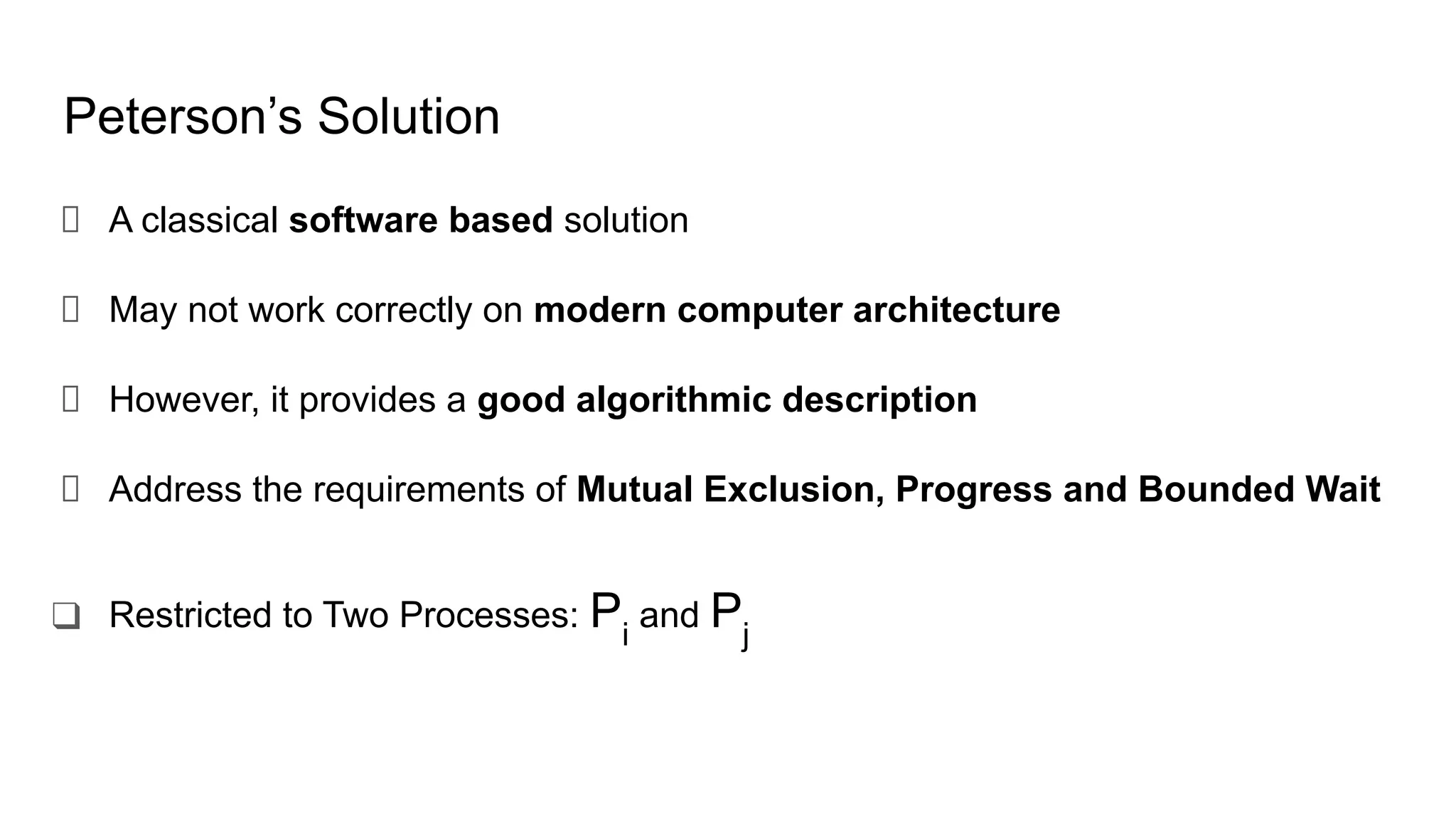
Peterson's solution is a classical algorithm that uses shared variables to coordinate access to a critical section for two processes. Each process uses a flag variable to indicate whether it wants to enter the critical section, and a turn variable to designate which process can enter next. A process sets its own flag, then checks the other's flag and turn to determine when it can safely enter the critical section without violating mutual exclusion. While this ensures only one process is in the critical section at a time, it may not work correctly on modern computer architectures due to assumptions about atomic read-write operations. Overall it provides a good conceptual model for solving the mutual exclusion problem in a way that guarantees progress and bounds waiting time.

![Shared Data Items
int turn
•• Indicates whose turn it is to
enter the critical section
boolean flag[2]
•• Indicate if a process is ready
to enter it’s critical section](https://image.slidesharecdn.com/petersonssolution-231213143955-e7573cfa/75/Peterson-s-Solution-pdf-by-Mustehsan-Mehmood-3-2048.jpg)
![Structure of process Pi
flag[ i ] = false;
flag [ i ] = true; // Ready to enter it’s critical section
turn = j; // Asking other process if it wants to enter it’s C.S
while ( flag[ j ] && turn == j );
do {
} while(true);
Critical Section
Remainder Section](https://image.slidesharecdn.com/petersonssolution-231213143955-e7573cfa/75/Peterson-s-Solution-pdf-by-Mustehsan-Mehmood-4-2048.jpg)
![Process Pi
Process Pj
flag[ i ] = false;
flag[ i ] = true;
turn = j;
while ( flag[ j ] && turn == j );
do {
} while(true);
Critical Section
Remainder Section
flag[ j ] = false;
flag[ j ] = true;
turn = i;
while ( flag[ i ] && turn == i );
do {
} while(true);
Critical Section
Remainder Section](https://image.slidesharecdn.com/petersonssolution-231213143955-e7573cfa/75/Peterson-s-Solution-pdf-by-Mustehsan-Mehmood-5-2048.jpg)