Presented By –
Aayush Kumar
Neena Nautiyal
Shruti Mukherjee
Arpit Rastogi
Santosh Kumar
Ruchi Jain
 The Indian telecommunications has been zooming
  up the growth curve at a feverish pace, emerging
  as one of the key sectors responsible for India's
  resurgent economic growth.
 It is the fastest growing telecommunication market
  in the world, and with 281.62 million telephone
  connections (at the end of January 2008) is the
  third largest telecom market.
 India has achieved its target of reaching 250
  million telephone subscribers by 2007, two months
  before target.
   PESTEL analysis of any industry sector investigates the
    important factors that are affecting the industry and influencing
    the companies operating in that sector.
   PESTEL is an acronym for
    political, economic, social, technological, legal and
    environmental analysis.
   Political factors include government policies relating to the
    industry, tax policies, laws and regulations, trade restrictions
    and tariffs etc.
   The economic factors relate to changes in the wider economy
    such as economic growth, interest rates, exchange rates and
    inflation rate, etc.
   Social factors often look at the cultural aspects and include
    health consciousness, population growth rate, age distribution,
    changes in tastes and buying patterns, etc.
   The technological factors relate to the application of new
    inventions and ideas such as R&D activity, automation,
    technology incentives and the rate of technological change.
   The industry's major service is the practice of law, which is
    providing legal services to individuals, businesses,
    government, and non profits which is Legal analysis.
   Environmental analysis of an industry studies whether the
    industry is working environmental friendly and following the
    ethics or not.
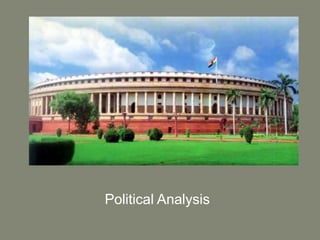
Political Analysis
   Telecom reforms in India began in the 1980s with the launch of a
    “Mission Better Communication” program.
   Private manufacturing of customer premise equipment was allowed
    in 1984 and the Center for Development of Telematics (C-DOT) was
    established for the development of indigenous technologies.
   Private franchises were freely given for public call offices (PCOs)
    that offered local, domestic and international calling services.
   Two large corporate entities were spun off from the Department of
    Telecommunications, e.g. Mahanagar Telephone Nigam Limited
    (MTNL) for Delhi and Mumbai and Videsh Sanchar Nigam Limited
    (VSNL) for all international services.
   The second phase of reform commenced with the
    general liberalization of the economy in the early
    1990s and announcement of a New Economic Policy
    (NEP)-1991.
   1991 telecom equipment manufacturing was de-
    licensed and value-added services were declared open
    to private sector.
   1992 radio paging, cellular mobile and other value
    added services were opened to private sector.
   1994 National Telecom Policy was announced and
    enhanced growth of private sector.
   The most important landmark in telecom reforms
    came with the New Telecom Policy 1999 (NTP-99).
   There were major developments on the policy front
    post year 2000. Establishment of Bharat Sanchar
    Nigam Ltd (BSNL) (2000), privatisation of VSNL
    (2002).
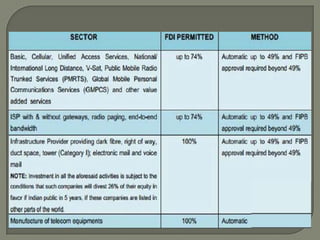
   Increase in FDI limits from 49% to 74% (2005) and
    proposal for mobile number portability (2006)
    which paved way for the remarkable growth in the
    sector.
Economic analysis
   The Indian Telecom industry has been playing an
    important role in the world economy and global
    revenues in 2008 were USD 4 trillion, expected to grow
    at a steep 11% p.a. CAGR over the next 2 years.
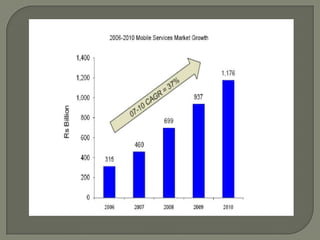
   India's telecom service revenue was ~USD 30 billion in
    2008, and Ernst and Young analysts believe it is
    projected to almost double to ~USD 55 billion by 2012.
   GDP contribution – 2%.
   Output per annum - ₹ 136,833crores per annum &
    Increasing 20% for every month.
 Increase  in disposable incomes.
 Greater network coverage.
 Greater affordability.
 Falling mobile phone prices.
 Falling call charges.
 The  Indian Telecom Industry
 manufacturing contributes about two-thirds
 of the total exports of the country.
 It has been estimated that manufacturing
 exports would increase from US$ 40 billion
 in 2002 to US$ 300 billion in
 2015, simultaneously increasing its share
 in world manufacturing trade from 0.8 % to
 3.5 %.
S
 Change in lifestyle
 Fast-changing lifestyles are forcing telecom
  companies to enlarge the breadth and depth of
  their services.
 joint ventures in the entertainment sector to add
  more services. For instance, Verizon now offers
  Verizon FiOS, a basic fiber-optic service which
  includes digital television, voice and high-speed
  internet services.
 The rural Indian consumer managed to remain an
  attractive proposition, especially in the demand for
  consumer goods and telecom services
 3 lakh PCOs are providing community access in
  the rural areas. Further, Mobile Gramin Sanchar
  Sewak Scheme (GSS) � a mobile Public Call
  Office (PCO) service is provided at the doorstep of
  villagers.
 Several areer paths lead to the Indian Telecom Industry. The telecom
  sector offers a variety of career options where there is room for
  everyone a degree holder or a diploma holder, a candidate with a
  part-time certification course or one with a full-time degree.

 The Certificate Courses for employment in the industry are:

 Certificate in Telecom Engineering.

 Certificate in Information Technology.

 Certificate in Computer Science.

 Certificate in Management Information Systems.

 Certificate in Computer Forensics.
Technology analysis
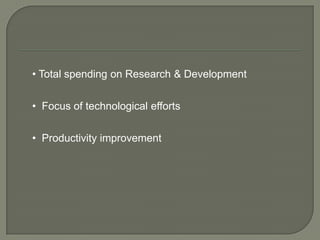
• Total spending on Research & Development

• Focus of technological efforts


• Productivity improvement
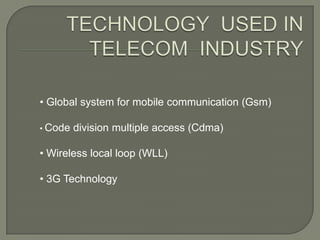
• Global system for mobile communication (Gsm)

• Code   division multiple access (Cdma)

• Wireless local loop (WLL)

• 3G Technology
Environmental Analysis
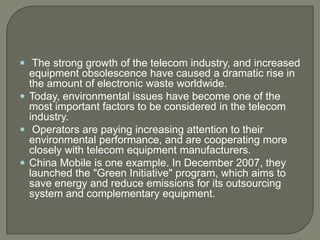
 The strong growth of the telecom industry, and increased
  equipment obsolescence have caused a dramatic rise in
  the amount of electronic waste worldwide.
 Today, environmental issues have become one of the
  most important factors to be considered in the telecom
  industry.
 Operators are paying increasing attention to their
  environmental performance, and are cooperating more
  closely with telecom equipment manufacturers.
 China Mobile is one example. In December 2007, they
  launched the "Green Initiative" program, which aims to
  save energy and reduce emissions for its outsourcing
  system and complementary equipment.
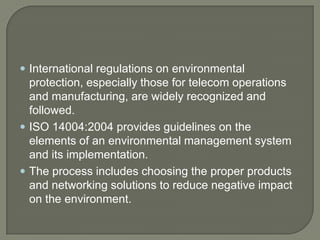
 International regulations on environmental
  protection, especially those for telecom operations
  and manufacturing, are widely recognized and
  followed.
 ISO 14004:2004 provides guidelines on the
  elements of an environmental management system
  and its implementation.
 The process includes choosing the proper products
  and networking solutions to reduce negative impact
  on the environment.
Legal analysis
“Telecommunications” falls under the legislative
competence of the Union and not the States.

 Consequently the Legal framework governing
Telecommunication Sector is within the control of
the Union Government and the Parliament.

In India Legal framework, covering telecom
sector include various services like internet, radio
paging, voice mail, V sat communications, E
Commerce, broadcasting services etc.

 Indian Legal framework with respect to telecom
infrastructure is made up of five main acts
The Legal Framework is
provided by:
 The Indian Telegraph Act 1885.


The Wireless Telegraphy Act 1933.


 The Telegraph Wires (Unlawful Possession) Act
1950.


 The Cable Television Network (Regulation) Act
1996.
The genesis of the Telecommunication Regulatory
Authority of India (TRAI) lies in the bidding process for the
grant of cellular licenses.

 First major dispute, entered into by TRAI, was between
itself and The Central Government.

The question of grant or amendment of a license by the
Central Government acting in its capacity as the licensor falls
outside the jurisdiction of the powers of TRAI.

The TRAI Act which was amended and passed in 2000
and the framework relating to the TRAI currently in force
have been analyzed subsequently
According to the TRAI act amended in 2000, the functions of
the original TRAI have now been divided between two
separate bodies.


The Telecom Regulatory Authority of India (TRAI).


The Telecom Disputes Settlement and Appellate Tribunal.


The Recommendatory and Regulatory functions are vested
with the TRAI while dispute settlement functions are handled
by the Appellate Tribunal
Pestle analysis – telecom sector

Pestle analysis – telecom sector

  • 1.
    Presented By – AayushKumar Neena Nautiyal Shruti Mukherjee Arpit Rastogi Santosh Kumar Ruchi Jain
  • 2.
     The Indiantelecommunications has been zooming up the growth curve at a feverish pace, emerging as one of the key sectors responsible for India's resurgent economic growth.  It is the fastest growing telecommunication market in the world, and with 281.62 million telephone connections (at the end of January 2008) is the third largest telecom market.  India has achieved its target of reaching 250 million telephone subscribers by 2007, two months before target.
  • 4.
    PESTEL analysis of any industry sector investigates the important factors that are affecting the industry and influencing the companies operating in that sector.  PESTEL is an acronym for political, economic, social, technological, legal and environmental analysis.  Political factors include government policies relating to the industry, tax policies, laws and regulations, trade restrictions and tariffs etc.  The economic factors relate to changes in the wider economy such as economic growth, interest rates, exchange rates and inflation rate, etc.
  • 5.
    Social factors often look at the cultural aspects and include health consciousness, population growth rate, age distribution, changes in tastes and buying patterns, etc.  The technological factors relate to the application of new inventions and ideas such as R&D activity, automation, technology incentives and the rate of technological change.  The industry's major service is the practice of law, which is providing legal services to individuals, businesses, government, and non profits which is Legal analysis.  Environmental analysis of an industry studies whether the industry is working environmental friendly and following the ethics or not.
  • 6.
  • 7.
    Telecom reforms in India began in the 1980s with the launch of a “Mission Better Communication” program.  Private manufacturing of customer premise equipment was allowed in 1984 and the Center for Development of Telematics (C-DOT) was established for the development of indigenous technologies.  Private franchises were freely given for public call offices (PCOs) that offered local, domestic and international calling services.  Two large corporate entities were spun off from the Department of Telecommunications, e.g. Mahanagar Telephone Nigam Limited (MTNL) for Delhi and Mumbai and Videsh Sanchar Nigam Limited (VSNL) for all international services.
  • 8.
    The second phase of reform commenced with the general liberalization of the economy in the early 1990s and announcement of a New Economic Policy (NEP)-1991.  1991 telecom equipment manufacturing was de- licensed and value-added services were declared open to private sector.  1992 radio paging, cellular mobile and other value added services were opened to private sector.  1994 National Telecom Policy was announced and enhanced growth of private sector.
  • 9.
    The most important landmark in telecom reforms came with the New Telecom Policy 1999 (NTP-99).  There were major developments on the policy front post year 2000. Establishment of Bharat Sanchar Nigam Ltd (BSNL) (2000), privatisation of VSNL (2002).  Increase in FDI limits from 49% to 74% (2005) and proposal for mobile number portability (2006) which paved way for the remarkable growth in the sector.
  • 10.
  • 11.
    The Indian Telecom industry has been playing an important role in the world economy and global revenues in 2008 were USD 4 trillion, expected to grow at a steep 11% p.a. CAGR over the next 2 years.  India's telecom service revenue was ~USD 30 billion in 2008, and Ernst and Young analysts believe it is projected to almost double to ~USD 55 billion by 2012.  GDP contribution – 2%.  Output per annum - ₹ 136,833crores per annum & Increasing 20% for every month.
  • 13.
     Increase in disposable incomes.  Greater network coverage.  Greater affordability.  Falling mobile phone prices.  Falling call charges.
  • 15.
     The Indian Telecom Industry manufacturing contributes about two-thirds of the total exports of the country.  It has been estimated that manufacturing exports would increase from US$ 40 billion in 2002 to US$ 300 billion in 2015, simultaneously increasing its share in world manufacturing trade from 0.8 % to 3.5 %.
  • 17.
  • 18.
     Change inlifestyle  Fast-changing lifestyles are forcing telecom companies to enlarge the breadth and depth of their services.  joint ventures in the entertainment sector to add more services. For instance, Verizon now offers Verizon FiOS, a basic fiber-optic service which includes digital television, voice and high-speed internet services.
  • 19.
     The ruralIndian consumer managed to remain an attractive proposition, especially in the demand for consumer goods and telecom services  3 lakh PCOs are providing community access in the rural areas. Further, Mobile Gramin Sanchar Sewak Scheme (GSS) � a mobile Public Call Office (PCO) service is provided at the doorstep of villagers.
  • 20.
     Several areerpaths lead to the Indian Telecom Industry. The telecom sector offers a variety of career options where there is room for everyone a degree holder or a diploma holder, a candidate with a part-time certification course or one with a full-time degree.  The Certificate Courses for employment in the industry are:  Certificate in Telecom Engineering.  Certificate in Information Technology.  Certificate in Computer Science.  Certificate in Management Information Systems.  Certificate in Computer Forensics.
  • 21.
  • 22.
    • Total spendingon Research & Development • Focus of technological efforts • Productivity improvement
  • 23.
    • Global systemfor mobile communication (Gsm) • Code division multiple access (Cdma) • Wireless local loop (WLL) • 3G Technology
  • 24.
  • 25.
     The stronggrowth of the telecom industry, and increased equipment obsolescence have caused a dramatic rise in the amount of electronic waste worldwide.  Today, environmental issues have become one of the most important factors to be considered in the telecom industry.  Operators are paying increasing attention to their environmental performance, and are cooperating more closely with telecom equipment manufacturers.  China Mobile is one example. In December 2007, they launched the "Green Initiative" program, which aims to save energy and reduce emissions for its outsourcing system and complementary equipment.
  • 26.
     International regulationson environmental protection, especially those for telecom operations and manufacturing, are widely recognized and followed.  ISO 14004:2004 provides guidelines on the elements of an environmental management system and its implementation.  The process includes choosing the proper products and networking solutions to reduce negative impact on the environment.
  • 27.
  • 28.
    “Telecommunications” falls underthe legislative competence of the Union and not the States.  Consequently the Legal framework governing Telecommunication Sector is within the control of the Union Government and the Parliament. In India Legal framework, covering telecom sector include various services like internet, radio paging, voice mail, V sat communications, E Commerce, broadcasting services etc.  Indian Legal framework with respect to telecom infrastructure is made up of five main acts
  • 29.
    The Legal Frameworkis provided by:  The Indian Telegraph Act 1885. The Wireless Telegraphy Act 1933.  The Telegraph Wires (Unlawful Possession) Act 1950.  The Cable Television Network (Regulation) Act 1996.
  • 30.
    The genesis ofthe Telecommunication Regulatory Authority of India (TRAI) lies in the bidding process for the grant of cellular licenses.  First major dispute, entered into by TRAI, was between itself and The Central Government. The question of grant or amendment of a license by the Central Government acting in its capacity as the licensor falls outside the jurisdiction of the powers of TRAI. The TRAI Act which was amended and passed in 2000 and the framework relating to the TRAI currently in force have been analyzed subsequently
  • 31.
    According to theTRAI act amended in 2000, the functions of the original TRAI have now been divided between two separate bodies. The Telecom Regulatory Authority of India (TRAI). The Telecom Disputes Settlement and Appellate Tribunal. The Recommendatory and Regulatory functions are vested with the TRAI while dispute settlement functions are handled by the Appellate Tribunal