Network Scheduling,
Planning & Controlling
Techniques
Introduction
 Schedule converts action plan into operating time table
 Basis for monitoring and controlling project
 Scheduling more important in projects than in production,
because unique nature
 Sometimes customer specified/approved requirement.
 Based on Work Breakdown Structure (WBS)
 Graphical portrayal of activities and event
 Shows dependency relationships between tasks/activities in a
project
 Clearly shows tasks that must precede (precedence) or follow
(succeeding) other tasks in a logical manner
 Clear representation of plan – a powerful tool for planning
and controlling project
Network
Networking Techniques
CPM GERTPERT
History Of PERT/CPM
Developed by
the US Navy for
the planning
and control of
the Polaris
missile program
The emphasis
was on
completing the
program in the
shortest possible
time.
PERT Developed by
Du Pont to solve
project
scheduling
problems
The emphasis
was on the
trade-off
between the
cost of the
project and its
overall
completion time
CPM
Why PERT/CPM?
 Prediction of deliverables
 Planning resource requirements
 Controlling resource allocation
 Internal program review
 External program review
 Performance evaluation
 Uniform wide acceptance
Applications Of PERT/CPM Techniques
1
• Construction of a Dam or Canal
• Construction of a building or highway
2
• Maintenance or Overhaul of aircrafts
• Space Flights
3
• Designing a Prototype of a Machine
• Development of Supersonic Planes
Steps in PERT/CPM
4. Controlling
3. Allocation Of Resources
2. Scheduling
1. Planning
Need of PERT/CPM
 Prediction of deliverables
 Planning resource requirements
 Controlling resource allocation
 Internal program review
 External program review
 Performance evaluation
 Uniform wide acceptance
PERT
PERT
Project Evaluation
and Review
Technique (PERT)
• U S Navy (1958) for the POLARIS
missile program
• Multiple task time estimates
(probabilistic nature)
• Activity-on-arrow network
construction
• Non-repetitive jobs (R & D work)
 PERT is based on the assumption that an activity’s duration
follows a probability distribution instead of being a single value
 Three time estimates are required to compute the parameters of
an activity’s duration distribution:
 pessimistic time (a) - the time the activity would take if things
did not go well
 most likely time (m ) - the consensus best estimate of the
activity’s duration
 optimistic time (b) - the time the activity would take if things
did go well
Mean (expected time):te = a + 4m + b
6
Variance: V =
b- a
6
2
PERT
Use of PERT
 In construction activities
 Transportation activities
 In oil refineries
 Computer system-
 For manufacturing electric generator machines
 Medical and surgical sector
 Library activities
Importance of PERT System
 Reduction in cost
 Saving of time
 Determination of activities
 Elimination of risk in complex activities –
 Flexibility
 Evaluation of alternatives-
 Useful in effective control-
 Useful in decision making
 Useful is research work
Critical path
 Those activities which contribute directly to the overall duration of the
project constitute critical activities, the critical activities form a chain
running through the network which is called critical path.
 Critical event : the slack of an event is the difference between the latest &
earliest events time. The events with zero slack time are called as critical
events.
 Critical activities : The difference between latest start time & earliest start
time of an activity will indicate amount of time by which the activity can be
delayed without affecting the total project duration. The difference is
usually called total float. Activities with 0 total float are called as critical
activities
CPM
Critical Path
Method (CPM)
• E I Du Pont de Nemours & Co. (1957)
for construction of new chemical plant
and maintenance shut-down
• Deterministic task times
• Activity-on-node network
construction
• Repetitive nature of jobs
CPM
 Path
 A connected sequence of activities leading from the starting
event to the ending event
 Critical Path
 The longest path (time); determines the project duration
 Critical Activities
 All of the activities that make up the critical path
CPM calculation
Critical path
 Those activities which contribute directly to the overall duration of the
project constitute critical activities, the critical activities form a chain
running through the network which is called critical path.
 Critical event : the slack of an event is the difference between the latest &
earliest events time. The events with zero slack time are called as critical
events.
 Critical activities : The difference between latest start time & earliest start
time of an activity will indicate amount of time by which the activity can be
delayed without affecting the total project duration. The difference is
usually called total float. Activities with 0 total float are called as critical
activities
 Useful at many stages of project management
 Mathematically simple
 Give critical path and slack time
 Provide project documentation
 Useful in monitoring costs
Benefits of CPM/PERT
 Clearly defined, independent and stable activities
 Specified precedence relationships
 Over emphasis on critical paths
 Deterministic CPM model
 Activity time estimates are subjective and depend on judgment
 PERT assumes a beta distribution for these time estimates, but
the actual distribution may be different
 PERT consistently underestimates the expected project
completion time due to alternate paths becoming critical
Limitations to CPM/PERT
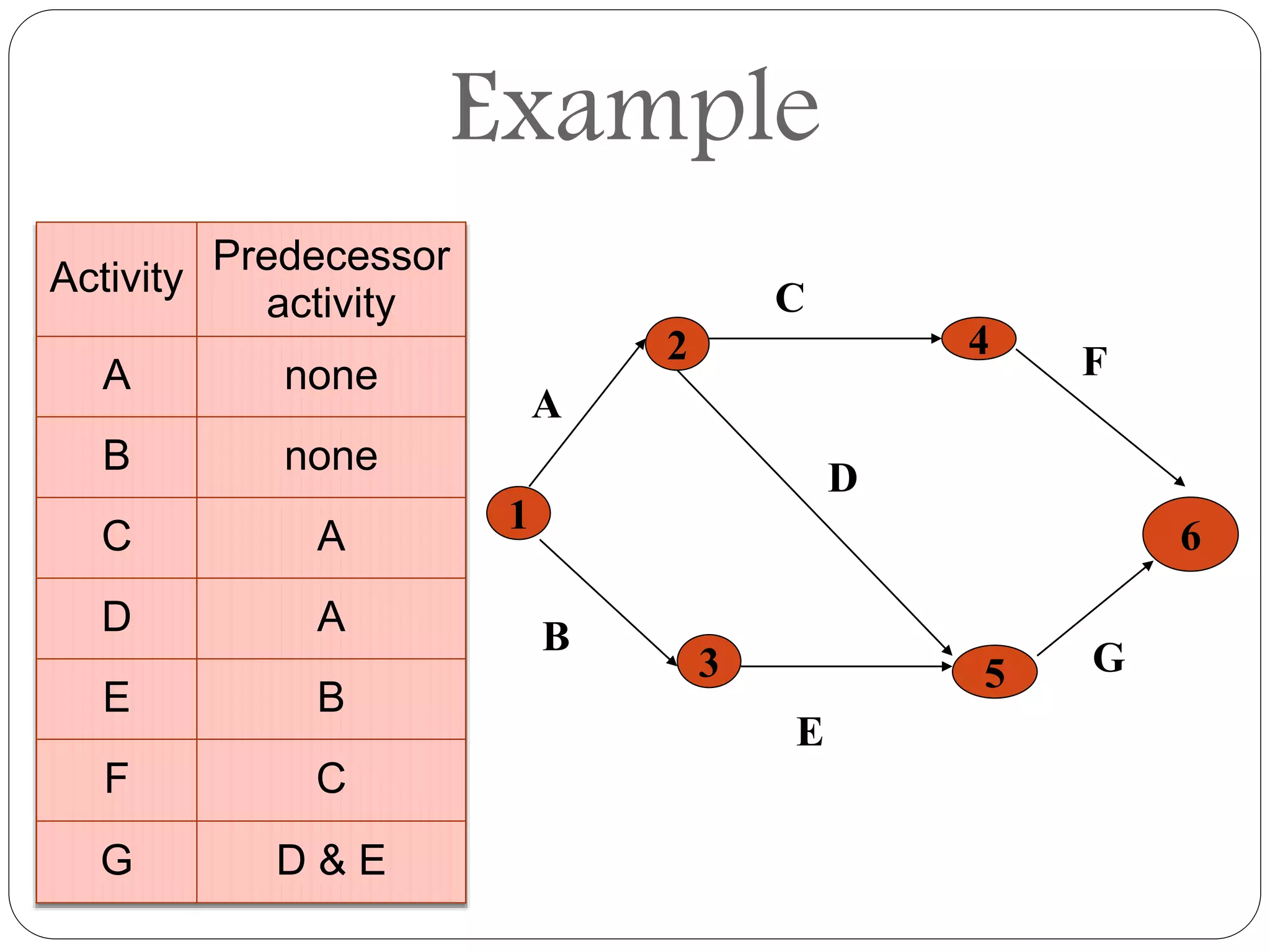
Activity
Predecessor
activity
A none
B none
C A
D A
E B
F C
G D & E
1
3
2
5
4
6
A
B
C
D
E
F
G
Example
Activity
Predecessor
activity
A none
B A
C A
D B
E C
F D ,E
Example
1 2
3
4
5 6
A
B
C
D
E
F
Project Crashing
 Crashing
 reducing project time by expending additional resources
 Crash time
 an amount of time an activity is reduced
 Crash cost
 cost of reducing activity time
 Goal
 reduce project duration at minimum cost
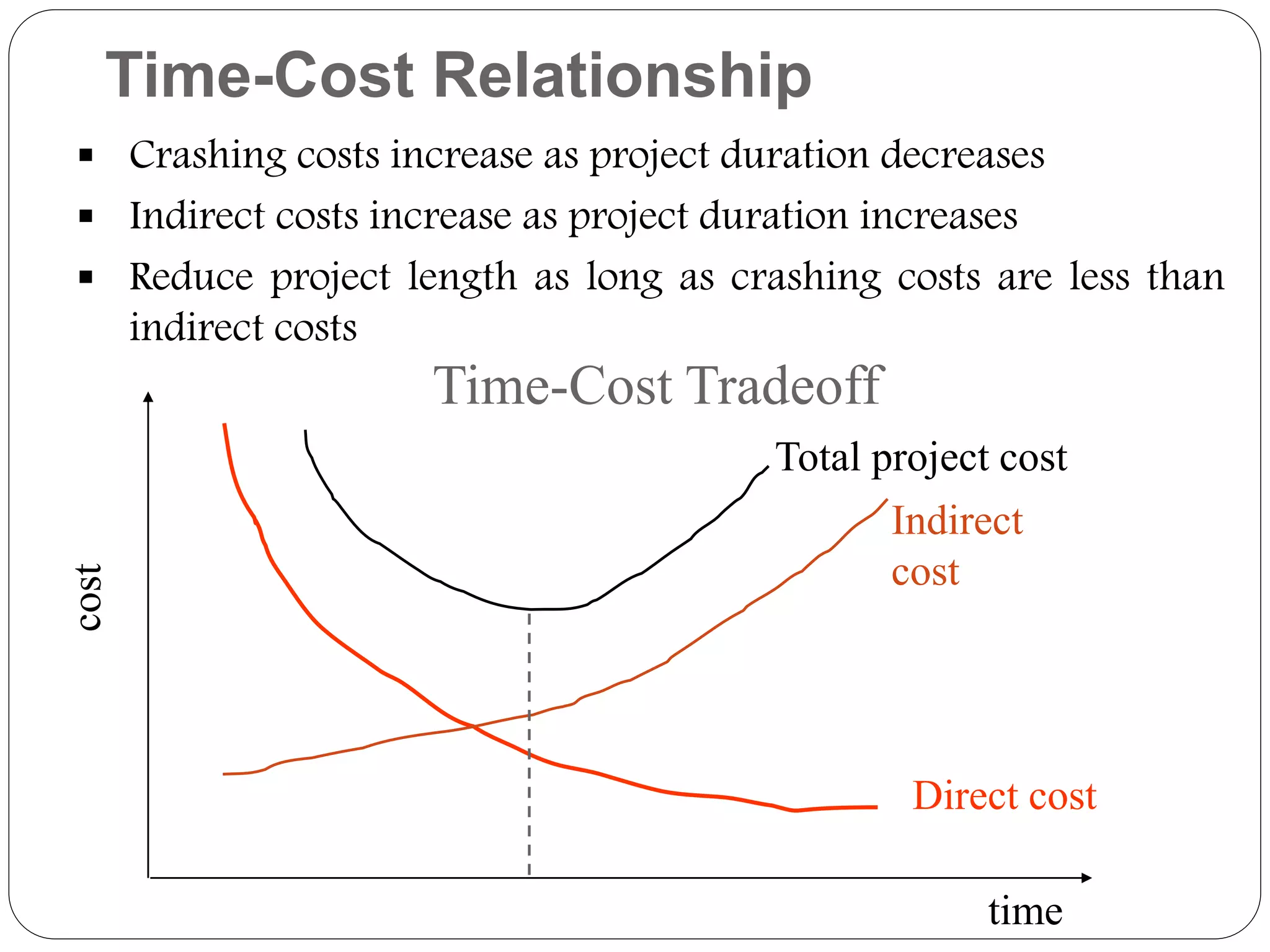
Time-Cost Relationship
 Crashing costs increase as project duration decreases
 Indirect costs increase as project duration increases
 Reduce project length as long as crashing costs are less than
indirect costs
Time-Cost Tradeoff
time
Direct cost
Indirect
cost
Total project cost
Activity
Normal
(Wks)
Crush
(Wks)
Cost
Slope
(K$)
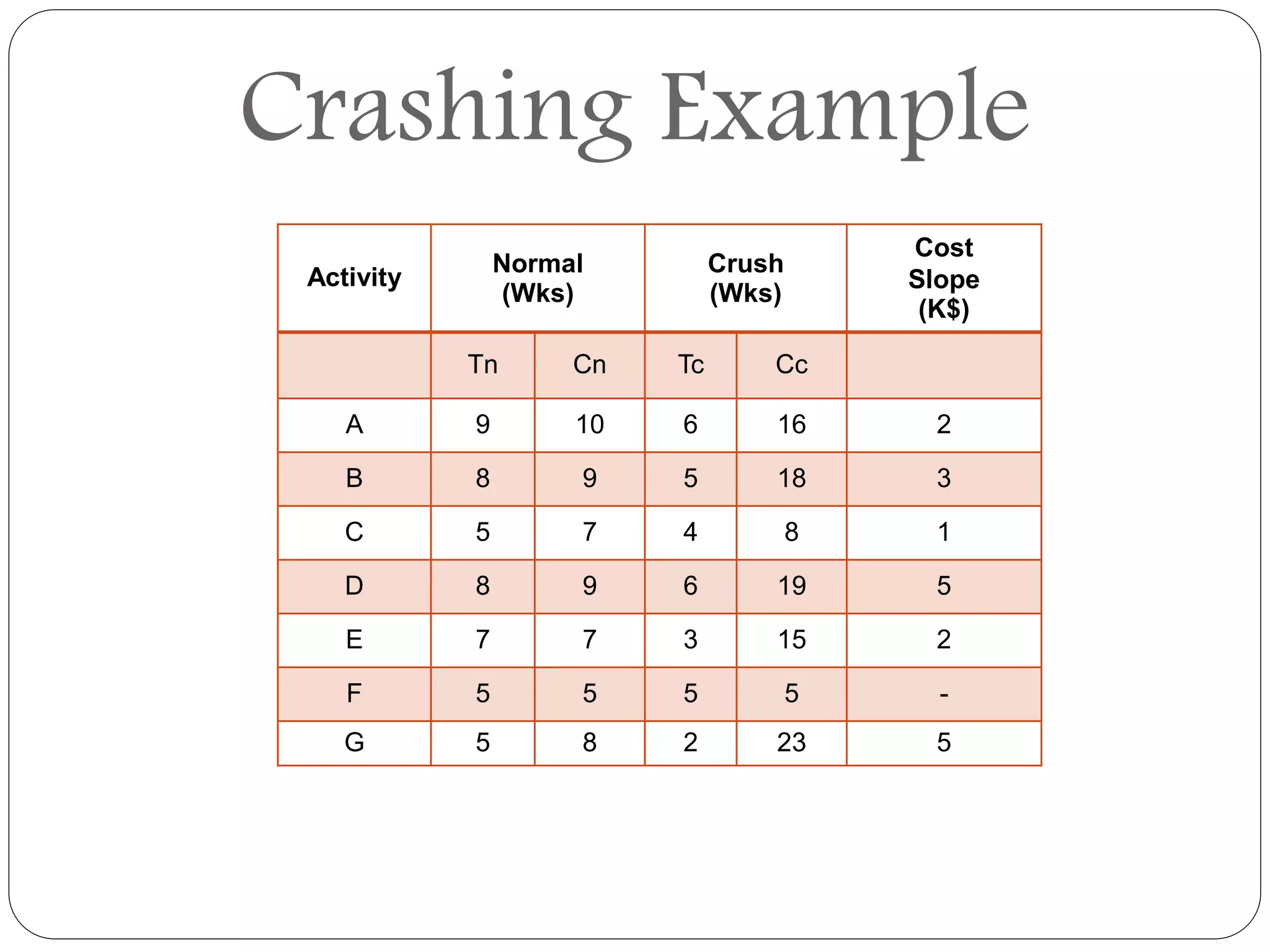
Tn Cn Tc Cc
A 9 10 6 16 2
B 8 9 5 18 3
C 5 7 4 8 1
D 8 9 6 19 5
E 7 7 3 15 2
F 5 5 5 5 -
G 5 8 2 23 5
Crashing Example
A
D
G
F
C
B
E
9
8
8
7
5
5
5
0
22
149
17
8
2
2
10
0
9 1
7
17
Critical Path A-D-G=22wks
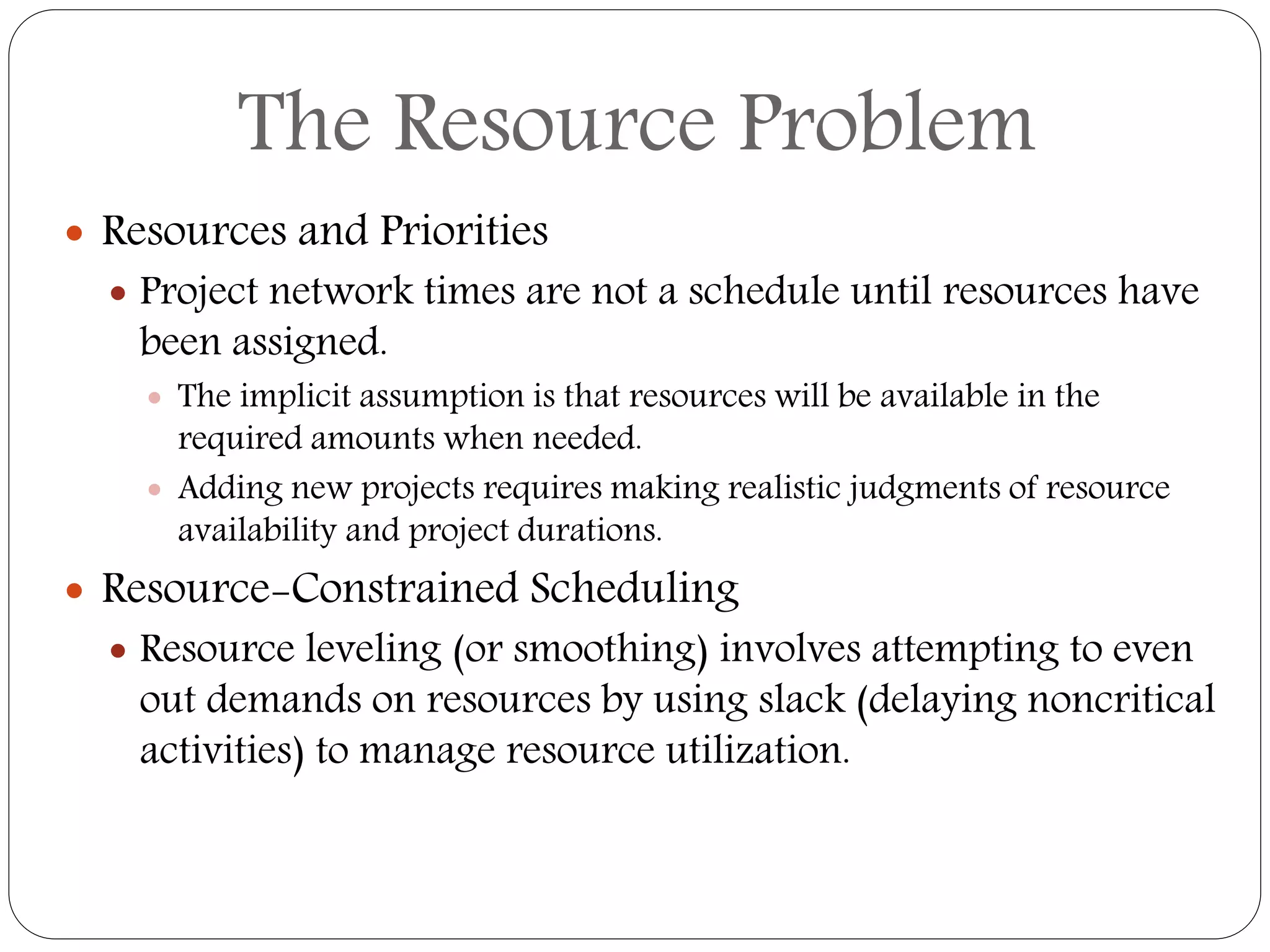
The Resource Problem
 Resources and Priorities
 Project network times are not a schedule until resources have
been assigned.
 The implicit assumption is that resources will be available in the
required amounts when needed.
 Adding new projects requires making realistic judgments of resource
availability and project durations.
 Resource-Constrained Scheduling
 Resource leveling (or smoothing) involves attempting to even
out demands on resources by using slack (delaying noncritical
activities) to manage resource utilization.
 People
 Materials
 Equipment
 Working Capital
Kinds of resource
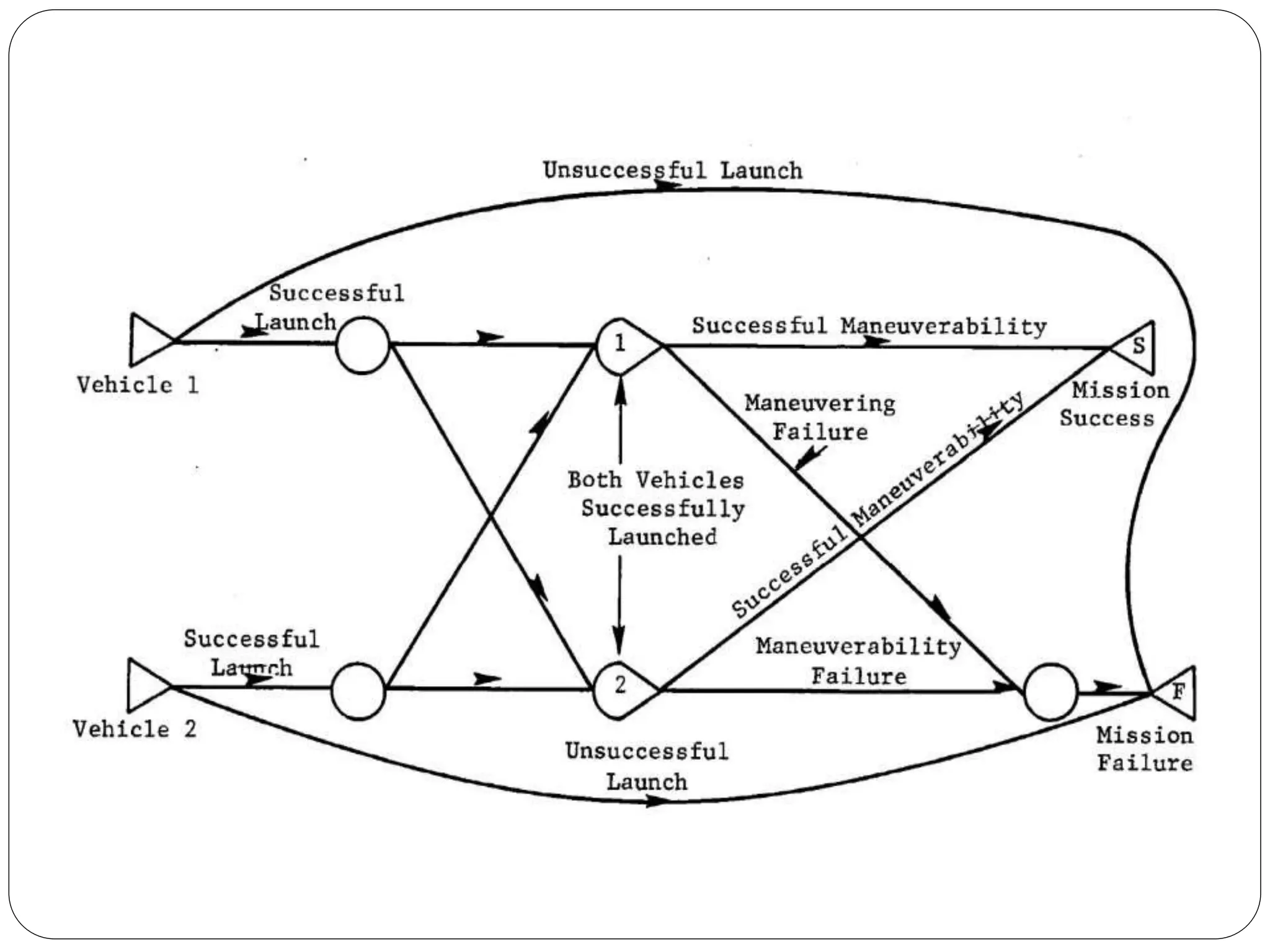
GERT
 A network analysis technique used in project management.
 It allows probabilistic treatment of both network logic and
activity duration estimated.
 The technique was first described in 1966 by Dr. Alan B.
Pritsker of Purdue University.
 Compared to other techniques, GERT is an only rarely used
scheduling technique.
GERT
Contd..
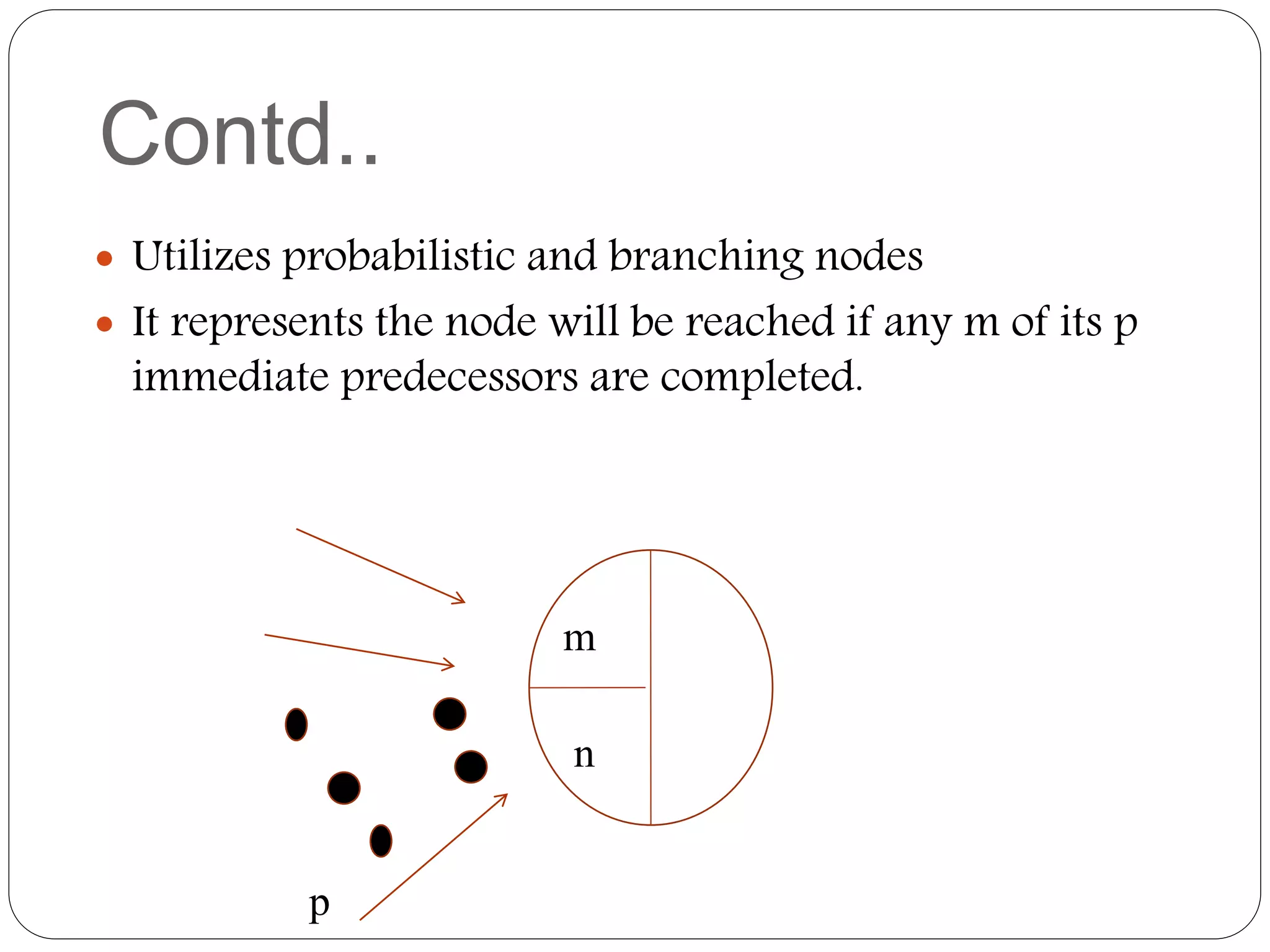
 Utilizes probabilistic and branching nodes
 It represents the node will be reached if any m of its p
immediate predecessors are completed.
m
n
p
Contd..
 It represents a probabilistic output where any of q
outputs are possible
 Each branch has an assigned probability
 When no probability is given, the probability is assumed
to be one for each branch.
1
2
q
Example
Pert, cpm & gert
Pert, cpm & gert

Pert, cpm & gert

  • 1.
    Network Scheduling, Planning &Controlling Techniques
  • 2.
    Introduction  Schedule convertsaction plan into operating time table  Basis for monitoring and controlling project  Scheduling more important in projects than in production, because unique nature  Sometimes customer specified/approved requirement.  Based on Work Breakdown Structure (WBS)
  • 3.
     Graphical portrayalof activities and event  Shows dependency relationships between tasks/activities in a project  Clearly shows tasks that must precede (precedence) or follow (succeeding) other tasks in a logical manner  Clear representation of plan – a powerful tool for planning and controlling project Network
  • 4.
  • 5.
    History Of PERT/CPM Developedby the US Navy for the planning and control of the Polaris missile program The emphasis was on completing the program in the shortest possible time. PERT Developed by Du Pont to solve project scheduling problems The emphasis was on the trade-off between the cost of the project and its overall completion time CPM
  • 6.
    Why PERT/CPM?  Predictionof deliverables  Planning resource requirements  Controlling resource allocation  Internal program review  External program review  Performance evaluation  Uniform wide acceptance
  • 7.
    Applications Of PERT/CPMTechniques 1 • Construction of a Dam or Canal • Construction of a building or highway 2 • Maintenance or Overhaul of aircrafts • Space Flights 3 • Designing a Prototype of a Machine • Development of Supersonic Planes
  • 8.
    Steps in PERT/CPM 4.Controlling 3. Allocation Of Resources 2. Scheduling 1. Planning
  • 9.
    Need of PERT/CPM Prediction of deliverables  Planning resource requirements  Controlling resource allocation  Internal program review  External program review  Performance evaluation  Uniform wide acceptance
  • 10.
  • 11.
    PERT Project Evaluation and Review Technique(PERT) • U S Navy (1958) for the POLARIS missile program • Multiple task time estimates (probabilistic nature) • Activity-on-arrow network construction • Non-repetitive jobs (R & D work)
  • 12.
     PERT isbased on the assumption that an activity’s duration follows a probability distribution instead of being a single value  Three time estimates are required to compute the parameters of an activity’s duration distribution:  pessimistic time (a) - the time the activity would take if things did not go well  most likely time (m ) - the consensus best estimate of the activity’s duration  optimistic time (b) - the time the activity would take if things did go well Mean (expected time):te = a + 4m + b 6 Variance: V = b- a 6 2 PERT
  • 13.
    Use of PERT In construction activities  Transportation activities  In oil refineries  Computer system-  For manufacturing electric generator machines  Medical and surgical sector  Library activities
  • 14.
    Importance of PERTSystem  Reduction in cost  Saving of time  Determination of activities  Elimination of risk in complex activities –  Flexibility  Evaluation of alternatives-  Useful in effective control-  Useful in decision making  Useful is research work
  • 15.
    Critical path  Thoseactivities which contribute directly to the overall duration of the project constitute critical activities, the critical activities form a chain running through the network which is called critical path.  Critical event : the slack of an event is the difference between the latest & earliest events time. The events with zero slack time are called as critical events.  Critical activities : The difference between latest start time & earliest start time of an activity will indicate amount of time by which the activity can be delayed without affecting the total project duration. The difference is usually called total float. Activities with 0 total float are called as critical activities
  • 16.
  • 17.
    Critical Path Method (CPM) •E I Du Pont de Nemours & Co. (1957) for construction of new chemical plant and maintenance shut-down • Deterministic task times • Activity-on-node network construction • Repetitive nature of jobs CPM
  • 18.
     Path  Aconnected sequence of activities leading from the starting event to the ending event  Critical Path  The longest path (time); determines the project duration  Critical Activities  All of the activities that make up the critical path CPM calculation
  • 19.
    Critical path  Thoseactivities which contribute directly to the overall duration of the project constitute critical activities, the critical activities form a chain running through the network which is called critical path.  Critical event : the slack of an event is the difference between the latest & earliest events time. The events with zero slack time are called as critical events.  Critical activities : The difference between latest start time & earliest start time of an activity will indicate amount of time by which the activity can be delayed without affecting the total project duration. The difference is usually called total float. Activities with 0 total float are called as critical activities
  • 20.
     Useful atmany stages of project management  Mathematically simple  Give critical path and slack time  Provide project documentation  Useful in monitoring costs Benefits of CPM/PERT
  • 21.
     Clearly defined,independent and stable activities  Specified precedence relationships  Over emphasis on critical paths  Deterministic CPM model  Activity time estimates are subjective and depend on judgment  PERT assumes a beta distribution for these time estimates, but the actual distribution may be different  PERT consistently underestimates the expected project completion time due to alternate paths becoming critical Limitations to CPM/PERT
  • 22.
    Activity Predecessor activity A none B none CA D A E B F C G D & E 1 3 2 5 4 6 A B C D E F G Example
  • 23.
  • 24.
  • 25.
    Project Crashing  Crashing reducing project time by expending additional resources  Crash time  an amount of time an activity is reduced  Crash cost  cost of reducing activity time  Goal  reduce project duration at minimum cost
  • 26.
    Time-Cost Relationship  Crashingcosts increase as project duration decreases  Indirect costs increase as project duration increases  Reduce project length as long as crashing costs are less than indirect costs Time-Cost Tradeoff time Direct cost Indirect cost Total project cost
  • 27.
    Activity Normal (Wks) Crush (Wks) Cost Slope (K$) Tn Cn TcCc A 9 10 6 16 2 B 8 9 5 18 3 C 5 7 4 8 1 D 8 9 6 19 5 E 7 7 3 15 2 F 5 5 5 5 - G 5 8 2 23 5 Crashing Example
  • 28.
  • 29.
    The Resource Problem Resources and Priorities  Project network times are not a schedule until resources have been assigned.  The implicit assumption is that resources will be available in the required amounts when needed.  Adding new projects requires making realistic judgments of resource availability and project durations.  Resource-Constrained Scheduling  Resource leveling (or smoothing) involves attempting to even out demands on resources by using slack (delaying noncritical activities) to manage resource utilization.
  • 31.
     People  Materials Equipment  Working Capital Kinds of resource
  • 32.
  • 33.
     A networkanalysis technique used in project management.  It allows probabilistic treatment of both network logic and activity duration estimated.  The technique was first described in 1966 by Dr. Alan B. Pritsker of Purdue University.  Compared to other techniques, GERT is an only rarely used scheduling technique. GERT
  • 34.
    Contd..  Utilizes probabilisticand branching nodes  It represents the node will be reached if any m of its p immediate predecessors are completed. m n p
  • 35.
    Contd..  It representsa probabilistic output where any of q outputs are possible  Each branch has an assigned probability  When no probability is given, the probability is assumed to be one for each branch. 1 2 q
  • 36.