
By
Dr. H.S. ABZAL BASHA, M.B.A., Ph.D.
Assistant Professor,
Department of Management Studies,
G. Pullaiah College of Engineering & Technology, Kurnool.
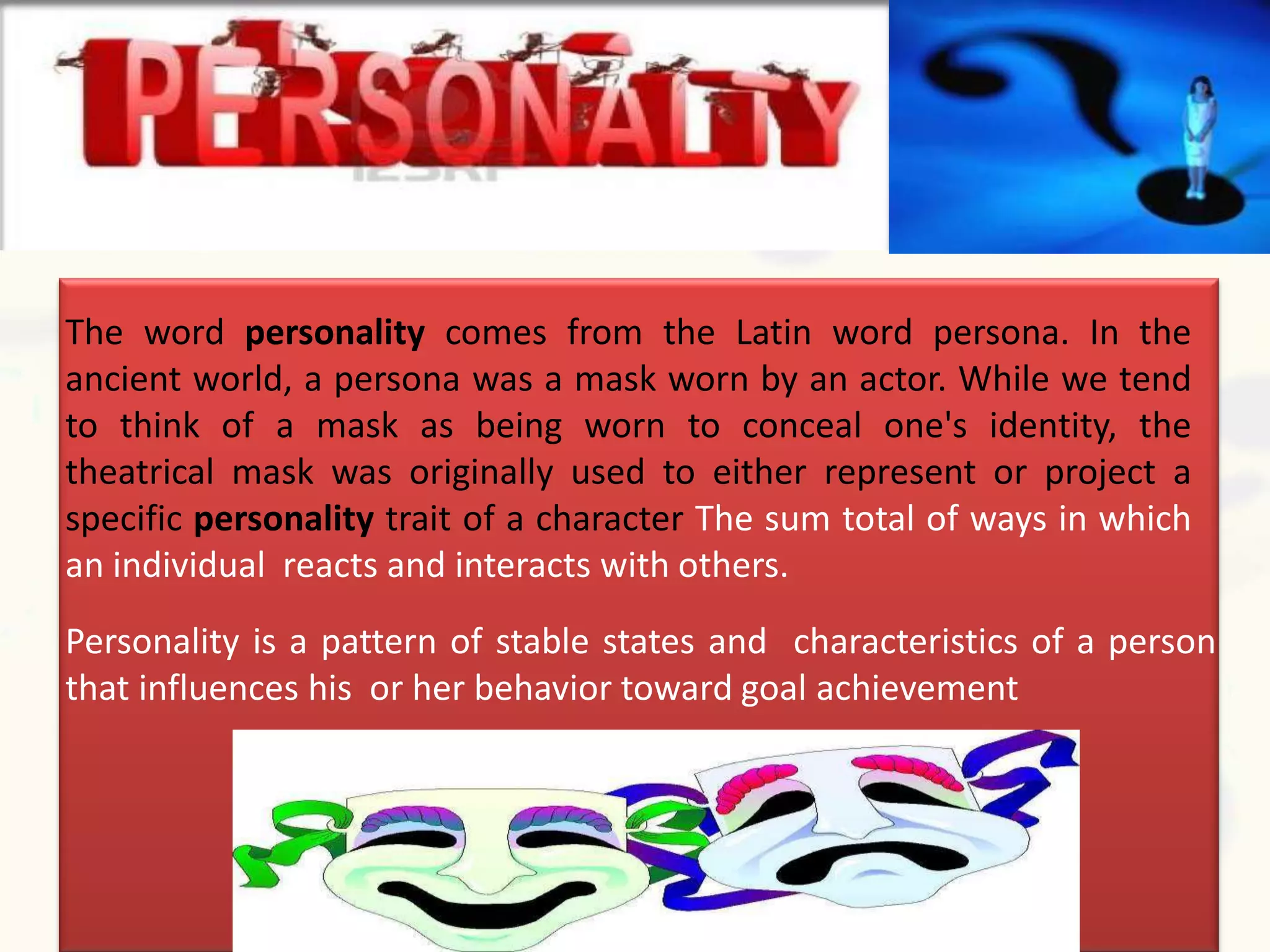
The word personality comes from the Latin word persona. In the
ancient world, a persona was a mask worn by an actor. While we tend
to think of a mask as being worn to conceal one's identity, the
theatrical mask was originally used to either represent or project a
specific personality trait of a character The sum total of ways in which
an individual reacts and interacts with others.
Personality is a pattern of stable states and characteristics of a person
that influences his or her behavior toward goal achievement
DEFINITION
Personality -A relatively stable
set of characteristics that
influences an individual’s
behavior
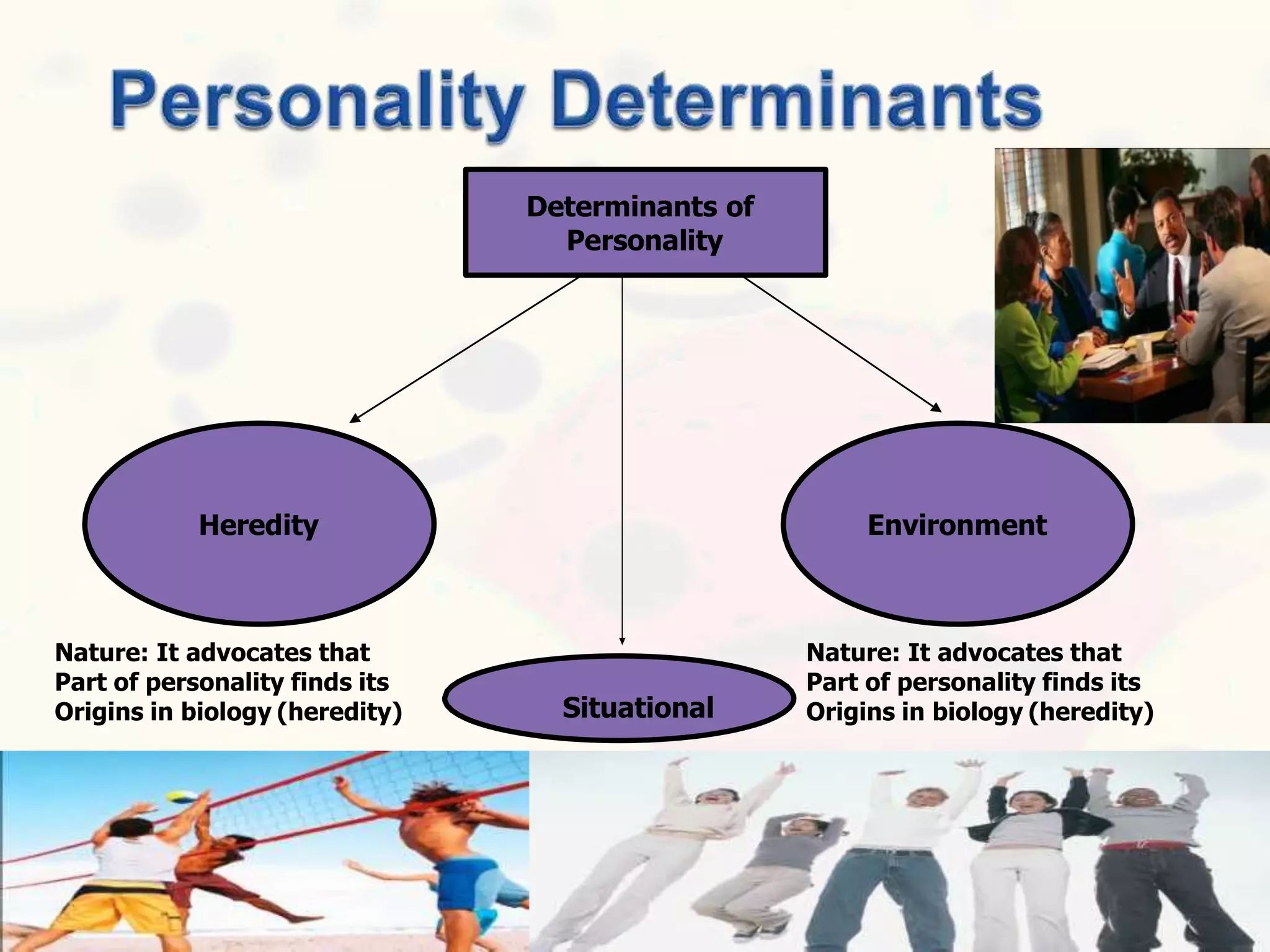
Determinants of
Personality
Heredity Environment
Situational
Nature: It advocates that
Part of personality finds its
Origins in biology (heredity)
Nature: It advocates that
Part of personality finds its
Origins in biology (heredity)
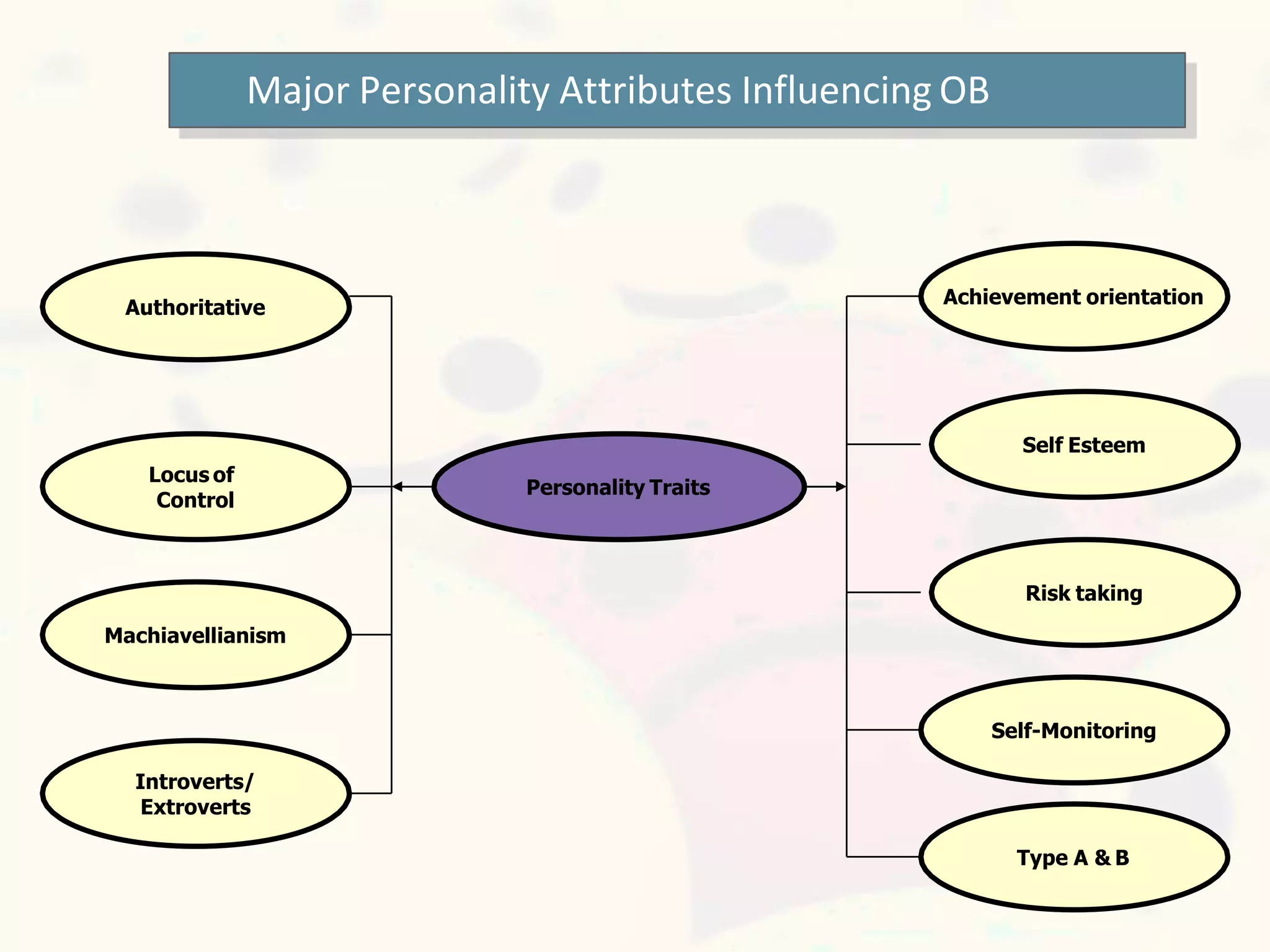
Major Personality Attributes Influencing OB
Personality Traits
Authoritative
Locus of
Control
Machiavellianism
Introverts/
Extroverts
Self Esteem
Risk taking
Self-Monitoring
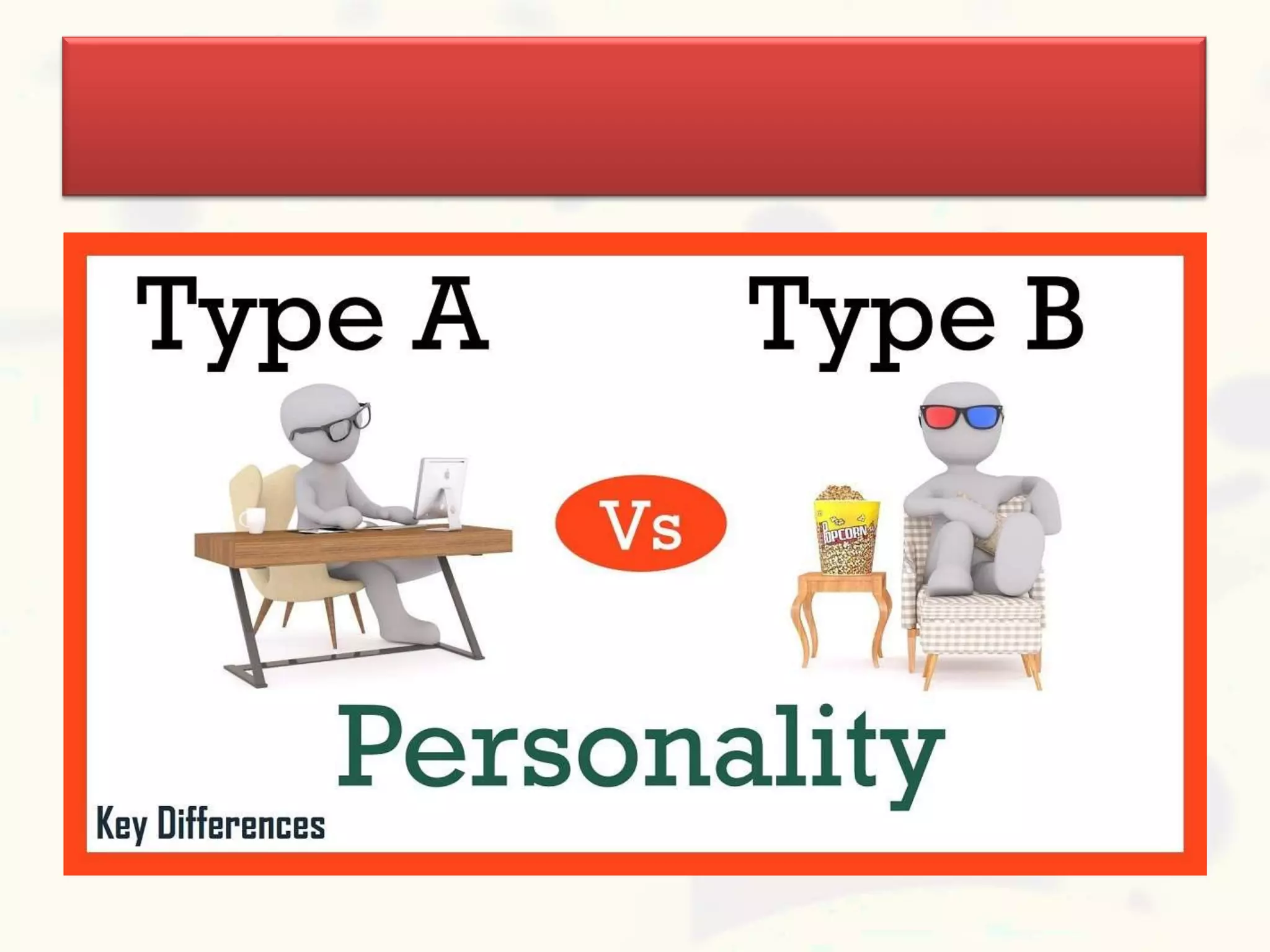
Type A & B
Achievement orientation
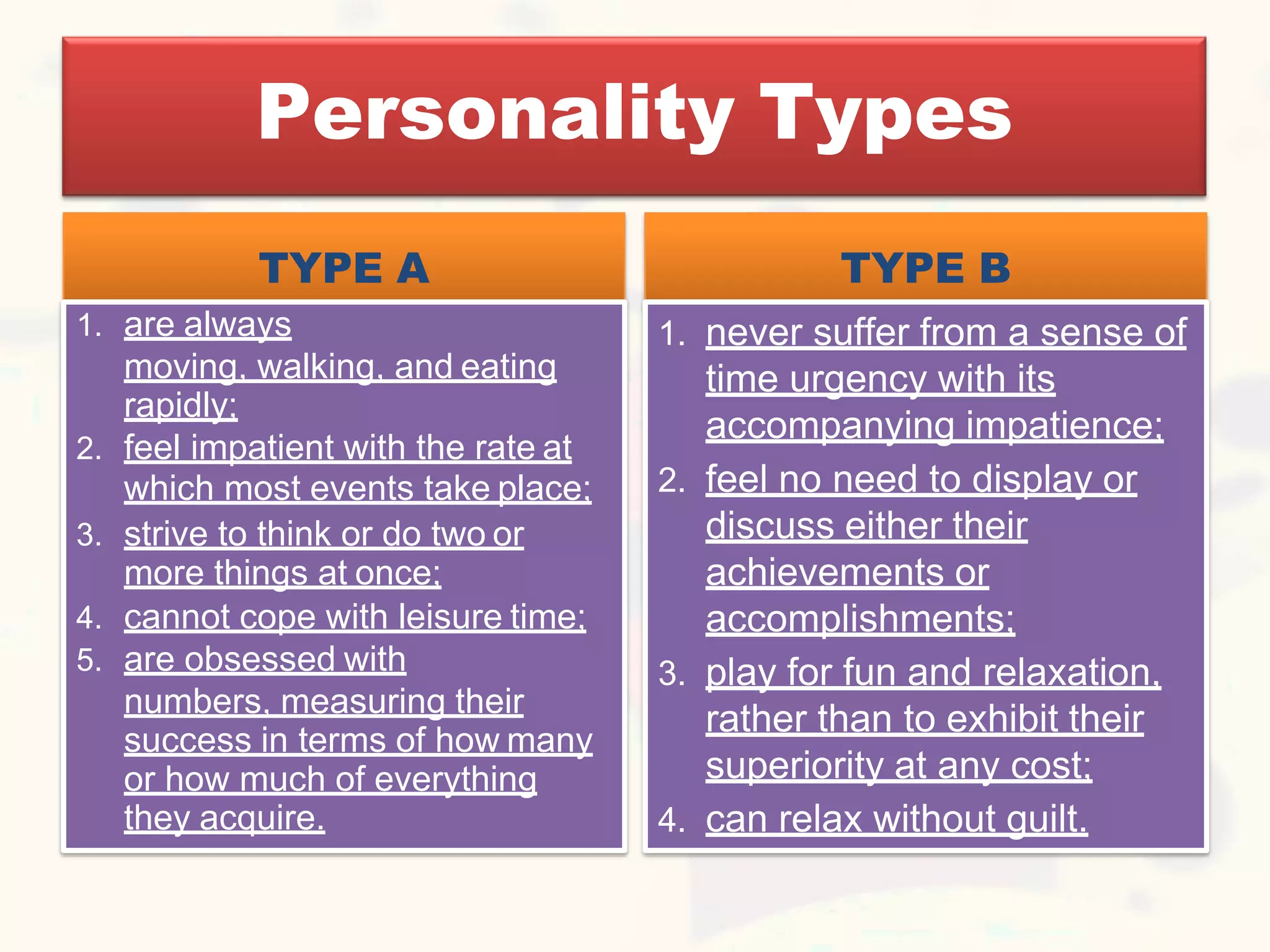
Personality Types
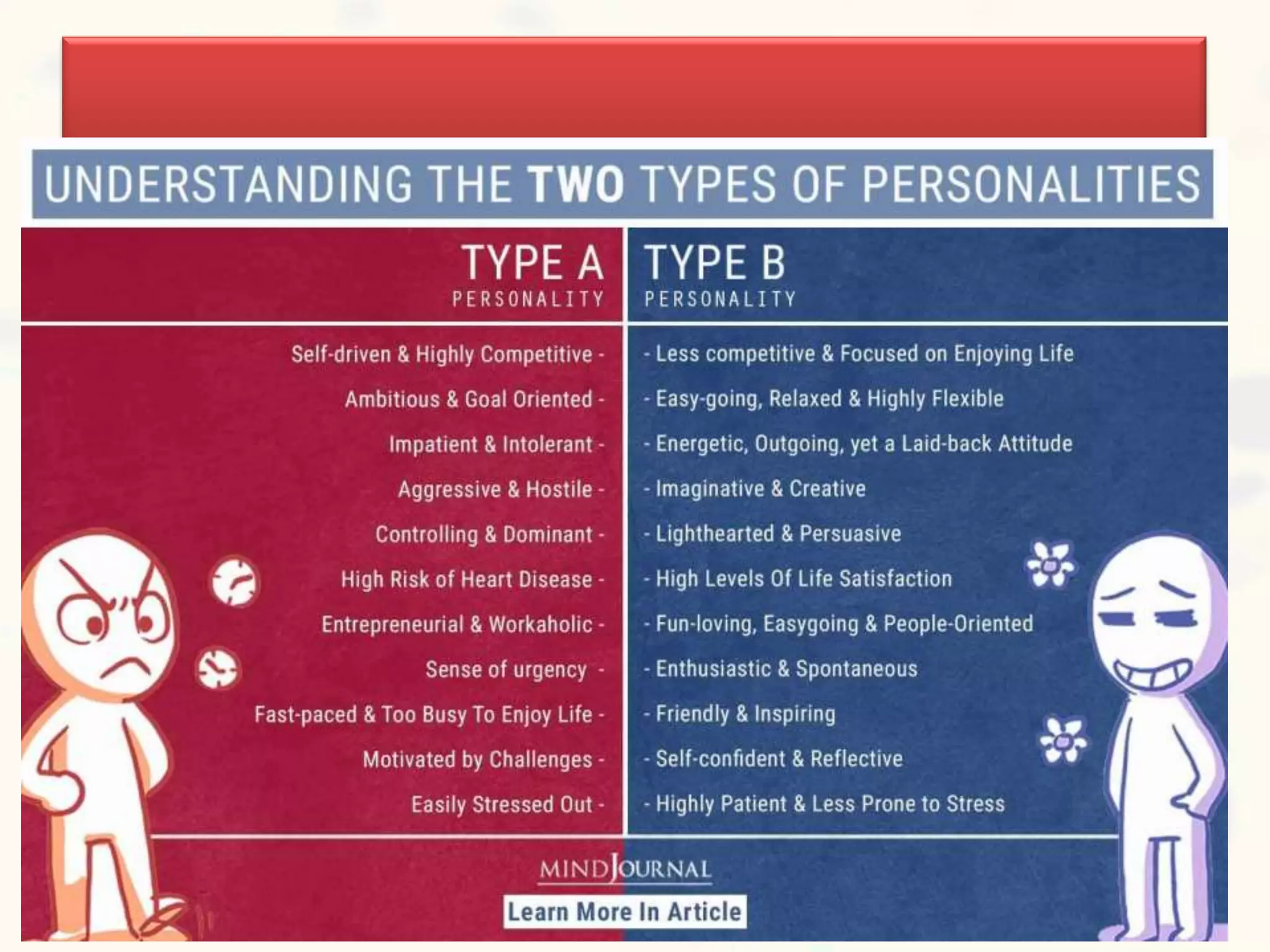
TYPE A
1. are always
moving, walking, and eating
rapidly;
2. feel impatient with the rate at
which most events take place;
3. strive to think or do two or
more things at once;
4. cannot cope with leisure time;
5. are obsessed with
numbers, measuring their
success in terms of how many
or how much of everything
they acquire.
TYPE B
1. never suffer from a sense of
time urgency with its
accompanying impatience;
2. feel no need to display or
discuss either their
achievements or
accomplishments;
3. play for fun and relaxation,
rather than to exhibit their
superiority at any cost;
4. can relax without guilt.
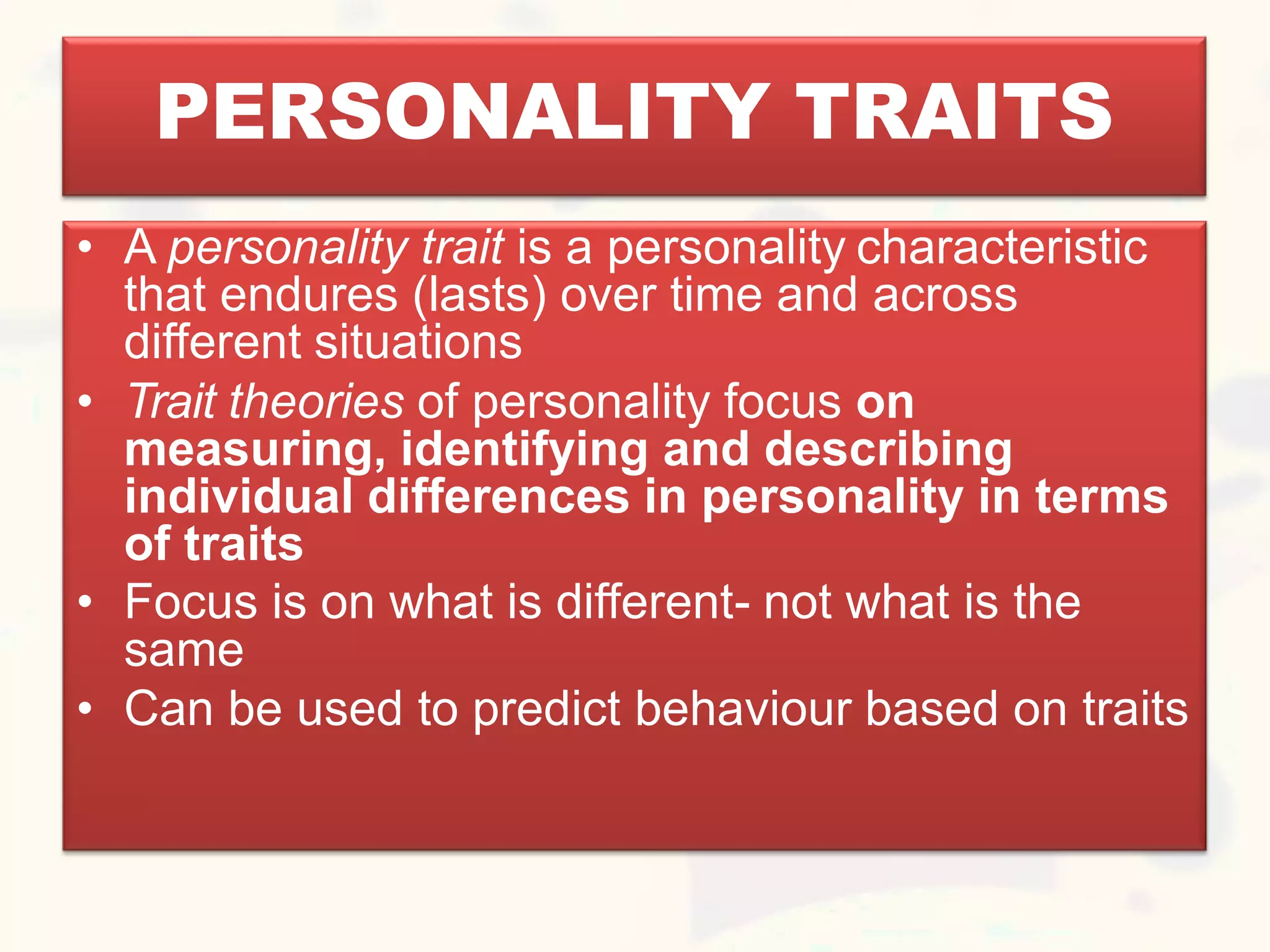
PERSONALITY TRAITS
• A personality trait is a personality characteristic
that endures (lasts) over time and across
different situations
• Trait theories of personality focus on
measuring, identifying and describing
individual differences in personality in terms
of traits
• Focus is on what is different- not what is the
same
• Can be used to predict behaviour based on traits
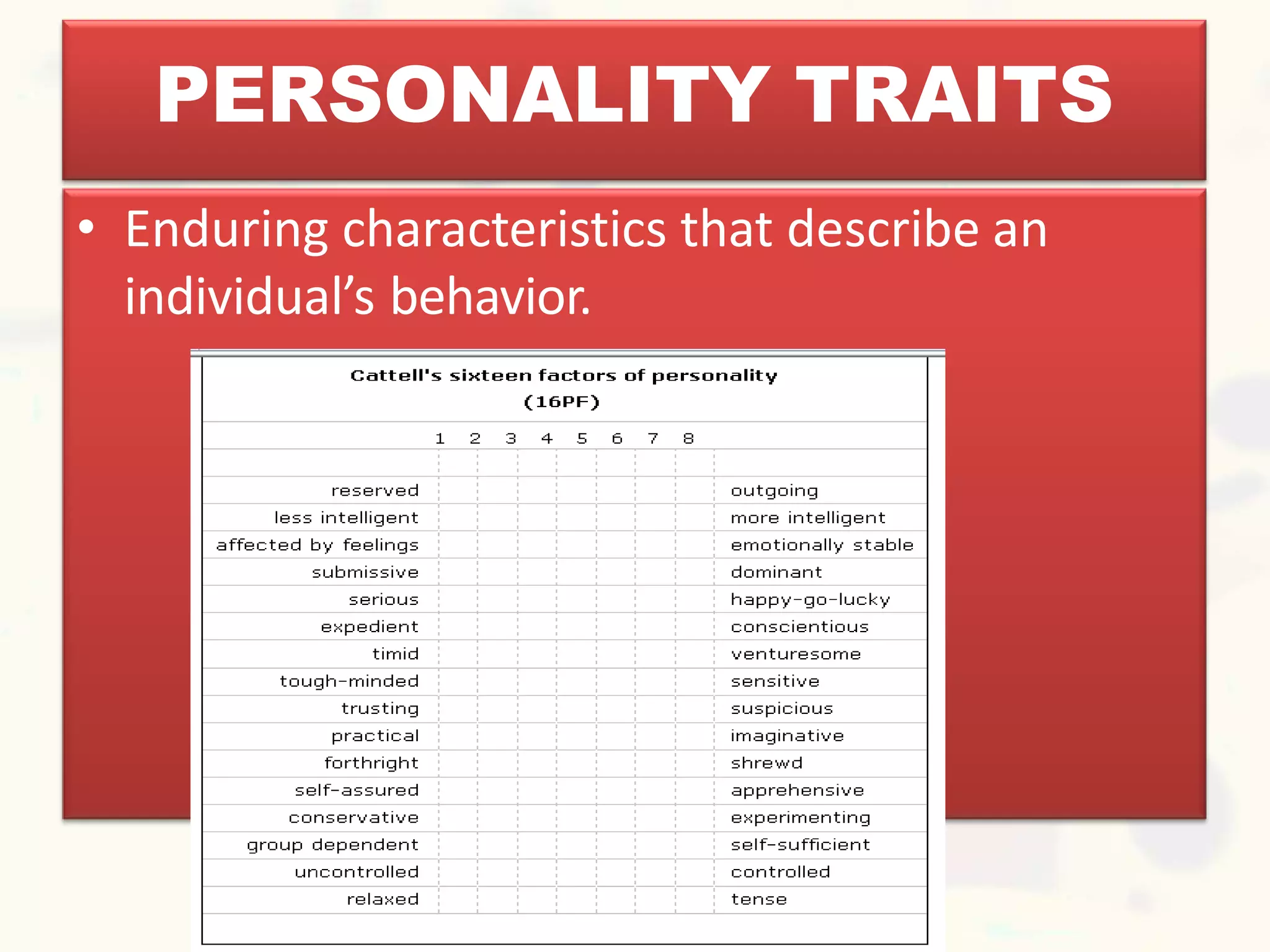
• Enduring characteristics that describe an
individual’s behavior.
PERSONALITY TRAITS
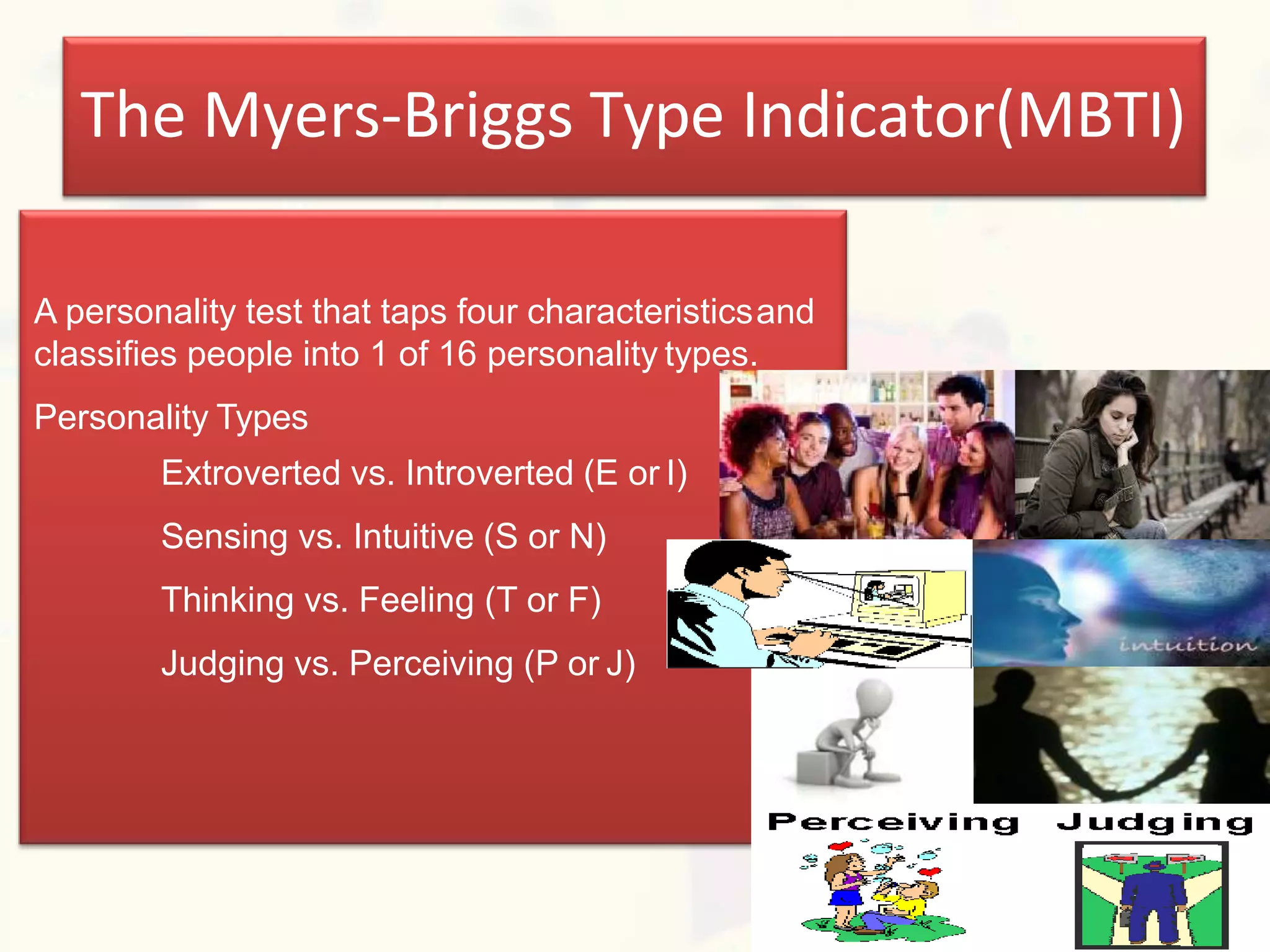
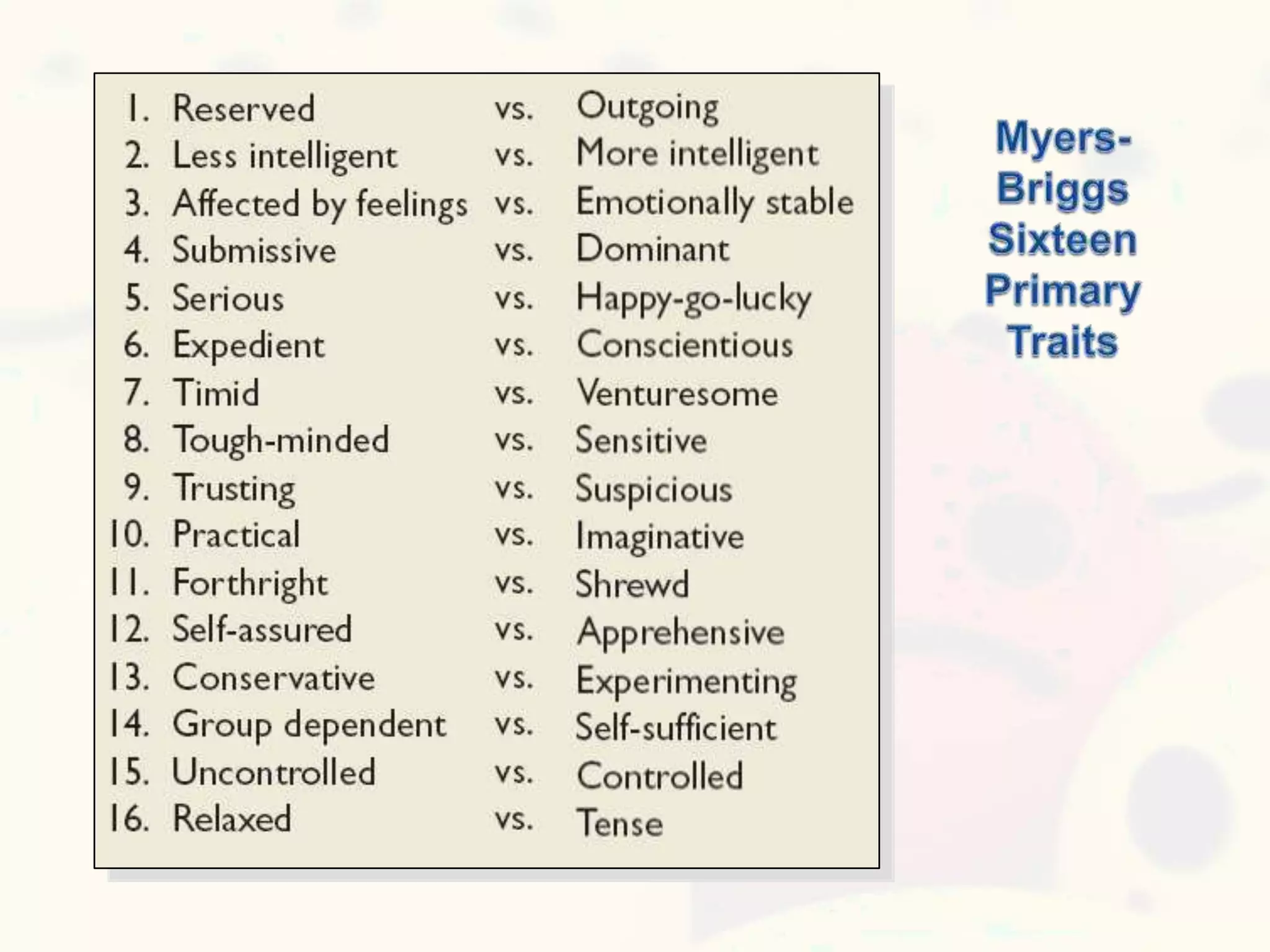
The Myers-Briggs Type Indicator(MBTI)
A personality test that taps four characteristicsand
classifies people into 1 of 16 personality types.
Personality Types
Extroverted vs. Introverted (E or I)
Sensing vs. Intuitive (S or N)
Thinking vs. Feeling (T or F)
Judging vs. Perceiving (P or J)
4–13
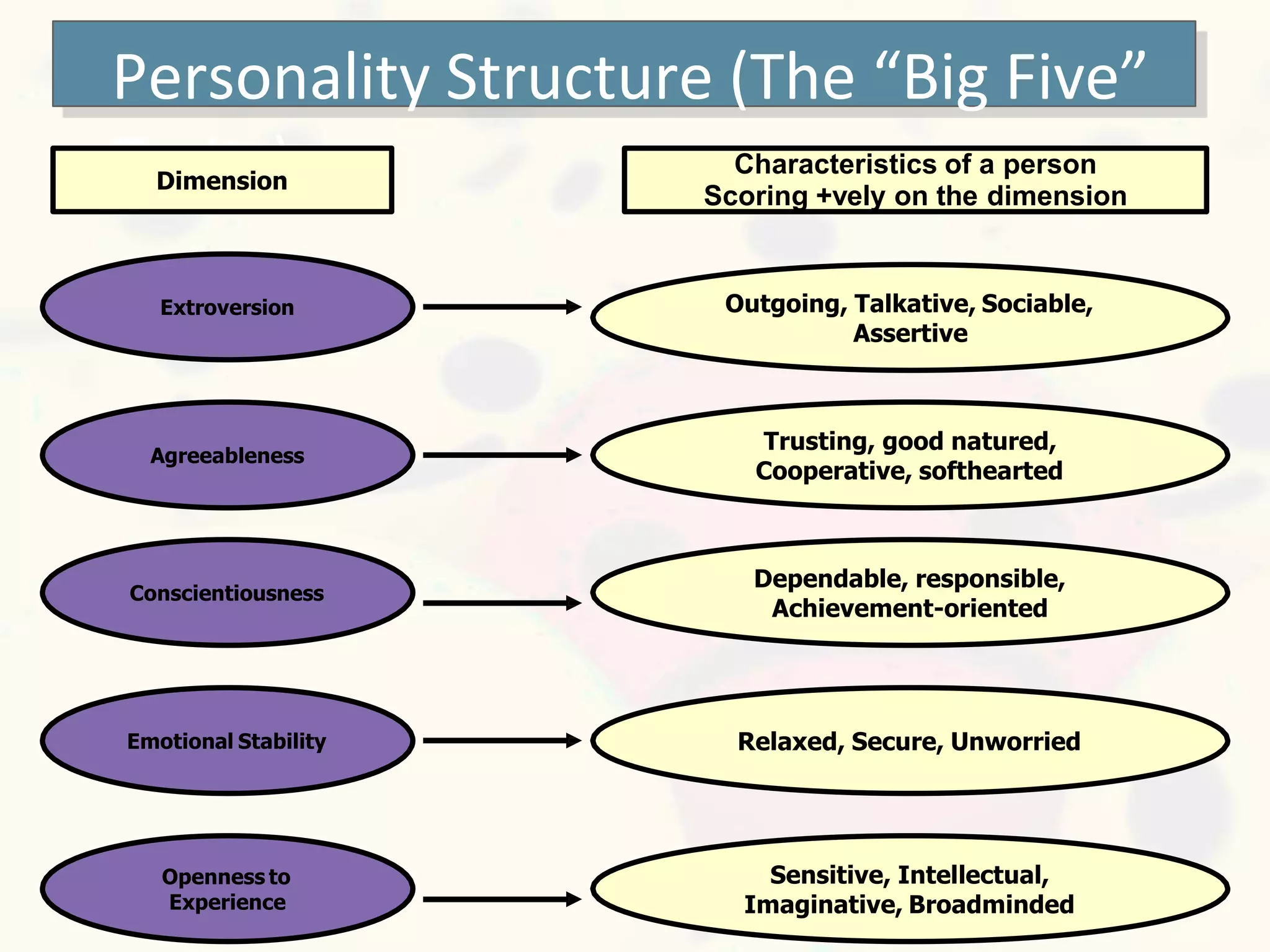
Personality Structure (The “Big Five”
Traits)
Dimension
Characteristics of a person
Scoring +vely on the dimension
Extroversion Outgoing, Talkative, Sociable,
Assertive
Agreeableness
Trusting, good natured,
Cooperative, softhearted
Dependable, responsible,
Achievement-oriented
Conscientiousness
Emotional Stability Relaxed, Secure, Unworried
Sensitive, Intellectual,
Imaginative, Broadminded
Openness to
Experience
4–12
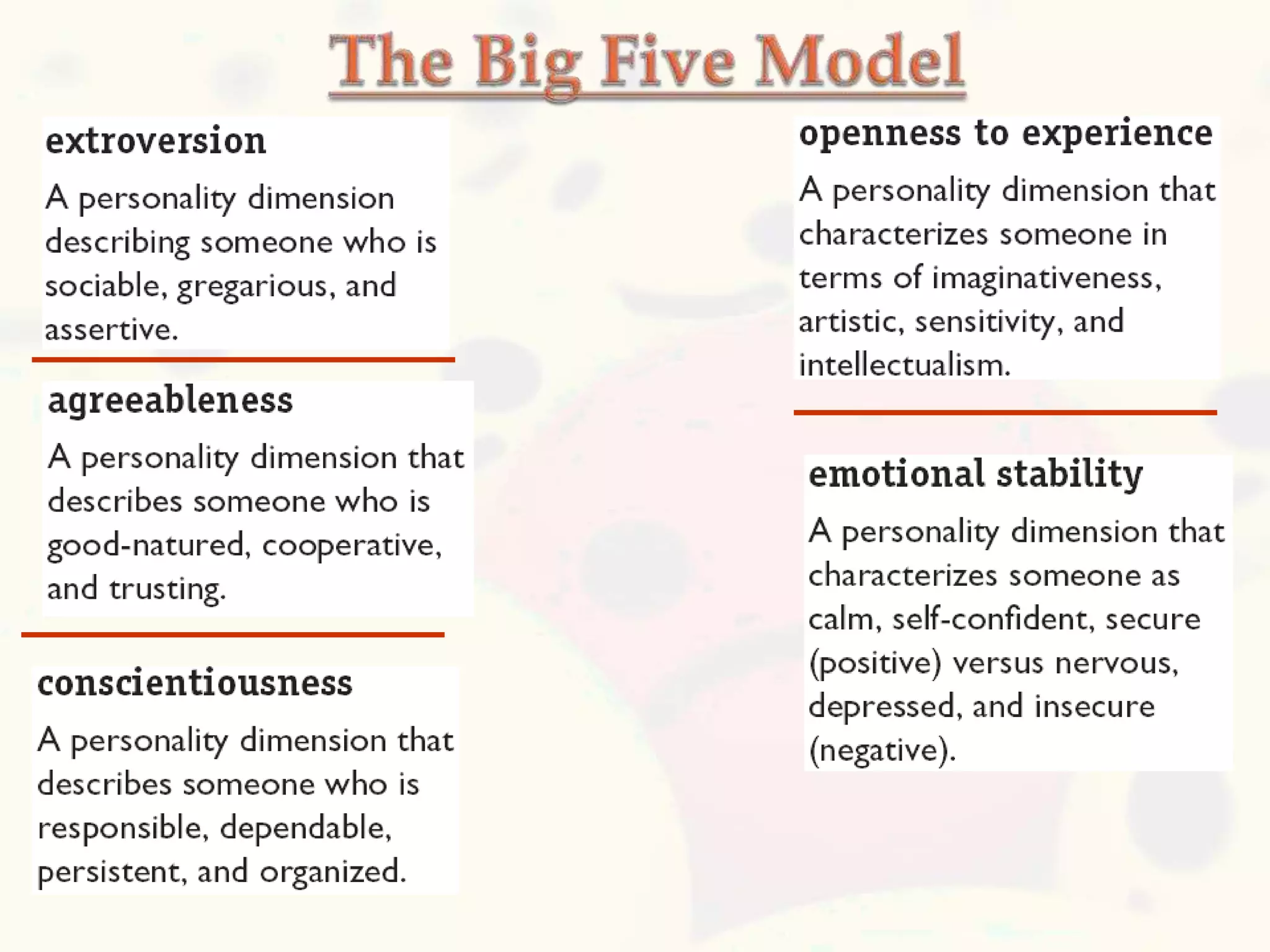
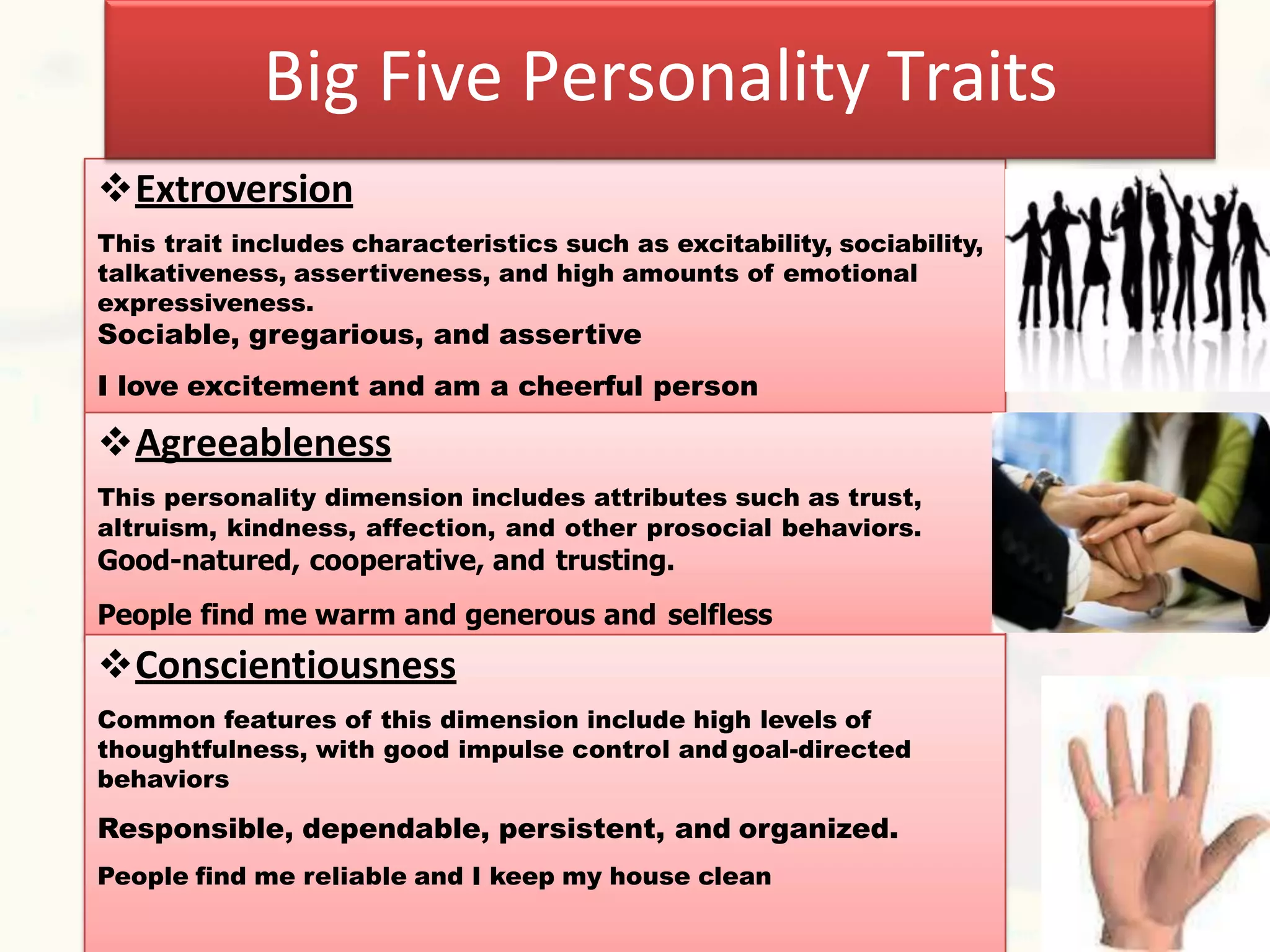
Extroversion
This trait includes characteristics such as excitability, sociability,
talkativeness, assertiveness, and high amounts of emotional
expressiveness.
Sociable, gregarious, and assertive
I love excitement and am a cheerful person
Agreeableness
This personality dimension includes attributes such as trust,
altruism, kindness, affection, and other prosocial behaviors.
Good-natured, cooperative, and trusting.
People find me warm and generous and selfless
Big Five Personality Traits
Conscientiousness
Common features of this dimension include high levels of
thoughtfulness, with good impulse control and goal-directed
behaviors
Responsible, dependable, persistent, and organized.
People find me reliable and I keep my house clean
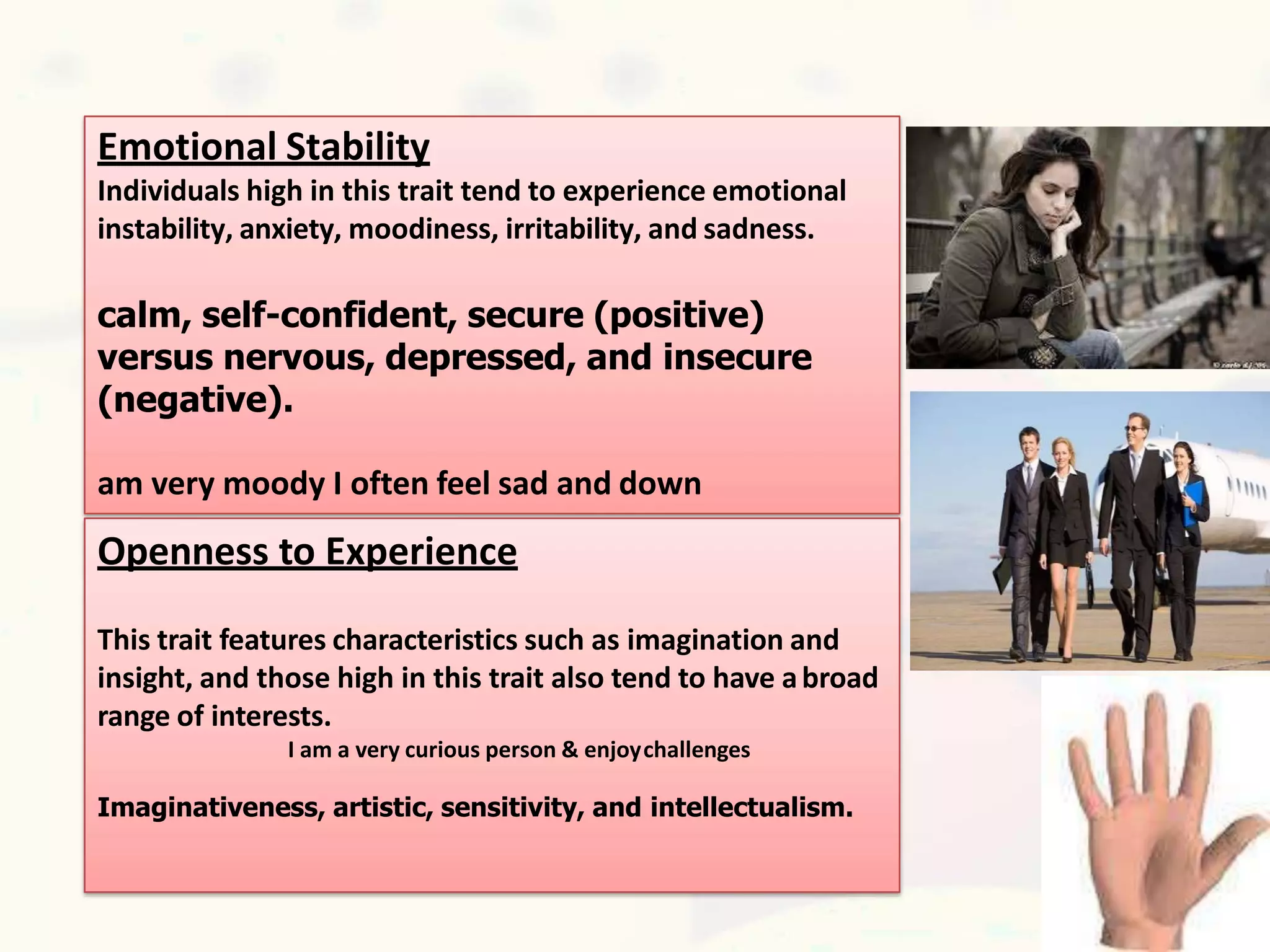
Emotional Stability
Individuals high in this trait tend to experience emotional
instability, anxiety, moodiness, irritability, and sadness.
calm, self-confident, secure (positive)
versus nervous, depressed, and insecure
(negative).
am very moody I often feel sad and down
Openness to Experience
This trait features characteristics such as imagination and
insight, and those high in this trait also tend to have abroad
range of interests.
I am a very curious person & enjoychallenges
Imaginativeness, artistic, sensitivity, and intellectualism.
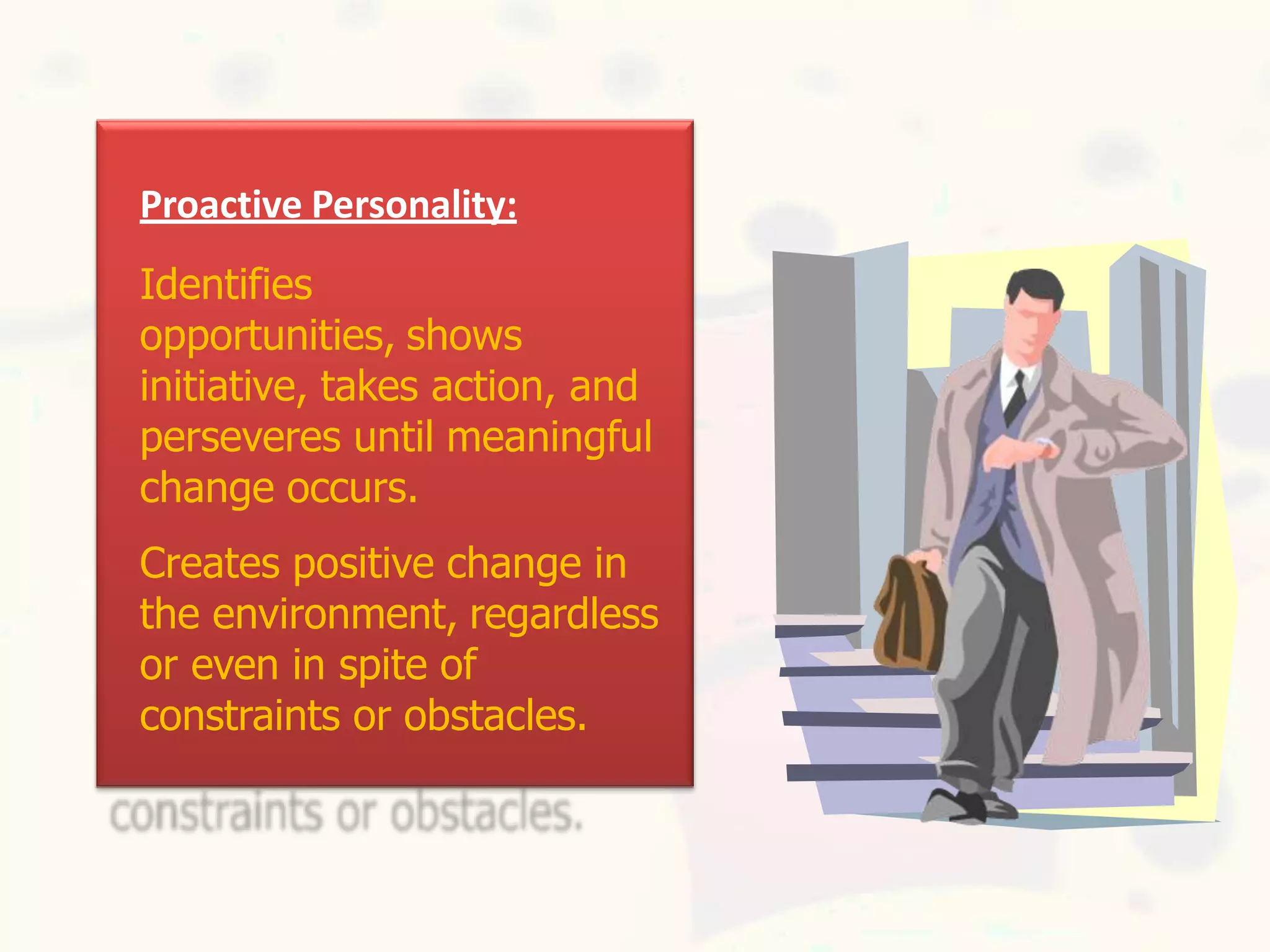
Proactive Personality:
Identifies
opportunities, shows
initiative, takes action, and
perseveres until meaningful
change occurs.
Creates positive change in
the environment, regardless
or even in spite of
constraints or obstacles.
Main assumptions of theories
• One: that personality traits are relatively stable and therefore
predictable over time
• Two: Personality traits are relatively stable across different
situations
• Three: trait theories take into account that personality
consists of a number of different traits, and that some people
have ‘more’ or ‘less’ of each trait than others
• Four: some traits are more closely interrelated than
other traits and tend to occur together
• Personality traits are described on a
continuum – showing either end of the trait.
• I.e. Confidence continuum
Strengths and Limitations of trait
theories
• Provide useful descriptions of personality and its
structure
• Provided the foundation of valid and reliable
personality devices
• Can lead people to accept and use oversimplified
classifications and descriptions
• Underestimate socio-cultural influences on
behaviour
Personality Theories, Types of Personalities and Traits.

Personality Theories, Types of Personalities and Traits.

  • 1.
    By Dr. H.S. ABZALBASHA, M.B.A., Ph.D. Assistant Professor, Department of Management Studies, G. Pullaiah College of Engineering & Technology, Kurnool.
  • 4.
    The word personalitycomes from the Latin word persona. In the ancient world, a persona was a mask worn by an actor. While we tend to think of a mask as being worn to conceal one's identity, the theatrical mask was originally used to either represent or project a specific personality trait of a character The sum total of ways in which an individual reacts and interacts with others. Personality is a pattern of stable states and characteristics of a person that influences his or her behavior toward goal achievement
  • 5.
    DEFINITION Personality -A relativelystable set of characteristics that influences an individual’s behavior
  • 6.
    Determinants of Personality Heredity Environment Situational Nature:It advocates that Part of personality finds its Origins in biology (heredity) Nature: It advocates that Part of personality finds its Origins in biology (heredity)
  • 7.
    Major Personality AttributesInfluencing OB Personality Traits Authoritative Locus of Control Machiavellianism Introverts/ Extroverts Self Esteem Risk taking Self-Monitoring Type A & B Achievement orientation
  • 8.
    Personality Types TYPE A 1.are always moving, walking, and eating rapidly; 2. feel impatient with the rate at which most events take place; 3. strive to think or do two or more things at once; 4. cannot cope with leisure time; 5. are obsessed with numbers, measuring their success in terms of how many or how much of everything they acquire. TYPE B 1. never suffer from a sense of time urgency with its accompanying impatience; 2. feel no need to display or discuss either their achievements or accomplishments; 3. play for fun and relaxation, rather than to exhibit their superiority at any cost; 4. can relax without guilt.
  • 12.
    PERSONALITY TRAITS • Apersonality trait is a personality characteristic that endures (lasts) over time and across different situations • Trait theories of personality focus on measuring, identifying and describing individual differences in personality in terms of traits • Focus is on what is different- not what is the same • Can be used to predict behaviour based on traits
  • 13.
    • Enduring characteristicsthat describe an individual’s behavior. PERSONALITY TRAITS
  • 14.
    The Myers-Briggs TypeIndicator(MBTI) A personality test that taps four characteristicsand classifies people into 1 of 16 personality types. Personality Types Extroverted vs. Introverted (E or I) Sensing vs. Intuitive (S or N) Thinking vs. Feeling (T or F) Judging vs. Perceiving (P or J)
  • 17.
    4–13 Personality Structure (The“Big Five” Traits) Dimension Characteristics of a person Scoring +vely on the dimension Extroversion Outgoing, Talkative, Sociable, Assertive Agreeableness Trusting, good natured, Cooperative, softhearted Dependable, responsible, Achievement-oriented Conscientiousness Emotional Stability Relaxed, Secure, Unworried Sensitive, Intellectual, Imaginative, Broadminded Openness to Experience
  • 18.
    4–12 Extroversion This trait includescharacteristics such as excitability, sociability, talkativeness, assertiveness, and high amounts of emotional expressiveness. Sociable, gregarious, and assertive I love excitement and am a cheerful person Agreeableness This personality dimension includes attributes such as trust, altruism, kindness, affection, and other prosocial behaviors. Good-natured, cooperative, and trusting. People find me warm and generous and selfless Big Five Personality Traits Conscientiousness Common features of this dimension include high levels of thoughtfulness, with good impulse control and goal-directed behaviors Responsible, dependable, persistent, and organized. People find me reliable and I keep my house clean
  • 19.
    Emotional Stability Individuals highin this trait tend to experience emotional instability, anxiety, moodiness, irritability, and sadness. calm, self-confident, secure (positive) versus nervous, depressed, and insecure (negative). am very moody I often feel sad and down Openness to Experience This trait features characteristics such as imagination and insight, and those high in this trait also tend to have abroad range of interests. I am a very curious person & enjoychallenges Imaginativeness, artistic, sensitivity, and intellectualism.
  • 20.
    Proactive Personality: Identifies opportunities, shows initiative,takes action, and perseveres until meaningful change occurs. Creates positive change in the environment, regardless or even in spite of constraints or obstacles.
  • 21.
    Main assumptions oftheories • One: that personality traits are relatively stable and therefore predictable over time • Two: Personality traits are relatively stable across different situations • Three: trait theories take into account that personality consists of a number of different traits, and that some people have ‘more’ or ‘less’ of each trait than others • Four: some traits are more closely interrelated than other traits and tend to occur together
  • 22.
    • Personality traitsare described on a continuum – showing either end of the trait. • I.e. Confidence continuum
  • 23.
    Strengths and Limitationsof trait theories • Provide useful descriptions of personality and its structure • Provided the foundation of valid and reliable personality devices • Can lead people to accept and use oversimplified classifications and descriptions • Underestimate socio-cultural influences on behaviour