P ersonal  L earning  E nvironments Rafael Scapin, Ph.D. Coordinator of Educational Technology Office of Instructional Development Dawson College
Index Course Management Systems (CMS) Web 2.0 and Changes in Learning Connectivism Introduction to PLEs Creating your PLE Conclusions References Questions
LMS/CMS In order to understand what a PLE is, let’s first analyze what a Course Management System (CMS) is. A Course Management System (CMS) is a web-based platform for delivering, tracking and managing courses online.  Examples:   Moodle, Sakai, Dokeos, ATutor ,  WebCT, BlackBoard, Desire2Learn Source: Wikipedia
LMS/CMS Characteristics Manage users, roles, courses, instructors, and facilities and generate reports  Course calendar  Learning Path  Student messaging and notifications  Assessment/testing capable of handling student pre/post testing  Display scores and transcripts  Grading of coursework  Web-based or blended course delivery  Source: Wikipedia
LMS/CMS Tools A CMS provides a collection of tools such as: assessment (particularly of types that can be marked automatically, such as multiple choice), communication,  uploading of content,  return of students' work,  peer assessment,  administration of student groups,  collecting and organizing student grades,  questionnaires, tracking tools, etc.  New features in these systems include wikis, blogs, RSS, e-portfolios and 3D virtual learning spaces.  Source: Wikipedia
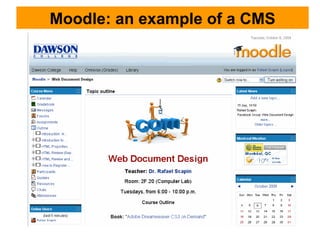
Moodle: an example of a CMS
Learning has changed! Old way  = linear, classroom based New way  = networks of people and online resources The way we find, store, create, critique, and share information has also changed: Information R/evolution
Learning has changed! It is not the development of technology per se which poses such a challenge to education systems and educational institutions… … but the changing ways in which people are using technologies to communicate and to learn and the accompanying social effect of such use A refusal to engage in these issues risks school becoming increasingly irrelevant to the  everyday lives of many young people
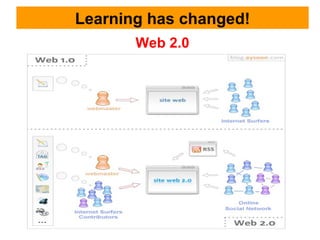
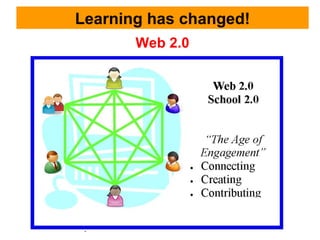
Learning has changed! Web 2.0 Emphasis on  online collaboration  and sharing among users Users are encouraged to  create  and manage information  Applications used entirely through a Web browser Social-networking aspects
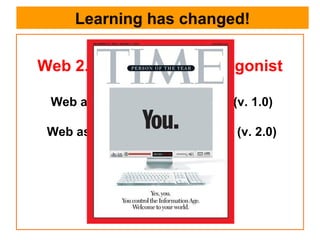
Learning has changed! Web 2.0: User is the Protagonist Web as an Information Source (v. 1.0) Web as a Participation Platform (v. 2.0)
Learning has changed! Web 2.0
Connectivism Learning is a process of connecting specialized nodes or information sources .  A learner can exponentially improve their own learning by plugging into an existing network.  Knowing  where to find information  is more important than knowing information.  George Siemens, Connectivism: A learning theory for today’s learner http://connectivism.ca/about.html
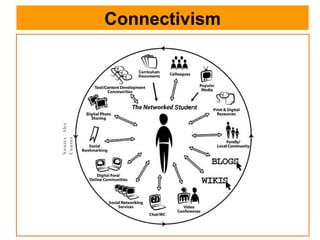
Connectivism Source: Alec Couros
Connectivism Information is changing constantly and located in so many places.  The ability to find, collect, connect and sort information among a multitude of human and computer networks is a  critical skill .  Mashup:   Web application that combines data from one or more sources into a single integrated tool.  http://thru-you.com/
PLE: Definition Personal Learning Environments (PLE)  are systems that help learners take control of and  manage their own learning .  This includes providing support for learners to set their own learning goals, manage their learning; managing both content and process  communicate with others in the process of learning  and thereby achieve learning goals. Source: Wikipedia
PLE: Definition A PLE is NOT: A specific software application   A method for creating e-learning applications
PLE: Definition A PLE is : A  concept  (based on Web 2.0 and social network) rather than specific software A  group of techniques   and a variety of tools: to gather information  explore/develop relationships between pieces of information  browser-based (potentially)
PLE: Definition A PLE is : An environment where you access learning from a variety of sources. A place where you do your own work. It’s not dependent on the university/school.   A collection of tools and systems, not a single monolithic system.  A collection of tools and systems chosen by each individual learner, rather than the university. More often than not these tools and systems will not be owned or maintained by the university.
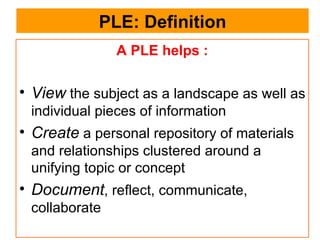
PLE: Definition A PLE helps : View  the subject as a landscape as well as individual pieces of information  Create  a personal repository of materials and relationships clustered around a unifying topic or concept  Document , reflect, communicate, collaborate
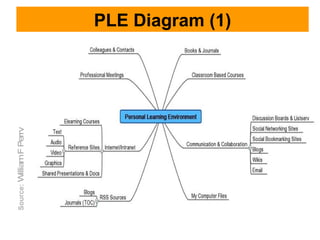
PLE Diagram (1) Source:   William F Perry
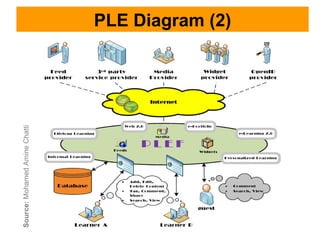
PLE Diagram (2) Source:  Mohamed Amine Chatti
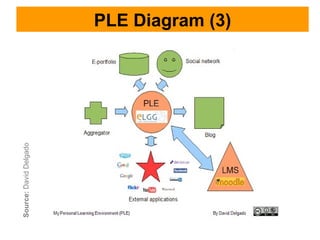
PLE Diagram (3) Source:  David Delgado
PLE: Definition In contrast to traditional LMS-driven e-learning solutions, a Personal Learning Environment (PLE) takes a more natural and  learner-centric approach  and is characterized by the freeform use of a set of lightweight services and tools that belong to and are controlled by individual learners.  (Mohamed Amine Chatti , 2009)
PLE: Definition Rather than integrating different services into a centralized system, the idea is to provide the learner with a plethora of different services and hand over control to her to select, use, and mashup the services the way she deems fit.  A PLE driven approach does not only provide personal spaces, which belong to and are controlled by the user, but also requires a social context by offering means to connect with other personal spaces for effective knowledge sharing and collaborative knowledge creation.  (Mohamed Amine Chatti , 2009)
How to Create a PLE A PLE can be implemented by using some free Web 2.0 services available online. Web Aggregators:  Netvibes PageFlakes iGoogle
How to Create a PLE You can also use a platform to create your own social network: Ning:   www.ning.com Elgg:   www.elgg.org
Conclusions “ PLEs are great. They’re just completely incompatible with the existing education system.”  Retrieved April 9, 2009 from: http://ltc.umanitoba.ca/wordpress/category/uncategorized/   Learning Technologies Centre Research Blog
Conclusions PLEs  are not another substantiation of educational technology but a new approach to learning. A response to pedagogic approaches which require that learner’s e-learning systems need to be under the control of the learners themselves. PLE are based on the idea that learning will take place in different contexts and situations and will not be provided by a single learning provider The idea of a Personal Learning Environment recognises that learning is continuing and seeks to provide tools to support that learning Source: Graham Attwell
Conclusions The ‘pedagogy’ behind the PLE is that it offers a portal to the world, through which learners can explore and create, according to their own interests and directions, interacting at all times with their friends and community New forms of learning are based on trying things and action, rather than on more abstract knowledge. Source: Graham Attwell
References Connectivist Learning and the Personal Learning Environment   (by Stephen Downes): Slideshare Networked Possibilities  (by Alec Couros):  Slideshare Colletion of PLE Diagrams:   http://edtechpost.wikispaces.com/PLE+Diagrams History of Personal Learning Environments   (Wikipedia) Personal Learning Environments - the future of eLearning?   (Article by Graham Attwell)
Questions
Contact Rafael Scapin Coordinator of Educational Technology Office of Instructional Development  (Dawson College) E-mail:   [email_address] Phone:  (514) 931 8731  ext 1404 Skype:  rscapin MSN:   [email_address] Twitter:  rscapin
Contact This presentation is available at: http://www.slideshare.net/oid

Personal Learning Environments

  • 1.
    P ersonal L earning E nvironments Rafael Scapin, Ph.D. Coordinator of Educational Technology Office of Instructional Development Dawson College
  • 2.
    Index Course ManagementSystems (CMS) Web 2.0 and Changes in Learning Connectivism Introduction to PLEs Creating your PLE Conclusions References Questions
  • 3.
    LMS/CMS In orderto understand what a PLE is, let’s first analyze what a Course Management System (CMS) is. A Course Management System (CMS) is a web-based platform for delivering, tracking and managing courses online. Examples: Moodle, Sakai, Dokeos, ATutor , WebCT, BlackBoard, Desire2Learn Source: Wikipedia
  • 4.
    LMS/CMS Characteristics Manageusers, roles, courses, instructors, and facilities and generate reports Course calendar Learning Path Student messaging and notifications Assessment/testing capable of handling student pre/post testing Display scores and transcripts Grading of coursework Web-based or blended course delivery Source: Wikipedia
  • 5.
    LMS/CMS Tools ACMS provides a collection of tools such as: assessment (particularly of types that can be marked automatically, such as multiple choice), communication, uploading of content, return of students' work, peer assessment, administration of student groups, collecting and organizing student grades, questionnaires, tracking tools, etc. New features in these systems include wikis, blogs, RSS, e-portfolios and 3D virtual learning spaces. Source: Wikipedia
  • 6.
  • 7.
    Learning has changed!Old way = linear, classroom based New way = networks of people and online resources The way we find, store, create, critique, and share information has also changed: Information R/evolution
  • 8.
    Learning has changed!It is not the development of technology per se which poses such a challenge to education systems and educational institutions… … but the changing ways in which people are using technologies to communicate and to learn and the accompanying social effect of such use A refusal to engage in these issues risks school becoming increasingly irrelevant to the everyday lives of many young people
  • 9.
    Learning has changed!Web 2.0 Emphasis on online collaboration and sharing among users Users are encouraged to create and manage information Applications used entirely through a Web browser Social-networking aspects
  • 10.
    Learning has changed!Web 2.0: User is the Protagonist Web as an Information Source (v. 1.0) Web as a Participation Platform (v. 2.0)
  • 11.
  • 12.
  • 13.
    Connectivism Learning isa process of connecting specialized nodes or information sources . A learner can exponentially improve their own learning by plugging into an existing network. Knowing where to find information is more important than knowing information. George Siemens, Connectivism: A learning theory for today’s learner http://connectivism.ca/about.html
  • 14.
  • 15.
    Connectivism Information ischanging constantly and located in so many places. The ability to find, collect, connect and sort information among a multitude of human and computer networks is a critical skill . Mashup: Web application that combines data from one or more sources into a single integrated tool. http://thru-you.com/
  • 16.
    PLE: Definition PersonalLearning Environments (PLE) are systems that help learners take control of and manage their own learning . This includes providing support for learners to set their own learning goals, manage their learning; managing both content and process communicate with others in the process of learning and thereby achieve learning goals. Source: Wikipedia
  • 17.
    PLE: Definition APLE is NOT: A specific software application A method for creating e-learning applications
  • 18.
    PLE: Definition APLE is : A concept (based on Web 2.0 and social network) rather than specific software A group of techniques and a variety of tools: to gather information explore/develop relationships between pieces of information browser-based (potentially)
  • 19.
    PLE: Definition APLE is : An environment where you access learning from a variety of sources. A place where you do your own work. It’s not dependent on the university/school. A collection of tools and systems, not a single monolithic system. A collection of tools and systems chosen by each individual learner, rather than the university. More often than not these tools and systems will not be owned or maintained by the university.
  • 20.
    PLE: Definition APLE helps : View the subject as a landscape as well as individual pieces of information Create a personal repository of materials and relationships clustered around a unifying topic or concept Document , reflect, communicate, collaborate
  • 21.
    PLE Diagram (1)Source: William F Perry
  • 22.
    PLE Diagram (2)Source: Mohamed Amine Chatti
  • 23.
    PLE Diagram (3)Source: David Delgado
  • 24.
    PLE: Definition Incontrast to traditional LMS-driven e-learning solutions, a Personal Learning Environment (PLE) takes a more natural and learner-centric approach and is characterized by the freeform use of a set of lightweight services and tools that belong to and are controlled by individual learners. (Mohamed Amine Chatti , 2009)
  • 25.
    PLE: Definition Ratherthan integrating different services into a centralized system, the idea is to provide the learner with a plethora of different services and hand over control to her to select, use, and mashup the services the way she deems fit. A PLE driven approach does not only provide personal spaces, which belong to and are controlled by the user, but also requires a social context by offering means to connect with other personal spaces for effective knowledge sharing and collaborative knowledge creation. (Mohamed Amine Chatti , 2009)
  • 26.
    How to Createa PLE A PLE can be implemented by using some free Web 2.0 services available online. Web Aggregators: Netvibes PageFlakes iGoogle
  • 27.
    How to Createa PLE You can also use a platform to create your own social network: Ning: www.ning.com Elgg: www.elgg.org
  • 28.
    Conclusions “ PLEsare great. They’re just completely incompatible with the existing education system.” Retrieved April 9, 2009 from: http://ltc.umanitoba.ca/wordpress/category/uncategorized/ Learning Technologies Centre Research Blog
  • 29.
    Conclusions PLEs are not another substantiation of educational technology but a new approach to learning. A response to pedagogic approaches which require that learner’s e-learning systems need to be under the control of the learners themselves. PLE are based on the idea that learning will take place in different contexts and situations and will not be provided by a single learning provider The idea of a Personal Learning Environment recognises that learning is continuing and seeks to provide tools to support that learning Source: Graham Attwell
  • 30.
    Conclusions The ‘pedagogy’behind the PLE is that it offers a portal to the world, through which learners can explore and create, according to their own interests and directions, interacting at all times with their friends and community New forms of learning are based on trying things and action, rather than on more abstract knowledge. Source: Graham Attwell
  • 31.
    References Connectivist Learningand the Personal Learning Environment (by Stephen Downes): Slideshare Networked Possibilities (by Alec Couros): Slideshare Colletion of PLE Diagrams: http://edtechpost.wikispaces.com/PLE+Diagrams History of Personal Learning Environments (Wikipedia) Personal Learning Environments - the future of eLearning? (Article by Graham Attwell)
  • 32.
  • 33.
    Contact Rafael ScapinCoordinator of Educational Technology Office of Instructional Development (Dawson College) E-mail: [email_address] Phone: (514) 931 8731 ext 1404 Skype: rscapin MSN: [email_address] Twitter: rscapin
  • 34.
    Contact This presentationis available at: http://www.slideshare.net/oid