IJRET: International Journal of Research in Engineering and Technology eISSN: 2319-1163 | pISSN: 2321-7308
_______________________________________________________________________________________________
Volume: 03 Issue: 05 | May-2014, Available @ http://www.ijret.org 517
PERIODIC IMPULSIVE NOISE REDUCTION IN OFDM BASED
POWER LINE COMMUNICATION
Sumi Mathew1
, Prasanth Murukan2
1
M.Tech Scholar, ECE Department, NCERC, Thrissur, Kerala, India
2
Asst. Professor, ECE Department, NCERC, Thrissur, Kerala, India
Abstract
Different communication technologies are used for the transmission of information such as wireless communication, satellite
communication etc. Power Line Communication (PLC) is one of the technologies using existing power cables for the transmission
of information. Power cables are not designed for data transmission. So the PLC environment contains different types of noise.
This paper presents a novel approach for removing periodic impulsive noise from OFDM based power line communication
system. The noise is detected using periodic impulsive noise detection algorithm and the noise is filtered by using adaptive notch
filter. An adaptive filter using LMS algorithm is also designed to suppress periodic impulsive noise. Then compare the Bit Error
Rate (BER) of PLC system without noise filtering, with noise filtering using notch filter and with noise filtering using adaptive
filtering based on LMS algorithm. Results show that the received data is same as that of input data which is transmitted.
Simulation results shows that PLC system after noise filtering gives better results than PLC system without noise filtering.
Key Words: CP (Cyclic Prefix), OFDM, PLC, Periodic Impulsive Noise
---------------------------------------------------------------------***---------------------------------------------------------------------
1. INTRODUCTION
Power Line Communication (PLC) is like any other
communication technologies, i.e, the transmitter modulates
the data before transmission, injects into the channel (power
line channel), and the receiver demodulates the data. PLC
does not require additional cables. It re-uses existing power
cables. Recently the power line communications has been
receiving widespread attention due to its applications in
smart grid (such as automatic meter reading, vehicle to grid
communications), micro inverters, traffic light control,
building automation etc. Power line communication is a
leading technology which uses existing cables for
transmission of signals. So installation cost is less than other
communication approaches. But power cables are originally
designed for supplying power to the electrical appliances.
These electrical appliances also produce noise. The noises in
the low voltage power line has been categorized into five
general classes [1] such as:- coloured background noise;
narrowband noise; periodic impulsive noise asynchronous to
main frequency; periodic impulsive noise synchronous to
main frequency; asynchronous impulsive noise. Coloured
background noise and narrowband noise can be summarized
as background noise. The other noises are impulsive noises
produced by the electrical appliances. i.e, the power line
noises are the summation of background noise and
impulsive noises. The periodic impulsive noises remain
stationary over periods of seconds, minutes or even hours.
This periodic impulsive noise interfered with the transmitted
OFDM signals affect the system performance. So these
impulsive noises must be removed to improve the
performance of the PLC system [2]. OFDM is a multi carrier
modulation technique which is adaptable for several channel
conditions. So the PLC system uses OFDM modulation for
reliable power line communication.
2. OFDM SYSTEM FOR PLC
The OFDM system consist of transmitter section, channel
and receiver section.
OFDM is a multi carrier modulation technique in which the
available spectrum is divided into several sub carriers. It is
based on orthogonality property which allows the
subcarriers are orthogonal to each other. Therefore the cross
talk between co channels can be eliminated. The main
advantage of OFDM over single carrier modulation is its
robustness to narrowband interference and its adaptability to
several channel conditions [3]. Figure 1 shows the OFDM
system for PLC.
2.1 Transmitter
The input bit stream is randomly generated and transmitted
through the OFDM transmitter. Some redundant bits are
added with the generated bit stream for coding purposes. It
is used for error detection and correction. In OFDM system
several coding techniques are used such as block codes,
convolution codes, turbo codes etc. In this system
convolutional coding is used for coding the input data. The
known symbols (also known as pilot symbols) are added
with the OFDM transmitted signals. By using Inverse Fast
Fourier Transform (IFFT) the transmitted data is converted
into orthogonal streams. Cyclic Prefix is inserted to prevent
interference between two overlapping channels. It also
reduces inter symbol interference. This OFDM symbol is
transmitted through the power line channel which contains
noise.
IJRET: International Journal of Research in Engineering and Technology eISSN: 2319-1163 | pISSN: 2321-7308
_______________________________________________________________________________________________
Volume: 03 Issue: 05 | May-2014, Available @ http://www.ijret.org 518
Fig-1: OFDM System for PLC
2.2 Power Line Channel
The data is transmitted through power line channel. Like
any other communication systems, PLC channel also
contains internal and external noise or disturbances. Channel
noise varies with load, frequency, geographic locations etc.
These noise removal technique will be explained later.
Power lines noises are classified into five categories [4].
 Coloured background noise-It is caused by
summation of multiple sources of noises with low
power. Its power spectral density decreases with
increasing frequencies.
 Narrow band noise-consists of amplitude modulated
sinusoidal signals which is caused by broadcasters,
radio stations etc.
 Periodic impulsive noise asynchronous to mains
frequency-It is a kind of impulsive noise which is
caused by switched-mode power supplies.
 Periodic impulsive noise synchronous to mains
frequency-which is mainly caused by switching
actions of rectifier diodes found in many electrical
appliances.
 Asynchronous impulsive noise-which caused by
switching transients in the power network. First two
types summarized as background noise and last three
types summarized as impulsive noises.
2.3 Receiver
At the receiver the inverse process is performed. The cyclic
prefix is removed and signal is transformed into frequency
domain using Fast Fourier Transform (FFT). Then pilot
symbols are removed and demodulated. After that the data is
decoded to produce the output data. Then the signals are
demodulated to produce the output data. The received data
must be same as that of the transmitted data without any bit
error.
3. PERIODIC IMPULSIVE NOISE DETECTION
ALGORITHM
The received signal consists of signal, background noise and
impulsive noise. Signal is transmitted data from the
transmitter, background noise can be modelled as white
Gaussian noise (WGN), and the periodic impulsive noise is
the dominant impulsive noise. The periodic impulsive noise
is interfered with the transmitted signal and causes the
performance of the PLC system [5]. This system is a simple
and effective method to remove this periodic impulsive
noise in the frequency domain. By mitigating the impulsive
noise, the system performance improves.
First step is to detect the presence of noise. The periodic
impulsive noise interfered in N symbols are almost the
same, because the periodic impulsive noises remain
stationary over periods of seconds, minutes or even hours.
The OFDM signals are sent to the detection algorithm to
detect the presence of noise. The OFDM signals are
converted into frequency domain using FFT. These signals
are given to the noise detection algorithm. A threshold value
[6] is set and maximum values of the signals are calculated.
If the maximum value is greater than threshold value, then
the presence of periodic impulsive noise is confirmed.
Otherwise we can confirm that the noise is not interfered
with the signal. After detecting the presence of noise, the
next step is to design an adaptive notch filter. Notch filter is
also called as narrow band reject filter. It is commonly used
for the rejection of single frequency such as 60 Hz power
line hum. Notch filter plays an important role in
communications for eliminating undesired frequencies. An
adaptive notch filter is designed to suppress the periodic
impulsive noise. If the periodic impulsive noise is detected,
the notch filter, filtered the frequencies above a particular
threshold value, otherwise it is bypassed. It is an effective
method to filter the periodic impulsive noise from the power
line communication.
4. ADAPTIVE LMS FILTERING
Adaptive filters are filters whose tap weight vectors vary
with time. The principles of adaptive filter are also known as
adaptive noise canceller (ANC).In this filter reference signal
is adaptively filtered and it is subtracted with input signal
produces the estimated signal. The OFDM transmitted
signals are interfered with periodic impulsive noise when
signals are transmitted through the power line cables. These
corrupted signals can be recovered by using the adaptive
filtering using Least Mean Square (LMS) algorithm[7].
Figure 2 shows the adaptive noise cancellation system. By
using adaptive filtering the BER of PLC system reduces and
thus system performance improves.
IJRET: International Journal of Research in Engineering and Technology eISSN: 2319-1163 | pISSN: 2321-7308
_______________________________________________________________________________________________
Volume: 03 Issue: 05 | May-2014, Available @ http://www.ijret.org 519
Fig-2: Adaptive Noise Cancellation System
Adaptive filters are self learning filters which do not require
any prior knowledge about the input signal. Adaptive noise
cancellation system consists of two inputs such as primary
input signal d(n) and reference input signal x(n). The desired
transmitted signal d(n) corrupted with periodic impulsive
noise and x(n) is the reference signal which is the undesired
noise must be filtered out of the system. The adaptive filter
using LMS algorithm filtered the undesired noise and
produce the uncorrupted signal.
e(n) = s(n) + x1(n)- y(n)------(1)
Then the output y(n) is subtracted from the primary input to
produce the system output e(n).
4.1 LMS Algorithm
Adaptive filter using LMS algorithm is used for cancelling
the noise which is interfered with transmitted OFDM signal.
The algorithm is as follows:-
1) Initialize the algorithm by setting all filter
coefficients to zero.
2) Estimation error is calculated by subtracting the
desired signal d(n) with filtered signal y(n)
e(n) = d(n) - y(n)-------------------------(2)
3) Updated estimate is the summation of old estimate
and product of adaptation costant ,estimation error
and tap input.
wi(n+1) = wi(n) + mu*e(n)*u(n-i)-----(3)
4) (4) constitutes the filteration process.
y(n)= wi(n)*u(n-i)----------------------(4)
5) Increment the iteration number N by one, go to back
to step 2, and repeat the computation. Figure 3 shows
the flow chart of adaptive filter using LMS
algorithm.
Fig-3: Flowchart of Adaptive LMS Algorithm
5. SIMULATION RESULTS
Simulation is done in MATLAB. The input bit stream is
randomly generated at the transmitted end. Error detection
and correction techniques are essential for reliable
communication over noisy channel [8]. Convolution coding
is used for coding the input bit stream. Convolution codes
are one of the powerful and efficient error correcting codes
for detecting and correcting burst errors. Figure 4 shows the
randomly generated input data.
IJRET: International Journal of Research in Engineering and Technology eISSN: 2319-1163 | pISSN: 2321-7308
_______________________________________________________________________________________________
Volume: 03 Issue: 05 | May-2014, Available @ http://www.ijret.org 520
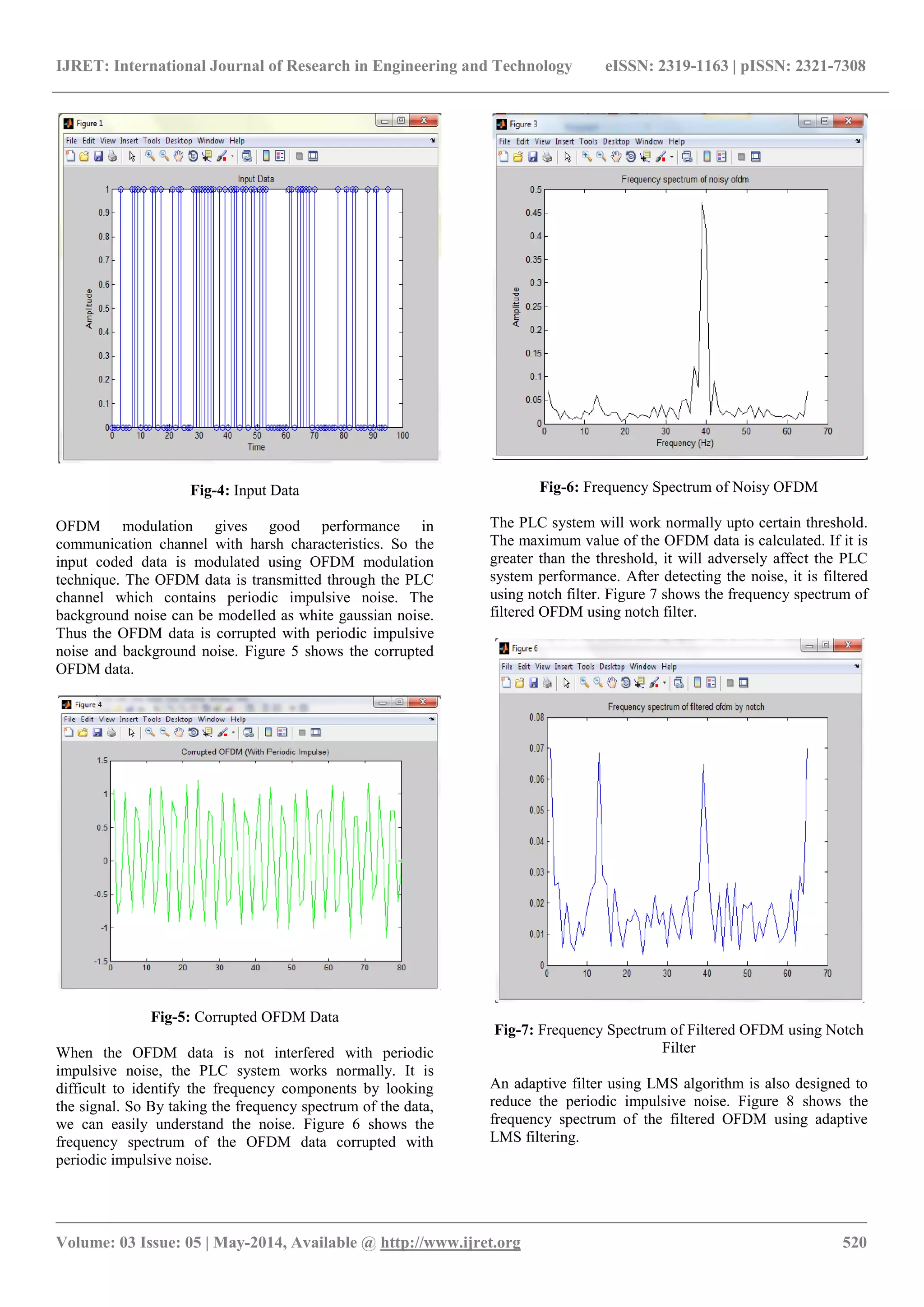
Fig-4: Input Data
OFDM modulation gives good performance in
communication channel with harsh characteristics. So the
input coded data is modulated using OFDM modulation
technique. The OFDM data is transmitted through the PLC
channel which contains periodic impulsive noise. The
background noise can be modelled as white gaussian noise.
Thus the OFDM data is corrupted with periodic impulsive
noise and background noise. Figure 5 shows the corrupted
OFDM data.
Fig-5: Corrupted OFDM Data
When the OFDM data is not interfered with periodic
impulsive noise, the PLC system works normally. It is
difficult to identify the frequency components by looking
the signal. So By taking the frequency spectrum of the data,
we can easily understand the noise. Figure 6 shows the
frequency spectrum of the OFDM data corrupted with
periodic impulsive noise.
Fig-6: Frequency Spectrum of Noisy OFDM
The PLC system will work normally upto certain threshold.
The maximum value of the OFDM data is calculated. If it is
greater than the threshold, it will adversely affect the PLC
system performance. After detecting the noise, it is filtered
using notch filter. Figure 7 shows the frequency spectrum of
filtered OFDM using notch filter.
Fig-7: Frequency Spectrum of Filtered OFDM using Notch
Filter
An adaptive filter using LMS algorithm is also designed to
reduce the periodic impulsive noise. Figure 8 shows the
frequency spectrum of the filtered OFDM using adaptive
LMS filtering.
IJRET: International Journal of Research in Engineering and Technology eISSN: 2319-1163 | pISSN: 2321-7308
_______________________________________________________________________________________________
Volume: 03 Issue: 05 | May-2014, Available @ http://www.ijret.org 521
Fig-8: Frequency Spectrum of Filtered OFDM using LMS
Filtering
After filtering the periodic impulsive noise, the OFDM data
is demodulated to produce the output data. The output bit
stream is same as that of input bit stream without any BER.
Figure 9 shows the output data after notch filtering. Figure
10 shows the output data after adaptive LMS filtering.
Fig-9: Received Data using Notch Filter.
Fig-10: Received Data after Adaptive LMS Filtering
The input data stream is divided into parallel data streams
using IFFT and match filtering of subcarriers is done by
using FFT. Channel coding and channel estimation is done
before IFFT and FFT, which improves BER performance of
the PLC system.
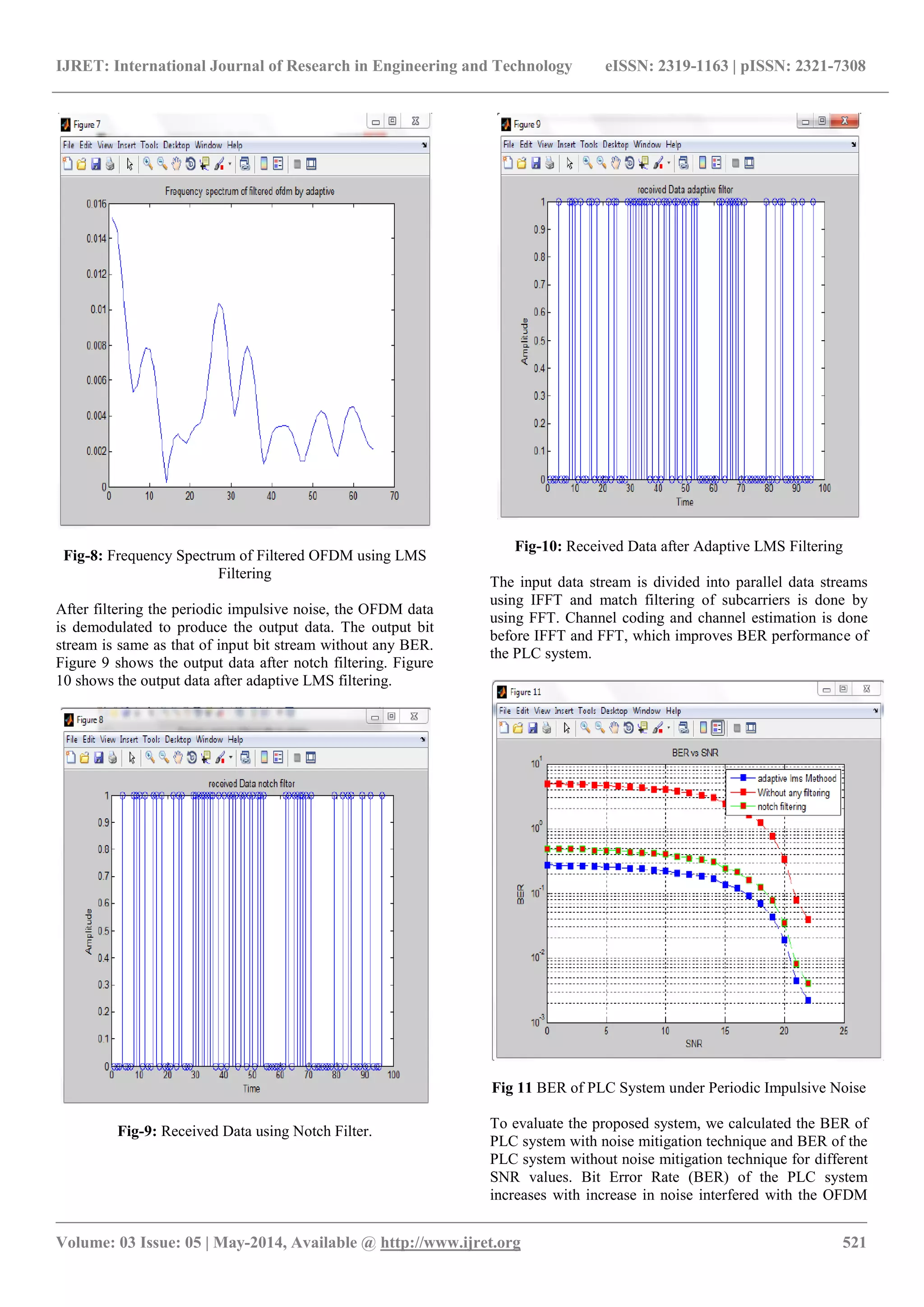
Fig 11 BER of PLC System under Periodic Impulsive Noise
To evaluate the proposed system, we calculated the BER of
PLC system with noise mitigation technique and BER of the
PLC system without noise mitigation technique for different
SNR values. Bit Error Rate (BER) of the PLC system
increases with increase in noise interfered with the OFDM
IJRET: International Journal of Research in Engineering and Technology eISSN: 2319-1163 | pISSN: 2321-7308
_______________________________________________________________________________________________
Volume: 03 Issue: 05 | May-2014, Available @ http://www.ijret.org 522
data. The bit error rate (BER) is the percentage of bits that
have errors relative to the total number of bits received.
Fig 11 shows the BER of the PLC system under periodic
impulsive noise. Red colour represents without any filtering,
light green colour represents with filtering using notch filter
and blue colour represents with filtering using adaptive
LMS filtering . Simulation results shows that BER rate of
the PLC system with noise mitigation technique is decreased
than BER of the PLC system without noise mitigation
algorithm. BER of PLC system using adaptive LMS filtering
is decreased than BER of PLC system using notch filter.
Thus these filtering techniques can be used to mitigate the
periodic impulsive noise from the power line
communication system. The proposed algorithm is a simple
and effective method for mitigating periodic impulsive noise
from the power line communication channel and thus it
improves the performance of the PLC system
6. CONCLUSIONS
The main objective of the paper is to reduce the effect of
periodic impulsive noise in the Power Line Communication
channel. First the presence of periodic impulsive noise is
detected and then an adaptive notch filter is designed to
mitigate the impulsive noise which is interfered with the
OFDM data. Then an adaptive LMS filter is designed and
suppress the noise. Simulation results shows that proposed
algorithm gives better performance than conventional PLC
system. i.e, BER of PLC system with filtering is decreased
than BER of PLC system without filtering. Adaptive LMS
algorithm can be used for effectively remove the periodic
impulsive noise.
ACKNOWLEDGEMENTS
I would like to thank all faculty members of ECE
department, Nehru College of Engineering and Research
Centre, Thrissur, Kerala for the guidance and support
throughout the project work.
REFERENCES
[1]. M. Zimmermann and K. Dosert, “Analysis and
modelling of impulsive noise in broadband power line
communications, “IEEE Trans. Electromagn.Compat., Vol
44,pp 249-258,February 2002.
[2]. G.Ndo, P.Sihon, and M.H Hamon, “Adaptive noise
mitigation in impulsive environment : Application to power
line communication,”IEEE Transactions on Power Delivery.
Vol 25, pp647-656,April 2010.
[3]. A.Mengi, A.J Han Vink, ”Successive impulsive noise
suppression in OFDM” in Proc. IEEE.ISPLC, pp 33-37
March 2010.
[4]. H.Meng, Y.L.Guan and S.Chen, Modelling and analysis
of noise effects on broadband power line communications,
IEEE Transactions on Power Delivery, pp 14-21,April 2006.
[5]. Gaofeng Ren, Shushan Qiao, Huidong Zhao,
Chundyang Li and Yong Hei, “Mitigation of periodic
impulsive noise in OFDM based power line
communications, IEEE Transactions on Power Delivery,
Vol 28,825-834,April 2013.
[6]. Y.C.Kim, J.Y.Kim,” Novel noise reduction scheme for
power line communication systems with smart grid
applications” in Proc. IEEE.ICCE, pp 791-792, Jan 2011
[7]. Ondraka J, Oravec R, K adlec J, Cochereova E, “
Simulation Of RLS And LMS Algorithm For Adaptive
Noise Cancellation In MATLAB”, Department Of
Radioelectronics, Bratislava, Slovak Republic
[8]. Mario Bogdanovic, “Computer based simulation model
realization of OFDM communication over power lines”,
20th TELFOR, pp 249-252, Nov. 2012.
BIOGRAPHIES
Sumi Mathew was born in Kerala, India, in 1990. She
received the B.Tech degree in electronics
and communication Engineering from
CUSAT university, India, in 2012 and is
currently pursuing M.Tech degree in
applied electronics and communication
system at Nehru College of Engineering
and Research Centre, Kerala, India. Her
research interests include power line communication,
modulation techniques, and wireless communication.
Prasanth Murukan received B.Tech Degree in electronics
and communication engineering from University of Kerala,
India in 2008 and M.E degree in applied electronics from
Sardar Raja College Of Engineering, Tirunelveli,
Tamilnadu, India in 2012. Currently, he is professor in
electronics and communication system at Nehru College of
Engineering and Research Centre, Thrissur, Kerala, India.

Periodic impulsive noise reduction in ofdm based power line communication

  • 1.
    IJRET: International Journalof Research in Engineering and Technology eISSN: 2319-1163 | pISSN: 2321-7308 _______________________________________________________________________________________________ Volume: 03 Issue: 05 | May-2014, Available @ http://www.ijret.org 517 PERIODIC IMPULSIVE NOISE REDUCTION IN OFDM BASED POWER LINE COMMUNICATION Sumi Mathew1 , Prasanth Murukan2 1 M.Tech Scholar, ECE Department, NCERC, Thrissur, Kerala, India 2 Asst. Professor, ECE Department, NCERC, Thrissur, Kerala, India Abstract Different communication technologies are used for the transmission of information such as wireless communication, satellite communication etc. Power Line Communication (PLC) is one of the technologies using existing power cables for the transmission of information. Power cables are not designed for data transmission. So the PLC environment contains different types of noise. This paper presents a novel approach for removing periodic impulsive noise from OFDM based power line communication system. The noise is detected using periodic impulsive noise detection algorithm and the noise is filtered by using adaptive notch filter. An adaptive filter using LMS algorithm is also designed to suppress periodic impulsive noise. Then compare the Bit Error Rate (BER) of PLC system without noise filtering, with noise filtering using notch filter and with noise filtering using adaptive filtering based on LMS algorithm. Results show that the received data is same as that of input data which is transmitted. Simulation results shows that PLC system after noise filtering gives better results than PLC system without noise filtering. Key Words: CP (Cyclic Prefix), OFDM, PLC, Periodic Impulsive Noise ---------------------------------------------------------------------***--------------------------------------------------------------------- 1. INTRODUCTION Power Line Communication (PLC) is like any other communication technologies, i.e, the transmitter modulates the data before transmission, injects into the channel (power line channel), and the receiver demodulates the data. PLC does not require additional cables. It re-uses existing power cables. Recently the power line communications has been receiving widespread attention due to its applications in smart grid (such as automatic meter reading, vehicle to grid communications), micro inverters, traffic light control, building automation etc. Power line communication is a leading technology which uses existing cables for transmission of signals. So installation cost is less than other communication approaches. But power cables are originally designed for supplying power to the electrical appliances. These electrical appliances also produce noise. The noises in the low voltage power line has been categorized into five general classes [1] such as:- coloured background noise; narrowband noise; periodic impulsive noise asynchronous to main frequency; periodic impulsive noise synchronous to main frequency; asynchronous impulsive noise. Coloured background noise and narrowband noise can be summarized as background noise. The other noises are impulsive noises produced by the electrical appliances. i.e, the power line noises are the summation of background noise and impulsive noises. The periodic impulsive noises remain stationary over periods of seconds, minutes or even hours. This periodic impulsive noise interfered with the transmitted OFDM signals affect the system performance. So these impulsive noises must be removed to improve the performance of the PLC system [2]. OFDM is a multi carrier modulation technique which is adaptable for several channel conditions. So the PLC system uses OFDM modulation for reliable power line communication. 2. OFDM SYSTEM FOR PLC The OFDM system consist of transmitter section, channel and receiver section. OFDM is a multi carrier modulation technique in which the available spectrum is divided into several sub carriers. It is based on orthogonality property which allows the subcarriers are orthogonal to each other. Therefore the cross talk between co channels can be eliminated. The main advantage of OFDM over single carrier modulation is its robustness to narrowband interference and its adaptability to several channel conditions [3]. Figure 1 shows the OFDM system for PLC. 2.1 Transmitter The input bit stream is randomly generated and transmitted through the OFDM transmitter. Some redundant bits are added with the generated bit stream for coding purposes. It is used for error detection and correction. In OFDM system several coding techniques are used such as block codes, convolution codes, turbo codes etc. In this system convolutional coding is used for coding the input data. The known symbols (also known as pilot symbols) are added with the OFDM transmitted signals. By using Inverse Fast Fourier Transform (IFFT) the transmitted data is converted into orthogonal streams. Cyclic Prefix is inserted to prevent interference between two overlapping channels. It also reduces inter symbol interference. This OFDM symbol is transmitted through the power line channel which contains noise.
  • 2.
    IJRET: International Journalof Research in Engineering and Technology eISSN: 2319-1163 | pISSN: 2321-7308 _______________________________________________________________________________________________ Volume: 03 Issue: 05 | May-2014, Available @ http://www.ijret.org 518 Fig-1: OFDM System for PLC 2.2 Power Line Channel The data is transmitted through power line channel. Like any other communication systems, PLC channel also contains internal and external noise or disturbances. Channel noise varies with load, frequency, geographic locations etc. These noise removal technique will be explained later. Power lines noises are classified into five categories [4].  Coloured background noise-It is caused by summation of multiple sources of noises with low power. Its power spectral density decreases with increasing frequencies.  Narrow band noise-consists of amplitude modulated sinusoidal signals which is caused by broadcasters, radio stations etc.  Periodic impulsive noise asynchronous to mains frequency-It is a kind of impulsive noise which is caused by switched-mode power supplies.  Periodic impulsive noise synchronous to mains frequency-which is mainly caused by switching actions of rectifier diodes found in many electrical appliances.  Asynchronous impulsive noise-which caused by switching transients in the power network. First two types summarized as background noise and last three types summarized as impulsive noises. 2.3 Receiver At the receiver the inverse process is performed. The cyclic prefix is removed and signal is transformed into frequency domain using Fast Fourier Transform (FFT). Then pilot symbols are removed and demodulated. After that the data is decoded to produce the output data. Then the signals are demodulated to produce the output data. The received data must be same as that of the transmitted data without any bit error. 3. PERIODIC IMPULSIVE NOISE DETECTION ALGORITHM The received signal consists of signal, background noise and impulsive noise. Signal is transmitted data from the transmitter, background noise can be modelled as white Gaussian noise (WGN), and the periodic impulsive noise is the dominant impulsive noise. The periodic impulsive noise is interfered with the transmitted signal and causes the performance of the PLC system [5]. This system is a simple and effective method to remove this periodic impulsive noise in the frequency domain. By mitigating the impulsive noise, the system performance improves. First step is to detect the presence of noise. The periodic impulsive noise interfered in N symbols are almost the same, because the periodic impulsive noises remain stationary over periods of seconds, minutes or even hours. The OFDM signals are sent to the detection algorithm to detect the presence of noise. The OFDM signals are converted into frequency domain using FFT. These signals are given to the noise detection algorithm. A threshold value [6] is set and maximum values of the signals are calculated. If the maximum value is greater than threshold value, then the presence of periodic impulsive noise is confirmed. Otherwise we can confirm that the noise is not interfered with the signal. After detecting the presence of noise, the next step is to design an adaptive notch filter. Notch filter is also called as narrow band reject filter. It is commonly used for the rejection of single frequency such as 60 Hz power line hum. Notch filter plays an important role in communications for eliminating undesired frequencies. An adaptive notch filter is designed to suppress the periodic impulsive noise. If the periodic impulsive noise is detected, the notch filter, filtered the frequencies above a particular threshold value, otherwise it is bypassed. It is an effective method to filter the periodic impulsive noise from the power line communication. 4. ADAPTIVE LMS FILTERING Adaptive filters are filters whose tap weight vectors vary with time. The principles of adaptive filter are also known as adaptive noise canceller (ANC).In this filter reference signal is adaptively filtered and it is subtracted with input signal produces the estimated signal. The OFDM transmitted signals are interfered with periodic impulsive noise when signals are transmitted through the power line cables. These corrupted signals can be recovered by using the adaptive filtering using Least Mean Square (LMS) algorithm[7]. Figure 2 shows the adaptive noise cancellation system. By using adaptive filtering the BER of PLC system reduces and thus system performance improves.
  • 3.
    IJRET: International Journalof Research in Engineering and Technology eISSN: 2319-1163 | pISSN: 2321-7308 _______________________________________________________________________________________________ Volume: 03 Issue: 05 | May-2014, Available @ http://www.ijret.org 519 Fig-2: Adaptive Noise Cancellation System Adaptive filters are self learning filters which do not require any prior knowledge about the input signal. Adaptive noise cancellation system consists of two inputs such as primary input signal d(n) and reference input signal x(n). The desired transmitted signal d(n) corrupted with periodic impulsive noise and x(n) is the reference signal which is the undesired noise must be filtered out of the system. The adaptive filter using LMS algorithm filtered the undesired noise and produce the uncorrupted signal. e(n) = s(n) + x1(n)- y(n)------(1) Then the output y(n) is subtracted from the primary input to produce the system output e(n). 4.1 LMS Algorithm Adaptive filter using LMS algorithm is used for cancelling the noise which is interfered with transmitted OFDM signal. The algorithm is as follows:- 1) Initialize the algorithm by setting all filter coefficients to zero. 2) Estimation error is calculated by subtracting the desired signal d(n) with filtered signal y(n) e(n) = d(n) - y(n)-------------------------(2) 3) Updated estimate is the summation of old estimate and product of adaptation costant ,estimation error and tap input. wi(n+1) = wi(n) + mu*e(n)*u(n-i)-----(3) 4) (4) constitutes the filteration process. y(n)= wi(n)*u(n-i)----------------------(4) 5) Increment the iteration number N by one, go to back to step 2, and repeat the computation. Figure 3 shows the flow chart of adaptive filter using LMS algorithm. Fig-3: Flowchart of Adaptive LMS Algorithm 5. SIMULATION RESULTS Simulation is done in MATLAB. The input bit stream is randomly generated at the transmitted end. Error detection and correction techniques are essential for reliable communication over noisy channel [8]. Convolution coding is used for coding the input bit stream. Convolution codes are one of the powerful and efficient error correcting codes for detecting and correcting burst errors. Figure 4 shows the randomly generated input data.
  • 4.
    IJRET: International Journalof Research in Engineering and Technology eISSN: 2319-1163 | pISSN: 2321-7308 _______________________________________________________________________________________________ Volume: 03 Issue: 05 | May-2014, Available @ http://www.ijret.org 520 Fig-4: Input Data OFDM modulation gives good performance in communication channel with harsh characteristics. So the input coded data is modulated using OFDM modulation technique. The OFDM data is transmitted through the PLC channel which contains periodic impulsive noise. The background noise can be modelled as white gaussian noise. Thus the OFDM data is corrupted with periodic impulsive noise and background noise. Figure 5 shows the corrupted OFDM data. Fig-5: Corrupted OFDM Data When the OFDM data is not interfered with periodic impulsive noise, the PLC system works normally. It is difficult to identify the frequency components by looking the signal. So By taking the frequency spectrum of the data, we can easily understand the noise. Figure 6 shows the frequency spectrum of the OFDM data corrupted with periodic impulsive noise. Fig-6: Frequency Spectrum of Noisy OFDM The PLC system will work normally upto certain threshold. The maximum value of the OFDM data is calculated. If it is greater than the threshold, it will adversely affect the PLC system performance. After detecting the noise, it is filtered using notch filter. Figure 7 shows the frequency spectrum of filtered OFDM using notch filter. Fig-7: Frequency Spectrum of Filtered OFDM using Notch Filter An adaptive filter using LMS algorithm is also designed to reduce the periodic impulsive noise. Figure 8 shows the frequency spectrum of the filtered OFDM using adaptive LMS filtering.
  • 5.
    IJRET: International Journalof Research in Engineering and Technology eISSN: 2319-1163 | pISSN: 2321-7308 _______________________________________________________________________________________________ Volume: 03 Issue: 05 | May-2014, Available @ http://www.ijret.org 521 Fig-8: Frequency Spectrum of Filtered OFDM using LMS Filtering After filtering the periodic impulsive noise, the OFDM data is demodulated to produce the output data. The output bit stream is same as that of input bit stream without any BER. Figure 9 shows the output data after notch filtering. Figure 10 shows the output data after adaptive LMS filtering. Fig-9: Received Data using Notch Filter. Fig-10: Received Data after Adaptive LMS Filtering The input data stream is divided into parallel data streams using IFFT and match filtering of subcarriers is done by using FFT. Channel coding and channel estimation is done before IFFT and FFT, which improves BER performance of the PLC system. Fig 11 BER of PLC System under Periodic Impulsive Noise To evaluate the proposed system, we calculated the BER of PLC system with noise mitigation technique and BER of the PLC system without noise mitigation technique for different SNR values. Bit Error Rate (BER) of the PLC system increases with increase in noise interfered with the OFDM
  • 6.
    IJRET: International Journalof Research in Engineering and Technology eISSN: 2319-1163 | pISSN: 2321-7308 _______________________________________________________________________________________________ Volume: 03 Issue: 05 | May-2014, Available @ http://www.ijret.org 522 data. The bit error rate (BER) is the percentage of bits that have errors relative to the total number of bits received. Fig 11 shows the BER of the PLC system under periodic impulsive noise. Red colour represents without any filtering, light green colour represents with filtering using notch filter and blue colour represents with filtering using adaptive LMS filtering . Simulation results shows that BER rate of the PLC system with noise mitigation technique is decreased than BER of the PLC system without noise mitigation algorithm. BER of PLC system using adaptive LMS filtering is decreased than BER of PLC system using notch filter. Thus these filtering techniques can be used to mitigate the periodic impulsive noise from the power line communication system. The proposed algorithm is a simple and effective method for mitigating periodic impulsive noise from the power line communication channel and thus it improves the performance of the PLC system 6. CONCLUSIONS The main objective of the paper is to reduce the effect of periodic impulsive noise in the Power Line Communication channel. First the presence of periodic impulsive noise is detected and then an adaptive notch filter is designed to mitigate the impulsive noise which is interfered with the OFDM data. Then an adaptive LMS filter is designed and suppress the noise. Simulation results shows that proposed algorithm gives better performance than conventional PLC system. i.e, BER of PLC system with filtering is decreased than BER of PLC system without filtering. Adaptive LMS algorithm can be used for effectively remove the periodic impulsive noise. ACKNOWLEDGEMENTS I would like to thank all faculty members of ECE department, Nehru College of Engineering and Research Centre, Thrissur, Kerala for the guidance and support throughout the project work. REFERENCES [1]. M. Zimmermann and K. Dosert, “Analysis and modelling of impulsive noise in broadband power line communications, “IEEE Trans. Electromagn.Compat., Vol 44,pp 249-258,February 2002. [2]. G.Ndo, P.Sihon, and M.H Hamon, “Adaptive noise mitigation in impulsive environment : Application to power line communication,”IEEE Transactions on Power Delivery. Vol 25, pp647-656,April 2010. [3]. A.Mengi, A.J Han Vink, ”Successive impulsive noise suppression in OFDM” in Proc. IEEE.ISPLC, pp 33-37 March 2010. [4]. H.Meng, Y.L.Guan and S.Chen, Modelling and analysis of noise effects on broadband power line communications, IEEE Transactions on Power Delivery, pp 14-21,April 2006. [5]. Gaofeng Ren, Shushan Qiao, Huidong Zhao, Chundyang Li and Yong Hei, “Mitigation of periodic impulsive noise in OFDM based power line communications, IEEE Transactions on Power Delivery, Vol 28,825-834,April 2013. [6]. Y.C.Kim, J.Y.Kim,” Novel noise reduction scheme for power line communication systems with smart grid applications” in Proc. IEEE.ICCE, pp 791-792, Jan 2011 [7]. Ondraka J, Oravec R, K adlec J, Cochereova E, “ Simulation Of RLS And LMS Algorithm For Adaptive Noise Cancellation In MATLAB”, Department Of Radioelectronics, Bratislava, Slovak Republic [8]. Mario Bogdanovic, “Computer based simulation model realization of OFDM communication over power lines”, 20th TELFOR, pp 249-252, Nov. 2012. BIOGRAPHIES Sumi Mathew was born in Kerala, India, in 1990. She received the B.Tech degree in electronics and communication Engineering from CUSAT university, India, in 2012 and is currently pursuing M.Tech degree in applied electronics and communication system at Nehru College of Engineering and Research Centre, Kerala, India. Her research interests include power line communication, modulation techniques, and wireless communication. Prasanth Murukan received B.Tech Degree in electronics and communication engineering from University of Kerala, India in 2008 and M.E degree in applied electronics from Sardar Raja College Of Engineering, Tirunelveli, Tamilnadu, India in 2012. Currently, he is professor in electronics and communication system at Nehru College of Engineering and Research Centre, Thrissur, Kerala, India.