

Performing
Student Case
      Studies
    Regular Seminar
       14 May 2008
Why learn
from excellent
students?
If the Kumon Method
is about pursuing the
potential of each
individual student,
why focus on one
student in
particular?
For someone who
only has a hammer,
     everything
  becomes a nail
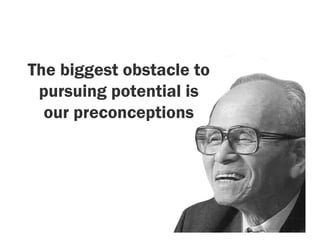
The biggest obstacle to
 pursuing potential is
  our preconceptions
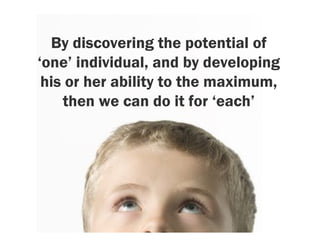
By discovering the potential of
‘one’ individual, and by developing
 his or her ability to the maximum,
    then we can do it for ‘each’
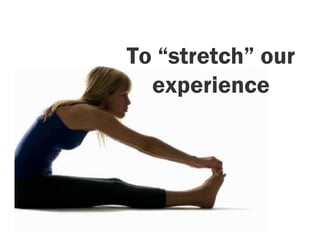
To “stretch” our
  experience
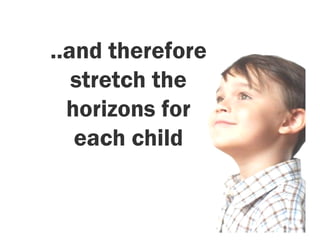
..and therefore
   stretch the
  horizons for
   each child
How do we
 go about
 doing it?
How do I choose a
monitor student?

What do I do with the
monitor student?

What do I do with what
I’ve learned?
How do I choose a monitor
student?

       Already beyond his grade level

         Preschool or primary school with
          high ability ranking

           Are studying levels that we are
            familiar with
What do I do with my monitor
student?

Know more about
the student using
the Six Ways for
Observing Students
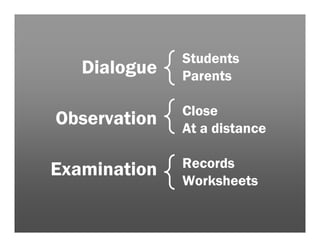
Students
   Dialogue   Parents

              Close
Observation   At a distance

              Records
Examination
              Worksheets
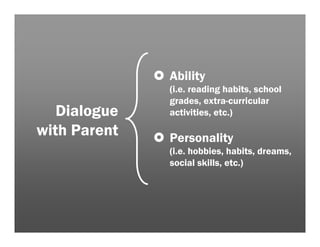
Ability
              (i.e. reading habits, school
              grades, extra-curricular
   Dialogue   activities, etc.)

with Parent   Personality
              (i.e. hobbies, habits, dreams,
              social skills, etc.)
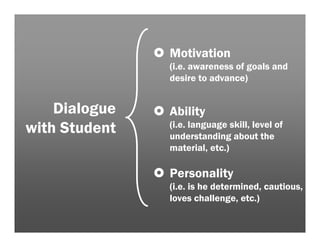
Motivation
               (i.e. awareness of goals and
               desire to advance)


    Dialogue   Ability
               (i.e. language skill, level of
with Student   understanding about the
               material, etc.)

               Personality
               (i.e. is he determined, cautious,
               loves challenge, etc.)
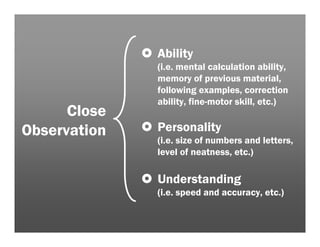
Ability
              (i.e. mental calculation ability,
              memory of previous material,
              following examples, correction
              ability, fine-motor skill, etc.)
      Close
Observation   Personality
              (i.e. size of numbers and letters,
              level of neatness, etc.)

              Understanding
              (i.e. speed and accuracy, etc.)
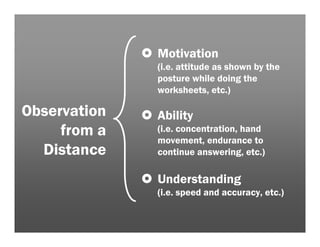
Motivation
              (i.e. attitude as shown by the
              posture while doing the
              worksheets, etc.)

Observation   Ability
     from a   (i.e. concentration, hand
              movement, endurance to
  Distance    continue answering, etc.)

              Understanding
              (i.e. speed and accuracy, etc.)
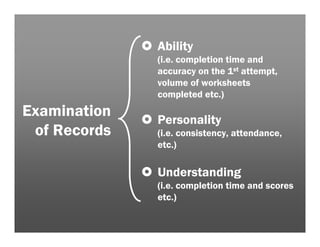
Ability
              (i.e. completion time and
              accuracy on the 1st attempt,
              volume of worksheets
              completed etc.)
Examination   Personality
 of Records   (i.e. consistency, attendance,
              etc.)

              Understanding
              (i.e. completion time and scores
              etc.)
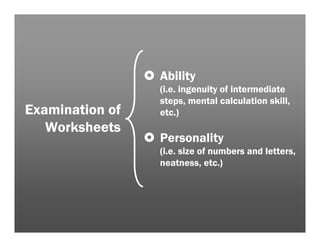
Ability
                 (i.e. ingenuity of intermediate
                 steps, mental calculation skill,
Examination of   etc.)
   Worksheets
                 Personality
                 (i.e. size of numbers and letters,
                 neatness, etc.)
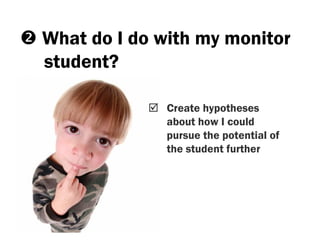
What do I do with my monitor
student?

              Create hypotheses
              about how I could
              pursue the potential of
              the student further
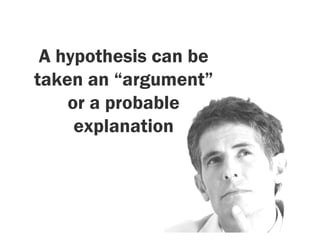
A hypothesis can be
taken an “argument”
    or a probable
     explanation
..but for the
 purpose of our
case studies, our
 hypotheses are
    phrased as
     “actions”
Instead of
    stating:

    “He is having
   problems with
division because he
doesn’t know how to
 check his answer”
We can have a
 hypothesis:

 “By reminding the
    child with his
consistent errors in
   his worksheets
   before he does
 classwork, we can
remedy his problem
    with division”
We state the
ACTION we’ll take
      and
the RESULT we are
  moving towards
What do I do with my monitor
student?

Create an implementation
and verification plan about
the students progress
The hypotheses
   should be stated
clearly, and should be
   given a period of
   implementation
We have a period of
implementation to
  know when we
should look again,
    and if the
  hypotheses are
     correct
After this, we can
 move on to other
  hypotheses that
   could further
    pursue the
potential of a child
What do I do with what I’ve
learned?
Verify if the what I’ve
learned is applicable:
   Only to the child and his situation
   To children with the same situation
   To most children in the center

Apply the lessons learned
from the student
How do I choose a monitor
student?

       Already beyond his grade level

         Preschool or primary school with
          high ability ranking

           Are studying levels that we are
            familiar with
What do I do with my monitor
student?
Know more about the student
using the Six Ways for
Observing Students

Create hypotheses about how
could pursue the potential of a
student further

Create an implementation and
verification plan about the
students’ progress
What do I do with what I’ve
learned?
Verify if the what I’ve
learned is applicable:
   Only to the child and his situation
   To children with the same situation
   To most children in the center

Apply the lessons learned
from the student
Rinse and Repeat
Simple as that.
Thanks for coming!

Performing Student Case Studies

  • 1.
    Performing Student Case Studies Regular Seminar 14 May 2008
  • 2.
  • 3.
    If the KumonMethod is about pursuing the potential of each individual student, why focus on one student in particular?
  • 4.
    For someone who onlyhas a hammer, everything becomes a nail
  • 5.
    The biggest obstacleto pursuing potential is our preconceptions
  • 6.
    By discovering thepotential of ‘one’ individual, and by developing his or her ability to the maximum, then we can do it for ‘each’
  • 7.
  • 8.
    ..and therefore stretch the horizons for each child
  • 9.
    How do we go about doing it?
  • 10.
    How do Ichoose a monitor student? What do I do with the monitor student? What do I do with what I’ve learned?
  • 11.
    How do Ichoose a monitor student? Already beyond his grade level Preschool or primary school with high ability ranking Are studying levels that we are familiar with
  • 12.
    What do Ido with my monitor student? Know more about the student using the Six Ways for Observing Students
  • 13.
    Students Dialogue Parents Close Observation At a distance Records Examination Worksheets
  • 14.
    Ability (i.e. reading habits, school grades, extra-curricular Dialogue activities, etc.) with Parent Personality (i.e. hobbies, habits, dreams, social skills, etc.)
  • 15.
    Motivation (i.e. awareness of goals and desire to advance) Dialogue Ability (i.e. language skill, level of with Student understanding about the material, etc.) Personality (i.e. is he determined, cautious, loves challenge, etc.)
  • 16.
    Ability (i.e. mental calculation ability, memory of previous material, following examples, correction ability, fine-motor skill, etc.) Close Observation Personality (i.e. size of numbers and letters, level of neatness, etc.) Understanding (i.e. speed and accuracy, etc.)
  • 17.
    Motivation (i.e. attitude as shown by the posture while doing the worksheets, etc.) Observation Ability from a (i.e. concentration, hand movement, endurance to Distance continue answering, etc.) Understanding (i.e. speed and accuracy, etc.)
  • 18.
    Ability (i.e. completion time and accuracy on the 1st attempt, volume of worksheets completed etc.) Examination Personality of Records (i.e. consistency, attendance, etc.) Understanding (i.e. completion time and scores etc.)
  • 19.
    Ability (i.e. ingenuity of intermediate steps, mental calculation skill, Examination of etc.) Worksheets Personality (i.e. size of numbers and letters, neatness, etc.)
  • 20.
    What do Ido with my monitor student? Create hypotheses about how I could pursue the potential of the student further
  • 21.
    A hypothesis canbe taken an “argument” or a probable explanation
  • 22.
    ..but for the purpose of our case studies, our hypotheses are phrased as “actions”
  • 23.
    Instead of stating: “He is having problems with division because he doesn’t know how to check his answer”
  • 24.
    We can havea hypothesis: “By reminding the child with his consistent errors in his worksheets before he does classwork, we can remedy his problem with division”
  • 25.
    We state the ACTIONwe’ll take and the RESULT we are moving towards
  • 26.
    What do Ido with my monitor student? Create an implementation and verification plan about the students progress
  • 27.
    The hypotheses should be stated clearly, and should be given a period of implementation
  • 28.
    We have aperiod of implementation to know when we should look again, and if the hypotheses are correct
  • 29.
    After this, wecan move on to other hypotheses that could further pursue the potential of a child
  • 30.
    What do Ido with what I’ve learned? Verify if the what I’ve learned is applicable: Only to the child and his situation To children with the same situation To most children in the center Apply the lessons learned from the student
  • 31.
    How do Ichoose a monitor student? Already beyond his grade level Preschool or primary school with high ability ranking Are studying levels that we are familiar with
  • 32.
    What do Ido with my monitor student? Know more about the student using the Six Ways for Observing Students Create hypotheses about how could pursue the potential of a student further Create an implementation and verification plan about the students’ progress
  • 33.
    What do Ido with what I’ve learned? Verify if the what I’ve learned is applicable: Only to the child and his situation To children with the same situation To most children in the center Apply the lessons learned from the student
  • 34.
  • 35.
  • 36.