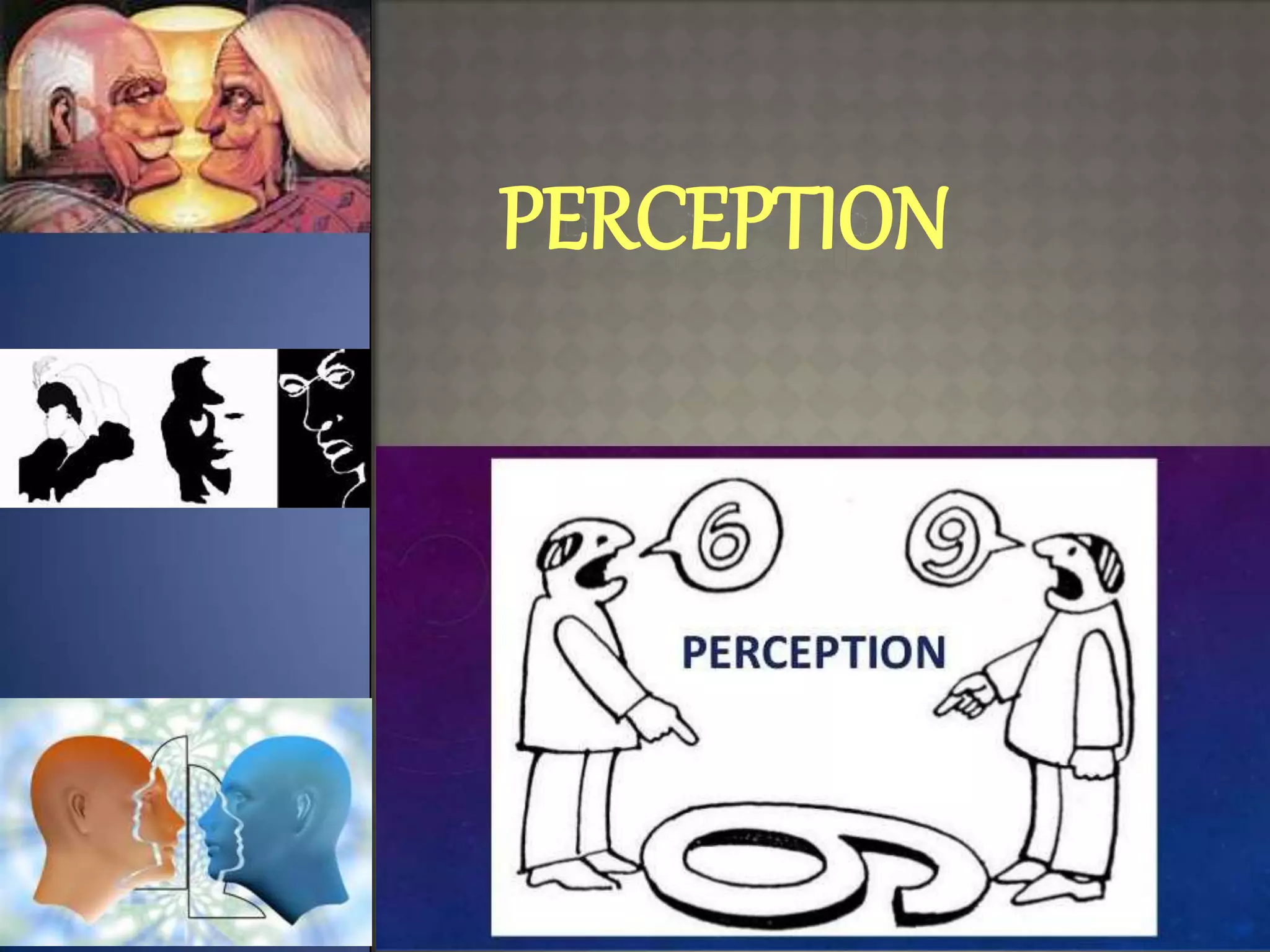
PERCEPTION
⦿Perception is the experience of objects,
events or relationships obtained by
extracting information from and interpreting
sensations.
(JH Jackson, O Desiderato and DB Howieson—
1976)
Perception is an individual's awareness aspect
of behaviour, for it is the way each person
processes the raw data he receives from the
environment, into meaningful patterns.
(RE Silverman—1976)
⦿Principle of Figure-ground Relationship
⦿Principle of Grouping
◾ Principle of proximity
◾ Principle of similarity
◾ Principle of continuity
◾ Principle of closure
◾ Principle of symmetry
⦿Principle of context
⦿Principle of contrast
⦿Principle of adaptability
⦿A figure is perceived in relationship to its
background.
⦿The perception of the object or figure in
terms of colour, size, shape and intensity,
etc. depends upon the figure-ground
relationship.
⦿We perceive a figure against a background or
background against a figure depending upon
the characteristics of the perceiver as well as
the relative strength of the figure or ground.
1. Principle of Figure-ground Relationship
⦿A proper figure-
ground
relationship is
quite important
from the angle of
perception of the
figure or the
ground.
⦿In case, where
such relationship
does not exist we
may witness
ambiguity in terms
of clear
perception.
⦿According to
gestalt principle
objects can be
perceived
meaningfully when
they are grouped
together.
Symmetry
Closure
Continuity
Similarity
Proximity
2. Principle of Grouping
⦿Proximity means nearness
⦿The objects which are nearer to each other
can be perceived meaningfully by grouping
them.
LAW OF PROXIMITY
⦿There is a tendency to perceive objects of a
similar size and shape or colour as a unit or
figure.
LAW OF SIMILARITY
⦿Any stimulus which extends in the same
direction or shape will be perceived as a whole
⦿Our attention is being held more by a
continuous pattern rather than discontinuous
ones.
lAW OF CONTINUITY
⦿While confronting
an incomplete
pattern one tends
to complete or
close the pattern
or fill in sensory
gaps and perceive
it as a meaningful
whole
LAWOF CLOSURE
⦿Objects having symmetrical shape are
perceived as groups
LAWOF SYMMETRY
⦿Perceptual organization is also
governed by the principle of
context.
⦿Eg. An examiner may award higher
marks to the same answer book in a
pleasant context than in an
unpleasant one.
3. PRINCIPLE OF CONTEXT
⦿Perceptual organization is very much
affected through contrast effects as the
stimuli may draw our maximum attention
and carry different perceptual affects.
4. PRINCIPLE OF CONTRAST
⦿The perceptual organization for some
stimuli depends upon the adaptability of
the perceiver to perceive similar stimuli.
⦿An individual who adapts himself to work
before an intense bright light will
perceive normal sunlight as quite dim.
5. PRINCIPLEOF ADAPTABILITY
PROCESS of PERCEPTION
•Physical factors
•Psychologicalfactors
•Environmentalfactors
⦿Perception depends upon the sense organs
or receptors on which the stimuli act and
sensory neurons which transmit the nerve
current from the receptors to the sensory
area of the brain.
⦿Perception
depends upon
the functioning
capacity of
both the
sensory and
association
areas of the
brain.
⦿Memory images help us in the comprehension of the
object or stimulus before us.
⦿perception involves the integration of sensory
experience and present psychological conditions.
⦿Our acquired interests also
determine the object or objects
which we perceive.
⦿A person who has a hobby of
collecting stamps will quickly notice
any new stamp on a letter
⦿Our needs or desires
also modify our
perceptions.
⦿Besides these our
beliefs, opinions and
cultural ideals also
modify our perception
of things, situations
and objects.
Illusion
Hallucination
1. Illusion of size: This type of illusion
provides false perception of the size of
the objects.
⦿A larger background always makes the
objects look smaller in comparison to a
smaller background, where they will be
perceived as larger.
⦿For example, in Ebbinghaus illusion, two
circles of the same size are perceived to be
of different sizes because of the size of the
surrounding objects
⦿2. Illusion of length: In Muller-Lyer Illusion,
the line segments of the same size appear to
be of different lengths based on the shapes
that are placed at the ends.
⦿Horizontal vertical illusion: In this, there are
two straight lines, one horizontal and the
other vertical. Both are equal in length, but
invariably the vertical one is perceived to be
longer than the other.
⦿All these examples are optical illusions.
Illusions arise either
because of the ambiguous
qualities of what is
perceived or the state
of the perceiving person
or both.
⦿Anaesthesia: it means a loss or absence
of sensitivity. It implies complete inability
to respond to sensory stimuli
⦿Hyperanesthesia: excessive response to
stimuli.
⦿Paresthesia: a person experiences false
sensations.
⦿Defective functioning of sense organs
⦿Inadequate stimulus
⦿T
oo many stimulus at one time
⦿Poor health
⦿Limited attention
⦿Figure merges in the ground
⦿Guidance
Perception.pptx
Perception.pptx
Perception.pptx
Perception.pptx
Perception.pptx
Perception.pptx
Perception.pptx
Perception.pptx
Perception.pptx
Perception.pptx

Perception.pptx

  • 1.
  • 5.
    ⦿Perception is theexperience of objects, events or relationships obtained by extracting information from and interpreting sensations. (JH Jackson, O Desiderato and DB Howieson— 1976)
  • 6.
    Perception is anindividual's awareness aspect of behaviour, for it is the way each person processes the raw data he receives from the environment, into meaningful patterns. (RE Silverman—1976)
  • 7.
    ⦿Principle of Figure-groundRelationship ⦿Principle of Grouping ◾ Principle of proximity ◾ Principle of similarity ◾ Principle of continuity ◾ Principle of closure ◾ Principle of symmetry ⦿Principle of context ⦿Principle of contrast ⦿Principle of adaptability
  • 8.
    ⦿A figure isperceived in relationship to its background. ⦿The perception of the object or figure in terms of colour, size, shape and intensity, etc. depends upon the figure-ground relationship. ⦿We perceive a figure against a background or background against a figure depending upon the characteristics of the perceiver as well as the relative strength of the figure or ground. 1. Principle of Figure-ground Relationship
  • 9.
    ⦿A proper figure- ground relationshipis quite important from the angle of perception of the figure or the ground. ⦿In case, where such relationship does not exist we may witness ambiguity in terms of clear perception.
  • 10.
    ⦿According to gestalt principle objectscan be perceived meaningfully when they are grouped together. Symmetry Closure Continuity Similarity Proximity 2. Principle of Grouping
  • 11.
    ⦿Proximity means nearness ⦿Theobjects which are nearer to each other can be perceived meaningfully by grouping them. LAW OF PROXIMITY
  • 12.
    ⦿There is atendency to perceive objects of a similar size and shape or colour as a unit or figure. LAW OF SIMILARITY
  • 13.
    ⦿Any stimulus whichextends in the same direction or shape will be perceived as a whole ⦿Our attention is being held more by a continuous pattern rather than discontinuous ones. lAW OF CONTINUITY
  • 14.
    ⦿While confronting an incomplete patternone tends to complete or close the pattern or fill in sensory gaps and perceive it as a meaningful whole LAWOF CLOSURE
  • 15.
    ⦿Objects having symmetricalshape are perceived as groups LAWOF SYMMETRY
  • 16.
    ⦿Perceptual organization isalso governed by the principle of context. ⦿Eg. An examiner may award higher marks to the same answer book in a pleasant context than in an unpleasant one. 3. PRINCIPLE OF CONTEXT
  • 17.
    ⦿Perceptual organization isvery much affected through contrast effects as the stimuli may draw our maximum attention and carry different perceptual affects. 4. PRINCIPLE OF CONTRAST
  • 18.
    ⦿The perceptual organizationfor some stimuli depends upon the adaptability of the perceiver to perceive similar stimuli. ⦿An individual who adapts himself to work before an intense bright light will perceive normal sunlight as quite dim. 5. PRINCIPLEOF ADAPTABILITY
  • 19.
  • 20.
  • 22.
    ⦿Perception depends uponthe sense organs or receptors on which the stimuli act and sensory neurons which transmit the nerve current from the receptors to the sensory area of the brain.
  • 23.
    ⦿Perception depends upon the functioning capacityof both the sensory and association areas of the brain.
  • 24.
    ⦿Memory images helpus in the comprehension of the object or stimulus before us. ⦿perception involves the integration of sensory experience and present psychological conditions.
  • 26.
    ⦿Our acquired interestsalso determine the object or objects which we perceive. ⦿A person who has a hobby of collecting stamps will quickly notice any new stamp on a letter
  • 27.
    ⦿Our needs ordesires also modify our perceptions. ⦿Besides these our beliefs, opinions and cultural ideals also modify our perception of things, situations and objects.
  • 28.
  • 30.
    1. Illusion ofsize: This type of illusion provides false perception of the size of the objects. ⦿A larger background always makes the objects look smaller in comparison to a smaller background, where they will be perceived as larger.
  • 31.
    ⦿For example, inEbbinghaus illusion, two circles of the same size are perceived to be of different sizes because of the size of the surrounding objects
  • 32.
    ⦿2. Illusion oflength: In Muller-Lyer Illusion, the line segments of the same size appear to be of different lengths based on the shapes that are placed at the ends.
  • 33.
    ⦿Horizontal vertical illusion:In this, there are two straight lines, one horizontal and the other vertical. Both are equal in length, but invariably the vertical one is perceived to be longer than the other. ⦿All these examples are optical illusions. Illusions arise either because of the ambiguous qualities of what is perceived or the state of the perceiving person or both.
  • 34.
    ⦿Anaesthesia: it meansa loss or absence of sensitivity. It implies complete inability to respond to sensory stimuli ⦿Hyperanesthesia: excessive response to stimuli. ⦿Paresthesia: a person experiences false sensations.
  • 35.
    ⦿Defective functioning ofsense organs ⦿Inadequate stimulus ⦿T oo many stimulus at one time ⦿Poor health ⦿Limited attention ⦿Figure merges in the ground ⦿Guidance