PERCEPTION
By Amit Newton
Tutor Nishat College of nursing
HOD Psychiatric Nursing Dept.
INTRODUCTION
• When our sensory-organs comes in contact with the world
and are stimulated by the external stimuli and receive the
sensations it result in perception.
• Sensation is the initial response of an individual to the
stimuli.
• Perception is the interpretation of sensory stimuli which
reach the sense organs and the brain.
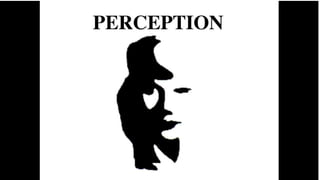
PERCEPTION
What is Perception
 How we view and interpret the events and situations in the world
about us.
What is it Important
 Because people’s behavior is based on their perception of what
reality is, not on reality itself.
Definition
Perception is the experience of object, events or
relationships obtained by extracting the information from
and interpreting the sensations.
(OR)
A process by which individuals organize and interpret their
sensory impressions in order to give meaning to their
environment.
Process of perception
Perception is the process by which we discriminate
among the stimuli and interpret their meanings.
Eg: when we hear a sound we are able to identify it as being
produced by a car or a bus. Perception gives meaning to sensation.
Process of perception
Perception is the process by which we discriminate
among the stimuli and interpret their meanings.
Eg: when we hear a sound we are able to identify it as being
produced by a car or a bus. Perception gives meaning to sensation.
Perception
Perception is a process by which individuals organize
and interpret their sensory impressions in order to
give meaning to their environment.
Principles Perception
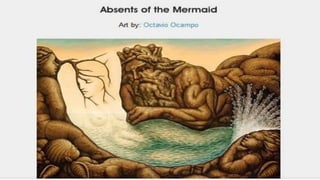
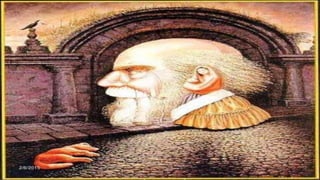
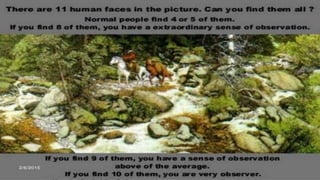
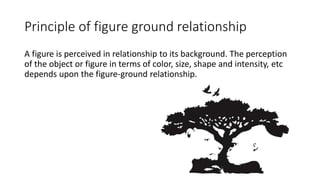
Principle of figure ground relationship
A figure is perceived in relationship to its background. The perception
of the object or figure in terms of color, size, shape and intensity, etc
depends upon the figure-ground relationship.
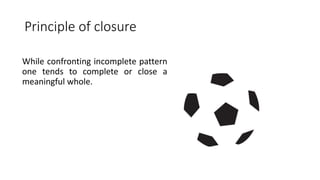
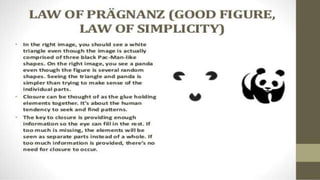
Principle of closure
While confronting incomplete pattern
one tends to complete or close a
meaningful whole.
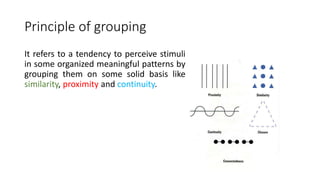
Principle of grouping
It refers to a tendency to perceive stimuli
in some organized meaningful patterns by
grouping them on some solid basis like
similarity, proximity and continuity.
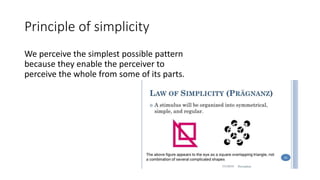
Principle of simplicity
We perceive the simplest possible pattern
because they enable the perceiver to
perceive the whole from some of its parts.
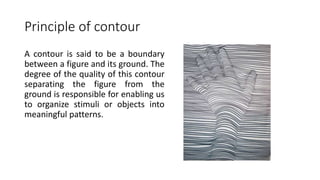
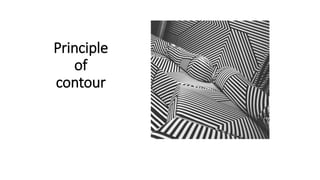
Principle of contour
A contour is said to be a boundary
between a figure and its ground. The
degree of the quality of this contour
separating the figure from the
ground is responsible for enabling us
to organize stimuli or objects into
meaningful patterns.
Principle
of
contour
Principle of context
Perceptual organization is also governed by the principle of context, i.e.
an examiner may award higher marks to the same answer book in a
pleasant context than in an unpleasant one
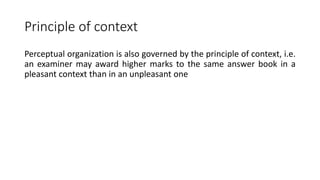
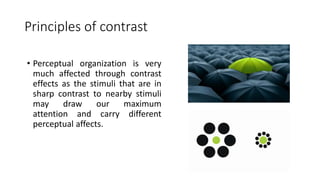
Principles of contrast
• Perceptual organization is very
much affected through contrast
effects as the stimuli that are in
sharp contrast to nearby stimuli
may draw our maximum
attention and carry different
perceptual affects.
Principle of adaptability
The perceptual organization for some
stimuli depends upon the adaptability
of the perceiver to perceive similar
stimuli. An individual who adapts
himself to work before an intense
bright light will perceive normal
sunlight as quite dim.
Factors affecting perception
• Sense organs
• Brain
• Memory images of the past experiences
• Personal interest and mind set
• Acquired interest
• Needs and Desires
Errors in perception
• Errors in perception also called Sensory
deceptions- these can be divided into
illusion which are misinterpretations of
stimuli arising from an external object, and
hallucinations , which are perceptions
without an adequate external stimulus.
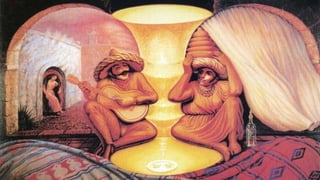
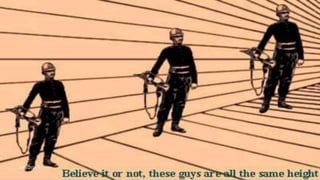
Illusion
• In illusions, stimuli from a perceived object are combined with a
mental image to produce a false perception
Types
Three types of illusion are described ( Sims, 2003)
 Completion illusions
 Affective illusion
 Pareidolia
Hallucinations
• Jaspers suggested- “ a false perception which is not a sensory
distortion of misinterpretation, but which occurs at the same time as
real perception.”
• Hallucination are imaginary perceptions in which one sees or hears
something that is not seen or heard by others around him
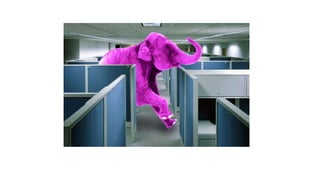
• Eg. An alcoholic may see “Pink elephants”, a paranoid schizophrenia may hear voices,
experiencing foul odors in absence of common in mentally ill people.
• Hallucinations are visual, auditory, kinesthetic, olfactory and
gustatory.
Causes of inaccurate perception
 Defective function of sense organs
 Inadequate stimulus
 Too many stimuli at one time
 Poor health
 Limited attention
 Figure merges in the ground
 Guidance- (Perception is inaccurate when we do not know what
should be perceived)

Perception

  • 1.
    PERCEPTION By Amit Newton TutorNishat College of nursing HOD Psychiatric Nursing Dept.
  • 11.
    INTRODUCTION • When oursensory-organs comes in contact with the world and are stimulated by the external stimuli and receive the sensations it result in perception. • Sensation is the initial response of an individual to the stimuli. • Perception is the interpretation of sensory stimuli which reach the sense organs and the brain.
  • 12.
    PERCEPTION What is Perception How we view and interpret the events and situations in the world about us. What is it Important  Because people’s behavior is based on their perception of what reality is, not on reality itself.
  • 13.
    Definition Perception is theexperience of object, events or relationships obtained by extracting the information from and interpreting the sensations. (OR) A process by which individuals organize and interpret their sensory impressions in order to give meaning to their environment.
  • 14.
    Process of perception Perceptionis the process by which we discriminate among the stimuli and interpret their meanings. Eg: when we hear a sound we are able to identify it as being produced by a car or a bus. Perception gives meaning to sensation.
  • 15.
    Process of perception Perceptionis the process by which we discriminate among the stimuli and interpret their meanings. Eg: when we hear a sound we are able to identify it as being produced by a car or a bus. Perception gives meaning to sensation.
  • 16.
    Perception Perception is aprocess by which individuals organize and interpret their sensory impressions in order to give meaning to their environment.
  • 17.
  • 18.
    Principle of figureground relationship A figure is perceived in relationship to its background. The perception of the object or figure in terms of color, size, shape and intensity, etc depends upon the figure-ground relationship.
  • 19.
    Principle of closure Whileconfronting incomplete pattern one tends to complete or close a meaningful whole.
  • 20.
    Principle of grouping Itrefers to a tendency to perceive stimuli in some organized meaningful patterns by grouping them on some solid basis like similarity, proximity and continuity.
  • 21.
    Principle of simplicity Weperceive the simplest possible pattern because they enable the perceiver to perceive the whole from some of its parts.
  • 23.
    Principle of contour Acontour is said to be a boundary between a figure and its ground. The degree of the quality of this contour separating the figure from the ground is responsible for enabling us to organize stimuli or objects into meaningful patterns.
  • 24.
  • 25.
    Principle of context Perceptualorganization is also governed by the principle of context, i.e. an examiner may award higher marks to the same answer book in a pleasant context than in an unpleasant one
  • 26.
    Principles of contrast •Perceptual organization is very much affected through contrast effects as the stimuli that are in sharp contrast to nearby stimuli may draw our maximum attention and carry different perceptual affects.
  • 27.
    Principle of adaptability Theperceptual organization for some stimuli depends upon the adaptability of the perceiver to perceive similar stimuli. An individual who adapts himself to work before an intense bright light will perceive normal sunlight as quite dim.
  • 28.
    Factors affecting perception •Sense organs • Brain • Memory images of the past experiences • Personal interest and mind set • Acquired interest • Needs and Desires
  • 29.
    Errors in perception •Errors in perception also called Sensory deceptions- these can be divided into illusion which are misinterpretations of stimuli arising from an external object, and hallucinations , which are perceptions without an adequate external stimulus.
  • 30.
    Illusion • In illusions,stimuli from a perceived object are combined with a mental image to produce a false perception Types Three types of illusion are described ( Sims, 2003)  Completion illusions  Affective illusion  Pareidolia
  • 31.
    Hallucinations • Jaspers suggested-“ a false perception which is not a sensory distortion of misinterpretation, but which occurs at the same time as real perception.” • Hallucination are imaginary perceptions in which one sees or hears something that is not seen or heard by others around him • Eg. An alcoholic may see “Pink elephants”, a paranoid schizophrenia may hear voices, experiencing foul odors in absence of common in mentally ill people. • Hallucinations are visual, auditory, kinesthetic, olfactory and gustatory.
  • 33.
    Causes of inaccurateperception  Defective function of sense organs  Inadequate stimulus  Too many stimuli at one time  Poor health  Limited attention  Figure merges in the ground  Guidance- (Perception is inaccurate when we do not know what should be perceived)