Per Unit Calculations
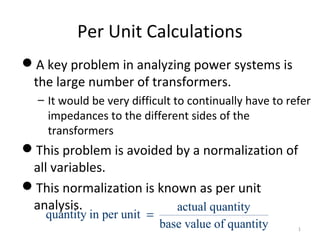
A key problem in analyzing power systems is
the large number of transformers.
– It would be very difficult to continually have to refer
impedances to the different sides of the
transformers
This problem is avoided by a normalization of
all variables.
This normalization is known as per unit
analysis. actual quantity
quantity in per unit
base value of quantity
=
1
Per Unit System
2
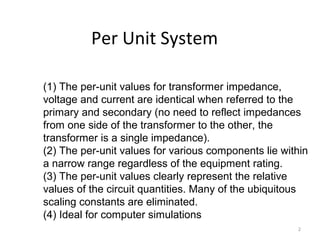
(1) The per-unit values for transformer impedance,
voltage and current are identical when referred to the
primary and secondary (no need to reflect impedances
from one side of the transformer to the other, the
transformer is a single impedance).
(2) The per-unit values for various components lie within
a narrow range regardless of the equipment rating.
(3) The per-unit values clearly represent the relative
values of the circuit quantities. Many of the ubiquitous
scaling constants are eliminated.
(4) Ideal for computer simulations
Per Unit Conversion Procedure, 1φ
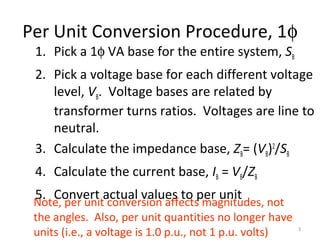
1. Pick a 1φ VA base for the entire system, SB
2. Pick a voltage base for each different voltage
level, VB. Voltage bases are related by
transformer turns ratios. Voltages are line to
neutral.
3. Calculate the impedance base, ZB= (VB)2
/SB
4. Calculate the current base, IB = VB/ZB
5. Convert actual values to per unit
Note, per unit conversion affects magnitudes, not
the angles. Also, per unit quantities no longer have
units (i.e., a voltage is 1.0 p.u., not 1 p.u. volts) 3
Per Unit Solution Procedure
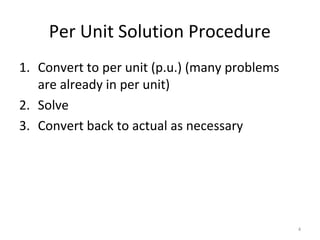
1. Convert to per unit (p.u.) (many problems
are already in per unit)
2. Solve
3. Convert back to actual as necessary
4
Per Unit Example
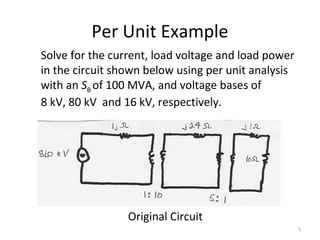
Solve for the current, load voltage and load power
in the circuit shown below using per unit analysis
with an SB of 100 MVA, and voltage bases of
8 kV, 80 kV and 16 kV, respectively.
Original Circuit
5
Per Unit Example, cont’d
2 2
2 2
2 2
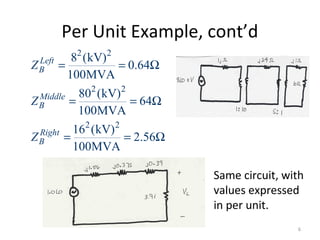
8 (kV)
0.64
100MVA
80 (kV)
64
100MVA
16 (kV)
2.56
100MVA
Left
B
Middle
B
Right
B
Z
Z
Z
= = Ω
= = Ω
= = Ω
Same circuit, with
values expressed
in per unit.
6
Per Unit Example, cont’d
2
*
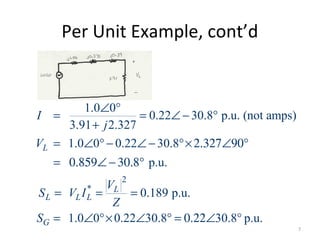
1.0 0
0.22 30.8 p.u. (not amps)
3.91 2.327
1.0 0 0.22 30.8
p.u.
0.189 p.u.
1.0 0 0.22 30.8 30.8 p.u.
L
L
L L L
G
I
j
V
V
S V I
Z
S
∠ °
= = ∠ − °
+
= ∠ ° − ∠ − °×2.327∠90°
= 0.859∠ − 30.8°
= = =
= ∠ °× ∠ ° = 0.22∠ °
7
Per Unit Example, cont’d
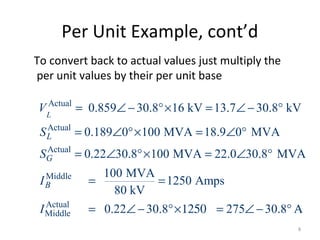
To convert back to actual values just multiply the
per unit values by their per unit base
Actual
Actual
Actual
Middle
Actual
Middle
0.859 30.8 16 kV 13.7 30.8 kV
0.189 0 100 MVA 18.9 0 MVA
0.22 30.8 100 MVA 22.0 30.8 MVA
100 MVA
1250 Amps
80 kV
0.22 30.8 275 30.8
L
L
G
B
V
S
S
I
I
= ∠ − °× = ∠ − °
= ∠ °× = ∠ °
= ∠ °× = ∠ °
= =
= ∠ − °×1250 = ∠ − ° Α
8
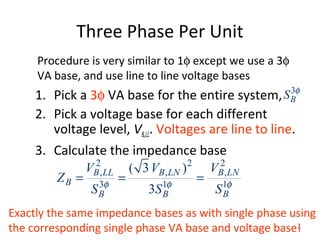
Three Phase Per Unit
1. Pick a 3φ VA base for the entire system,
2. Pick a voltage base for each different
voltage level, VB,LL. Voltages are line to line.
3. Calculate the impedance base
Procedure is very similar to 1φ except we use a 3φ
VA base, and use line to line voltage bases
3
BS φ
2 2 2
, , ,
3 1 1
( 3 )
3
B LL B LN B LN
B
B B B
V V V
Z
S S Sφ φ φ
= = =
Exactly the same impedance bases as with single phase using
the corresponding single phase VA base and voltage base!9
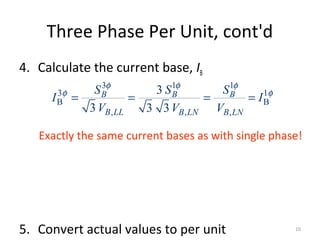
Three Phase Per Unit, cont'd
4. Calculate the current base, IB
5. Convert actual values to per unit
3 1 1
3 1
B B
, , ,
3
3 3 3
B B B
B LL B LN B LN
S S S
I I
V V V
φ φ φ
φ φ
= = = =
Exactly the same current bases as with single phase!
10
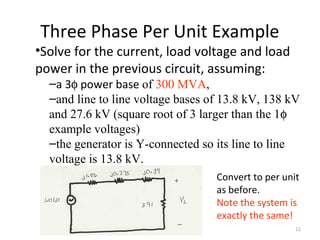
Three Phase Per Unit Example
•Solve for the current, load voltage and load
power in the previous circuit, assuming:
–a 3φ power base of 300 MVA,
–and line to line voltage bases of 13.8 kV, 138 kV
and 27.6 kV (square root of 3 larger than the 1φ
example voltages)
–the generator is Y-connected so its line to line
voltage is 13.8 kV.
Convert to per unit
as before.
Note the system is
exactly the same!
11
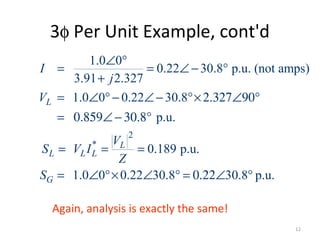
3φ Per Unit Example, cont'd
2
*
1.0 0
0.22 30.8 p.u. (not amps)
3.91 2.327
1.0 0 0.22 30.8
p.u.
0.189 p.u.
1.0 0 0.22 30.8 30.8 p.u.
L
L
L L L
G
I
j
V
V
S V I
Z
S
∠ °
= = ∠ − °
+
= ∠ ° − ∠ − °×2.327∠90°
= 0.859∠ − 30.8°
= = =
= ∠ °× ∠ ° = 0.22∠ °
Again, analysis is exactly the same!
12
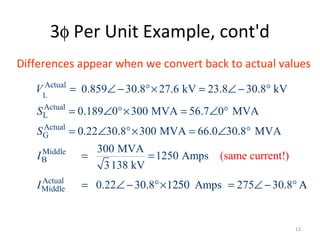
3φ Per Unit Example, cont'd
L
Actual
Actual
L
Actual
G
Middle
B
Actual
Middle
0.859 30.8 27.6 kV 23.8 30.8 kV
0.189 0 300 MVA 56.7 0 MVA
0.22 30.8 300 MVA 66.0 30.8 MVA
300 MVA
125 (same cu0 Amps
3138 kV
0.22 30
rrent
8
!)
.
V
S
S
I
I
= ∠ − °× = ∠ − °
= ∠ °× = ∠ °
= ∠ °× = ∠ °
= =
= ∠ − °× Amps 275 30.81250 = ∠ − ° Α
Differences appear when we convert back to actual values
13

Per unit system

  • 1.
    Per Unit Calculations Akey problem in analyzing power systems is the large number of transformers. – It would be very difficult to continually have to refer impedances to the different sides of the transformers This problem is avoided by a normalization of all variables. This normalization is known as per unit analysis. actual quantity quantity in per unit base value of quantity = 1
  • 2.
    Per Unit System 2 (1)The per-unit values for transformer impedance, voltage and current are identical when referred to the primary and secondary (no need to reflect impedances from one side of the transformer to the other, the transformer is a single impedance). (2) The per-unit values for various components lie within a narrow range regardless of the equipment rating. (3) The per-unit values clearly represent the relative values of the circuit quantities. Many of the ubiquitous scaling constants are eliminated. (4) Ideal for computer simulations
  • 3.
    Per Unit ConversionProcedure, 1φ 1. Pick a 1φ VA base for the entire system, SB 2. Pick a voltage base for each different voltage level, VB. Voltage bases are related by transformer turns ratios. Voltages are line to neutral. 3. Calculate the impedance base, ZB= (VB)2 /SB 4. Calculate the current base, IB = VB/ZB 5. Convert actual values to per unit Note, per unit conversion affects magnitudes, not the angles. Also, per unit quantities no longer have units (i.e., a voltage is 1.0 p.u., not 1 p.u. volts) 3
  • 4.
    Per Unit SolutionProcedure 1. Convert to per unit (p.u.) (many problems are already in per unit) 2. Solve 3. Convert back to actual as necessary 4
  • 5.
    Per Unit Example Solvefor the current, load voltage and load power in the circuit shown below using per unit analysis with an SB of 100 MVA, and voltage bases of 8 kV, 80 kV and 16 kV, respectively. Original Circuit 5
  • 6.
    Per Unit Example,cont’d 2 2 2 2 2 2 8 (kV) 0.64 100MVA 80 (kV) 64 100MVA 16 (kV) 2.56 100MVA Left B Middle B Right B Z Z Z = = Ω = = Ω = = Ω Same circuit, with values expressed in per unit. 6
  • 7.
    Per Unit Example,cont’d 2 * 1.0 0 0.22 30.8 p.u. (not amps) 3.91 2.327 1.0 0 0.22 30.8 p.u. 0.189 p.u. 1.0 0 0.22 30.8 30.8 p.u. L L L L L G I j V V S V I Z S ∠ ° = = ∠ − ° + = ∠ ° − ∠ − °×2.327∠90° = 0.859∠ − 30.8° = = = = ∠ °× ∠ ° = 0.22∠ ° 7
  • 8.
    Per Unit Example,cont’d To convert back to actual values just multiply the per unit values by their per unit base Actual Actual Actual Middle Actual Middle 0.859 30.8 16 kV 13.7 30.8 kV 0.189 0 100 MVA 18.9 0 MVA 0.22 30.8 100 MVA 22.0 30.8 MVA 100 MVA 1250 Amps 80 kV 0.22 30.8 275 30.8 L L G B V S S I I = ∠ − °× = ∠ − ° = ∠ °× = ∠ ° = ∠ °× = ∠ ° = = = ∠ − °×1250 = ∠ − ° Α 8
  • 9.
    Three Phase PerUnit 1. Pick a 3φ VA base for the entire system, 2. Pick a voltage base for each different voltage level, VB,LL. Voltages are line to line. 3. Calculate the impedance base Procedure is very similar to 1φ except we use a 3φ VA base, and use line to line voltage bases 3 BS φ 2 2 2 , , , 3 1 1 ( 3 ) 3 B LL B LN B LN B B B B V V V Z S S Sφ φ φ = = = Exactly the same impedance bases as with single phase using the corresponding single phase VA base and voltage base!9
  • 10.
    Three Phase PerUnit, cont'd 4. Calculate the current base, IB 5. Convert actual values to per unit 3 1 1 3 1 B B , , , 3 3 3 3 B B B B LL B LN B LN S S S I I V V V φ φ φ φ φ = = = = Exactly the same current bases as with single phase! 10
  • 11.
    Three Phase PerUnit Example •Solve for the current, load voltage and load power in the previous circuit, assuming: –a 3φ power base of 300 MVA, –and line to line voltage bases of 13.8 kV, 138 kV and 27.6 kV (square root of 3 larger than the 1φ example voltages) –the generator is Y-connected so its line to line voltage is 13.8 kV. Convert to per unit as before. Note the system is exactly the same! 11
  • 12.
    3φ Per UnitExample, cont'd 2 * 1.0 0 0.22 30.8 p.u. (not amps) 3.91 2.327 1.0 0 0.22 30.8 p.u. 0.189 p.u. 1.0 0 0.22 30.8 30.8 p.u. L L L L L G I j V V S V I Z S ∠ ° = = ∠ − ° + = ∠ ° − ∠ − °×2.327∠90° = 0.859∠ − 30.8° = = = = ∠ °× ∠ ° = 0.22∠ ° Again, analysis is exactly the same! 12
  • 13.
    3φ Per UnitExample, cont'd L Actual Actual L Actual G Middle B Actual Middle 0.859 30.8 27.6 kV 23.8 30.8 kV 0.189 0 300 MVA 56.7 0 MVA 0.22 30.8 300 MVA 66.0 30.8 MVA 300 MVA 125 (same cu0 Amps 3138 kV 0.22 30 rrent 8 !) . V S S I I = ∠ − °× = ∠ − ° = ∠ °× = ∠ ° = ∠ °× = ∠ ° = = = ∠ − °× Amps 275 30.81250 = ∠ − ° Α Differences appear when we convert back to actual values 13