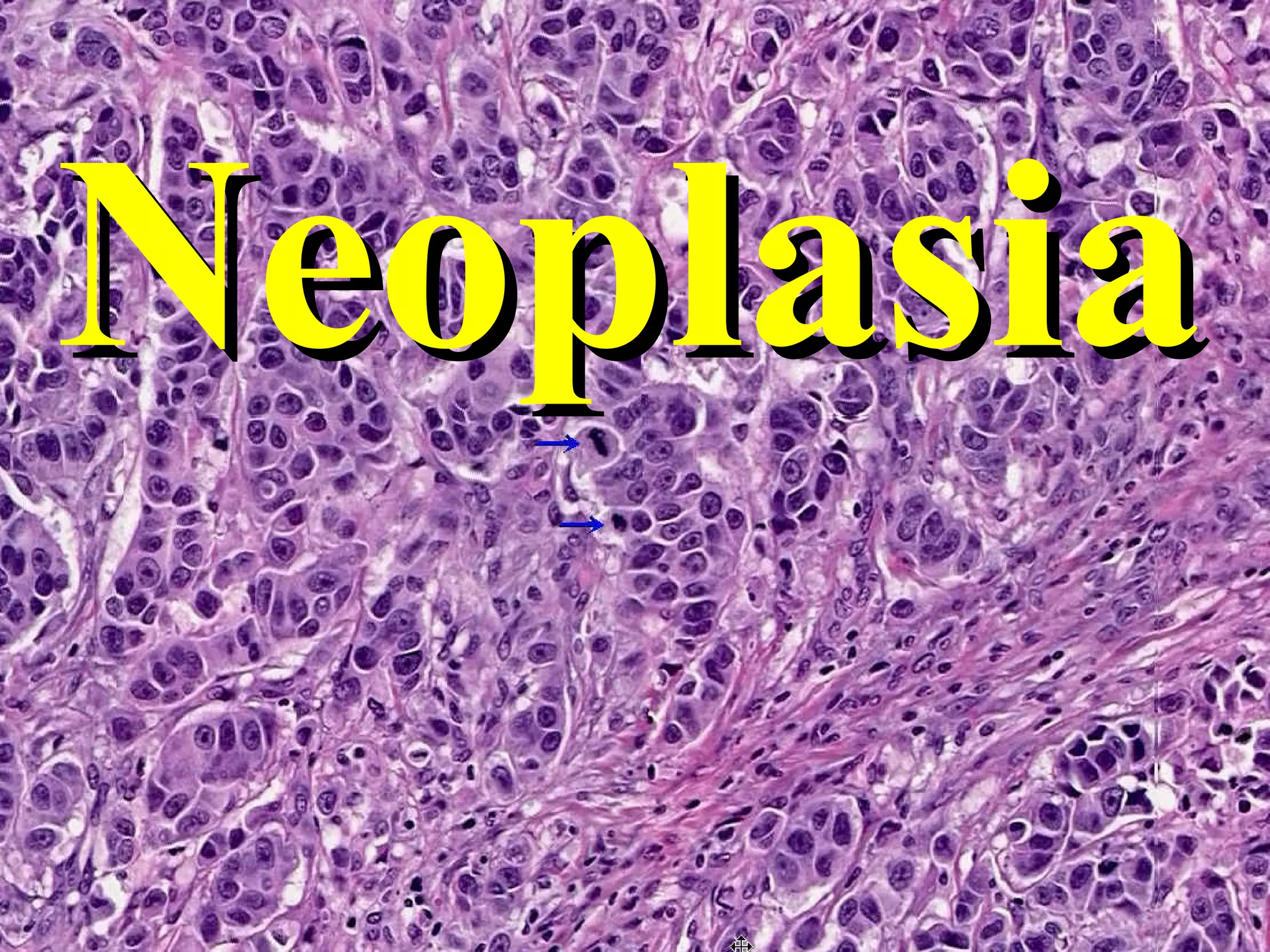
NeoplasiaNeoplasia
NEOPLASIA (TUMORS)NEOPLASIA (TUMORS)
 DefinitionsDefinitions
 NomenclatureNomenclature
 Biology of Tumor GrowthBiology of Tumor Growth
 EpidemiologyEpidemiology
 Molecular Basis of CancerMolecular Basis of Cancer
 Molecular Basis of CarcinogenesisMolecular Basis of Carcinogenesis
 Agents (The Usual Suspects)Agents (The Usual Suspects)
 Host Defense (Tumor Immunity)Host Defense (Tumor Immunity)
 Clinical Features of TumorsClinical Features of Tumors
Defnition of NeoplasiaDefnition of Neoplasia
“A neoplasm is an abnormal mass of tissue, the growth
of which exceeds and is uncoordinated with that of
the normal tissues and persists in the same excessive
manner after cessation of the stimuli which evoked
the change” - Willis
 Genetic changes
 Autonomous
 Clonal
Nomenclature – Benign TumorsNomenclature – Benign Tumors
 -oma = benign neoplasm-oma = benign neoplasm
 Mesenchymal tumorsMesenchymal tumors
 chrondroma: cartilaginous tumorchrondroma: cartilaginous tumor
 fibroma: fibrous tumorfibroma: fibrous tumor
 osteoma: bone tumorosteoma: bone tumor
 Epithelial tumorEpithelial tumor
 adenoma: tumor forming glandsadenoma: tumor forming glands
 papilloma: tumor with finger like projectionspapilloma: tumor with finger like projections
 papillary cystadenoma: papillary and cystic tumor formingpapillary cystadenoma: papillary and cystic tumor forming
glandsglands
 polyp: a tumor that projects above a mucosal surfacepolyp: a tumor that projects above a mucosal surface
Downloaded from: Robbins & Cotran Pathologic Basis of Disease (on 28 July 2005 03:41 PM)
© 2005 Elsevier
Colonic Polyp: Tubular Adenoma
Stalk
Tumor
Nomenclature – Malignant TumorsNomenclature – Malignant Tumors
 Sarcomas: mesenchymal tumorSarcomas: mesenchymal tumor
 chrondrosarcoma: cartilaginous tumorchrondrosarcoma: cartilaginous tumor
 fibrosarcoma: fibrous tumorfibrosarcoma: fibrous tumor
 osteosarcoma: bone tumorosteosarcoma: bone tumor
 Carcinomas: epithelial tumorsCarcinomas: epithelial tumors
 adenocarcinoma: gland forming tumoradenocarcinoma: gland forming tumor
 squamous cell carcinoma: squamous differentiationsquamous cell carcinoma: squamous differentiation
 undifferentiated carcinoma: no differentiationundifferentiated carcinoma: no differentiation
 note: carcinomas can arise from ectoderm,note: carcinomas can arise from ectoderm,
mesoderm, or endodermmesoderm, or endoderm
 Tumors with mixed differentiationTumors with mixed differentiation
 mixed tumors: e.g. pleomorphic adenoma of salivary glandmixed tumors: e.g. pleomorphic adenoma of salivary gland
 carcinosarcomacarcinosarcoma
 TeratomaTeratoma
 tumor comprised of cells from more than one germ layertumor comprised of cells from more than one germ layer
 arise from totipotent cells (usually gonads)arise from totipotent cells (usually gonads)
 benign cystic teratoma of ovary is the most commonbenign cystic teratoma of ovary is the most common
teratomateratoma
 Aberrant differentiation (not true neoplasms)Aberrant differentiation (not true neoplasms)
 Hamartoma: disorganized mass of tissue whose cell types areHamartoma: disorganized mass of tissue whose cell types are
indiginous to the site of the lesionindiginous to the site of the lesion
 Choriostoma: ectopic focus of normal tissue (heterotopia)Choriostoma: ectopic focus of normal tissue (heterotopia)
 MisnomersMisnomers
 hepatoma: malignant liver tumorhepatoma: malignant liver tumor
 melanoma: malignant skin tumormelanoma: malignant skin tumor
 seminoma: malignant testicular tumorseminoma: malignant testicular tumor
 lymphoma: malignant tumor of lymphocyteslymphoma: malignant tumor of lymphocytes
Figure 7-4 A, Gross appearance of an opened cystic teratoma of the ovary. Note the
presence of hair, sebaceous material, and tooth. You do not need a microscope to
appreciate this tumor produces both connective tissue as well as epithelial derived
elements.
Downloaded from: Robbins & Cotran Pathologic Basis of Disease (on 28 July 2005 03:41 PM)
© 2005 Elsevier
Natural History Of Malignant TumorsNatural History Of Malignant Tumors
1.1. Malignant change in the targetMalignant change in the target
cell, referred to ascell, referred to as
transformationtransformation
2.2. Growth of the transformed cellsGrowth of the transformed cells
3.3. Local invasionLocal invasion
4.4. Distant metastases.Distant metastases.
DifferentiationDifferentiation
 Well differentiated neoplasmWell differentiated neoplasm
 Resembles mature cells of tissue of originResembles mature cells of tissue of origin
 Poorly diffentiated neoplasmPoorly diffentiated neoplasm
 Composed of primitive cells with littleComposed of primitive cells with little
diffrerentiationdiffrerentiation
 Undifferentiated or “anaplastic” tumorUndifferentiated or “anaplastic” tumor
 Correlation with biologic behaviorCorrelation with biologic behavior
 Benign tumors are well differentiatedBenign tumors are well differentiated
 Poorly differentiated malignant tumors usuallyPoorly differentiated malignant tumors usually
have worse prognosishave worse prognosis
If cells LOOK BAD, they are probably going to BEHAVE BAD
If cells LOOK GOOD, they are probably going to BEHAVE GOOD
 PleomorphismPleomorphism
 SizeSize
 shapeshape
 Abnormal nuclear morphologyAbnormal nuclear morphology
 HyperchromasiaHyperchromasia
 High nuclear cytoplasmic ratioHigh nuclear cytoplasmic ratio
 Chromatin clumpingChromatin clumping
 Prominent nucleoliProminent nucleoli
 MitosesMitoses
 Mitotic rateMitotic rate
 Location of mitosesLocation of mitoses
 Loss of polarityLoss of polarity
““ANAPLASIA”ANAPLASIA”
DysplasiaDysplasia
 Literally means abnormal growthLiterally means abnormal growth
 Malignant transformation is a multistep processMalignant transformation is a multistep process
 In dysplasia some but not all of the features ofIn dysplasia some but not all of the features of
malignancy are presentmalignancy are present

DysplasiaDysplasia maymay develop into malignancydevelop into malignancy
 Uterine cervixUterine cervix
 Colon polypsColon polyps
 Graded as low-grade or high-gradeGraded as low-grade or high-grade
 Dysplasia mayDysplasia may NOTNOT develop into malignancydevelop into malignancy
Tumor Growth RateTumor Growth Rate
 Doubling time of tumor cellsDoubling time of tumor cells
 Lengthens as tumor growsLengthens as tumor grows
 30 doublings (1030 doublings (1099
cells) = 1 gcells) = 1 g (months to years)(months to years)
 10 more doublings (1 kg) = lethal burden10 more doublings (1 kg) = lethal burden (“)(“)
 Fraction of tumor cells in replicative poolFraction of tumor cells in replicative pool
 May be only 20% even in rapidly growing tumorsMay be only 20% even in rapidly growing tumors
 Tumor stem cellsTumor stem cells
 Rate at which tumor cells are shed or lostRate at which tumor cells are shed or lost
 ApoptosisApoptosis
 MaturationMaturation
 Implications for therapyImplications for therapy
Schematic Representation Of Tumor
Growth
Features of Malignant TumorsFeatures of Malignant Tumors
 Cellular featuresCellular features
 Local invasionLocal invasion
 CapsuleCapsule
 Basement membraneBasement membrane
 MetastasisMetastasis
 Unequivocal sign of malignancyUnequivocal sign of malignancy
 Seeding of body cavitiesSeeding of body cavities
 LymphaticLymphatic
 HematogenousHematogenous
Significance of Nodal MetsSignificance of Nodal Mets
 Example of breast cancerExample of breast cancer
 Halsted radical mastectomyHalsted radical mastectomy
 Sentinel node biopsySentinel node biopsy
 PrognosticPrognostic
 Number of involved nodes is an importantNumber of involved nodes is an important
component of TNM staging systemcomponent of TNM staging system
 TherapeuticTherapeutic
 Overall risk of recurrenceOverall risk of recurrence
 Extent of nodal involvementExtent of nodal involvement
 Histologic grade and other considerationsHistologic grade and other considerations
 ““Adjuvant” chemotherapyAdjuvant” chemotherapy
Benign vs Malignant FeaturesBenign vs Malignant Features
FeatureFeature BenignBenign MalignantMalignant
Rate of growthRate of growth Progressive butProgressive but
slow. Mitosesslow. Mitoses
few and normalfew and normal
Variable. MitosesVariable. Mitoses
more frequentmore frequent
and may beand may be
abnormalabnormal
DifferentiationDifferentiation WellWell
differentiateddifferentiated
Some degree ofSome degree of
anaplasiaanaplasia
Local invasionLocal invasion Cohesive growth.Cohesive growth.
Capsule & BMCapsule & BM
not breachednot breached
Poorly cohesivePoorly cohesive
and infiltrative.and infiltrative.
MetastasisMetastasis AbsentAbsent May occurMay occur
Geographic & EnvironmentalGeographic & Environmental
 Sun exposureSun exposure
 Melanomas 6x incidence New Zealand vs IcelandMelanomas 6x incidence New Zealand vs Iceland
 Blacks have low incidence of melanomaBlacks have low incidence of melanoma
 Smoking and alcohol abuseSmoking and alcohol abuse
 Body massBody mass
 Overweight = 50% increase in cancerOverweight = 50% increase in cancer
 Environmental vs racial factorsEnvironmental vs racial factors
 Japanese immigrants to USAJapanese immigrants to USA
 Viral exposureViral exposure
 Human papilloma virus (HPV) and cervical cancerHuman papilloma virus (HPV) and cervical cancer
 Hepatitis B virus (HBV) and liver cancer (Africa)Hepatitis B virus (HBV) and liver cancer (Africa)
 Epstein-Barr Virus (EBV) and lymphomaEpstein-Barr Virus (EBV) and lymphoma
Change In Incidence Of Various Cancers With
Migration From Japan To The United States
Predisposing Factors for CancerPredisposing Factors for Cancer
 AgeAge
 Most cancers occur in persons ≥ 55 yearsMost cancers occur in persons ≥ 55 years
 Childhood cancersChildhood cancers
 Leukemias & CNS neoplasmsLeukemias & CNS neoplasms
 Bone tumorsBone tumors
 Genetic predispostionGenetic predispostion
 Familial cancer syndromesFamilial cancer syndromes
 Early age at onsetEarly age at onset
 Two or more primary relatives with the cancerTwo or more primary relatives with the cancer
 Multiple or bilateral tumorsMultiple or bilateral tumors
 Polymorphisms that metabolize procarcinogens, e.g., nitritesPolymorphisms that metabolize procarcinogens, e.g., nitrites
 Nonhereditary predisposing conditionsNonhereditary predisposing conditions
 Chronic inflammationChronic inflammation
 Precancerous conditionsPrecancerous conditions
 Chronic ulcerative colitisChronic ulcerative colitis
 Atrophic gastritis of pernicious anemiaAtrophic gastritis of pernicious anemia
 Leukoplakia of mucous membranesLeukoplakia of mucous membranes
MOLECULAR BASISMOLECULAR BASIS
of CANCERof CANCER
 NON-lethalNON-lethal genetic damagegenetic damage
 A tumor is formed by the clonal expansionA tumor is formed by the clonal expansion
of a single precursor cell (of a single precursor cell (monoclonalmonoclonal))
 Four classesFour classes of normal regulatory genesof normal regulatory genes
 PROTO-oncogenesPROTO-oncogenes
 OncogenesOncogenes OncoproteinsOncoproteins
 DNA repair genesDNA repair genes
 Apoptosis genesApoptosis genes
 Carcinogenesis is aCarcinogenesis is a multistepmultistep processprocess
TRANSFORMATION &TRANSFORMATION &
PROGRESSIONPROGRESSION
 Self-sufficiency in growth signalsSelf-sufficiency in growth signals
 Insensitivity to growth-inhibiting signalsInsensitivity to growth-inhibiting signals
 Evasion of apoptosisEvasion of apoptosis
 Defects in DNA repair: “Spell checker”Defects in DNA repair: “Spell checker”
 Limitless replicative potential: TelomeraseLimitless replicative potential: Telomerase
 AngiogenesisAngiogenesis
 Invasive abilityInvasive ability
 Metastatic abilityMetastatic ability
Normal CELL CYCLE PhasesNormal CELL CYCLE Phases
INHIBITORS: Cip/Kip, INK4/ARF
Tumor (really growth) suppressor genes: p53
ONCOGENESONCOGENES
 Are MUTATIONS of NORMAL genesAre MUTATIONS of NORMAL genes
(PROTO-oncogenes)(PROTO-oncogenes)
 Growth FactorsGrowth Factors
 Growth Factor ReceptorsGrowth Factor Receptors
 Signal Transduction Proteins (RAS)Signal Transduction Proteins (RAS)
 Nuclear Regulatory ProteinsNuclear Regulatory Proteins
 Cell Cycle RegulatorsCell Cycle Regulators
 Oncogenes code forOncogenes code for  OncoproteinsOncoproteins
Category
PROTO-
Oncogene
Mode of
Activation
Associated Human
Tumor
GFs
PDGF-β chain SIS Overexpression Astrocytoma
Osteosarcoma
Fibroblast
growth factors
HST-1 Overexpression Stomach cancer
INT-2 Amplification Bladder cancer
Breast cancer
Melanoma
TGFα TGFα Overexpression Astrocytomas
Hepatocellular
carcinomas
HGF HGF Overexpression Thyroid cancer
Category
PROTO-
Oncogene
Mode of
Activation
Associated Human
Tumor
GF
Receptors
EGF-receptor
family
ERB-B1
(ECFR)
Overexpression Squamous cell carcinomas of
lung, gliomas
ERB-B2 Amplification Breast and ovarian cancers
CSF-1 receptor FMS Point mutation Leukemia
Receptor for
neurotrophic
factors
RET Point mutation Multiple endocrine neoplasia 2A
and B, familial medullary thyroid
carcinomas
PDGF receptor PDGF-R Overexpression Gliomas
Receptor for stem
cell (steel) factor
KIT Point mutation Gastrointestinal stromal tumors
and other soft tissue tumors
Category
PROTO-
Oncogene
Mode of
Activation
Associated Human
Tumor
Signal
Transduction
Proteins
GTP-binding K-RAS Point mutation Colon, lung, and pancreatic
tumors
H-RAS Point mutation Bladder and kidney tumors
N-RAS Point mutation Melanomas, hematologic
malignancies
Nonreceptor
tyrosine kinase
ABL Translocation Chronic myeloid leukemia
Acute lymphoblastic leukemia
RAS signal
transduction
BRAF Point mutation Melanomas
WNT signal
transduction
β-catenin Point mutation Hepatoblastomas,
hepatocellular carcinoma
Category
PROTO-
Oncogene
Mode of
Activation Associated Human
Tumor
Nuclear
Regulatory
Proteins
Transcrip.
activators
C-MYC Translocation Burkitt lymphoma
N-MYC Amplification Neuroblastoma,
small cell
carcinoma of lung
L-MYC Amplification Small cell
carcinoma of lung
MYCMYC
 Encodes for transcription factorsEncodes for transcription factors
 Also involved with apoptosisAlso involved with apoptosis
P53 and RASP53 and RAS
p53p53
 Activates DNA repairActivates DNA repair
proteinsproteins
 Sentinel of G1/SSentinel of G1/S
transitiontransition
 Initiates apoptosisInitiates apoptosis
 Mutated in more thanMutated in more than
50% of all human50% of all human
cancerscancers
RASRAS
 H, N, K, etc., varietiesH, N, K, etc., varieties
 Single most commonSingle most common
abnormality ofabnormality of
dominant oncogenes indominant oncogenes in
human tumorshuman tumors
 Present in about 1/3 ofPresent in about 1/3 of
all human cancersall human cancers
Tumor (really “GROWTH”)Tumor (really “GROWTH”)
suppressor genessuppressor genes
 TGF-TGF-ββ  COLONCOLON
 E-cadherinE-cadherin  STOMACHSTOMACH
 NF-1,2NF-1,2  NEURAL TUMORSNEURAL TUMORS
 APC/APC/ββ-cadherin-cadherin  GI, MELANOMAGI, MELANOMA
 SMADsSMADs  GIGI
 RBRB  RETINOBLASTOMARETINOBLASTOMA
 P53P53  EVERYTHING!!EVERYTHING!!
 WT-1WT-1  WILMS TUMORWILMS TUMOR
 p16 (INK4a)p16 (INK4a)  GI, BREAST (MM if inherited)GI, BREAST (MM if inherited)
 BRCA-1,2BRCA-1,2  BREASTBREAST
 KLF6KLF6  PROSTATEPROSTATE
Evasion of APOPTOSISEvasion of APOPTOSIS
BCL-2BCL-2
p53p53
MYCMYC
DNA REPAIR GENE DEFECTSDNA REPAIR GENE DEFECTS
 DNA repair is like a spell checkerDNA repair is like a spell checker
 HNPCCHNPCC ((HHereditaryereditary NNon-on-PPolyposisolyposis CColonolon
CCancer): TGF-ancer): TGF-ββ,, ββ-catenin, BAX-catenin, BAX
 Xeroderma Pigmentosum: UV fixing geneXeroderma Pigmentosum: UV fixing gene
 Ataxia Telangiectasia: ATM geneAtaxia Telangiectasia: ATM gene
 Bloom Syndrome: defective helicaseBloom Syndrome: defective helicase
 Fanconi anemiaFanconi anemia
LIMITLESS REPLICATIVELIMITLESS REPLICATIVE
POTENTIALPOTENTIAL
 TELOMERES determine the limitedTELOMERES determine the limited
number of duplications a cell willnumber of duplications a cell will
have, like a cat with nine lives.have, like a cat with nine lives.
 TELOMERASETELOMERASE, present in >90% of, present in >90% of
human cancers, changes telomeres sohuman cancers, changes telomeres so
they will have UNLIMITEDthey will have UNLIMITED
replicative potentialreplicative potential
TUMOR ANGIOGENESISTUMOR ANGIOGENESIS
 QQ: How close to a blood vessel must a cell be?: How close to a blood vessel must a cell be?
 A: 1-2 mmA: 1-2 mm
 Activation of VEGF and FGF-bActivation of VEGF and FGF-b
 Tumor size is regulated (allowed) byTumor size is regulated (allowed) by
angiogenesis/anti-angiogenesis balanceangiogenesis/anti-angiogenesis balance
TRANSFORMATIONTRANSFORMATION
GROWTHGROWTH
BM INVASIONBM INVASION
ANGIOGENESISANGIOGENESIS
INTRAVASATIONINTRAVASATION
EMBOLIZATIONEMBOLIZATION
ADHESIONADHESION
EXTRAVASATIONEXTRAVASATION
METASTATIC GROWTHMETASTATIC GROWTH
etc.etc.
Invasion FactorsInvasion Factors
 DetachmentDetachment ("loosening up") of("loosening up") of
the tumor cells from each otherthe tumor cells from each other
 AttachmentAttachment to matrix componentsto matrix components
 DegradationDegradation of ECM, e.g.,of ECM, e.g.,
collagenase, etc.collagenase, etc.
 MigrationMigration of tumor cellsof tumor cells
METASTATIC GENES?METASTATIC GENES?
 NM23NM23
 KAI-1KAI-1
 KiSSKiSS
CHROMOSOME CHANGES
in CANCER
 TRANSLOCATIONS and INVERSIONS
 Occur in MOST Lymphomas/Leukemias
 Occur in MANY (and growing numbers) of
NON-hematologic malignancies also
Malignancy Translocation Affected Genes
Chronic myeloid leukemia (9;22)(q34;q11) Ab1 9q34
    bcr 22q11
Acute leukemias (AML and ALL) (4;11)(q21;q23) AF4 4q21
    MLL 11q23
  (6;11)(q27;q23) AF6 6q27
    MLL 11q23
Burkitt lymphoma (8;14)(q24;q32) c-myc 8q24
    IgH 14q32
Mantle cell lymphoma (11;14)(q13;q32) Cyclin D 11q13
    IgH 14q32
Follicular lymphoma (14;18)(q32;q21) IgH 14q32
    bcl-2 18q21
T-cell acute lymphoblastic leukemia (8;14)(q24;q11) c-myc 8q24
    TCR-α 14q11
  (10;14)(q24;q11) Hox 11 10q24
    TCR-α 14q11
Ewing sarcoma (11;22)(q24;q12) Fl-1 11q24
Carcinogenesis is “MULTISTEP”
 NO single oncogene causes cancer
 BOTH several oncogenes AND several tumor
suppressor genes must be involved
 Gatekeeper/Caretaker concept
Gatekeepers: ONCOGENES and TUMOR
SUPPRESSOR GENES
Caretakers: DNA REPAIR GENES
 Tumor “PROGRESSION”
 ANGIOGENESIS
 HETEROGENEITY from original single cell
Carcinogenesis:
The USUAL (3) Suspects
Initiation/Promotion concept:
 BOTH initiators AND promotors are needed
 NEITHER can cause cancer by itself
INITIATORS (carcinogens) cause
MUTATIONS
 PROMOTORS are NOT carcinogenic by
themselves, and MUST take effect AFTER
initiation, NOT before
PROMOTORS enhance the proliferation of
initiated cells
Q: WHO are the usual suspects?
 Inflammation?
 Teratogenesis?
 Immune
Suppression?
 Neoplasia?
 Mutations?
A: The SAME 3 that are
ALWAYS blamed!
1) ChemicalsChemicals
2) RadiationRadiation
3) InfectiousInfectious PathogensPathogens
CHEMICAL CARCINOGENS:
INITIATORS
 DIRECT
 β-Propiolactone
 Dimethyl sulfate
 Diepoxybutane
 Anticancer drugs
(cyclophosphamide,
chlorambucil,
nitrosoureas, and others)
 Acylating Agents
 1-Acetyl-imidazole
 Dimethylcarbamyl chloride
 “PRO”CARCINOGENS
 Polycyclic and Heterocyclic
Aromatic Hydrocarbons
 Aromatic Amines, Amides,
Azo Dyes
 Natural Plant and Microbial
Products
 Aflatoxin B1 Hepatomas
 Griseofulvin Antifungal
 Cycasin from cycads
 Safrole from sassafras
 Betel nuts Oral SCC
CHEMICAL CARCINOGENS:
INITIATORS
OTHERS
 Nitrosamine and amides (tar, nitrites)
 Vinyl chloride angiosarcoma in Kentucky
 Nickel
 Chromium
 Insecticides
 Fungicides
 PolyChlorinated Biphenyls (PCBs)
CHEMICAL CARCINOGENS:
PROMOTORS
 HORMONES
 PHORBOL ESTERS (TPA), activate kinase C
 PHENOLS
 DRUGS
“Initiated” cells respond and proliferate
FASTER to promotors than normal cells
RADIATION CARCINOGENS
 UV:UV: BCC, SCC, MM
 IONIZING:IONIZING: photons and particulate
 Hematopoetic and Thyroid (90%/15yrs) tumors
in fallout victims
 Solid tumors either less susceptible or require a
longer latency period than LEUK/LYMPH
 BCCs in Therapeutic Radiation
VIRAL CARCINOGENESIS
 HPV SCC
 EBV Burkitt Lymphoma
 HBV Hepatocellular Carcinoma (Hepatoma)
 HTLV1 T-Cell Malignancies
 KSHV Kaposi Sarcoma
H. pylori CARCINOGENESIS
 100% of gastric lymphomas (i.e., M.A.L.T.-
omas)
 Gastric CARCINOMAS also!
HOST DEFENSES
 IMMUNE SURVEILLENCE CONCEPT
 CD8+ T-Cells
 NK cells
 MACROPHAGES
 ANTIBODIES
CYTOTOXIC CD8+ T-CELLS are the main eliminators of tumor cells
How do tumor cells
escape immune surveillance?
 MutationMutation
↓↓ MHC molecules on tumor cell surfaceMHC molecules on tumor cell surface
 Lack of CO-stimulation molecules, e.g.,Lack of CO-stimulation molecules, e.g.,
(CD28, ICOS)(CD28, ICOS)
 Immunosuppressive agentsImmunosuppressive agents
 Antigen maskingAntigen masking
 Apoptosis of cytotoxic T-Cells (CD8), i.e.,Apoptosis of cytotoxic T-Cells (CD8), i.e.,
the damn tumor cell KILLS the T-cell!the damn tumor cell KILLS the T-cell!
Effects of TUMOR on the HOST
 Location anatomic ENCROACHMENT
 HORMONE production
 Bleeding, Infection
 ACUTE symptoms, e.g., rupture, infarction
 METASTASES
CACHEXIA
 Reduced diet: Fat loss>Muscle loss
 Cachexia: Fat lost + Muscle loss
 TNF
 IL-1
 PIF (Proteolysis Inducing Factor)
PARA-Neoplastic Syndromes
Endocrine
 Nerve/Muscle, e.g., myasthenia w. lung ca.
 Skin: e.g., acanthosis nigricans,
dermatomyositis
 Bone/Joint/Soft tissue: HPOA
(Hypertrophic Pulmonary
OsteoArthropathy)
 Vascular: Trousseau, Endocarditis
 Hematologic: Anemias
 Renal: e.g., Nephrotic Syndrome
ENDOCRINECushing syndrome Small cell carcinoma of lung ACTH or ACTH-like substance
  Pancreatic carcinoma  
  Neural tumors  
Syndrome of inappropriate
antidiuretic hormone
secretion
Small cell carcinoma of lung;
intracranial neoplasms
Antidiuretic hormone or atrial
natriuretic hormones
Hypercalcemia Squamous cell carcinoma of lung
Parathyroid hormone-related protein
(PTHRP), TGF-α, TNF, IL-1
  Breast carcinoma  
  Renal carcinoma  
  Adult T-cell leukemia/lymphoma  
  Ovarian carcinoma  
Hypoglycemia Fibrosarcoma Insulin or insulin-like substance
  Other mesenchymal sarcomas  
  Hepatocellular carcinoma  
Carcinoid syndrome Bronchial adenoma (carcinoid) Serotonin, bradykinin
  Pancreatic carcinoma  
  Gastric carcinoma  
Polycythemia Renal carcinoma Erythropoietin
  Cerebellar hemangioma  
  Hepatocellular carcinoma  
GRADING/STAGING
GRADING: HOW
“DIFFERENTIATED” ARE
THE CELLS?
STAGING: HOW MUCH
ANATOMIC EXTENSION?
Which one of the above do you
think is more important?
WELL?
MODERATE?
POOR?
GRADING for Squamous Cell Carcinoma
ADENOCARCINOMA GRADING
Let’s have some FUN!
LAB DIAGNOSIS
BIOPSY
CYTOLOGY: (exfoliative)
CYTOLOGY: (FNA, Fine
Needle Aspirate)
IMMUNOHISTOCHEMISTRY
Categorization of
undifferentiated tumors
Leukemias/Lymphomas
Site of origin
Receptors, e.g., ERA, PRA
TUMOR MARKERS
 HORMONES: (Paraneoplastic Syndromes)
 “ONCO”FETAL: AFP, CEA
 ISOENZYMES: PAP, NSE
 PROTEINS: PSA, PSMA
 GLYCOPROTEINS: CA-125, CA-19-5, CA-15-3
 MOLECULAR: p53, RAS
NOTE: These SAME substances which can
be measured in the blood, also can be stained
by immunochemical methods in tissue
MICRO-ARRAYS
THOUSANDS of genes identified from
tumors give the cells their own identity
and FINGERPRINT and may give
important prognostic information as well
as guidelines for therapy. Some say this
may replace standard histopathologic
identifications of tumors.
What do you think?

Pathology neoplasm

  • 1.
  • 2.
    NEOPLASIA (TUMORS)NEOPLASIA (TUMORS) DefinitionsDefinitions  NomenclatureNomenclature  Biology of Tumor GrowthBiology of Tumor Growth  EpidemiologyEpidemiology  Molecular Basis of CancerMolecular Basis of Cancer  Molecular Basis of CarcinogenesisMolecular Basis of Carcinogenesis  Agents (The Usual Suspects)Agents (The Usual Suspects)  Host Defense (Tumor Immunity)Host Defense (Tumor Immunity)  Clinical Features of TumorsClinical Features of Tumors
  • 3.
    Defnition of NeoplasiaDefnitionof Neoplasia “A neoplasm is an abnormal mass of tissue, the growth of which exceeds and is uncoordinated with that of the normal tissues and persists in the same excessive manner after cessation of the stimuli which evoked the change” - Willis  Genetic changes  Autonomous  Clonal
  • 4.
    Nomenclature – BenignTumorsNomenclature – Benign Tumors  -oma = benign neoplasm-oma = benign neoplasm  Mesenchymal tumorsMesenchymal tumors  chrondroma: cartilaginous tumorchrondroma: cartilaginous tumor  fibroma: fibrous tumorfibroma: fibrous tumor  osteoma: bone tumorosteoma: bone tumor  Epithelial tumorEpithelial tumor  adenoma: tumor forming glandsadenoma: tumor forming glands  papilloma: tumor with finger like projectionspapilloma: tumor with finger like projections  papillary cystadenoma: papillary and cystic tumor formingpapillary cystadenoma: papillary and cystic tumor forming glandsglands  polyp: a tumor that projects above a mucosal surfacepolyp: a tumor that projects above a mucosal surface
  • 6.
    Downloaded from: Robbins& Cotran Pathologic Basis of Disease (on 28 July 2005 03:41 PM) © 2005 Elsevier
  • 7.
    Colonic Polyp: TubularAdenoma Stalk Tumor
  • 8.
    Nomenclature – MalignantTumorsNomenclature – Malignant Tumors  Sarcomas: mesenchymal tumorSarcomas: mesenchymal tumor  chrondrosarcoma: cartilaginous tumorchrondrosarcoma: cartilaginous tumor  fibrosarcoma: fibrous tumorfibrosarcoma: fibrous tumor  osteosarcoma: bone tumorosteosarcoma: bone tumor  Carcinomas: epithelial tumorsCarcinomas: epithelial tumors  adenocarcinoma: gland forming tumoradenocarcinoma: gland forming tumor  squamous cell carcinoma: squamous differentiationsquamous cell carcinoma: squamous differentiation  undifferentiated carcinoma: no differentiationundifferentiated carcinoma: no differentiation  note: carcinomas can arise from ectoderm,note: carcinomas can arise from ectoderm, mesoderm, or endodermmesoderm, or endoderm
  • 14.
     Tumors withmixed differentiationTumors with mixed differentiation  mixed tumors: e.g. pleomorphic adenoma of salivary glandmixed tumors: e.g. pleomorphic adenoma of salivary gland  carcinosarcomacarcinosarcoma  TeratomaTeratoma  tumor comprised of cells from more than one germ layertumor comprised of cells from more than one germ layer  arise from totipotent cells (usually gonads)arise from totipotent cells (usually gonads)  benign cystic teratoma of ovary is the most commonbenign cystic teratoma of ovary is the most common teratomateratoma  Aberrant differentiation (not true neoplasms)Aberrant differentiation (not true neoplasms)  Hamartoma: disorganized mass of tissue whose cell types areHamartoma: disorganized mass of tissue whose cell types are indiginous to the site of the lesionindiginous to the site of the lesion  Choriostoma: ectopic focus of normal tissue (heterotopia)Choriostoma: ectopic focus of normal tissue (heterotopia)  MisnomersMisnomers  hepatoma: malignant liver tumorhepatoma: malignant liver tumor  melanoma: malignant skin tumormelanoma: malignant skin tumor  seminoma: malignant testicular tumorseminoma: malignant testicular tumor  lymphoma: malignant tumor of lymphocyteslymphoma: malignant tumor of lymphocytes
  • 15.
    Figure 7-4 A,Gross appearance of an opened cystic teratoma of the ovary. Note the presence of hair, sebaceous material, and tooth. You do not need a microscope to appreciate this tumor produces both connective tissue as well as epithelial derived elements. Downloaded from: Robbins & Cotran Pathologic Basis of Disease (on 28 July 2005 03:41 PM) © 2005 Elsevier
  • 18.
    Natural History OfMalignant TumorsNatural History Of Malignant Tumors 1.1. Malignant change in the targetMalignant change in the target cell, referred to ascell, referred to as transformationtransformation 2.2. Growth of the transformed cellsGrowth of the transformed cells 3.3. Local invasionLocal invasion 4.4. Distant metastases.Distant metastases.
  • 19.
    DifferentiationDifferentiation  Well differentiatedneoplasmWell differentiated neoplasm  Resembles mature cells of tissue of originResembles mature cells of tissue of origin  Poorly diffentiated neoplasmPoorly diffentiated neoplasm  Composed of primitive cells with littleComposed of primitive cells with little diffrerentiationdiffrerentiation  Undifferentiated or “anaplastic” tumorUndifferentiated or “anaplastic” tumor  Correlation with biologic behaviorCorrelation with biologic behavior  Benign tumors are well differentiatedBenign tumors are well differentiated  Poorly differentiated malignant tumors usuallyPoorly differentiated malignant tumors usually have worse prognosishave worse prognosis
  • 20.
    If cells LOOKBAD, they are probably going to BEHAVE BAD
  • 21.
    If cells LOOKGOOD, they are probably going to BEHAVE GOOD
  • 23.
     PleomorphismPleomorphism  SizeSize shapeshape  Abnormal nuclear morphologyAbnormal nuclear morphology  HyperchromasiaHyperchromasia  High nuclear cytoplasmic ratioHigh nuclear cytoplasmic ratio  Chromatin clumpingChromatin clumping  Prominent nucleoliProminent nucleoli  MitosesMitoses  Mitotic rateMitotic rate  Location of mitosesLocation of mitoses  Loss of polarityLoss of polarity ““ANAPLASIA”ANAPLASIA”
  • 25.
    DysplasiaDysplasia  Literally meansabnormal growthLiterally means abnormal growth  Malignant transformation is a multistep processMalignant transformation is a multistep process  In dysplasia some but not all of the features ofIn dysplasia some but not all of the features of malignancy are presentmalignancy are present  DysplasiaDysplasia maymay develop into malignancydevelop into malignancy  Uterine cervixUterine cervix  Colon polypsColon polyps  Graded as low-grade or high-gradeGraded as low-grade or high-grade  Dysplasia mayDysplasia may NOTNOT develop into malignancydevelop into malignancy
  • 28.
    Tumor Growth RateTumorGrowth Rate  Doubling time of tumor cellsDoubling time of tumor cells  Lengthens as tumor growsLengthens as tumor grows  30 doublings (1030 doublings (1099 cells) = 1 gcells) = 1 g (months to years)(months to years)  10 more doublings (1 kg) = lethal burden10 more doublings (1 kg) = lethal burden (“)(“)  Fraction of tumor cells in replicative poolFraction of tumor cells in replicative pool  May be only 20% even in rapidly growing tumorsMay be only 20% even in rapidly growing tumors  Tumor stem cellsTumor stem cells  Rate at which tumor cells are shed or lostRate at which tumor cells are shed or lost  ApoptosisApoptosis  MaturationMaturation  Implications for therapyImplications for therapy
  • 30.
  • 31.
    Features of MalignantTumorsFeatures of Malignant Tumors  Cellular featuresCellular features  Local invasionLocal invasion  CapsuleCapsule  Basement membraneBasement membrane  MetastasisMetastasis  Unequivocal sign of malignancyUnequivocal sign of malignancy  Seeding of body cavitiesSeeding of body cavities  LymphaticLymphatic  HematogenousHematogenous
  • 39.
    Significance of NodalMetsSignificance of Nodal Mets  Example of breast cancerExample of breast cancer  Halsted radical mastectomyHalsted radical mastectomy  Sentinel node biopsySentinel node biopsy  PrognosticPrognostic  Number of involved nodes is an importantNumber of involved nodes is an important component of TNM staging systemcomponent of TNM staging system  TherapeuticTherapeutic  Overall risk of recurrenceOverall risk of recurrence  Extent of nodal involvementExtent of nodal involvement  Histologic grade and other considerationsHistologic grade and other considerations  ““Adjuvant” chemotherapyAdjuvant” chemotherapy
  • 40.
    Benign vs MalignantFeaturesBenign vs Malignant Features FeatureFeature BenignBenign MalignantMalignant Rate of growthRate of growth Progressive butProgressive but slow. Mitosesslow. Mitoses few and normalfew and normal Variable. MitosesVariable. Mitoses more frequentmore frequent and may beand may be abnormalabnormal DifferentiationDifferentiation WellWell differentiateddifferentiated Some degree ofSome degree of anaplasiaanaplasia Local invasionLocal invasion Cohesive growth.Cohesive growth. Capsule & BMCapsule & BM not breachednot breached Poorly cohesivePoorly cohesive and infiltrative.and infiltrative. MetastasisMetastasis AbsentAbsent May occurMay occur
  • 46.
    Geographic & EnvironmentalGeographic& Environmental  Sun exposureSun exposure  Melanomas 6x incidence New Zealand vs IcelandMelanomas 6x incidence New Zealand vs Iceland  Blacks have low incidence of melanomaBlacks have low incidence of melanoma  Smoking and alcohol abuseSmoking and alcohol abuse  Body massBody mass  Overweight = 50% increase in cancerOverweight = 50% increase in cancer  Environmental vs racial factorsEnvironmental vs racial factors  Japanese immigrants to USAJapanese immigrants to USA  Viral exposureViral exposure  Human papilloma virus (HPV) and cervical cancerHuman papilloma virus (HPV) and cervical cancer  Hepatitis B virus (HBV) and liver cancer (Africa)Hepatitis B virus (HBV) and liver cancer (Africa)  Epstein-Barr Virus (EBV) and lymphomaEpstein-Barr Virus (EBV) and lymphoma
  • 47.
    Change In IncidenceOf Various Cancers With Migration From Japan To The United States
  • 48.
    Predisposing Factors forCancerPredisposing Factors for Cancer  AgeAge  Most cancers occur in persons ≥ 55 yearsMost cancers occur in persons ≥ 55 years  Childhood cancersChildhood cancers  Leukemias & CNS neoplasmsLeukemias & CNS neoplasms  Bone tumorsBone tumors  Genetic predispostionGenetic predispostion  Familial cancer syndromesFamilial cancer syndromes  Early age at onsetEarly age at onset  Two or more primary relatives with the cancerTwo or more primary relatives with the cancer  Multiple or bilateral tumorsMultiple or bilateral tumors  Polymorphisms that metabolize procarcinogens, e.g., nitritesPolymorphisms that metabolize procarcinogens, e.g., nitrites  Nonhereditary predisposing conditionsNonhereditary predisposing conditions  Chronic inflammationChronic inflammation  Precancerous conditionsPrecancerous conditions  Chronic ulcerative colitisChronic ulcerative colitis  Atrophic gastritis of pernicious anemiaAtrophic gastritis of pernicious anemia  Leukoplakia of mucous membranesLeukoplakia of mucous membranes
  • 49.
    MOLECULAR BASISMOLECULAR BASIS ofCANCERof CANCER  NON-lethalNON-lethal genetic damagegenetic damage  A tumor is formed by the clonal expansionA tumor is formed by the clonal expansion of a single precursor cell (of a single precursor cell (monoclonalmonoclonal))  Four classesFour classes of normal regulatory genesof normal regulatory genes  PROTO-oncogenesPROTO-oncogenes  OncogenesOncogenes OncoproteinsOncoproteins  DNA repair genesDNA repair genes  Apoptosis genesApoptosis genes  Carcinogenesis is aCarcinogenesis is a multistepmultistep processprocess
  • 50.
    TRANSFORMATION &TRANSFORMATION & PROGRESSIONPROGRESSION Self-sufficiency in growth signalsSelf-sufficiency in growth signals  Insensitivity to growth-inhibiting signalsInsensitivity to growth-inhibiting signals  Evasion of apoptosisEvasion of apoptosis  Defects in DNA repair: “Spell checker”Defects in DNA repair: “Spell checker”  Limitless replicative potential: TelomeraseLimitless replicative potential: Telomerase  AngiogenesisAngiogenesis  Invasive abilityInvasive ability  Metastatic abilityMetastatic ability
  • 52.
    Normal CELL CYCLEPhasesNormal CELL CYCLE Phases INHIBITORS: Cip/Kip, INK4/ARF Tumor (really growth) suppressor genes: p53
  • 53.
    ONCOGENESONCOGENES  Are MUTATIONSof NORMAL genesAre MUTATIONS of NORMAL genes (PROTO-oncogenes)(PROTO-oncogenes)  Growth FactorsGrowth Factors  Growth Factor ReceptorsGrowth Factor Receptors  Signal Transduction Proteins (RAS)Signal Transduction Proteins (RAS)  Nuclear Regulatory ProteinsNuclear Regulatory Proteins  Cell Cycle RegulatorsCell Cycle Regulators  Oncogenes code forOncogenes code for  OncoproteinsOncoproteins
  • 54.
    Category PROTO- Oncogene Mode of Activation Associated Human Tumor GFs PDGF-βchain SIS Overexpression Astrocytoma Osteosarcoma Fibroblast growth factors HST-1 Overexpression Stomach cancer INT-2 Amplification Bladder cancer Breast cancer Melanoma TGFα TGFα Overexpression Astrocytomas Hepatocellular carcinomas HGF HGF Overexpression Thyroid cancer
  • 55.
    Category PROTO- Oncogene Mode of Activation Associated Human Tumor GF Receptors EGF-receptor family ERB-B1 (ECFR) OverexpressionSquamous cell carcinomas of lung, gliomas ERB-B2 Amplification Breast and ovarian cancers CSF-1 receptor FMS Point mutation Leukemia Receptor for neurotrophic factors RET Point mutation Multiple endocrine neoplasia 2A and B, familial medullary thyroid carcinomas PDGF receptor PDGF-R Overexpression Gliomas Receptor for stem cell (steel) factor KIT Point mutation Gastrointestinal stromal tumors and other soft tissue tumors
  • 56.
    Category PROTO- Oncogene Mode of Activation Associated Human Tumor Signal Transduction Proteins GTP-bindingK-RAS Point mutation Colon, lung, and pancreatic tumors H-RAS Point mutation Bladder and kidney tumors N-RAS Point mutation Melanomas, hematologic malignancies Nonreceptor tyrosine kinase ABL Translocation Chronic myeloid leukemia Acute lymphoblastic leukemia RAS signal transduction BRAF Point mutation Melanomas WNT signal transduction β-catenin Point mutation Hepatoblastomas, hepatocellular carcinoma
  • 57.
    Category PROTO- Oncogene Mode of Activation AssociatedHuman Tumor Nuclear Regulatory Proteins Transcrip. activators C-MYC Translocation Burkitt lymphoma N-MYC Amplification Neuroblastoma, small cell carcinoma of lung L-MYC Amplification Small cell carcinoma of lung
  • 58.
    MYCMYC  Encodes fortranscription factorsEncodes for transcription factors  Also involved with apoptosisAlso involved with apoptosis
  • 59.
    P53 and RASP53and RAS p53p53  Activates DNA repairActivates DNA repair proteinsproteins  Sentinel of G1/SSentinel of G1/S transitiontransition  Initiates apoptosisInitiates apoptosis  Mutated in more thanMutated in more than 50% of all human50% of all human cancerscancers RASRAS  H, N, K, etc., varietiesH, N, K, etc., varieties  Single most commonSingle most common abnormality ofabnormality of dominant oncogenes indominant oncogenes in human tumorshuman tumors  Present in about 1/3 ofPresent in about 1/3 of all human cancersall human cancers
  • 61.
    Tumor (really “GROWTH”)Tumor(really “GROWTH”) suppressor genessuppressor genes  TGF-TGF-ββ  COLONCOLON  E-cadherinE-cadherin  STOMACHSTOMACH  NF-1,2NF-1,2  NEURAL TUMORSNEURAL TUMORS  APC/APC/ββ-cadherin-cadherin  GI, MELANOMAGI, MELANOMA  SMADsSMADs  GIGI  RBRB  RETINOBLASTOMARETINOBLASTOMA  P53P53  EVERYTHING!!EVERYTHING!!  WT-1WT-1  WILMS TUMORWILMS TUMOR  p16 (INK4a)p16 (INK4a)  GI, BREAST (MM if inherited)GI, BREAST (MM if inherited)  BRCA-1,2BRCA-1,2  BREASTBREAST  KLF6KLF6  PROSTATEPROSTATE
  • 62.
    Evasion of APOPTOSISEvasionof APOPTOSIS BCL-2BCL-2 p53p53 MYCMYC
  • 63.
    DNA REPAIR GENEDEFECTSDNA REPAIR GENE DEFECTS  DNA repair is like a spell checkerDNA repair is like a spell checker  HNPCCHNPCC ((HHereditaryereditary NNon-on-PPolyposisolyposis CColonolon CCancer): TGF-ancer): TGF-ββ,, ββ-catenin, BAX-catenin, BAX  Xeroderma Pigmentosum: UV fixing geneXeroderma Pigmentosum: UV fixing gene  Ataxia Telangiectasia: ATM geneAtaxia Telangiectasia: ATM gene  Bloom Syndrome: defective helicaseBloom Syndrome: defective helicase  Fanconi anemiaFanconi anemia
  • 64.
    LIMITLESS REPLICATIVELIMITLESS REPLICATIVE POTENTIALPOTENTIAL TELOMERES determine the limitedTELOMERES determine the limited number of duplications a cell willnumber of duplications a cell will have, like a cat with nine lives.have, like a cat with nine lives.  TELOMERASETELOMERASE, present in >90% of, present in >90% of human cancers, changes telomeres sohuman cancers, changes telomeres so they will have UNLIMITEDthey will have UNLIMITED replicative potentialreplicative potential
  • 65.
    TUMOR ANGIOGENESISTUMOR ANGIOGENESIS QQ: How close to a blood vessel must a cell be?: How close to a blood vessel must a cell be?  A: 1-2 mmA: 1-2 mm  Activation of VEGF and FGF-bActivation of VEGF and FGF-b  Tumor size is regulated (allowed) byTumor size is regulated (allowed) by angiogenesis/anti-angiogenesis balanceangiogenesis/anti-angiogenesis balance
  • 66.
  • 67.
    Invasion FactorsInvasion Factors DetachmentDetachment ("loosening up") of("loosening up") of the tumor cells from each otherthe tumor cells from each other  AttachmentAttachment to matrix componentsto matrix components  DegradationDegradation of ECM, e.g.,of ECM, e.g., collagenase, etc.collagenase, etc.  MigrationMigration of tumor cellsof tumor cells
  • 69.
    METASTATIC GENES?METASTATIC GENES? NM23NM23  KAI-1KAI-1  KiSSKiSS
  • 70.
    CHROMOSOME CHANGES in CANCER TRANSLOCATIONS and INVERSIONS  Occur in MOST Lymphomas/Leukemias  Occur in MANY (and growing numbers) of NON-hematologic malignancies also
  • 71.
    Malignancy Translocation AffectedGenes Chronic myeloid leukemia (9;22)(q34;q11) Ab1 9q34     bcr 22q11 Acute leukemias (AML and ALL) (4;11)(q21;q23) AF4 4q21     MLL 11q23   (6;11)(q27;q23) AF6 6q27     MLL 11q23 Burkitt lymphoma (8;14)(q24;q32) c-myc 8q24     IgH 14q32 Mantle cell lymphoma (11;14)(q13;q32) Cyclin D 11q13     IgH 14q32 Follicular lymphoma (14;18)(q32;q21) IgH 14q32     bcl-2 18q21 T-cell acute lymphoblastic leukemia (8;14)(q24;q11) c-myc 8q24     TCR-α 14q11   (10;14)(q24;q11) Hox 11 10q24     TCR-α 14q11 Ewing sarcoma (11;22)(q24;q12) Fl-1 11q24
  • 72.
    Carcinogenesis is “MULTISTEP” NO single oncogene causes cancer  BOTH several oncogenes AND several tumor suppressor genes must be involved  Gatekeeper/Caretaker concept Gatekeepers: ONCOGENES and TUMOR SUPPRESSOR GENES Caretakers: DNA REPAIR GENES  Tumor “PROGRESSION”  ANGIOGENESIS  HETEROGENEITY from original single cell
  • 73.
    Carcinogenesis: The USUAL (3)Suspects Initiation/Promotion concept:  BOTH initiators AND promotors are needed  NEITHER can cause cancer by itself INITIATORS (carcinogens) cause MUTATIONS  PROMOTORS are NOT carcinogenic by themselves, and MUST take effect AFTER initiation, NOT before PROMOTORS enhance the proliferation of initiated cells
  • 75.
    Q: WHO arethe usual suspects?  Inflammation?  Teratogenesis?  Immune Suppression?  Neoplasia?  Mutations?
  • 76.
    A: The SAME3 that are ALWAYS blamed! 1) ChemicalsChemicals 2) RadiationRadiation 3) InfectiousInfectious PathogensPathogens
  • 77.
    CHEMICAL CARCINOGENS: INITIATORS  DIRECT β-Propiolactone  Dimethyl sulfate  Diepoxybutane  Anticancer drugs (cyclophosphamide, chlorambucil, nitrosoureas, and others)  Acylating Agents  1-Acetyl-imidazole  Dimethylcarbamyl chloride  “PRO”CARCINOGENS  Polycyclic and Heterocyclic Aromatic Hydrocarbons  Aromatic Amines, Amides, Azo Dyes  Natural Plant and Microbial Products  Aflatoxin B1 Hepatomas  Griseofulvin Antifungal  Cycasin from cycads  Safrole from sassafras  Betel nuts Oral SCC
  • 78.
    CHEMICAL CARCINOGENS: INITIATORS OTHERS  Nitrosamineand amides (tar, nitrites)  Vinyl chloride angiosarcoma in Kentucky  Nickel  Chromium  Insecticides  Fungicides  PolyChlorinated Biphenyls (PCBs)
  • 79.
    CHEMICAL CARCINOGENS: PROMOTORS  HORMONES PHORBOL ESTERS (TPA), activate kinase C  PHENOLS  DRUGS “Initiated” cells respond and proliferate FASTER to promotors than normal cells
  • 80.
    RADIATION CARCINOGENS  UV:UV:BCC, SCC, MM  IONIZING:IONIZING: photons and particulate  Hematopoetic and Thyroid (90%/15yrs) tumors in fallout victims  Solid tumors either less susceptible or require a longer latency period than LEUK/LYMPH  BCCs in Therapeutic Radiation
  • 81.
    VIRAL CARCINOGENESIS  HPVSCC  EBV Burkitt Lymphoma  HBV Hepatocellular Carcinoma (Hepatoma)  HTLV1 T-Cell Malignancies  KSHV Kaposi Sarcoma
  • 82.
    H. pylori CARCINOGENESIS 100% of gastric lymphomas (i.e., M.A.L.T.- omas)  Gastric CARCINOMAS also!
  • 83.
    HOST DEFENSES  IMMUNESURVEILLENCE CONCEPT  CD8+ T-Cells  NK cells  MACROPHAGES  ANTIBODIES
  • 84.
    CYTOTOXIC CD8+ T-CELLSare the main eliminators of tumor cells
  • 85.
    How do tumorcells escape immune surveillance?  MutationMutation ↓↓ MHC molecules on tumor cell surfaceMHC molecules on tumor cell surface  Lack of CO-stimulation molecules, e.g.,Lack of CO-stimulation molecules, e.g., (CD28, ICOS)(CD28, ICOS)  Immunosuppressive agentsImmunosuppressive agents  Antigen maskingAntigen masking  Apoptosis of cytotoxic T-Cells (CD8), i.e.,Apoptosis of cytotoxic T-Cells (CD8), i.e., the damn tumor cell KILLS the T-cell!the damn tumor cell KILLS the T-cell!
  • 86.
    Effects of TUMORon the HOST  Location anatomic ENCROACHMENT  HORMONE production  Bleeding, Infection  ACUTE symptoms, e.g., rupture, infarction  METASTASES
  • 87.
    CACHEXIA  Reduced diet:Fat loss>Muscle loss  Cachexia: Fat lost + Muscle loss  TNF  IL-1  PIF (Proteolysis Inducing Factor)
  • 88.
    PARA-Neoplastic Syndromes Endocrine  Nerve/Muscle,e.g., myasthenia w. lung ca.  Skin: e.g., acanthosis nigricans, dermatomyositis  Bone/Joint/Soft tissue: HPOA (Hypertrophic Pulmonary OsteoArthropathy)  Vascular: Trousseau, Endocarditis  Hematologic: Anemias  Renal: e.g., Nephrotic Syndrome
  • 89.
    ENDOCRINECushing syndrome Smallcell carcinoma of lung ACTH or ACTH-like substance   Pancreatic carcinoma     Neural tumors   Syndrome of inappropriate antidiuretic hormone secretion Small cell carcinoma of lung; intracranial neoplasms Antidiuretic hormone or atrial natriuretic hormones Hypercalcemia Squamous cell carcinoma of lung Parathyroid hormone-related protein (PTHRP), TGF-α, TNF, IL-1   Breast carcinoma     Renal carcinoma     Adult T-cell leukemia/lymphoma     Ovarian carcinoma   Hypoglycemia Fibrosarcoma Insulin or insulin-like substance   Other mesenchymal sarcomas     Hepatocellular carcinoma   Carcinoid syndrome Bronchial adenoma (carcinoid) Serotonin, bradykinin   Pancreatic carcinoma     Gastric carcinoma   Polycythemia Renal carcinoma Erythropoietin   Cerebellar hemangioma     Hepatocellular carcinoma  
  • 90.
    GRADING/STAGING GRADING: HOW “DIFFERENTIATED” ARE THECELLS? STAGING: HOW MUCH ANATOMIC EXTENSION? Which one of the above do you think is more important?
  • 91.
  • 92.
  • 93.
  • 94.
  • 95.
    TUMOR MARKERS  HORMONES:(Paraneoplastic Syndromes)  “ONCO”FETAL: AFP, CEA  ISOENZYMES: PAP, NSE  PROTEINS: PSA, PSMA  GLYCOPROTEINS: CA-125, CA-19-5, CA-15-3  MOLECULAR: p53, RAS NOTE: These SAME substances which can be measured in the blood, also can be stained by immunochemical methods in tissue
  • 96.
    MICRO-ARRAYS THOUSANDS of genesidentified from tumors give the cells their own identity and FINGERPRINT and may give important prognostic information as well as guidelines for therapy. Some say this may replace standard histopathologic identifications of tumors. What do you think?

Editor's Notes

  • #2 Poorly differentiated carcinoma of breast. Iowa Histopathology
  • #6 Papillary adenoma of colon. Note the fingerlike projections of the tumor. Iowa Histopathology
  • #7 Figure 7-2 Colonic polyp.. Gross appearance of several colonic polyps.
  • #8 Colonic polyp. This benign glandular tumor (adenoma) is projecting into the colonic lumen and is attached to the mucosa by a distinct stalk.
  • #10 This view shows the transition from normal squamous epithelium into invasive carcinoma.
  • #11 A hallmark of well differentiated squamous cell carcinoma is that the nests of invading cells still attempt to make keratin which then gets deposited in the center of the nests, resulting in a keratin "pearl". From the Iowa Collection
  • #12 Another characteristic of a well differentiated squamous cell carcinoma is that it still makes visible intercellular bridges.
  • #13 Adenocarcinoma of color arising in a case of ulcerative colitis
  • #14 Lymph node with undifferentiated large cell carcinoma of the lung. If these epithelial tumor cells formed little circular or tubular structures called “glands”, it might better be termed “adenocarcinoma”. If it showed any attempt at keratin formation, “pearls”, or intercellular bridges between tumor cells, it might best be termed “squamous cell” carcinoma. From the Iowa collection
  • #16 Figure 7-4 A, Gross appearance of an opened cystic teratoma of the ovary. Note the presence of hair, sebaceous material, and tooth. You do not need a microscope to appreciate this tumor produces both connective tissue as well as epithelial derived elements.
  • #17 A microscopic view of a similar tumor shows sebaceous glands, respiratory epithelium, bone, and bone marrow.
  • #18 Dermoid cyst of ovary (a component of benign cystic teratoma) Iowa Collection
  • #21 The strong relationship between histology and biologic behavior
  • #22 The Mormon Tabernacle Choir
  • #23 Leiomyoma of the uterus. This benign, well-differentiated tumor contains interlacing bundles of neoplastic smooth muscle cells that are virtually identical in appearance to normal smooth muscle cells in the myometrium.
  • #24 Dysplasia means potential PRE-cancer. Anaplasia means cancer.
  • #25 Anaplastic large cell carcinoma of lung showing cellular and nuclear variation in size and shape. No differentiation into squamous or glandular epithelium is evident. This is what we mean when we say, it looks “bad”, i.e., pleomorphic, hyperchromatic.
  • #27 This epithelium shows severe dysplasia: Note that dysplastic basal cells characterized by cuboidal shape, high nuclear cytoplasmic ratio, hyperchromatism, mitotic activity, and some loss of orientation to the basement membrane, occupy the lower two thirds of the surface rather than just the basal row of cells. More differentiated cells which occupy the outer third, though still retaining some dysplastic nuclear features have the appearance of maturing squamous cells rather than basal cells, and eventually become flattened on the surface.
  • #28 Carcinoma in situ: This section shows that the dysplastic basiloid cells go all the way to the surface and never undergo significant differentistion towards more differentiated flattened squamous cells. Note however that the basement membrane is still intact.
  • #30 Figure 7-12 Biology of tumor growth. The left panel depicts minimal estimates of tumor cell doublings that precede the formation of a clinically detectable tumor mass. It is evident that by the time a solid tumor is detected, it has already completed a major portion of its life cycle as measured by cell doublings. The right panel illustrates clonal evolution of tumors and generation of tumor cell heterogeneity. New subclones arise from the descendants of the original transformed cell, and with progressive growth the tumor mass becomes enriched for those variants that are more adept at evading host defenses and are likely to be more aggressive. (Adapted from Tannock IF: Biology of tumor growth. Hosp Pract 18:81, 1983.)
  • #31 Figure 7-13 Schematic representation of tumor growth. As the cell population expands, a progressively higher percentage of tumor cells leaves the replicative pool by reversion to G0, differentiation, and death. Radiation and chemotherapy work on dividing cells, so the size of the non-proliferative pool is important.
  • #34 Note the sharply demarcated border and a thin capsule in this neoplasm which is composed of both proliferating fibrous stroma (fibro) and glands (adenoma). The tumor is at the right and normal breast is at the left. As shown in this view the fibroadenoma, a benign tumor, is well circumscribed and has a fibrous capsule. This view shows the proliferation of benign appearing fibroblasts (arrows) (i.e. the "fibro" component), and several glands (the "adeno" component).
  • #35 The invasiveness aspect of solid tumors is how “cancer” got its name, i.e., “crab”-like
  • #36 Invasiveness (aka, “infiltration”) has BOTH gross as well as microscopic connotations
  • #37 Adenocarcinoma of the breast. Note that the fibrous stroma of the beast is infiltrated by tumor cells arranged in nests with some gland formation. The dense fibrous stroma results in the tumor having a very firm consistency (schirrous carcinoma). Every pathologist could look at this image, and instantly know it was carcinoma.
  • #39 Lymph node with metastatic adenocarcinoma. In this case only a few remnants of normal lymph node tissue are seen. Find them. In fact, this could even be a PRIMARY with some lymphoid tissue reacting to it.
  • #40 Adjuvant chemotherapy in breast cancer reduces the incidence of recurrence and metastasis, but is toxic. Such treatment is not advised when the risk of recurrence is very low. Grade and stage are important prognostic factors, but are being supplemented by newer biologic markers.
  • #42 Figure 1 indicates the most common cancers expected to occur in men and women in 2005. Among men, cancers of the prostate, lung and bronchus, and colon and rectum account for more than 56% of all newly diagnosed cancers. Prostate cancer alone accounts for approximately 33% (232,090) of incident cases in men. Based on cases diagnosed between 1995 and 2000, about 90% of these estimated new cases of prostate cancer are expected to be diagnosed at local or regional stages, for which 5-year relative survival approaches 100%.
  • #47 Notice that although there are FIVE bullets on this slide, it really is the THREE USUAL SUSPECTS, isn’t it?
  • #48 Figure 7-25 The change in incidence of various cancers with migration from Japan to the United States provides evidence that the occurrence of cancers is related to components of the environment that differ in the two countries. The incidence of each kind of cancer is expressed as the ratio of the death rate in the population being considered to that in a hypothetical population of California whites with the same age distribution; the death rates for whites are thus defined as 1. The death rates among immigrants and immigrants' sons tend consistently toward California norms. (From Cairns J: The cancer problem. In Readings from Scientific American-Cancer Biology. New York, WH Freeman, 1986, p. 13.)
  • #49 EPIDEMIOLOGY of cancer
  • #50 A proto-oncogene is a normal gene that can become an oncogene due to mutations or increased expression. Proto-oncogenes code for proteins that help to regulate cell growth and differentiation.
  • #51 The various aspects of “malignant tansformation”.
  • #52 This is a BEAUTIFUL chart!
  • #53 CDK’s (kinases) are enzymes which PHOSPHORILATE proteins in preparation for the next phase of the cycle. G1SG2M is regulated by Cyclins DEAB, respectively, and CDKs 4221, respectively.
  • #54 Signal transduction is a generic term which refers to any process by which a cell converts one kind of signal or stimulus into another.
  • #55 Note, in every case, there is a NORMAL gene (proto-oncogene) MUTATED to become an ONCOGENE, ultimately resulting in the expression of as tumor.
  • #56 Note, in every case, there is a NORMAL gene (proto-oncogene) MUTATED to become an ONCOGENE, ultimately resulting in the expression of as tumor.
  • #57 Note, in every case, there is a NORMAL gene (proto-oncogene) MUTATED to become an ONCOGENE, ultimately resulting in the expression of as tumor.
  • #58 Note, in every case, there is a NORMAL gene (proto-oncogene) MUTATED to become an ONCOGENE, ultimately resulting in the expression of as tumor.
  • #59 Myc (cMyc) codes for a protein that binds to the DNA of other genes. When Myc is mutated, or overexpressed, the protein doesn't bind correctly, and often causes cancer.
  • #60 These are the TWO other most important and widely studied genes in cancer.
  • #61 A RAS protein
  • #62 It would be a good idea to have a familiarity with these genes, recognizing that mutations of them result in cancers. NOTE: Problems of GROWTH SUPPRESSION, result in GROWTH being UN-regulated.
  • #63 Mutations of genes resulting in EVASION of APOPTOSIS would also be a factor in carcinogenesis, wouldn’t it?
  • #65 Telomeres are a sequence of repetitive bases at the ends of linear chromosomes that prevent adjacent chromosomes from attaching to each other. Think about this? If a telomere is interfered with, perhaps by telomerase, it LOSES its ability to limit mitoses!
  • #66 Think about this too: A tumor could NEVER be more than 1-2 mm, if it did not have the ability to generate blood vessels to feed it? Right?
  • #67 Another AWESOME diagram! Most important diagrammatic explanation of malignancy I have ever seen.
  • #68 FOUR orderly steps of “INVASION” (aka, INFILTRATION, or INVASIVENESS)
  • #69 1) Detachment, 2) attachment, 3) degradation, 4) migration
  • #70 It would be wise to remember that these THREE genes are often discussed in the ability of tumors to METASTASIZE. They are metastatic SUPRESSOR genes. So once again, metastasis, like carcinogenesis, is a LOSS of regulation.
  • #72 Many/Most leukemias/lymphomas have fairly predictable chromosome translocations.
  • #74 The Initiation/Promotion concept is what we have always know about he cause of cancer. You need TWO things: 2) carcinogens and 2) proliferation
  • #78 Direct carcinogens initiators cause mutations DIRECTLY. “Pro”-carcinogens initiators are metabolized into substances which are more direct. A glancing familiarity with all these compounds is a good thing to have.
  • #80 As you might suspect, promotors are NOT carcinogenic by themselves, but often are agents of hyperplasia, e.g., steroid hormones.
  • #81 ALL THREE common types of skin cancer are related to UV radiation.
  • #82 The FIVE common viruses associated with cancers should also be in your recollection.
  • #85 CYTOTOXIC CD8+ T-CELLS are the main eliminators of tumor cells
  • #90 These words could not be seen in a real classroom, but they can be seen in a virtual one!
  • #91 Which one of these two is more important?
  • #93 The main question in grading is: HOW WELL do the tumor cells look like the NORMAL cells from which they arose? If they look A LOT like “normal” cells, it is a LOW grade with a GOOD prognosis, but perhaps a TUFF diagnosis. If they look NOT like “normal” cells, it is a HIGH grade with a BAD prognosis, but perhaps an EASY diagnosis.