Parent Engagement in ECEC
Why is it important; What is it; Can we improve it?
Dr. Catherine Wade
Principal Research Specialist & Psychologist
Parenting Research Centre & University of Sydney
Paper presented at the Queensland Early Education and Care Conference June 2016, Brisbane.
What is a parenting research centre?
Acknowledgements
Parenting Research Centre: Dr Gina-Maree Sartore,
Dr Michelle Macvean, Dr Catherine Wade, Derek
McCormack, Dr Arno Parolini, Faye Forbes, Tracey
Phan, Durga Shrestha, Anastasia Pourliakas, Ben
Devine, Cathy Bent, Jessica Falkiner, Dr Robyn Mildon,
Dr Erica Neill, Tracey Phan, Durga Shrestha, Faye
Forbes, Fiona Shackleton, Catherine Murphy, Melinda
Polimeni, Cathy Bent, Tony Gates, Warren Cann…
Centre for Community Child Health: Maria Fong
Australian Research Alliance for Children and Youth
(ARACY): Neil Stafford & Dr Stacey Fox
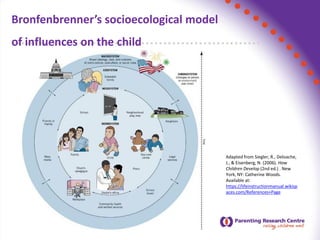
Bronfenbrenner’s socioecological model
of influences on the child
Adapted from Siegler, R., Deloache,
J., & Eisenberg, N. (2006). How
Children Develop (2nd ed.) . New
York, NY: Catherine Woods.
Available at:
https://lifeinstructionmanual.wikisp
aces.com/References+Page
The science shows the ingredients of
a healthy childhood are consistent.
The most important magic ingredient
is the quality and stability of the
relationships that children have with
the adults in their lives.
Jack Shonkoff, The Age, 3 March 2006
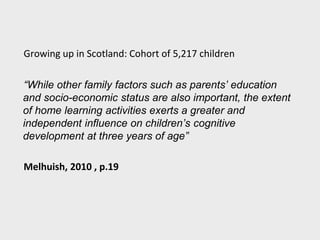
Growing up in Scotland: Cohort of 5,217 children
“While other family factors such as parents’ education
and socio-economic status are also important, the extent
of home learning activities exerts a greater and
independent influence on children’s cognitive
development at three years of age”
Melhuish, 2010 , p.19
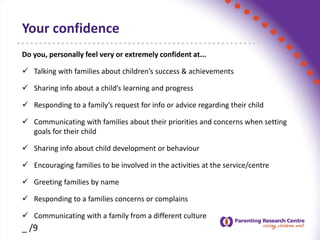
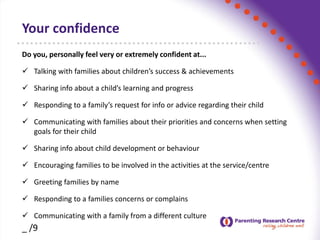
Your confidence
Do you, personally feel very or extremely confident at...
 Talking with families about children’s success & achievements
 Sharing info about a child’s learning and progress
 Responding to a family’s request for info or advice regarding their child
 Communicating with families about their priorities and concerns when setting
goals for their child
 Sharing info about child development or behaviour
 Encouraging families to be involved in the activities at the service/centre
 Greeting families by name
 Responding to a families concerns or complains
 Communicating with a family from a different culture
_ /9
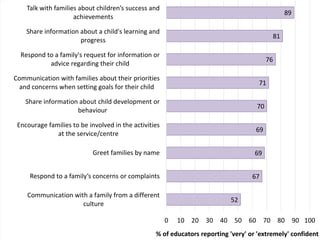
89
81
76
71
70
69
69
67
52
0 10 20 30 40 50 60 70 80 90 100
Talk with families about children’s success and
achievements
Share information about a child's learning and
progress
Respond to a family's request for information or
advice regarding their child
Communication with families about their priorities
and concerns when setting goals for their child
Share information about child development or
behaviour
Encourage families to be involved in the activities
at the service/centre
Greet families by name
Respond to a family’s concerns or complaints
Communication with a family from a different
culture
% of educators reporting 'very' or 'extremely' confident
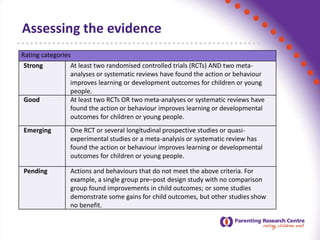
Assessing the evidence
Rating categories
Strong At least two randomised controlled trials (RCTs) AND two meta-
analyses or systematic reviews have found the action or behaviour
improves learning or development outcomes for children or young
people.
Good At least two RCTs OR two meta-analyses or systematic reviews have
found the action or behaviour improves learning or developmental
outcomes for children or young people.
Emerging One RCT or several longitudinal prospective studies or quasi-
experimental studies or a meta-analysis or systematic review has
found the action or behaviour improves learning or developmental
outcomes for children or young people.
Pending Actions and behaviours that do not meet the above criteria. For
example, a single group pre–post design study with no comparison
group found improvements in child outcomes; or some studies
demonstrate some gains for child outcomes, but other studies show
no benefit.
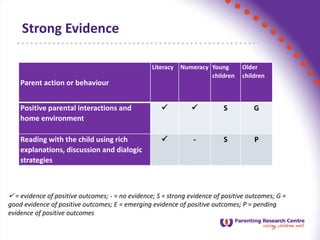
Strong Evidence
 = evidence of positive outcomes; - = no evidence; S = strong evidence of positive outcomes; G =
good evidence of positive outcomes; E = emerging evidence of positive outcomes; P = pending
evidence of positive outcomes
Parent action or behaviour
Literacy Numeracy Young
children
Older
children
Positive parental interactions and
home environment
  S G
Reading with the child using rich
explanations, discussion and dialogic
strategies
 - S P
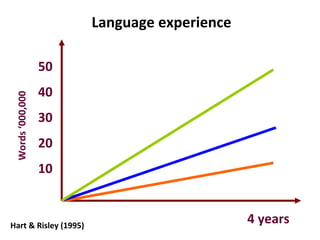
4 years
Words‘000,000
50
40
30
20
10
Language experience
Hart & Risley (1995)
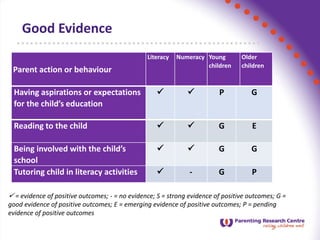
Good Evidence
 = evidence of positive outcomes; - = no evidence; S = strong evidence of positive outcomes; G =
good evidence of positive outcomes; E = emerging evidence of positive outcomes; P = pending
evidence of positive outcomes
Parent action or behaviour
Literacy Numeracy Young
children
Older
children
Having aspirations or expectations
for the child’s education
  P G
Reading to the child   G E
Being involved with the child’s
school
  G G
Tutoring child in literacy activities  - G P
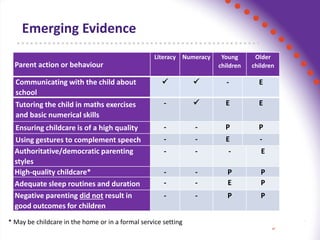
Emerging Evidence
* May be childcare in the home or in a formal service setting
Parent action or behaviour
Literacy Numeracy Young
children
Older
children
Communicating with the child about
school
  - E
Tutoring the child in maths exercises
and basic numerical skills
-  E E
Ensuring childcare is of a high quality - - P P
Using gestures to complement speech - - E -
Authoritative/democratic parenting
styles
- - - E
High-quality childcare* - - P P
Adequate sleep routines and duration - - E P
Negative parenting did not result in
good outcomes for children
- - P P
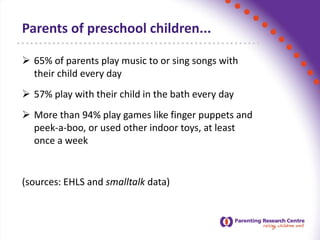
Parents of preschool children...
 65% of parents play music to or sing songs with
their child every day
 57% play with their child in the bath every day
 More than 94% play games like finger puppets and
peek-a-boo, or used other indoor toys, at least
once a week
(sources: EHLS and smalltalk data)
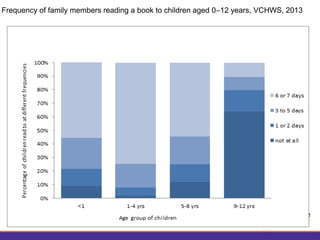
Frequency of family members reading a book to children aged 0–12 years, VCHWS, 2013
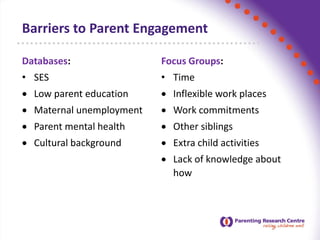
Barriers to Parent Engagement
Databases:
• SES
 Low parent education
 Maternal unemployment
 Parent mental health
 Cultural background
Focus Groups:
• Time
 Inflexible work places
 Work commitments
 Other siblings
 Extra child activities
 Lack of knowledge about
how
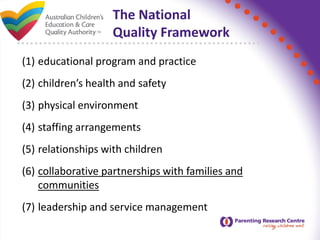
The National
Quality Framework
(1) educational program and practice
(2) children’s health and safety
(3) physical environment
(4) staffing arrangements
(5) relationships with children
(6) collaborative partnerships with families and
communities
(7) leadership and service management
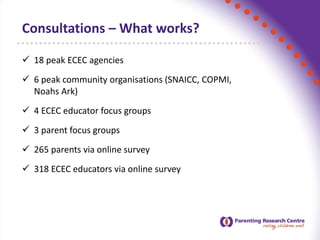
Consultations – What works?
 18 peak ECEC agencies
 6 peak community organisations (SNAICC, COPMI,
Noahs Ark)
 4 ECEC educator focus groups
 3 parent focus groups
 265 parents via online survey
 318 ECEC educators via online survey
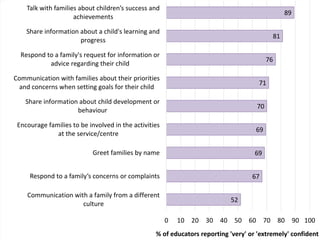
89
81
76
71
70
69
69
67
52
0 10 20 30 40 50 60 70 80 90 100
Talk with families about children’s success and
achievements
Share information about a child's learning and
progress
Respond to a family's request for information or
advice regarding their child
Communication with families about their priorities
and concerns when setting goals for their child
Share information about child development or
behaviour
Encourage families to be involved in the activities
at the service/centre
Greet families by name
Respond to a family’s concerns or complaints
Communication with a family from a different
culture
% of educators reporting 'very' or 'extremely' confident
coaching
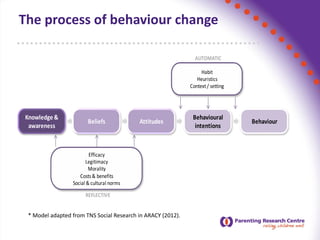
The process of behaviour change
Knowledge &
awareness
Beliefs Attitudes
Behavioural
intentions
Behaviour
Efficacy
Legitimacy
Morality
Costs& benefits
Social & cultural norms
Habit
Heuristics
Context/ setting
REFLECTIVE
AUTOMATIC
* Model adapted from TNS Social Research in ARACY (2012).
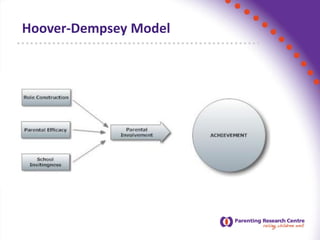
Hoover-Dempsey Model
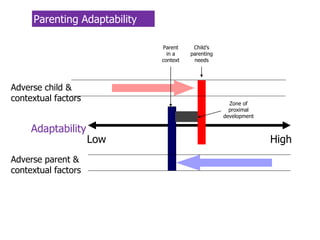
Adaptability
Low High
Child’s
parenting
needs
StrongWeakAdverse child &
contextual factors
eak
Adverse parent &
contextual factors
Parent
in a
context
Parenting Adaptability
Zone of
proximal
development
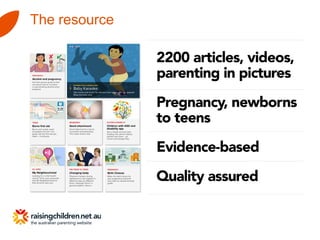
The resource
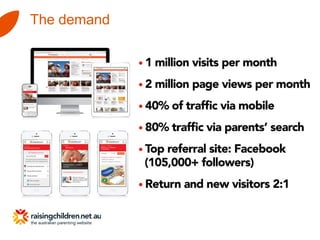
The demand
Jump aboard
Your confidence
Do you, personally feel very or extremely confident at...
 Talking with families about children’s success & achievements
 Sharing info about a child’s learning and progress
 Responding to a family’s request for info or advice regarding their child
 Communicating with families about their priorities and concerns when setting
goals for their child
 Sharing info about child development or behaviour
 Encouraging families to be involved in the activities at the service/centre
 Greeting families by name
 Responding to a families concerns or complains
 Communicating with a family from a different culture
_ /9
Thank You.
Dr. Catherine Wade
www.parentingrc.org.au
Twitter: @WadeCath

Parent Engagement in ECEC

  • 1.
    Parent Engagement inECEC Why is it important; What is it; Can we improve it? Dr. Catherine Wade Principal Research Specialist & Psychologist Parenting Research Centre & University of Sydney Paper presented at the Queensland Early Education and Care Conference June 2016, Brisbane.
  • 2.
    What is aparenting research centre?
  • 5.
    Acknowledgements Parenting Research Centre:Dr Gina-Maree Sartore, Dr Michelle Macvean, Dr Catherine Wade, Derek McCormack, Dr Arno Parolini, Faye Forbes, Tracey Phan, Durga Shrestha, Anastasia Pourliakas, Ben Devine, Cathy Bent, Jessica Falkiner, Dr Robyn Mildon, Dr Erica Neill, Tracey Phan, Durga Shrestha, Faye Forbes, Fiona Shackleton, Catherine Murphy, Melinda Polimeni, Cathy Bent, Tony Gates, Warren Cann… Centre for Community Child Health: Maria Fong Australian Research Alliance for Children and Youth (ARACY): Neil Stafford & Dr Stacey Fox
  • 6.
    Bronfenbrenner’s socioecological model ofinfluences on the child Adapted from Siegler, R., Deloache, J., & Eisenberg, N. (2006). How Children Develop (2nd ed.) . New York, NY: Catherine Woods. Available at: https://lifeinstructionmanual.wikisp aces.com/References+Page
  • 7.
    The science showsthe ingredients of a healthy childhood are consistent. The most important magic ingredient is the quality and stability of the relationships that children have with the adults in their lives. Jack Shonkoff, The Age, 3 March 2006
  • 8.
    Growing up inScotland: Cohort of 5,217 children “While other family factors such as parents’ education and socio-economic status are also important, the extent of home learning activities exerts a greater and independent influence on children’s cognitive development at three years of age” Melhuish, 2010 , p.19
  • 10.
    Your confidence Do you,personally feel very or extremely confident at...  Talking with families about children’s success & achievements  Sharing info about a child’s learning and progress  Responding to a family’s request for info or advice regarding their child  Communicating with families about their priorities and concerns when setting goals for their child  Sharing info about child development or behaviour  Encouraging families to be involved in the activities at the service/centre  Greeting families by name  Responding to a families concerns or complains  Communicating with a family from a different culture _ /9
  • 11.
    89 81 76 71 70 69 69 67 52 0 10 2030 40 50 60 70 80 90 100 Talk with families about children’s success and achievements Share information about a child's learning and progress Respond to a family's request for information or advice regarding their child Communication with families about their priorities and concerns when setting goals for their child Share information about child development or behaviour Encourage families to be involved in the activities at the service/centre Greet families by name Respond to a family’s concerns or complaints Communication with a family from a different culture % of educators reporting 'very' or 'extremely' confident
  • 12.
    Assessing the evidence Ratingcategories Strong At least two randomised controlled trials (RCTs) AND two meta- analyses or systematic reviews have found the action or behaviour improves learning or development outcomes for children or young people. Good At least two RCTs OR two meta-analyses or systematic reviews have found the action or behaviour improves learning or developmental outcomes for children or young people. Emerging One RCT or several longitudinal prospective studies or quasi- experimental studies or a meta-analysis or systematic review has found the action or behaviour improves learning or developmental outcomes for children or young people. Pending Actions and behaviours that do not meet the above criteria. For example, a single group pre–post design study with no comparison group found improvements in child outcomes; or some studies demonstrate some gains for child outcomes, but other studies show no benefit.
  • 13.
    Strong Evidence  =evidence of positive outcomes; - = no evidence; S = strong evidence of positive outcomes; G = good evidence of positive outcomes; E = emerging evidence of positive outcomes; P = pending evidence of positive outcomes Parent action or behaviour Literacy Numeracy Young children Older children Positive parental interactions and home environment   S G Reading with the child using rich explanations, discussion and dialogic strategies  - S P
  • 14.
  • 15.
    Good Evidence  =evidence of positive outcomes; - = no evidence; S = strong evidence of positive outcomes; G = good evidence of positive outcomes; E = emerging evidence of positive outcomes; P = pending evidence of positive outcomes Parent action or behaviour Literacy Numeracy Young children Older children Having aspirations or expectations for the child’s education   P G Reading to the child   G E Being involved with the child’s school   G G Tutoring child in literacy activities  - G P
  • 16.
    Emerging Evidence * Maybe childcare in the home or in a formal service setting Parent action or behaviour Literacy Numeracy Young children Older children Communicating with the child about school   - E Tutoring the child in maths exercises and basic numerical skills -  E E Ensuring childcare is of a high quality - - P P Using gestures to complement speech - - E - Authoritative/democratic parenting styles - - - E High-quality childcare* - - P P Adequate sleep routines and duration - - E P Negative parenting did not result in good outcomes for children - - P P
  • 17.
    Parents of preschoolchildren...  65% of parents play music to or sing songs with their child every day  57% play with their child in the bath every day  More than 94% play games like finger puppets and peek-a-boo, or used other indoor toys, at least once a week (sources: EHLS and smalltalk data)
  • 18.
    Frequency of familymembers reading a book to children aged 0–12 years, VCHWS, 2013
  • 20.
    Barriers to ParentEngagement Databases: • SES  Low parent education  Maternal unemployment  Parent mental health  Cultural background Focus Groups: • Time  Inflexible work places  Work commitments  Other siblings  Extra child activities  Lack of knowledge about how
  • 21.
    The National Quality Framework (1)educational program and practice (2) children’s health and safety (3) physical environment (4) staffing arrangements (5) relationships with children (6) collaborative partnerships with families and communities (7) leadership and service management
  • 22.
    Consultations – Whatworks?  18 peak ECEC agencies  6 peak community organisations (SNAICC, COPMI, Noahs Ark)  4 ECEC educator focus groups  3 parent focus groups  265 parents via online survey  318 ECEC educators via online survey
  • 23.
    89 81 76 71 70 69 69 67 52 0 10 2030 40 50 60 70 80 90 100 Talk with families about children’s success and achievements Share information about a child's learning and progress Respond to a family's request for information or advice regarding their child Communication with families about their priorities and concerns when setting goals for their child Share information about child development or behaviour Encourage families to be involved in the activities at the service/centre Greet families by name Respond to a family’s concerns or complaints Communication with a family from a different culture % of educators reporting 'very' or 'extremely' confident
  • 24.
  • 25.
    The process ofbehaviour change Knowledge & awareness Beliefs Attitudes Behavioural intentions Behaviour Efficacy Legitimacy Morality Costs& benefits Social & cultural norms Habit Heuristics Context/ setting REFLECTIVE AUTOMATIC * Model adapted from TNS Social Research in ARACY (2012).
  • 26.
  • 27.
    Adaptability Low High Child’s parenting needs StrongWeakAdverse child& contextual factors eak Adverse parent & contextual factors Parent in a context Parenting Adaptability Zone of proximal development
  • 30.
  • 31.
  • 32.
  • 33.
    Your confidence Do you,personally feel very or extremely confident at...  Talking with families about children’s success & achievements  Sharing info about a child’s learning and progress  Responding to a family’s request for info or advice regarding their child  Communicating with families about their priorities and concerns when setting goals for their child  Sharing info about child development or behaviour  Encouraging families to be involved in the activities at the service/centre  Greeting families by name  Responding to a families concerns or complains  Communicating with a family from a different culture _ /9
  • 34.
    Thank You. Dr. CatherineWade www.parentingrc.org.au Twitter: @WadeCath