Catholic Christianity-
Forms of Expression
and way of life
Paper 1 – Unit 4
Church architecture
La Sagrada Familia,
Barcelona
St Paul’s Cathedral,
London
Importance today:
1) Better experience 2) Greater participation 3) Changes from Second VC
Place of worship and prayer
Feature Belief
Face East Sun rises – Jesus
resurrection
Some Cruciform shape Cross – reminder of
Jesus’ sacrifice
Some round Eternal nature of God
Some octagonal Represent star
High ceilings and spires Connect to God in
heaven
Stained glass windows Tell stories
Worship Mass
Sacraments
Other uses Private prayer
Popular piety
‘Make visible the Church living in
this place’ CCC
Internal features of a
Catholic church
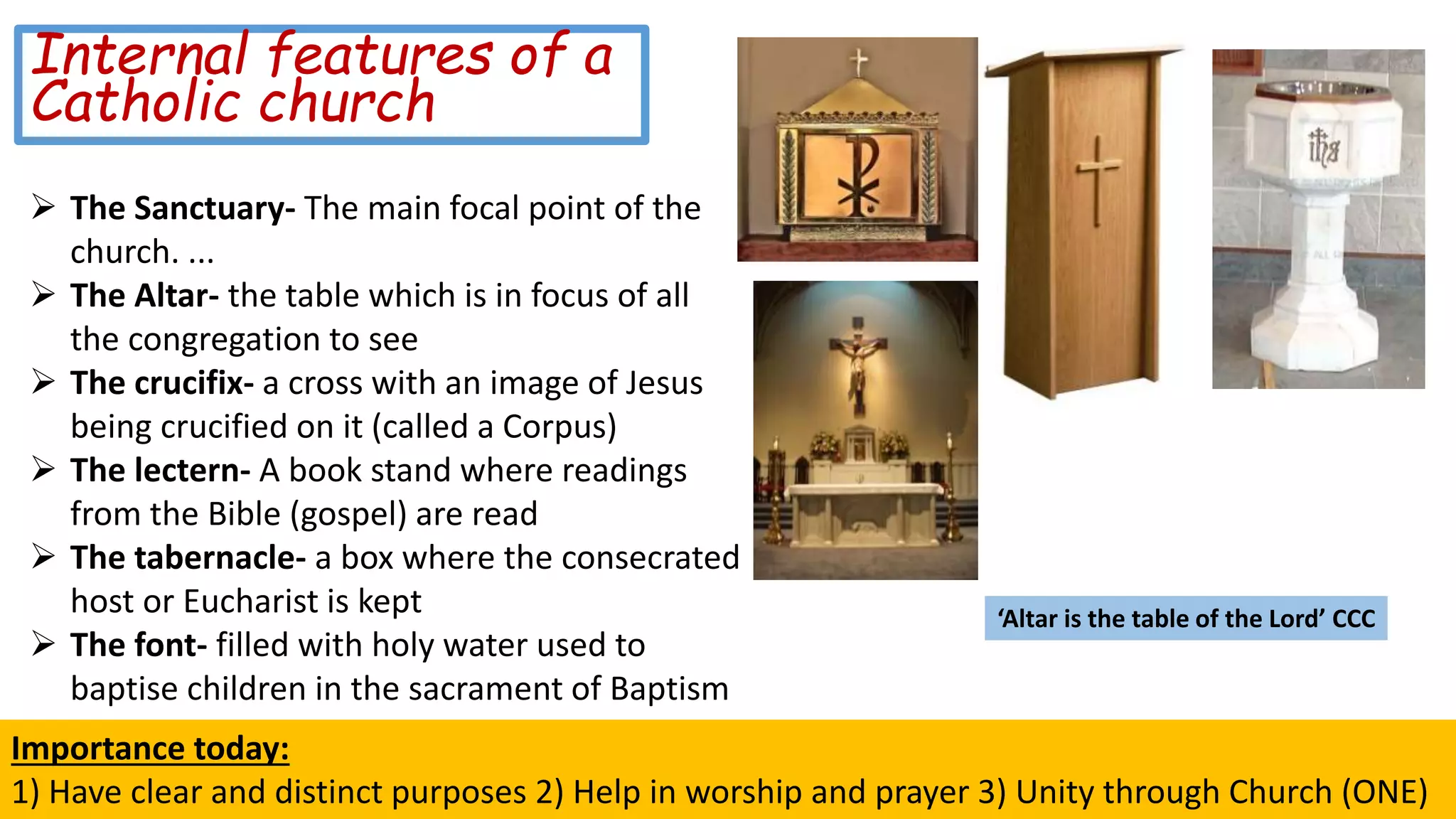
 The Sanctuary- The main focal point of the
church. ...
 The Altar- the table which is in focus of all
the congregation to see
 The crucifix- a cross with an image of Jesus
being crucified on it (called a Corpus)
 The lectern- A book stand where readings
from the Bible (gospel) are read
 The tabernacle- a box where the consecrated
host or Eucharist is kept
 The font- filled with holy water used to
baptise children in the sacrament of Baptism
Importance today:
1) Have clear and distinct purposes 2) Help in worship and prayer 3) Unity through Church (ONE)
‘Altar is the table of the Lord’ CCC
Inside a typical church, there are many features, which are very important to Christians
in their worship. When a member of the congregation enters the church, he or she will
firstly go through the Porch. It is open to invite the congregation into church and is
always open before services to welcome people. Inside the Porch, the Holy Water
Stoup is found in there. This is where people dip their fingers in the Holy water and
make the sign of the cross, on their forehead. The water is for cleaning and washing
away the sins symbolically, as well as preparations for the prayer and reminds the
Christians of their Baptism, which is the First sacrament of Initiation. This represents
welcoming into the family of Jesus. The sign of the cross, reminds them of Jesus’ death
and resurrection. Many books are found inside the Porch. One of the books is the
Order of Service, which tells us that the services are liturgical, that they follow a set
pattern. There are lots of leaflets, about charities and congregation of activities, which
tells us that there are opportunities for Christians to put Jesus’ teachings into practice in
their daily lives.
How internal features
facilitate Catholic worship
Sacred Objects
Sarcophagi- box like container for
corpse sometimes for Pope’s. Physical
reminder and focus for prayer
Hunger Cloths-depict a set
of stories, usually taken
from the gospels
Help to focus on worship
Sacred Vessels – important for the celebration of the Eucharist. Contain Jesus’ body and blood
Importance today:
1) Have clear and distinct purposes 2) Help in worship and prayer 3) Unity through Church (ONE)
Paintings, frescos and
drawings
Fresco- is a technique of
mural painting executed upon
freshly laid, or wet lime
plaster. Water is used as the
vehicle for the dry-powder
pigment to merge with the
plaster, and with the setting
of the plaster, the painting
becomes an integral part of
the wall
An icon is a religious work of art, most
commonly a painting, from the Eastern
Orthodox Church, Oriental Orthodoxy, and
certain Eastern Catholic churches. The
most common subjects include Christ,
Mary, saints and/or angels
Paintings- From its very beginning nearly 2,000 years ago, the Catholic
Church has used art to instruct men and women about the Faith and to
inspire them to live up to its high ideals
Different Views
Catholics – all must glorify God
Orthodox - ICONS
‘evoke and glorify God’ CCC
Paintings, frescos and
drawings
Importance today:
1) Capture a story 2) Help in worship and prayer 3) Express belief
Michelango’s ‘Creation of Adam’
* Reminds faithful to scripture
* Layers of meaning for philosophical
debate
Rembrandt’s ‘The return of the Prodigal Son’
• He was moved by this parable so painted it
• Helps explore meaning
Sculptures and statues
Importance today:
1) Capture a story 2) Help in worship and prayer 3) Express belief
Expression of artist Expression by audience
Statues • Reflection of
scripture
• Attempt to produce
likeness
• Kneel before them
• Touch or kiss them
• Light a candle before
them
• Pray before them
Sculptures • Expression of faith in
an emotive way
• Convey message
• Meditation
• Reflection upon them
• Used to recall a person / thing
• Teaching tool
• Not WORSHIPED but AID to prayer
‘Practical wisdom’ CCC
Sculptures and statues
Divergent Christian attitudes to use of sculptures and statues
Use of symbolism and imagery
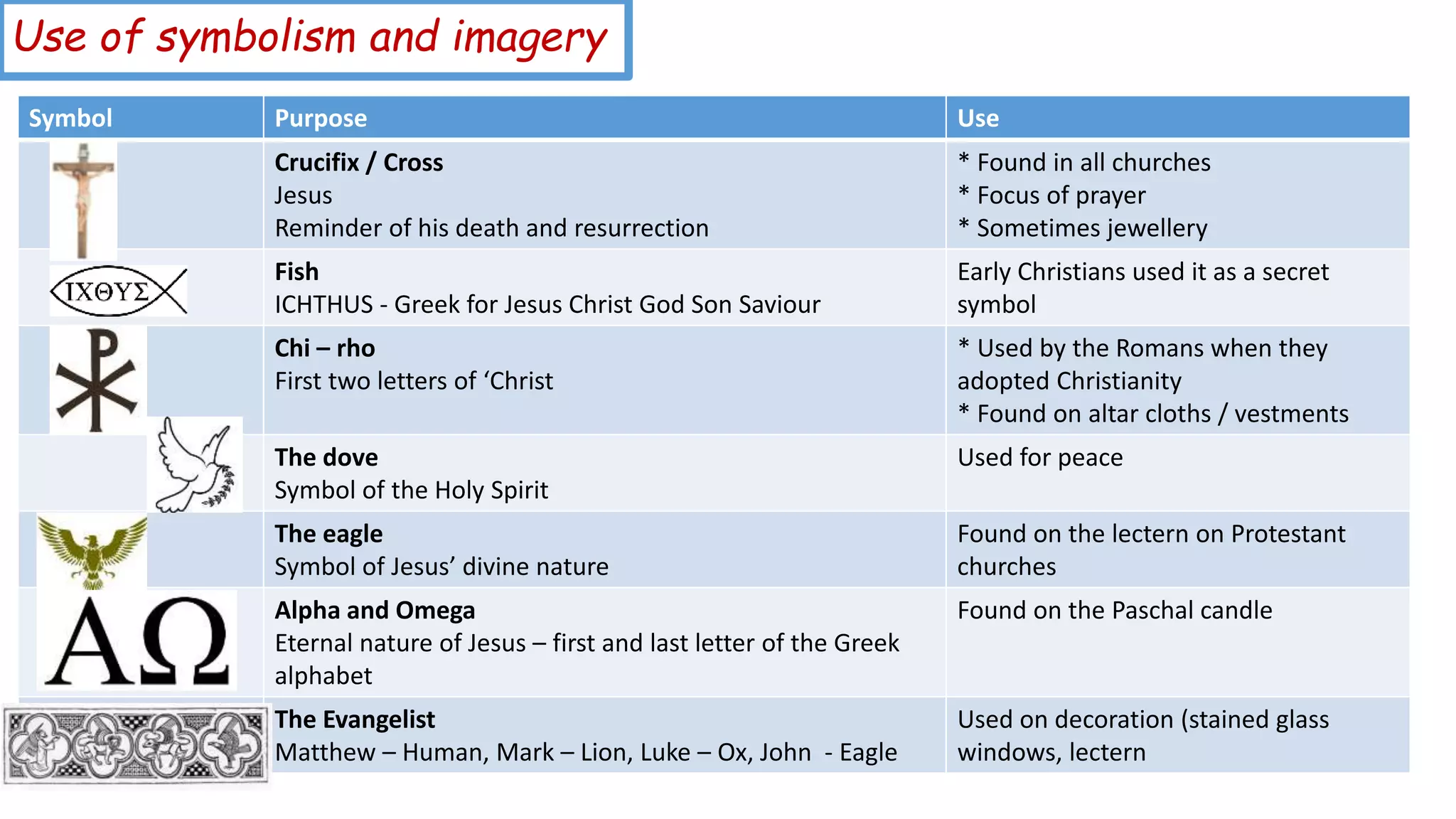
Symbol Purpose Use
Crucifix / Cross
Jesus
Reminder of his death and resurrection
* Found in all churches
* Focus of prayer
* Sometimes jewellery
Fish
ICHTHUS - Greek for Jesus Christ God Son Saviour
Early Christians used it as a secret
symbol
Chi – rho
First two letters of ‘Christ
* Used by the Romans when they
adopted Christianity
* Found on altar cloths / vestments
The dove
Symbol of the Holy Spirit
Used for peace
The eagle
Symbol of Jesus’ divine nature
Found on the lectern on Protestant
churches
Alpha and Omega
Eternal nature of Jesus – first and last letter of the Greek
alphabet
Found on the Paschal candle
The Evangelist
Matthew – Human, Mark – Lion, Luke – Ox, John - Eagle
Used on decoration (stained glass
windows, lectern
Drama- in worship
Nativity Play- typically
performed by children
at Christmas, based on
the events surrounding
the birth of Jesus
Christ.
The Passion Play or
Easter pageant
(senakulo) is a dramatic
presentation depicting
the Passion of Jesus
Christ: his trial,
suffering and death. It is
a traditional part of Lent
in several Christian
denominations,
particularly in Catholic
tradition.
• Drama is used to bring stories from the
Bible to life
• MYSTERY PLAYS – Remember Biblical
stories
• PASSSION PLAYS – Jesus’ death and
resurrection
• Engages people
• Focus of prayer and devotion
• Form of worship
• More powerful way to express the
Biblical stories
• Help people to remember and
understand
• Doesn’t have to take place in a Church
Importance today:
1) Engages people 2) Form of worship and prayer 3) Express belief
‘Engages the heart’ CCC
Music in worship
Other Christian points of view- Against-
• Some argue that lots of music in worship could be very
distracting, they might prefer more traditional music.
• People might go to Church and treat it like a concert, rather
than a place to worship God.
• Young people might forget the real reason they’re going to
Church.
Types of music used in Christian worship:
Charismatic worship- Contemporary worship music
(CWM), also known as praise and worship music, is a
defined genre of Christian music used in
contemporary worship
Hymns- a religious song or poem of praise to God or a
god
Psalms-a sacred song or hymn, in particular any of
those contained in the biblical Book of Psalms and
used in Christian worship
Plainchant- ‘Plainsong’ is a body of chants used in the
liturgies of the Western Church.
‘He who sings prays
twice’ CCC

Paper 1: Unit 4 revision

  • 1.
    Catholic Christianity- Forms ofExpression and way of life Paper 1 – Unit 4
  • 2.
    Church architecture La SagradaFamilia, Barcelona St Paul’s Cathedral, London Importance today: 1) Better experience 2) Greater participation 3) Changes from Second VC Place of worship and prayer Feature Belief Face East Sun rises – Jesus resurrection Some Cruciform shape Cross – reminder of Jesus’ sacrifice Some round Eternal nature of God Some octagonal Represent star High ceilings and spires Connect to God in heaven Stained glass windows Tell stories Worship Mass Sacraments Other uses Private prayer Popular piety ‘Make visible the Church living in this place’ CCC
  • 3.
    Internal features ofa Catholic church  The Sanctuary- The main focal point of the church. ...  The Altar- the table which is in focus of all the congregation to see  The crucifix- a cross with an image of Jesus being crucified on it (called a Corpus)  The lectern- A book stand where readings from the Bible (gospel) are read  The tabernacle- a box where the consecrated host or Eucharist is kept  The font- filled with holy water used to baptise children in the sacrament of Baptism Importance today: 1) Have clear and distinct purposes 2) Help in worship and prayer 3) Unity through Church (ONE) ‘Altar is the table of the Lord’ CCC
  • 4.
    Inside a typicalchurch, there are many features, which are very important to Christians in their worship. When a member of the congregation enters the church, he or she will firstly go through the Porch. It is open to invite the congregation into church and is always open before services to welcome people. Inside the Porch, the Holy Water Stoup is found in there. This is where people dip their fingers in the Holy water and make the sign of the cross, on their forehead. The water is for cleaning and washing away the sins symbolically, as well as preparations for the prayer and reminds the Christians of their Baptism, which is the First sacrament of Initiation. This represents welcoming into the family of Jesus. The sign of the cross, reminds them of Jesus’ death and resurrection. Many books are found inside the Porch. One of the books is the Order of Service, which tells us that the services are liturgical, that they follow a set pattern. There are lots of leaflets, about charities and congregation of activities, which tells us that there are opportunities for Christians to put Jesus’ teachings into practice in their daily lives. How internal features facilitate Catholic worship
  • 5.
    Sacred Objects Sarcophagi- boxlike container for corpse sometimes for Pope’s. Physical reminder and focus for prayer Hunger Cloths-depict a set of stories, usually taken from the gospels Help to focus on worship Sacred Vessels – important for the celebration of the Eucharist. Contain Jesus’ body and blood Importance today: 1) Have clear and distinct purposes 2) Help in worship and prayer 3) Unity through Church (ONE)
  • 6.
    Paintings, frescos and drawings Fresco-is a technique of mural painting executed upon freshly laid, or wet lime plaster. Water is used as the vehicle for the dry-powder pigment to merge with the plaster, and with the setting of the plaster, the painting becomes an integral part of the wall An icon is a religious work of art, most commonly a painting, from the Eastern Orthodox Church, Oriental Orthodoxy, and certain Eastern Catholic churches. The most common subjects include Christ, Mary, saints and/or angels Paintings- From its very beginning nearly 2,000 years ago, the Catholic Church has used art to instruct men and women about the Faith and to inspire them to live up to its high ideals Different Views Catholics – all must glorify God Orthodox - ICONS ‘evoke and glorify God’ CCC
  • 7.
    Paintings, frescos and drawings Importancetoday: 1) Capture a story 2) Help in worship and prayer 3) Express belief Michelango’s ‘Creation of Adam’ * Reminds faithful to scripture * Layers of meaning for philosophical debate Rembrandt’s ‘The return of the Prodigal Son’ • He was moved by this parable so painted it • Helps explore meaning
  • 8.
    Sculptures and statues Importancetoday: 1) Capture a story 2) Help in worship and prayer 3) Express belief Expression of artist Expression by audience Statues • Reflection of scripture • Attempt to produce likeness • Kneel before them • Touch or kiss them • Light a candle before them • Pray before them Sculptures • Expression of faith in an emotive way • Convey message • Meditation • Reflection upon them • Used to recall a person / thing • Teaching tool • Not WORSHIPED but AID to prayer ‘Practical wisdom’ CCC
  • 9.
    Sculptures and statues DivergentChristian attitudes to use of sculptures and statues
  • 10.
    Use of symbolismand imagery Symbol Purpose Use Crucifix / Cross Jesus Reminder of his death and resurrection * Found in all churches * Focus of prayer * Sometimes jewellery Fish ICHTHUS - Greek for Jesus Christ God Son Saviour Early Christians used it as a secret symbol Chi – rho First two letters of ‘Christ * Used by the Romans when they adopted Christianity * Found on altar cloths / vestments The dove Symbol of the Holy Spirit Used for peace The eagle Symbol of Jesus’ divine nature Found on the lectern on Protestant churches Alpha and Omega Eternal nature of Jesus – first and last letter of the Greek alphabet Found on the Paschal candle The Evangelist Matthew – Human, Mark – Lion, Luke – Ox, John - Eagle Used on decoration (stained glass windows, lectern
  • 11.
    Drama- in worship NativityPlay- typically performed by children at Christmas, based on the events surrounding the birth of Jesus Christ. The Passion Play or Easter pageant (senakulo) is a dramatic presentation depicting the Passion of Jesus Christ: his trial, suffering and death. It is a traditional part of Lent in several Christian denominations, particularly in Catholic tradition. • Drama is used to bring stories from the Bible to life • MYSTERY PLAYS – Remember Biblical stories • PASSSION PLAYS – Jesus’ death and resurrection • Engages people • Focus of prayer and devotion • Form of worship • More powerful way to express the Biblical stories • Help people to remember and understand • Doesn’t have to take place in a Church Importance today: 1) Engages people 2) Form of worship and prayer 3) Express belief ‘Engages the heart’ CCC
  • 12.
    Music in worship OtherChristian points of view- Against- • Some argue that lots of music in worship could be very distracting, they might prefer more traditional music. • People might go to Church and treat it like a concert, rather than a place to worship God. • Young people might forget the real reason they’re going to Church. Types of music used in Christian worship: Charismatic worship- Contemporary worship music (CWM), also known as praise and worship music, is a defined genre of Christian music used in contemporary worship Hymns- a religious song or poem of praise to God or a god Psalms-a sacred song or hymn, in particular any of those contained in the biblical Book of Psalms and used in Christian worship Plainchant- ‘Plainsong’ is a body of chants used in the liturgies of the Western Church. ‘He who sings prays twice’ CCC