PREHISTORIC
ARCHITECTURE
This was the type of architecture
invented by the primeval man to get
shelter and protection :
From variable extreme weather
conditions.
From wild beasts and enemies.
PALEOLITHIC
DWELLINGS
Structures created in wood and
stone.
Fire used on paved hearths.
No buildings for any special
purposes but dwellings.
Categorized into 5 types:
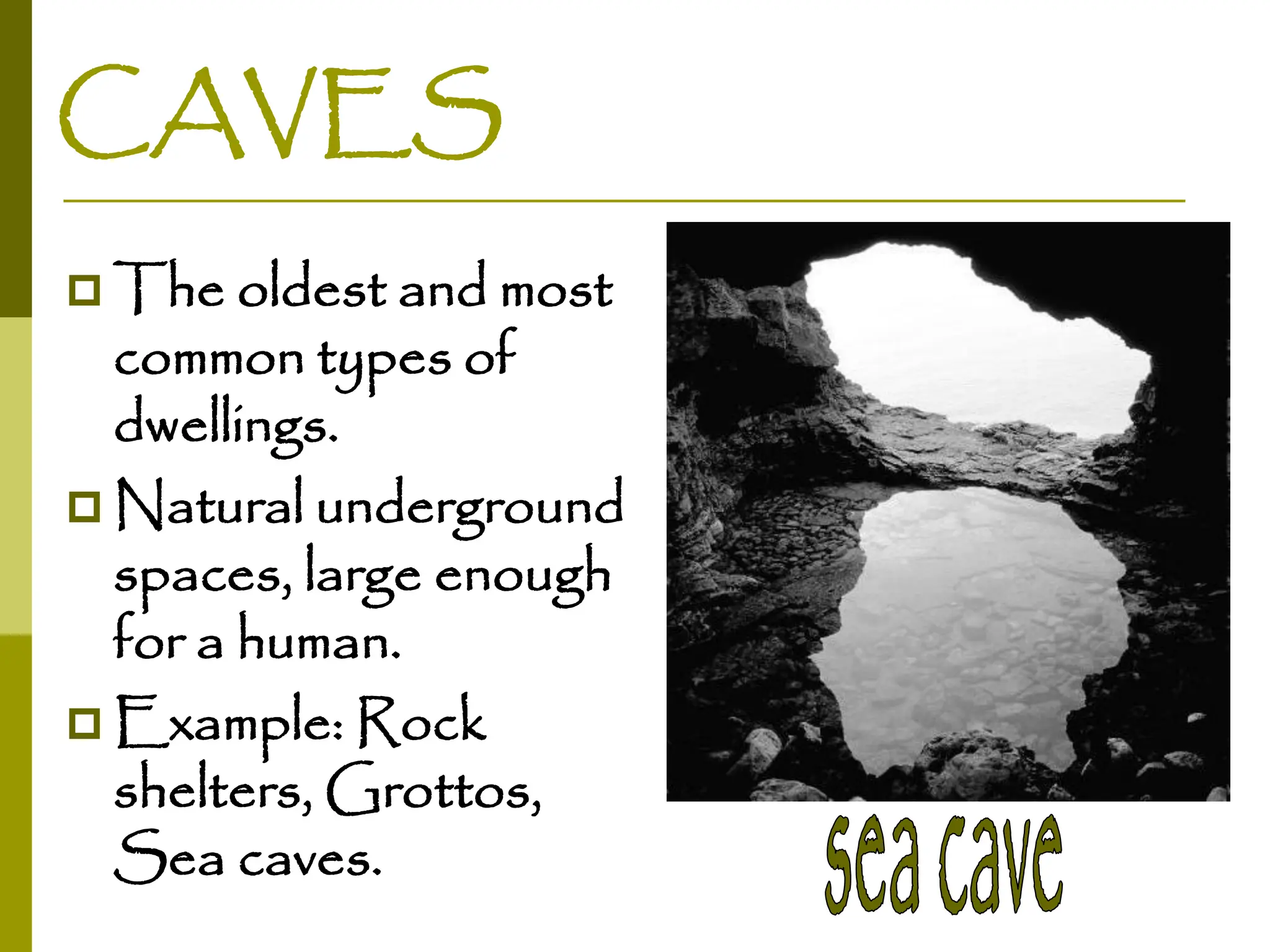
CAVES
 The oldest and most
common types of
dwellings.
 Natural underground
spaces, large enough
for a human.
 Example: Rock
shelters, Grottos,
Sea caves.
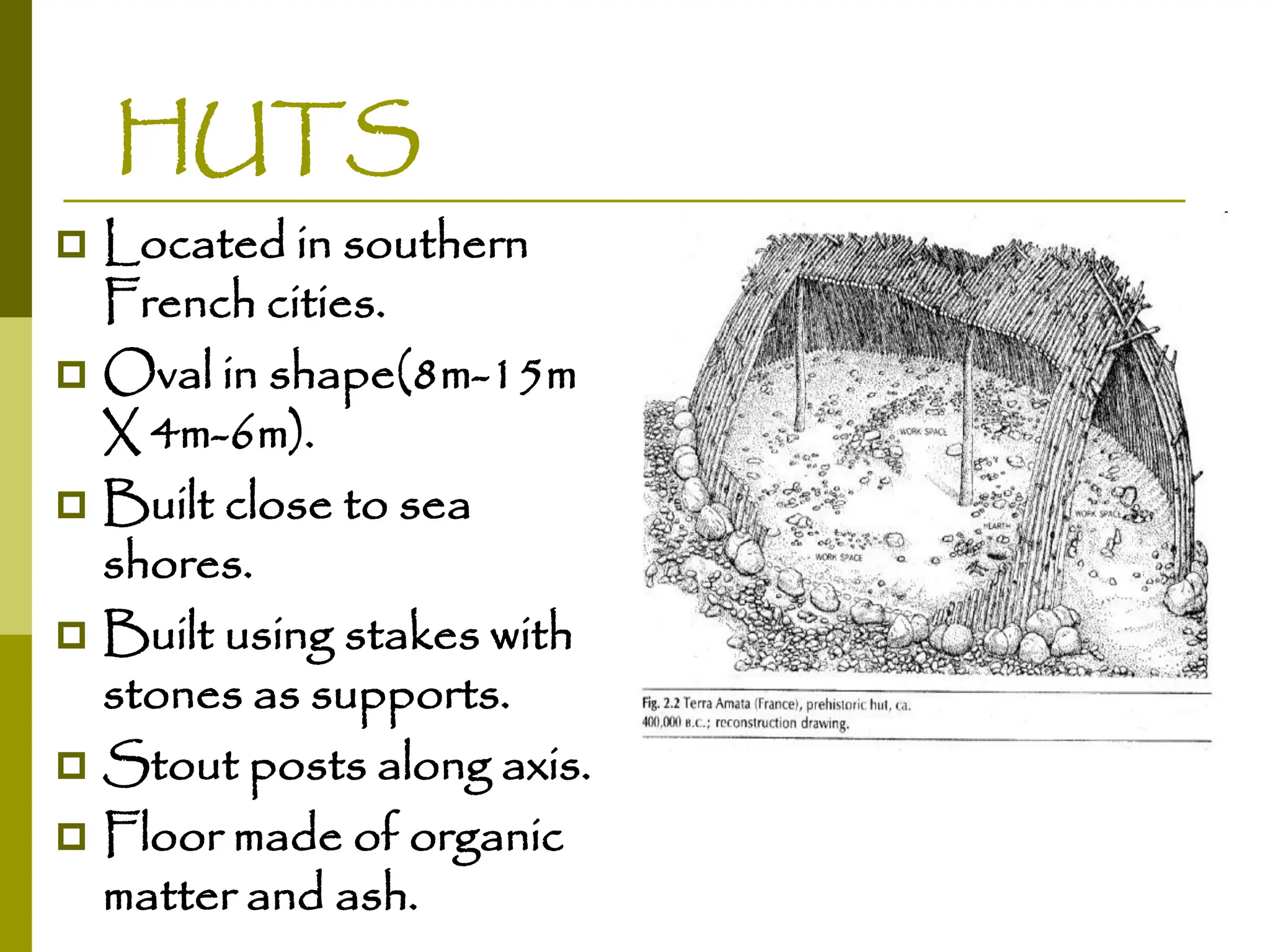
HUTS
 Located in southern
French cities.
 Oval in shape(8m-15m
X 4m-6m).
 Built close to sea
shores.
 Built using stakes with
stones as supports.
 Stout posts along axis.
 Floor made of organic
matter and ash.
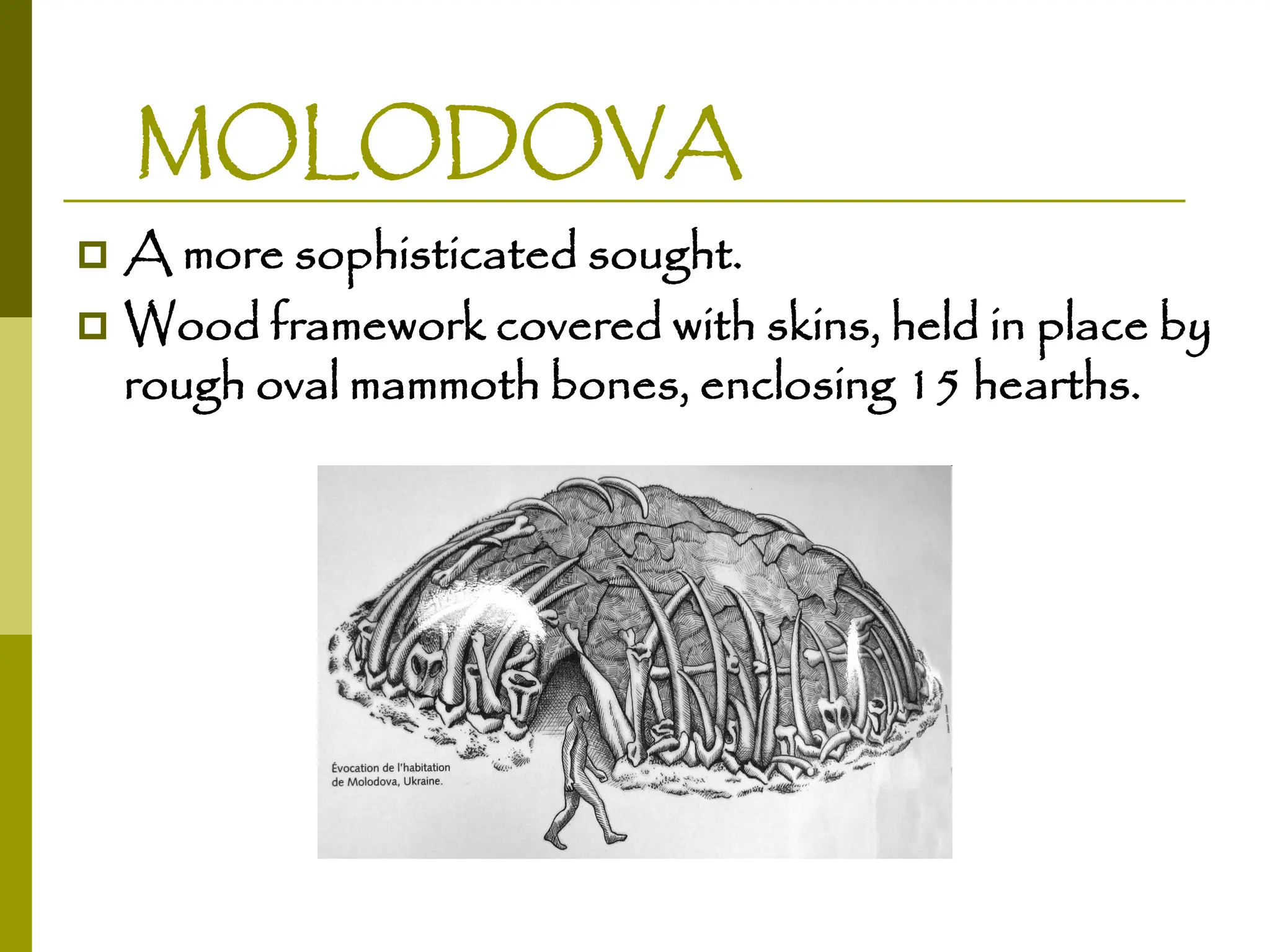
MOLODOVA
 A more sophisticated sought.
 Wood framework covered with skins, held in place by
rough oval mammoth bones, enclosing 15 hearths.
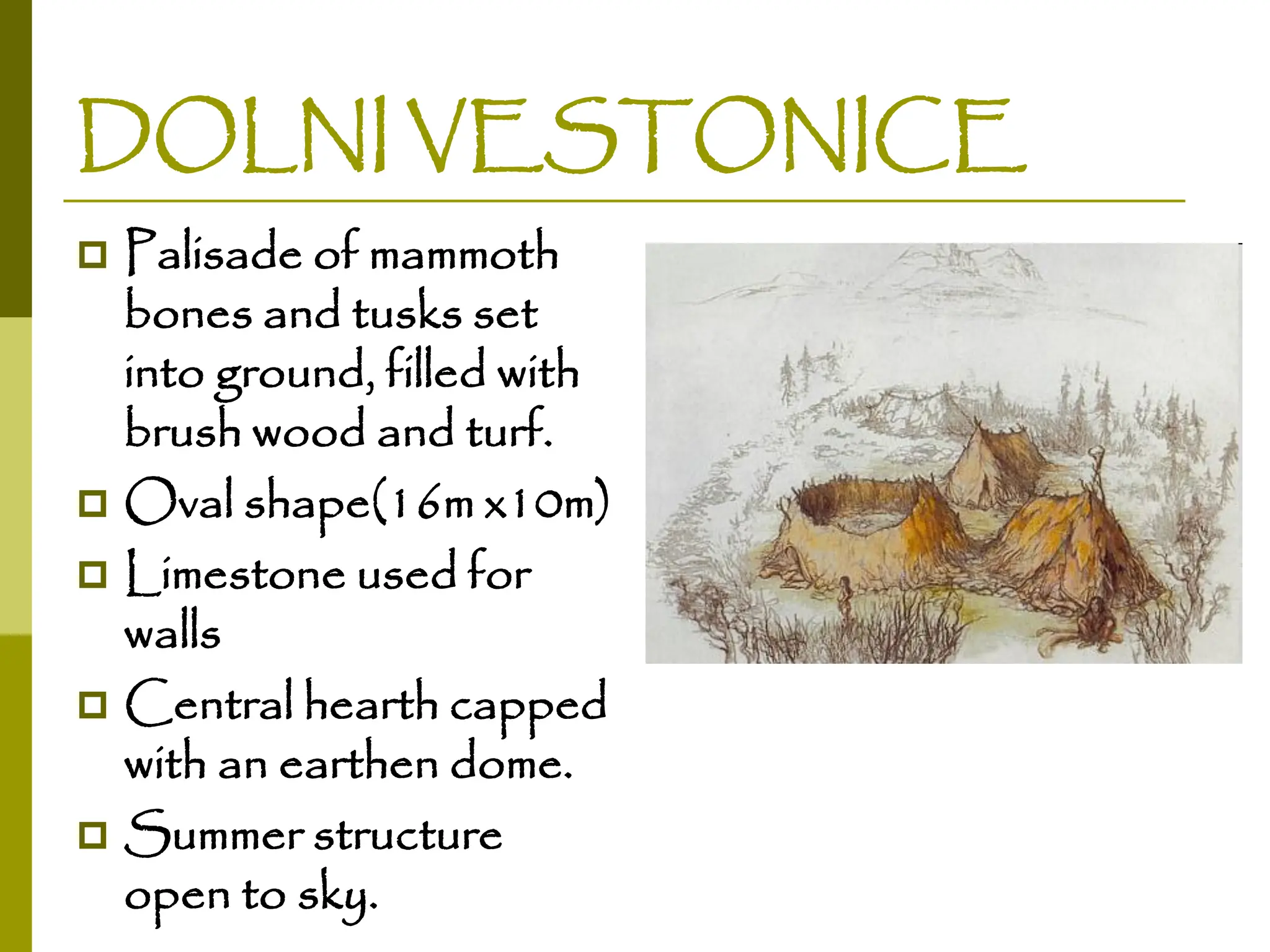
DOLNI VESTONICE
 Palisade of mammoth
bones and tusks set
into ground, filled with
brush wood and turf.
 Oval shape(16m x10m)
 Limestone used for
walls
 Central hearth capped
with an earthen dome.
 Summer structure
open to sky.
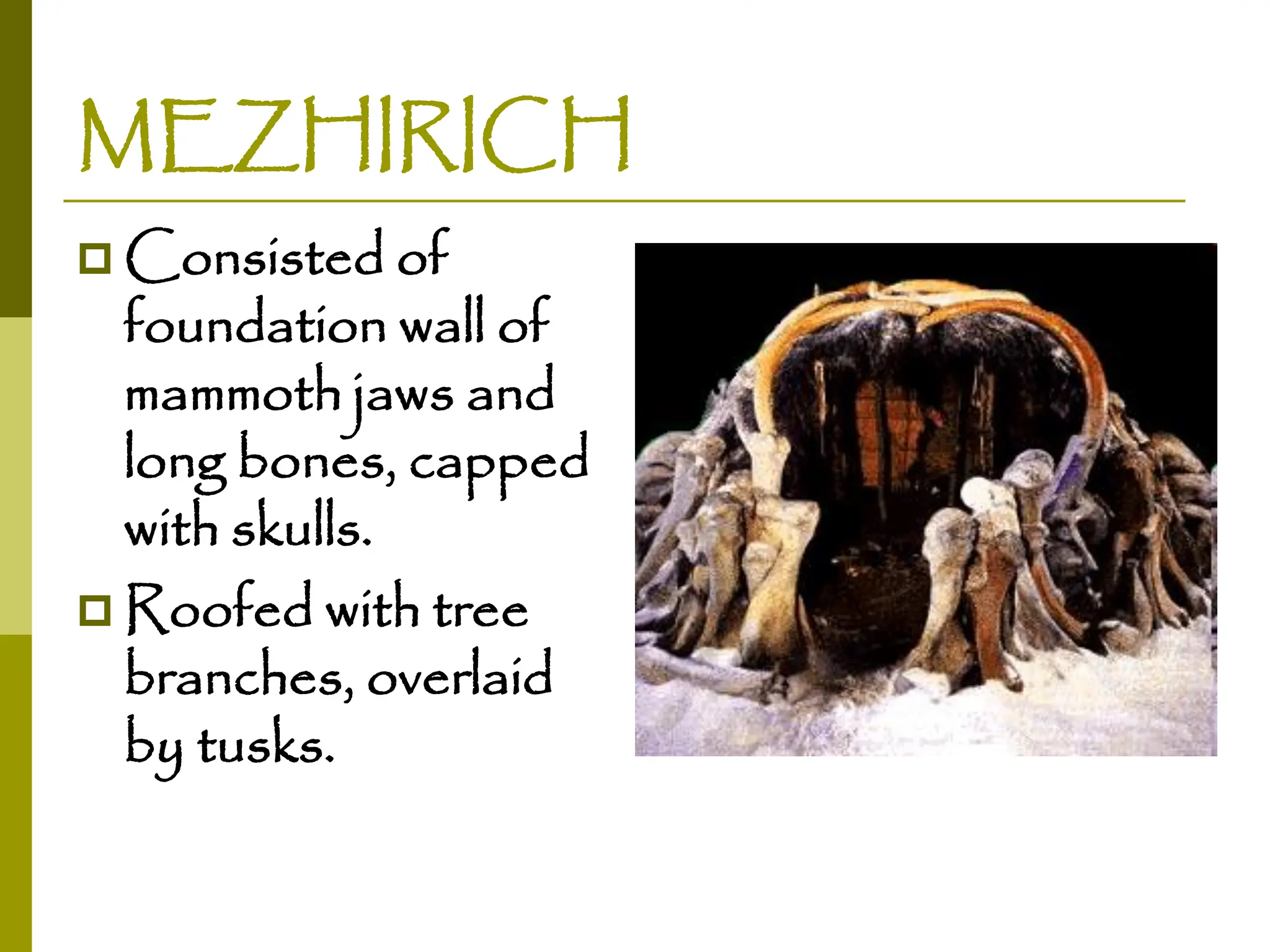
MEZHIRICH
 Consisted of
foundation wall of
mammoth jaws and
long bones, capped
with skulls.
 Roofed with tree
branches, overlaid
by tusks.
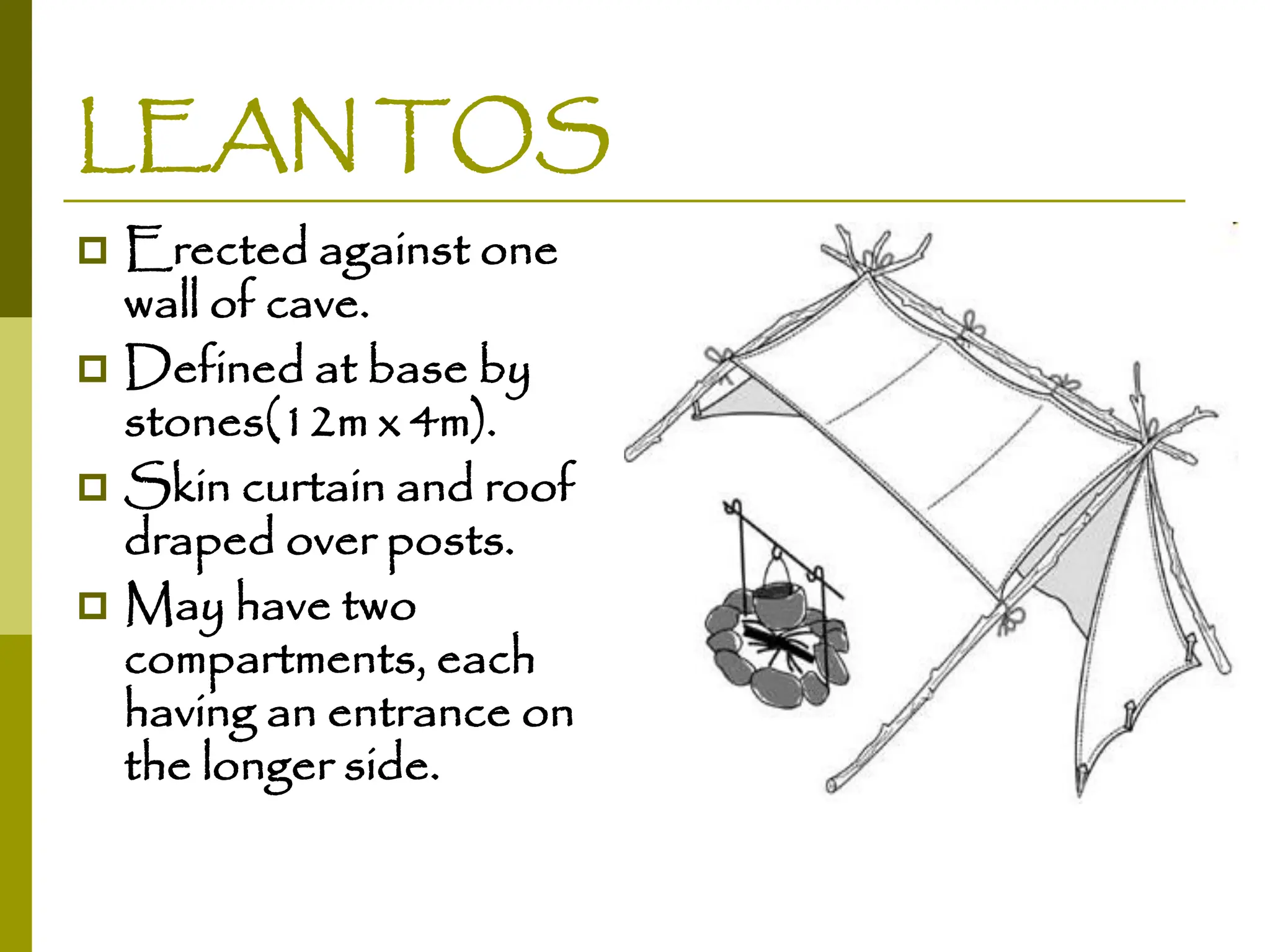
LEAN TOS
 Erected against one
wall of cave.
 Defined at base by
stones(12m x 4m).
 Skin curtain and roof
draped over posts.
 May have two
compartments, each
having an entrance on
the longer side.
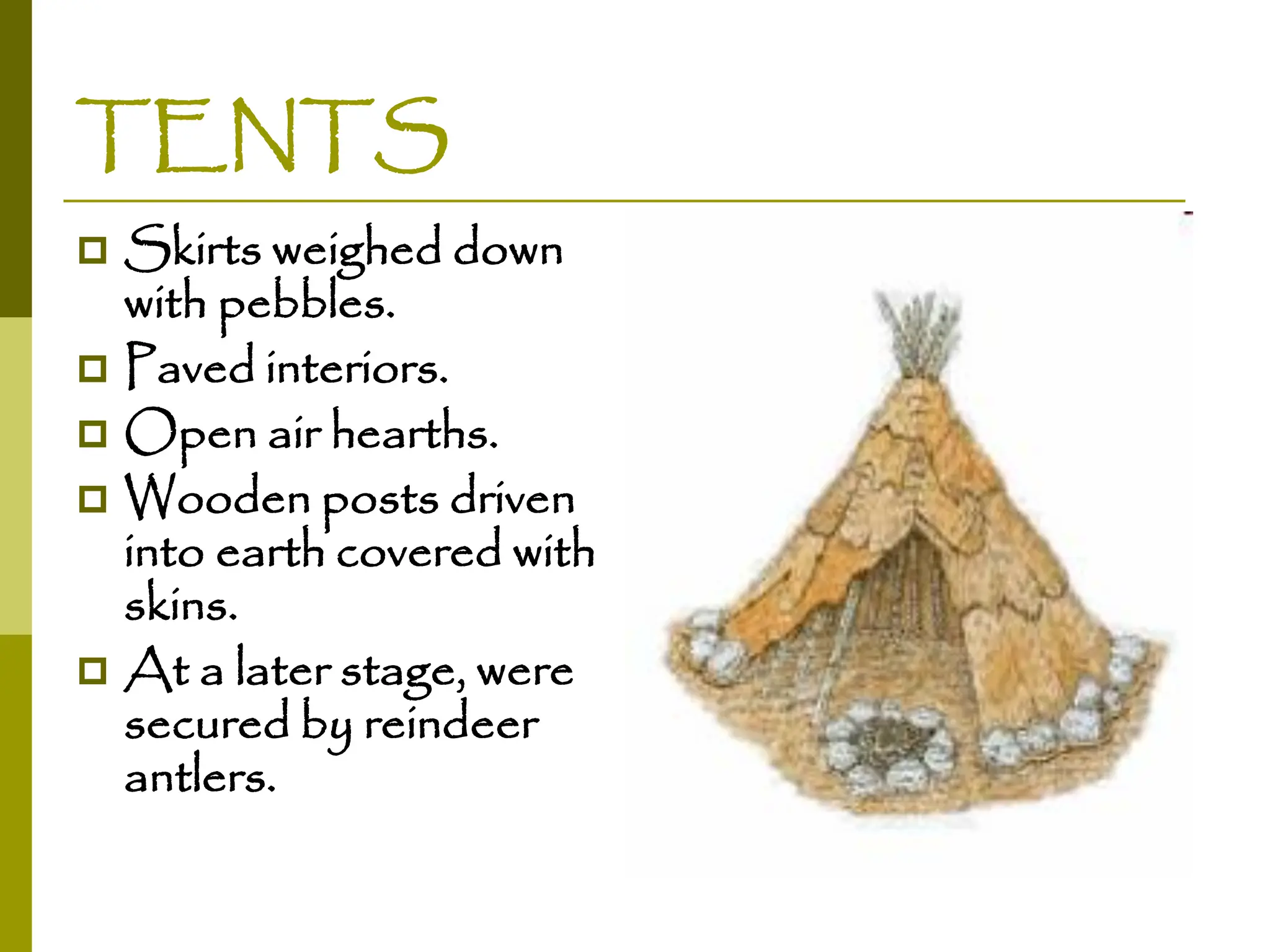
TENTS
 Skirts weighed down
with pebbles.
 Paved interiors.
 Open air hearths.
 Wooden posts driven
into earth covered with
skins.
 At a later stage, were
secured by reindeer
antlers.
PIT HOUSES
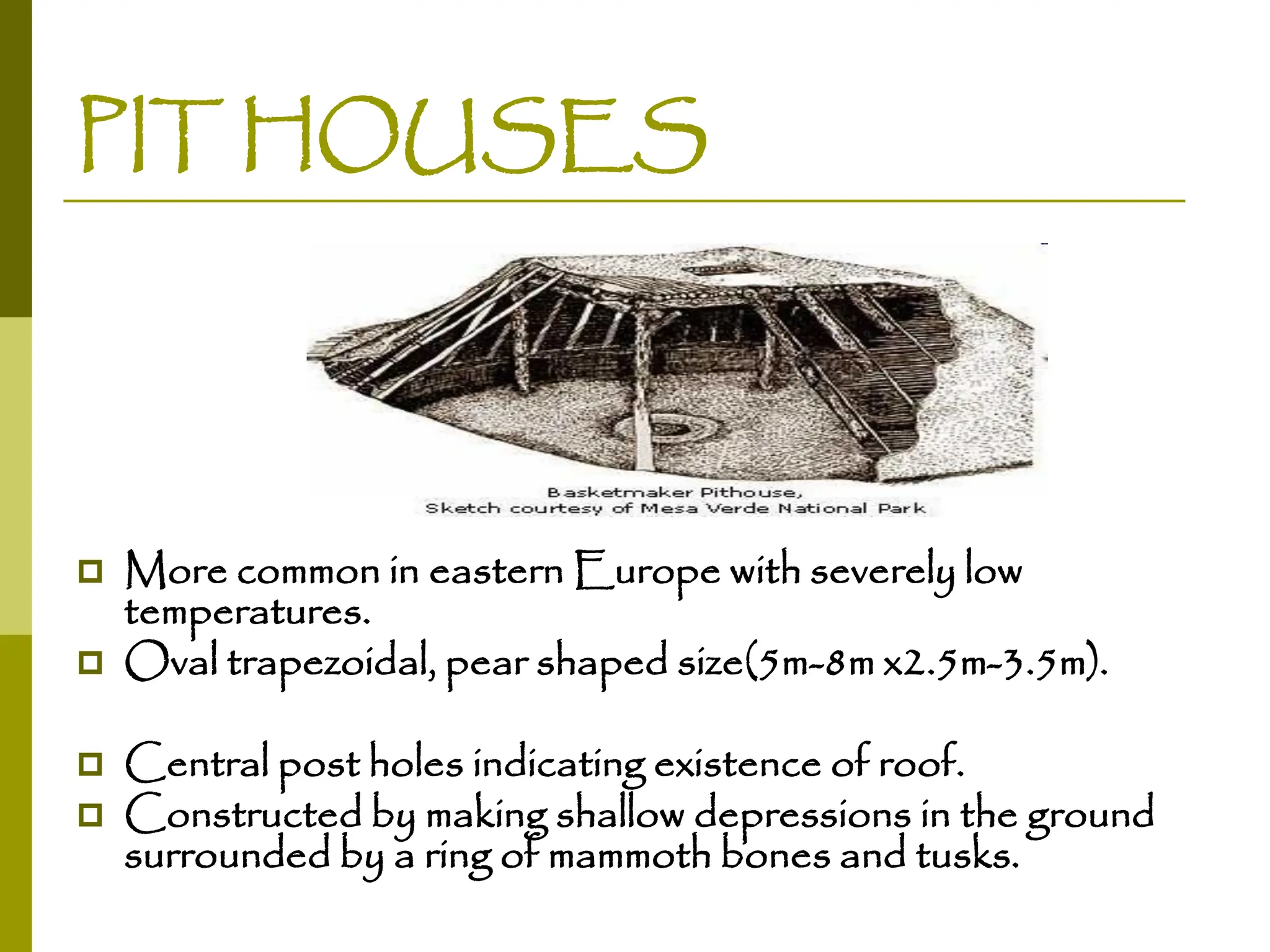
 More common in eastern Europe with severely low
temperatures.
 Oval trapezoidal, pear shaped size(5m-8m x2.5m-3.5m).
 Central post holes indicating existence of roof.
 Constructed by making shallow depressions in the ground
surrounded by a ring of mammoth bones and tusks.
MESOLITHIC PERIOD
 Villages arranged systematically.
 Houses aligned in rows.
 More regular plans.
 Artefacts came into existence.
 Settlements began around water bodies.
 Fishing, cultivation of cereals and vegetables
began.
 Animals were domesticated, farming tools were
developed.
 Dwellings were more durable as compared to that in
the Paleolithic age.
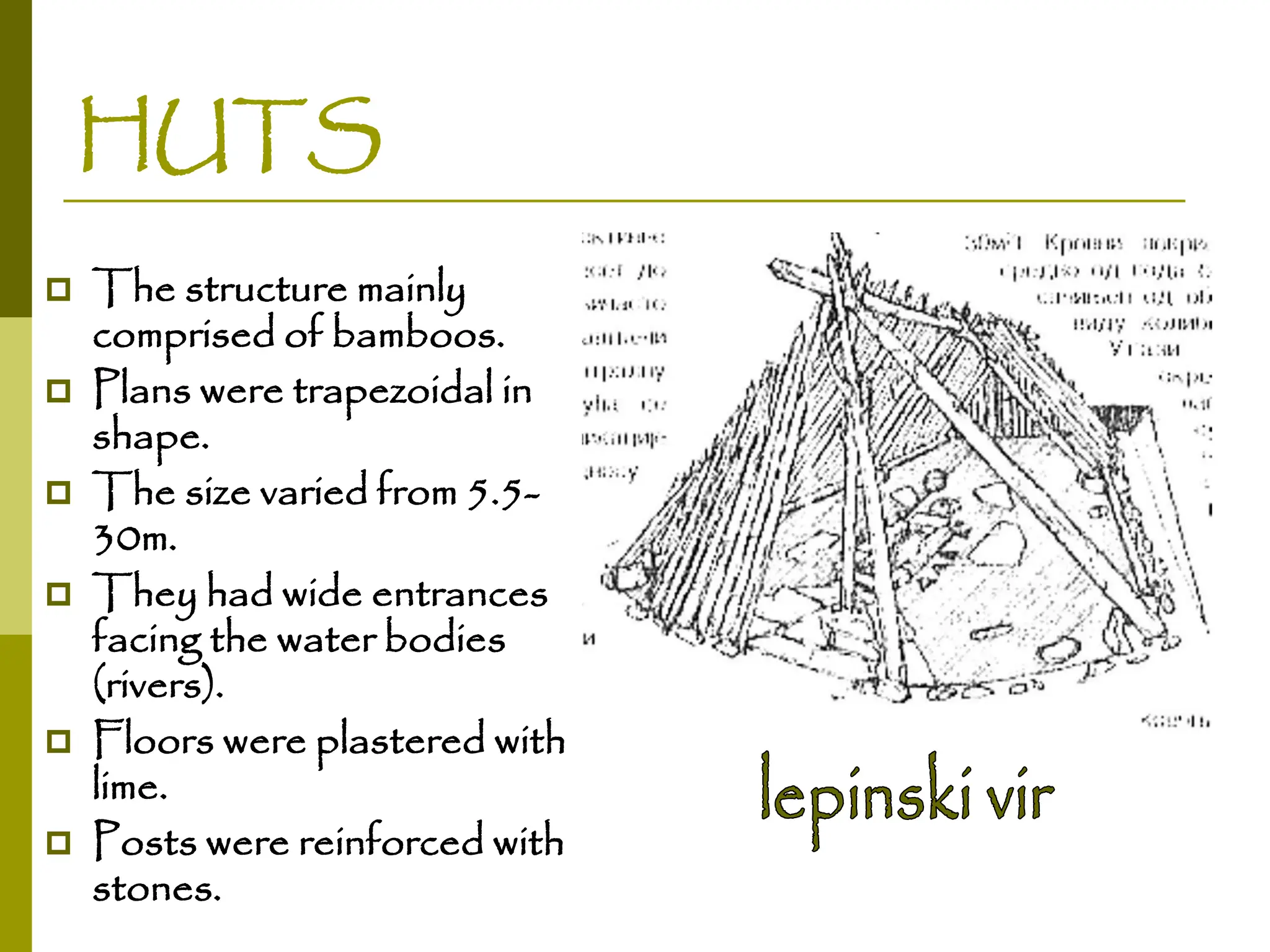
HUTS
 The structure mainly
comprised of bamboos.
 Plans were trapezoidal in
shape.
 The size varied from 5.5-
30m.
 They had wide entrances
facing the water bodies
(rivers).
 Floors were plastered with
lime.
 Posts were reinforced with
stones.
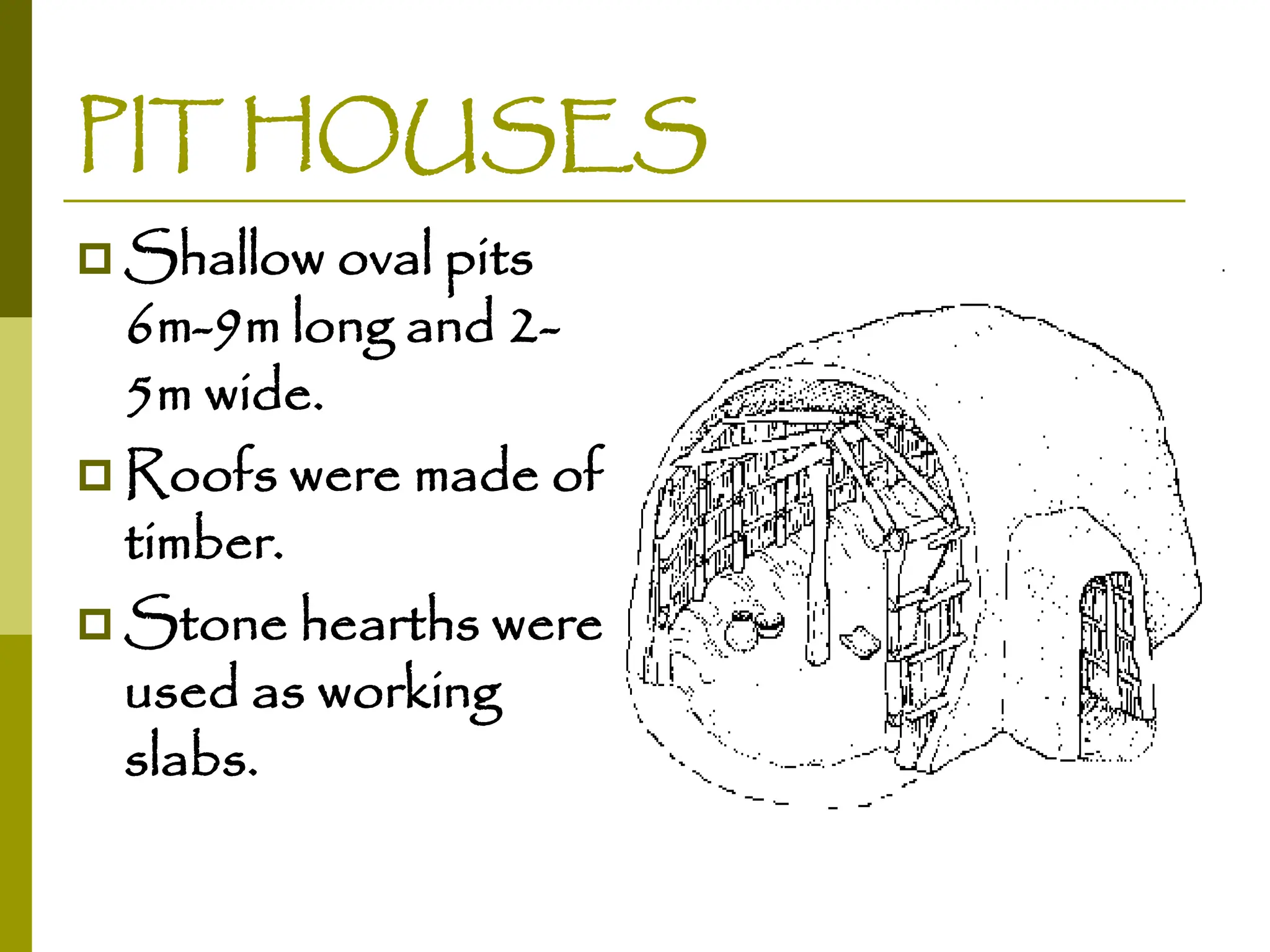
PIT HOUSES
 Shallow oval pits
6m-9m long and 2-
5m wide.
 Roofs were made of
timber.
 Stone hearths were
used as working
slabs.
NEOLITHIC PERIOD
Many changes took place.
Production of food.
Developments in agriculture lead to
settling down.
Dwellings became more sustainable.
Houses were built with
square/rectangular plans, with sections
divided with animal skins.
TIMBER FRAMED
HOUSES
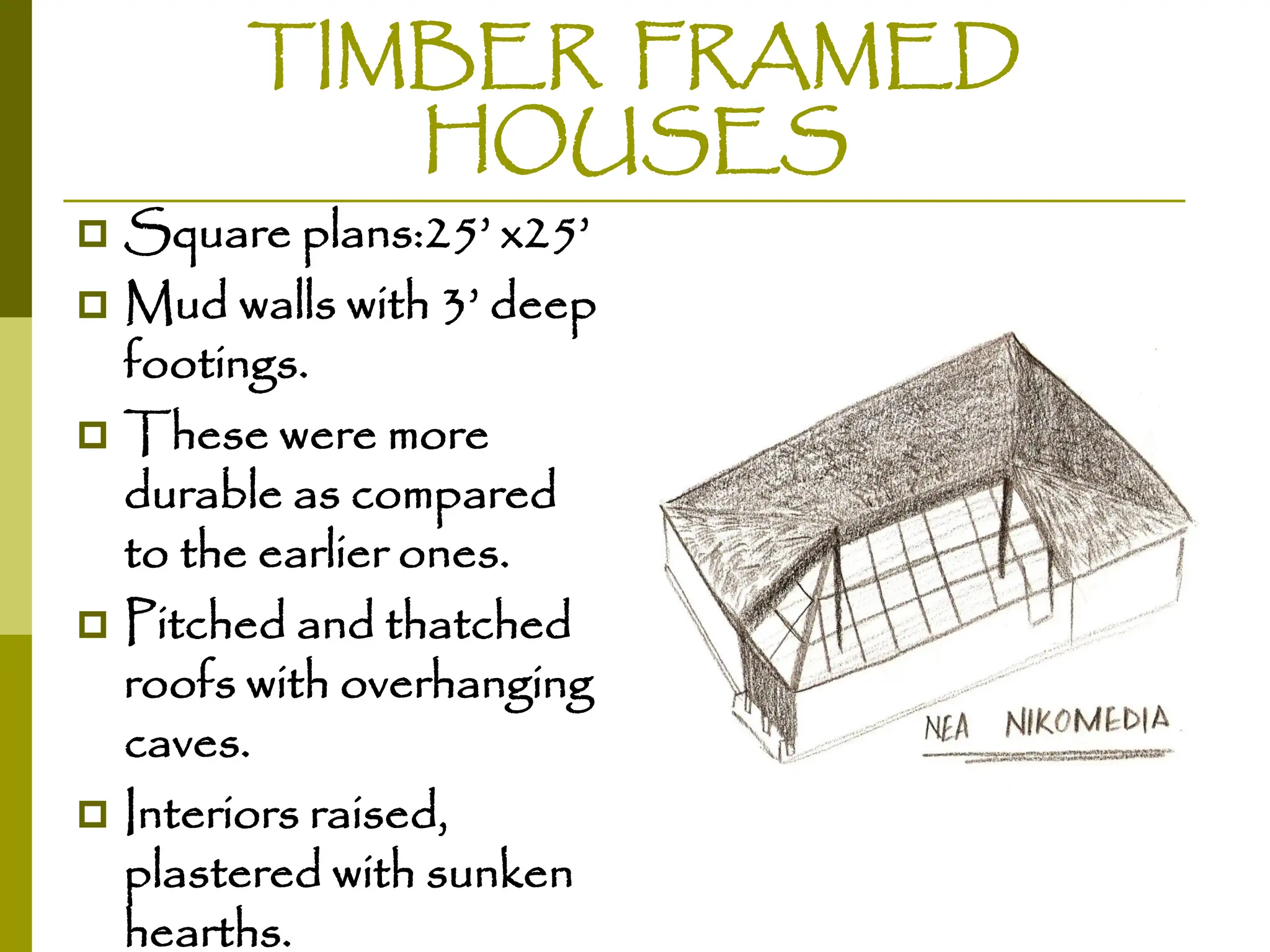
 Square plans:25’ x25’
 Mud walls with 3’ deep
footings.
 These were more
durable as compared
to the earlier ones.
 Pitched and thatched
roofs with overhanging
caves.
 Interiors raised,
plastered with sunken
hearths.
LONG HOUSES
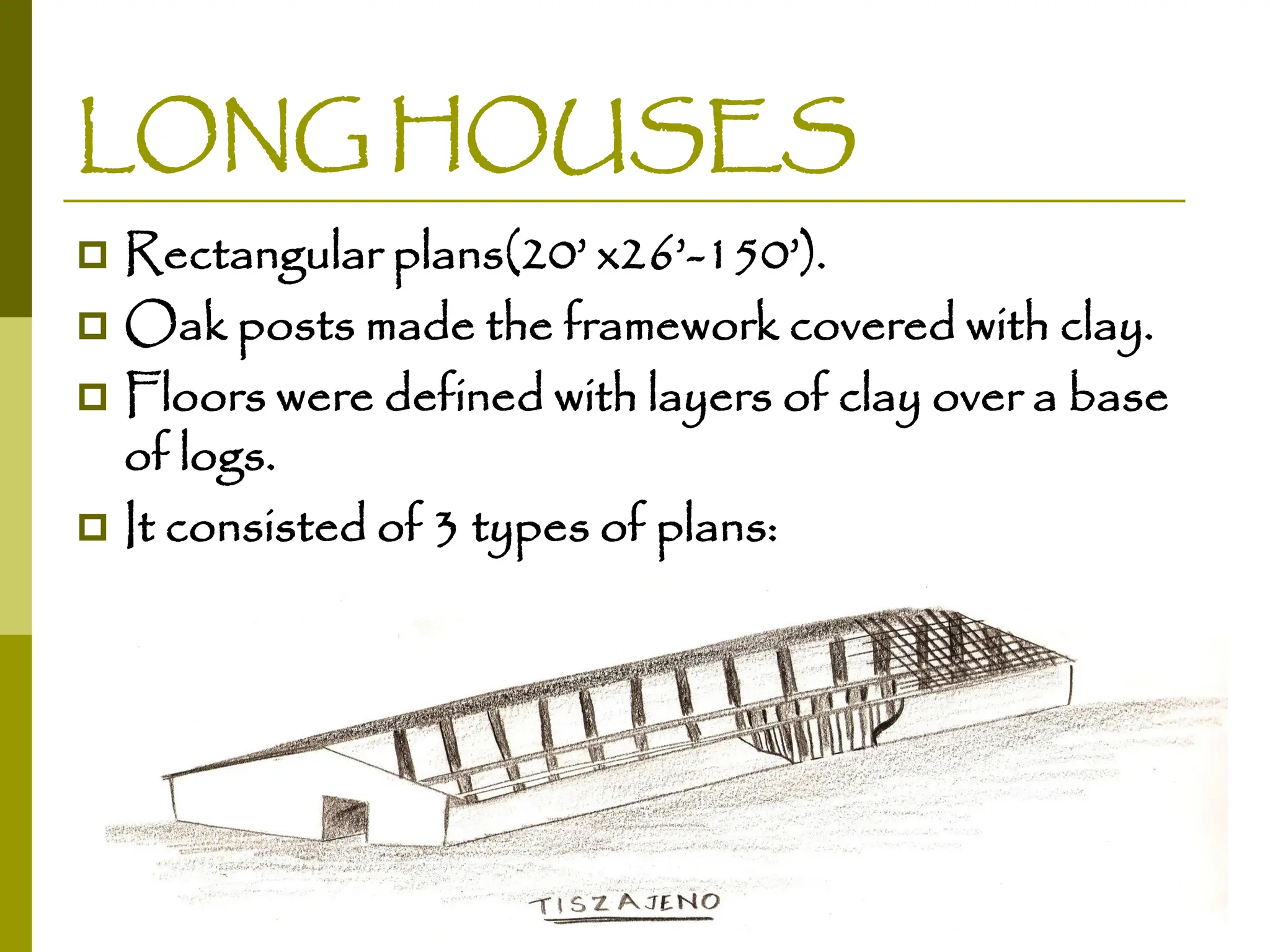
 Rectangular plans(20’ x26’-150’).
 Oak posts made the framework covered with clay.
 Floors were defined with layers of clay over a base
of logs.
 It consisted of 3 types of plans:
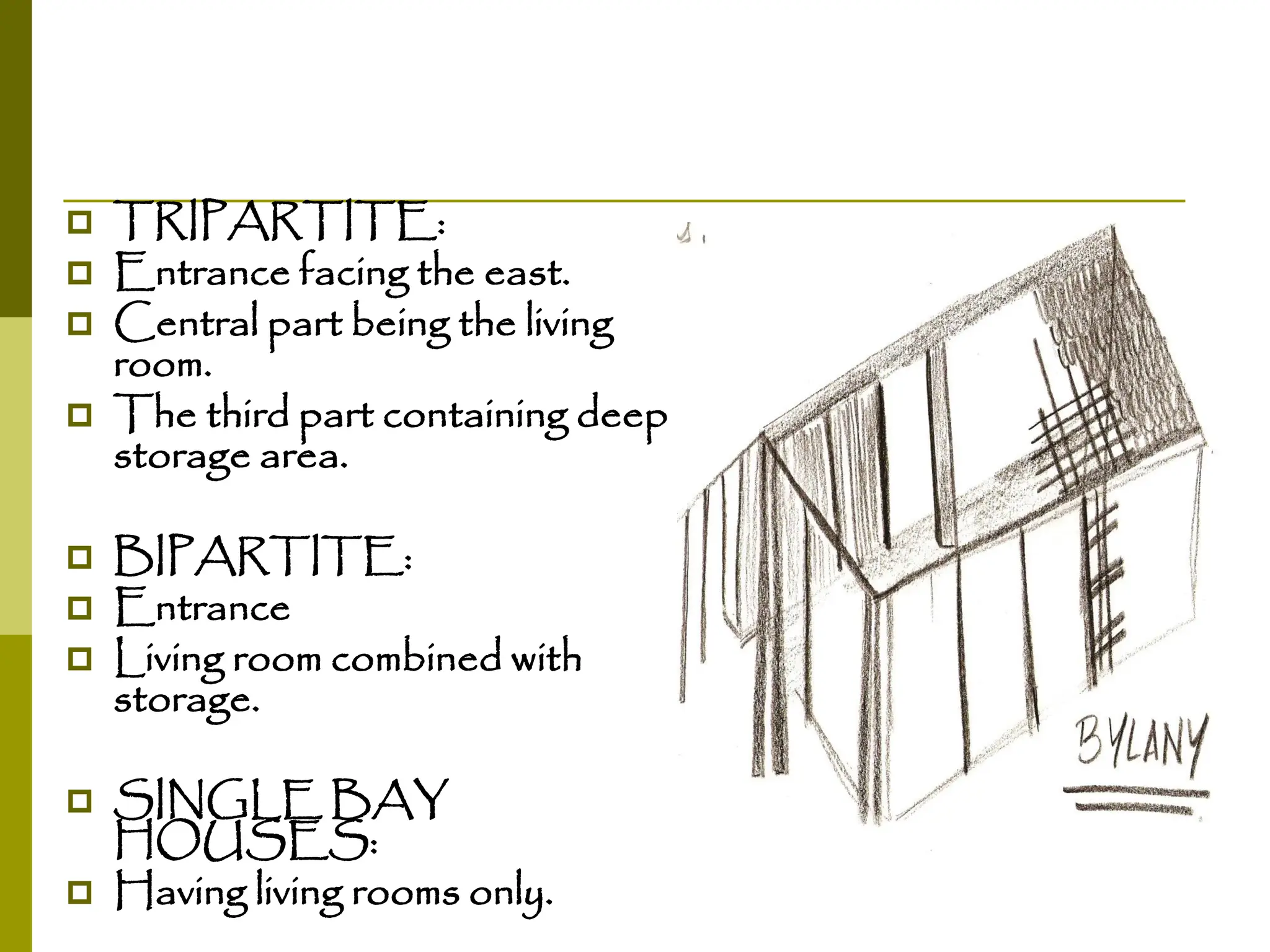
 TRIPARTITE:
 Entrance facing the east.
 Central part being the living
room.
 The third part containing deep
storage area.
 BIPARTITE:
 Entrance
 Living room combined with
storage.
 SINGLE BAY
HOUSES:
 Having living rooms only.
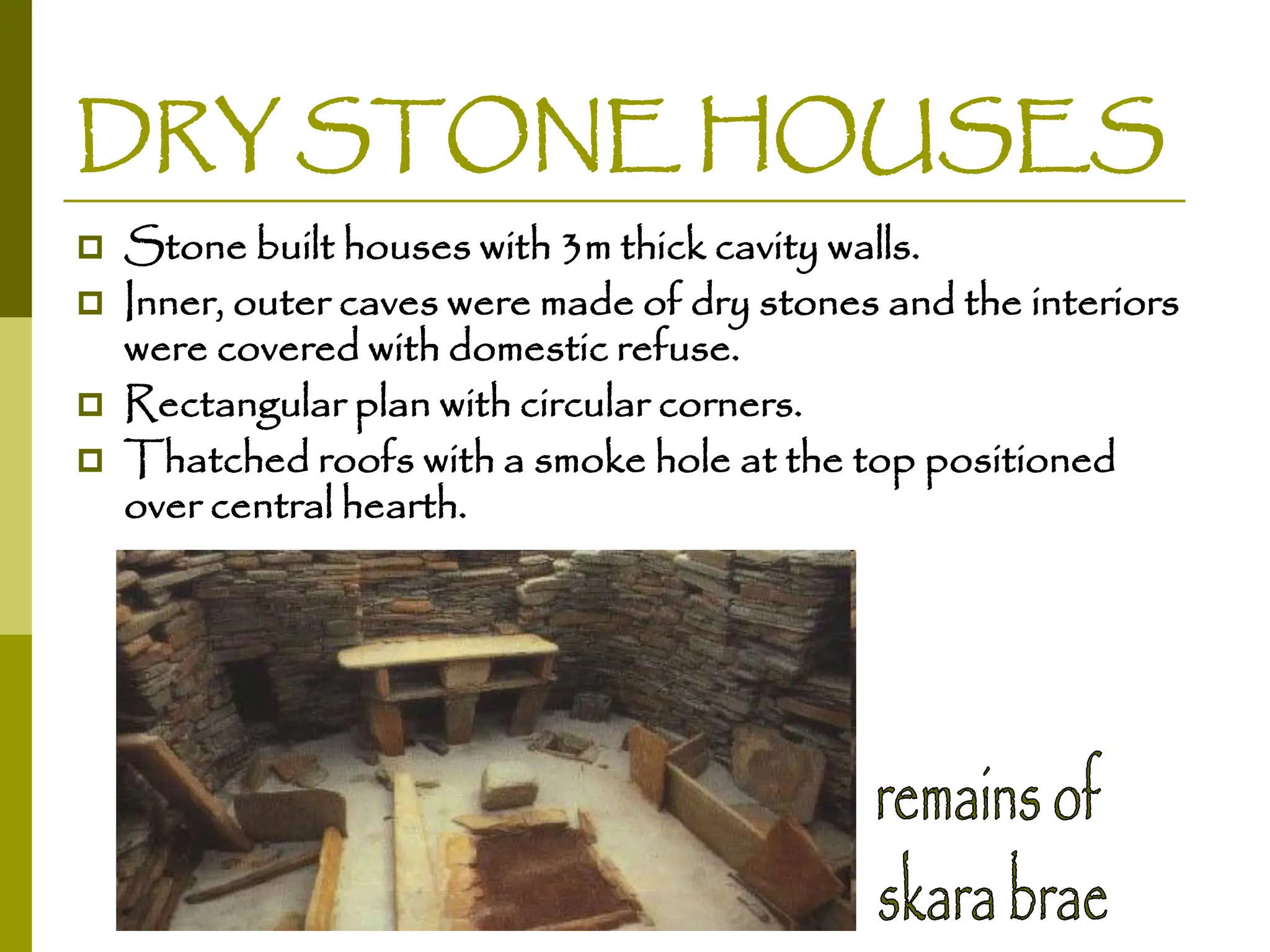
DRY STONE HOUSES
 Stone built houses with 3m thick cavity walls.
 Inner, outer caves were made of dry stones and the interiors
were covered with domestic refuse.
 Rectangular plan with circular corners.
 Thatched roofs with a smoke hole at the top positioned
over central hearth.
MONUMENTS
Settlements lead to building of
monumental stone architecture.
These were mainly collective tombs.
PASSAGE GRAVES
GALLERY GRAVES
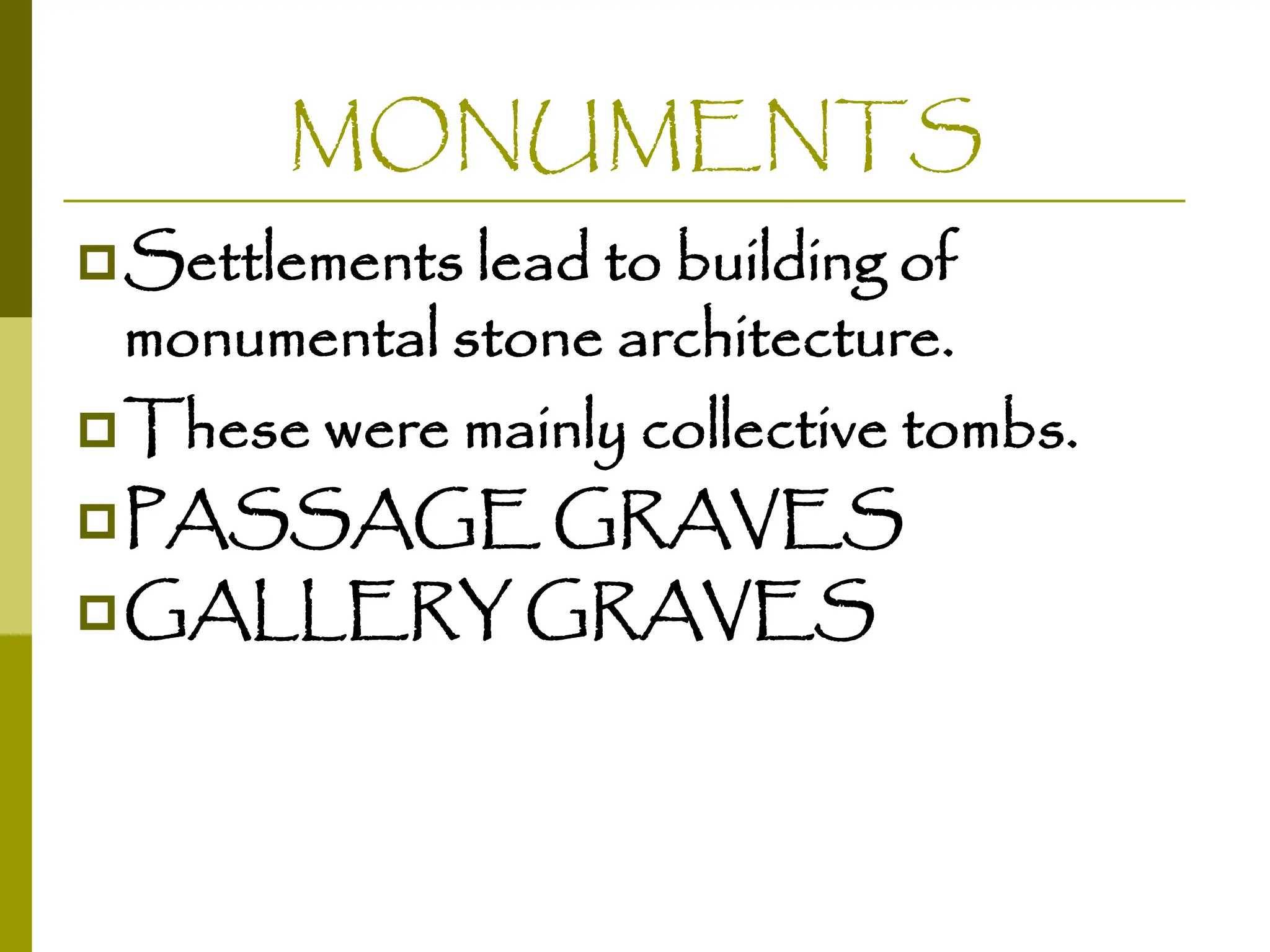
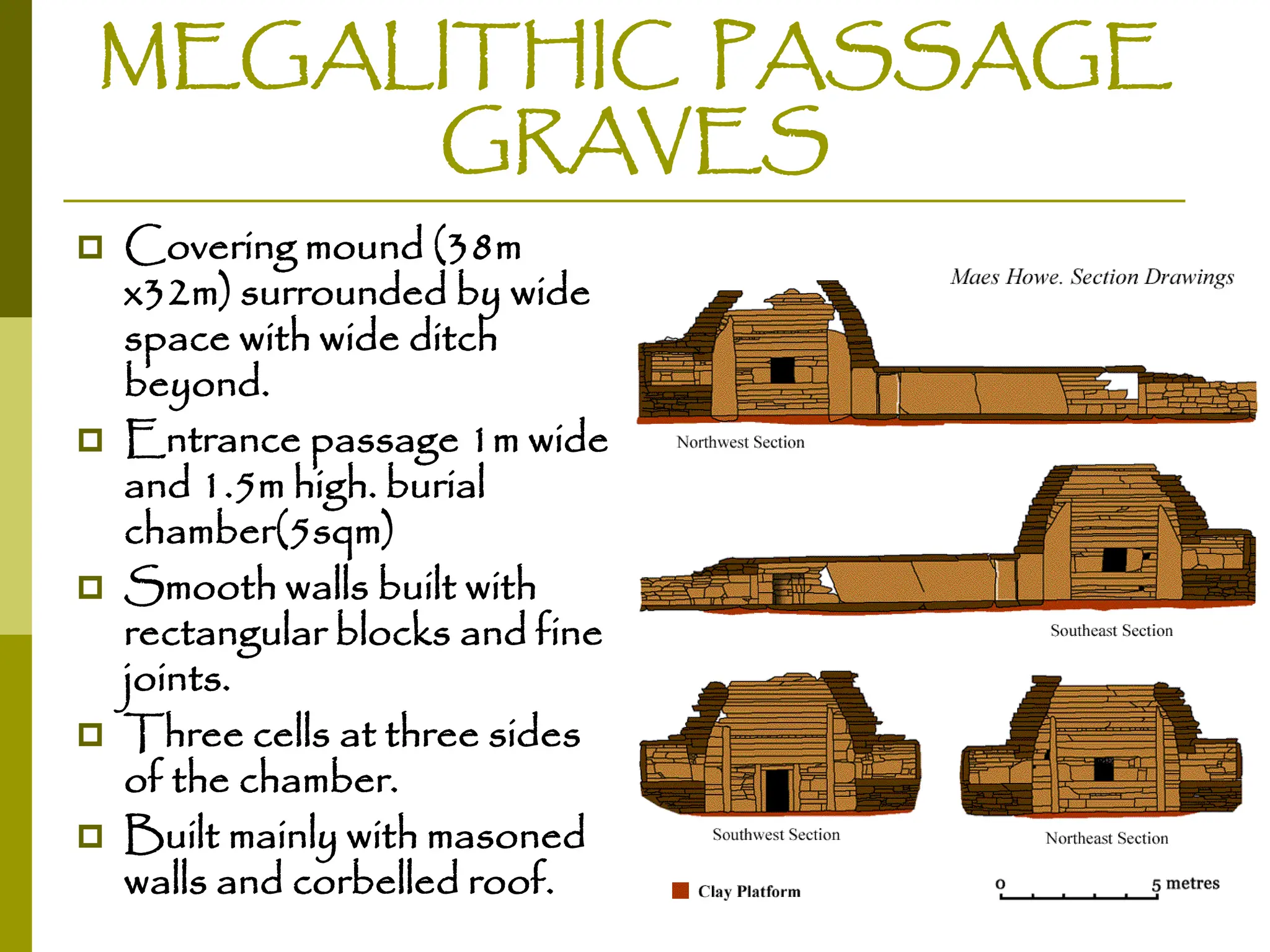
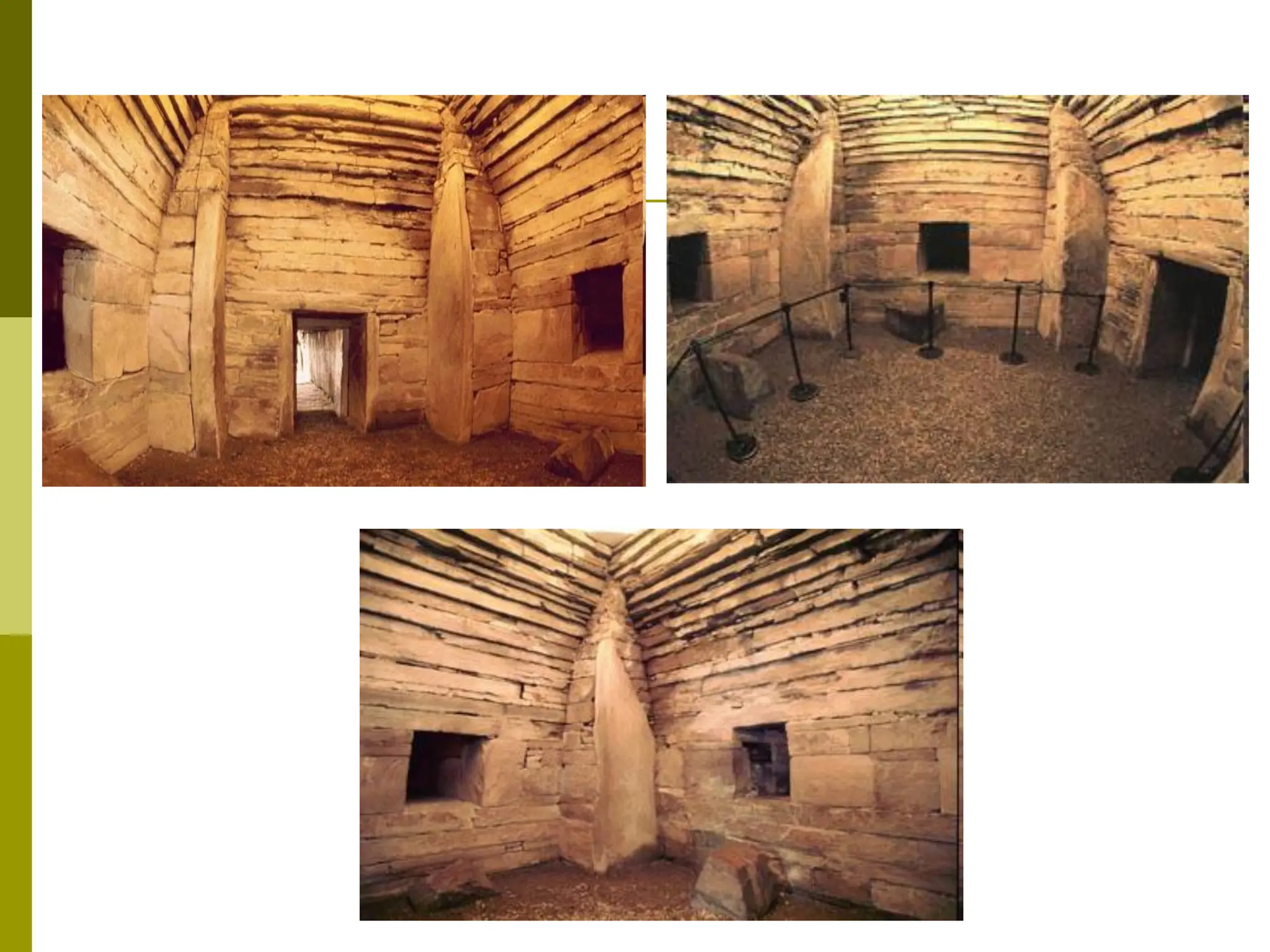
MEGALITHIC PASSAGE
GRAVES
 Covering mound (38m
x32m) surrounded by wide
space with wide ditch
beyond.
 Entrance passage 1m wide
and 1.5m high. burial
chamber(5sqm)
 Smooth walls built with
rectangular blocks and fine
joints.
 Three cells at three sides
of the chamber.
 Built mainly with masoned
walls and corbelled roof.
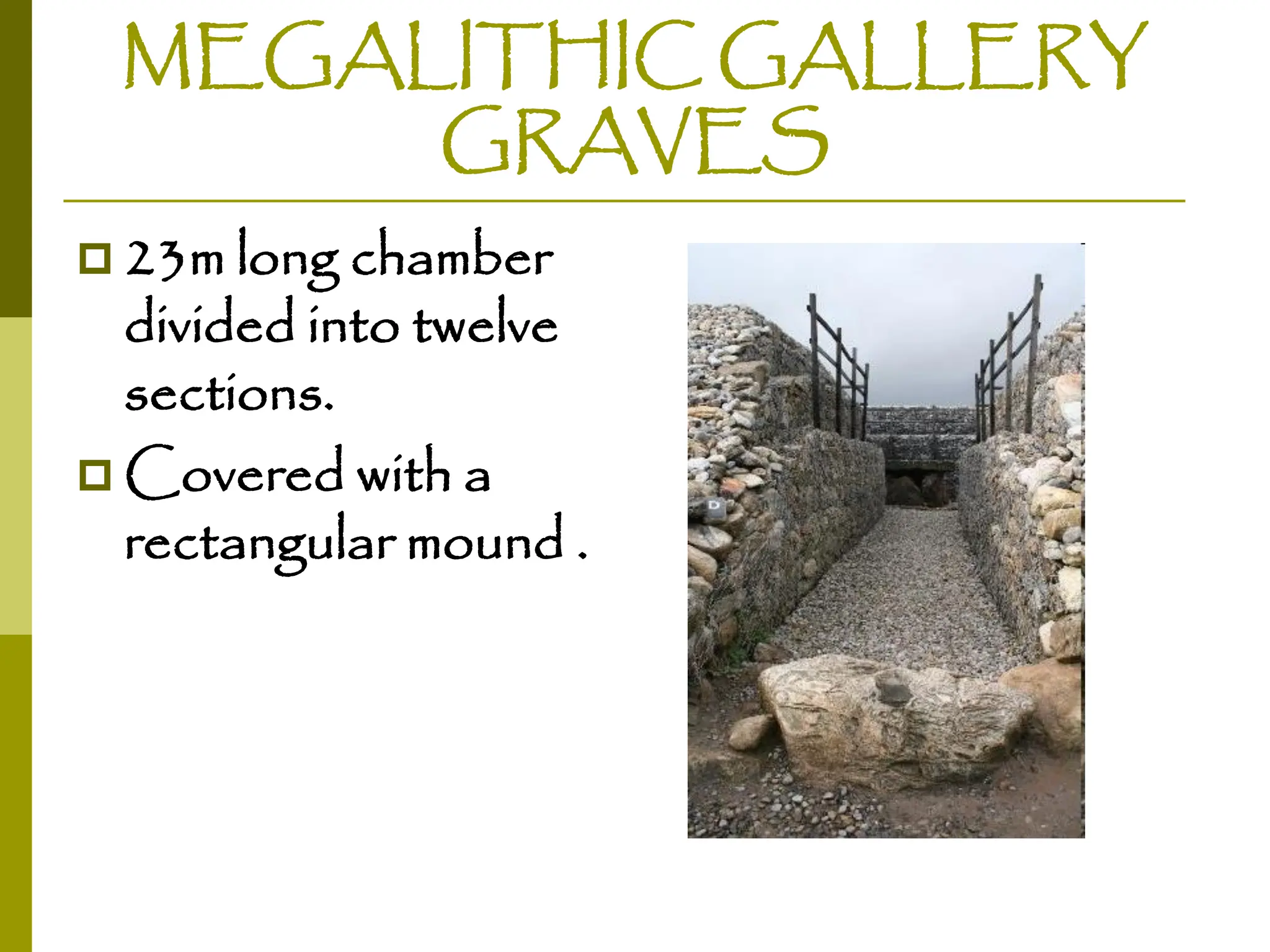
MEGALITHIC GALLERY
GRAVES
 23m long chamber
divided into twelve
sections.
 Covered with a
rectangular mound .
EARTHERN LONG
BARROWS
 Trapezoid mound(40m x6m approx.)
 Wide entrance and porch with 4 posts.
 Earthen mound surrounded by a bedding trunch
over 1m deep and 0.5 m wide.
 Timber retaining wall 2m high.
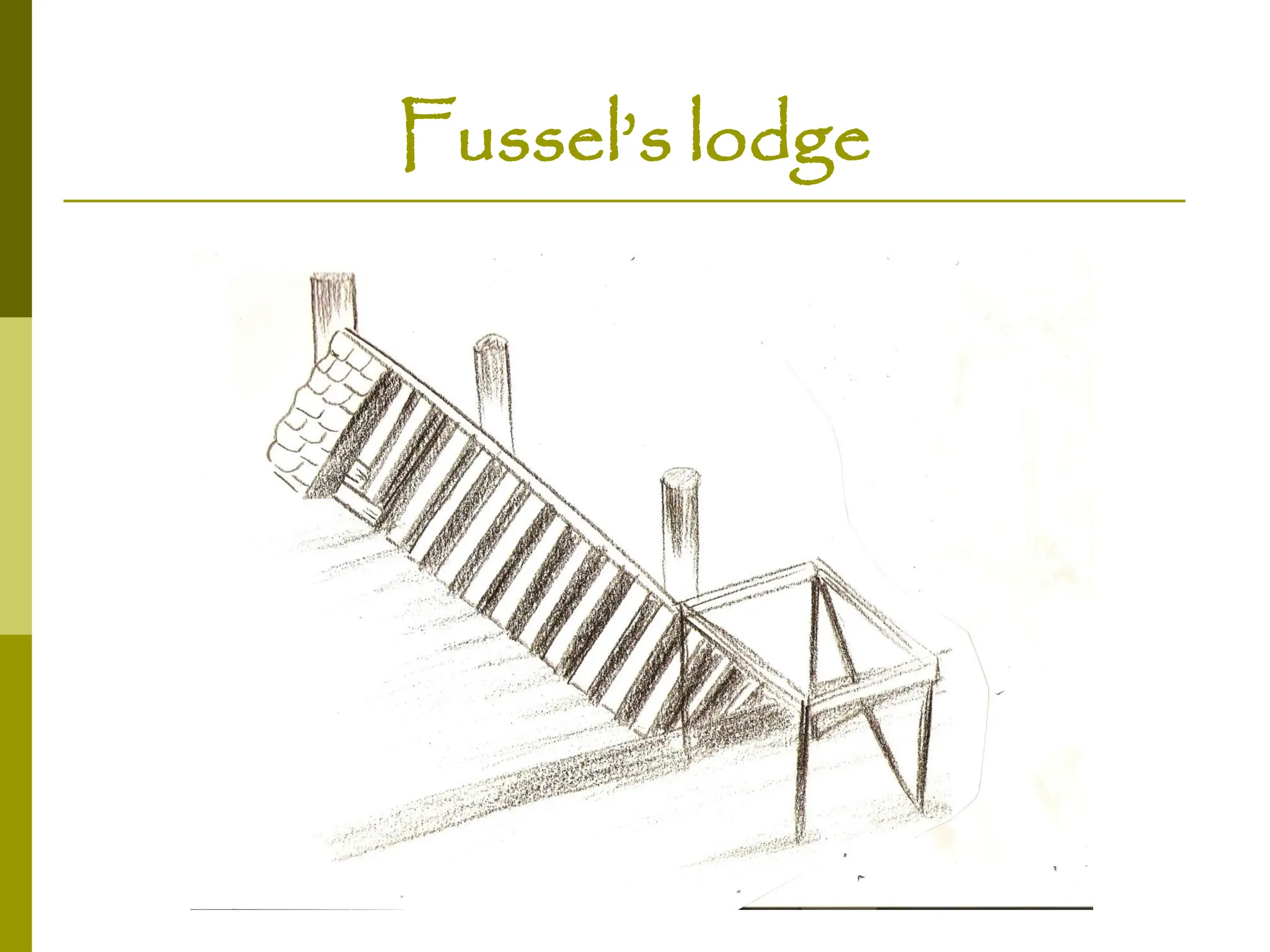
 Mortuary houses exactly behind entrance,
constructed using three split tree trunks(600mm dia
app.) placed 1m apart from each other supporting a
ridge post.
 Sloping timber formed triangular framework(1.5m
high, 2.4m wide) at groung level.
Fussel’s lodge
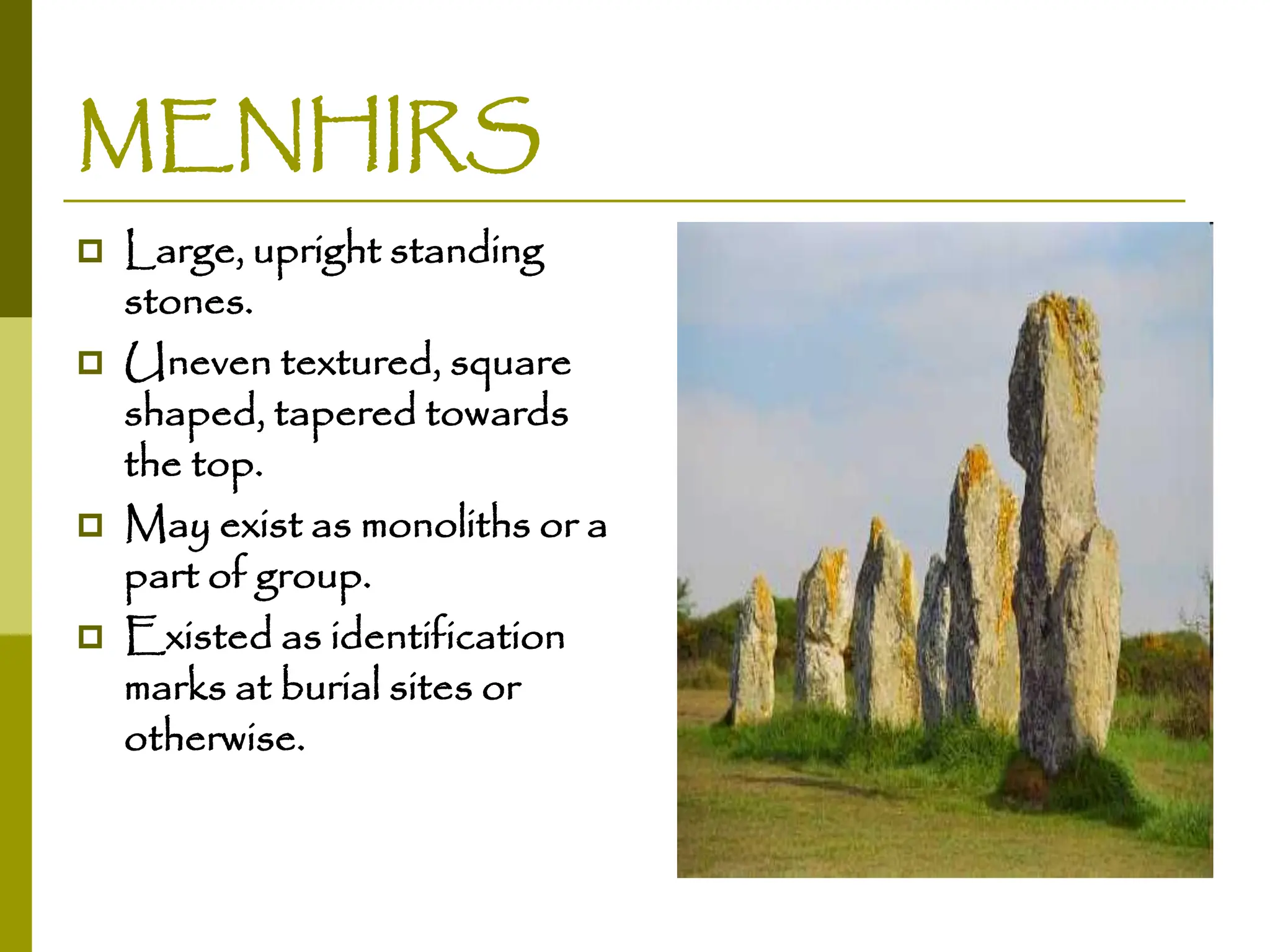
MENHIRS
 Large, upright standing
stones.
 Uneven textured, square
shaped, tapered towards
the top.
 May exist as monoliths or a
part of group.
 Existed as identification
marks at burial sites or
otherwise.
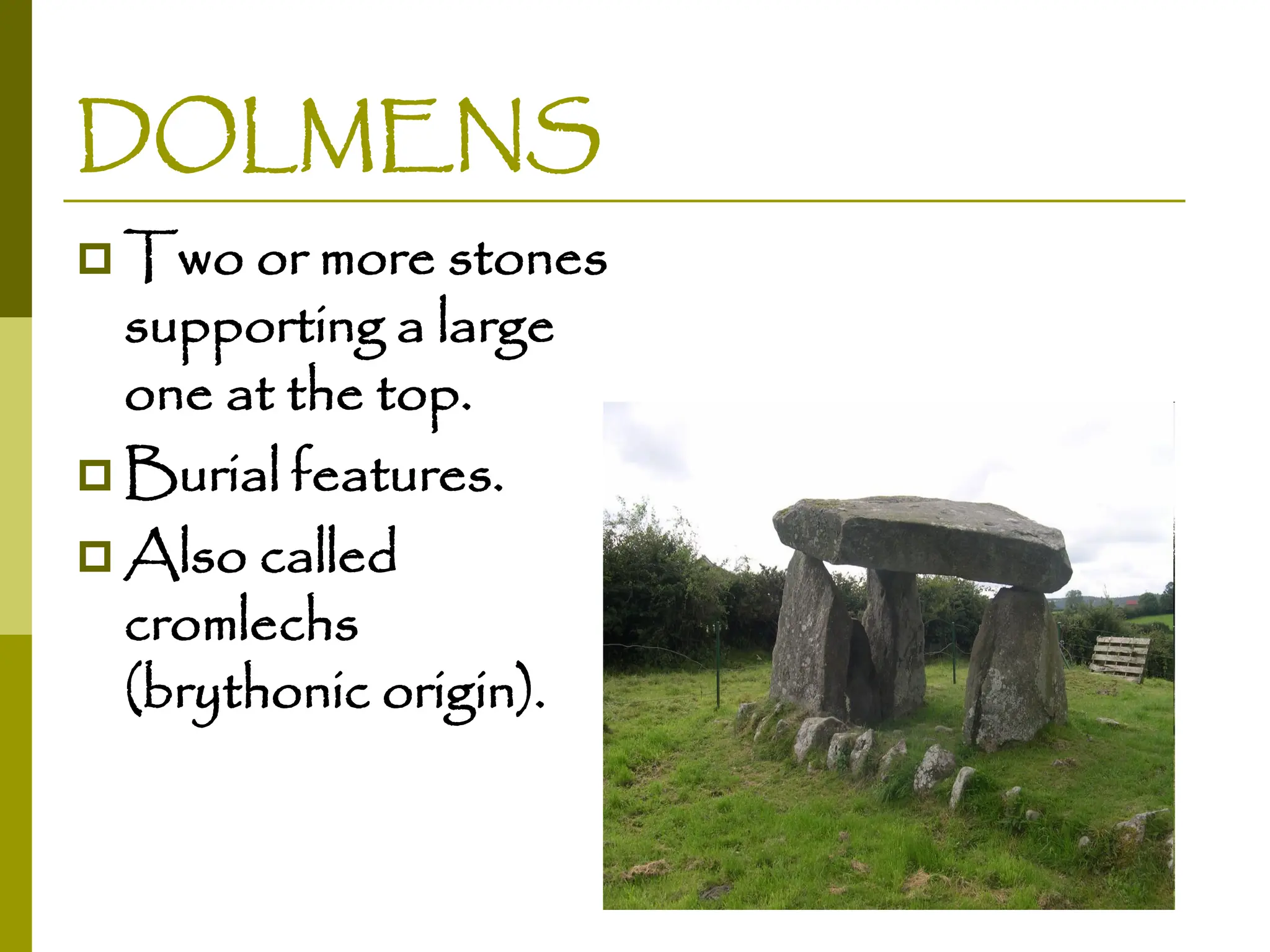
DOLMENS
 Two or more stones
supporting a large
one at the top.
 Burial features.
 Also called
cromlechs
(brythonic origin).
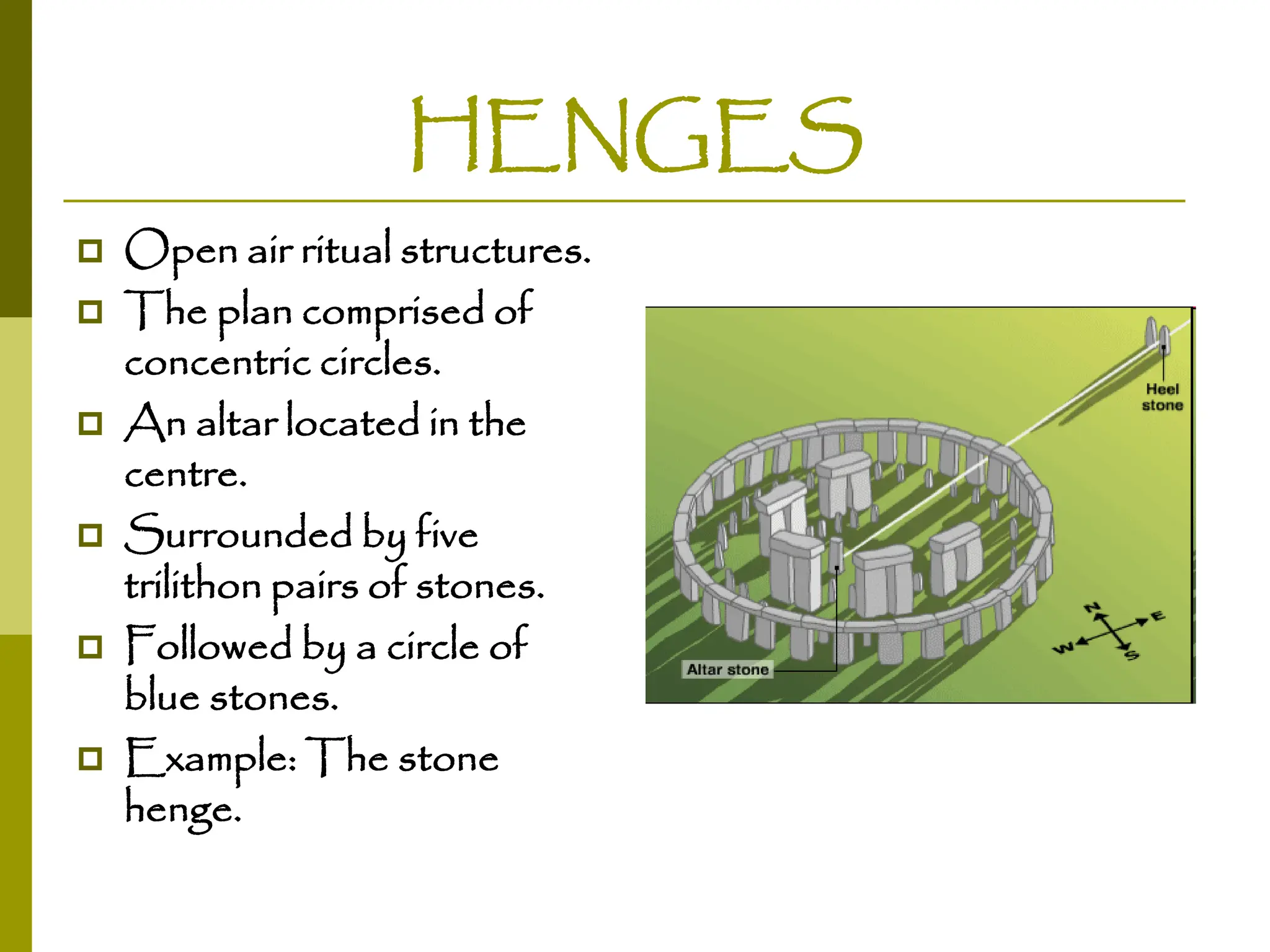
HENGES
 Open air ritual structures.
 The plan comprised of
concentric circles.
 An altar located in the
centre.
 Surrounded by five
trilithon pairs of stones.
 Followed by a circle of
blue stones.
 Example: The stone
henge.
BRONZE AGE
 DWELLINGS
 Enclosed timber framed and dry stone
farmsteads.
 Cooking area and storage were added
features.
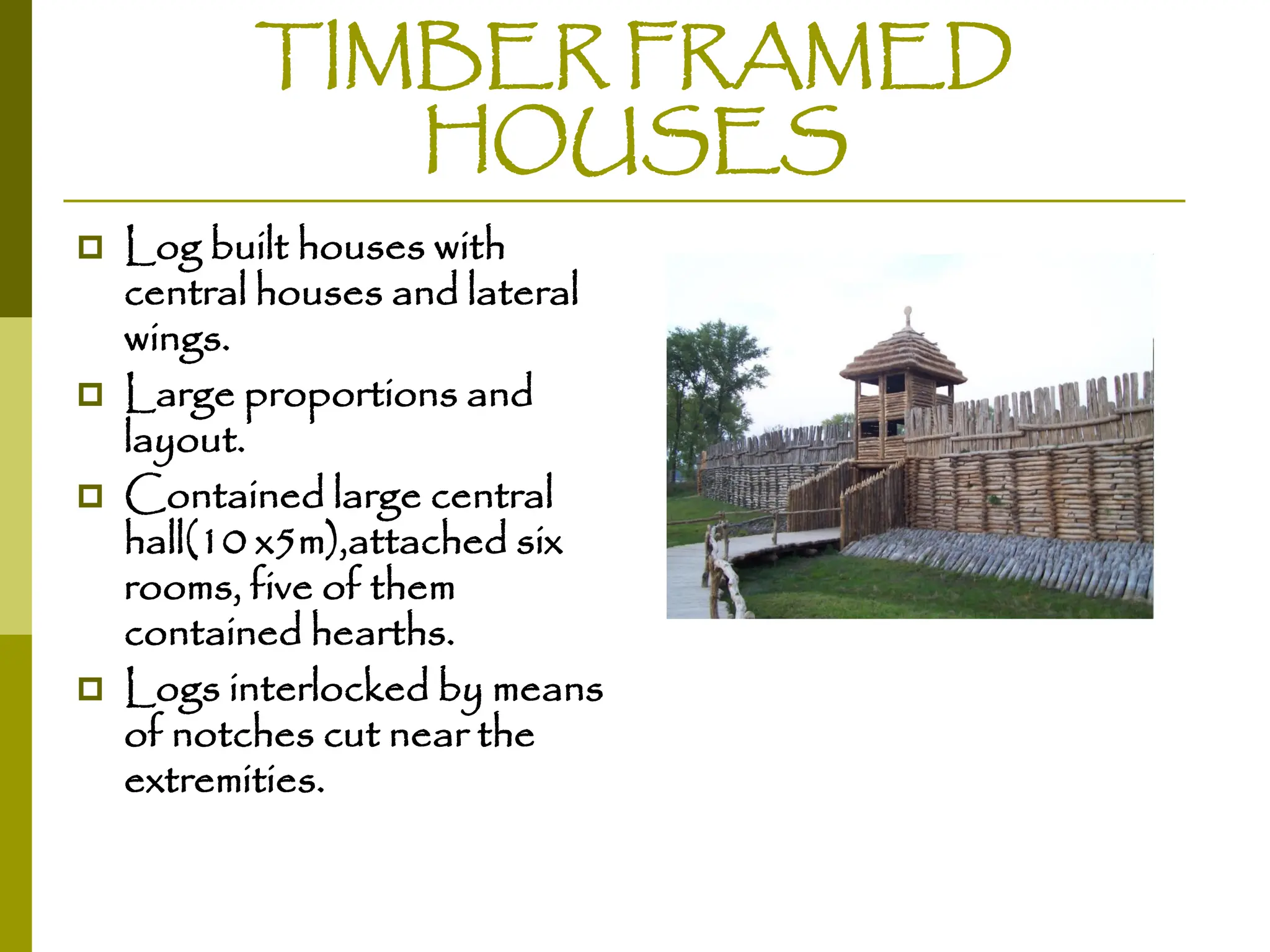
TIMBER FRAMED
HOUSES
 Log built houses with
central houses and lateral
wings.
 Large proportions and
layout.
 Contained large central
hall(10 x5m),attached six
rooms, five of them
contained hearths.
 Logs interlocked by means
of notches cut near the
extremities.
 Entrance porch facing the street, living area
and loft accessible by ladder.
 Stone hearth on the left of entrance with a
family bed located against southern wall.
 Wooden floors, thatched roofs.
 Houses placed in rows oriented east-west.
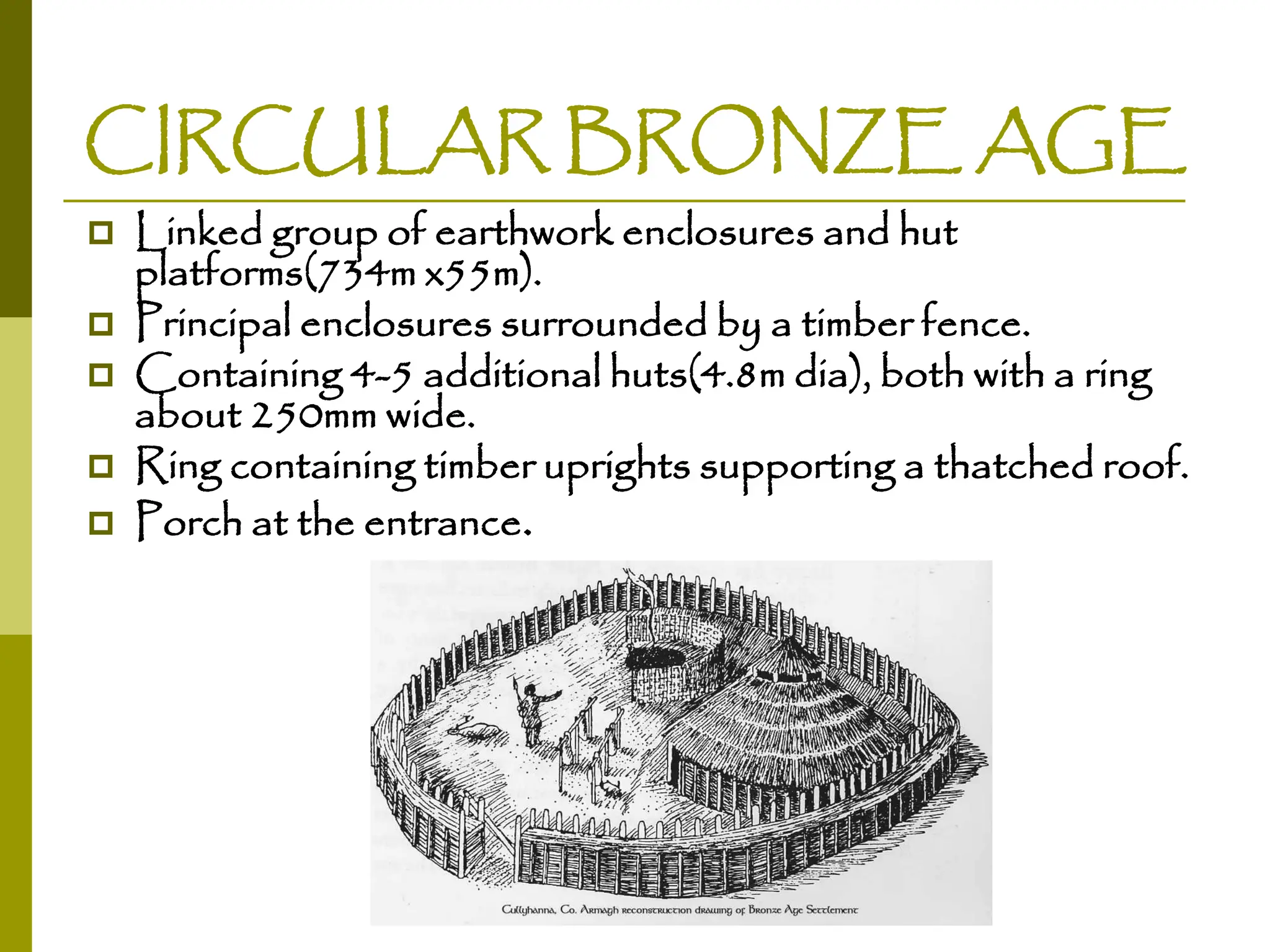
CIRCULAR BRONZE AGE
 Linked group of earthwork enclosures and hut
platforms(734m x55m).
 Principal enclosures surrounded by a timber fence.
 Containing 4-5 additional huts(4.8m dia), both with a ring
about 250mm wide.
 Ring containing timber uprights supporting a thatched roof.
 Porch at the entrance.
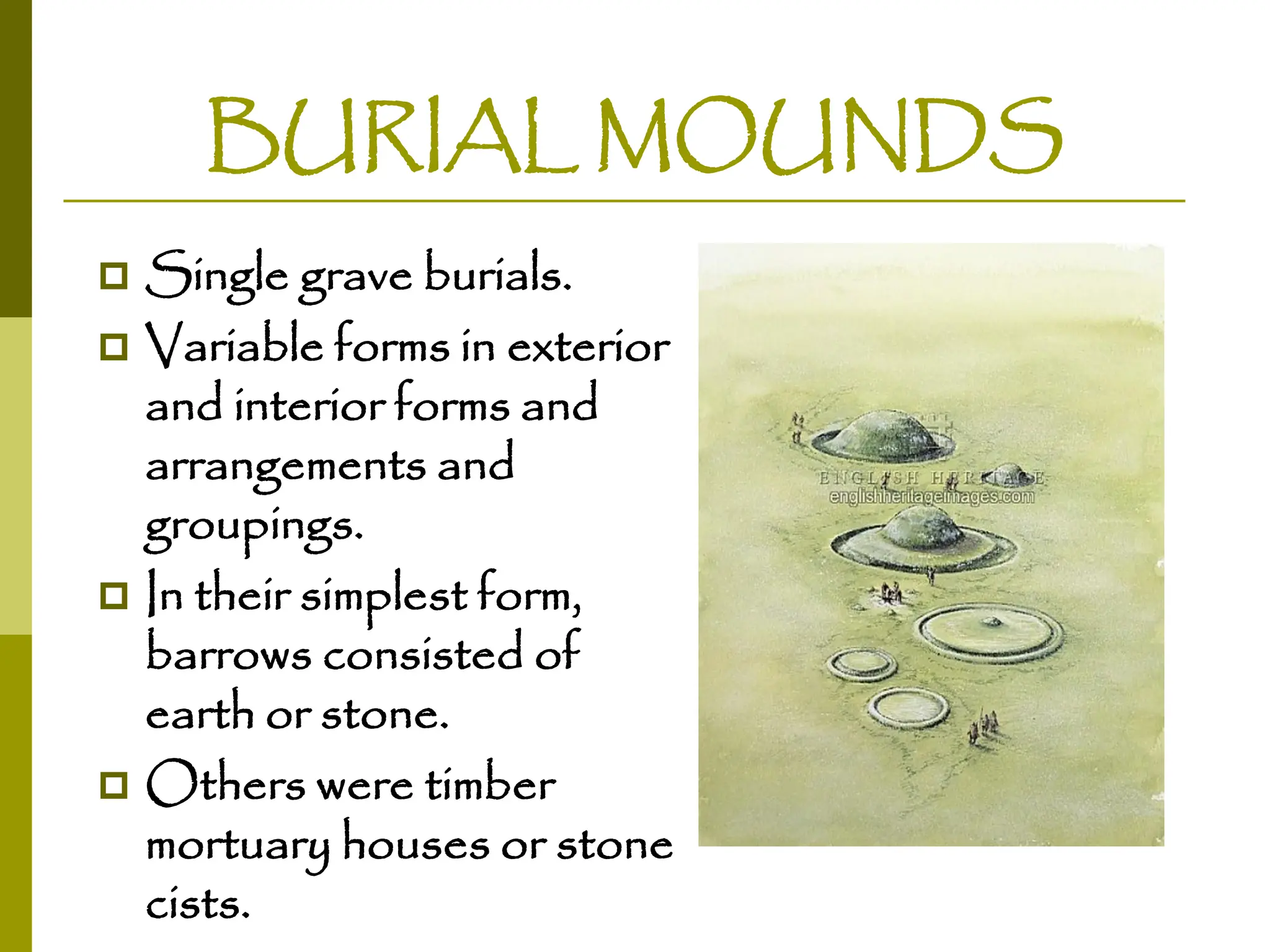
BURIAL MOUNDS
 Single grave burials.
 Variable forms in exterior
and interior forms and
arrangements and
groupings.
 In their simplest form,
barrows consisted of
earth or stone.
 Others were timber
mortuary houses or stone
cists.
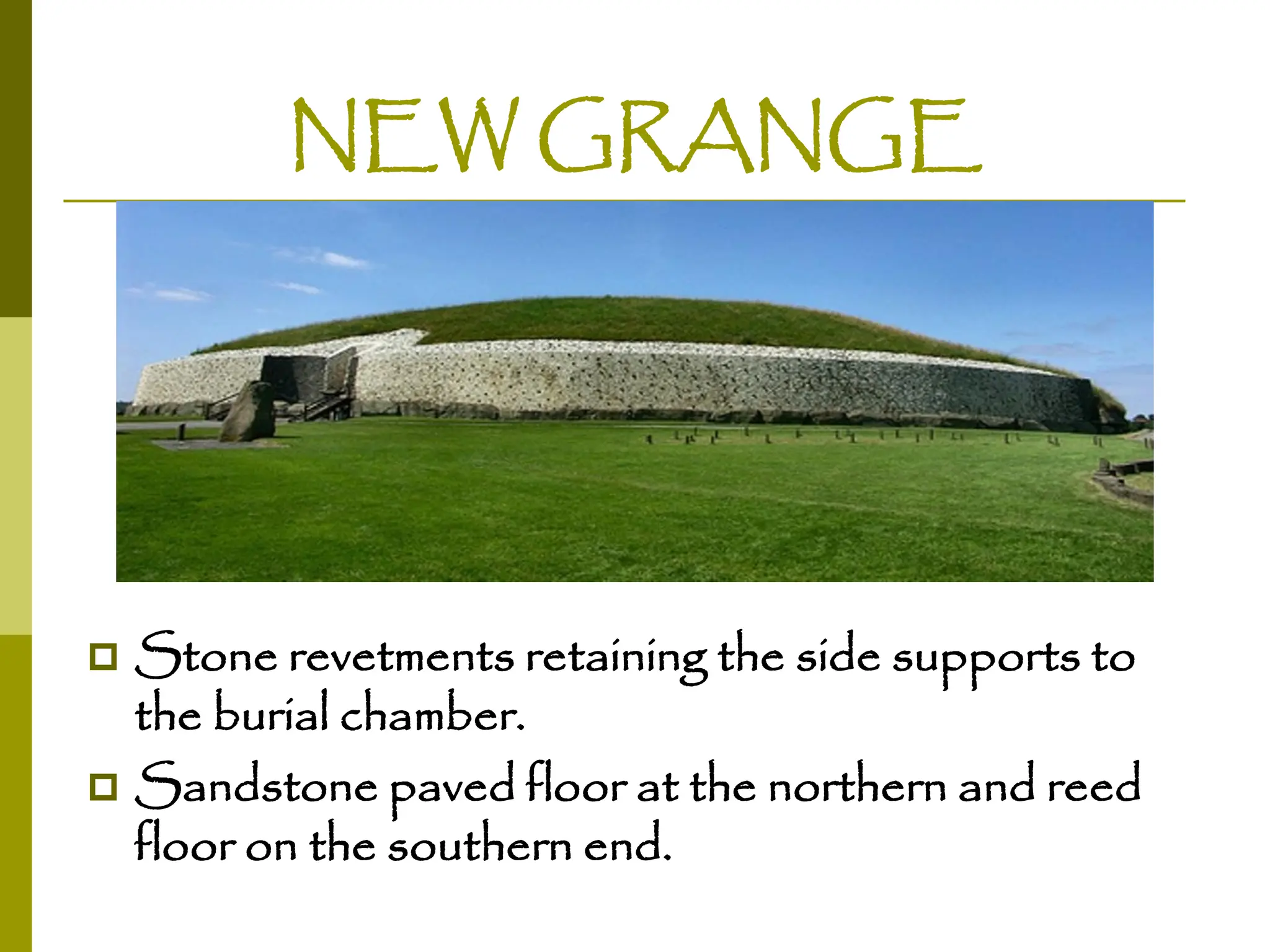
NEW GRANGE
 Stone revetments retaining the side supports to
the burial chamber.
 Sandstone paved floor at the northern and reed
floor on the southern end.
TEMPLES AND RITUAL
STRUCTURES
 Structures had three to four rooms.(8.8m x 5.2m)
 Megaron like porch leading to a room containing a
hanging altar.
 Followed by a large squarish room with plastered
frieze.
 Two raised altars on raised clay platforms set
against side walls.
 Six supports for a reed thatched roof.
DEFENSIVE
STRUCTURES
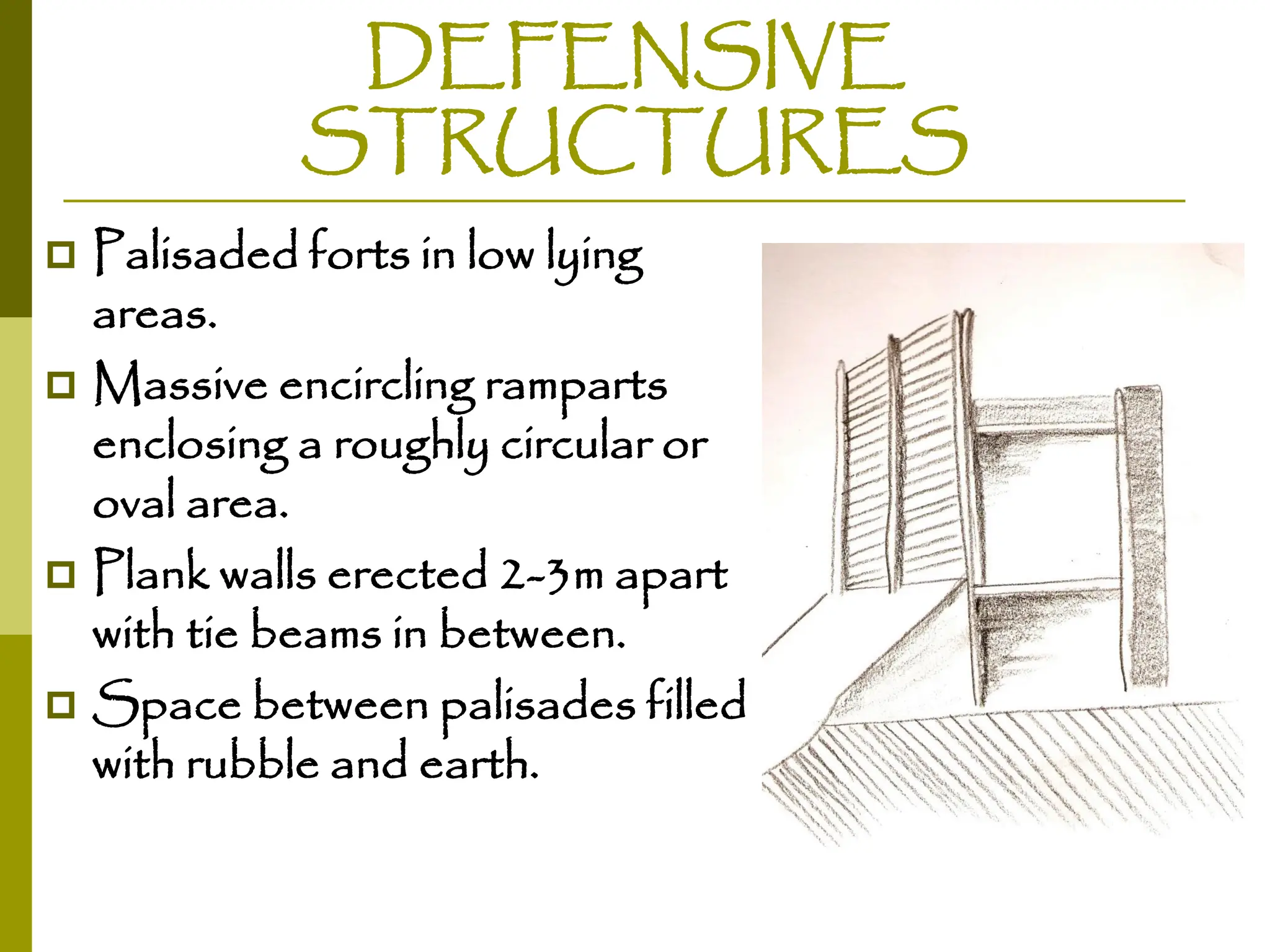
 Palisaded forts in low lying
areas.
 Massive encircling ramparts
enclosing a roughly circular or
oval area.
 Plank walls erected 2-3m apart
with tie beams in between.
 Space between palisades filled
with rubble and earth.
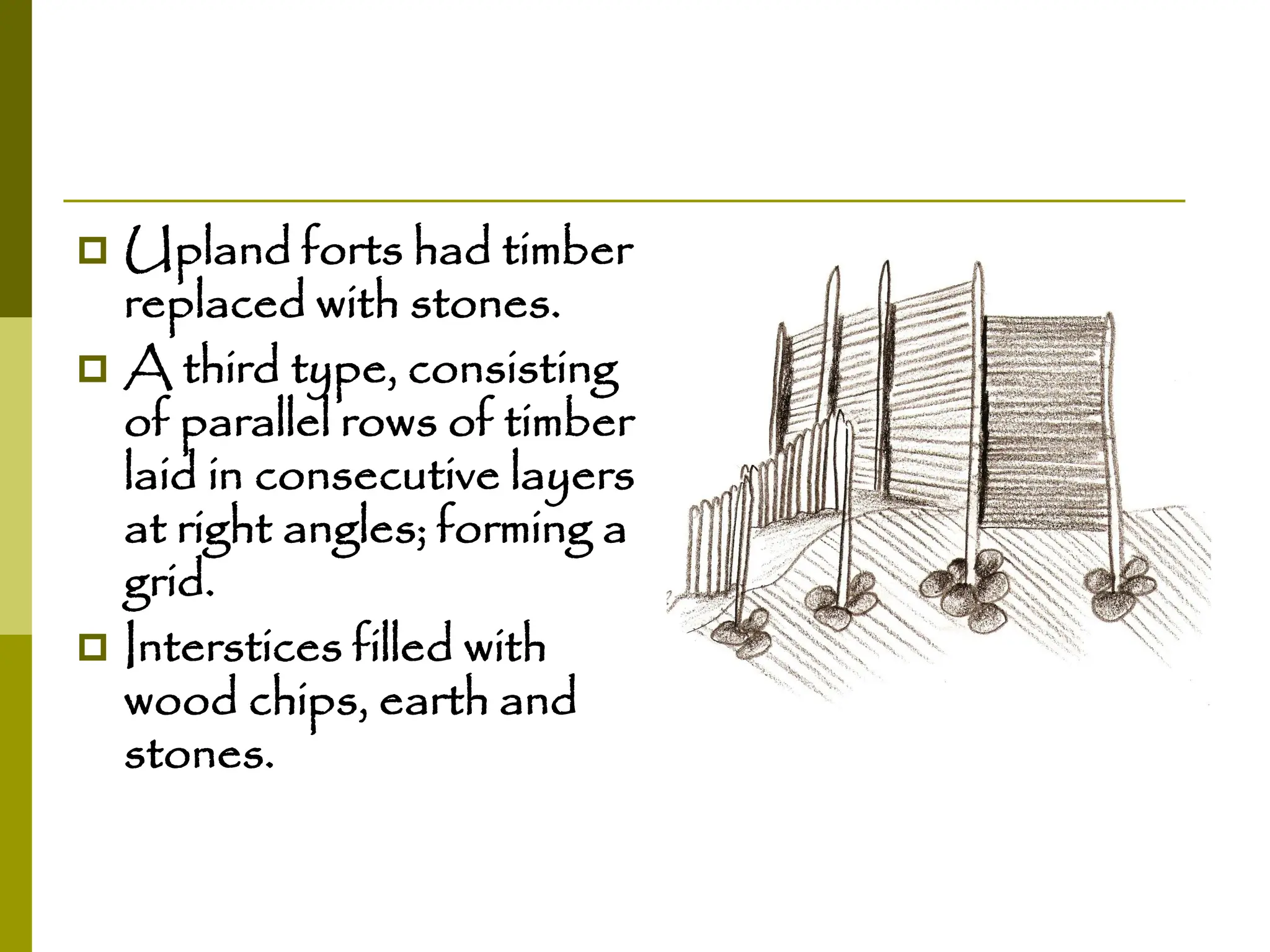
 Upland forts had timber
replaced with stones.
 A third type, consisting
of parallel rows of timber
laid in consecutive layers
at right angles; forming a
grid.
 Interstices filled with
wood chips, earth and
stones.
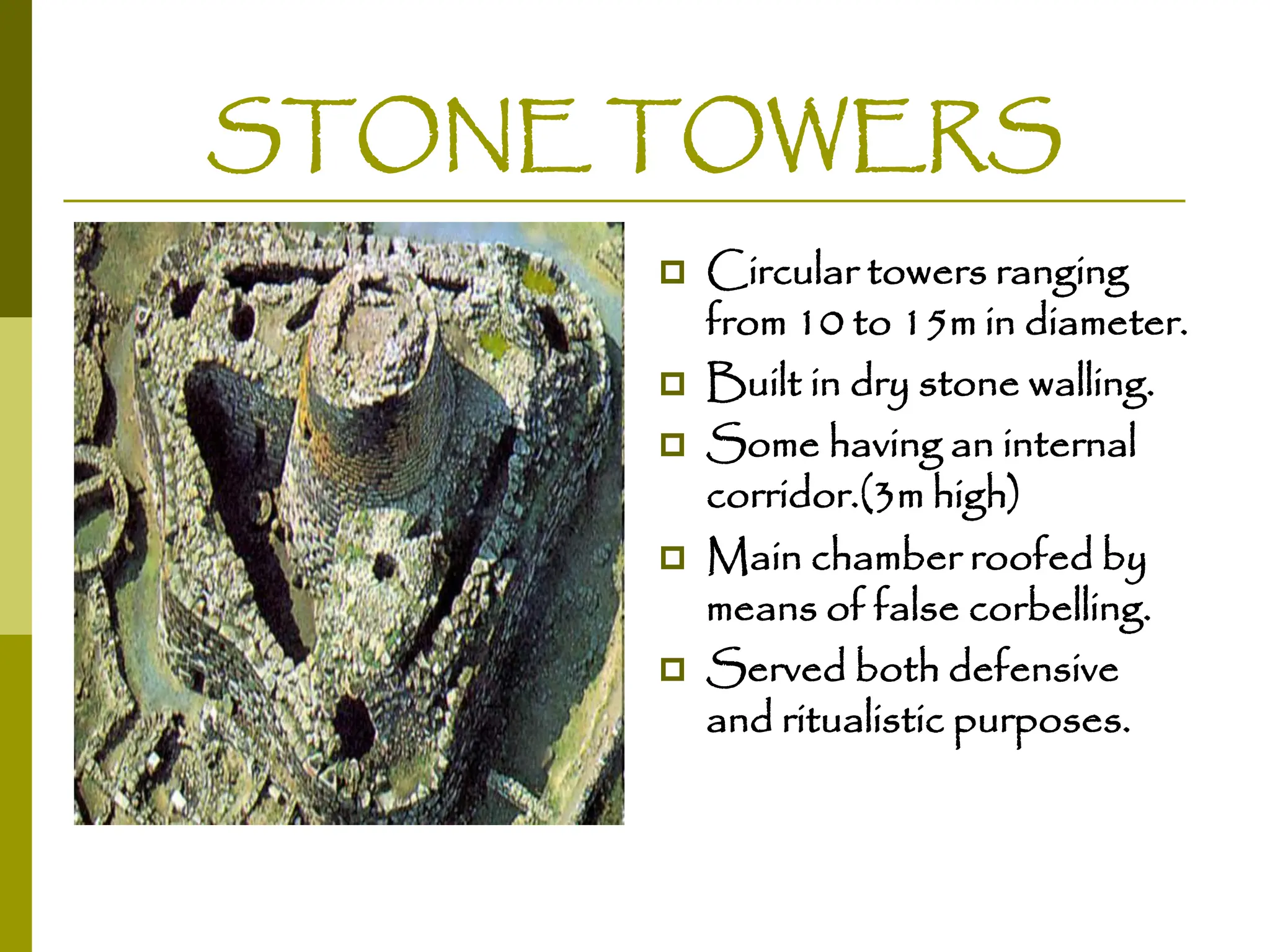
STONE TOWERS
 Circular towers ranging
from 10 to 15m in diameter.
 Built in dry stone walling.
 Some having an internal
corridor.(3m high)
 Main chamber roofed by
means of false corbelling.
 Served both defensive
and ritualistic purposes.
IRON AGE
Development in domestic
architecture.
Traditional farmstrade maintained.
TIMBER FRAMED
HOUSES
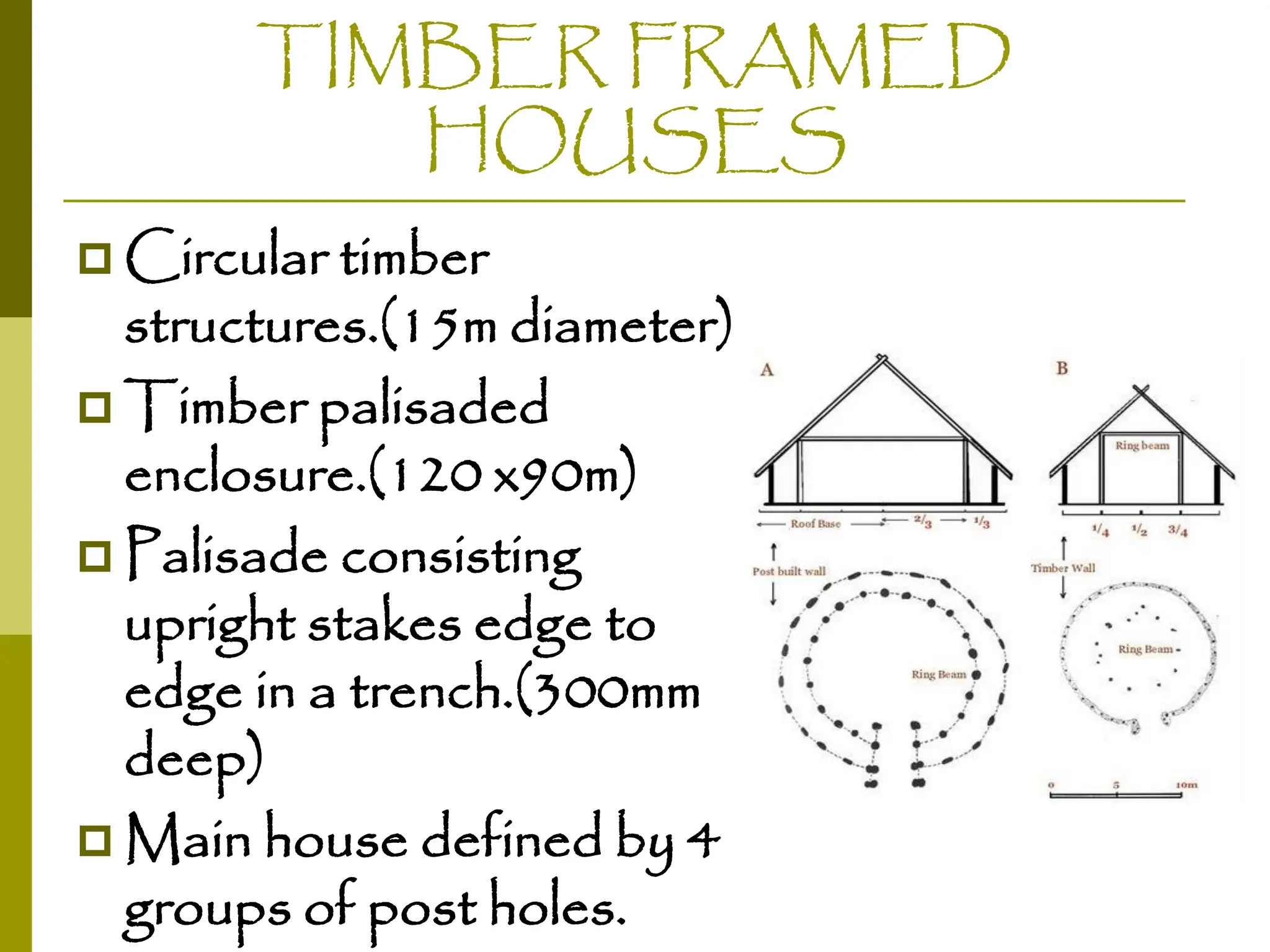
 Circular timber
structures.(15m diameter)
 Timber palisaded
enclosure.(120 x90m)
 Palisade consisting
upright stakes edge to
edge in a trench.(300mm
deep)
 Main house defined by 4
groups of post holes.
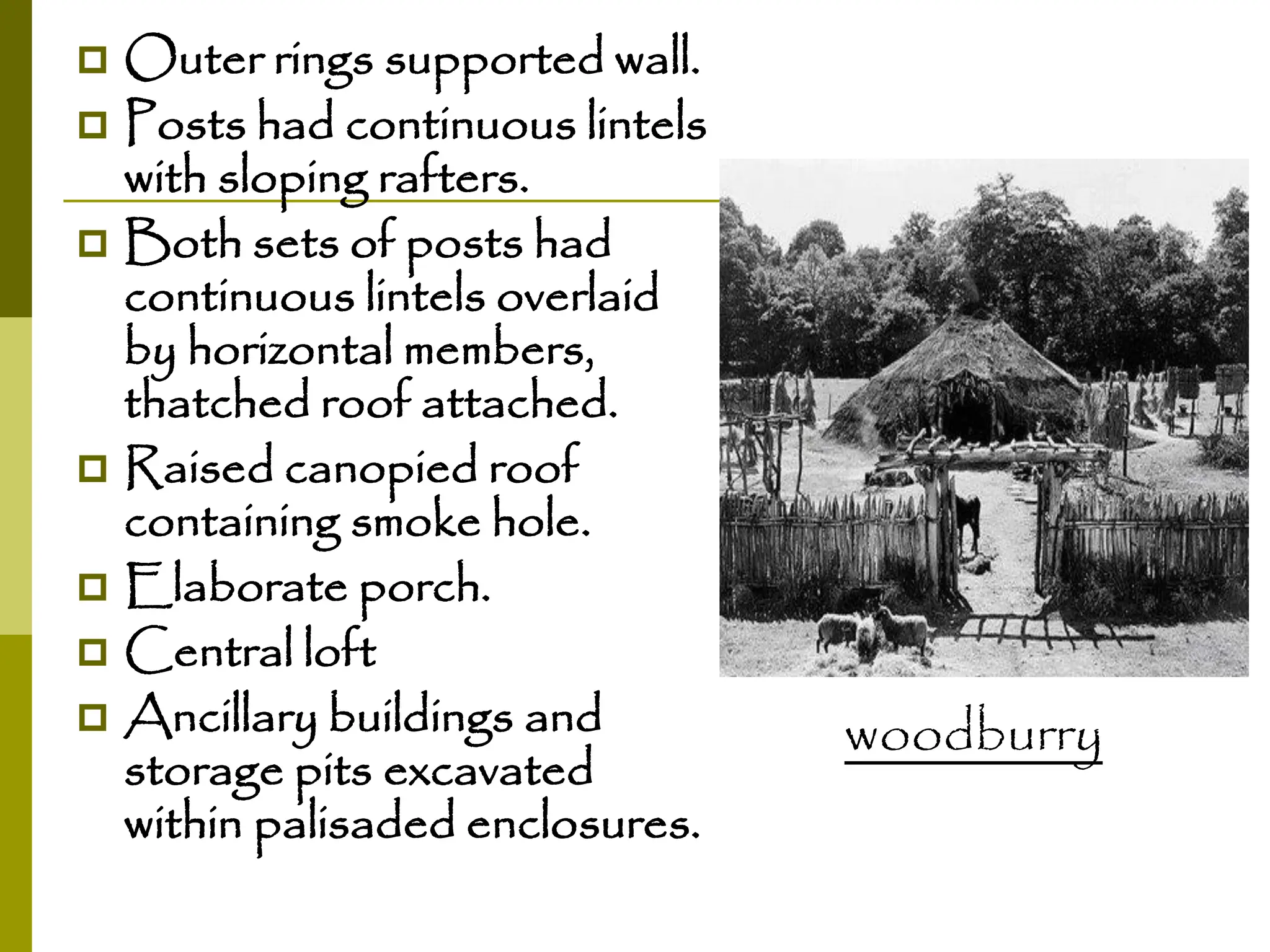
 Outer rings supported wall.
 Posts had continuous lintels
with sloping rafters.
 Both sets of posts had
continuous lintels overlaid
by horizontal members,
thatched roof attached.
 Raised canopied roof
containing smoke hole.
 Elaborate porch.
 Central loft
 Ancillary buildings and
storage pits excavated
within palisaded enclosures.
woodburry
DRY STONE HOUSES
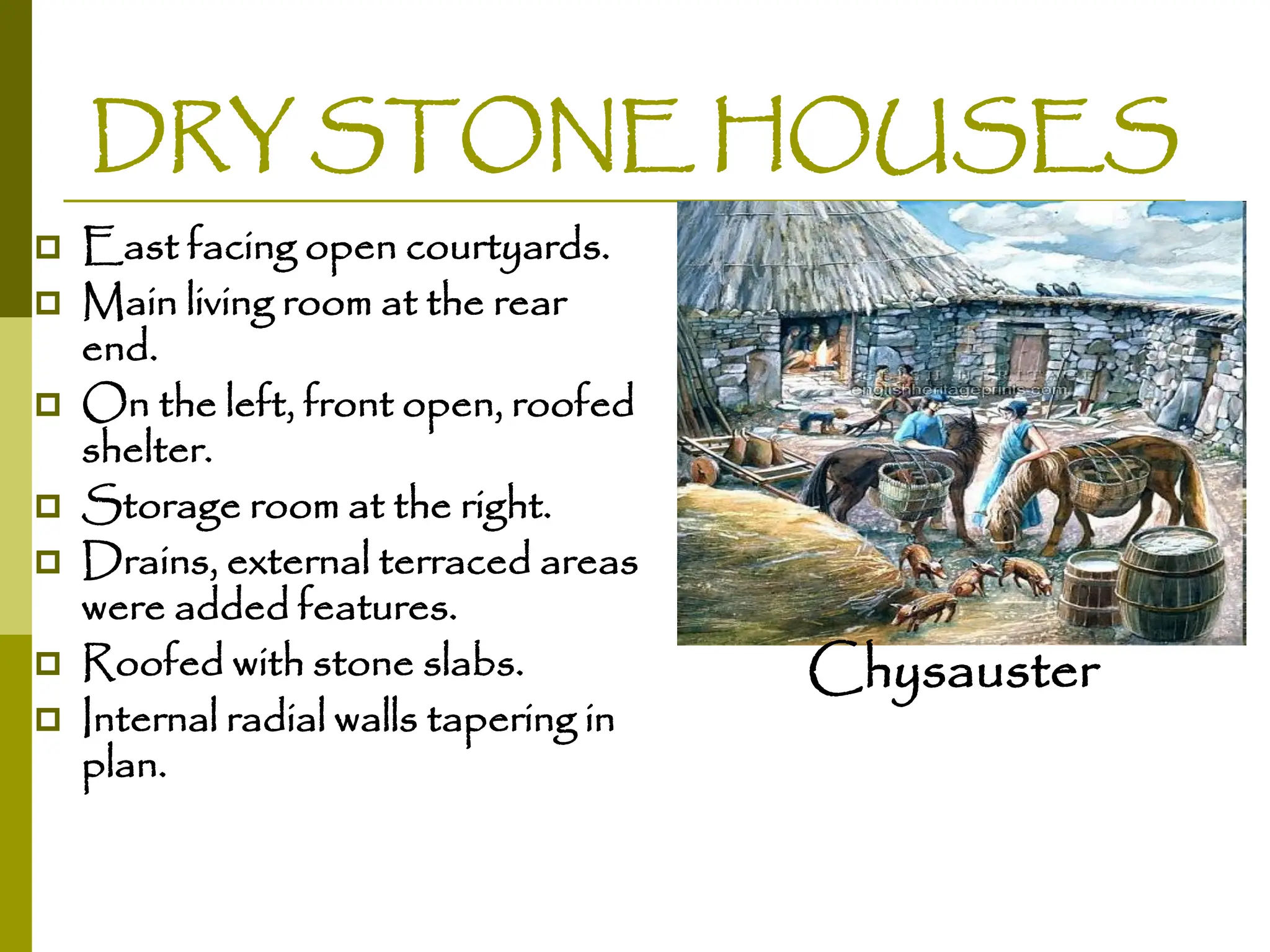
 East facing open courtyards.
 Main living room at the rear
end.
 On the left, front open, roofed
shelter.
 Storage room at the right.
 Drains, external terraced areas
were added features.
 Roofed with stone slabs.
 Internal radial walls tapering in
plan.
Chysauster
FUNERARY
MONUMENTS
Artificial shafts, ritual wells sunken to
12 to 40 m.
Ditch and earthwork enclosures (10
x10 m approximately).
Long , parallel sided rectilinear
enclosures containing standing stones,
post holes and hearths.
DEFENSIVE
STRUCTURES
 Parapets varying from sloping front earth work
backed by stone or timber revetting.
 Stone cladded fortifications reinforced with
timber, fired occasionally for vitrification.
 Gates in the east and the west.
 Century later, eastern gates were elaborated with
claw like structures and the western gates were
enlarged.
 Ramparts were reinforced with stones.
FORTIFIED BUILDINGS
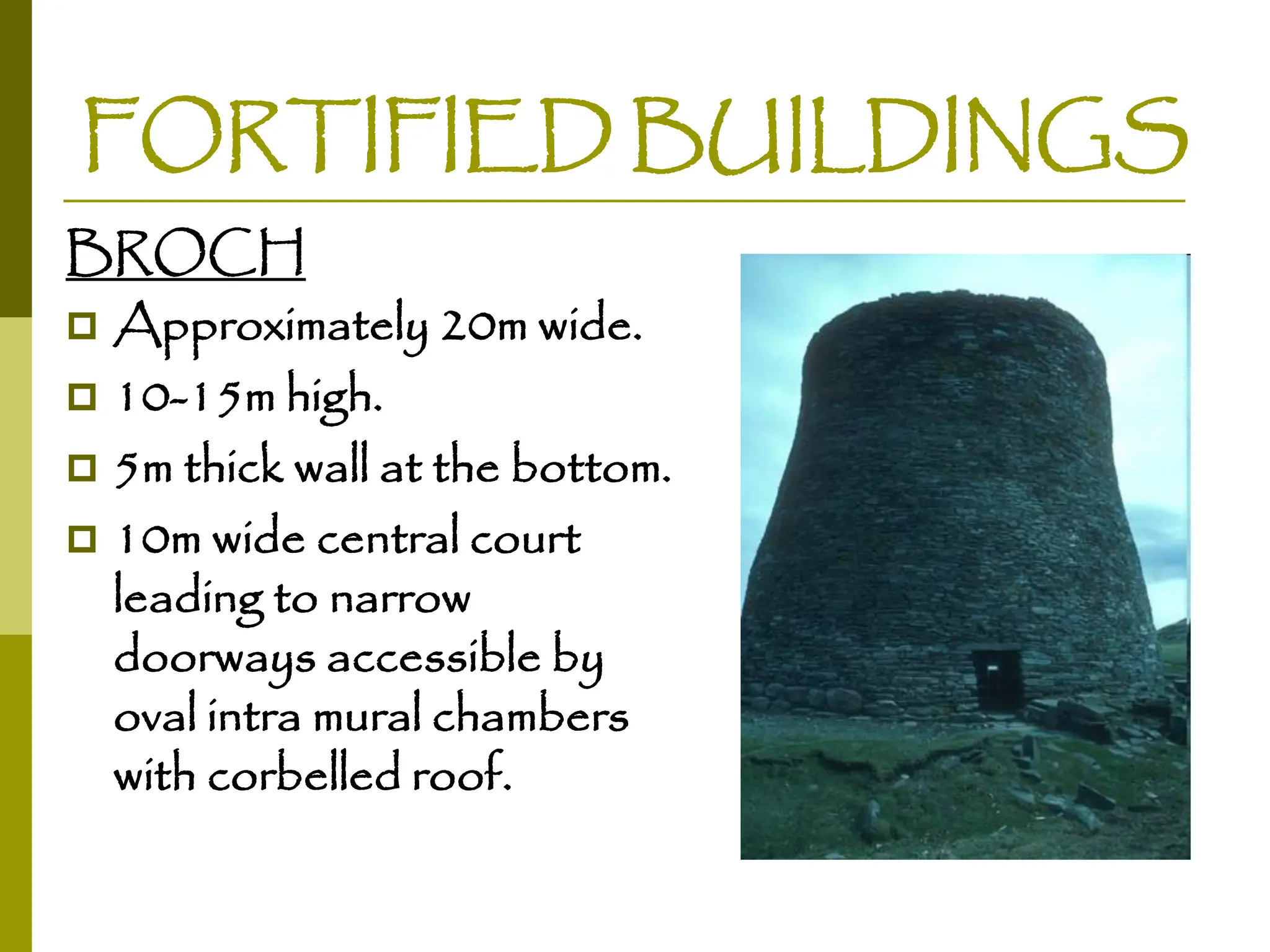
BROCH
 Approximately 20m wide.
 10-15m high.
 5m thick wall at the bottom.
 10m wide central court
leading to narrow
doorways accessible by
oval intra mural chambers
with corbelled roof.
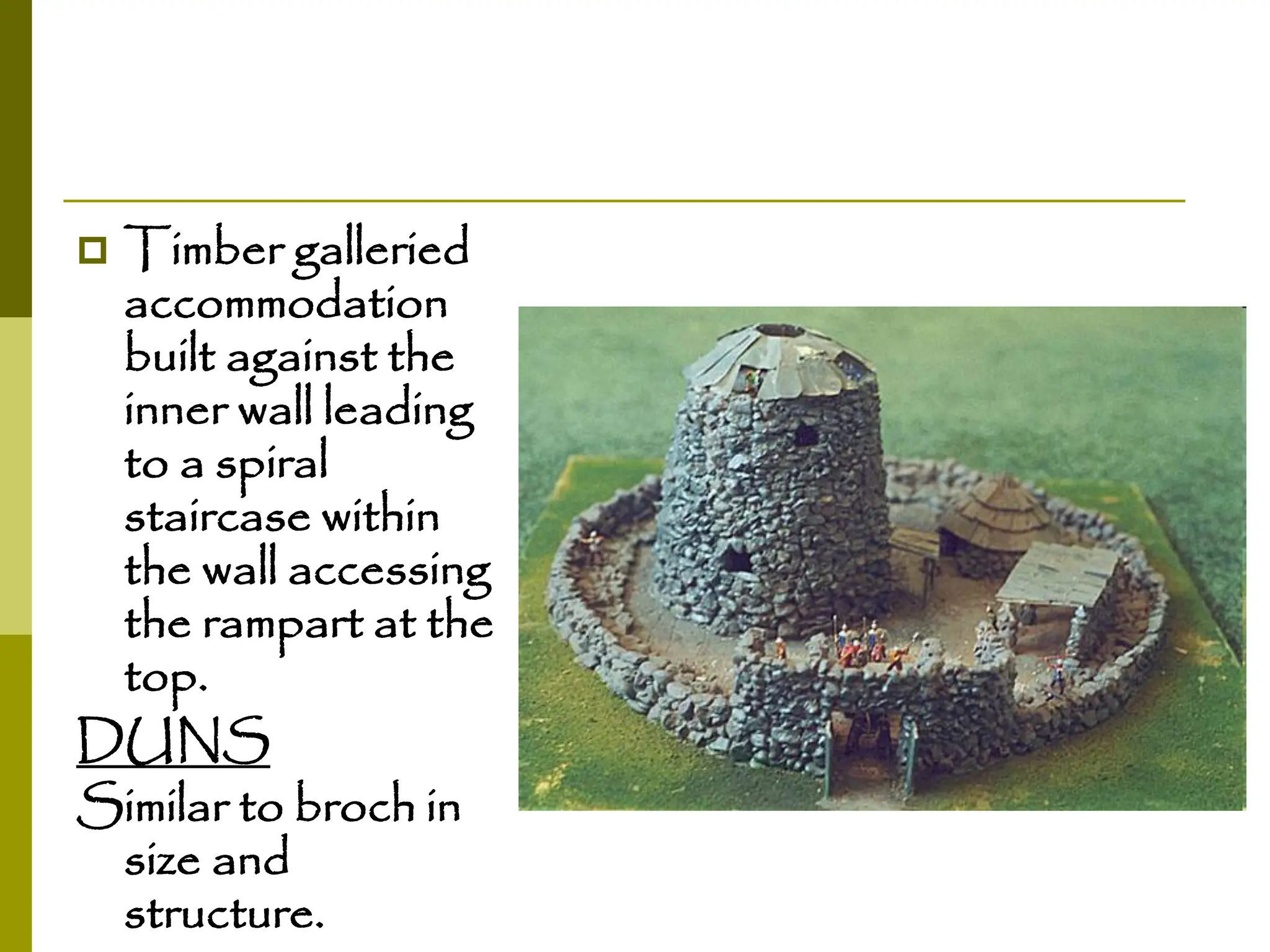
 Timber galleried
accommodation
built against the
inner wall leading
to a spiral
staircase within
the wall accessing
the rampart at the
top.
DUNS
Similar to broch in
size and
structure.
paleolithicarchitecture-140102011307-phpapp02.pdf

  • 2.
    PREHISTORIC ARCHITECTURE This was thetype of architecture invented by the primeval man to get shelter and protection : From variable extreme weather conditions. From wild beasts and enemies.
  • 3.
    PALEOLITHIC DWELLINGS Structures created inwood and stone. Fire used on paved hearths. No buildings for any special purposes but dwellings. Categorized into 5 types:
  • 4.
    CAVES  The oldestand most common types of dwellings.  Natural underground spaces, large enough for a human.  Example: Rock shelters, Grottos, Sea caves.
  • 5.
    HUTS  Located insouthern French cities.  Oval in shape(8m-15m X 4m-6m).  Built close to sea shores.  Built using stakes with stones as supports.  Stout posts along axis.  Floor made of organic matter and ash.
  • 6.
    MOLODOVA  A moresophisticated sought.  Wood framework covered with skins, held in place by rough oval mammoth bones, enclosing 15 hearths.
  • 7.
    DOLNI VESTONICE  Palisadeof mammoth bones and tusks set into ground, filled with brush wood and turf.  Oval shape(16m x10m)  Limestone used for walls  Central hearth capped with an earthen dome.  Summer structure open to sky.
  • 8.
    MEZHIRICH  Consisted of foundationwall of mammoth jaws and long bones, capped with skulls.  Roofed with tree branches, overlaid by tusks.
  • 9.
    LEAN TOS  Erectedagainst one wall of cave.  Defined at base by stones(12m x 4m).  Skin curtain and roof draped over posts.  May have two compartments, each having an entrance on the longer side.
  • 10.
    TENTS  Skirts weigheddown with pebbles.  Paved interiors.  Open air hearths.  Wooden posts driven into earth covered with skins.  At a later stage, were secured by reindeer antlers.
  • 11.
    PIT HOUSES  Morecommon in eastern Europe with severely low temperatures.  Oval trapezoidal, pear shaped size(5m-8m x2.5m-3.5m).  Central post holes indicating existence of roof.  Constructed by making shallow depressions in the ground surrounded by a ring of mammoth bones and tusks.
  • 12.
    MESOLITHIC PERIOD  Villagesarranged systematically.  Houses aligned in rows.  More regular plans.  Artefacts came into existence.  Settlements began around water bodies.  Fishing, cultivation of cereals and vegetables began.  Animals were domesticated, farming tools were developed.  Dwellings were more durable as compared to that in the Paleolithic age.
  • 13.
    HUTS  The structuremainly comprised of bamboos.  Plans were trapezoidal in shape.  The size varied from 5.5- 30m.  They had wide entrances facing the water bodies (rivers).  Floors were plastered with lime.  Posts were reinforced with stones.
  • 14.
    PIT HOUSES  Shallowoval pits 6m-9m long and 2- 5m wide.  Roofs were made of timber.  Stone hearths were used as working slabs.
  • 15.
    NEOLITHIC PERIOD Many changestook place. Production of food. Developments in agriculture lead to settling down. Dwellings became more sustainable. Houses were built with square/rectangular plans, with sections divided with animal skins.
  • 16.
    TIMBER FRAMED HOUSES  Squareplans:25’ x25’  Mud walls with 3’ deep footings.  These were more durable as compared to the earlier ones.  Pitched and thatched roofs with overhanging caves.  Interiors raised, plastered with sunken hearths.
  • 17.
    LONG HOUSES  Rectangularplans(20’ x26’-150’).  Oak posts made the framework covered with clay.  Floors were defined with layers of clay over a base of logs.  It consisted of 3 types of plans:
  • 18.
     TRIPARTITE:  Entrancefacing the east.  Central part being the living room.  The third part containing deep storage area.  BIPARTITE:  Entrance  Living room combined with storage.  SINGLE BAY HOUSES:  Having living rooms only.
  • 19.
    DRY STONE HOUSES Stone built houses with 3m thick cavity walls.  Inner, outer caves were made of dry stones and the interiors were covered with domestic refuse.  Rectangular plan with circular corners.  Thatched roofs with a smoke hole at the top positioned over central hearth.
  • 20.
    MONUMENTS Settlements lead tobuilding of monumental stone architecture. These were mainly collective tombs. PASSAGE GRAVES GALLERY GRAVES
  • 21.
    MEGALITHIC PASSAGE GRAVES  Coveringmound (38m x32m) surrounded by wide space with wide ditch beyond.  Entrance passage 1m wide and 1.5m high. burial chamber(5sqm)  Smooth walls built with rectangular blocks and fine joints.  Three cells at three sides of the chamber.  Built mainly with masoned walls and corbelled roof.
  • 23.
    MEGALITHIC GALLERY GRAVES  23mlong chamber divided into twelve sections.  Covered with a rectangular mound .
  • 24.
    EARTHERN LONG BARROWS  Trapezoidmound(40m x6m approx.)  Wide entrance and porch with 4 posts.  Earthen mound surrounded by a bedding trunch over 1m deep and 0.5 m wide.  Timber retaining wall 2m high.  Mortuary houses exactly behind entrance, constructed using three split tree trunks(600mm dia app.) placed 1m apart from each other supporting a ridge post.  Sloping timber formed triangular framework(1.5m high, 2.4m wide) at groung level.
  • 25.
  • 26.
    MENHIRS  Large, uprightstanding stones.  Uneven textured, square shaped, tapered towards the top.  May exist as monoliths or a part of group.  Existed as identification marks at burial sites or otherwise.
  • 27.
    DOLMENS  Two ormore stones supporting a large one at the top.  Burial features.  Also called cromlechs (brythonic origin).
  • 28.
    HENGES  Open airritual structures.  The plan comprised of concentric circles.  An altar located in the centre.  Surrounded by five trilithon pairs of stones.  Followed by a circle of blue stones.  Example: The stone henge.
  • 29.
    BRONZE AGE  DWELLINGS Enclosed timber framed and dry stone farmsteads.  Cooking area and storage were added features.
  • 30.
    TIMBER FRAMED HOUSES  Logbuilt houses with central houses and lateral wings.  Large proportions and layout.  Contained large central hall(10 x5m),attached six rooms, five of them contained hearths.  Logs interlocked by means of notches cut near the extremities.
  • 31.
     Entrance porchfacing the street, living area and loft accessible by ladder.  Stone hearth on the left of entrance with a family bed located against southern wall.  Wooden floors, thatched roofs.  Houses placed in rows oriented east-west.
  • 32.
    CIRCULAR BRONZE AGE Linked group of earthwork enclosures and hut platforms(734m x55m).  Principal enclosures surrounded by a timber fence.  Containing 4-5 additional huts(4.8m dia), both with a ring about 250mm wide.  Ring containing timber uprights supporting a thatched roof.  Porch at the entrance.
  • 33.
    BURIAL MOUNDS  Singlegrave burials.  Variable forms in exterior and interior forms and arrangements and groupings.  In their simplest form, barrows consisted of earth or stone.  Others were timber mortuary houses or stone cists.
  • 34.
    NEW GRANGE  Stonerevetments retaining the side supports to the burial chamber.  Sandstone paved floor at the northern and reed floor on the southern end.
  • 35.
    TEMPLES AND RITUAL STRUCTURES Structures had three to four rooms.(8.8m x 5.2m)  Megaron like porch leading to a room containing a hanging altar.  Followed by a large squarish room with plastered frieze.  Two raised altars on raised clay platforms set against side walls.  Six supports for a reed thatched roof.
  • 36.
    DEFENSIVE STRUCTURES  Palisaded fortsin low lying areas.  Massive encircling ramparts enclosing a roughly circular or oval area.  Plank walls erected 2-3m apart with tie beams in between.  Space between palisades filled with rubble and earth.
  • 37.
     Upland fortshad timber replaced with stones.  A third type, consisting of parallel rows of timber laid in consecutive layers at right angles; forming a grid.  Interstices filled with wood chips, earth and stones.
  • 38.
    STONE TOWERS  Circulartowers ranging from 10 to 15m in diameter.  Built in dry stone walling.  Some having an internal corridor.(3m high)  Main chamber roofed by means of false corbelling.  Served both defensive and ritualistic purposes.
  • 39.
    IRON AGE Development indomestic architecture. Traditional farmstrade maintained.
  • 40.
    TIMBER FRAMED HOUSES  Circulartimber structures.(15m diameter)  Timber palisaded enclosure.(120 x90m)  Palisade consisting upright stakes edge to edge in a trench.(300mm deep)  Main house defined by 4 groups of post holes.
  • 41.
     Outer ringssupported wall.  Posts had continuous lintels with sloping rafters.  Both sets of posts had continuous lintels overlaid by horizontal members, thatched roof attached.  Raised canopied roof containing smoke hole.  Elaborate porch.  Central loft  Ancillary buildings and storage pits excavated within palisaded enclosures. woodburry
  • 42.
    DRY STONE HOUSES East facing open courtyards.  Main living room at the rear end.  On the left, front open, roofed shelter.  Storage room at the right.  Drains, external terraced areas were added features.  Roofed with stone slabs.  Internal radial walls tapering in plan. Chysauster
  • 43.
    FUNERARY MONUMENTS Artificial shafts, ritualwells sunken to 12 to 40 m. Ditch and earthwork enclosures (10 x10 m approximately). Long , parallel sided rectilinear enclosures containing standing stones, post holes and hearths.
  • 44.
    DEFENSIVE STRUCTURES  Parapets varyingfrom sloping front earth work backed by stone or timber revetting.  Stone cladded fortifications reinforced with timber, fired occasionally for vitrification.  Gates in the east and the west.  Century later, eastern gates were elaborated with claw like structures and the western gates were enlarged.  Ramparts were reinforced with stones.
  • 45.
    FORTIFIED BUILDINGS BROCH  Approximately20m wide.  10-15m high.  5m thick wall at the bottom.  10m wide central court leading to narrow doorways accessible by oval intra mural chambers with corbelled roof.
  • 46.
     Timber galleried accommodation builtagainst the inner wall leading to a spiral staircase within the wall accessing the rampart at the top. DUNS Similar to broch in size and structure.