2
Introduction
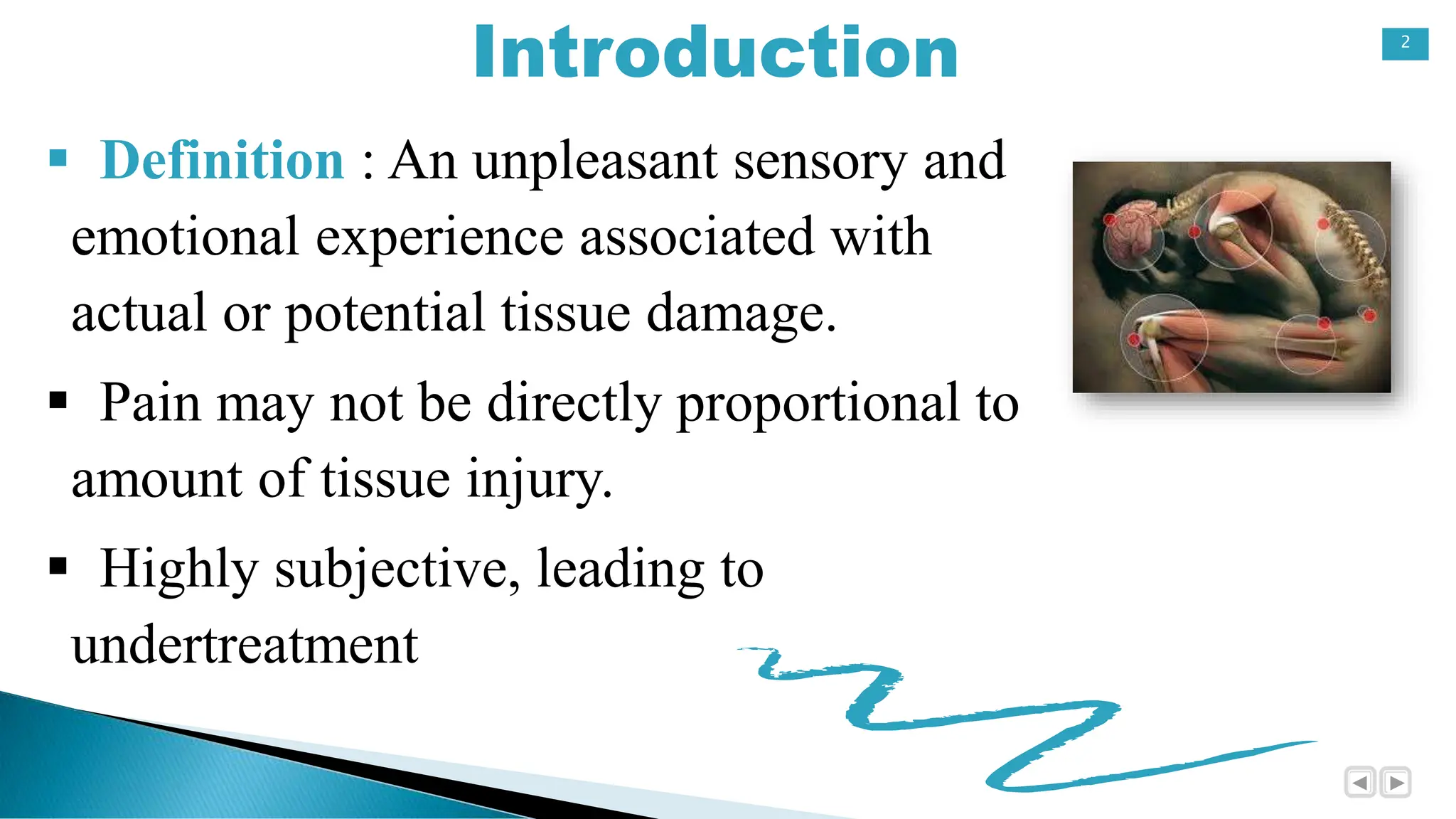
Definition :An unpleasant sensory and
emotional experience associated with
actual or potential tissue damage.
Pain may not be directly proportional to
amount of tissue injury.
Highly subjective, leading to
undertreatment
3.
3
In cancer,the prevalence of pain in
advanced disease is 70-90%.
" In HIV disease, pain prevalence is
about 50%.
" Other illnesses may have significant
pain but no clear data.
5
Injury, trauma,spasm or disease to skin, muscle, somatic
structures or viscera;
Perceived and communicated via peripheral mechanisms
(pathways)
Usually associated with autonomic response as well
(tachycardia, blood pressure, diaphoresis, pallor,
mydriasis (pupil dilation).
I. Acute Pain
6.
6
i. Non-malignant
Painpersists beyond the precipitating injury
Rarely accompanied by autonomic symptoms
Sufferers often fail to demonstrate objective
evidence of underlying pathology.
Characterized by location-visceral, myofacial, or
neurologic causes.
II. Chronic Pain
7.
7
ii. Malignant
Hascharacteristics of chronic pain as well as
symptoms of acute pain (breakthrough pain).
Has a definable cause, e.g. tumor recurrence
In treatment, narcotic habituation is generally
not a concern.
II. Chronic Pain
9
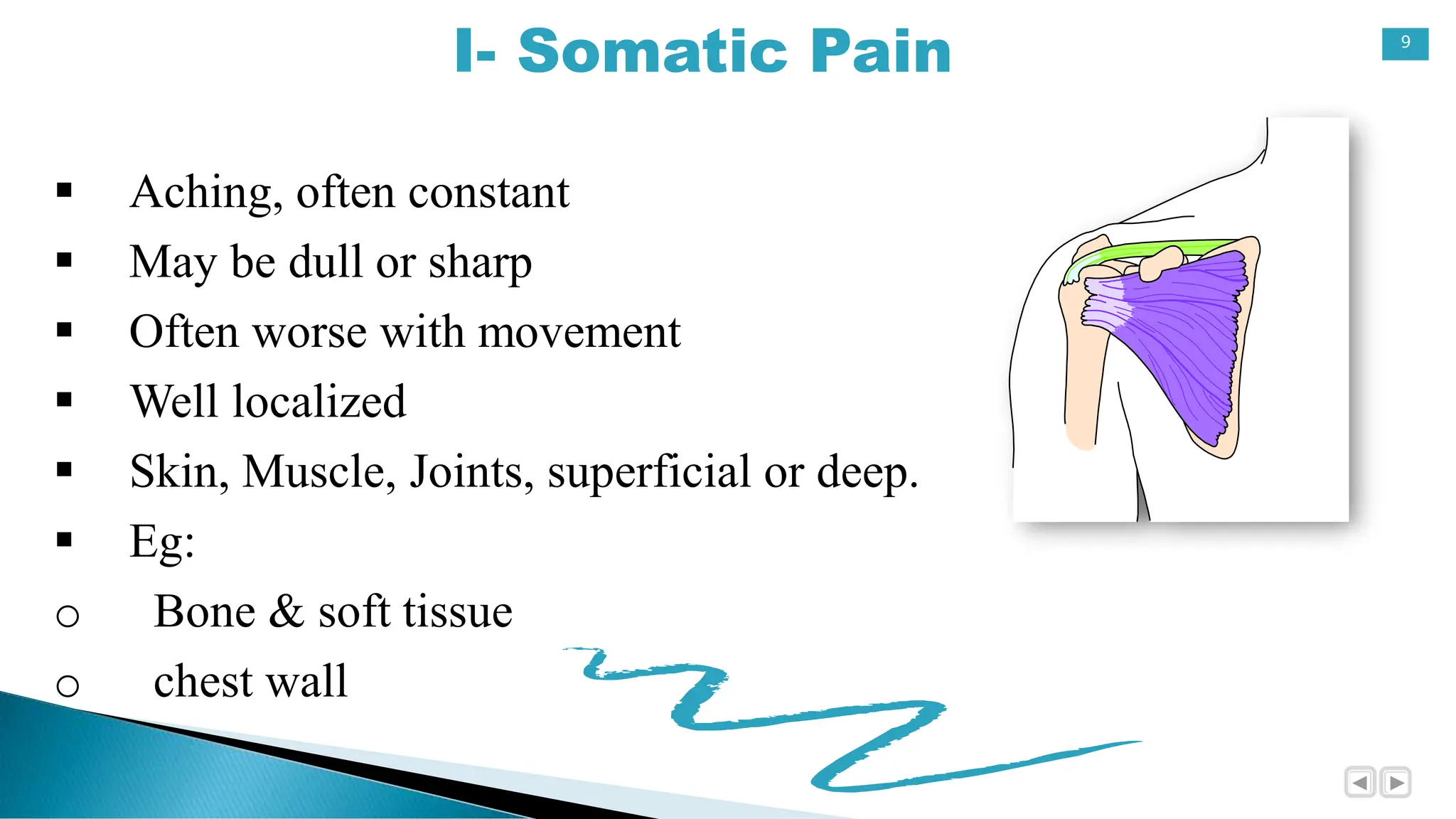
I- Somatic Pain
Aching, often constant
May be dull or sharp
Often worse with movement
Well localized
Skin, Muscle, Joints, superficial or deep.
Eg:
o Bone & soft tissue
o chest wall
10.
10
II- Visceral Pain
Constant or crampy
Aching, burning
Poorly localized
Referred
Organs of Thorax & Abdominal Cavity.
Usually as a result of stretching, infiltration and
compression
Eg:
o Liver capsule distension
o Bowel obstruction
11.
11
III- Bone Pain
Poorly localized, aching, deep, burning.
Common with malignancy of Breast, Lung,
Prostate, Bladder, Cervical, Renal, Colon,
Stomach and Esophagus
Can lead to pathological fractures.
Vertebral Metastases can lead to cord
compression.
12.
12
IV- Neuropathic Pain
Caused by disturbance of function or pathological
changes in a nerve.
May arise from a lesion or trauma, infection,
compression or tumour invasion.
Described as burning, shooting, tingling.
Does not respond well to standard analgesics.
13.
13
Categories ofPain
Classified by inferred pathophysiology:
I. Nociceptive pain (stimuli from somatic and
visceral structures)
II. Neuropathic pain (stimuli abnormally
processed by the nervous system)
14.
14
I. Nociceptive:
Causedby invasion &/or destruction &/or pressure on
superficial somatic structures like skin, deeper skeletal
structures such as bone & muscle and visceral structures
and organs.
Types: superficial somatic, deep somatic, & visceral.
15.
15
II. Neuropathic:
Causedby pressure on &/or destruction of peripheral,
autonomic or central nervous system structures.
Radiation of pain along dermatomal or peripheral nerve
distributions.
Often described as burning and/or deep aching &
associated with dysesthesia or lancinating pain.
16.
16
Effects of pain
Sympathetic responses
o Pallor
o Increased blood pressure
o Increased pulse
o Increased respiration
o Skeletal muscle tension
o Diaphoresis
17.
17
Effects of pain
Parasympathetic responses
o Decreased blood pressure
o Decreased pulse
o Nausea & vomiting
o Weakness
o Pallor
o Loss of consciousness
18.
18
Pain History
Thesite of pain
Type of pain
Exacerbating & Relieving factors
How frequently
Impact on daily life
19.
19
Pain History
Otherimportant additional questions to be asked.
o What is the response to past and current analgesic
therapy?
o Any kind of diary or record about the pain?
o Fears they have about analgesics?
21
Factors to considerin choosing a
pain scale
1. Age of patient
2. Physical condition
3. Level of consciousness
4. Mental status
5. Ability to communicate
22.
22
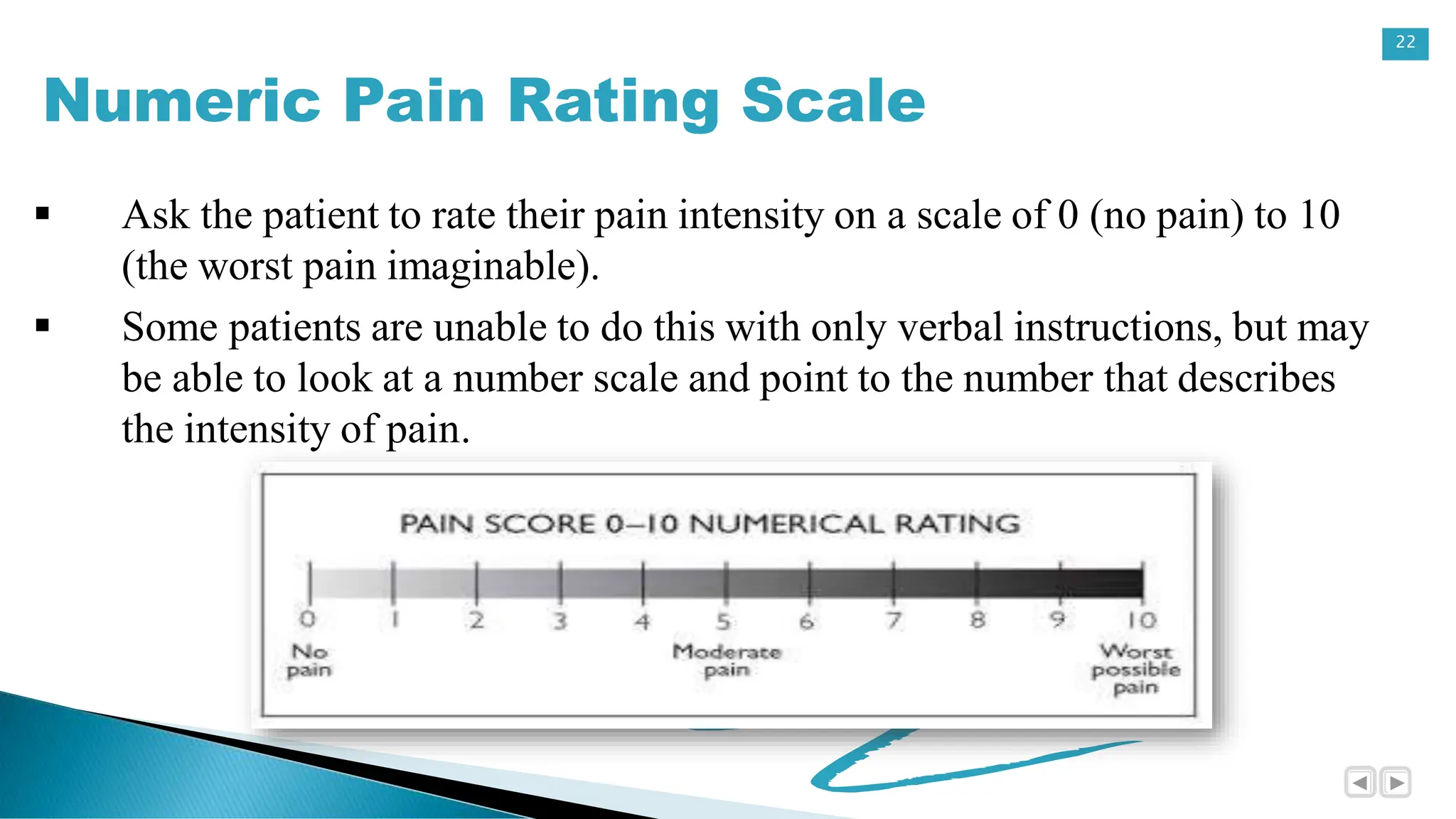
Numeric Pain RatingScale
Ask the patient to rate their pain intensity on a scale of 0 (no pain) to 10
(the worst pain imaginable).
Some patients are unable to do this with only verbal instructions, but may
be able to look at a number scale and point to the number that describes
the intensity of pain.
23.
23
Wong-Baker FACES PainRating Scale
Can be used with young children (sometimes as young as 3 years of age)
Works well for many older children and adults as well as for those who speak a
different language
Explain that each face represents a person who may have no pain, some pain, or as
much pain as imaginable. Point to the appropriate face and say the appropriate
description. e.g. “This face hurts just a little bit”
Ask the patient to choose the face that best matches how she or he feels or how much
they hurt.
24.
24
Severity Assessment
McGillPain Questionnaire
Scale from 0 to 5
From None to Severe Pain
for children or adults who understand numerical
relationships.
25.
25
Goals of PainManagement Therapy
1) Decreased pain
2) Decreased healthcare utilization
o Decreased “shopping” for care
o Decreased emergency room visits
3) Improved functional status
o Increased ability to perform activities of daily living
o Return to employment
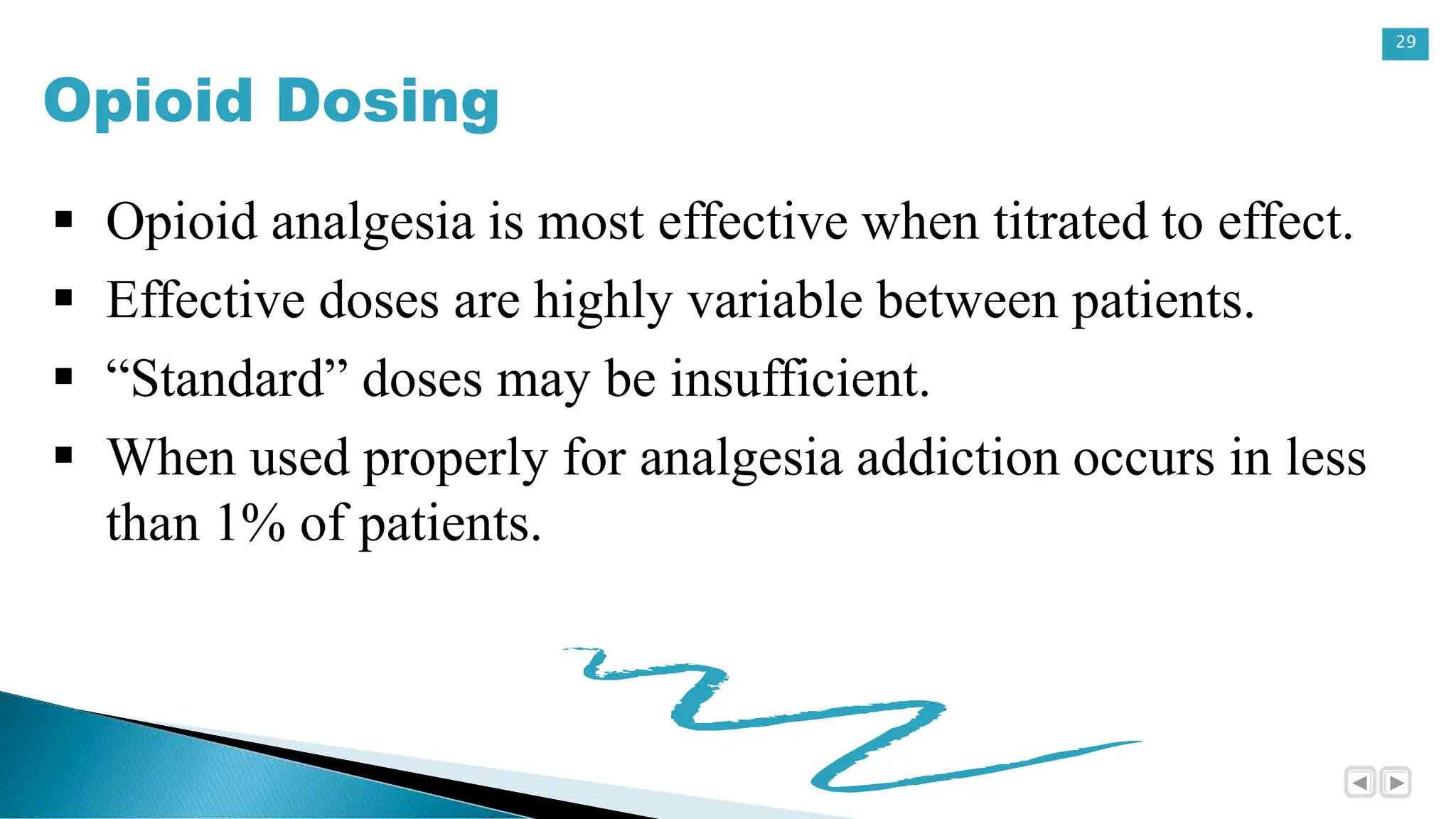
29
Opioid Dosing
Opioidanalgesia is most effective when titrated to effect.
Effective doses are highly variable between patients.
“Standard” doses may be insufficient.
When used properly for analgesia addiction occurs in less
than 1% of patients.
30.
30
Opioid Side Effects
Constipation :
o need proactive laxative use
Nausea/vomiting:
o consider treating with dopamine antagonists and/or prokinetics (metoclopramide, domperidone,
prochlorperazine, haloperidol)
Urinary retention
Itch/rash
o worse in children; may need low-dose naloxone infusion. May try antihistamines, however not great
success
Dry mouth
Respiratory depression
o uncommon when titrated in response to symptom