

Definitions
 Work study is a generic term for those
 techniques particularly ‘Method Study’ and
 ‘Work Measurement’ which are used in the
 examination of human work in all its contexts
 and which lead systematically to the
 investigation of all the factors which effect
 the efficiency of the situation being reviewed,
 in order to seek improvements.
It may be defined as the systematic
 investigation (i.e recording and critical
 examination) of the existing method of doing
 a job in order to develop and install an easy,
 rapid, efficient, effective and less fatiguing
 procedure for doing the same job and at
 lower costs.
It is the application of different techniques to
 measure and establish the time required to
 complete the job by a qualified worker at a
 defined level of performance.
 Uniform and improved production flow
 Higher productive efficiency
 Reduced manufacturing costs
 Fast and accurate delivery dates
 Better employee-employer relations
 Better service to customers
 Job security and job satisfaction
 Better working and other conditions
 Higher wages to workers
 Improved working and standardized procedures.
 Better work place layout
 Less fatigue to operators.
 Better product quality
 Effective utilization of men, material & machinery
 Efficient and fast material handling.
 Reduced health hazards
 Efficient planning of the section
 Streamlined working procedures
 Determines the time required to do a job
 Decides manpower to do a job
 Decides equipment requirement
 Provides information for effective PPC
 Aids in calculating exact delivery dates
 Decides realistic labor budgeting and provides a basis for
  standard costing system
 Provides a basis for fair and sound incentive schemes
 Results in effective labor control
 Method Study
*Select the task to be studied
*Collection, recording and presentation of
  facts
*Analyze the facts
*Develop the new methods
*Install the new methods
*Maintain the methods.
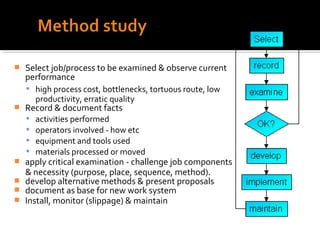
   Select job/process to be examined & observe current
    performance
     high process cost, bottlenecks, tortuous route, low
       productivity, erratic quality
   Record & document facts
     activities performed
     operators involved - how etc
     equipment and tools used
     materials processed or moved
   apply critical examination - challenge job components
    & necessity (purpose, place, sequence, method).
   develop alternative methods & present proposals
   document as base for new work system
   Install, monitor (slippage) & maintain
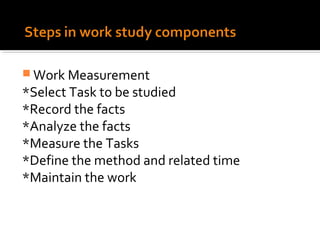
 Work Measurement
*Select Task to be studied
*Record the facts
*Analyze the facts
*Measure the Tasks
*Define the method and related time
*Maintain the work
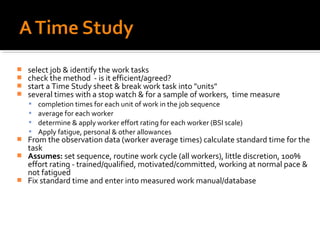
   select job & identify the work tasks
   check the method - is it efficient/agreed?
   start a Time Study sheet & break work task into "units"
   several times with a stop watch & for a sample of workers, time measure
       completion times for each unit of work in the job sequence
       average for each worker
       determine & apply worker effort rating for each worker (BSI scale)
       Apply fatigue, personal & other allowances
   From the observation data (worker average times) calculate standard time for the
    task
   Assumes: set sequence, routine work cycle (all workers), little discretion, 100%
    effort rating - trained/qualified, motivated/committed, working at normal pace &
    not fatigued
   Fix standard time and enter into measured work manual/database

P roduction ppt

  • 1.
  • 2.
     Work studyis a generic term for those techniques particularly ‘Method Study’ and ‘Work Measurement’ which are used in the examination of human work in all its contexts and which lead systematically to the investigation of all the factors which effect the efficiency of the situation being reviewed, in order to seek improvements.
  • 3.
    It may bedefined as the systematic investigation (i.e recording and critical examination) of the existing method of doing a job in order to develop and install an easy, rapid, efficient, effective and less fatiguing procedure for doing the same job and at lower costs.
  • 4.
    It is theapplication of different techniques to measure and establish the time required to complete the job by a qualified worker at a defined level of performance.
  • 5.
     Uniform andimproved production flow  Higher productive efficiency  Reduced manufacturing costs  Fast and accurate delivery dates  Better employee-employer relations  Better service to customers  Job security and job satisfaction  Better working and other conditions  Higher wages to workers
  • 6.
     Improved workingand standardized procedures.  Better work place layout  Less fatigue to operators.  Better product quality  Effective utilization of men, material & machinery  Efficient and fast material handling.  Reduced health hazards  Efficient planning of the section  Streamlined working procedures
  • 7.
     Determines thetime required to do a job  Decides manpower to do a job  Decides equipment requirement  Provides information for effective PPC  Aids in calculating exact delivery dates  Decides realistic labor budgeting and provides a basis for standard costing system  Provides a basis for fair and sound incentive schemes  Results in effective labor control
  • 8.
     Method Study *Selectthe task to be studied *Collection, recording and presentation of facts *Analyze the facts *Develop the new methods *Install the new methods *Maintain the methods.
  • 9.
    Select job/process to be examined & observe current performance  high process cost, bottlenecks, tortuous route, low productivity, erratic quality  Record & document facts  activities performed  operators involved - how etc  equipment and tools used  materials processed or moved  apply critical examination - challenge job components & necessity (purpose, place, sequence, method).  develop alternative methods & present proposals  document as base for new work system  Install, monitor (slippage) & maintain
  • 10.
     Work Measurement *SelectTask to be studied *Record the facts *Analyze the facts *Measure the Tasks *Define the method and related time *Maintain the work
  • 11.
    select job & identify the work tasks  check the method - is it efficient/agreed?  start a Time Study sheet & break work task into "units"  several times with a stop watch & for a sample of workers, time measure  completion times for each unit of work in the job sequence  average for each worker  determine & apply worker effort rating for each worker (BSI scale)  Apply fatigue, personal & other allowances  From the observation data (worker average times) calculate standard time for the task  Assumes: set sequence, routine work cycle (all workers), little discretion, 100% effort rating - trained/qualified, motivated/committed, working at normal pace & not fatigued  Fix standard time and enter into measured work manual/database