An Overview of Web 2.0 Tools for Collaborative Language Learning EuroCALL 2009 Conference  9-12, September 2009 Universidad Politechnica Valencia, Gandia, Spain http: //leon . blogspot .com   David L. Brooks, Associate Professor Kitasato University, Sagamahira, Japan
Outline of the session What’s new in the New Internet: Web 2.0? Why the Web’s evolution matters The language educator’s self-development  guide in Web 2.0 Categories of Web 2.0 sites and Net Apps Examples of collaborative projects  Highlighting collaborative tools and strategies Questions and Reflections EuroCALL 2009  EuroCALL 2009  9-12 Sept UPV, Gandia  Spain
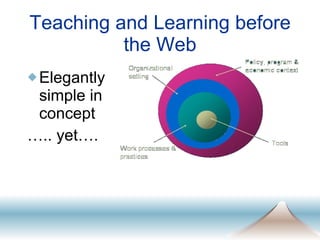
Teaching and Learning before the Web Elegantly simple in concept … .. yet….
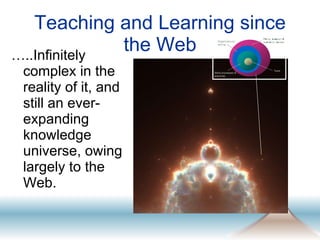
Teaching and Learning since the Web … ..Infinitely complex in the reality of it, and still an ever-expanding knowledge universe, owing largely to the Web.
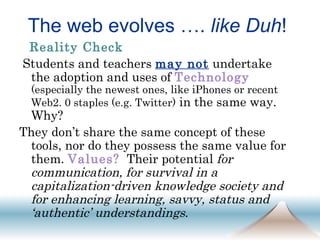
The web evolves ….  like Duh ! Reality Check   Students and teachers  may not  undertake the adoption and uses of  Technology   (especially the newest ones, like iPhones or recent Web2. 0 staples (e.g. Twitter)  in the same way. Why?  They don’t share the same concept of these tools, nor do they possess the same value for them.  Values?   Their potential  for communication, for survival in a capitalization-driven knowledge society and for enhancing learning, savvy, status and ‘authentic’ understandings .
The web evolves ….  Nah, you think? Consequence   - a digital divide in education, the  new media  intercultural gap,  Adding on barriers to communication, and a schism in the classroom or school culture and beyond…. between generations, between digital tribes,  within nations, economies, civilizations
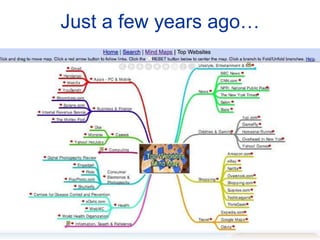
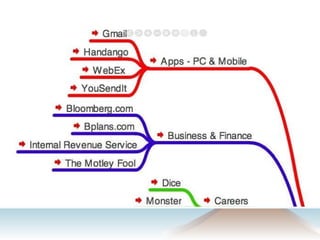
Just a few years ago…
 
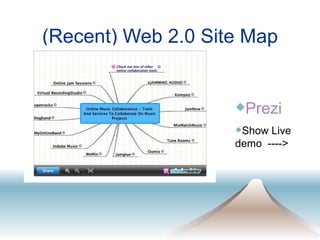
(Recent) Web 2.0 Site Map Prezi Show Live demo  ---->
Obviously, something’s  different.  Consider then what these changes are and what they mean.
Why it matters? Humans are tool-gathers & tool-makers, thus retooling human society by designing more and better tools.  Hot air balloons -> TWA -> NASA Gutenberg -> typewriters - Digital Media Model-T -> Ford -> Demise of GM  Brothers Lumiere .. -->etc
Mankind’s Greatest Tool Language and Cognition ….the tools to transmit, manipulate, and encode meaning
Digital Ethnography See Embedded Video above from YouTube A macro history of the web  by Dr. Michael Wesch  (in less than 5 min)  Kansas State University http://www. youtube .com/watch? v=6gmP4nk0EOE
Teaching the Machine =  Us using the Machine to  teach it to use us to teach it…. Each time you post, add photo,  tweet, bookmark a link or add tags, you are teaching the Web to think like a  Planetary Thinking Machine, the Cloud Computer, the Universal Cyborg - Sky Net is coming to pass - slowly but inevitably.
Theory of Web 2.0 How could this be an ‘academic’ or even ‘educational’ presentation without a little theory?
Characteristics of Web 2.0  1 O’Reilly’s definition: the  ‘network effects’ of mass participation ‘ users pursuing their own ‘selfish’ interests build collective value as an automatic byproduct (O’Reilly, 2005) Openness, increasingly greater interoperability, lowered threshold for easier access and data manipulation Brooks’ Web 2.0 key features: immediacy, ubiquity, portability, connectivity, self-focused intensity, information aggregation, actionable multi-user collaborative involvement.
Characteristics of Web 2.0  2 Simplified content sharing formulas (RSS,  Harnessing collective intelligence  (Rennie & Mason, 2004) User interaction, engagement & participation Hyperlinked connections Extensible through user-generated, user-added content Network identity – (increasingly) Internet-wide, more complete and targeted profile (virtual identity) Traversable, publicly articulated social network   (Boyd 2006a)
Characteristics of Web 2.0  3 Visible reaction or feedback adds user-added content to user-generated content.  This often takes the form of semi-persistent public comments, testimonials, guestbook messages, ratings, tagging, …. Supports collaborative work, thereby developing users’ skills for & through learning and for & by working in teams A shared community environment or space allowing inter-group communication  (results in increased learner motivation and persistence)
Pivotal Effects of Web 2.0  The  Network Society the  Network  is now the fundamental underpinning structure of social organization  (Castells as referenced in quote from (Rudd, Sutch, & Faces, 2006, p.4) It calls into question the validity of our current education system, based on the premise of individual acquisition of content and skills. What are the new competencies to which the ‘network(ed) society’ educational system should strive to develop? Shared Virtual Communities - Environments or spaces allowing inter-group communication,  resulting in increased user(learner) motivation and persistence.
Criticisms of the rush toward a Web 2.0 based education Not accepting any today? No time for that!
Digital Tribes - the new social media reality   Digital Natives  Digital Immigrants   Digital Refugees
Outcomes? That may not be difficult to predict.
On second thought.. I might not be so easy.
 
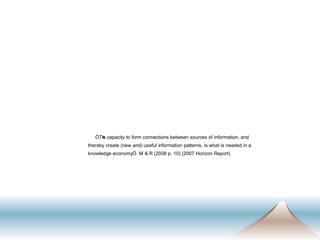
Outcome “ The capacity to form connections between sources of information, and thereby create (new and) useful information patterns” is what is needed in a knowledge.  (2007 Horizon Report)
An Outcome of Web Evolution “  The capacity to form connections between sources of information, and thereby create (new and) useful information patterns” is what is needed in a knowledge economy.   (2007 Horizon Report)
Web 2.0 is a research network as well as a learning network ( also consumer network). New role and definition(s) of research  Death of individual ownership  (Pre-postmodern Intellectual Communism) True collaboration, Beyond peer review, Mega-distribution of data and knowledge Newly emerging forms of scholarship New forms of academic conferences  Impact of Globally Networked  Society on Research
- beyond behaviorism,  - beyond cognitivism,  - beyond constructivism  Connectivism   (Seimens, 2004) Click above link to see upcoming online course details Impact of Globally Networked  Society on Education and on Educators  (Siemens )->  on Robin Good’s  MasterNewMedia.com site
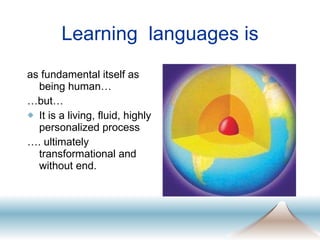
Learning  languages is as fundamental itself as being human… … but… It is a living, fluid, highly personalized process … . ultimately transformational and without end.
 
So is the Web!
Mindset adjustment is needed.  destabilizing the notion of a course … ..or at least they may bump into each other less than gently.  http: //ltc . umanitoba . ca/connectivism/ ? p=194 Digital  and pre-digital cultures collide in the classroom
What really matters… By the middle the 21st century, ‘foreign’ language mastery will no longer truly be needed.  What will?  Just think about what foretells the inevitable outcome….. Global media presence Global economic interdependence Computing technology Digital and virtual communication tools Shrinking planet Interconnectivity Mega-complexity So……..
The Paradigm Shift Instead of  foreign language mastery, what we really need is….. Intercultural Communicative Competence Web 2.0 (and beyond) can play a critical role in aiding in this goal, especially across Digital Cultures.
Rationale  Fact : Whether we recognize it or not, all teachers employ an explicit, mutually-actualized, teacher-mediated process for intuitively ‘ inculturating’   students into the our own digital (and socio-linguistic) culture. Risk :  Not being ready for the CHANGE (…shift).  (It might be fatal if unrecognized.) Aim :  Advocating that both the teacher and students realize this fact, allow for it, plan for it, and collaborate on this process.  How :  First, educator, know thy tools and thy texts, and  ESPECIALLY the content of the new social web 2.0 environment that our students inhabit.
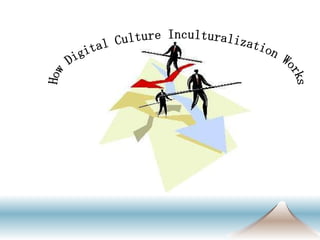
How Digital Culture Inculturalization Works
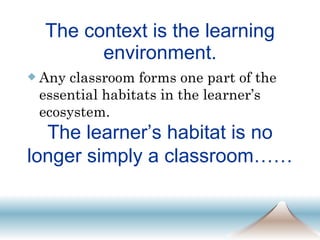
The context is the learning environment. Any classroom forms one part of the essential habitats in the learner’s ecosystem. The learner’s habitat is no longer simply a classroom……
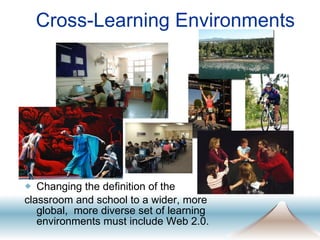
Cross-Learning Environments Changing the definition of the  classroom and school to a wider, more global,  more diverse set of learning environments must include Web 2.0.
Re-defining the learning environment New Purposes New Processes New Content New Activities / Tasks  (learning tasks involving collaboration) New Forms of Assessment New Focus on Broader Outcomes Web 2.0 can add value.
Re-defining the learning environment New Purposes New Processes New Content New Activities / Tasks  (learning tasks involving  collaboration ) New Forms of Assessment New Focus on Broader Outcomes
Re-defining the learning environment New Purposes New Processes New Content New Activities / Tasks  (learning tasks involving  collaboration ) New Forms of Assessment New Focus on Broader Outcomes COLLABORATION
Collaboration…  is probably one of the most essential defining elements of today’s Internet  (Web 2.0 - 3.0…..)
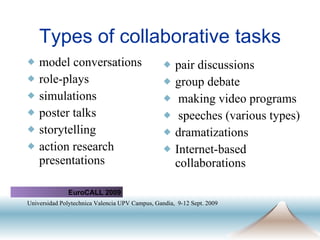
Types of collaborative tasks model conversations role-plays simulations poster talks storytelling action research presentations pair discussions  group debate making video programs speeches (various types) dramatizations Internet-based collaborations EuroCALL 2009 Universidad Polytechnica Valencia UPV Campus, Gandia,  9-12 Sept. 2009
As time permits, show next slides  Check Session  TIME Questions  Comments Experiences Discussion David! OK? Yeah? Hey, you guys. It’s your turn.
What are the main categories of Web 2. 0 tools?
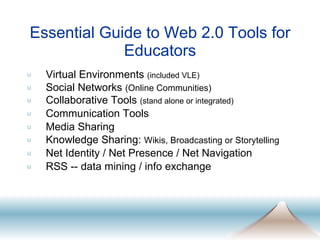
Essential Guide to Web 2.0 Tools for Educators Virtual Environments  (included VLE) Social Networks  (Online Communities) Collaborative Tools  (stand alone or integrated) Communication Tools Media Sharing Knowledge Sharing:  Wikis, Broadcasting or Storytelling Net Identity / Net Presence / Net Navigation RSS -- data mining / info exchange
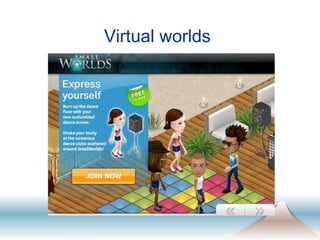
1. Virtual Environments  Virtual Learning Environments LMS (leaning management system) or CMS (course management systems or content management systems) Moodle  (an Open Source LMS) which will inevitably be transformed into a more Web 2.0 type server application  Virtual Worlds Second Life  --  Others here at EuroCALL are exploring it and giving us the benefit of their experiences,  see Graham Davies et al Small Worlds http://www.smallworlds.com
Virtual worlds
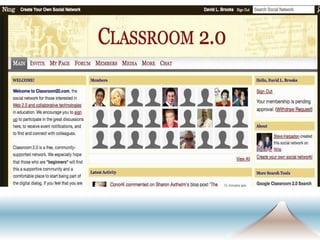
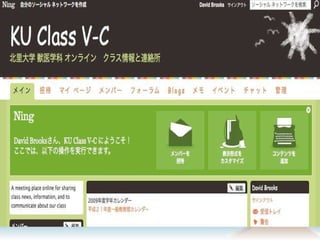
Facebook   - set to become the dominating force, but it is limited and deliberately limiting, especially for traditional classroom settings Creating your own Social Media Network for the classroom /course Ning Webjam 2. Social Networks  (online groups)
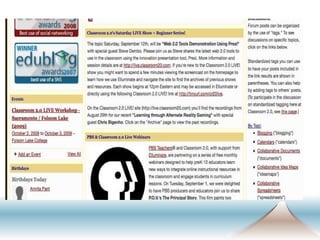
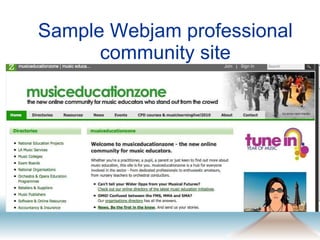
Create your own social network site http://www.classroom20.com/ Visit Ning.com  Here is a Ning site worth joining   (or browsing) Visit Webjam.com http://www. musiceducationzone .net/? _c=1


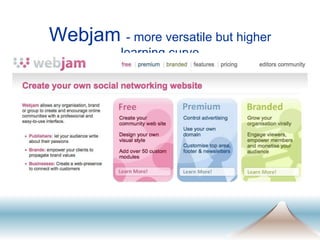
Webjam  - more versatile but higher learning curve
Sample Webjam professional community site
3. Collaborative Tools  (stand alone or integrated) Google’s Cupboard to Tools Google Apps Google Talk Google Voice Google Maps Blogger  Picasa (photo sharing ) Specific type of shared product/process Robin Good’s  Mindmap  of Best Collaboration Tools Web2.0
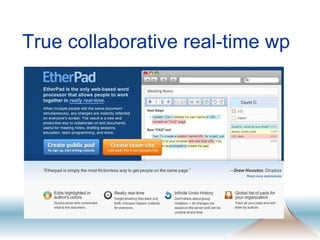
True collaborative real-time wp
4. Communication Tools Email  -- Google Mail  Meebo  (cross-platform)  or Gtalk  for  Instant Messenging Twitter - cross between a microblogger, an IM, and email,  works across multiples devices (cellphone, Smartphone, PDA, Netbook, PC/Mac, game machine, browser plug-in, etc) plus MORE….
5. Media Sharing Flickr   -- photo-sharing site;  Integrates with almost everything Video)   a) video-sharing sites (Youtube, Vimeo…) b)  Embed Code --> Use it effectively to employ streaming media (saves server space)    c)  RealPlayer Downloader (plug-in for Firefox) to obtain temporary use of files (esp. Creative Commons materials) Slideshare.net   - for sharing PowerPoint presentations via a blog, course or web page.  Webslides (Diigo)   - Create a automatic slideshow of your favorite (selected) website (tour or guidebook, training, research, etc)
6. Knowledge Sharing:  Wikis, Broadcasting, Web Meetings & Storytelling Wikispaces   (see example used below: Alan Levine) Web-conferencing / Online meetings a)  Elluminate  b)  WizIQ  (also available as a Moodle module) Storytelling using Web 2.0 Alan Levine’s 50+ Web 2.0 Ways To Tell a Story   http: //cogdogroo . wikispaces .com/50+ways
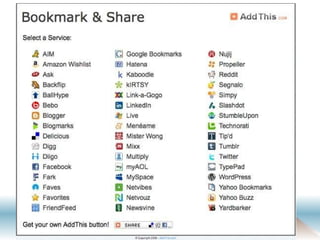
Net Life:  Net Identity / Net Presence  / Net Navigation LifeStreams   --> Aggregated Net Identities Netvibes, Plaxo, Profilactic Net Presence a)  Twitter and its integration and mashups, such as Twitxr.com, Brightkite.com b) Location-based tools  Net Navigation  via Social Bookmarking  Digg, Delicious, Diigo, Technorati
 
8. Integration  Data mining, sharing & info exchange RSS  “Really Simple Syndication” (can included synchronization of data also) Also referred to in alternative formats, such as Atom Mashups Widgets, Gadgets, Module Aggregators Feedreaders and Feedburners
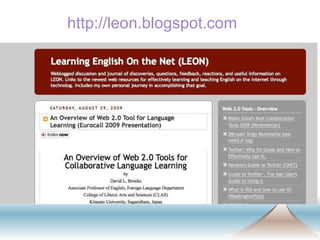
http: //leon . blogspot .com
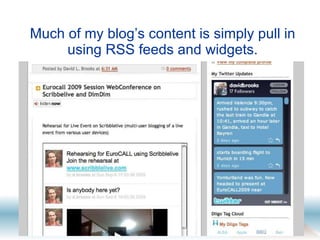
Much of my blog’s content is simply pull in using RSS feeds and widgets.
The End of  the presentation Thank you for your attention and cooperation.
An Overview of Web 2.0 Tools for Collaborative Language Learning EuroCALL 2009 Conference  9-12, September 2009 Universidad Politechnica Valencia, Gandia, Spain David L. Brooks, Associate Professor Kitasato University, Sagamahira, Japan You  can find the handouts, useful links, tutorials, a WebSlide (Diigo bookmarks), and this Powerpoint at: http: //leon . blogspot .com Learning English On (the) Net -->  LEON

Overview Web2.0 Tools For Collaborative Learning

  • 1.
    An Overview ofWeb 2.0 Tools for Collaborative Language Learning EuroCALL 2009 Conference 9-12, September 2009 Universidad Politechnica Valencia, Gandia, Spain http: //leon . blogspot .com David L. Brooks, Associate Professor Kitasato University, Sagamahira, Japan
  • 2.
    Outline of thesession What’s new in the New Internet: Web 2.0? Why the Web’s evolution matters The language educator’s self-development guide in Web 2.0 Categories of Web 2.0 sites and Net Apps Examples of collaborative projects Highlighting collaborative tools and strategies Questions and Reflections EuroCALL 2009 EuroCALL 2009 9-12 Sept UPV, Gandia Spain
  • 3.
    Teaching and Learningbefore the Web Elegantly simple in concept … .. yet….
  • 4.
    Teaching and Learningsince the Web … ..Infinitely complex in the reality of it, and still an ever-expanding knowledge universe, owing largely to the Web.
  • 5.
    The web evolves…. like Duh ! Reality Check Students and teachers may not undertake the adoption and uses of Technology (especially the newest ones, like iPhones or recent Web2. 0 staples (e.g. Twitter) in the same way. Why? They don’t share the same concept of these tools, nor do they possess the same value for them. Values? Their potential for communication, for survival in a capitalization-driven knowledge society and for enhancing learning, savvy, status and ‘authentic’ understandings .
  • 6.
    The web evolves…. Nah, you think? Consequence - a digital divide in education, the new media intercultural gap, Adding on barriers to communication, and a schism in the classroom or school culture and beyond…. between generations, between digital tribes, within nations, economies, civilizations
  • 7.
    Just a fewyears ago…
  • 8.
  • 9.
    (Recent) Web 2.0Site Map Prezi Show Live demo ---->
  • 10.
    Obviously, something’s different. Consider then what these changes are and what they mean.
  • 11.
    Why it matters?Humans are tool-gathers & tool-makers, thus retooling human society by designing more and better tools. Hot air balloons -> TWA -> NASA Gutenberg -> typewriters - Digital Media Model-T -> Ford -> Demise of GM Brothers Lumiere .. -->etc
  • 12.
    Mankind’s Greatest ToolLanguage and Cognition ….the tools to transmit, manipulate, and encode meaning
  • 13.
    Mankind’s Greatest ToolLanguage and Cognition ….the tools to transmit, manipulate, and encode meaning
  • 14.
    Digital Ethnography SeeEmbedded Video above from YouTube A macro history of the web by Dr. Michael Wesch (in less than 5 min) Kansas State University http://www. youtube .com/watch? v=6gmP4nk0EOE
  • 15.
    Teaching the Machine= Us using the Machine to teach it to use us to teach it…. Each time you post, add photo, tweet, bookmark a link or add tags, you are teaching the Web to think like a Planetary Thinking Machine, the Cloud Computer, the Universal Cyborg - Sky Net is coming to pass - slowly but inevitably.
  • 16.
    Theory of Web2.0 How could this be an ‘academic’ or even ‘educational’ presentation without a little theory?
  • 17.
    Characteristics of Web2.0 1 O’Reilly’s definition: the ‘network effects’ of mass participation ‘ users pursuing their own ‘selfish’ interests build collective value as an automatic byproduct (O’Reilly, 2005) Openness, increasingly greater interoperability, lowered threshold for easier access and data manipulation Brooks’ Web 2.0 key features: immediacy, ubiquity, portability, connectivity, self-focused intensity, information aggregation, actionable multi-user collaborative involvement.
  • 18.
    Characteristics of Web2.0 2 Simplified content sharing formulas (RSS, Harnessing collective intelligence (Rennie & Mason, 2004) User interaction, engagement & participation Hyperlinked connections Extensible through user-generated, user-added content Network identity – (increasingly) Internet-wide, more complete and targeted profile (virtual identity) Traversable, publicly articulated social network (Boyd 2006a)
  • 19.
    Characteristics of Web2.0 3 Visible reaction or feedback adds user-added content to user-generated content. This often takes the form of semi-persistent public comments, testimonials, guestbook messages, ratings, tagging, …. Supports collaborative work, thereby developing users’ skills for & through learning and for & by working in teams A shared community environment or space allowing inter-group communication (results in increased learner motivation and persistence)
  • 20.
    Pivotal Effects ofWeb 2.0 The Network Society the Network is now the fundamental underpinning structure of social organization (Castells as referenced in quote from (Rudd, Sutch, & Faces, 2006, p.4) It calls into question the validity of our current education system, based on the premise of individual acquisition of content and skills. What are the new competencies to which the ‘network(ed) society’ educational system should strive to develop? Shared Virtual Communities - Environments or spaces allowing inter-group communication, resulting in increased user(learner) motivation and persistence.
  • 21.
    Criticisms of therush toward a Web 2.0 based education Not accepting any today? No time for that!
  • 22.
    Digital Tribes -the new social media reality Digital Natives Digital Immigrants Digital Refugees
  • 23.
    Outcomes? That maynot be difficult to predict.
  • 24.
    On second thought..I might not be so easy.
  • 25.
  • 26.
    Outcome “ Thecapacity to form connections between sources of information, and thereby create (new and) useful information patterns” is what is needed in a knowledge. (2007 Horizon Report)
  • 27.
    An Outcome ofWeb Evolution “ The capacity to form connections between sources of information, and thereby create (new and) useful information patterns” is what is needed in a knowledge economy. (2007 Horizon Report)
  • 28.
    Web 2.0 isa research network as well as a learning network ( also consumer network). New role and definition(s) of research Death of individual ownership (Pre-postmodern Intellectual Communism) True collaboration, Beyond peer review, Mega-distribution of data and knowledge Newly emerging forms of scholarship New forms of academic conferences Impact of Globally Networked Society on Research
  • 29.
    - beyond behaviorism, - beyond cognitivism, - beyond constructivism Connectivism (Seimens, 2004) Click above link to see upcoming online course details Impact of Globally Networked Society on Education and on Educators (Siemens )-> on Robin Good’s MasterNewMedia.com site
  • 30.
    Learning languagesis as fundamental itself as being human… … but… It is a living, fluid, highly personalized process … . ultimately transformational and without end.
  • 31.
  • 32.
  • 33.
    Mindset adjustment isneeded. destabilizing the notion of a course … ..or at least they may bump into each other less than gently. http: //ltc . umanitoba . ca/connectivism/ ? p=194 Digital and pre-digital cultures collide in the classroom
  • 34.
    What really matters…By the middle the 21st century, ‘foreign’ language mastery will no longer truly be needed. What will? Just think about what foretells the inevitable outcome….. Global media presence Global economic interdependence Computing technology Digital and virtual communication tools Shrinking planet Interconnectivity Mega-complexity So……..
  • 35.
    The Paradigm ShiftInstead of foreign language mastery, what we really need is….. Intercultural Communicative Competence Web 2.0 (and beyond) can play a critical role in aiding in this goal, especially across Digital Cultures.
  • 36.
    Rationale Fact: Whether we recognize it or not, all teachers employ an explicit, mutually-actualized, teacher-mediated process for intuitively ‘ inculturating’ students into the our own digital (and socio-linguistic) culture. Risk : Not being ready for the CHANGE (…shift). (It might be fatal if unrecognized.) Aim : Advocating that both the teacher and students realize this fact, allow for it, plan for it, and collaborate on this process. How : First, educator, know thy tools and thy texts, and ESPECIALLY the content of the new social web 2.0 environment that our students inhabit.
  • 37.
    How Digital CultureInculturalization Works
  • 38.
    The context isthe learning environment. Any classroom forms one part of the essential habitats in the learner’s ecosystem. The learner’s habitat is no longer simply a classroom……
  • 39.
    Cross-Learning Environments Changingthe definition of the classroom and school to a wider, more global, more diverse set of learning environments must include Web 2.0.
  • 40.
    Re-defining the learningenvironment New Purposes New Processes New Content New Activities / Tasks (learning tasks involving collaboration) New Forms of Assessment New Focus on Broader Outcomes Web 2.0 can add value.
  • 41.
    Re-defining the learningenvironment New Purposes New Processes New Content New Activities / Tasks (learning tasks involving collaboration ) New Forms of Assessment New Focus on Broader Outcomes
  • 42.
    Re-defining the learningenvironment New Purposes New Processes New Content New Activities / Tasks (learning tasks involving collaboration ) New Forms of Assessment New Focus on Broader Outcomes
  • 43.
    Re-defining the learningenvironment New Purposes New Processes New Content New Activities / Tasks (learning tasks involving collaboration ) New Forms of Assessment New Focus on Broader Outcomes COLLABORATION
  • 44.
    Collaboration… isprobably one of the most essential defining elements of today’s Internet (Web 2.0 - 3.0…..)
  • 45.
    Types of collaborativetasks model conversations role-plays simulations poster talks storytelling action research presentations pair discussions group debate making video programs speeches (various types) dramatizations Internet-based collaborations EuroCALL 2009 Universidad Polytechnica Valencia UPV Campus, Gandia, 9-12 Sept. 2009
  • 46.
    As time permits,show next slides Check Session TIME Questions Comments Experiences Discussion David! OK? Yeah? Hey, you guys. It’s your turn.
  • 47.
    What are themain categories of Web 2. 0 tools?
  • 48.
    Essential Guide toWeb 2.0 Tools for Educators Virtual Environments (included VLE) Social Networks (Online Communities) Collaborative Tools (stand alone or integrated) Communication Tools Media Sharing Knowledge Sharing: Wikis, Broadcasting or Storytelling Net Identity / Net Presence / Net Navigation RSS -- data mining / info exchange
  • 49.
    1. Virtual Environments Virtual Learning Environments LMS (leaning management system) or CMS (course management systems or content management systems) Moodle (an Open Source LMS) which will inevitably be transformed into a more Web 2.0 type server application Virtual Worlds Second Life -- Others here at EuroCALL are exploring it and giving us the benefit of their experiences, see Graham Davies et al Small Worlds http://www.smallworlds.com
  • 50.
  • 51.
    Facebook - set to become the dominating force, but it is limited and deliberately limiting, especially for traditional classroom settings Creating your own Social Media Network for the classroom /course Ning Webjam 2. Social Networks (online groups)
  • 52.
    Create your ownsocial network site http://www.classroom20.com/ Visit Ning.com Here is a Ning site worth joining (or browsing) Visit Webjam.com http://www. musiceducationzone .net/? _c=1
  • 53.
  • 54.
  • 55.
  • 56.
    Webjam -more versatile but higher learning curve
  • 57.
  • 58.
    3. Collaborative Tools (stand alone or integrated) Google’s Cupboard to Tools Google Apps Google Talk Google Voice Google Maps Blogger Picasa (photo sharing ) Specific type of shared product/process Robin Good’s Mindmap of Best Collaboration Tools Web2.0
  • 59.
  • 60.
    4. Communication ToolsEmail -- Google Mail Meebo (cross-platform) or Gtalk for Instant Messenging Twitter - cross between a microblogger, an IM, and email, works across multiples devices (cellphone, Smartphone, PDA, Netbook, PC/Mac, game machine, browser plug-in, etc) plus MORE….
  • 61.
    5. Media SharingFlickr -- photo-sharing site; Integrates with almost everything Video) a) video-sharing sites (Youtube, Vimeo…) b) Embed Code --> Use it effectively to employ streaming media (saves server space) c) RealPlayer Downloader (plug-in for Firefox) to obtain temporary use of files (esp. Creative Commons materials) Slideshare.net - for sharing PowerPoint presentations via a blog, course or web page. Webslides (Diigo) - Create a automatic slideshow of your favorite (selected) website (tour or guidebook, training, research, etc)
  • 62.
    6. Knowledge Sharing: Wikis, Broadcasting, Web Meetings & Storytelling Wikispaces (see example used below: Alan Levine) Web-conferencing / Online meetings a) Elluminate b) WizIQ (also available as a Moodle module) Storytelling using Web 2.0 Alan Levine’s 50+ Web 2.0 Ways To Tell a Story http: //cogdogroo . wikispaces .com/50+ways
  • 63.
    Net Life: Net Identity / Net Presence / Net Navigation LifeStreams --> Aggregated Net Identities Netvibes, Plaxo, Profilactic Net Presence a) Twitter and its integration and mashups, such as Twitxr.com, Brightkite.com b) Location-based tools Net Navigation via Social Bookmarking Digg, Delicious, Diigo, Technorati
  • 64.
  • 65.
    8. Integration Data mining, sharing & info exchange RSS “Really Simple Syndication” (can included synchronization of data also) Also referred to in alternative formats, such as Atom Mashups Widgets, Gadgets, Module Aggregators Feedreaders and Feedburners
  • 66.
    http: //leon .blogspot .com
  • 67.
    Much of myblog’s content is simply pull in using RSS feeds and widgets.
  • 68.
    The End of the presentation Thank you for your attention and cooperation.
  • 69.
    An Overview ofWeb 2.0 Tools for Collaborative Language Learning EuroCALL 2009 Conference 9-12, September 2009 Universidad Politechnica Valencia, Gandia, Spain David L. Brooks, Associate Professor Kitasato University, Sagamahira, Japan You can find the handouts, useful links, tutorials, a WebSlide (Diigo bookmarks), and this Powerpoint at: http: //leon . blogspot .com Learning English On (the) Net --> LEON