Overview Of ICH –GCP Guidelines
Presented by:
Aditya Malan
M.Pharmacy (pharmacology)
Roll no - 22
Presented To :
DR MANJUSHA CHAUDHARY
(Clinical Research and pharmacovigilance)
INSTITUTE OF PHARMACEUTICAL SCIENCES
KURUKSHETRA UNIVERSITY
CONTENT
 Introduction
 Historical background
 Sections
 Principles
 Ethics committee
 Responsibilities of sponsor, investigator and monitor
 Investigator brochure
 Informed consent process
Good Clinical Practices (GCP)
 It is an international scientific and ethical quality standard for designing
conducting , recording, reporting trails that involve the participation of
human beings and ensure the rights, safety and well – being of the trail
subjects is protected.
 Results in producing the data of higher quality and up to global
standards .
The International Conference On
Harmonization (ICH-GCP)
 the objective of ICH GCP guidelines is to provide a unified standard for
the European union (EU), japan and the united states to facilitate the
mutual acceptance of clinical data by the regulatory authorities in these
jurisdictions.
 The guidelines were developed with consideration of the current good
clinical practices of the European union, japan, and the united states as
well as those of Australia , Canada , the Nordic countries and the world
health organization (WHO).
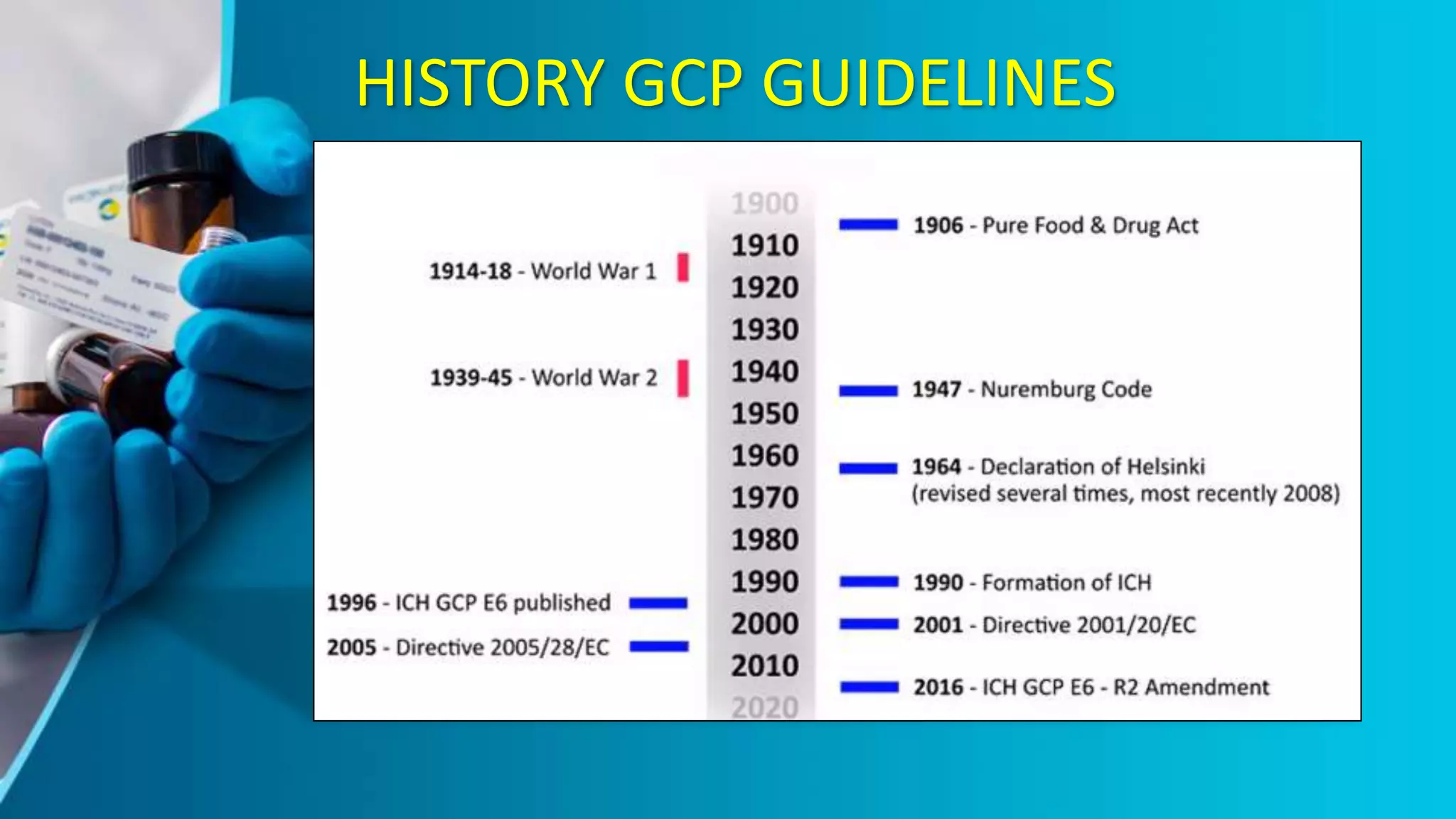
HISTORY GCP GUIDELINES
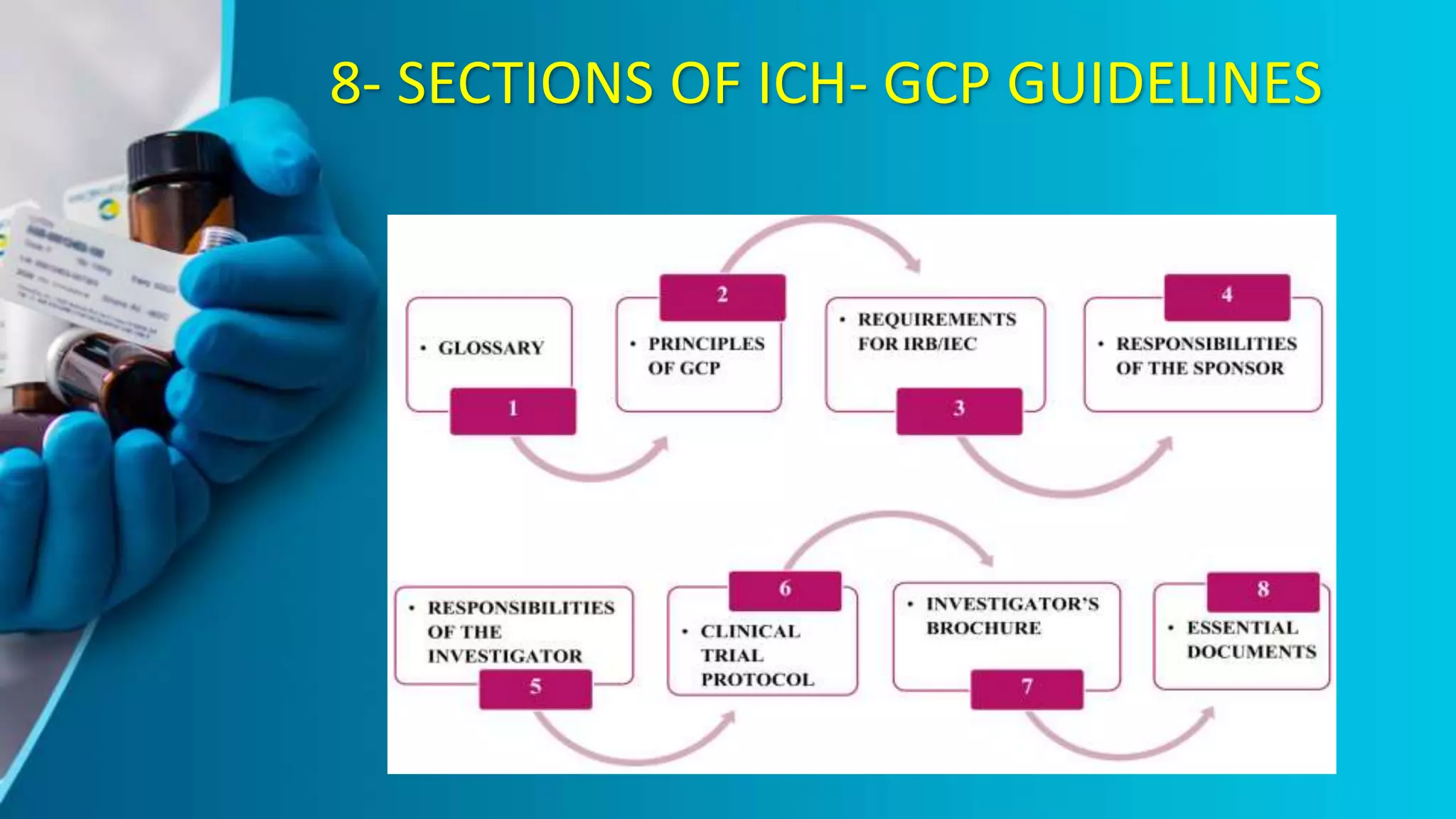
8- SECTIONS OF ICH- GCP GUIDELINES
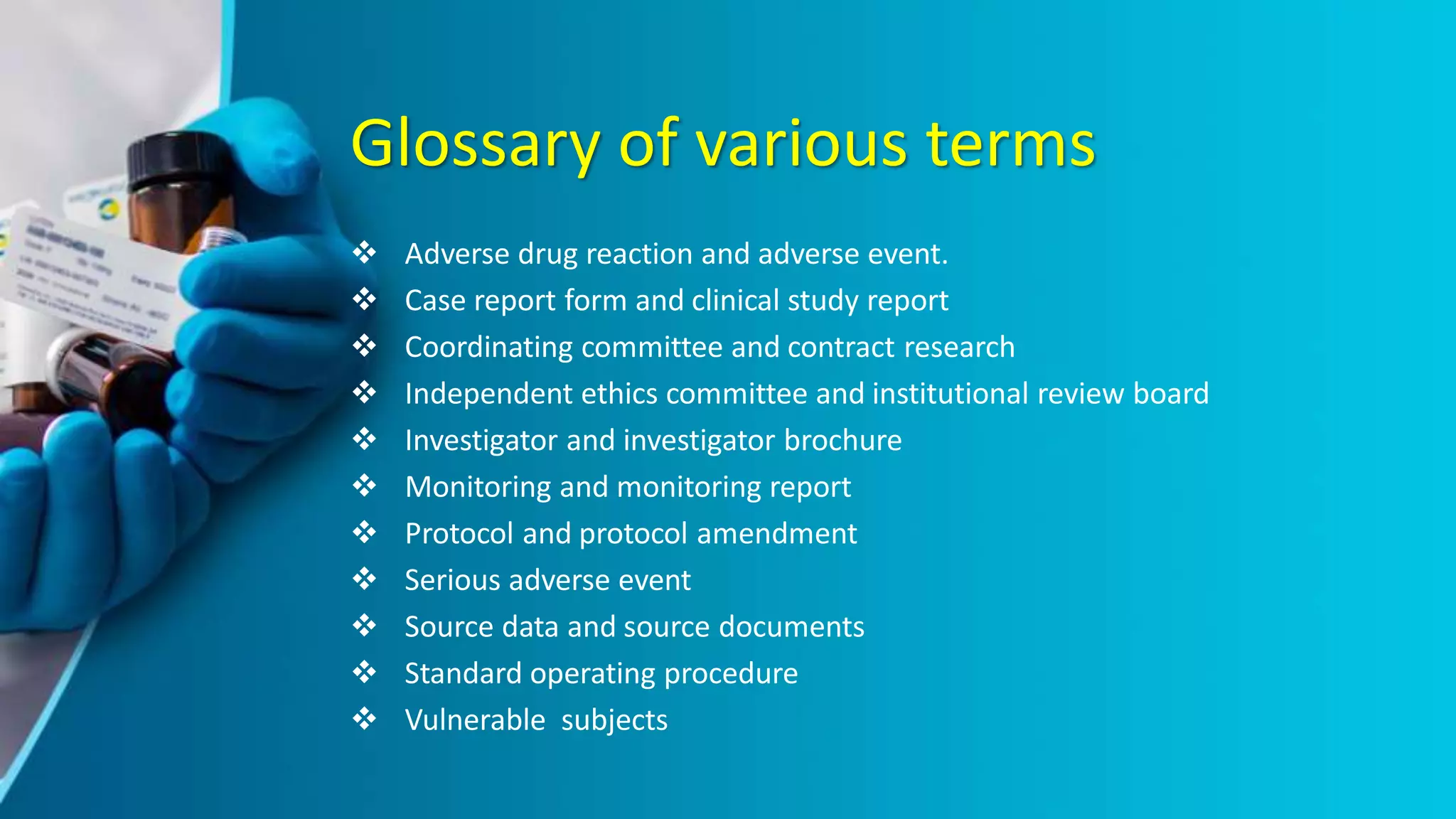
Glossary of various terms
 Adverse drug reaction and adverse event.
 Case report form and clinical study report
 Coordinating committee and contract research
 Independent ethics committee and institutional review board
 Investigator and investigator brochure
 Monitoring and monitoring report
 Protocol and protocol amendment
 Serious adverse event
 Source data and source documents
 Standard operating procedure
 Vulnerable subjects
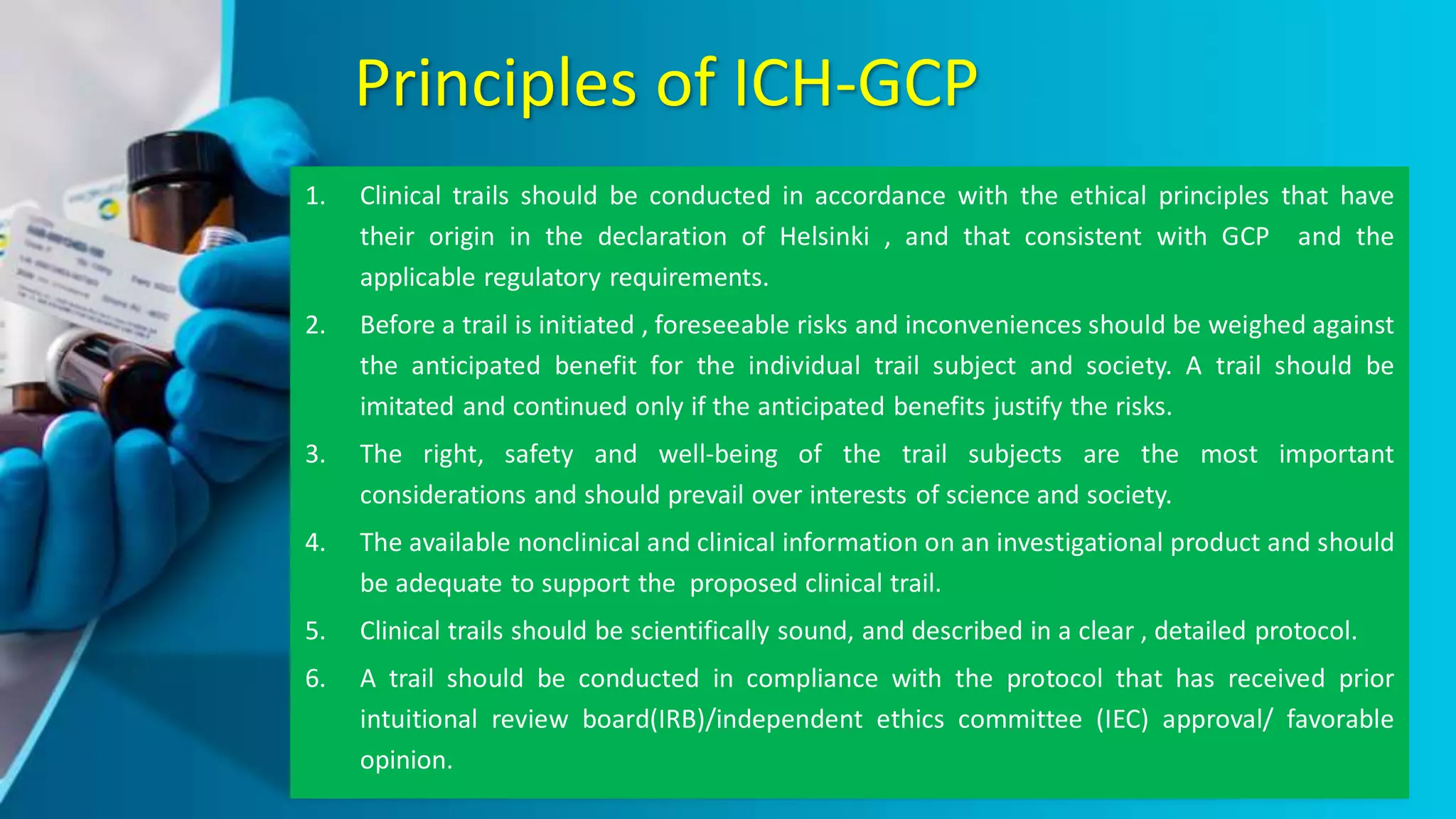
Principles of ICH-GCP
1. Clinical trails should be conducted in accordance with the ethical principles that have
their origin in the declaration of Helsinki , and that consistent with GCP and the
applicable regulatory requirements.
2. Before a trail is initiated , foreseeable risks and inconveniences should be weighed against
the anticipated benefit for the individual trail subject and society. A trail should be
imitated and continued only if the anticipated benefits justify the risks.
3. The right, safety and well-being of the trail subjects are the most important
considerations and should prevail over interests of science and society.
4. The available nonclinical and clinical information on an investigational product and should
be adequate to support the proposed clinical trail.
5. Clinical trails should be scientifically sound, and described in a clear , detailed protocol.
6. A trail should be conducted in compliance with the protocol that has received prior
intuitional review board(IRB)/independent ethics committee (IEC) approval/ favorable
opinion.
7. The medical care give to, and medical decisions made on behalf of, subjects should always be the responsibility of a
qualified physician or, when appropriate, of a qualified dentist.
8. Each individual involved in conducting a trail should be qualified by education, training and experience to perform
his or her respective tasks.
9. Freely given informed consent should be obtained from every subject prior to clinical trail participation.
10. All clinical information should be recorded, handled and stored in a way that allows its accurate reporting,
interpretation and verification.
11. The confidentiality of record that could identify subjects should be protected, respecting the privacy and
confidentiality rules in accordance with applicable regulatory requirements.
12. Investigational products should be manufactured, handled and stored in accordance with applicable good
manufacturing practice (GMP). They should be used in accordance with the approved protocol.
13. Systems with procedure that assure the quality of every aspect of the trail should be implemented.
ETHICS COMMITTEE RESPONSIBLITIES
1. To protect the dignity , rights and well beings of research participants.
2. To ensure that universal ethical values and international scientific
standards are followed.
3. To assist in the development and the education of a research community
responsive to local health care requirements.
COMPOSTION
1. Chairperson
2. 1-2 basic medical scientists(preferably one pharmacologists).
3. 1-2 clinicians from various institutes
4. One legal experts or retired judge
5. One social scientist/ respresentive of non- government voluntary agency
6. One philosopher/ ethicist
7. One lay person from the community
8. Member secretary
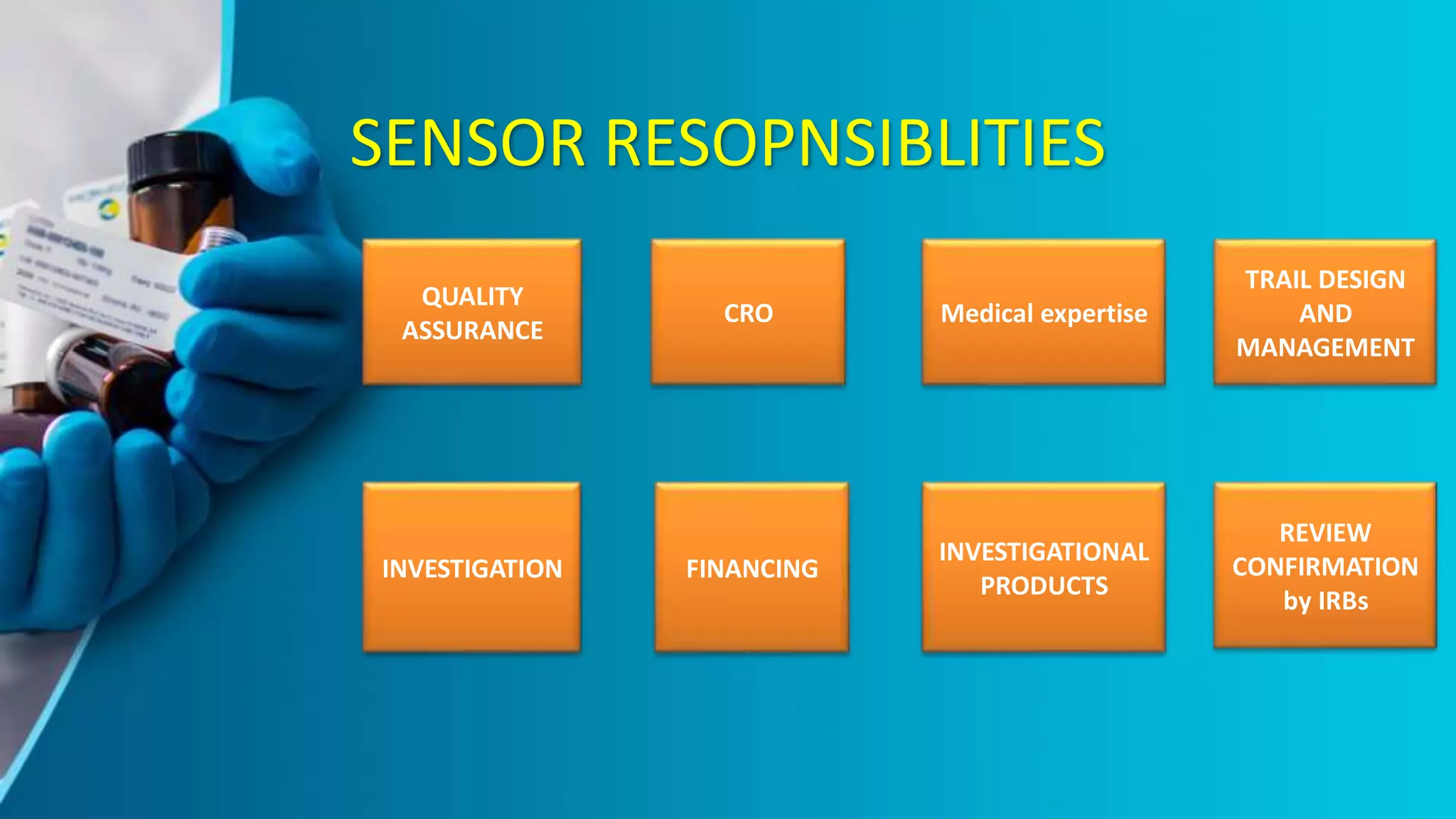
SENSOR RESOPNSIBLITIES
REVIEW
CONFIRMATION
by IRBs
INVESTIGATIONAL
PRODUCTS
FINANCING
INVESTIGATION
CRO Medical expertise
TRAIL DESIGN
AND
MANAGEMENT
QUALITY
ASSURANCE
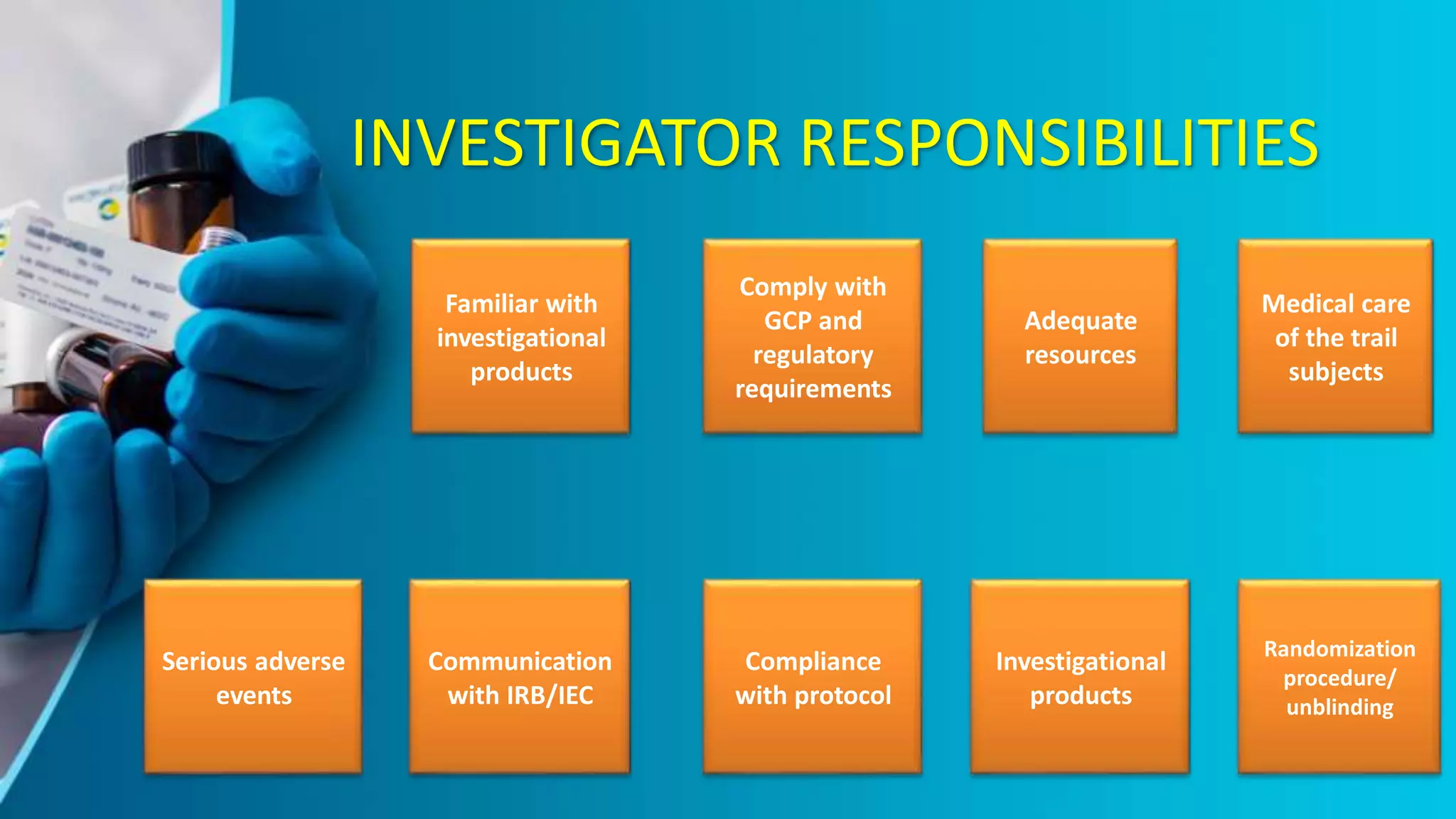
INVESTIGATOR RESPONSIBILITIES
Familiar with
investigational
products
Comply with
GCP and
regulatory
requirements
Investigational
products
Adequate
resources
Randomization
procedure/
unblinding
Medical care
of the trail
subjects
Communication
with IRB/IEC
Compliance
with protocol
Serious adverse
events
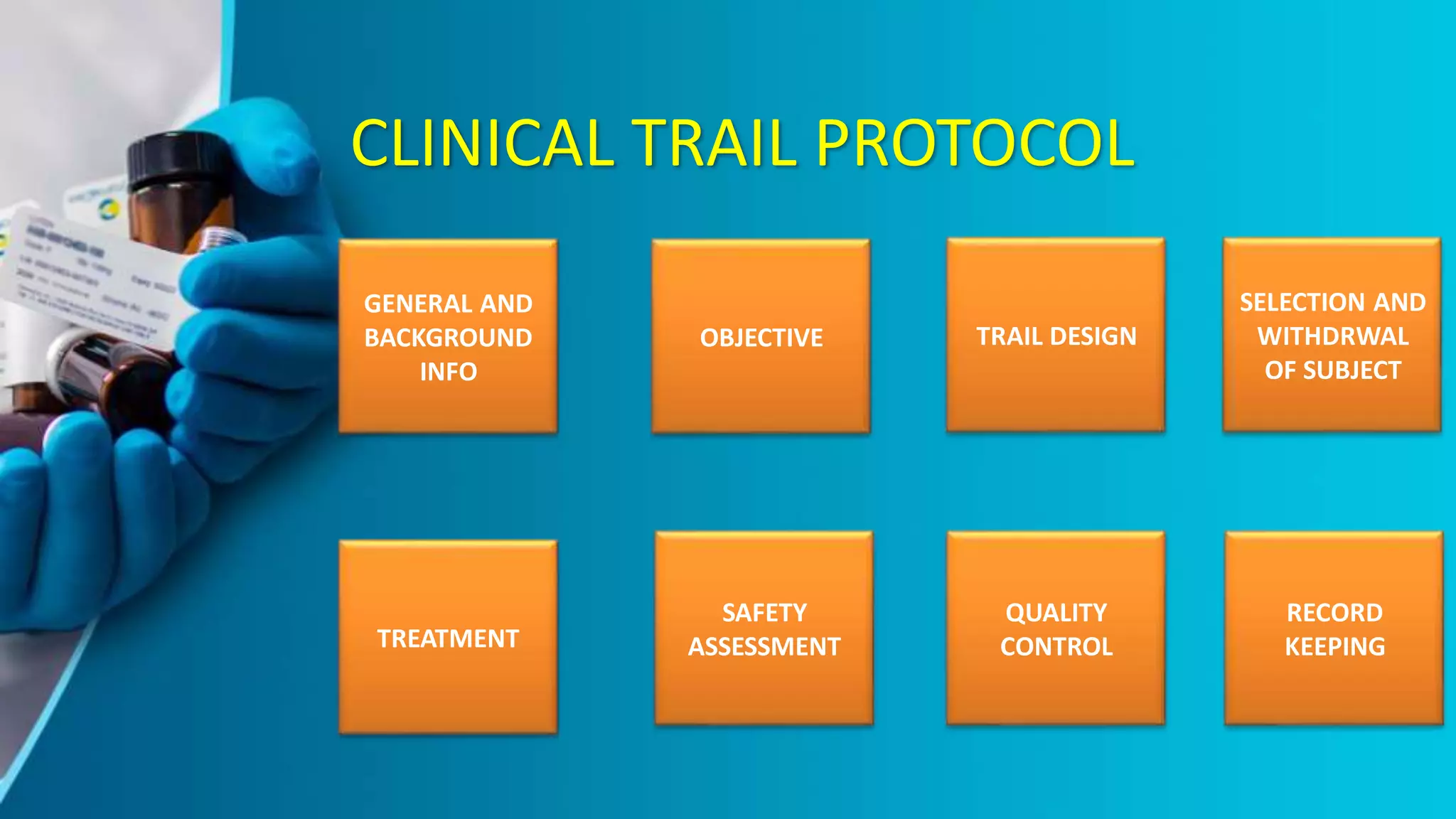
CLINICAL TRAIL PROTOCOL
GENERAL AND
BACKGROUND
INFO
TREATMENT
SAFETY
ASSESSMENT
OBJECTIVE
QUALITY
CONTROL
TRAIL DESIGN
RECORD
KEEPING
SELECTION AND
WITHDRWAL
OF SUBJECT
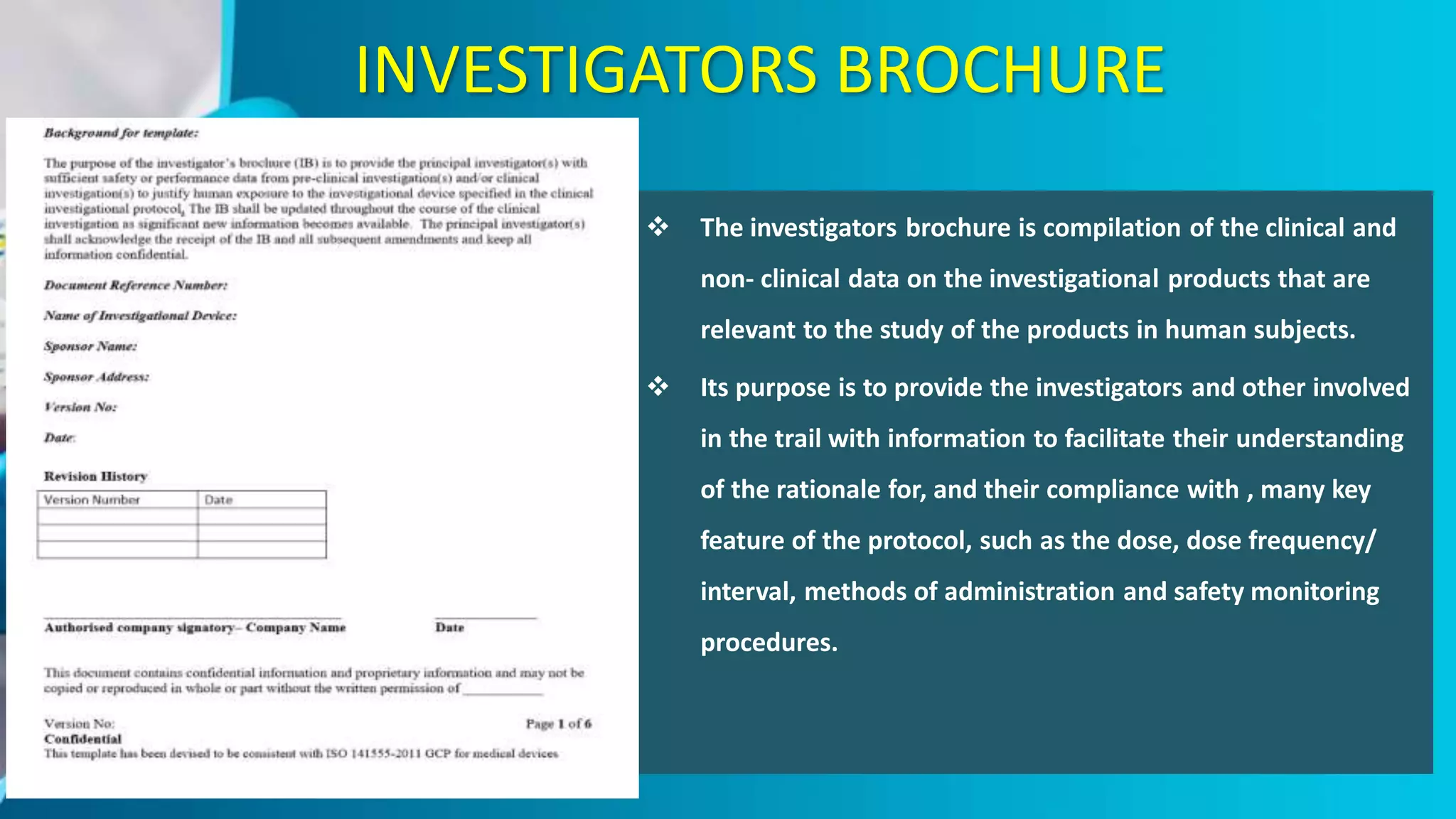
INVESTIGATORS BROCHURE
 The investigators brochure is compilation of the clinical and
non- clinical data on the investigational products that are
relevant to the study of the products in human subjects.
 Its purpose is to provide the investigators and other involved
in the trail with information to facilitate their understanding
of the rationale for, and their compliance with , many key
feature of the protocol, such as the dose, dose frequency/
interval, methods of administration and safety monitoring
procedures.
INFORMED CONSENT PROCESS
 The PI discusses the trails risks, benefits and other aspect with potential
participants and if required, the participants legal representative, before
the trail begins.
 The PI gives the potential ample time and opportunity to ask questions
about the trial and discuss it with relatives and family members.
 If potential participant decides to get involved in the trail, he or she
provides voluntary consent by signing and dating the written informed
consent document of which he or she also receives a copy. The
participant has the right to withdraw consent at any time without
penalty repercussions or reason.
Significance In Clinical Trail Workings
 Harmonization of standards for protecting the rights safety and well-
being of human subjects.
 Minimization of the human exposure to harmful medical products.
 Clinical trail data quality improvement.
 Prevention of duplication of the clinical trails, resulting in reduced cost of
treatment.
Thank you….

OVERVIEW OF ICH-GCP GUIDELINES

  • 1.
    Overview Of ICH–GCP Guidelines Presented by: Aditya Malan M.Pharmacy (pharmacology) Roll no - 22 Presented To : DR MANJUSHA CHAUDHARY (Clinical Research and pharmacovigilance) INSTITUTE OF PHARMACEUTICAL SCIENCES KURUKSHETRA UNIVERSITY
  • 2.
    CONTENT  Introduction  Historicalbackground  Sections  Principles  Ethics committee  Responsibilities of sponsor, investigator and monitor  Investigator brochure  Informed consent process
  • 3.
    Good Clinical Practices(GCP)  It is an international scientific and ethical quality standard for designing conducting , recording, reporting trails that involve the participation of human beings and ensure the rights, safety and well – being of the trail subjects is protected.  Results in producing the data of higher quality and up to global standards .
  • 4.
    The International ConferenceOn Harmonization (ICH-GCP)  the objective of ICH GCP guidelines is to provide a unified standard for the European union (EU), japan and the united states to facilitate the mutual acceptance of clinical data by the regulatory authorities in these jurisdictions.  The guidelines were developed with consideration of the current good clinical practices of the European union, japan, and the united states as well as those of Australia , Canada , the Nordic countries and the world health organization (WHO).
  • 5.
  • 6.
    8- SECTIONS OFICH- GCP GUIDELINES
  • 7.
    Glossary of variousterms  Adverse drug reaction and adverse event.  Case report form and clinical study report  Coordinating committee and contract research  Independent ethics committee and institutional review board  Investigator and investigator brochure  Monitoring and monitoring report  Protocol and protocol amendment  Serious adverse event  Source data and source documents  Standard operating procedure  Vulnerable subjects
  • 8.
    Principles of ICH-GCP 1.Clinical trails should be conducted in accordance with the ethical principles that have their origin in the declaration of Helsinki , and that consistent with GCP and the applicable regulatory requirements. 2. Before a trail is initiated , foreseeable risks and inconveniences should be weighed against the anticipated benefit for the individual trail subject and society. A trail should be imitated and continued only if the anticipated benefits justify the risks. 3. The right, safety and well-being of the trail subjects are the most important considerations and should prevail over interests of science and society. 4. The available nonclinical and clinical information on an investigational product and should be adequate to support the proposed clinical trail. 5. Clinical trails should be scientifically sound, and described in a clear , detailed protocol. 6. A trail should be conducted in compliance with the protocol that has received prior intuitional review board(IRB)/independent ethics committee (IEC) approval/ favorable opinion.
  • 9.
    7. The medicalcare give to, and medical decisions made on behalf of, subjects should always be the responsibility of a qualified physician or, when appropriate, of a qualified dentist. 8. Each individual involved in conducting a trail should be qualified by education, training and experience to perform his or her respective tasks. 9. Freely given informed consent should be obtained from every subject prior to clinical trail participation. 10. All clinical information should be recorded, handled and stored in a way that allows its accurate reporting, interpretation and verification. 11. The confidentiality of record that could identify subjects should be protected, respecting the privacy and confidentiality rules in accordance with applicable regulatory requirements. 12. Investigational products should be manufactured, handled and stored in accordance with applicable good manufacturing practice (GMP). They should be used in accordance with the approved protocol. 13. Systems with procedure that assure the quality of every aspect of the trail should be implemented.
  • 10.
    ETHICS COMMITTEE RESPONSIBLITIES 1.To protect the dignity , rights and well beings of research participants. 2. To ensure that universal ethical values and international scientific standards are followed. 3. To assist in the development and the education of a research community responsive to local health care requirements. COMPOSTION 1. Chairperson 2. 1-2 basic medical scientists(preferably one pharmacologists). 3. 1-2 clinicians from various institutes 4. One legal experts or retired judge 5. One social scientist/ respresentive of non- government voluntary agency 6. One philosopher/ ethicist 7. One lay person from the community 8. Member secretary
  • 11.
  • 12.
    INVESTIGATOR RESPONSIBILITIES Familiar with investigational products Complywith GCP and regulatory requirements Investigational products Adequate resources Randomization procedure/ unblinding Medical care of the trail subjects Communication with IRB/IEC Compliance with protocol Serious adverse events
  • 13.
    CLINICAL TRAIL PROTOCOL GENERALAND BACKGROUND INFO TREATMENT SAFETY ASSESSMENT OBJECTIVE QUALITY CONTROL TRAIL DESIGN RECORD KEEPING SELECTION AND WITHDRWAL OF SUBJECT
  • 14.
    INVESTIGATORS BROCHURE  Theinvestigators brochure is compilation of the clinical and non- clinical data on the investigational products that are relevant to the study of the products in human subjects.  Its purpose is to provide the investigators and other involved in the trail with information to facilitate their understanding of the rationale for, and their compliance with , many key feature of the protocol, such as the dose, dose frequency/ interval, methods of administration and safety monitoring procedures.
  • 15.
    INFORMED CONSENT PROCESS The PI discusses the trails risks, benefits and other aspect with potential participants and if required, the participants legal representative, before the trail begins.  The PI gives the potential ample time and opportunity to ask questions about the trial and discuss it with relatives and family members.  If potential participant decides to get involved in the trail, he or she provides voluntary consent by signing and dating the written informed consent document of which he or she also receives a copy. The participant has the right to withdraw consent at any time without penalty repercussions or reason.
  • 16.
    Significance In ClinicalTrail Workings  Harmonization of standards for protecting the rights safety and well- being of human subjects.  Minimization of the human exposure to harmful medical products.  Clinical trail data quality improvement.  Prevention of duplication of the clinical trails, resulting in reduced cost of treatment.
  • 17.