Overcoming The
Challenges Faced
In Exploratory
Testing
www.lambdatest.com
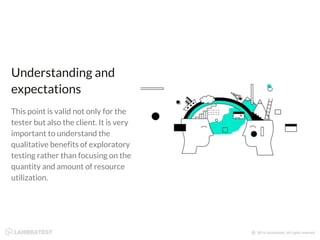
Understanding and
expectations
This point is valid not only for the
tester but also the client. It is very
important to understand the
qualitative benefits of exploratory
testing rather than focusing on the
quantity and amount of resource
utilization.
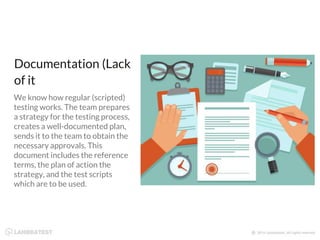
Documentation (Lack
of it
We know how regular (scripted)
testing works. The team prepares
a strategy for the testing process,
creates a well-documented plan,
sends it to the team to obtain the
necessary approvals. This
document includes the reference
terms, the plan of action the
strategy, and the test scripts
which are to be used.
Like documentation, logging is
extremely important. Going by the
thumb rule, “Log as you execute” will
make things easier for you as a tester.
Moreover, logging in any form helps
you create evidence for the efforts that
have been put in irrespective of the
outcome or delay.
Logging Progress update
Communication is key and when
working with exploratory testing it can
lack. But keeping the team and the
client updated about the latest
progress will make it easier to execute
the work without undue pressure and
also display your effort. Updating the
team could be as simple as Sharing the
logs with them.
Now that we know this as a another one of common challenges of exploratory
testing let us understand how we can minimize its impact on our working.
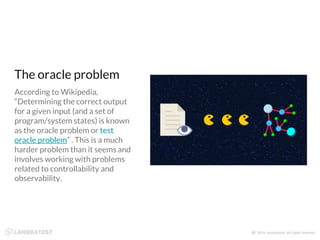
The oracle problem
According to Wikipedia,
“Determining the correct output
for a given input (and a set of
program/system states) is known
as the oracle problem or test
oracle problem” . This is a much
harder problem than it seems and
involves working with problems
related to controllability and
observability.
When we talk about testing, a common
misconception about a tester is that
testing is intended to ‘identify’ bugs
document their behaviours well. But as
a tester, it is important to understand
that creativity and innovation are
essential to a well-designed product,
even the testing phase.
Negative testing
Timing the execution
Another common issue while ensuring
best practices in exploratory testing is
not knowing when to adapt to
exploratory testing. In fact, when it
comes to exploratory testing it is more
important to know when to run it than
how to. This is also important because of
the lack of test cases.
Exploratory testing is considered more
informal than scripted testing thus
making it unfit for auditing purposes.
This is why not knowing how to time it
can have a negative impact on the entire
working.
Organize Your Test Cycle
Exploratory testing involves venturing
into the unknown and trying to find
faults that might get missed by scripts
and other traditional forms of testing.
The benefits that we get is that critical
bugs can be caught through this method.
EXPLORATORY TESTING BEST PRACTICES
ONE
Add Checkpoints
Exploratory Testing is a time-consuming
process and this might often lead to long
spells of no information regarding the
testing progress. To avoid multiple teams
from waiting on the entire testing
process to complete, it is highly
recommended that certain checkpoints
be set by the testers.
TWO
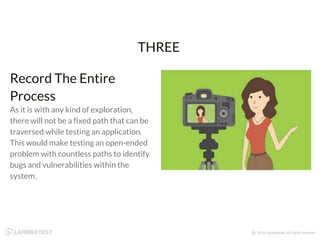
As it is with any kind of exploration,
there will not be a fixed path that can be
traversed while testing an application.
This would make testing an open-ended
problem with countless paths to identify
bugs and vulnerabilities within the
system.
THREE
Record The Entire
Process
Real users of the application don’t
usually have a supervised guidance or a
manual that gives the best way to use an
application. Based on the users’ intuition
and experience using other similar
applications, they might use the same
feature of an application in multiple
ways.
FOUR
Aim to be a User
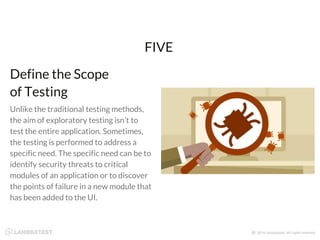
Unlike the traditional testing methods,
the aim of exploratory testing isn’t to
test the entire application. Sometimes,
the testing is performed to address a
specific need. The specific need can be to
identify security threats to critical
modules of an application or to discover
the points of failure in a new module that
has been added to the UI.
FIVE
Define the Scope
of Testing
The bugs encountered while performing
Exploratory testing should be
appropriately prioritized and classified.
Every organization has a process where
they classify the most frequently
encountered bugs. This classification
could be on the basis of various
functionality offered by the application.
SIX
Prioritize and
Classify Your Bugs
Bug reporting is an art and one that
needs to be performed with caution and
concentration. Make sure you provide a
unique yet relevant title to the bug for
easy identification. It is always
recommended as a best practice to
provide the steps to reproduce.
Prepare an informative
bug report
SEVEN
Exploratory testing has its own set of challenges, some of which we discussed above.
Yet, it is a revolutionary method of testing which ensures a well-tested and well
thought of product leaving a very little scope for common error apart from technical
errors which can be taken care of by automation. Thus, it will be ideal to say that
despite its challenges, exploratory testing is very important to the testing process.
Feel free to share about your experience with exploratory testing in the comment
section below. If you have got some questions for us then we will be happy to
answer them. Happy testing!
CONCLUSION
HAPPY TESTING!!
www.lambdatest.com

Overcoming The Challenges Faced in Exploratory Testing

  • 2.
    Overcoming The Challenges Faced InExploratory Testing www.lambdatest.com
  • 3.
    Understanding and expectations This pointis valid not only for the tester but also the client. It is very important to understand the qualitative benefits of exploratory testing rather than focusing on the quantity and amount of resource utilization.
  • 4.
    Documentation (Lack of it Weknow how regular (scripted) testing works. The team prepares a strategy for the testing process, creates a well-documented plan, sends it to the team to obtain the necessary approvals. This document includes the reference terms, the plan of action the strategy, and the test scripts which are to be used.
  • 5.
    Like documentation, loggingis extremely important. Going by the thumb rule, “Log as you execute” will make things easier for you as a tester. Moreover, logging in any form helps you create evidence for the efforts that have been put in irrespective of the outcome or delay. Logging Progress update Communication is key and when working with exploratory testing it can lack. But keeping the team and the client updated about the latest progress will make it easier to execute the work without undue pressure and also display your effort. Updating the team could be as simple as Sharing the logs with them. Now that we know this as a another one of common challenges of exploratory testing let us understand how we can minimize its impact on our working.
  • 6.
    The oracle problem Accordingto Wikipedia, “Determining the correct output for a given input (and a set of program/system states) is known as the oracle problem or test oracle problem” . This is a much harder problem than it seems and involves working with problems related to controllability and observability.
  • 7.
    When we talkabout testing, a common misconception about a tester is that testing is intended to ‘identify’ bugs document their behaviours well. But as a tester, it is important to understand that creativity and innovation are essential to a well-designed product, even the testing phase. Negative testing
  • 8.
    Timing the execution Anothercommon issue while ensuring best practices in exploratory testing is not knowing when to adapt to exploratory testing. In fact, when it comes to exploratory testing it is more important to know when to run it than how to. This is also important because of the lack of test cases. Exploratory testing is considered more informal than scripted testing thus making it unfit for auditing purposes. This is why not knowing how to time it can have a negative impact on the entire working.
  • 9.
    Organize Your TestCycle Exploratory testing involves venturing into the unknown and trying to find faults that might get missed by scripts and other traditional forms of testing. The benefits that we get is that critical bugs can be caught through this method. EXPLORATORY TESTING BEST PRACTICES ONE
  • 10.
    Add Checkpoints Exploratory Testingis a time-consuming process and this might often lead to long spells of no information regarding the testing progress. To avoid multiple teams from waiting on the entire testing process to complete, it is highly recommended that certain checkpoints be set by the testers. TWO
  • 11.
    As it iswith any kind of exploration, there will not be a fixed path that can be traversed while testing an application. This would make testing an open-ended problem with countless paths to identify bugs and vulnerabilities within the system. THREE Record The Entire Process
  • 12.
    Real users ofthe application don’t usually have a supervised guidance or a manual that gives the best way to use an application. Based on the users’ intuition and experience using other similar applications, they might use the same feature of an application in multiple ways. FOUR Aim to be a User
  • 13.
    Unlike the traditionaltesting methods, the aim of exploratory testing isn’t to test the entire application. Sometimes, the testing is performed to address a specific need. The specific need can be to identify security threats to critical modules of an application or to discover the points of failure in a new module that has been added to the UI. FIVE Define the Scope of Testing
  • 14.
    The bugs encounteredwhile performing Exploratory testing should be appropriately prioritized and classified. Every organization has a process where they classify the most frequently encountered bugs. This classification could be on the basis of various functionality offered by the application. SIX Prioritize and Classify Your Bugs
  • 15.
    Bug reporting isan art and one that needs to be performed with caution and concentration. Make sure you provide a unique yet relevant title to the bug for easy identification. It is always recommended as a best practice to provide the steps to reproduce. Prepare an informative bug report SEVEN
  • 16.
    Exploratory testing hasits own set of challenges, some of which we discussed above. Yet, it is a revolutionary method of testing which ensures a well-tested and well thought of product leaving a very little scope for common error apart from technical errors which can be taken care of by automation. Thus, it will be ideal to say that despite its challenges, exploratory testing is very important to the testing process. Feel free to share about your experience with exploratory testing in the comment section below. If you have got some questions for us then we will be happy to answer them. Happy testing! CONCLUSION
  • 17.