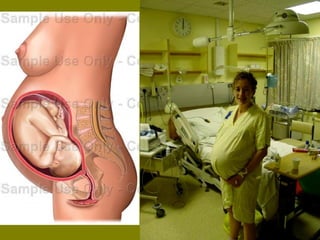
Ovarian cycleOvarian cycle
Menstrual cycleMenstrual cycle
PlacentationPlacentation
Department of the Histology, Cytology and EmbryologyDepartment of the Histology, Cytology and Embryology
Tatiana GlobaTatiana Globa
State University of Medicine and Pharmacy “Nicolae Testemitanu”State University of Medicine and Pharmacy “Nicolae Testemitanu”
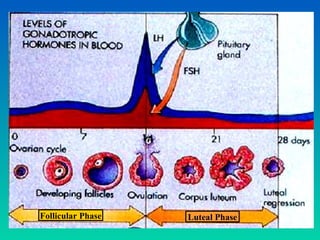
Ovarian cycle has 2 phasesOvarian cycle has 2 phases
• FOLLICULAR PHASEFOLLICULAR PHASE – consists of
the development of a primordial follicle
into a mature or Graafian follicle
• LUTEAL PHASELUTEAL PHASE – consists of the
formation of the corpus luteum, a
major-secreting gland
• At the middle of the ovarian cycle the
OVULATIONOVULATION takes place
Follicular Phase Luteal Phase
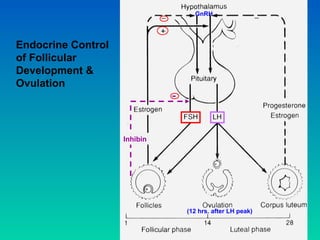
Endocrine Control
of Follicular
Development &
Ovulation
GnRH
(12 hrs. after LH peak)
-
Inhibin
Fate of Corpus Luteum (CL)
without fertilization
• FSH and LH release is inhibited by the
progesterone and estradiol released by
the CL
• Without LH, the CL lasts for ~14 days
before it degenerates
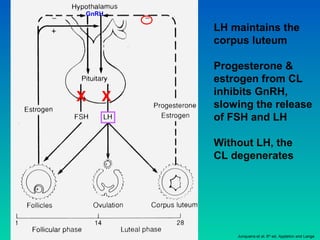
GnRH
LH maintains the
corpus luteum
Progesterone &
estrogen from CL
inhibits GnRH,
slowing the release
of FSH and LH
Without LH, the
CL degenerates
Junqueira et al. 8th
ed. Appleton and Lange
X X
Fate of Corpus LuteumFate of Corpus Luteum withwith
fertilization & implantationfertilization & implantation
• Chorionic gonadotropinChorionic gonadotropin (hCG) produced by the
placenta will support the CL for ~ 6 months
• also estrogen, IGF-I and II (from ovary), LH,
prolactin (from ant. pituitary) and insulin
contribute to formation and maintenance
• CL grows to a diameter of 5 cm
• Continues to secrete progesterone
• Decreases in size during last 3 months
• Begins to secrete relaxin in preparation for birth
Menstrual cycleMenstrual cycle
The endometrium is directly controlled by
OVARIAN hormones (estrogen,
progesterone), not by pituitary hormones
Menstrual cycle has 3 phases:
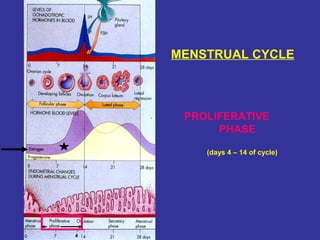
• Proliferative phaseProliferative phase is regulated by estrogens
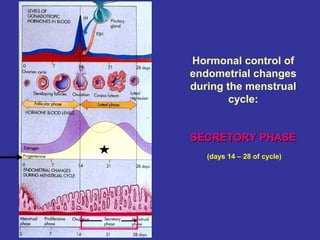
• Secretory phaseSecretory phase is under the control of
progesterone
• Menstrual phaseMenstrual phase results from a decline in the
ovarian secretion of progesterone & estrogens
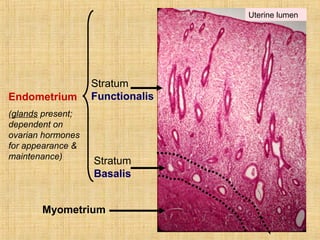
Stratum
Functionalis
Stratum
Basalis
Myometrium
Endometrium
(glands present;
dependent on
ovarian hormones
for appearance &
maintenance)
Uterine lumen
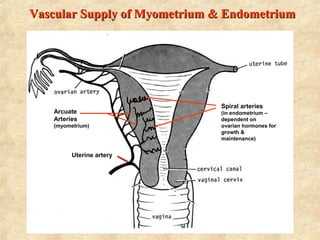
Arcuate
Arteries
(myometrium)
Uterine artery
Spiral arteries
(in endometrium –
dependent on
ovarian hormones for
growth &
maintenance)
Vascular Supply of Myometrium & EndometriumVascular Supply of Myometrium & Endometrium
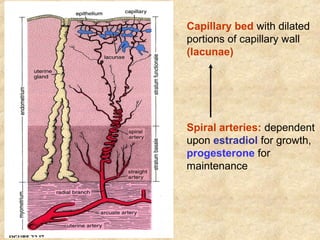
Spiral arteries: dependent
upon estradiol for growth,
progesterone for
maintenance
Capillary bed with dilated
portions of capillary wall
(lacunae)
PROLIFERATIVE
PHASE
(days 4 – 14 of cycle)
MENSTRUAL CYCLE
4
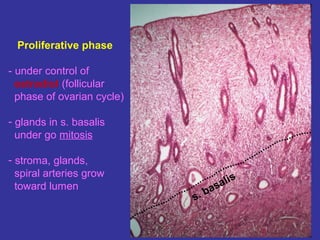
Proliferative phase
- under control of
estradiol (follicular
phase of ovarian cycle)
- glands in s. basalis
under go mitosis
- stroma, glands,
spiral arteries grow
toward lumen
s. basalis
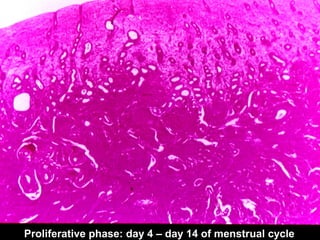
Proliferative phase: day 4 – day 14 of menstrual cycle
Hormonal control of
endometrial changes
during the menstrual
cycle:
SECRETORY PHASESECRETORY PHASE
(days 14 – 28 of cycle)
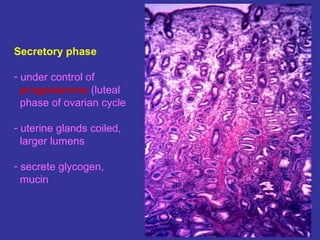
Secretory phase
- under control of
progesterone (luteal
phase of ovarian cycle
- uterine glands coiled,
larger lumens
- secrete glycogen,
mucin
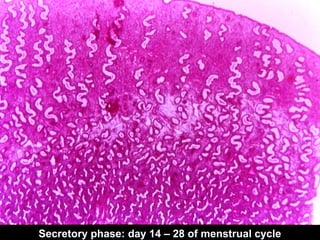
Secretory phase: day 14 – 28 of menstrual cycle
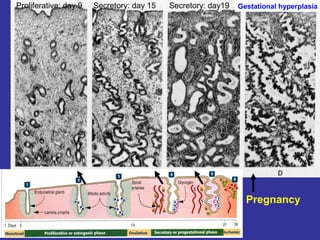
Gestational hyperplasiaProliferative: day 9 Secretory: day 15 Secretory: day19
Pregnancy
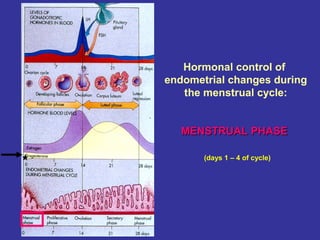
Hormonal control of
endometrial changes during
the menstrual cycle:
MENSTRUAL PHASEMENSTRUAL PHASE
(days 1 – 4 of cycle)
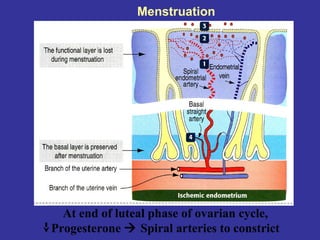
Menstruation
At end of luteal phase of ovarian cycle,
Progesterone  Spiral arteries to constrict
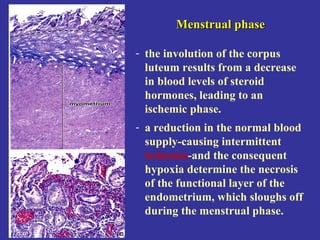
Menstrual phaseMenstrual phase
- the involution of the corpus
luteum results from a decrease
in blood levels of steroid
hormones, leading to an
ischemic phase.
- a reduction in the normal blood
supply-causing intermittent
ischemia-and the consequent
hypoxia determine the necrosis
of the functional layer of the
endometrium, which sloughs off
during the menstrual phase.
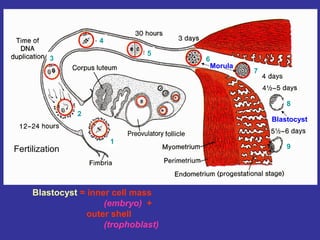
Blastocyst
Blastocyst = inner cell mass
(embryo) +
outer shell
(trophoblast)
Fertilization
1
2
3
4
5
6
7
8
9
Morula
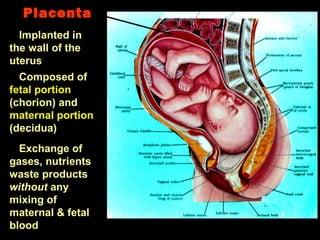
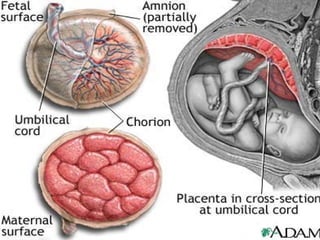
Placenta
Implanted in
the wall of the
uterus
Composed of
fetal portion
(chorion) and
maternal portion
(decidua)
Exchange of
gases, nutrients
waste products
without any
mixing of
maternal & fetal
blood
Functions of placenta
Act as
• respiratory organ
• excretory organ
• nutritive organ
• protective organ
• endocrine organ (progesterone, estrogens,
human chorionic gonatotropin, melanin
spreading factor, other hormones also
manufactured by the hypothalamus & pituitary.
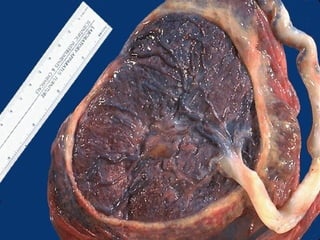
This is a circumvallate placenta in which the membranes double back for a
short distance over the fetal surface when the chorionic plate is too small.
There may be increased fetal loss with this condition.
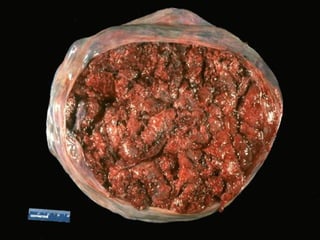
The maternal surface of a normal term placenta is seen here. Note that the
cotyledons that form the placenta are reddish brown and indistinct.
Placenta
• The morpho-functional unit is cotyledon. Placenta
has about 15-25 cotyledons.
• Proliferation of the trophoblast, growth of chorionic
mesoderm & blood vessel development give rise
to:
- primary chorionic villi – a mass of cells
- secondary villi – composed of a core of
mesenchyme surrounded by an inner layer of
cytotrophoblast & an outer layer of
syncytiotrophoblast
- tertiary villi – blood vessels have developed in
the cores
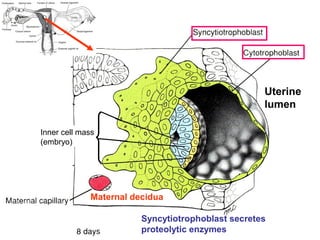
Inner cell mass
(embryo)
Uterine
lumen
Syncytiotrophoblast secretes
proteolytic enzymes
Maternal decidua
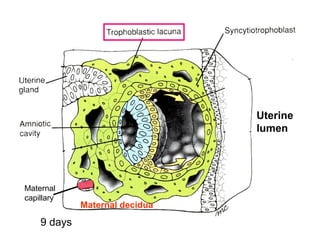
9 days
Maternal
capillary
Uterine
lumen
Maternal decidua
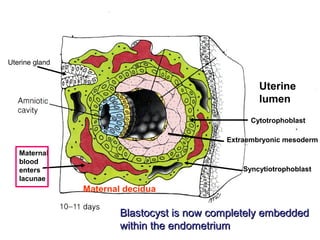
Maternal
blood
enters
lacunae
Uterine gland
Syncytiotrophoblast
Uterine
lumen
Extraembryonic mesoderm
Cytotrophoblast
Maternal decidua
Blastocyst is now completely embeddedBlastocyst is now completely embedded
within the endometriumwithin the endometrium
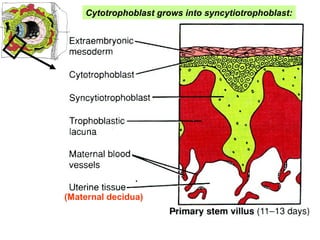
Cytotrophoblast grows into syncytiotrophoblast:
(Maternal decidua)
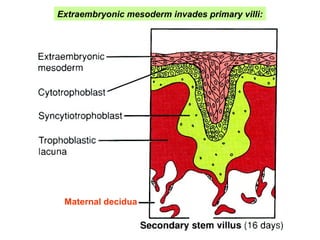
Extraembryonic mesoderm invades primary villi:
Maternal decidua
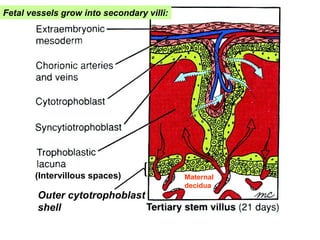
(Intervillous spaces)
Fetal vessels grow into secondary villi:
Outer cytotrophoblast
shell
Maternal
decidua
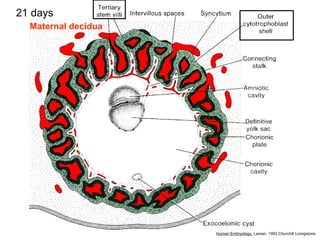
21 days
Maternal decidua
Human Embryology, Larsen, 1993 Churchill Livingstone
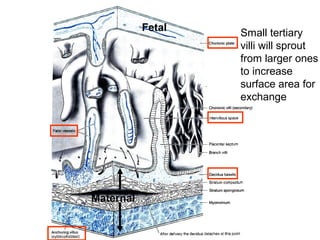
Fetal
Maternal
Small tertiary
villi will sprout
from larger ones
to increase
surface area for
exchange
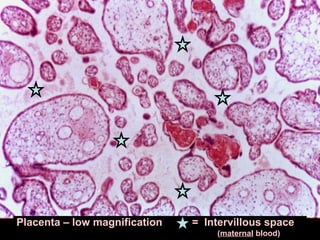
Placenta – low magnification = Intervillous space
(maternal blood)
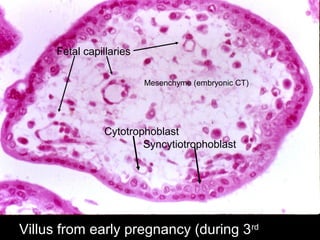
Villus from early pregnancy (during 3rd
Cytotrophoblast
Syncytiotrophoblast
Mesenchyme (embryonic CT)
Fetal capillaries
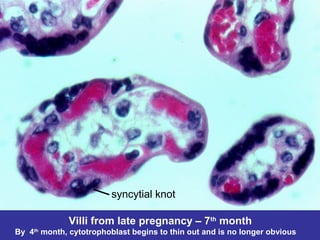
Villi from late pregnancy – 7th
month
By 4th
month, cytotrophoblast begins to thin out and is no longer obvious
syncytial knot
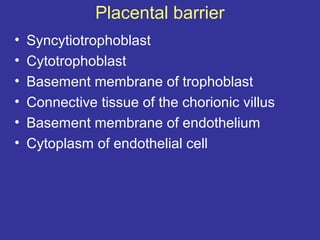
Placental barrier
• Syncytiotrophoblast
• Cytotrophoblast
• Basement membrane of trophoblast
• Connective tissue of the chorionic villus
• Basement membrane of endothelium
• Cytoplasm of endothelial cell
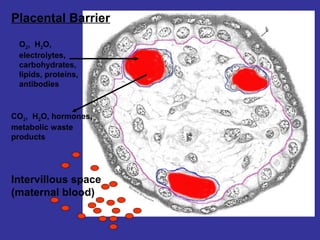
Placental Barrier
Intervillous space
(maternal blood)
O2, H2O,
electrolytes,
carbohydrates,
lipids, proteins,
antibodies
CO2, H2O, hormones,
metabolic waste
products
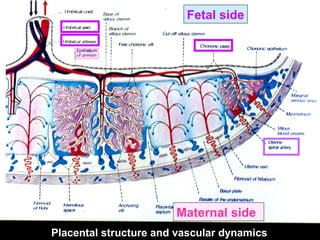
Placental structure and vascular dynamics
Fetal side
Maternal side
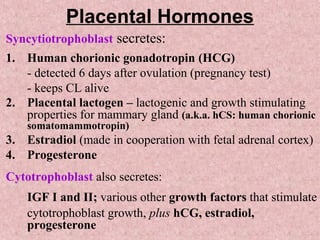
Placental Hormones
Syncytiotrophoblast secretes:
1. Human chorionic gonadotropin (HCG)
- detected 6 days after ovulation (pregnancy test)
- keeps CL alive
2. Placental lactogen – lactogenic and growth stimulating
properties for mammary gland (a.k.a. hCS: human chorionic
somatomammotropin)
3. Estradiol (made in cooperation with fetal adrenal cortex)
4. Progesterone
Cytotrophoblast also secretes:
IGF I and II; various other growth factors that stimulate
cytotrophoblast growth, plus hCG, estradiol,
progesterone
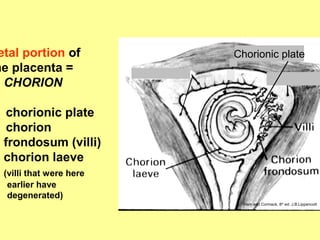
etal portion of
he placenta =
CHORION
. chorionic plate
. chorion
frondosum (villi)
. chorion laeve
(villi that were here
earlier have
degenerated)
Chorionic plate
Ham and Cormack, 8th
ed. J.B.Lippencott
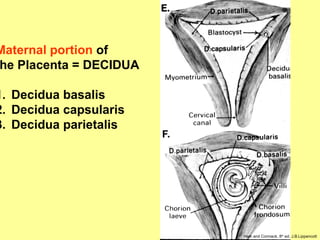
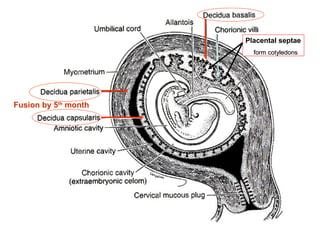
Maternal portion of
he Placenta = DECIDUA
1. Decidua basalis
2. Decidua capsularis
3. Decidua parietalis
Ham and Cormack, 8th
ed. J.B.Lippencott
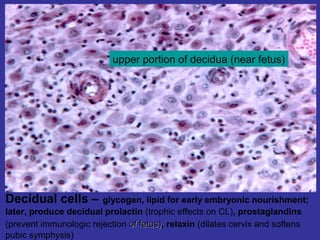
Decidual cells – glycogen, lipid for early embryonic nourishment;
later, produce decidual prolactin (trophic effects on CL), prostaglandins
(prevent immunologic rejection of fetus)of fetus), relaxin (dilates cervix and softens
pubic symphysis)
upper portion of decidua (near fetus)
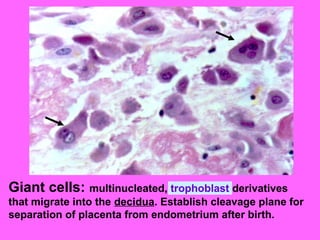
Giant cells: multinucleated, trophoblast derivatives
that migrate into the decidua. Establish cleavage plane for
separation of placenta from endometrium after birth.
Fusion by 5th
month
(form cotyledons(form cotyledons
Placental septae
Ovarian cycle
Ovarian cycle

Ovarian cycle

  • 1.
    Ovarian cycleOvarian cycle MenstrualcycleMenstrual cycle PlacentationPlacentation Department of the Histology, Cytology and EmbryologyDepartment of the Histology, Cytology and Embryology Tatiana GlobaTatiana Globa State University of Medicine and Pharmacy “Nicolae Testemitanu”State University of Medicine and Pharmacy “Nicolae Testemitanu”
  • 2.
    Ovarian cycle has2 phasesOvarian cycle has 2 phases • FOLLICULAR PHASEFOLLICULAR PHASE – consists of the development of a primordial follicle into a mature or Graafian follicle • LUTEAL PHASELUTEAL PHASE – consists of the formation of the corpus luteum, a major-secreting gland • At the middle of the ovarian cycle the OVULATIONOVULATION takes place
  • 3.
  • 4.
    Endocrine Control of Follicular Development& Ovulation GnRH (12 hrs. after LH peak) - Inhibin
  • 5.
    Fate of CorpusLuteum (CL) without fertilization • FSH and LH release is inhibited by the progesterone and estradiol released by the CL • Without LH, the CL lasts for ~14 days before it degenerates
  • 6.
    GnRH LH maintains the corpusluteum Progesterone & estrogen from CL inhibits GnRH, slowing the release of FSH and LH Without LH, the CL degenerates Junqueira et al. 8th ed. Appleton and Lange X X
  • 7.
    Fate of CorpusLuteumFate of Corpus Luteum withwith fertilization & implantationfertilization & implantation • Chorionic gonadotropinChorionic gonadotropin (hCG) produced by the placenta will support the CL for ~ 6 months • also estrogen, IGF-I and II (from ovary), LH, prolactin (from ant. pituitary) and insulin contribute to formation and maintenance • CL grows to a diameter of 5 cm • Continues to secrete progesterone • Decreases in size during last 3 months • Begins to secrete relaxin in preparation for birth
  • 8.
    Menstrual cycleMenstrual cycle Theendometrium is directly controlled by OVARIAN hormones (estrogen, progesterone), not by pituitary hormones Menstrual cycle has 3 phases: • Proliferative phaseProliferative phase is regulated by estrogens • Secretory phaseSecretory phase is under the control of progesterone • Menstrual phaseMenstrual phase results from a decline in the ovarian secretion of progesterone & estrogens
  • 9.
  • 10.
    Arcuate Arteries (myometrium) Uterine artery Spiral arteries (inendometrium – dependent on ovarian hormones for growth & maintenance) Vascular Supply of Myometrium & EndometriumVascular Supply of Myometrium & Endometrium
  • 11.
    Spiral arteries: dependent uponestradiol for growth, progesterone for maintenance Capillary bed with dilated portions of capillary wall (lacunae)
  • 12.
    PROLIFERATIVE PHASE (days 4 –14 of cycle) MENSTRUAL CYCLE 4
  • 13.
    Proliferative phase - undercontrol of estradiol (follicular phase of ovarian cycle) - glands in s. basalis under go mitosis - stroma, glands, spiral arteries grow toward lumen s. basalis
  • 14.
    Proliferative phase: day4 – day 14 of menstrual cycle
  • 15.
    Hormonal control of endometrialchanges during the menstrual cycle: SECRETORY PHASESECRETORY PHASE (days 14 – 28 of cycle)
  • 16.
    Secretory phase - undercontrol of progesterone (luteal phase of ovarian cycle - uterine glands coiled, larger lumens - secrete glycogen, mucin
  • 17.
    Secretory phase: day14 – 28 of menstrual cycle
  • 18.
    Gestational hyperplasiaProliferative: day9 Secretory: day 15 Secretory: day19 Pregnancy
  • 19.
    Hormonal control of endometrialchanges during the menstrual cycle: MENSTRUAL PHASEMENSTRUAL PHASE (days 1 – 4 of cycle)
  • 20.
    Menstruation At end ofluteal phase of ovarian cycle, Progesterone  Spiral arteries to constrict
  • 21.
    Menstrual phaseMenstrual phase -the involution of the corpus luteum results from a decrease in blood levels of steroid hormones, leading to an ischemic phase. - a reduction in the normal blood supply-causing intermittent ischemia-and the consequent hypoxia determine the necrosis of the functional layer of the endometrium, which sloughs off during the menstrual phase.
  • 22.
    Blastocyst Blastocyst = innercell mass (embryo) + outer shell (trophoblast) Fertilization 1 2 3 4 5 6 7 8 9 Morula
  • 23.
    Placenta Implanted in the wallof the uterus Composed of fetal portion (chorion) and maternal portion (decidua) Exchange of gases, nutrients waste products without any mixing of maternal & fetal blood
  • 24.
    Functions of placenta Actas • respiratory organ • excretory organ • nutritive organ • protective organ • endocrine organ (progesterone, estrogens, human chorionic gonatotropin, melanin spreading factor, other hormones also manufactured by the hypothalamus & pituitary.
  • 26.
    This is acircumvallate placenta in which the membranes double back for a short distance over the fetal surface when the chorionic plate is too small. There may be increased fetal loss with this condition.
  • 27.
    The maternal surfaceof a normal term placenta is seen here. Note that the cotyledons that form the placenta are reddish brown and indistinct.
  • 28.
    Placenta • The morpho-functionalunit is cotyledon. Placenta has about 15-25 cotyledons. • Proliferation of the trophoblast, growth of chorionic mesoderm & blood vessel development give rise to: - primary chorionic villi – a mass of cells - secondary villi – composed of a core of mesenchyme surrounded by an inner layer of cytotrophoblast & an outer layer of syncytiotrophoblast - tertiary villi – blood vessels have developed in the cores
  • 29.
    Inner cell mass (embryo) Uterine lumen Syncytiotrophoblastsecretes proteolytic enzymes Maternal decidua
  • 30.
  • 31.
    Maternal blood enters lacunae Uterine gland Syncytiotrophoblast Uterine lumen Extraembryonic mesoderm Cytotrophoblast Maternaldecidua Blastocyst is now completely embeddedBlastocyst is now completely embedded within the endometriumwithin the endometrium
  • 32.
    Cytotrophoblast grows intosyncytiotrophoblast: (Maternal decidua)
  • 33.
    Extraembryonic mesoderm invadesprimary villi: Maternal decidua
  • 34.
    (Intervillous spaces) Fetal vesselsgrow into secondary villi: Outer cytotrophoblast shell Maternal decidua
  • 35.
    21 days Maternal decidua HumanEmbryology, Larsen, 1993 Churchill Livingstone
  • 36.
    Fetal Maternal Small tertiary villi willsprout from larger ones to increase surface area for exchange
  • 37.
    Placenta – lowmagnification = Intervillous space (maternal blood)
  • 38.
    Villus from earlypregnancy (during 3rd Cytotrophoblast Syncytiotrophoblast Mesenchyme (embryonic CT) Fetal capillaries
  • 39.
    Villi from latepregnancy – 7th month By 4th month, cytotrophoblast begins to thin out and is no longer obvious syncytial knot
  • 40.
    Placental barrier • Syncytiotrophoblast •Cytotrophoblast • Basement membrane of trophoblast • Connective tissue of the chorionic villus • Basement membrane of endothelium • Cytoplasm of endothelial cell
  • 41.
    Placental Barrier Intervillous space (maternalblood) O2, H2O, electrolytes, carbohydrates, lipids, proteins, antibodies CO2, H2O, hormones, metabolic waste products
  • 42.
    Placental structure andvascular dynamics Fetal side Maternal side
  • 43.
    Placental Hormones Syncytiotrophoblast secretes: 1.Human chorionic gonadotropin (HCG) - detected 6 days after ovulation (pregnancy test) - keeps CL alive 2. Placental lactogen – lactogenic and growth stimulating properties for mammary gland (a.k.a. hCS: human chorionic somatomammotropin) 3. Estradiol (made in cooperation with fetal adrenal cortex) 4. Progesterone Cytotrophoblast also secretes: IGF I and II; various other growth factors that stimulate cytotrophoblast growth, plus hCG, estradiol, progesterone
  • 44.
    etal portion of heplacenta = CHORION . chorionic plate . chorion frondosum (villi) . chorion laeve (villi that were here earlier have degenerated) Chorionic plate Ham and Cormack, 8th ed. J.B.Lippencott
  • 45.
    Maternal portion of hePlacenta = DECIDUA 1. Decidua basalis 2. Decidua capsularis 3. Decidua parietalis Ham and Cormack, 8th ed. J.B.Lippencott
  • 46.
    Decidual cells –glycogen, lipid for early embryonic nourishment; later, produce decidual prolactin (trophic effects on CL), prostaglandins (prevent immunologic rejection of fetus)of fetus), relaxin (dilates cervix and softens pubic symphysis) upper portion of decidua (near fetus)
  • 48.
    Giant cells: multinucleated,trophoblast derivatives that migrate into the decidua. Establish cleavage plane for separation of placenta from endometrium after birth.
  • 49.
    Fusion by 5th month (formcotyledons(form cotyledons Placental septae

Editor's Notes

  • #5 Estradiol has negative feedback on FSH release and almost stops LH secretion – however both are still synthesized and stored in the gonadotropes. At midcycle, the pituitary gonadotropes become more sensitive to GnRH and the graafian follicle releases a maximum level of estradiol, which now effects a positive feedback effect on GnRH, causing gonadotropes to release LH and some FSH as well
  • #8 Relaxin causes dilation of cervix, softens symphysis pubis in preparation for birth
  • #11 Branches of arcuate arteries enter basalis layer, where they ascend to functionalis layer as spiral arteries.
  • #12 Lacunae are thin-walled, dilated segments of the capillary bed. Spiral arteries give off numerous capillaries.
  • #30 The layer of trophoblast closest to the inner cell mass is called the cytotrophoblast and consists of an irregular layer of ovoid, mononucleated cells thatundergo extensive proliferation. At day 8, the portion of the cytotrophoblast that pushes into the endometrium differentiates into the syncytiotrophoblast. The syncytiotrophoblast is formed by the fusion of cytotrophoblast cells, forming a multinucleated syncytium possessing microvilli at its surface.
  • #31 The syncytiotrophoblast forms spaces, or lacunae which will shortly become filled with maternal blood
  • #32 The syncytiotrophoblast invades the endometrium (decidua) and ruptures the maternal arterial and venous blood vessels. The maternal blood flows from the arterial vessels into spaces (lacunae) that form at day 9 within syncytiotrophoblast. The maternal blood is drained by the ruptured veins and returns to the mother’s circulatory system.
  • #33 By day 13, the cytotrophoblast cells grow into the syncytiotrophoblast to form primary villi.
  • #34 By day 16, the extraembryonic mesoderm derived from the inner cell mass invades the center of the primary villi, producing secondary villi.
  • #35 By day 21, fetal vessels (part of the umbilical circulation) grow into the secondary villi, forming tertiary villi.
  • #36 Cytotrophoblastic shell anchors blastocyst to decidua – cytotrophoblast cells migrate out from tertiary villi to surround blastocyst
  • #42 Placenta Functions as lungs, GI tract and kidneys for the fetus!
  • #45 Chorion laeve forms chorionic sac
  • #47 decidual prolactin has trophic effects on CL; relaxin softens cervix and pubic symphysis; prostaglandins help to prevent immunologic rejection of fetus