Outbreak Investigation
Goals
• The goals of this presentation are to:
– Provide a general overview of the basic steps of disease
outbreak investigations
– Describe factors that may contribute to a decision to investigate
03/31/19
Prof Dr Muhammad Tauseef Jawaid King Khalid University KSA
2
Prof Dr Muhammad Tauseef Jawaid King Khalid University KSA
Outbreak
• A sudden increase in the number of individuals who
contact a specific infectious disease in a population,
putting others at risk.
OR
• Spread of disease, which occurs in a short period of
time and in a limited geographic location (i.e,
neighborhood, community, school, or hospital)
03/31/19
Prof Dr Muhammad Tauseef Jawaid King Khalid University KSA
3
Prof Dr Muhammad Tauseef Jawaid King Khalid University KSA
Why investigate an outbreak?
• Characterize a public health problem
• Identify preventable risk factors
• Provide new research insights into disease
• Train health department staff in methods of public
health investigations and emergency response
03/31/19
Prof Dr Muhammad Tauseef Jawaid King Khalid University KSA
4
Prof Dr Muhammad Tauseef Jawaid King Khalid University KSA
When to Investigate
03/31/19 Prof Dr Muhammad Tauseef Jawaid King Khalid University KSA
5
•Consider the following factors:
– Severity of illness
– Transmissibility
– Unanswered questions
– Ongoing illness / exposure
– Public concern
– Prevention potential
Prof Dr Muhammad Tauseef Jawaid King Khalid University KSA
Outbreak Investigations
• Three critical variables in investigating an
outbreak or epidemic are:
–When did the exposure take place?
–When did the disease begin?
–What was the incubation period for the
disease?
03/31/19
Prof Dr Muhammad Tauseef Jawaid King Khalid University KSA
6
Prof Dr Muhammad Tauseef Jawaid King Khalid University KSA
In the Beginning…
 Successful investigations require a multidisciplinary
approach, effective communication and collaboration
 Steps:
 Assemble team members
 Present available information
 Outline plan for investigation and team communication
 Assign roles and responsibilities
03/31/19
Prof Dr Muhammad Tauseef Jawaid King Khalid University KSA
7
Prof Dr Muhammad Tauseef Jawaid King Khalid University KSA
Prepare for Field Work
03/31/19
Prof Dr Muhammad Tauseef Jawaid King Khalid University KSA
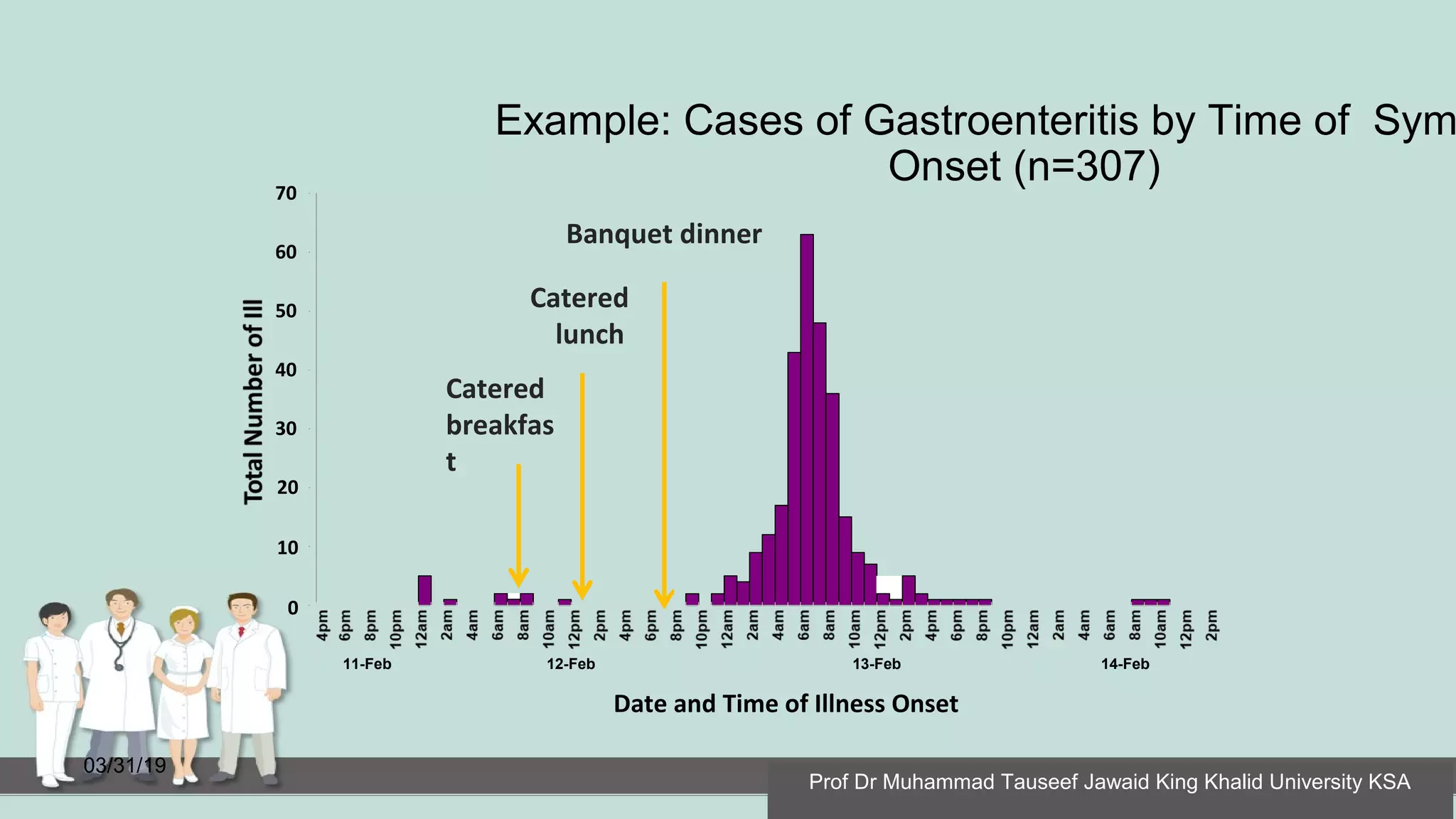
8
•Identification of team
•Gather resources, supplies, equipment
– Computer, questionnaires, specimen collection kits
•Make necessary administrative, personal arrangements
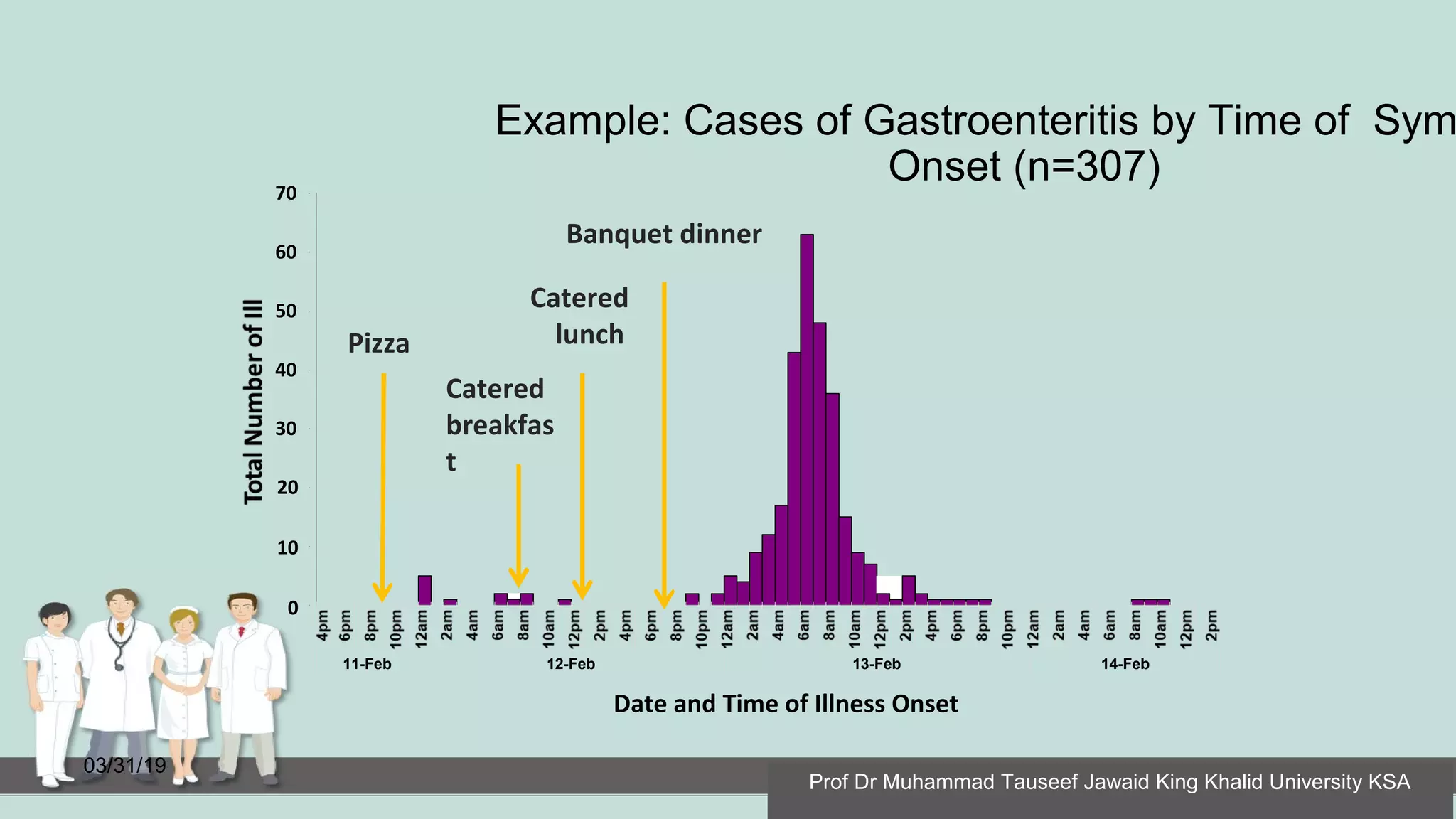
for travel
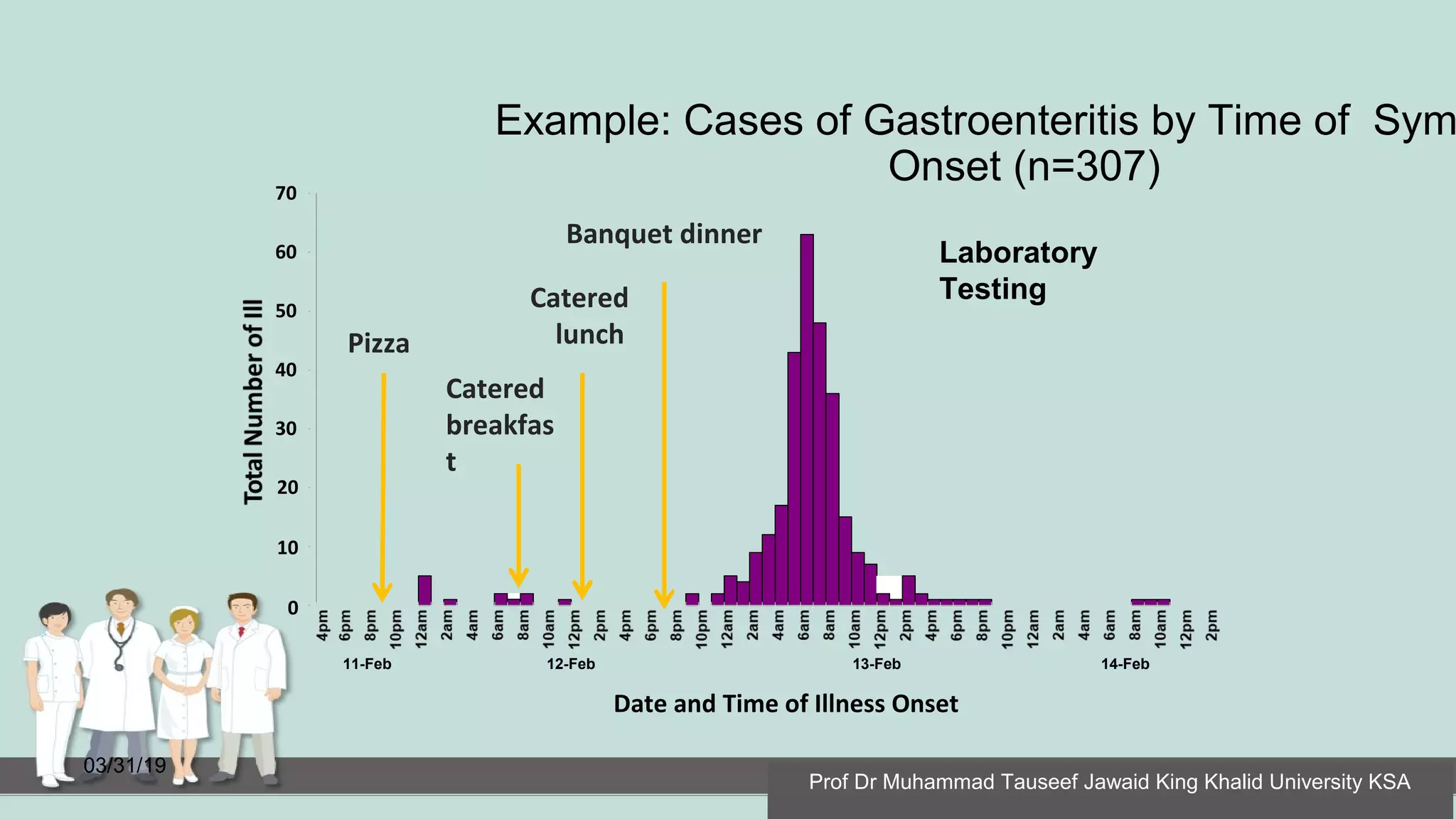
– Determine role in the investigation
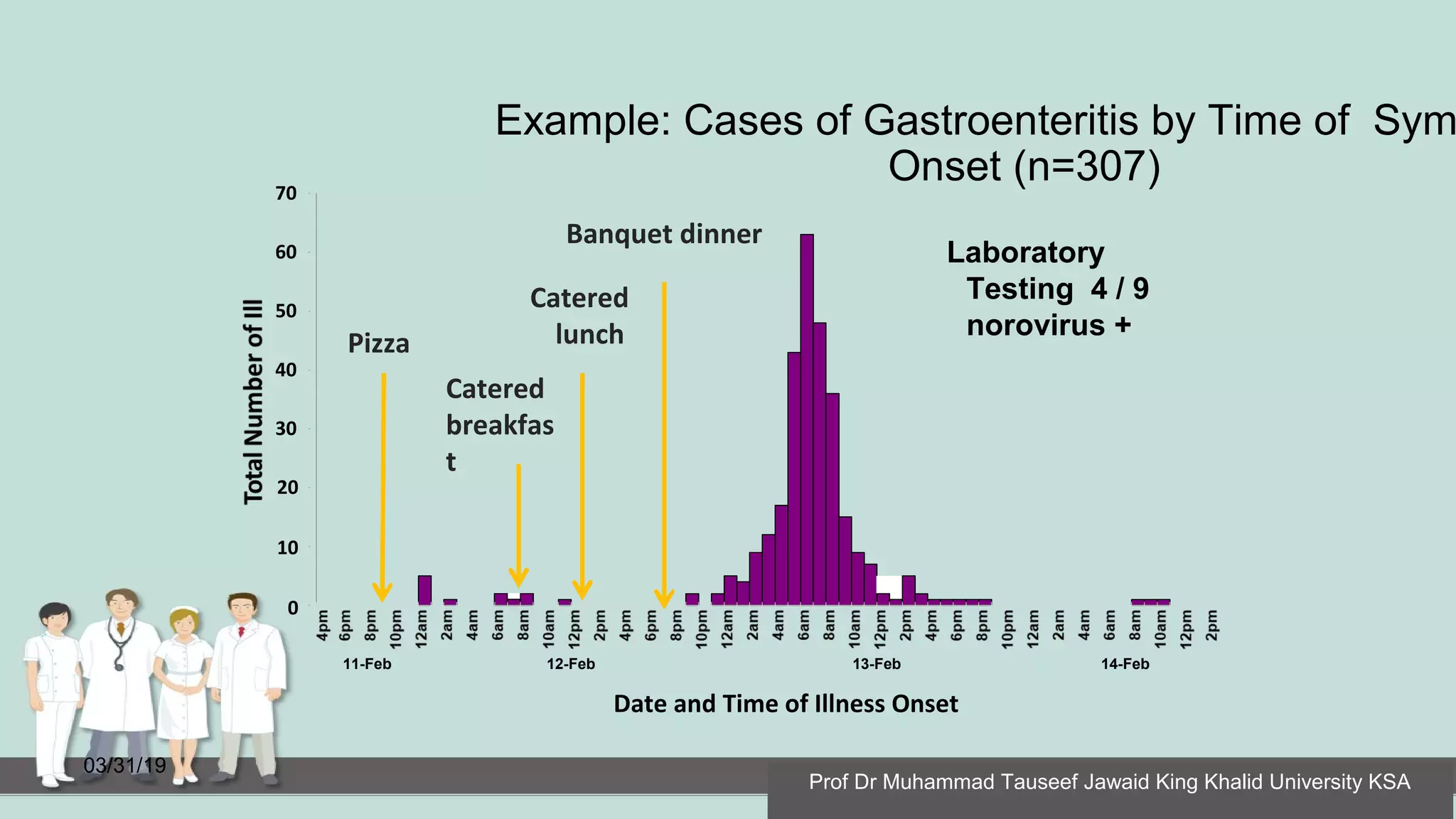
– Identify points of contact (field and office)
•What do you need to do to prepare?
Prof Dr Muhammad Tauseef Jawaid King Khalid University KSA
Team Member Roles
 Team Leader
 Experience in outbreak investigation and epidemiology
 Selection can be result of outbreak setting or etiologic agent
 Role can be filled by:
 County health director,
 Public health nurse,
 Epidemiologist, or
 Environmental health specialist
 Role may change depending on stage of investigation
03/31/19 Prof Dr Muhammad Tauseef Jawaid King Khalid University KSA
9
Prof Dr Muhammad Tauseef Jawaid King Khalid University KSA
Team Member Roles
 Epidemiologist
 Develop study design and survey questionnaires
 Create database and conduct data analysis
03/31/19
Prof Dr Muhammad Tauseef Jawaid King Khalid University KSA
10
Prof Dr Muhammad Tauseef Jawaid King Khalid University KSA
Team Member Roles
 Microbiologist
 Verify the diagnosis
 Subtype pathogens to help refine case definition
03/31/19
Prof Dr Muhammad Tauseef Jawaid King Khalid University KSA
11
Prof Dr Muhammad Tauseef Jawaid King Khalid University KSA
Team Member Roles
 Environmental health specialists (EHS)
 Collect food and environmental samples
 Provide guidance on food safety regulations and engineering
03/31/19
Prof Dr Muhammad Tauseef Jawaid King Khalid University KSA
12
Prof Dr Muhammad Tauseef Jawaid King Khalid University KSA
Team Member Roles
 Interviewers
 Collect data in person or by telephone
 Role can be filled by health department personnel, state
or federal personnel, or health science students
03/31/19
Prof Dr Muhammad Tauseef Jawaid King Khalid University KSA
13
Prof Dr Muhammad Tauseef Jawaid King Khalid University KSA
Team Member Roles
 Clinicians
 Administer vaccines or prophylaxis
 Collect clinical specimens
 Role can be filled by health department or local medical
community
 May include veterinarians, depending on type of outbreak
03/31/19
Prof Dr Muhammad Tauseef Jawaid King Khalid University KSA
14
Prof Dr Muhammad Tauseef Jawaid King Khalid University KSA
Team Member Roles
 Regulators
 Facilitate identification of the source of outbreak and
develop prevention strategies
 Role can be filled by state or federal agency employees
03/31/19
Prof Dr Muhammad Tauseef Jawaid King Khalid University KSA
15
Prof Dr Muhammad Tauseef Jawaid King Khalid University KSA
Team Member Roles
 Media Spokesperson
 Deliver clear and consistent messages to community
 Role can be filled by one outbreak team member or
representatives from each agency
03/31/19
Prof Dr Muhammad Tauseef Jawaid King Khalid University KSA
16
Prof Dr Muhammad Tauseef Jawaid King Khalid University KSA
Questions to Consider
 What resources, including personnel, are available?
 What resources could be provided by outside
collaborators?
 Who will direct the day-to-day investigation?
03/31/19
Prof Dr Muhammad Tauseef Jawaid King Khalid University KSA
17
Prof Dr Muhammad Tauseef Jawaid King Khalid University KSA
More Questions to Consider
 Who will interact with the media?
 How will data be shared and analyzed?
 Who will write the final report and present the
information?
 How will the team communicate with each other?
03/31/19
Prof Dr Muhammad Tauseef Jawaid King Khalid University KSA
18
Prof Dr Muhammad Tauseef Jawaid King Khalid University KSA
Team Equipment
• Computer with access to internet
– Email communication
– Literature searches (PUBMED)
– Data entry and analysis (Epi-Info 2002
http://www.cdc.gov/epiinfo/epiinfo.htm)
– Written reports
03/31/19
Prof Dr Muhammad Tauseef Jawaid King Khalid University KSA
19
Prof Dr Muhammad Tauseef Jawaid King Khalid University KSA
Team Equipment
• Specimen collection tools
– Rectal swabs or specimen cups
– Phlebotomy equipment
– Cooler to transport specimens
03/31/19
Prof Dr Muhammad Tauseef Jawaid King Khalid University KSA
20
Prof Dr Muhammad Tauseef Jawaid King Khalid University KSA
Communication
• Information flows in both directions
– Leader should update the team during meetings,
conference calls, or email
– Members provide regular updates to team leader
• Acts as tool for measuring progress
• Enables leader to provide feedback and direction to team
members
03/31/19
Prof Dr Muhammad Tauseef Jawaid King Khalid University KSA
21
Prof Dr Muhammad Tauseef Jawaid King Khalid University KSA
Communication
• Keep lines of communication open through regular
meetings or phone
– Include local, state, and federal public health agencies
• Document progress
– Allows all members to remain up-to-date
– Assists in drafting final report
03/31/19
Prof Dr Muhammad Tauseef Jawaid King Khalid University KSA
22
Prof Dr Muhammad Tauseef Jawaid King Khalid University KSA
Steps of an Outbreak
Investigation
03/31/19 23
Prof Dr Muhammad Tauseef Jawaid King Khalid University KSA
Steps of an Outbreak Investigation
1. Preparation
2. Confirm the existence of outbreak
3. Verify the diagnosis
4. Establish a case definition
5. Find cases systematically & record information
6. Perform descriptive epidemiology
7. Develop hypotheses
8. Evaluate hypotheses epidemiologically
9. As necessary, reconsider, refine, and re-evaluate hypotheses.
10.Implement control and prevention measures
11. Communicate findings
03/31/19
Prof Dr Muhammad Tauseef Jawaid King Khalid University KSA
24
Prof Dr Muhammad Tauseef Jawaid King Khalid University KSA
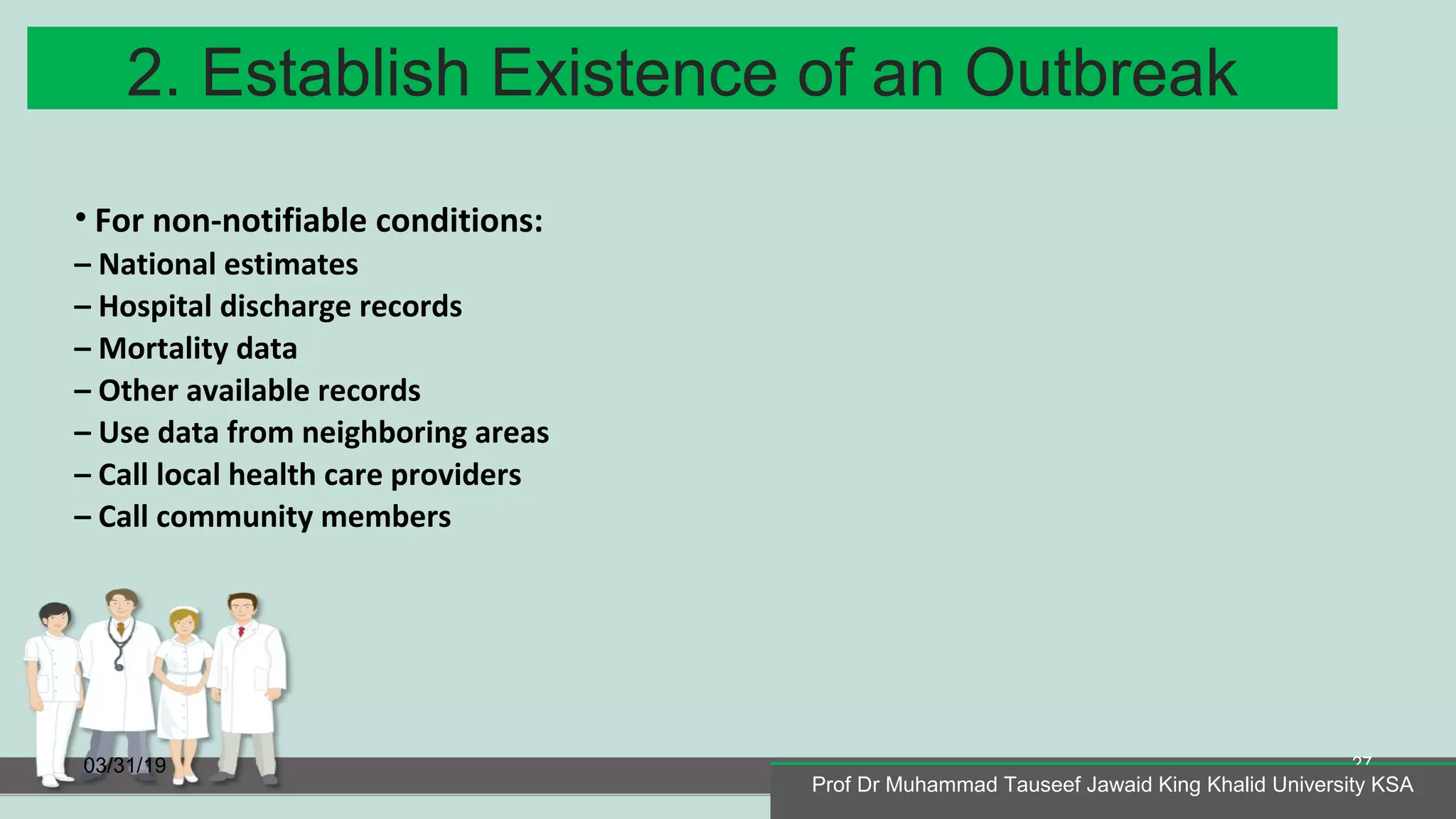
1. Preparation
• Investigation
– Scientific knowledge
• Review literature
• Consult experts
• Sample questionnaires
– Supplies
• Consult with laboratory
– Equipment
• Laptop, camera etc.
03/31/19 Prof Dr Muhammad Tauseef Jawaid King Khalid University KSA
25
Prof Dr Muhammad Tauseef Jawaid King Khalid University KSA
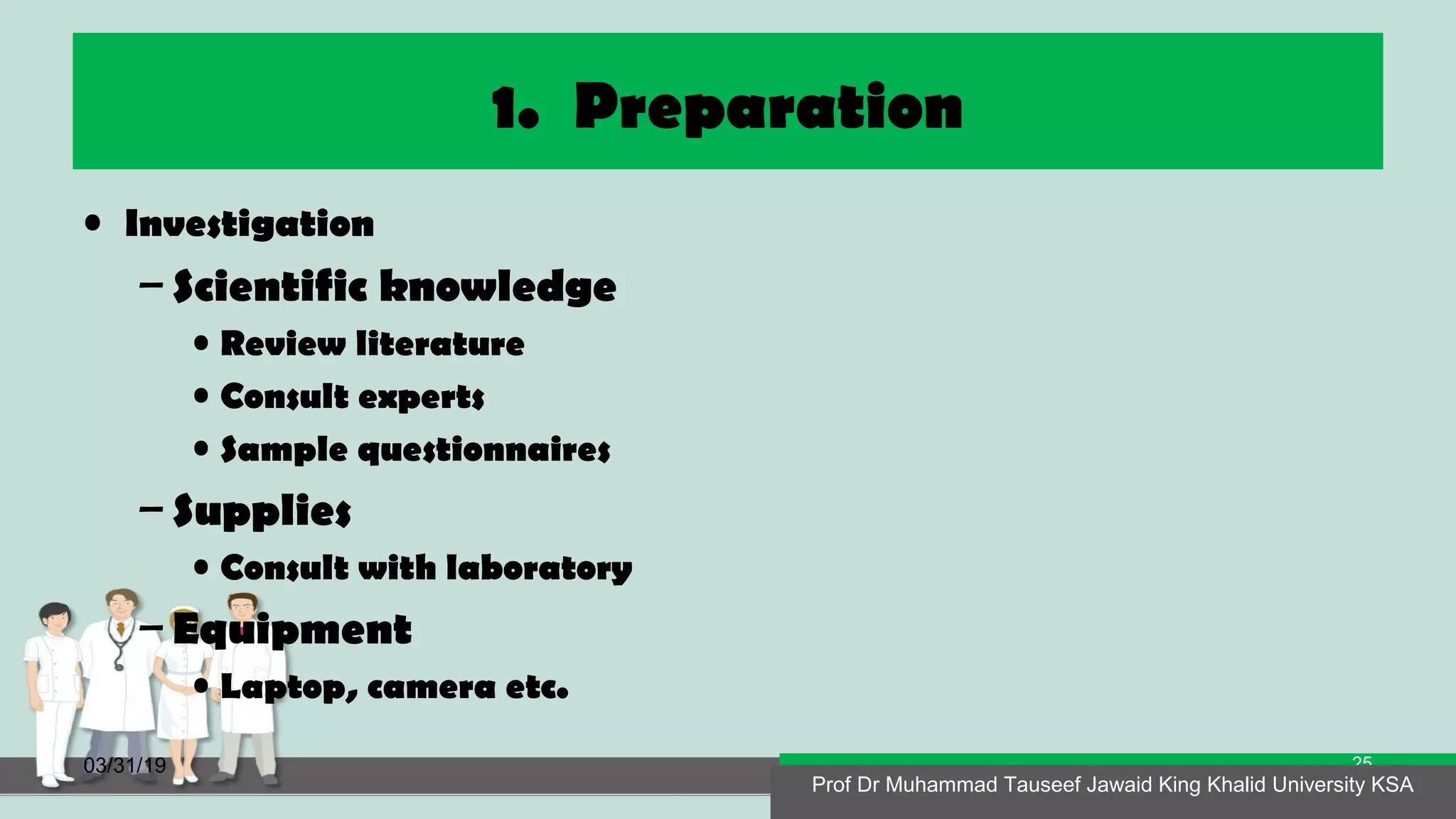
2. Establish existence of an outbreak
• Is an outbreak truly occurred?
– through surveillance records for notifiable diseases.
– hospital data.
– data from other facilities
– community survey.
03/31/19
Prof Dr Muhammad Tauseef Jawaid King Khalid University KSA
26
Prof Dr Muhammad Tauseef Jawaid King Khalid University KSA
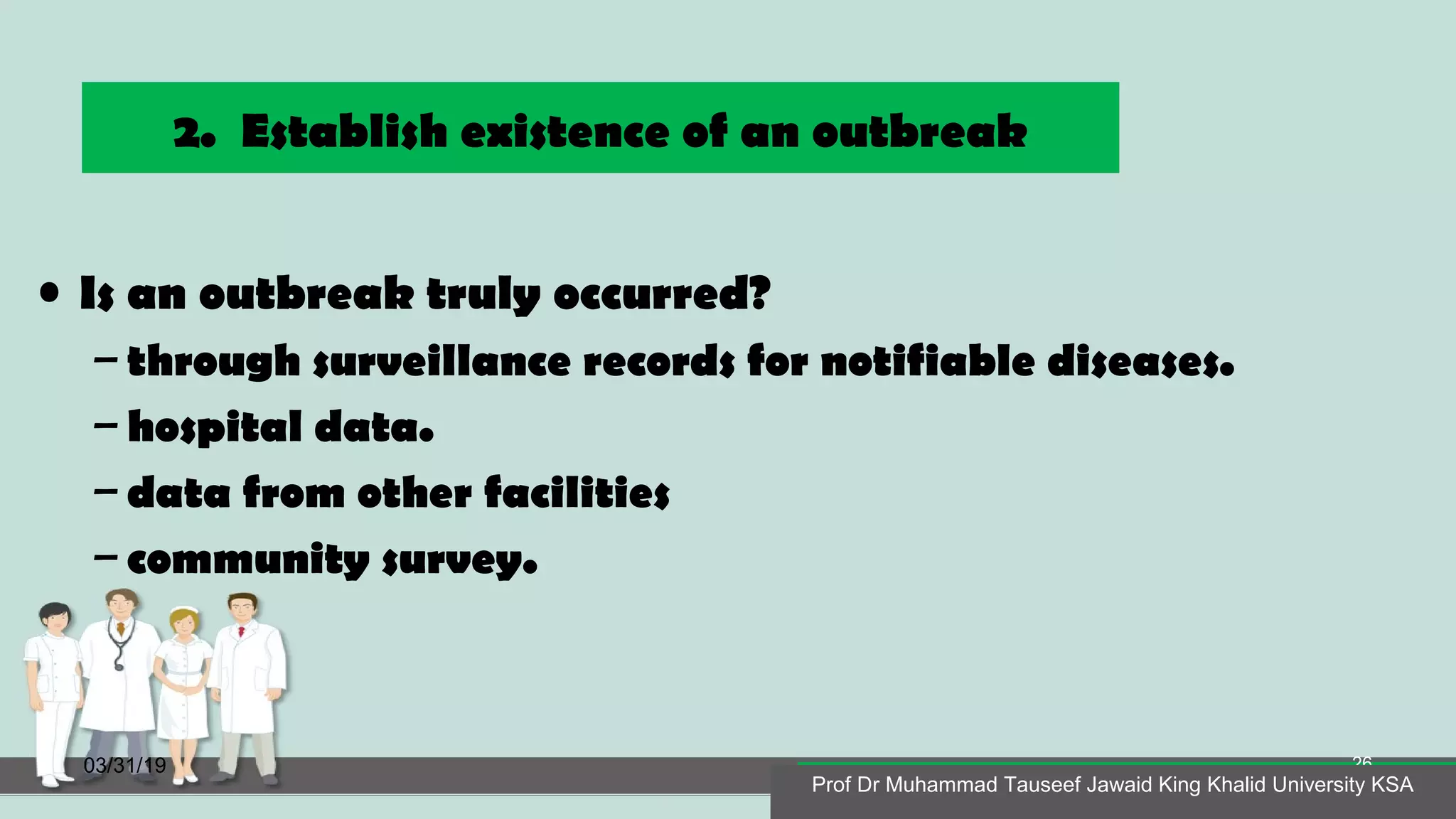
2. Establish Existence of an Outbreak
03/31/19
Prof Dr Muhammad Tauseef Jawaid King Khalid University KSA
27
• For non-notifiable conditions:
– National estimates
– Hospital discharge records
– Mortality data
– Other available records
– Use data from neighboring areas
– Call local health care providers
– Call community members
Prof Dr Muhammad Tauseef Jawaid King Khalid University KSA
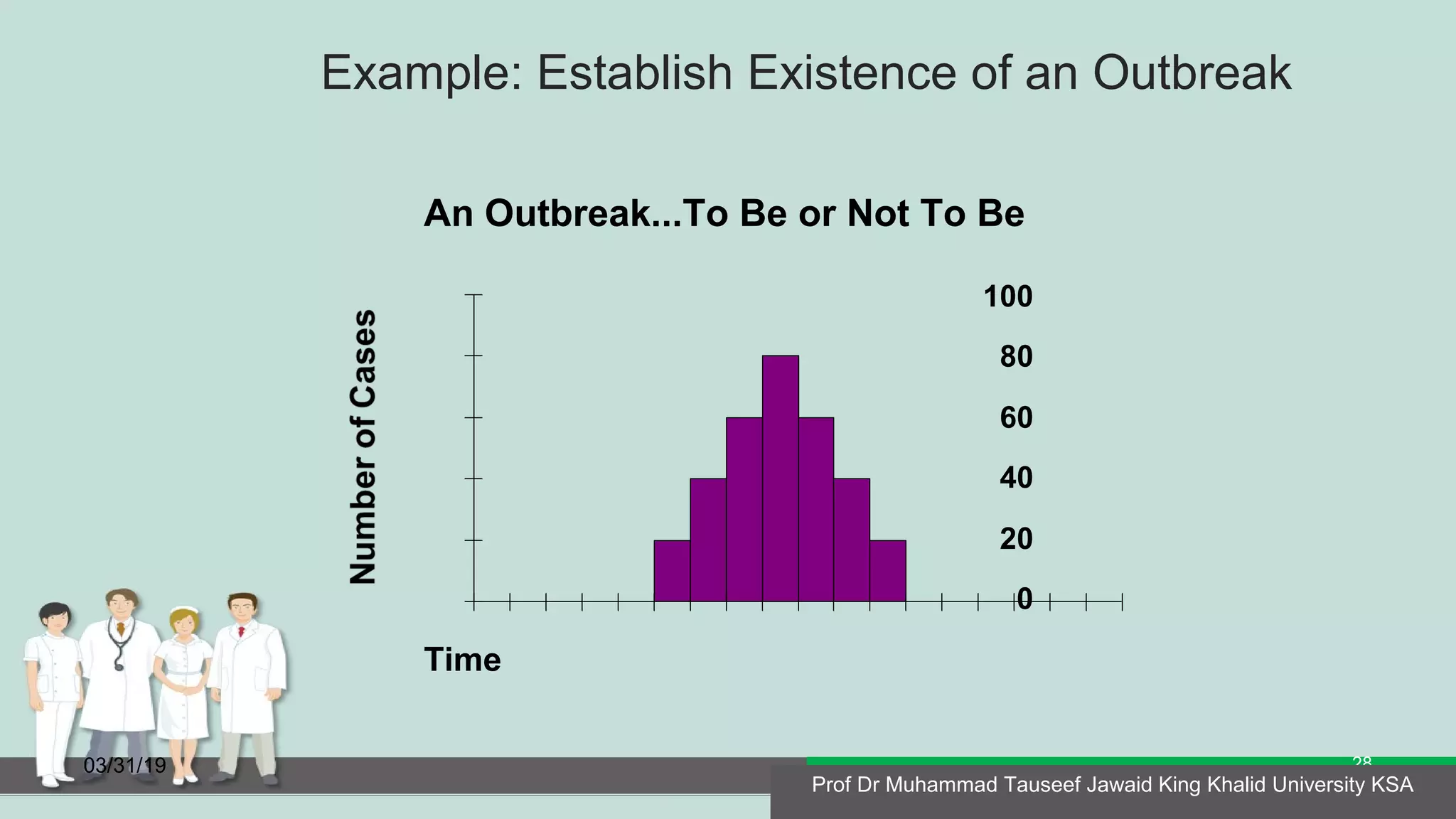
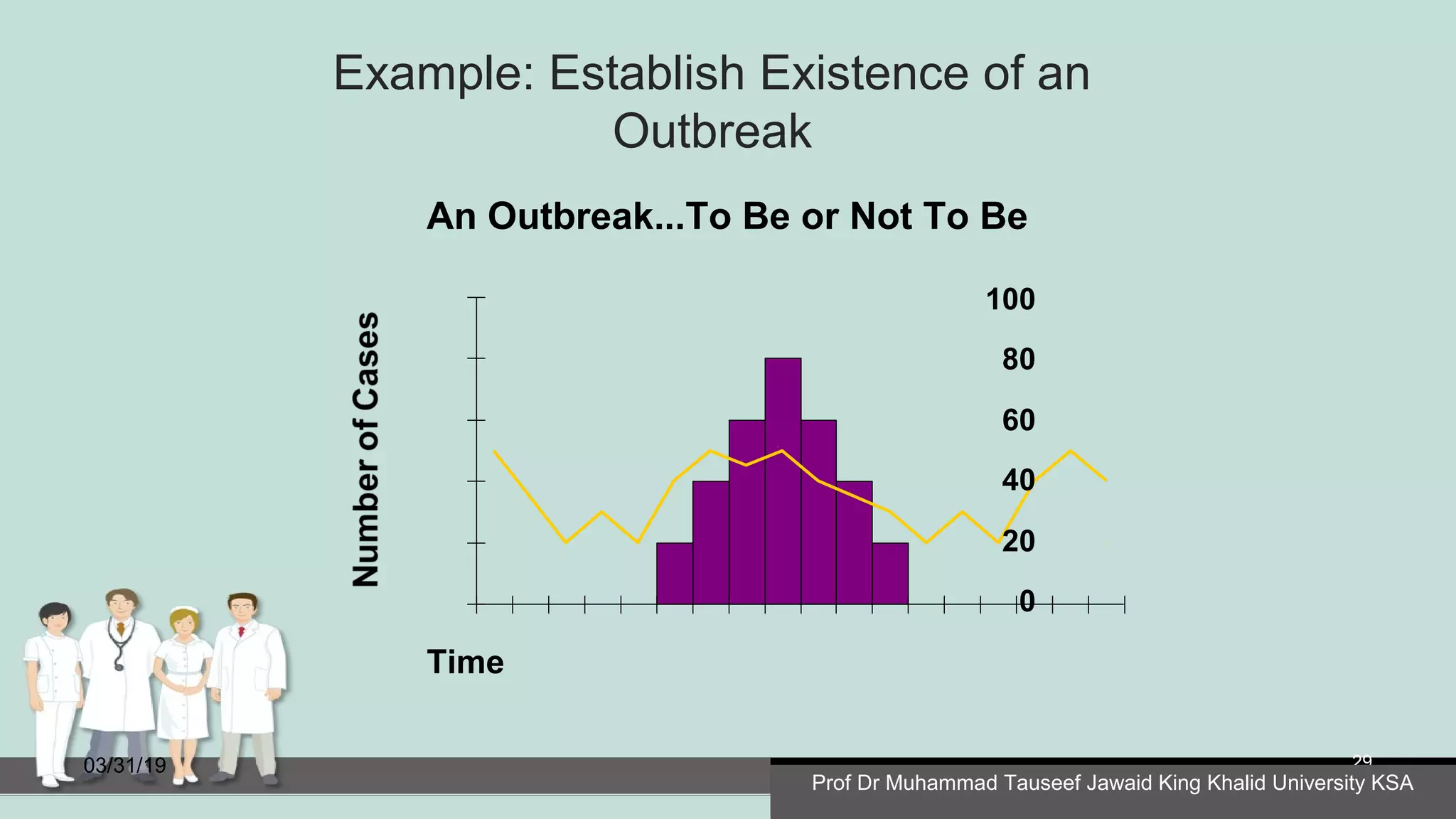
Example: Establish Existence of an Outbreak
03/31/19
Prof Dr Muhammad Tauseef Jawaid King Khalid University KSA
28
An Outbreak...To Be or Not To Be
100
80
60
40
20
0
Time
Prof Dr Muhammad Tauseef Jawaid King Khalid University KSA
Example: Establish Existence of an
Outbreak
03/31/19
Prof Dr Muhammad Tauseef Jawaid King Khalid University KSA
29
An Outbreak...To Be or Not To Be
100
80
60
40
20
0
Time
Prof Dr Muhammad Tauseef Jawaid King Khalid University KSA
3. Verify the Diagnosis
• Ensure proper diagnosis and rule out lab error
as the bias for increased diagnosis
– Review clinical findings, lab results
03/31/19
Prof Dr Muhammad Tauseef Jawaid King Khalid University KSA
30
Prof Dr Muhammad Tauseef Jawaid King Khalid University KSA
Verify the Diagnosis
cont.
• See and talk with patients if at all possible
– Better understand clinical features
– Gather critical information
• Source of exposure
• What they think caused illness
• Knowledge of others with similar illness
• Helpful in generating ideas for hypothesis about etiology and spread
03/31/19
Prof Dr Muhammad Tauseef Jawaid King Khalid University KSA
31
Prof Dr Muhammad Tauseef Jawaid King Khalid University KSA
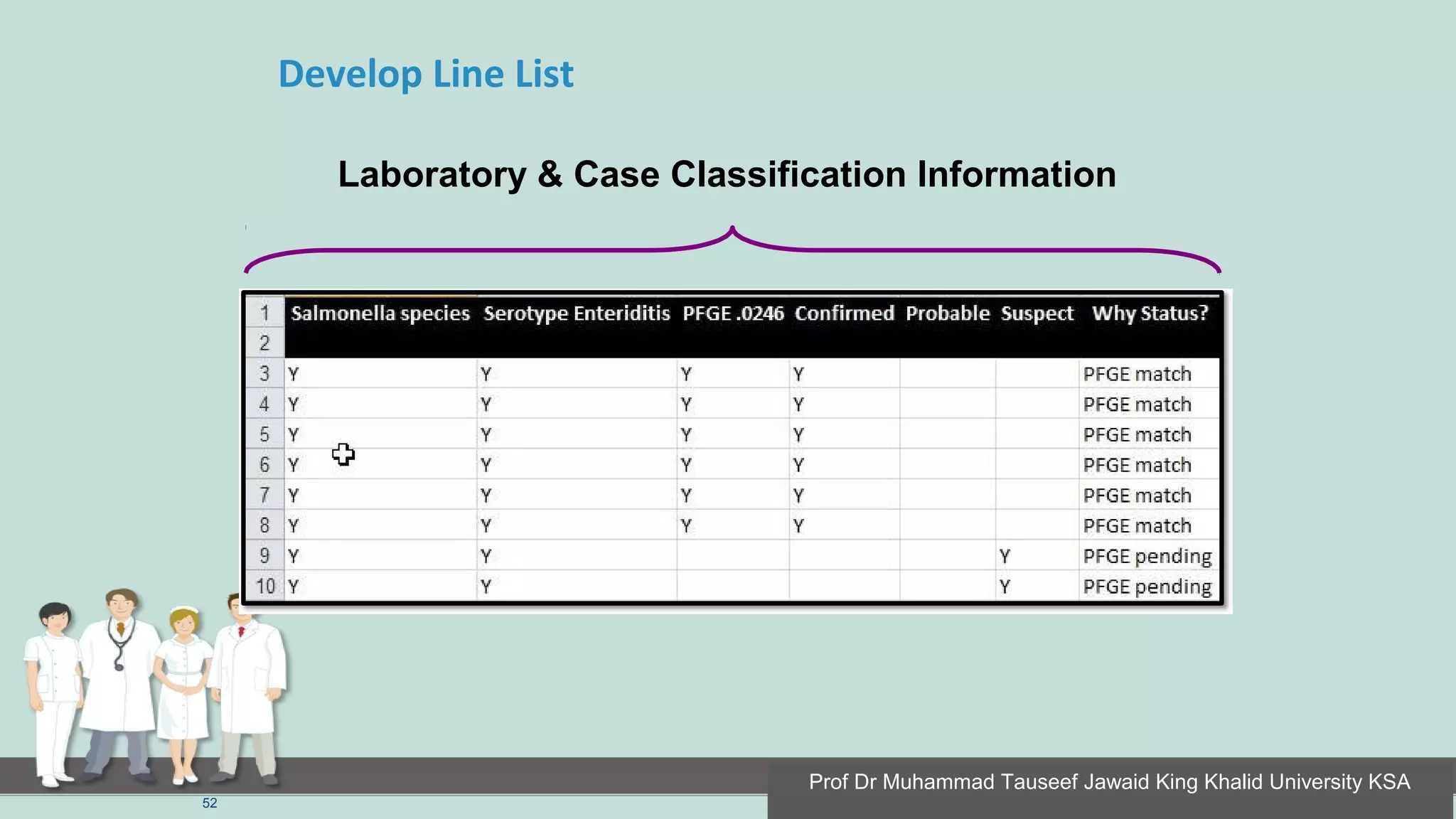
4. Establish a case definition
• Case definition
– Includes clinical criteria and restrictions by time, place and person
• Classification
– Definite (confirmed)
• Laboratory confirmed
– Probable
• Typical clinical features without lab confirmation
– Possible (suspected)
• Fewer of the typical clinical features
03/31/19
Prof Dr Muhammad Tauseef Jawaid King Khalid University KSA
32
Prof Dr Muhammad Tauseef Jawaid King Khalid University KSAProf Dr Muhammad Tauseef Jawaid King Khalid University KSA
Meningococcal Disease — Case Definition
Clinical case definition
• An illness with sudden onset of fever (>38.5°C rectal or >38.0°C
axillary) and one or more of the following: neck stiffness, altered
consciousness, other meningeal sign or petechial or puerperal rash.
Laboratory criteria for diagnosis
• Positive cerebrospinal fluid (CSF) antigen detection or positive
culture.
03/31/19
Prof Dr Muhammad Tauseef Jawaid King Khalid University KSA
33
Prof Dr Muhammad Tauseef Jawaid King Khalid University KSA
Case classification
• Suspected: A case that meets the clinical case definition.
• Probable: A suspected case as defined above and turbid CSF
(with or without positive Gram stain) or ongoing epidemic
and epidemiological link to a confirmed case.
• Confirmed: A suspected or probable case with laboratory
confirmation.
03/31/19
Prof Dr Muhammad Tauseef Jawaid King Khalid University KSA
34
Example: Case Definition
for Hepatitis A
• Confirmed case:
– Anti-HAV IgM+
• Probable case:
– Pale skin
• Suspect case:
– Any two of the following:
– Abdominal pain, fever, nausea, anorexia, malaise
03/31/19
Prof Dr Muhammad Tauseef Jawaid King Khalid University KSA
35
5. Find cases systematically & record information
• Target health care facilities where diagnosis is likely
to be made
– Enhanced passive surveillance e.g. letter describing
situation and asking for reports.
– Active surveillance e.g. phone or visit facility to collect
information
• Alerting the public
– Media alert to avoid contaminated food products and seek
medical attention if symptoms arise.
03/31/19 Prof Dr Muhammad Tauseef Jawaid King Khalid University KSA
36
5. Find cases systematically & record information
contd….
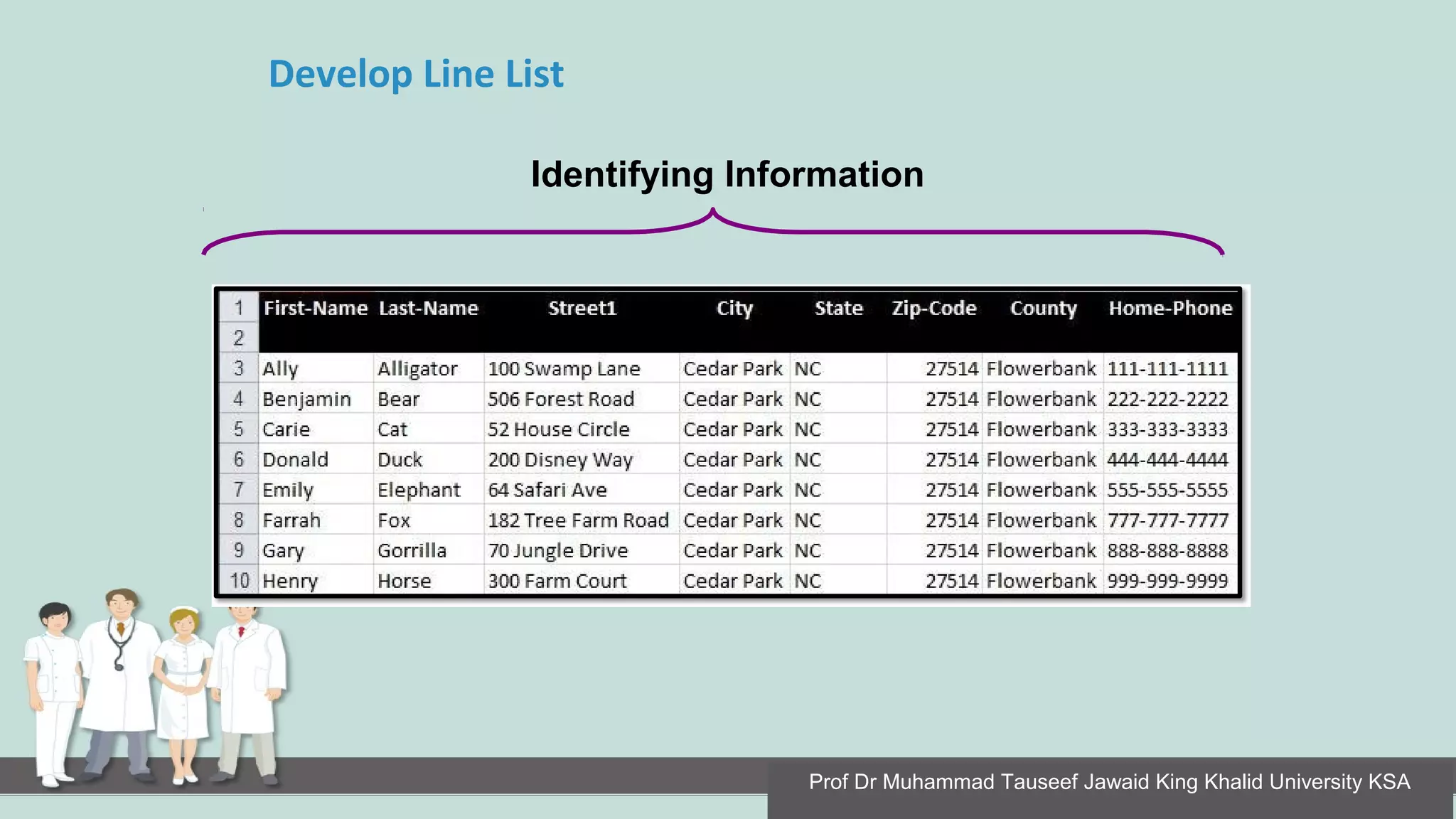
• Identifying information
• Name, address, and telephone number is essential if need to
contact patients additional questions.
• Also to Notify them of lab results and outcomes of investigation
• Names also helps in checking for duplicate records while addresses
allow for Mapping the geographic extent.
– Demographic information.
• Provide “person” characteristics for defining population at risk
03/31/19
Prof Dr Muhammad Tauseef Jawaid King Khalid University KSA
37
5. Find cases systematically & record
information contd….
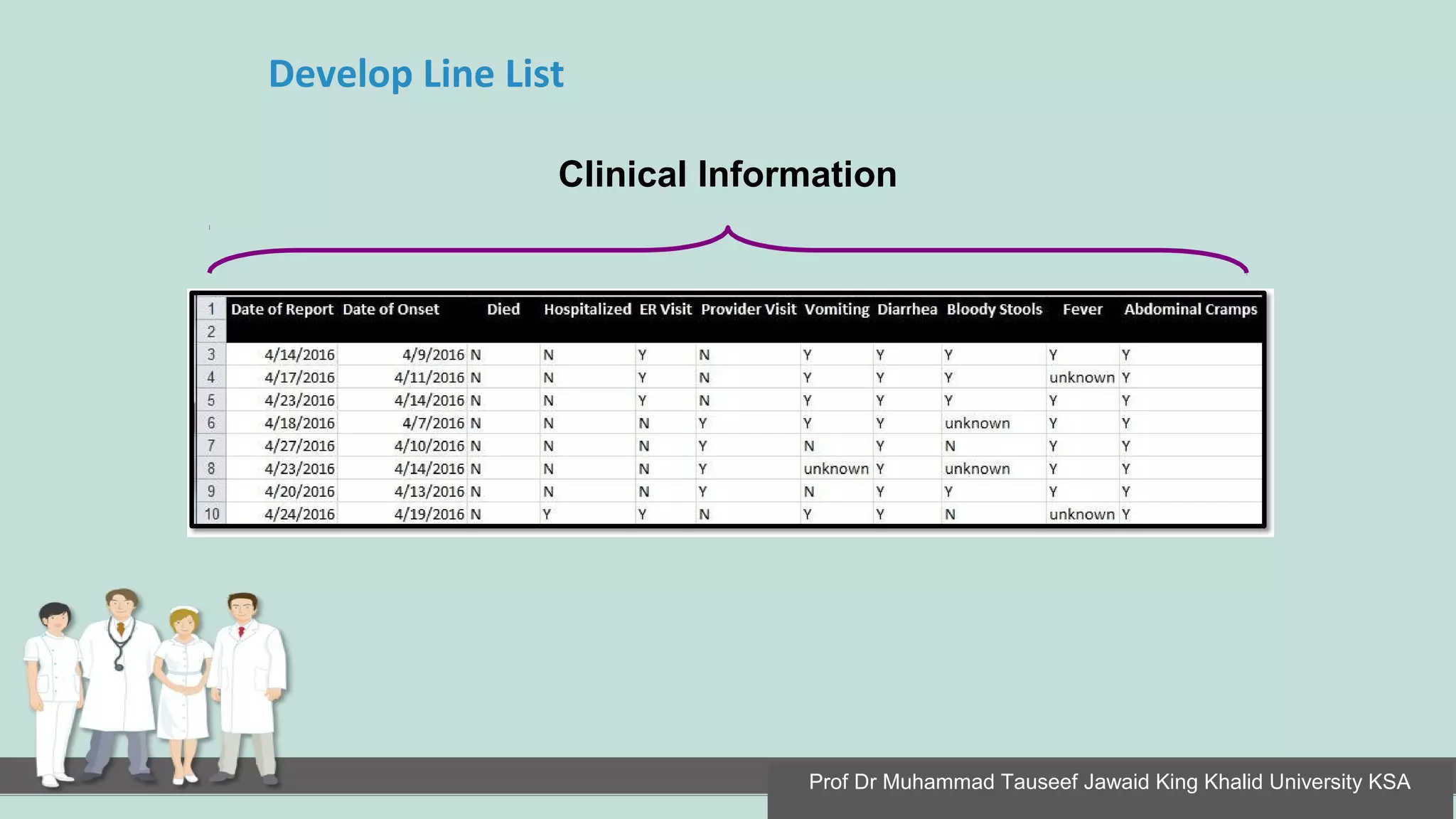
• Clinical findings
• Signs and symptoms allow to Verify that the case definition has been
met
• Date of onset is needed to Chart the time course of outbreak.
– Reporter information
• Id of person making report
03/31/19
Prof Dr Muhammad Tauseef Jawaid King Khalid University KSA
38
5. Find cases systematically & record information
contd….
• Line listing
– Abstraction of selected critical items
from above information
03/31/19
Prof Dr Muhammad Tauseef Jawaid King Khalid University KSA
39
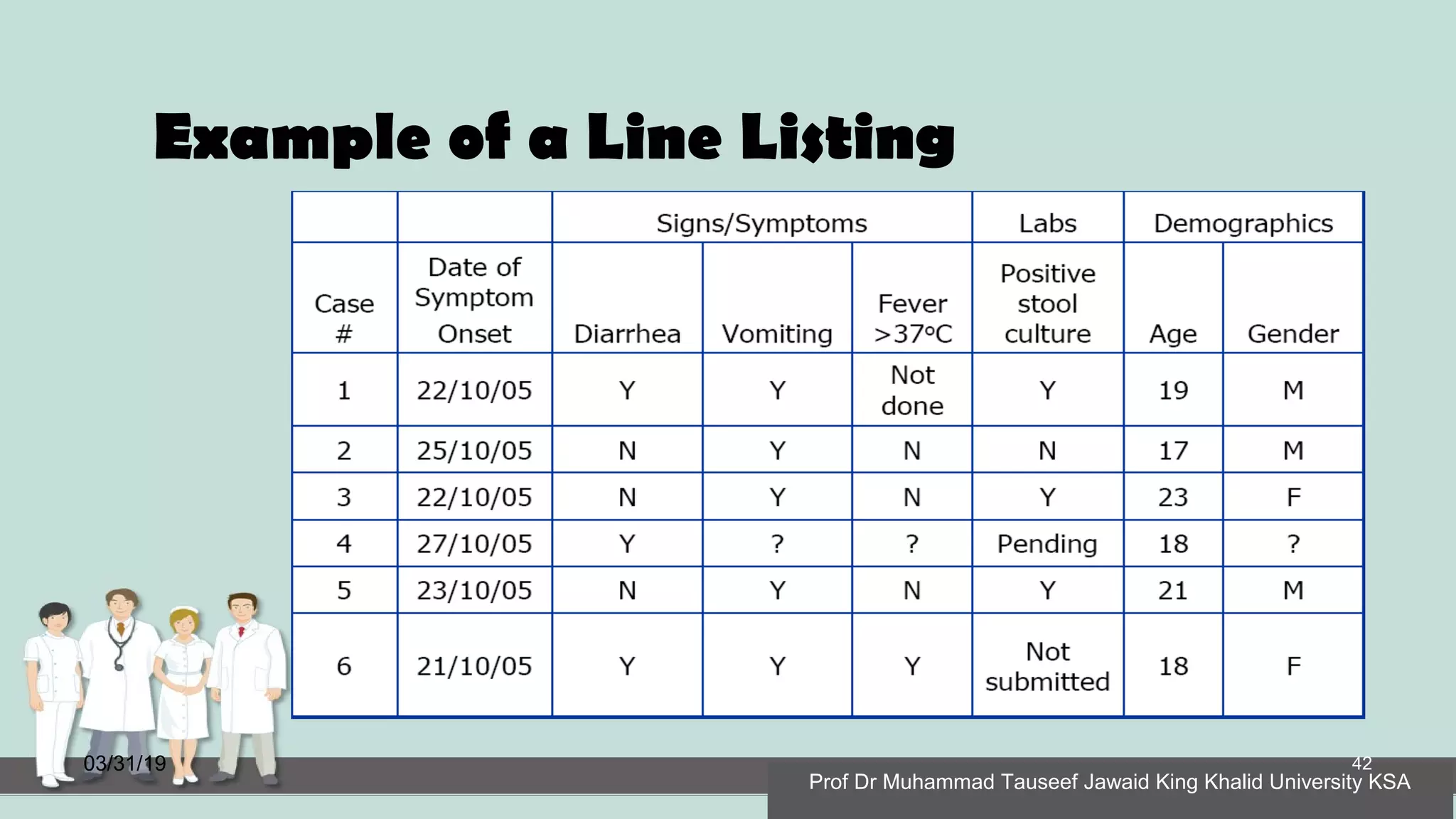
What is a Line Listing?
• A rectangular database similar to spreadsheet
• Provides summary of key data about cases in an outbreak
• Each row represents one case
• Each column represents one variable
• First column usually identifier —name, initials, or ID number
• Can be paper or electronic
• Can be quickly reviewed and updated
03/31/19
Prof Dr Muhammad Tauseef Jawaid King Khalid University KSA
40
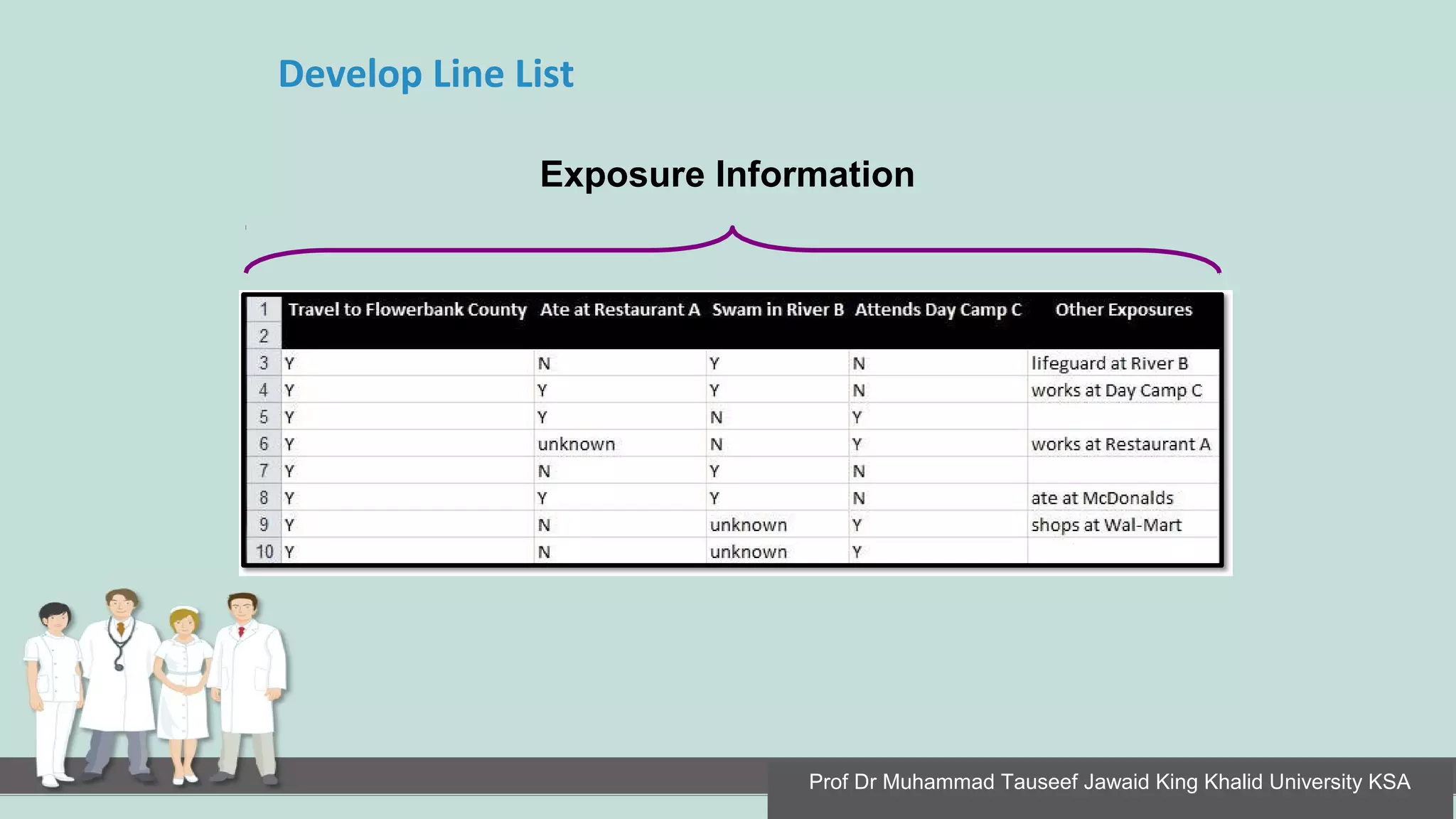
Develop Line List
Identifying Information
Prof Dr Muhammad Tauseef Jawaid King Khalid University KSA
Example of a Line Listing
03/31/19
Prof Dr Muhammad Tauseef Jawaid King Khalid University KSA
42
Develop Line List
Clinical Information
Prof Dr Muhammad Tauseef Jawaid King Khalid University KSA
Develop Line List
Laboratory & Case Classification Information
52
Prof Dr Muhammad Tauseef Jawaid King Khalid University KSA
Develop Line List
Exposure Information
Prof Dr Muhammad Tauseef Jawaid King Khalid University KSA
6. Perform Descriptive Epidemiology
• After collection of data characterize
the outbreak by:
–Time
–Place
–Person
03/31/19 46
Prof Dr Muhammad Tauseef Jawaid King Khalid University KSA
Perform Descriptive Epidemiology
03/31/19 47
• What and why
–Provides systematic method
–Characterize, or describe what has occurred
–Person, place, time
useful for developing
hypotheses
• Components
–Line list
–Epi curve
–Others, but we will focus on line list and epi-curve
Prof Dr Muhammad Tauseef Jawaid King Khalid University KSA
Tabulate and orient data
 Create line listing
 Person
 Who was infected?
 What do the cases have in common?
 Place
 Where were they infected?
 May be useful to draw a map
 Time
 When were they infected?
 Create an epidemic curve
03/31/19 48
Prof Dr Muhammad Tauseef Jawaid King Khalid University KSA
Time (Epidemic curve)
• Epidemic curve
– Histogram of the number of cases by their date of onset
– Visual display of the outbreak’s magnitude and time trend
– Common source vs. Propagated
03/31/19 49
Prof Dr Muhammad Tauseef Jawaid King Khalid University KSA
Perform Descriptive Epidemiology
03/31/19 50
Line List• Person
• Place
• Time Epidemic curve (‘Epi curve’)
Prof Dr Muhammad Tauseef Jawaid King Khalid University KSA
Perform Descriptive Epidemiology
03/31/19 51
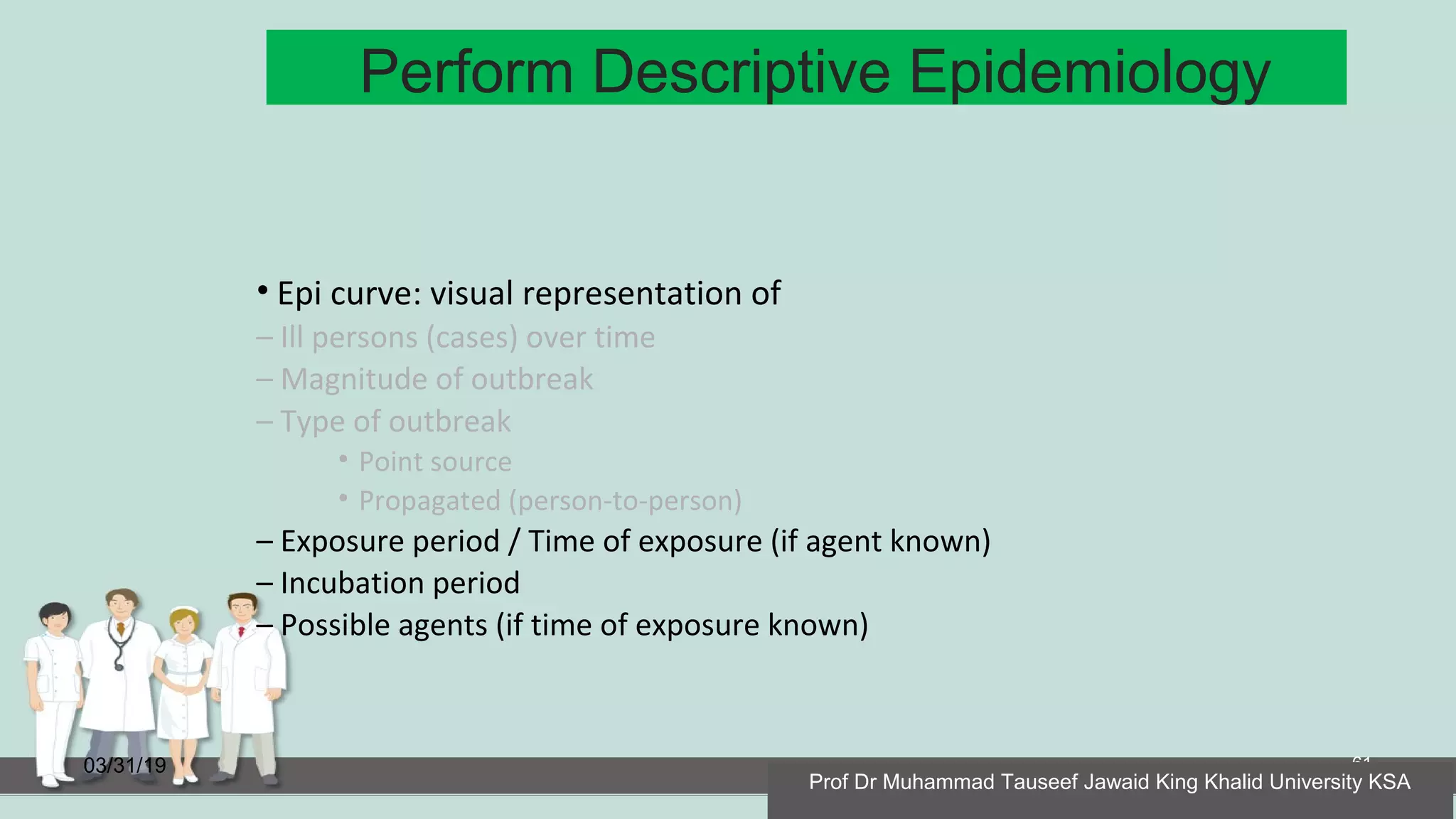
• Epi curve: visual representation of
– Ill persons (cases) over time
– Magnitude of outbreak
– Type of outbreak
• Point source
• Propagated (person-to-person)
– Exposure period / Time of exposure (if agent known)
– Incubation period
– Possible agents (if time of exposure known)
Prof Dr Muhammad Tauseef Jawaid King Khalid University KSA
Perform Descriptive Epidemiology
03/31/19 52
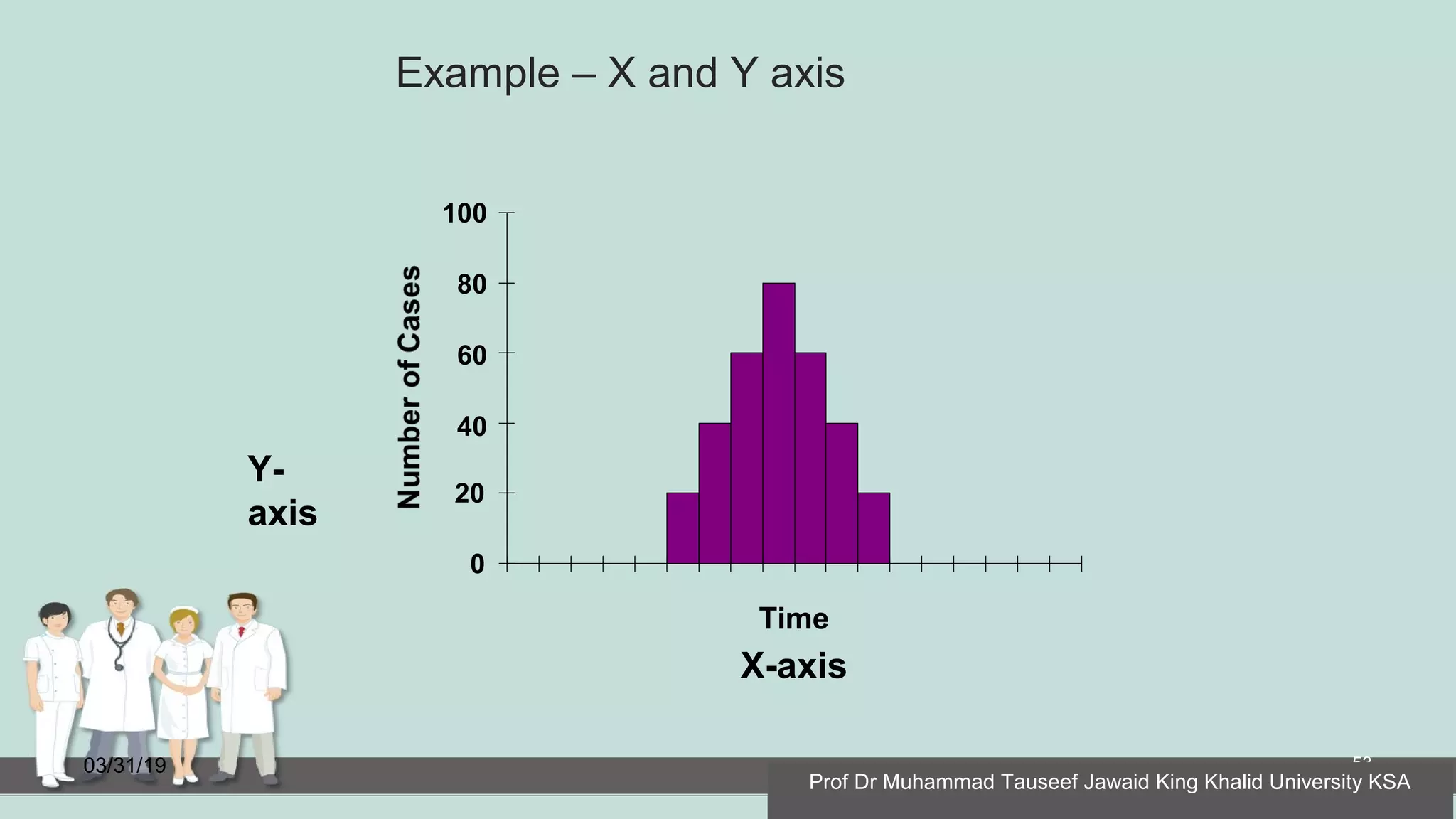
• How do I make an epi curve?
– Number of cases on the vertical (y) axis
– Time period (or date of illness onset) on the horizontal (x) axis
Prof Dr Muhammad Tauseef Jawaid King Khalid University KSA
Example – X and Y axis
03/31/19 53
0
20
100
80
60
40
Y-
axis
Time
X-axis
Prof Dr Muhammad Tauseef Jawaid King Khalid University KSA
Perform Descriptive Epidemiology
03/31/19 54
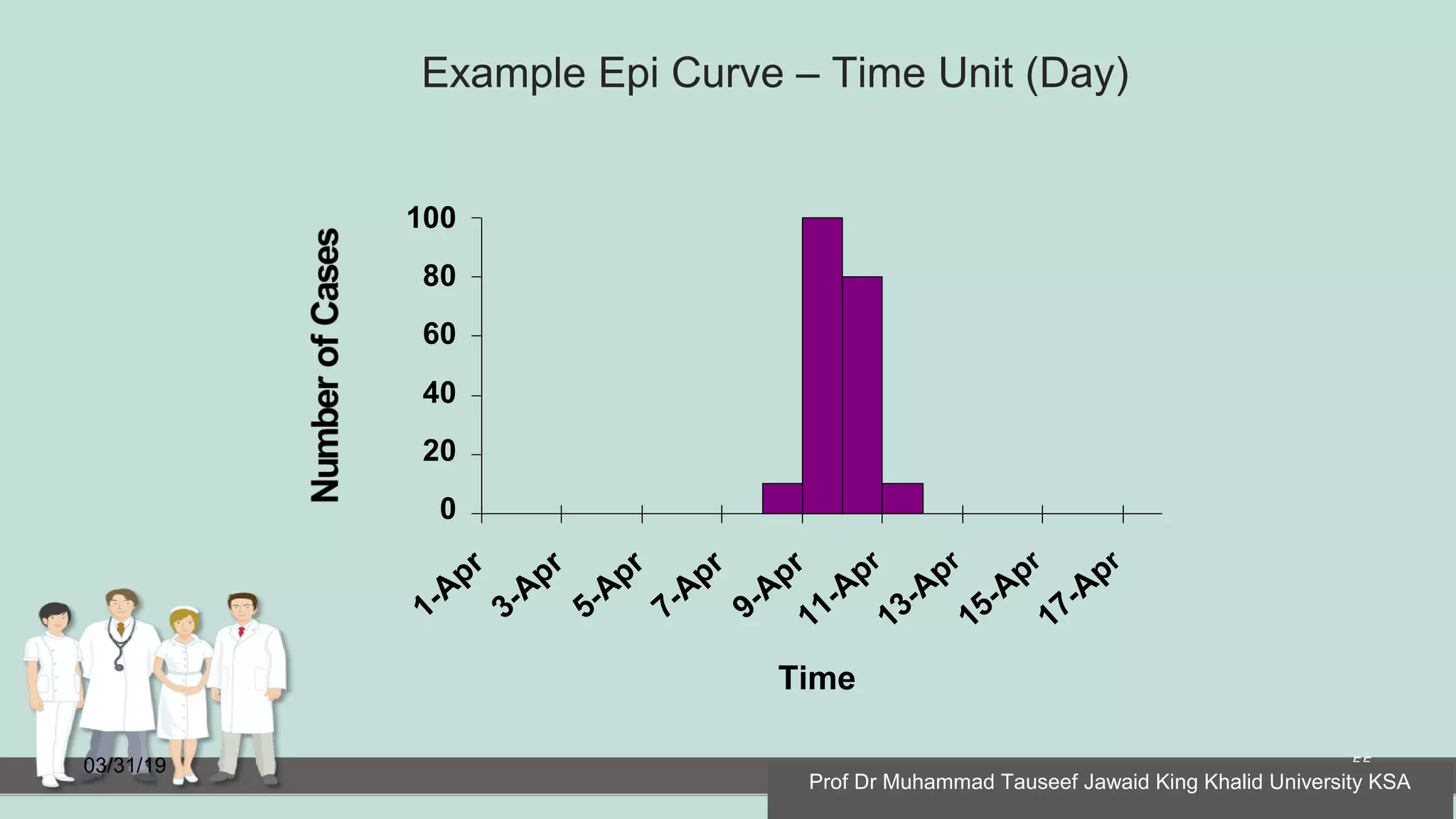
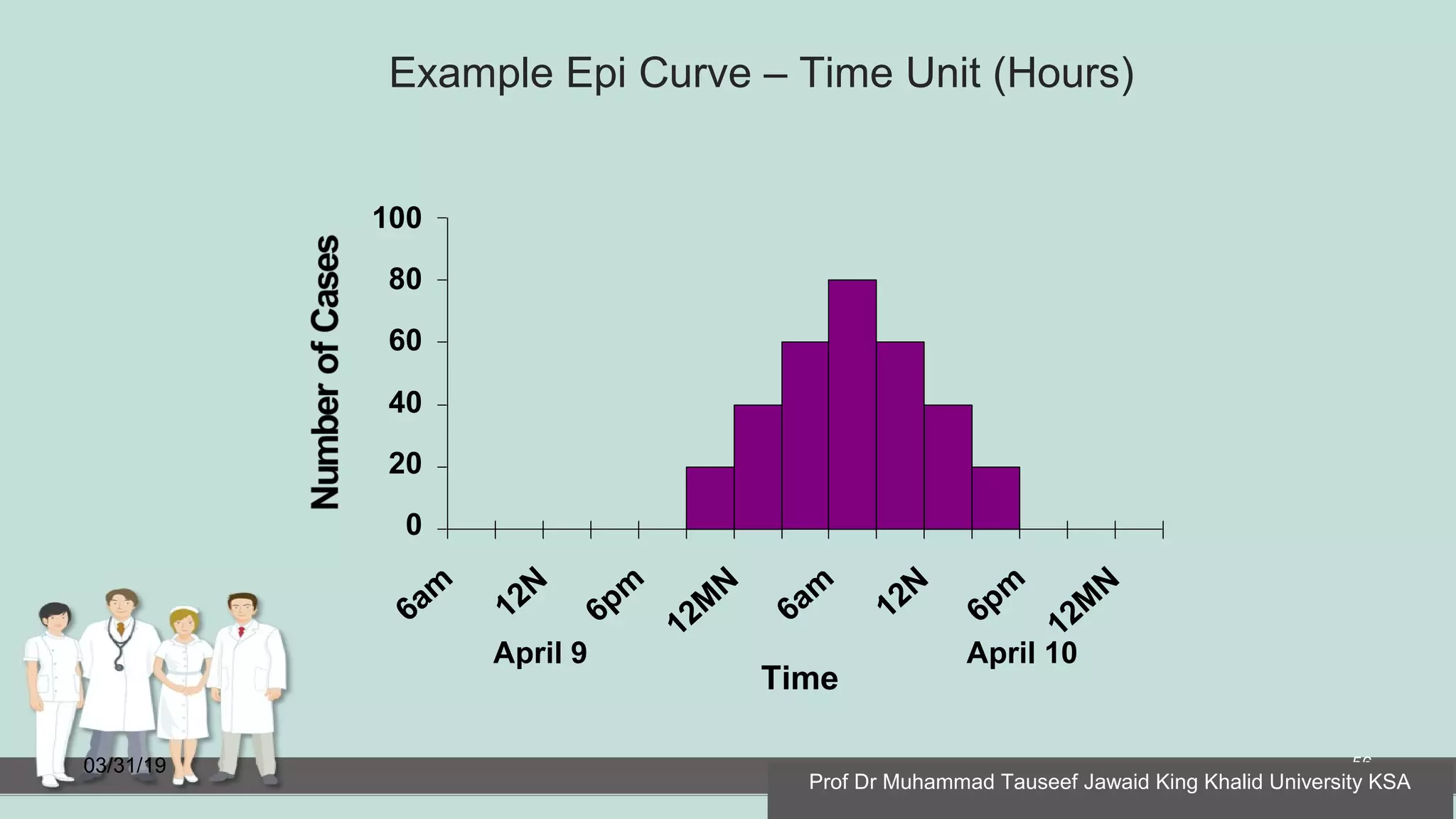
•How do I choose the correct unit of time?
– Depends upon the incubation period
– If incubation period is not known, graph several
epi-curves with different time units
Prof Dr Muhammad Tauseef Jawaid King Khalid University KSA
Example Epi Curve – Time Unit (Day)
03/31/19 55
100
80
60
40
20
0
1-Apr
3-Apr
5-Apr
7-Apr
9-Apr
11-Apr
13-Apr
15-Apr
17-Apr
Time
Prof Dr Muhammad Tauseef Jawaid King Khalid University KSA
Example Epi Curve – Time Unit (Hours)
03/31/19 56
100
80
60
40
20
0
6am
12N
6pm
12M
N
6am
12N
6pm
12M
N
Time
April 9 April 10
Prof Dr Muhammad Tauseef Jawaid King Khalid University KSA
Perform Descriptive Epidemiology
03/31/19 57
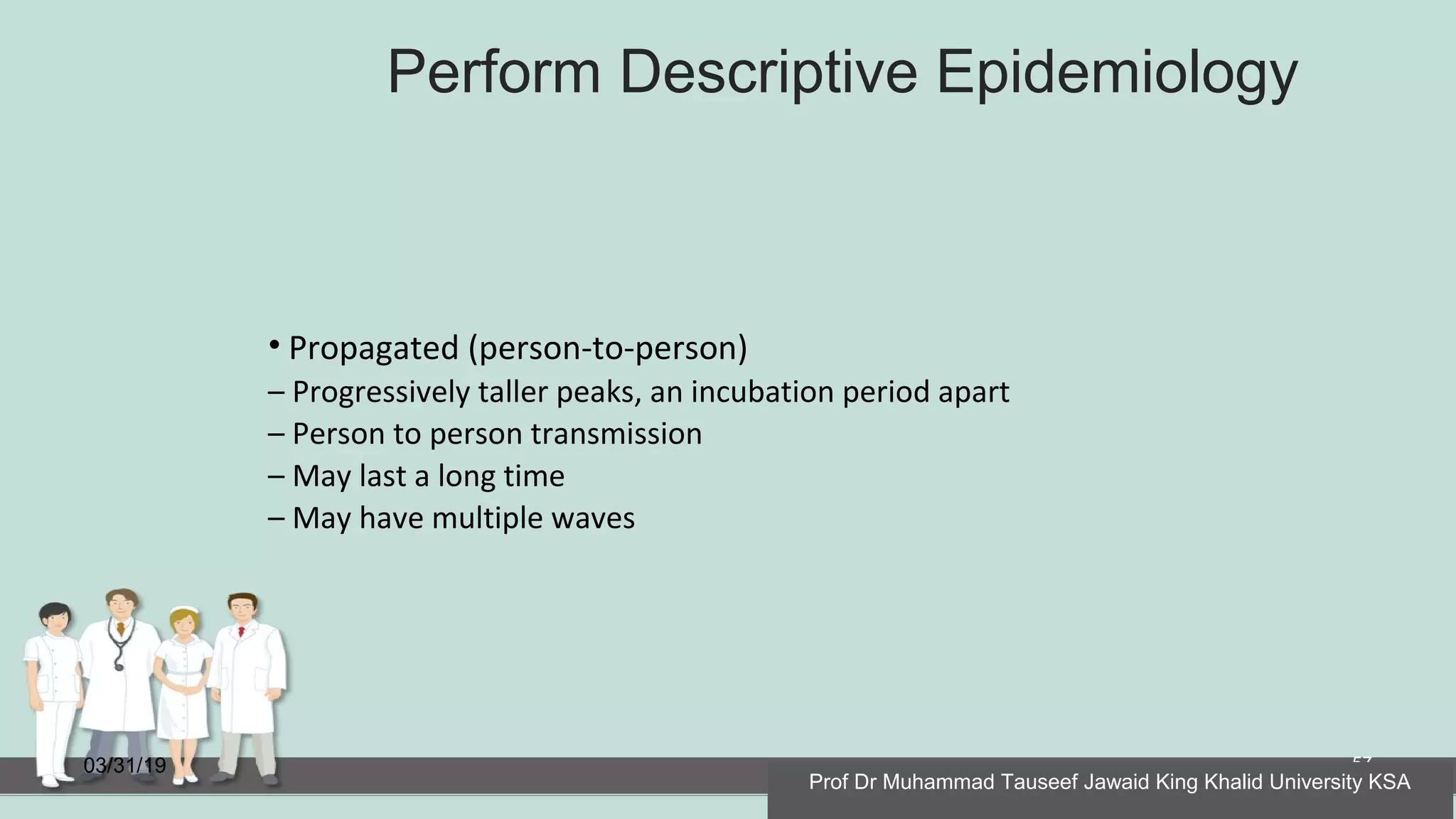
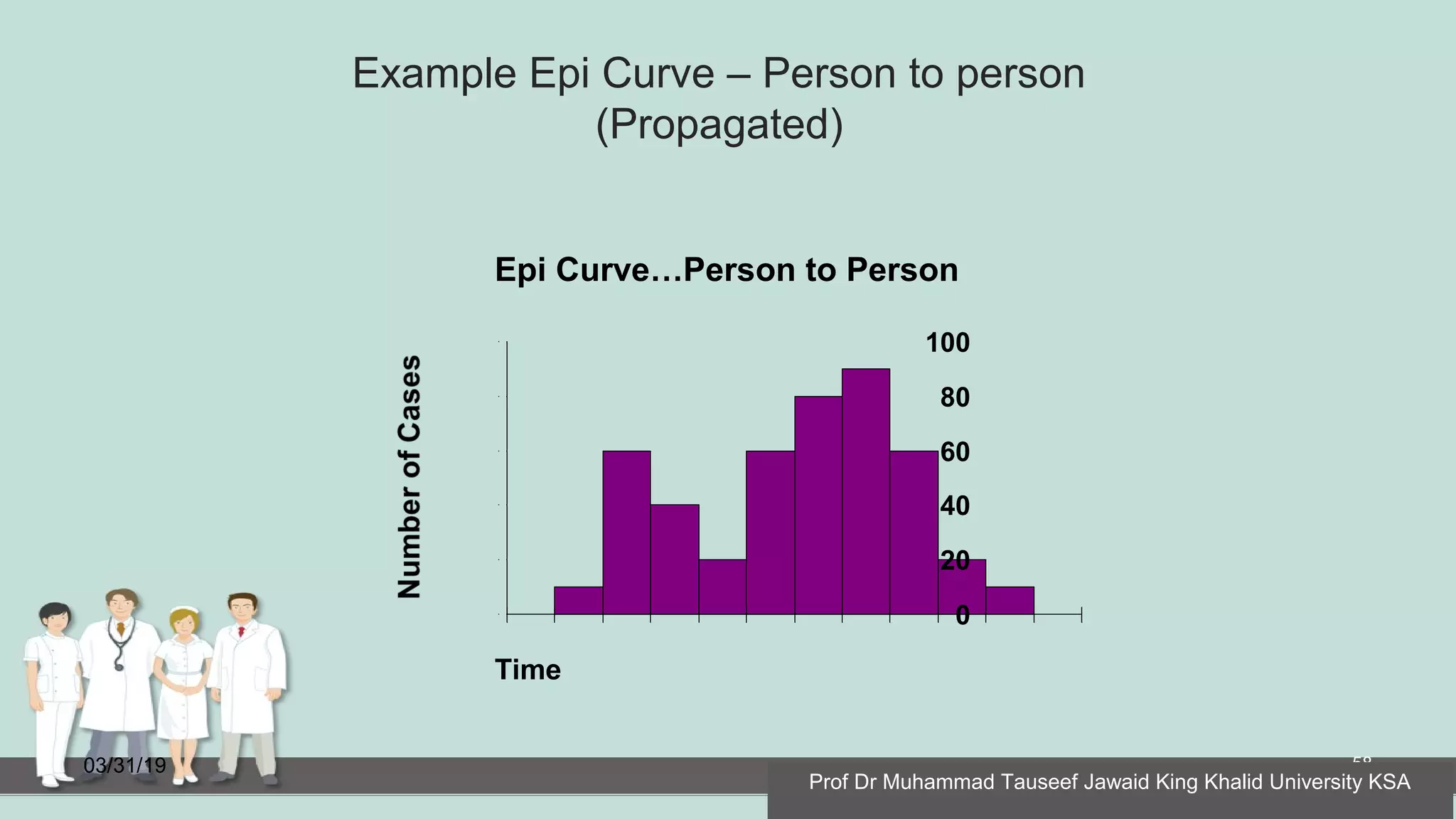
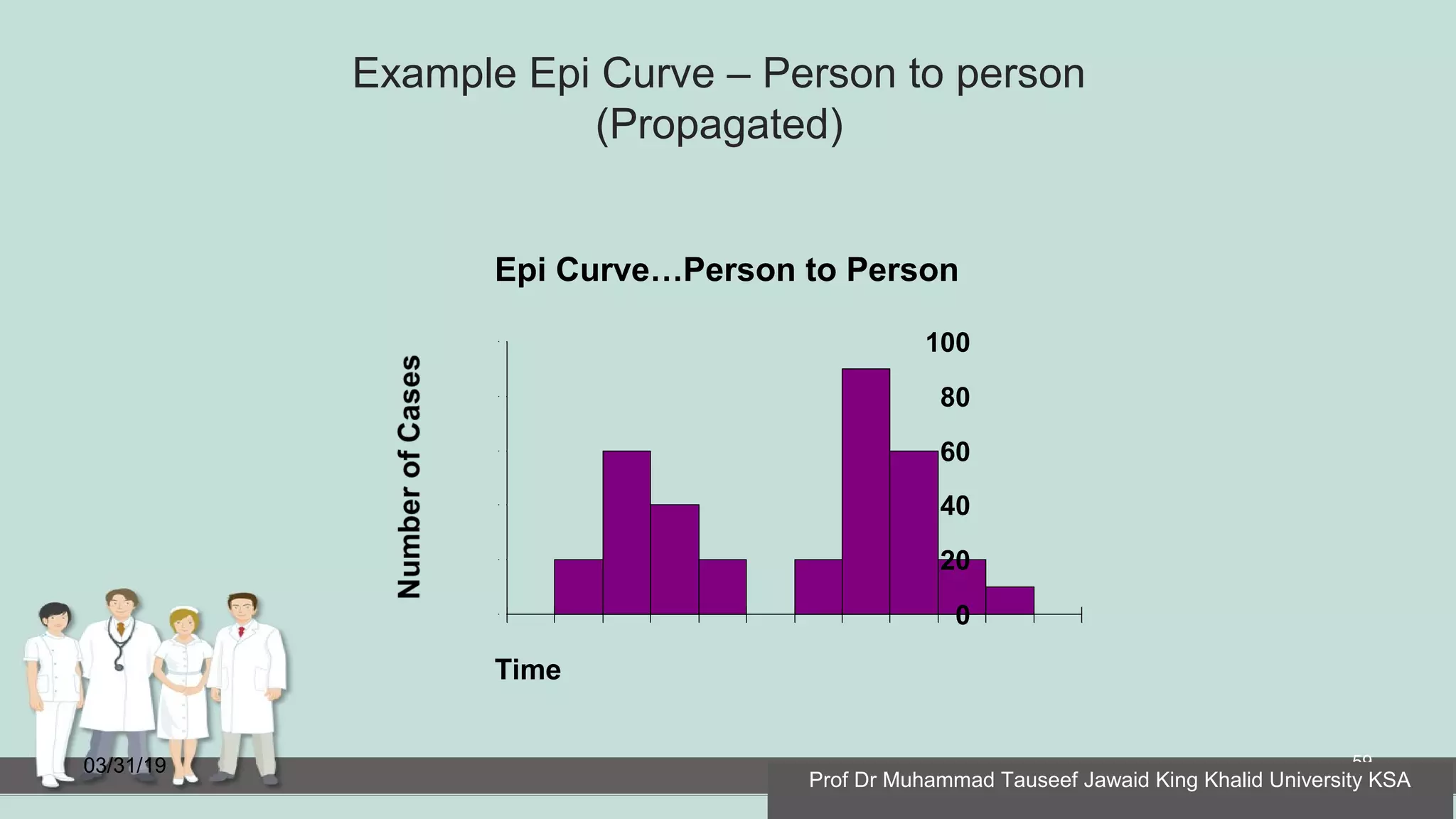
• Propagated (person-to-person)
– Progressively taller peaks, an incubation period apart
– Person to person transmission
– May last a long time
– May have multiple waves
Prof Dr Muhammad Tauseef Jawaid King Khalid University KSA
Example Epi Curve – Person to person
(Propagated)
03/31/19 58
Epi Curve…Person to Person
100
80
60
40
20
0
Time
Prof Dr Muhammad Tauseef Jawaid King Khalid University KSA
Example Epi Curve – Person to person
(Propagated)
03/31/19 59
Epi Curve…Person to Person
100
80
60
40
20
0
Time
Prof Dr Muhammad Tauseef Jawaid King Khalid University KSA
Example Epi Curve – Person to person
(Propagated)
03/31/19 60
Epi Curve…Person to Person
100
80
60
40
20
0
Time
Prof Dr Muhammad Tauseef Jawaid King Khalid University KSA
Perform Descriptive Epidemiology
03/31/19 61
• Epi curve: visual representation of
– Ill persons (cases) over time
– Magnitude of outbreak
– Type of outbreak
• Point source
• Propagated (person-to-person)
– Exposure period / Time of exposure (if agent known)
– Incubation period
– Possible agents (if time of exposure known)
Prof Dr Muhammad Tauseef Jawaid King Khalid University KSA
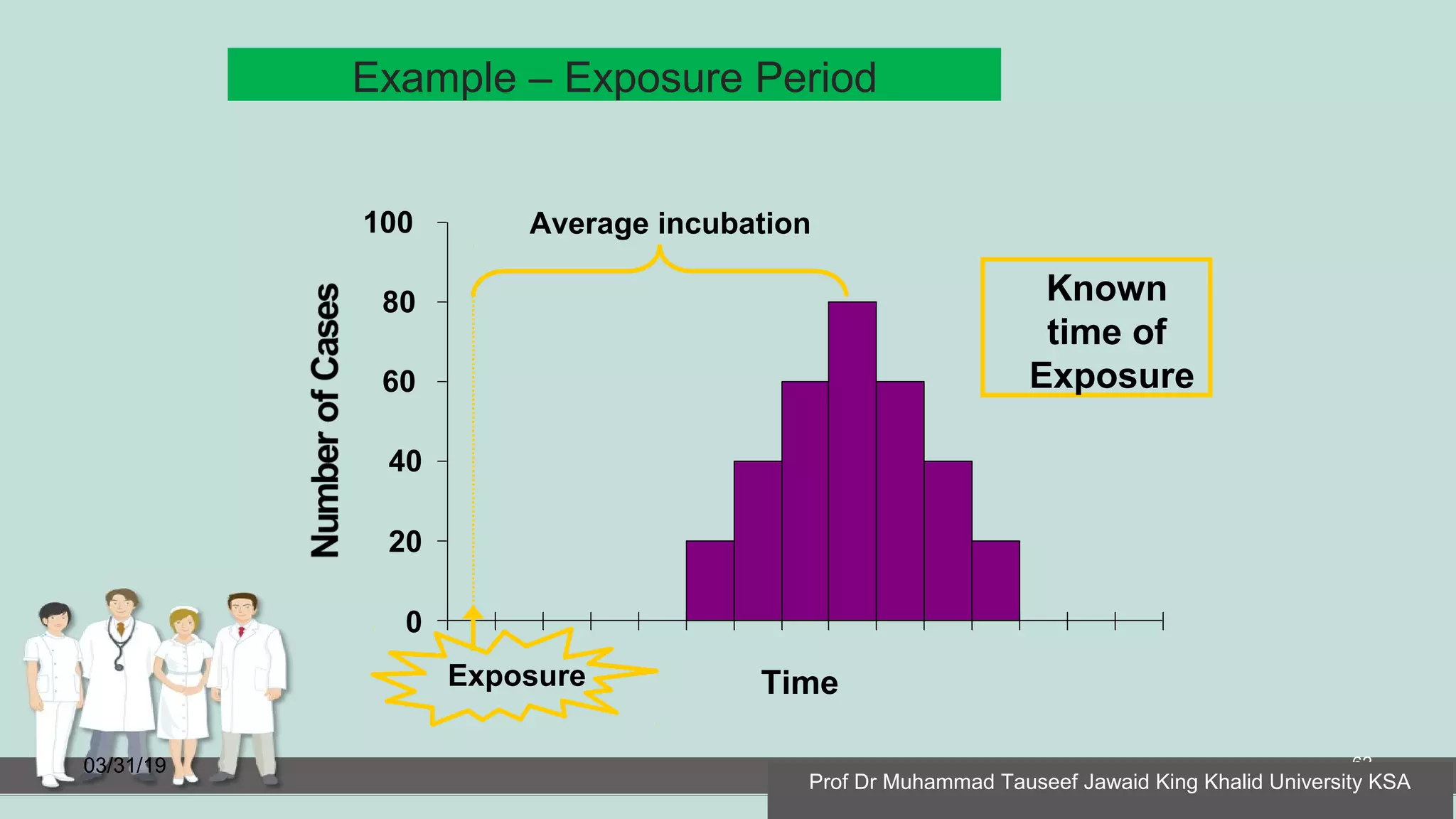
Example – Exposure Period
03/31/19 62
40
20
0
60
80
100
Time
Known
time of
Exposure
Average incubation
Exposure
Prof Dr Muhammad Tauseef Jawaid King Khalid University KSA
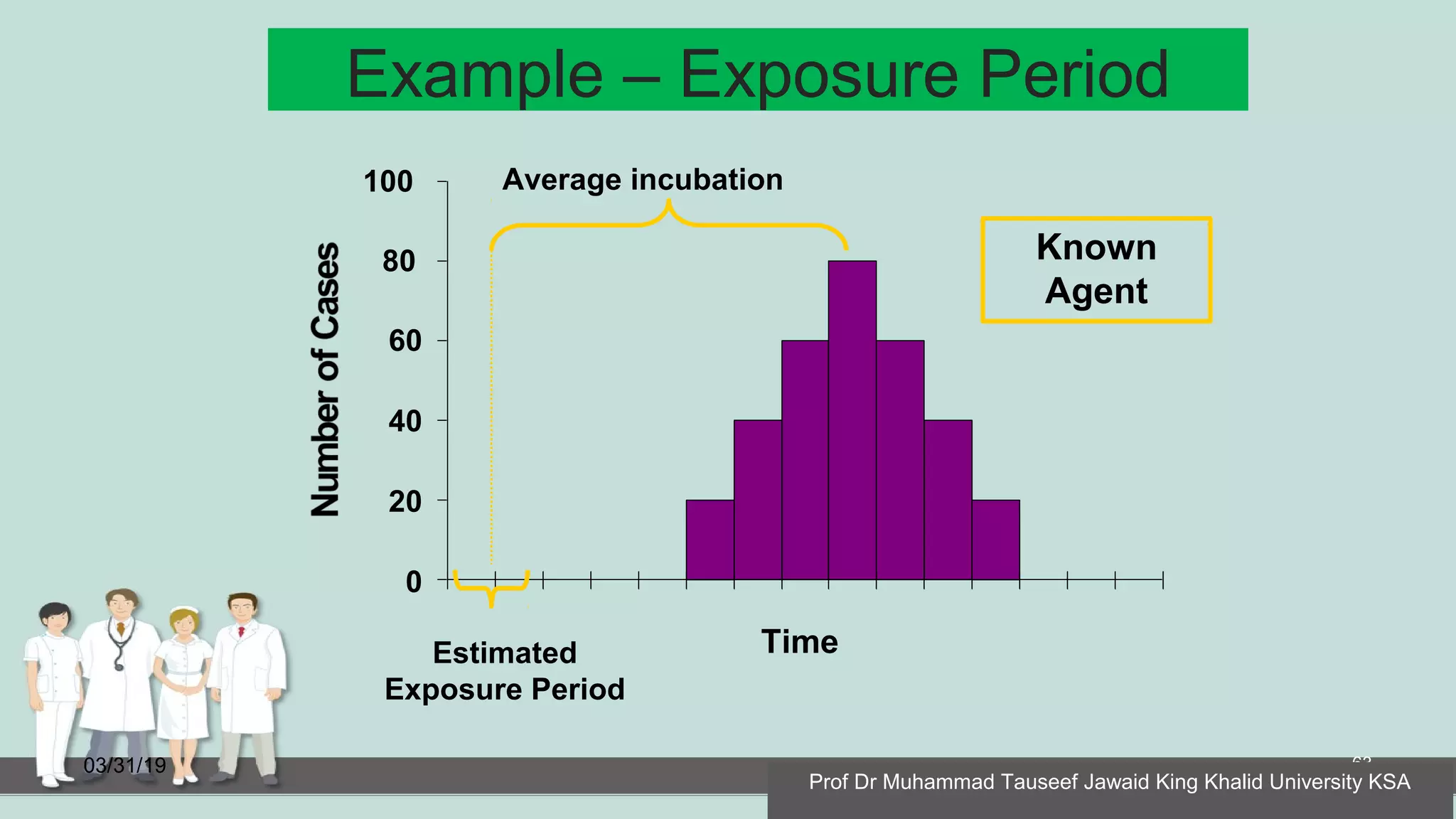
Example – Exposure Period
03/31/19 63
60
40
20
0
80
100
Time
Known
Agent
Average incubation
Estimated
Exposure Period
Prof Dr Muhammad Tauseef Jawaid King Khalid University KSA
Place (spot map, shaded map)
• Geographic extent of problem
• Clusters or patterns providing important etiologic
clues
• Spot maps
– Where cases live, work or may have been exposed
03/31/19 64
Prof Dr Muhammad Tauseef Jawaid King Khalid University KSA
Person (Tables)
• Determine what population at risk
• Usually define population by host characteristics or
exposure
• Use rates to identify high-risk groups
– Numerator = number of cases
– Denominator = number of people at risk
03/31/19 65
Prof Dr Muhammad Tauseef Jawaid King Khalid University KSA
Develop Hypotheses
 Hypotheses should address
 Source of the agent
 Mode of transmission
 Vector or vehicle
 Exposure that caused disease
03/31/19 66
Prof Dr Muhammad Tauseef Jawaid King Khalid University KSA
Develop Hypotheses
03/31/19
• What are hypotheses?
– Statements which help us describe why and how the
outbreak occurred
• How do you generate hypotheses?
– Examine descriptive epidemiology: line list, epi-
curve
– Administer open-ended questionnaire to cases
– Review the existing body of knowledge
Prof Dr Muhammad Tauseef Jawaid King Khalid University KSA
Develop Hypotheses
03/31/19
•Questions to ask yourself:
– What is the agent’s usual reservoir
– How is the agent usually transmitted
– What vehicles are commonly implicated
– What are the known risk factors
– In discussions with ill persons, what possible exposures were in
common
Prof Dr Muhammad Tauseef Jawaid King Khalid University KSA
Example – Develop Hypothesis
03/31/19
• Case and clinical information:
– Acute gastroenteritis
– Most aged 14 – 18 years
– 307 ill persons (cases)
– Onset of illness: 12am Feb 12 – 10am Feb 14
• Common exposures:
– Attending youth conference
Prof Dr Muhammad Tauseef Jawaid King Khalid University KSA
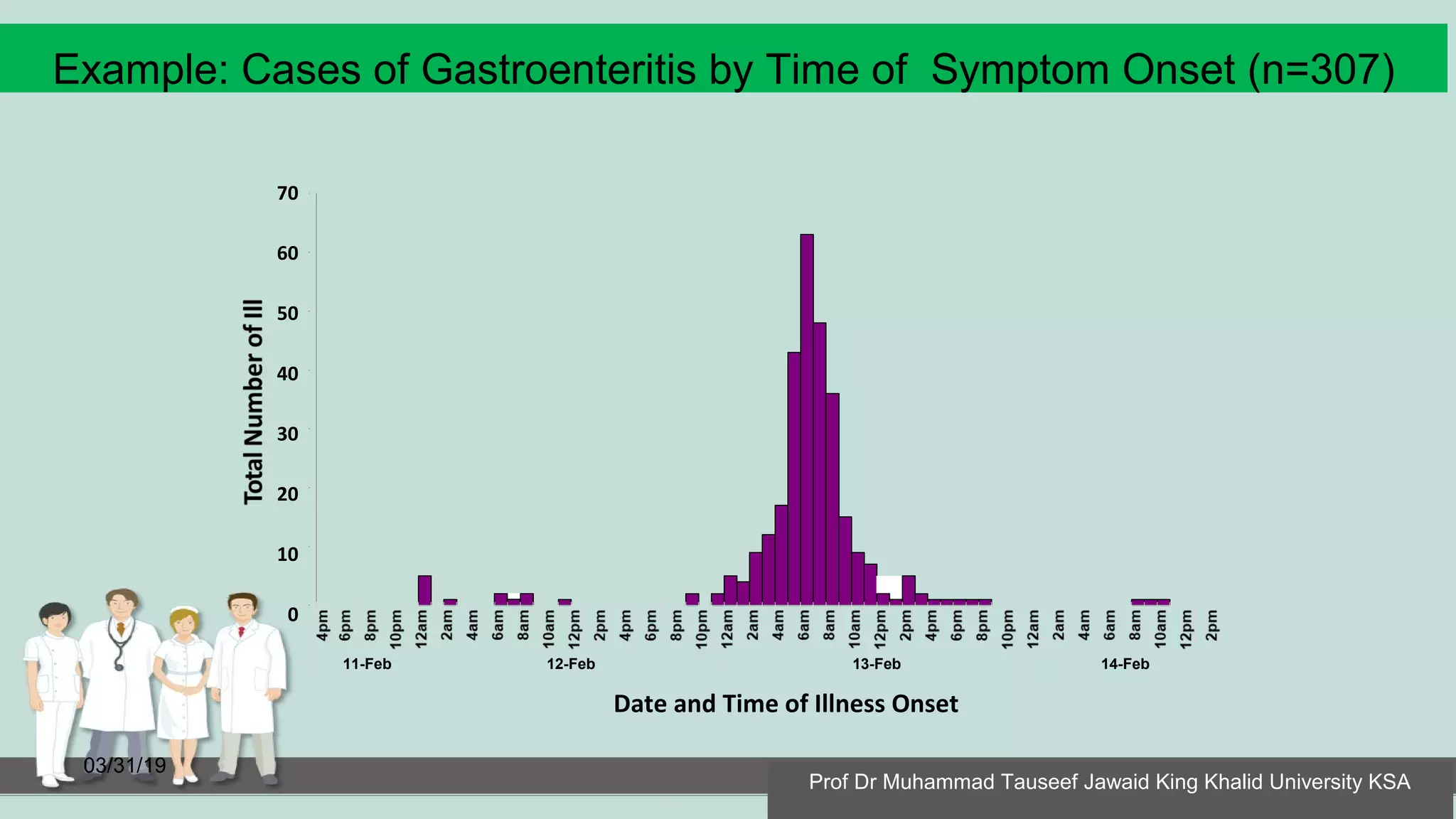
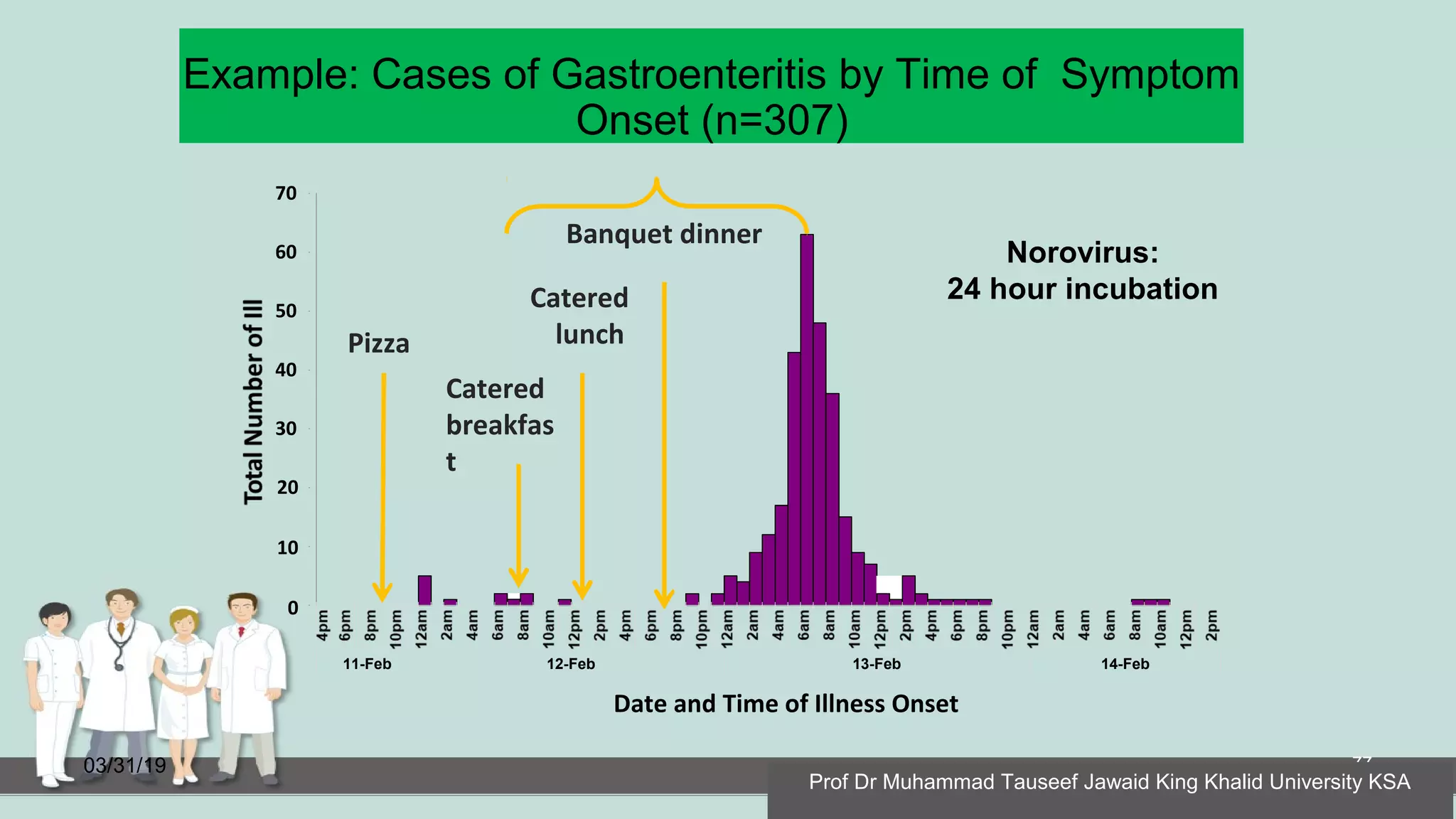
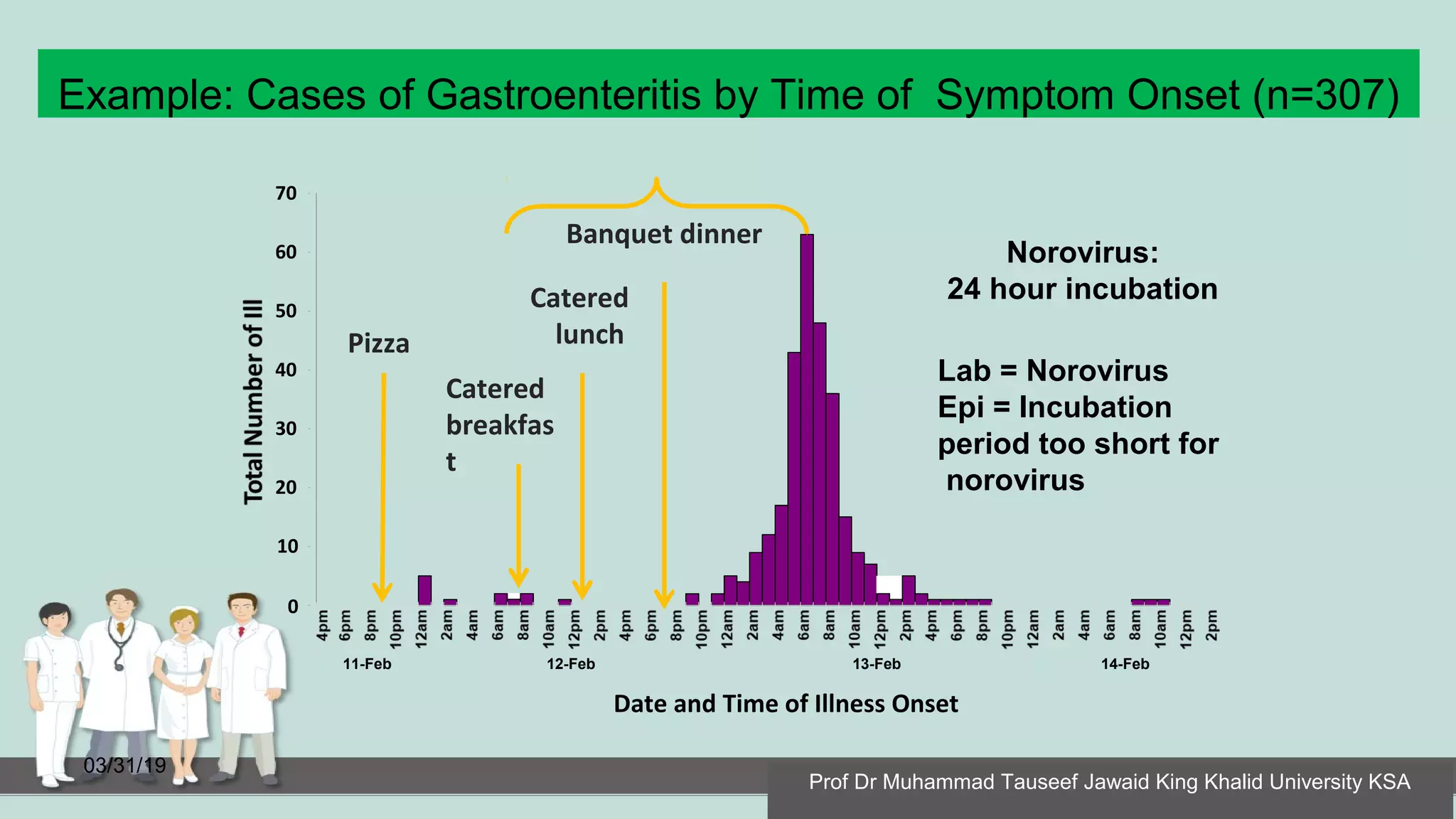
Example: Cases of Gastroenteritis by Time of Symptom Onset (n=307)
03/31/19
70
60
50
40
30
20
10
0
11-Feb 12-Feb 13-Feb 14-Feb
Date and Time of Illness Onset
Prof Dr Muhammad Tauseef Jawaid King Khalid University KSA
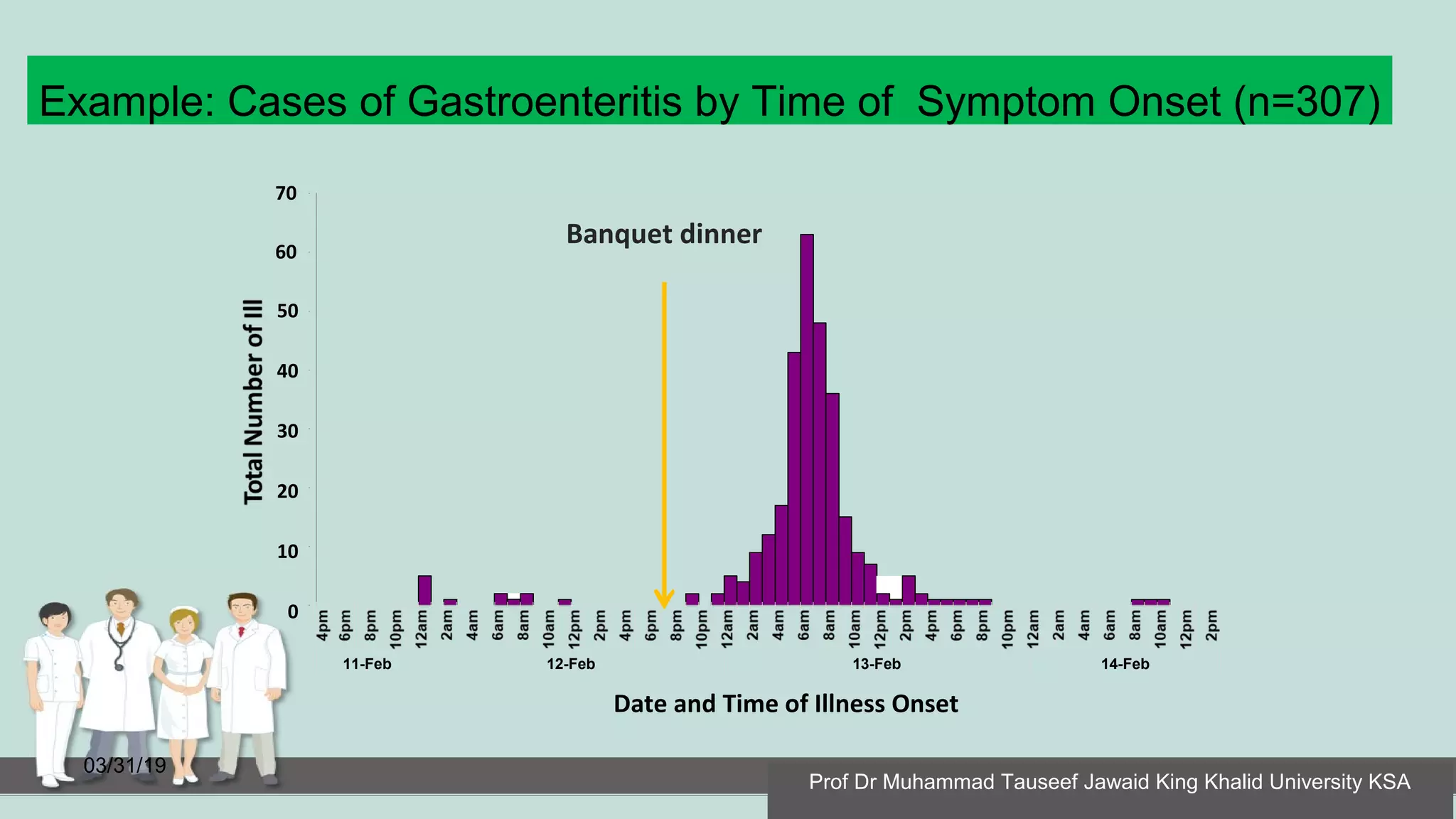
Example: Cases of Gastroenteritis by Time of Symptom Onset (n=307)
03/31/19
50
40
30
20
10
0
60
70
11-Feb 12-Feb 13-Feb 14-Feb
Date and Time of Illness Onset
Banquet dinner
Prof Dr Muhammad Tauseef Jawaid King Khalid University KSA
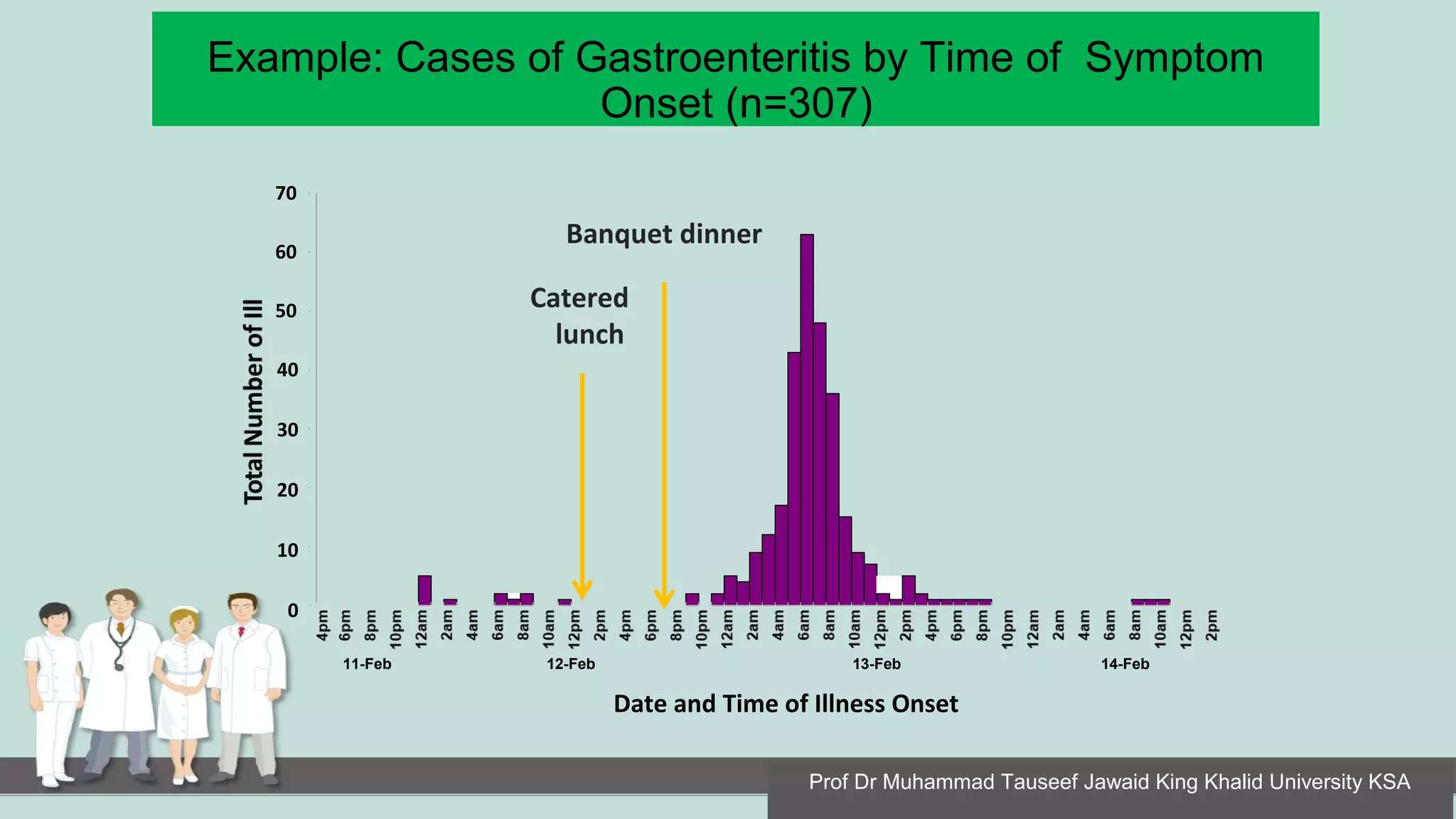
Example: Cases of Gastroenteritis by Time of Symptom
Onset (n=307)
40
30
20
10
0
50
60
70
11-Feb 12-Feb 13-Feb 14-Feb
Date and Time of Illness Onset
Banquet dinner
Catered
lunch
Prof Dr Muhammad Tauseef Jawaid King Khalid University KSA
Example: Cases of Gastroenteritis by Time of Sym
Onset (n=307)
03/31/19
20
10
0
30
40
50
60
70
11-Feb 12-Feb 13-Feb 14-Feb
Date and Time of Illness Onset
Banquet dinner
Catered
lunch
Catered
breakfas
t
Prof Dr Muhammad Tauseef Jawaid King Khalid University KSA
Example: Cases of Gastroenteritis by Time of Sym
Onset (n=307)
03/31/19
20
10
0
30
40
50
60
70
11-Feb 12-Feb 13-Feb 14-Feb
Date and Time of Illness Onset
Banquet dinner
Catered
lunch
Catered
breakfas
t
Pizza
Prof Dr Muhammad Tauseef Jawaid King Khalid University KSA
Example: Cases of Gastroenteritis by Time of Sym
Onset (n=307)
03/31/19
20
10
0
30
40
50
60
70
11-Feb 12-Feb 13-Feb 14-Feb
Date and Time of Illness Onset
Banquet dinner
Catered
lunch
Catered
breakfas
t
Pizza
Laboratory
Testing
Prof Dr Muhammad Tauseef Jawaid King Khalid University KSA
Example: Cases of Gastroenteritis by Time of Sym
Onset (n=307)
03/31/19
20
10
0
30
40
50
60
70
11-Feb 12-Feb 13-Feb 14-Feb
Date and Time of Illness Onset
Banquet dinner
Catered
lunch
Catered
breakfas
t
Pizza
Laboratory
Testing 4 / 9
norovirus +
Prof Dr Muhammad Tauseef Jawaid King Khalid University KSA
Example: Cases of Gastroenteritis by Time of Symptom
Onset (n=307)
03/31/19 77
20
10
0
30
40
50
60
70
11-Feb 12-Feb 13-Feb 14-Feb
Date and Time of Illness Onset
Banquet dinner
Catered
lunch
Catered
breakfas
t
Pizza
Norovirus:
24 hour incubation
Prof Dr Muhammad Tauseef Jawaid King Khalid University KSA
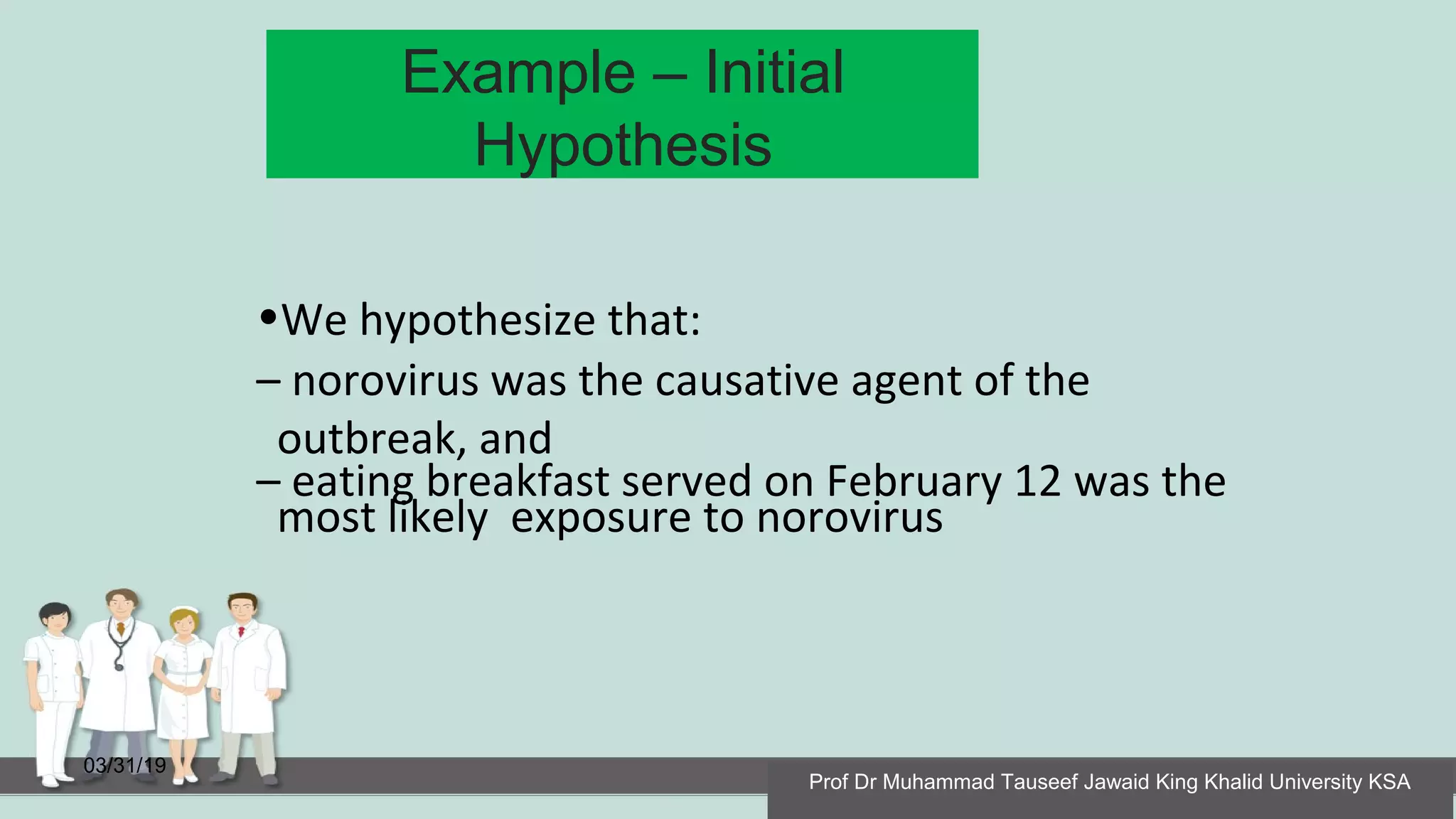
Example – Initial
Hypothesis
03/31/19
•We hypothesize that:
– norovirus was the causative agent of the
outbreak, and
– eating breakfast served on February 12 was the
most likely exposure to norovirus
Prof Dr Muhammad Tauseef Jawaid King Khalid University KSA
Example: Cases of Gastroenteritis by Time of Symptom
Onset (n=307)
20
10
0
30
40
50
60
70
11-Feb 12-Feb 13-Feb 14-Feb
Date and Time of Illness Onset
Banquet dinner
Catered
lunch
Catered
breakfas
t
Pizza
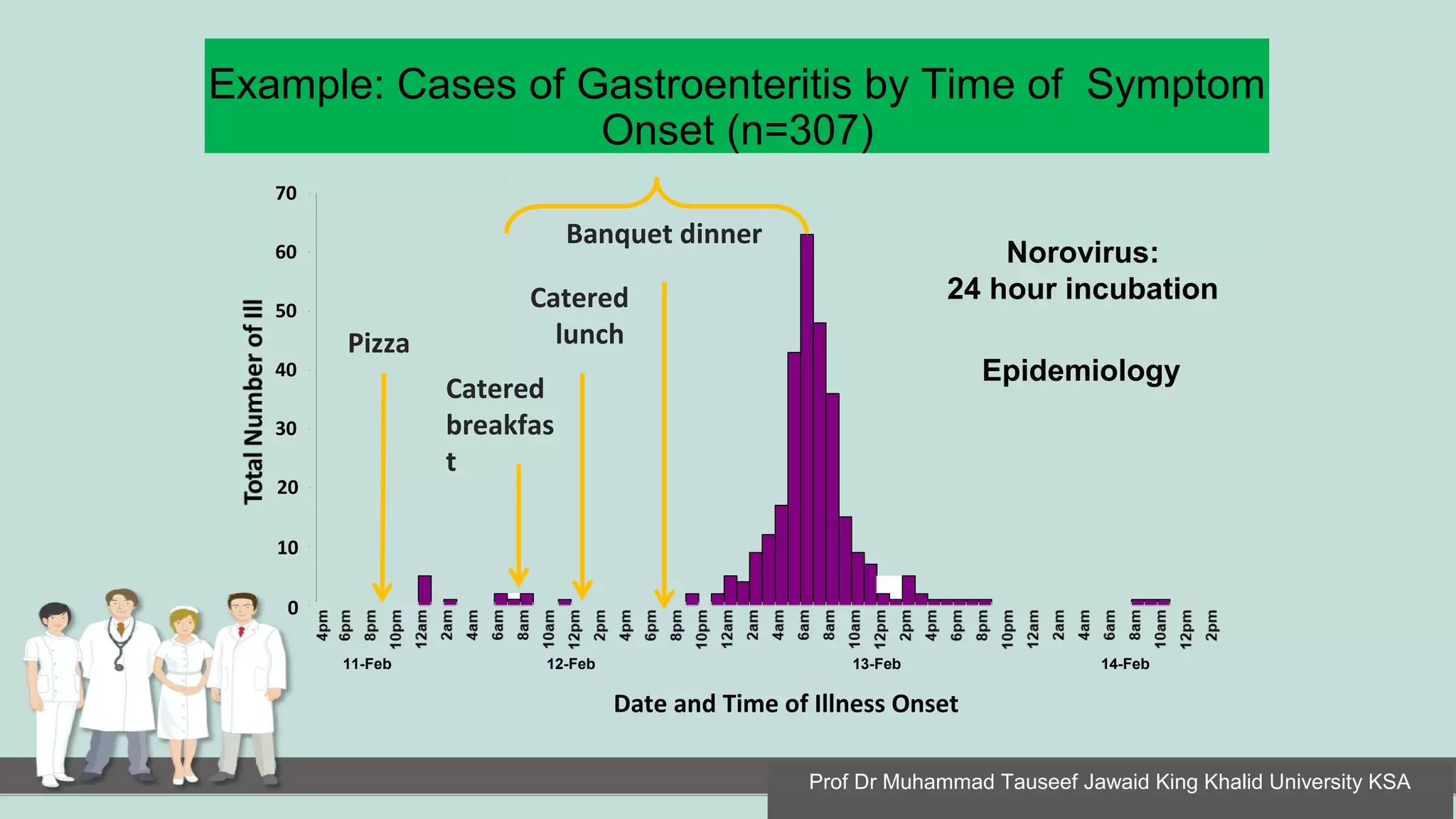
Epidemiology
Norovirus:
24 hour incubation
Prof Dr Muhammad Tauseef Jawaid King Khalid University KSA
Example: Cases of Gastroenteritis by Time of Symptom
Onset (n=307)
03/31/19
20
10
0
30
40
50
60
70
11-Feb 12-Feb 13-Feb 14-Feb
Date and Time of Illness Onset
Banquet dinner
Catered
lunch
Catered
breakfas
t
Pizza
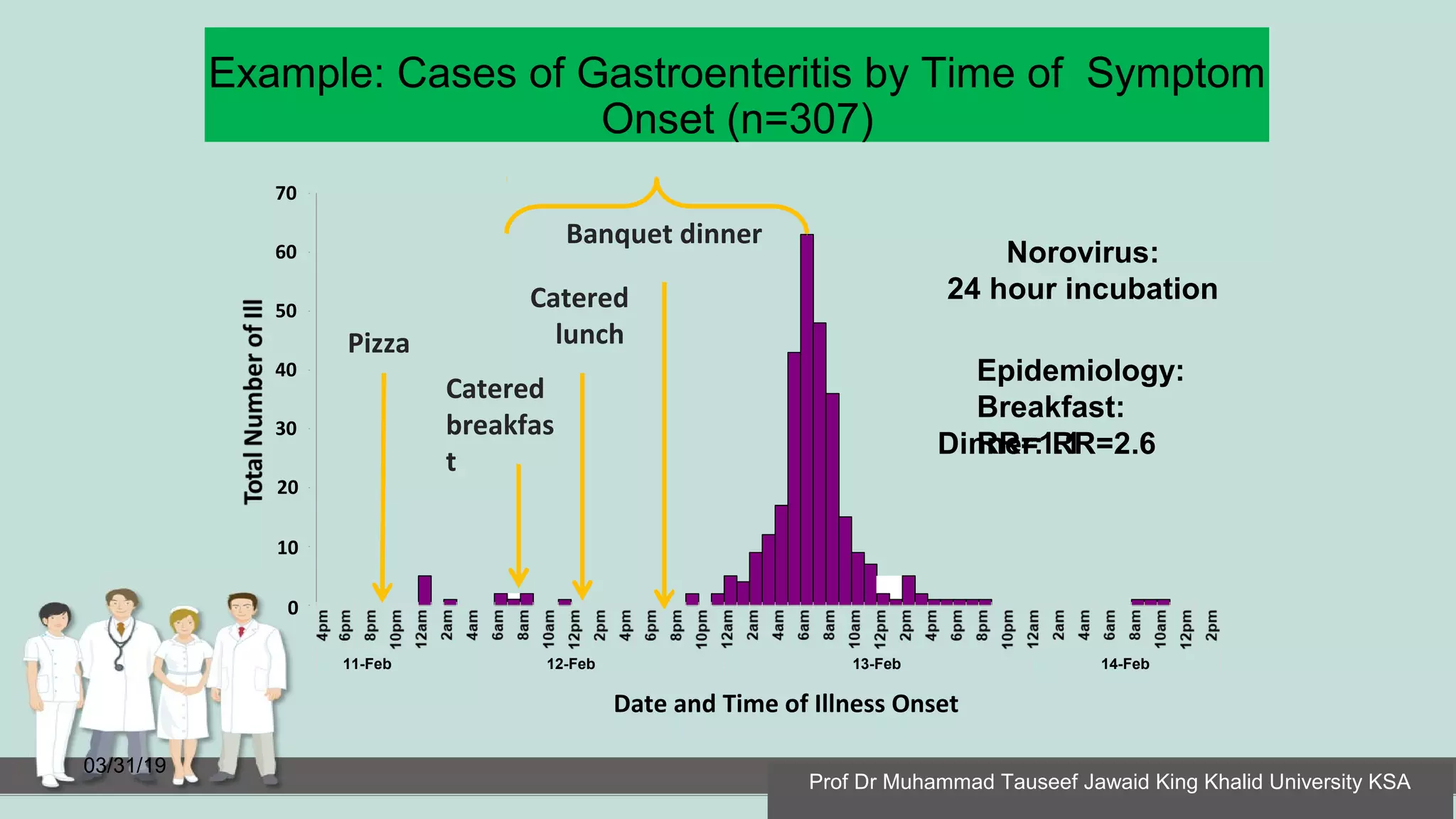
Epidemiology:
Breakfast:
RR=1.1Dinner: RR=2.6
Norovirus:
24 hour incubation
Prof Dr Muhammad Tauseef Jawaid King Khalid University KSA
Example: Cases of Gastroenteritis by Time of Symptom Onset (n=307)
03/31/19
10
0
20
30
40
50
60
70
11-Feb 12-Feb 13-Feb 14-Feb
Date and Time of Illness Onset
Banquet dinner
Catered
lunch
Catered
breakfas
t
Pizza
Lab = Norovirus
Epi = Incubation
period too short for
norovirus
Norovirus:
24 hour incubation
Prof Dr Muhammad Tauseef Jawaid King Khalid University KSA
Example: Cases of Gastroenteritis by Time of Symptom
Onset (n=307)
03/31/19
20
10
0
30
40
50
60
70
11-Feb 12-Feb 13-Feb 14-Feb
Date and Time of Illness Onset
Banquet dinner
Catered
lunch
Catered
breakfas
t
Pizza
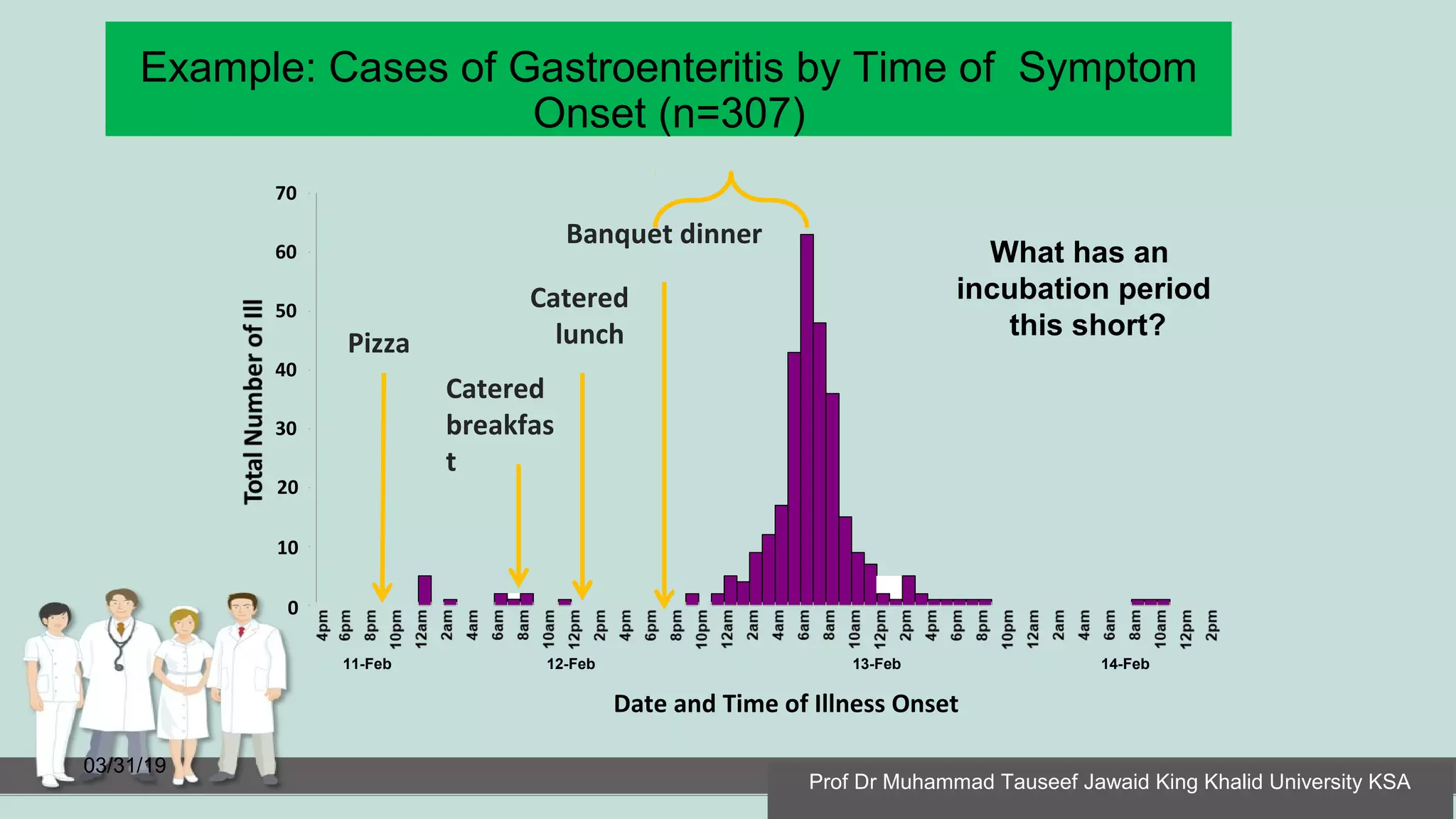
What has an
incubation period
this short?
Prof Dr Muhammad Tauseef Jawaid King Khalid University KSA
Norovirus Infection
03/31/19
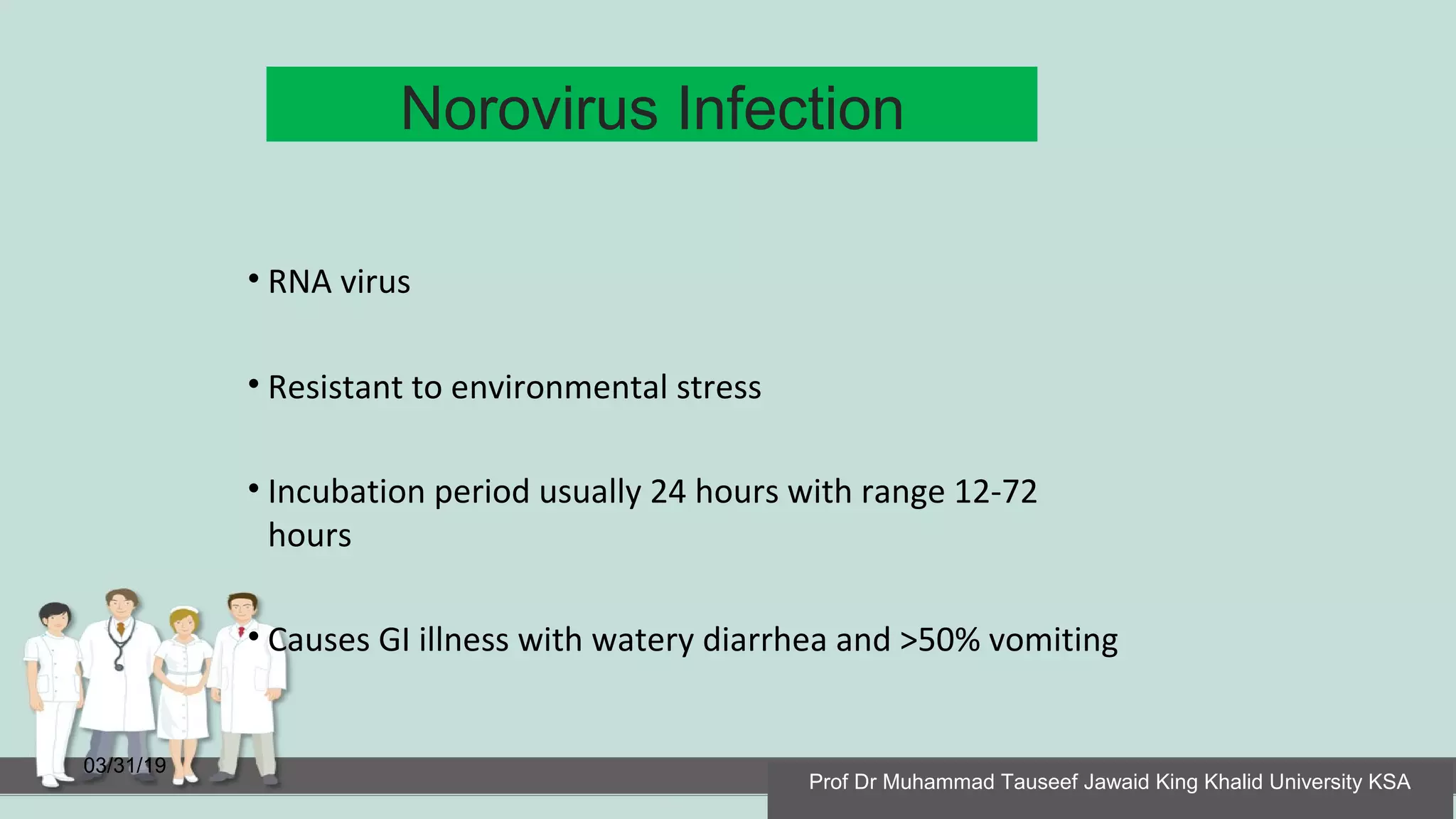
• RNA virus
• Resistant to environmental stress
• Incubation period usually 24 hours with range 12-72
hours
• Causes GI illness with watery diarrhea and >50% vomiting
Prof Dr Muhammad Tauseef Jawaid King Khalid University KSA
Clostridium perfringens
Toxicoinfection
03/31/19
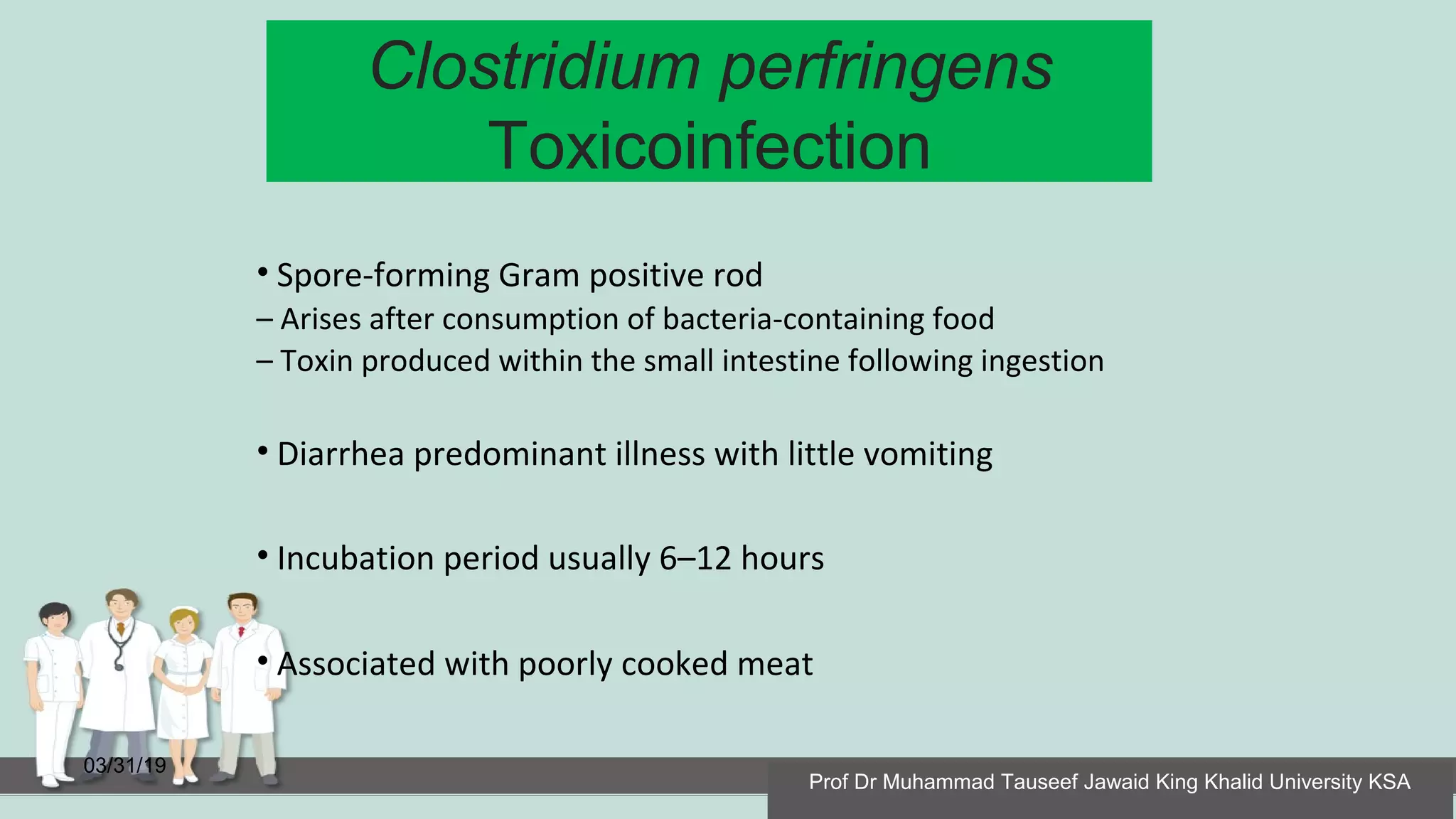
• Spore-forming Gram positive rod
– Arises after consumption of bacteria-containing food
– Toxin produced within the small intestine following ingestion
• Diarrhea predominant illness with little vomiting
• Incubation period usually 6–12 hours
• Associated with poorly cooked meat
Prof Dr Muhammad Tauseef Jawaid King Khalid University KSA
Example – Additional Lab
Information
03/31/19
• Norovirus testing
– Reverse transcription PCR (RT-PCR)
– Sent to CDC for confirmation
• Clostridium perfringens enterotoxin
testing
– Oxoid toxin detection kit
– PCR
Prof Dr Muhammad Tauseef Jawaid King Khalid University KSA
Example – Additional Lab
Information
03/31/19
• Testing did not confirm the presence of norovirus
• After 4 weeks at 4°C, stool tested for Clostridium
perfringens
enterotoxin
– Toxin present in 8 of 9 specimens tested
– Enterotoxin gene detected in 5 of 6 specimens tested
Prof Dr Muhammad Tauseef Jawaid King Khalid University KSA
Example – Final
Hypothesis
03/31/19
•We hypothesize that:
– Clostridium perfringens toxicoinfection was the causative agent
of this point source outbreak
– Associated with consumption of inappropriately-cooked
chicken at the dinner served on February 12
Prof Dr Muhammad Tauseef Jawaid King Khalid University KSA
Develop Hypotheses
03/31/19
• Questions to ask yourself regarding
hypothesis:
– Is hypothesis stated in a way that can be ‘tested’
– Does it address:
• agent
• vehicle / source
• mode of transmission
• exposure that caused illness
Prof Dr Muhammad Tauseef Jawaid King Khalid University KSA
Test the Hypothesis
03/31/19
•We hypothesize that:
–Clostridium perfringens toxicoinfection was the causative
agent of this point source outbreak
–Associated with consumption of inappropriately-cooked
chicken at the dinner served on February 12
•Testable
•Agent
•Vehicle or source of agent
•Mode of transmission
•Exposure
Prof Dr Muhammad Tauseef Jawaid King Khalid University KSA
Evaluate Hypotheses
03/31/19 90
• Two methods:
– Compare hypothesis with established facts
– Perform additional studies (e.g., analytic)
• Cohort or case-control
• Assess exposures equally among ill and non-ill persons
Prof Dr Muhammad Tauseef Jawaid King Khalid University KSA
Evaluate Hypotheses
03/31/19 91
•Compare hypothesis with established facts
– Evidence is so strong that hypothesis does not need to be tested
– E.g., Salmonella Paratyphi B with PFGE pattern .1228 (the
outbreak strain) isolated from unpasteurized tempeh
– E.g., norovirus identified in a nursing home; norovirus is known
to be circulating in the community
Prof Dr Muhammad Tauseef Jawaid King Khalid University KSA
7. Perform Additional Studies
Used when the relationship between exposure and
disease is less clear
Prof Dr Muhammad Tauseef Jawaid King Khalid University KSA
Value of Analytic Studies
03/31/19
•Support for specific public health action (e.g., recall)
•Describe new diseases, learn more about known
diseases
•Address public and political concern
•Develop strategies to prevent future outbreaks
•Fulfillment of legal obligations and duty of care for
the public
Prof Dr Muhammad Tauseef Jawaid King Khalid University KSA
Perform Additional Studies
03/31/19
•Cohort
– Able to identify every person in group (‘cohort’)
– Possible when group is well defined
– Include EVERYONE who could have been exposed
• E.g., Meeting attendees, students, wedding reception,
LTCF residents
Prof Dr Muhammad Tauseef Jawaid King Khalid University KSA
Perform Additional Studies
03/31/19 95
•Case-control
– Compare exposures among ill persons (case) and non-ill persons (controls)
– Used when a complete list is not available or too large
– Controls are sample of same population from which cases
arose (e.g., source population)
• E.g., same city, attend same restaurant
– If a control had developed illness, would have been included as
a case
Prof Dr Muhammad Tauseef Jawaid King Khalid University KSA
10. Implement Control /Prevention
Measures
• Implement control measures as soon as possible
• May be aimed at agent, source, or reservoir
– eliminate the source
– interrupt transmission
– reduce susceptibility
• Create mechanism to evaluate both short and long-term
effectiveness of control / prevention measures
03/31/19 96
Prof Dr Muhammad Tauseef Jawaid King Khalid University KSA
Implement Control Measures
03/31/19
•Required response from public health
•Can occur at any point during the outbreak
•Prevent further exposure, future outbreaks
•Should be guided by epidemiologic results in
conjunction with environmental investigation
•Performed in conjunction with DPH, regulators,
industry, other agencies
•Balance between preventing further disease,
protecting credibility and reputation of institution
•Identify one person to communicate control measures
Prof Dr Muhammad Tauseef Jawaid King Khalid University KSA
Example – Control Measures
03/31/19
• Summary:
– Attendees at a youth conference
• > 1,000 attendees
• 307 ill persons (cases)
– Clostridium perfringens toxicoinfection
– Associated with inappropriately cooked chicken
• Recommended control measures?
Prof Dr Muhammad Tauseef Jawaid King Khalid University KSA
11. Communicate Findings
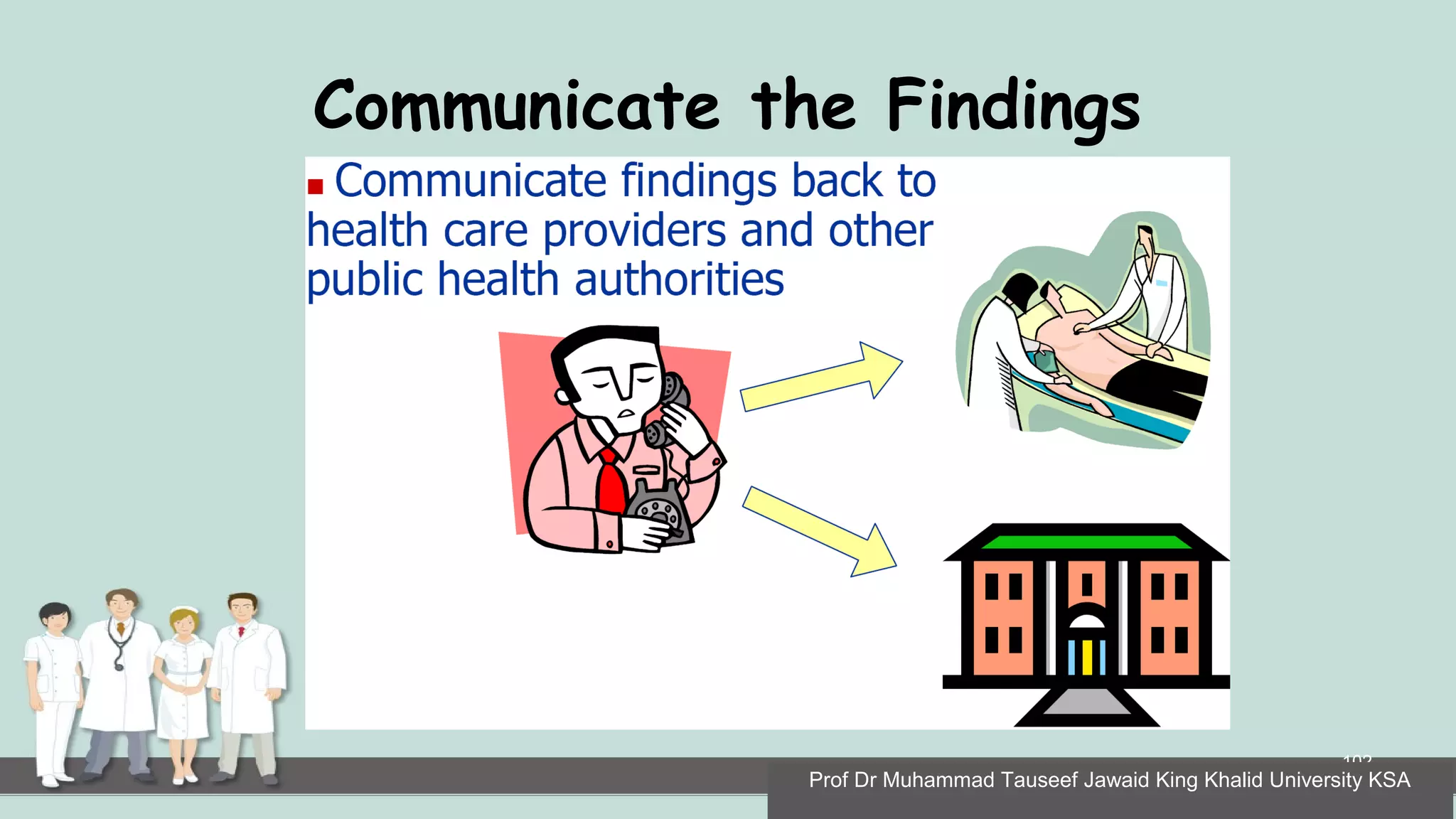
• Oral briefing for local authorities
– Local health authorities and persons responsible for
implementation of control and prevention measures
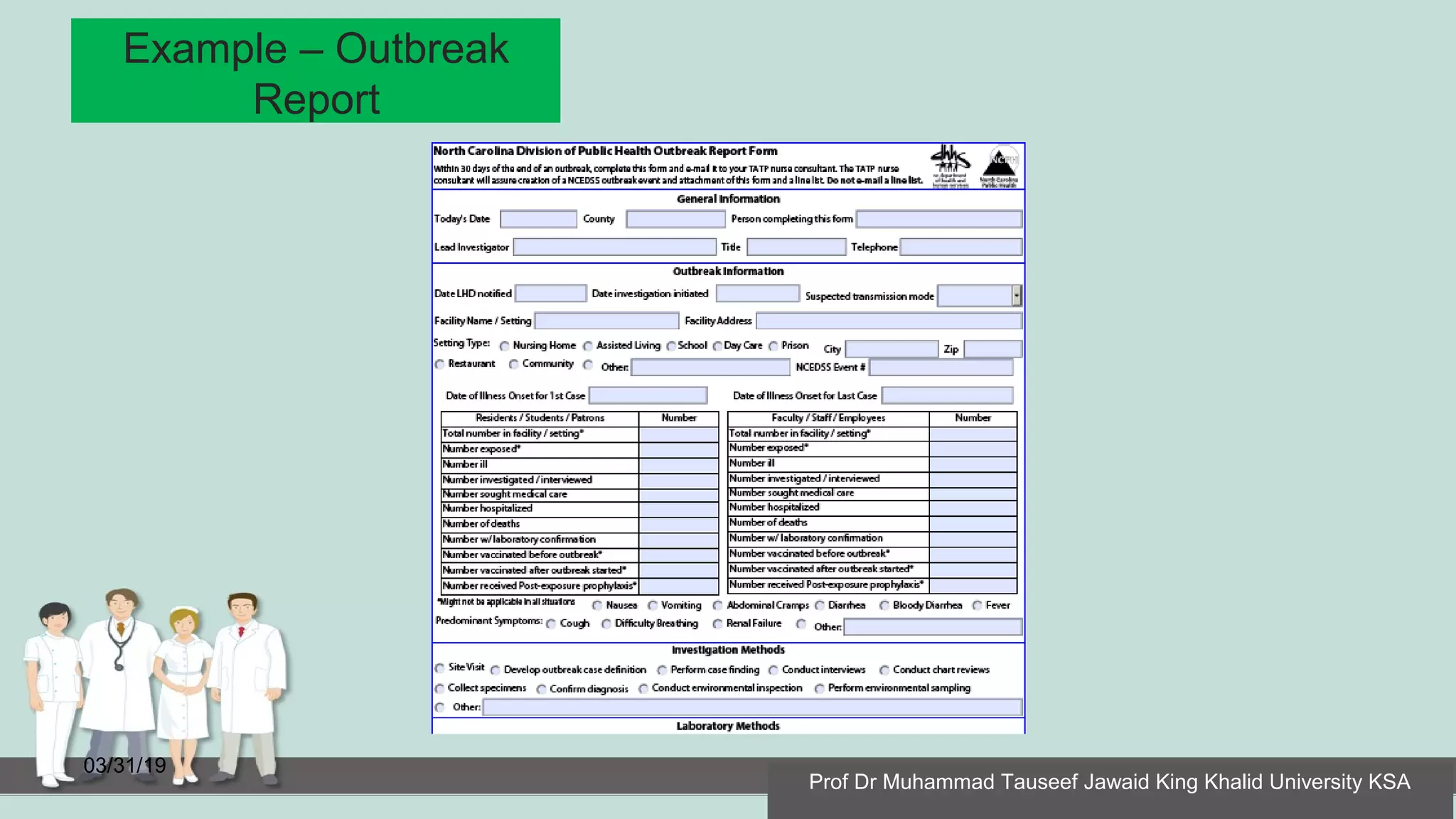
• Written reports;
– that follows intro, background, methods, results, discussion
and recommendations.
03/31/19 99
Prof Dr Muhammad Tauseef Jawaid King Khalid University KSA
Communicate Findings
03/31/19 100
•Public and media:
– Single member of team should interact with media,
communicate progress and findings
– Media attention desirable if public action is needed
– Response to media attention important to address public
concerns about outbreak
– Opportunity to educate community
– Single overriding communication objective (SOCO)
Prof Dr Muhammad Tauseef Jawaid King Khalid University KSA
Communicate Findings
03/31/19
• Daily updates (Situation Reports)
–Narrative
• Number of persons ill
• Number of persons potentially exposed (if known)
• Range of onset dates
• Type of symptoms
• Available laboratory results
• Number hospitalized / died
• Actions already taken
–Action Items
• Summary of recommendations and plans for surveillance, control
Prof Dr Muhammad Tauseef Jawaid King Khalid University KSA
Communicate the Findings
102
Prof Dr Muhammad Tauseef Jawaid King Khalid University KSA
Example – Outbreak
Report
03/31/19
Prof Dr Muhammad Tauseef Jawaid King Khalid University KSA
Maintain Surveillance
03/31/19 Prof Dr Muhammad Tauseef Jawaid King Khalid
University KSA
104
126
•Evaluate / document effectiveness of control measures
•To ensure outbreak is over
•To ensure secondary outbreak is not occurring
•It is recommended to maintain surveillance for 2
average incubation periods following the last date of
illness onset
Prof Dr Muhammad Tauseef Jawaid King Khalid University KSA
Conclusions
03/31/19 Prof Dr Muhammad Tauseef Jawaid King Khalid
University KSA
•Epidemiologic investigations essential component of
public health, present opportunities to:
– Characterize diseases
– Identify populations at risk
– Evaluate programs, policies, or existing prevention strategies
– Train public health staff
– Educate the public
– Fulfill legal obligations and duty of care for the public
•10 steps provide systematic framework necessary to
investigate any outbreak
Prof Dr Muhammad Tauseef Jawaid King Khalid University KSA
References
 Michael Gregg. Field Epidemiology. 2nd
edition. Oxford University Press, 2012.
 Control of Communicable Disease in Man,
17th edition. Chin, J (ed). APHA, 2010.
 Principles & Practice of Infectious Diseases,
5th edition. Mandell GL, Bennett JE, Dolin R
(eds). Churchill Livingstone; 2010
03/31/19 106
Prof Dr Muhammad Tauseef Jawaid King Khalid University KSA

OUT BREAK INVESTIGATION

  • 1.
  • 2.
    Goals • The goalsof this presentation are to: – Provide a general overview of the basic steps of disease outbreak investigations – Describe factors that may contribute to a decision to investigate 03/31/19 Prof Dr Muhammad Tauseef Jawaid King Khalid University KSA 2 Prof Dr Muhammad Tauseef Jawaid King Khalid University KSA
  • 3.
    Outbreak • A suddenincrease in the number of individuals who contact a specific infectious disease in a population, putting others at risk. OR • Spread of disease, which occurs in a short period of time and in a limited geographic location (i.e, neighborhood, community, school, or hospital) 03/31/19 Prof Dr Muhammad Tauseef Jawaid King Khalid University KSA 3 Prof Dr Muhammad Tauseef Jawaid King Khalid University KSA
  • 4.
    Why investigate anoutbreak? • Characterize a public health problem • Identify preventable risk factors • Provide new research insights into disease • Train health department staff in methods of public health investigations and emergency response 03/31/19 Prof Dr Muhammad Tauseef Jawaid King Khalid University KSA 4 Prof Dr Muhammad Tauseef Jawaid King Khalid University KSA
  • 5.
    When to Investigate 03/31/19Prof Dr Muhammad Tauseef Jawaid King Khalid University KSA 5 •Consider the following factors: – Severity of illness – Transmissibility – Unanswered questions – Ongoing illness / exposure – Public concern – Prevention potential Prof Dr Muhammad Tauseef Jawaid King Khalid University KSA
  • 6.
    Outbreak Investigations • Threecritical variables in investigating an outbreak or epidemic are: –When did the exposure take place? –When did the disease begin? –What was the incubation period for the disease? 03/31/19 Prof Dr Muhammad Tauseef Jawaid King Khalid University KSA 6 Prof Dr Muhammad Tauseef Jawaid King Khalid University KSA
  • 7.
    In the Beginning… Successful investigations require a multidisciplinary approach, effective communication and collaboration  Steps:  Assemble team members  Present available information  Outline plan for investigation and team communication  Assign roles and responsibilities 03/31/19 Prof Dr Muhammad Tauseef Jawaid King Khalid University KSA 7 Prof Dr Muhammad Tauseef Jawaid King Khalid University KSA
  • 8.
    Prepare for FieldWork 03/31/19 Prof Dr Muhammad Tauseef Jawaid King Khalid University KSA 8 •Identification of team •Gather resources, supplies, equipment – Computer, questionnaires, specimen collection kits •Make necessary administrative, personal arrangements for travel – Determine role in the investigation – Identify points of contact (field and office) •What do you need to do to prepare? Prof Dr Muhammad Tauseef Jawaid King Khalid University KSA
  • 9.
    Team Member Roles Team Leader  Experience in outbreak investigation and epidemiology  Selection can be result of outbreak setting or etiologic agent  Role can be filled by:  County health director,  Public health nurse,  Epidemiologist, or  Environmental health specialist  Role may change depending on stage of investigation 03/31/19 Prof Dr Muhammad Tauseef Jawaid King Khalid University KSA 9 Prof Dr Muhammad Tauseef Jawaid King Khalid University KSA
  • 10.
    Team Member Roles Epidemiologist  Develop study design and survey questionnaires  Create database and conduct data analysis 03/31/19 Prof Dr Muhammad Tauseef Jawaid King Khalid University KSA 10 Prof Dr Muhammad Tauseef Jawaid King Khalid University KSA
  • 11.
    Team Member Roles Microbiologist  Verify the diagnosis  Subtype pathogens to help refine case definition 03/31/19 Prof Dr Muhammad Tauseef Jawaid King Khalid University KSA 11 Prof Dr Muhammad Tauseef Jawaid King Khalid University KSA
  • 12.
    Team Member Roles Environmental health specialists (EHS)  Collect food and environmental samples  Provide guidance on food safety regulations and engineering 03/31/19 Prof Dr Muhammad Tauseef Jawaid King Khalid University KSA 12 Prof Dr Muhammad Tauseef Jawaid King Khalid University KSA
  • 13.
    Team Member Roles Interviewers  Collect data in person or by telephone  Role can be filled by health department personnel, state or federal personnel, or health science students 03/31/19 Prof Dr Muhammad Tauseef Jawaid King Khalid University KSA 13 Prof Dr Muhammad Tauseef Jawaid King Khalid University KSA
  • 14.
    Team Member Roles Clinicians  Administer vaccines or prophylaxis  Collect clinical specimens  Role can be filled by health department or local medical community  May include veterinarians, depending on type of outbreak 03/31/19 Prof Dr Muhammad Tauseef Jawaid King Khalid University KSA 14 Prof Dr Muhammad Tauseef Jawaid King Khalid University KSA
  • 15.
    Team Member Roles Regulators  Facilitate identification of the source of outbreak and develop prevention strategies  Role can be filled by state or federal agency employees 03/31/19 Prof Dr Muhammad Tauseef Jawaid King Khalid University KSA 15 Prof Dr Muhammad Tauseef Jawaid King Khalid University KSA
  • 16.
    Team Member Roles Media Spokesperson  Deliver clear and consistent messages to community  Role can be filled by one outbreak team member or representatives from each agency 03/31/19 Prof Dr Muhammad Tauseef Jawaid King Khalid University KSA 16 Prof Dr Muhammad Tauseef Jawaid King Khalid University KSA
  • 17.
    Questions to Consider What resources, including personnel, are available?  What resources could be provided by outside collaborators?  Who will direct the day-to-day investigation? 03/31/19 Prof Dr Muhammad Tauseef Jawaid King Khalid University KSA 17 Prof Dr Muhammad Tauseef Jawaid King Khalid University KSA
  • 18.
    More Questions toConsider  Who will interact with the media?  How will data be shared and analyzed?  Who will write the final report and present the information?  How will the team communicate with each other? 03/31/19 Prof Dr Muhammad Tauseef Jawaid King Khalid University KSA 18 Prof Dr Muhammad Tauseef Jawaid King Khalid University KSA
  • 19.
    Team Equipment • Computerwith access to internet – Email communication – Literature searches (PUBMED) – Data entry and analysis (Epi-Info 2002 http://www.cdc.gov/epiinfo/epiinfo.htm) – Written reports 03/31/19 Prof Dr Muhammad Tauseef Jawaid King Khalid University KSA 19 Prof Dr Muhammad Tauseef Jawaid King Khalid University KSA
  • 20.
    Team Equipment • Specimencollection tools – Rectal swabs or specimen cups – Phlebotomy equipment – Cooler to transport specimens 03/31/19 Prof Dr Muhammad Tauseef Jawaid King Khalid University KSA 20 Prof Dr Muhammad Tauseef Jawaid King Khalid University KSA
  • 21.
    Communication • Information flowsin both directions – Leader should update the team during meetings, conference calls, or email – Members provide regular updates to team leader • Acts as tool for measuring progress • Enables leader to provide feedback and direction to team members 03/31/19 Prof Dr Muhammad Tauseef Jawaid King Khalid University KSA 21 Prof Dr Muhammad Tauseef Jawaid King Khalid University KSA
  • 22.
    Communication • Keep linesof communication open through regular meetings or phone – Include local, state, and federal public health agencies • Document progress – Allows all members to remain up-to-date – Assists in drafting final report 03/31/19 Prof Dr Muhammad Tauseef Jawaid King Khalid University KSA 22 Prof Dr Muhammad Tauseef Jawaid King Khalid University KSA
  • 23.
    Steps of anOutbreak Investigation 03/31/19 23 Prof Dr Muhammad Tauseef Jawaid King Khalid University KSA
  • 24.
    Steps of anOutbreak Investigation 1. Preparation 2. Confirm the existence of outbreak 3. Verify the diagnosis 4. Establish a case definition 5. Find cases systematically & record information 6. Perform descriptive epidemiology 7. Develop hypotheses 8. Evaluate hypotheses epidemiologically 9. As necessary, reconsider, refine, and re-evaluate hypotheses. 10.Implement control and prevention measures 11. Communicate findings 03/31/19 Prof Dr Muhammad Tauseef Jawaid King Khalid University KSA 24 Prof Dr Muhammad Tauseef Jawaid King Khalid University KSA
  • 25.
    1. Preparation • Investigation –Scientific knowledge • Review literature • Consult experts • Sample questionnaires – Supplies • Consult with laboratory – Equipment • Laptop, camera etc. 03/31/19 Prof Dr Muhammad Tauseef Jawaid King Khalid University KSA 25 Prof Dr Muhammad Tauseef Jawaid King Khalid University KSA
  • 26.
    2. Establish existenceof an outbreak • Is an outbreak truly occurred? – through surveillance records for notifiable diseases. – hospital data. – data from other facilities – community survey. 03/31/19 Prof Dr Muhammad Tauseef Jawaid King Khalid University KSA 26 Prof Dr Muhammad Tauseef Jawaid King Khalid University KSA
  • 27.
    2. Establish Existenceof an Outbreak 03/31/19 Prof Dr Muhammad Tauseef Jawaid King Khalid University KSA 27 • For non-notifiable conditions: – National estimates – Hospital discharge records – Mortality data – Other available records – Use data from neighboring areas – Call local health care providers – Call community members Prof Dr Muhammad Tauseef Jawaid King Khalid University KSA
  • 28.
    Example: Establish Existenceof an Outbreak 03/31/19 Prof Dr Muhammad Tauseef Jawaid King Khalid University KSA 28 An Outbreak...To Be or Not To Be 100 80 60 40 20 0 Time Prof Dr Muhammad Tauseef Jawaid King Khalid University KSA
  • 29.
    Example: Establish Existenceof an Outbreak 03/31/19 Prof Dr Muhammad Tauseef Jawaid King Khalid University KSA 29 An Outbreak...To Be or Not To Be 100 80 60 40 20 0 Time Prof Dr Muhammad Tauseef Jawaid King Khalid University KSA
  • 30.
    3. Verify theDiagnosis • Ensure proper diagnosis and rule out lab error as the bias for increased diagnosis – Review clinical findings, lab results 03/31/19 Prof Dr Muhammad Tauseef Jawaid King Khalid University KSA 30 Prof Dr Muhammad Tauseef Jawaid King Khalid University KSA
  • 31.
    Verify the Diagnosis cont. •See and talk with patients if at all possible – Better understand clinical features – Gather critical information • Source of exposure • What they think caused illness • Knowledge of others with similar illness • Helpful in generating ideas for hypothesis about etiology and spread 03/31/19 Prof Dr Muhammad Tauseef Jawaid King Khalid University KSA 31 Prof Dr Muhammad Tauseef Jawaid King Khalid University KSA
  • 32.
    4. Establish acase definition • Case definition – Includes clinical criteria and restrictions by time, place and person • Classification – Definite (confirmed) • Laboratory confirmed – Probable • Typical clinical features without lab confirmation – Possible (suspected) • Fewer of the typical clinical features 03/31/19 Prof Dr Muhammad Tauseef Jawaid King Khalid University KSA 32 Prof Dr Muhammad Tauseef Jawaid King Khalid University KSAProf Dr Muhammad Tauseef Jawaid King Khalid University KSA
  • 33.
    Meningococcal Disease —Case Definition Clinical case definition • An illness with sudden onset of fever (>38.5°C rectal or >38.0°C axillary) and one or more of the following: neck stiffness, altered consciousness, other meningeal sign or petechial or puerperal rash. Laboratory criteria for diagnosis • Positive cerebrospinal fluid (CSF) antigen detection or positive culture. 03/31/19 Prof Dr Muhammad Tauseef Jawaid King Khalid University KSA 33 Prof Dr Muhammad Tauseef Jawaid King Khalid University KSA
  • 34.
    Case classification • Suspected: Acase that meets the clinical case definition. • Probable: A suspected case as defined above and turbid CSF (with or without positive Gram stain) or ongoing epidemic and epidemiological link to a confirmed case. • Confirmed: A suspected or probable case with laboratory confirmation. 03/31/19 Prof Dr Muhammad Tauseef Jawaid King Khalid University KSA 34
  • 35.
    Example: Case Definition forHepatitis A • Confirmed case: – Anti-HAV IgM+ • Probable case: – Pale skin • Suspect case: – Any two of the following: – Abdominal pain, fever, nausea, anorexia, malaise 03/31/19 Prof Dr Muhammad Tauseef Jawaid King Khalid University KSA 35
  • 36.
    5. Find casessystematically & record information • Target health care facilities where diagnosis is likely to be made – Enhanced passive surveillance e.g. letter describing situation and asking for reports. – Active surveillance e.g. phone or visit facility to collect information • Alerting the public – Media alert to avoid contaminated food products and seek medical attention if symptoms arise. 03/31/19 Prof Dr Muhammad Tauseef Jawaid King Khalid University KSA 36
  • 37.
    5. Find casessystematically & record information contd…. • Identifying information • Name, address, and telephone number is essential if need to contact patients additional questions. • Also to Notify them of lab results and outcomes of investigation • Names also helps in checking for duplicate records while addresses allow for Mapping the geographic extent. – Demographic information. • Provide “person” characteristics for defining population at risk 03/31/19 Prof Dr Muhammad Tauseef Jawaid King Khalid University KSA 37
  • 38.
    5. Find casessystematically & record information contd…. • Clinical findings • Signs and symptoms allow to Verify that the case definition has been met • Date of onset is needed to Chart the time course of outbreak. – Reporter information • Id of person making report 03/31/19 Prof Dr Muhammad Tauseef Jawaid King Khalid University KSA 38
  • 39.
    5. Find casessystematically & record information contd…. • Line listing – Abstraction of selected critical items from above information 03/31/19 Prof Dr Muhammad Tauseef Jawaid King Khalid University KSA 39
  • 40.
    What is aLine Listing? • A rectangular database similar to spreadsheet • Provides summary of key data about cases in an outbreak • Each row represents one case • Each column represents one variable • First column usually identifier —name, initials, or ID number • Can be paper or electronic • Can be quickly reviewed and updated 03/31/19 Prof Dr Muhammad Tauseef Jawaid King Khalid University KSA 40
  • 41.
    Develop Line List IdentifyingInformation Prof Dr Muhammad Tauseef Jawaid King Khalid University KSA
  • 42.
    Example of aLine Listing 03/31/19 Prof Dr Muhammad Tauseef Jawaid King Khalid University KSA 42
  • 43.
    Develop Line List ClinicalInformation Prof Dr Muhammad Tauseef Jawaid King Khalid University KSA
  • 44.
    Develop Line List Laboratory& Case Classification Information 52 Prof Dr Muhammad Tauseef Jawaid King Khalid University KSA
  • 45.
    Develop Line List ExposureInformation Prof Dr Muhammad Tauseef Jawaid King Khalid University KSA
  • 46.
    6. Perform DescriptiveEpidemiology • After collection of data characterize the outbreak by: –Time –Place –Person 03/31/19 46 Prof Dr Muhammad Tauseef Jawaid King Khalid University KSA
  • 47.
    Perform Descriptive Epidemiology 03/31/1947 • What and why –Provides systematic method –Characterize, or describe what has occurred –Person, place, time useful for developing hypotheses • Components –Line list –Epi curve –Others, but we will focus on line list and epi-curve Prof Dr Muhammad Tauseef Jawaid King Khalid University KSA
  • 48.
    Tabulate and orientdata  Create line listing  Person  Who was infected?  What do the cases have in common?  Place  Where were they infected?  May be useful to draw a map  Time  When were they infected?  Create an epidemic curve 03/31/19 48 Prof Dr Muhammad Tauseef Jawaid King Khalid University KSA
  • 49.
    Time (Epidemic curve) •Epidemic curve – Histogram of the number of cases by their date of onset – Visual display of the outbreak’s magnitude and time trend – Common source vs. Propagated 03/31/19 49 Prof Dr Muhammad Tauseef Jawaid King Khalid University KSA
  • 50.
    Perform Descriptive Epidemiology 03/31/1950 Line List• Person • Place • Time Epidemic curve (‘Epi curve’) Prof Dr Muhammad Tauseef Jawaid King Khalid University KSA
  • 51.
    Perform Descriptive Epidemiology 03/31/1951 • Epi curve: visual representation of – Ill persons (cases) over time – Magnitude of outbreak – Type of outbreak • Point source • Propagated (person-to-person) – Exposure period / Time of exposure (if agent known) – Incubation period – Possible agents (if time of exposure known) Prof Dr Muhammad Tauseef Jawaid King Khalid University KSA
  • 52.
    Perform Descriptive Epidemiology 03/31/1952 • How do I make an epi curve? – Number of cases on the vertical (y) axis – Time period (or date of illness onset) on the horizontal (x) axis Prof Dr Muhammad Tauseef Jawaid King Khalid University KSA
  • 53.
    Example – Xand Y axis 03/31/19 53 0 20 100 80 60 40 Y- axis Time X-axis Prof Dr Muhammad Tauseef Jawaid King Khalid University KSA
  • 54.
    Perform Descriptive Epidemiology 03/31/1954 •How do I choose the correct unit of time? – Depends upon the incubation period – If incubation period is not known, graph several epi-curves with different time units Prof Dr Muhammad Tauseef Jawaid King Khalid University KSA
  • 55.
    Example Epi Curve– Time Unit (Day) 03/31/19 55 100 80 60 40 20 0 1-Apr 3-Apr 5-Apr 7-Apr 9-Apr 11-Apr 13-Apr 15-Apr 17-Apr Time Prof Dr Muhammad Tauseef Jawaid King Khalid University KSA
  • 56.
    Example Epi Curve– Time Unit (Hours) 03/31/19 56 100 80 60 40 20 0 6am 12N 6pm 12M N 6am 12N 6pm 12M N Time April 9 April 10 Prof Dr Muhammad Tauseef Jawaid King Khalid University KSA
  • 57.
    Perform Descriptive Epidemiology 03/31/1957 • Propagated (person-to-person) – Progressively taller peaks, an incubation period apart – Person to person transmission – May last a long time – May have multiple waves Prof Dr Muhammad Tauseef Jawaid King Khalid University KSA
  • 58.
    Example Epi Curve– Person to person (Propagated) 03/31/19 58 Epi Curve…Person to Person 100 80 60 40 20 0 Time Prof Dr Muhammad Tauseef Jawaid King Khalid University KSA
  • 59.
    Example Epi Curve– Person to person (Propagated) 03/31/19 59 Epi Curve…Person to Person 100 80 60 40 20 0 Time Prof Dr Muhammad Tauseef Jawaid King Khalid University KSA
  • 60.
    Example Epi Curve– Person to person (Propagated) 03/31/19 60 Epi Curve…Person to Person 100 80 60 40 20 0 Time Prof Dr Muhammad Tauseef Jawaid King Khalid University KSA
  • 61.
    Perform Descriptive Epidemiology 03/31/1961 • Epi curve: visual representation of – Ill persons (cases) over time – Magnitude of outbreak – Type of outbreak • Point source • Propagated (person-to-person) – Exposure period / Time of exposure (if agent known) – Incubation period – Possible agents (if time of exposure known) Prof Dr Muhammad Tauseef Jawaid King Khalid University KSA
  • 62.
    Example – ExposurePeriod 03/31/19 62 40 20 0 60 80 100 Time Known time of Exposure Average incubation Exposure Prof Dr Muhammad Tauseef Jawaid King Khalid University KSA
  • 63.
    Example – ExposurePeriod 03/31/19 63 60 40 20 0 80 100 Time Known Agent Average incubation Estimated Exposure Period Prof Dr Muhammad Tauseef Jawaid King Khalid University KSA
  • 64.
    Place (spot map,shaded map) • Geographic extent of problem • Clusters or patterns providing important etiologic clues • Spot maps – Where cases live, work or may have been exposed 03/31/19 64 Prof Dr Muhammad Tauseef Jawaid King Khalid University KSA
  • 65.
    Person (Tables) • Determinewhat population at risk • Usually define population by host characteristics or exposure • Use rates to identify high-risk groups – Numerator = number of cases – Denominator = number of people at risk 03/31/19 65 Prof Dr Muhammad Tauseef Jawaid King Khalid University KSA
  • 66.
    Develop Hypotheses  Hypothesesshould address  Source of the agent  Mode of transmission  Vector or vehicle  Exposure that caused disease 03/31/19 66 Prof Dr Muhammad Tauseef Jawaid King Khalid University KSA
  • 67.
    Develop Hypotheses 03/31/19 • Whatare hypotheses? – Statements which help us describe why and how the outbreak occurred • How do you generate hypotheses? – Examine descriptive epidemiology: line list, epi- curve – Administer open-ended questionnaire to cases – Review the existing body of knowledge Prof Dr Muhammad Tauseef Jawaid King Khalid University KSA
  • 68.
    Develop Hypotheses 03/31/19 •Questions toask yourself: – What is the agent’s usual reservoir – How is the agent usually transmitted – What vehicles are commonly implicated – What are the known risk factors – In discussions with ill persons, what possible exposures were in common Prof Dr Muhammad Tauseef Jawaid King Khalid University KSA
  • 69.
    Example – DevelopHypothesis 03/31/19 • Case and clinical information: – Acute gastroenteritis – Most aged 14 – 18 years – 307 ill persons (cases) – Onset of illness: 12am Feb 12 – 10am Feb 14 • Common exposures: – Attending youth conference Prof Dr Muhammad Tauseef Jawaid King Khalid University KSA
  • 70.
    Example: Cases ofGastroenteritis by Time of Symptom Onset (n=307) 03/31/19 70 60 50 40 30 20 10 0 11-Feb 12-Feb 13-Feb 14-Feb Date and Time of Illness Onset Prof Dr Muhammad Tauseef Jawaid King Khalid University KSA
  • 71.
    Example: Cases ofGastroenteritis by Time of Symptom Onset (n=307) 03/31/19 50 40 30 20 10 0 60 70 11-Feb 12-Feb 13-Feb 14-Feb Date and Time of Illness Onset Banquet dinner Prof Dr Muhammad Tauseef Jawaid King Khalid University KSA
  • 72.
    Example: Cases ofGastroenteritis by Time of Symptom Onset (n=307) 40 30 20 10 0 50 60 70 11-Feb 12-Feb 13-Feb 14-Feb Date and Time of Illness Onset Banquet dinner Catered lunch Prof Dr Muhammad Tauseef Jawaid King Khalid University KSA
  • 73.
    Example: Cases ofGastroenteritis by Time of Sym Onset (n=307) 03/31/19 20 10 0 30 40 50 60 70 11-Feb 12-Feb 13-Feb 14-Feb Date and Time of Illness Onset Banquet dinner Catered lunch Catered breakfas t Prof Dr Muhammad Tauseef Jawaid King Khalid University KSA
  • 74.
    Example: Cases ofGastroenteritis by Time of Sym Onset (n=307) 03/31/19 20 10 0 30 40 50 60 70 11-Feb 12-Feb 13-Feb 14-Feb Date and Time of Illness Onset Banquet dinner Catered lunch Catered breakfas t Pizza Prof Dr Muhammad Tauseef Jawaid King Khalid University KSA
  • 75.
    Example: Cases ofGastroenteritis by Time of Sym Onset (n=307) 03/31/19 20 10 0 30 40 50 60 70 11-Feb 12-Feb 13-Feb 14-Feb Date and Time of Illness Onset Banquet dinner Catered lunch Catered breakfas t Pizza Laboratory Testing Prof Dr Muhammad Tauseef Jawaid King Khalid University KSA
  • 76.
    Example: Cases ofGastroenteritis by Time of Sym Onset (n=307) 03/31/19 20 10 0 30 40 50 60 70 11-Feb 12-Feb 13-Feb 14-Feb Date and Time of Illness Onset Banquet dinner Catered lunch Catered breakfas t Pizza Laboratory Testing 4 / 9 norovirus + Prof Dr Muhammad Tauseef Jawaid King Khalid University KSA
  • 77.
    Example: Cases ofGastroenteritis by Time of Symptom Onset (n=307) 03/31/19 77 20 10 0 30 40 50 60 70 11-Feb 12-Feb 13-Feb 14-Feb Date and Time of Illness Onset Banquet dinner Catered lunch Catered breakfas t Pizza Norovirus: 24 hour incubation Prof Dr Muhammad Tauseef Jawaid King Khalid University KSA
  • 78.
    Example – Initial Hypothesis 03/31/19 •Wehypothesize that: – norovirus was the causative agent of the outbreak, and – eating breakfast served on February 12 was the most likely exposure to norovirus Prof Dr Muhammad Tauseef Jawaid King Khalid University KSA
  • 79.
    Example: Cases ofGastroenteritis by Time of Symptom Onset (n=307) 20 10 0 30 40 50 60 70 11-Feb 12-Feb 13-Feb 14-Feb Date and Time of Illness Onset Banquet dinner Catered lunch Catered breakfas t Pizza Epidemiology Norovirus: 24 hour incubation Prof Dr Muhammad Tauseef Jawaid King Khalid University KSA
  • 80.
    Example: Cases ofGastroenteritis by Time of Symptom Onset (n=307) 03/31/19 20 10 0 30 40 50 60 70 11-Feb 12-Feb 13-Feb 14-Feb Date and Time of Illness Onset Banquet dinner Catered lunch Catered breakfas t Pizza Epidemiology: Breakfast: RR=1.1Dinner: RR=2.6 Norovirus: 24 hour incubation Prof Dr Muhammad Tauseef Jawaid King Khalid University KSA
  • 81.
    Example: Cases ofGastroenteritis by Time of Symptom Onset (n=307) 03/31/19 10 0 20 30 40 50 60 70 11-Feb 12-Feb 13-Feb 14-Feb Date and Time of Illness Onset Banquet dinner Catered lunch Catered breakfas t Pizza Lab = Norovirus Epi = Incubation period too short for norovirus Norovirus: 24 hour incubation Prof Dr Muhammad Tauseef Jawaid King Khalid University KSA
  • 82.
    Example: Cases ofGastroenteritis by Time of Symptom Onset (n=307) 03/31/19 20 10 0 30 40 50 60 70 11-Feb 12-Feb 13-Feb 14-Feb Date and Time of Illness Onset Banquet dinner Catered lunch Catered breakfas t Pizza What has an incubation period this short? Prof Dr Muhammad Tauseef Jawaid King Khalid University KSA
  • 83.
    Norovirus Infection 03/31/19 • RNAvirus • Resistant to environmental stress • Incubation period usually 24 hours with range 12-72 hours • Causes GI illness with watery diarrhea and >50% vomiting Prof Dr Muhammad Tauseef Jawaid King Khalid University KSA
  • 84.
    Clostridium perfringens Toxicoinfection 03/31/19 • Spore-formingGram positive rod – Arises after consumption of bacteria-containing food – Toxin produced within the small intestine following ingestion • Diarrhea predominant illness with little vomiting • Incubation period usually 6–12 hours • Associated with poorly cooked meat Prof Dr Muhammad Tauseef Jawaid King Khalid University KSA
  • 85.
    Example – AdditionalLab Information 03/31/19 • Norovirus testing – Reverse transcription PCR (RT-PCR) – Sent to CDC for confirmation • Clostridium perfringens enterotoxin testing – Oxoid toxin detection kit – PCR Prof Dr Muhammad Tauseef Jawaid King Khalid University KSA
  • 86.
    Example – AdditionalLab Information 03/31/19 • Testing did not confirm the presence of norovirus • After 4 weeks at 4°C, stool tested for Clostridium perfringens enterotoxin – Toxin present in 8 of 9 specimens tested – Enterotoxin gene detected in 5 of 6 specimens tested Prof Dr Muhammad Tauseef Jawaid King Khalid University KSA
  • 87.
    Example – Final Hypothesis 03/31/19 •Wehypothesize that: – Clostridium perfringens toxicoinfection was the causative agent of this point source outbreak – Associated with consumption of inappropriately-cooked chicken at the dinner served on February 12 Prof Dr Muhammad Tauseef Jawaid King Khalid University KSA
  • 88.
    Develop Hypotheses 03/31/19 • Questionsto ask yourself regarding hypothesis: – Is hypothesis stated in a way that can be ‘tested’ – Does it address: • agent • vehicle / source • mode of transmission • exposure that caused illness Prof Dr Muhammad Tauseef Jawaid King Khalid University KSA
  • 89.
    Test the Hypothesis 03/31/19 •Wehypothesize that: –Clostridium perfringens toxicoinfection was the causative agent of this point source outbreak –Associated with consumption of inappropriately-cooked chicken at the dinner served on February 12 •Testable •Agent •Vehicle or source of agent •Mode of transmission •Exposure Prof Dr Muhammad Tauseef Jawaid King Khalid University KSA
  • 90.
    Evaluate Hypotheses 03/31/19 90 •Two methods: – Compare hypothesis with established facts – Perform additional studies (e.g., analytic) • Cohort or case-control • Assess exposures equally among ill and non-ill persons Prof Dr Muhammad Tauseef Jawaid King Khalid University KSA
  • 91.
    Evaluate Hypotheses 03/31/19 91 •Comparehypothesis with established facts – Evidence is so strong that hypothesis does not need to be tested – E.g., Salmonella Paratyphi B with PFGE pattern .1228 (the outbreak strain) isolated from unpasteurized tempeh – E.g., norovirus identified in a nursing home; norovirus is known to be circulating in the community Prof Dr Muhammad Tauseef Jawaid King Khalid University KSA
  • 92.
    7. Perform AdditionalStudies Used when the relationship between exposure and disease is less clear Prof Dr Muhammad Tauseef Jawaid King Khalid University KSA
  • 93.
    Value of AnalyticStudies 03/31/19 •Support for specific public health action (e.g., recall) •Describe new diseases, learn more about known diseases •Address public and political concern •Develop strategies to prevent future outbreaks •Fulfillment of legal obligations and duty of care for the public Prof Dr Muhammad Tauseef Jawaid King Khalid University KSA
  • 94.
    Perform Additional Studies 03/31/19 •Cohort –Able to identify every person in group (‘cohort’) – Possible when group is well defined – Include EVERYONE who could have been exposed • E.g., Meeting attendees, students, wedding reception, LTCF residents Prof Dr Muhammad Tauseef Jawaid King Khalid University KSA
  • 95.
    Perform Additional Studies 03/31/1995 •Case-control – Compare exposures among ill persons (case) and non-ill persons (controls) – Used when a complete list is not available or too large – Controls are sample of same population from which cases arose (e.g., source population) • E.g., same city, attend same restaurant – If a control had developed illness, would have been included as a case Prof Dr Muhammad Tauseef Jawaid King Khalid University KSA
  • 96.
    10. Implement Control/Prevention Measures • Implement control measures as soon as possible • May be aimed at agent, source, or reservoir – eliminate the source – interrupt transmission – reduce susceptibility • Create mechanism to evaluate both short and long-term effectiveness of control / prevention measures 03/31/19 96 Prof Dr Muhammad Tauseef Jawaid King Khalid University KSA
  • 97.
    Implement Control Measures 03/31/19 •Requiredresponse from public health •Can occur at any point during the outbreak •Prevent further exposure, future outbreaks •Should be guided by epidemiologic results in conjunction with environmental investigation •Performed in conjunction with DPH, regulators, industry, other agencies •Balance between preventing further disease, protecting credibility and reputation of institution •Identify one person to communicate control measures Prof Dr Muhammad Tauseef Jawaid King Khalid University KSA
  • 98.
    Example – ControlMeasures 03/31/19 • Summary: – Attendees at a youth conference • > 1,000 attendees • 307 ill persons (cases) – Clostridium perfringens toxicoinfection – Associated with inappropriately cooked chicken • Recommended control measures? Prof Dr Muhammad Tauseef Jawaid King Khalid University KSA
  • 99.
    11. Communicate Findings •Oral briefing for local authorities – Local health authorities and persons responsible for implementation of control and prevention measures • Written reports; – that follows intro, background, methods, results, discussion and recommendations. 03/31/19 99 Prof Dr Muhammad Tauseef Jawaid King Khalid University KSA
  • 100.
    Communicate Findings 03/31/19 100 •Publicand media: – Single member of team should interact with media, communicate progress and findings – Media attention desirable if public action is needed – Response to media attention important to address public concerns about outbreak – Opportunity to educate community – Single overriding communication objective (SOCO) Prof Dr Muhammad Tauseef Jawaid King Khalid University KSA
  • 101.
    Communicate Findings 03/31/19 • Dailyupdates (Situation Reports) –Narrative • Number of persons ill • Number of persons potentially exposed (if known) • Range of onset dates • Type of symptoms • Available laboratory results • Number hospitalized / died • Actions already taken –Action Items • Summary of recommendations and plans for surveillance, control Prof Dr Muhammad Tauseef Jawaid King Khalid University KSA
  • 102.
    Communicate the Findings 102 ProfDr Muhammad Tauseef Jawaid King Khalid University KSA
  • 103.
    Example – Outbreak Report 03/31/19 ProfDr Muhammad Tauseef Jawaid King Khalid University KSA
  • 104.
    Maintain Surveillance 03/31/19 ProfDr Muhammad Tauseef Jawaid King Khalid University KSA 104 126 •Evaluate / document effectiveness of control measures •To ensure outbreak is over •To ensure secondary outbreak is not occurring •It is recommended to maintain surveillance for 2 average incubation periods following the last date of illness onset Prof Dr Muhammad Tauseef Jawaid King Khalid University KSA
  • 105.
    Conclusions 03/31/19 Prof DrMuhammad Tauseef Jawaid King Khalid University KSA •Epidemiologic investigations essential component of public health, present opportunities to: – Characterize diseases – Identify populations at risk – Evaluate programs, policies, or existing prevention strategies – Train public health staff – Educate the public – Fulfill legal obligations and duty of care for the public •10 steps provide systematic framework necessary to investigate any outbreak Prof Dr Muhammad Tauseef Jawaid King Khalid University KSA
  • 106.
    References  Michael Gregg.Field Epidemiology. 2nd edition. Oxford University Press, 2012.  Control of Communicable Disease in Man, 17th edition. Chin, J (ed). APHA, 2010.  Principles & Practice of Infectious Diseases, 5th edition. Mandell GL, Bennett JE, Dolin R (eds). Churchill Livingstone; 2010 03/31/19 106 Prof Dr Muhammad Tauseef Jawaid King Khalid University KSA

Editor's Notes

  • #3 This presentation will provide a general overview of the basic steps of disease outbreak investigations, and explain factors that may contribute to a decision to investigate. We will present Dr. John Snow’s seminal work during the 1854 cholera outbreak in London as an example of how to conduct an outbreak investigation.  
  • #5 Outbreak investigations afford a number of opportunities for health department personnel. First, outbreaks provide an opportunity to characterize a public health problem. For example, the investigation of 15 confirmed Salmonella cases in Minnesota uncovered a nationwide outbreak associated with consumption of Schwan’s ice cream that may have gone undetected. This product was estimated to cause 224,000 cases of salmonellosis. Second, investigation may identify risk factors that are associated with infection that are preventable. Epidemiologic investigations of Escherichia coli O157:H7 outbreaks have identified consumption of foods such as pink hamburgers, unpasteurized apple juice, or alfalfa sprouts that consumers may avoid to reduce their risk of illness. Third, outbreak investigations may provide new research insights into the disease even if no new cases are occurring. In 1986, identification of a small outbreak of chronic diarrheal illness of unknown etiology associated with consumption of unpasteurized milk has led to intense laboratory research into the presumed infectious agent of “Brainerd” diarrhea. Finally, outbreak investigations provide opportunities for training of health department staff in methods of public health investigation and emergency response that are essential in the era of potential bioterrrorism events.  
  • #8 Deciding to investigate is the crucial early step. Availability of resources and trained personnel should factor into this decision, especially since the direct costs of an investigation are considerable. Once the decision to investigate is made, the team leader will then begin to assemble team members. The team leader may be selected as a result of the outbreak setting or etiologic agent. Initially, the investigation may be led by an epidemiologist or clinician who will assume responsibility for the first stages of the outbreak (verifying the diagnosis and existence of the outbreak). Personnel will likely be added as the outbreak progresses, but availability of trained personnel should factor into the decision to investigate. Ideally, the team leader will assemble the team, present available information, outline the plan for investigation, and assign roles and responsibilities to the team members early in the investigation.
  • #10 The team leader should have experience in outbreak investigation and public health epidemiology. Depending on the size and organization of the health department, this could be the local health director, public health nurse, epidemiologist, or environmental health specialist.
  • #11 The epidemiologist has expertise in various aspects of outbreak investigations, from choosing the study design and questionnaire development to creating a database and conducting data analysis.  
  • #12 A microbiologist, usually at a state or regional public health laboratory, will be important in verifying the diagnosis and subtyping of pathogens to help refine a case definition.
  • #13 Environmental health specialists (EHS) or sanitarians are important in preventing foodborne outbreaks from occurring through routine inspections of food preparation facilities, health education, and training of foodhandlers. However, once an outbreak occurs, sanitarians are able to identify food safety issues that may have contributed to the outbreak, such as time and temperature violations, and can assist in proper collection of food and environmental samples. An EHS may also provide guidance on food safety regulations and engineering during the outbreak.  
  • #14 Interviewers will be used to collect data, either in person or by telephone. Interviewers can come from the ranks of the health department personnel, including clerical support staff; in large outbreaks, state or federal personnel or students in medicine or public health may be recruited to conduct interviews.
  • #15 Clinicians may be necessary to administer vaccines or prophylactiv therapies, or to assist in collection of clinical specimens from case-patients. Clinicians may come from the health department or the local medical community. Zoonotic outbreaks may involve veterinarians and other scientists, such as entomologists, to provide expertise in animal reservoirs or vectors.
  • #16 Regulators from state or federal agencies may be included on the outbreak team to help facilitate identification of the source of contaminated food items and develop prevention strategies through enforcement of food safety regulations.  
  • #17 One person from the team should be designated as the media spokesperson to make sure that clear and consistent messages are transmitted to the public. This is especially important if the outbreak is ongoing or there is anxiety among the public, such as during a suspected bioterrorism event.
  • #18 Some questions to keep in mind as an outbreak unfolds are:
  • #19 Other questions to consider during outbreaks are:
  • #20 Proper equipment is necessary for a successful outbreak investigation. Health departments should have a functioning computer with access to the internet for email and literature searches through PubMed. Epi Info is a software package that is useful for entry and analysis of epidemiologic data; it is available for free from the Centers from Disease Control and Prevention (CDC) website.
  • #21 A cooler to transport specimens, rectal swabs or specimen cups to collect specimens, and phlebotomy equipment for collecting blood samples are useful equipment to have in a local health department for specimen collection . The CDC’s Foodborne and Diarrheal Disease website offers helpful guidelines for confirming the diagnosis, specimen collection, and a sample questionnaire for use in specimen collection for foodborne disease outbreaks.
  • #22 Team leaders should receive regular updates to measure progress in the investigation; they should use this information to provide feedback and direction to the team members. Concurrently, leaders should make task checklists and assign specific roles and responsibilities to team members.  
  • #23 During outbreak investigations, keeping the lines of communication open through regular meetings or phone calls is crucial. Management of outbreaks that occur in multiple jurisdictions rely on communication among local, state, and federal public health agencies.  Documentation of progress is important for keeping all team members up to date and helpful for drafting the final report.
  • #26 As a field investigator, you must have the appropriate scientific knowledge, supplies, and equipment to carry out the investigation before departing for the field. Discuss the situation with someone knowledgeable about the disease and about field investigations, and review the applicable literature. In previous similar outbreaks, what have been the sources, modes of transmission, and risk factors for the disease? Assemble useful references such as journal articles and sample questionnaires. Before leaving for a field investigation, consult laboratory staff to ensure that you take the proper laboratory material and know the proper collection, storage, and transportation techniques. By talking with the laboratory staff you are also informing them about the outbreak, and they can anticipate what type of laboratory resources will be needed. You also need to know what supplies or equipment to bring to protect yourself. Some outbreak investigations require no special equipment while an investigation of SARS or Ebola hemorrhagic fever may require personal protective equipment such as masks, gowns, and gloves.
  • #33 A case definition is a standard set of criteria for deciding whether an individual should be classified as having the health condition of interest. A case definition includes clinical criteria and — particularly in the setting of an outbreak investigation — restrictions by time, place, and person. The clinical criteria should be based on simple and objective measures such as "fever ≥ 40°C (101°F)," "three or more loose bowel movements per day," or "myalgias (muscle pain) severe enough to limit the patient's usual activities. " The case definition may be restricted by time (for example, to persons with onset of illness within the past 2 months), by place (for example, to residents of the nine-county area or to employees of a particular plant) and by person (for example, to persons with no previous history of a positive tuberculin skin test, or to premenopausal women). Whatever the criteria, they must be applied consistently to all persons under investigation.
  • #49 It is important to create a line listing of confirmed, probable, and possible cases. An epidemic curve can orient the data by time and provide evidence of the outbreak. The shape of the curve can be used to determine the type of outbreak (e.g. point source or person-to-person transmission) and if the outbreak is ongoing. Snow first created a line listing of case-patients, including age, gender, and address. These cases were plotted on a map and it was observed that they occurred in proximity to the pump on Broad Street.
  • #107 Additional references used during this presentation are listed in the periodical FOCUS on Field Epidemiology, issue #1: An Overview of Outbreak Investigations