Lecture 5 - Other Distributed Systems CSE 490h – Introduction to Distributed Computing, Spring 2007 Except as otherwise noted, the content of this presentation is licensed under the Creative Commons Attribution 2.5 License.
Outline DNS BOINC PlanetLab OLPC & Ad-hoc Mesh Networks Lecture content wrap-up
DNS: The  Distributed  System in the Distributed System
Domain Name System Mnemonic identifiers work considerably better for humans than IP addresses “ www.google.com? Surely you mean 66.102.7.99!” Who maintains the mappings from name  IP?
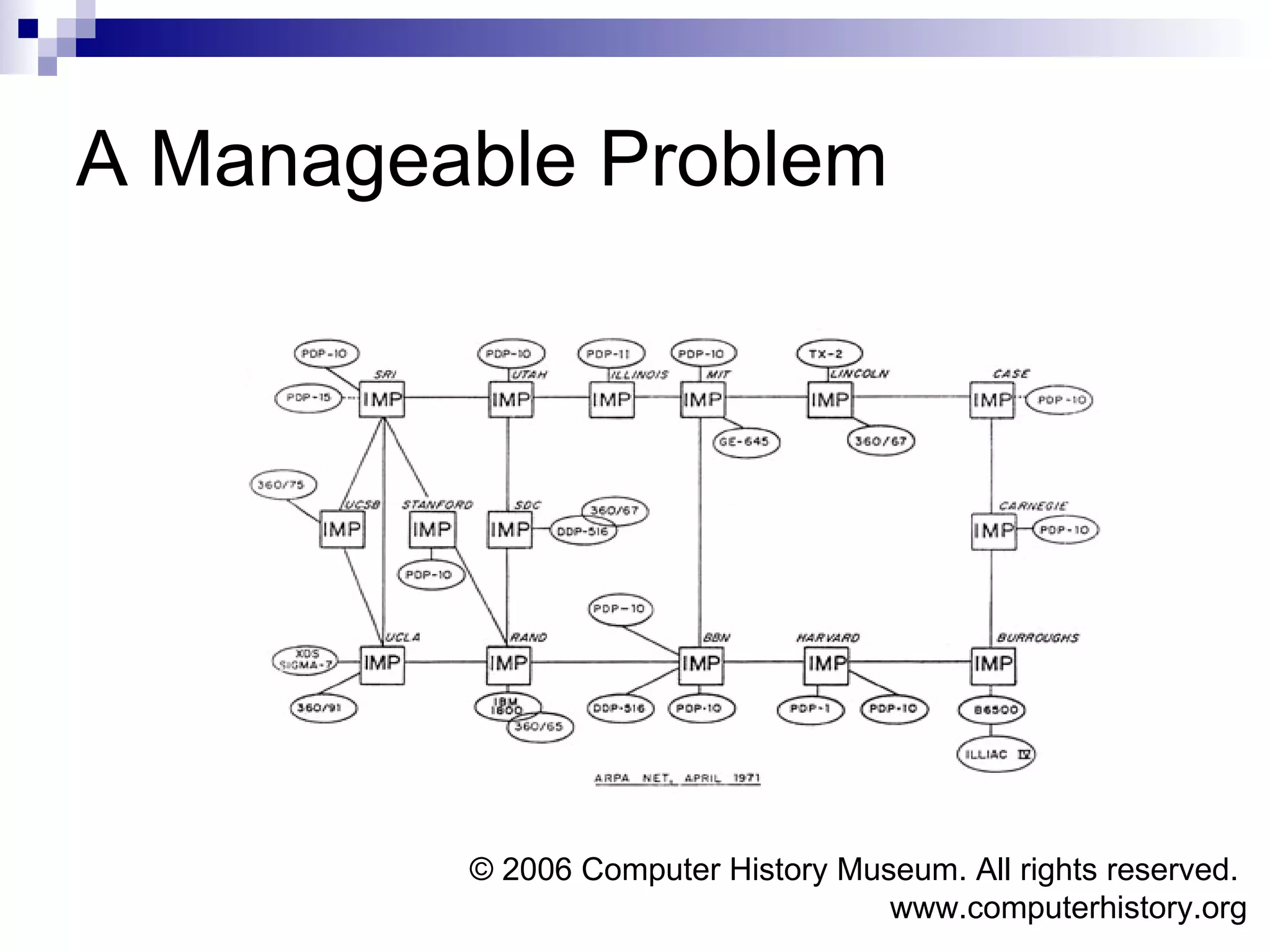
A Manageable Problem © 2006 Computer History Museum. All rights reserved.  www.computerhistory.org
In the beginning… Every machine had a file named hosts.txt Each line contained a name/IP mapping New hosts files were updated and distributed via email …  This clearly wasn’t going to scale
DNS Implementations Modern DNS system first proposed in 1983 First implementation in 1984 (Paul Mockapetris) BIND (Berkeley Internet Name Domain) written by four Berkeley students in 1985.  Many other implementations today
Hierarchical Naming DNS names are arranged in a hierarchy: www.cs.washington.edu Entries are either  subdomains  or  hostnames subdomains contain more subdomains, or hosts (up to 127 levels deep!) Hosts have individual IP addresses
Mechanics: Theory DNS Recurser (client) parses address from right to left Asks root server (with known, static IP address) for name of first subdomain DNS server Contacts successive DNS servers until it finds the host
Mechanics: In Practice ISPs provide a DNS recurser for clients DNS recursers cache lookups for period of time after a request Greatly speeds up retrieval of entries and reduces system load
BOINC
What is BOINC? “ Berkeley Open Infrastructure for Network Computing” Platform for Internet-wide distributed applications Volunteer computing  infrastructure Relies on many far-flung users volunteering spare CPU power
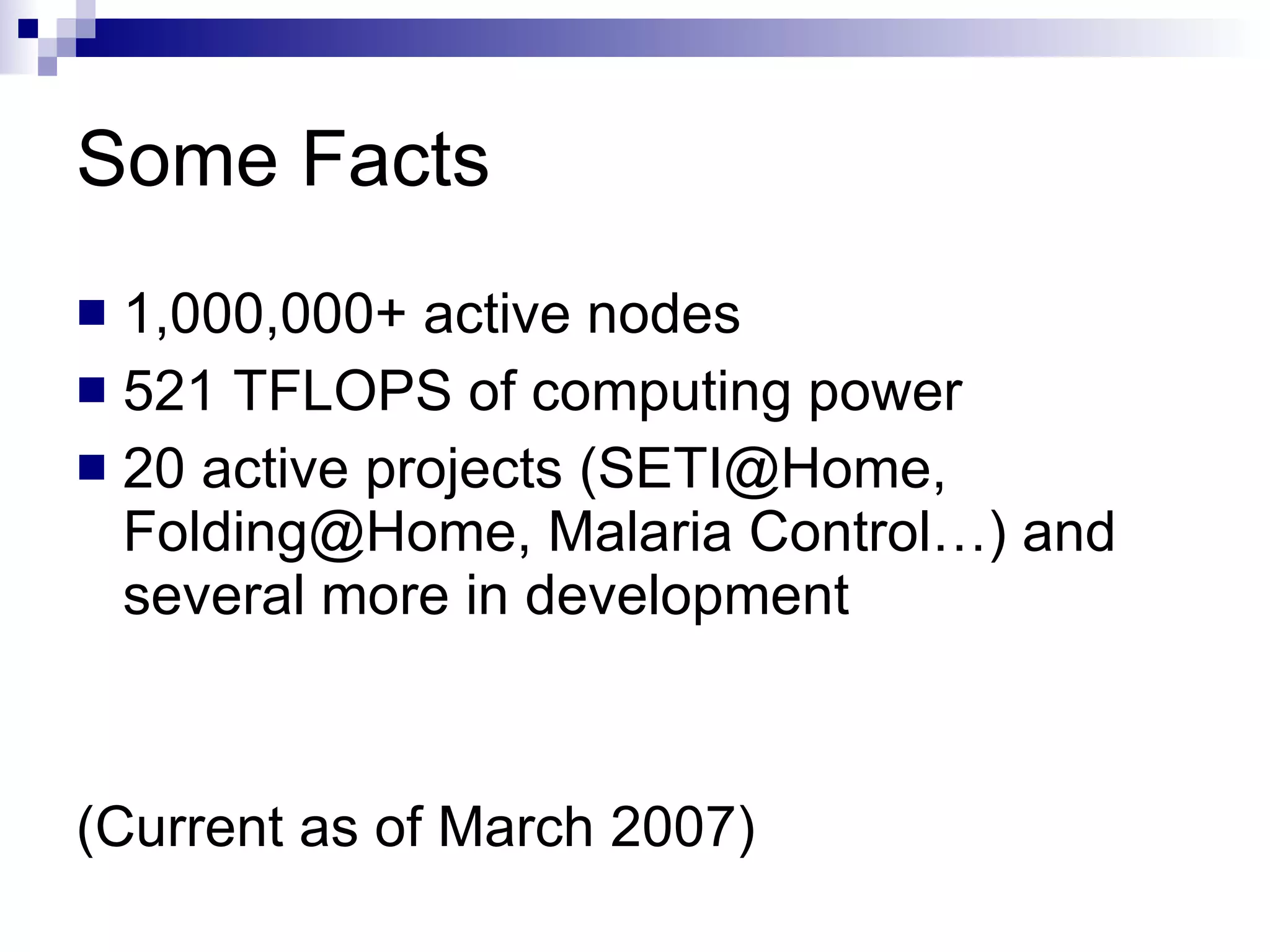
Some Facts 1,000,000+ active nodes 521 TFLOPS of computing power 20 active projects (SETI@Home, Folding@Home, Malaria Control…) and several more in development (Current as of March 2007)
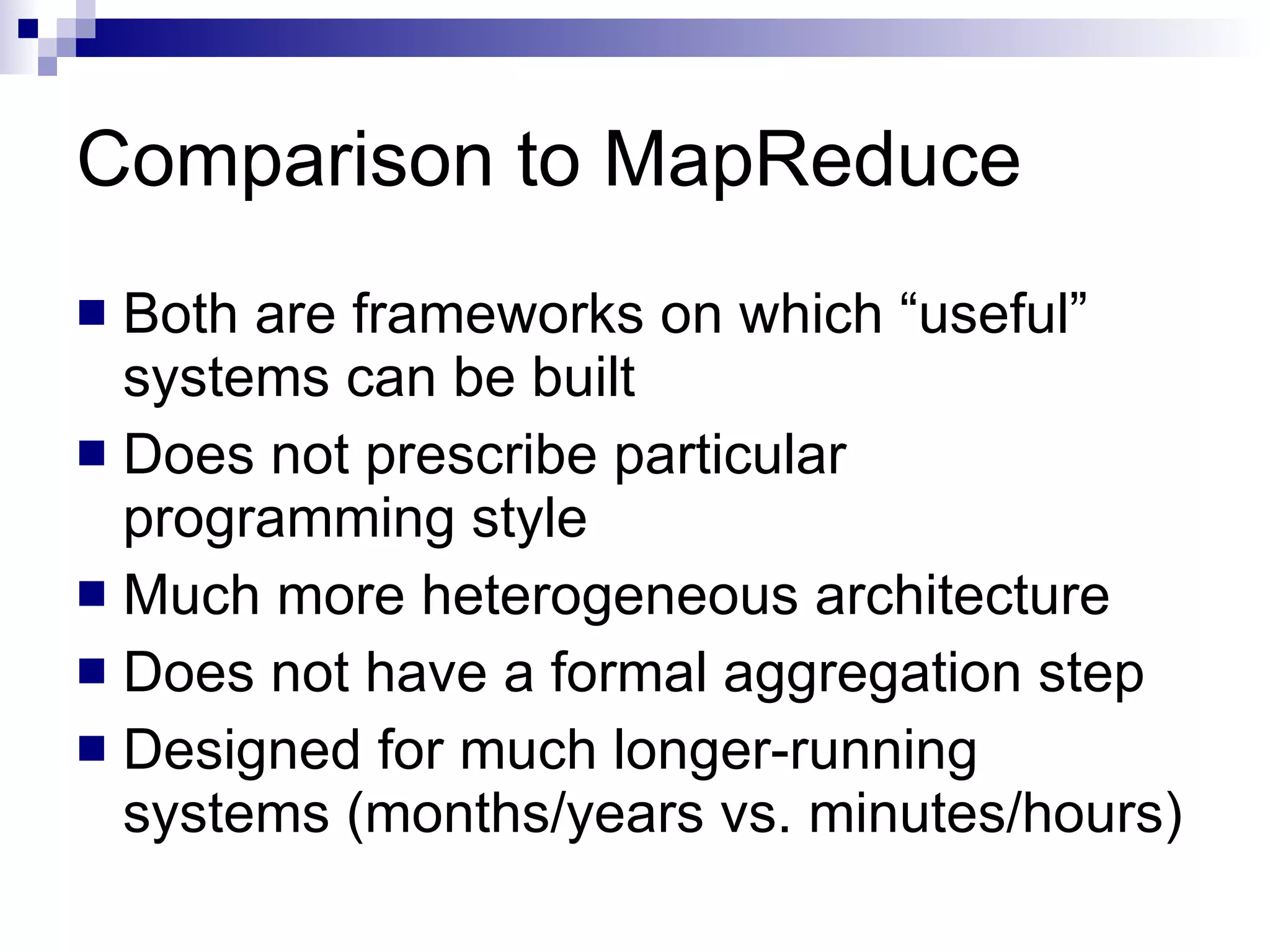
Comparison to MapReduce Both are frameworks on which “useful” systems can be built Does not prescribe particular programming style Much more heterogeneous architecture Does not have a formal aggregation step Designed for much longer-running systems (months/years vs. minutes/hours)
Architecture Central server runs LAMP architecture for web + database End-users run client application with modules for actual computation BitTorrent used to distribute data elements efficiently
System Features Homogenous redundancy Work unit “trickling” Locality scheduling Distribution based on host parameters
Client software Available as regular application, background “service”, or screensaver Can be administered locally or LAN-administered via RPC Can be configured to use only “low priority” cycles
Client/Task Interaction Client software runs on variety of operating systems, each with different IPC  Uses  shared memory message passing  to transmit information from “manager” to actual tasks and vice versa
Why Participate? Sense of accomplishment, community involvement, or scientific duty Stress testing machines/networks Potential for fame (if your computer “finds” an alien planet, you can name it!) “ Bragging rights” for computing more units “ BOINC Credits”
Credit & Cobblestones Work done is rewarded with “cobblestones” 100 cobblestones = 1 day of CPU time for a computer with performance equaling 1,000 double-precision floating-point MIPS (Whetstone) & 1,000 integer VAX MIPS (Dhrystone) Computers are benchmarked by the BOINC system and receive credit appropriate to their machine
Anti-Cheating Measures Work units are computed redundantly by several different machines, and results are compared by the central server for consistency Credit is awarded after the internal server validates the returned work units Work units must be returned before a deadline
Conclusions Versatile infrastructure SETI tasks take a few hours Climate simulation tasks take months Network monitoring tasks are not CPU-bound at all! Scales extremely well to internet-wide applications Provides another flexible middleware layer to base distributed applications on Volunteer computing comes with add’l considerations (rewards, cheating)
PlanetLab
What if you wanted  to: Test a new version of Bittorrent that might generate GB’s and GB’s of data? Design a new distributed hashtable algorithm for thousands of nodes? Create a gigantic caching structure that mirrored web pages in several sites across the USA?
Problem Similarities Each of these problems requires: Hundreds or thousands of servers Geographic distribution An isolated network for testing and controlled experiments Developing one-off systems to support these would be  Costly Redundant
PlanetLab A multi-university effort to build a network for large-scale simulation, testing, and research “ Simulate the Internet”
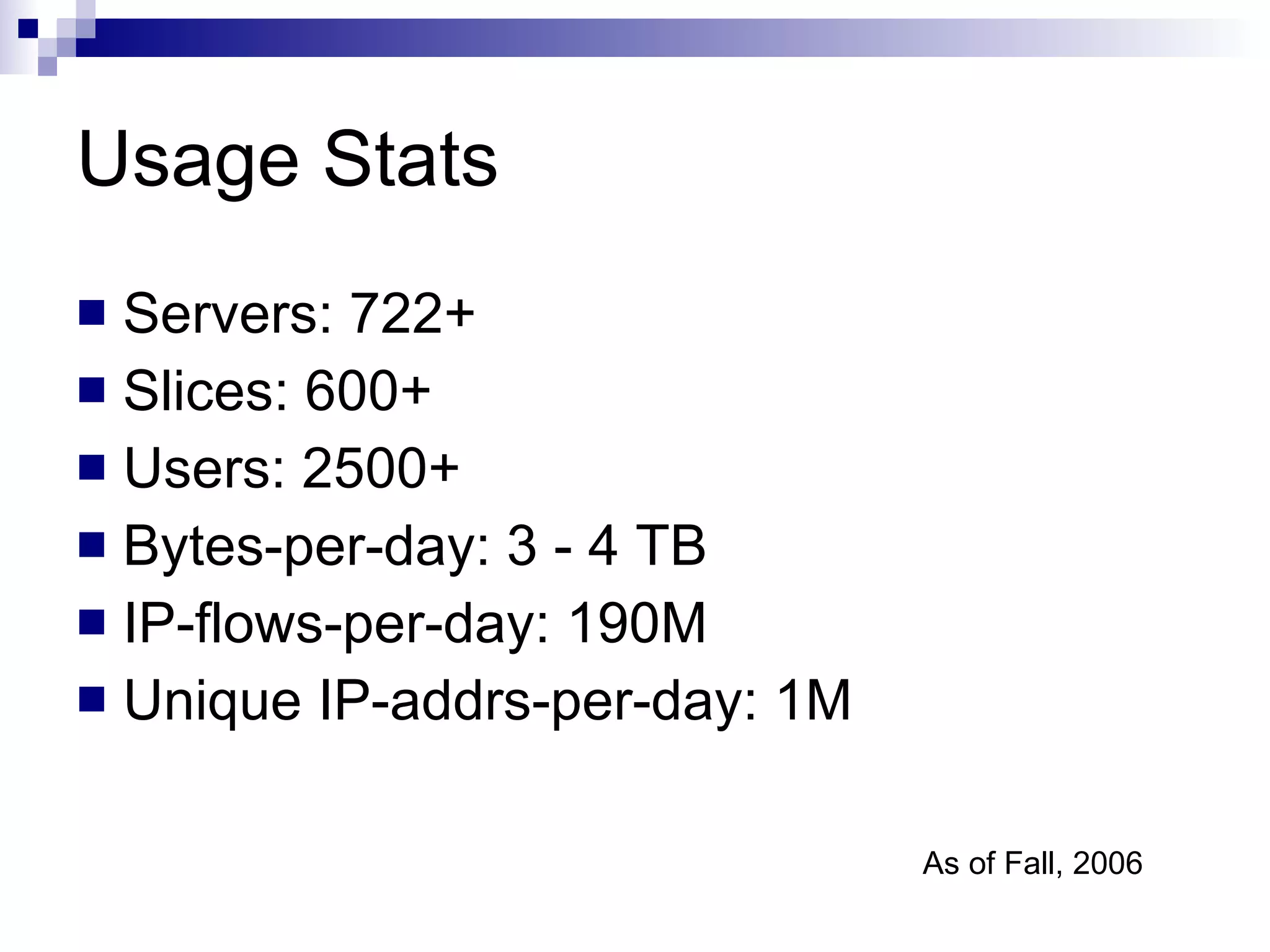
Usage Stats Servers: 722+ Slices: 600+ Users: 2500+ Bytes-per-day: 3 - 4 TB IP-flows-per-day: 190M Unique IP-addrs-per-day: 1M As of Fall, 2006
Project Goals Supports short- and long-term research goals System put up “as fast as possible” – PlanetLab design evolves over time to meet changing needs  PlanetLab is a  process , not a result
Simultaneous Research Projects must be isolated from one another Code from several researchers: Untrustworthy? Possibly buggy?  Intellectual property issues? Time-sensitive experiments must not interfere with one another Must provide realistic workload simulations
Architecture Built on Linux, ssh, other standard tools Provides “normal” environment for application development Hosted at multiple universities w/ separate admins Requires  trust relationships  with respect to previous goals
Architecture (cont.) Network is divided into “slices” – server pools created out of virtual machines Trusted intermediary “PLC” system grants access to network resources Allows universities to specify who can use slices at each site Distributed trust relationships  Central system control    Federated control
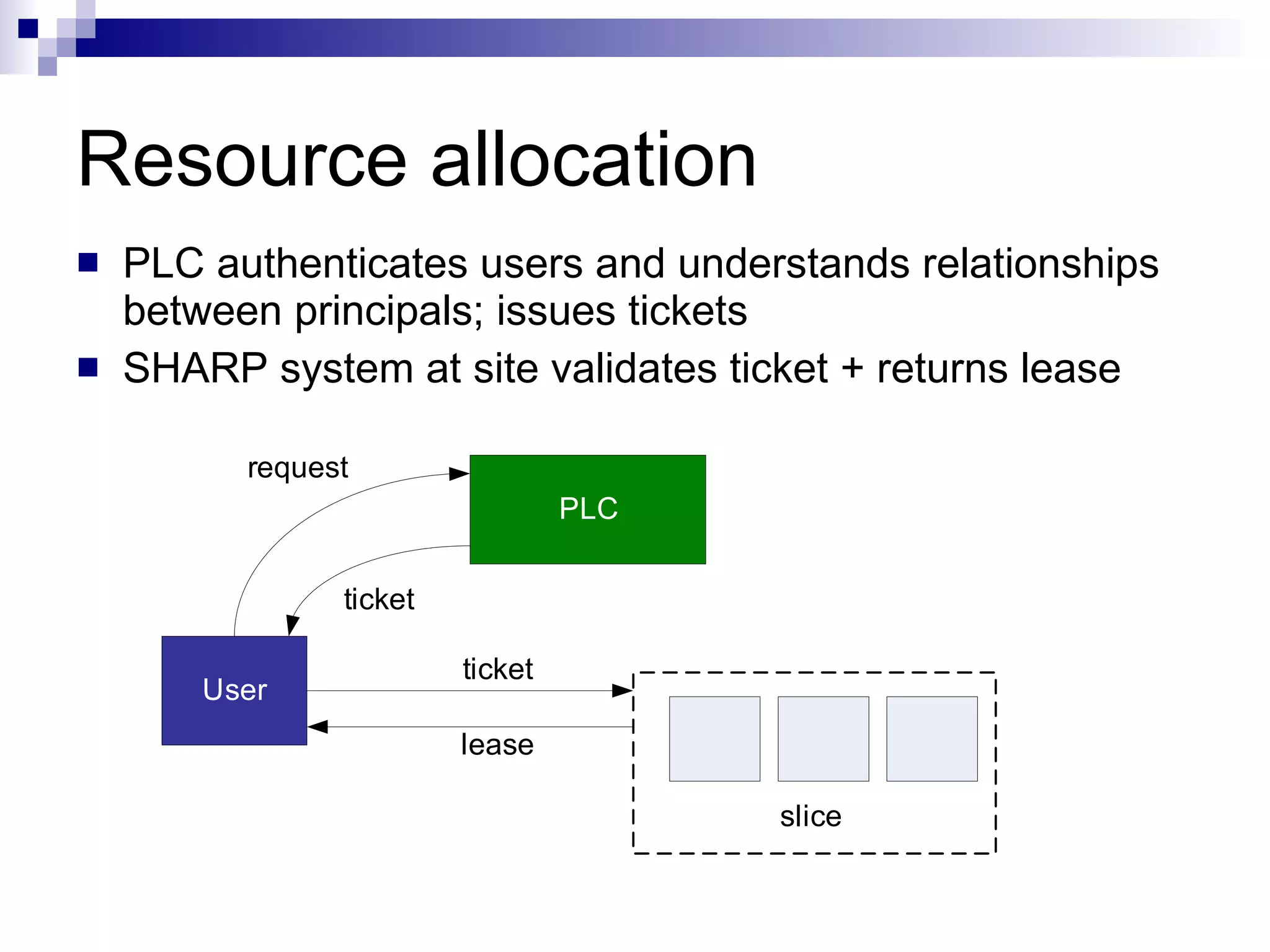
Resource allocation PLC authenticates users and understands relationships between principals; issues tickets SHARP system at site validates ticket + returns lease
User Verification Public-key cryptography used to sign modules entered into PlanetLab X.509 + SSL keys are used by PLC + slices to verify user authenticity Keys distributed “out of band” ahead of time
Final Thoughts Large system with complex relationships Currently upgrading to version 4.0 New systems (GENI) are being proposed Still provides lots of resources to researchers CoralCache, several other projects run on PlanetLab
OLPC “ They want to deliver vast amounts of information over the Internet. And again, the Internet is not something you just dump something on. It's not a big truck. It's a  series of tubes .”
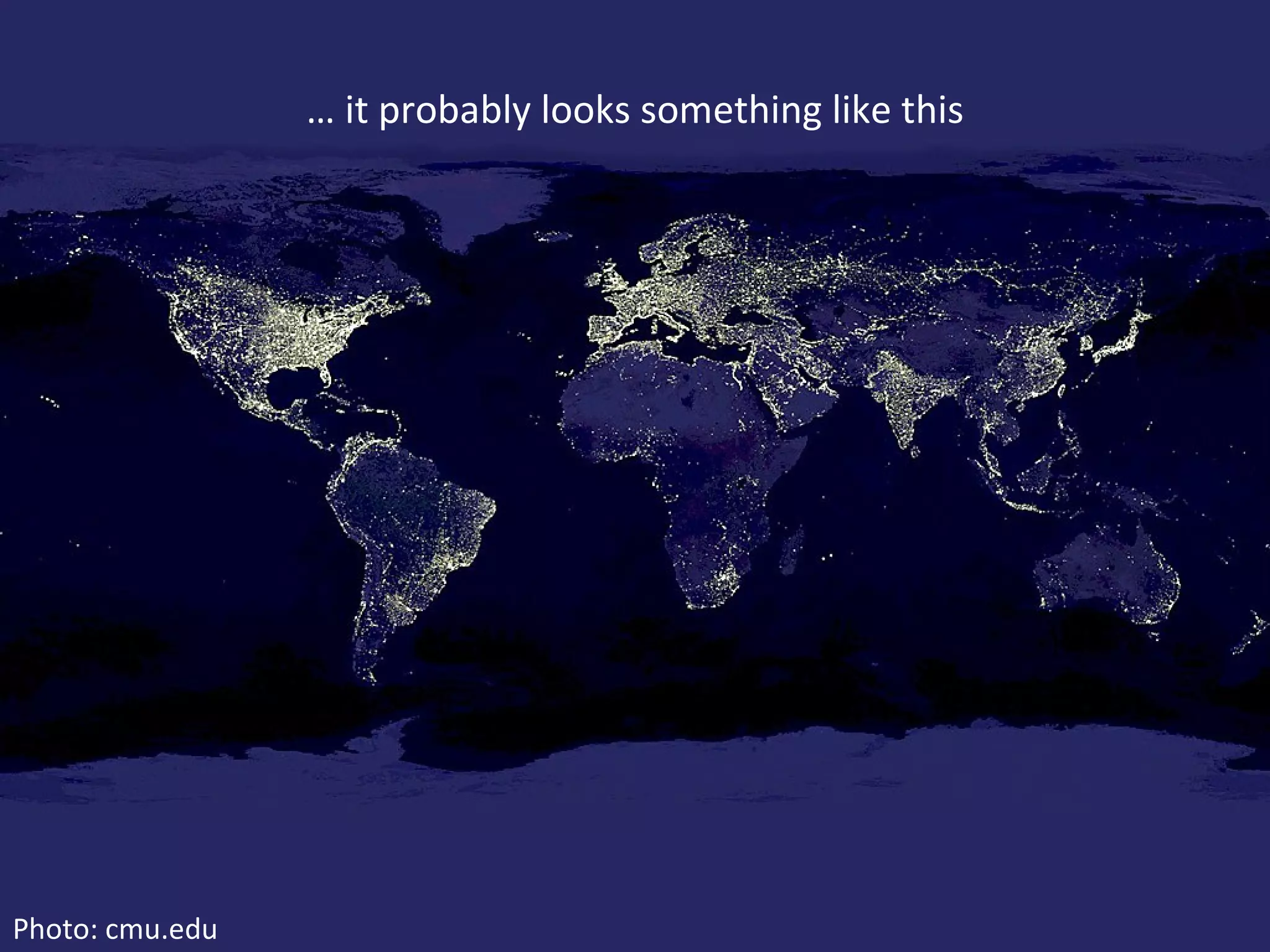
The Internet is a series of tubes The internet is composed of a lot of infrastructure: Clients and servers Routers and switches Fiber optic trunk lines, telephone lines, tubes and trucks And if we map the density of this infrastructure…
…  it probably looks something like this Photo: cmu.edu
How do we distribute knowledge when there are no tubes? What if we wanted to share a book? Pass it along, door-to-door. What if we wanted to share 10,000 books? Build community library. How about 10 million books? Or 300 copies of one book? A very large library?
Solutions We need to build infrastructure to make large-scale distribution easy (i.e., computers and networking equipment) We need to be cheap Most of those dark spots don’t have much money We need reliability where reliable power is costly Again, did you notice that there weren’t so many lights? It’s because there’s no electricity!
The traditional solution: a shared computer with Internet India 75% of people in rural villages 90% of phones in urban areas Many villagers share a single phone, usually located in the town post office Likewise, villages typically share a few computers, located at the school (or somewhere with reliable power) What’s the downside to this model? It might provide shared access to a lot of information, but it doesn’t solve the “300 copies of a book” case
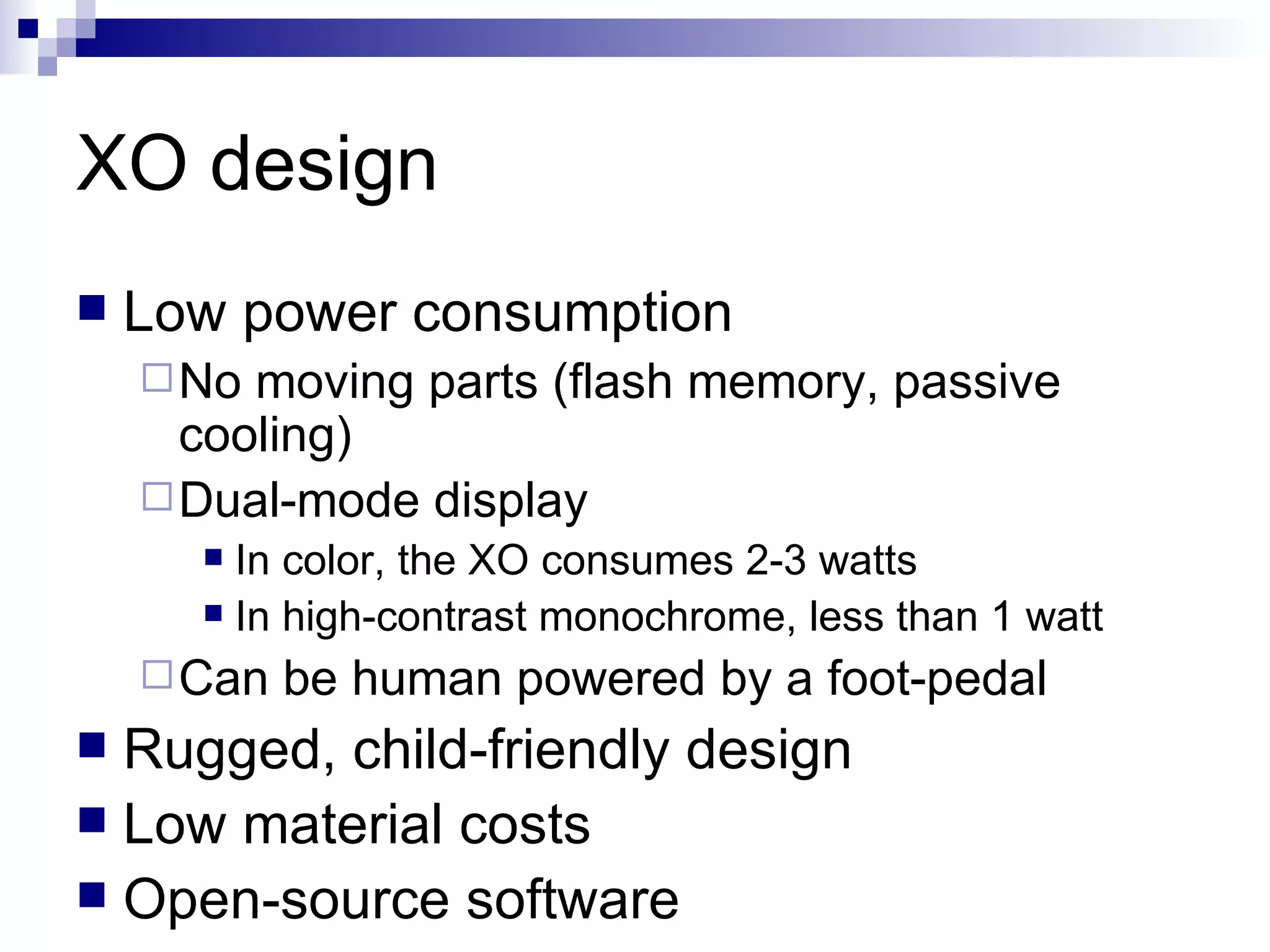
The distributed solution: the XO AKA: Children’s Machine, OLPC, $100 laptop A cheap (~$150) laptop designed for children in developing countries OLPC = One Laptop Per Child. Photo: laptop.org
XO design Low power consumption No moving parts (flash memory, passive cooling) Dual-mode display In color, the XO consumes 2-3 watts In high-contrast monochrome, less than 1 watt Can be human powered by a foot-pedal Rugged, child-friendly design Low material costs Open-source software
XO networking The XO utilizes far-reaching, low-power wireless networking to create ad-hoc mesh networks If any single XO is connected to the Internet, other nearby computers can share the connection in a peer-to-peer scheme Networks can theoretically sprawl as far as ten miles, even connecting nearby villages
XO storage and sharing XO relies on network for content and collaboration Content is stored on a central servers Textbooks Cached websites (Wikipedia) User content Software makes it easy to see other users on the network and share content
XO distribution XO must be purchased in orders of 1 million units by governments in developing nations (economies of scale help to lower costs) Governments are responsible for distribution of laptops Laptops are only for children, designed solely as a tool for learning
XO downfalls Distribution downfalls What about children in developed nations? Sell to developed markets at a higher price to subsidize costs for developing nations. Can governments effectively distribute? What about black markets? OLPC could perhaps partner with local schools and other NGOs to aid in distribution, training and maintenance Too expensive? Some nations can only afford as much $20 per child per year. How can we cater to them?
What can the XO achieve? Today, only 16 percent of the world’s population is estimated to have access to the Internet Develop new markets Microcredit Make small loans to the impoverished without requiring collateral Muhammad Yunus and the Grameen Bank won the 2006 Nobel Peace Prize for their work here The power of the village economy As millions of users come online in developing nations, there will be many new opportunities for commerce. Helps those in developing nations to advance their economies and develop stronger economic models
Why give the XO to children? UN Millennium Development Goal #2: “achieve universal primary education” Empower children to think and compete in a global space Children are a nations greatest resource Backed by a bolstered economy, they will grow to solve other issues (infrastructure, poverty, famine)
The Course Again (in 5 minutes) So what did we see in this class? Moore’s law is starting to fail More computing power means more machines This means breaking problems into sub problems Sub-problems cannot interfere with or depend on one another Have to “play nice” with shared memory
MapReduce MapReduce is one paradigm for breaking problems up Makes the “playing nice” easy by enforcing a decoupled programming model Handles lots of the behind-the-scenes work
Distributed Systems & Networks The network is a fundamental part of a distributed system Have to plan for bandwidth, latency, etc We’d like to think of the network as an abstraction Sockets = pipes RPC looks like a normal procedure call, handles tricky stuff under the hood Still have to plan for failures of all kinds
Distributed Filesystems The network allows us to make data available across many machines Network file systems can hook into existing infrastructure Specialized file systems (like GFS) can offer better performance with loss of generality Raises issues of concurrency, process isolation, and how to combat stale data
And finally… There are lots of distributed systems out there MapReduce, BOINC, MPI, several other architectures, styles, problems to solve

Other distributed systems

  • 1.
    Lecture 5 -Other Distributed Systems CSE 490h – Introduction to Distributed Computing, Spring 2007 Except as otherwise noted, the content of this presentation is licensed under the Creative Commons Attribution 2.5 License.
  • 2.
    Outline DNS BOINCPlanetLab OLPC & Ad-hoc Mesh Networks Lecture content wrap-up
  • 3.
    DNS: The Distributed System in the Distributed System
  • 4.
    Domain Name SystemMnemonic identifiers work considerably better for humans than IP addresses “ www.google.com? Surely you mean 66.102.7.99!” Who maintains the mappings from name  IP?
  • 5.
    A Manageable Problem© 2006 Computer History Museum. All rights reserved. www.computerhistory.org
  • 6.
    In the beginning…Every machine had a file named hosts.txt Each line contained a name/IP mapping New hosts files were updated and distributed via email … This clearly wasn’t going to scale
  • 7.
    DNS Implementations ModernDNS system first proposed in 1983 First implementation in 1984 (Paul Mockapetris) BIND (Berkeley Internet Name Domain) written by four Berkeley students in 1985. Many other implementations today
  • 8.
    Hierarchical Naming DNSnames are arranged in a hierarchy: www.cs.washington.edu Entries are either subdomains or hostnames subdomains contain more subdomains, or hosts (up to 127 levels deep!) Hosts have individual IP addresses
  • 9.
    Mechanics: Theory DNSRecurser (client) parses address from right to left Asks root server (with known, static IP address) for name of first subdomain DNS server Contacts successive DNS servers until it finds the host
  • 10.
    Mechanics: In PracticeISPs provide a DNS recurser for clients DNS recursers cache lookups for period of time after a request Greatly speeds up retrieval of entries and reduces system load
  • 11.
  • 12.
    What is BOINC?“ Berkeley Open Infrastructure for Network Computing” Platform for Internet-wide distributed applications Volunteer computing infrastructure Relies on many far-flung users volunteering spare CPU power
  • 13.
    Some Facts 1,000,000+active nodes 521 TFLOPS of computing power 20 active projects (SETI@Home, Folding@Home, Malaria Control…) and several more in development (Current as of March 2007)
  • 14.
    Comparison to MapReduceBoth are frameworks on which “useful” systems can be built Does not prescribe particular programming style Much more heterogeneous architecture Does not have a formal aggregation step Designed for much longer-running systems (months/years vs. minutes/hours)
  • 15.
    Architecture Central serverruns LAMP architecture for web + database End-users run client application with modules for actual computation BitTorrent used to distribute data elements efficiently
  • 16.
    System Features Homogenousredundancy Work unit “trickling” Locality scheduling Distribution based on host parameters
  • 17.
    Client software Availableas regular application, background “service”, or screensaver Can be administered locally or LAN-administered via RPC Can be configured to use only “low priority” cycles
  • 18.
    Client/Task Interaction Clientsoftware runs on variety of operating systems, each with different IPC Uses shared memory message passing to transmit information from “manager” to actual tasks and vice versa
  • 19.
    Why Participate? Senseof accomplishment, community involvement, or scientific duty Stress testing machines/networks Potential for fame (if your computer “finds” an alien planet, you can name it!) “ Bragging rights” for computing more units “ BOINC Credits”
  • 20.
    Credit & CobblestonesWork done is rewarded with “cobblestones” 100 cobblestones = 1 day of CPU time for a computer with performance equaling 1,000 double-precision floating-point MIPS (Whetstone) & 1,000 integer VAX MIPS (Dhrystone) Computers are benchmarked by the BOINC system and receive credit appropriate to their machine
  • 21.
    Anti-Cheating Measures Workunits are computed redundantly by several different machines, and results are compared by the central server for consistency Credit is awarded after the internal server validates the returned work units Work units must be returned before a deadline
  • 22.
    Conclusions Versatile infrastructureSETI tasks take a few hours Climate simulation tasks take months Network monitoring tasks are not CPU-bound at all! Scales extremely well to internet-wide applications Provides another flexible middleware layer to base distributed applications on Volunteer computing comes with add’l considerations (rewards, cheating)
  • 23.
  • 24.
    What if youwanted to: Test a new version of Bittorrent that might generate GB’s and GB’s of data? Design a new distributed hashtable algorithm for thousands of nodes? Create a gigantic caching structure that mirrored web pages in several sites across the USA?
  • 25.
    Problem Similarities Eachof these problems requires: Hundreds or thousands of servers Geographic distribution An isolated network for testing and controlled experiments Developing one-off systems to support these would be Costly Redundant
  • 26.
    PlanetLab A multi-universityeffort to build a network for large-scale simulation, testing, and research “ Simulate the Internet”
  • 27.
    Usage Stats Servers:722+ Slices: 600+ Users: 2500+ Bytes-per-day: 3 - 4 TB IP-flows-per-day: 190M Unique IP-addrs-per-day: 1M As of Fall, 2006
  • 28.
    Project Goals Supportsshort- and long-term research goals System put up “as fast as possible” – PlanetLab design evolves over time to meet changing needs PlanetLab is a process , not a result
  • 29.
    Simultaneous Research Projectsmust be isolated from one another Code from several researchers: Untrustworthy? Possibly buggy? Intellectual property issues? Time-sensitive experiments must not interfere with one another Must provide realistic workload simulations
  • 30.
    Architecture Built onLinux, ssh, other standard tools Provides “normal” environment for application development Hosted at multiple universities w/ separate admins Requires trust relationships with respect to previous goals
  • 31.
    Architecture (cont.) Networkis divided into “slices” – server pools created out of virtual machines Trusted intermediary “PLC” system grants access to network resources Allows universities to specify who can use slices at each site Distributed trust relationships Central system control  Federated control
  • 32.
    Resource allocation PLCauthenticates users and understands relationships between principals; issues tickets SHARP system at site validates ticket + returns lease
  • 33.
    User Verification Public-keycryptography used to sign modules entered into PlanetLab X.509 + SSL keys are used by PLC + slices to verify user authenticity Keys distributed “out of band” ahead of time
  • 34.
    Final Thoughts Largesystem with complex relationships Currently upgrading to version 4.0 New systems (GENI) are being proposed Still provides lots of resources to researchers CoralCache, several other projects run on PlanetLab
  • 35.
    OLPC “ Theywant to deliver vast amounts of information over the Internet. And again, the Internet is not something you just dump something on. It's not a big truck. It's a series of tubes .”
  • 36.
    The Internet isa series of tubes The internet is composed of a lot of infrastructure: Clients and servers Routers and switches Fiber optic trunk lines, telephone lines, tubes and trucks And if we map the density of this infrastructure…
  • 37.
    … itprobably looks something like this Photo: cmu.edu
  • 38.
    How do wedistribute knowledge when there are no tubes? What if we wanted to share a book? Pass it along, door-to-door. What if we wanted to share 10,000 books? Build community library. How about 10 million books? Or 300 copies of one book? A very large library?
  • 39.
    Solutions We needto build infrastructure to make large-scale distribution easy (i.e., computers and networking equipment) We need to be cheap Most of those dark spots don’t have much money We need reliability where reliable power is costly Again, did you notice that there weren’t so many lights? It’s because there’s no electricity!
  • 40.
    The traditional solution:a shared computer with Internet India 75% of people in rural villages 90% of phones in urban areas Many villagers share a single phone, usually located in the town post office Likewise, villages typically share a few computers, located at the school (or somewhere with reliable power) What’s the downside to this model? It might provide shared access to a lot of information, but it doesn’t solve the “300 copies of a book” case
  • 41.
    The distributed solution:the XO AKA: Children’s Machine, OLPC, $100 laptop A cheap (~$150) laptop designed for children in developing countries OLPC = One Laptop Per Child. Photo: laptop.org
  • 42.
    XO design Lowpower consumption No moving parts (flash memory, passive cooling) Dual-mode display In color, the XO consumes 2-3 watts In high-contrast monochrome, less than 1 watt Can be human powered by a foot-pedal Rugged, child-friendly design Low material costs Open-source software
  • 43.
    XO networking TheXO utilizes far-reaching, low-power wireless networking to create ad-hoc mesh networks If any single XO is connected to the Internet, other nearby computers can share the connection in a peer-to-peer scheme Networks can theoretically sprawl as far as ten miles, even connecting nearby villages
  • 44.
    XO storage andsharing XO relies on network for content and collaboration Content is stored on a central servers Textbooks Cached websites (Wikipedia) User content Software makes it easy to see other users on the network and share content
  • 45.
    XO distribution XOmust be purchased in orders of 1 million units by governments in developing nations (economies of scale help to lower costs) Governments are responsible for distribution of laptops Laptops are only for children, designed solely as a tool for learning
  • 46.
    XO downfalls Distributiondownfalls What about children in developed nations? Sell to developed markets at a higher price to subsidize costs for developing nations. Can governments effectively distribute? What about black markets? OLPC could perhaps partner with local schools and other NGOs to aid in distribution, training and maintenance Too expensive? Some nations can only afford as much $20 per child per year. How can we cater to them?
  • 47.
    What can theXO achieve? Today, only 16 percent of the world’s population is estimated to have access to the Internet Develop new markets Microcredit Make small loans to the impoverished without requiring collateral Muhammad Yunus and the Grameen Bank won the 2006 Nobel Peace Prize for their work here The power of the village economy As millions of users come online in developing nations, there will be many new opportunities for commerce. Helps those in developing nations to advance their economies and develop stronger economic models
  • 48.
    Why give theXO to children? UN Millennium Development Goal #2: “achieve universal primary education” Empower children to think and compete in a global space Children are a nations greatest resource Backed by a bolstered economy, they will grow to solve other issues (infrastructure, poverty, famine)
  • 49.
    The Course Again(in 5 minutes) So what did we see in this class? Moore’s law is starting to fail More computing power means more machines This means breaking problems into sub problems Sub-problems cannot interfere with or depend on one another Have to “play nice” with shared memory
  • 50.
    MapReduce MapReduce isone paradigm for breaking problems up Makes the “playing nice” easy by enforcing a decoupled programming model Handles lots of the behind-the-scenes work
  • 51.
    Distributed Systems &Networks The network is a fundamental part of a distributed system Have to plan for bandwidth, latency, etc We’d like to think of the network as an abstraction Sockets = pipes RPC looks like a normal procedure call, handles tricky stuff under the hood Still have to plan for failures of all kinds
  • 52.
    Distributed Filesystems Thenetwork allows us to make data available across many machines Network file systems can hook into existing infrastructure Specialized file systems (like GFS) can offer better performance with loss of generality Raises issues of concurrency, process isolation, and how to combat stale data
  • 53.
    And finally… Thereare lots of distributed systems out there MapReduce, BOINC, MPI, several other architectures, styles, problems to solve

Editor's Notes

  • #9 This allows multiple machines named “CS” in the world For unfortunate reasons, the most significant label is to the right, instead of the left.
  • #10 Pitfalls of this design: -- requires literally billions or more queries to root servers in a day – far too much stress -- requires every individual computer to make lots of requests to many different machines
  • #37 Alright, maybe Senator Stevens isn’t entirely correct, but he’s right about one thing: the internet is composed of some sort of infrastructure.
  • #38 This is a composited satellite image of the earth at night. This is meant to demonstrate that there are a lot of spaces which lack infrastructure even for electricity. A real map of internet infrastructure would probably show even greater infrastructural disparity between the wealthier developed nations and the developing nations.
  • #40 Cheap: Fiber costs nearly $50k per mile in rural areas, Cisco routers with 80 ports are around $7k, desktop computers are $300-$400, and the cost of powering this equipment reliably is tremendously expensive in a developing nation
  • #42 Founded by Nicholas Negroponte while he was working at MediaLab. Took the project outside of the lab to form a new non-profit NGO called OLPC. Backed by many industry leaders, including: Quanta (manufacturer), eBay, AMD, Google, Red Hat. Mission: provide the laptop at a low cost (in terms of both hardware and operation) to facilitate its purchase by governments of developing nations; provide rich, open-source software tools to allow teachers and children to create, develop and discover knowledge; provide high-bandwidth connectivity to enable the development of knowledge communities. OLPC: If you give each child access simultaneous access to the Internet (or even a local copy of Wikipedia stored at some village server) you can provide them with more knowledge than the biggest library in the world, and at a lower cost. Improving the educational experience in drastic ways to create long-term effects towards providing fair, equitable, and economically and socially viable societies.
  • #48 Of course, all of this is good for us (and the rest of the developed nations). Simple math can tell you that an expansion of the market (potentially 5 fold!) means more commerce here too!
  • #49 Certainly, children are the future of any nation. If we can elevate the level of education, we can create more opportunities for them to compete and grab a share of global markets, and standard of living will rise. India and China are already bringing themselves out of poverty, largely because of the commerce they have with developed nations.