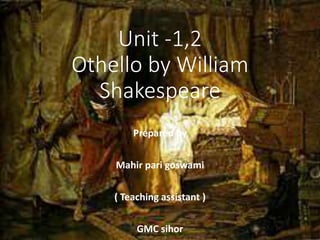
Unit -1,2
Othello by William
Shakespeare
Prepared by
Mahir pari goswami
( Teaching assistant )
GMC sihor
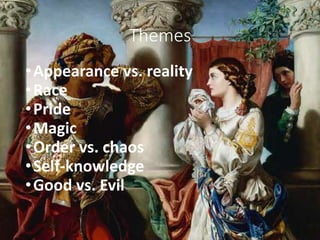
Themes
•Appearance vs. reality
•Race
•Pride
•Magic
•Order vs. chaos
•Self-knowledge
•Good vs. Evil
Appearance vs. reality
• Especially relevant to the issue of Iago's
character; for although he is called "honest"
by almost everyone in the play, he is
treacherous, deceitful, and manipulative.
This also applies to Desdemona, as Othello
believes that she is deceitful and impure,
although she is really blameless and
innocent.
• This theme contributes greatly to the tragedy,
as Iago is able to engineer his schemes due to
the perception of others of his honesty.
• Othello's decision to murder his wife is
hastened by a conversation in which Cassio
speaks of Bianca; Othello assumes the man is
talking about an affair with Desdemona.
• Misrepresentation allows Iago to gain trust and
manipulate other people; he is able to appear
to be "honest," in order to deceive and
misdirect people. Although the word "honest"
is usually used in an ironic way throughout the
text, most characters in the play go through a
crisis of learning who and who not to trust.
• Most of them, unfortunately, trust in Iago's
honesty; this leads to the downfall of many
characters, as this trust in Iago's "honesty"
became a crucial contributor to their
undoing. Discovering or uncovering reality
would have changed the course of the play.
Race
• Race is an extremely important theme, as it leads
to Othello's insecurity, which Iago is able to
manipulate. Despite his standing and military
prowess, Othello never feels comfortable in
Venice because of his otherness. As a Moor, he is
constantly stereotyped as "savage" or "animal",
even though he speaks eloquently and displays
more gentlemanly qualities than those who judge
him. Thus, Othello perceives himself to be a rough
outsider, though he is nothing of the sort.
• Othello's race sets him apart, and makes
him very self-conscious; it makes him work
hard and look carefully after his reputation,
so he is regarded as equal to the white
people that surround him. This has perhaps
led to his success, but the prejudice that
surrounds him - especially with respect to
his marriage to Desdemona - has tragic
consequences.
Pride
• Othello is defensively proud of himself and his
achievements, and especially proud of the
honorable appearance he presents. The allegations
of Desdemona's affair hurt his pride even more than
they inflame his vanity and jealousy; he wants to
appear powerful, accomplished, and moral at every
possible instance, and when this is almost denied to
him, his wounded pride becomes especially
powerful.
Magic
• Othello is charged with using magic to woo
Desdemona, merely because he is black, and
therefore, "pagan." Yet, Othello does have real
magic, in the words he uses and the stories he
tells. Magic also reappears when Desdemona's
handkerchief cannot be found; Othello has too
much trust in the symbolism and charm of the
handkerchief, which is why the object is so
significant to him.
Order vs. chaos
• As Othello begins to abandon reason and
language, chaos takes over. His world
begins to be ruled by chaotic emotions
and very shady allegations, with order
pushed to the side. This chaos rushes him
into tragedy, and once Othello has sunk
into it, he is unable to stop his fate from
taking him over.
Self-knowledge
•Othello's lack of self-knowledge
makes him easy prey for Iago. Once
Iago inflames Othello's jealousy and
sets the darker aspects of Othello's
nature in motion, there is nothing
Othello can do to stop it, since he
cannot even admit that he has these
darker traits.
• Even after he has murdered his wife, and
has learned that Iago set a trap for him,
Othello is unable to acknowledge the
character flaws that were manipulated.
He asserts he is "honorable" even in
murder. This theme is related to pride, as
Othello's pride blinds him to his
weaknesses, precipitating his downfall.
Good vs. Evil
• Iago's battle against Othello and Cassio
certainly counts as an embodiment of
this theme. Iago and his evil battle to
corrupt and turn the flawed natures of
other characters, and he does succeed to
some extent. By the end of the play,
neither has won, as Desdemona and
Emilia are both dead, and Iago revealed
and punished.
•Othello is a tragic character, but one
that is neither good nor evil. His flaws
are easily manipulated, and he is
unable to see the truth while blinded
by pride. He is a good soldier and a
good man, but this good is twisted
and he commits an evil act.
•Desdemona is the embodiment of
goodness in the play, as she has done
no wrong and seeks only to love and
to help her friends. However, she
resigns herself to her death out of
this goodness.
•The ruin of innocence is a key
ingredient to tragedy, but one could
interpret that Desdemona did not
have to suffer her fate. Othello
represents a grey area between good
and evil, where self-interest clouds
even the best intentions, and people
on both sides end up dead.
Work citation
• Shakespeare, W., Asked byAman Deep S
#1042266Answered byAslanon 9/6/2020 5:54 PM,
#1042266, A., Asked byMelly M
#1031046Answered byjill d #170087on 6/24/2020
5:25 PM, #1031046, M., Asked byAmahle D
#1030900Answered byAslanon 6/23/2020 5:23 PM,
& #1030900, A. (n.d.). Othello Themes.
Retrieved September 09, 2020, from
https://www.gradesaver.com/othello/study-
guide/themes
•Thank you

Othello themes

  • 1.
    Unit -1,2 Othello byWilliam Shakespeare Prepared by Mahir pari goswami ( Teaching assistant ) GMC sihor
  • 2.
    Themes •Appearance vs. reality •Race •Pride •Magic •Ordervs. chaos •Self-knowledge •Good vs. Evil
  • 3.
    Appearance vs. reality •Especially relevant to the issue of Iago's character; for although he is called "honest" by almost everyone in the play, he is treacherous, deceitful, and manipulative. This also applies to Desdemona, as Othello believes that she is deceitful and impure, although she is really blameless and innocent.
  • 4.
    • This themecontributes greatly to the tragedy, as Iago is able to engineer his schemes due to the perception of others of his honesty. • Othello's decision to murder his wife is hastened by a conversation in which Cassio speaks of Bianca; Othello assumes the man is talking about an affair with Desdemona.
  • 5.
    • Misrepresentation allowsIago to gain trust and manipulate other people; he is able to appear to be "honest," in order to deceive and misdirect people. Although the word "honest" is usually used in an ironic way throughout the text, most characters in the play go through a crisis of learning who and who not to trust.
  • 6.
    • Most ofthem, unfortunately, trust in Iago's honesty; this leads to the downfall of many characters, as this trust in Iago's "honesty" became a crucial contributor to their undoing. Discovering or uncovering reality would have changed the course of the play.
  • 7.
    Race • Race isan extremely important theme, as it leads to Othello's insecurity, which Iago is able to manipulate. Despite his standing and military prowess, Othello never feels comfortable in Venice because of his otherness. As a Moor, he is constantly stereotyped as "savage" or "animal", even though he speaks eloquently and displays more gentlemanly qualities than those who judge him. Thus, Othello perceives himself to be a rough outsider, though he is nothing of the sort.
  • 8.
    • Othello's racesets him apart, and makes him very self-conscious; it makes him work hard and look carefully after his reputation, so he is regarded as equal to the white people that surround him. This has perhaps led to his success, but the prejudice that surrounds him - especially with respect to his marriage to Desdemona - has tragic consequences.
  • 9.
    Pride • Othello isdefensively proud of himself and his achievements, and especially proud of the honorable appearance he presents. The allegations of Desdemona's affair hurt his pride even more than they inflame his vanity and jealousy; he wants to appear powerful, accomplished, and moral at every possible instance, and when this is almost denied to him, his wounded pride becomes especially powerful.
  • 10.
    Magic • Othello ischarged with using magic to woo Desdemona, merely because he is black, and therefore, "pagan." Yet, Othello does have real magic, in the words he uses and the stories he tells. Magic also reappears when Desdemona's handkerchief cannot be found; Othello has too much trust in the symbolism and charm of the handkerchief, which is why the object is so significant to him.
  • 11.
    Order vs. chaos •As Othello begins to abandon reason and language, chaos takes over. His world begins to be ruled by chaotic emotions and very shady allegations, with order pushed to the side. This chaos rushes him into tragedy, and once Othello has sunk into it, he is unable to stop his fate from taking him over.
  • 12.
    Self-knowledge •Othello's lack ofself-knowledge makes him easy prey for Iago. Once Iago inflames Othello's jealousy and sets the darker aspects of Othello's nature in motion, there is nothing Othello can do to stop it, since he cannot even admit that he has these darker traits.
  • 13.
    • Even afterhe has murdered his wife, and has learned that Iago set a trap for him, Othello is unable to acknowledge the character flaws that were manipulated. He asserts he is "honorable" even in murder. This theme is related to pride, as Othello's pride blinds him to his weaknesses, precipitating his downfall.
  • 14.
    Good vs. Evil •Iago's battle against Othello and Cassio certainly counts as an embodiment of this theme. Iago and his evil battle to corrupt and turn the flawed natures of other characters, and he does succeed to some extent. By the end of the play, neither has won, as Desdemona and Emilia are both dead, and Iago revealed and punished.
  • 15.
    •Othello is atragic character, but one that is neither good nor evil. His flaws are easily manipulated, and he is unable to see the truth while blinded by pride. He is a good soldier and a good man, but this good is twisted and he commits an evil act.
  • 16.
    •Desdemona is theembodiment of goodness in the play, as she has done no wrong and seeks only to love and to help her friends. However, she resigns herself to her death out of this goodness.
  • 17.
    •The ruin ofinnocence is a key ingredient to tragedy, but one could interpret that Desdemona did not have to suffer her fate. Othello represents a grey area between good and evil, where self-interest clouds even the best intentions, and people on both sides end up dead.
  • 18.
    Work citation • Shakespeare,W., Asked byAman Deep S #1042266Answered byAslanon 9/6/2020 5:54 PM, #1042266, A., Asked byMelly M #1031046Answered byjill d #170087on 6/24/2020 5:25 PM, #1031046, M., Asked byAmahle D #1030900Answered byAslanon 6/23/2020 5:23 PM, & #1030900, A. (n.d.). Othello Themes. Retrieved September 09, 2020, from https://www.gradesaver.com/othello/study- guide/themes
  • 19.