OSGi
as Enterprise Integration Platform
Elek Márton
@anzix
2014 September
DPC Consulting
Agenda
Typical question:
JavaEE or Spring based application?
Our question:
Is the OSGi good enough for a third way?
● What is OSGi
– Classpath separation
– Service definitions
– Lifecycle
● How does an OSGi application server looks like?
– Felix, Karaf, ServiceMix
– JBoss Fuse, Fabric8.io
OSGi
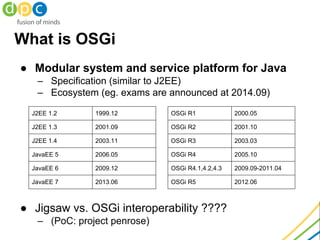
What is OSGi
● Modular system and service platform for Java
– Specification (similar to J2EE)
– Ecosystem (eg. exams are announced at 2014.09)
● Jigsaw vs. OSGi interoperability ????
– (PoC: project penrose)
OSGi R1 2000.05
OSGi R2 2001.10
OSGi R3 2003.03
OSGi R4 2005.10
OSGi R4.1,4.2,4.3 2009.09-2011.04
OSGi R5 2012.06
J2EE 1.2 1999.12
J2EE 1.3 2001.09
J2EE 1.4 2003.11
JavaEE 5 2006.05
JavaEE 6 2009.12
JavaEE 7 2013.06
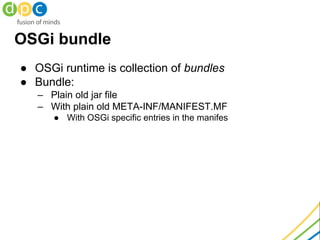
● OSGi runtime is collection of bundles
● Bundle:
– Plain old jar file
– With plain old META-INF/MANIFEST.MF
● With OSGi specific entries in the manifes
OSGi bundle
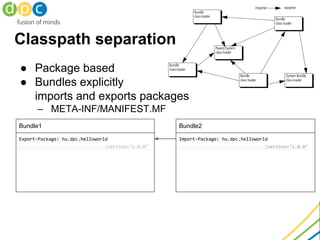
Classpath separation
● Package based
● Bundles explicitly
imports and exports packages
– META-INF/MANIFEST.MF
Bundle1
Export-Package: hu.dpc.helloworld
;version="1.0.0"
Bundle2
Import-Package: hu.dpc.helloworld
;version="1.0.0"
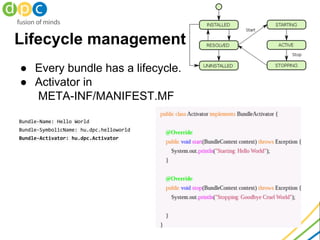
Lifecycle management
● Every bundle has a lifecycle.
● Activator in
META-INF/MANIFEST.MF
Bundle-Name: Hello World
Bundle-SymbolicName: hu.dpc.helloworld
Bundle-Activator: hu.dpc.Activator
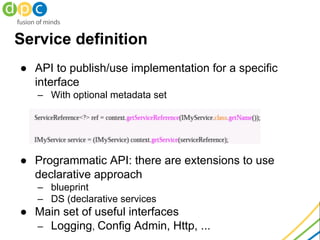
Service definition
● API to publish/use implementation for a specific
interface
– With optional metadata set
● Programmatic API: there are extensions to use
declarative approach
– blueprint
– DS (declarative services
● Main set of useful interfaces
– Logging, Config Admin, Http, ...
Runtime container
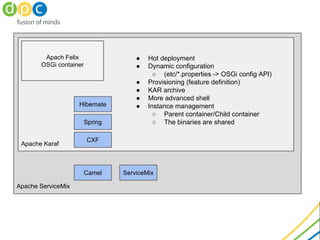
Apach Felix
OSGi container
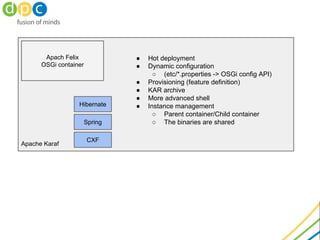
Apache Karaf
Apach Felix
OSGi container
Hibernate
Spring
CXF
● Hot deployment
● Dynamic configuration
○ (etc/*.properties -> OSGi config API)
● Provisioning (feature definition)
● KAR archive
● More advanced shell
● Instance management
○ Parent container/Child container
○ The binaries are shared
Apache Karaf
Apach Felix
OSGi container
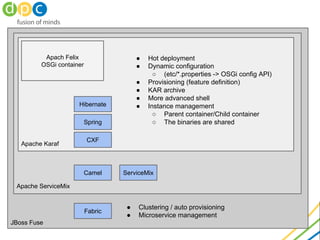
Apache ServiceMix
Hibernate
Spring
CXF
Camel ServiceMix
● Hot deployment
● Dynamic configuration
○ (etc/*.properties -> OSGi config API)
● Provisioning (feature definition)
● KAR archive
● More advanced shell
● Instance management
○ Parent container/Child container
○ The binaries are shared
Apache Karaf
Apach Felix
OSGi container
Apache ServiceMix
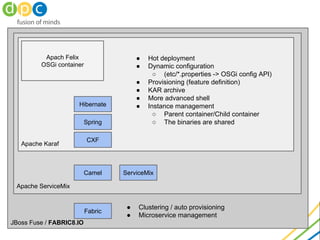
JBoss Fuse
● Clustering / auto provisioning
● Microservice management
Hibernate
Spring
CXF
Fabric
Camel ServiceMix
● Hot deployment
● Dynamic configuration
○ (etc/*.properties -> OSGi config API)
● Provisioning (feature definition)
● KAR archive
● More advanced shell
● Instance management
○ Parent container/Child container
○ The binaries are shared
Apache Karaf
Apach Felix
OSGi container
Apache ServiceMix
JBoss Fuse / FABRIC8.IO
● Clustering / auto provisioning
● Microservice management
Hibernate
Spring
CXF
Fabric
Camel ServiceMix
● Hot deployment
● Dynamic configuration
○ (etc/*.properties -> OSGi config API)
● Provisioning (feature definition)
● KAR archive
● More advanced shell
● Instance management
○ Parent container/Child container
○ The binaries are shared
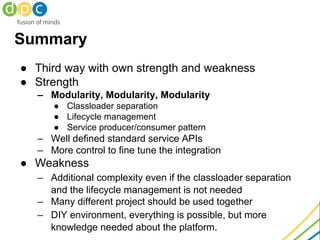
Summary
● Third way with own strength and weakness
● Strength
– Modularity, Modularity, Modularity
● Classloader separation
● Lifecycle management
● Service producer/consumer pattern
– Well defined standard service APIs
– More control to fine tune the integration
● Weakness
– Additional complexity even if the classloader separation
and the lifecycle management is not needed
– Many different project should be used together
– DIY environment, everything is possible, but more
knowledge needed about the platform.
Q&A

OSGi as Enterprise Integration Platform

  • 1.
    OSGi as Enterprise IntegrationPlatform Elek Márton @anzix 2014 September DPC Consulting
  • 2.
    Agenda Typical question: JavaEE orSpring based application? Our question: Is the OSGi good enough for a third way? ● What is OSGi – Classpath separation – Service definitions – Lifecycle ● How does an OSGi application server looks like? – Felix, Karaf, ServiceMix – JBoss Fuse, Fabric8.io
  • 3.
  • 4.
    What is OSGi ●Modular system and service platform for Java – Specification (similar to J2EE) – Ecosystem (eg. exams are announced at 2014.09) ● Jigsaw vs. OSGi interoperability ???? – (PoC: project penrose) OSGi R1 2000.05 OSGi R2 2001.10 OSGi R3 2003.03 OSGi R4 2005.10 OSGi R4.1,4.2,4.3 2009.09-2011.04 OSGi R5 2012.06 J2EE 1.2 1999.12 J2EE 1.3 2001.09 J2EE 1.4 2003.11 JavaEE 5 2006.05 JavaEE 6 2009.12 JavaEE 7 2013.06
  • 5.
    ● OSGi runtimeis collection of bundles ● Bundle: – Plain old jar file – With plain old META-INF/MANIFEST.MF ● With OSGi specific entries in the manifes OSGi bundle
  • 6.
    Classpath separation ● Packagebased ● Bundles explicitly imports and exports packages – META-INF/MANIFEST.MF Bundle1 Export-Package: hu.dpc.helloworld ;version="1.0.0" Bundle2 Import-Package: hu.dpc.helloworld ;version="1.0.0"
  • 7.
    Lifecycle management ● Everybundle has a lifecycle. ● Activator in META-INF/MANIFEST.MF Bundle-Name: Hello World Bundle-SymbolicName: hu.dpc.helloworld Bundle-Activator: hu.dpc.Activator
  • 8.
    Service definition ● APIto publish/use implementation for a specific interface – With optional metadata set ● Programmatic API: there are extensions to use declarative approach – blueprint – DS (declarative services ● Main set of useful interfaces – Logging, Config Admin, Http, ...
  • 9.
  • 10.
  • 11.
    Apache Karaf Apach Felix OSGicontainer Hibernate Spring CXF ● Hot deployment ● Dynamic configuration ○ (etc/*.properties -> OSGi config API) ● Provisioning (feature definition) ● KAR archive ● More advanced shell ● Instance management ○ Parent container/Child container ○ The binaries are shared
  • 12.
    Apache Karaf Apach Felix OSGicontainer Apache ServiceMix Hibernate Spring CXF Camel ServiceMix ● Hot deployment ● Dynamic configuration ○ (etc/*.properties -> OSGi config API) ● Provisioning (feature definition) ● KAR archive ● More advanced shell ● Instance management ○ Parent container/Child container ○ The binaries are shared
  • 13.
    Apache Karaf Apach Felix OSGicontainer Apache ServiceMix JBoss Fuse ● Clustering / auto provisioning ● Microservice management Hibernate Spring CXF Fabric Camel ServiceMix ● Hot deployment ● Dynamic configuration ○ (etc/*.properties -> OSGi config API) ● Provisioning (feature definition) ● KAR archive ● More advanced shell ● Instance management ○ Parent container/Child container ○ The binaries are shared
  • 14.
    Apache Karaf Apach Felix OSGicontainer Apache ServiceMix JBoss Fuse / FABRIC8.IO ● Clustering / auto provisioning ● Microservice management Hibernate Spring CXF Fabric Camel ServiceMix ● Hot deployment ● Dynamic configuration ○ (etc/*.properties -> OSGi config API) ● Provisioning (feature definition) ● KAR archive ● More advanced shell ● Instance management ○ Parent container/Child container ○ The binaries are shared
  • 15.
    Summary ● Third waywith own strength and weakness ● Strength – Modularity, Modularity, Modularity ● Classloader separation ● Lifecycle management ● Service producer/consumer pattern – Well defined standard service APIs – More control to fine tune the integration ● Weakness – Additional complexity even if the classloader separation and the lifecycle management is not needed – Many different project should be used together – DIY environment, everything is possible, but more knowledge needed about the platform.
  • 16.