3. Higher-Level Synchronization 3.1 Shared Memory Methods  Monitors  Protected Types 3.2 Distributed Synchronization/Comm. Message-Based Communication  Procedure-Based Communication  Distributed Mutual Exclusion 3.3 Other Classical Problems The Readers/Writers Problem The Dining Philosophers Problem  The Elevator Algorithm Event Ordering with Logical Clocks
Motivation Semaphores and Events are:  Powerful but low-level abstractions Programming with them is highly error prone Such programs are difficult to design, debug, and maintain Not usable in distributed memory systems Need higher-level primitives  Based on semaphores or messages
Shared Memory Methods Monitors (Hoare, 1974) Follow principles of abstract data type (object-oriented) programming: A data type is manipulated only by a set of predefined operations A monitor is A  collection of data  representing the state of the resource controlled by the monitor, and Procedures  to manipulate that resource data [Is there an “ object -ion” here?  :-) ]
Monitors Implementation must guarantee: Resource accessible  only  by monitor procedures Monitor procedures are mutually exclusive For coordination, monitors provide: c.wait Calling process is blocked and placed on waiting queue associated with condition variable  c c.signal Calling process wakes up first process on  c  queue
Monitors “ condition variable”  c  is  not a conventional variable c  has no value c  is an arbitrary name chosen by programmer to designate an event, state, or condition Each  c  has a waiting queue associated A process may “block” itself on  c  -- it  waits  until another process issues a  signal  on  c
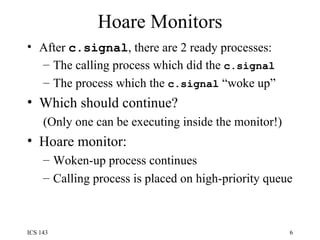
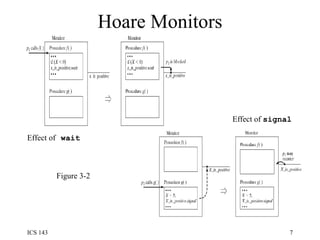
Hoare Monitors After  c.signal , there are 2 ready processes: The calling process which did the  c.signal The process which the  c.signal  “woke up” Which should continue? (Only one can be executing inside the monitor!) Hoare monitor:  Woken-up process continues Calling process is placed on high-priority queue
Hoare Monitors Figure 3-2 Effect of   wait Effect of  signal
Bounded buffer problem monitor BoundedBuffer {  char buffer[n];  int nextin=0, nextout=0, fullCount=0;  condition notempty, notfull;  deposit(char data) {  ... }  remove(char data) {  ... }
Bounded buffer problem deposit(char data) {  if (fullCount==n) notfull.wait;  buffer[nextin] = data;  nextin = (nextin+1) % n;  fullCount = fullCount+1;  notempty.signal;  }  remove(char data) {  if (fullCount==0) notempty.wait;  data = buffer[nextout];  nextout = (nextout+1) % n;  fullCount = fullCount - 1;  notfull.signal;  }
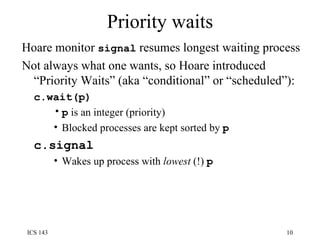
Priority waits Hoare monitor  signal  resumes longest waiting process Not always what one wants, so Hoare introduced “Priority Waits” (aka “conditional” or “scheduled”): c.wait(p) p  is an integer (priority) Blocked processes are kept sorted by  p   c.signal Wakes up process with  lowest  (!)  p
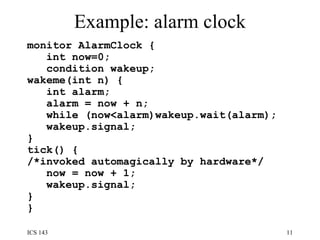
Example: alarm clock monitor AlarmClock {  int now=0;  condition wakeup;  wakeme(int n) {  int alarm;  alarm = now + n;  while (now<alarm)wakeup.wait(alarm);  wakeup.signal;  }  tick() { /*invoked automagically by hardware*/ now = now + 1;  wakeup.signal;  } }
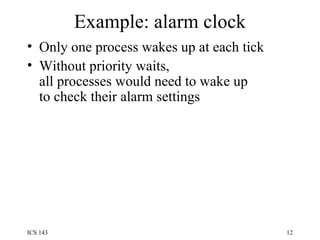
Example: alarm clock Only one process wakes up at each tick Without priority waits, all processes would need to wake up to check their alarm settings
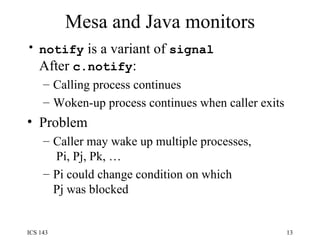
Mesa and Java monitors notify  is a variant of  signal After  c.notify : Calling process continues Woken-up process continues when caller exits Problem Caller may wake up multiple processes,  Pi, Pj, Pk, … Pi could change condition on which Pj was blocked
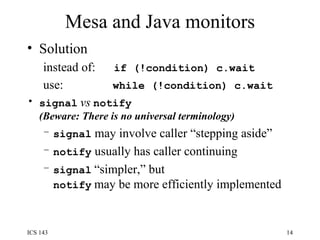
Mesa and Java monitors Solution instead of:  if (!condition) c.wait use:  while (!condition) c.wait signal   vs   notify (Beware: There is no universal terminology) signal  may involve caller “stepping aside” notify  usually has caller continuing signal   “simpler,” but   notify   may be more efficiently implemented
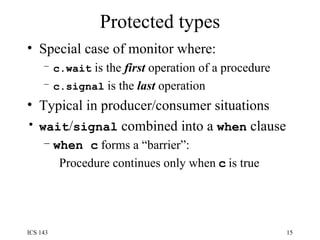
Protected types Special case of monitor where: c.wait  is the  first  operation of a procedure c.signal  is the  last  operation Typical in producer/consumer situations wait / signal  combined into a  when  clause when c  forms a “barrier”:  Procedure continues only when   c   is true
Example entry deposit(char c)  when (fullCount < n) {  buffer[nextin] = c;  nextin = (nextin + 1) % n;  fullCount = fullCount + 1;  }  entry remove(char c)  when (fullCount > 0) {  c = buffer[nextout];  nextout = (nextout + 1) % n;  fullCount = fullCount - 1;  }
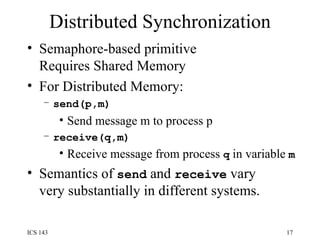
Distributed Synchronization Semaphore-based primitive Requires Shared Memory For Distributed Memory: send(p,m) Send message m to process p receive(q,m) Receive message from process  q  in variable  m Semantics of  send  and  receive  vary very substantially in different systems.
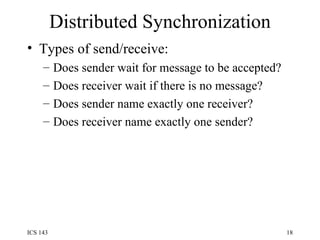
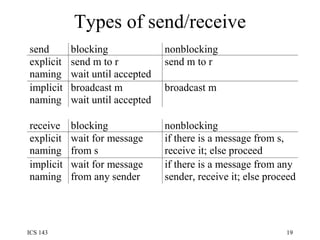
Distributed Synchronization Types of send/receive: Does sender wait for message to be accepted? Does receiver wait if there is no message? Does sender name exactly one receiver? Does receiver name exactly one sender?
Types of send/receive
Channels, Ports, and Mailboxes Allow indirect communication: Senders/Receivers name channel instead of processes Senders/Receivers determined at runtime Sender does not need to know who receives the message Receiver does not need to know who sent the message
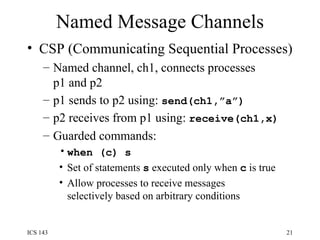
Named Message Channels CSP (Communicating Sequential Processes) Named channel, ch1, connects processes p1 and p2 p1 sends to p2 using:  send(ch1,”a”) p2 receives from p1 using:  receive(ch1,x) Guarded commands: when (c) s   Set of statements  s  executed only when  c  is true Allow processes to receive messages selectively based on arbitrary conditions
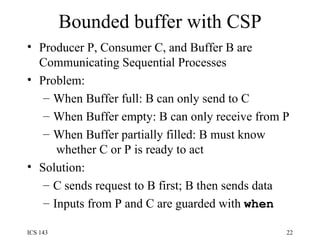
Bounded buffer with CSP Producer P, Consumer C, and Buffer B are Communicating Sequential Processes Problem:  When Buffer full: B can only send to C When Buffer empty: B can only receive from P When Buffer partially filled: B must know  whether C or P is ready to act Solution: C sends request to B first; B then sends data Inputs from P and C are guarded with  when
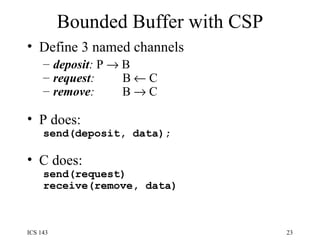
Bounded Buffer with CSP Define 3 named channels  deposit :  P    B request :   B    C  remove :   B    C P does: send(deposit, data); C does: send(request) receive(remove, data)
Bounded buffer with CSP process BoundedBuffer {  ... while (1) {  when ((fullCount<n) &&  receive(deposit, buf[nextin])){  nextin = (nextin + 1) % n;  fullCount = fullCount + 1;  }  or  when ((fullCount>0) && receive(req)){  send(remove, buf[nextout]);  nextout = (nextout + 1) % n;  fullCount = fullCount - 1;  }  }
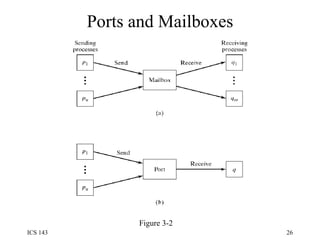
Ports and Mailboxes Indirect communication (named message channels) allows a receiver to receive from multiple senders (nondeterministically) When channel is a queue, send can be nonblocking  Such a queue is called  mailbox  or  port , depending on number of receivers: mailbox  can have multiple senders and receivers port  can have only one receiver
Ports and Mailboxes Figure 3-2
Procedure-Based Communication Send/Receive are too low level (like P/V) Typical interaction:  Send Request & (then) Receive Result Make this into a single higher-level primitive Use RPC (Remote Procedure Call) or Rendezvous Caller invokes procedure on remote machine Remote machine performs operation and returns result Similar to regular procedure call, but parameters cannot contain pointers because caller and server do not share any memory
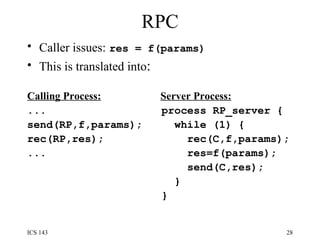
RPC Caller issues:   res = f(params) This is translated into : Calling Process:     Server Process: ...  process RP_server {  send(RP,f,params);  while (1) {  rec(RP,res);  rec(C,f,params);  ...  res=f(params);  send(C,res);  }  }
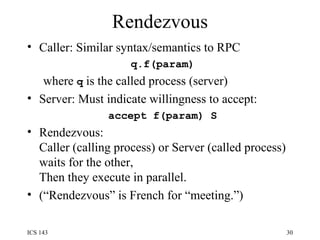
Rendezvous With RPC:  Called process p is part of a dedicated server With Rendezvous:  p is part of an arbitrary process p maintains state between calls p may accept/delay/reject call Setup is symmetrical:  Any process may be a client or a server
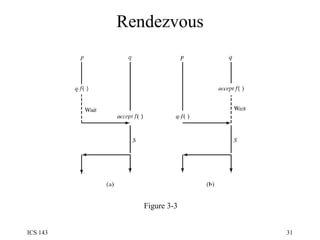
Rendezvous Caller: Similar syntax/semantics to RPC q.f(param) where  q  is the called process (server) Server: Must indicate willingness to accept: accept f(param) S Rendezvous: Caller (calling process) or Server (called process) waits for the other, Then they execute in parallel. (“Rendezvous” is French for “meeting.”)
Rendezvous Figure 3-3
Rendezvous To permit selective receive: select { [when B1:] accept E1(…) S1; or [when B2:] accept E2(…) S2; or … [when Bn:] accept En(…) Sn; [else R] }
Example: Bounded Buffer process BoundedBuffer {  while(1) {  select {  when (fullCount < n):  accept deposit(char c) {  buffer[nextin] = c;  nextin = (nextin + 1) % n;  fullCount = fullCount + 1;  }  or  when (fullCount > 0):  accept remove(char c) {  c = buffer[nextout];  nextout = (nextout + 1) % n;  fullCount = fullCount - 1;  }  }}}
Distributed Mutual Exclusion CS problem in a Distributed Environment No shared memory, No shared clock, Delays in message transmission . Central Controller Solution Requesting process sends request to controller Controller grant it to one processes at a time Problems: Single point of failure,    Performance bottleneck Fully Distributed Solution: Processes negotiate access among themselves
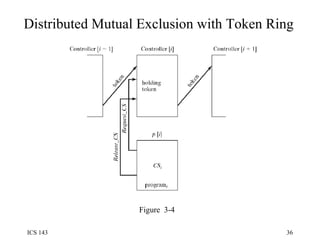
Distributed Mutual Exclusion Token Ring solution Each process has a controller Controllers are arranged in a ring Controllers pass “token” around ring Process whose controller holds token may enter CS
Distributed Mutual Exclusion with Token Ring Figure  3-4
Distributed Mutual Exclusion process controller[i] {  while(1) {  accept Token;  select {  accept Request_CS() {busy=1;}  else null;  }  if (busy) accept Release_CS() {busy=0;} controller[(i+1) % n].Token;  }  }  process p[i] {  while(1) {  controller[i].Request_CS();  CSi;  controller[i].Release_CS();  programi;  } }
Readers/Writers Problem Extension of basic CS problem (Courtois, Heymans, and Parnas, 1971) Two types of processes entering a CS: Only one W may be inside CS, (exclusive) or Any number of R may be inside CS Prevent starvation of either process type: If Rs are in CS, a new R must not enter if W is waiting If W is in CS, once it leaves, all Rs waiting should enter (even if they arrived after new Ws)
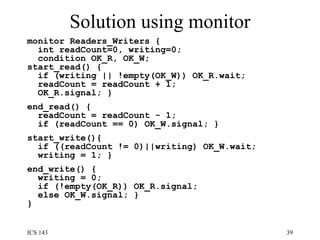
Solution using monitor monitor Readers_Writers {  int readCount=0, writing=0; condition OK_R, OK_W; start_read() {  if (writing || !empty(OK_W)) OK_R.wait;  readCount = readCount + 1;  OK_R.signal; }  end_read() {  readCount = readCount - 1;  if (readCount == 0) OK_W.signal; } start_write(){  if ((readCount != 0)||writing) OK_W.wait;  writing = 1; }  end_write() {  writing = 0;  if (!empty(OK_R)) OK_R.signal;  else OK_W.signal; } }
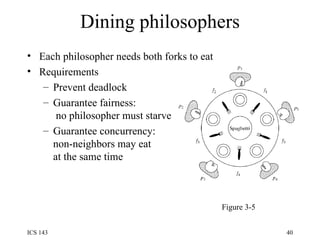
Dining philosophers Each philosopher needs both forks to eat Requirements Prevent deadlock Guarantee fairness:  no philosopher must starve Guarantee concurrency: non-neighbors may eat  at the same time Figure 3-5
Dining philosophers p(i) { while (1) { think(i); grab_forks(i); eat(i); return_forks(i); } grab_forks(i):  P(f[i]); P(f[(i+1)%5]) return_forks(i): V(f[i]); V(f[(i+1)%5]) Only one process can grab any fork May lead to deadlock
Dining Philosophers Solutions to deadlock Use a counter: At most n–1 philosophers may attempt to grab forks One philosopher requests forks in reverse order,   e.g.,   grab_forks(1): P(f[2]); P(f[1]) Violates concurrency requirement:   While P(1) is eating,   all other could be blocked in a chain Divide philosophers into two groups: Odd grab Left fork first,  Even grab Right fork first
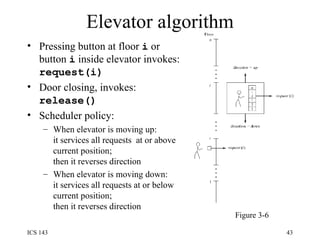
Elevator algorithm Pressing button at floor  i  or button  i  inside elevator invokes:  request(i) Door closing, invokes:  release() Scheduler policy: When elevator is moving up: it services all requests  at or above current position; then it reverses direction When elevator is moving down: it services all requests at or below current position; then it reverses direction Figure 3-6
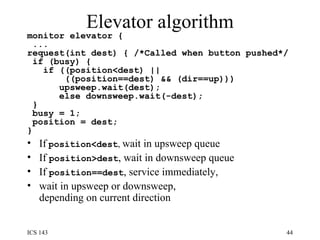
Elevator algorithm monitor elevator {  ... request(int dest) { /*Called when button pushed*/  if (busy) {  if ((position<dest) ||  ((position==dest) && (dir==up)))  upsweep.wait(dest);  else downsweep.wait(-dest);  }  busy = 1;  position = dest;  }  If   position<dest ,  wait in upsweep queue If  position>dest , wait in downsweep queue If  position==dest , service immediately, wait in upsweep or downsweep, depending on current direction
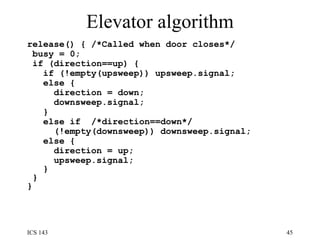
Elevator algorithm release() { /*Called when door closes*/ busy = 0;  if (direction==up) {  if (!empty(upsweep)) upsweep.signal;  else {  direction = down;  downsweep.signal;  }  else if  /*direction==down*/ (!empty(downsweep)) downsweep.signal; else { direction = up;  upsweep.signal;  }  }  }
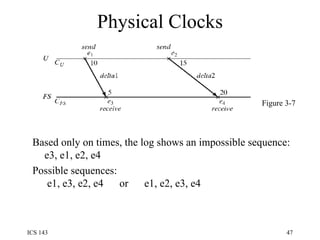
Logical Clocks Many applications need to  time-stamp  events  for debugging, recovery, distributed mutual exclusion, ordering of broadcast messages, transactions, etc. Centralized  system allows one to attach clock value: C(e1)<C(e2)  means  e1  happened before  e2 Physical clocks in  distributed  systems are skewed Example below shows what can happen if one relies on physical clocks which are skewed.
Physical Clocks Based only on times, the log shows an impossible sequence: e3, e1, e2, e4 Possible sequences:  e1, e3, e2, e4  or  e1, e2, e3, e4 Figure 3-7
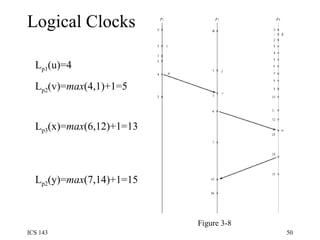
Logical Clocks Use  counters  as logical clocks: Within a process p, increment counter for each new event:   L p (e i+1 ) = L p (e i ) + 1 Label each  send  event with new clock value:   L p (e s ) = L p (e i ) + 1 Label each  receive  event with  maximum  of local clock value and value of message:   L q (e r ) = max( L p (e s ), L q (e i ) ) + 1
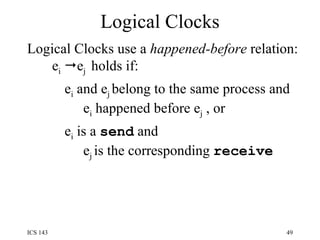
Logical Clocks Logical Clocks use a  happened-before   relation:  e i    e j  holds if: e i  and e j  belong to the same process and   e i  happened before e j  , or   e i  is a  send  and   e j  is the corresponding  receive
Logical Clocks Figure 3-8 L p1 (u)=4 L p2 (v)= max (4,1)+1=5 L p3 (x)= max (6,12)+1=13 L p2 (y)= max (7,14)+1=15

Os3

  • 1.
    3. Higher-Level Synchronization3.1 Shared Memory Methods Monitors Protected Types 3.2 Distributed Synchronization/Comm. Message-Based Communication Procedure-Based Communication Distributed Mutual Exclusion 3.3 Other Classical Problems The Readers/Writers Problem The Dining Philosophers Problem The Elevator Algorithm Event Ordering with Logical Clocks
  • 2.
    Motivation Semaphores andEvents are: Powerful but low-level abstractions Programming with them is highly error prone Such programs are difficult to design, debug, and maintain Not usable in distributed memory systems Need higher-level primitives Based on semaphores or messages
  • 3.
    Shared Memory MethodsMonitors (Hoare, 1974) Follow principles of abstract data type (object-oriented) programming: A data type is manipulated only by a set of predefined operations A monitor is A collection of data representing the state of the resource controlled by the monitor, and Procedures to manipulate that resource data [Is there an “ object -ion” here? :-) ]
  • 4.
    Monitors Implementation mustguarantee: Resource accessible only by monitor procedures Monitor procedures are mutually exclusive For coordination, monitors provide: c.wait Calling process is blocked and placed on waiting queue associated with condition variable c c.signal Calling process wakes up first process on c queue
  • 5.
    Monitors “ conditionvariable” c is not a conventional variable c has no value c is an arbitrary name chosen by programmer to designate an event, state, or condition Each c has a waiting queue associated A process may “block” itself on c -- it waits until another process issues a signal on c
  • 6.
    Hoare Monitors After c.signal , there are 2 ready processes: The calling process which did the c.signal The process which the c.signal “woke up” Which should continue? (Only one can be executing inside the monitor!) Hoare monitor: Woken-up process continues Calling process is placed on high-priority queue
  • 7.
    Hoare Monitors Figure3-2 Effect of wait Effect of signal
  • 8.
    Bounded buffer problemmonitor BoundedBuffer { char buffer[n]; int nextin=0, nextout=0, fullCount=0; condition notempty, notfull; deposit(char data) { ... } remove(char data) { ... }
  • 9.
    Bounded buffer problemdeposit(char data) { if (fullCount==n) notfull.wait; buffer[nextin] = data; nextin = (nextin+1) % n; fullCount = fullCount+1; notempty.signal; } remove(char data) { if (fullCount==0) notempty.wait; data = buffer[nextout]; nextout = (nextout+1) % n; fullCount = fullCount - 1; notfull.signal; }
  • 10.
    Priority waits Hoaremonitor signal resumes longest waiting process Not always what one wants, so Hoare introduced “Priority Waits” (aka “conditional” or “scheduled”): c.wait(p) p is an integer (priority) Blocked processes are kept sorted by p c.signal Wakes up process with lowest (!) p
  • 11.
    Example: alarm clockmonitor AlarmClock { int now=0; condition wakeup; wakeme(int n) { int alarm; alarm = now + n; while (now<alarm)wakeup.wait(alarm); wakeup.signal; } tick() { /*invoked automagically by hardware*/ now = now + 1; wakeup.signal; } }
  • 12.
    Example: alarm clockOnly one process wakes up at each tick Without priority waits, all processes would need to wake up to check their alarm settings
  • 13.
    Mesa and Javamonitors notify is a variant of signal After c.notify : Calling process continues Woken-up process continues when caller exits Problem Caller may wake up multiple processes, Pi, Pj, Pk, … Pi could change condition on which Pj was blocked
  • 14.
    Mesa and Javamonitors Solution instead of: if (!condition) c.wait use: while (!condition) c.wait signal vs notify (Beware: There is no universal terminology) signal may involve caller “stepping aside” notify usually has caller continuing signal “simpler,” but notify may be more efficiently implemented
  • 15.
    Protected types Specialcase of monitor where: c.wait is the first operation of a procedure c.signal is the last operation Typical in producer/consumer situations wait / signal combined into a when clause when c forms a “barrier”: Procedure continues only when c is true
  • 16.
    Example entry deposit(charc) when (fullCount < n) { buffer[nextin] = c; nextin = (nextin + 1) % n; fullCount = fullCount + 1; } entry remove(char c) when (fullCount > 0) { c = buffer[nextout]; nextout = (nextout + 1) % n; fullCount = fullCount - 1; }
  • 17.
    Distributed Synchronization Semaphore-basedprimitive Requires Shared Memory For Distributed Memory: send(p,m) Send message m to process p receive(q,m) Receive message from process q in variable m Semantics of send and receive vary very substantially in different systems.
  • 18.
    Distributed Synchronization Typesof send/receive: Does sender wait for message to be accepted? Does receiver wait if there is no message? Does sender name exactly one receiver? Does receiver name exactly one sender?
  • 19.
  • 20.
    Channels, Ports, andMailboxes Allow indirect communication: Senders/Receivers name channel instead of processes Senders/Receivers determined at runtime Sender does not need to know who receives the message Receiver does not need to know who sent the message
  • 21.
    Named Message ChannelsCSP (Communicating Sequential Processes) Named channel, ch1, connects processes p1 and p2 p1 sends to p2 using: send(ch1,”a”) p2 receives from p1 using: receive(ch1,x) Guarded commands: when (c) s Set of statements s executed only when c is true Allow processes to receive messages selectively based on arbitrary conditions
  • 22.
    Bounded buffer withCSP Producer P, Consumer C, and Buffer B are Communicating Sequential Processes Problem: When Buffer full: B can only send to C When Buffer empty: B can only receive from P When Buffer partially filled: B must know whether C or P is ready to act Solution: C sends request to B first; B then sends data Inputs from P and C are guarded with when
  • 23.
    Bounded Buffer withCSP Define 3 named channels deposit : P  B request : B  C remove : B  C P does: send(deposit, data); C does: send(request) receive(remove, data)
  • 24.
    Bounded buffer withCSP process BoundedBuffer { ... while (1) { when ((fullCount<n) && receive(deposit, buf[nextin])){ nextin = (nextin + 1) % n; fullCount = fullCount + 1; } or when ((fullCount>0) && receive(req)){ send(remove, buf[nextout]); nextout = (nextout + 1) % n; fullCount = fullCount - 1; } }
  • 25.
    Ports and MailboxesIndirect communication (named message channels) allows a receiver to receive from multiple senders (nondeterministically) When channel is a queue, send can be nonblocking Such a queue is called mailbox or port , depending on number of receivers: mailbox can have multiple senders and receivers port can have only one receiver
  • 26.
  • 27.
    Procedure-Based Communication Send/Receiveare too low level (like P/V) Typical interaction: Send Request & (then) Receive Result Make this into a single higher-level primitive Use RPC (Remote Procedure Call) or Rendezvous Caller invokes procedure on remote machine Remote machine performs operation and returns result Similar to regular procedure call, but parameters cannot contain pointers because caller and server do not share any memory
  • 28.
    RPC Caller issues: res = f(params) This is translated into : Calling Process: Server Process: ... process RP_server { send(RP,f,params); while (1) { rec(RP,res); rec(C,f,params); ... res=f(params); send(C,res); } }
  • 29.
    Rendezvous With RPC: Called process p is part of a dedicated server With Rendezvous: p is part of an arbitrary process p maintains state between calls p may accept/delay/reject call Setup is symmetrical: Any process may be a client or a server
  • 30.
    Rendezvous Caller: Similarsyntax/semantics to RPC q.f(param) where q is the called process (server) Server: Must indicate willingness to accept: accept f(param) S Rendezvous: Caller (calling process) or Server (called process) waits for the other, Then they execute in parallel. (“Rendezvous” is French for “meeting.”)
  • 31.
  • 32.
    Rendezvous To permitselective receive: select { [when B1:] accept E1(…) S1; or [when B2:] accept E2(…) S2; or … [when Bn:] accept En(…) Sn; [else R] }
  • 33.
    Example: Bounded Bufferprocess BoundedBuffer { while(1) { select { when (fullCount < n): accept deposit(char c) { buffer[nextin] = c; nextin = (nextin + 1) % n; fullCount = fullCount + 1; } or when (fullCount > 0): accept remove(char c) { c = buffer[nextout]; nextout = (nextout + 1) % n; fullCount = fullCount - 1; } }}}
  • 34.
    Distributed Mutual ExclusionCS problem in a Distributed Environment No shared memory, No shared clock, Delays in message transmission . Central Controller Solution Requesting process sends request to controller Controller grant it to one processes at a time Problems: Single point of failure, Performance bottleneck Fully Distributed Solution: Processes negotiate access among themselves
  • 35.
    Distributed Mutual ExclusionToken Ring solution Each process has a controller Controllers are arranged in a ring Controllers pass “token” around ring Process whose controller holds token may enter CS
  • 36.
    Distributed Mutual Exclusionwith Token Ring Figure 3-4
  • 37.
    Distributed Mutual Exclusionprocess controller[i] { while(1) { accept Token; select { accept Request_CS() {busy=1;} else null; } if (busy) accept Release_CS() {busy=0;} controller[(i+1) % n].Token; } } process p[i] { while(1) { controller[i].Request_CS(); CSi; controller[i].Release_CS(); programi; } }
  • 38.
    Readers/Writers Problem Extensionof basic CS problem (Courtois, Heymans, and Parnas, 1971) Two types of processes entering a CS: Only one W may be inside CS, (exclusive) or Any number of R may be inside CS Prevent starvation of either process type: If Rs are in CS, a new R must not enter if W is waiting If W is in CS, once it leaves, all Rs waiting should enter (even if they arrived after new Ws)
  • 39.
    Solution using monitormonitor Readers_Writers { int readCount=0, writing=0; condition OK_R, OK_W; start_read() { if (writing || !empty(OK_W)) OK_R.wait; readCount = readCount + 1; OK_R.signal; } end_read() { readCount = readCount - 1; if (readCount == 0) OK_W.signal; } start_write(){ if ((readCount != 0)||writing) OK_W.wait; writing = 1; } end_write() { writing = 0; if (!empty(OK_R)) OK_R.signal; else OK_W.signal; } }
  • 40.
    Dining philosophers Eachphilosopher needs both forks to eat Requirements Prevent deadlock Guarantee fairness: no philosopher must starve Guarantee concurrency: non-neighbors may eat at the same time Figure 3-5
  • 41.
    Dining philosophers p(i){ while (1) { think(i); grab_forks(i); eat(i); return_forks(i); } grab_forks(i): P(f[i]); P(f[(i+1)%5]) return_forks(i): V(f[i]); V(f[(i+1)%5]) Only one process can grab any fork May lead to deadlock
  • 42.
    Dining Philosophers Solutionsto deadlock Use a counter: At most n–1 philosophers may attempt to grab forks One philosopher requests forks in reverse order, e.g., grab_forks(1): P(f[2]); P(f[1]) Violates concurrency requirement: While P(1) is eating, all other could be blocked in a chain Divide philosophers into two groups: Odd grab Left fork first, Even grab Right fork first
  • 43.
    Elevator algorithm Pressingbutton at floor i or button i inside elevator invokes: request(i) Door closing, invokes: release() Scheduler policy: When elevator is moving up: it services all requests at or above current position; then it reverses direction When elevator is moving down: it services all requests at or below current position; then it reverses direction Figure 3-6
  • 44.
    Elevator algorithm monitorelevator { ... request(int dest) { /*Called when button pushed*/ if (busy) { if ((position<dest) || ((position==dest) && (dir==up))) upsweep.wait(dest); else downsweep.wait(-dest); } busy = 1; position = dest; } If position<dest , wait in upsweep queue If position>dest , wait in downsweep queue If position==dest , service immediately, wait in upsweep or downsweep, depending on current direction
  • 45.
    Elevator algorithm release(){ /*Called when door closes*/ busy = 0; if (direction==up) { if (!empty(upsweep)) upsweep.signal; else { direction = down; downsweep.signal; } else if /*direction==down*/ (!empty(downsweep)) downsweep.signal; else { direction = up; upsweep.signal; } } }
  • 46.
    Logical Clocks Manyapplications need to time-stamp events for debugging, recovery, distributed mutual exclusion, ordering of broadcast messages, transactions, etc. Centralized system allows one to attach clock value: C(e1)<C(e2) means e1 happened before e2 Physical clocks in distributed systems are skewed Example below shows what can happen if one relies on physical clocks which are skewed.
  • 47.
    Physical Clocks Basedonly on times, the log shows an impossible sequence: e3, e1, e2, e4 Possible sequences: e1, e3, e2, e4 or e1, e2, e3, e4 Figure 3-7
  • 48.
    Logical Clocks Use counters as logical clocks: Within a process p, increment counter for each new event: L p (e i+1 ) = L p (e i ) + 1 Label each send event with new clock value: L p (e s ) = L p (e i ) + 1 Label each receive event with maximum of local clock value and value of message: L q (e r ) = max( L p (e s ), L q (e i ) ) + 1
  • 49.
    Logical Clocks LogicalClocks use a happened-before relation: e i  e j holds if: e i and e j belong to the same process and e i happened before e j , or e i is a send and e j is the corresponding receive
  • 50.
    Logical Clocks Figure3-8 L p1 (u)=4 L p2 (v)= max (4,1)+1=5 L p3 (x)= max (6,12)+1=13 L p2 (y)= max (7,14)+1=15

Editor's Notes

  • #20 Blocking = synchronos Nonblocking = a synchronous Blocking implicit send is rare Blocking receive is common Blocking implicit receive is a natural situation