Origin and Evolution of
Life
BI 201 Natural History of Guam
Class Presentation 23
 Origin of Life
 Environmental conditions of primitive Earth
• Earth was “born” about 4.5 Bybp
• The planets probably formed from debris cast off
from our Sun following its condensation from
interstellar gas and dust of a nebula about 5–7
Bybp
• At first, Earth was semi-molten, but gradually
cooled enough to form a solid rock crust
 The oldest rocks are 3.964 Bybp—from Canada
• Decay of radioactive elements of Earth caused
partial melting of the planet’s interior, with denser
materials making up the core
• Differential temperatures of the core and crust set
convection currents in motion in the mantle
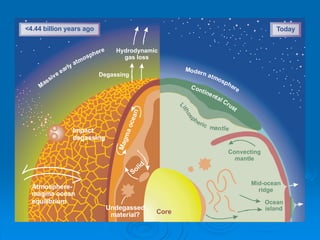
M
a
g
m
a
o
c
e
a
n
Core
Solid
Continental Crust
Convecting
mantle
Mid-ocean
ridge
Ocean
island
L
s
i
t
h
o
pheric mantle
Atmosphere-
magma ocean
equilibrium
Modern atmosphere
Impact
degassing
Hydrodynamic
gas loss
Degassing
M
assive early atmosphere
Undegassed
material?
<4.44 billion years ago Today
• As Earth cooled, there was a period of intense
volcanic activity that released gases into the
primitive atmosphere, primarily
 ammonia = NH3
 carbon monoxide = CO
 hydrogen sulfide = H2S
 methane = CH4
 nitrogen = N2
 water vapor = H2O
• As the rate of radioactive decay slowed, water
vapor condensed and fell through the atmosphere,
dissolving gases and forming a “poisonous” rain
• Run-off of rainwater from the land carried
dissolved minerals into a shallow proto-ocean
• The collective materials in the proto-ocean formed
a “hot, thin primordial soup”
• Earth’s surface was bombarded by solar
energy, especially ultraviolet (UV) radiation
(N.B., the ozone layer was not formed until ca.
600 Mybp)
• Intense electrical storms generated lightning
that assaulted the surface
• Together, the UV and lightning provided energy
necessary to arrange simple molecules of CH4,
NH3, PO4 salts, and H2O into the basic building
blocks of organic compounds, and then into
complex macromolecules
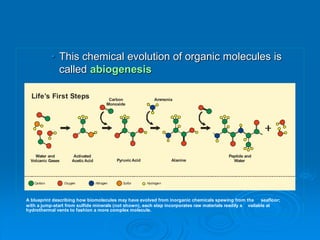
• This chemical evolution of organic molecules is
called abiogenesis
Life’s First Steps
Water and
Volcanic Gases
Activated
AceticAcid PyruvicAcid Alanine
Peptide and
Water
Carbon
Monoxide
Ammonia
Carbon Oxygen Nitrogen Sulfur Hydrogen
A blueprint describing how biomolecules may have evolved from inorganic chemicals spewing from the seafloor;
with a jump-start from sulfide minerals (not shown), each step incorporates raw materials readily a vailable at
hydrothermal vents to fashion a more complex molecule.
 Life began with the first self-replicating
“organism”
• The earliest organism may have been no more
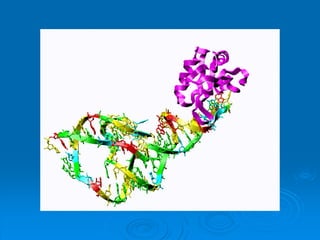
than a ribozyme
 A ribozyme is an RNA molecule capable of enzymatic
actions, e.g., the self-splicing introns of some RNAs,
which can excise themselves from the molecule without
the help of protein enzymes
 These first self-reproducing organisms
appeared about 3.5 Bybp
 They were prokaryotes and anaerobic
heterotrophs that fed on organic molecules in
the primordial soup
• [anaerobic, without oxygen]
• [heterotrophs, consume organics from other
sources]
 Early life forms were continuously bombarded
by UV radiation, causing mutations that
produced new life forms
 As new life forms evolved, the predatory
mode appeared
• Consumption of prey organisms required
catabolism of their organics through the process of
respiration
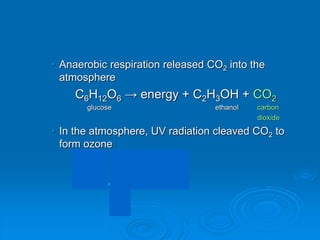
• Anaerobic respiration released CO2 into the
atmosphere
C6H12O6 → energy + C2H3OH + CO2
glucose ethanol carbon
dioxide
• In the atmosphere, UV radiation cleaved CO2 to
form ozone
3CO2 → O3 + 3CO
carbon ozone carbon
dioxide monoxide
UV
• The ozone accumulated into the ozone layer in the
stratosphere, and blocked most of the UV radiation
from penetrating to surface
• Formation of the ozone layer enabled development
of terrestrial life forms
 Other organisms developed the ability to
utilize energy released from breaking
chemical bonds to manufacture their own
organic compounds in the process called
chemosynthesis
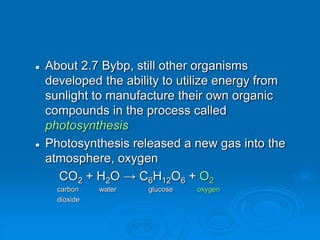
 About 2.7 Bybp, still other organisms
developed the ability to utilize energy from
sunlight to manufacture their own organic
compounds in the process called
photosynthesis
 Photosynthesis released a new gas into the
atmosphere, oxygen
CO2 + H2O → C6H12O6 + O2
carbon water glucose oxygen
dioxide
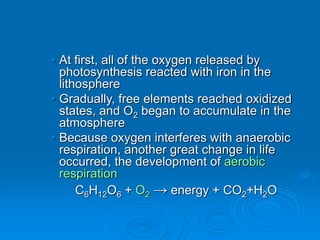
• At first, all of the oxygen released by
photosynthesis reacted with iron in the
lithosphere
• Gradually, free elements reached oxidized
states, and O2 began to accumulate in the
atmosphere
• Because oxygen interferes with anaerobic
respiration, another great change in life
occurred, the development of aerobic
respiration
C6H12O6 + O2 → energy + CO2+H2O
• The oxygen-rich atmosphere and aerobic
respiration are thought to have led to the evolution
of eukaryotes
Time (Bypb)
2.8 2.0 1.0 0
Atmospheric
pressures
of
oxygen
(atmospheres)
0.0001
0.001
0.01
0.1
1.0
The first spike in oxygen levels was a toxic challenge to life and may
have shattered a life-sustaining greenhouse. [Adapted from Kerr, 1999].
 Serial Endosymbiosis Theory
 In the 1970s, scientists hypothesized that
eukaryotes arose as free-living bacteria in
symbiosis with some archaebacterial host that
became the nucleus-containing cytoplasm of
the resulting eukaryote
 They further hypothesized that organelles
were modified from prokaryotic
endosymbionts during eukaryote evolution
 Evidence in support of SET
• Some organelles possess their own DNA outside
the nucleus of the cell
• DNA in organelles is in the form of a convoluted
loop
• For each organelle, there is an analog that that has
been identified among living Eubacteria
 Bacteria giving rise to mitochondria were aerobic
respirers (and predatory?)
• similar to modern α purple bacteria
 Bacteria giving rise to plastids were oxygenic
phototrophic bacteria
• similar to cyanobacteria, and probably were ingested
but not digested or digestible
 Bacteria giving rise to undulipodia (e.g., cilia, sperm tail,
etc., but NOT true flagella of bacteria)
• similar to spirochetes
MULTICELLULAR UNICELLULAR
EUKARYOTES
PROKARYOTES COMMON
ANCESTRAL FORM
OXYGEN-FREE
ATMOSPHERE
OXYGEN-RICH
ATMOSPHERE
PROTISTS
ARCHAE-
BACTERIA
EU-
BACTERIA
PLANTS
FUNGI
ANIMALS
0
0.5
1.0
1.5
2.0
2.5
3.0
3.5
4.0
BILLIONS
OF
YEARS
AGO
Evolutionary tree depicts major events in the history of life. Some scientists argue
that the last common ancestor of all living beings existed a little more than two billion
years ago. [Modified from de Duve, 1996].
PRIMITIVE
PHAGOCYTE
ENDOSYMBIONTS

origin-early-evolution-life.ppt

  • 1.
    Origin and Evolutionof Life BI 201 Natural History of Guam Class Presentation 23
  • 2.
     Origin ofLife  Environmental conditions of primitive Earth • Earth was “born” about 4.5 Bybp • The planets probably formed from debris cast off from our Sun following its condensation from interstellar gas and dust of a nebula about 5–7 Bybp • At first, Earth was semi-molten, but gradually cooled enough to form a solid rock crust  The oldest rocks are 3.964 Bybp—from Canada
  • 3.
    • Decay ofradioactive elements of Earth caused partial melting of the planet’s interior, with denser materials making up the core • Differential temperatures of the core and crust set convection currents in motion in the mantle
  • 4.
    M a g m a o c e a n Core Solid Continental Crust Convecting mantle Mid-ocean ridge Ocean island L s i t h o pheric mantle Atmosphere- magmaocean equilibrium Modern atmosphere Impact degassing Hydrodynamic gas loss Degassing M assive early atmosphere Undegassed material? <4.44 billion years ago Today
  • 5.
    • As Earthcooled, there was a period of intense volcanic activity that released gases into the primitive atmosphere, primarily  ammonia = NH3  carbon monoxide = CO  hydrogen sulfide = H2S  methane = CH4  nitrogen = N2  water vapor = H2O
  • 6.
    • As therate of radioactive decay slowed, water vapor condensed and fell through the atmosphere, dissolving gases and forming a “poisonous” rain • Run-off of rainwater from the land carried dissolved minerals into a shallow proto-ocean • The collective materials in the proto-ocean formed a “hot, thin primordial soup”
  • 7.
    • Earth’s surfacewas bombarded by solar energy, especially ultraviolet (UV) radiation (N.B., the ozone layer was not formed until ca. 600 Mybp) • Intense electrical storms generated lightning that assaulted the surface • Together, the UV and lightning provided energy necessary to arrange simple molecules of CH4, NH3, PO4 salts, and H2O into the basic building blocks of organic compounds, and then into complex macromolecules
  • 8.
    • This chemicalevolution of organic molecules is called abiogenesis Life’s First Steps Water and Volcanic Gases Activated AceticAcid PyruvicAcid Alanine Peptide and Water Carbon Monoxide Ammonia Carbon Oxygen Nitrogen Sulfur Hydrogen A blueprint describing how biomolecules may have evolved from inorganic chemicals spewing from the seafloor; with a jump-start from sulfide minerals (not shown), each step incorporates raw materials readily a vailable at hydrothermal vents to fashion a more complex molecule.
  • 9.
     Life beganwith the first self-replicating “organism” • The earliest organism may have been no more than a ribozyme  A ribozyme is an RNA molecule capable of enzymatic actions, e.g., the self-splicing introns of some RNAs, which can excise themselves from the molecule without the help of protein enzymes
  • 11.
     These firstself-reproducing organisms appeared about 3.5 Bybp  They were prokaryotes and anaerobic heterotrophs that fed on organic molecules in the primordial soup • [anaerobic, without oxygen] • [heterotrophs, consume organics from other sources]
  • 12.
     Early lifeforms were continuously bombarded by UV radiation, causing mutations that produced new life forms  As new life forms evolved, the predatory mode appeared • Consumption of prey organisms required catabolism of their organics through the process of respiration
  • 13.
    • Anaerobic respirationreleased CO2 into the atmosphere C6H12O6 → energy + C2H3OH + CO2 glucose ethanol carbon dioxide • In the atmosphere, UV radiation cleaved CO2 to form ozone 3CO2 → O3 + 3CO carbon ozone carbon dioxide monoxide UV
  • 14.
    • The ozoneaccumulated into the ozone layer in the stratosphere, and blocked most of the UV radiation from penetrating to surface • Formation of the ozone layer enabled development of terrestrial life forms  Other organisms developed the ability to utilize energy released from breaking chemical bonds to manufacture their own organic compounds in the process called chemosynthesis
  • 15.
     About 2.7Bybp, still other organisms developed the ability to utilize energy from sunlight to manufacture their own organic compounds in the process called photosynthesis  Photosynthesis released a new gas into the atmosphere, oxygen CO2 + H2O → C6H12O6 + O2 carbon water glucose oxygen dioxide
  • 16.
    • At first,all of the oxygen released by photosynthesis reacted with iron in the lithosphere • Gradually, free elements reached oxidized states, and O2 began to accumulate in the atmosphere • Because oxygen interferes with anaerobic respiration, another great change in life occurred, the development of aerobic respiration C6H12O6 + O2 → energy + CO2+H2O
  • 17.
    • The oxygen-richatmosphere and aerobic respiration are thought to have led to the evolution of eukaryotes Time (Bypb) 2.8 2.0 1.0 0 Atmospheric pressures of oxygen (atmospheres) 0.0001 0.001 0.01 0.1 1.0 The first spike in oxygen levels was a toxic challenge to life and may have shattered a life-sustaining greenhouse. [Adapted from Kerr, 1999].
  • 18.
     Serial EndosymbiosisTheory  In the 1970s, scientists hypothesized that eukaryotes arose as free-living bacteria in symbiosis with some archaebacterial host that became the nucleus-containing cytoplasm of the resulting eukaryote  They further hypothesized that organelles were modified from prokaryotic endosymbionts during eukaryote evolution
  • 19.
     Evidence insupport of SET • Some organelles possess their own DNA outside the nucleus of the cell • DNA in organelles is in the form of a convoluted loop
  • 20.
    • For eachorganelle, there is an analog that that has been identified among living Eubacteria  Bacteria giving rise to mitochondria were aerobic respirers (and predatory?) • similar to modern α purple bacteria  Bacteria giving rise to plastids were oxygenic phototrophic bacteria • similar to cyanobacteria, and probably were ingested but not digested or digestible  Bacteria giving rise to undulipodia (e.g., cilia, sperm tail, etc., but NOT true flagella of bacteria) • similar to spirochetes
  • 21.
    MULTICELLULAR UNICELLULAR EUKARYOTES PROKARYOTES COMMON ANCESTRALFORM OXYGEN-FREE ATMOSPHERE OXYGEN-RICH ATMOSPHERE PROTISTS ARCHAE- BACTERIA EU- BACTERIA PLANTS FUNGI ANIMALS 0 0.5 1.0 1.5 2.0 2.5 3.0 3.5 4.0 BILLIONS OF YEARS AGO Evolutionary tree depicts major events in the history of life. Some scientists argue that the last common ancestor of all living beings existed a little more than two billion years ago. [Modified from de Duve, 1996]. PRIMITIVE PHAGOCYTE ENDOSYMBIONTS