Organization Assessment and Design Process
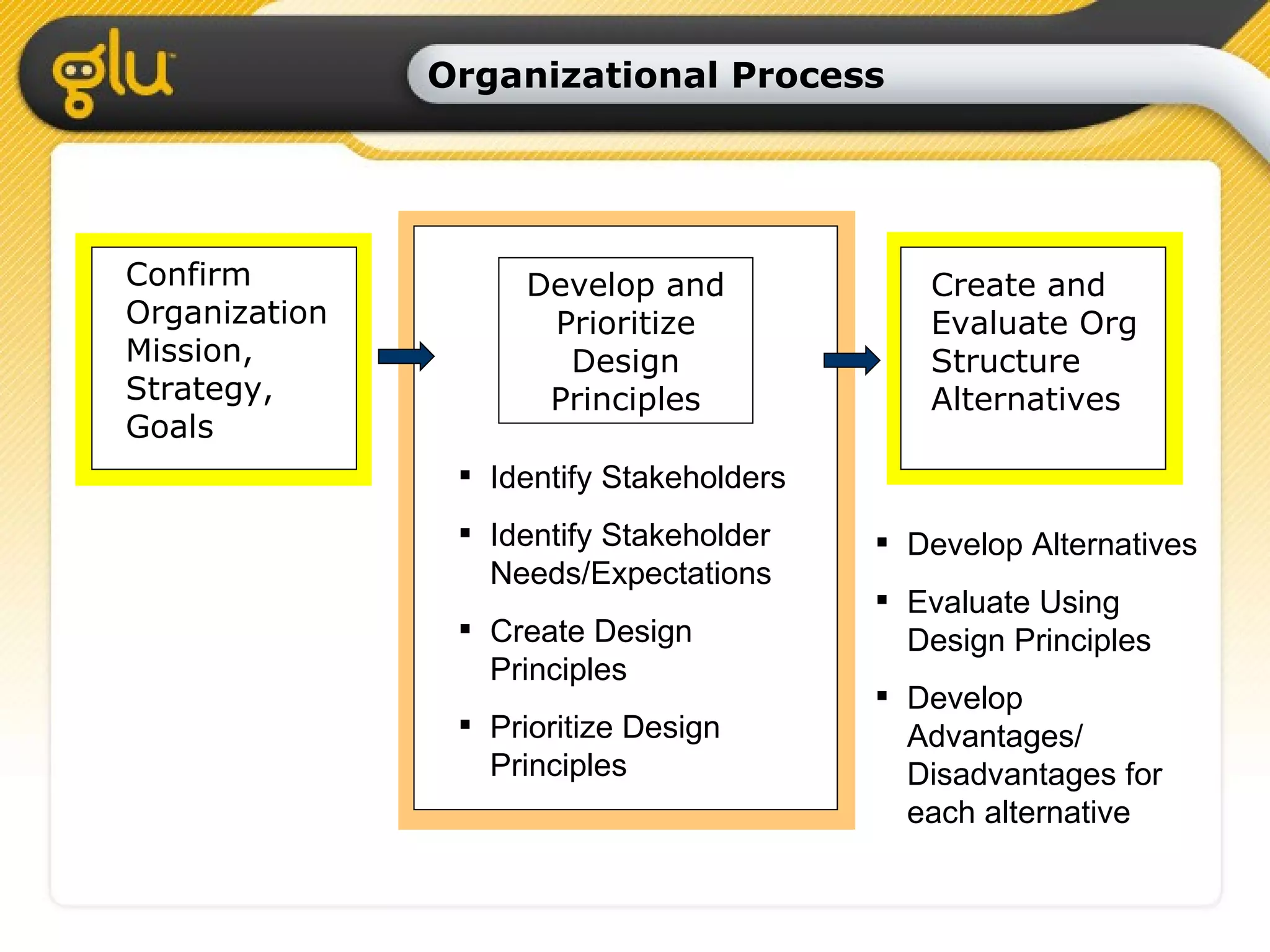
Organizational Process Develop and Prioritize Design Principles Identify Stakeholders Identify Stakeholder Needs/Expectations Create Design Principles Prioritize Design Principles Develop Alternatives Evaluate Using Design Principles Develop Advantages/ Disadvantages for each alternative Confirm Organization Mission, Strategy, Goals Create and Evaluate Org Structure Alternatives
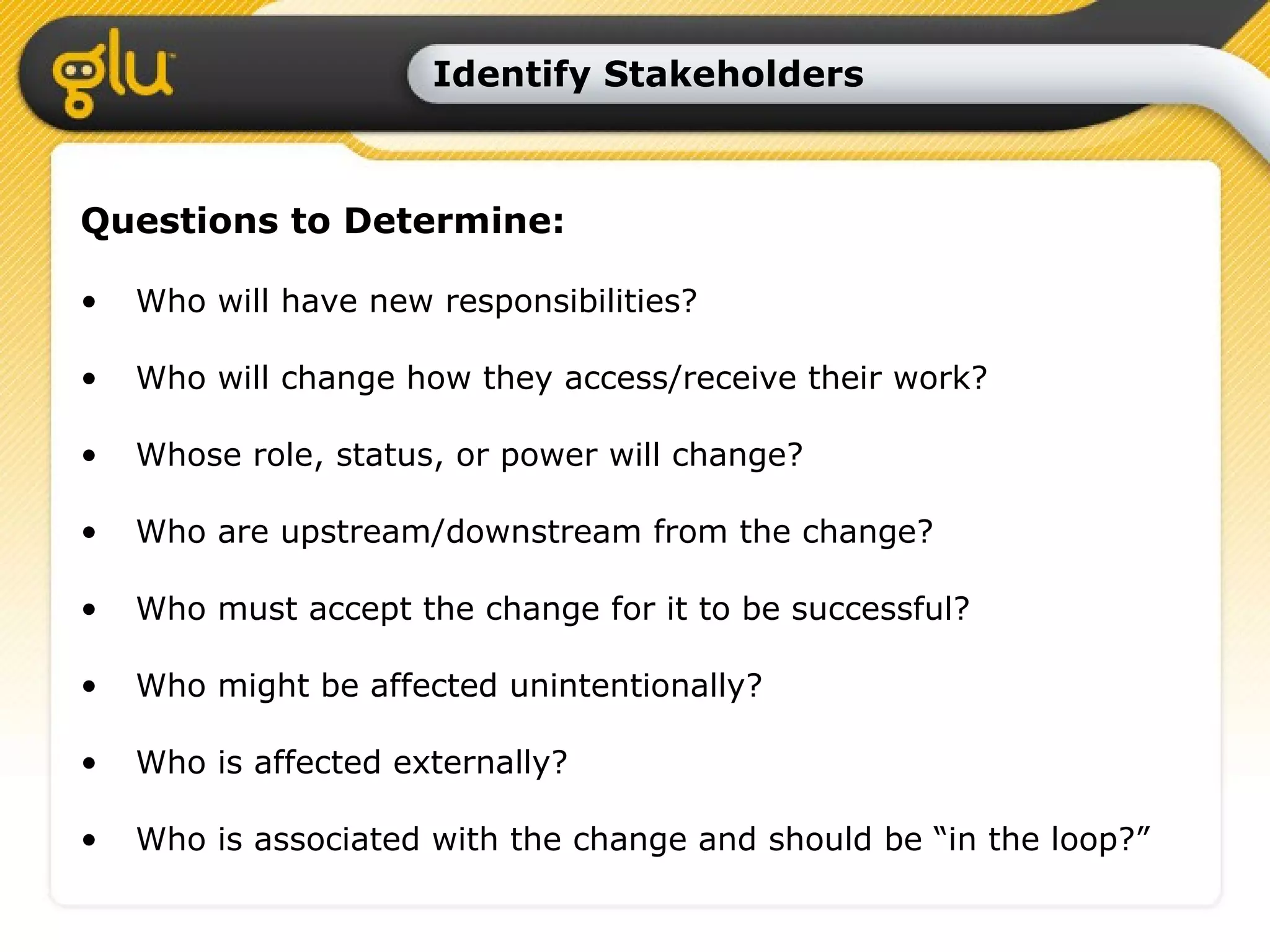
Identify Stakeholders Questions to Determine: Who will have new responsibilities? Who will change how they access/receive their work? Whose role, status, or power will change? Who are upstream/downstream from the change? Who must accept the change for it to be successful? Who might be affected unintentionally? Who is affected externally? Who is associated with the change and should be “in the loop?”
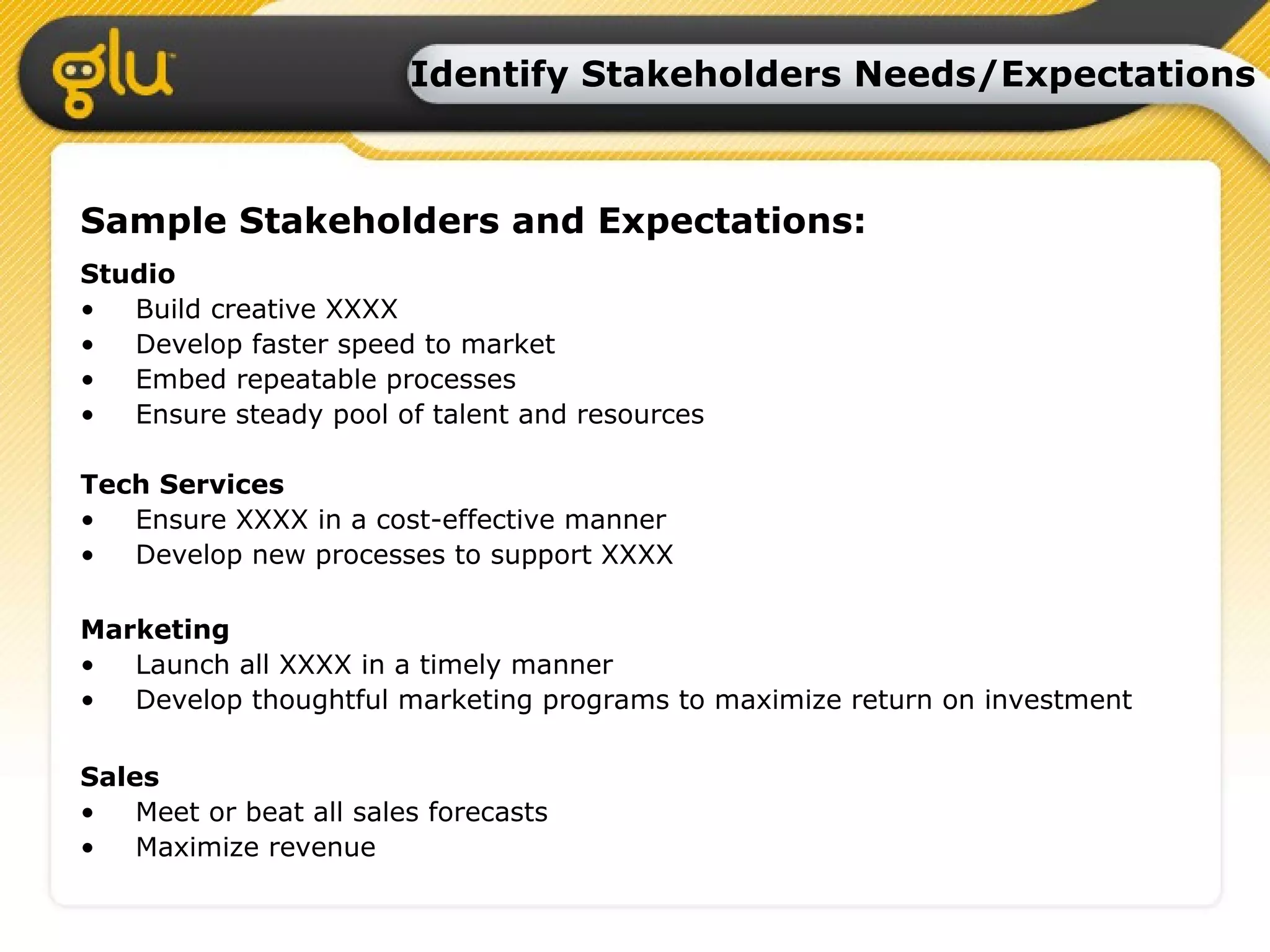
Identify Stakeholders Needs/Expectations Sample Stakeholders and Expectations: Studio Build creative XXXX Develop faster speed to market Embed repeatable processes Ensure steady pool of talent and resources Tech Services Ensure XXXX in a cost-effective manner Develop new processes to support XXXX Marketing Launch all XXXX in a timely manner Develop thoughtful marketing programs to maximize return on investment Sales Meet or beat all sales forecasts Maximize revenue
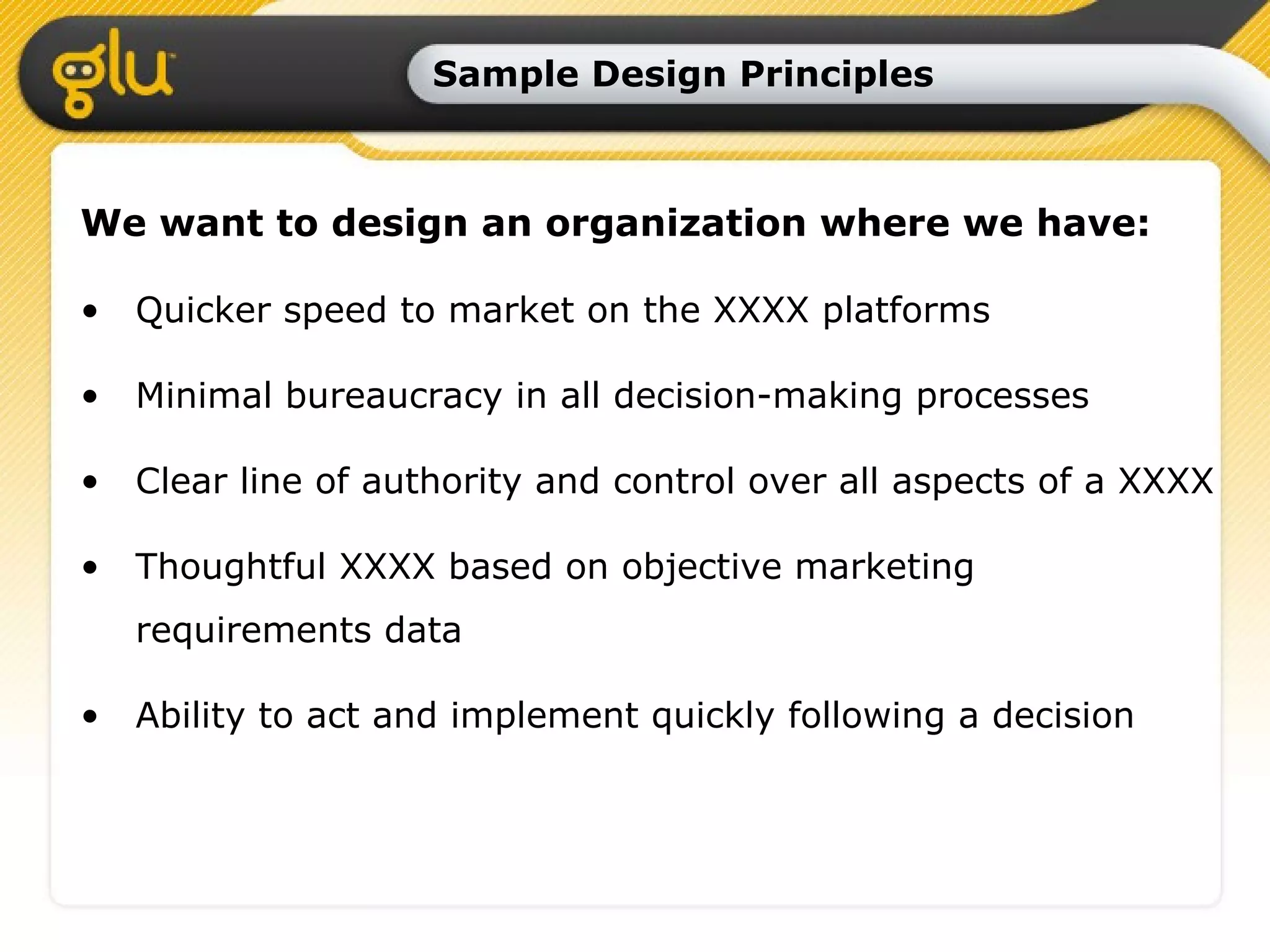
Sample Design Principles We want to design an organization where we have: Quicker speed to market on the XXXX platforms Minimal bureaucracy in all decision-making processes Clear line of authority and control over all aspects of a XXXX Thoughtful XXXX based on objective marketing requirements data Ability to act and implement quickly following a decision
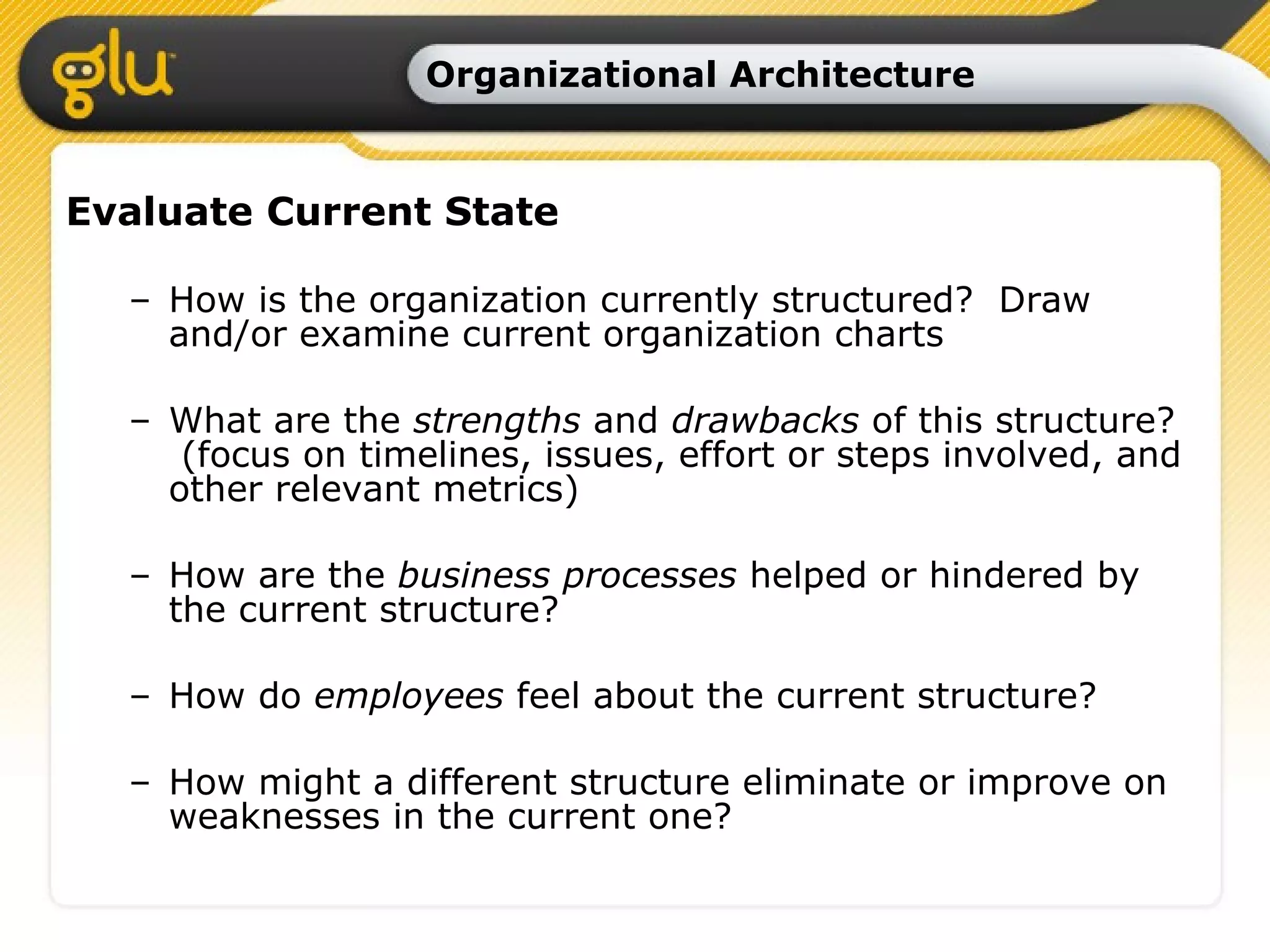
Organizational Architecture Evaluate Current State How is the organization currently structured?  Draw and/or examine current organization charts What are the  strengths  and  drawbacks  of this structure?  (focus on timelines, issues, effort or steps involved, and other relevant metrics) How are the  business processes  helped or hindered by the current structure?  How do  employees  feel about the current structure?  How might a different structure eliminate or improve on weaknesses in the current one?
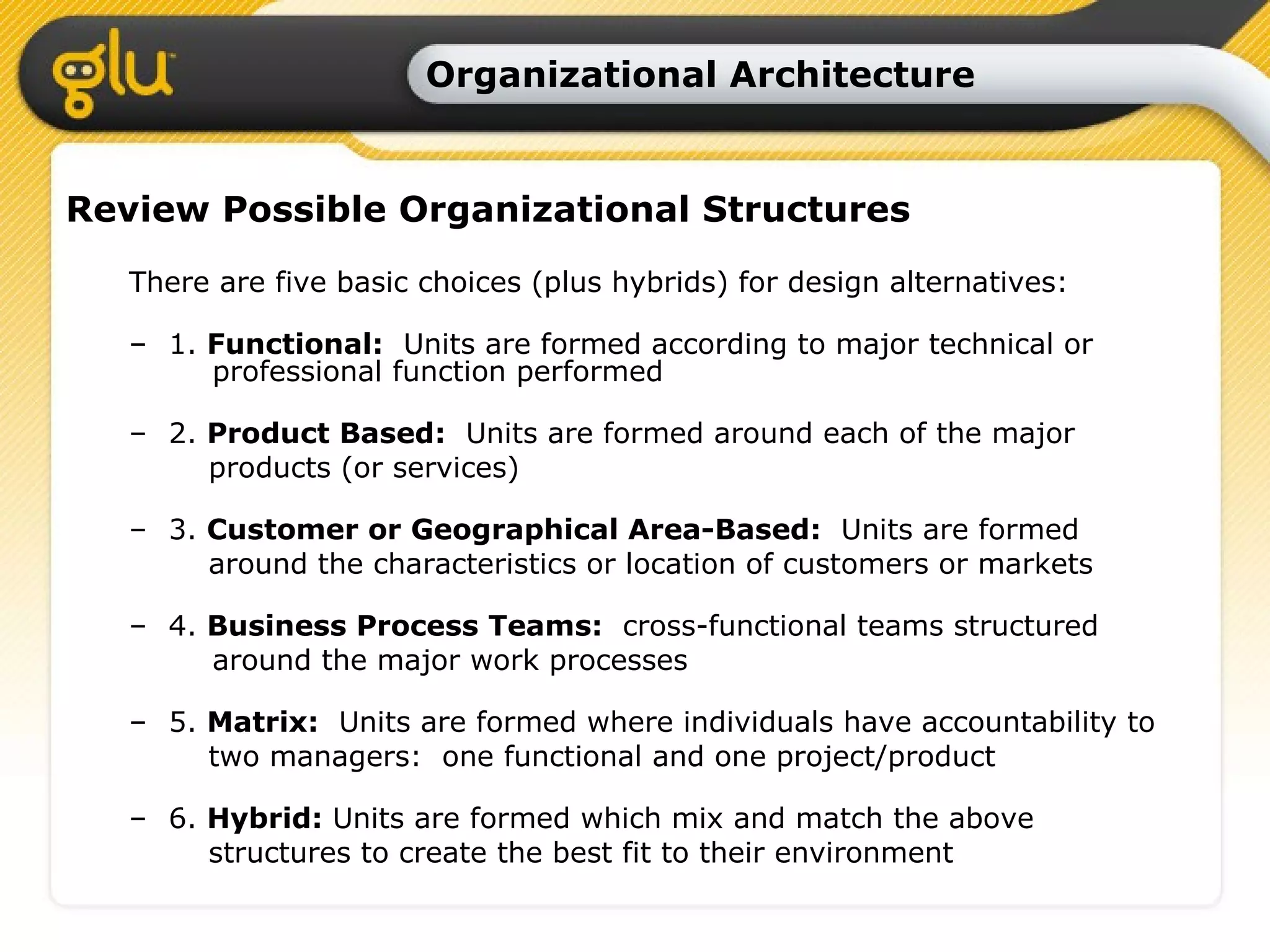
Organizational Architecture Review Possible Organizational Structures There are five basic choices (plus hybrids) for design alternatives: 1.  Functional:   Units are formed according to major technical or    professional function performed 2.  Product Based:   Units are formed around each of the major products (or services) 3.  Customer or Geographical Area-Based:   Units are formed  around the characteristics or location of customers or markets 4.  Business Process Teams:   cross-functional teams structured    around the major work processes 5.  Matrix:   Units are formed where individuals have accountability to    two managers:  one functional and one project/product 6.  Hybrid:  Units are formed which mix and match the above  structures to create the best fit to their environment
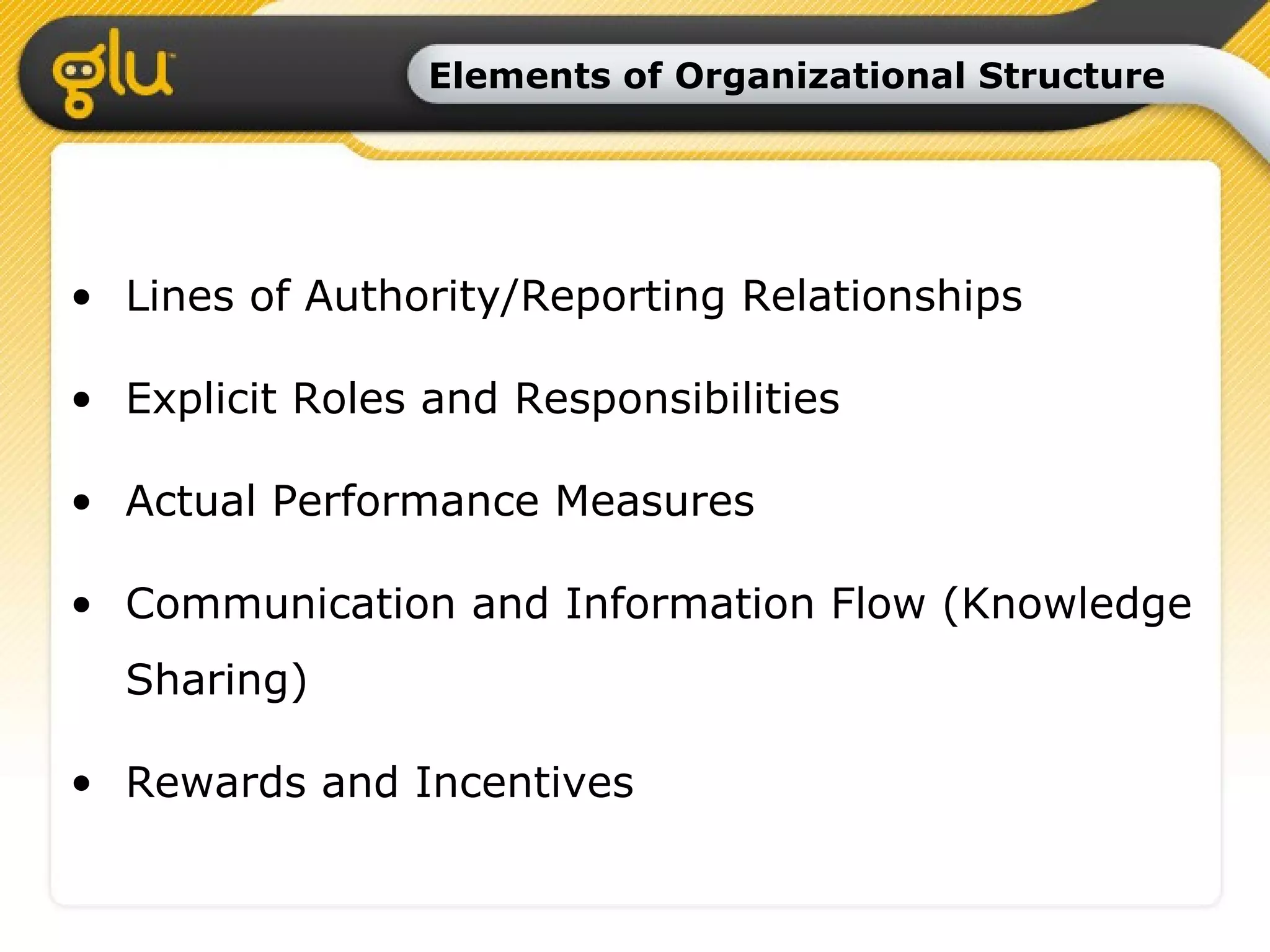
Elements of Organizational Structure Lines of Authority/Reporting Relationships Explicit Roles and Responsibilities Actual Performance Measures Communication and Information Flow (Knowledge Sharing) Rewards and Incentives
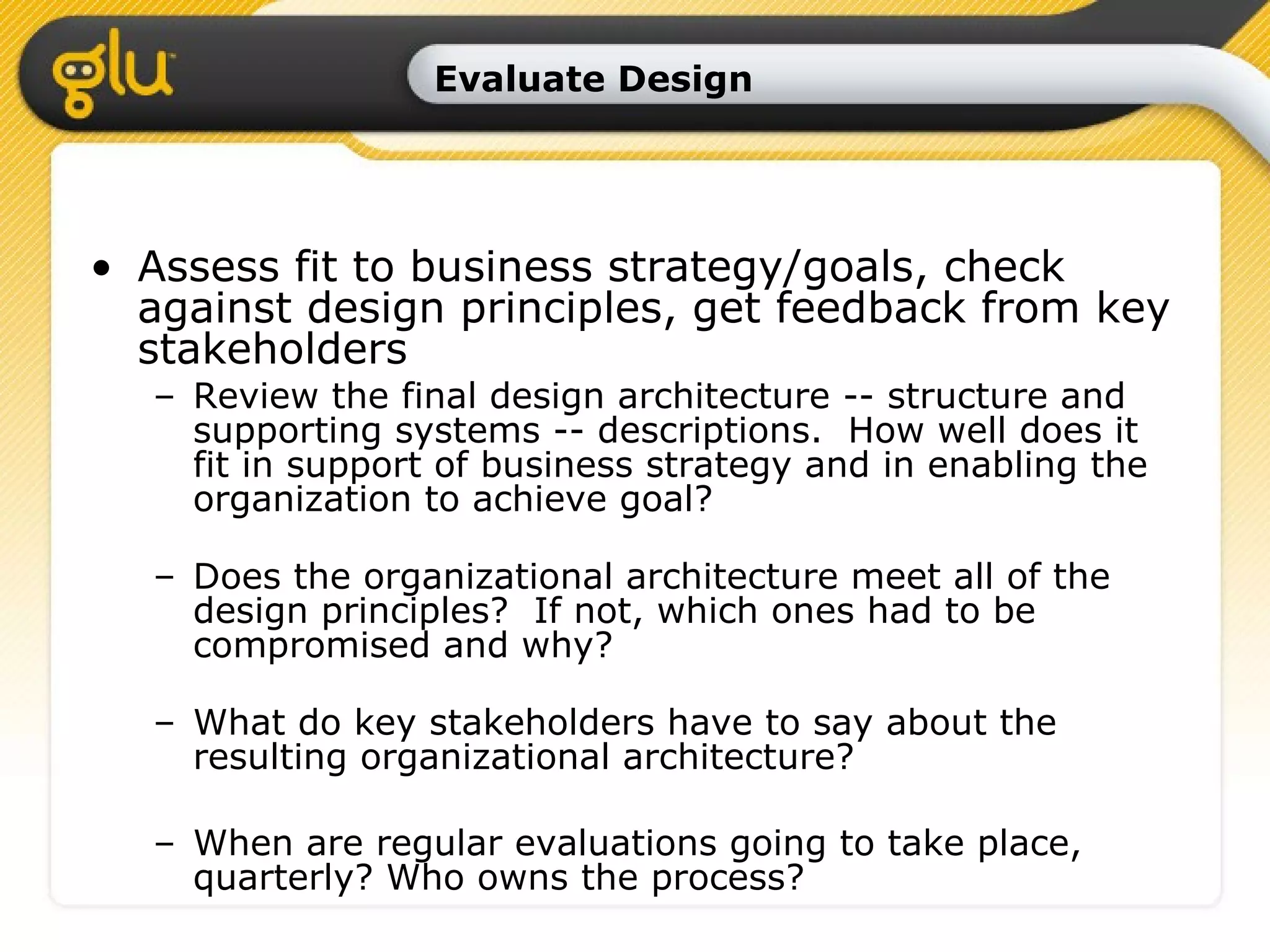
Evaluate Design Assess fit to business strategy/goals, check against design principles, get feedback from key stakeholders Review the final design architecture -- structure and supporting systems -- descriptions.  How well does it fit in support of business strategy and in enabling the organization to achieve goal? Does the organizational architecture meet all of the design principles?  If not, which ones had to be compromised and why? What do key stakeholders have to say about the resulting organizational architecture? When are regular evaluations going to take place, quarterly? Who owns the process?
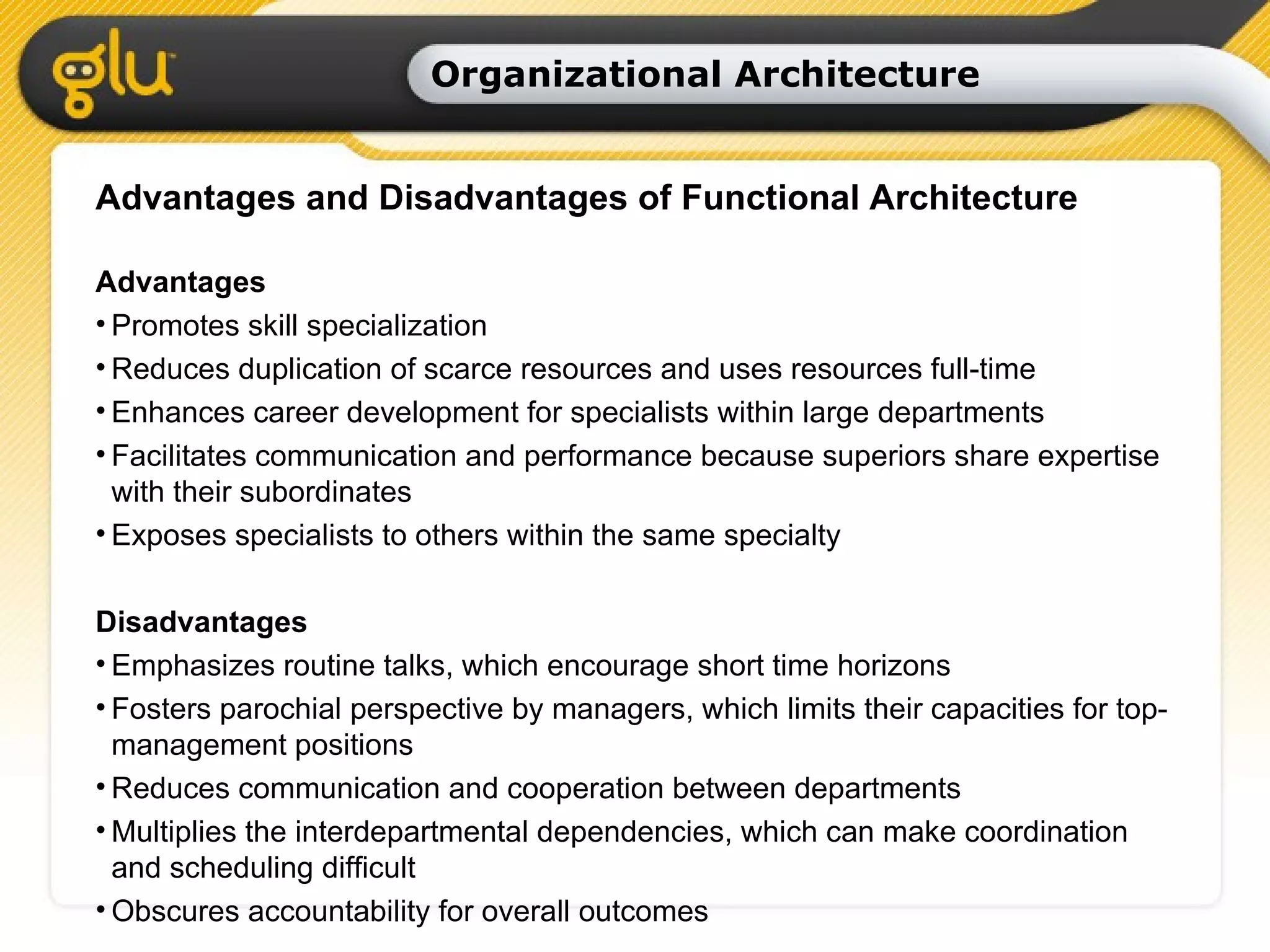
Organizational Architecture Advantages and Disadvantages of Functional Architecture Advantages Promotes skill specialization Reduces duplication of scarce resources and uses resources full-time Enhances career development for specialists within large departments Facilitates communication and performance because superiors share expertise with their subordinates Exposes specialists to others within the same specialty Disadvantages Emphasizes routine talks, which encourage short time horizons Fosters parochial perspective by managers, which limits their capacities for top-management positions Reduces communication and cooperation between departments Multiplies the interdepartmental dependencies, which can make coordination and scheduling difficult Obscures accountability for overall outcomes
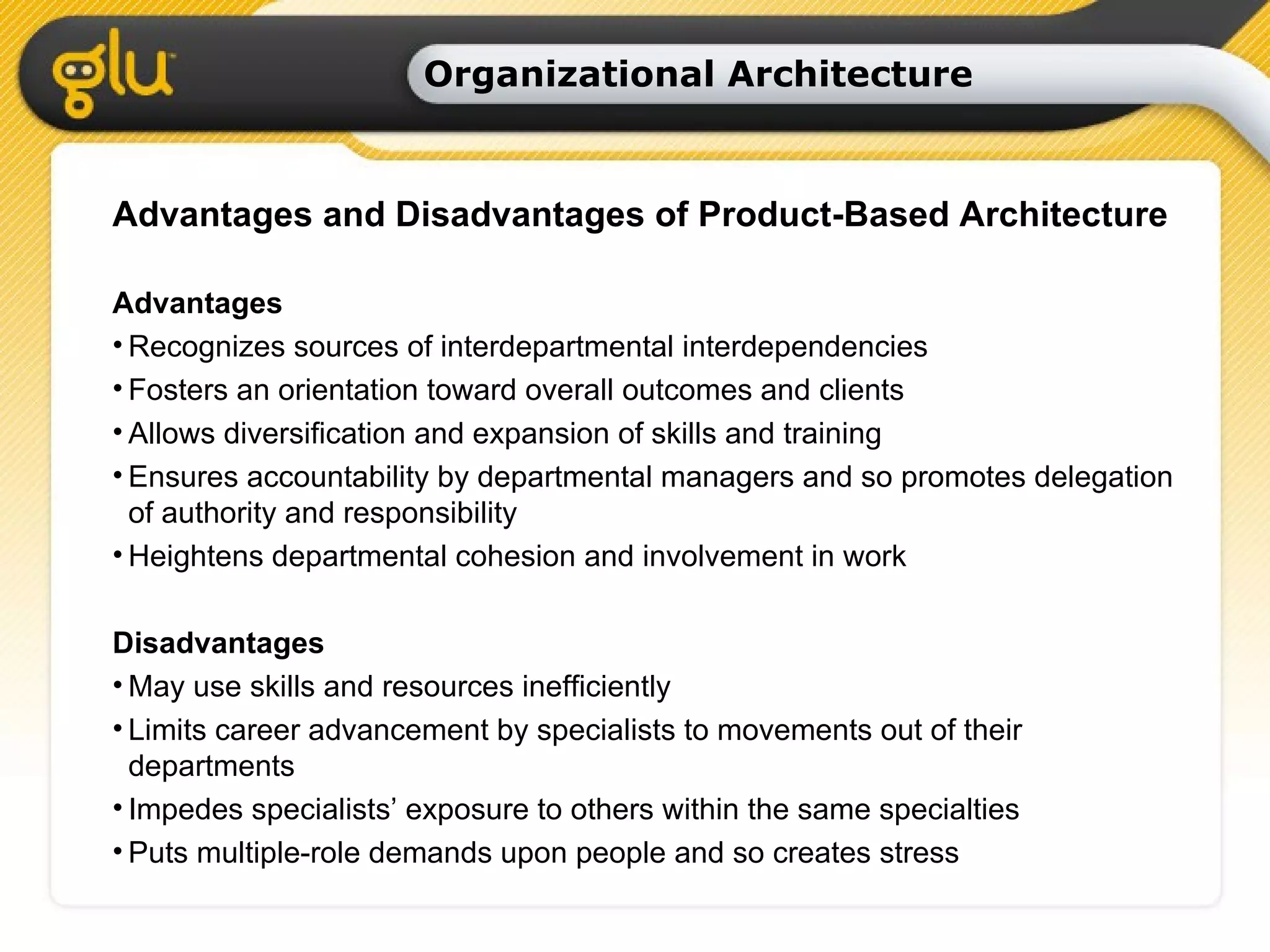
Organizational Architecture Advantages and Disadvantages of Product-Based Architecture Advantages Recognizes sources of interdepartmental interdependencies Fosters an orientation toward overall outcomes and clients Allows diversification and expansion of skills and training Ensures accountability by departmental managers and so promotes delegation of authority and responsibility Heightens departmental cohesion and involvement in work Disadvantages May use skills and resources inefficiently Limits career advancement by specialists to movements out of their departments Impedes specialists’ exposure to others within the same specialties Puts multiple-role demands upon people and so creates stress
Organizational Architecture Advantages and Disadvantages of Matrix Architecture Advantages Makes specialized, functional knowledge available to all projects Uses people flexibly, since departments maintain reservoirs of specialists Maintains consistency between different departments and projects by forcing communication between managers Recognizes and provides mechanisms for dealing with legitimate, multiple sources of power in the organization Can adapt to environmental changes by shifting emphasis between project and functional aspects Disadvantages Can be very difficult to introduce without a preexisting supportive management climate Increases role ambiguity, stress, and anxiety by assigning people to more than one department Without power balancing between product and functional forms, lowers overall performance Makes inconsistent demands, which may result in unproductive conflicts and short-term crisis management. May reward political skills as opposed to technical skills
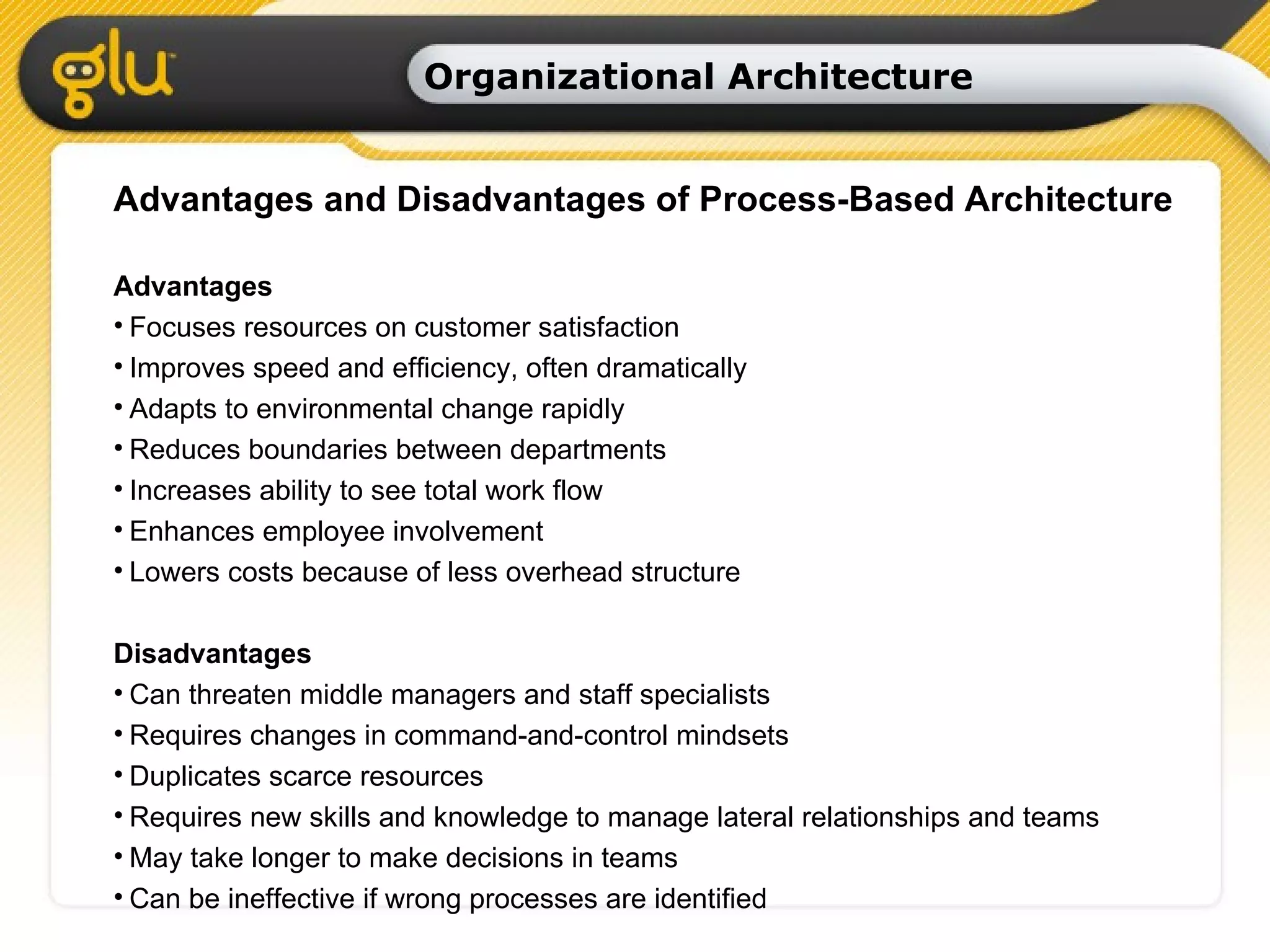
Organizational Architecture Advantages and Disadvantages of Process-Based Architecture Advantages Focuses resources on customer satisfaction Improves speed and efficiency, often dramatically Adapts to environmental change rapidly Reduces boundaries between departments Increases ability to see total work flow Enhances employee involvement Lowers costs because of less overhead structure Disadvantages Can threaten middle managers and staff specialists Requires changes in command-and-control mindsets Duplicates scarce resources Requires new skills and knowledge to manage lateral relationships and teams May take longer to make decisions in teams Can be ineffective if wrong processes are identified
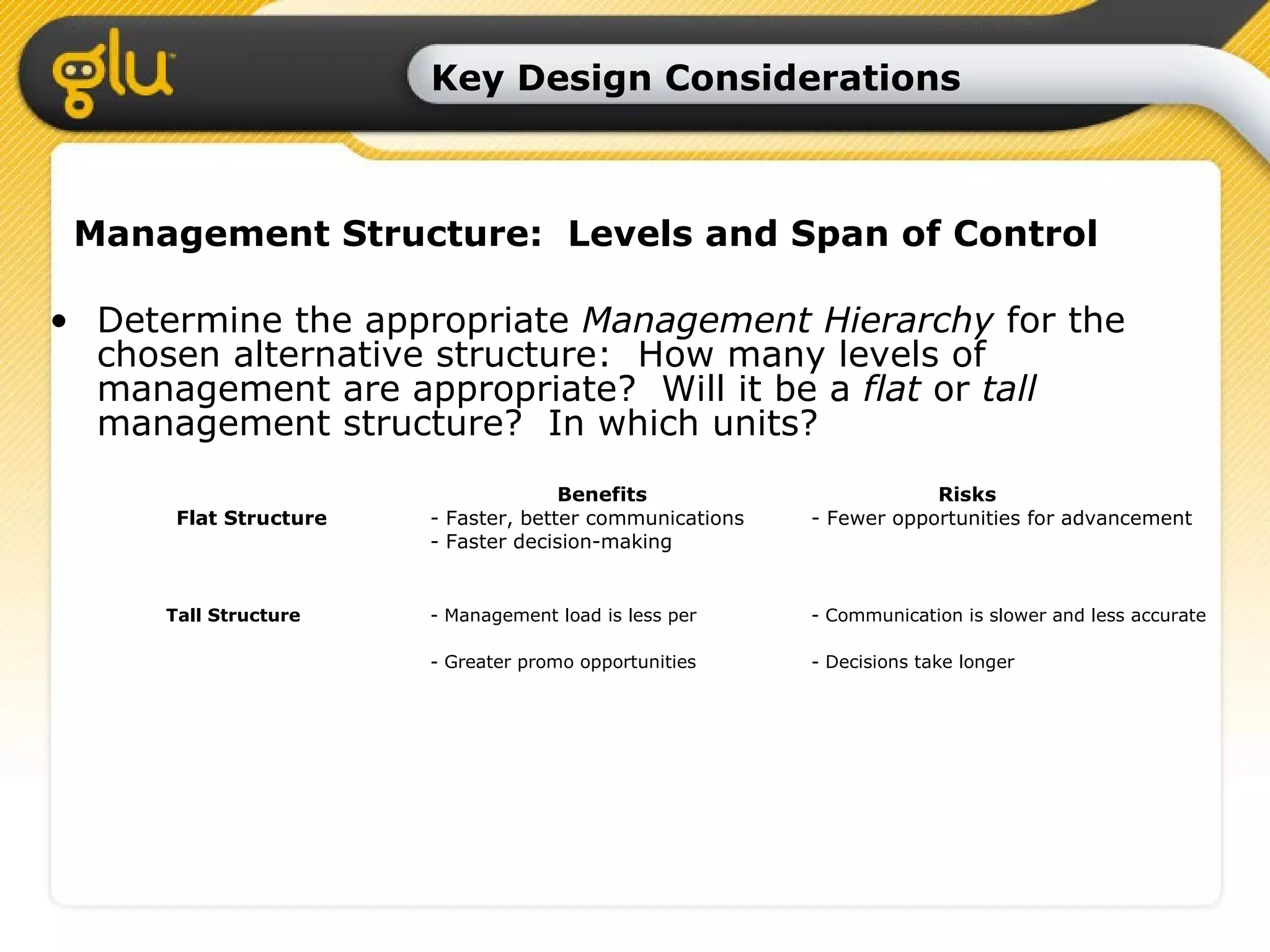
Key Design Considerations Management Structure:  Levels and Span of Control Determine the appropriate  Management Hierarchy  for the chosen alternative structure:  How many levels of management are appropriate?  Will it be a  flat  or  tall  management structure?  In which units? Benefits Risks Flat Structure - Faster, better communications - Fewer opportunities for advancement - Faster decision-making Tall Structure   - Management load is less per  - Communication is slower and less accurate - Greater promo opportunities - Decisions take longer
Key Design Considerations (cont.) Management Structure:  Levels and Span of Control Determine the  Span of Control  -- the number of individuals who report to one manager?  Where does it make sense to be  narrow  or  broad  -- to increase or decrease the span of control?   Benefits Risks Narrow Span   - Managers have more time for  - Cost of management is greater   of Control     management - Workers get more individual attn - Slower coordination among work groups A narrow span might be most appropriate in cases:  Where the work to be supervised is complex, unpredictable and needs close coordination; where workers are unskilled or inexperienced or where the manager is expected to perform significant individual contributor work in addition to supervising. Benefits Risks Broad Span   - Cost of management is lower  - Management task is more difficult    of Control   - Workers encouraged to develop - Workers who need close supervision    skill/initiative and make own decisions  don’t get it - More direct communications up and down A broad span might be most appropriate in cases:  where the work is straightforward and there are standard rules and procedures to guide workers ; where workers are highly capable; where other forms of support (I.e. staff experts) are available or where groups are relatively autonomous (I.e. process teams)
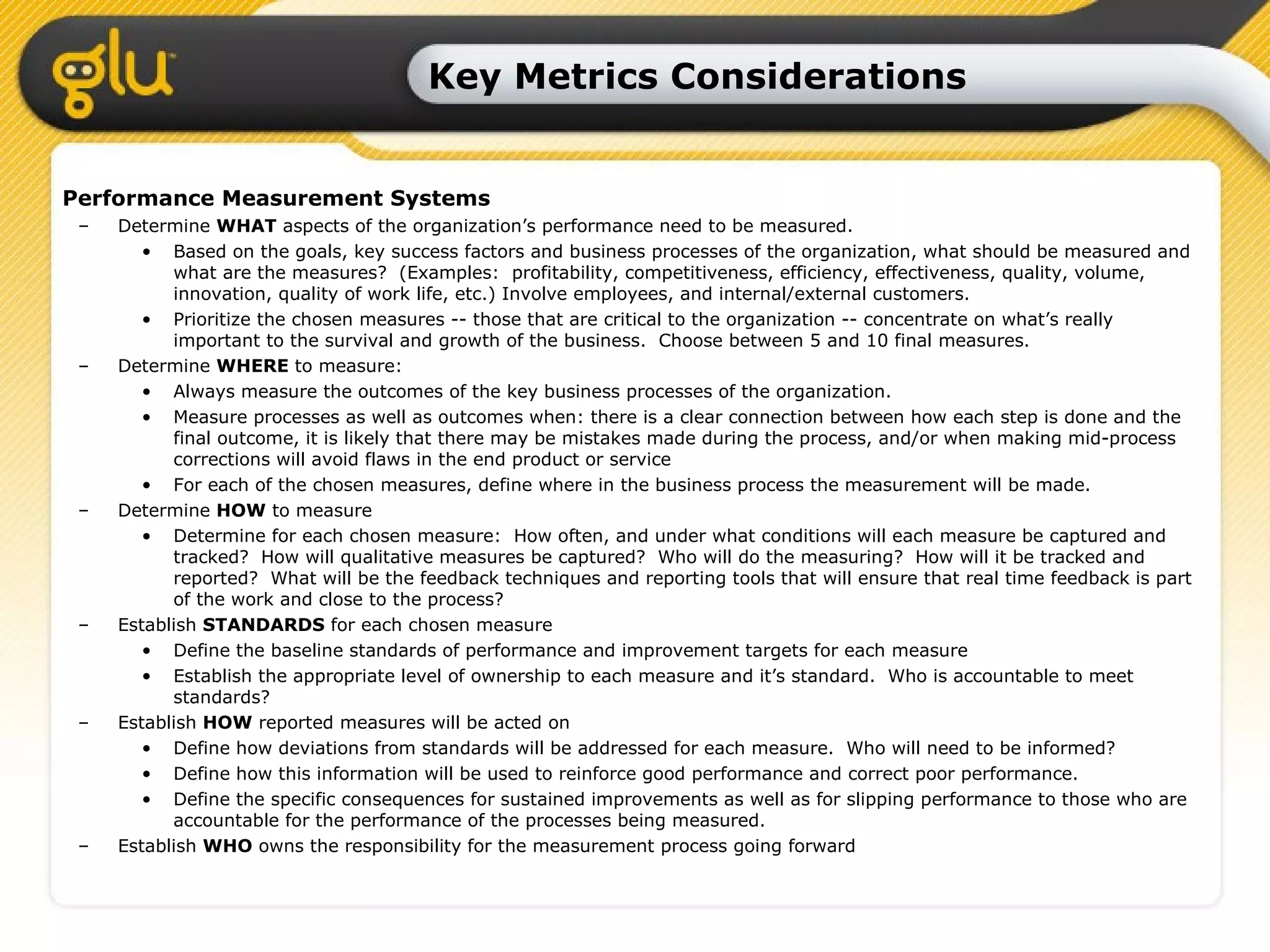
Key Metrics Considerations Performance Measurement Systems Determine  WHAT  aspects of the organization’s performance need to be measured. Based on the goals, key success factors and business processes of the organization, what should be measured and what are the measures?  (Examples:  profitability, competitiveness, efficiency, effectiveness, quality, volume, innovation, quality of work life, etc.) Involve employees, and internal/external customers.  Prioritize the chosen measures -- those that are critical to the organization -- concentrate on what’s really important to the survival and growth of the business.  Choose between 5 and 10 final measures. Determine  WHERE  to measure: Always measure the outcomes of the key business processes of the organization. Measure processes as well as outcomes when: there is a clear connection between how each step is done and the final outcome, it is likely that there may be mistakes made during the process, and/or when making mid-process corrections will avoid flaws in the end product or service For each of the chosen measures, define where in the business process the measurement will be made. Determine  HOW  to measure Determine for each chosen measure:  How often, and under what conditions will each measure be captured and tracked?  How will qualitative measures be captured?  Who will do the measuring?  How will it be tracked and reported?  What will be the feedback techniques and reporting tools that will ensure that real time feedback is part of the work and close to the process? Establish  STANDARDS  for each chosen measure Define the baseline standards of performance and improvement targets for each measure Establish the appropriate level of ownership to each measure and it’s standard.  Who is accountable to meet standards? Establish  HOW  reported measures will be acted on Define how deviations from standards will be addressed for each measure.  Who will need to be informed? Define how this information will be used to reinforce good performance and correct poor performance. Define the specific consequences for sustained improvements as well as for slipping performance to those who are accountable for the performance of the processes being measured. Establish  WHO  owns the responsibility for the measurement process going forward

Organizational Design And Assessment Overview And Process

  • 1.
  • 2.
    Organizational Process Developand Prioritize Design Principles Identify Stakeholders Identify Stakeholder Needs/Expectations Create Design Principles Prioritize Design Principles Develop Alternatives Evaluate Using Design Principles Develop Advantages/ Disadvantages for each alternative Confirm Organization Mission, Strategy, Goals Create and Evaluate Org Structure Alternatives
  • 3.
    Identify Stakeholders Questionsto Determine: Who will have new responsibilities? Who will change how they access/receive their work? Whose role, status, or power will change? Who are upstream/downstream from the change? Who must accept the change for it to be successful? Who might be affected unintentionally? Who is affected externally? Who is associated with the change and should be “in the loop?”
  • 4.
    Identify Stakeholders Needs/ExpectationsSample Stakeholders and Expectations: Studio Build creative XXXX Develop faster speed to market Embed repeatable processes Ensure steady pool of talent and resources Tech Services Ensure XXXX in a cost-effective manner Develop new processes to support XXXX Marketing Launch all XXXX in a timely manner Develop thoughtful marketing programs to maximize return on investment Sales Meet or beat all sales forecasts Maximize revenue
  • 5.
    Sample Design PrinciplesWe want to design an organization where we have: Quicker speed to market on the XXXX platforms Minimal bureaucracy in all decision-making processes Clear line of authority and control over all aspects of a XXXX Thoughtful XXXX based on objective marketing requirements data Ability to act and implement quickly following a decision
  • 6.
    Organizational Architecture EvaluateCurrent State How is the organization currently structured? Draw and/or examine current organization charts What are the strengths and drawbacks of this structure? (focus on timelines, issues, effort or steps involved, and other relevant metrics) How are the business processes helped or hindered by the current structure? How do employees feel about the current structure? How might a different structure eliminate or improve on weaknesses in the current one?
  • 7.
    Organizational Architecture ReviewPossible Organizational Structures There are five basic choices (plus hybrids) for design alternatives: 1. Functional: Units are formed according to major technical or professional function performed 2. Product Based: Units are formed around each of the major products (or services) 3. Customer or Geographical Area-Based: Units are formed around the characteristics or location of customers or markets 4. Business Process Teams: cross-functional teams structured around the major work processes 5. Matrix: Units are formed where individuals have accountability to two managers: one functional and one project/product 6. Hybrid: Units are formed which mix and match the above structures to create the best fit to their environment
  • 8.
    Elements of OrganizationalStructure Lines of Authority/Reporting Relationships Explicit Roles and Responsibilities Actual Performance Measures Communication and Information Flow (Knowledge Sharing) Rewards and Incentives
  • 9.
    Evaluate Design Assessfit to business strategy/goals, check against design principles, get feedback from key stakeholders Review the final design architecture -- structure and supporting systems -- descriptions. How well does it fit in support of business strategy and in enabling the organization to achieve goal? Does the organizational architecture meet all of the design principles? If not, which ones had to be compromised and why? What do key stakeholders have to say about the resulting organizational architecture? When are regular evaluations going to take place, quarterly? Who owns the process?
  • 10.
    Organizational Architecture Advantagesand Disadvantages of Functional Architecture Advantages Promotes skill specialization Reduces duplication of scarce resources and uses resources full-time Enhances career development for specialists within large departments Facilitates communication and performance because superiors share expertise with their subordinates Exposes specialists to others within the same specialty Disadvantages Emphasizes routine talks, which encourage short time horizons Fosters parochial perspective by managers, which limits their capacities for top-management positions Reduces communication and cooperation between departments Multiplies the interdepartmental dependencies, which can make coordination and scheduling difficult Obscures accountability for overall outcomes
  • 11.
    Organizational Architecture Advantagesand Disadvantages of Product-Based Architecture Advantages Recognizes sources of interdepartmental interdependencies Fosters an orientation toward overall outcomes and clients Allows diversification and expansion of skills and training Ensures accountability by departmental managers and so promotes delegation of authority and responsibility Heightens departmental cohesion and involvement in work Disadvantages May use skills and resources inefficiently Limits career advancement by specialists to movements out of their departments Impedes specialists’ exposure to others within the same specialties Puts multiple-role demands upon people and so creates stress
  • 12.
    Organizational Architecture Advantagesand Disadvantages of Matrix Architecture Advantages Makes specialized, functional knowledge available to all projects Uses people flexibly, since departments maintain reservoirs of specialists Maintains consistency between different departments and projects by forcing communication between managers Recognizes and provides mechanisms for dealing with legitimate, multiple sources of power in the organization Can adapt to environmental changes by shifting emphasis between project and functional aspects Disadvantages Can be very difficult to introduce without a preexisting supportive management climate Increases role ambiguity, stress, and anxiety by assigning people to more than one department Without power balancing between product and functional forms, lowers overall performance Makes inconsistent demands, which may result in unproductive conflicts and short-term crisis management. May reward political skills as opposed to technical skills
  • 13.
    Organizational Architecture Advantagesand Disadvantages of Process-Based Architecture Advantages Focuses resources on customer satisfaction Improves speed and efficiency, often dramatically Adapts to environmental change rapidly Reduces boundaries between departments Increases ability to see total work flow Enhances employee involvement Lowers costs because of less overhead structure Disadvantages Can threaten middle managers and staff specialists Requires changes in command-and-control mindsets Duplicates scarce resources Requires new skills and knowledge to manage lateral relationships and teams May take longer to make decisions in teams Can be ineffective if wrong processes are identified
  • 14.
    Key Design ConsiderationsManagement Structure: Levels and Span of Control Determine the appropriate Management Hierarchy for the chosen alternative structure: How many levels of management are appropriate? Will it be a flat or tall management structure? In which units? Benefits Risks Flat Structure - Faster, better communications - Fewer opportunities for advancement - Faster decision-making Tall Structure - Management load is less per - Communication is slower and less accurate - Greater promo opportunities - Decisions take longer
  • 15.
    Key Design Considerations(cont.) Management Structure: Levels and Span of Control Determine the Span of Control -- the number of individuals who report to one manager? Where does it make sense to be narrow or broad -- to increase or decrease the span of control? Benefits Risks Narrow Span - Managers have more time for - Cost of management is greater of Control management - Workers get more individual attn - Slower coordination among work groups A narrow span might be most appropriate in cases: Where the work to be supervised is complex, unpredictable and needs close coordination; where workers are unskilled or inexperienced or where the manager is expected to perform significant individual contributor work in addition to supervising. Benefits Risks Broad Span - Cost of management is lower - Management task is more difficult of Control - Workers encouraged to develop - Workers who need close supervision skill/initiative and make own decisions don’t get it - More direct communications up and down A broad span might be most appropriate in cases: where the work is straightforward and there are standard rules and procedures to guide workers ; where workers are highly capable; where other forms of support (I.e. staff experts) are available or where groups are relatively autonomous (I.e. process teams)
  • 16.
    Key Metrics ConsiderationsPerformance Measurement Systems Determine WHAT aspects of the organization’s performance need to be measured. Based on the goals, key success factors and business processes of the organization, what should be measured and what are the measures? (Examples: profitability, competitiveness, efficiency, effectiveness, quality, volume, innovation, quality of work life, etc.) Involve employees, and internal/external customers. Prioritize the chosen measures -- those that are critical to the organization -- concentrate on what’s really important to the survival and growth of the business. Choose between 5 and 10 final measures. Determine WHERE to measure: Always measure the outcomes of the key business processes of the organization. Measure processes as well as outcomes when: there is a clear connection between how each step is done and the final outcome, it is likely that there may be mistakes made during the process, and/or when making mid-process corrections will avoid flaws in the end product or service For each of the chosen measures, define where in the business process the measurement will be made. Determine HOW to measure Determine for each chosen measure: How often, and under what conditions will each measure be captured and tracked? How will qualitative measures be captured? Who will do the measuring? How will it be tracked and reported? What will be the feedback techniques and reporting tools that will ensure that real time feedback is part of the work and close to the process? Establish STANDARDS for each chosen measure Define the baseline standards of performance and improvement targets for each measure Establish the appropriate level of ownership to each measure and it’s standard. Who is accountable to meet standards? Establish HOW reported measures will be acted on Define how deviations from standards will be addressed for each measure. Who will need to be informed? Define how this information will be used to reinforce good performance and correct poor performance. Define the specific consequences for sustained improvements as well as for slipping performance to those who are accountable for the performance of the processes being measured. Establish WHO owns the responsibility for the measurement process going forward