By
Dr. Kiran Kumar Thoti
Organization Development
404- Unit- I
Organization Development
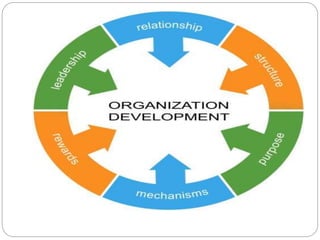
 Organization development (OD) is a deliberately planned,
organization-wide effort to increase an organization's effectiveness
and/or efficiency and/or to enable the organization to achieve its
strategic goals.
 OD theorists and practitioners define it in various ways. Its
multiplicity of definition reflects the complexity of the discipline
and is responsible for its lack of understanding.
 For example, Vasudevan has referred to OD being about promoting
organizational readiness to meet change, and it has been said that
OD is a systemic learning and development strategy intended to
change the basics of beliefs, attitudes and relevance of values, and
structure of the current organization to better absorb disruptive
technologies, shrinking or exploding market opportunities and
ensuing challenges and chaos.
 It is worth understanding what OD is not.
Overview
 Organization development is an ongoing, systematic
process of implementing effective organizational
change.
 OD is known as both a field of science focused on
understanding and managing organizational change
and as a field of scientific study and inquiry.
 It is interdisciplinary in nature and draws
on sociology, psychology, particularly industrial and
organizational psychology, and theories of
motivation, learning, and personality.
History
 Kurt Lewin (1898–1947) is widely recognized as the
founding father of OD, although he died before the
concept became current in the mid-1950s.
 From Lewin came the ideas of group dynamics and
action research which underpin the basic OD process as
well as providing its collaborative consultant/client
ethos.
 Institutionally, Lewin founded the "Research Center for
Group Dynamics" (RCGD) at MIT, which moved to
Michigan after his death.
 RCGD colleagues were among those who founded
the National Training Laboratories (NTL), from which
the T-groups and group-based OD emerged.
Objective of OD
 To increase the level of inter-personal trust among
employees.
 To increase employees' level of satisfaction and
commitment.
 To confront problems instead of neglecting them.
 To effectively manage conflict.
 To increase cooperation and collaboration among the
employees.
 To increase the organization's problem solving.
 To put in place processes that will help improve the
ongoing operation of the organization on a continuous
basis.
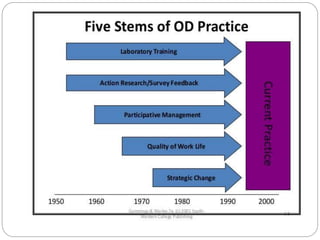
Contributory Stems of OD
 The Five Major stems, or backgrounds from which
OD has developed, in order from the first to the
most recent, are:
 Laboratory Training and T-Groups
 Action Research and Survey Feedback
 The Normative Approach
 Productivity and Quality of Work Life Approaches
 The Strategic Approach
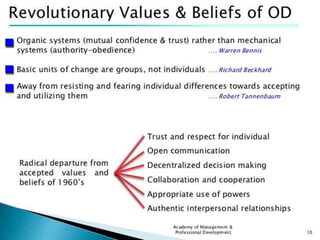
Values
 Ethics based on values help OD practitioners guide
themselves as they move along the paths of their work and
lives.
 Values are set of manners that individuals learn while
growing up. It is different from ethics because ethics are
publicly agreed on, and publicly stated, guidelines for a
practice in a profession.
 “Providing opportunities for people to function as human
beings rather than as resources in the productive
process.
 Providing opportunities for each organization member, as
well as for the organization itself, to develop to his full
potential.
Contd..
 Seeking to increase the effectiveness of the
organization in terms of all of its goals.
 Attempting to create an environment in which it
is possible to find exciting and challenging
work.
 Providing opportunities for people in
organizations to influence the way in which
they relate to work, the organization, and
the environment.
 Treating each human being as a person with a
complex set of needs, all of which are
important in his work and in his life.”
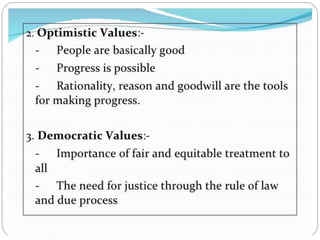
Three types of OD Values
 Humanistic
 Optimistic
 Democratic
 Humanistic Value: Humanistic philosophy and values reflect a
belief in human dignity and science — but not religion.
Humanistic philosophy refers to a few specific ideas. For one
thing, humanistic thinkers aren't religious; they don't believe in
a god or gods. ... This philosophy is called humanism.
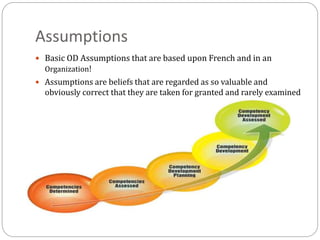
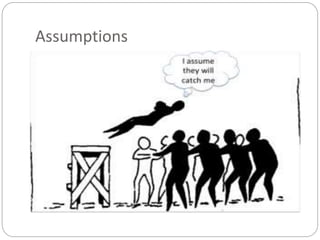
Assumptions
 Basic OD Assumptions that are based upon French and in an
Organization!
 Assumptions are beliefs that are regarded as so valuable and
obviously correct that they are taken for granted and rarely examined
or questioned.
Assumptions
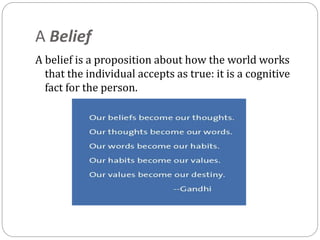
A Belief
A belief is a proposition about how the world works
that the individual accepts as true: it is a cognitive
fact for the person.
OD ethics issues
 RESPONSIBILITY TO OURSELVES
 RESPONSIBILITY FOR PROFESSIONAL
DEVELOPMENT AND COMPETENCE
 RESPONSIBILTY TO CLIENTS AND
SIGNIFICANT OTHERS
 RESPONSIBILITY TO THE OD COMMUNITY
 SOCIAL RESPONSIBILITY
Characteristics of OD
 There are seven characteristics of OD:
1. Humanistic Values: Positive beliefs about the
potential of employees (McGregor's Theory Y).
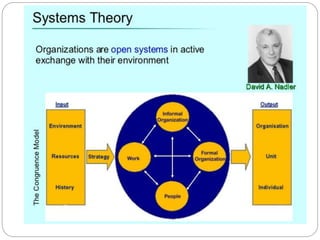
2. Systems Orientation: All parts of the organization,
to include structure, technology, and people, must
work together.
3. Experiential Learning: The learners' experiences in
the training environment should be the kind of
human problems they encounter at work. The
training should NOT be all theory and lecture.
Contd.
4. Problem Solving: Problems are identified, data is
gathered, corrective action is taken, progress is
assessed, and adjustments in the problem solving
process are made as needed. This process is known as
Action Research.
5. Contingency Orientation: Actions are selected and
adapted to fit the need.
6. Change Agent: Stimulate, facilitate, and coordinate
change.
7. Levels of Interventions: Problems can occur at one or
more level in the organization so the strategy will
require one or more interventions
Foundation of OD
 First, OD is a systematic approach to the planned change. It is
structured style of diagnosing organizational problems and
opportunities and then applying expertise to them.
 Second, OD is grounded in solid research and theory. It
involves the application of our knowledge of behavioral
science to the challenge that the organizations face.
 Third, OD recognizes the reciprocal relationship between
individuals and organizations. It acknowledges that for
organizations to change, individuals must change.
 Fourth, OD is goal oriented. It is a process that seeks to
improve both individual and organizational well- being and
effectiveness.
 Fifth, OD is designed to solve problems.
System Outlook
 System Outlook is a new original system-
information theory of everything that unites
science, rules, norms and regulation on the
basis of a system-informational approach.
 System Outlook serves as a platform of
organization reconciliation as it helps
understanding the basic principles that underlie
reality and development of organization.
Third wave management
 Modern process management was born during the
"Quality Revolution" of the 1980s.
 In one form or another, the First Wave of process
management -Total Quality Management (TQM)-
swept across all industries and sectors during the
decade.
 Like all buzzword revolutions, TQM fell from grace
in the late 1980's...but was followed in the early
1990s by the Second Wave of process
management: Business Process Reengineering
(BPR).
Contd..
 Third Wave Management: (Change Management)
Making Process Excellence a Strategic Asset
 Operational excellence cannot be sustained unless all
management structures and systems are aligned to
support business process performance.
 The walls (silos, fiefdoms) of modern organizations were
created early in the industrial age.
 Task specialization led to functional management, which
in turn led to the hierarchical bureaucracy.
 The walls have been reinforced over the years by layer
upon layer of management systems.
 This legacy of function-oriented management makes it
very difficult for cross-function process change to endure
and flourish.
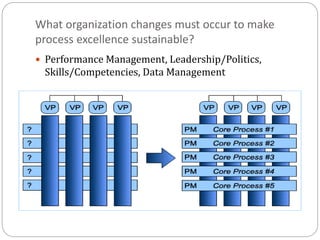
What organization changes must occur to make
process excellence sustainable?
 Performance Management, Leadership/Politics,
Skills/Competencies, Data Management
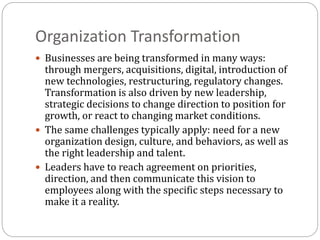
Organization Transformation
 Businesses are being transformed in many ways:
through mergers, acquisitions, digital, introduction of
new technologies, restructuring, regulatory changes.
Transformation is also driven by new leadership,
strategic decisions to change direction to position for
growth, or react to changing market conditions.
 The same challenges typically apply: need for a new
organization design, culture, and behaviors, as well as
the right leadership and talent.
 Leaders have to reach agreement on priorities,
direction, and then communicate this vision to
employees along with the specific steps necessary to
make it a reality.
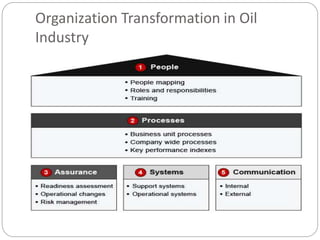
Organization Transformation in Oil
Industry
Organization Development

Organization Development

  • 1.
    By Dr. Kiran KumarThoti Organization Development 404- Unit- I
  • 3.
    Organization Development  Organizationdevelopment (OD) is a deliberately planned, organization-wide effort to increase an organization's effectiveness and/or efficiency and/or to enable the organization to achieve its strategic goals.  OD theorists and practitioners define it in various ways. Its multiplicity of definition reflects the complexity of the discipline and is responsible for its lack of understanding.  For example, Vasudevan has referred to OD being about promoting organizational readiness to meet change, and it has been said that OD is a systemic learning and development strategy intended to change the basics of beliefs, attitudes and relevance of values, and structure of the current organization to better absorb disruptive technologies, shrinking or exploding market opportunities and ensuing challenges and chaos.  It is worth understanding what OD is not.
  • 5.
    Overview  Organization developmentis an ongoing, systematic process of implementing effective organizational change.  OD is known as both a field of science focused on understanding and managing organizational change and as a field of scientific study and inquiry.  It is interdisciplinary in nature and draws on sociology, psychology, particularly industrial and organizational psychology, and theories of motivation, learning, and personality.
  • 7.
    History  Kurt Lewin(1898–1947) is widely recognized as the founding father of OD, although he died before the concept became current in the mid-1950s.  From Lewin came the ideas of group dynamics and action research which underpin the basic OD process as well as providing its collaborative consultant/client ethos.  Institutionally, Lewin founded the "Research Center for Group Dynamics" (RCGD) at MIT, which moved to Michigan after his death.  RCGD colleagues were among those who founded the National Training Laboratories (NTL), from which the T-groups and group-based OD emerged.
  • 9.
    Objective of OD To increase the level of inter-personal trust among employees.  To increase employees' level of satisfaction and commitment.  To confront problems instead of neglecting them.  To effectively manage conflict.  To increase cooperation and collaboration among the employees.  To increase the organization's problem solving.  To put in place processes that will help improve the ongoing operation of the organization on a continuous basis.
  • 10.
    Contributory Stems ofOD  The Five Major stems, or backgrounds from which OD has developed, in order from the first to the most recent, are:  Laboratory Training and T-Groups  Action Research and Survey Feedback  The Normative Approach  Productivity and Quality of Work Life Approaches  The Strategic Approach
  • 13.
    Values  Ethics basedon values help OD practitioners guide themselves as they move along the paths of their work and lives.  Values are set of manners that individuals learn while growing up. It is different from ethics because ethics are publicly agreed on, and publicly stated, guidelines for a practice in a profession.  “Providing opportunities for people to function as human beings rather than as resources in the productive process.  Providing opportunities for each organization member, as well as for the organization itself, to develop to his full potential.
  • 14.
    Contd..  Seeking toincrease the effectiveness of the organization in terms of all of its goals.  Attempting to create an environment in which it is possible to find exciting and challenging work.  Providing opportunities for people in organizations to influence the way in which they relate to work, the organization, and the environment.  Treating each human being as a person with a complex set of needs, all of which are important in his work and in his life.”
  • 16.
    Three types ofOD Values  Humanistic  Optimistic  Democratic  Humanistic Value: Humanistic philosophy and values reflect a belief in human dignity and science — but not religion. Humanistic philosophy refers to a few specific ideas. For one thing, humanistic thinkers aren't religious; they don't believe in a god or gods. ... This philosophy is called humanism.
  • 18.
    Assumptions  Basic ODAssumptions that are based upon French and in an Organization!  Assumptions are beliefs that are regarded as so valuable and obviously correct that they are taken for granted and rarely examined or questioned.
  • 19.
  • 21.
    A Belief A beliefis a proposition about how the world works that the individual accepts as true: it is a cognitive fact for the person.
  • 24.
    OD ethics issues RESPONSIBILITY TO OURSELVES  RESPONSIBILITY FOR PROFESSIONAL DEVELOPMENT AND COMPETENCE  RESPONSIBILTY TO CLIENTS AND SIGNIFICANT OTHERS  RESPONSIBILITY TO THE OD COMMUNITY  SOCIAL RESPONSIBILITY
  • 25.
    Characteristics of OD There are seven characteristics of OD: 1. Humanistic Values: Positive beliefs about the potential of employees (McGregor's Theory Y). 2. Systems Orientation: All parts of the organization, to include structure, technology, and people, must work together. 3. Experiential Learning: The learners' experiences in the training environment should be the kind of human problems they encounter at work. The training should NOT be all theory and lecture.
  • 26.
    Contd. 4. Problem Solving:Problems are identified, data is gathered, corrective action is taken, progress is assessed, and adjustments in the problem solving process are made as needed. This process is known as Action Research. 5. Contingency Orientation: Actions are selected and adapted to fit the need. 6. Change Agent: Stimulate, facilitate, and coordinate change. 7. Levels of Interventions: Problems can occur at one or more level in the organization so the strategy will require one or more interventions
  • 27.
    Foundation of OD First, OD is a systematic approach to the planned change. It is structured style of diagnosing organizational problems and opportunities and then applying expertise to them.  Second, OD is grounded in solid research and theory. It involves the application of our knowledge of behavioral science to the challenge that the organizations face.  Third, OD recognizes the reciprocal relationship between individuals and organizations. It acknowledges that for organizations to change, individuals must change.  Fourth, OD is goal oriented. It is a process that seeks to improve both individual and organizational well- being and effectiveness.  Fifth, OD is designed to solve problems.
  • 28.
    System Outlook  SystemOutlook is a new original system- information theory of everything that unites science, rules, norms and regulation on the basis of a system-informational approach.  System Outlook serves as a platform of organization reconciliation as it helps understanding the basic principles that underlie reality and development of organization.
  • 30.
    Third wave management Modern process management was born during the "Quality Revolution" of the 1980s.  In one form or another, the First Wave of process management -Total Quality Management (TQM)- swept across all industries and sectors during the decade.  Like all buzzword revolutions, TQM fell from grace in the late 1980's...but was followed in the early 1990s by the Second Wave of process management: Business Process Reengineering (BPR).
  • 31.
    Contd..  Third WaveManagement: (Change Management) Making Process Excellence a Strategic Asset  Operational excellence cannot be sustained unless all management structures and systems are aligned to support business process performance.  The walls (silos, fiefdoms) of modern organizations were created early in the industrial age.  Task specialization led to functional management, which in turn led to the hierarchical bureaucracy.  The walls have been reinforced over the years by layer upon layer of management systems.  This legacy of function-oriented management makes it very difficult for cross-function process change to endure and flourish.
  • 32.
    What organization changesmust occur to make process excellence sustainable?  Performance Management, Leadership/Politics, Skills/Competencies, Data Management
  • 33.
    Organization Transformation  Businessesare being transformed in many ways: through mergers, acquisitions, digital, introduction of new technologies, restructuring, regulatory changes. Transformation is also driven by new leadership, strategic decisions to change direction to position for growth, or react to changing market conditions.  The same challenges typically apply: need for a new organization design, culture, and behaviors, as well as the right leadership and talent.  Leaders have to reach agreement on priorities, direction, and then communicate this vision to employees along with the specific steps necessary to make it a reality.
  • 34.