UNIVERSITY OF HORTICULTURAL
SCIENCES, BAGALKOT
COLLEGE OF HORTICULTURE, MUNIRABAD
DEPARTMENT OF FLORICULTURE
PRESENTATION ON BREEDING OF ORCHIDS
SUBMITTED BY:
RAGHAVENDRA HIREHAL
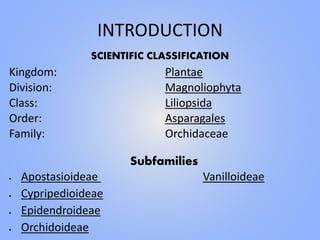
INTRODUCTION
Kingdom: Plantae
Division: Magnoliophyta
Class: Liliopsida
Order: Asparagales
Family: Orchidaceae
Subfamilies
 Apostasioideae Vanilloideae
 Cypripedioideae
 Epidendroideae
 Orchidoideae
SCIENTIFIC CLASSIFICATION
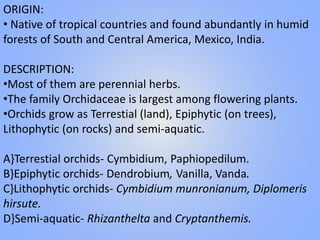
ORIGIN:
• Native of tropical countries and found abundantly in humid
forests of South and Central America, Mexico, India.
DESCRIPTION:
•Most of them are perennial herbs.
•The family Orchidaceae is largest among flowering plants.
•Orchids grow as Terrestial (land), Epiphytic (on trees),
Lithophytic (on rocks) and semi-aquatic.
A}Terrestial orchids- Cymbidium, Paphiopedilum.
B}Epiphytic orchids- Dendrobium, Vanilla, Vanda.
C}Lithophytic orchids- Cymbidium munronianum, Diplomeris
hirsute.
D}Semi-aquatic- Rhizanthelta and Cryptanthemis.
VEGETATIVE GROWTH OF ORCHIDS:
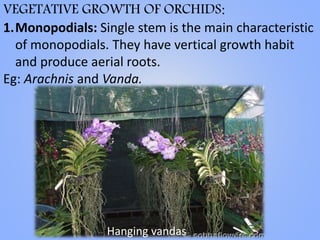
1.Monopodials: Single stem is the main characteristic
of monopodials. They have vertical growth habit
and produce aerial roots.
Eg: Arachnis and Vanda.
Hanging vandas
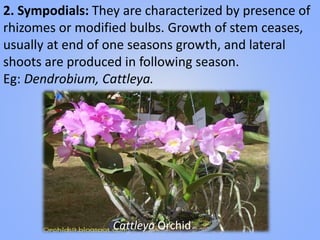
2. Sympodials: They are characterized by presence of
rhizomes or modified bulbs. Growth of stem ceases,
usually at end of one seasons growth, and lateral
shoots are produced in following season.
Eg: Dendrobium, Cattleya.
Cattleya Orchid
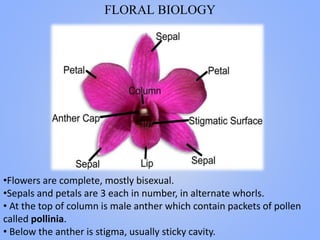
FLORAL BIOLOGY
•Flowers are complete, mostly bisexual.
•Sepals and petals are 3 each in number, in alternate whorls.
• At the top of column is male anther which contain packets of pollen
called pollinia.
• Below the anther is stigma, usually sticky cavity.
IMPORTANT ORCHID SPECIES
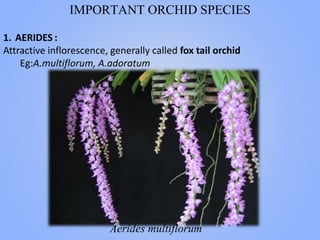
1. AERIDES :
Attractive inflorescence, generally called fox tail orchid
Eg:A.multiflorum, A.adoratum
Aerides multiflorum
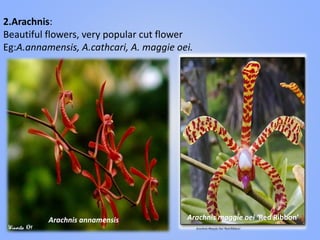
2.Arachnis:
Beautiful flowers, very popular cut flower
Eg:A.annamensis, A.cathcari, A. maggie oei.
Arachnis annamensis Arachnis maggie oei ‘Red Ribbon’
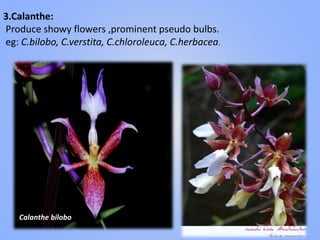
3.Calanthe:
Produce showy flowers ,prominent pseudo bulbs.
eg: C.bilobo, C.verstita, C.chloroleuca, C.herbacea.
Calanthe bilobo
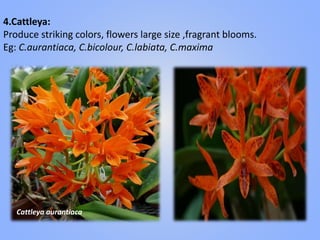
4.Cattleya:
Produce striking colors, flowers large size ,fragrant blooms.
Eg: C.aurantiaca, C.bicolour, C.labiata, C.maxima
Cattleya aurantiaca
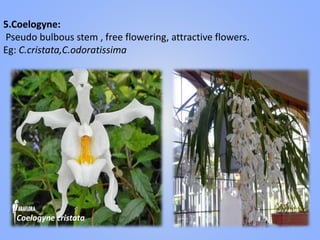
5.Coelogyne:
Pseudo bulbous stem , free flowering, attractive flowers.
Eg: C.cristata,C.odoratissima
Coelogyne cristata
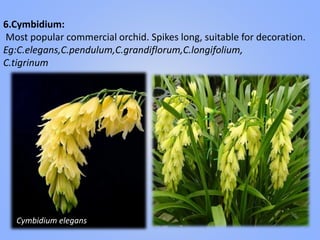
6.Cymbidium:
Most popular commercial orchid. Spikes long, suitable for decoration.
Eg:C.elegans,C.pendulum,C.grandiflorum,C.longifolium,
C.tigrinum
Cymbidium elegans
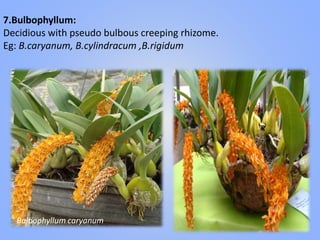
7.Bulbophyllum:
Decidious with pseudo bulbous creeping rhizome.
Eg: B.caryanum, B.cylindracum ,B.rigidum
Bulbophyllum caryanum
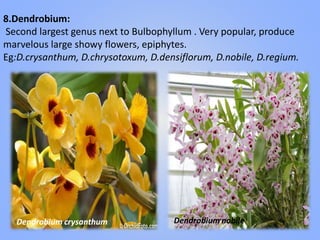
8.Dendrobium:
Second largest genus next to Bulbophyllum . Very popular, produce
marvelous large showy flowers, epiphytes.
Eg:D.crysanthum, D.chrysotoxum, D.densiflorum, D.nobile, D.regium.
Dendrobium crysanthum Dendrobium nobile
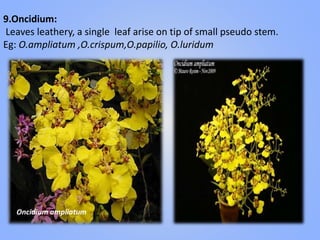
9.Oncidium:
Leaves leathery, a single leaf arise on tip of small pseudo stem.
Eg: O.ampliatum ,O.crispum,O.papilio, O.luridum
Oncidium ampliatum
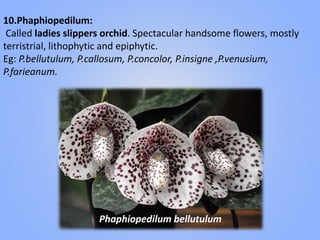
10.Phaphiopedilum:
Called ladies slippers orchid. Spectacular handsome flowers, mostly
terristrial, lithophytic and epiphytic.
Eg: P.bellutulum, P.callosum, P.concolor, P.insigne ,P.venusium,
P.farieanum.
Phaphiopedilum bellutulum
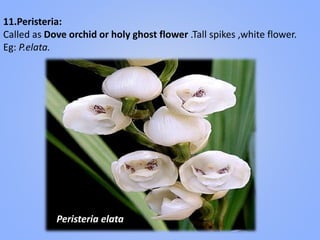
11.Peristeria:
Called as Dove orchid or holy ghost flower .Tall spikes ,white flower.
Eg: P.elata.
Peristeria elata
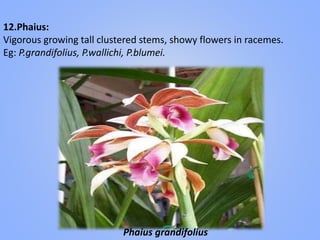
12.Phaius:
Vigorous growing tall clustered stems, showy flowers in racemes.
Eg: P.grandifolius, P.wallichi, P.blumei.
Phaius grandifolius
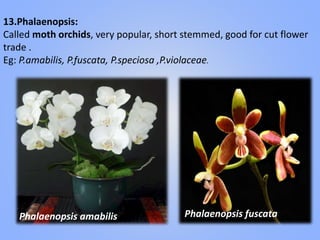
13.Phalaenopsis:
Called moth orchids, very popular, short stemmed, good for cut flower
trade .
Eg: P.amabilis, P.fuscata, P.speciosa ,P.violaceae.
Phalaenopsis amabilis Phalaenopsis fuscata
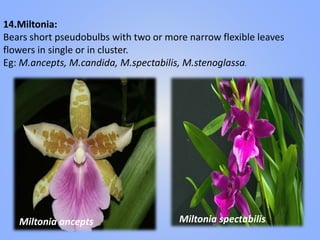
14.Miltonia:
Bears short pseudobulbs with two or more narrow flexible leaves
flowers in single or in cluster.
Eg: M.ancepts, M.candida, M.spectabilis, M.stenoglassa.
Miltonia ancepts Miltonia spectabilis
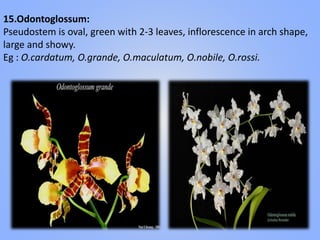
15.Odontoglossum:
Pseudostem is oval, green with 2-3 leaves, inflorescence in arch shape,
large and showy.
Eg : O.cardatum, O.grande, O.maculatum, O.nobile, O.rossi.
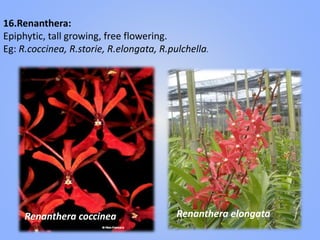
16.Renanthera:
Epiphytic, tall growing, free flowering.
Eg: R.coccinea, R.storie, R.elongata, R.pulchella.
Renanthera coccinea Renanthera elongata
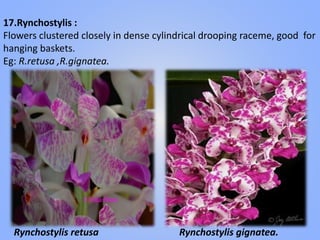
17.Rynchostylis :
Flowers clustered closely in dense cylindrical drooping raceme, good for
hanging baskets.
Eg: R.retusa ,R.gignatea.
Rynchostylis gignatea.Rynchostylis retusa
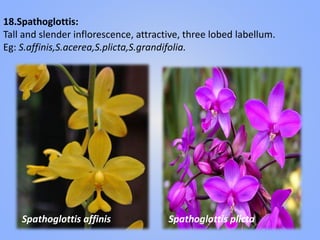
18.Spathoglottis:
Tall and slender inflorescence, attractive, three lobed labellum.
Eg: S.affinis,S.acerea,S.plicta,S.grandifolia.
Spathoglottis affinis Spathoglottis plicta
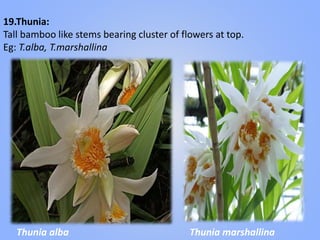
19.Thunia:
Tall bamboo like stems bearing cluster of flowers at top.
Eg: T.alba, T.marshallina
Thunia alba Thunia marshallina
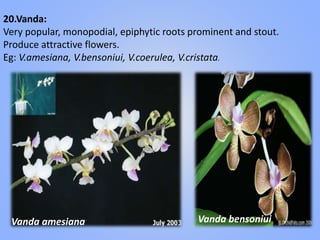
20.Vanda:
Very popular, monopodial, epiphytic roots prominent and stout.
Produce attractive flowers.
Eg: V.amesiana, V.bensoniui, V.coerulea, V.cristata.
Vanda amesiana Vanda bensoniui
BREEDING OBJECTIVES
>To breed for better YIELD & QUALITY.
>To introduce EARLY FLOWERING.
>To increase the LENGTH OF INFLORESCENCE.
> To increase the number of FLOWERS PER
INFLORESCENCE.
>To achieve better COLOUR, SIZE, SHAPE.
>To develop WIDER ADAPTABILITY.
>To extend the BLOOMING PERIOD.
>To develop NON STAKING VARIETIES.
>To produce FRAGRANT VARIETIES.
>To develop varieties with better ROOT POLIFERATION.
BREEDING METHODS
1.HYBRIDIZATION
2.MUTATION BREEDING
3.POLYPLIODY BREEDING
4.BIOTECHONOLOGY
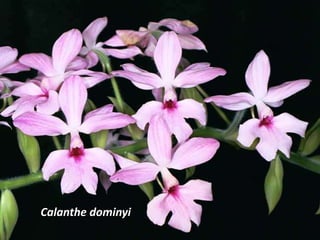
First orchid hybrid is Calanthe dominyi
(C. masuca X C.fuscata)
•In 1982, the first sexageneric hybrid Brilliandeara
gary was registered.
•This is the first sexageneric hybrid in the whole of
plant kingdom.
•It has been named in the honour of Gary
brilliande, a famous orchid breeder
Calanthe dominyi
STEPS IN HYBRIDIZATION
SELECTION OF PARENTS: Select male and female parents
depending on characters to be combined.
EMASCULATION: Remove pollens of female parent to
prevent natural pollination.
POLLINATION: Collect pollens from male parent and
remove anther cap. Put the pollens in stigmatic cavity and see
that it sticks well to stigmatic surface.
BAGGING: Tie the bags giving details of male and female
parents
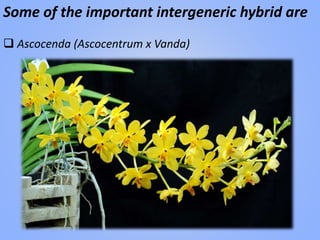
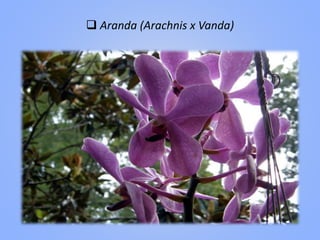
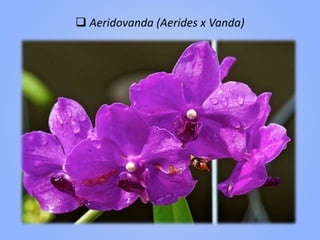
Some of the important intergeneric hybrid are :
 Ascocenda (Ascocentrum x Vanda)
 Aranda (Arachnis x Vanda)
 Aeridovanda (Aerides x Vanda)
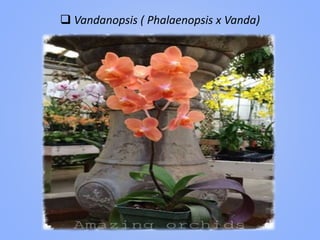
 Vandanopsis ( Phalaenopsis x Vanda)
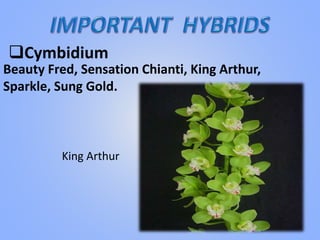
Beauty Fred, Sensation Chianti, King Arthur,
Sparkle, Sung Gold.
Cymbidium
King Arthur
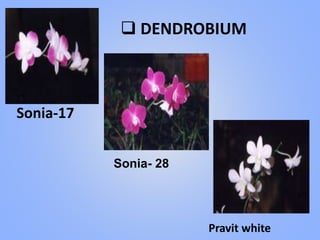
Sonia-17
Sonia- 28
Pravit white
 DENDROBIUM
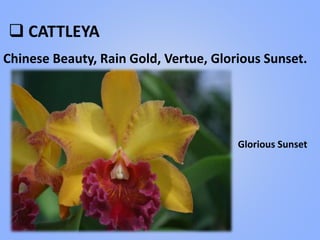
 CATTLEYA
Chinese Beauty, Rain Gold, Vertue, Glorious Sunset.
Glorious Sunset
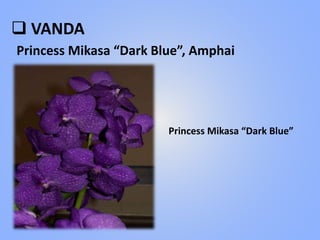
 VANDA
Princess Mikasa “Dark Blue”, Amphai
Princess Mikasa “Dark Blue”
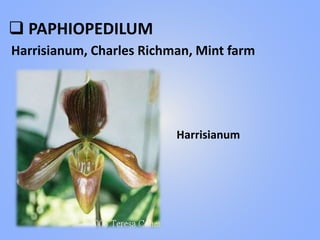
 PAPHIOPEDILUM
Harrisianum, Charles Richman, Mint farm
Harrisianum
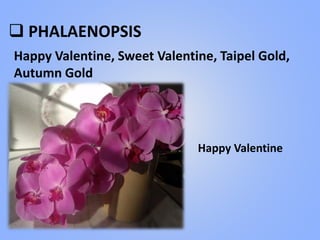
 PHALAENOPSIS
Happy Valentine, Sweet Valentine, Taipel Gold,
Autumn Gold
Happy Valentine
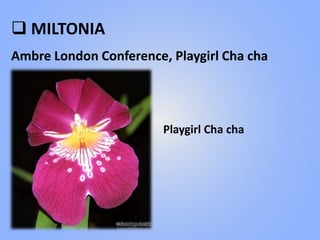
 MILTONIA
Ambre London Conference, Playgirl Cha cha
Playgirl Cha cha
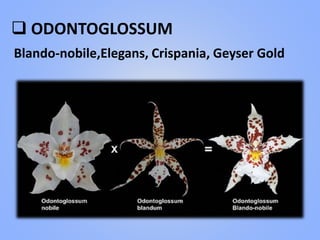
 ODONTOGLOSSUM
Blando-nobile,Elegans, Crispania, Geyser Gold
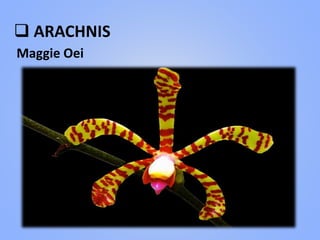
 ARACHNIS
Maggie Oei
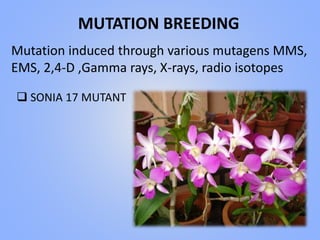
MUTATION BREEDING
Mutation induced through various mutagens MMS,
EMS, 2,4-D ,Gamma rays, X-rays, radio isotopes
 SONIA 17 MUTANT
POLYPLOIDY BREEDING
Colchicines has been used effectively in
inducing doubling of chromosomes.
Submerging bulbs of Cymbidium in
colchicines twice within an interval of 10
days has been reported to produce
tetraploids.
Similar technique has also been applied to
Dendrobium and in Vanda
BIOTECHNOLOGY
1. American Orchid Society has taken a lead in
stimulating interest in protoplast fusion research
in orchid
2.It was possible to fuse protoplasts from different
plants within the genus Eg. Phalaenopsis,
Dendrobium and Renanthera.
3.The frequency of fusion was increased by
polyethylene glycol.
4. Inter –generic fusion of terrestrial orchid
protoplast induced by different fusion promoting
agent was also found to be possible
INTERNATIONAL RULING VARIETIES
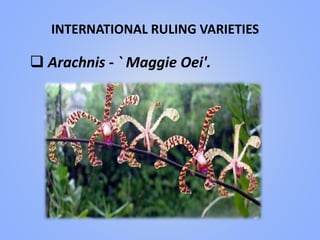
 Arachnis - ` Maggie Oei'.
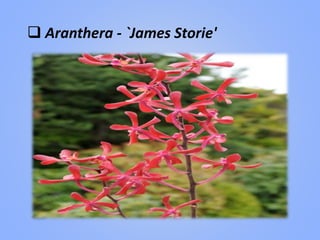
 Aranthera - `James Storie'
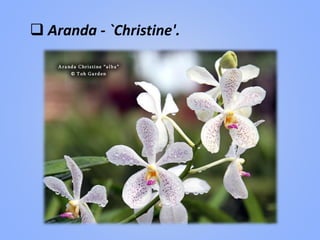
 Aranda - `Christine'.
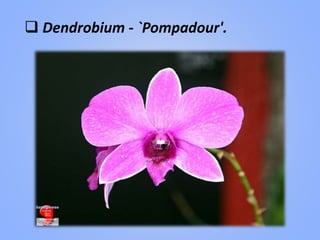
 Dendrobium - `Pompadour'.
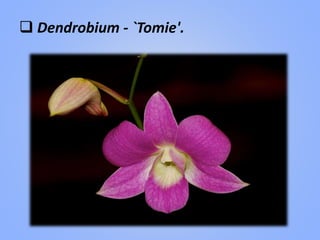
 Dendrobium - `Tomie'.
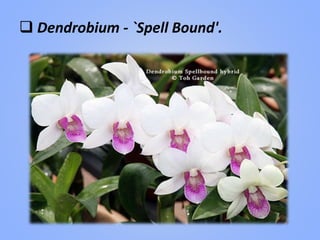
 Dendrobium - `Spell Bound'.
 Dendrobium - `Ceasar'.
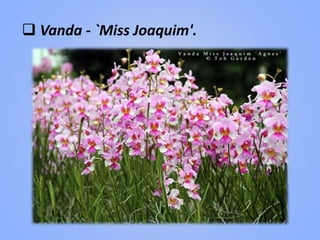
 Vanda - `Miss Joaquim'.
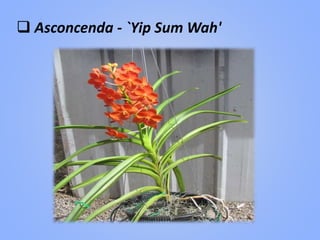
 Asconcenda - `Yip Sum Wah'
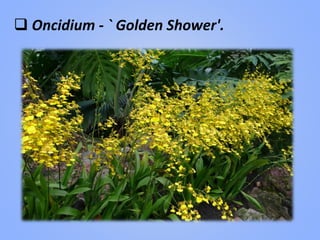
 Oncidium - ` Golden Shower'.
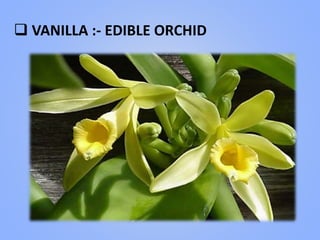
 VANILLA :- EDIBLE ORCHID
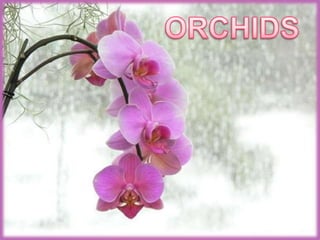
Orchids

Orchids