
Optimizing Tcl
Bytecode
Donal Fellows
University of Manchester / Tcl Core Team
donal.k.fellows@manchester.ac.uk
Outline
1. A refresher on Tcl Bytecode
2. Improving compilation Coverage
3. Improving bytecode Generation
4. A script-readable bytecode Disassembler
5. Towards a true bytecode Optimizer
6. Measured effects on Performance
7. Some future Directions
25–27 Sept. 2013 Tcl 2013, New Orleans 2
Bytecode
A refresher on Tcl
Tcl Evaluation Strategy
 Code stored as script (string)
 When required, bytecode interpretation added
 Stored in Tcl_Obj internal representation
 Bytecode evaluated in stack-based engine
 Example: set c [expr {$a + $b}]
loadScalar1 %v0 # var "a"
loadScalar1 %v1 # var "b"
add
storeScalar1 %v2 # var "c"
pop
25–27 Sept. 2013 Tcl 2013, New Orleans 4
Looking at Bytecode
 tcl::unsupported::disassemble
 Introduced in Tcl 8.5
 Same functionality as was achieved in earlier versions
by setting tcl_traceCompile global
 Compiles what it is told, if necessary
 Disassembles the bytecode
 But not if done by TDK compiler
 Returns a human-readable representation
25–27 Sept. 2013 Tcl 2013, New Orleans 5
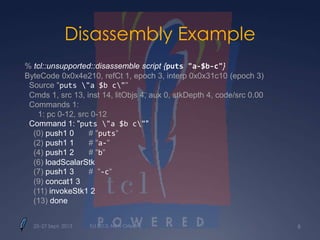
Disassembly Example
% tcl::unsupported::disassemble script {puts "a-$b-c"}
ByteCode 0x0x4e210, refCt 1, epoch 3, interp 0x0x31c10 (epoch 3)
Source "puts "a $b c""
Cmds 1, src 13, inst 14, litObjs 4, aux 0, stkDepth 4, code/src 0.00
Commands 1:
1: pc 0-12, src 0-12
Command 1: "puts "a $b c""
(0) push1 0 # "puts"
(2) push1 1 # "a-"
(4) push1 2 # "b"
(6) loadScalarStk
(7) push1 3 # "-c"
(9) concat1 3
(11) invokeStk1 2
(13) done
25–27 Sept. 2013 Tcl 2013, New Orleans 6
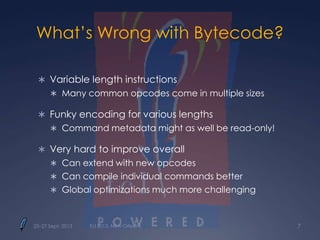
What’s Wrong with Bytecode?
 Variable length instructions
 Many common opcodes come in multiple sizes
 Funky encoding for various lengths
 Command metadata might as well be read-only!
 Very hard to improve overall
 Can extend with new opcodes
 Can compile individual commands better
 Global optimizations much more challenging
25–27 Sept. 2013 Tcl 2013, New Orleans 7
Coverage
Improving
compilation
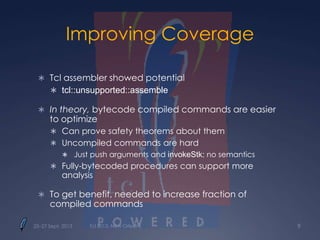
Improving Coverage
 Tcl assembler showed potential
 tcl::unsupported::assemble
 In theory, bytecode compiled commands are easier
to optimize
 Can prove safety theorems about them
 Uncompiled commands are hard
 Just push arguments and invokeStk; no semantics
 Fully-bytecoded procedures can support more
analysis
 To get benefit, needed to increase fraction of
compiled commands
25–27 Sept. 2013 Tcl 2013, New Orleans 9
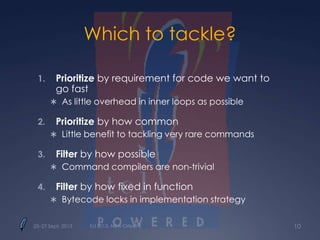
Which to tackle?
1. Prioritize by requirement for code we want to
go fast
 As little overhead in inner loops as possible
2. Prioritize by how common
 Little benefit to tackling very rare commands
3. Filter by how possible
 Command compilers are non-trivial
4. Filter by how fixed in function
 Bytecode locks in implementation strategy
25–27 Sept. 2013 Tcl 2013, New Orleans 10
Methodology
 Identify which commands used in key inner loops
 Study samples from various performance
discussions
 comp.lang.tcl, Wiki, tcl-core, private emails
 Identify which commands used to generate
literals
 Not just expr and subst!
 Official return -level 0 was known, but non-obvious
 lappend x [if {$y} {set y} else {return -level 0 "no"}]
25–27 Sept. 2013 Tcl 2013, New Orleans 11
Methodology
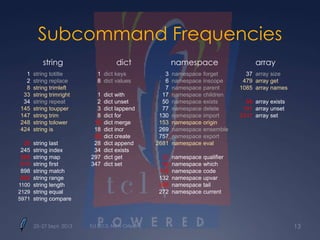
 Identify commands with subcommands
(“ensembles”)
 Collect list of all literal subcommands used in
packages in ActiveTcl Teapot repository
 Ignore subcommand names from a variable
 Collate/sort by frequency
 Manually filter for actual subcommands
 find $TEAPOTDIR -type f -print0 | xargs -0 cat
| grep --binary-files=text -w $CMD
| sed "s/.*$CMD *([a-z]*).*/1/"
| sort | uniq -c | sort -n
25–27 Sept. 2013 Tcl 2013, New Orleans 12
Subcommand Frequencies
1 string totitle
2 string replace
8 string trimleft
33 string trimright
34 string repeat
145 string toupper
147 string trim
248 string tolower
424 string is
28 string last
245 string index
569 string map
674 string first
898 string match
892 string range
1100 string length
2129 string equal
5971 string compare
25–27 Sept. 2013 Tcl 2013, New Orleans 13
1 dict keys
8 dict values
1 dict with
2 dict unset
3 dict lappend
8 dict for
15 dict merge
18 dict incr
22 dict create
28 dict append
34 dict exists
297 dict get
347 dict set
3 namespace forget
6 namespace inscope
7 namespace parent
17 namespace children
50 namespace exists
77 namespace delete
130 namespace import
153 namespace origin
269 namespace ensemble
757 namespace export
2681 namespace eval
30 namespace qualifier
56 namespace which
116 namespace code
132 namespace upvar
206 namespace tail
272 namespace current
37 array size
479 array get
1085 array names
56 array exists
191 array unset
2511 array set
string dict namespace array
Commands with New Compilers
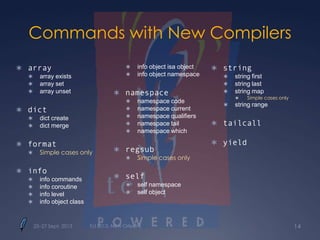
 array
 array exists
 array set
 array unset
 dict
 dict create
 dict merge
 format
 Simple cases only
 info
 info commands
 info coroutine
 info level
 info object class
 info object isa object
 info object namespace
 namespace
 namespace code
 namespace current
 namespace qualifiers
 namespace tail
 namespace which
 regsub
 Simple cases only
 self
 self namespace
 self object
 string
 string first
 string last
 string map
 Simple cases only
 string range
 tailcall
 yield
25–27 Sept. 2013 Tcl 2013, New Orleans 14
Future Compiled Commands?
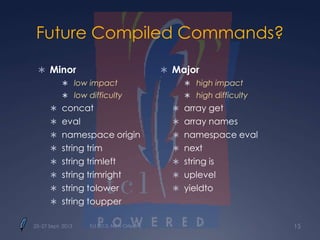
 Minor
 low impact
 low difficulty
 concat
 eval
 namespace origin
 string trim
 string trimleft
 string trimright
 string tolower
 string toupper
 Major
 high impact
 high difficulty
 array get
 array names
 namespace eval
 next
 string is
 uplevel
 yieldto
25–27 Sept. 2013 Tcl 2013, New Orleans 15
Generation
Improving
bytecode
Improving Generation:
“list concat” via expansion
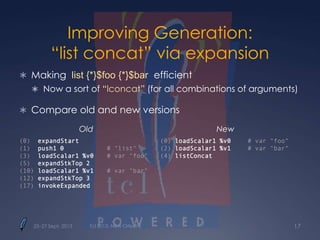
 Making list {*}$foo {*}$bar efficient
 Now a sort of “lconcat” (for all combinations of arguments)
 Compare old and new versions
25–27 Sept. 2013 Tcl 2013, New Orleans 17
(0) expandStart
(1) push1 0 # "list"
(3) loadScalar1 %v0 # var "foo"
(5) expandStkTop 2
(10) loadScalar1 %v1 # var "bar"
(12) expandStkTop 3
(17) invokeExpanded
(0) loadScalar1 %v0 # var "foo"
(2) loadScalar1 %v1 # var "bar"
(4) listConcat
Old New
Improving Generation:
Ensembles
 Bind core ensembles to their
implementations
 Apply basic syntax checks
 Number of arguments
 Replace ensemble call with
direct call to correct
implementation command
if possible
 Otherwise, use special
ensemble dispatch
 Half the mechanism…
 Not for user-defined
ensembles
 Would be very bad for Snit!
% disassemble script {info body foo}
[…]
(0) push1 0 # "::tcl::info::body"
(2) push1 1 # "foo"
(4) invokeStk1 2
(6) done
% disassemble script {string is space x}
[…]
(0) push1 0 # "string"
(2) push1 1 # "is"
(4) push1 2 # "space"
(6) push1 3 # "x"
(8) push1 4 # "::tcl::string::is"
(10) invokeReplace 4 2
(16) done
Tcl 2013, New Orleans 1825–27 Sept. 2013
Improving Generation
 Expanding the set of cases for which existing
compilers generate “good” code
 Avoid doing complex (expensive!) exception
processing when no exceptions are present
 Especially the try…finally compiler
 Also dict with with an empty body
 Generating jumps for break and continue
 Even when inside expansion inside nested
evaluation inside…
25–27 Sept. 2013 Tcl 2013, New Orleans 19
Disassembler
A script-readable
bytecode
Improving Inspection
 tcl::unsupported::getbytecode
 Currently on a development branch,
dkf-improved-disassembler
 Returns a script-readable version of the disassembly
 Dictionary of various things
 Lots of interesting things inside
 Opcodes, variables, exception handlers, literals,
commands, …
 Can easily build useful tools on top
 Example next slide…
25–27 Sept. 2013 Tcl 2013, New Orleans 21
Example: foreach loop
::tcl::unsupported::controlflow lambda {{} {
foreach foo $bar {
puts [list {*}$foo {*}$bar]
break
}
} ::tcl}
0 loadScalar1 %bar
2 storeScalar1 %%%4
4 pop
5 foreach_start4 {data %%%4 loop %%%5 assign %foo}
┌── 10 foreach_step4 {data %%%4 loop %%%5 assign %foo}
│ ┌─ 15 jumpFalse1 35
│ │ 17 push1 "puts"
│ │ 19 loadScalar1 %foo
│ │ 21 loadScalar1 %bar
│ │ 23 listConcat
│ │ 24 invokeStk1 2
│ │ 26 pop
│┌┼─ 27 jump4 35
│││ 32 pop
└┼┼─ 33 jump1 10
└┴ 35 push1 ""
37 done
25–27 Sept. 2013 Tcl 2013, New Orleans 22
Inside the Disassembly Dict
 literals
 List of literal values
 variables
 List of variable descriptors
(name, temporary, other flags)
 exception
 List of exception ranges (definitions
of where to go when an opcode
throws an error, a break or a
continue)
 instructions
 Dictionary of instructions and
arguments, indexed by address
 auxiliary
 List of extra information required by
some instructions (foreach, etc.)
 commands
 List of information about commands
in the bytecode (source range,
bytecode range)
 script
 Literal script that was compiled
 namespace
 Name of the namespace to which
the sbytecode is bound
 stackdepth
 Maximum depth of execution stack
required
 exceptdepth
 Maximum depth of nested
exceptions required
25–27 Sept. 2013 Tcl 2013, New Orleans 23
Optimizer
Towards a true
bytecode
Optimization
 Tcl now has a formal bytecode optimizer
 Initial aim: fewer peephole optimizations in
bytecode engine
 Very early days!
 Part of 8.6.1
 Depends on very efficient handling of multi-
“nop” sequences in bytecode engine
25–27 Sept. 2013 Tcl 2013, New Orleans 25
Current Optimizations
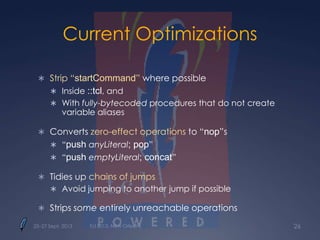
 Strip “startCommand” where possible
 Inside ::tcl, and
 With fully-bytecoded procedures that do not create
variable aliases
 Converts zero-effect operations to “nop”s
 “push anyLiteral; pop”
 “push emptyLiteral; concat”
 Tidies up chains of jumps
 Avoid jumping to another jump if possible
 Strips some entirely unreachable operations
25–27 Sept. 2013 Tcl 2013, New Orleans 26
Much still to do
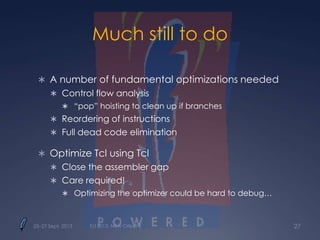
 A number of fundamental optimizations needed
 Control flow analysis
 “pop” hoisting to clean up if branches
 Reordering of instructions
 Full dead code elimination
 Optimize Tcl using Tcl
 Close the assembler gap
 Care required!
 Optimizing the optimizer could be hard to debug…
25–27 Sept. 2013 Tcl 2013, New Orleans 27
Performance
Measured
effects on
Methodology
 All timings done with same
build and execution
environment
 Measure time to execute a
small script
 Careful to avoid most
performance problems
 Invert to get calls/sec
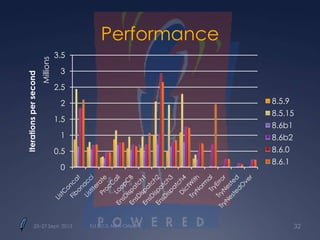
 “Performance”
 Normalize
proc Fibonacci {n} {
set a 0
set b 1
for {set i 2} {$i <= $n} {incr i} {
set b [expr {$a + [set a $b]}]
}
return $b
}
proc benchmark {title script} {
eval $script
for {set i 0} {$i < 20} {incr i} {
lappend t [lindex [
time $script 100000
] 0]
}
puts [format "%s: %4f" $title 
[tcl::mathfunc::min {*}$t]]
}
benchmark ”Fibonacci" {Fibonacci 10}
Tcl 2013, New Orleans 2925–27 Sept. 2013
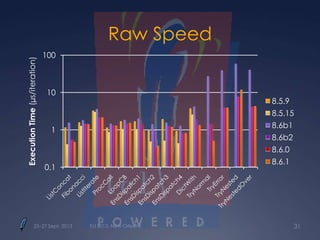
Raw Performance (time/iter)
25–27 Sept. 2013 Tcl 2013, New Orleans 30
General
Operations
New concat
try
dict with
Ensembles
Program 8.5.9 8.5.15 8.6b1 8.6b2 8.6.0 8.6.1
ListConcat 1.1609 0.4097 1.5622 0.5405 0.5433 0.4737
Fibonacci 1.5906 1.2710 1.8087 1.4340 1.4620 1.4114
ListIterate 3.3059 3.0234 3.5981 2.1105 2.1232 2.1599
ProcCall 1.1510 0.8695 1.4590 1.3083 1.3039 1.2996
LoopCB 1.6978 1.0508 1.8496 1.4095 1.4581 1.5382
EnsDispatch1 1.6907 1.0425 2.0192 1.3988 1.4293 0.9404
EnsDispatch2 1.0189 0.4875 1.4117 0.9670 0.3406 0.3763
EnsDispatch3 1.9381 0.5133 1.5587 1.2390 1.2585 1.1909
EnsDispatch4 0.9240 0.4369 1.2799 0.7928 0.7925 0.8167
DictWith 3.7534 2.5671 4.1987 1.9461 1.2926 1.3514
TryNormal N/A N/A 27.2137 1.4110 1.4075 0.5086
TryError N/A N/A 39.1749 3.8483 3.8556 3.9413
TryNested N/A N/A 58.8109 7.6793 7.6454 11.9620
TryNestedOver N/A N/A 40.3560 4.1359 4.1963 4.3093
Raw Speed
0.1
1
10
100
ExecutionTime(µs/iteration)
8.5.9
8.5.15
8.6b1
8.6b2
8.6.0
8.6.1
25–27 Sept. 2013 Tcl 2013, New Orleans 31
Performance
0
0.5
1
1.5
2
2.5
3
3.5
Iterationspersecond
Millions
8.5.9
8.5.15
8.6b1
8.6b2
8.6.0
8.6.1
25–27 Sept. 2013 Tcl 2013, New Orleans 32
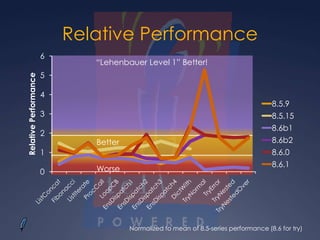
Relative Performance
Normalized to mean of 8.5-series performance (8.6 for try)
“Lehenbauer Level 1” Better!
Better
Worse0
1
2
3
4
5
6
RelativePerformance
8.5.9
8.5.15
8.6b1
8.6b2
8.6.0
8.6.1
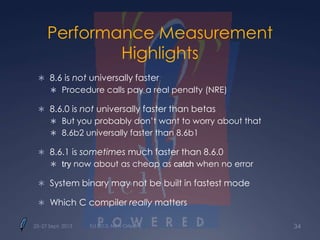
Performance Measurement
Highlights
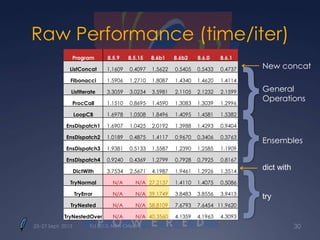
 8.6 is not universally faster
 Procedure calls pay a real penalty (NRE)
 8.6.0 is not universally faster than betas
 But you probably don’t want to worry about that
 8.6b2 universally faster than 8.6b1
 8.6.1 is sometimes much faster than 8.6.0
 try now about as cheap as catch when no error
 System binary may not be built in fastest mode
 Which C compiler really matters
25–27 Sept. 2013 Tcl 2013, New Orleans 34
Implications for Optimization
 Improving the compilation of commands provides the
biggest gain
 But only for code that uses those commands
 Doesn’t deliver a quantum leap for most
 General optimization has had little impact so far
 Answering “Is Tcl getting faster?” is hard
 Some things are faster, some are not
 “It depends”
 We can easily answer for particular scripts
 How should we weight each sample script to get an
overall figure?
25–27 Sept. 2013 Tcl 2013, New Orleans 35
Directions
Future
Where next?
 Integrate “getbytecode” into trunk
 Name?
 Compile more commands
 Some of the biggest wins will be very hard to get right
 Some should be done without immediate
wins, because they strengthen the type algebra
 Compile more cases with existing commands?
 Can we optimize in Tcl?
 Definitely can’t do so yet; can’t assemble foreach
25–27 Sept. 2013 Tcl 2013, New Orleans 37
Where next?
 The command dispatch mechanism is quite a bit
more expensive in 8.6
 Can we improve it?
 Several performance tests very sensitive to this
 That’s one reason why no TclOO benchmarks this
time
 Warning! Might be optimizing for benchmarks, not for
reality
 Can we inline sufficiently simple procedures?
 Suspect it is fairly easy for variable-free code
 Only really relevant with some variables…
25–27 Sept. 2013 Tcl 2013, New Orleans 38
Where next?
 Can we generate native code?
 Topic for Tcl 9.0!
 Automatic type annotations are key
 The Lehenbauer Challenges
 Attaining even Level 1 (speed ×2) is hard
 Arguably the case for a few scripts
 Level 2 (×10) is extremely difficult!
 Bytecode engine is not fast enough
25–27 Sept. 2013 Tcl 2013, New Orleans 39

Optimizing Tcl Bytecode

  • 1.
    Optimizing Tcl Bytecode Donal Fellows Universityof Manchester / Tcl Core Team donal.k.fellows@manchester.ac.uk
  • 2.
    Outline 1. A refresheron Tcl Bytecode 2. Improving compilation Coverage 3. Improving bytecode Generation 4. A script-readable bytecode Disassembler 5. Towards a true bytecode Optimizer 6. Measured effects on Performance 7. Some future Directions 25–27 Sept. 2013 Tcl 2013, New Orleans 2
  • 3.
  • 4.
    Tcl Evaluation Strategy Code stored as script (string)  When required, bytecode interpretation added  Stored in Tcl_Obj internal representation  Bytecode evaluated in stack-based engine  Example: set c [expr {$a + $b}] loadScalar1 %v0 # var "a" loadScalar1 %v1 # var "b" add storeScalar1 %v2 # var "c" pop 25–27 Sept. 2013 Tcl 2013, New Orleans 4
  • 5.
    Looking at Bytecode tcl::unsupported::disassemble  Introduced in Tcl 8.5  Same functionality as was achieved in earlier versions by setting tcl_traceCompile global  Compiles what it is told, if necessary  Disassembles the bytecode  But not if done by TDK compiler  Returns a human-readable representation 25–27 Sept. 2013 Tcl 2013, New Orleans 5
  • 6.
    Disassembly Example % tcl::unsupported::disassemblescript {puts "a-$b-c"} ByteCode 0x0x4e210, refCt 1, epoch 3, interp 0x0x31c10 (epoch 3) Source "puts "a $b c"" Cmds 1, src 13, inst 14, litObjs 4, aux 0, stkDepth 4, code/src 0.00 Commands 1: 1: pc 0-12, src 0-12 Command 1: "puts "a $b c"" (0) push1 0 # "puts" (2) push1 1 # "a-" (4) push1 2 # "b" (6) loadScalarStk (7) push1 3 # "-c" (9) concat1 3 (11) invokeStk1 2 (13) done 25–27 Sept. 2013 Tcl 2013, New Orleans 6
  • 7.
    What’s Wrong withBytecode?  Variable length instructions  Many common opcodes come in multiple sizes  Funky encoding for various lengths  Command metadata might as well be read-only!  Very hard to improve overall  Can extend with new opcodes  Can compile individual commands better  Global optimizations much more challenging 25–27 Sept. 2013 Tcl 2013, New Orleans 7
  • 8.
  • 9.
    Improving Coverage  Tclassembler showed potential  tcl::unsupported::assemble  In theory, bytecode compiled commands are easier to optimize  Can prove safety theorems about them  Uncompiled commands are hard  Just push arguments and invokeStk; no semantics  Fully-bytecoded procedures can support more analysis  To get benefit, needed to increase fraction of compiled commands 25–27 Sept. 2013 Tcl 2013, New Orleans 9
  • 10.
    Which to tackle? 1.Prioritize by requirement for code we want to go fast  As little overhead in inner loops as possible 2. Prioritize by how common  Little benefit to tackling very rare commands 3. Filter by how possible  Command compilers are non-trivial 4. Filter by how fixed in function  Bytecode locks in implementation strategy 25–27 Sept. 2013 Tcl 2013, New Orleans 10
  • 11.
    Methodology  Identify whichcommands used in key inner loops  Study samples from various performance discussions  comp.lang.tcl, Wiki, tcl-core, private emails  Identify which commands used to generate literals  Not just expr and subst!  Official return -level 0 was known, but non-obvious  lappend x [if {$y} {set y} else {return -level 0 "no"}] 25–27 Sept. 2013 Tcl 2013, New Orleans 11
  • 12.
    Methodology  Identify commandswith subcommands (“ensembles”)  Collect list of all literal subcommands used in packages in ActiveTcl Teapot repository  Ignore subcommand names from a variable  Collate/sort by frequency  Manually filter for actual subcommands  find $TEAPOTDIR -type f -print0 | xargs -0 cat | grep --binary-files=text -w $CMD | sed "s/.*$CMD *([a-z]*).*/1/" | sort | uniq -c | sort -n 25–27 Sept. 2013 Tcl 2013, New Orleans 12
  • 13.
    Subcommand Frequencies 1 stringtotitle 2 string replace 8 string trimleft 33 string trimright 34 string repeat 145 string toupper 147 string trim 248 string tolower 424 string is 28 string last 245 string index 569 string map 674 string first 898 string match 892 string range 1100 string length 2129 string equal 5971 string compare 25–27 Sept. 2013 Tcl 2013, New Orleans 13 1 dict keys 8 dict values 1 dict with 2 dict unset 3 dict lappend 8 dict for 15 dict merge 18 dict incr 22 dict create 28 dict append 34 dict exists 297 dict get 347 dict set 3 namespace forget 6 namespace inscope 7 namespace parent 17 namespace children 50 namespace exists 77 namespace delete 130 namespace import 153 namespace origin 269 namespace ensemble 757 namespace export 2681 namespace eval 30 namespace qualifier 56 namespace which 116 namespace code 132 namespace upvar 206 namespace tail 272 namespace current 37 array size 479 array get 1085 array names 56 array exists 191 array unset 2511 array set string dict namespace array
  • 14.
    Commands with NewCompilers  array  array exists  array set  array unset  dict  dict create  dict merge  format  Simple cases only  info  info commands  info coroutine  info level  info object class  info object isa object  info object namespace  namespace  namespace code  namespace current  namespace qualifiers  namespace tail  namespace which  regsub  Simple cases only  self  self namespace  self object  string  string first  string last  string map  Simple cases only  string range  tailcall  yield 25–27 Sept. 2013 Tcl 2013, New Orleans 14
  • 15.
    Future Compiled Commands? Minor  low impact  low difficulty  concat  eval  namespace origin  string trim  string trimleft  string trimright  string tolower  string toupper  Major  high impact  high difficulty  array get  array names  namespace eval  next  string is  uplevel  yieldto 25–27 Sept. 2013 Tcl 2013, New Orleans 15
  • 16.
  • 17.
    Improving Generation: “list concat”via expansion  Making list {*}$foo {*}$bar efficient  Now a sort of “lconcat” (for all combinations of arguments)  Compare old and new versions 25–27 Sept. 2013 Tcl 2013, New Orleans 17 (0) expandStart (1) push1 0 # "list" (3) loadScalar1 %v0 # var "foo" (5) expandStkTop 2 (10) loadScalar1 %v1 # var "bar" (12) expandStkTop 3 (17) invokeExpanded (0) loadScalar1 %v0 # var "foo" (2) loadScalar1 %v1 # var "bar" (4) listConcat Old New
  • 18.
    Improving Generation: Ensembles  Bindcore ensembles to their implementations  Apply basic syntax checks  Number of arguments  Replace ensemble call with direct call to correct implementation command if possible  Otherwise, use special ensemble dispatch  Half the mechanism…  Not for user-defined ensembles  Would be very bad for Snit! % disassemble script {info body foo} […] (0) push1 0 # "::tcl::info::body" (2) push1 1 # "foo" (4) invokeStk1 2 (6) done % disassemble script {string is space x} […] (0) push1 0 # "string" (2) push1 1 # "is" (4) push1 2 # "space" (6) push1 3 # "x" (8) push1 4 # "::tcl::string::is" (10) invokeReplace 4 2 (16) done Tcl 2013, New Orleans 1825–27 Sept. 2013
  • 19.
    Improving Generation  Expandingthe set of cases for which existing compilers generate “good” code  Avoid doing complex (expensive!) exception processing when no exceptions are present  Especially the try…finally compiler  Also dict with with an empty body  Generating jumps for break and continue  Even when inside expansion inside nested evaluation inside… 25–27 Sept. 2013 Tcl 2013, New Orleans 19
  • 20.
  • 21.
    Improving Inspection  tcl::unsupported::getbytecode Currently on a development branch, dkf-improved-disassembler  Returns a script-readable version of the disassembly  Dictionary of various things  Lots of interesting things inside  Opcodes, variables, exception handlers, literals, commands, …  Can easily build useful tools on top  Example next slide… 25–27 Sept. 2013 Tcl 2013, New Orleans 21
  • 22.
    Example: foreach loop ::tcl::unsupported::controlflowlambda {{} { foreach foo $bar { puts [list {*}$foo {*}$bar] break } } ::tcl} 0 loadScalar1 %bar 2 storeScalar1 %%%4 4 pop 5 foreach_start4 {data %%%4 loop %%%5 assign %foo} ┌── 10 foreach_step4 {data %%%4 loop %%%5 assign %foo} │ ┌─ 15 jumpFalse1 35 │ │ 17 push1 "puts" │ │ 19 loadScalar1 %foo │ │ 21 loadScalar1 %bar │ │ 23 listConcat │ │ 24 invokeStk1 2 │ │ 26 pop │┌┼─ 27 jump4 35 │││ 32 pop └┼┼─ 33 jump1 10 └┴ 35 push1 "" 37 done 25–27 Sept. 2013 Tcl 2013, New Orleans 22
  • 23.
    Inside the DisassemblyDict  literals  List of literal values  variables  List of variable descriptors (name, temporary, other flags)  exception  List of exception ranges (definitions of where to go when an opcode throws an error, a break or a continue)  instructions  Dictionary of instructions and arguments, indexed by address  auxiliary  List of extra information required by some instructions (foreach, etc.)  commands  List of information about commands in the bytecode (source range, bytecode range)  script  Literal script that was compiled  namespace  Name of the namespace to which the sbytecode is bound  stackdepth  Maximum depth of execution stack required  exceptdepth  Maximum depth of nested exceptions required 25–27 Sept. 2013 Tcl 2013, New Orleans 23
  • 24.
  • 25.
    Optimization  Tcl nowhas a formal bytecode optimizer  Initial aim: fewer peephole optimizations in bytecode engine  Very early days!  Part of 8.6.1  Depends on very efficient handling of multi- “nop” sequences in bytecode engine 25–27 Sept. 2013 Tcl 2013, New Orleans 25
  • 26.
    Current Optimizations  Strip“startCommand” where possible  Inside ::tcl, and  With fully-bytecoded procedures that do not create variable aliases  Converts zero-effect operations to “nop”s  “push anyLiteral; pop”  “push emptyLiteral; concat”  Tidies up chains of jumps  Avoid jumping to another jump if possible  Strips some entirely unreachable operations 25–27 Sept. 2013 Tcl 2013, New Orleans 26
  • 27.
    Much still todo  A number of fundamental optimizations needed  Control flow analysis  “pop” hoisting to clean up if branches  Reordering of instructions  Full dead code elimination  Optimize Tcl using Tcl  Close the assembler gap  Care required!  Optimizing the optimizer could be hard to debug… 25–27 Sept. 2013 Tcl 2013, New Orleans 27
  • 28.
  • 29.
    Methodology  All timingsdone with same build and execution environment  Measure time to execute a small script  Careful to avoid most performance problems  Invert to get calls/sec  “Performance”  Normalize proc Fibonacci {n} { set a 0 set b 1 for {set i 2} {$i <= $n} {incr i} { set b [expr {$a + [set a $b]}] } return $b } proc benchmark {title script} { eval $script for {set i 0} {$i < 20} {incr i} { lappend t [lindex [ time $script 100000 ] 0] } puts [format "%s: %4f" $title [tcl::mathfunc::min {*}$t]] } benchmark ”Fibonacci" {Fibonacci 10} Tcl 2013, New Orleans 2925–27 Sept. 2013
  • 30.
    Raw Performance (time/iter) 25–27Sept. 2013 Tcl 2013, New Orleans 30 General Operations New concat try dict with Ensembles Program 8.5.9 8.5.15 8.6b1 8.6b2 8.6.0 8.6.1 ListConcat 1.1609 0.4097 1.5622 0.5405 0.5433 0.4737 Fibonacci 1.5906 1.2710 1.8087 1.4340 1.4620 1.4114 ListIterate 3.3059 3.0234 3.5981 2.1105 2.1232 2.1599 ProcCall 1.1510 0.8695 1.4590 1.3083 1.3039 1.2996 LoopCB 1.6978 1.0508 1.8496 1.4095 1.4581 1.5382 EnsDispatch1 1.6907 1.0425 2.0192 1.3988 1.4293 0.9404 EnsDispatch2 1.0189 0.4875 1.4117 0.9670 0.3406 0.3763 EnsDispatch3 1.9381 0.5133 1.5587 1.2390 1.2585 1.1909 EnsDispatch4 0.9240 0.4369 1.2799 0.7928 0.7925 0.8167 DictWith 3.7534 2.5671 4.1987 1.9461 1.2926 1.3514 TryNormal N/A N/A 27.2137 1.4110 1.4075 0.5086 TryError N/A N/A 39.1749 3.8483 3.8556 3.9413 TryNested N/A N/A 58.8109 7.6793 7.6454 11.9620 TryNestedOver N/A N/A 40.3560 4.1359 4.1963 4.3093
  • 31.
  • 32.
  • 33.
    Relative Performance Normalized tomean of 8.5-series performance (8.6 for try) “Lehenbauer Level 1” Better! Better Worse0 1 2 3 4 5 6 RelativePerformance 8.5.9 8.5.15 8.6b1 8.6b2 8.6.0 8.6.1
  • 34.
    Performance Measurement Highlights  8.6is not universally faster  Procedure calls pay a real penalty (NRE)  8.6.0 is not universally faster than betas  But you probably don’t want to worry about that  8.6b2 universally faster than 8.6b1  8.6.1 is sometimes much faster than 8.6.0  try now about as cheap as catch when no error  System binary may not be built in fastest mode  Which C compiler really matters 25–27 Sept. 2013 Tcl 2013, New Orleans 34
  • 35.
    Implications for Optimization Improving the compilation of commands provides the biggest gain  But only for code that uses those commands  Doesn’t deliver a quantum leap for most  General optimization has had little impact so far  Answering “Is Tcl getting faster?” is hard  Some things are faster, some are not  “It depends”  We can easily answer for particular scripts  How should we weight each sample script to get an overall figure? 25–27 Sept. 2013 Tcl 2013, New Orleans 35
  • 36.
  • 37.
    Where next?  Integrate“getbytecode” into trunk  Name?  Compile more commands  Some of the biggest wins will be very hard to get right  Some should be done without immediate wins, because they strengthen the type algebra  Compile more cases with existing commands?  Can we optimize in Tcl?  Definitely can’t do so yet; can’t assemble foreach 25–27 Sept. 2013 Tcl 2013, New Orleans 37
  • 38.
    Where next?  Thecommand dispatch mechanism is quite a bit more expensive in 8.6  Can we improve it?  Several performance tests very sensitive to this  That’s one reason why no TclOO benchmarks this time  Warning! Might be optimizing for benchmarks, not for reality  Can we inline sufficiently simple procedures?  Suspect it is fairly easy for variable-free code  Only really relevant with some variables… 25–27 Sept. 2013 Tcl 2013, New Orleans 38
  • 39.
    Where next?  Canwe generate native code?  Topic for Tcl 9.0!  Automatic type annotations are key  The Lehenbauer Challenges  Attaining even Level 1 (speed ×2) is hard  Arguably the case for a few scripts  Level 2 (×10) is extremely difficult!  Bytecode engine is not fast enough 25–27 Sept. 2013 Tcl 2013, New Orleans 39

Editor's Notes

  • #15 Outliers: string last (since functionality needed elsewhere anyway)Namespaceeval, array get and array names not present: too complex to get right!
  • #18 Previous code for expanding list was just a variation on push args and invoke; now it does direct list construction in TEBC
  • #19 TODO: Example bytecode
  • #23 Red is (loop)exception range. 10 is range continue target, 35 is range break target. Indented part is detected loop.Live demo here? Use: make shell SCRIPT=flowdemo.tcl | less –RS(If doing this yourself, use the font Courier New for your terminal as it has better glyph definitions for this sort of thing.)
  • #31 Performance on [try] for 8.5 not tested; command not present
  • #34 8.6b2 universally faster than 8.6b1EnsDispatch1 measures ensemble dispatch converted to implementation invokeEnsDispatch2 measures ensemble dispatch converted to direct bytecodesEnsDispatch3 measures ensemble dispatch via new invoke schemeEnsDispatch4 measures user-defined ensemble dispatch