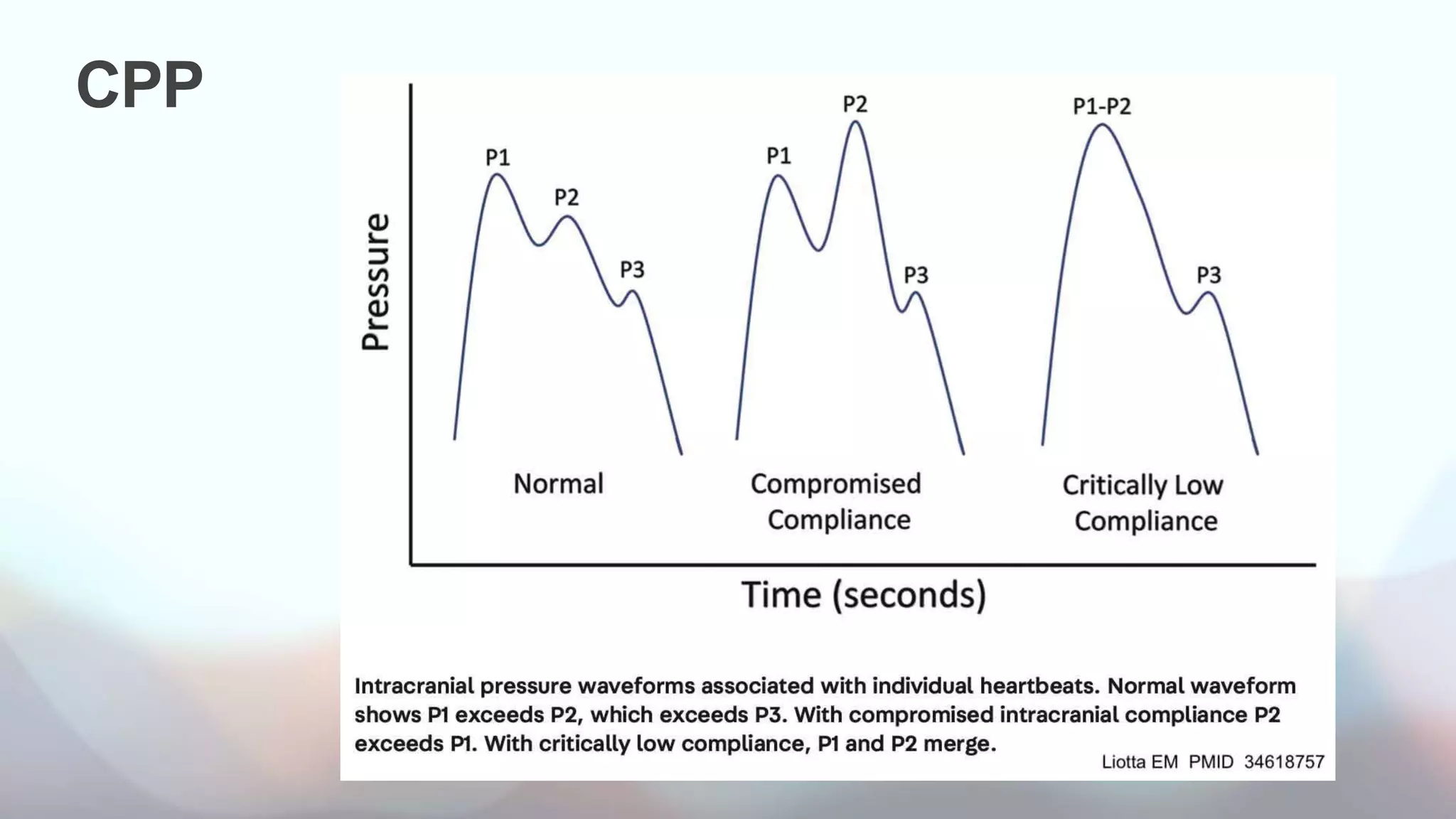

Cerebral Perfusion
Pressure
CPP
Key concepts
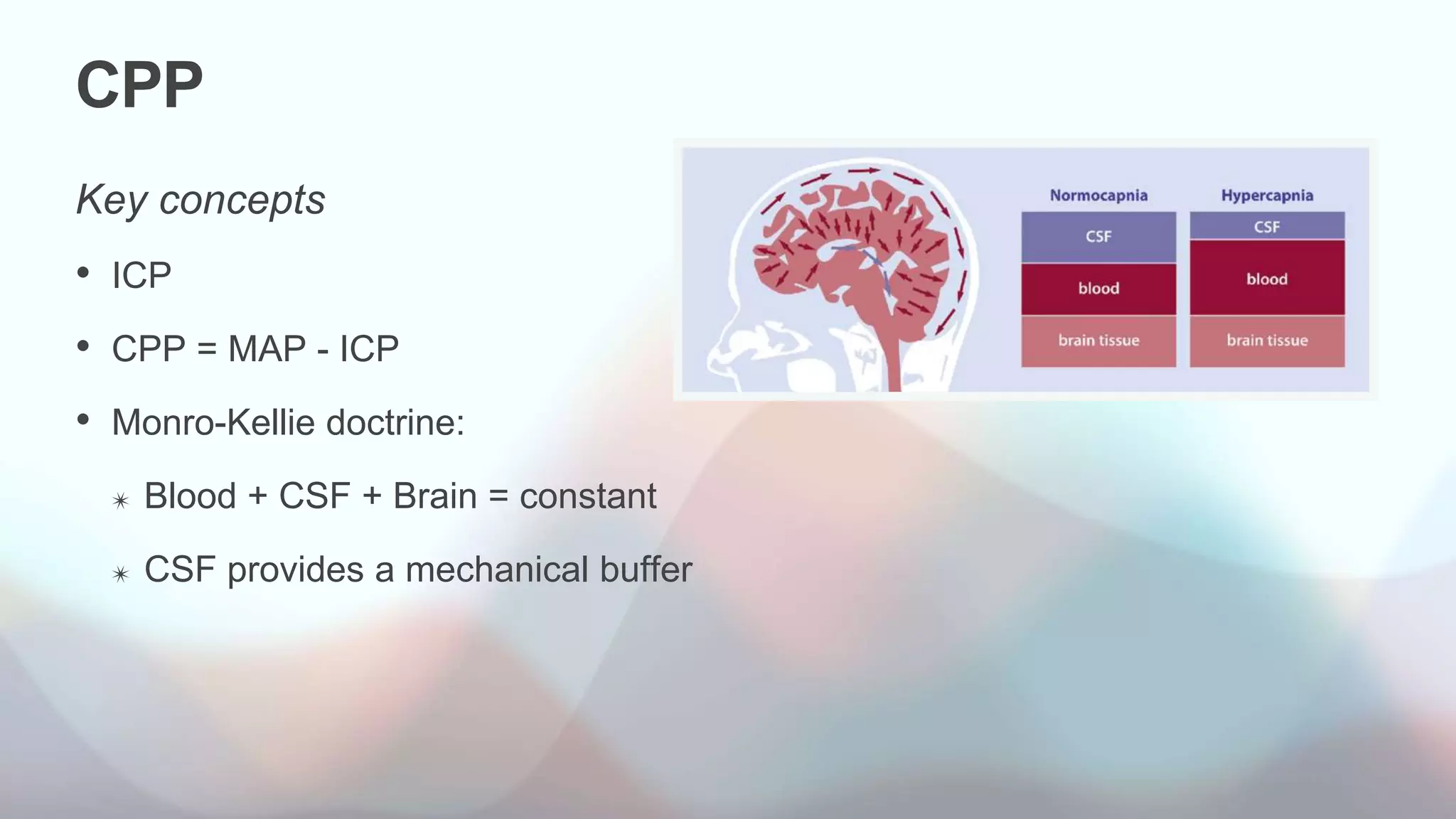
• ICP
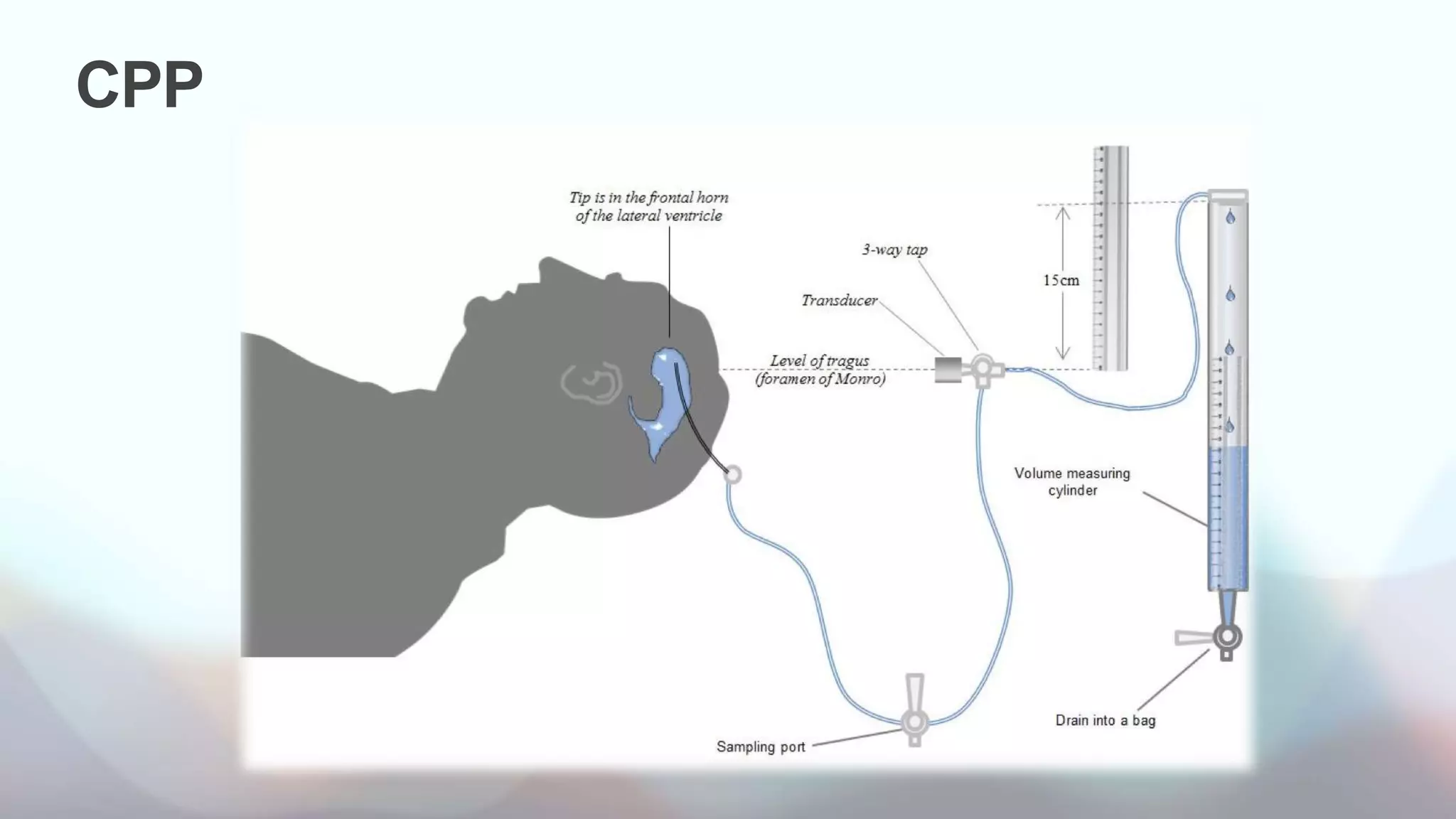
• CPP = MAP - ICP
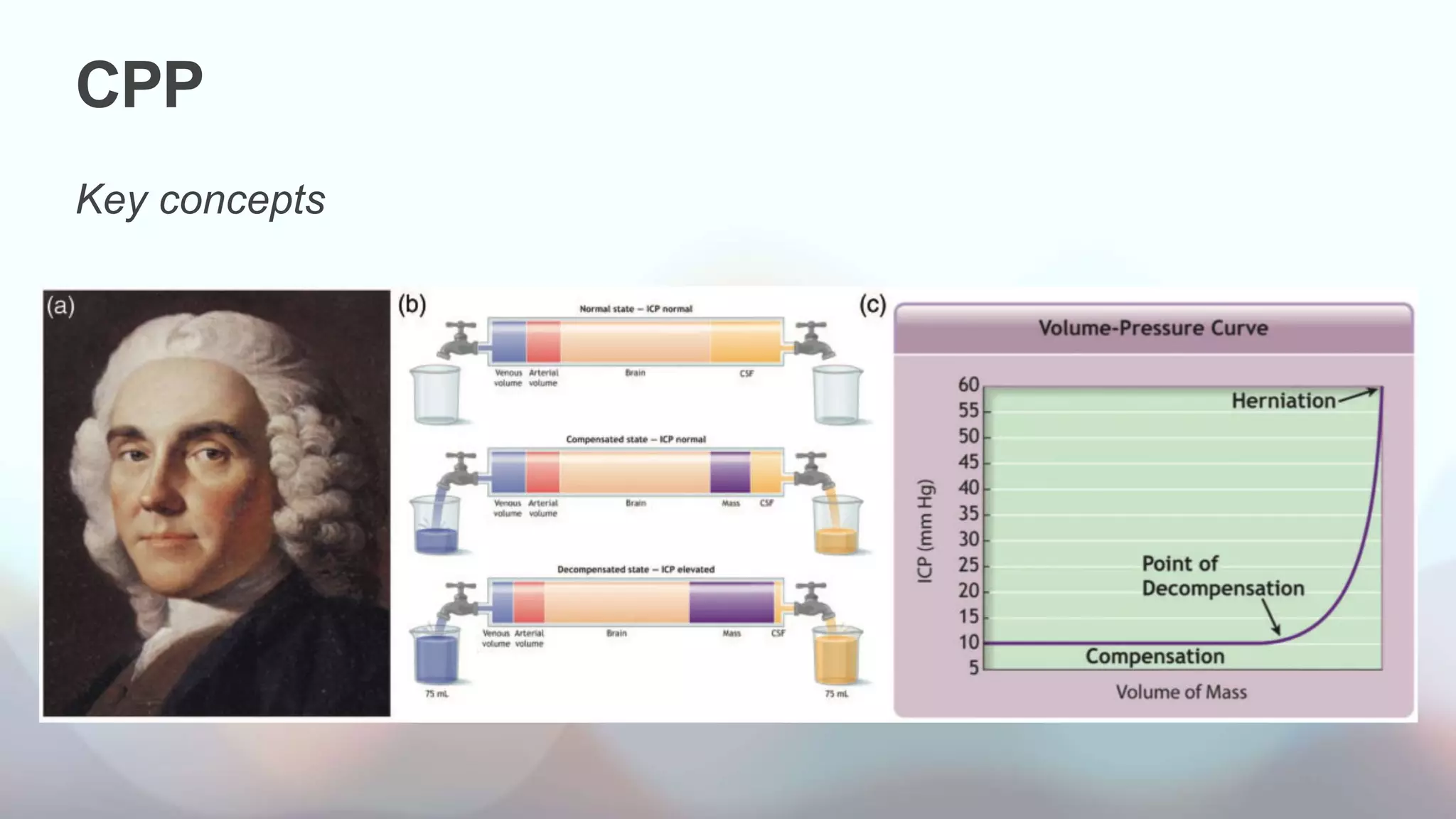
• Monro-Kellie doctrine:
✴ Blood + CSF + Brain = constant
✴ CSF provides a mechanical buffer
CPP
Key concepts
CPP
https://www.nejm.org/doi/full/10.1056/NEJMvcm1805314
CPP
CPP
CPP
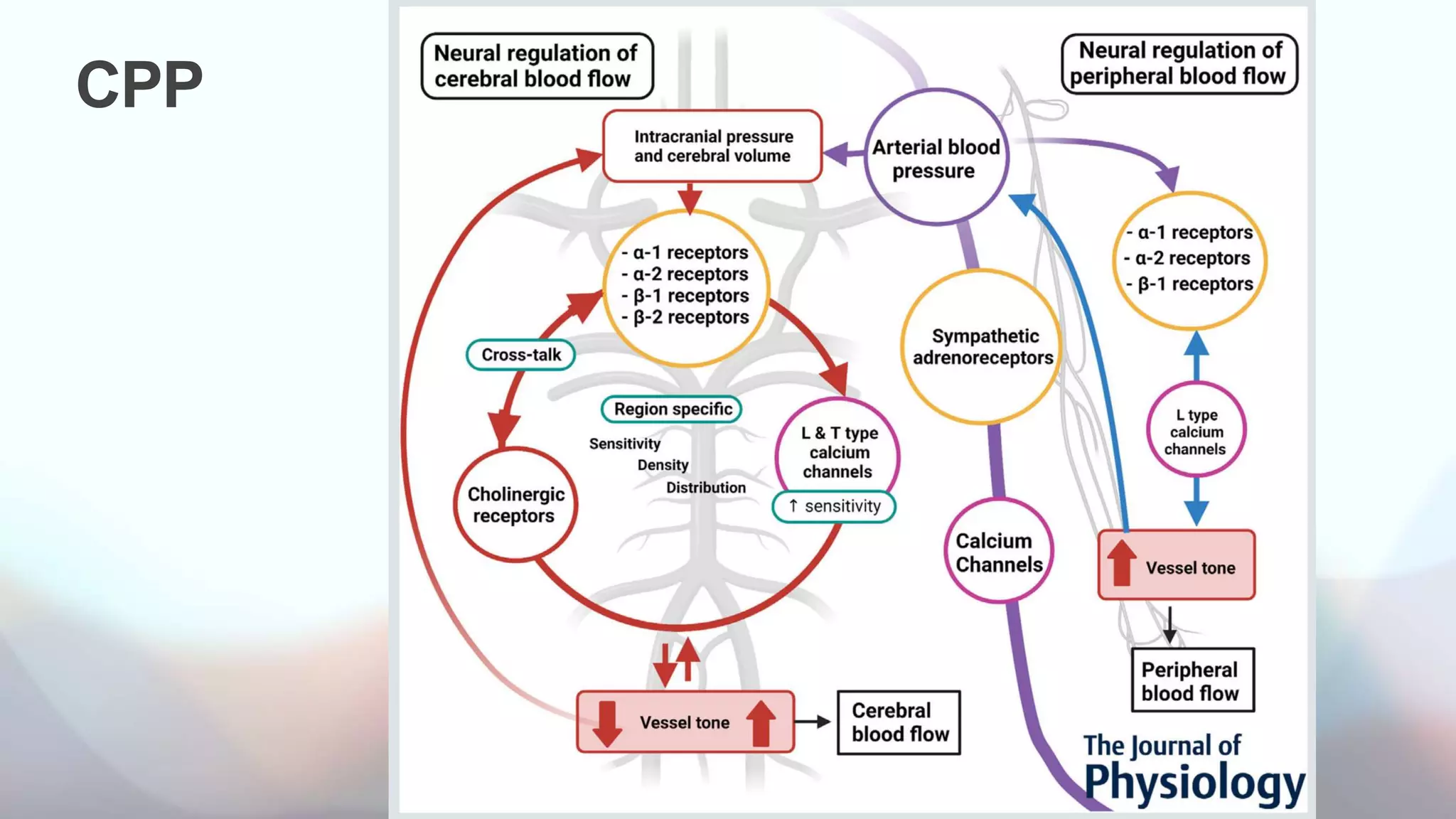
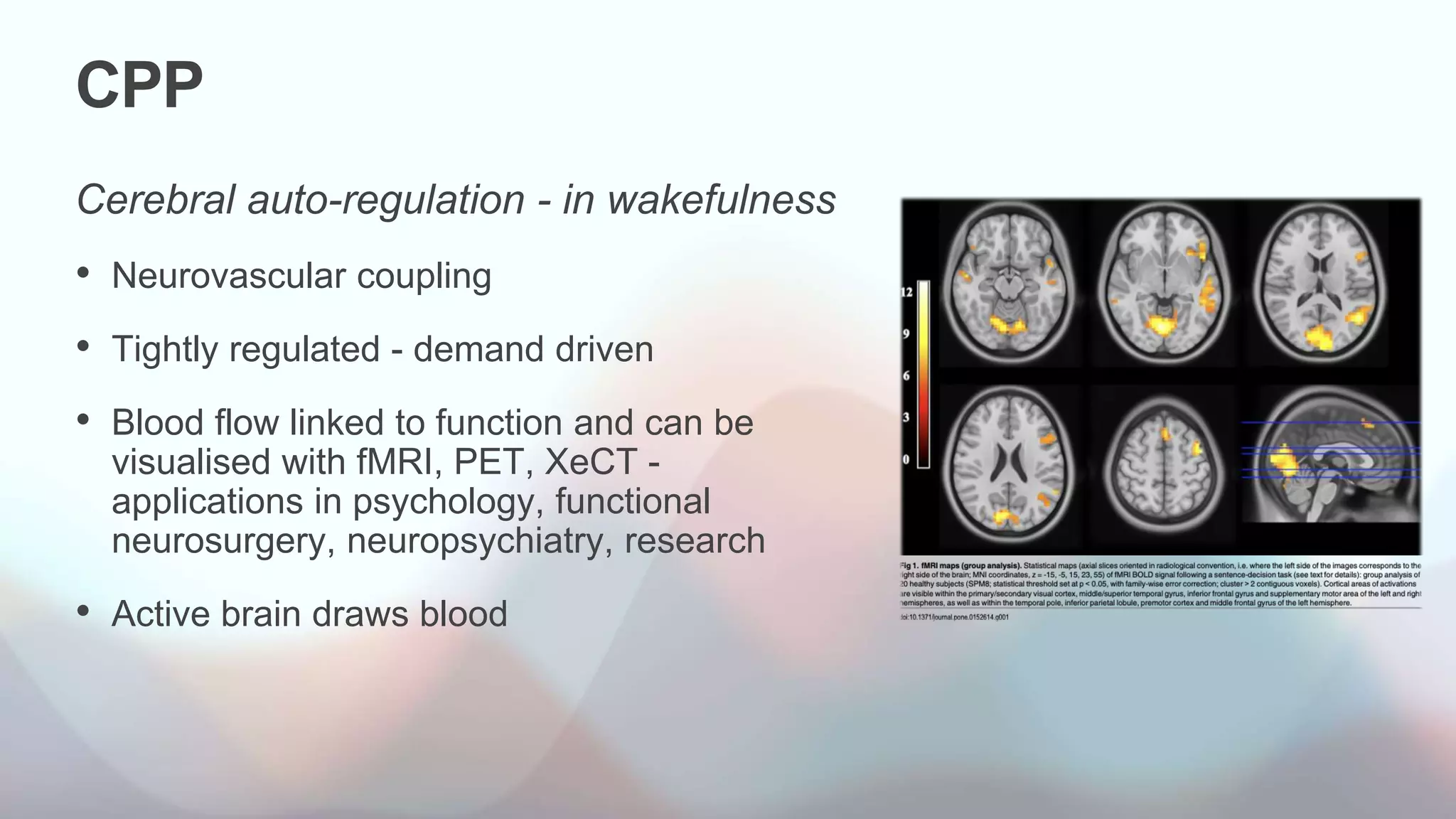
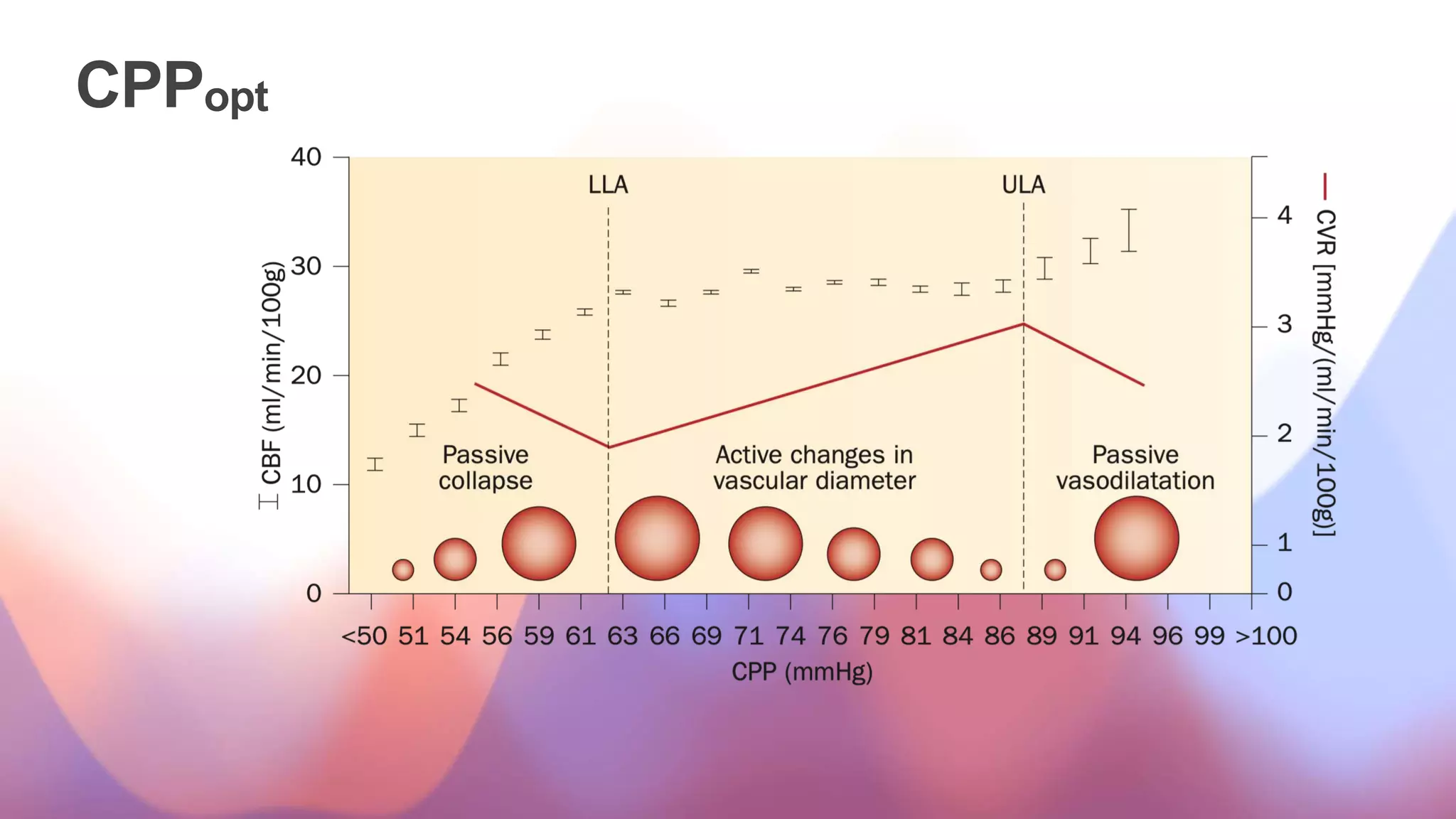
Cerebral auto-regulation - in wakefulness
• Neurovascular coupling
• Tightly regulated - demand driven
• Blood flow linked to function and can be
visualised with fMRI, PET, XeCT -
applications in psychology, functional
neurosurgery, neuropsychiatry, research
• Active brain draws blood
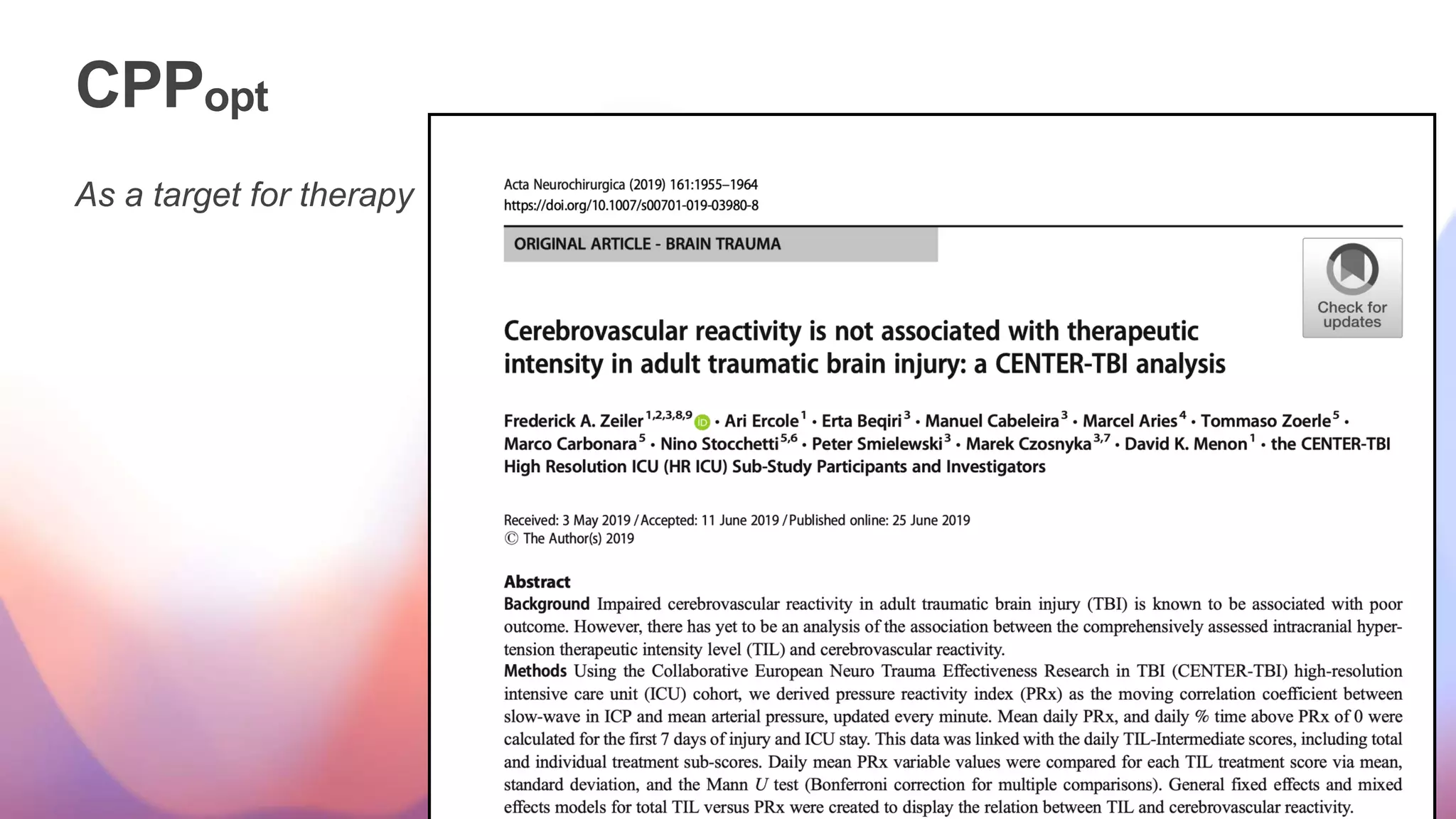
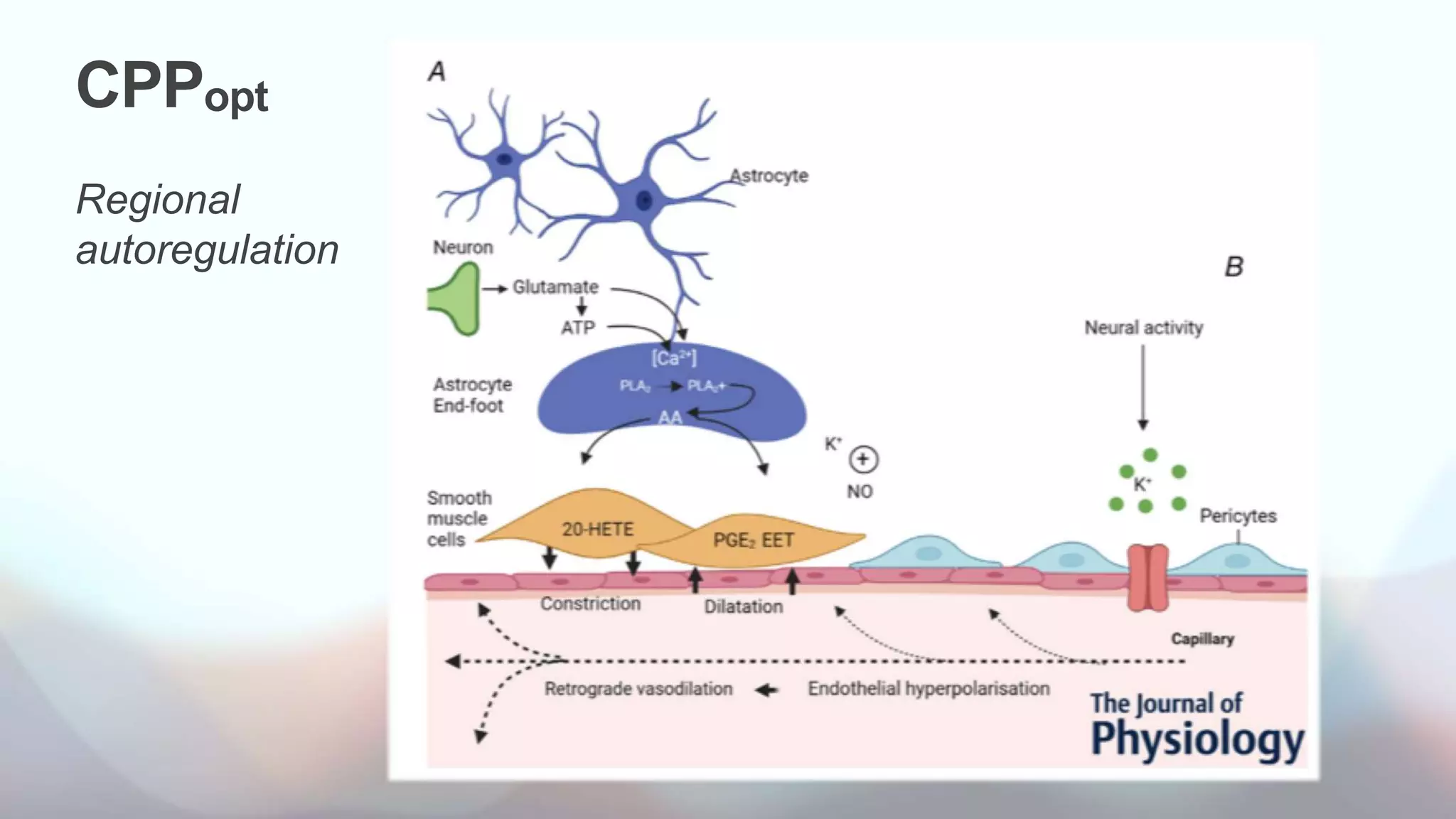
CPPopt
Regional
autoregulation
CPP
CPP and the BTF guidelines
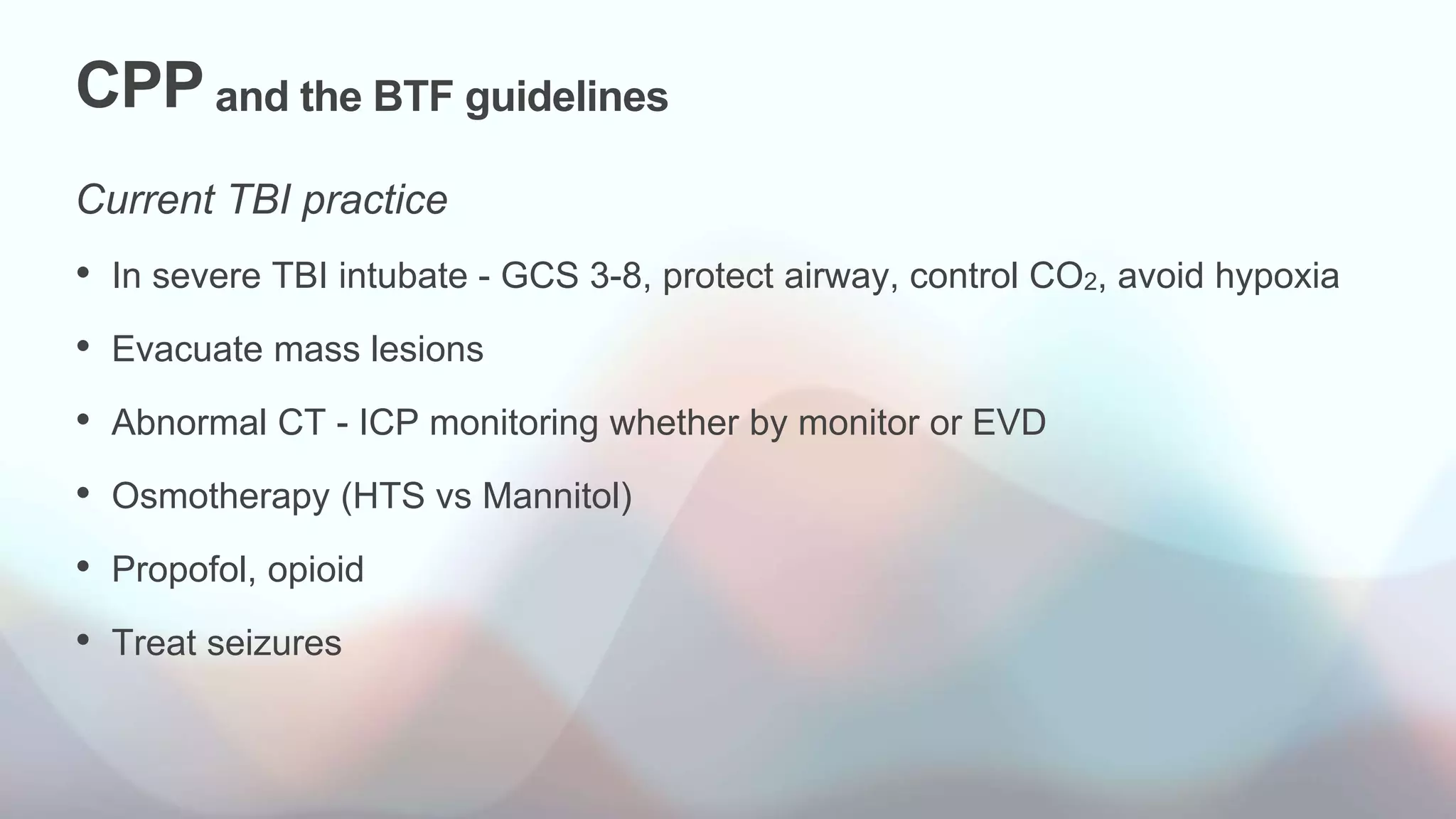
Current TBI practice
• In severe TBI intubate - GCS 3-8, protect airway, control CO2, avoid hypoxia
• Evacuate mass lesions
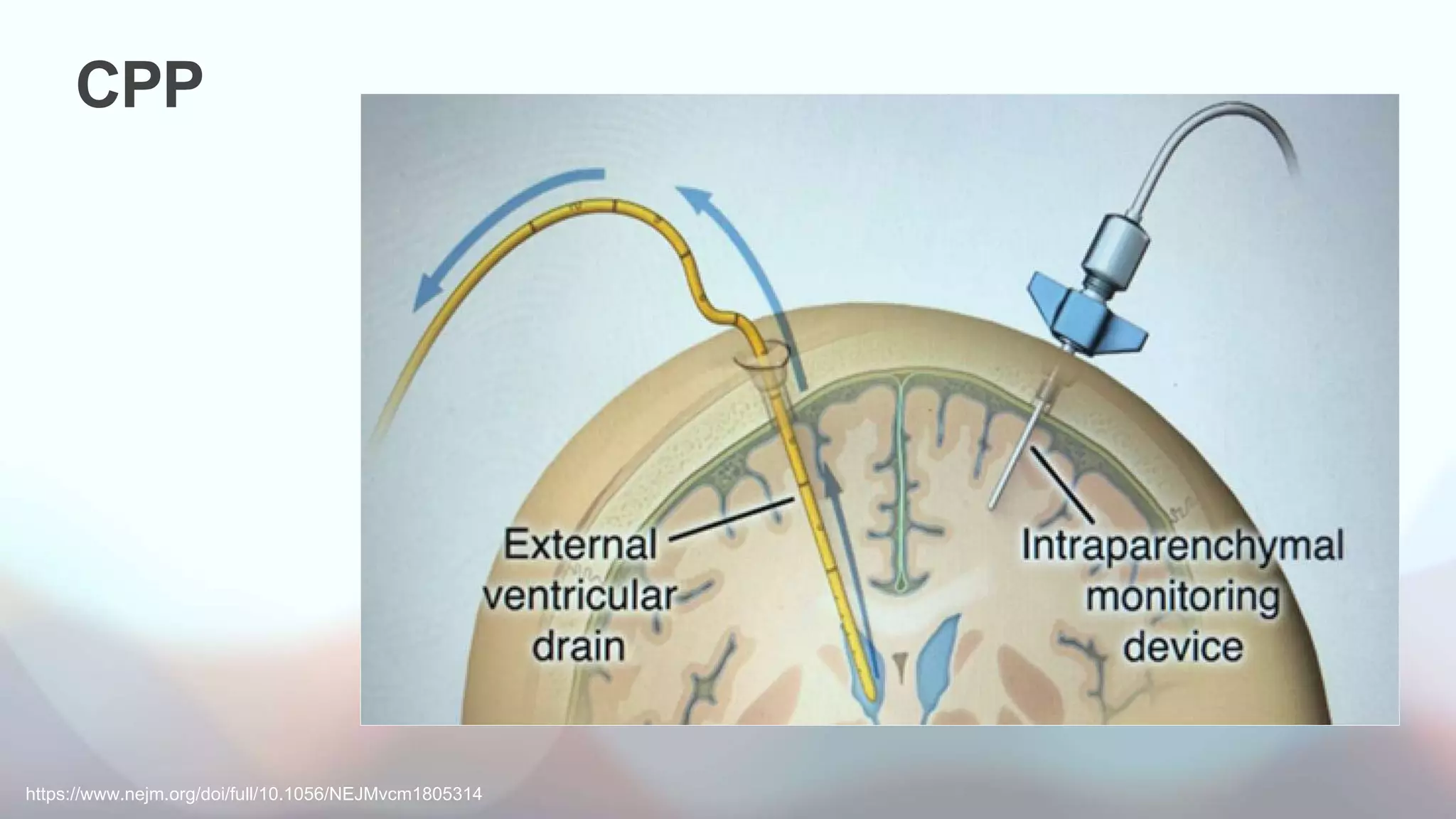
• Abnormal CT - ICP monitoring whether by monitor or EVD
• Osmotherapy (HTS vs Mannitol)
• Propofol, opioid
• Treat seizures
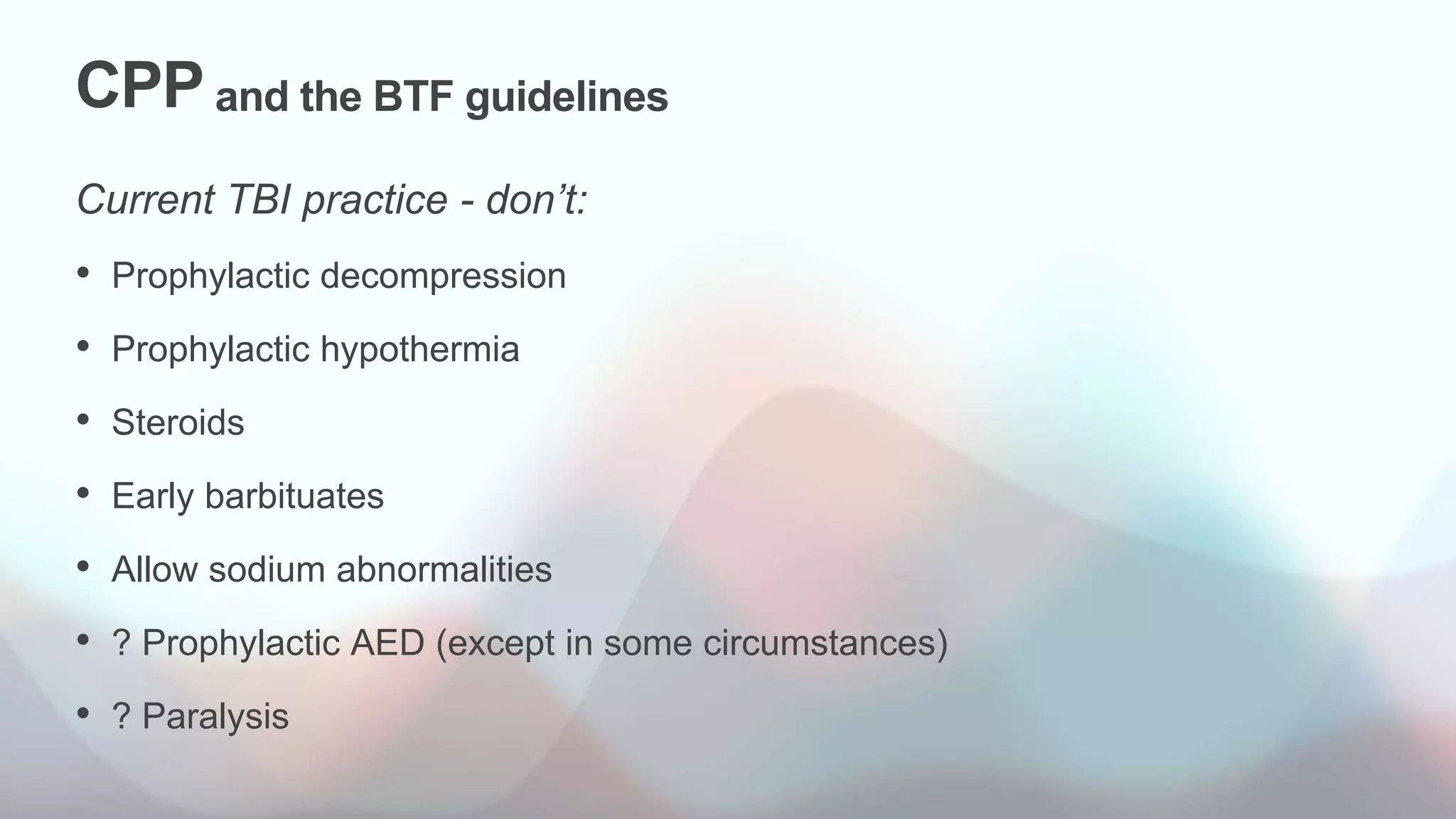
Current TBI practice - don’t:
• Prophylactic decompression
• Prophylactic hypothermia
• Steroids
• Early barbituates
• Allow sodium abnormalities
• ? Prophylactic AED (except in some circumstances)
• ? Paralysis
CPP and the BTF guidelines
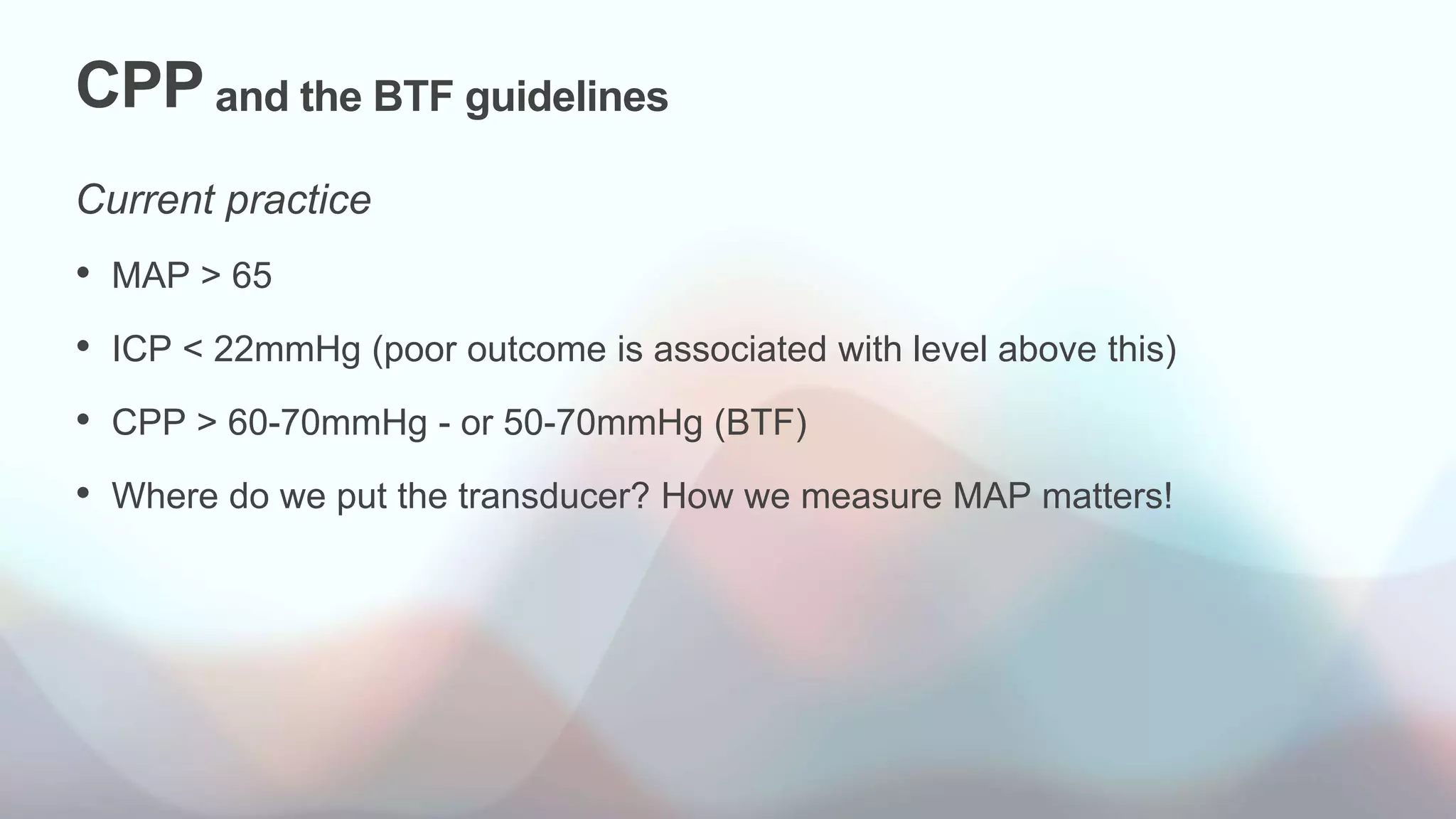
Current practice
• MAP > 65
• ICP < 22mmHg (poor outcome is associated with level above this)
• CPP > 60-70mmHg - or 50-70mmHg (BTF)
• Where do we put the transducer? How we measure MAP matters!
CPP and the BTF guidelines
CPP
Current practice
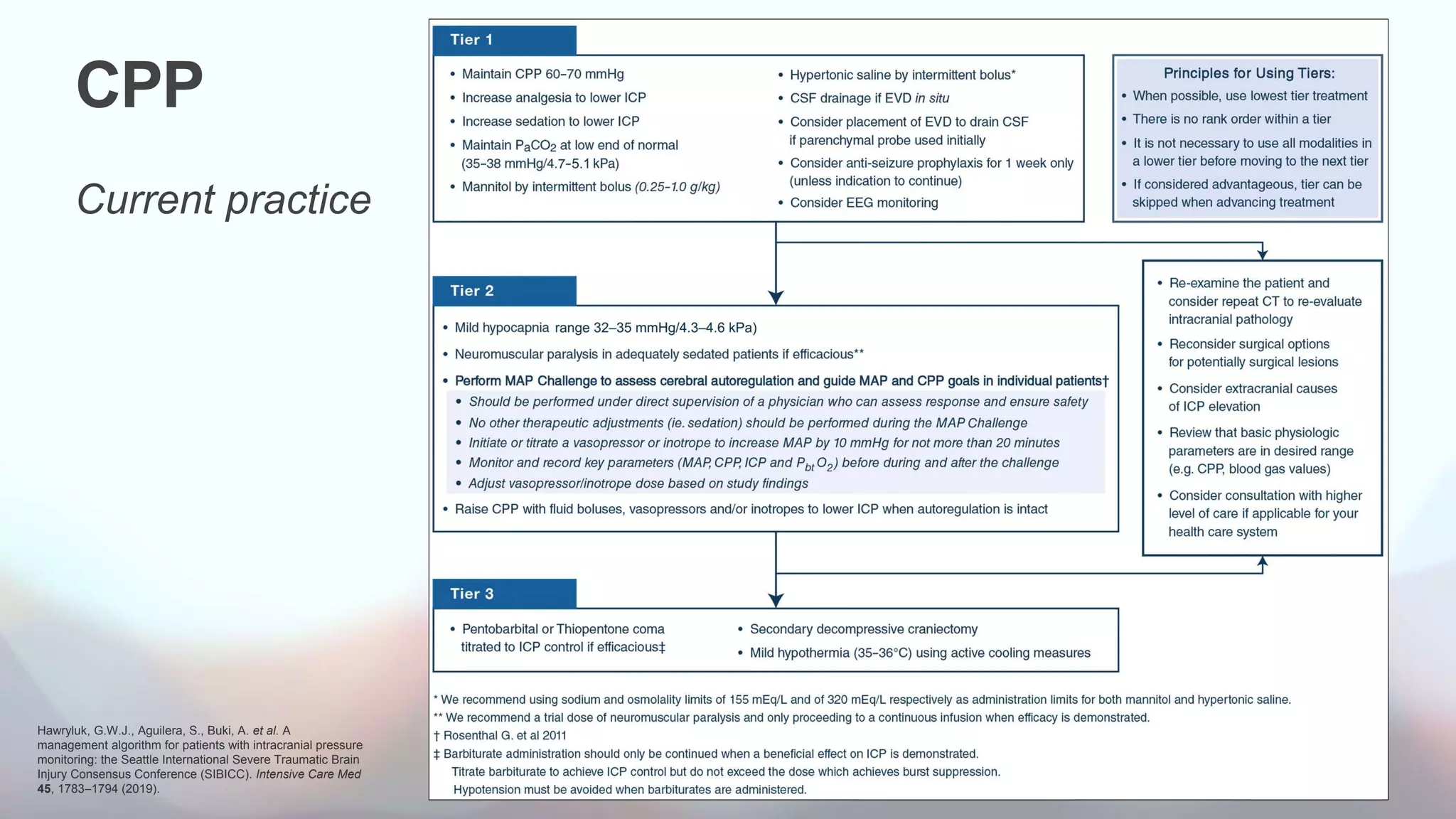
Hawryluk, G.W.J., Aguilera, S., Buki, A. et al. A
management algorithm for patients with intracranial pressure
monitoring: the Seattle International Severe Traumatic Brain
Injury Consensus Conference (SIBICC). Intensive Care Med
45, 1783–1794 (2019).
CPP
Current practice
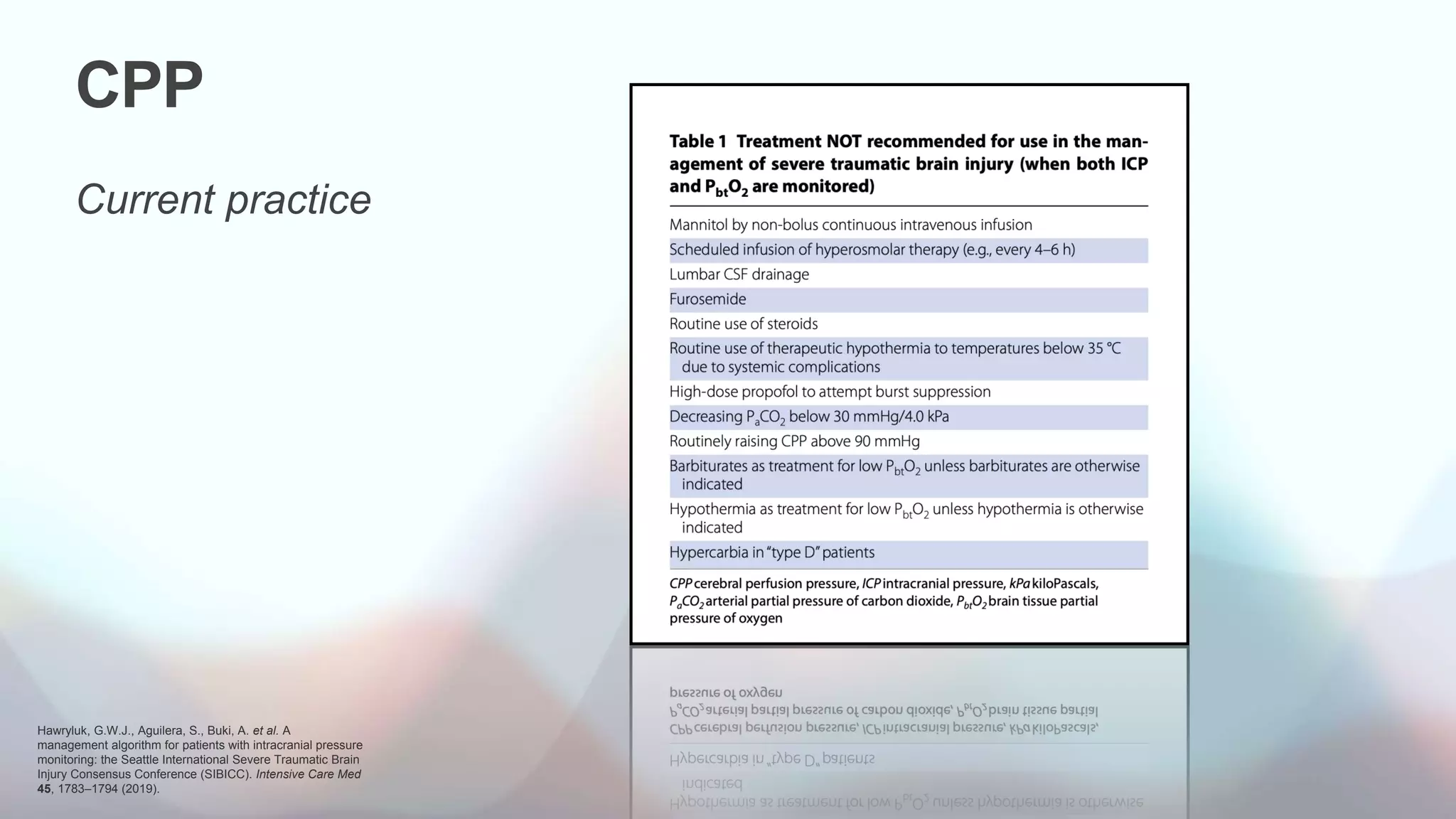
Hawryluk, G.W.J., Aguilera, S., Buki, A. et al. A
management algorithm for patients with intracranial pressure
monitoring: the Seattle International Severe Traumatic Brain
Injury Consensus Conference (SIBICC). Intensive Care Med
45, 1783–1794 (2019).
CPPopt
DR MARK WEEDEN
ST GEORGE ICU
CPPopt
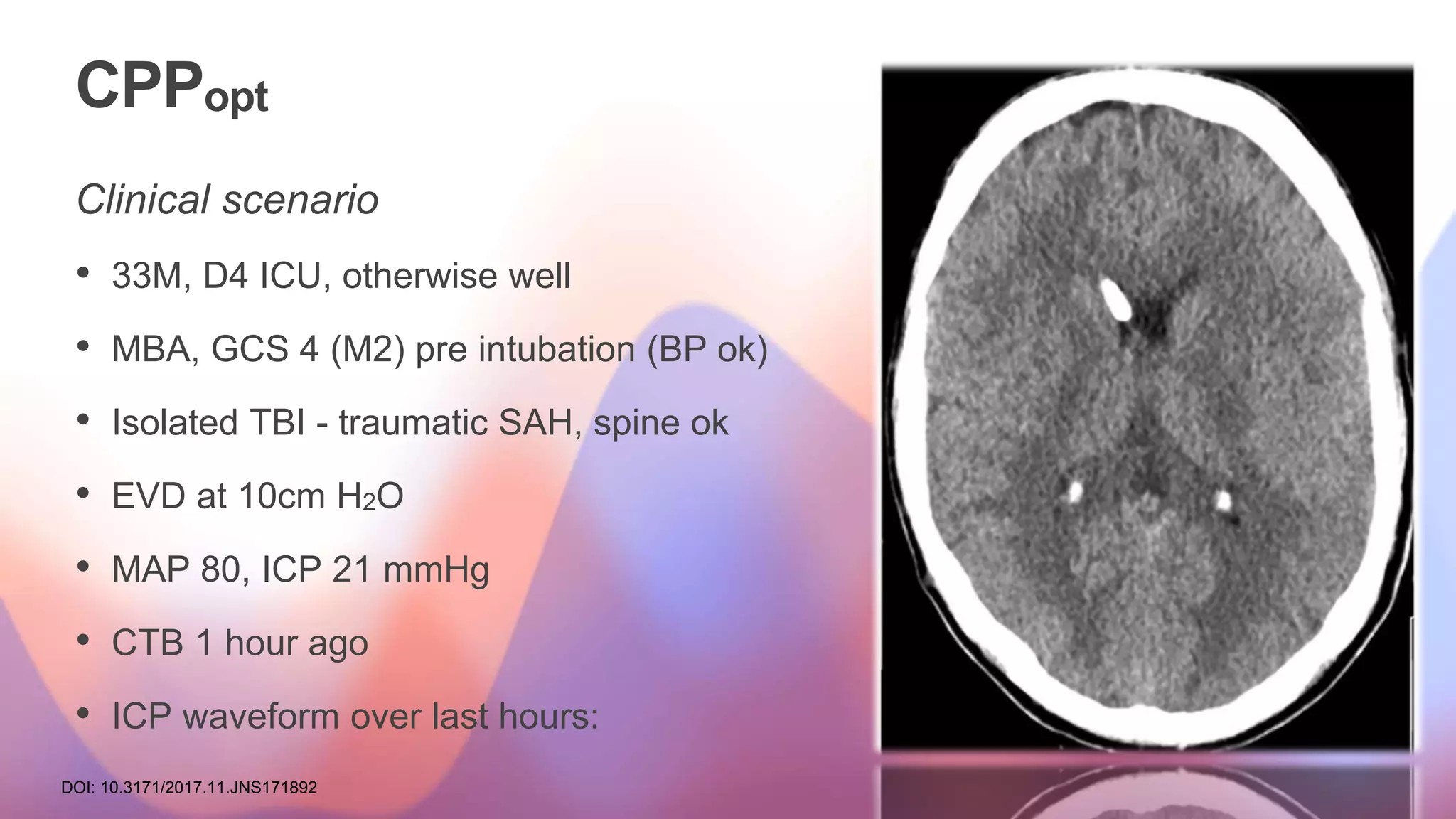
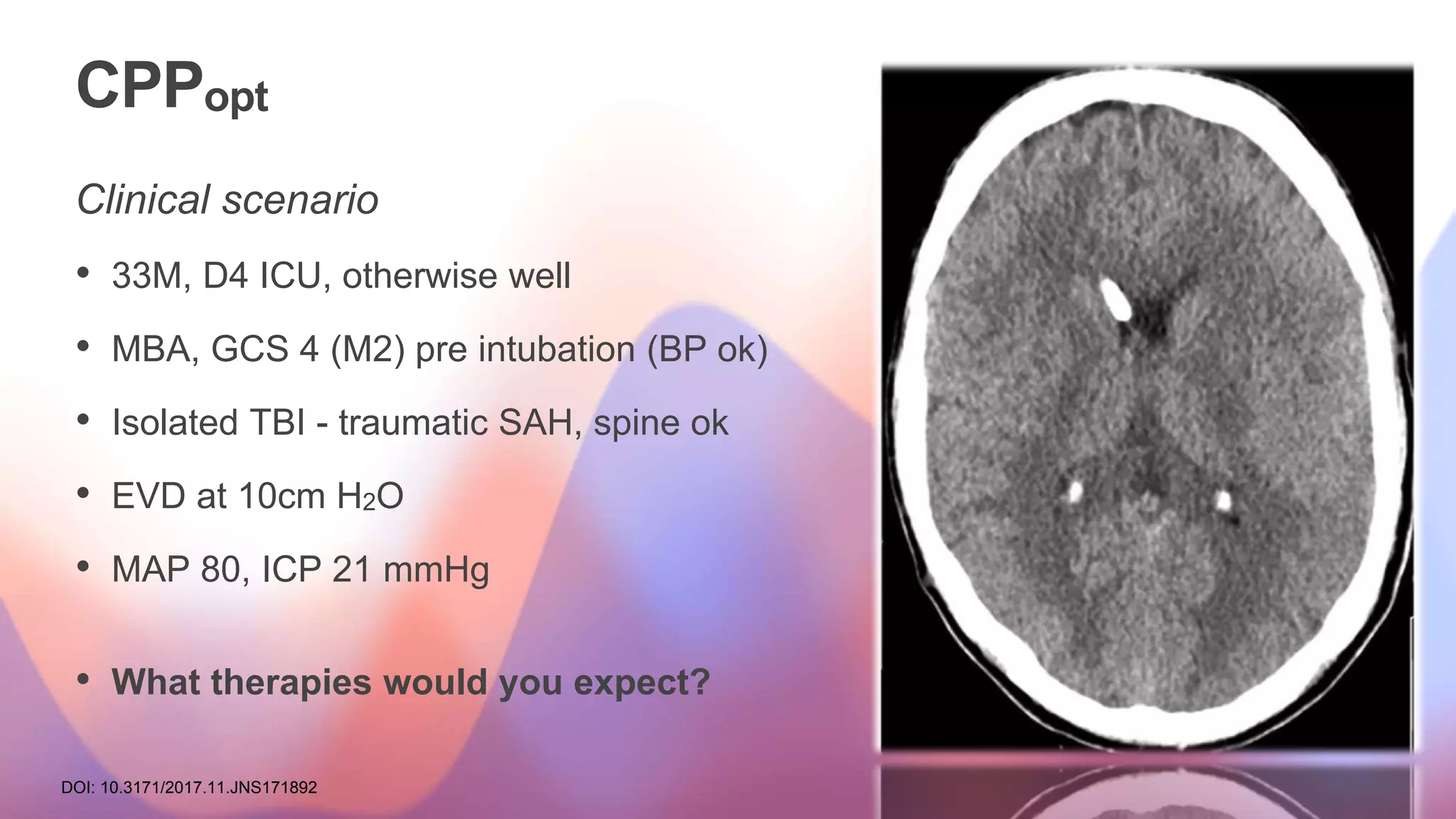
Clinical scenario
• 33M, D4 ICU, otherwise well
• MBA, GCS 4 (M2) pre intubation (BP ok)
• Isolated TBI - traumatic SAH, spine ok
• EVD at 10cm H2O
• MAP 80, ICP 21 mmHg
• CTB 1 hour ago
• ICP waveform over last hours:
DOI: 10.3171/2017.11.JNS171892
CPPopt
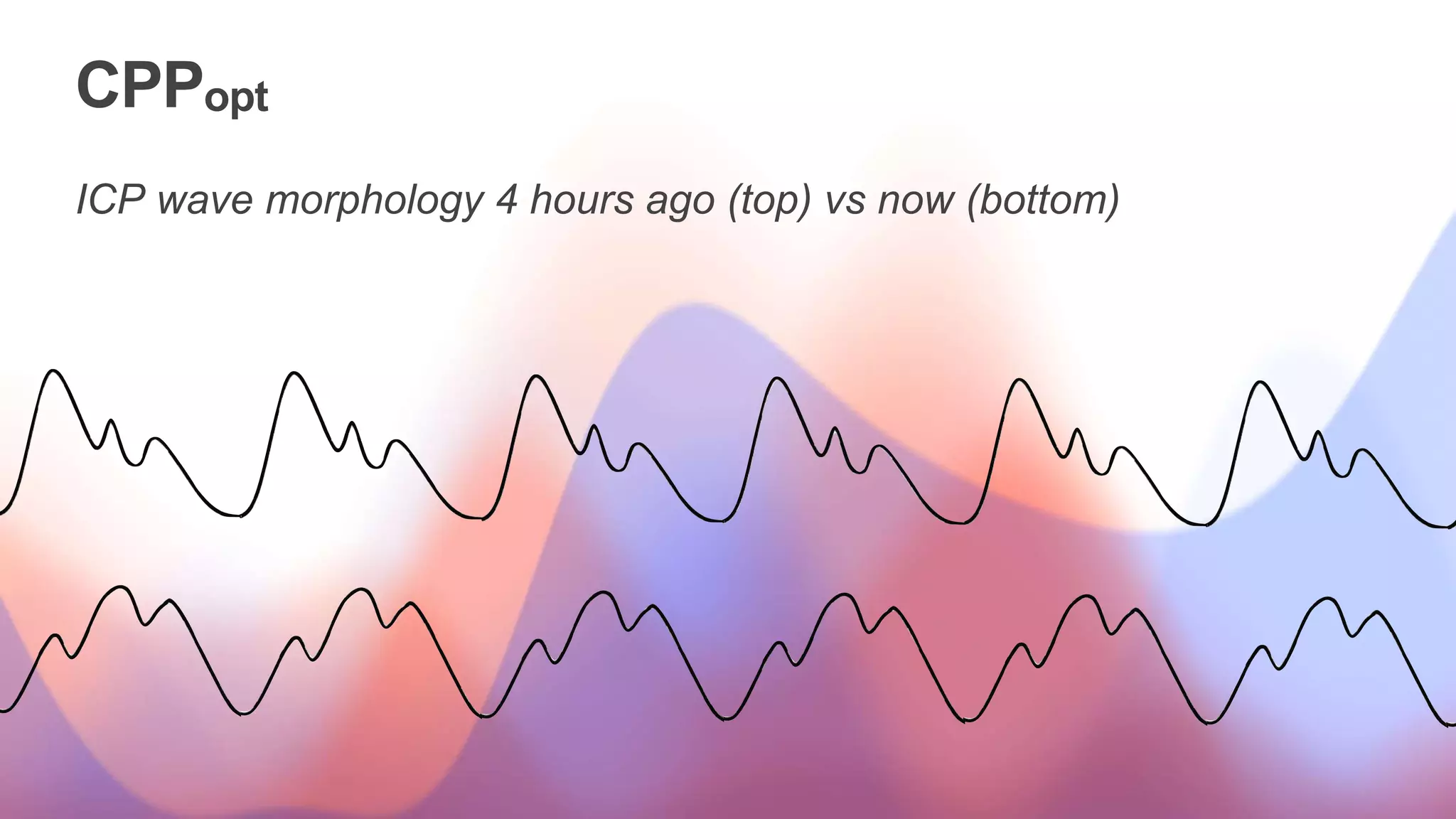
ICP wave morphology 4 hours ago (top) vs now (bottom)
CPPopt
Clinical scenario
• 33M, D4 ICU, otherwise well
• MBA, GCS 4 (M2) pre intubation (BP ok)
• Isolated TBI - traumatic SAH, spine ok
• EVD at 10cm H2O
• MAP 80, ICP 21 mmHg
• What therapies would you expect?
DOI: 10.3171/2017.11.JNS171892
CPPopt
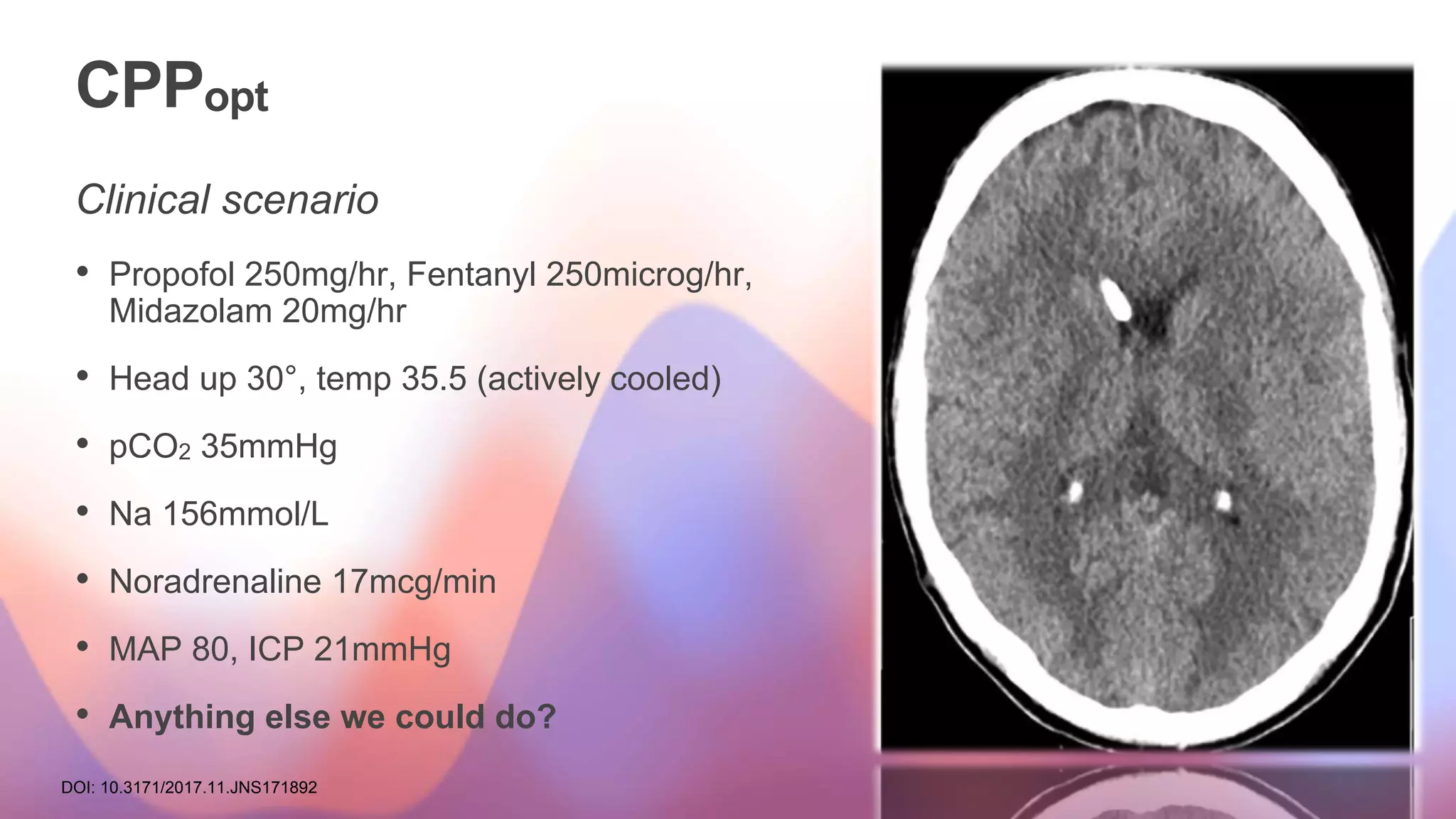
Clinical scenario
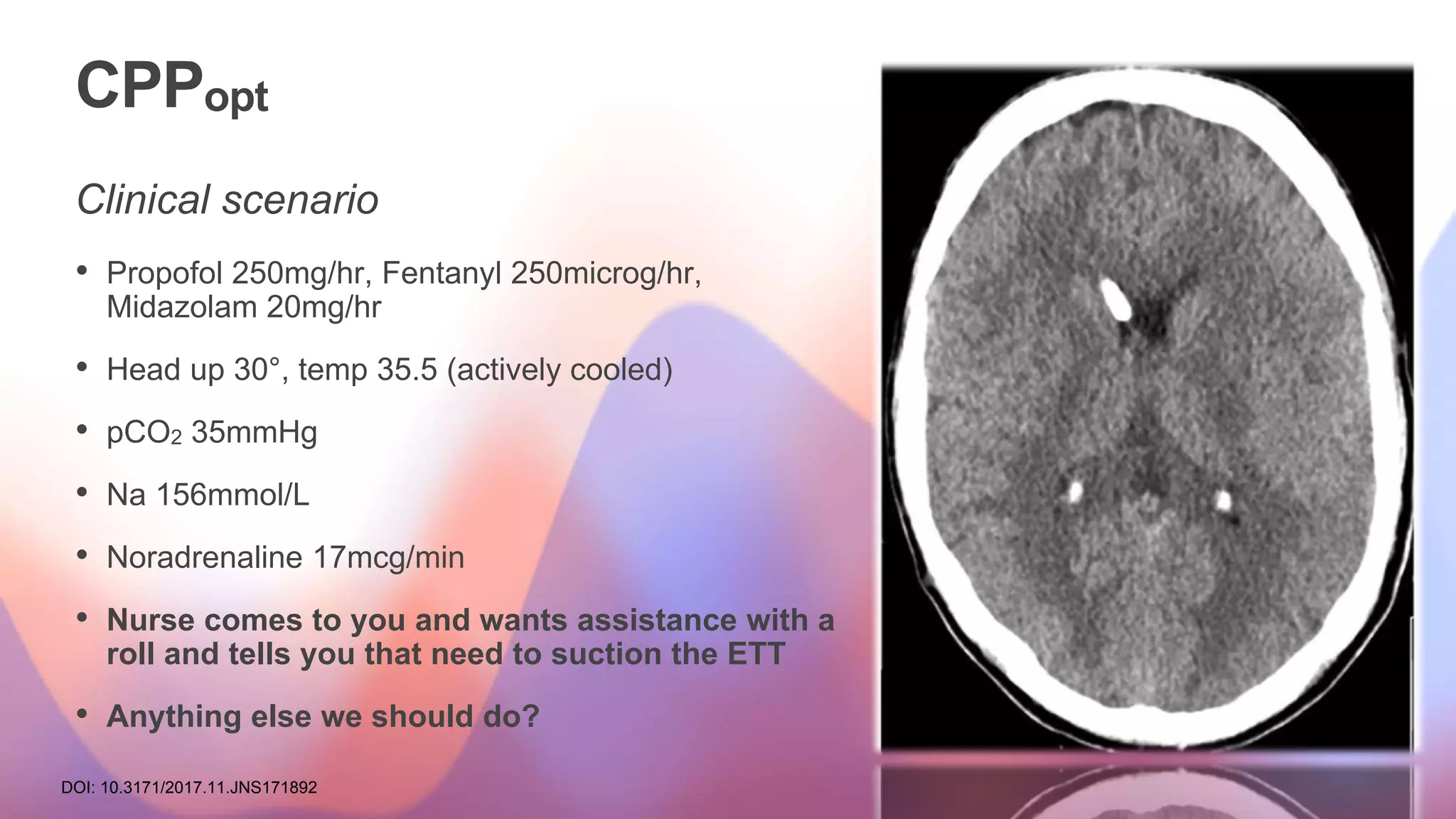
• Propofol 250mg/hr, Fentanyl 250microg/hr,
Midazolam 20mg/hr
• Head up 30°, temp 35.5 (actively cooled)
• pCO2 35mmHg
• Na 156mmol/L
• Noradrenaline 17mcg/min
• Nurse comes to you and wants assistance with a
roll and tells you that need to suction the ETT
• Anything else we should do?
DOI: 10.3171/2017.11.JNS171892
CPPopt
• Are ICP and MAP independent of one
another?
CPP = MAP - ICP
• What would happen over the next half
hour if we increased the noradrenaline so
that the MAP increased from 80 to
86mmHg?
CPPopt
CPPopt
CPPopt
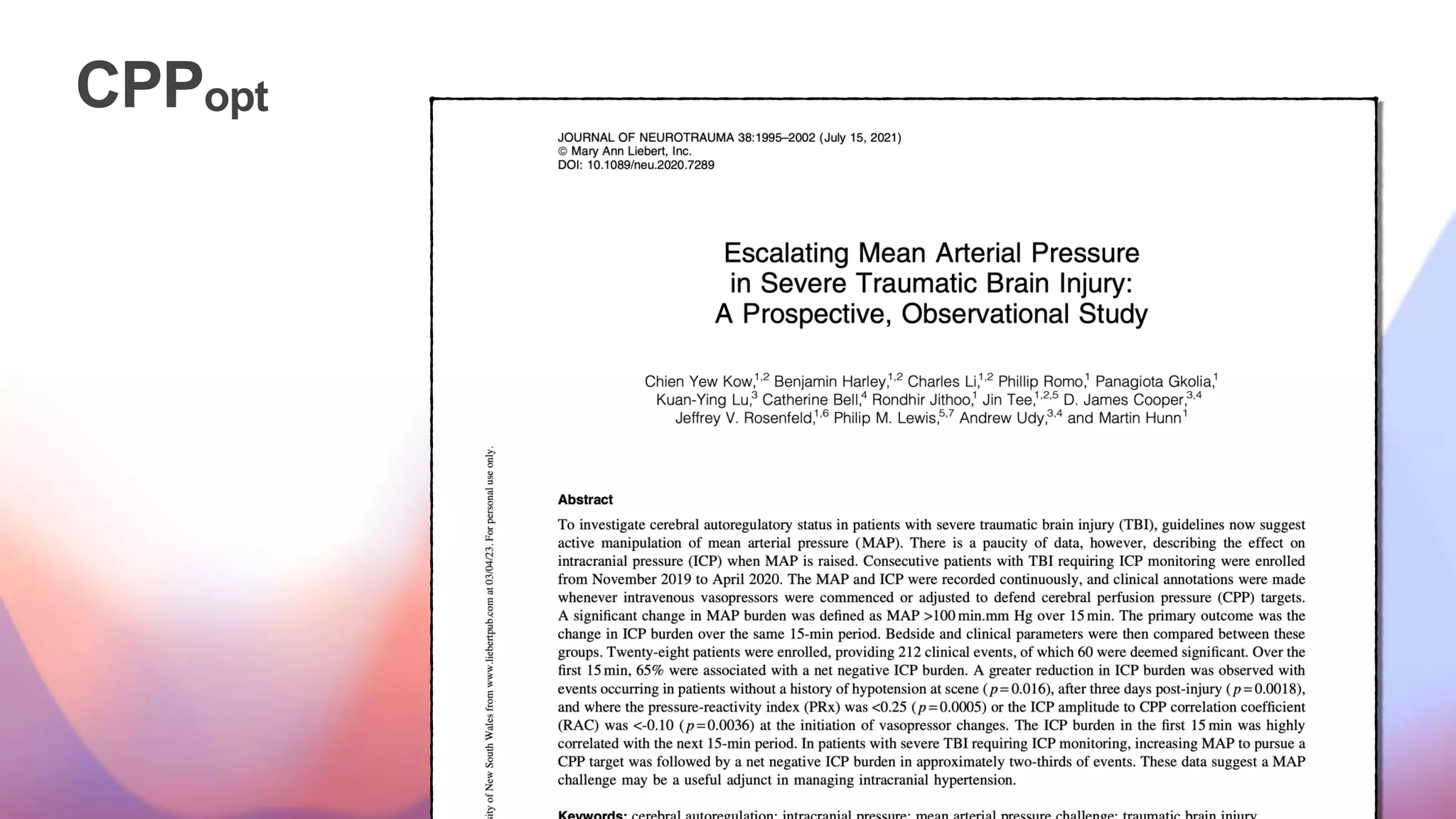
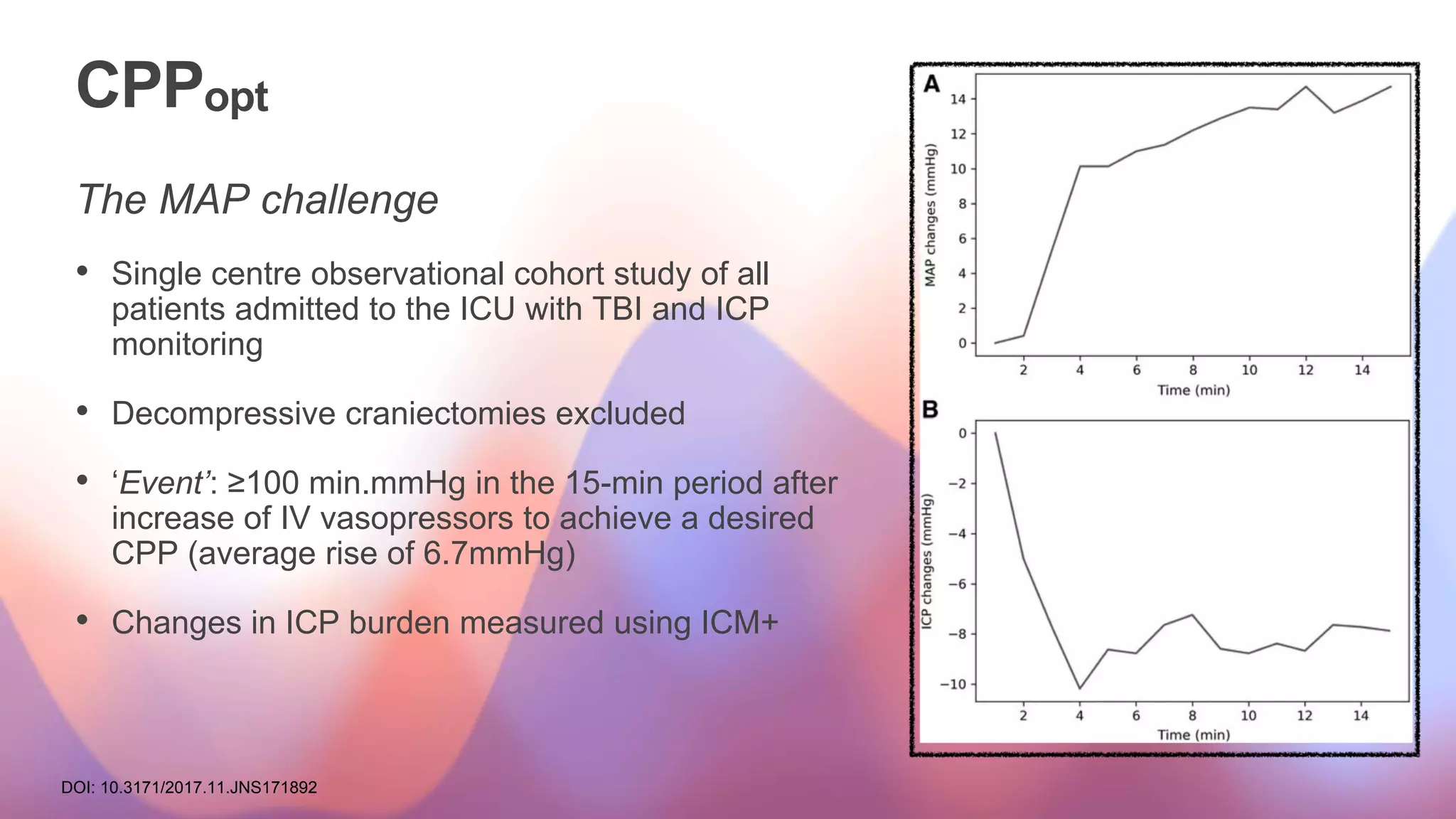
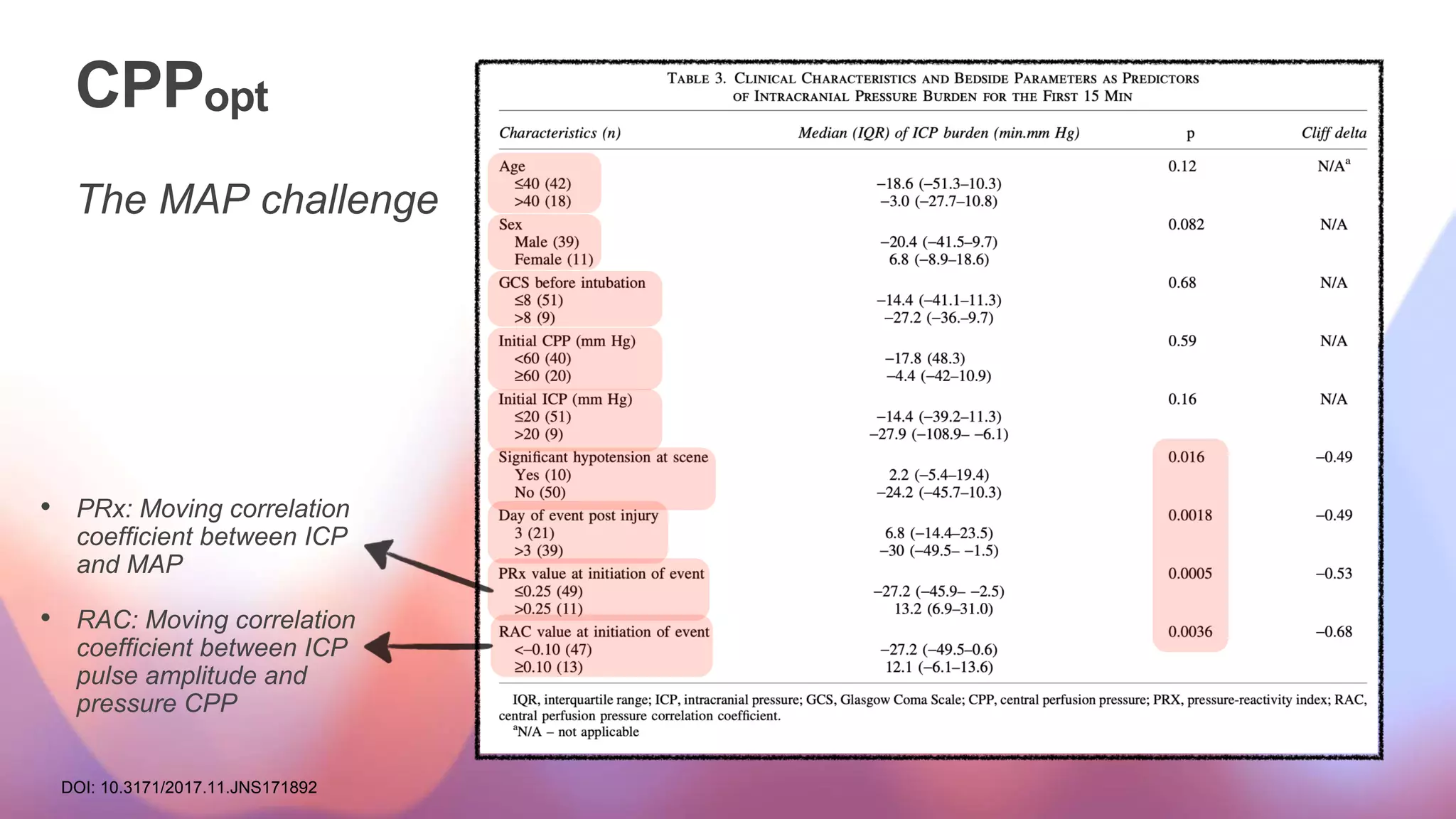
The MAP challenge
• Single centre observational cohort study of all
patients admitted to the ICU with TBI and ICP
monitoring
• Decompressive craniectomies excluded
• ‘Event’: ≥100 min.mmHg in the 15-min period after
increase of IV vasopressors to achieve a desired
CPP (average rise of 6.7mmHg)
• Changes in ICP burden measured using ICM+
DOI: 10.3171/2017.11.JNS171892
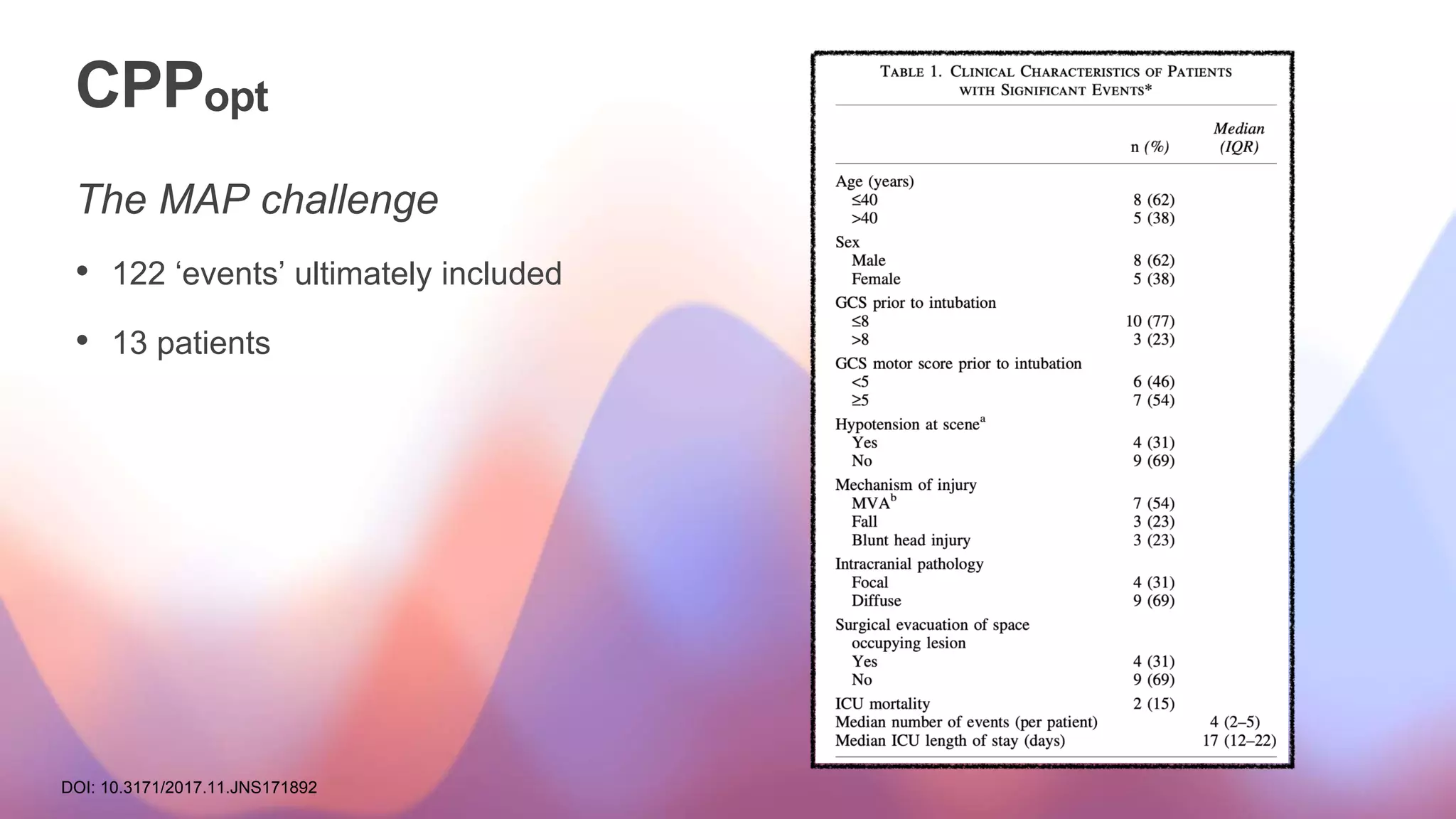
CPPopt
The MAP challenge
• 122 ‘events’ ultimately included
• 13 patients
DOI: 10.3171/2017.11.JNS171892
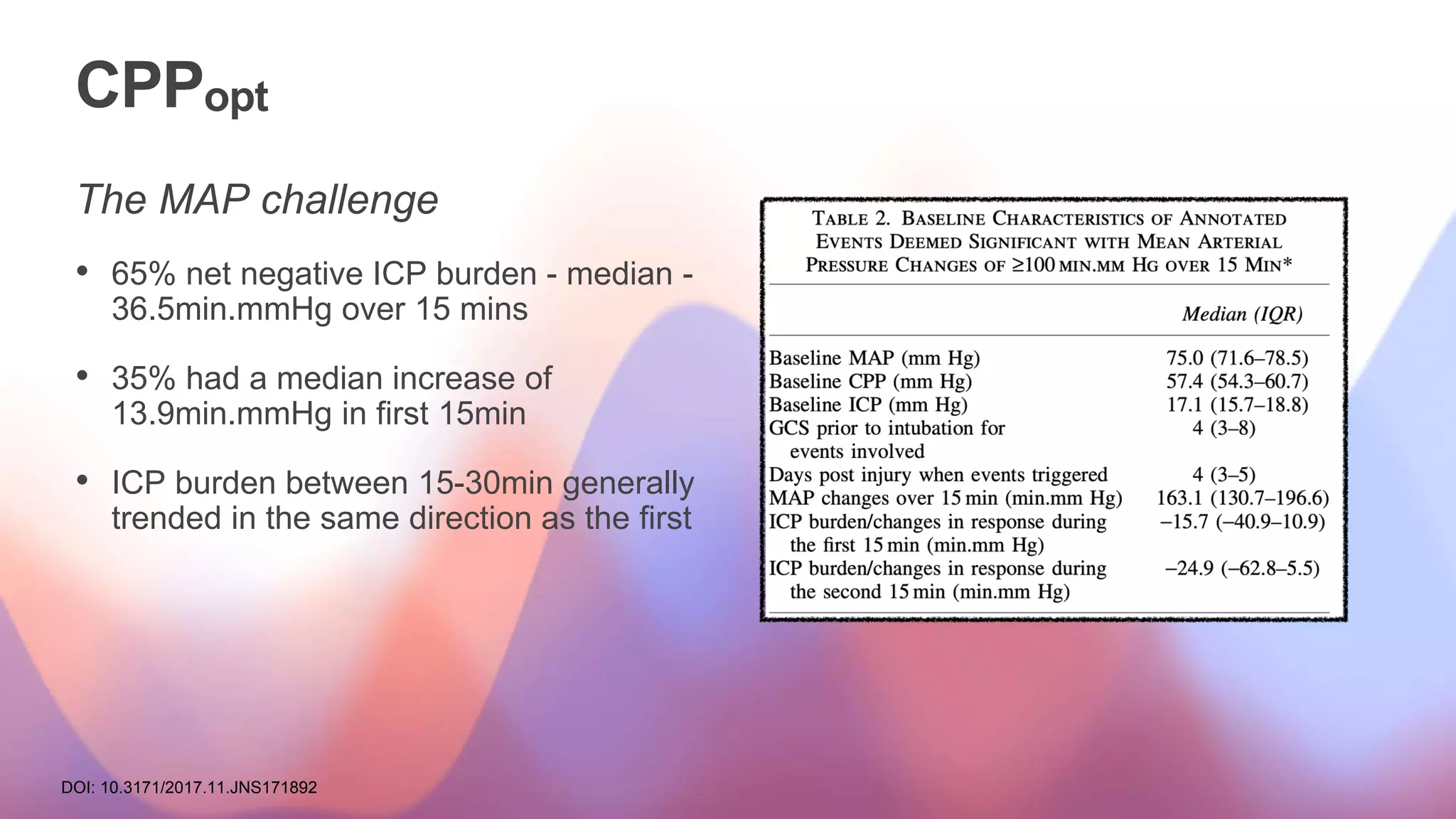
CPPopt
The MAP challenge
• 65% net negative ICP burden - median -
36.5min.mmHg over 15 mins
• 35% had a median increase of
13.9min.mmHg in first 15min
• ICP burden between 15-30min generally
trended in the same direction as the first
DOI: 10.3171/2017.11.JNS171892
CPPopt
The MAP challenge
• RAC: Moving correlation
coefficient between ICP
pulse amplitude and
pressure CPP
DOI: 10.3171/2017.11.JNS171892
• PRx: Moving correlation
coefficient between ICP
and MAP
CPPopt
Clinical scenario
• Propofol 250mg/hr, Fentanyl 250microg/hr,
Midazolam 20mg/hr
• Head up 30°, temp 35.5 (actively cooled)
• pCO2 35mmHg
• Na 156mmol/L
• Noradrenaline 17mcg/min
• MAP 80, ICP 21mmHg
• Anything else we could do?
DOI: 10.3171/2017.11.JNS171892
CPPopt
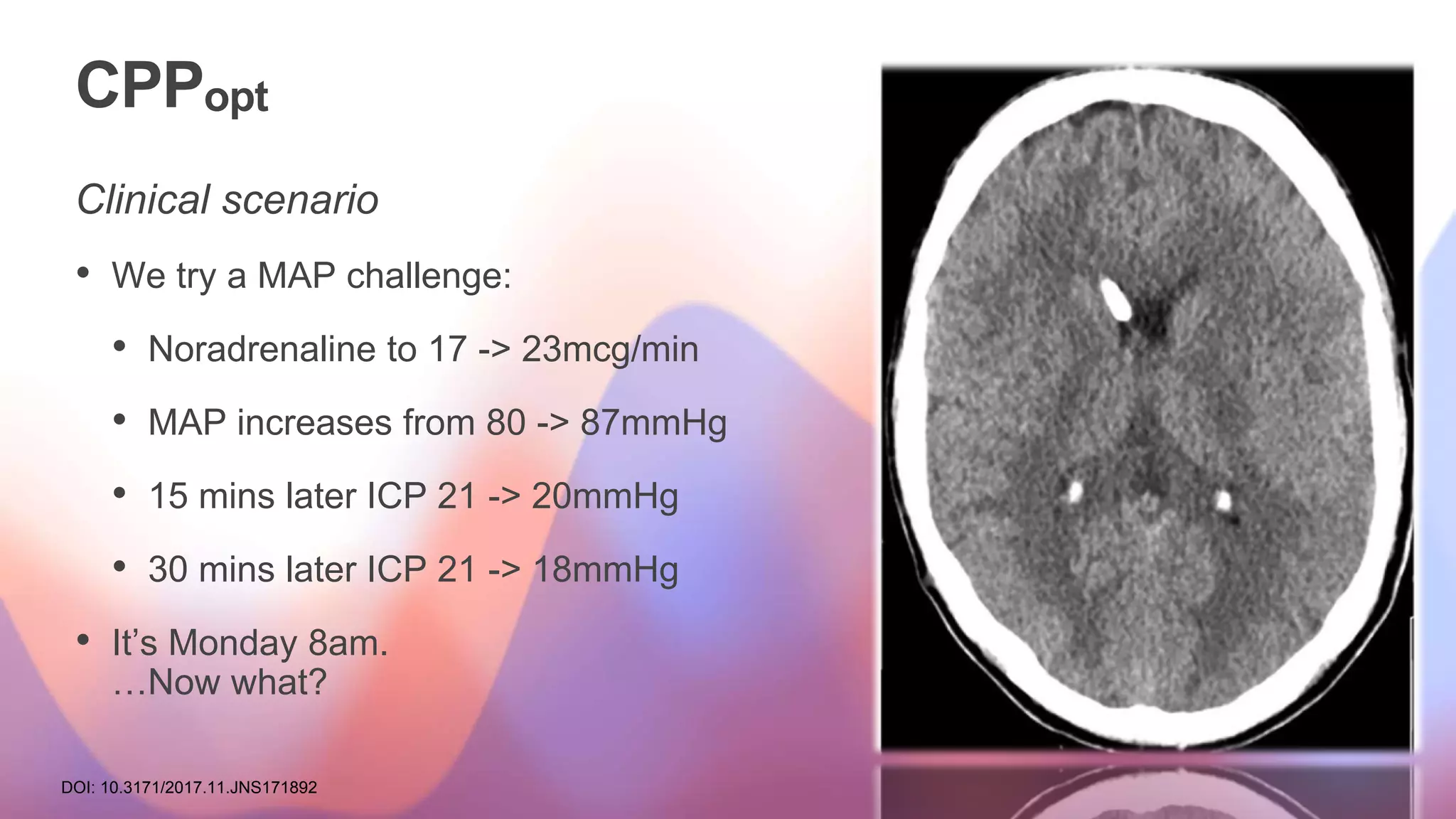
Clinical scenario
• We try a MAP challenge:
• Noradrenaline to 17 -> 23mcg/min
• MAP increases from 80 -> 87mmHg
• 15 mins later ICP 21 -> 20mmHg
• 30 mins later ICP 21 -> 18mmHg
• It’s Monday 8am.
…Now what?
DOI: 10.3171/2017.11.JNS171892
CPPopt
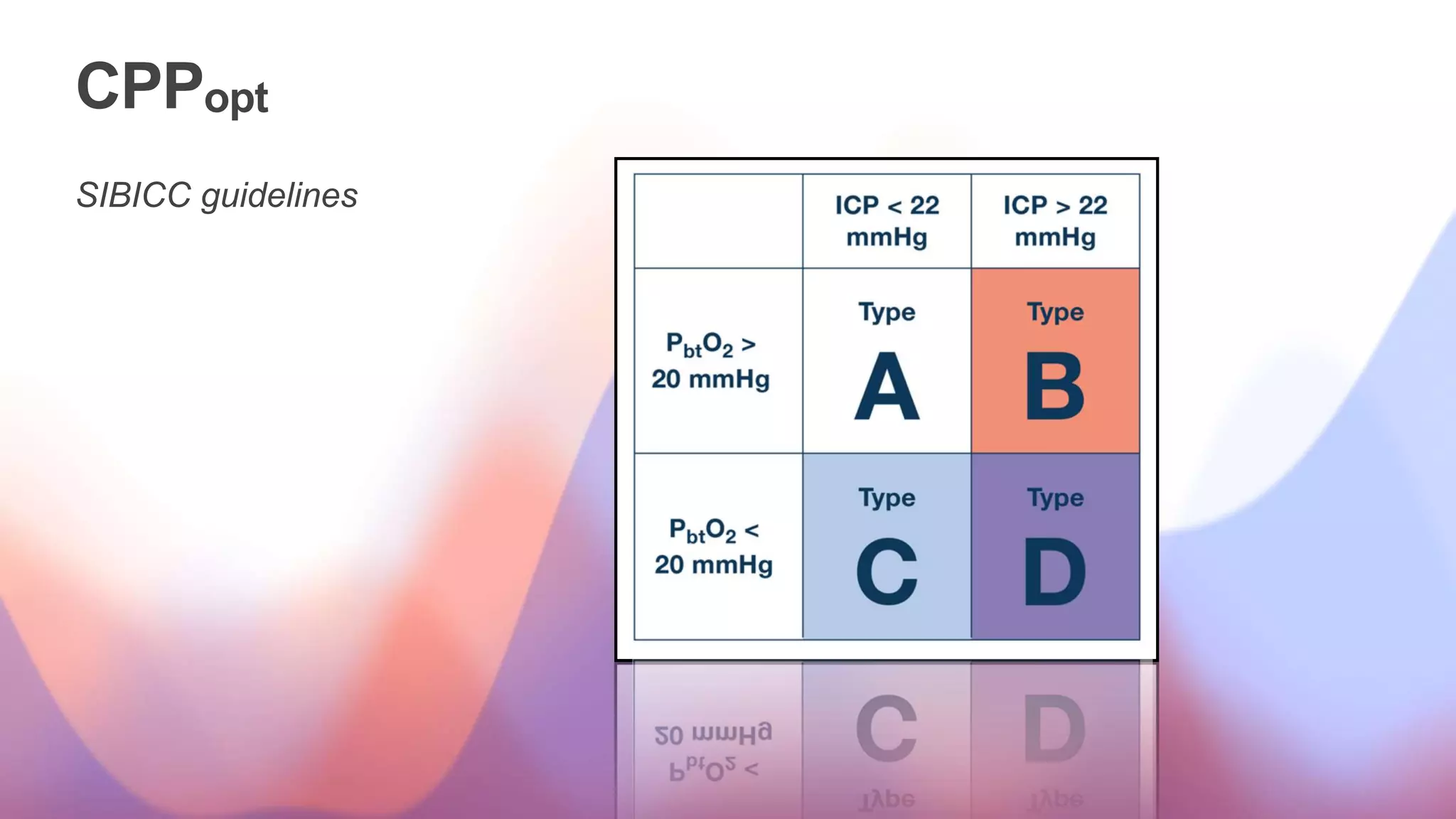
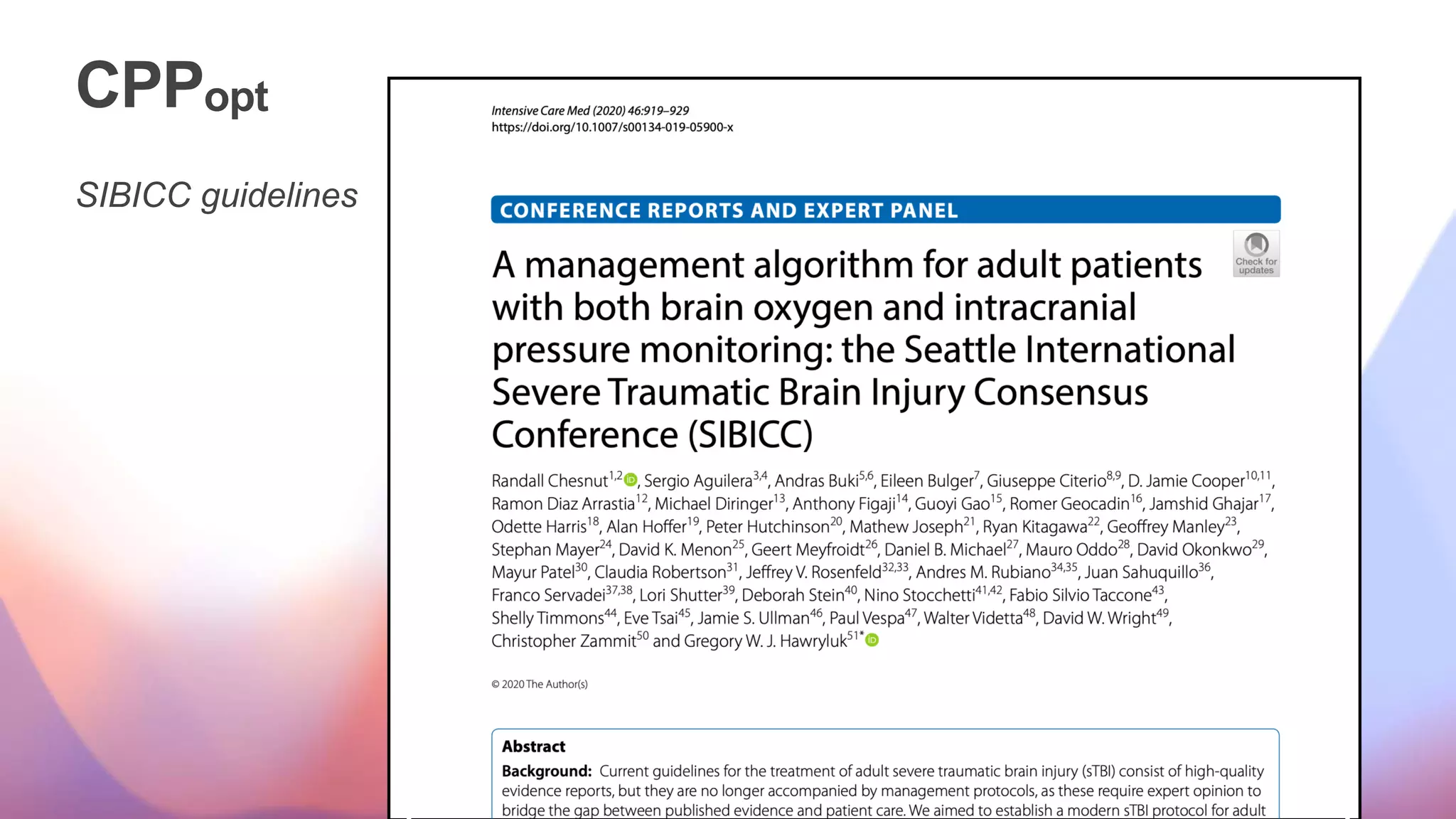
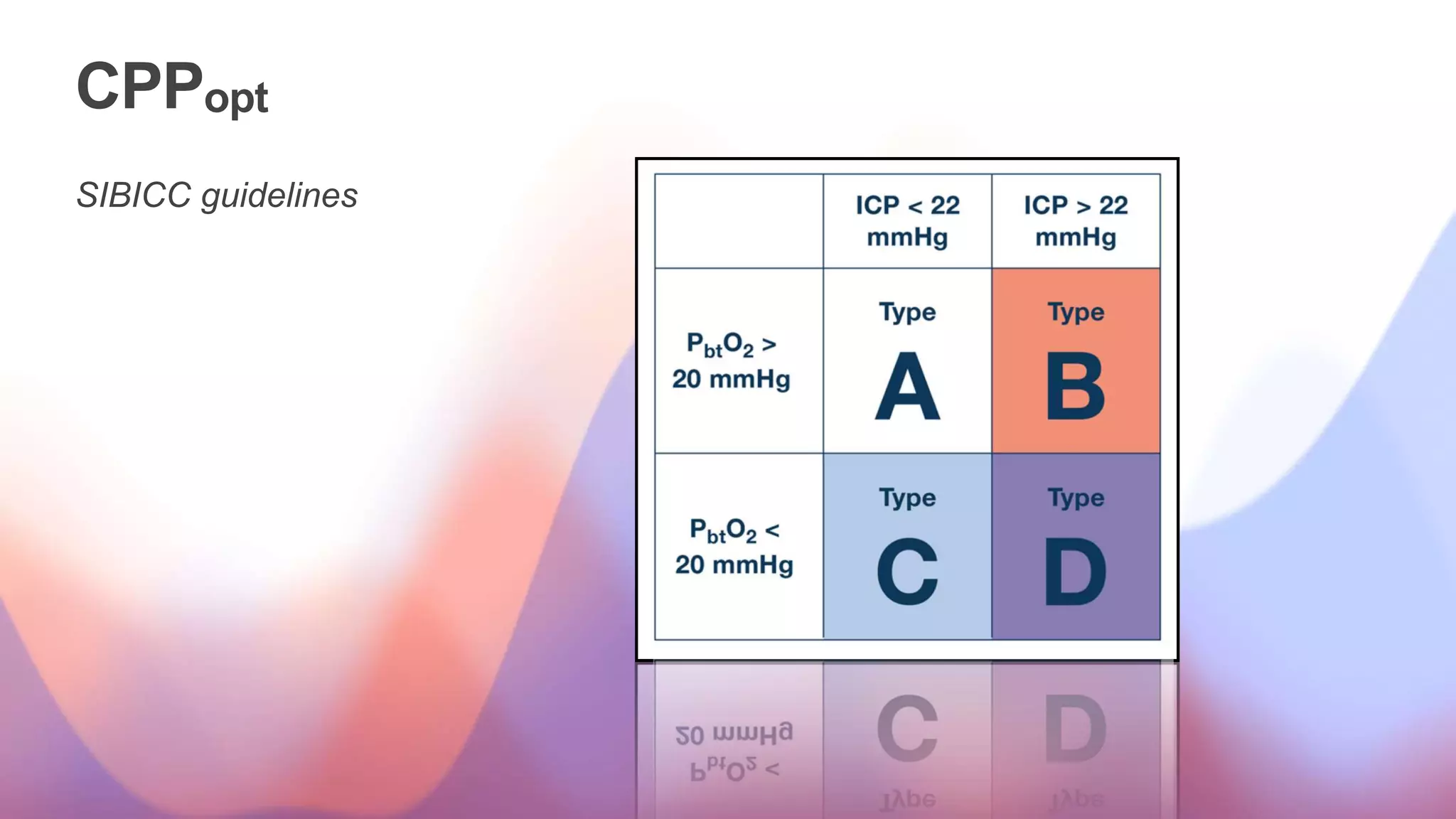
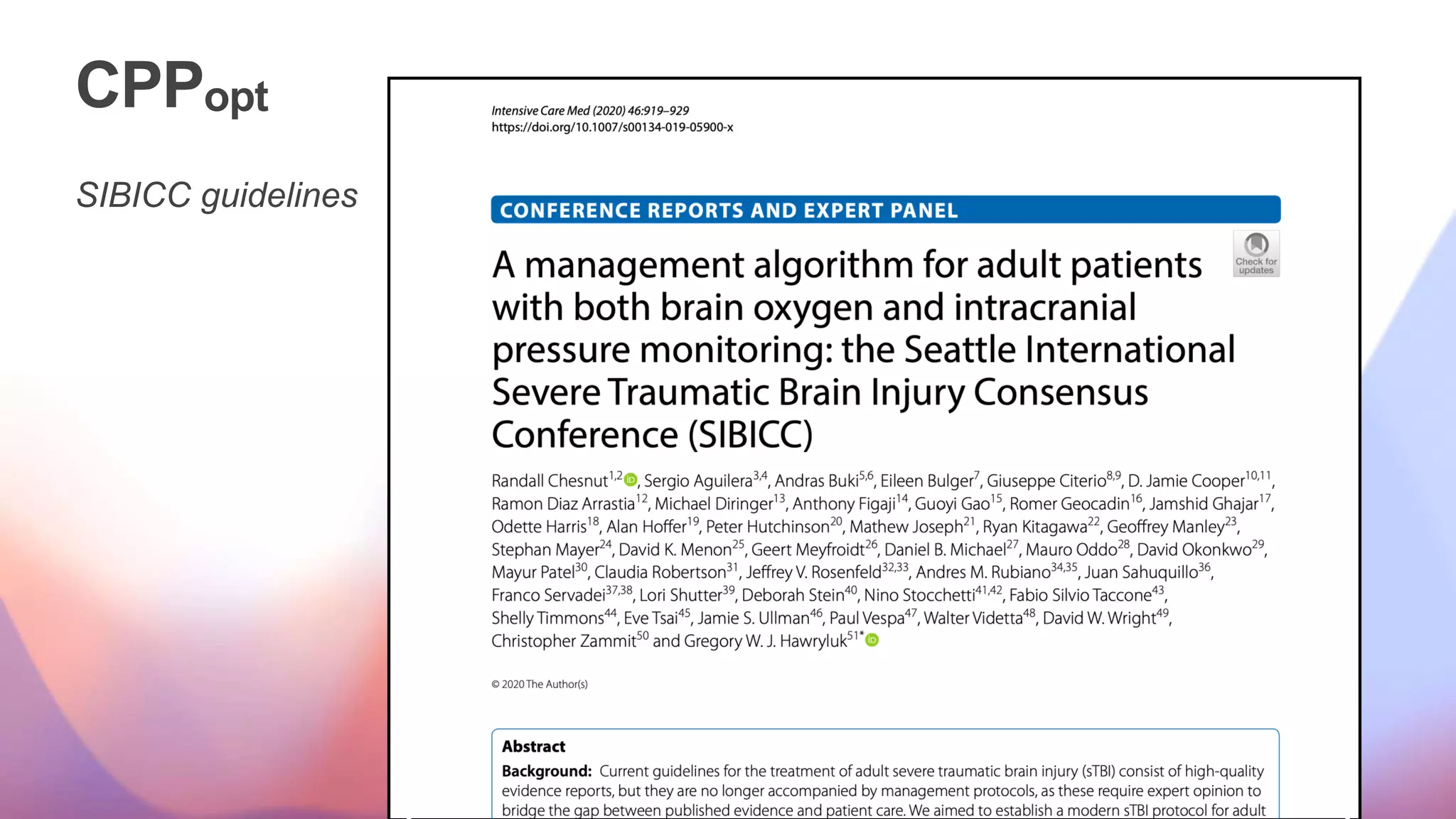
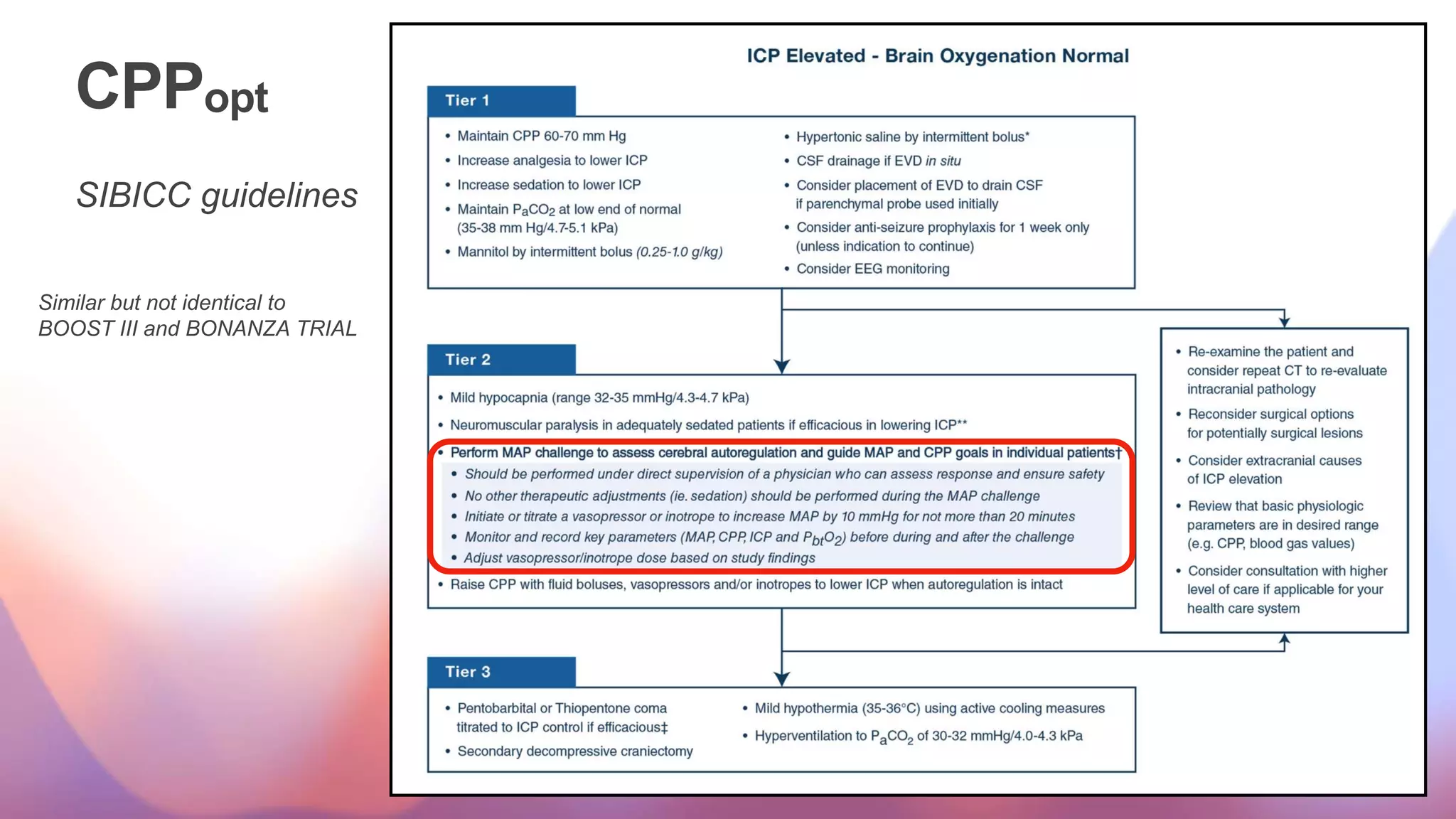
SIBICC guidelines
CPPopt
SIBICC guidelines
Similar but not identical to
BOOST III and BONANZA TRIAL
CPPopt
PRx
• What if we did a series of MAP challenges (or even just let the MAP passively
drift) and watched the ICP changes?
• Then plot them against each other?
• And work out a correlation coefficient
CPPopt
Underlying hypothesis
• CPP too low -> cerebral vasodilation - hyperaemia -> raised ICP
• CPP too high -> cerebral oedema -> raised ICP
• This relationship is likely to vary across time with the phase of illness
CPPopt
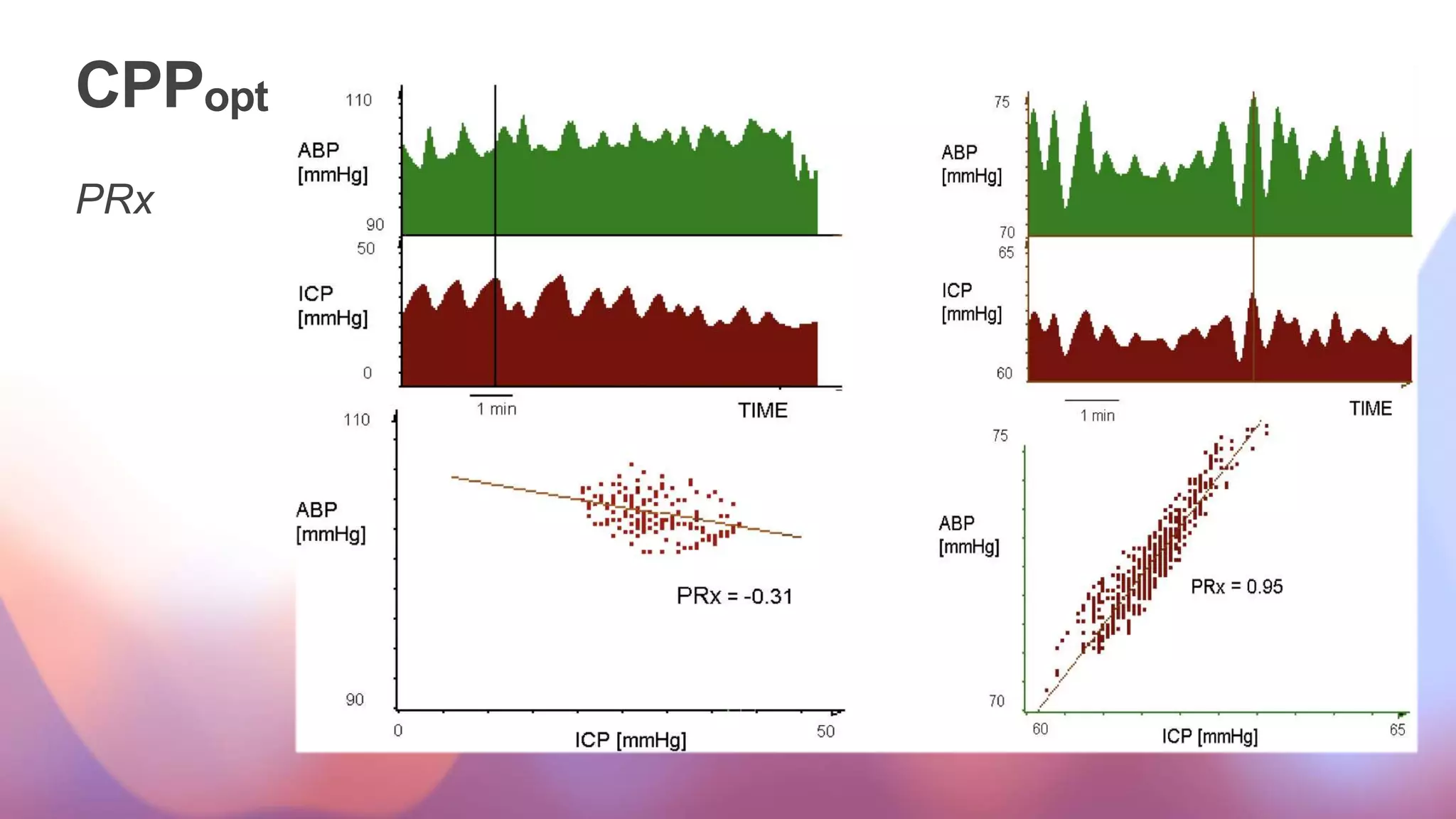
PRx
CPPopt
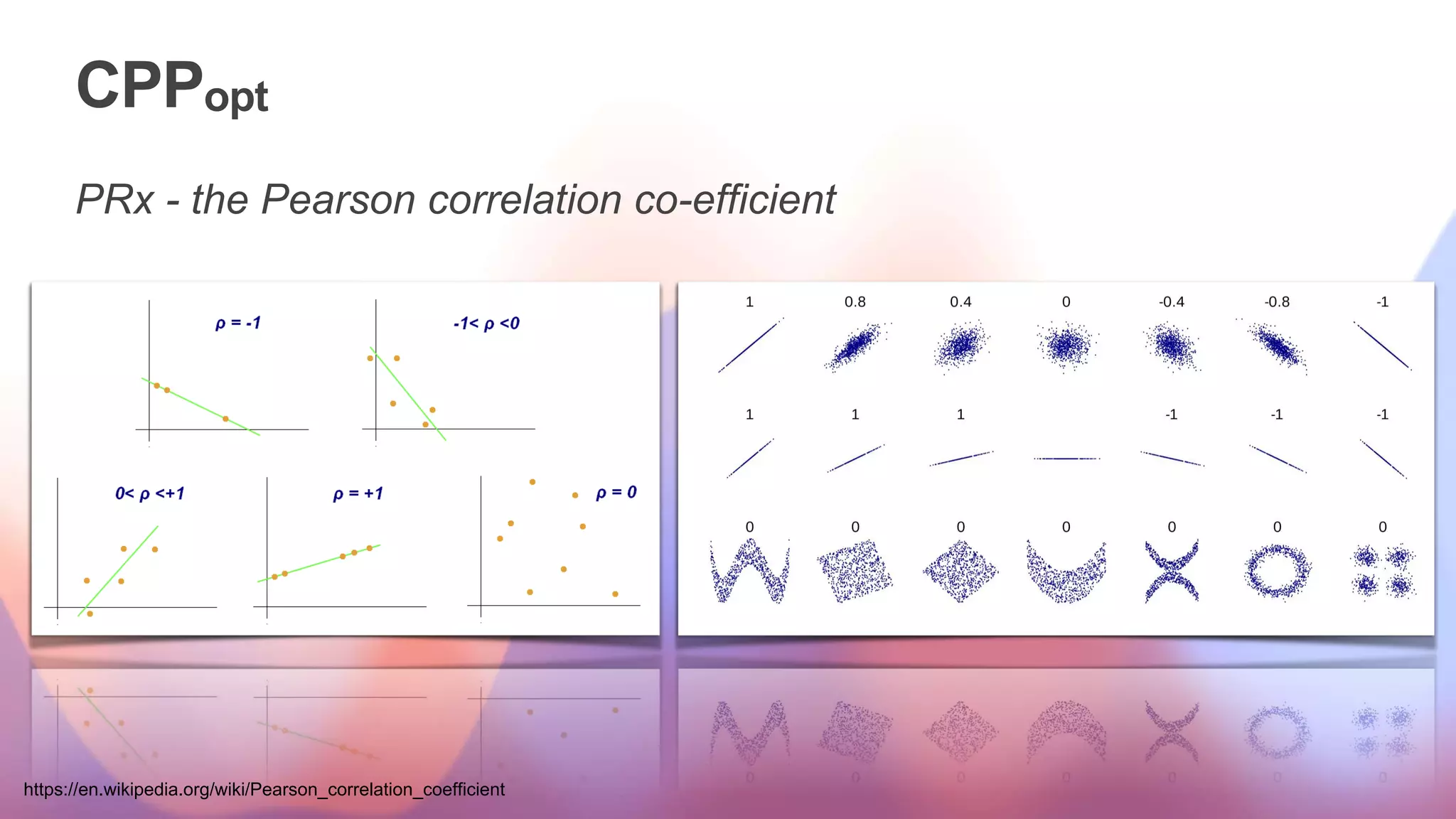
PRx - the Pearson correlation co-efficient
https://en.wikipedia.org/wiki/Pearson_correlation_coefficient
CPPopt
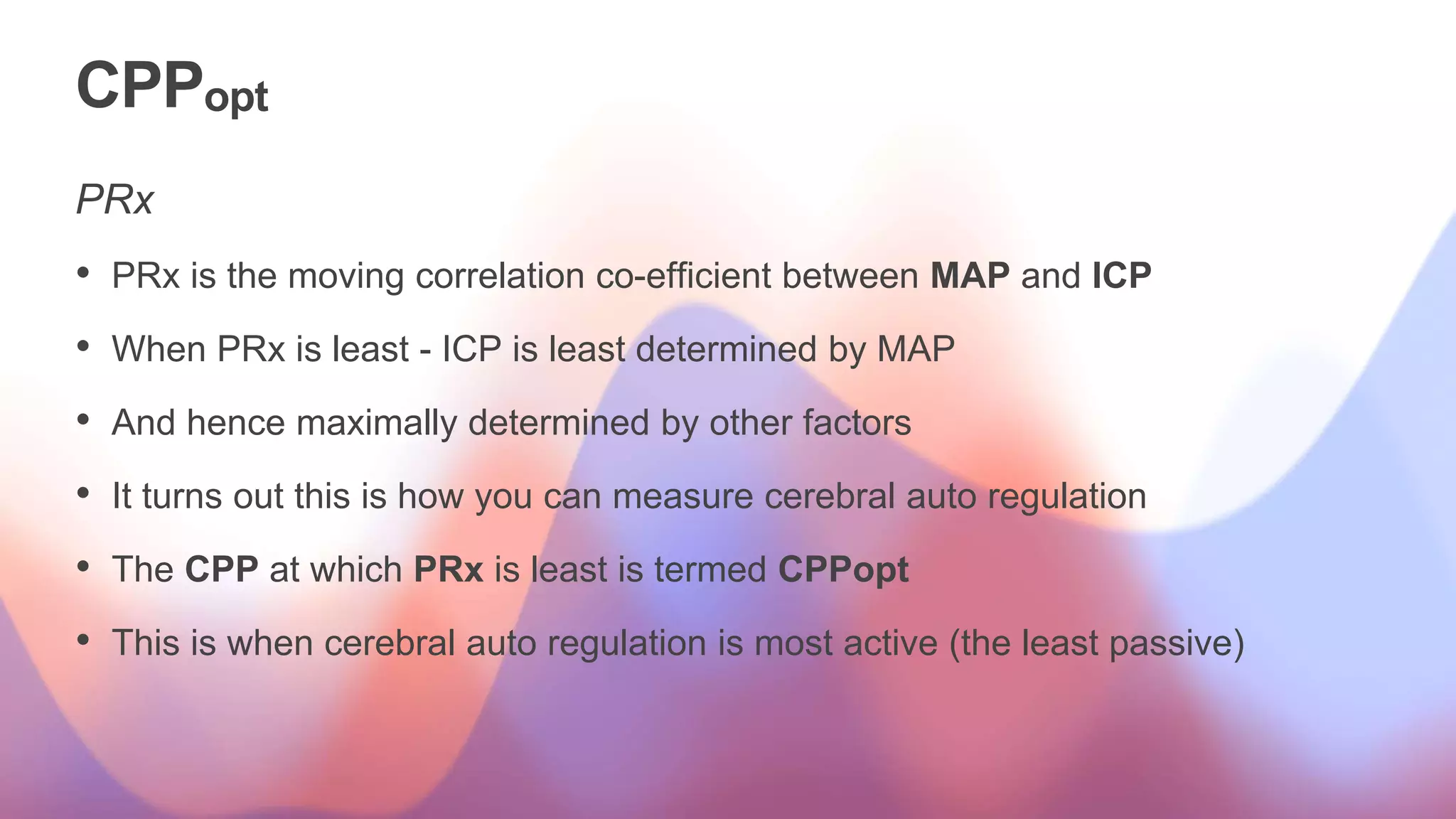
PRx
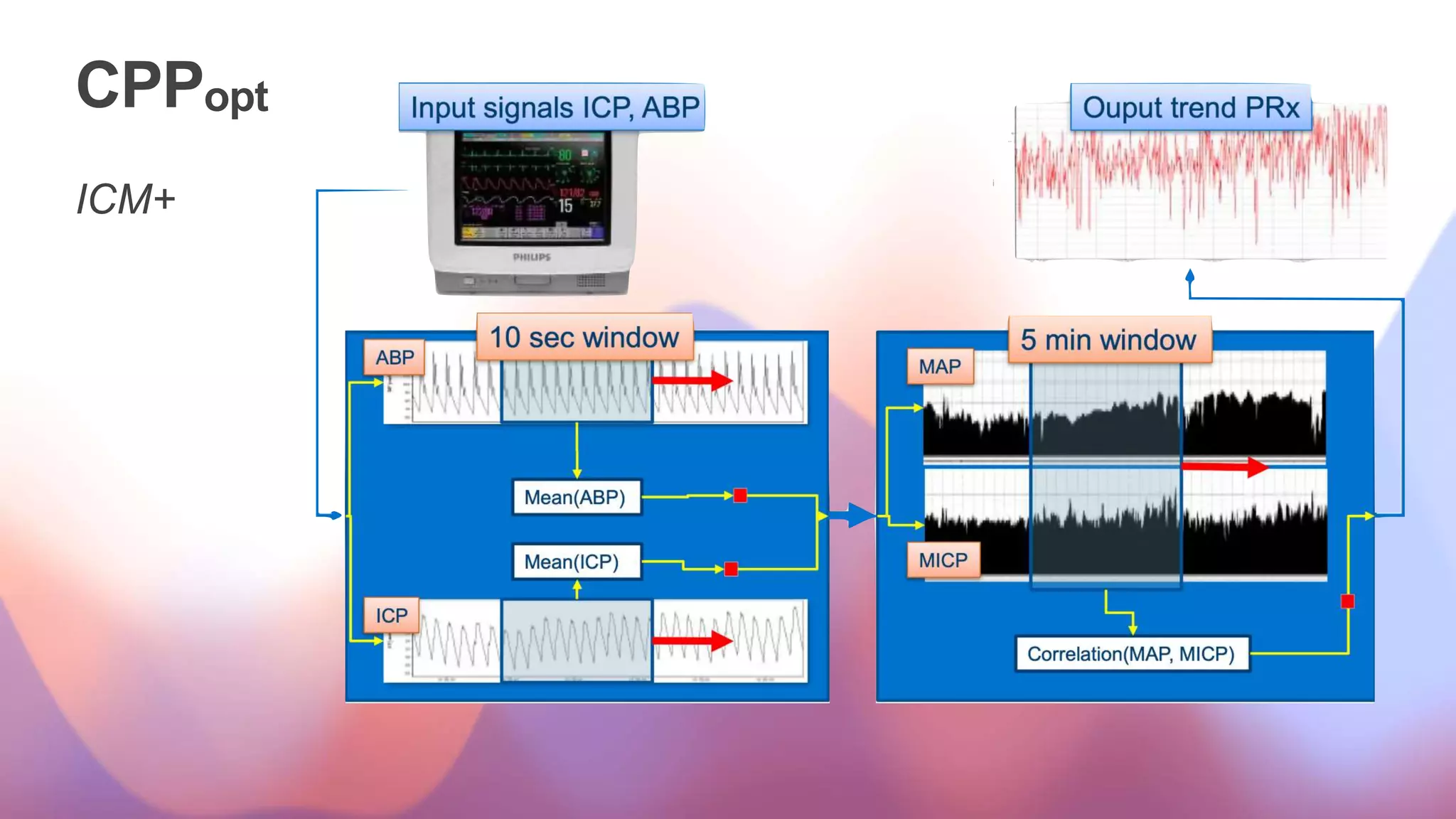
• PRx is the moving correlation co-efficient between MAP and ICP
• When PRx is least - ICP is least determined by MAP
• And hence maximally determined by other factors
• It turns out this is how you can measure cerebral auto regulation
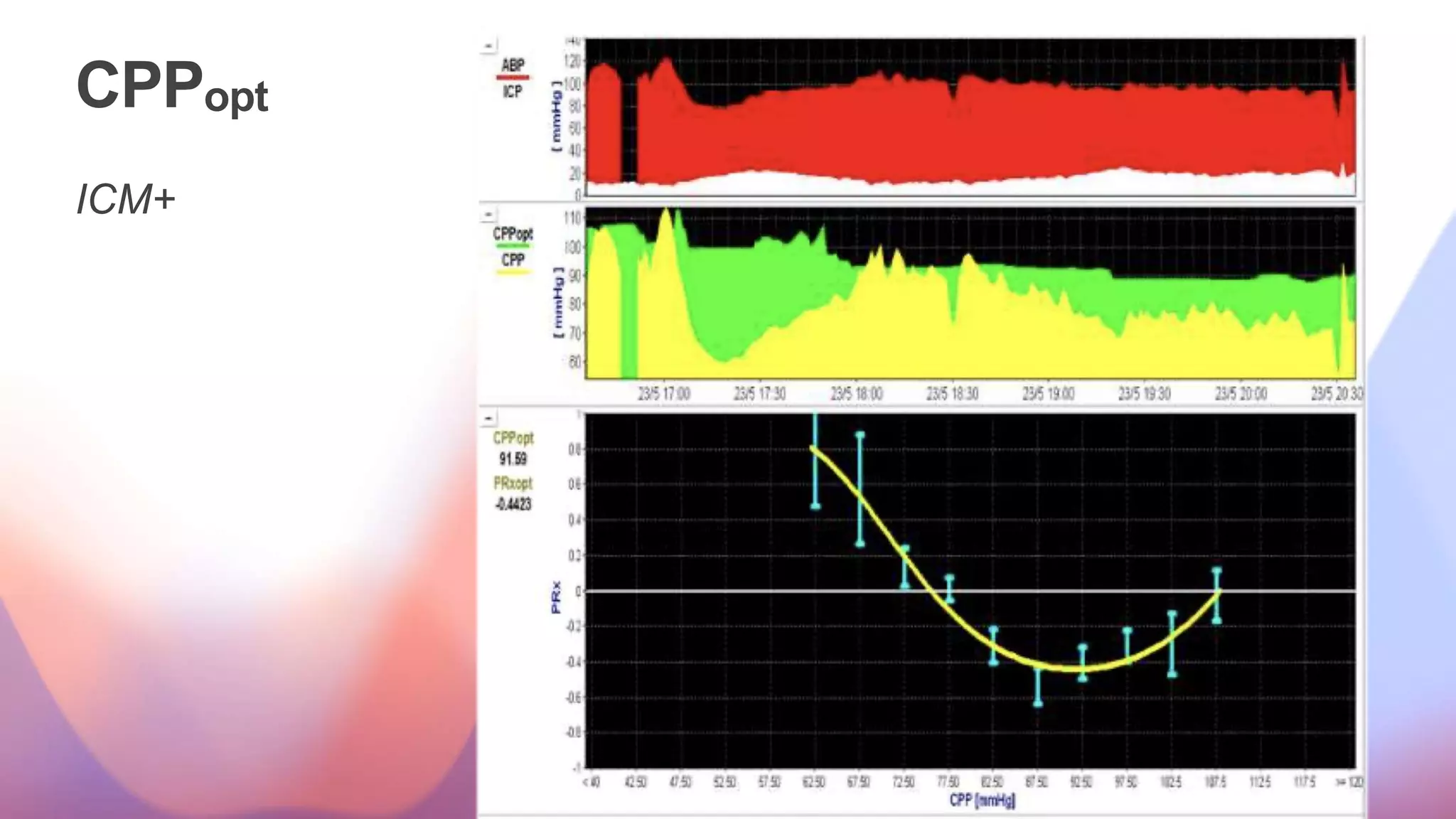
• The CPP at which PRx is least is termed CPPopt
• This is when cerebral auto regulation is most active (the least passive)
CPPopt
ICM+
CPPopt
ICM+
CPPopt
History
• Pressure reactivity index (PRx) described in 1997
• CPPopt in 2002 - 20 years ago!
• Developed by the “brain physics” department in Cambridge, Neurosurgeons,
and nascent Neurocritical Care Unit.
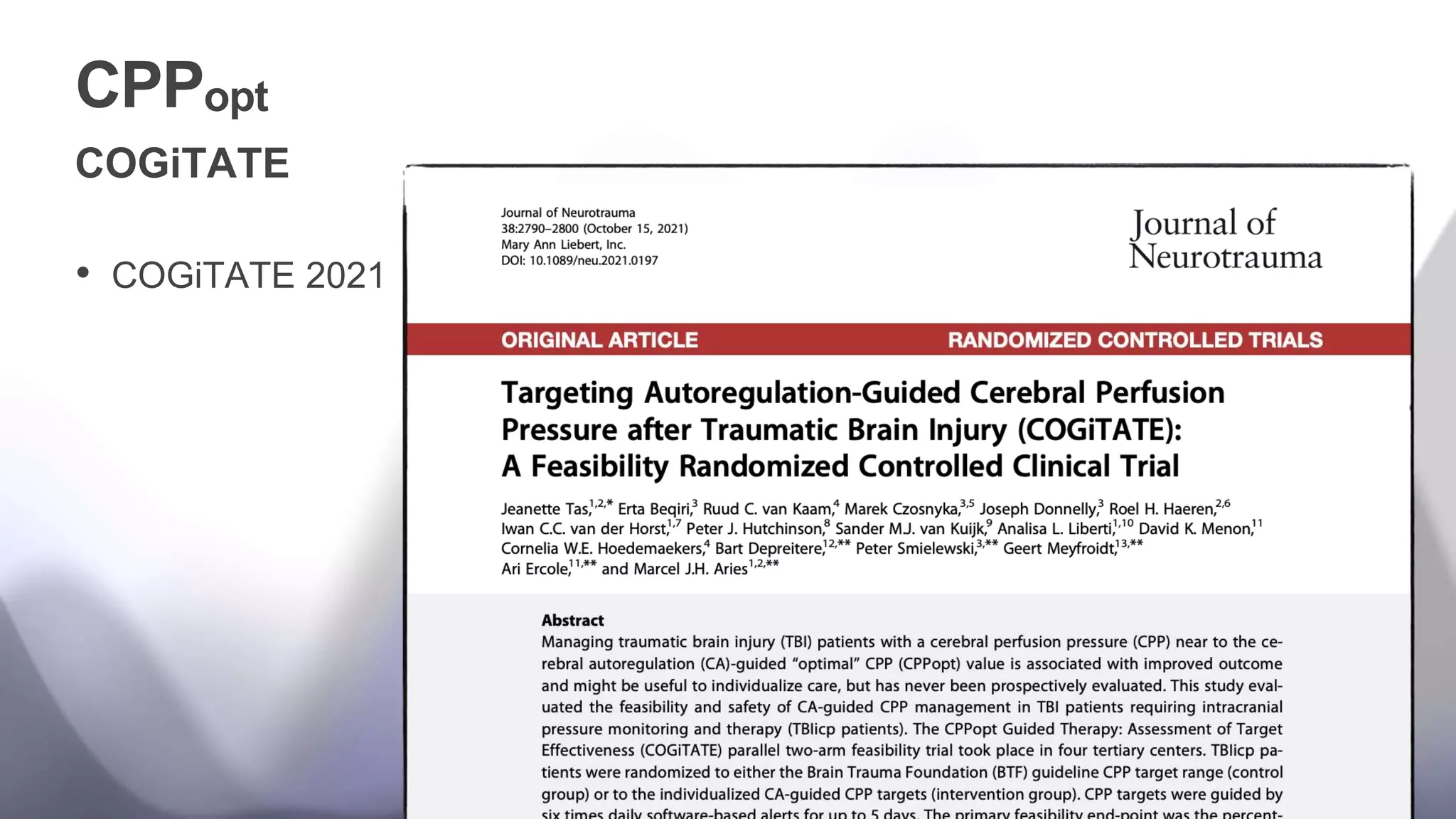
• COGiTATE - the first (pilot) RCT published 2021
CPPopt
As a target for therapy
• PRx > 0.25 is associated in multiple cohorts with poor neurological outcomes
and death
• Does anything we do change it?
• Is it a therapeutic target and if so does it affect outcomes?
CPPopt
As a target for therapy
TIL Sub-Category Intervention
Positioning Head elevation for ICP control
Nursed flat (180o) for CPP management
Sedation Level Sedation (low-dose as required for mechanical ventilation)
Higher-dose sedation for ICP control (not aiming for burst suppression)
Metabolic suppression for ICP control with high-dose barbiturates or propofol
NMBA Neuromuscular blockade (paralysis)
CSF Drainage CSF drainage < 120 mL/d (<5 mL/h)
CSF drainage ≤ 120 mL/d (≤5 mL/h)
Fluid/Vasopressor Therapy Fluid loading for maintenance of cerebral perfusion
Vasopressor therapy required for management of cerebral perfusion
Hyperventilation Mild hypocapnia for ICP control (PaCO2 4.6–5.3 kPa [35–40 mm Hg])
Moderate hypocapnia for ICP control (PaCO2 ≤ 4 kPa [30 mm Hg])
Intensive hypocapnia for ICP control (PaCO2 < 4 kPa [30 mm Hg])
Hyperosmolar Therapy Hyperosmolar therapy with mannitol up to 2 gm/kg/24 h
Hyperosmolar therapy with hypertonic saline up to 0.3 gm/kg/24 h
Hyperosmolar therapy with mannitol > 2 gm/kg/24 h
Hyperosmolar therapy with hypertonic saline > 0.3 gm/kg/24 h
Temperature Management Treatment of fever (>38C) or spontaneous temperature of 34.5C
Mild hypothermia for ICP control with a lower limit of 35C
Hypothermia below 35C
Surgery for ICP Control Intracranial operation for progressive mass lesion, not scheduled on admission
Decompressive craniectomy
CPPopt
As a target for therapy
CPPopt
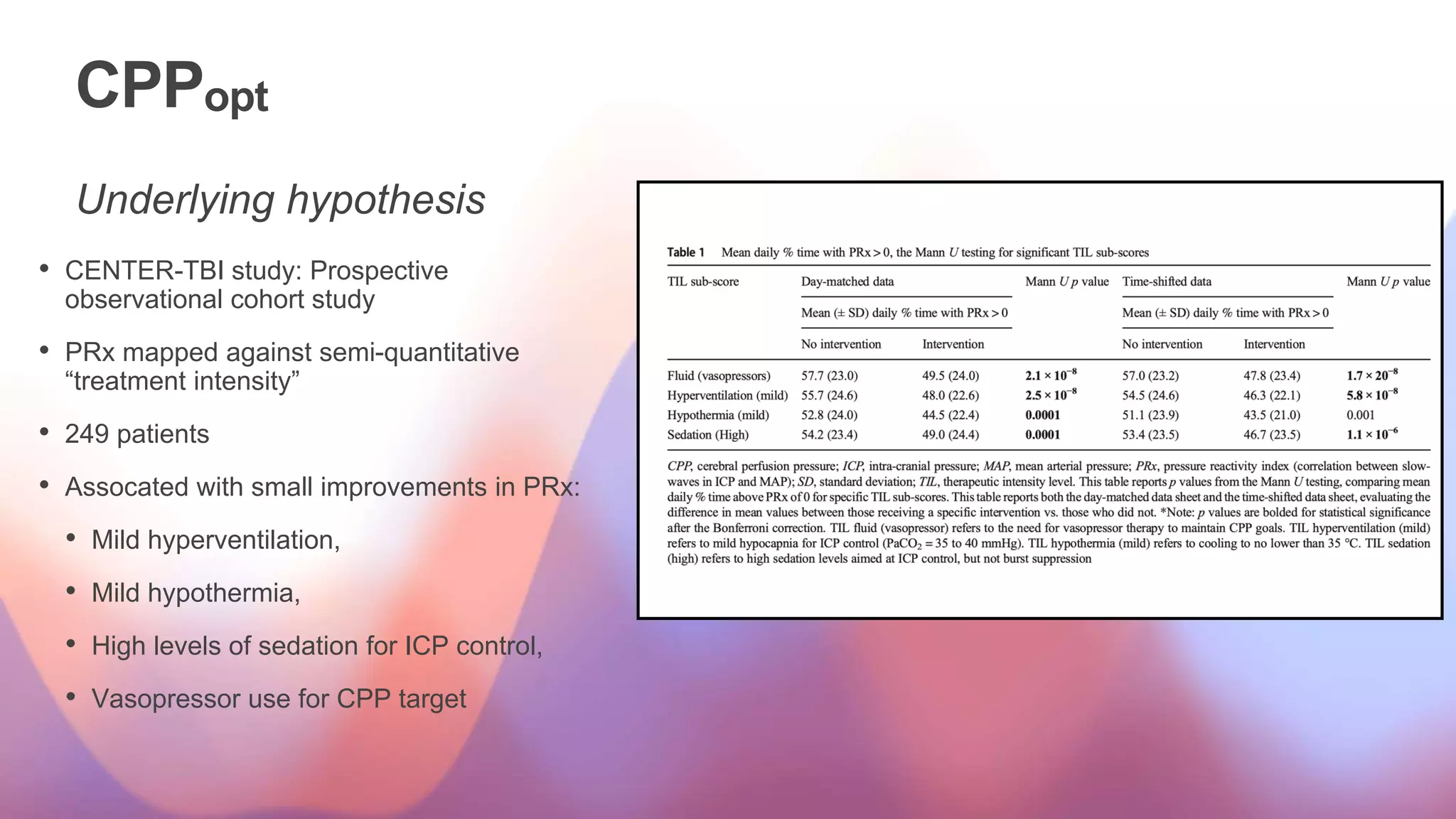
Underlying hypothesis
• CENTER-TBI study: Prospective
observational cohort study
• PRx mapped against semi-quantitative
“treatment intensity”
• 249 patients
• Assocated with small improvements in PRx:
• Mild hyperventilation,
• Mild hypothermia,
• High levels of sedation for ICP control,
• Vasopressor use for CPP target
CPPopt
As a target for therapy
TIL Sub-Category Intervention
Positioning Head elevation for ICP control
Nursed flat (180o) for CPP management
Sedation Level Sedation (low-dose as required for mechanical ventilation)
Higher-dose sedation for ICP control (not aiming for burst suppression)
Metabolic suppression for ICP control with high-dose barbiturates or propofol
NMBA Neuromuscular blockade (paralysis)
CSF Drainage CSF drainage < 120 mL/d (<5 mL/h)
CSF drainage ≤ 120 mL/d (≤5 mL/h)
Fluid/Vasopressor Therapy Fluid loading for maintenance of cerebral perfusion
Vasopressor therapy required for management of cerebral perfusion
Hyperventilation Mild hypocapnia for ICP control (PaCO2 4.6–5.3 kPa [35–40 mm Hg])
Moderate hypocapnia for ICP control (PaCO2 ≤ 4 kPa [30 mm Hg])
Intensive hypocapnia for ICP control (PaCO2 < 4 kPa [30 mm Hg])
Hyperosmolar Therapy Hyperosmolar therapy with mannitol up to 2 gm/kg/24 h
Hyperosmolar therapy with hypertonic saline up to 0.3 gm/kg/24 h
Hyperosmolar therapy with mannitol > 2 gm/kg/24 h
Hyperosmolar therapy with hypertonic saline > 0.3 gm/kg/24 h
Temperature Management Treatment of fever (>38C) or spontaneous temperature of 34.5C
Mild hypothermia for ICP control with a lower limit of 35C
Hypothermia below 35C
Surgery for ICP Control Intracranial operation for progressive mass lesion, not scheduled on admission
Decompressive craniectomy
CPPopt
PRx as a target for therapy
• What about differential effects of vasopressors on PRx/CPPopt?
Vasopressin, Angiotensin II, adrenaline, dexmedetomidine…
• How about ketamine?
• Other agents like glibenclamide, neurokinin 1 receptor antagonists,
remimazolam…?
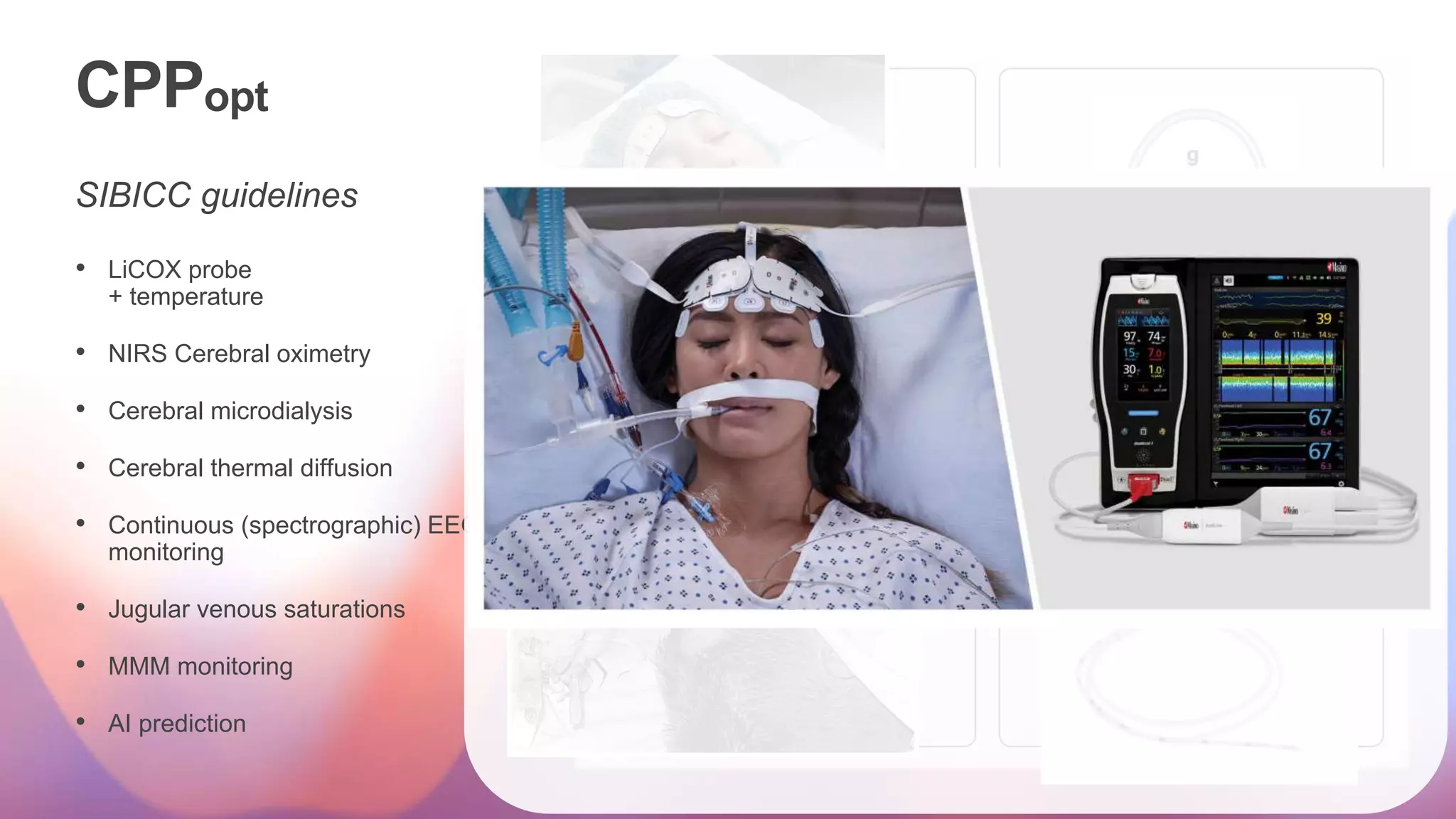
CPPopt
SIBICC guidelines
• LiCOX probe
+ temperature
• NIRS Cerebral oximetry
• Cerebral microdialysis
• Cerebral thermal diffusion
• Continuous (spectrographic) EEG
monitoring
• Jugular venous saturations
• MMM monitoring
• AI prediction
CPPopt
SIBICC guidelines
CPPopt
& Brain tissue
oxygen
CPPopt
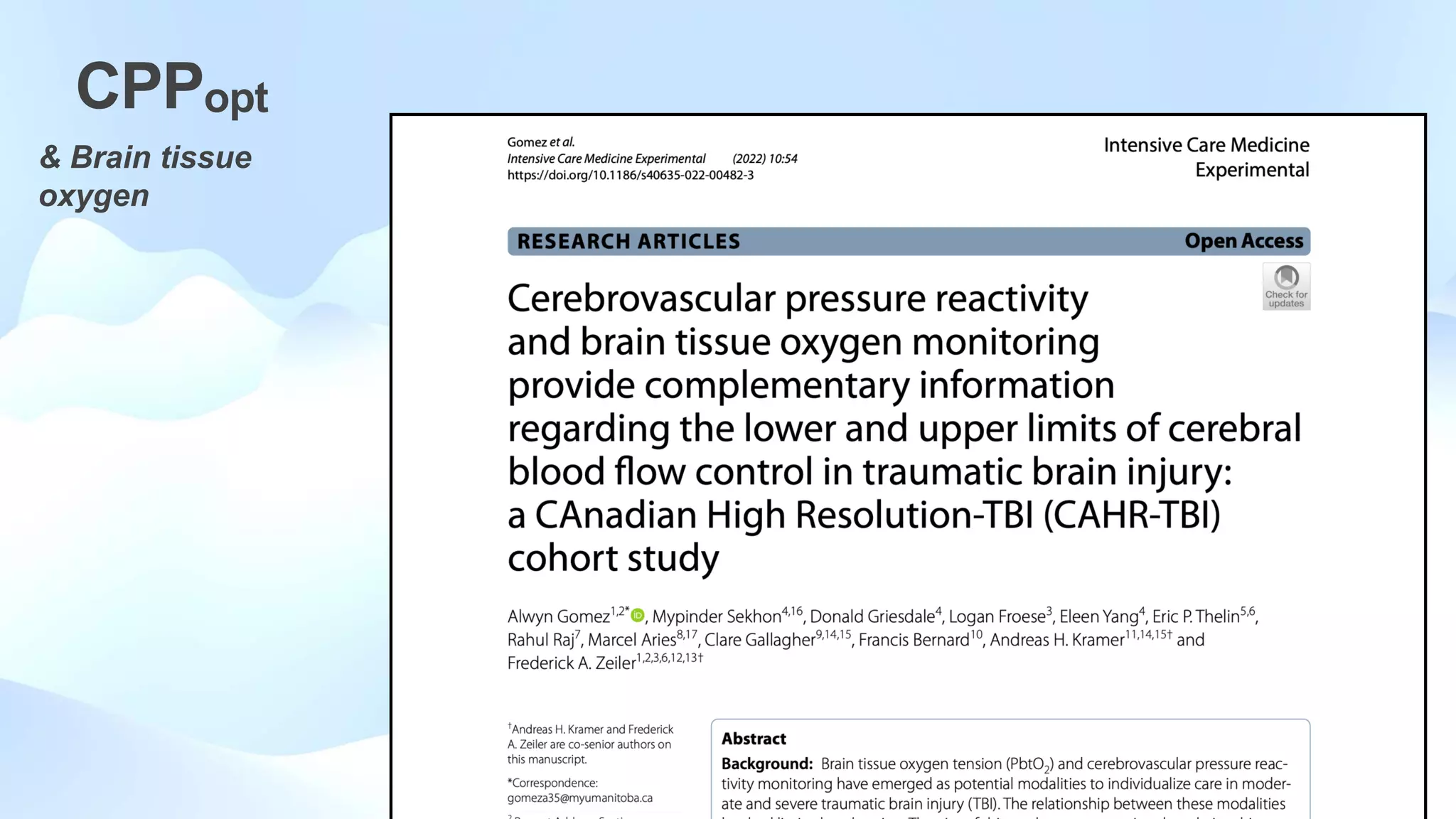
& Brain tissue
oxygen
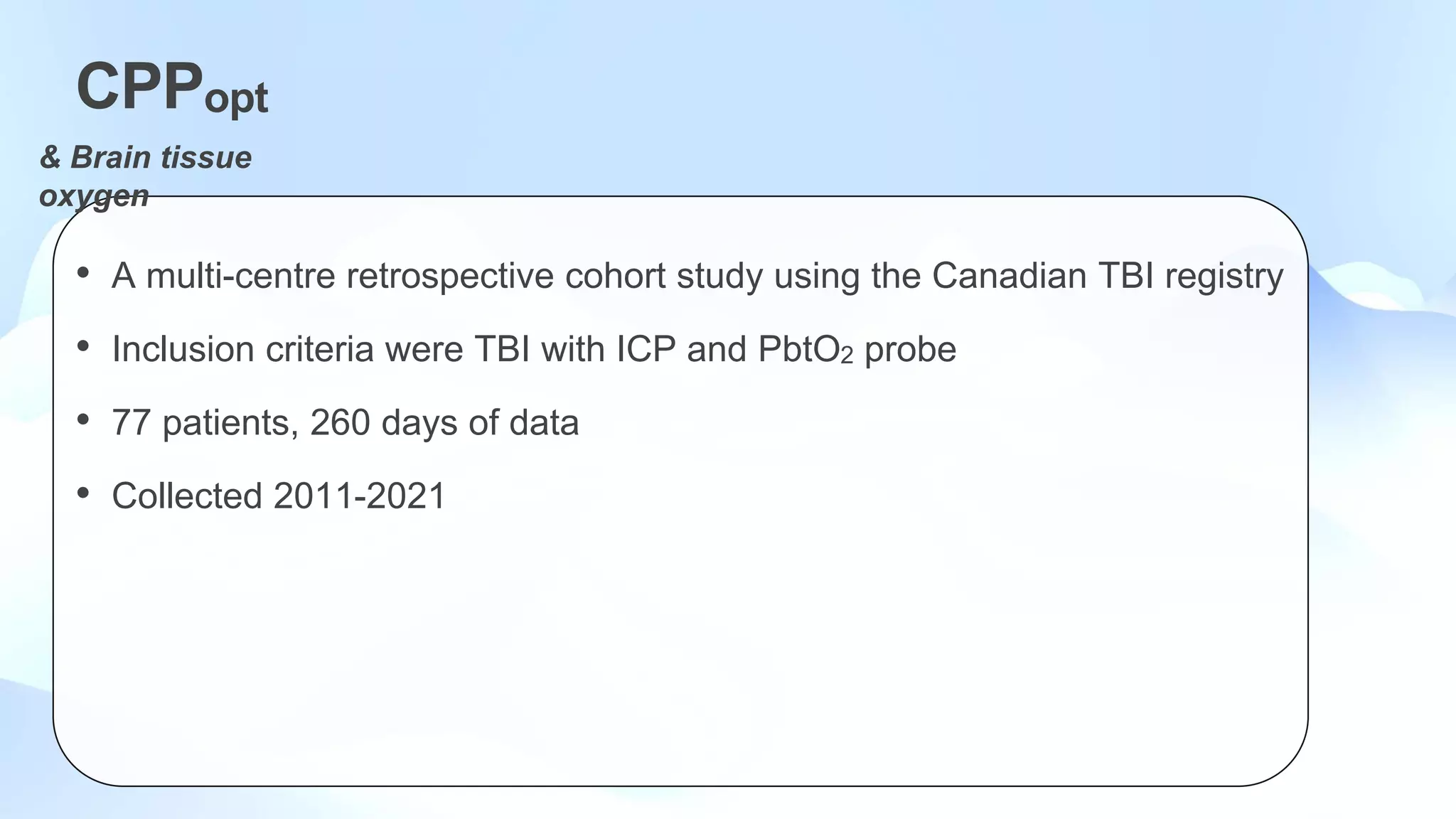
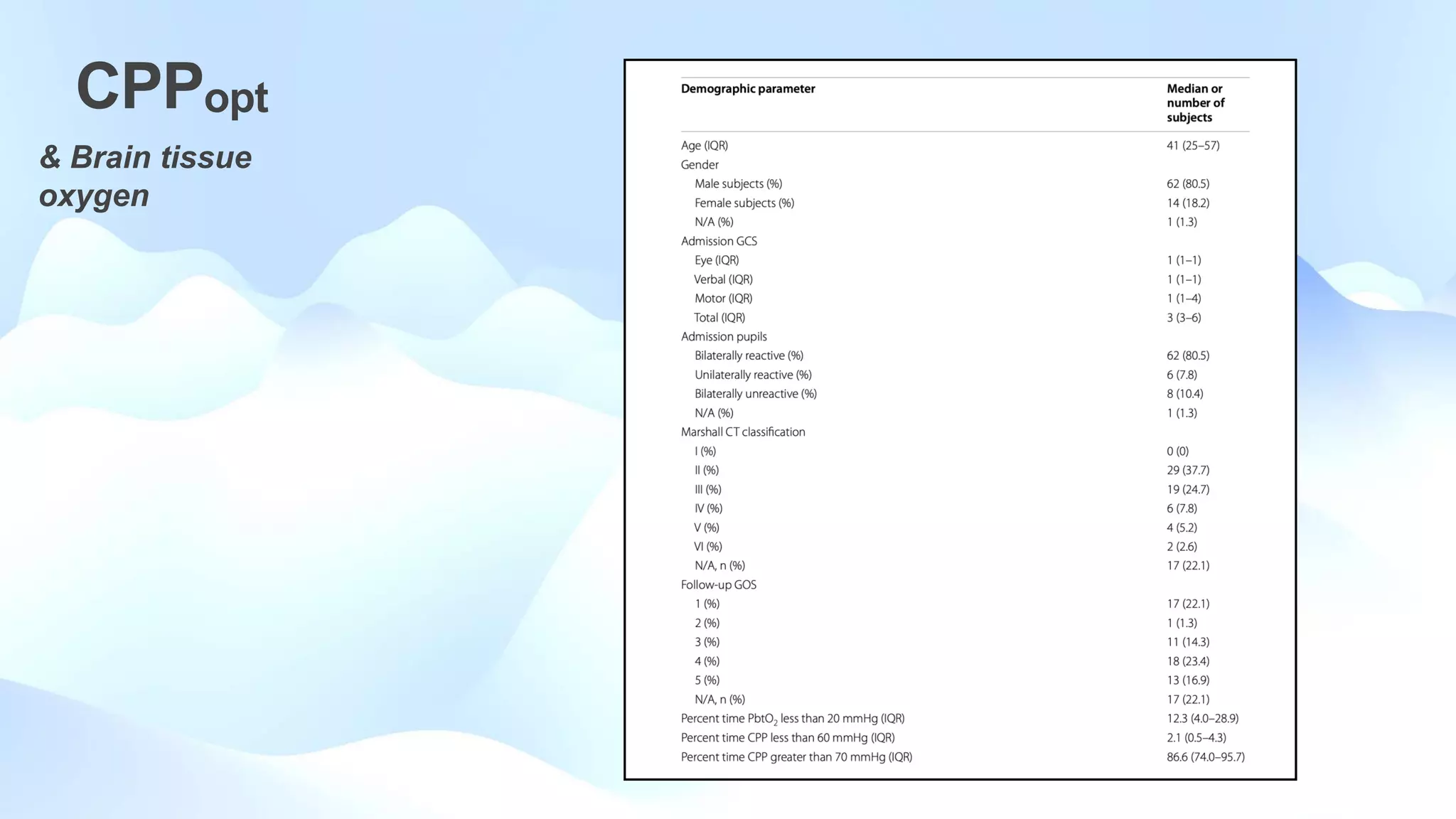
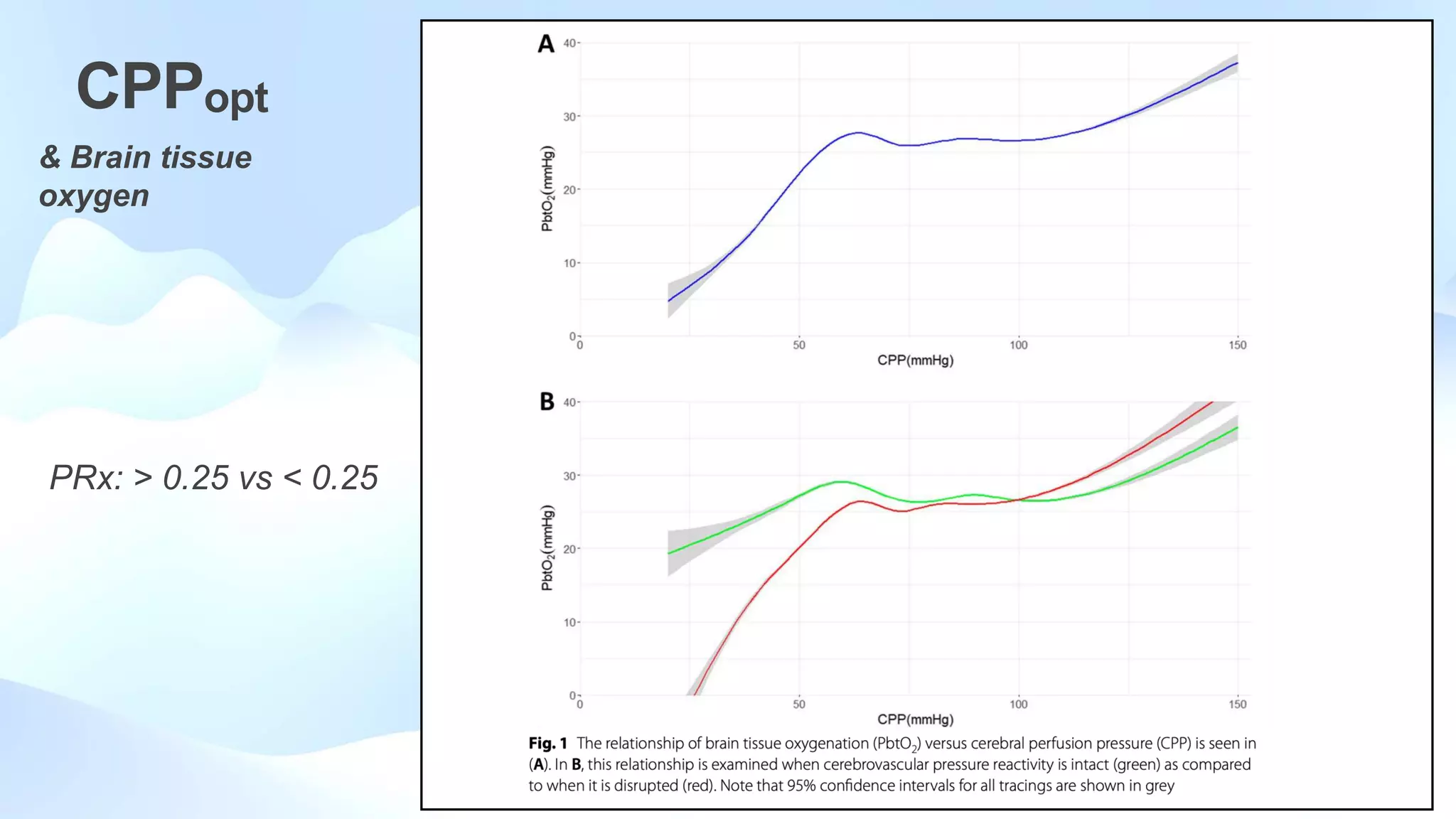
• A multi-centre retrospective cohort study using the Canadian TBI registry
• Inclusion criteria were TBI with ICP and PbtO2 probe
• 77 patients, 260 days of data
• Collected 2011-2021
CPPopt
& Brain tissue
oxygen
☠️
CPPopt
& Brain tissue
oxygen
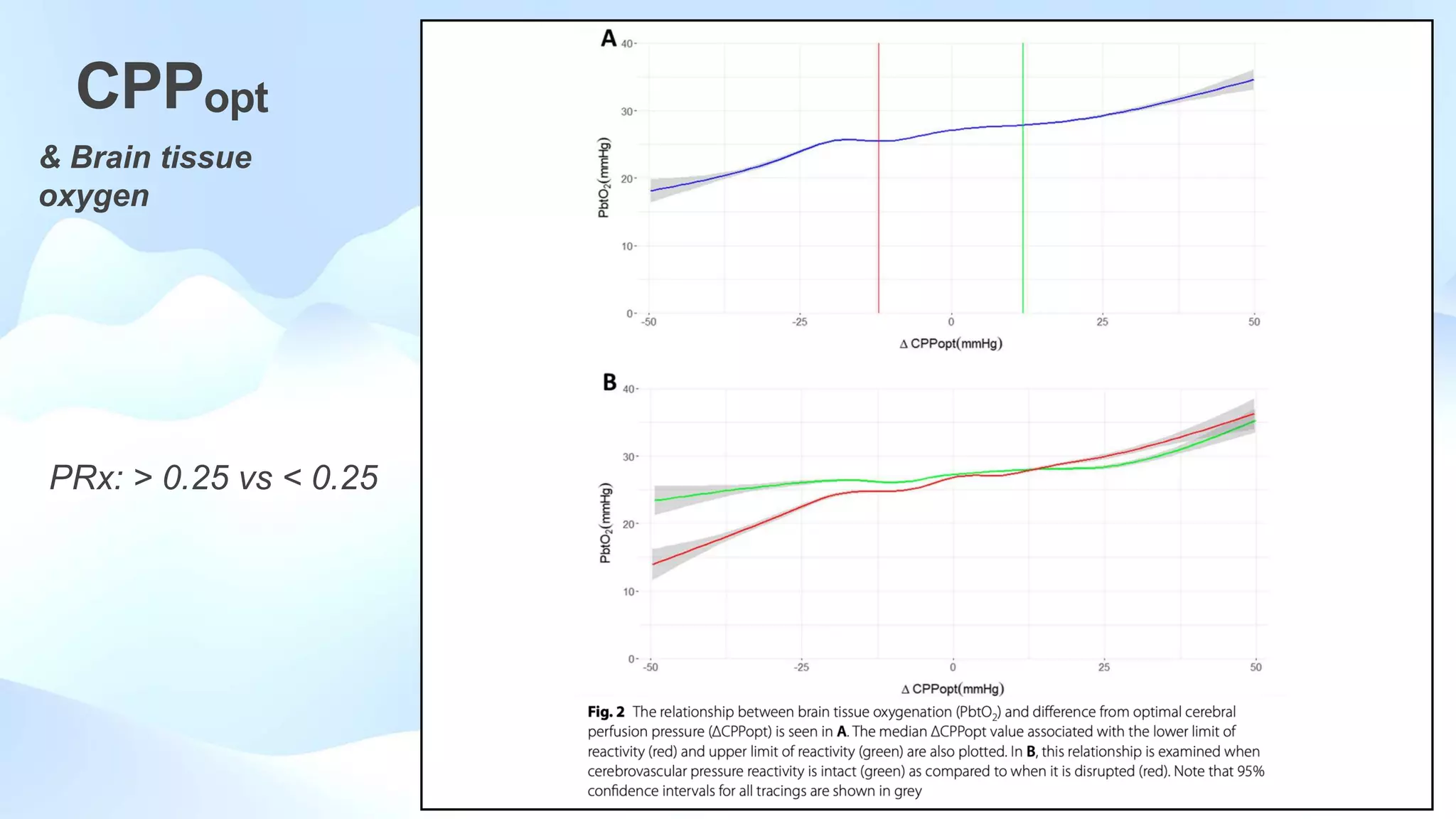
PRx: > 0.25 vs < 0.25
CPPopt
& Brain tissue
oxygen
PRx: > 0.25 vs < 0.25
CPPopt
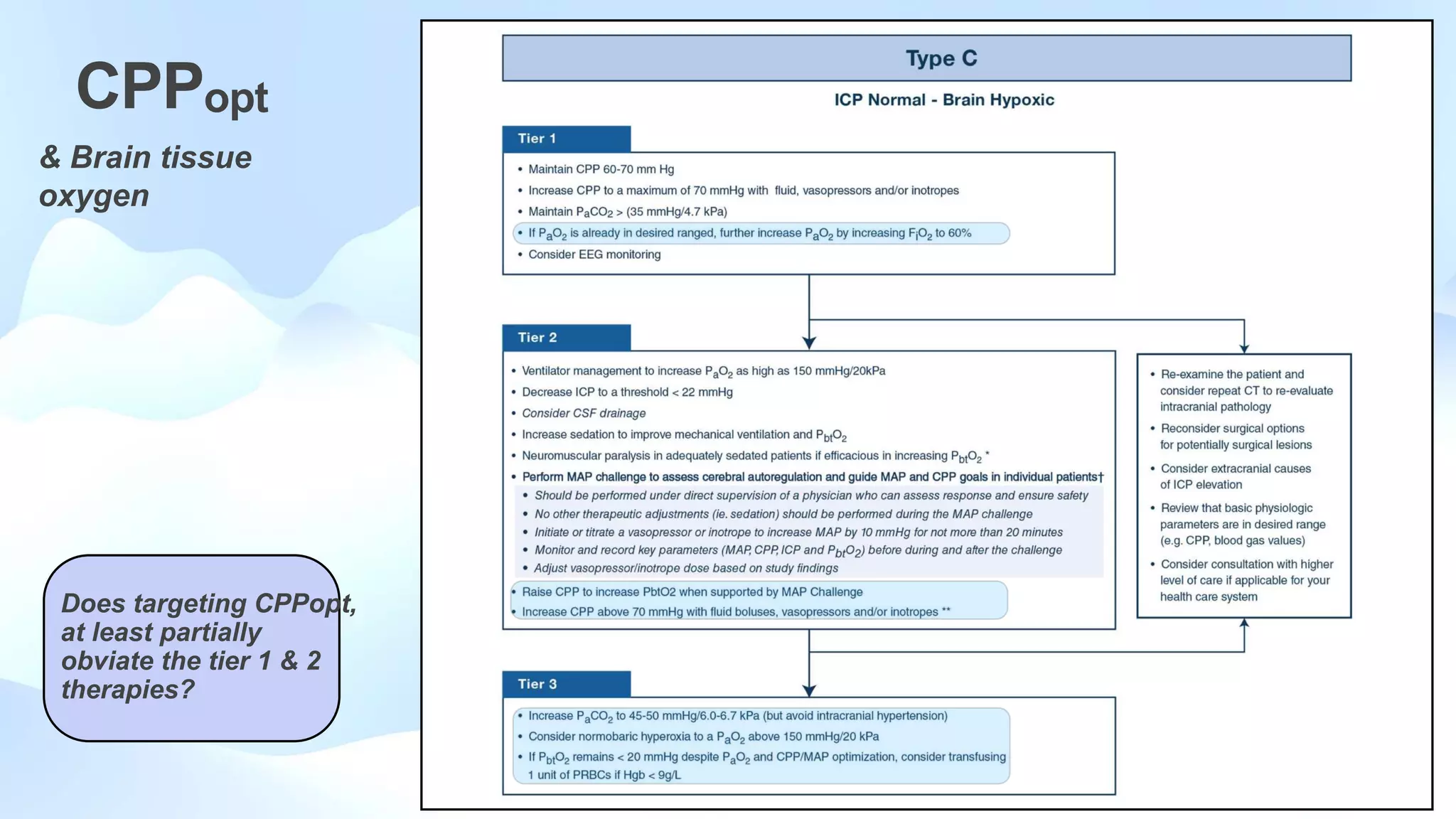
SIBICC guidelines
CPPopt
SIBICC guidelines
CPPopt
& Brain tissue
oxygen
Does targeting CPPopt,
at least partially
obviate the tier 1 & 2
therapies?
CPPopt
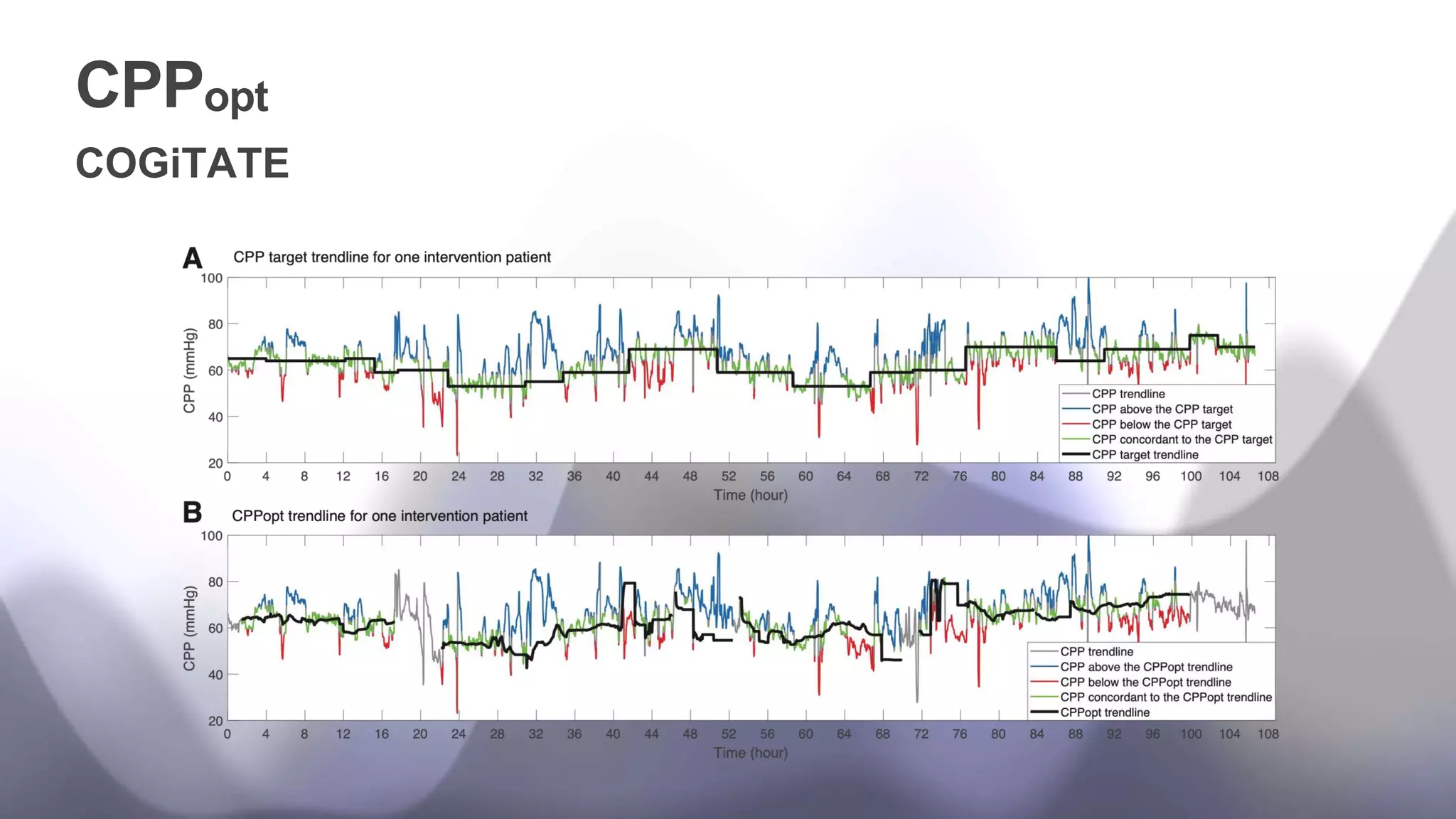
COGiTATE
• COGiTATE 2021
CPPopt
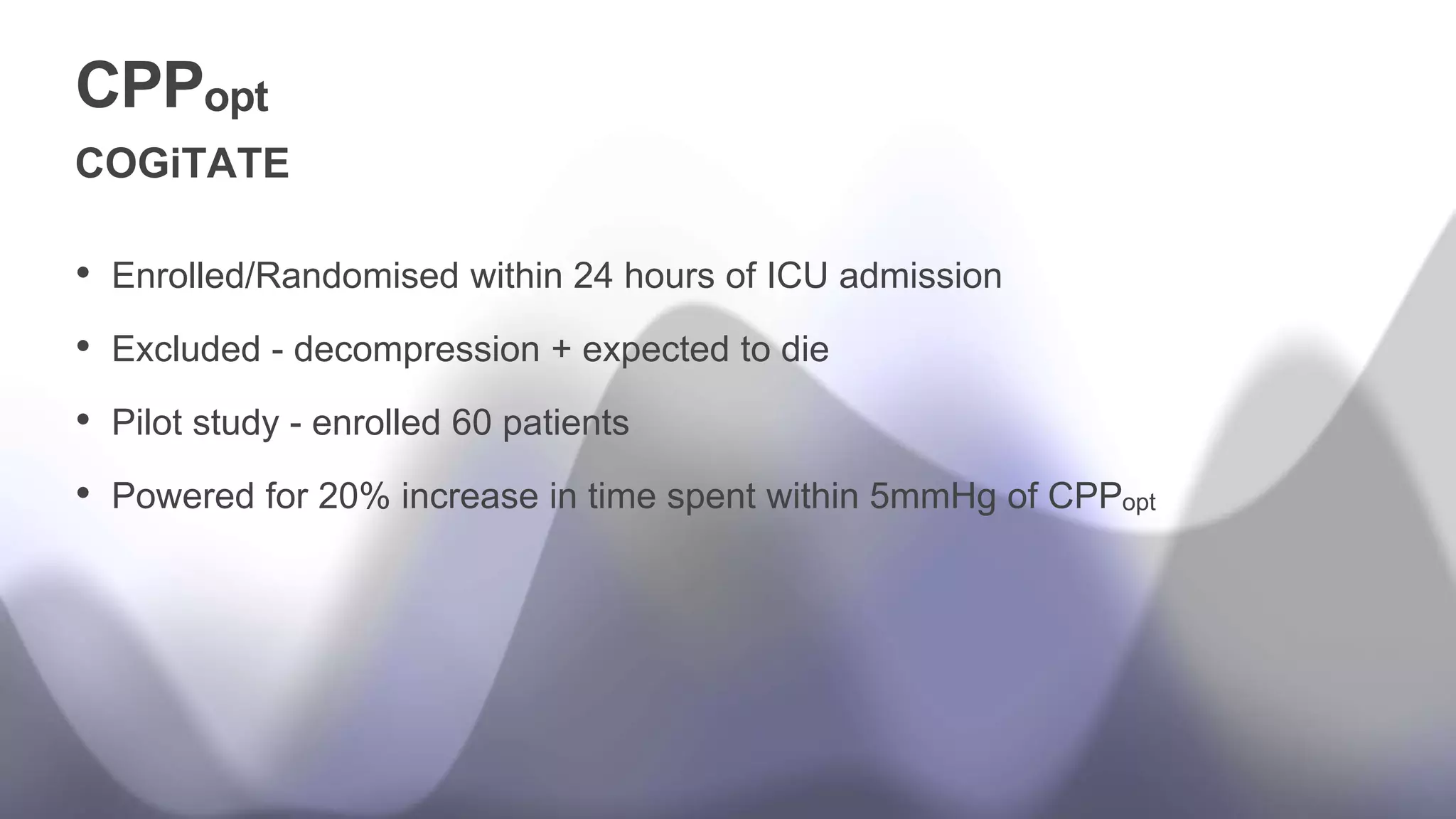
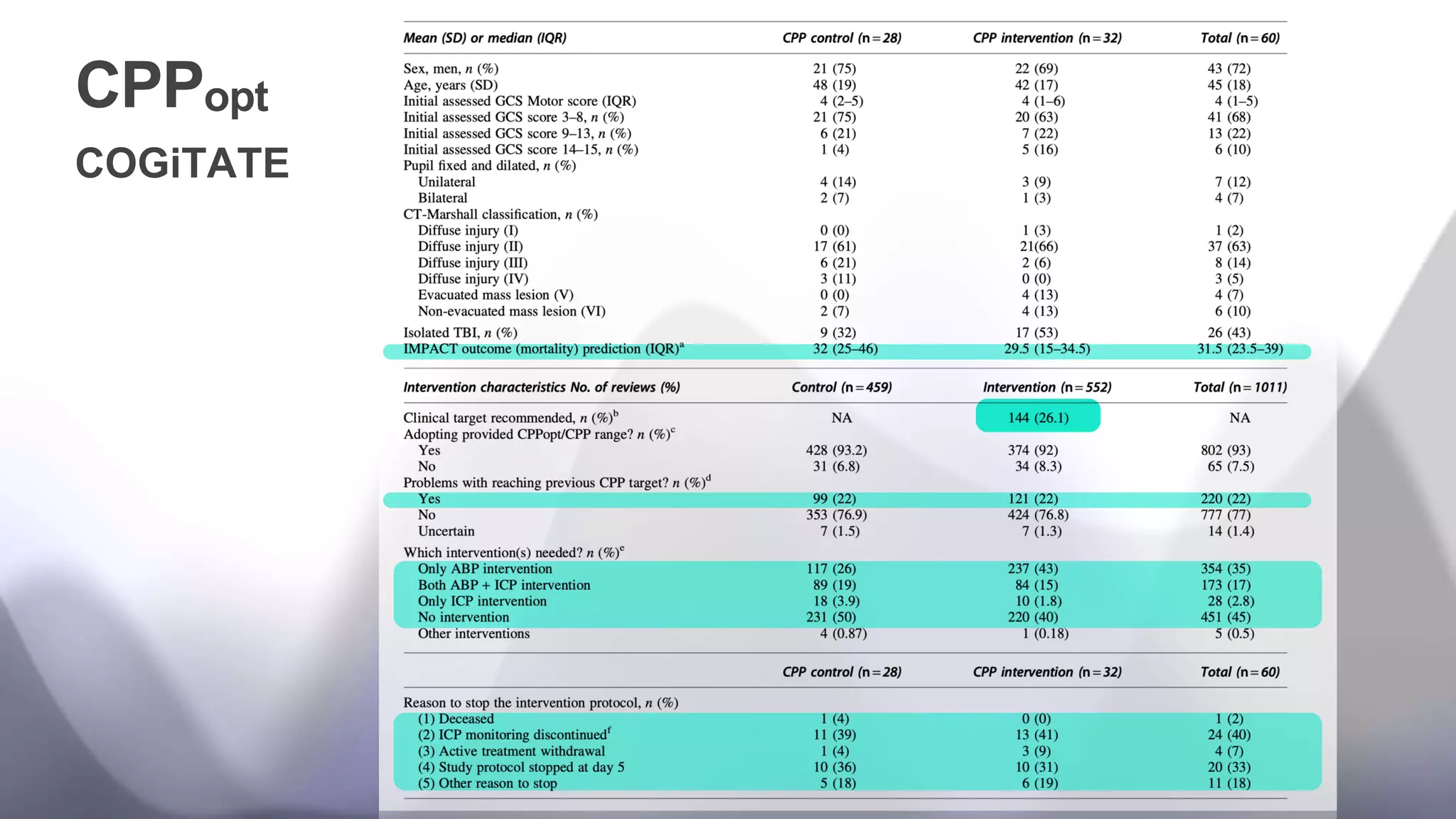
• Enrolled/Randomised within 24 hours of ICU admission
• Excluded - decompression + expected to die
• Pilot study - enrolled 60 patients
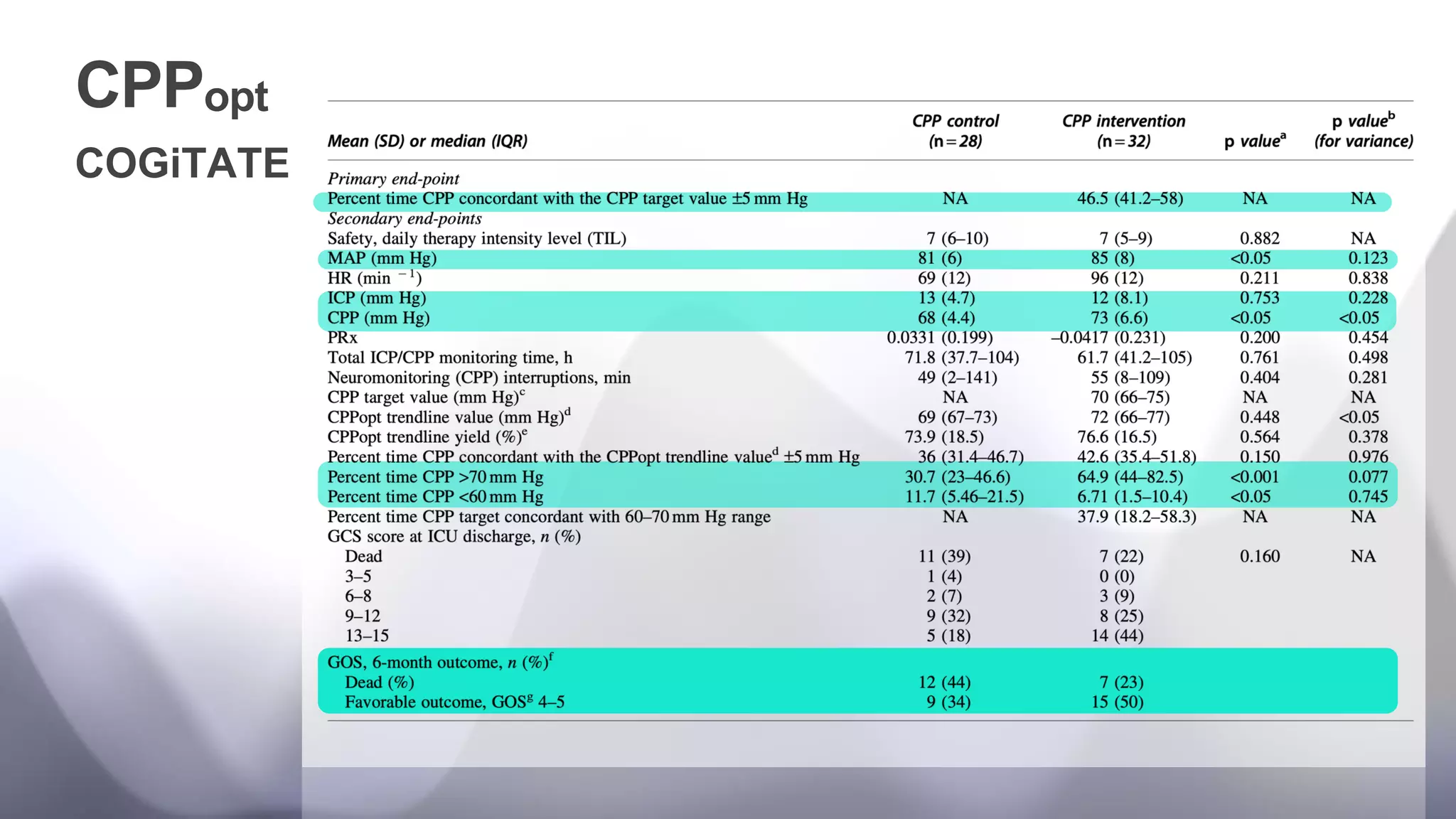
• Powered for 20% increase in time spent within 5mmHg of CPPopt
COGiTATE
CPPopt
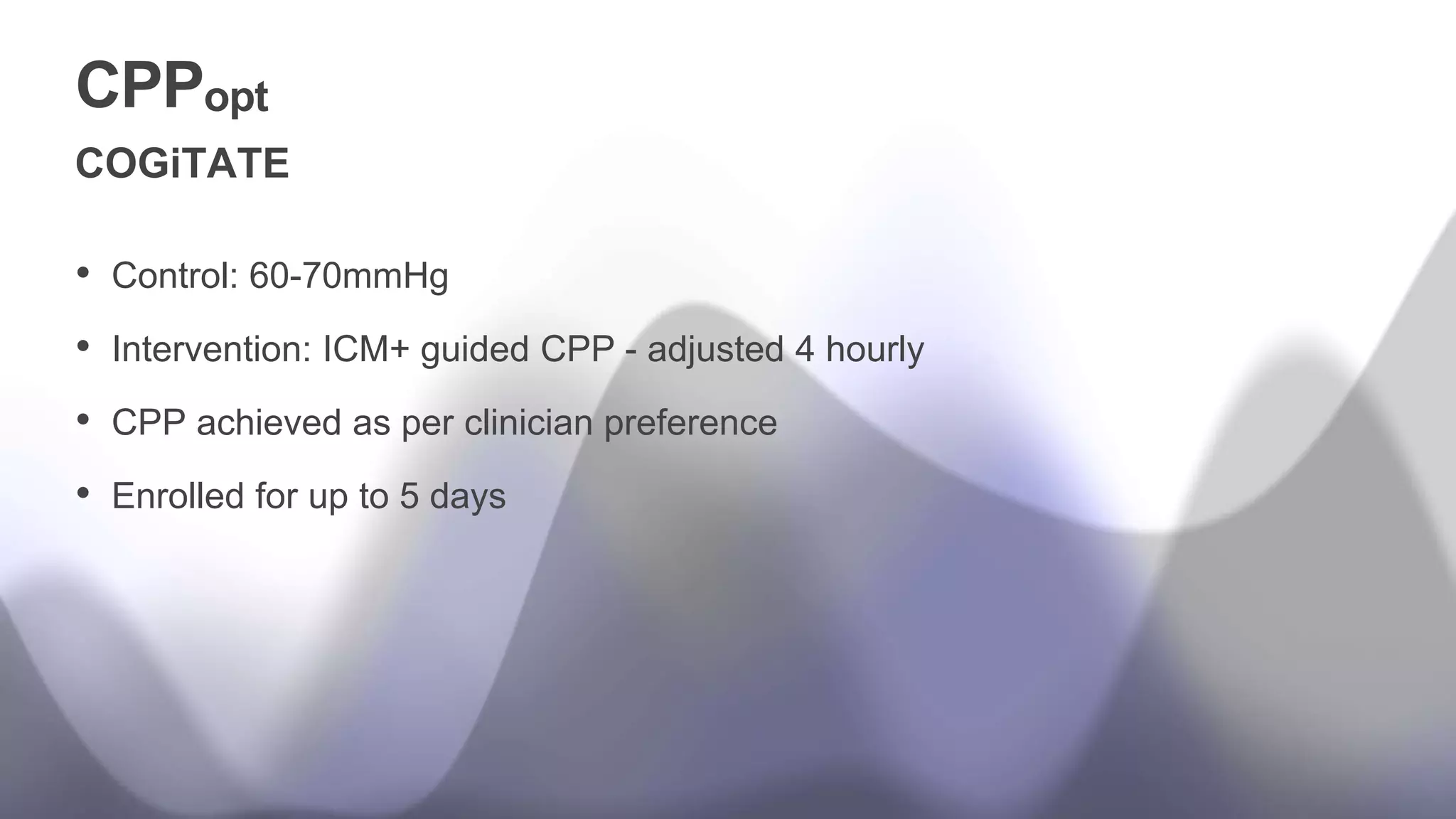
• Control: 60-70mmHg
• Intervention: ICM+ guided CPP - adjusted 4 hourly
• CPP achieved as per clinician preference
• Enrolled for up to 5 days
COGiTATE
CPPopt
COGiTATE
CPPopt
COGiTATE
CPPopt
COGiTATE
CPPopt
COGiTATE
CPPopt
COGiTATE
CPPopt
COGiTATE
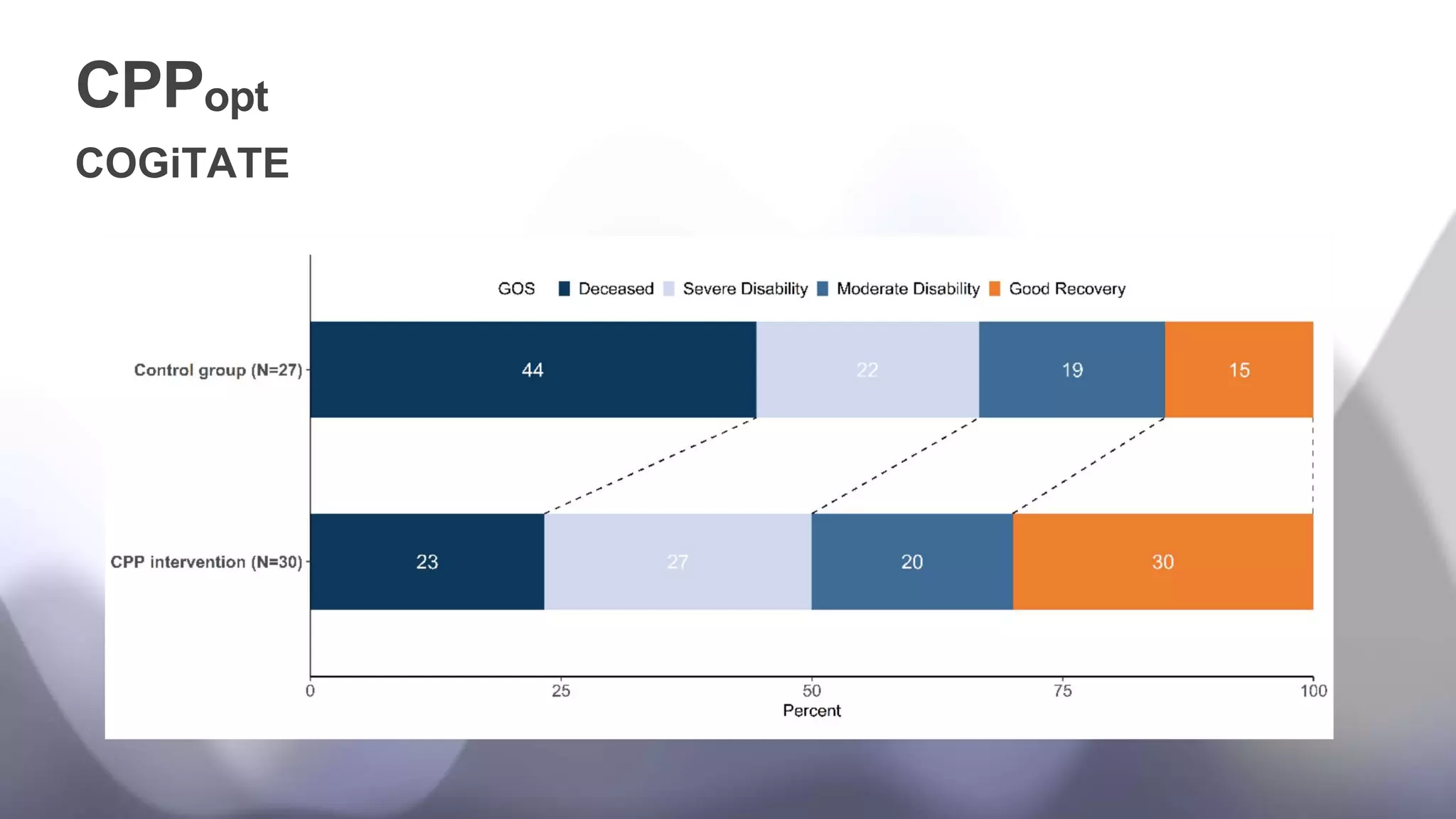
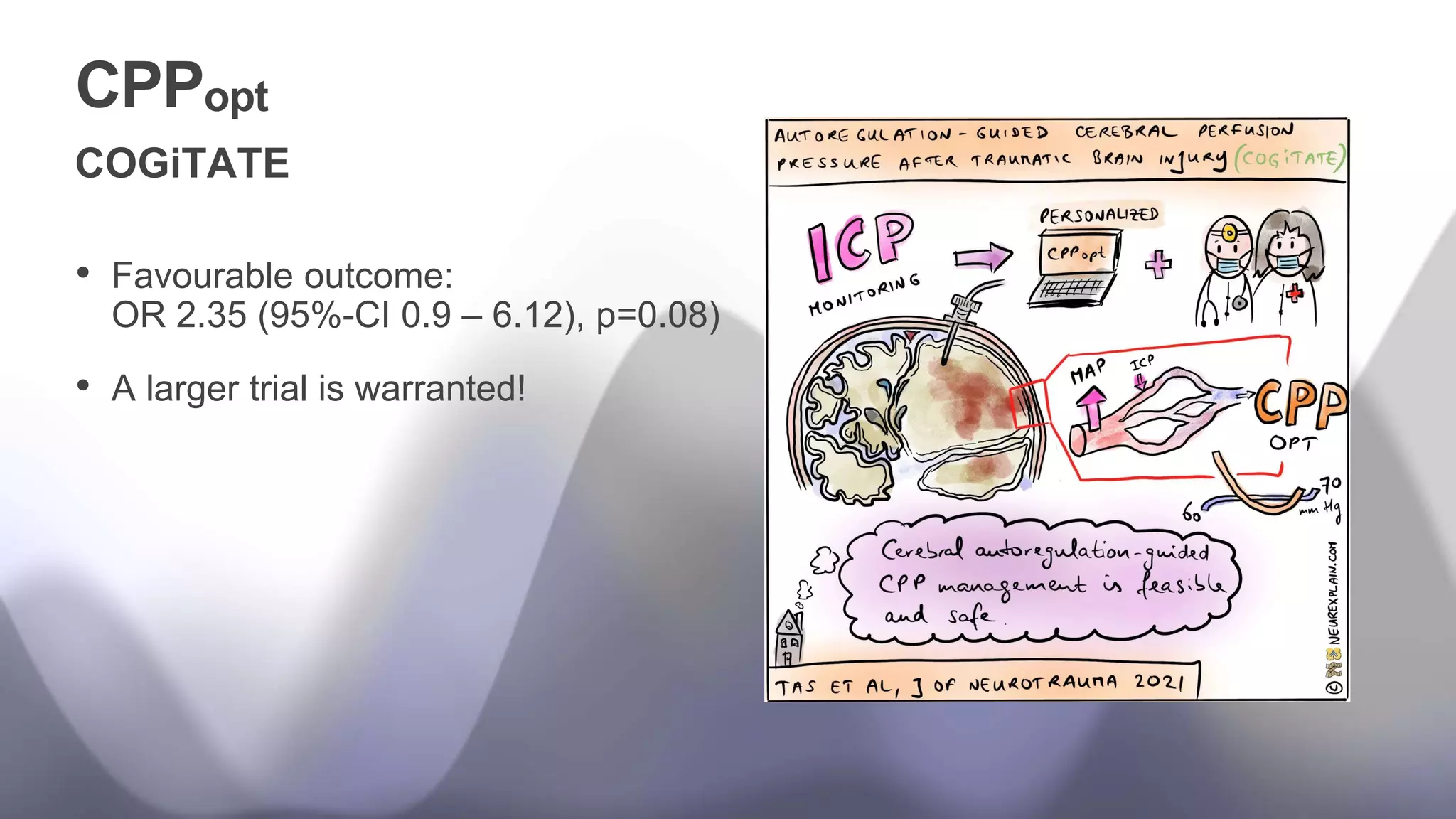
• Favourable outcome:
OR 2.35 (95%-CI 0.9 – 6.12), p=0.08)
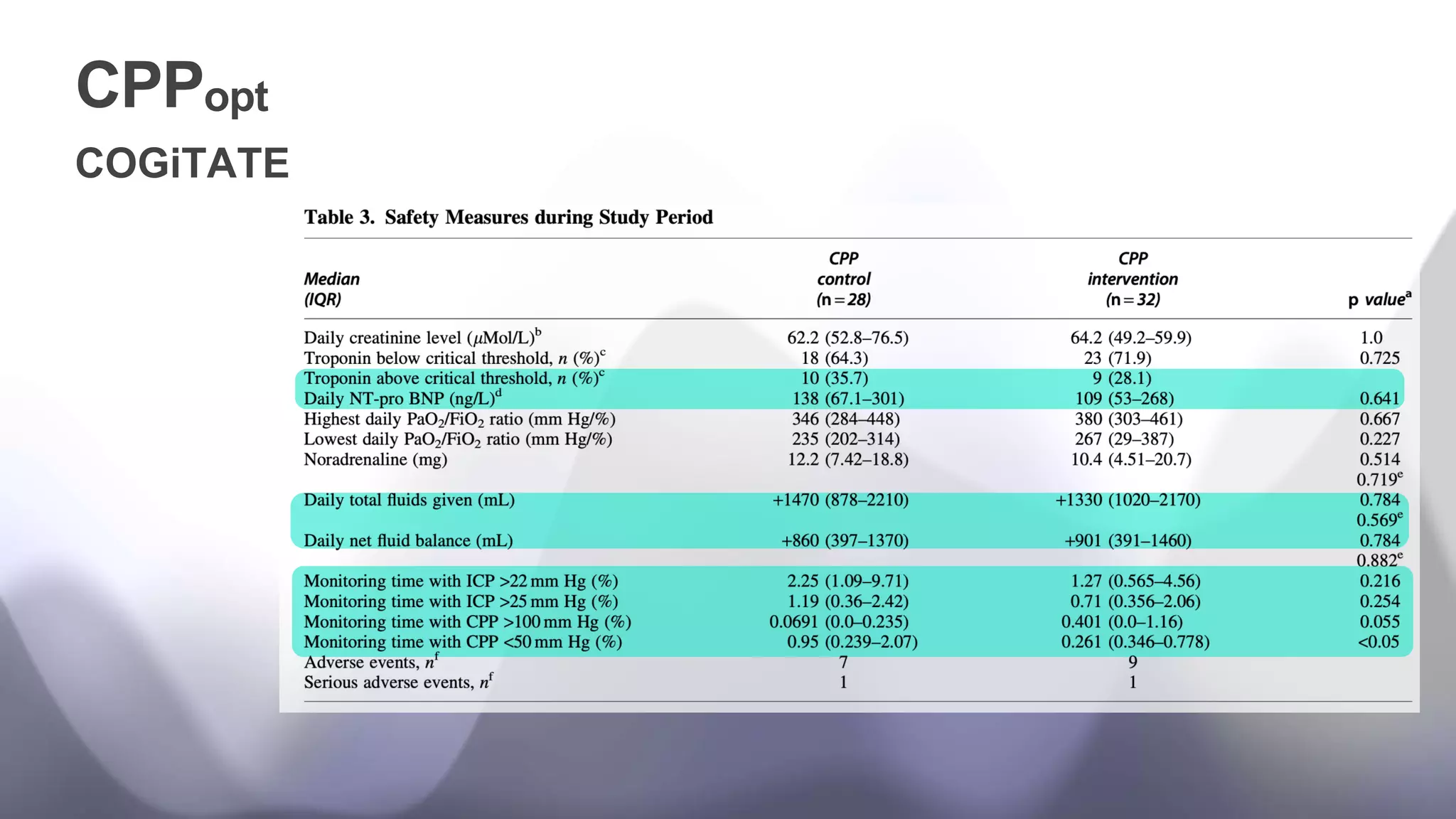
• A larger trial is warranted!
CPPopt
COGiTATE
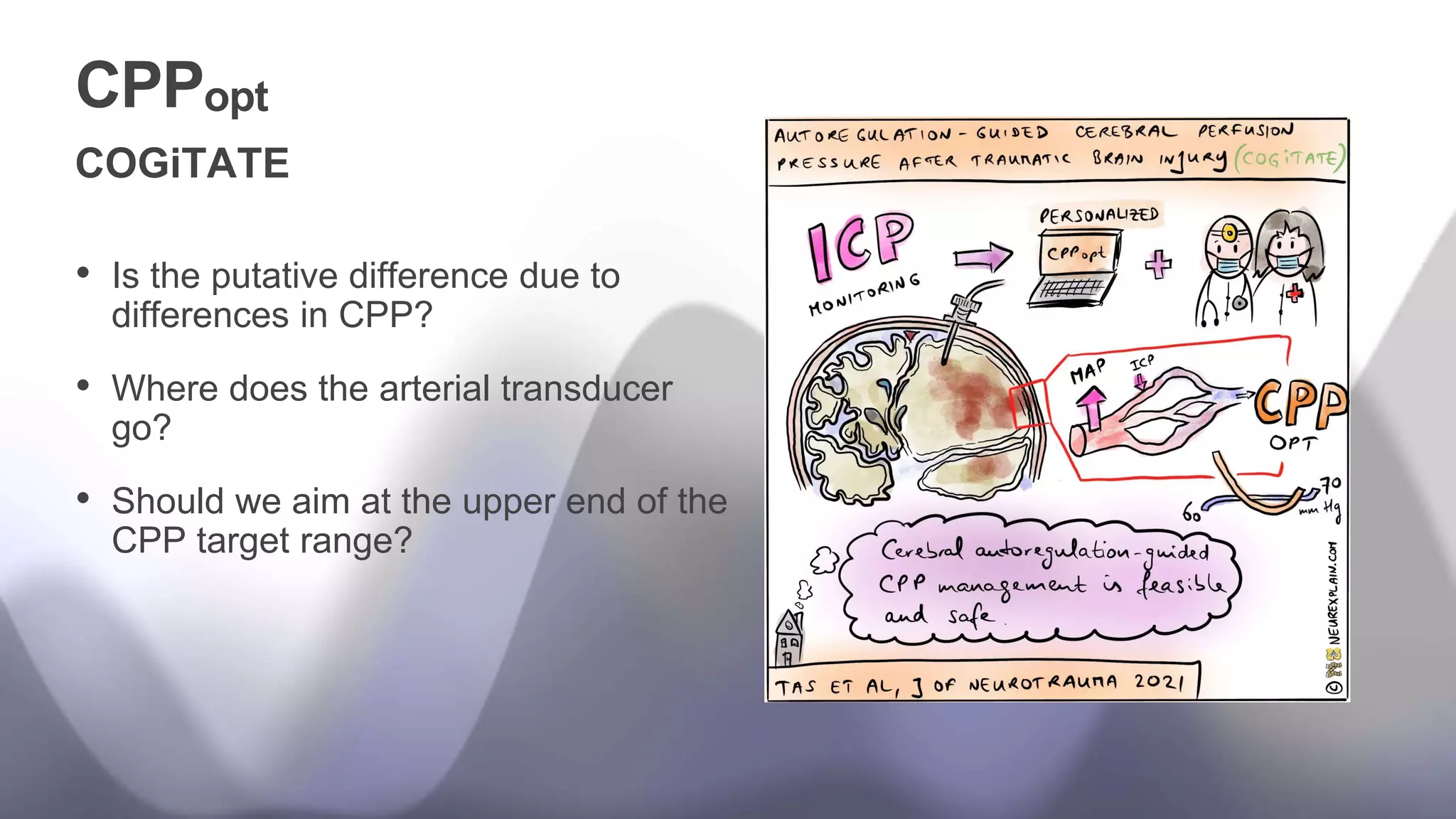
• Is the putative difference due to
differences in CPP?
• Where does the arterial transducer
go?
• Should we aim at the upper end of the
CPP target range?
CPPopt
Guidelines
• 4th edition (2016) of brain trauma foundation guidelines - insufficient evidence
to make a reccomendation
• COGiTATE subsequently released
• Worth acknowledging that there are considerable knowledge gaps in this field

Optimal Cerebral Perfusion Pressure

  • 1.
  • 2.
    CPP Key concepts • ICP •CPP = MAP - ICP • Monro-Kellie doctrine: ✴ Blood + CSF + Brain = constant ✴ CSF provides a mechanical buffer
  • 3.
  • 4.
  • 5.
  • 6.
  • 7.
    CPP Cerebral auto-regulation -in wakefulness • Neurovascular coupling • Tightly regulated - demand driven • Blood flow linked to function and can be visualised with fMRI, PET, XeCT - applications in psychology, functional neurosurgery, neuropsychiatry, research • Active brain draws blood
  • 8.
  • 9.
  • 10.
    CPP and theBTF guidelines Current TBI practice • In severe TBI intubate - GCS 3-8, protect airway, control CO2, avoid hypoxia • Evacuate mass lesions • Abnormal CT - ICP monitoring whether by monitor or EVD • Osmotherapy (HTS vs Mannitol) • Propofol, opioid • Treat seizures
  • 11.
    Current TBI practice- don’t: • Prophylactic decompression • Prophylactic hypothermia • Steroids • Early barbituates • Allow sodium abnormalities • ? Prophylactic AED (except in some circumstances) • ? Paralysis CPP and the BTF guidelines
  • 12.
    Current practice • MAP> 65 • ICP < 22mmHg (poor outcome is associated with level above this) • CPP > 60-70mmHg - or 50-70mmHg (BTF) • Where do we put the transducer? How we measure MAP matters! CPP and the BTF guidelines
  • 13.
    CPP Current practice Hawryluk, G.W.J.,Aguilera, S., Buki, A. et al. A management algorithm for patients with intracranial pressure monitoring: the Seattle International Severe Traumatic Brain Injury Consensus Conference (SIBICC). Intensive Care Med 45, 1783–1794 (2019).
  • 14.
    CPP Current practice Hawryluk, G.W.J.,Aguilera, S., Buki, A. et al. A management algorithm for patients with intracranial pressure monitoring: the Seattle International Severe Traumatic Brain Injury Consensus Conference (SIBICC). Intensive Care Med 45, 1783–1794 (2019).
  • 15.
  • 16.
    CPPopt Clinical scenario • 33M,D4 ICU, otherwise well • MBA, GCS 4 (M2) pre intubation (BP ok) • Isolated TBI - traumatic SAH, spine ok • EVD at 10cm H2O • MAP 80, ICP 21 mmHg • CTB 1 hour ago • ICP waveform over last hours: DOI: 10.3171/2017.11.JNS171892
  • 17.
    CPPopt ICP wave morphology4 hours ago (top) vs now (bottom)
  • 18.
    CPPopt Clinical scenario • 33M,D4 ICU, otherwise well • MBA, GCS 4 (M2) pre intubation (BP ok) • Isolated TBI - traumatic SAH, spine ok • EVD at 10cm H2O • MAP 80, ICP 21 mmHg • What therapies would you expect? DOI: 10.3171/2017.11.JNS171892
  • 19.
    CPPopt Clinical scenario • Propofol250mg/hr, Fentanyl 250microg/hr, Midazolam 20mg/hr • Head up 30°, temp 35.5 (actively cooled) • pCO2 35mmHg • Na 156mmol/L • Noradrenaline 17mcg/min • Nurse comes to you and wants assistance with a roll and tells you that need to suction the ETT • Anything else we should do? DOI: 10.3171/2017.11.JNS171892
  • 20.
    CPPopt • Are ICPand MAP independent of one another? CPP = MAP - ICP • What would happen over the next half hour if we increased the noradrenaline so that the MAP increased from 80 to 86mmHg?
  • 21.
  • 22.
  • 23.
    CPPopt The MAP challenge •Single centre observational cohort study of all patients admitted to the ICU with TBI and ICP monitoring • Decompressive craniectomies excluded • ‘Event’: ≥100 min.mmHg in the 15-min period after increase of IV vasopressors to achieve a desired CPP (average rise of 6.7mmHg) • Changes in ICP burden measured using ICM+ DOI: 10.3171/2017.11.JNS171892
  • 24.
    CPPopt The MAP challenge •122 ‘events’ ultimately included • 13 patients DOI: 10.3171/2017.11.JNS171892
  • 25.
    CPPopt The MAP challenge •65% net negative ICP burden - median - 36.5min.mmHg over 15 mins • 35% had a median increase of 13.9min.mmHg in first 15min • ICP burden between 15-30min generally trended in the same direction as the first DOI: 10.3171/2017.11.JNS171892
  • 26.
    CPPopt The MAP challenge •RAC: Moving correlation coefficient between ICP pulse amplitude and pressure CPP DOI: 10.3171/2017.11.JNS171892 • PRx: Moving correlation coefficient between ICP and MAP
  • 27.
    CPPopt Clinical scenario • Propofol250mg/hr, Fentanyl 250microg/hr, Midazolam 20mg/hr • Head up 30°, temp 35.5 (actively cooled) • pCO2 35mmHg • Na 156mmol/L • Noradrenaline 17mcg/min • MAP 80, ICP 21mmHg • Anything else we could do? DOI: 10.3171/2017.11.JNS171892
  • 28.
    CPPopt Clinical scenario • Wetry a MAP challenge: • Noradrenaline to 17 -> 23mcg/min • MAP increases from 80 -> 87mmHg • 15 mins later ICP 21 -> 20mmHg • 30 mins later ICP 21 -> 18mmHg • It’s Monday 8am. …Now what? DOI: 10.3171/2017.11.JNS171892
  • 29.
  • 30.
    CPPopt SIBICC guidelines Similar butnot identical to BOOST III and BONANZA TRIAL
  • 31.
    CPPopt PRx • What ifwe did a series of MAP challenges (or even just let the MAP passively drift) and watched the ICP changes? • Then plot them against each other? • And work out a correlation coefficient
  • 32.
    CPPopt Underlying hypothesis • CPPtoo low -> cerebral vasodilation - hyperaemia -> raised ICP • CPP too high -> cerebral oedema -> raised ICP • This relationship is likely to vary across time with the phase of illness
  • 33.
  • 34.
    CPPopt PRx - thePearson correlation co-efficient https://en.wikipedia.org/wiki/Pearson_correlation_coefficient https://en.wikipedia.org/wiki/Pearson_correlation_coefficient
  • 35.
    CPPopt PRx • PRx isthe moving correlation co-efficient between MAP and ICP • When PRx is least - ICP is least determined by MAP • And hence maximally determined by other factors • It turns out this is how you can measure cerebral auto regulation • The CPP at which PRx is least is termed CPPopt • This is when cerebral auto regulation is most active (the least passive)
  • 36.
  • 37.
  • 38.
    CPPopt History • Pressure reactivityindex (PRx) described in 1997 • CPPopt in 2002 - 20 years ago! • Developed by the “brain physics” department in Cambridge, Neurosurgeons, and nascent Neurocritical Care Unit. • COGiTATE - the first (pilot) RCT published 2021
  • 39.
    CPPopt As a targetfor therapy • PRx > 0.25 is associated in multiple cohorts with poor neurological outcomes and death • Does anything we do change it? • Is it a therapeutic target and if so does it affect outcomes?
  • 40.
    CPPopt As a targetfor therapy TIL Sub-Category Intervention Positioning Head elevation for ICP control Nursed flat (180o) for CPP management Sedation Level Sedation (low-dose as required for mechanical ventilation) Higher-dose sedation for ICP control (not aiming for burst suppression) Metabolic suppression for ICP control with high-dose barbiturates or propofol NMBA Neuromuscular blockade (paralysis) CSF Drainage CSF drainage < 120 mL/d (<5 mL/h) CSF drainage ≤ 120 mL/d (≤5 mL/h) Fluid/Vasopressor Therapy Fluid loading for maintenance of cerebral perfusion Vasopressor therapy required for management of cerebral perfusion Hyperventilation Mild hypocapnia for ICP control (PaCO2 4.6–5.3 kPa [35–40 mm Hg]) Moderate hypocapnia for ICP control (PaCO2 ≤ 4 kPa [30 mm Hg]) Intensive hypocapnia for ICP control (PaCO2 < 4 kPa [30 mm Hg]) Hyperosmolar Therapy Hyperosmolar therapy with mannitol up to 2 gm/kg/24 h Hyperosmolar therapy with hypertonic saline up to 0.3 gm/kg/24 h Hyperosmolar therapy with mannitol > 2 gm/kg/24 h Hyperosmolar therapy with hypertonic saline > 0.3 gm/kg/24 h Temperature Management Treatment of fever (>38C) or spontaneous temperature of 34.5C Mild hypothermia for ICP control with a lower limit of 35C Hypothermia below 35C Surgery for ICP Control Intracranial operation for progressive mass lesion, not scheduled on admission Decompressive craniectomy
  • 41.
    CPPopt As a targetfor therapy
  • 42.
    CPPopt Underlying hypothesis • CENTER-TBIstudy: Prospective observational cohort study • PRx mapped against semi-quantitative “treatment intensity” • 249 patients • Assocated with small improvements in PRx: • Mild hyperventilation, • Mild hypothermia, • High levels of sedation for ICP control, • Vasopressor use for CPP target
  • 43.
    CPPopt As a targetfor therapy TIL Sub-Category Intervention Positioning Head elevation for ICP control Nursed flat (180o) for CPP management Sedation Level Sedation (low-dose as required for mechanical ventilation) Higher-dose sedation for ICP control (not aiming for burst suppression) Metabolic suppression for ICP control with high-dose barbiturates or propofol NMBA Neuromuscular blockade (paralysis) CSF Drainage CSF drainage < 120 mL/d (<5 mL/h) CSF drainage ≤ 120 mL/d (≤5 mL/h) Fluid/Vasopressor Therapy Fluid loading for maintenance of cerebral perfusion Vasopressor therapy required for management of cerebral perfusion Hyperventilation Mild hypocapnia for ICP control (PaCO2 4.6–5.3 kPa [35–40 mm Hg]) Moderate hypocapnia for ICP control (PaCO2 ≤ 4 kPa [30 mm Hg]) Intensive hypocapnia for ICP control (PaCO2 < 4 kPa [30 mm Hg]) Hyperosmolar Therapy Hyperosmolar therapy with mannitol up to 2 gm/kg/24 h Hyperosmolar therapy with hypertonic saline up to 0.3 gm/kg/24 h Hyperosmolar therapy with mannitol > 2 gm/kg/24 h Hyperosmolar therapy with hypertonic saline > 0.3 gm/kg/24 h Temperature Management Treatment of fever (>38C) or spontaneous temperature of 34.5C Mild hypothermia for ICP control with a lower limit of 35C Hypothermia below 35C Surgery for ICP Control Intracranial operation for progressive mass lesion, not scheduled on admission Decompressive craniectomy
  • 44.
    CPPopt PRx as atarget for therapy • What about differential effects of vasopressors on PRx/CPPopt? Vasopressin, Angiotensin II, adrenaline, dexmedetomidine… • How about ketamine? • Other agents like glibenclamide, neurokinin 1 receptor antagonists, remimazolam…?
  • 45.
    CPPopt SIBICC guidelines • LiCOXprobe + temperature • NIRS Cerebral oximetry • Cerebral microdialysis • Cerebral thermal diffusion • Continuous (spectrographic) EEG monitoring • Jugular venous saturations • MMM monitoring • AI prediction
  • 46.
  • 47.
  • 48.
    CPPopt & Brain tissue oxygen •A multi-centre retrospective cohort study using the Canadian TBI registry • Inclusion criteria were TBI with ICP and PbtO2 probe • 77 patients, 260 days of data • Collected 2011-2021
  • 49.
  • 50.
  • 51.
  • 52.
  • 53.
  • 54.
    CPPopt & Brain tissue oxygen Doestargeting CPPopt, at least partially obviate the tier 1 & 2 therapies?
  • 55.
  • 56.
    CPPopt • Enrolled/Randomised within24 hours of ICU admission • Excluded - decompression + expected to die • Pilot study - enrolled 60 patients • Powered for 20% increase in time spent within 5mmHg of CPPopt COGiTATE
  • 57.
    CPPopt • Control: 60-70mmHg •Intervention: ICM+ guided CPP - adjusted 4 hourly • CPP achieved as per clinician preference • Enrolled for up to 5 days COGiTATE
  • 58.
  • 59.
  • 60.
  • 61.
  • 62.
  • 63.
    CPPopt COGiTATE • Favourable outcome: OR2.35 (95%-CI 0.9 – 6.12), p=0.08) • A larger trial is warranted!
  • 64.
    CPPopt COGiTATE • Is theputative difference due to differences in CPP? • Where does the arterial transducer go? • Should we aim at the upper end of the CPP target range?
  • 65.
    CPPopt Guidelines • 4th edition(2016) of brain trauma foundation guidelines - insufficient evidence to make a reccomendation • COGiTATE subsequently released • Worth acknowledging that there are considerable knowledge gaps in this field

Editor's Notes

  • #3 ICP - what is normal? 5-15 - varies wildly with posture and straining? how can we measure? idiopathic intracranial hypertension - 60
  • #4 Monro-Kellie - Monro 1783 - Kellie Scottish Neurosurgeons from Edinburgh Doesn’t work in infants -> How do we measure ICP, MAP, CPP?
  • #5 MAP - where do we put the transducer? BTF: RA/Phlebostatic axis - European: Tragus - 10mmHg at 30 deg head up.
  • #6 MAP - where do we put the transducer? BTF: RA/Phlebostatic axis - European: Tragus - 10mmHg at 30 deg head up.
  • #13 What MAP is required for CPP 70 if is ICP 22?
  • #14 What MAP is required for CPP 70 if is ICP 22?
  • #15 What MAP is required for CPP 70 if is ICP 22?
  • #16 Questions?
  • #17 Tight head \\
  • #18 Tight head \\
  • #19 Tight head \\
  • #21 Two questions for the room
  • #27 Lets return to our case
  • #47 Which brings us to a brief excursion
  • #59 Absence of slow arterial blood pressure waves (odds ratio, 2.7; p <0.001), higher pressure reactivity index values (odds ratio, 2.9; p <0.001), lower amount of sedative-analgesic drugs (odds ratio, 1.9; p = 0.03), higher vasoactive medication dose (odds ratio, 3.2; p = 0.02), no administration of maintenance neuromuscular blockers (odds ratio, 1.7; p <0.01), and following decompressive craniectomy (odds ratio, 1.8; p <0.01) were independently associated with optimal cerebral perfusion pressure curve absence.
  • #60 Absence of slow arterial blood pressure waves (odds ratio, 2.7; p <0.001), higher pressure reactivity index values (odds ratio, 2.9; p <0.001), lower amount of sedative-analgesic drugs (odds ratio, 1.9; p = 0.03), higher vasoactive medication dose (odds ratio, 3.2; p = 0.02), no administration of maintenance neuromuscular blockers (odds ratio, 1.7; p <0.01), and following decompressive craniectomy (odds ratio, 1.8; p <0.01) were independently associated with optimal cerebral perfusion pressure curve absence.
  • #64 moderate disability (GOS=4) and good recovery (GOS=5)
  • #65 moderate disability (GOS=4) and good recovery (GOS=5)
  • #66 Gaps: Optimal CPP, dysregulation of cerebral blood flow,