
Optical Spatial
Modulation OFDM
using Micro LEDs
Presented by,
Basil Jacob
Roll no: 19
S7 ECE A
VJCET
Contents
 OFDM
 Visible light Communication
 MIMO systems
 Optical Spatial Modulation
 Optical Spatial Multiplexing
 Micro LEDs
 OSM-OFDM using Micro LEDs
 Inference
 References
2
Modulation Vs Multiplexing
3
₪ Modulation – Mapping of the information on
changes in the carrier phase,
frequency or amplitude or
combination
₪ Multiplexing – Method of sharing a bandwidth
with other independent data
channels
Orthogonal Frequency Division
Multiplexing
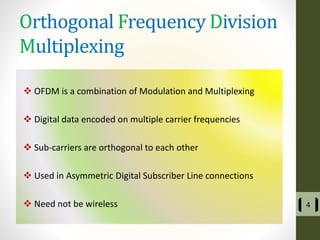
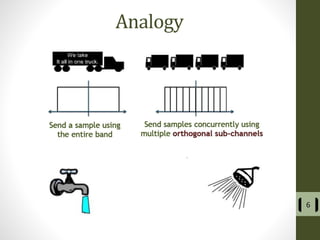
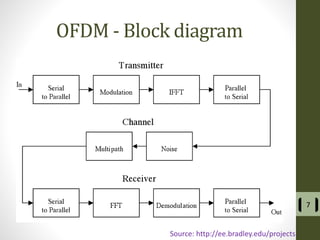
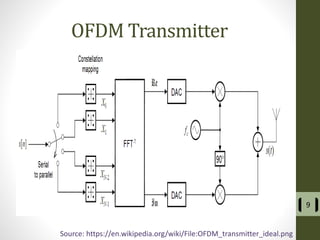
 OFDM is a combination of Modulation and Multiplexing
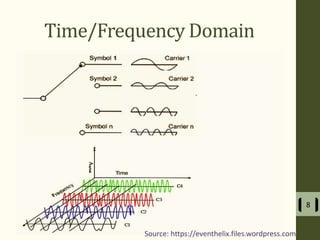
 Digital data encoded on multiple carrier frequencies
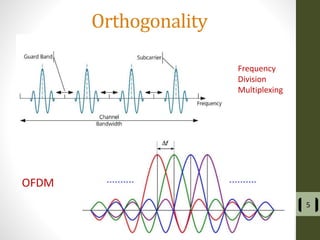
 Sub-carriers are orthogonal to each other
 Used in Asymmetric Digital Subscriber Line connections
 Need not be wireless 4
Orthogonality
5
Frequency
Division
Multiplexing
OFDM
Analogy
6
OFDM - Block diagram
7
Source: http://ee.bradley.edu/projects
Time/Frequency Domain
8
Source: https://eventhelix.files.wordpress.com
OFDM Transmitter
9
Source: https://en.wikipedia.org/wiki/File:OFDM_transmitter_ideal.png
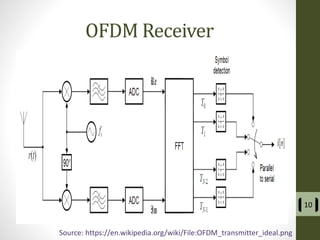
OFDM Receiver
10
Source: https://en.wikipedia.org/wiki/File:OFDM_transmitter_ideal.png
Visible Light Communication
systems
€ Uses visible light between 400 and 800 THz (780–375 nm)
€ Fluorescent lamps ( 10 Kbit/s ) , LEDs ( 500 Mbit/s )
€ Organic LEDs (OLED) as optical transceivers achieve 10 Mbit/s
€ Modulation transforms data into a series of light pulses
€ Frequency of light pulses is modulated & not the frequency of light
11
VLC - Motivation
∞ Visible light does not cause health problems
∞ Expensive patent-license is not needed
∞ No Electromagnetic Interference
∞ Safe to use in hospitals
∞ LEDs -the predominant choice - very short switching time 12
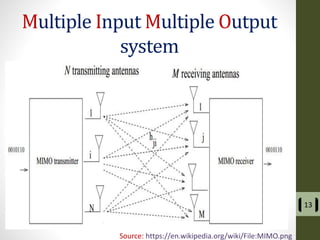
Multiple Input Multiple Output
system
13
Source: https://en.wikipedia.org/wiki/File:MIMO.png
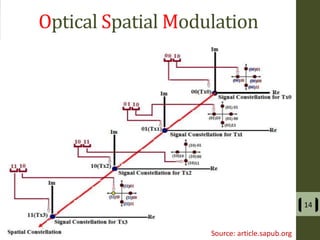
Optical Spatial Modulation
14
Source: article.sapub.org
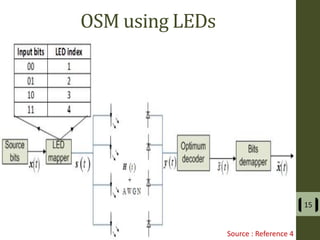
OSM using LEDs
15
Source : Reference 4
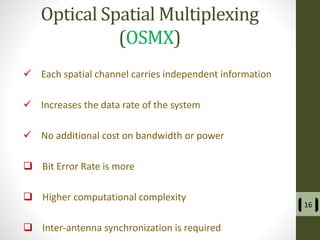
Optical Spatial Multiplexing
(OSMX)
 Each spatial channel carries independent information
 Increases the data rate of the system
 No additional cost on bandwidth or power
 Bit Error Rate is more
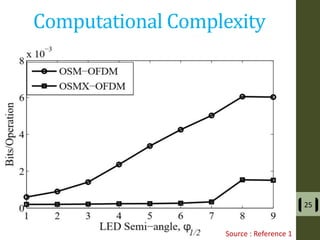
 Higher computational complexity
 Inter-antenna synchronization is required
16
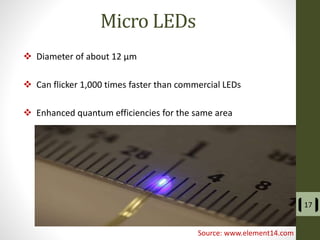
Micro LEDs
 Diameter of about 12 µm
 Can flicker 1,000 times faster than commercial LEDs
 Enhanced quantum efficiencies for the same area
17
Source: www.element14.com
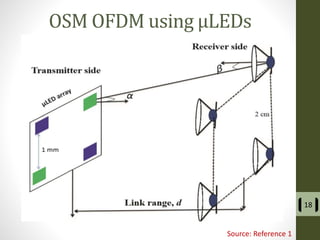
OSM OFDM using µLEDs
18
Source: Reference 1
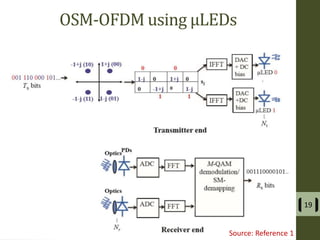
OSM-OFDM using µLEDs
19
Source: Reference 1
OSM OFDM using µLEDs
Vs
OSMX OFDM
20
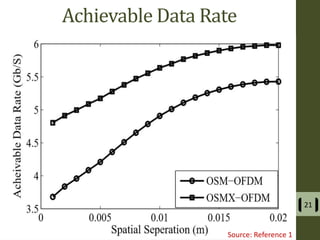
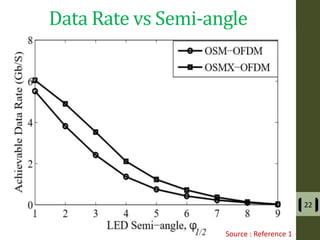
Achievable Data Rate
21
Source: Reference 1
Data Rate vs Semi-angle
22
Source : Reference 1
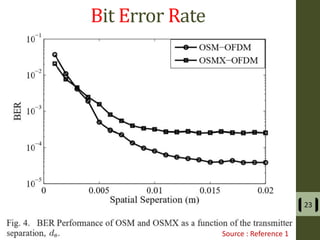
Bit Error Rate
23
Source : Reference 1
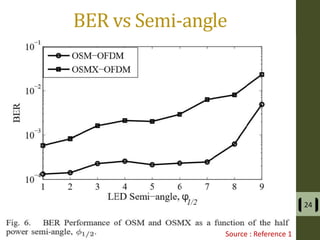
BER vs Semi-angle
24
Source : Reference 1
Computational Complexity
25
Source : Reference 1
Inference
₪ OSM-OFDM using µLEDs
 Better than OSMX-OFDM in terms of computational complexity
 Achieves data rate up to 5.5 Gb/s
₪ OSMX OFDM
 Data rates of up to 6 Gb/s are feasible
₪ BER depends largely on spatial separation between the transmitters(ds)
and on the half- power semi-angle of the µLEDs (φ1/2)
₪ Optimum conditions :- larger spatial separation, a smaller half
power semi-angle
26
References
1. M. Ijaz et al., "Optical spatial modulation OFDM using micro
LEDs," 2014 48th Asilomar Conference on Signals, Systems and
Computers, Pacific Grove, CA, 2014, pp. 1734-1738.
doi: 10.1109/ACSSC.2014.7094764
2. M. Ijaz et al., "Experimental proof-of-concept of optical spatial
modulation OFDM using micro LEDs," 2015 IEEE International
Conference on Communication Workshop (ICCW), London, 2015, pp.
1338-1343.
doi: 10.1109/ICCW.2015.7247364
3. R. Mesleh, H. Elgala and H. Haas, "Optical Spatial Modulation,"
in IEEE/OSA Journal of Optical Communications and Networking,
vol. 3, no. 3, pp. 234-244, March 2011.
doi: 10.1364/JOCN.3.000234
4. R. Mesleh, R. Mehmood, H. Elgala and H. Haas, "Indoor MIMO Optical Wireless
Communication Using Spatial Modulation," Communications (ICC), 2010 IEEE
International Conference on, Cape Town, 2010, pp. 1-5.
doi: 10.1109/ICC.2010.5502062
27
28

Optical Spatial Modulation OFDM using Micro LEDs