siemens.com/smarthospitals
Hospitals harness
­
digitalization to reach
new levels of operational
performance
A smart hospital concept by Siemens
The healthcare sector is no stranger to ­
considerable and diverse ­
pressure.
The ­
recent COVID-19 pandemic has ­
exacerbated these ­
challenges;
capacity has been pushed to extremes, driving ­
traditional infrastructure
and historical ­
processes to their limit. ­
Hospitals are ­
increasingly leveraging
digitalization and technological innovations to build resiliency, enhance
efficiency and meet their strategic objectives.
Siemens ­
engages with hospital executives and health service providers
across the world to gauge the pulse of the evolving smart hospitals ­
market
and identify opportunities that can help ­
executives map their next steps
to a smart hospital.
Content
Hospitals face an array
of operational challenges	 3
Smart hospitals offer a vision
for ­
optimizing ­
multiple aspects
of ­
operational performance	 4
Unlock the full potential
of the smart hospital vision	 7
How to get started with
a smart hospital strategy	 10
Conclusion	 11
2
Hospitals harness IoT to reach new levels of operational performance.
In the process hospitals face a dizzying array of operational challenges.
The white paper explores the vision of a ‘Smart Hospital’ based on the
capability framework it offers in optimizing multiple aspects of operational
performance. The future Smart Hospital increases staff efficiency and
patient well-being which in turn drive the business case.
The white paper explores the options of adding smarter capabilities
in the hospital infrastructure enabled through digitalization.
The white paper finally aims to support you in getting started with your
Smart Hospitals’ strategy.
The healthcare sector is a complex environment that faces a broad spectrum of ­
challenges.
These challenges range from external factors – such as ageing populations, public and political pressures,
and stringent regulatory ­
requirements – to internal factors such as resource constraints, significant staff
shortages and funding challenges.
Hospitals face an array of operational challenges
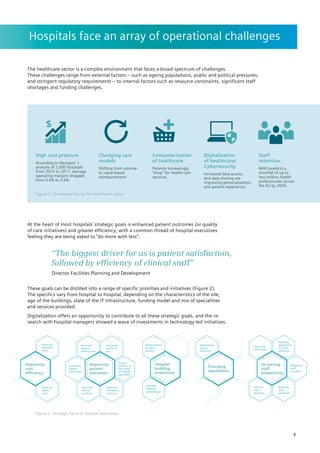
Figure 1: Challenges facing the healthcare sector
At the heart of most hospitals’ strategic goals is enhanced patient outcomes (or quality
of care initiatives) and greater efficiency, with a common thread of hospital executives
feeling they are being asked to “do more with less”.
These goals can be distilled into a range of specific priorities and initiatives (Figure 2).
The specifics vary from hospital to hospital, depending on the characteristics of the site,
age of the buildings, state of the IT infrastructure, funding model and mix of specialities
and services provided.
Digitalization offers an opportunity to contribute to all these strategic goals, and the re-
search with hospital managers showed a wave of investments in technology-led initiatives.
Figure 2: Strategic focus of hospital executives
“The biggest driver for us is patient satisfaction,
followed by efficiency of clinical staff”
Director Facilities Planning and Development
High cost pressure
According to Navigant`s
analysis of 2,000 hospitals
from 2015 to 2017, average
operating margins dropped
from 5.6% to 3.6%.
Changing care
models
Shifting from volume-
to value-based
reimbursement
Consumerization
of healthcare
Patients increasingly
“shop” for health care
services.
Digitalization
of healthcare/
Cybersecurity
lncreased data access
and data sharing are
improving personalization,
and patient experience.
Staff
retention
WHO predicts a
shortfall of up to
two million health
professionals across
the EU by 2020.
Reducing
operating
costs
Reducing
labour
costs
Improving
cost
efficiency
Reducing
patient
waiting time
Improving
quality of
care
Putting
patients at
the center
of hospital
operations
Increasing
patient
satisfaction
Reducing
patient
accidents
Speed up
emergency
response
Improving
patient
outcomes
Modernization
of legacy
systems
Non-BMS
networks
(LoRa/Sigfox)
Hospital
building
extensions
Emphasizing
energy
efficiency
Changing
regulations
Improving
staff safety
Adopting
digital tools
for staff
efficiency
Mitigating
staff
accidents
Tackling
staff
shortage
Reducing
staff
workload
Increasing
staff
productivity
3
Smart hospitals offer a vision for ­
optimizing
­
multiple aspects of ­
operational performance
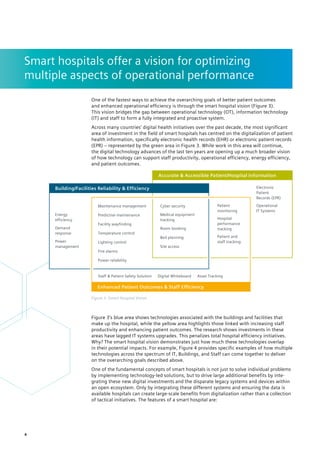
Figure 3’s blue area shows technologies associated with the buildings and facilities that
make up the hospital, while the yellow area highlights those linked with increasing staff
productivity and enhancing patient outcomes. The research shows investments in these
areas have lagged IT systems upgrades. This penalizes total hospital efficiency initiatives.
Why? The smart hospital vision demonstrates just how much these technologies overlap
in their potential impacts. For example, Figure 4 provides specific examples of how multiple
technologies across the spectrum of IT, Buildings, and Staff can come together to deliver
on the overarching goals described above.
One of the fundamental concepts of smart hospitals is not just to solve individual problems
by implementing technology-led solutions, but to drive large additional benefits by inte-
grating these new digital investments and the disparate legacy systems and devices within
an open ecosystem. Only by integrating these different systems and ensuring the data is
available hospitals can create large-scale benefits from digitalization rather than a collection
of tactical initiatives. The features of a smart hospital are:
Energy
efficiency
Electronic
Patient
Records (EPR)
Predictive maintenance
Lighting control
Power reliability
Temperature control
Fire alarms
Facility wayfinding
Maintenance management Cyber security
Medical equipment
tracking
Room booking
Bed planning
Site access
Demand
response
Operational
IT Systems
Patient
monitoring
Hospital
performance
tracking
Patient and
staff tracking
Asset Tracking
Digital Whiteboard
Staff & Patient Safety Solution
Power
management
Building/Facilities Reliability & Efficiency
Accurate & Accessible Patient/Hospital Information
Enhanced Patient Outcomes & Staff Efficiency
One of the fastest ways to achieve the overarching goals of better patient outcomes
and enhanced operational efficiency is through the smart hospital vision (Figure 3).
This vision bridges the gap between operational technology (OT), information technology
(IT) and staff to form a fully integrated and proactive system.
Across many countries’ digital health initiatives over the past decade, the most significant
area of investment in the field of smart hospitals has centred on the digitalization of patient
health information, specifically electronic health records (EHR) or electronic patient records
(EPR) – represented by the green area in Figure 3. While work in this area will continue,
the digital technology advances of the last ten years are opening up a much broader vision
of how technology can support staff productivity, operational efficiency, energy efficiency,
and patient outcomes.
Figure 3: Smart Hospital Vision
4
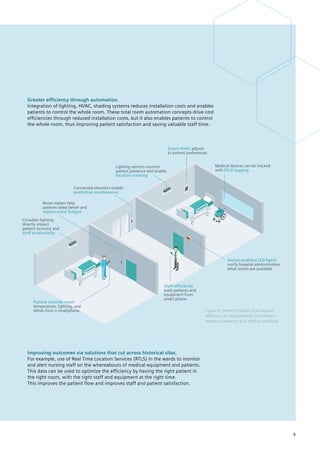
Greater efficiency through automation.
Integration of lighting, HVAC, shading systems reduces installation costs and enables
patients to control the whole room. These total room automation concepts drive cost
efficiencies through reduced installation costs, but it also enables patients to control
the whole room, thus improving patient satisfaction and saving valuable staff time.
Improving outcomes via solutions that cut across historical silos.
For example, use of Real Time Location Services (RTLS) in the wards to monitor
and alert nursing staff on the whereabouts of medical equipment and patients.
This data can be used to optimize the efficiency by having the right patient in
the right room, with the right staff and equipment at the right time.
This improves the patient flow and improves staff and patient satisfaction.
Figure 4: Smart hospitals look beyond
efficiency for opportunities to enhance
patient experience and staff productivity
Connected elevators enable
predictive maintenance
Lighting sensors monitor
patient presence and enable
location tracking
Smart HVAC adjusts
to patient preferences
Medical devices can be tracked
with RTLS tagging
Noise meters help
patients sleep better and
reduce noise fatigue
Circadian lighting
directly impact
patient recovery and
staff productivity
Patient controls room
temperature, lighting, and
blinds from a smartphone
Sensor-enabled LED lights
notify hospital administrators
what rooms are available
Staff efficiently
track patients and
equipment from
smart phone
5
Leveraging data (from multiple sources) to gain maximum value from the
underlying technology.
For example, medical equipment can continuously monitor patient vital signs and
feed that information into both EPRs and digital whiteboards. Leading indicators can
be built from all the data, and the software can push alerts to nurses in the case of
an emergency.
Overcoming technological choke points in a way that is scalable.
Hospitals are installing Internet of Things (IoT) sensors on a long range low power
(e.g. LoRa) network to complement data collection. In the first instance this is often
done for regulatory purposes, but it is easily scalable to collect other data in the future.
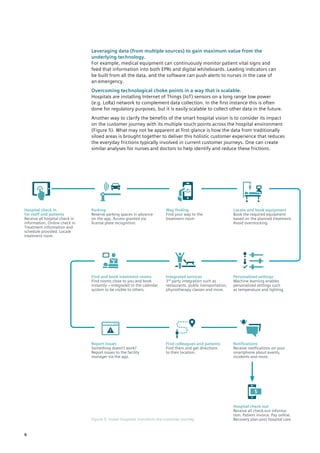
Another way to clarify the benefits of the smart hospital vision is to consider its impact
on the customer journey with its multiple touch points across the hospital environment
(Figure 5). What may not be ­
apparent at first glance is how the data from traditionally
siloed areas is brought together to deliver this holistic customer experience that reduces
the everyday frictions typically involved in current customer journeys. One can create
similar analyses for nurses and doctors to help identify and reduce these frictions.
Figure 5: Smart hospitals transform the customer journey
Hospital check in
for staff and patients
Receive all hospital check in
information. Online check in.
Treatment information and
schedule provided. Locate
­treatment room.
Report issues
Something doesn’t work?
Report issues to the facility
manager via the app.
Parking
Reserve parking spaces in advance
on the app. Access granted via
license plate recognition.
Find colleagues and patients
Find them and get directions
to their location.
Way finding
Find your way to the
treatment room
Notifications
Receive notifications on your
smartphone about events,
incidents and more.
Locate and book equipment
Book the required equipment
based on the planned treatment.
Avoid overstocking.
Hospital check-out
Receive all check-out informa-
tion. Patient invoice. Pay online.
Recovery plan post hospital care.
Personalized settings
Machine learning enables
personalized settings such
as temperature and lighting.
Integrated services
3rd
party integration such as
restaurants, public transportation,
physiotherapy classes and more.
Find and book treatment rooms
Find rooms close to you and book
instantly – integrated to the calendar
system to be visible to others.
6
“We want patients to have control over lighting and temperature
as this helps for creating a healing environment. We have ­
capital
spend allocated to this.”
Energy Manager
Unlock the full potential
of the smart hospital vision
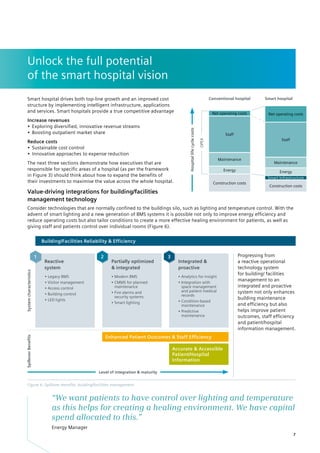
Building/Facilities Reliability & Efficiency
Reactive
system
Partially optimized
& integrated
Integrated &
proactive
• Legacy BMS
• Visitor management
• Access control
• Building control
• LED lights
• Modern BMS
• 
CMMS for planned
maintenance
• 
Fire alarms and
security systems
• Smart lighting
• Analytics for insight
• 
Integration with
space management
and patient medical
records
• Condition-based
­maintenance
• Predictive ­
maintenance
System
characteristics
Spillover
Benefits
Accurate  Accessible
Patient/Hospital
­Information
Enhanced Patient Outcomes  Staff Efficiency
Progressing from
a reactive operational
technology system
for building/ facilities
management to an
integrated and proactive
system not only enhances
building maintenance
and efficiency but also
helps improve patient
outcomes, staff efficiency
and patient/hospital
information management.
2
1 3
Level of integration  maturity
Smart hospital drives both top-line growth and an improved cost
structure by implementing intelligent infrastructure, applications
and services. Smart hospitals provide a true competitive advantage
Increase revenues
•	 Exploring diversified, innovative revenue streams
•	 Boosting outpatient market share
Reduce costs
•	 Sustainable cost control
•	 Innovative approaches to expense reduction
The next three sections demonstrate how executives that are
responsible for specific areas of a hospital (as per the framework
in Figure 3) should think about how to expand the benefits of
their investments to maximise the value across the whole hospital.
Value-driving integrations for building/facilities
­management technology
Consider technologies that are normally confined to the buildings silo, such as lighting and temperature control. With the
advent of smart lighting and a new generation of BMS systems it is possible not only to improve energy efficiency and
reduce operating costs but also tailor conditions to create a more effective healing environment for patients, as well as
giving staff and patients control over individual rooms (Figure 6).
Construction costs
Energy
Maintenance
Staff
Net operating costs
Construction costs
Energy
Smart Infrastructure
Maintenance
Staff
Net operating costs
Hospital
life
cycle
costs
Conventional hospital Smart hospital
OPEX
Figure 6: Spillover benefits: building/facilities management
7
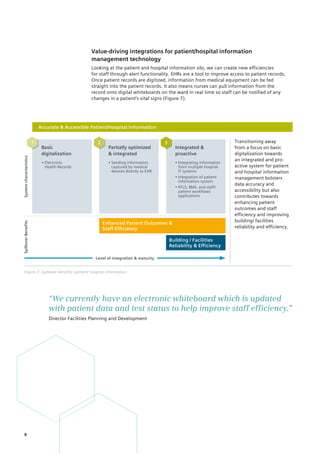
Value-driving integrations for patient/hospital information ­
management technology
Looking at the patient and hospital information silo, we can create new efficiencies
for staff through alert functionality. EHRs are a tool to improve access to patient records.
Once patient records are digitized, information from medical equipment can be fed
straight into the patient records. It also means nurses can pull information from the
record onto digital whiteboards on the ward in real time so staff can be notified of any
changes in a patient’s vital signs (Figure 7).
“We currently have an electronic whiteboard which is updated
with patient data and test status to help improve staff efficiency.”
Director Facilities Planning and Development
Figure 7: Spillover benefits: patient/ hospital information
Accurate  Accessible Patient/Hospital Information
Basic
digitalization
Partially optimized
 integrated
Integrated 
proactive
• Electronic
Health Records
• 
Sending information
captured by medical
devices directly to EHR
• 
Integrating information
from multiple hospital
IT systems
• 
Integration of patient
information system
• 
RTLS, BMS, and staff/
patient workflows
applications
System
characteristics
Spillover
Benefits
Building / Facilities
Reliability  Efficiency
Enhanced Patient Outcomes 
Staff Efficiency
Transitioning away
from a focus on basic
digitalization towards
an ­
integrated and pro­
active system for patient
and hospital information
management bolsters
data accuracy and
­
accessibility but also
contri­butes towards
enhancing patient
­
outcomes and staff
­efficiency and ­improving
building/ facilities
­
reliability and efficiency.
2
1 3
Level of integration  maturity
8
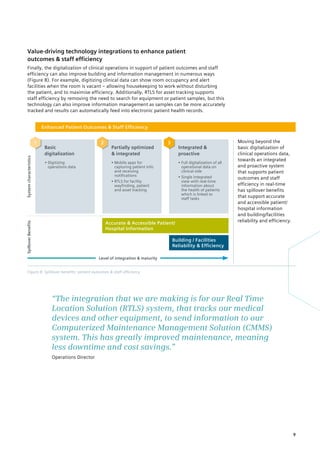
Figure 8: Spillover benefits: patient outcomes  staff efficiency
Enhanced Patient Outcomes  Staff Efficiency
Basic
digitalization
Partially optimized
 integrated
Integrated 
proactive
• Digitizing
operations data
• 
Mobile apps for
capturing patient info
and receiving
notifications
• 
RTLS for facility
wayfinding, patient
and asset tracking
• 
Full digitalization of all
operational data on
clinical side
• 
Single integrated
view with real-time
information about
the health of patients
which is linked to
staff tasks
System
characteristics
Spillover
Benefits
Building / Facilities
Reliability  Efficiency
Accurate  Accessible Patient/
Hospital Information
Moving beyond the
basic digitalization of
clinical operations data,
towards an integrated
and proactive system
that supports patient
outcomes and staff
­
efficiency in real-time
has spillover benefits
that support accurate
and accessible patient/
hospital information
and building/facilities
reliability and efficiency.
2
1 3
Level of integration  maturity
Value-driving technology integrations to enhance patient
outcomes  staff efficiency
Finally, the digitalization of clinical operations in support of patient outcomes and staff
efficiency can also improve building and information management in numerous ways
(Figure 8). For example, digitizing clinical data can show room occupancy and alert
­
facilities when the room is vacant – allowing housekeeping to work without disturbing
the ­
patient, and to maximise efficiency. Additionally, RTLS for asset tracking supports
staff efficiency by removing the need to search for equipment or patient samples, but this
technology can also improve information management as samples can be more accurately
tracked and results can automatically feed into electronic patient health records.
“The integration that we are making is for our Real Time
­
Location Solution (RTLS) system, that tracks our medical
devices and other equipment, to send information to our
­
Computerized Maintenance Management Solution (CMMS)
­
system. This has greatly improved maintenance, meaning
less downtime and cost savings.”
Operations Director
9
How to get started with a smart hospital strategy
To challenge investment decisions and garner momentum towards the smart hospital
vision, there are several key actions to consider:
Develop a multi-stakeholder group to manage and drive the smart hospital initiative.
The smart hospital vision has touch points across the hospital operating environment, and
there is typically no single function that would own the smart hospital agenda. Work to
establish a multi-disciplinary project team that helps individuals break out of the silo-men-
tality and understand the dynamics across the entire hospital ecosystem. Common stake-
holders include staff across the medical, nursing, facilities management, IT, and finance
functions. In the case of one hospital in the research, the stakeholders also included the
external doctors that were referring patients to the hospital—creating more visibility into
schedules for them removed some frictions for patients in the end-to-end process.
Clearly understand the hospital’s current state in terms of technological and
process constraints
The constraints faced by a hospital play a significant role in determining the appropriate
and feasible level of investment. Hospital executives should audit and map out the OT and
IT stacks and understand current network architecture and capabilities. It is also crucial to
understand the regulatory landscape which may inhibit certain investments. For example,
in Germany, regulations prohibit certain data integrations with patient health information,
which inhibits the ability to fully integrate patient, equipment and building information and
limits data sharing across stakeholder groups. Similarly, some hospitals avoid integrations
between some building and clinical systems, patient privacy, and cybersecurity reasons.
Focus on outcome-based solutions that mitigate key pain points.
Every hospital is unique with its own set of pain points, constraints and strategic objectives.
Engage hospital stakeholders to understand the key challenges and pain points across
hospital operations and how these factors map to priority outcomes such as decreasing
operating costs, reducing patient accidents, or dealing with staff shortages. Perform a
prioritization exercise of these pain points and objectives to help focus investment deci-
sions and identify relevant technologies that would mitigate the high-impact challenges
and support key objectives.
“We have adopted an RTLS solution that has a number of
­
benefits, but it helped us address a big problem relating to
staff safety.”
Medical Director
10
Evaluate solutions that have demonstrable value across multiple areas and
support process re-engineering
As shown in this white paper, demonstrating the spillover benefits of technology
­
investments can dramatically strengthen the business case. But it is not just about
what technology is used, but how it is being used to alter existing processes and improve
efficiencies. For example, RTLS system in combination with Automated Guide Vehicles
(AGVs) is utilized by some smart hospitals to reduce the need for porters to manually trans-
port deliveries. Nurses can monitor the exact location of ordered goods and mobile equip-
ment within the hospital, which improves staff efficiency and reduces the ­
opportunity for
human error. Technology here has been used to drive efficiencies through process
re-engineering.
Futureproof investments by ensuring solutions are scalable and can support
future integrations
Hospital are 24/7 facilities that cannot be shut down for major system and infrastructure
upgrades. Furthermore, limited budgets typically prevent hospitals from doing a complete
upgrade at one time. Consider the sequencing of investments and prioritize open systems
that can form the foundation of the smart hospital, overcome legacy integration issues and
support future investments.
Progressing on the next steps towards a smart hospital may seem complex,
but this approach helps hospital executives garner significant momentum ­
towards their overarching strategic goals. By targeting investments and ­
developing open and proactive technology ecosystems, the tangible benefits
of the smart hospital vision can be truly realized. In Siemens you have a
trusted partner, one who understands the value of a smart hospital.
With more than a century of managing building and energy performance,
we know how to create environments that care for organizations of all types.
It is our mission, and our strength. Whether you are starting with new con-
struction or existing infrastructure, we can help you get started on the path
to a smart hospital today. Tomorrow is closer than you think.
The era of the smart hospital has just begun.
Conclusion
11
Research by Verdantix
Verdantix is an independent research and consulting
firm with a focus on innovative technologies that
optimize business operations. With expertise in
­
environment, health and safety, operational excellence
and smart buildings, we help corporate managers,
­
investors, technology executives and leaders make
robust, evidence-based decisions. The smart building
­
practice produces research on technologies to enhance
the performance of buildings from energy efficiency
to occupant productivity.
Published by
Siemens Switzerland Ltd
Smart Infrastructure
Global Headquarters
Theilerstrasse 1a
6300 Zug
Switzerland
Tel. +41 58 724 24 24
For the U.S. published by
Siemens Industry Inc.
100 Technology Drive
Alpharetta, GA 30005
United States
Article no. SI_0193_EN (Status 10/2020)
Subject to changes and errors. The information given in
this document only contains general descriptions and/or
performance features which may not always specifically
reflect those described, or which may undergo modification
in the course of further development of the products.
The requested performance features are binding only when
they are expressly agreed upon in the concluded contract.
© Siemens 2020
Smart Infrastructure intelligently connects
energy systems, buildings and industries to
adapt and evolve the way we live and work.
We work together with customers and partners
to create an ecosystem that intuitively responds
to the needs of people and helps customers
to better use resources.
It helps our customers to thrive, communities
to progress and supports sustainable
development.
Creating environments that care.
siemens.com/smart-infrastructure

Opinion_Paper_Smart_Hospitals_US_201022.pdf

  • 1.
    siemens.com/smarthospitals Hospitals harness ­ digitalization toreach new levels of operational performance A smart hospital concept by Siemens
  • 2.
    The healthcare sectoris no stranger to ­ considerable and diverse ­ pressure. The ­ recent COVID-19 pandemic has ­ exacerbated these ­ challenges; capacity has been pushed to extremes, driving ­ traditional infrastructure and historical ­ processes to their limit. ­ Hospitals are ­ increasingly leveraging digitalization and technological innovations to build resiliency, enhance efficiency and meet their strategic objectives. Siemens ­ engages with hospital executives and health service providers across the world to gauge the pulse of the evolving smart hospitals ­ market and identify opportunities that can help ­ executives map their next steps to a smart hospital. Content Hospitals face an array of operational challenges 3 Smart hospitals offer a vision for ­ optimizing ­ multiple aspects of ­ operational performance 4 Unlock the full potential of the smart hospital vision 7 How to get started with a smart hospital strategy 10 Conclusion 11 2 Hospitals harness IoT to reach new levels of operational performance. In the process hospitals face a dizzying array of operational challenges. The white paper explores the vision of a ‘Smart Hospital’ based on the capability framework it offers in optimizing multiple aspects of operational performance. The future Smart Hospital increases staff efficiency and patient well-being which in turn drive the business case. The white paper explores the options of adding smarter capabilities in the hospital infrastructure enabled through digitalization. The white paper finally aims to support you in getting started with your Smart Hospitals’ strategy.
  • 3.
    The healthcare sectoris a complex environment that faces a broad spectrum of ­ challenges. These challenges range from external factors – such as ageing populations, public and political pressures, and stringent regulatory ­ requirements – to internal factors such as resource constraints, significant staff shortages and funding challenges. Hospitals face an array of operational challenges Figure 1: Challenges facing the healthcare sector At the heart of most hospitals’ strategic goals is enhanced patient outcomes (or quality of care initiatives) and greater efficiency, with a common thread of hospital executives feeling they are being asked to “do more with less”. These goals can be distilled into a range of specific priorities and initiatives (Figure 2). The specifics vary from hospital to hospital, depending on the characteristics of the site, age of the buildings, state of the IT infrastructure, funding model and mix of specialities and services provided. Digitalization offers an opportunity to contribute to all these strategic goals, and the re- search with hospital managers showed a wave of investments in technology-led initiatives. Figure 2: Strategic focus of hospital executives “The biggest driver for us is patient satisfaction, followed by efficiency of clinical staff” Director Facilities Planning and Development High cost pressure According to Navigant`s analysis of 2,000 hospitals from 2015 to 2017, average operating margins dropped from 5.6% to 3.6%. Changing care models Shifting from volume- to value-based reimbursement Consumerization of healthcare Patients increasingly “shop” for health care services. Digitalization of healthcare/ Cybersecurity lncreased data access and data sharing are improving personalization, and patient experience. Staff retention WHO predicts a shortfall of up to two million health professionals across the EU by 2020. Reducing operating costs Reducing labour costs Improving cost efficiency Reducing patient waiting time Improving quality of care Putting patients at the center of hospital operations Increasing patient satisfaction Reducing patient accidents Speed up emergency response Improving patient outcomes Modernization of legacy systems Non-BMS networks (LoRa/Sigfox) Hospital building extensions Emphasizing energy efficiency Changing regulations Improving staff safety Adopting digital tools for staff efficiency Mitigating staff accidents Tackling staff shortage Reducing staff workload Increasing staff productivity 3
  • 4.
    Smart hospitals offera vision for ­ optimizing ­ multiple aspects of ­ operational performance Figure 3’s blue area shows technologies associated with the buildings and facilities that make up the hospital, while the yellow area highlights those linked with increasing staff productivity and enhancing patient outcomes. The research shows investments in these areas have lagged IT systems upgrades. This penalizes total hospital efficiency initiatives. Why? The smart hospital vision demonstrates just how much these technologies overlap in their potential impacts. For example, Figure 4 provides specific examples of how multiple technologies across the spectrum of IT, Buildings, and Staff can come together to deliver on the overarching goals described above. One of the fundamental concepts of smart hospitals is not just to solve individual problems by implementing technology-led solutions, but to drive large additional benefits by inte- grating these new digital investments and the disparate legacy systems and devices within an open ecosystem. Only by integrating these different systems and ensuring the data is available hospitals can create large-scale benefits from digitalization rather than a collection of tactical initiatives. The features of a smart hospital are: Energy efficiency Electronic Patient Records (EPR) Predictive maintenance Lighting control Power reliability Temperature control Fire alarms Facility wayfinding Maintenance management Cyber security Medical equipment tracking Room booking Bed planning Site access Demand response Operational IT Systems Patient monitoring Hospital performance tracking Patient and staff tracking Asset Tracking Digital Whiteboard Staff & Patient Safety Solution Power management Building/Facilities Reliability & Efficiency Accurate & Accessible Patient/Hospital Information Enhanced Patient Outcomes & Staff Efficiency One of the fastest ways to achieve the overarching goals of better patient outcomes and enhanced operational efficiency is through the smart hospital vision (Figure 3). This vision bridges the gap between operational technology (OT), information technology (IT) and staff to form a fully integrated and proactive system. Across many countries’ digital health initiatives over the past decade, the most significant area of investment in the field of smart hospitals has centred on the digitalization of patient health information, specifically electronic health records (EHR) or electronic patient records (EPR) – represented by the green area in Figure 3. While work in this area will continue, the digital technology advances of the last ten years are opening up a much broader vision of how technology can support staff productivity, operational efficiency, energy efficiency, and patient outcomes. Figure 3: Smart Hospital Vision 4
  • 5.
    Greater efficiency throughautomation. Integration of lighting, HVAC, shading systems reduces installation costs and enables patients to control the whole room. These total room automation concepts drive cost efficiencies through reduced installation costs, but it also enables patients to control the whole room, thus improving patient satisfaction and saving valuable staff time. Improving outcomes via solutions that cut across historical silos. For example, use of Real Time Location Services (RTLS) in the wards to monitor and alert nursing staff on the whereabouts of medical equipment and patients. This data can be used to optimize the efficiency by having the right patient in the right room, with the right staff and equipment at the right time. This improves the patient flow and improves staff and patient satisfaction. Figure 4: Smart hospitals look beyond efficiency for opportunities to enhance patient experience and staff productivity Connected elevators enable predictive maintenance Lighting sensors monitor patient presence and enable location tracking Smart HVAC adjusts to patient preferences Medical devices can be tracked with RTLS tagging Noise meters help patients sleep better and reduce noise fatigue Circadian lighting directly impact patient recovery and staff productivity Patient controls room temperature, lighting, and blinds from a smartphone Sensor-enabled LED lights notify hospital administrators what rooms are available Staff efficiently track patients and equipment from smart phone 5
  • 6.
    Leveraging data (frommultiple sources) to gain maximum value from the underlying technology. For example, medical equipment can continuously monitor patient vital signs and feed that information into both EPRs and digital whiteboards. Leading indicators can be built from all the data, and the software can push alerts to nurses in the case of an emergency. Overcoming technological choke points in a way that is scalable. Hospitals are installing Internet of Things (IoT) sensors on a long range low power (e.g. LoRa) network to complement data collection. In the first instance this is often done for regulatory purposes, but it is easily scalable to collect other data in the future. Another way to clarify the benefits of the smart hospital vision is to consider its impact on the customer journey with its multiple touch points across the hospital environment (Figure 5). What may not be ­ apparent at first glance is how the data from traditionally siloed areas is brought together to deliver this holistic customer experience that reduces the everyday frictions typically involved in current customer journeys. One can create similar analyses for nurses and doctors to help identify and reduce these frictions. Figure 5: Smart hospitals transform the customer journey Hospital check in for staff and patients Receive all hospital check in information. Online check in. Treatment information and schedule provided. Locate ­treatment room. Report issues Something doesn’t work? Report issues to the facility manager via the app. Parking Reserve parking spaces in advance on the app. Access granted via license plate recognition. Find colleagues and patients Find them and get directions to their location. Way finding Find your way to the treatment room Notifications Receive notifications on your smartphone about events, incidents and more. Locate and book equipment Book the required equipment based on the planned treatment. Avoid overstocking. Hospital check-out Receive all check-out informa- tion. Patient invoice. Pay online. Recovery plan post hospital care. Personalized settings Machine learning enables personalized settings such as temperature and lighting. Integrated services 3rd party integration such as restaurants, public transportation, physiotherapy classes and more. Find and book treatment rooms Find rooms close to you and book instantly – integrated to the calendar system to be visible to others. 6
  • 7.
    “We want patientsto have control over lighting and temperature as this helps for creating a healing environment. We have ­ capital spend allocated to this.” Energy Manager Unlock the full potential of the smart hospital vision Building/Facilities Reliability & Efficiency Reactive system Partially optimized & integrated Integrated & proactive • Legacy BMS • Visitor management • Access control • Building control • LED lights • Modern BMS • CMMS for planned maintenance • Fire alarms and security systems • Smart lighting • Analytics for insight • Integration with space management and patient medical records • Condition-based ­maintenance • Predictive ­ maintenance System characteristics Spillover Benefits Accurate Accessible Patient/Hospital ­Information Enhanced Patient Outcomes Staff Efficiency Progressing from a reactive operational technology system for building/ facilities management to an integrated and proactive system not only enhances building maintenance and efficiency but also helps improve patient outcomes, staff efficiency and patient/hospital information management. 2 1 3 Level of integration maturity Smart hospital drives both top-line growth and an improved cost structure by implementing intelligent infrastructure, applications and services. Smart hospitals provide a true competitive advantage Increase revenues • Exploring diversified, innovative revenue streams • Boosting outpatient market share Reduce costs • Sustainable cost control • Innovative approaches to expense reduction The next three sections demonstrate how executives that are responsible for specific areas of a hospital (as per the framework in Figure 3) should think about how to expand the benefits of their investments to maximise the value across the whole hospital. Value-driving integrations for building/facilities ­management technology Consider technologies that are normally confined to the buildings silo, such as lighting and temperature control. With the advent of smart lighting and a new generation of BMS systems it is possible not only to improve energy efficiency and reduce operating costs but also tailor conditions to create a more effective healing environment for patients, as well as giving staff and patients control over individual rooms (Figure 6). Construction costs Energy Maintenance Staff Net operating costs Construction costs Energy Smart Infrastructure Maintenance Staff Net operating costs Hospital life cycle costs Conventional hospital Smart hospital OPEX Figure 6: Spillover benefits: building/facilities management 7
  • 8.
    Value-driving integrations forpatient/hospital information ­ management technology Looking at the patient and hospital information silo, we can create new efficiencies for staff through alert functionality. EHRs are a tool to improve access to patient records. Once patient records are digitized, information from medical equipment can be fed straight into the patient records. It also means nurses can pull information from the record onto digital whiteboards on the ward in real time so staff can be notified of any changes in a patient’s vital signs (Figure 7). “We currently have an electronic whiteboard which is updated with patient data and test status to help improve staff efficiency.” Director Facilities Planning and Development Figure 7: Spillover benefits: patient/ hospital information Accurate Accessible Patient/Hospital Information Basic digitalization Partially optimized integrated Integrated proactive • Electronic Health Records • Sending information captured by medical devices directly to EHR • Integrating information from multiple hospital IT systems • Integration of patient information system • RTLS, BMS, and staff/ patient workflows applications System characteristics Spillover Benefits Building / Facilities Reliability Efficiency Enhanced Patient Outcomes Staff Efficiency Transitioning away from a focus on basic digitalization towards an ­ integrated and pro­ active system for patient and hospital information management bolsters data accuracy and ­ accessibility but also contri­butes towards enhancing patient ­ outcomes and staff ­efficiency and ­improving building/ facilities ­ reliability and efficiency. 2 1 3 Level of integration maturity 8
  • 9.
    Figure 8: Spilloverbenefits: patient outcomes staff efficiency Enhanced Patient Outcomes Staff Efficiency Basic digitalization Partially optimized integrated Integrated proactive • Digitizing operations data • Mobile apps for capturing patient info and receiving notifications • RTLS for facility wayfinding, patient and asset tracking • Full digitalization of all operational data on clinical side • Single integrated view with real-time information about the health of patients which is linked to staff tasks System characteristics Spillover Benefits Building / Facilities Reliability Efficiency Accurate Accessible Patient/ Hospital Information Moving beyond the basic digitalization of clinical operations data, towards an integrated and proactive system that supports patient outcomes and staff ­ efficiency in real-time has spillover benefits that support accurate and accessible patient/ hospital information and building/facilities reliability and efficiency. 2 1 3 Level of integration maturity Value-driving technology integrations to enhance patient outcomes staff efficiency Finally, the digitalization of clinical operations in support of patient outcomes and staff efficiency can also improve building and information management in numerous ways (Figure 8). For example, digitizing clinical data can show room occupancy and alert ­ facilities when the room is vacant – allowing housekeeping to work without disturbing the ­ patient, and to maximise efficiency. Additionally, RTLS for asset tracking supports staff efficiency by removing the need to search for equipment or patient samples, but this technology can also improve information management as samples can be more accurately tracked and results can automatically feed into electronic patient health records. “The integration that we are making is for our Real Time ­ Location Solution (RTLS) system, that tracks our medical devices and other equipment, to send information to our ­ Computerized Maintenance Management Solution (CMMS) ­ system. This has greatly improved maintenance, meaning less downtime and cost savings.” Operations Director 9
  • 10.
    How to getstarted with a smart hospital strategy To challenge investment decisions and garner momentum towards the smart hospital vision, there are several key actions to consider: Develop a multi-stakeholder group to manage and drive the smart hospital initiative. The smart hospital vision has touch points across the hospital operating environment, and there is typically no single function that would own the smart hospital agenda. Work to establish a multi-disciplinary project team that helps individuals break out of the silo-men- tality and understand the dynamics across the entire hospital ecosystem. Common stake- holders include staff across the medical, nursing, facilities management, IT, and finance functions. In the case of one hospital in the research, the stakeholders also included the external doctors that were referring patients to the hospital—creating more visibility into schedules for them removed some frictions for patients in the end-to-end process. Clearly understand the hospital’s current state in terms of technological and process constraints The constraints faced by a hospital play a significant role in determining the appropriate and feasible level of investment. Hospital executives should audit and map out the OT and IT stacks and understand current network architecture and capabilities. It is also crucial to understand the regulatory landscape which may inhibit certain investments. For example, in Germany, regulations prohibit certain data integrations with patient health information, which inhibits the ability to fully integrate patient, equipment and building information and limits data sharing across stakeholder groups. Similarly, some hospitals avoid integrations between some building and clinical systems, patient privacy, and cybersecurity reasons. Focus on outcome-based solutions that mitigate key pain points. Every hospital is unique with its own set of pain points, constraints and strategic objectives. Engage hospital stakeholders to understand the key challenges and pain points across hospital operations and how these factors map to priority outcomes such as decreasing operating costs, reducing patient accidents, or dealing with staff shortages. Perform a prioritization exercise of these pain points and objectives to help focus investment deci- sions and identify relevant technologies that would mitigate the high-impact challenges and support key objectives. “We have adopted an RTLS solution that has a number of ­ benefits, but it helped us address a big problem relating to staff safety.” Medical Director 10
  • 11.
    Evaluate solutions thathave demonstrable value across multiple areas and support process re-engineering As shown in this white paper, demonstrating the spillover benefits of technology ­ investments can dramatically strengthen the business case. But it is not just about what technology is used, but how it is being used to alter existing processes and improve efficiencies. For example, RTLS system in combination with Automated Guide Vehicles (AGVs) is utilized by some smart hospitals to reduce the need for porters to manually trans- port deliveries. Nurses can monitor the exact location of ordered goods and mobile equip- ment within the hospital, which improves staff efficiency and reduces the ­ opportunity for human error. Technology here has been used to drive efficiencies through process re-engineering. Futureproof investments by ensuring solutions are scalable and can support future integrations Hospital are 24/7 facilities that cannot be shut down for major system and infrastructure upgrades. Furthermore, limited budgets typically prevent hospitals from doing a complete upgrade at one time. Consider the sequencing of investments and prioritize open systems that can form the foundation of the smart hospital, overcome legacy integration issues and support future investments. Progressing on the next steps towards a smart hospital may seem complex, but this approach helps hospital executives garner significant momentum ­ towards their overarching strategic goals. By targeting investments and ­ developing open and proactive technology ecosystems, the tangible benefits of the smart hospital vision can be truly realized. In Siemens you have a trusted partner, one who understands the value of a smart hospital. With more than a century of managing building and energy performance, we know how to create environments that care for organizations of all types. It is our mission, and our strength. Whether you are starting with new con- struction or existing infrastructure, we can help you get started on the path to a smart hospital today. Tomorrow is closer than you think. The era of the smart hospital has just begun. Conclusion 11
  • 12.
    Research by Verdantix Verdantixis an independent research and consulting firm with a focus on innovative technologies that optimize business operations. With expertise in ­ environment, health and safety, operational excellence and smart buildings, we help corporate managers, ­ investors, technology executives and leaders make robust, evidence-based decisions. The smart building ­ practice produces research on technologies to enhance the performance of buildings from energy efficiency to occupant productivity. Published by Siemens Switzerland Ltd Smart Infrastructure Global Headquarters Theilerstrasse 1a 6300 Zug Switzerland Tel. +41 58 724 24 24 For the U.S. published by Siemens Industry Inc. 100 Technology Drive Alpharetta, GA 30005 United States Article no. SI_0193_EN (Status 10/2020) Subject to changes and errors. The information given in this document only contains general descriptions and/or performance features which may not always specifically reflect those described, or which may undergo modification in the course of further development of the products. The requested performance features are binding only when they are expressly agreed upon in the concluded contract. © Siemens 2020 Smart Infrastructure intelligently connects energy systems, buildings and industries to adapt and evolve the way we live and work. We work together with customers and partners to create an ecosystem that intuitively responds to the needs of people and helps customers to better use resources. It helps our customers to thrive, communities to progress and supports sustainable development. Creating environments that care. siemens.com/smart-infrastructure