By gouri hari |roll no 15| bba llb
Operations
strategy
What Is an Operations Strategy?
An operations strategy is a set of decisions an organization
makes regarding the production and delivery of its goods.
Organizations may consider each step they take toward
manufacturing or delivering a product an operation, and all
decisions regarding these various operations are the operations
strategy.
An organization's operations strategy works in tandem with its
overall business strategy, helping the organization to achieve
its long-term goals and improve competitiveness in the
marketplace
For example, a company that produces and sells computers may
have the following operations:
Obtaining materials
Working with suppliers
Designing new computers
Manufacturing computer designs
Managing employees
Delivering finished computers to sellers or consumers
Elements of an
operations
strategy
Elements of an operations strategy
Products and assembly
Product operations managers look to streamline processes, such as team
communication or product assembly. They also analyze data regarding their
products and use it to prioritize tasks. For example, they may help product
managers decide which elements of a product to build first. Product operations
teams work with departments such as manufacturing, customer support and
sales to help optimize the process consumers go through with the product, from
researching to becoming repeat customers.
Delivering and storing inventory
An inventory operations strategy is one that helps businesses decide how to
order, maintain and process their inventory. It looks for more efficient ways to
deliver or store inventory, with the goal of reducing costs and waste. An inventory
operations strategy also aims to order the optimal number of goods, maximizing
storage capacity without wasting resources.
Supply chain optimization
The supply chain element of an operations strategy looks for ways to optimize
the movement of products from suppliers to distributors. It may do this in
several ways, for example, implementing faster communication technology or
optimizing shipping amounts. In a supply chain operations strategy, leaders
decide on the structure of the supply chain and the activities of each stage. They
also decide where to make products and where to store them.
Quality of the final product
Quality operations aim to produce a satisfactory final product. This includes
product testing and analyzing customer feedback. They also check for
consistency so their customers all receive the same level of quality. In addition,
quality operations managers analyze the operations that contribute to
production. For example, they ensure the organization is using the best materials
for a high-quality finished product. They constantly monitor the production
process to ensure it is leading to their desired quality outcomes.
Scheduling use of resourcesScheduling is the timing and use of resources, and this
means ensuring the organization is using its resources at the best possible time. This
may include the best time to send out shipments of products or which activities
employees should focus on first.
A common challenge for those working in scheduling operations is finding a
compromise between competing goals in terms of shared resources. For example, both
the product development and customer satisfaction teams may want to conduct a
focus group, but your organization only has the resources to host one at a time. Within
your operations plan, you would determine the optimal scheduling for these two
departments.
Facilities management
Facilities planning and management is the analysis of how the organization's current
facilities factor into the organization's goals. This part of your operations strategy
determines if your current facilities are performing as needed. In addition, it also
discovers if your organization needs new facilities and if so, it conducts a search to
find the right ones.
Forecasting for planning
Forecasting operations is where an organization makes plans for the future. It
uses data to make assumptions about the future of the organization. For
example, it may study current sales trends to determine profits in a year. It then
implements changes within the organization to ensure it is always moving
toward its goals. For example, if a forecaster determines a drop in sales because
of economic factors that may happen in six months, they may look for ways to
reduce costs now to prepare them for this situation.
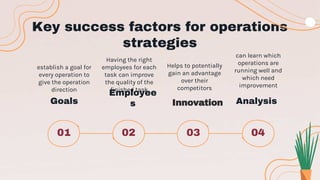
Key success factors for operations
strategies
establish a goal for
every operation to
give the operation
direction
Goals
Having the right
employees for each
task can improve
the quality of the
finished task
Helps to potentially
gain an advantage
over their
competitors
can learn which
operations are
running well and
which need
improvement
Employee
s Innovation Analysis
01 02 03 04
Types of
Operations
Strategies
Types of Operations Strategies
Core competency strategies: Core competency operations strategies
revolve around the main strengths of a company’s business model. By
identifying the best core business processes within an organization,
core competency operations strategies focus on leveraging existing
strengths to maximize profitability.
Corporate strategies: This type of operations strategy adheres to a
company’s mission statement and aligns itself to a larger corporate
strategy. Businesses using this type of operations strategy develop
production initiatives, key performance indicators (KPIs), and decision-
making processes based on an overall strategic plan determined by
company leaders and stakeholders.
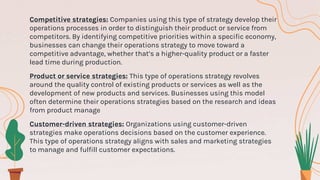
Competitive strategies: Companies using this type of strategy develop their
operations processes in order to distinguish their product or service from
competitors. By identifying competitive priorities within a specific economy,
businesses can change their operations strategy to move toward a
competitive advantage, whether that’s a higher-quality product or a faster
lead time during production.
Product or service strategies: This type of operations strategy revolves
around the quality control of existing products or services as well as the
development of new products and services. Businesses using this model
often determine their operations strategies based on the research and ideas
from product manage
Customer-driven strategies: Organizations using customer-driven
strategies make operations decisions based on the customer experience.
This type of operations strategy aligns with sales and marketing strategies
to manage and fulfill customer expectations.
Example of
Operations
Strategy
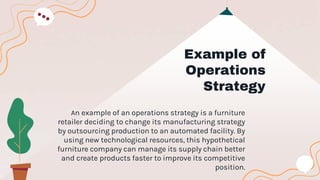
An example of an operations strategy is a furniture
retailer deciding to change its manufacturing strategy
by outsourcing production to an automated facility. By
using new technological resources, this hypothetical
furniture company can manage its supply chain better
and create products faster to improve its competitive
position.
Benefits of
operations strategy
Benefits of having an operations
strategy
● Employee efficiency
● Resource management
● Department cooperation
Thank
YOU

operations strategy.pptx

  • 1.
    By gouri hari|roll no 15| bba llb Operations strategy
  • 2.
    What Is anOperations Strategy? An operations strategy is a set of decisions an organization makes regarding the production and delivery of its goods. Organizations may consider each step they take toward manufacturing or delivering a product an operation, and all decisions regarding these various operations are the operations strategy. An organization's operations strategy works in tandem with its overall business strategy, helping the organization to achieve its long-term goals and improve competitiveness in the marketplace
  • 3.
    For example, acompany that produces and sells computers may have the following operations: Obtaining materials Working with suppliers Designing new computers Manufacturing computer designs Managing employees Delivering finished computers to sellers or consumers
  • 4.
  • 5.
    Elements of anoperations strategy Products and assembly Product operations managers look to streamline processes, such as team communication or product assembly. They also analyze data regarding their products and use it to prioritize tasks. For example, they may help product managers decide which elements of a product to build first. Product operations teams work with departments such as manufacturing, customer support and sales to help optimize the process consumers go through with the product, from researching to becoming repeat customers. Delivering and storing inventory An inventory operations strategy is one that helps businesses decide how to order, maintain and process their inventory. It looks for more efficient ways to deliver or store inventory, with the goal of reducing costs and waste. An inventory operations strategy also aims to order the optimal number of goods, maximizing storage capacity without wasting resources.
  • 6.
    Supply chain optimization Thesupply chain element of an operations strategy looks for ways to optimize the movement of products from suppliers to distributors. It may do this in several ways, for example, implementing faster communication technology or optimizing shipping amounts. In a supply chain operations strategy, leaders decide on the structure of the supply chain and the activities of each stage. They also decide where to make products and where to store them. Quality of the final product Quality operations aim to produce a satisfactory final product. This includes product testing and analyzing customer feedback. They also check for consistency so their customers all receive the same level of quality. In addition, quality operations managers analyze the operations that contribute to production. For example, they ensure the organization is using the best materials for a high-quality finished product. They constantly monitor the production process to ensure it is leading to their desired quality outcomes.
  • 7.
    Scheduling use ofresourcesScheduling is the timing and use of resources, and this means ensuring the organization is using its resources at the best possible time. This may include the best time to send out shipments of products or which activities employees should focus on first. A common challenge for those working in scheduling operations is finding a compromise between competing goals in terms of shared resources. For example, both the product development and customer satisfaction teams may want to conduct a focus group, but your organization only has the resources to host one at a time. Within your operations plan, you would determine the optimal scheduling for these two departments. Facilities management Facilities planning and management is the analysis of how the organization's current facilities factor into the organization's goals. This part of your operations strategy determines if your current facilities are performing as needed. In addition, it also discovers if your organization needs new facilities and if so, it conducts a search to find the right ones.
  • 8.
    Forecasting for planning Forecastingoperations is where an organization makes plans for the future. It uses data to make assumptions about the future of the organization. For example, it may study current sales trends to determine profits in a year. It then implements changes within the organization to ensure it is always moving toward its goals. For example, if a forecaster determines a drop in sales because of economic factors that may happen in six months, they may look for ways to reduce costs now to prepare them for this situation.
  • 9.
    Key success factorsfor operations strategies establish a goal for every operation to give the operation direction Goals Having the right employees for each task can improve the quality of the finished task Helps to potentially gain an advantage over their competitors can learn which operations are running well and which need improvement Employee s Innovation Analysis 01 02 03 04
  • 10.
  • 11.
    Types of OperationsStrategies Core competency strategies: Core competency operations strategies revolve around the main strengths of a company’s business model. By identifying the best core business processes within an organization, core competency operations strategies focus on leveraging existing strengths to maximize profitability. Corporate strategies: This type of operations strategy adheres to a company’s mission statement and aligns itself to a larger corporate strategy. Businesses using this type of operations strategy develop production initiatives, key performance indicators (KPIs), and decision- making processes based on an overall strategic plan determined by company leaders and stakeholders.
  • 12.
    Competitive strategies: Companiesusing this type of strategy develop their operations processes in order to distinguish their product or service from competitors. By identifying competitive priorities within a specific economy, businesses can change their operations strategy to move toward a competitive advantage, whether that’s a higher-quality product or a faster lead time during production. Product or service strategies: This type of operations strategy revolves around the quality control of existing products or services as well as the development of new products and services. Businesses using this model often determine their operations strategies based on the research and ideas from product manage Customer-driven strategies: Organizations using customer-driven strategies make operations decisions based on the customer experience. This type of operations strategy aligns with sales and marketing strategies to manage and fulfill customer expectations.
  • 13.
    Example of Operations Strategy An exampleof an operations strategy is a furniture retailer deciding to change its manufacturing strategy by outsourcing production to an automated facility. By using new technological resources, this hypothetical furniture company can manage its supply chain better and create products faster to improve its competitive position.
  • 14.
  • 15.
    Benefits of havingan operations strategy ● Employee efficiency ● Resource management ● Department cooperation
  • 16.